Article

Characteristics and Provenance of Tremolite Jade Artifacts from the Fangjiagang Cemetery of the Eastern Zhou Dynasty, Hubei, China


1
Hubei Provincial Institute of Cultural Relics and Archaeology, Wuhan 430077, China
2
Gemmological Institute, China University of Geosciences (Wuhan), Wuhan 430074, China
3
School of Gemmology and Materials Science, Hebei GEO University, Shijiazhuang 052161, China
4
Hebei Key Laboratory of Green Development of Rock and Mineral Materials, Hebei GEO University, Shijiazhuang 052161, China
5
Engineering Research Center for Silicate Solid Waste Resource Utilization of Hebei Province, Hebei GEO University, Shijiazhuang 052161, China
6
Yicheng Museum, Xiangyang 441400, China
*
Author to whom correspondence should be addressed.
Minerals 2025, 15(12), 1273; https://doi.org/10.3390/min15121273
Submission received: 28 October 2025 / Revised: 21 November 2025 / Accepted: 25 November 2025 / Published: 30 November 2025

Abstract

Hubei Province is a significant center for cultural and trade exchange in Central China. However, since no nephrite deposit has been discovered in Hubei, nephrite artifacts excavated within its jurisdiction must have been obtained from other regions. Tracing their provenance can contribute to our understanding of the trade exchange between ancient Hubei and other regions. In this study, the appearance, spectroscopy, and chemical compositions of nephrite artifacts excavated from the Fangjiagang Cemetery of the Eastern Zhou Dynasty, Hubei Province, were systematically studied, and their provenance was discussed. The characteristics of a weathered layer of raw nephrite material retained in one of the jade artifacts (M22:5) indicate it should be made from the placer nephrite of Hetian, Xinjiang. Infrared and Raman spectroscopy confirms that both the whitened and unwhitened areas in the samples are composed of tremolite, indicating that the whitening mechanism should be attributed to the etched structures caused by weathering rather than a change in the major mineral composition caused by high temperature. When no obvious appearance-based characteristics remain, chemical compositions become a crucial tool for discussing the provenance of jade artifacts. The chondrite-normalized rare earth element patterns for the samples suggest that their formation is associated with granite intrusion, implying that the placer nephrite of Hetian, Xinjiang; Xiuyan nephrite, Liaoning; Golmud nephrite, Qinghai; Xiaomeiling nephrite, Jiangsu; Vitim nephrite, Russia; and Chuncheon nephrite, South Korea, are potential sources. However, the trace element spider diagrams for the samples show a better match with those of the placer nephrite of Hetian. The placer nephrite of Hetian was used in Fangjiagang Cemetery, indicating that the trade exchange between the Eastern Zhou dynasty and the Hetian area had already been established.

1. Introduction

Archaeological excavation reveals that China has a history of using nephrite for over 9000 years without interruption, making nephrite the most important material for studying Chinese culture. Jade artifacts made of nephrite are the most significant objects in ancient Chinese tombs, with almost all important ancient sites yielding nephrite artifacts, such as the Xiaonanshan site [1], Niuheliang site, Yuhang site group [2], Taosi site [3], Sanxingdui site [4,5], Shijiahe site [6], Erlitou site [7], etc. Initially, nephrite artifacts were small in size and primarily served as ornaments, such as the jade jue, huang, and pendant excavated from the Xiaonanshan site [1]. With the development of society, nephrite artifacts evolved into important objects that combined decorative, religious, political, military, aesthetic, and wealth functions, all of which relied on the natural properties of nephrite, such as color, luster, toughness, and slight transparency, to manifest. Thus, nephrite artifacts had dual attributes, natural and social attributes [8].
Currently, tracing the provenance of ancient Chinese nephrite artifacts is an important topic that can be used to constrain the resource development and utilization, productivity, trade routes, and spheres of influence of ancient society, but the accuracy of tracing relies on the in-depth analysis of the geological information carried by jade artifacts. Several scholars have discussed the provenance of nephrite artifacts unearthed from the Neolithic period to Han Dynasty from perspectives of appearance characteristics [9], spectral characteristics [10], major elements [8,11], and trace elements [2,12].
Hubei Province, as a key north-to-south transportation hub, serves as a melting pot of materials and cultures from various regions, while it also radiates an immense influence outward. Turquoise is the most famous gem material produced in Hubei Province [13], making it an important potential source of turquoise artifacts excavated from a lot of archaeological sites. However, no report has confirmed the existence of high-quality nephrite deposits in Hubei. Therefore, nephrite artifacts excavated from Hubei were likely transported from other regions. By tracing the provenance of nephrite artifacts excavated from Hubei, trade routes and cultural exchanges between the middle reaches of the Yangtze River and other regions at different historical periods can be explored.
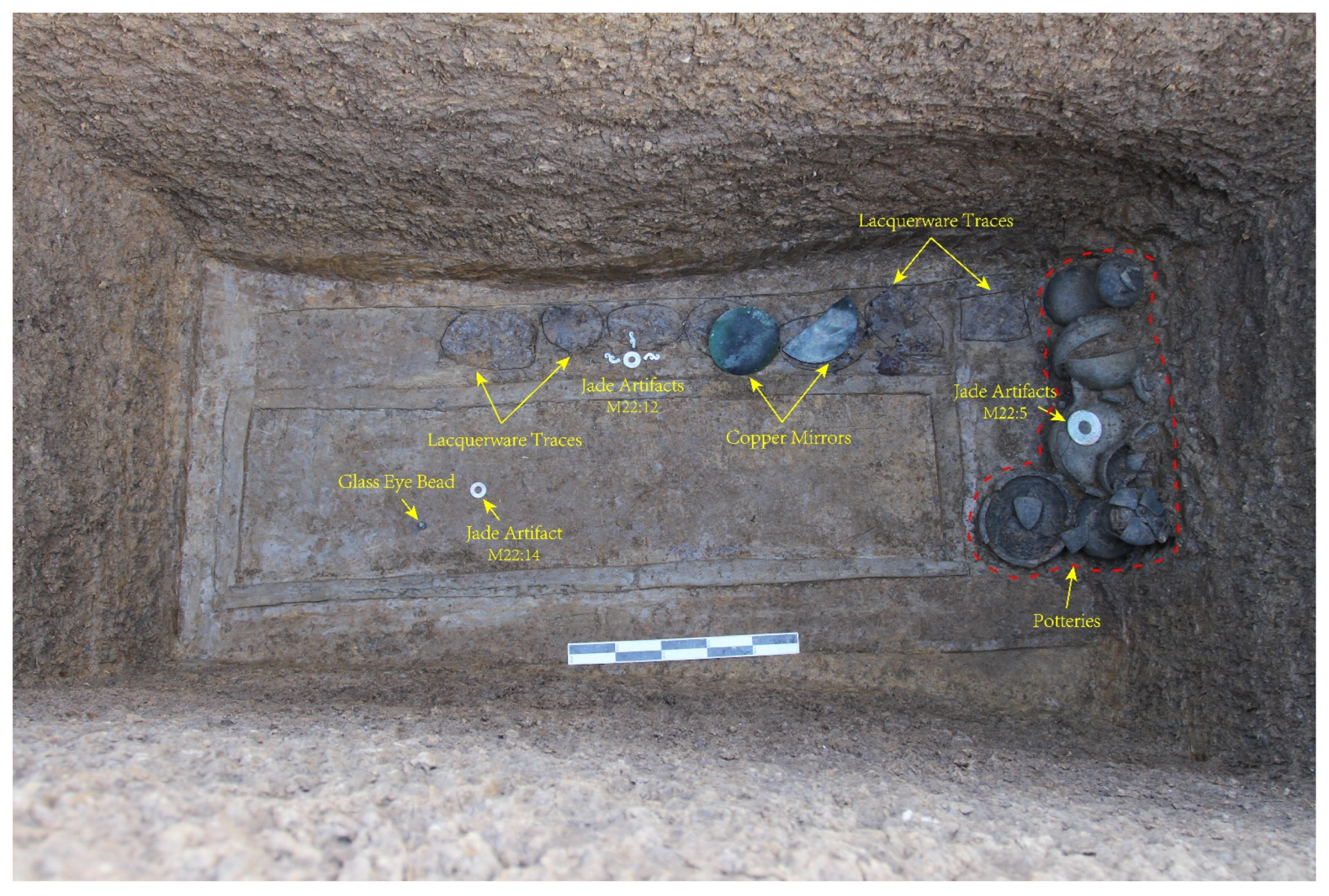
In this study, six nephrite artifacts of the Eastern Zhou Dynasty excavated from the Fangjiagang Cemetery in Yicheng, Hubei Province, were used for research (Figure 1). Based on analysis of their appearances, spectroscopic characteristics, mineral compositions, and chemical compositions, we discuss the provenance of these jade artifacts.

2. Methods

Microscopic features including the color distribution, surface texture, and inclusion were observed and captured using a Leica M205A super-depth-of-field stereomicroscope (Wetzlar, Germany) and a Zeiss SteREO Discovery. V20 polarization microscope (Oberkochen, Germany) in plane-polarized light.
Infrared spectra were obtained with a Bruker Vertex 80 Fourier-transform infrared spectrometer (Karlsruhe, Germany). Mid-infrared spectra in the range of 400 to 4000 cm−1 were recorded in reflectance mode at a resolution of 4 cm−l, a scanning frequency of 10 kHz, and 32 scans and then processed by the K-K transformation to calibrate the spectral band differences caused by anomalous dispersion and obtain the absorption spectra.
Raman spectra of the major and minor minerals in samples were collected using a JASCO NRS-7500 micro confocal Raman spectrometer (Tokyo, Japan). Before testing, the spectrometer was calibrated to the Raman peak of Si wafer at 520.4 cm−1. Test conditions were as follows: laser 532 nm, power attenuation sheet 100%, grating 600 grooves/mm, acquisition time 20 s, and accumulation times 3 times. Depolarized spectra in the 100 to 4000 cm−1 range were acquired.
Major chemical compositions were obtained via a Thermo Scientific ARL QUANT’X energy-dispersive X-ray fluorescence spectrometer (Tokyo, Japan). Test conditions were as follows: vacuum mode, tube with Rh target, maximum power 50 W, voltage range 4–50 kV, anode current 0.02–1.98 mA, the collimator diameter 3.5 mm. The elemental analysis ranges from Na to U, and the FWHM energy resolution is 160 eV. Quantitative calibration was performed using the working curve established by the ancient jade research team of the gemological institute, China University of Geosciences (Wuhan).
Trace element analyses were conducted using a laser ablation inductively coupled plasma-mass spectrometer. Tests were carried out on an Agilent 7900 Quadrupole ICP-MS (Santa Clara, CA, USA) coupled with a Photon Machines Analyte HE 193 nm ArF excimer laser ablation system (Bozeman, MT, USA). Testing conditions were as follows: the laser energy 80 mJ, the frequency 5 Hz, the 300 laser ablation pulses, and a laser beam spot diameter of 44 µm. The NIST 610, BHVO-2G, BIR-1G, BCR-2G, and GSE-1G were used as standard samples for calibrating trace elements. Detailed operating conditions and process were the same as described by Liu et al. (2008) [14]. Samples M22:5 and M22:14 were too large in size to be placed in the sample compartment, so their trace elements were not tested.

3. Samples

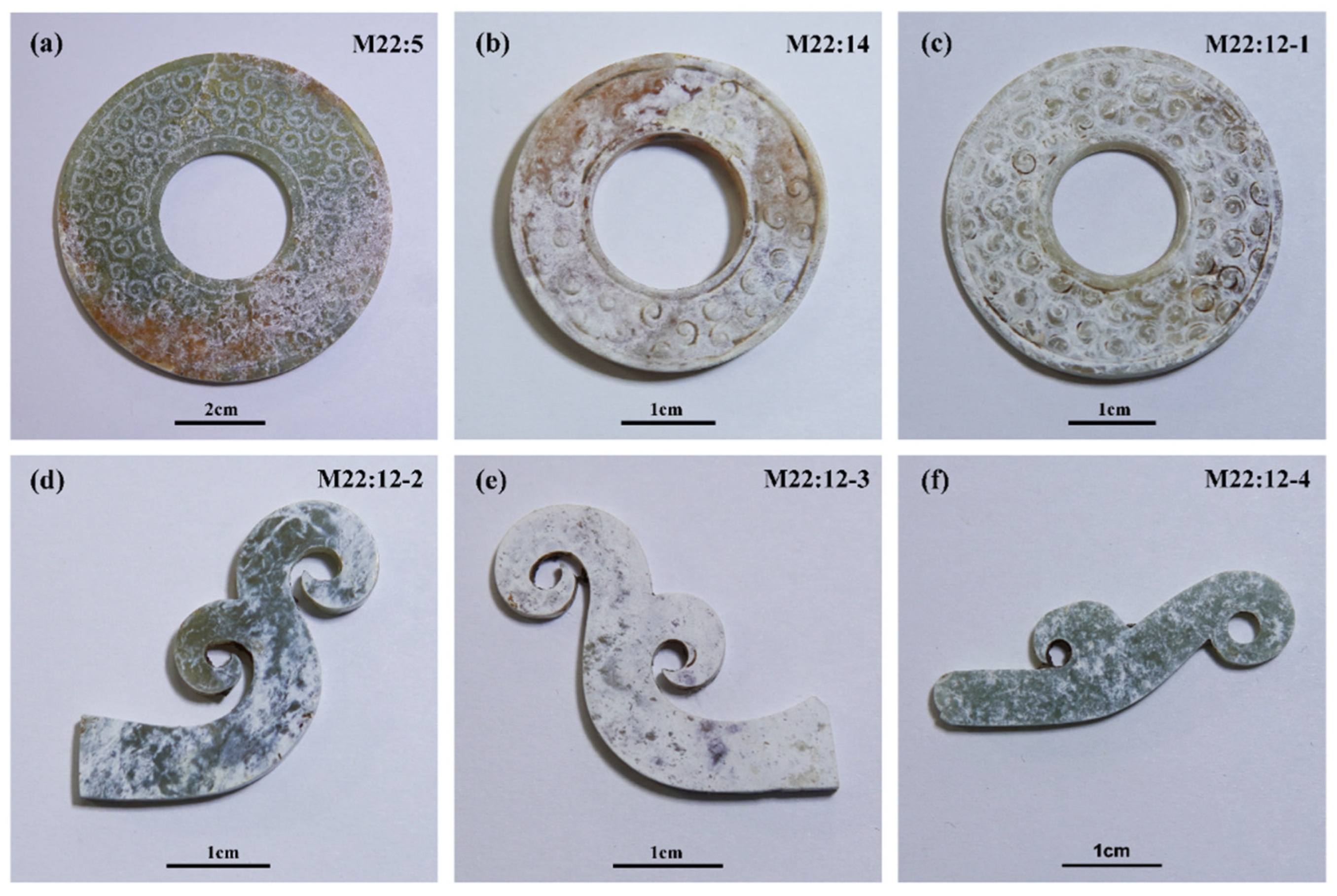
Six nephrite artifact samples including three Bi (discs) and three Pei (pendant) excavated from tomb No.22 of Fangjiagang Cemetery (Figure 1 and Figure 2) were provided by the Hubei Provincial Institute of Cultural Relics and Archaeology. Three jade Bi are decorated with grain patterns resembling bean sprouts (Figure 2a–c). Three jade Pei decorated with no pattern are supposed to be (or be revised from) the tail parts of jade dragon pendants (Figure 2d–f). These semi-translucent samples display a waxy to earthy luster, and their relative densities range from 2.92 to 2.97 (Table 1). Due to long-term burial, all samples show different degrees of the whitening phenomenon (Figure 2), which is very common in unearthed ancient jade artifacts.
Sample M22:5 contains some orange-red areas (Figure 2a). The secondary color formed after the burial of a jade artifact often accumulates along the cracks, but the cracks in the upper part of M22:5 and the crafting marks on these orange-red areas show whitening without an enrichment in the orange-red color (Figure 2a), indicating that the formation of whitening occurred later than that of the orange-red process; therefore, this orange-red color should have been the color of the jade material itself before sample M22:5 was buried. The orange-red color should be a secondary color formed during the process of placer nephrite formation, rather than a primary color. Considering its distribution and morphology, the orange-red color is highly consistent with the secondary color of the surface layer in placer nephrite of Hetian, Xinjiang, while being different from that of placer nephrite from Xiuyan, Liaoning and Vitim, Russia.

4. Result and Discussion

4.1. Microscopic Characteristics

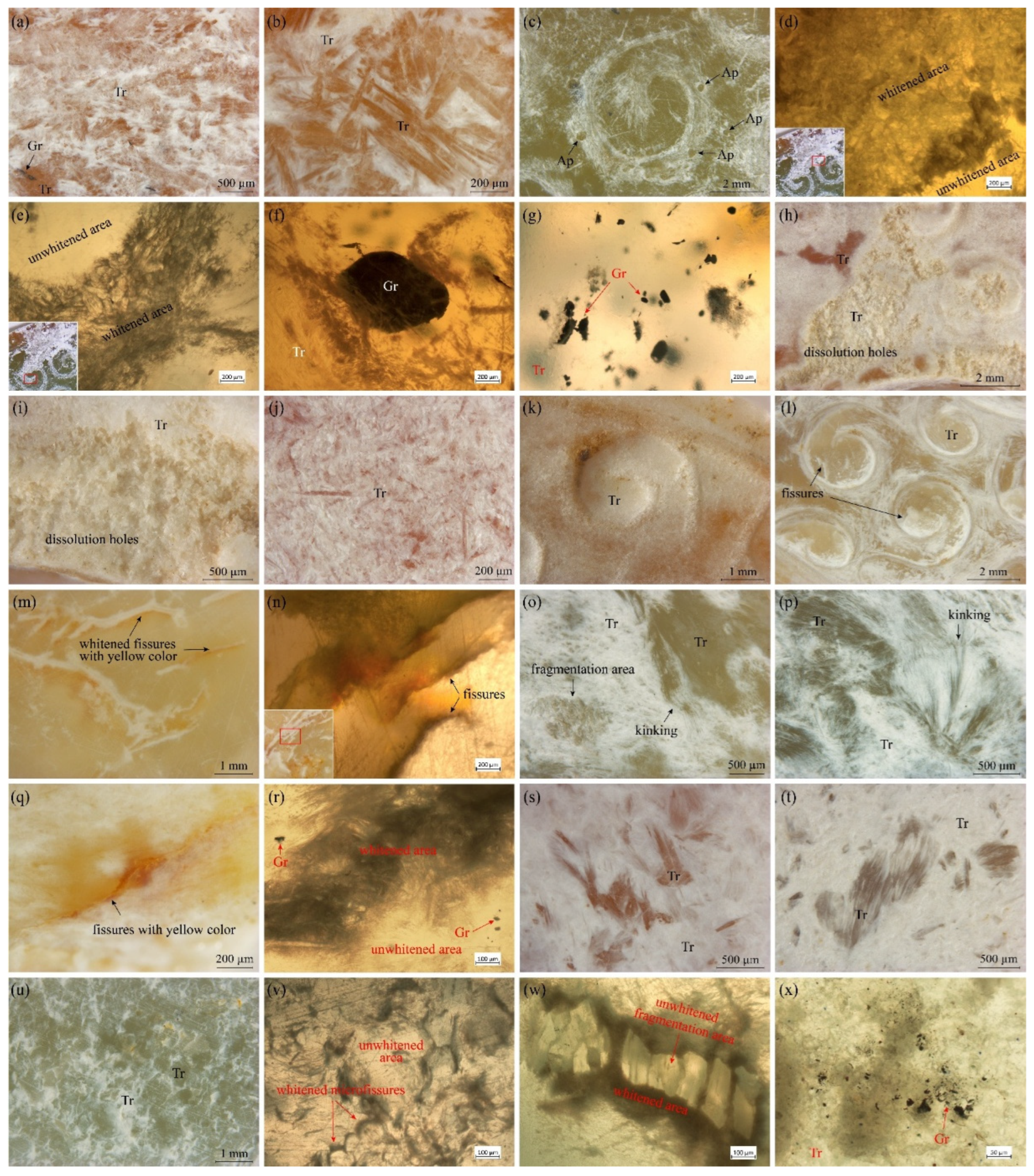
Figure 3 illustrates minor minerals and the effects of burial on the color and texture of the ancient jade artifact samples. The whitening degree of samples can be categorized into two levels, the significant one (M22:14 and M22:12-3) and the slight one (M22:5, M22:12-1, M22:12-2, and M22:12-4). The whitened area of sample M22:14 has many etched pits (Figure 3h,i), which results in its loose structure. Within the whitened areas, the unwhitened tremolite fibers of varying lengths can be frequently observed (Figure 3b,j,s,t). The micro-fissures produced by geologic stress or jade artifact processing are preferential sites for whitening occurrence. The whitening phenomenon tends to initiate from open fissures (Figure 3l–n) or craft marks on the surface of jade artifacts; thus, significant whitening of decorative patterns can be observed on three jade Bi samples (Figure 3c,k,l). The kinking tremolite in sample M22:12-2 indicates that it has experienced plastic deformation under tectonic stresses (Figure 3o). In sample M22:12-4, the whitening is mainly distributed along reticular micro-fissures and the boundaries between mineral grains (Figure 3u and v), which also serve as preferential sites for the accumulation of secondary color (Figure 3m,n,q). Microscopic observations under the transmitted light reveal that tremolite aggregates in whitened areas are more fragmented than those in unwhitened ones (Figure 3d,e,r,w). Moreover, no secondary minerals are observed at these fragmentation sites. In fragmented areas, the whitening tends to expand further along fissures (Figure 3w).
It is reasonable to infer that these jade artifact samples have gone through corrosions of structure and increases in porosity during burial. These voids typically manifest etched structures [15,16,17], which change the reflection and refraction of light and are responsible for the whitening of jade artifacts [8].
A lot of opaque black minerals with a metallic luster are observed in sample M22:5. Microscopically, they appear as euhedral, subhedral, anhedral flakes (Figure 3f,g,r), as well as dotted aggregates (Figure 3x), with diameters ranging from 0.02 to 1 mm. Another kind of minor mineral with a transparent and granular appearance is also found in samples M22:5 (Figure 3c) and M22:12-2.

4.2. Infrared and Raman Spectroscopy

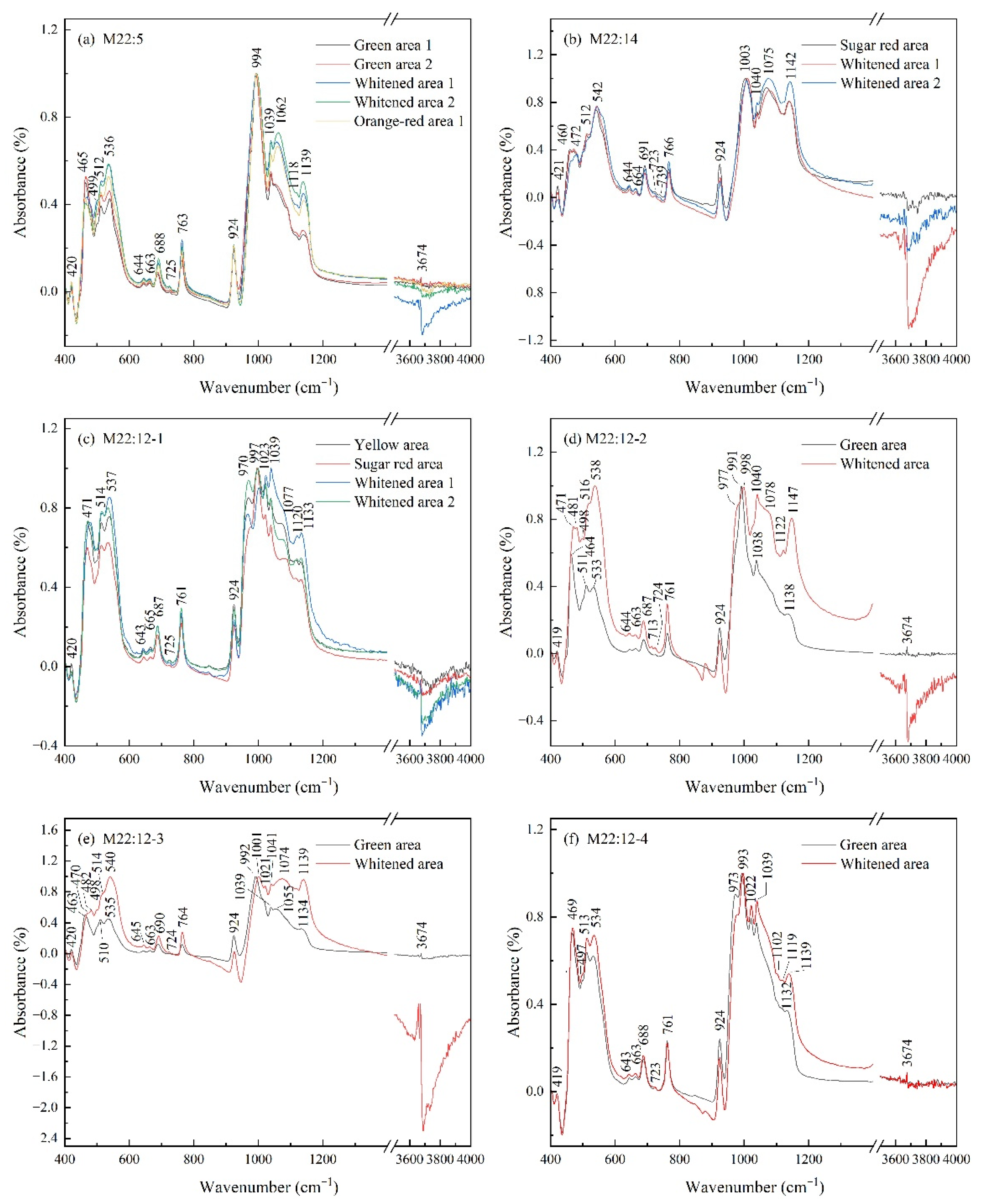
Infrared and Raman spectroscopy methods are important non-destructive methods for studying the vibration modes of minerals in ancient jade artifacts [2,10,12,18]. Mid-infrared spectra of jade artifact samples are characterized by three sets of bands (400–600, 600–800, and 800–1200 cm−1) in the 400 to 1200 cm−1 range and one band in the 3600 to 3700 cm−1 range (Figure 4 and Table 2), corresponding to vibrations of bands within [Si4O11] and (M1M2M3)-OH in tremolite (M is an abbreviation for a metal ion) [9], respectively. The asymmetric stretching vibrations of Si-O-Si and the asymmetric and symmetric stretching vibrations of O-Si-O appear mainly at approximately 924, 994, 1039, 1062, 1118, and 1139 cm−1 [19]. The symmetric stretching vibrations of Si-O-Si appear mainly at 644, 663, 688, 725, and 763 cm−1. The bands at 420, 465, 499, 512, and 536 cm−1 are related to the bending vibrations of Si-O, stretching vibrations of M-O, and translational vibrations of O-H, respectively. The peak at 3674 cm−1 is related to the asymmetric stretching vibrations of (MgMgMg)-OH (A band) [20]. No significant differences are observed between the whitened and unwhitened areas, and no absorption bands related to minor minerals are recognized.
Figure 3. Microscopic characteristics of jade artifact samples from the Fangjiagang Cemetery, Hubei province, China. (ag) M22:5; (hk) M22:14; (ln) M22:12-1; (or) M22:12-2; (s,t) M22:12-3; (ux) M22:12-4. The red boxes in the inset of subfigures (d), (e) and (n) indicate the observed areas in samples M22:5 and M22:12-1, respectively (Tr—tremolite; Gr—graphite; Ap—apatite).
Minerals 15 01273 g003
Figure 4. Infrared spectra of jade artifact samples from the Fangjiagang Cemetery, Hubei province, China. (a) M22:5; (b) M22:14; (c) M22:12-1; (d) M22:12-2; (e) M22:12-3; (f) M22:12-4.
Minerals 15 01273 g004
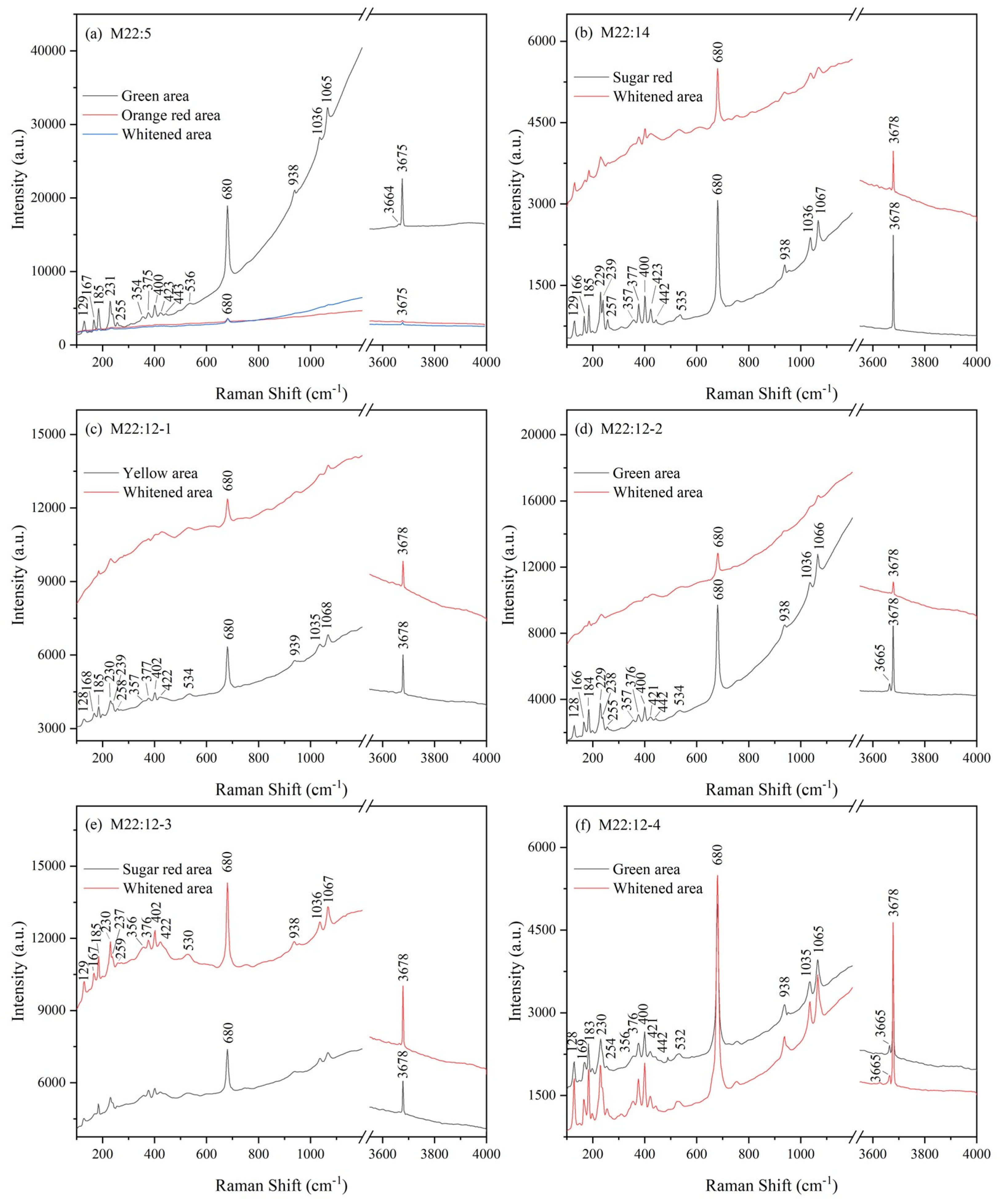
Raman spectra indicate that the jade artifact samples are mainly composed of tremolite (Figure 5 and Table 3), which is consistent with the results of the mid-infrared spectra. The spectra are primarily characterized by peaks in the ranges of 100–1200 and 3600–3700 cm−1, which are vibrations of bands within [Si4O11] and (M1M2M3)-OH in tremolite.
Overall, there are no significant differences in Raman spectra between the whitened and unwhitened areas, with only the peak intensities of the former ones in most samples being relatively lower (M22:5, M22:14, M22:12-1, and M22:12-2) (Figure 5). The strong peak at 680 cm−1 is related to the stretching vibration of Si-O-Si, and the weak peaks at 938, 1036, and 1066 cm−1 are related to the stretching vibrations of Si-O. The bending vibrations of Si-O appear mainly at approximately 442 and 534 cm−1. Peaks at around 128, 166, 184, 229, 238, 255, 357, 376, 400, and 421 cm−1 are assigned to the lattice vibration modes. In addition, all samples shows a sharp peak related to (MgMgMg)-OH stretching at 3675–3678 cm−1 (A band), while the green samples (M22:5, M22:12-2, and M22:12-4) further show a weak split peak related to (MgMgFe2+)-OH at 3664–3665 cm−1 (B band) [10,21,22,23].
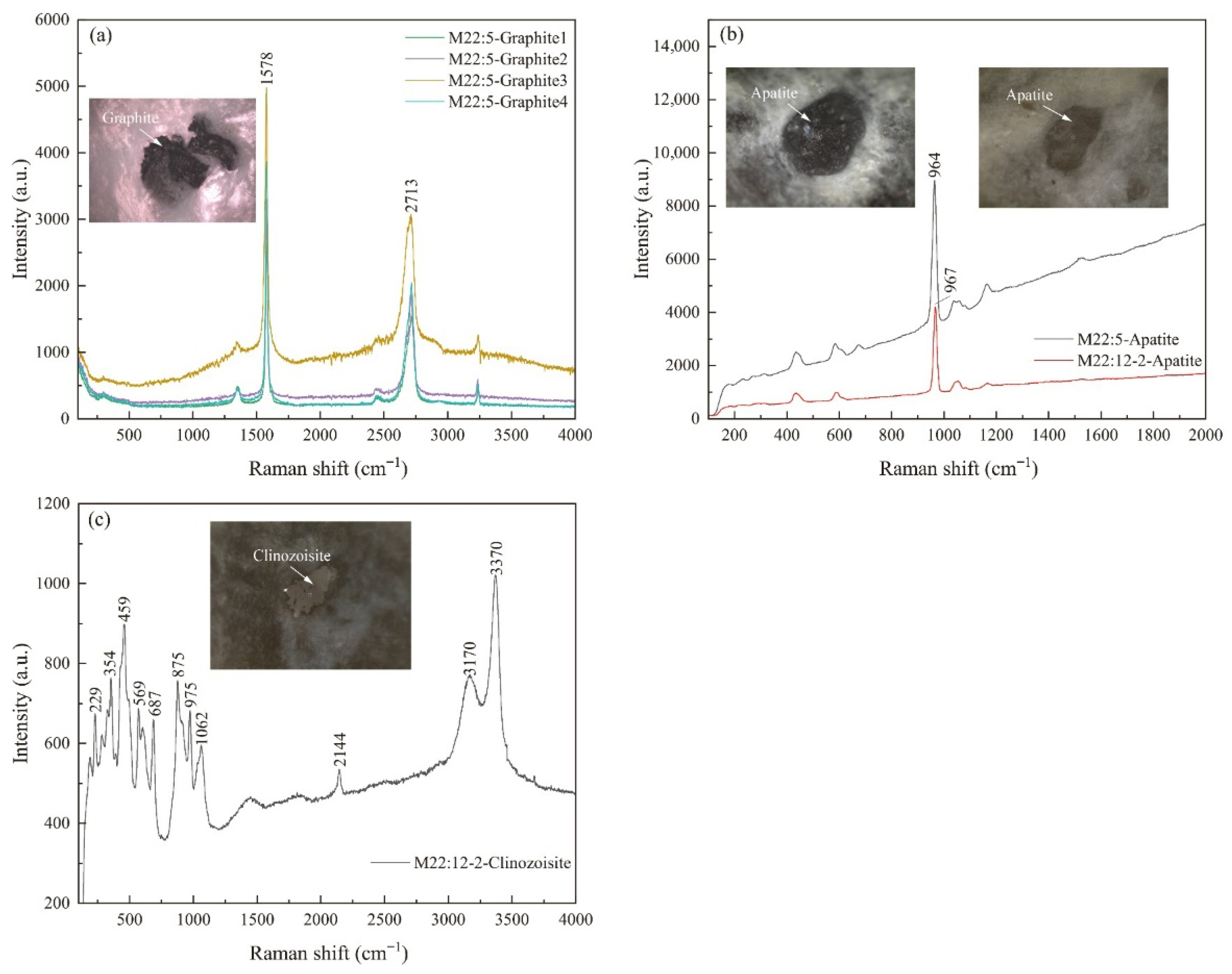
Figure 6a indicates that the black minor mineral in samples M22:5, M22:12-2, M22:12-3, and M22:12-4 is graphite. Raman peaks at 1578 cm−1 (G peak), 1352 cm−1 (D1 peak), and 1619 cm−1 (D2 peak) are caused by the C-C stretching vibrations and structural disorder, respectively. The sharp peak at 1577 cm−1 and its small full width at half maximum (FWHM) indicate a high degree of graphite crystallization [24]. In the second-order region (1650~3300 cm−1), characteristic peaks are mainly located at 2715 cm−1 (D1 overtone peak), 3240 cm−1 (G overtone peak), 2943 cm−1 (D, G combination frequency), and 2448 cm−1 [25,26]. Currently, well-known sources of graphite-bearing nephrite mainly include Hetian, Xinjiang [27]; Golmud, Qinghai; Xiuyan, Liaoning [28]; and Vitim, Russia [29]. Therefore, the potential provenances of tremolite jade artifacts from the Fangjiagang Cemetery are greatly narrowed down. The transparent granular minor minerals in samples M22:5 and M22:12-2 are apatite (Figure 3c and Figure 6b), and sample M22:12-2 contains some clinozoisite additionally (Figure 6c).

4.3. Major Chemical Compositions

The XRF results demonstrate that there are no significant differences in the major chemical compositions of different samples, with a SiO2 content of 56.67–59.37 wt.%, a MgO content of 19.47–25.57 wt.%, and a CaO content of 13.73–21.14 wt.% (Table 4). Only the contents of MgO (19.47 wt.%) and SiO2 (56.67 wt.%) in the whitened area of sample M22:14 are relatively lower, and the CaO content (21.14 wt.%) is relatively higher. However, the infrared spectra (Figure 4b) and Raman spectra (Figure 5b) show that the mineral phase of the whitened area is still tremolite. Compared to the unwhitened area, the whitened one of sample M22:14 exhibits the loss of Si and Mg and the enrichment of Ca, which may be consequences of the input and output of elements caused by weathering during the burial [8]. Element transfer is rather common in buried jade artifacts, and the nephrite artifact buried together with bronzeware in the Sanxingdui site can even form malachite mineral on its surface [5]. The TFeO contents of samples M22:12-2 and M22:12-4 are more than 1 wt.%, resulting in their green colors (Figure 2). These iron contents are also sufficient to cause a small split peak at 3664–3665 cm−1 related to the stretching vibrations of (MgMgFe2+)OH in Raman spectra (Figure 5a,d,f).

4.4. Trace Element Compositions

Grapes and Yun (2010) suggested that, from the unweathered to the weathered layer of New Zealand placer nephrite (serpentinite-related-type nephrite), the contents of Ni, V, and Sc were scarcely changed, while Cr and Zn tended to slightly increase [30]. The low contents of Ni, Cr, and Mn suggest that jade artifact samples from the Fangjiagang Cemetery are typical carbonate rock-related-type nephrite (C-type), rather than S-type nephrite (Table 5). Up to now, the weathering behavior of elements in C-type nephrite is relatively fuzzy, and it is difficult to effectively analyze the original state of jade before weathering through the weathering behavior of elements. Only the general weathering behavior of trace elements can be understood from other geological studies. Mobile elements, such as Sr, Ba, and Rb, can be quickly leached from weathered layers of rocks [31,32,33], which involves the dissolution–reprecipitation mechanism on reaction interfaces of minerals [34,35,36], while Al, Zr, Ti, Hf, Th, Nb, Sc, Cr, and REEs are relatively immobile and tend to be concentrated in residual phases and/or adsorbed by secondary minerals [8,31].
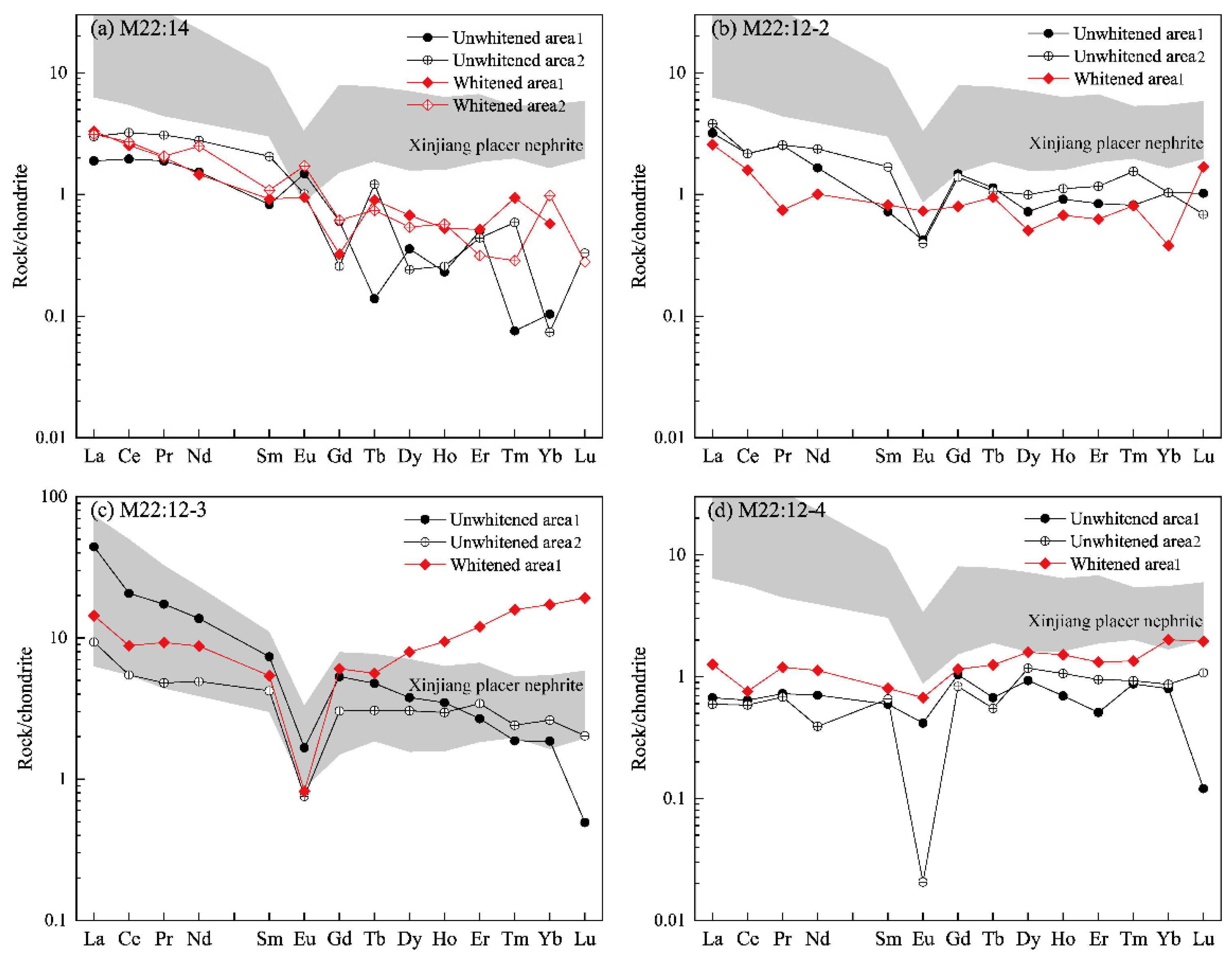
Due to relatively strong weathering resistance, the residual REEs in jade artifacts can still retain the provenance information. The total contents of rare earth elements (∑REE) in samples range from 1.75 to 35.71, and the ∑REE of most samples is less than 5 (Table 5). The LREE/HREE ratio is relatively high, indicating a significant differentiation between light and heavy rare earth elements. Although these values differ from the values before weathering, the difference should not be significant. Except for sample M22:14, the REE patterns for the other three samples show the type of “gull” (Figure 7), with significant negative δEu anomalies, indicating that their formation is related to granite intrusion [37,38]. Compared to other REEs, Eu is easily liberated and concentrated in the residual soils [31], which is likely responsible for the negative anomalies of δEu in the whitened areas of samples being not as significant as those in the unwhitened areas.
As two newly found important nephrite mines in southwest China within 20 years, Luodian nephrite [39] and Dahua nephrite [40] show significant negative δCe anomalies and slight negative δEu anomalies, which don’t match the results of our samples. Xiuyan placer nephrite can be excluded because of its positive δEu anomalies [41] and apple-green color. Although Xiuyan primary nephrite also shows a “gull” REE pattern, the curve from Sm to Eu is gentle [42]. In addition, nephrite from Chuncheon, South Korea, lacks a “gull” REE pattern [43,44]. Therefore, taking into consideration the REE patterns for nephrite from different regions, the provenance of jade artifact samples from the Fangjiagang Cemetery is narrowed to Hetian, Xinjiang; Golmud, Qinghai; Vitim area, Russia; and Maxianshan, Gansu. However, Maxianshan nephrite lacks graphite in minor minerals and is usually yellow green in color, so it can also be excluded.
Figure 7. Chondrite-normalized REE patterns for jade artifact samples from the Fangjiagang Cemetery, Hubei province, China. (a) M22:14; (b) M22:12-2; (c) M22:12-3; (d) M22:12-4. Normalizing values were after Sun and McDonough (1989) [45].
Minerals 15 01273 g007
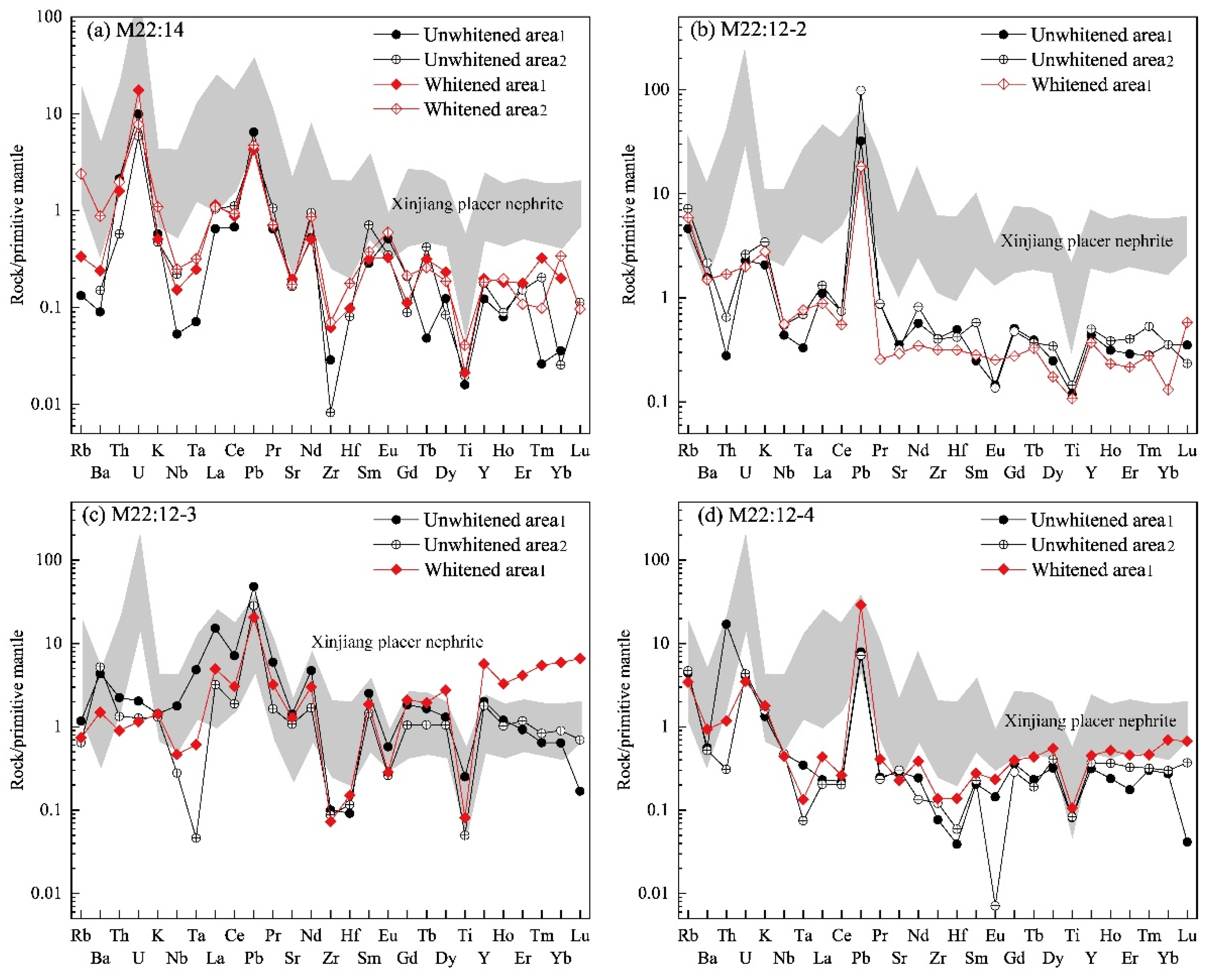
The trace element data for jade artifact samples from the Fangjiagang Cemetery are presented in Table 6. The trace element patterns for whitened areas are essentially consistent with those of unwhitened areas (Figure 8), indicating that weathering has an unobvious impact on most trace elements of samples. Four tested samples exhibit significant enrichment in Pb and Nd and a depletion in Ta, Sr, Zr, Hf, Eu, Ti (Figure 8). The whole trace element patterns for samples match those of placer nephrite from Hetian, Xinjiang. Nephrite from Golmud, Qinghai, generally displays a slight depletion or enrichment in Zr and Hf [46], whereas nephrite from Vitim, Russia, lacks the Ta depletion and commonly shows an Sr enrichment [47], suggesting that these two deposits are not the provenance of our jade artifact samples.
Most placer nephrite raw materials from Hetian, Xinjiang, are from the riverbed of Yurungkash and Karakash River [48], which were very convenient for ancients to mine, carry and transport. They commonly exhibit a variety of primary colors (such as white, green-white, green, black, etc.) and secondary colors (such as yellow, red, brown, and black distributing in the weathered layer). The placer nephrite output of these two rivers is enormous, which could meet the market demand during the eastern Zhou Dynasty. More importantly, these two rivers are rich in graphite-bearing placer nephrite, especially the Karakash River, which is also known as the Moyu River, and up to now, it is still a major supplier of graphite-bearing placer nephrite to the eastern Chinese jade market. Therefore, Hetian area, Xinjiang, is the likely reasonable provenance of nephrite artifacts excavated from the Fangjiagang Cemetery.

5. Conclusions

Weathering during the burial process can cause changes in the chemical compositions of nephrite artifacts, reducing the precision of tracing their provenance. Therefore, for jade artifacts with a low alteration in burial, appearance characteristics, mainly the color of the weathered layer and the rock texture composed of tremolite aggregates, are also an important basis for raw material origin determination.
The weathered layer of the raw material retained in sample M22:5 indicates that it should be made from placer nephrite from Hetian, Xinjiang. For jade artifacts lacking the typical appearance characteristics, the minor minerals, rare earth elements, and trace elements can serve as important evidence for tracing their provenance. Both the REE patterns and the trace element patterns for samples indicate that the raw material of the other four jade artifacts (samples M22:14, M22:12-2, M22:12-3, M22:12-4) are also likely the placer nephrite of Hetian, Xinjiang.
Although tomb No.22 of Fangjiagang Cemetery is a small tomb, jade artifacts in the funerary objects were crafted from the placer nephrite of Hetian, indicating that the placer nephrite of Hetian had become a common commodity in the market, reflecting the frequent trade exchange between the eastern Zhou Dynasty and Hetian area, Xinjiang.

Author Contributions

Experiments, Q.Z., X.X. and X.Z.; formal analysis, Q.Z., P.L. and J.S.; writing—original draft, Q.Z., P.L. and Q.X.; writing—review and editing, Q.Z. and Y.L. All authors have read and agreed to the published version of the manuscript.

Funding

This research was funded by the Hebei Provincial Department of Education (Grant No. QN2025289).

Data Availability Statement

The data presented in this study are available in the article.

Acknowledgments

The authors thank Qinghui Li (Shanghai Institute of Optics and Fine Mechanics, Chinese Academy of Sciences) for help in obtaining Raman data.

Conflicts of Interest

The authors declare no conflicts of interest.

References

  1. Yue, J.-P.; Li, Y.-Q.; Yan, X.-J.; Du, X.-Y.; Yang, S.-X. Late Glacial lithic industry of the Xiaonanshan site: Implications for the Neolithisation in the Amur River basin. Antiquity 2024, 98, e1. [Google Scholar] [CrossRef]
  2. Gan, F.X.; Cao, J.Y.; Cheng, H.S.; Gu, D.H.; Rui, G.Y.; Fang, X.M.; Dong, J.Q.; Zhao, H.X. The non-destructive analysis of ancient jade artifacts unearthed from the Liangzhu sites at Yuhang, Zhejiang. Sci. China Technol. Sci. 2010, 53, 3404–3419. [Google Scholar] [CrossRef]
  3. He, N. Taosi: An archaeological example of urbanization as a political center in prehistoric China. Archaeol. Res. Asia 2018, 14, 20–32. [Google Scholar] [CrossRef]
  4. Barnes, G.L. Understanding Chinese jade in a world context. J. Br. Acad. 2018, 6, 1–63. [Google Scholar] [CrossRef]
  5. Bao, Y.; Yun, X.M.; Zhao, C.H.; Wang, F.; Li, Y.S. Nondestructive analysis of alterations of Chinese jade artifacts from Jinsha, Sichuan Province, China. Sci. Rep. 2020, 10, 18476. [Google Scholar] [CrossRef]
  6. Li, B.L.; Zhu, C.; Wu, L.; Li, F.; Sun, W.; Wang, X.; Liu, H.; Meng, H.; Wu, D. Relationship between environmental change and human activities in the period of the Shijiahe culture, Tanjialing site, Jianghan Plain, China. Quat. Int. 2013, 308–309, 45–52. [Google Scholar] [CrossRef]
  7. Childs-Johnson, E. Symbolic jades of the Erlitou period: A Xia royal tradition. Arch. Asian Art 1995, 48, 64–92. [Google Scholar]
  8. Li, P.; Liao, Z.; Zhou, Z. The residual geological information in Liangzhu jades: Implications for their provenance. Proc. Geol. Assoc. 2022, 133, 256–268. [Google Scholar] [CrossRef]
  9. Wen, G.; Jing, Z.C. Chinese neolithic jade: A preliminary geoarchaeological study. Geoarchaeology 1992, 7, 251–275. [Google Scholar] [CrossRef]
  10. Li, P.; Liao, Z.; Zhou, Z.; Wu, Q. Evidences from infrared and Raman spectra: Xiaomeiling is one reasonable provenance of nephrite materials used in Liangzhu Culture. Spectrochim. Acta Part A Mol. Biomol. Spectrosc. 2021, 261, 120012. [Google Scholar] [CrossRef]
  11. Hung, H.-C.; Iizuka, Y.; Bellwood, P.; Nguyen, K.D.; Bellina, B.; Silapanth, P.; Dizonh, E.; Santiago, R.; Datan, I.; Manton, J.H. Ancient jades map 3,000 years of prehistoric exchange in Southeast Asia. Proc. Natl. Acad. Sci. USA 2007, 104, 19745–19750. [Google Scholar] [CrossRef]
  12. Liu, J.; Su, Y.; Cao, Y.; Yu, X.; Yang, M. Mineral origin of tremolite jade artifacts from the Guojiamiao Cemetery, Eastern Zhou Dynasty, Hubei, China: Based on petrology, spectroscopy, and geochemistry. npj Herit. Sci. 2025, 13, 52. [Google Scholar] [CrossRef]
  13. Liu, L.; Yang, M.; Li, Y. Unique raindrop pattern of turquoise from Hubei, China. Gems Gemol. 2020, 56, 380–400. [Google Scholar] [CrossRef]
  14. Liu, Y.S.; Hu, Z.C.; Gao, S.; Günther, D.; Xu, J.; Gao, C.G.; Chen, H.H. In situ analysis of major and trace elements of anhydrous minerals by LA-ICP-MS without applying an internalstandard. Chemical Geology. Chem. Geol. 2008, 257, 34–43. [Google Scholar] [CrossRef]
  15. Berner, R.A.; Sjöberg, E.L.; Velbel, M.A.; Krom, M.D. Dissolution of pyroxenes and amphiboles during weathering. Science 1980, 207, 1205–1206. [Google Scholar] [CrossRef] [PubMed]
  16. Berner, R.A.; Schott, J. Mechanism of pyroxene and amphibole weathering; II, Observations of soil grains. Am. J. Sci. 1982, 282, 1214–1231. [Google Scholar] [CrossRef]
  17. Velbel, M.A. Microdenticles on naturally weathered hornblende. Appl. Geochem. 2011, 26, 1594–1596. [Google Scholar] [CrossRef]
  18. Casadio, F.; Douglas, J.G.; Faber, K.T. Noninvasive methods for the investigation of ancient Chinese jades: An integrated analytical approach. Anal. Bioanal. Chem. 2007, 387, 791–801. [Google Scholar] [CrossRef]
  19. Andrut, M.; Gottschalk, M.; Melzer, S.; Najorka, J. Lattice vibrational modes in synthetic tremolite-Sr-tremolite and tremolite-richterite solid solutions. Phys. Chem. Miner. 2000, 27, 301–309. [Google Scholar] [CrossRef]
  20. Burns, R.G.; Strens, R.G.J. Infrared study of the hydroxyl bands in clinoamphiboles. Science 1966, 153, 890–892. [Google Scholar] [CrossRef]
  21. Bersani, D.; Andò, S.; Scrocco, L.; Gentile, P.; Salvioli-Mariani, E.; Fornasini, L.; Lottici, P.P. Composition of amphiboles in the tremolite–ferro–actinolite series by raman spectroscopy. Minerals 2019, 9, 491. [Google Scholar] [CrossRef]
  22. Della Ventura, G.; Mihailova, B.; Susta, U.; Guidi, M.C.; Marcelli, A.; Schlüter, J.; Oberti, R. The dynamics of Fe oxidation in riebeckite: A model for amphiboles. Am. Mineral. 2018, 103, 1103–1111. [Google Scholar] [CrossRef]
  23. Della Ventura, G.; Hawthorne, F.C.; Robert, J.-L.; Iezzi, G. Synthesis and infrared spectroscopy of amphiboles along the tremolite-pargasite join. Eur. J. Mineral. 2003, 15, 341–347. [Google Scholar] [CrossRef]
  24. Pasteris, J.; Wopenka, B. Raman spectra of graphite as indicators of degree of metamorphism. Can. Mineral. 1991, 29, 1–9. [Google Scholar]
  25. Reich, S.; Thomsen, C. Raman spectroscopy of graphite. Philos. Trans. Ser. A Math. Phys. Eng. Sci. 2004, 362, 2271–2288. [Google Scholar] [CrossRef] [PubMed]
  26. Jehlička, J.; Beny, C. First and second order Raman spectra of natural highly carbonified organic compounds from metamorphic rocks. J. Mol. Struct. 1999, 480–481, 541–545. [Google Scholar] [CrossRef]
  27. Liu, Y.; Deng, J.; Shi, G.H.; Sun, X.; Yang, L.Q. Geochemistry and petrogenesis of placer nephrite from Hetian, Xinjiang, Northwest China. Ore Geol. Rev. 2011, 41, 122–132. [Google Scholar] [CrossRef]
  28. Zhang, C.; Yu, X.Y.; Jiang, T.L. Mineral association and graphite inclusions in nephrite jade from Liaoning, northeast China: Implications for metamorphic conditions and ore genesis. Geosci. Front. 2019, 10, 425–437. [Google Scholar] [CrossRef]
  29. Kislov, E.V.; Kotova, I.Y.; Posokhov, V.F.; Trofimov, A.V.; Khromova, E.A. Composition and genesis of dark dolomite-type nephrite in the Kavokta deposit, Middle Vitim Mountain Country, Russia. Geosciences 2025, 15, 398. [Google Scholar] [CrossRef]
  30. Grapes, R.H.; Yun, S.T. Geochemistry of a New Zealand nephrite weathering rind. N. Z. J. Geol. Geophys. 2010, 53, 413–426. [Google Scholar] [CrossRef]
  31. Middelburg, J.J.; Van der Weijden, C.H.; Woittiez, J.R.W. Chemical processes affecting the mobility of major, minor and trace elements during weathering of granitic rocks. Chem. Geol. 1988, 68, 253–273. [Google Scholar] [CrossRef]
  32. Condie, K.C.; Dengate, J.; Cullers, R.L. Behavior of rare earth elements in a paleoweathering profile on granodiorite in the Front Range, Colorado, USA. Geochim. Cosmochim. Acta 1995, 59, 279–294. [Google Scholar] [CrossRef]
  33. Ma, Y.; Liu, C. Trace element geochemistry in chemical weathering: A case study of biotite granite weathering crust in Longnan, Jiangxi Province. Chin. Sci. Bull. 1999, 44, 2433–2437. (In Chinese) [Google Scholar] [CrossRef]
  34. Reis, F.D.A.A. Modeling the growth of an altered layer in mineral weathering. Geochim. Cosmochim. Acta 2015, 166, 298–311. [Google Scholar] [CrossRef]
  35. Hellmann, R.; Wirth, R.; Daval, D.; Barnes, J.-P.; Penisson, J.-M.; Tisserand, D.; Epicier, T.; Florin, B.; Hervig, R.L. Unifying natural and laboratory chemical weathering with interfacial dissolution–reprecipitation: A study based on the nanometer-scale chemistry of fluid–silicate interfaces. Chem. Geol. 2012, 294–295, 203–216. [Google Scholar] [CrossRef]
  36. Rozalen, M.; Ramos, M.E.; Gervilla, F.; Kerestedjian, T.; Fiore, S.; Huertas, F.J. Dissolution study of tremolite and anthophyllite: pH effect on the reaction kinetics. Appl. Geochem. 2014, 49, 46–56. [Google Scholar] [CrossRef]
  37. Zhang, Y.; Yang, J.; Qiu, Z.; Gu, X.; Luo, H.; Zhong, L.; Li, F.; Wang, H.; Chen, G.; Qin, S.; et al. A new tectonic-geochemical approach using LAICP-MS to constrain the provenance of East Asian carbonate-related nephrite. J. Anal. At. Spectrom. 2025, 40, 2702–2715. [Google Scholar] [CrossRef]
  38. Zhang, C.; Yang, F.; Yu, X.Y.; Liu, J.H.; Carranza, E.J.M.; Chi, J.; Zhang, P. Spatial-temporal distribution, metallogenic mechanisms and genetic types of nephrite jade deposits in China. Front. Earth Sci. 2023, 11, 1047707. [Google Scholar] [CrossRef]
  39. Huang, Y.; Chen, N.S.; Bai, L.; Liu, H.; Liu, G.F.; Zhang, O.B.; Liu, J. Discovery and its genesis of talc ore in Luodian nephrite mineral area in Guizhou Province. Guizhou Geol. 2019, 36, 120–127, (In Chinese with English Abstract). [Google Scholar] [CrossRef]
  40. Xu, L.G.; Wang, S.Q. Gemological characteristics and genesis of Dahua nephrite. Acta Petrol. Mineral. 2016, 35, 1–11, (In Chinese with English Abstract). [Google Scholar]
  41. Zheng, F.; Liu, Y.; Zhang, H.Q. The petrogeochemistry and zircon U-Pb age of nephrite placer deposit in Xiuyan, Liaoning. Rock Miner. Anal. 2019, 38, 438–448, (In Chinese with English Abstract). [Google Scholar] [CrossRef]
  42. Zheng, F. The Genesis and Zircon U-Pb Age of Nephrite Placer Deposit, Xiuyan, Liaoning. Master’s Thesis, China University of Geosciences (Beijing), Beijing, China, 2019. [Google Scholar]
  43. Li, N.; Bai, F.; Peng, Q.; Liu, M.S. Geochemical characteristics of nephrite from Chuncheon, South Korea: Implications for geographic origin determination of nephrite from dolomite-related deposits. Crystals 2023, 13, 1468. [Google Scholar] [CrossRef]
  44. Feng, Y.H.; He, X.M.; Jing, Y.T. A new model for the formation of nephrite deposits: A case study of the Chuncheon nephrite deposit, South Korea. Ore Geol. Rev. 2021, 141, 104655. [Google Scholar] [CrossRef]
  45. Sun, S.S.; McDonough, W.F. Chemical and isotopic systematics of oceanic basalts: Implications for mantle composition and processes. In Magmatism in the Ocean Basins; Special Publication 42; Saunders, A.D., Norry, M.J., Eds.; Geological Society: London, UK, 1989; pp. 313–345. [Google Scholar]
  46. Yu, H.Y.; Wang, R.C.; Guo, J.C.; Li, J.H.; Yang, X.W. Study of the minerogenetic mechanism and origin of Qinghai nephrite from Golmud, Qinghai, Northwest China. Sci. China Earth Sci. 2016, 59, 1597–1609. [Google Scholar] [CrossRef]
  47. Kislov, E.V.; Goncharuk, I.S.; Vanteev, V.V.; Posokhov, V.F. Voimakan deposit of dolomite-type nephrite, Middle-Vitim Mountain Country: Formation conditions. Geol. Ore Depos. 2024, 66, 752–768. [Google Scholar] [CrossRef]
  48. Liu, Y.; Zhang, R.Q.; Abuduwayiti, M.; Wang, C.; Zhang, S.P.; Shen, C.H.; Zhang, Z.Y.; He, M.Y.; Zhang, Y.; Yang, X.D. SHRIMP U-Pb zircon ages, mineral compositions and geochemistry of placer nephrite in the Yurungkash and Karakash River deposits, West Kunlun, Xinjiang, northwest China: Implication for a Magnesium Skarn. Ore Geol. Rev. 2016, 72, 699–727. [Google Scholar] [CrossRef]
Figure 1. Burial positions of six jade artifacts, one glass eye bead, two copper mirrors, five potteries, and a few lacquerware traces in tomb No.22 (M22) of the Fangjiagang Cemetery, Hubei province, China. Located in the western part of the cemetery, M22 was unspoiled and could be categorized as a small-sized tomb based on the small size of the grave and the lack of a tomb passageway (scale bar: 1 m).
Minerals 15 01273 g001
Figure 2. Photos of jade artifact samples from the Fangjiagang Cemetery, Hubei province, China. (ac) Jade Bi samples decorated with grain patterns; (df) Jade Pei samples decorated with no pattern and are supposed to be (or be revised from) the tail parts of jade dragon pendants.
Minerals 15 01273 g002
Figure 5. Raman spectra of tremolite in jade artifact samples from the Fangjiagang Cemetery, Hubei province, China. (a) M22:5; (b) M22:14; (c) M22:12-1; (d) M22:12-2; (e) M22:12-3; (f) M22:12-4.
Minerals 15 01273 g005
Figure 6. Raman spectra of minor minerals in jade artifact samples from the Fangjiagang Cemetery, Hubei province, China. (a) Raman spectra of graphite in sample M22:5; (b) Raman spectra of apatite in samples M22:5 and M22:12-2; (c) Raman spectra of clinozoisite in sample M22:12-2.
Minerals 15 01273 g006
Figure 8. Primitive mantle-normalized spider diagram for jade artifact samples from the Fangjiagang Cemetery, Hubei province, China. (a) M22:14; (b) M22:12-2; (c) M22:12-3; (d) M22:12-4. Normalizing values were after Sun and McDonough (1989) [45].
Minerals 15 01273 g008
Table 1. Appearance characteristics of jade artifact samples from the Fangjiagang Cemetery, Hubei province, China.
Sample Artifact TypeColorLusterWeight (g)Relative
Density
Minor Minerals
M22:5jade Bi 1green, orange-red, whitegreasy to waxy48.282.97dotted black mineral and some transparent mineral
M22:14jade Bisugar red to sugar yellow, white greasy to earthy9.232.95-
M22:12-1jade Biyellow, whitegreasy to waxy7.702.93-
M22:12-2jade Pei 2green, whitegreasy to waxy4.072.95dotted black mineral
M22:12-3jade Peiwhitewaxy to earthy3.272.92dotted black mineral
M22:12-4jade Peigreengreasy to waxy2.512.95dotted black mineral
1 Bi is a disc-shaped object. 2 Pei is the jade pendant.
Table 2. Assignments of mid-infrared absorption bands of tremolite in jade artifact samples from the Fangjiagang Cemetery, Hubei province, China (cm−1).
SampleSi-O Bending, M-O Stretching, and O-H Translational VibrationsSi-O-Si Symmetric Stretching VibrationSi-O-Si Asymmetric and O-Si-O Asymmetric, Symmetric Stretching Vibrations(M1M2M3)-OH Asymmetric Stretching Vibration
M22:5420 (m), 465 (vs), 499 (s), 512 (vs), 536 (vs)644 (w), 663 (w), 688 (m), 725 (w), 763 (s)924 (s), 994 (vs), 1039 (vs), 1062 (vs), 1118 (s), 1139 (s)3674 (w)
M22:14421 (m), 460 (s), 472 (s), 512(vs), 542 (vs)644 (w), 664 (w), 691 (m), 723 (w), 739 (w), 766 (s)924 (s), 1003 (vs), 1040 (vs), 1075 (vs), 1142 (vs)-
M22:12-1420 (m), 471 (vs), 514 (vs), 537 (vs)643 (w), 665 (w), 687 (m), 725 (w), 761 (s)924 (s), 970 (vs), 997 (vs), 1023 (vs), 1039 (vs), 1077 (vs), 1120 (s), 1133 (s)-
M22:12-2419 (m), 471 (vs), 481 (vs), 498 (s), 516(vs), 538 (vs)644 (w), 663 (w), 687 (m), 713 (w), 724 (w), 761 (s)924 (s), 977 (vs), 998 (vs), 1040 (vs), 1078 (vs), 1122 (s), 1147 (vs)3674 (w)
M22:12-3420 (m), 470 (s), 482 (s), 498 (s), 514 (vs), 540 (vs)645 (w), 663 (w), 690 (m), 724 (w), 764 (m)924 (s), 1001 (vs), 1021 (vs), 1041 (vs), 1074 (vs), 1139 (vs)3674 (w)
M22:12-4419 (m), 469 (vs), 497 (s), 513 (vs), 534 (vs)643 (w), 663 (w), 688 (m), 723 (w), 761 (m)924 (s), 973 (vs), 1022 (vs), 1039 (vs), 1102 (s), 1119 (s), 1139 (s)3674 (w)
M is an abbreviation for a metal ion, vs: very strong, s: strong, m: medium, w: weak.
Table 3. Assignments of Raman peaks of tremolite in jade artifact samples from the Fangjiagang Cemetery, Hubei province, China (cm−1).
SampleLattice Vibration Si-O Bending VibrationSi-O-Si Stretching VibrationSi-O Stretching Vibration(M1M2M3)-OH Stretching Vibration
M22:5129 (m), 167 (m), 185 (s), 231 (s), 255 (w), 354 (w), 375 (w), 400 (m), 423 (w)443 (w), 536 (w)680 (vs)938 (w), 1036 (w), 1065 (m)3664 (w), 3675 (vs)
M22:14129 (m), 166 (m), 185 (s), 229 (s), 239 (s), 257 (w), 357 (w), 377 (s), 400 (s), 423 (m)442 (w), 535 (w)680 (vs)938 (m), 1036 (m), 1067 (s)3678 (vs)
M22:12-1128 (w), 168 (w), 185 (m), 230 (m), 239 (m), 258 (w), 357 (w), 377 (w), 402 (m), 422 (w)534 (w)680 (s)939 (w), 1035 (w), 1068 (m)3678 (vs)
M22:12-2128 (m), 166 (m), 184 (s), 229 (s), 238 (m), 255 (w), 357 (w), 376 (w), 400 (m), 421 (w)442 (w), 534 (w)680 (vs)938 (w), 1036 (w), 1066 (s)3665 (w), 3678 (vs)
M22:12-3129 (m), 167 (m), 185 (s), 230 (s), 237 (m), 259 (w), 356 (m), 376 (m), 402 (s), 422 (m)530 (m)680 (vs)938 (m), 1036 (m), 1067 (s)3678 (vs)
M22:12-4128 (s), 169 (m), 183 (s), 230 (s), 254 (w), 356 (w), 376 (m), 400 (s), 421 (m)442 (w), 532 (m)680 (vs)938 (m), 1035 (m), 1065 (s)3665 (w), 3678 (vs)
M is an abbreviation for a metal ion, vs: very strong, s: strong, m: medium, w: weak.
Table 4. Major chemical compositions of jade artifact samples from the Fangjiagang Cemetery, Hubei province, China (wt.%).
SamplesM22:5M22:5M22:5M22:14M22:14M22:12-1M22:12-1M22:12-1M22:12-2M22:12-2M22:12-3M22:12-3M22:12-4M22:12-4
Position
/Oxides
Green areaRed areaWhit-ened areaSugar red areaWhit-ened areaYellow area Sugar red areaWhit-ened areaGreen areaWhit-ened areaGreen areaWhit-ened areaGreen areaWhit-ened area
SiO258.79 58.54 58.62 59.33 56.67 59.10 59.37 58.74 58.87 58.74 58.89 58.13 58.74 58.76
TiO20.03 0.01 0.01 0.02 0.08 0.02 0.02 0.02 0.03 0.03 0.02 0.01 0.03 0.03
Al2O30.61 0.57 0.60 0.68 0.75 0.62 0.58 0.59 0.62 0.59 0.60 0.57 0.64 0.63
Cr2O3bdlbdlbdlbdlbdlBdlBdlbdlbdlbdlbdlbdlbdlbdl
TFeO0.66 0.69 0.68 0.26 1.95 0.38 0.41 0.39 1.46 1.53 0.73 0.82 1.05 1.04
MnO0.16 0.13 0.13 0.01 0.07 0.07 0.06 0.07 0.17 0.19 0.03 0.05 0.06 0.06
MgO24.61 24.79 24.87 24.10 19.47 25.58 25.44 26.04 25.29 24.52 24.92 24.87 24.48 25.57
CaO15.29 15.37 15.23 15.77 21.14 14.41 14.28 14.32 13.73 14.54 14.97 15.67 15.20 14.11
Na2O0.08 0.08 0.07 0.07 0.08 0.08 0.08 0.08 0.08 0.08 0.08 0.08 0.08 0.08
K2O0.09 0.10 0.09 0.11 0.23 0.07 0.06 0.07 0.09 0.11 0.06 0.09 0.07 0.07
Total100.31 100.29 100.30 100.36 100.44 100.32 100.31 100.31 100.34 100.33 100.31 100.30 100.35 100.34
TFeO is the total iron content in samples.
Table 5. Rare earth elements in jade artifact samples from the Fangjiagang Cemetery, Hubei province, China (μg/g).
SamplesM22:14M22:14M22:14M22:14M22:12-2M22:12-2M22:12-2M22:12-3M22:12-3M22:12-3M22:12-4M22:12-4M22:12-4
Position
/Elements
Unwhitened area 1 Unwhitened area 2Whitened area 1Whitened area 2Unwhitened area 1 Unwhitened area 2Whitened area 1Unwhitened area 1 Unwhitened area 2Whitened area 1Unwhitened area 1 Unwhitened area 2Whitened area 1
La0.450.710.790.740.760.900.6110.492.223.410.160.140.30
Ce1.201.981.561.651.321.330.9812.693.355.400.390.360.47
Pr0.180.290.190.200.240.240.071.650.460.880.070.060.11
Nd0.721.300.681.170.771.110.476.412.304.090.330.180.53
Sm0.130.310.140.170.110.260.131.130.650.830.090.100.12
Eu0.090.060.060.100.020.020.040.100.040.050.020.000.04
Gd0.120.050.070.130.300.290.161.090.621.250.210.170.24
Tb0.010.050.030.030.040.040.040.180.110.210.030.020.05
Dy0.090.060.170.140.180.250.130.960.782.030.240.300.40
Ho0.010.010.030.030.050.060.040.200.170.530.040.060.09
Er0.080.070.090.050.140.190.100.440.571.990.080.160.22
Tm0.000.020.020.010.020.040.020.050.060.400.020.020.03
Yb0.020.010.100.170.180.180.060.320.442.930.140.150.34
Lu0.000.010.000.010.030.020.040.010.050.490.000.030.05
∑REE3.09 4.94 3.92 4.58 4.18 4.93 2.89 35.71 11.82 24.49 1.83 1.75 2.99
∑LREE2.76 4.66 3.41 4.03 3.23 3.86 2.29 32.46 9.02 14.66 1.07 0.85 1.57
∑HREE0.34 0.28 0.51 0.56 0.94 1.07 0.60 3.25 2.81 9.83 0.76 0.91 1.42
LREE/HREE8.22 16.44 6.71 7.21 3.43 3.62 3.83 9.98 3.21 1.49 1.40 0.94 1.10
LaN/YbN18.17 40.61 5.79 3.19 3.10 3.69 6.77 23.74 3.58 0.84 0.84 0.69 0.63
δEu2.101.391.742.100.410.260.910.270.210.140.530.030.70
δCe1.04 1.06 0.98 1.06 0.76 0.69 1.15 0.75 0.82 0.76 0.92 0.92 0.62
Table 6. Trace elements in jade artifact samples from the Fangjiagang Cemetery, Hubei province, China (μg/g).
SamplesM22:14M22:14M22:14M22:14M22:12-2M22:12-2M22:12-2M22:12-3M22:12-3M22:12-3M22:12-4M22:12-4M22:12-4
Position
/Elements
Unwhitened area 1 Unwhitened area 2Whitened area 1Whitened area 2Unwhitened area 1 Unwhitened area 2Whitened area 1Unwhitened area 1 Unwhitened area 2Whitened area 1Unwhitened area 1 Unwhitened area 2Whitened area 1
Y0.56 0.80 0.90 0.83 2.00 2.28 1.69 9.22 8.21 25.83 1.43 1.67 2.05
Rb0.08 0.00 0.21 1.51 2.94 4.58 3.76 0.75 0.41 0.47 2.81 2.98 2.19
Ba0.63 1.05 1.66 6.12 10.93 15.25 10.42 30.44 36.49 10.45 3.94 3.65 6.50
Th0.18 0.05 0.13 0.17 0.02 0.06 0.14 0.19 0.11 0.08 1.45 0.03 0.10
U0.21 0.12 0.37 0.16 0.05 0.05 0.04 0.04 0.03 0.02 0.09 0.09 0.07
Nb0.04 0.16 0.11 0.18 0.31 0.39 0.40 1.27 0.20 0.33 0.34 0.34 0.31
Ta0.00 0.00 0.01 0.01 0.01 0.03 0.03 0.20 0.00 0.02 0.01 0.00 0.01
Sr3.86 3.49 4.13 3.62 7.52 6.76 6.19 29.93 22.70 27.07 5.98 6.38 4.80
Zr0.32 0.09 0.70 0.79 4.57 4.52 3.55 1.12 0.98 0.81 0.86 1.35 1.54
Hf0.00 0.02 0.03 0.05 0.15 0.13 0.10 0.03 0.04 0.05 0.01 0.02 0.04
Li0.93 0.45 2.78 7.75 1.19 2.32 1.65 11.74 1.24 1.12 1.63 1.41 2.31
Be0.39 0.73 0.28 0.58 24.72 29.99 21.47 1.62 0.53 0.57 10.64 8.72 6.91
Sc1.41 1.52 1.38 1.41 1.42 1.16 1.68 1.62 1.55 2.63 1.25 1.70 3.19
V3.51 6.97 6.20 5.44 13.62 16.28 12.46 6.82 7.35 6.36 0.00 14.42 26.15
Cr0.52 1.87 1.71 05.60 2.48 3.19 16.46 0.00 0.56 4.58 2.76 3.85
Co1.38 1.36 2.62 3.01 7.47 8.46 8.14 0.59 0.77 0.66 1.62 1.87 2.83
Ni1.78 1.53 3.84 1.89 2.21 5.78 5.18 0.77 0.84 1.29 3.36 2.11 5.67
Cu2.10 1.74 5.24 4.02 12.79 33.69 35.88 27.55 97.14 42.61 3.28 5.52 52.60
Zn17.14 20.99 35.79 56.93 262.34 265.08 261.62 37.93 41.42 44.90 28.03 28.40 61.30
Ga0.39 0.42 0.99 0.74 0.68 1.09 1.21 2.03 2.98 2.05 1.69 2.29 6.48
Mo0.00 0.04 0.00 0.00 0.03 0.00 0.06 0.01 0.01 0.00 0.07 0.00 0.00
Cs0.09 0.01 0.00 0.00 2.63 1.74 0.89 0.60 0.34 0.20 2.33 1.96 0.82
Pb1.20 0.79 0.79 0.87 5.94 18.23 3.36 9.00 5.30 3.82 1.47 1.33 5.39
Bi0.01 0.00 0.00 0.00 0.00 0.00 0.00 0.04 0.01 0.01 0.02 0.02 0.01
Sn0.26 0.82 0.77 0.88 0.70 0.52 0.51 0.98 0.68 0.85 0.22 0.25 0.67
B7.45 5.55 13.01 6.14 5.69 3.83 3.03 7.13 1.09 4.04 6.81 3.50 6.68
Y0.56 0.80 0.90 0.83 2.00 2.28 1.69 9.22 8.21 25.83 1.43 1.67 2.05
Ag0.07 0.08 0.03 0.01 0.00 0.02 0.01 0.04 0.09 0.07 0.02 0.00 0.02
Cd0.00 0.01 0.00 0.00 0.25 0.00 0.00 0.00 0.08 0.00 0.00 0.00 0.11
Sb0.47 0.61 1.13 0.39 1.22 0.97 0.73 0.32 0.28 0.00 0.04 0.21 0.19
W10.61 0.15 0.21 0.07 0.00 1.23 0.84 0.45 0.18 0.05 0.68 0.55 0.32
Hg0.00 0.00 0.00 0.00 0.00 0.00 0.00 0.00 0.00 0.00 0.00 0.00 0.00
Tl0.00 0.00 0.00 0.00 0.03 0.03 0.02 0.00 0.00 0.00 0.03 0.01 0.01
Disclaimer/Publisher’s Note: The statements, opinions and data contained in all publications are solely those of the individual author(s) and contributor(s) and not of MDPI and/or the editor(s). MDPI and/or the editor(s) disclaim responsibility for any injury to people or property resulting from any ideas, methods, instructions or products referred to in the content.