Age, Genesis, and Tectonic Setting of the Serbian Čukaru Peki Copper Deposit in Timok Ore Cluster Area, Eastern Europe: Constraints from Zircon U-Pb Dating, Pyrite Re-Os Dating, and Geochemical Data
Abstract
1. Introduction
2. Geological Setting and Ore Deposit Geological Characteristics


3. Materials and Methods
4. Results
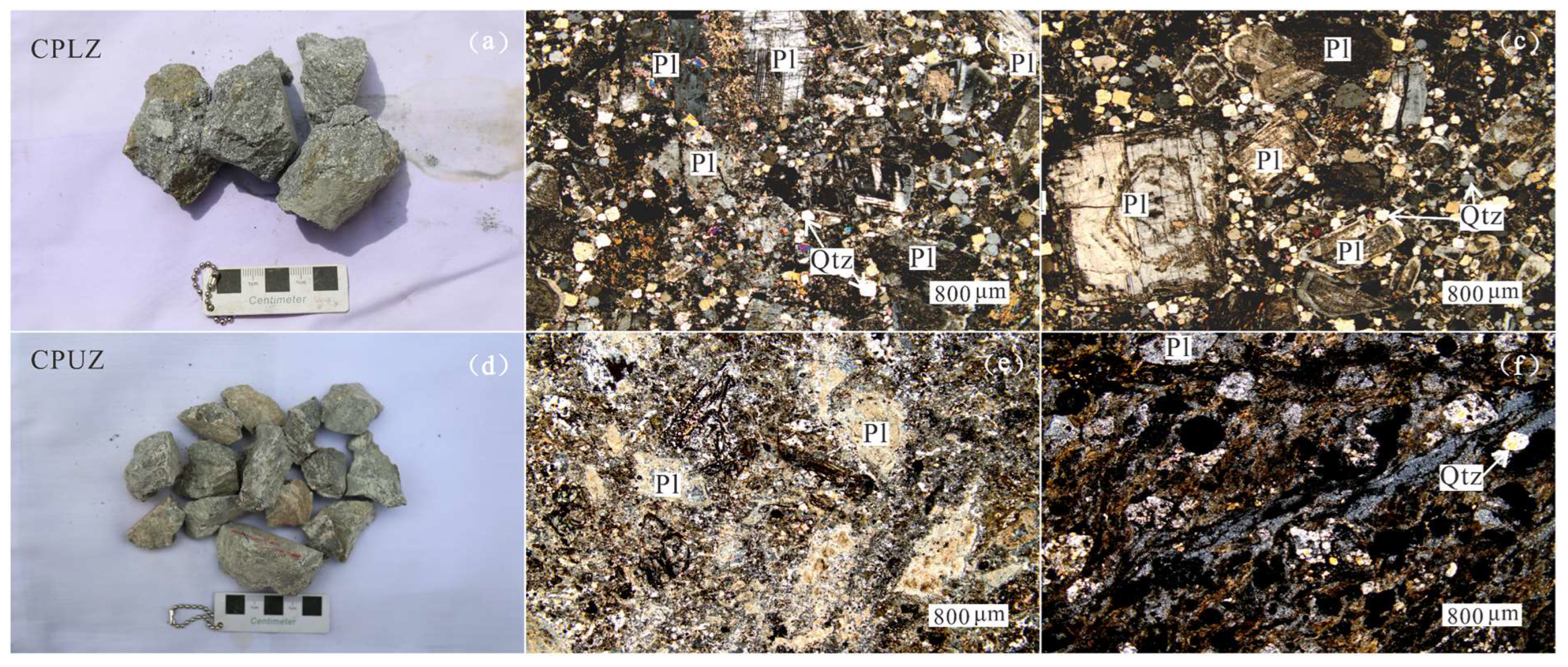
4.1. Sample Description
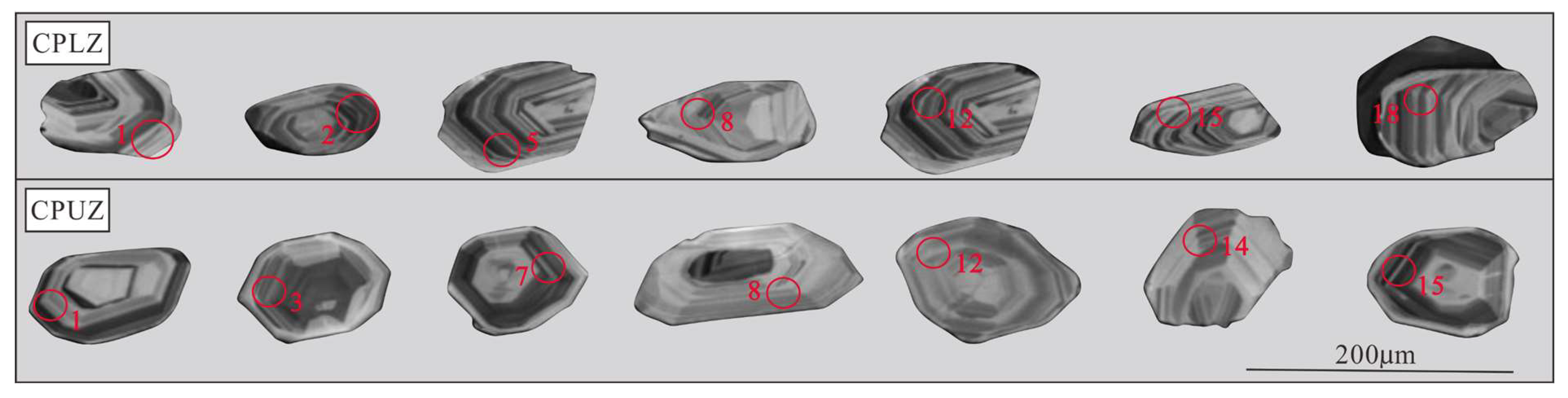
4.2. Metallogenic and Petrogenic Ages
4.3. Geochemical Characteristics
5. Discussion
5.1. Magmatic Rock Formation Ages and Mineralization Ages
5.2. Petrogenesis and Magma Source Region

5.3. Tectonic Setting
6. Conclusions
- (1)
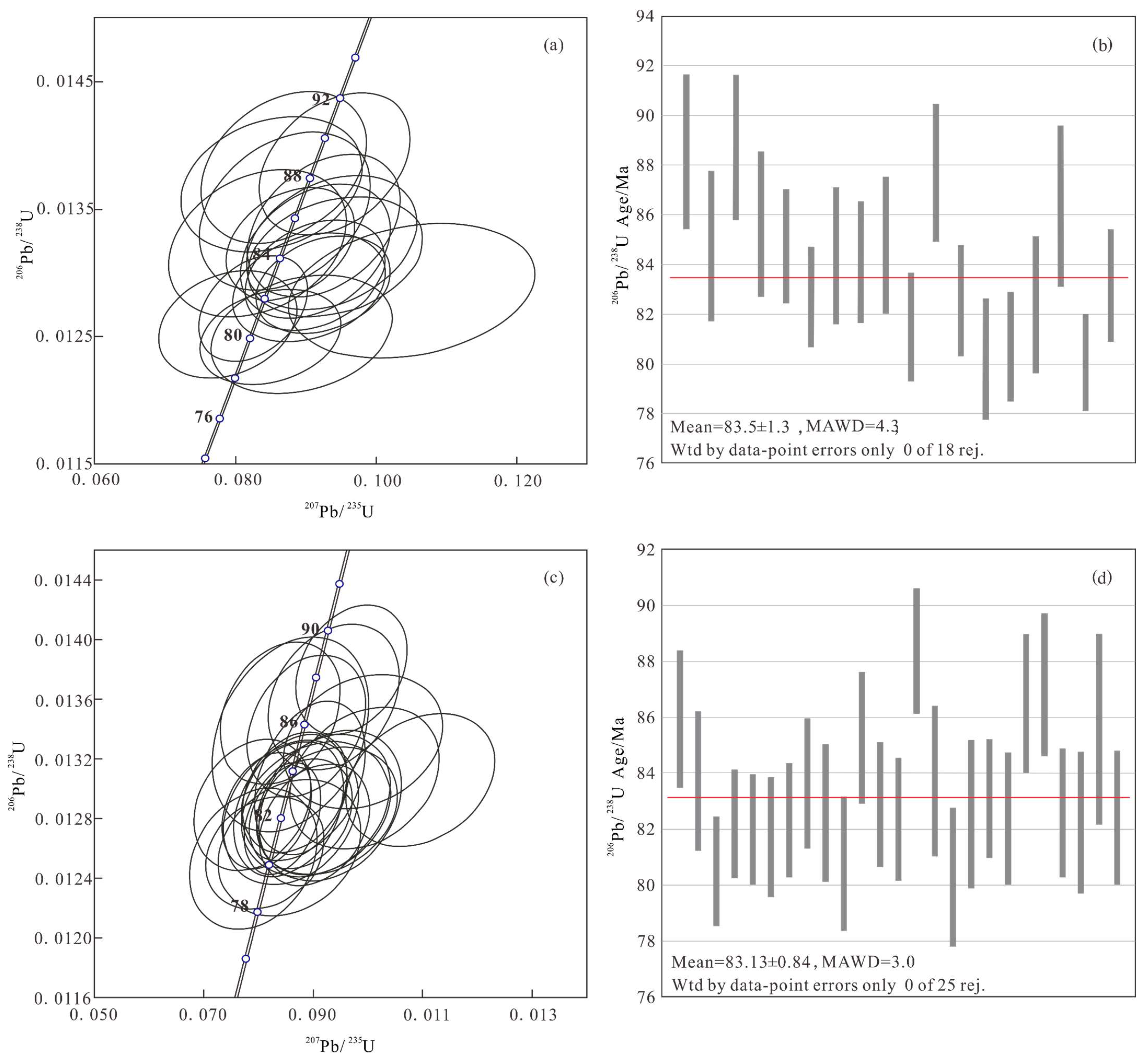
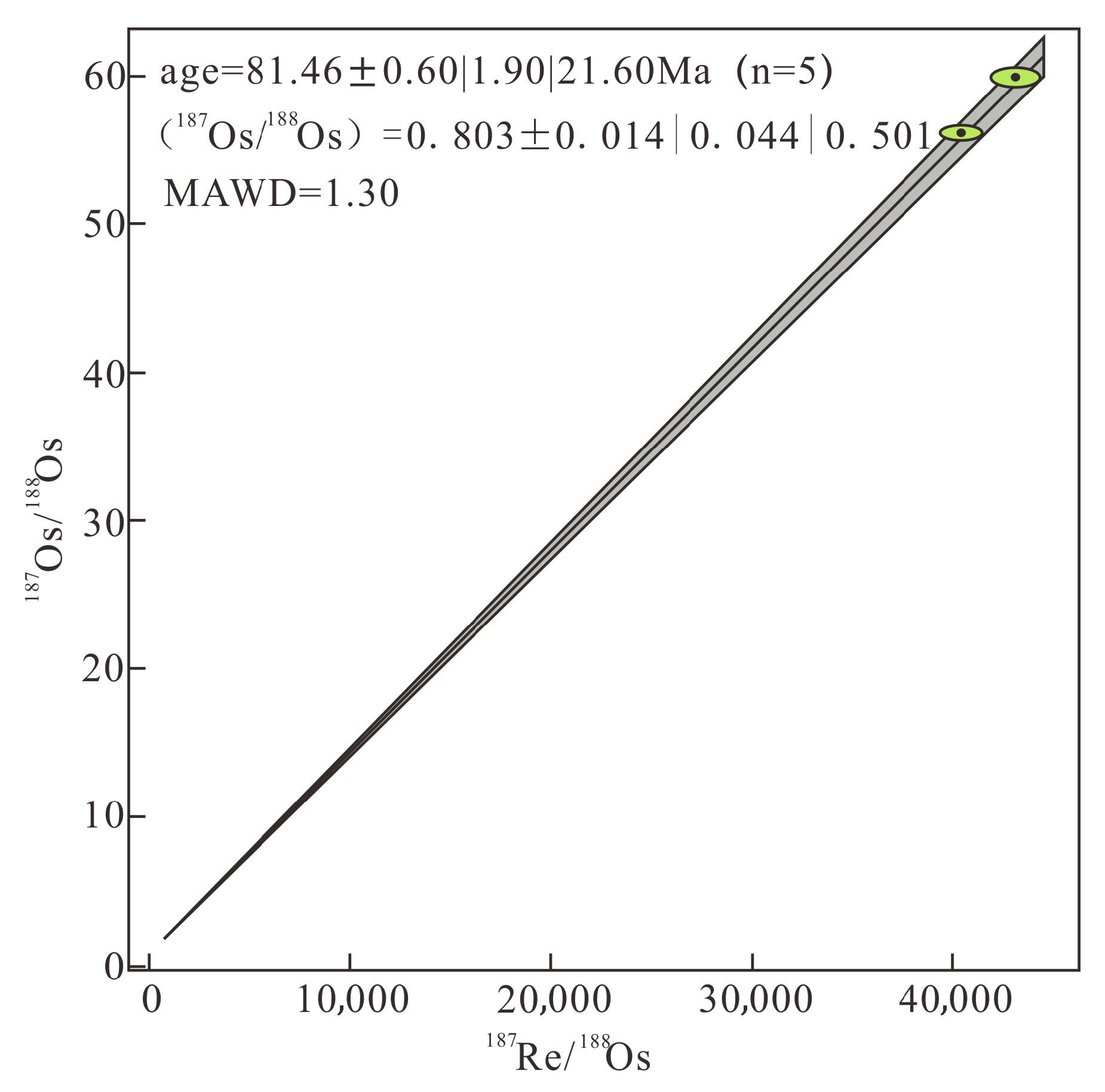
- Late Cretaceous Mineralization and Petrogenesis: Zircon U–Pb dating of andesite samples from the Čukaru Peki deposit, Serbia, yielded weighted mean ages of 83.5 ± 1.3 Ma and 83.5 ± 0.84 Ma, while pyrite Re–Os isochron dating yielded a mineralization age of 81.46 ± 0.60 Ma. These overlapping Late Cretaceous ages demonstrate that andesite emplacement and associated Cu mineralization were essentially coeval, reflecting a major magmatic–metallogenic event in the Sava–Vardar zone during this period.
- (2)
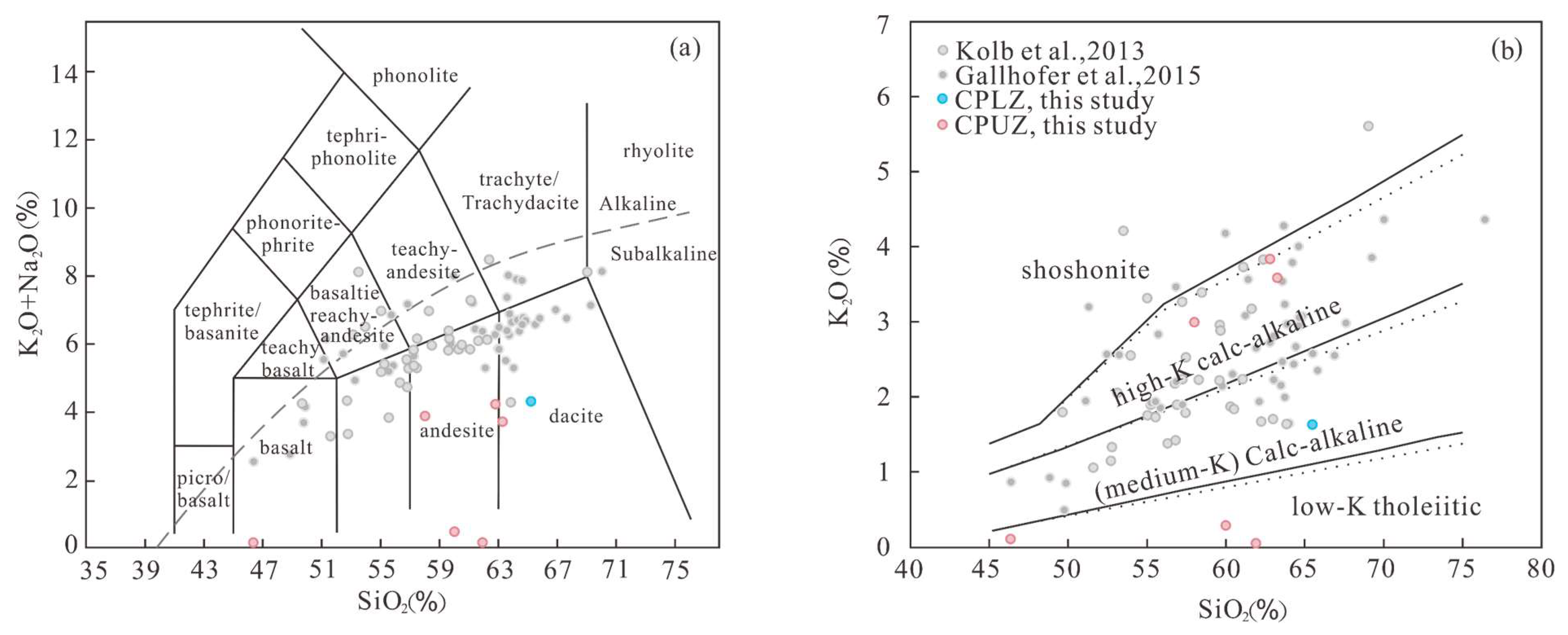
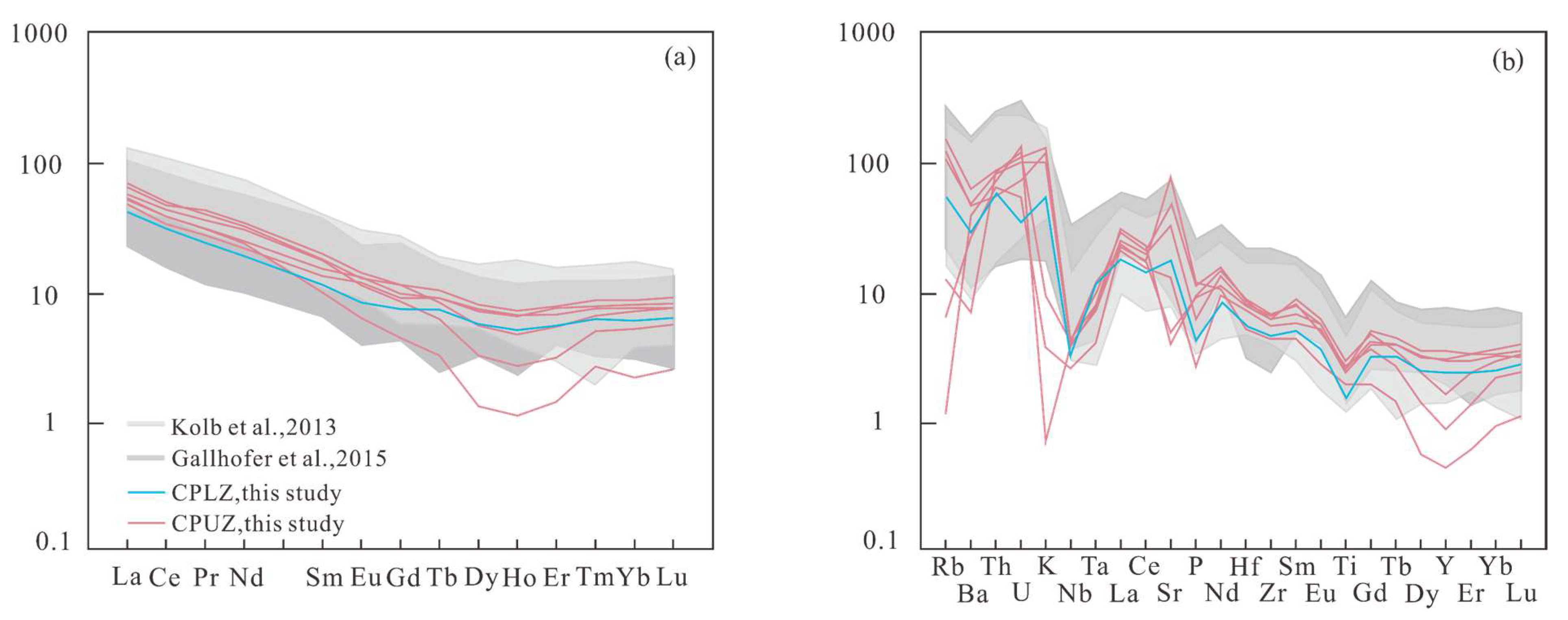
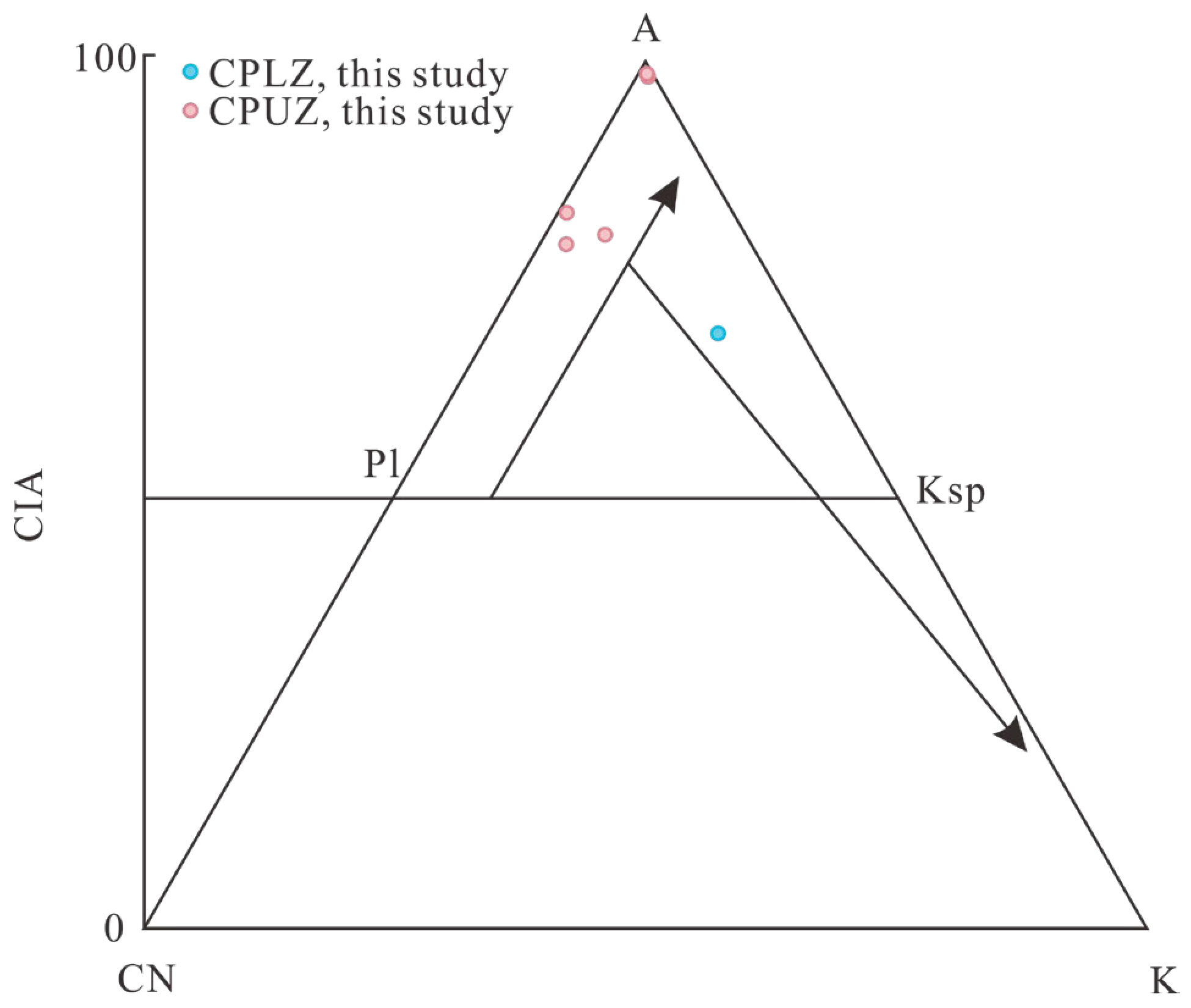
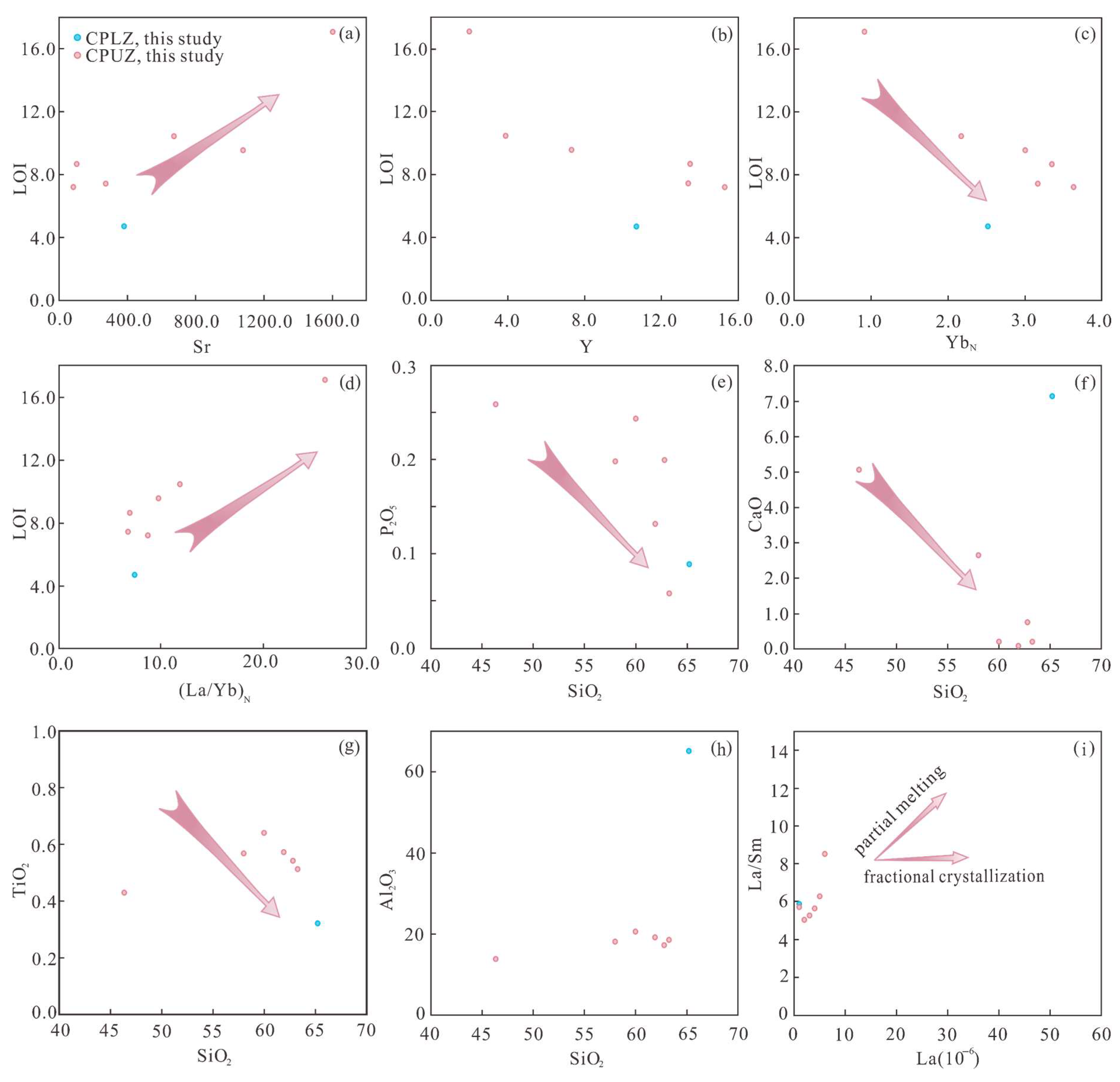
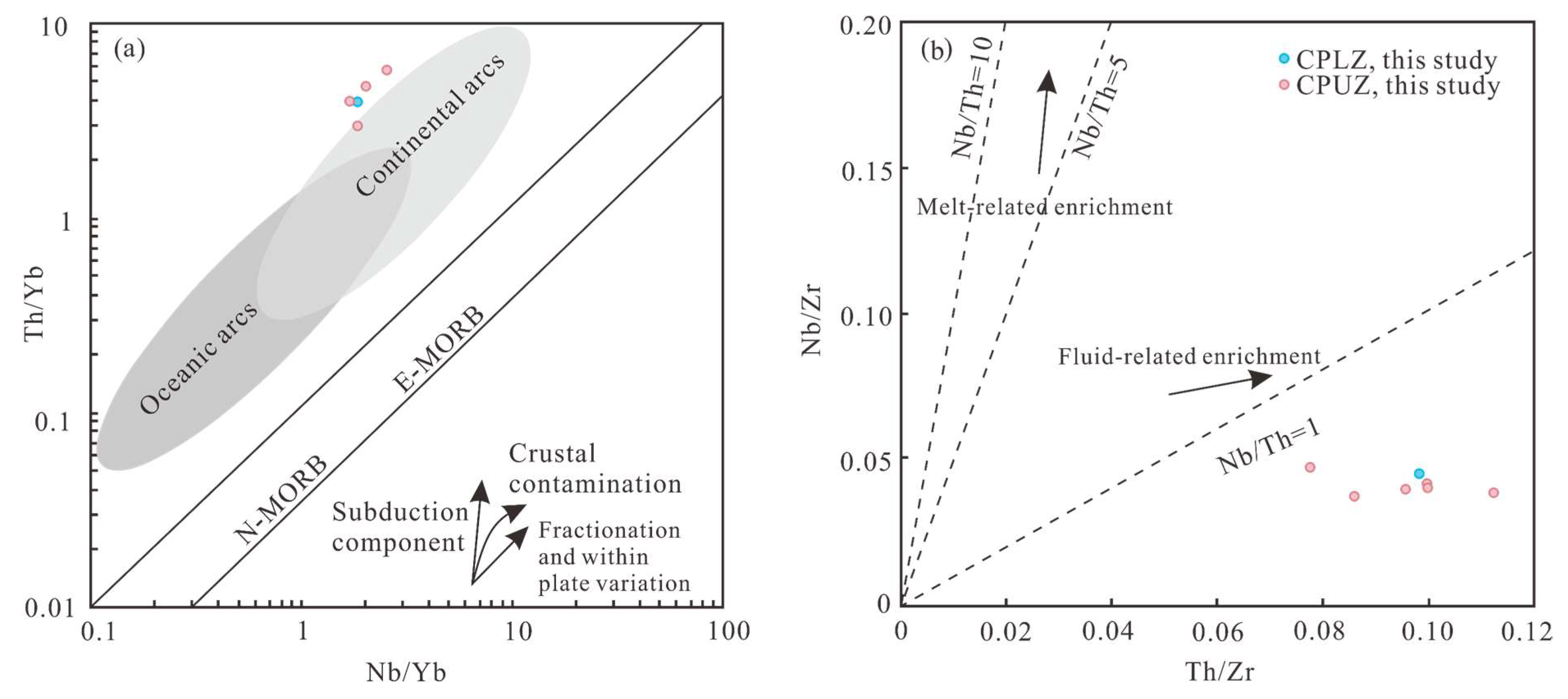
- Island-Arc Magmatism and Geochemical Signatures: The andesites exhibit classic subduction-related geochemical features: high SiO2 and Al2O3, low MgO, and TiO2, enrichment in LREEs (e.g., La, Nd) and LILEs, and depletion in HREEs and HFSEs (e.g., Yb, Y). Th/La and Th/Ce ratios close to average continental crust indicate a derivation from a mantle wedge metasomatized by slab-derived fluids, with minor crustal assimilation during ascent in an island-arc setting.
- (3)
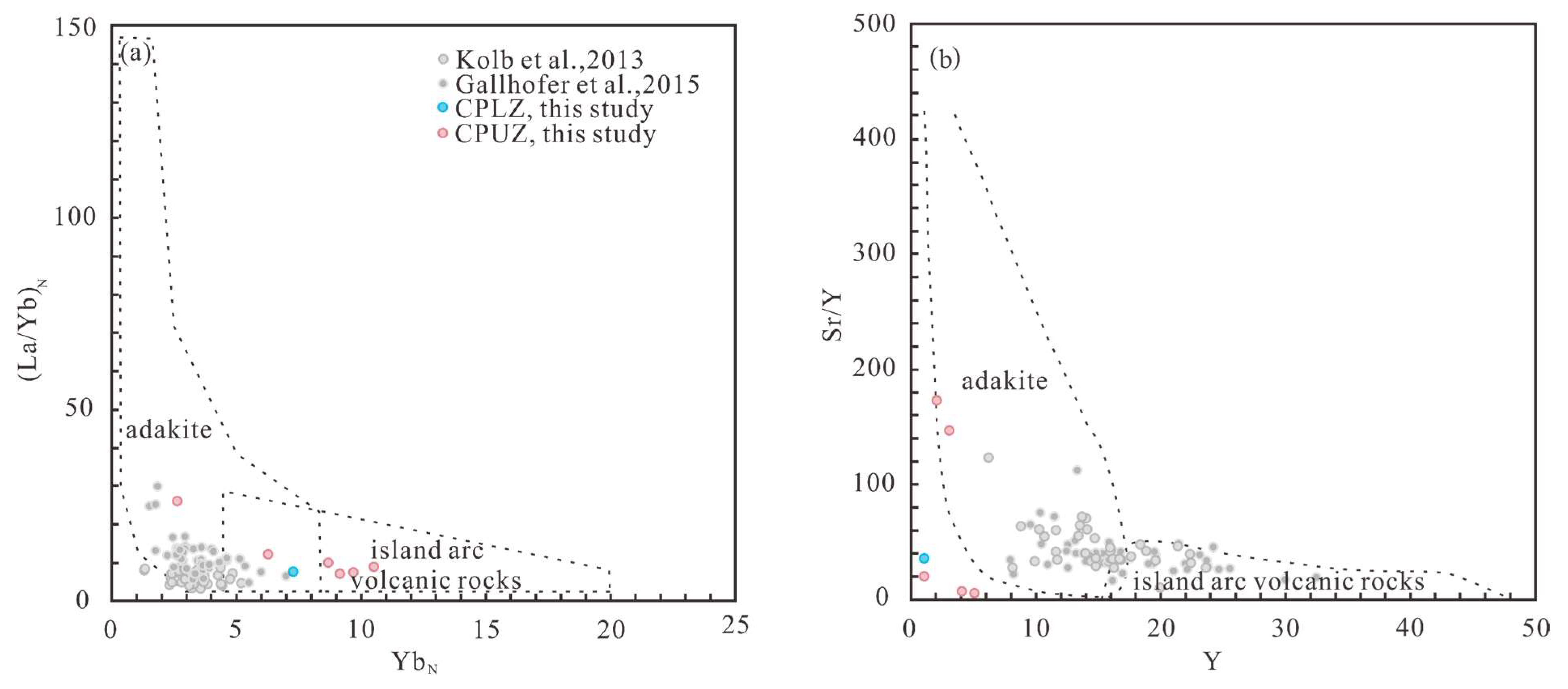
- Tectonic Evolution and Slab Rollback: The Sava–Vardar belt records the complete tectonic cycle from Late Permian–Triassic opening of the Vardar Ocean to its Late Cretaceous–Cenozoic closure. During the Late Cretaceous, rapid subduction and exhumation of HP–LT metamorphic rocks accompanied slab rollback, evidenced by the bimodal Sr/Y distribution in the andesites that reflects alternating deep and shallow subduction stages. Slab rollback drove asthenospheric upwelling and generated the prominent ~20 Ma metallogenic pulse observed across the ABTS belt.
Author Contributions
Funding
Data Availability Statement
Acknowledgments
Conflicts of Interest
Appendix A

| Analytical Spot Number | 232Th | 238U | Th/U | 207Pb/206Pb | 207Pb/235U | 206Pb/238U | 206Pb/238U | 207Pb/235U | |||||
|---|---|---|---|---|---|---|---|---|---|---|---|---|---|
| ppm | ppm | Ratio | 1σ | Ratio | 1σ | Ratio | 1σ | Age (Ma) | 1σ | Age (Ma) | 1σ | ||
| CPLZ01-01 | 216 | 371 | 0.58 | 0.0463 | 0.0027 | 0.0868 | 0.0048 | 0.0138 | 0.0002 | 88.5 | 1.6 | 84.55 | 4.5 |
| CPLZ01-02 | 116 | 323 | 0.36 | 0.0538 | 0.0033 | 0.110 | 0.0067 | 0.0149 | 0.0003 | 95.6 | 1.9 | 106.1 | 6.1 |
| CPLZ01-03 | 176 | 337 | 0.52 | 0.0465 | 0.0030 | 0.0831 | 0.0052 | 0.0132 | 0.0002 | 84.7 | 1.5 | 81.08 | 4.9 |
| CPLZ01-04 | 198 | 403 | 0.49 | 0.0496 | 0.0024 | 0.0941 | 0.0044 | 0.0139 | 0.0002 | 88.7 | 1.5 | 91.28 | 4.1 |
| CPLZ01-05 | 339 | 517 | 0.66 | 0.0503 | 0.0023 | 0.0926 | 0.0045 | 0.0134 | 0.0002 | 85.6 | 1.5 | 89.88 | 4.1 |
| CPLZ01-06 | 697 | 808 | 0.86 | 0.0485 | 0.0021 | 0.0878 | 0.0038 | 0.0132 | 0.0002 | 84.7 | 1.1 | 85.42 | 3.5 |
| CPLZ01-07 | 472 | 614 | 0.77 | 0.0524 | 0.0023 | 0.0925 | 0.0039 | 0.0129 | 0.0002 | 82.7 | 1.0 | 89.81 | 3.7 |
| CPLZ01-08 | 312 | 429 | 0.73 | 0.0600 | 0.0030 | 0.114 | 0.0062 | 0.0137 | 0.0002 | 87.5 | 1.4 | 109.6 | 5.6 |
| CPLZ01-09 | 445 | 497 | 0.89 | 0.0507 | 0.0024 | 0.0913 | 0.0044 | 0.0132 | 0.0002 | 84.4 | 1.4 | 88.76 | 4.1 |
| CPLZ01-10 | 295 | 467 | 0.63 | 0.0524 | 0.0028 | 0.0942 | 0.0051 | 0.0131 | 0.0002 | 84.1 | 1.2 | 91.37 | 4.7 |
| CPLZ01-11 | 207 | 399 | 0.52 | 0.0516 | 0.0027 | 0.0937 | 0.0050 | 0.0132 | 0.0002 | 84.8 | 1.4 | 90.91 | 4.6 |
| CPLZ01-13 | 874 | 894 | 0.98 | 0.0473 | 0.0019 | 0.0825 | 0.0032 | 0.0127 | 0.0002 | 81.5 | 1.1 | 80.48 | 3.0 |
| CPLZ01-14 | 757 | 678 | 1.1 | 0.0451 | 0.0026 | 0.0851 | 0.0053 | 0.0137 | 0.0002 | 87.7 | 1.4 | 82.90 | 5.0 |
| CPLZ01-15 | 195 | 342 | 0.57 | 0.0763 | 0.0077 | 0.147 | 0.0086 | 0.0138 | 0.0003 | 88.5 | 1.7 | 139.3 | 16.5 |
| CPLZ01-16 | 236 | 436 | 0.54 | 0.0509 | 0.0025 | 0.0904 | 0.0045 | 0.0129 | 0.0002 | 82.5 | 1.1 | 87.91 | 4.2 |
| CPLZ01-17 | 342 | 506 | 0.68 | 0.0521 | 0.0031 | 0.0894 | 0.0053 | 0.0125 | 0.0002 | 80.2 | 1.2 | 86.91 | 5.0 |
| CPLZ01-18 | 258 | 453 | 0.57 | 0.0637 | 0.0042 | 0.111 | 0.0069 | 0.0128 | 0.0002 | 82.3 | 1.2 | 106.6 | 6.3 |
| CPLZ01-19 | 373 | 512 | 0.73 | 0.0461 | 0.0025 | 0.0789 | 0.0041 | 0.0126 | 0.0002 | 80.7 | 1.1 | 77.09 | 3.8 |
| CPLZ01-20 | 209 | 317 | 0.66 | 0.0606 | 0.0043 | 0.105 | 0.0072 | 0.0129 | 0.0002 | 82.4 | 1.4 | 101.5 | 6.6 |
| CPLZ01-21 | 206 | 359 | 0.57 | 0.0482 | 0.0030 | 0.0870 | 0.0050 | 0.0135 | 0.0003 | 86.4 | 1.6 | 84.70 | 4.7 |
| CPLZ01-22 | 473 | 634 | 0.75 | 0.0492 | 0.0024 | 0.0849 | 0.0041 | 0.0125 | 0.0002 | 80.1 | 1.0 | 82.77 | 3.9 |
| CPLZ01-23 | 681 | 809 | 0.84 | 0.0516 | 0.0025 | 0.0912 | 0.0041 | 0.0130 | 0.0002 | 83.2 | 1.1 | 88.66 | 3.8 |
| CPLZ01-24 | 224 | 350 | 0.64 | 0.0631 | 0.0050 | 0.111 | 0.0086 | 0.0130 | 0.0002 | 83.4 | 1.3 | 107.1 | 7.8 |
| CPLZ01-25 | 560 | 599 | 0.93 | 0.0605 | 0.0033 | 0.111 | 0.0053 | 0.0134 | 0.0002 | 86.0 | 1.2 | 106.8 | 4.9 |
| CPUZ-02-01 | 146 | 264 | 0.55 | 0.0484 | 0.0025 | 0.0888 | 0.0044 | 0.0134 | 0.0002 | 86.0 | 1.2 | 86.35 | 4.1 |
| CPUZ02-02 | 207 | 373 | 0.55 | 0.0554 | 0.0032 | 0.0994 | 0.0056 | 0.0131 | 0.0002 | 83.7 | 1.2 | 96.23 | 5.2 |
| CPUZ02-03 | 222 | 406 | 0.55 | 0.0466 | 0.0025 | 0.0812 | 0.0045 | 0.0126 | 0.0002 | 80.5 | 1.0 | 79.27 | 4.2 |
| CPUZ02-04 | 360 | 471 | 0.76 | 0.0496 | 0.0022 | 0.0877 | 0.0039 | 0.0128 | 0.0002 | 82.2 | 1.0 | 85.40 | 3.6 |
| CPUZ02-05 | 1034 | 942 | 1.1 | 0.0479 | 0.0017 | 0.0844 | 0.0029 | 0.0128 | 0.0002 | 82.0 | 1.0 | 82.30 | 2.7 |
| CPUZ02-06 | 539 | 488 | 1.1 | 0.0513 | 0.0023 | 0.0903 | 0.0042 | 0.0128 | 0.0002 | 81.7 | 1.1 | 87.77 | 3.9 |
| CPUZ02-07 | 496 | 738 | 0.67 | 0.0461 | 0.0019 | 0.0816 | 0.0034 | 0.0129 | 0.0002 | 82.3 | 1.0 | 79.62 | 3.2 |
| CPUZ02-08 | 230 | 343 | 0.67 | 0.0613 | 0.0033 | 0.110 | 0.0056 | 0.0131 | 0.0002 | 83.6 | 1.2 | 105.6 | 5.1 |
| CPUZ02-09 | 303 | 348 | 0.87 | 0.0522 | 0.0029 | 0.0919 | 0.0050 | 0.0129 | 0.0002 | 82.6 | 1.2 | 89.30 | 4.7 |
| CPUZ02-10 | 191 | 330 | 0.58 | 0.0499 | 0.0033 | 0.0857 | 0.0054 | 0.0126 | 0.0002 | 80.8 | 1.2 | 83.48 | 5.0 |
| CPUZ02-11 | 115 | 234 | 0.49 | 0.0543 | 0.0034 | 0.0992 | 0.0060 | 0.0133 | 0.0002 | 85.3 | 1.2 | 96.01 | 5.5 |
| CPUZ02-12 | 225 | 337 | 0.67 | 0.0486 | 0.0022 | 0.0866 | 0.0040 | 0.0129 | 0.0002 | 82.9 | 1.1 | 84.33 | 3.7 |
| CPUZ02-13 | 233 | 322 | 0.72 | 0.0526 | 0.0031 | 0.0925 | 0.0053 | 0.0129 | 0.0002 | 82.3 | 1.1 | 89.85 | 4.9 |
| CPUZ02-14 | 345 | 592 | 0.58 | 0.0508 | 0.0021 | 0.0970 | 0.0042 | 0.0138 | 0.0002 | 88.3 | 1.1 | 94.01 | 3.9 |
| CPUZ02-15 | 424 | 450 | 0.94 | 0.0498 | 0.0023 | 0.0894 | 0.0042 | 0.0131 | 0.0002 | 83.7 | 1.3 | 86.95 | 3.9 |
| CPUZ02-16 | 132 | 259 | 0.51 | 0.0462 | 0.0029 | 0.0791 | 0.0048 | 0.0125 | 0.0002 | 80.3 | 1.2 | 77.29 | 4.5 |
| CPUZ02-17 | 111 | 254 | 0.44 | 0.0534 | 0.0033 | 0.0932 | 0.0054 | 0.0129 | 0.0002 | 82.5 | 1.3 | 90.44 | 5.0 |
| CPUZ02-18 | 385 | 420 | 0.92 | 0.0487 | 0.0023 | 0.0867 | 0.0039 | 0.0130 | 0.0002 | 83.1 | 1.1 | 84.41 | 3.7 |
| CPUZ02-19 | 120 | 228 | 0.53 | 0.0512 | 0.0032 | 0.0904 | 0.0056 | 0.0129 | 0.0002 | 82.4 | 1.2 | 87.92 | 5.2 |
| CPUZ02-20 | 146 | 282 | 0.52 | 0.0455 | 0.0025 | 0.0840 | 0.0045 | 0.0135 | 0.0002 | 86.5 | 1.2 | 81.98 | 4.2 |
| CPUZ02-21 | 245 | 284 | 0.86 | 0.0501 | 0.0026 | 0.0938 | 0.0049 | 0.0136 | 0.0002 | 87.2 | 1.3 | 91.02 | 4.6 |
| CPUZ02-22 | 275 | 344 | 0.80 | 0.0448 | 0.0025 | 0.0789 | 0.0044 | 0.0129 | 0.0002 | 82.6 | 1.2 | 77.10 | 4.1 |
| CPUZ02-23 | 185 | 273 | 0.68 | 0.0489 | 0.0030 | 0.0859 | 0.0051 | 0.0128 | 0.0002 | 82.2 | 1.3 | 83.71 | 4.8 |
| CPUZ02-24 | 117 | 223 | 0.53 | 0.0481 | 0.0033 | 0.0859 | 0.0059 | 0.0134 | 0.0003 | 85.6 | 1.7 | 83.67 | 5.5 |
| CPUZ02-25 | 458 | 431 | 1.1 | 0.0485 | 0.0024 | 0.0855 | 0.0041 | 0.0129 | 0.0002 | 82.4 | 1.2 | 83.35 | 3.9 |
| Sample Name | Sample No. | Sample Weight (g) | Re ng/g | Common Os (ng/g) | Os187ng/g | 187Re/188Os | 187Os/188Os | Model Age | ||||||
|---|---|---|---|---|---|---|---|---|---|---|---|---|---|---|
| Measured Value | σ | Measured Value | σ | Measured Value | σ | Measured Value | σ | Measured Value | σ | Measured Value | σ | |||
| Pyrite | CPZK06 | 0.60052 | 1.623 | 0.012 | 0.0046 | 0.0000 | 0.00166 | 0.00001 | 1690.0 | 17.0 | 2.740 | 0.006 | 97.37 | 1.00 |
| Pyrite | CPZK08 | 0.30041 | 386.8 | 2.900 | 0.025 | 0.0002 | 0.334 | 0.002 | 73,734 | 764 | 101.3 | 0.2 | 82.53 | 0.850 |
| Pyrite | CPZK09 | 0.10733 | 41.49 | 0.31 | 0.67 | 0.002 | 0.0535 | 0.0005 | 300.10 | 3.60 | 0.6170 | 0.002 | 122.9 | 1.40 |
| Pyrite | CPZK11 | 0.30181 | 101.6 | 0.80 | 0.030 | 0.0002 | 0.0913 | 0.0007 | 16,266 | 166 | 23.26 | 0.04 | 85.75 | 0.870 |
| Testing Items | Sample No | |||||||
|---|---|---|---|---|---|---|---|---|
| CPLZ-01 | CPUZ-1 | CPUZ-3 | CPUZ-7 | CPUZ-8 | CPUZ-12 | CPUZ-14 | ||
| SiO2 | % | 65.20 | 63.26 | 61.89 | 59.99 | 58.00 | 62.79 | 46.35 |
| Al2O3 | % | 12.91 | 18.59 | 19.16 | 20.59 | 18.11 | 17.28 | 13.82 |
| TiO2 | % | 0.32 | 0.51 | 0.57 | 0.64 | 0.57 | 0.54 | 0.43 |
| Fe2O3 | % | 1.28 | 5.41 | 7.33 | 7.70 | 5.93 | 5.74 | 15.9 |
| FeO | % | 1.1 | 0.11 | 0.043 | 0.083 | 0.067 | 0.083 | 0.027 |
| CaO | % | 7.14 | 0.211 | 0.090 | 0.213 | 2.65 | 0.757 | 5.07 |
| MgO | % | 2.2 | 0.55 | 0.034 | 0.094 | 1.7 | 0.81 | 0.12 |
| K2O | % | 1.6 | 3.6 | 0.021 | 0.29 | 3.0 | 3.8 | 0.11 |
| Na2O | % | 2.7 | 0.12 | 0.060 | 0.17 | 0.87 | 0.38 | 0.013 |
| MnO | % | 0.023 | 0.010 | 0.019 | 0.016 | 0.13 | 0.028 | 0.007 |
| P2O5 | % | 0.089 | 0.058 | 0.13 | 0.24 | 0.20 | 0.20 | 0.26 |
| H2O+ | % | 3.52 | 4.05 | 6.27 | 4.88 | 4.01 | 3.35 | 4.63 |
| H2O− | % | 0.38 | 0.88 | 0.52 | 0.61 | 1.3 | 1.1 | 2.5 |
| LOI | % | 4.71 | 7.44 | 10.5 | 9.58 | 8.68 | 7.22 | 17.1 |
| Total | % | 99.41 | 99.87 | 99.83 | 99.62 | 99.90 | 99.66 | 99.21 |
| TFe2O3 | % | 2.52 | 5.53 | 7.38 | 7.79 | 6.01 | 5.83 | 15.9 |
| Y | μg/g | 10.7 | 13.4 | 3.89 | 7.32 | 13.5 | 15.3 | 1.99 |
| La | μg/g | 12.9 | 14.8 | 17.7 | 20.2 | 16.5 | 21.8 | 16.2 |
| Ce | μg/g | 25.3 | 27.2 | 35.1 | 38.1 | 30.9 | 40.3 | 30.9 |
| Pr | μg/g | 2.92 | 3.35 | 4.38 | 5.26 | 3.79 | 4.94 | 3.75 |
| Nd | μg/g | 11.4 | 13.1 | 18.2 | 20.6 | 14.8 | 19.5 | 14.3 |
| Sm | μg/g | 2.20 | 2.59 | 3.52 | 3.84 | 2.93 | 3.47 | 1.90 |
| Eu | μg/g | 0.61 | 0.87 | 0.82 | 1.0 | 0.95 | 0.94 | 0.46 |
| Gd | μg/g | 1.88 | 2.30 | 2.16 | 2.91 | 2.51 | 2.92 | 1.13 |
| Tb | μg/g | 0.34 | 0.42 | 0.29 | 0.39 | 0.42 | 0.48 | 0.15 |
| Dy | μg/g | 1.79 | 2.35 | 1.03 | 1.74 | 2.26 | 2.55 | 0.41 |
| Ho | μg/g | 0.36 | 0.47 | 0.19 | 0.33 | 0.46 | 0.51 | 0.078 |
| Er | μg/g | 1.1 | 1.40 | 0.64 | 1.1 | 1.6 | 1.6 | 0.29 |
| Tm | μg/g | 0.20 | 0.24 | 0.16 | 0.21 | 0.25 | 0.28 | 0.090 |
| Yb | μg/g | 1.24 | 1.56 | 1.07 | 1.48 | 1.65 | 1.79 | 0.450 |
| Lu | μg/g | 0.20 | 0.24 | 0.18 | 0.24 | 0.26 | 0.29 | 0.08 |
| Li | μg/g | 5.64 | 16.8 | 48.8 | 18.0 | 62.2 | 10.9 | 46.0 |
| Be | μg/g | 0.68 | 0.77 | 0.15 | 0.49 | 1.1 | 1.5 | 0.28 |
| Sc | μg/g | 12.4 | 13.1 | 9.95 | 11.8 | 12.9 | 11.3 | 6.36 |
| V | μg/g | 185 | 177 | 185 | 330 | 207 | 224 | 187 |
| Cr | μg/g | 5.76 | 4.39 | 8.15 | 9.79 | 4.17 | 17.5 | 4.04 |
| Co | μg/g | 9.25 | 15.8 | 15.4 | 16.2 | 14.8 | 17.1 | 45.7 |
| Ni | μg/g | 3.80 | 3.86 | 4.02 | 4.18 | 4.06 | 4.14 | 9.48 |
| Cu | μg/g | 3379 | 162.0 | 749.0 | 1413 | 146.0 | 160.0 | 3524 |
| Zn | μg/g | 17.1 | 67.1 | 15.1 | 18.2 | 12.8 | 55.2 | 15.5 |
| Ga | μg/g | 12.4 | 15.9 | 15.9 | 15.4 | 15.4 | 19.9 | 9.28 |
| Rb | μg/g | 35.5 | 78.1 | 0.720 | 8.02 | 67.6 | 97.5 | 3.94 |
| Sr | μg/g | 380.0 | 273.0 | 673.0 | 1077 | 103.0 | 82.80 | 1603 |
| Zr | μg/g | 50.3 | 60.4 | 72.4 | 71.3 | 68.0 | 75.4 | 48.1 |
| Nb | μg/g | 2.29 | 2.88 | 2.72 | 2.99 | 2.76 | 3.03 | 1.87 |
| Mo | μg/g | 0.580 | 0.210 | 1.40 | 0.760 | 0.710 | 1.23 | 13.9 |
| Cd | μg/g | 0.04 | 0.3 | 0.07 | 0.02 | 0.01 | 0.04 | 0.4 |
| In | μg/g | 0.016 | 0.028 | 0.065 | 0.13 | 0.020 | 0.036 | 0.11 |
| Cs | μg/g | 0.750 | 8.03 | 0.190 | 1.19 | 4.77 | 4.50 | 0.270 |
| Ba | μg/g | 201 | 321 | 267 | 50.0 | 332 | 431 | 183 |
| Hf | μg/g | 1.68 | 2.21 | 2.58 | 2.63 | 2.37 | 2.71 | 1.57 |
| Ta | μg/g | 0.45 | 0.48 | 0.31 | 0.39 | 0.29 | 0.33 | 0.17 |
| W | μg/g | 0.35 | 1.1 | 1.4 | 0.38 | 0.27 | 0.47 | 0.48 |
| Tl | μg/g | 0.180 | 2.40 | 4.24 | 0.310 | 1.84 | 4.54 | 5.25 |
| Pb | μg/g | 2.53 | 15.6 | 90.3 | 6.86 | 9.63 | 23.8 | 64.6 |
| Bi | μg/g | 0.140 | 0.140 | 1.95 | 0.790 | 0.130 | 0.870 | 3.86 |
| Th | μg/g | 4.95 | 4.69 | 6.23 | 7.12 | 6.80 | 7.22 | 5.41 |
| U | μg/g | 0.720 | 1.53 | 2.89 | 2.52 | 2.10 | 2.22 | 1.12 |
| Type | Study Area | Subject (s) | Method | Ages (Ma) | References |
|---|---|---|---|---|---|
| rock mass | Elatsite | Pre/syn ore granodiorite | zircon U-Pb dating | 92.10 ± 0.3 | [60] |
| rock mass | Elatsite | Late mineralization dyke | zircon U-Pb dating | 91.84 ± 0.3 | [104] |
| rock mass | Elatsite | Post-ore amphibolite–granodiorite dyke | zircon U-Pb dating | 91.42 ± 0.15 | [104] |
| rock mass | TMC | Valja Strž plutonite | zircon U-Pb dating | 78.62 ± 0.44 | [104] |
| rock mass | Elshitsa | Granite | zircon U-Pb dating | 86.62 ± 0.02 | [105] |
| rock mass | Chelopech | Post-ore andesite | zircon U-Pb dating | 91.3 ± 0.3 | [106] |
| rock mass | Medet | Vitosha-andesite | zircon U-Pb dating | 89.75 ± 0.4 | [107] |
| ore body | Bor | Igneous hornblende | 40Ar/39Ar isotopic dating | 84.0 ± 1.5 Ma | [108] |
| ore body | Bor | White mica | 40Ar/39Ar isotopic dating | 86.6 ± 1.0 | [108] |
| ore body | Panagyurishte | Igneous mineral | 40Ar/39Ar isotopic dating | 90.8 ± 0.8 | [108] |
| ore body | Panagyurishte | Alteration mineral | 40Ar/39Ar isotopic dating | 79.5 ± 0.5 | [108] |
| rock mass | Velichkovo quarry | Granodiorite | zircon U-Pb dating | 84.6 ± 0.3 | [16] |
| rock mass | Velichkovo quarry | Hybrid gabbro | zircon U-Pb dating | 82.16 ± 0.10 | [16] |
| rock mass | Vetrensko Gradishte | Hybrid gabbro | zircon U-Pb dating | 84.87 ± 0.13 | [16] |
| rock mass | Dolno Varshilo | Granite | zircon U-Pb dating | 82.25 ± 0.22 | [16] |
| ore body | Apuseni Mountains | Molybdenite | molybdenite Re-Os dating | 79.45 ± 0.4~80.63 ± 0.3 | [37] |
| ore body | banat | Molybdenite | molybdenite Re-Os dating | 72.2 ± 0.4~82.71 ± 0.3 | [37] |
| ore body | Elatsite | Molybdenite | molybdenite Re-Os dating | 91.88 ± 0.5~92.43 ± 0.3 | [37] |
| ore body | Medet | Molybdenite | molybdenite Re-Os dating | 90.55 ± 0.5~91.31 ± 0.3 | [37] |
| ore body | Vlaykov Vruh | Molybdenite | molybdenite Re-Os dating | 86.77 ± 0.5~87.70 ± 0.5 | [37] |
| rock mass | TMC | Osnić basaltic andesite (AO) and Ježevica andesite | zircon U-Pb dating | 80.8 to 82.27 ± 0.35 | [45] |
| ore body | Čukaru Peki | Molybdenite | molybdenite Re-Os dating | 88 ± 0.4 | [40] |
| rock mass | Bor | Timok andesite | zircon U-Pb dating | 89.0 ± 0.6 | [42] |
| ore body | Bor | Timok andesite | 40Ar/39Ar isotopic dating | 84.26 ± 0.67 | [42] |
| rock mass | Timok | Hornblende-biotite diorite porphyry | zircon U-Pb dating | 83.6 ± 0.5~78.5 ± 1.3 | [44] |
| rock mass | Nikoličevo area | Hornblende andesite breccias | zircon U-Pb dating | 84.89 ± 0.75 Ma | [43] |
| rock mass | Nikoličevo area | Hornblende andesite breccias | zircon U-Pb dating | 85.56 ± 0.53 Ma | [43] |
| rock mass | Nikoličevo area | Hornblende-plagioclase phyric andesite | zircon U-Pb dating | 85.23 ± 0.47 Ma | [43] |
| rock mass | Nikoličevo area | Hornblende-plagioclase phyric andesite | zircon U-Pb dating | 90.05 ± 0.61 Ma | [43] |
| rock mass | Jama | Jama andesite | zircon U-Pb dating | 85.7 ± 0.9 Ma | [60] |
| rock mass | Jama | Jama andesite | zircon U-Pb dating | 85.8 ± 0.7 Ma | [60] |
References
- Singer, D.A.; Berger, V.I.; Menzie, W.D.; Berger, B.R. Porphyry Copper Deposit Density Available to Purchase. Econ. Geol. 2005, 100, 491–514. [Google Scholar] [CrossRef]
- Mao, J.W.; Yu, J.J.; Yuan, S.D.; Cheng, Y.B.; Xie, G.Q.; Hou, K.J.; Xiang, J.F.; Yang, Z.X. Iron Oxide-Copper-Gold (IOCG) Deposits: Basic Characteristics, Current Research Status, and Ore Prospecting. Miner. Depos. 2008, 37, 267–278. [Google Scholar]
- Bi, X.W.; Li, H.L.; Shuang, Y.; Hu, X.Y.; Hu, R.Z.; Peng, J.T. Geochemical Characteristics of Fluid Inclusions from Qitianling A-Type Granite, Hunan Province, China: Tracing the Source of Ore-Forming Fluid of the Furong Superlarge Tin Deposit. Geol. J. China Univ. 2009, 14, 539–548. [Google Scholar]
- Hou, Z.Q.; Cook, N.J. Metallogenesis of the Tibetan Collisional Orogen: A Review and Introduction to the Special Issue. Ore Geol. Rev. J. Compr. Stud. Ore Genes. Ore Explor. 2009, 36, 2–24. [Google Scholar] [CrossRef]
- Gao, J.; Zhu, M.T.; Wang, X.S.; Hong, T.; Li, G.M.; Li, J.L.; Xiao, W.J.; Qin, K.Z.; Zeng, Q.D.; Shen, P.; et al. Large-Scale Porphyry-Type Mineralization in the Central Asian Metallogenic Domain: Tectonic Background, Fluid Features, and Metallogenic Deep Dynamic Mechanisms. Acta Geol. Sin. 2019, 93, 24–71. [Google Scholar]
- Calder, M.F.; Chang, Z.S.; Arribas, A.; Gaibor, A.; Dunkley, P.; Pastoral, J.; Kouzmanov, K.; Spandler, C.; Hedenquist, J.W. High-Grade Copper and Gold Deposited During Postpotassic Chlorite-White Mica-Albite Stage in the Far Southeast Porphyry Deposit, Philippines. Econ. Geol. 2022, 117, 1573–1596. [Google Scholar] [CrossRef]
- Zhang, H.Q.; Xue, C.L.; Wang, J.B.; Sun, Z.J.; Xiong, L.H.; An, T.H. Analysis of Resources and Industrial Layout in Timok Ore Concentrated Area in Serbia. Miner. Explor. 2023, 14, 1914–1922. [Google Scholar]
- Clark, A.H.; Ullrich, T.D. 40Ar-39Ar Age Data for Andesitic Magmatism and Hydrothermal Activity in the Timok Massif, Eastern Serbia: Implications for Metallogenetic Relationships in the Bor Copper-Gold Subprovince. Miner. Depos. 2004, 39, 256–262. [Google Scholar] [CrossRef]
- Drew, L.J. A Tectonic Model for the Spatial Occurrence of Porphyry Copper and Polymetallic Vein Deposits—Applications to Central Europe; U.S. Geological Survey (USGS): Reston, VA, USA, 2005; p. 36.
- Hou, Z.Q.; Yang, Z.M. Porphyry Deposits in Continental Settings of China: Basic Geological Characteristics, Magmatic-Hydrothermal System, and Metallogenic Model. Acta Geol. Sin. 2009, 83, 1779–1817. [Google Scholar]
- Tatnell, L.; Anenburg, M.; Loucks, R. Porphyry Copper Deposit Formation: Identifying Garnet and Amphibole Fractionation With REE Pattern Curvature Modeling. Geophys. Res. Lett. 2023, 50, e2023GL103525. [Google Scholar] [CrossRef]
- Dong, W.; Hu, H.L.; Yan, G.Q.; Wei, J.L.; Hu, X.J. Post-collisional Metallogenic Response in Eastern Junggar, Xinjiang: Geological Characteristics of the Songkalsu Copper-Gold Deposit and Geochemical Evidence of Granite Porphyry. China Min. Mag. 2024, 33, 280–294. [Google Scholar]
- Sillitoe, R.H. Porphyry Copper Systems. Econ. Geol. 2010, 105, 3–41. [Google Scholar] [CrossRef]
- Zhou, X.S.; Liu, W.Y.; Shan, S.Q.; Chen, J.; Zhang, A.S.; Xie, G.Q.; Lin, X.R.; Rao, D.P.; Wang, H.; Lin, J. Ore Geology of Typical Deposits in the Timok Cu-Au Ore Field, Serbia. Geol. Bull. China 2024, 43, 270–288. [Google Scholar]
- Ciobanu, C.L.; Cook, N.J.; Stein, H. Regional Setting and Geochronology of the Late Cretaceous Banatitic Magmatic and Metallogenetic Belt. Miner. Depos. 2002, 37, 541–567. [Google Scholar] [CrossRef]
- von Quadt, A.; Moritz, R.; Peytcheva, I.; Heinrich, C.A. 3: Geochronology and Geodynamics of Late Cretaceous Magmatism and Cu-Au Mineralization in the Panagyurishte Region of the Apuseni-Banat-Timok-Srednogorie Belt, Bulgaria. Ore Geol. Rev. 2005, 27, 95–126. [Google Scholar] [CrossRef]
- Gallhofer, D.; von Quadt, A.; Peytcheva, I.; Schmid, S.M.; Heinrich, C.A. Tectonic, Magmatic, and Metallogenic Evolution of the Late Cretaceous Arc in the Carpathian-Balkan Orogen. Tectonics 2015, 34, 1813–1836. [Google Scholar] [CrossRef]
- Shan, S.Q.; Xie, G.Q.; Liu, W.Y.; Zheng, J.H.; Xing, B. Hydrothermal Alteration and Sulfide Zoning Characteristics of the Čukaru Peki Super-large Porphyry-epithermal Copper-gold Deposit in Western Tethys, Serbia and its Implication for Exploration. Geotecton. Metallog. 2023, 47, 1085–1109. [Google Scholar]
- Wang, G.P. Discovery and Significance of the Z. Brdo Large Gold Deposit in Eastern Serbia. Geol. Explor. 2024, 60, 1081–1094. [Google Scholar]
- Jankovic, S. Types of Copper Deposits Related to Volcanic Environment in the Bor District, Yugoslavia. Geol. Rundsch. 1990, 79, 467–478. [Google Scholar] [CrossRef]
- Jelenkovic, R.; Milovanović, D.J.; Koželj, D.; Banješević, M. The Mineral Resources of the Bor Metallogenic Zone: A Review. Geol. Croat. 2016, 69, 143–155. [Google Scholar] [CrossRef]
- Han, N.; Jiang, S.H.; Bai, D.M.; Chen, C.L.; Liu, Y.; Kang, H. Geological Characteristics and Research Progress of the Apuseni-Banat-Timok-Srednogorie Cu-Au Metallogenic Belt in Southeast Europe. Geol. Bull. China 2019, 38, 1920–1937. [Google Scholar]
- Zheng, H.; Zhang, A.S.; Rao, D.P.; Xie, G.Q.; Shan, S.Q.; Liu, W.Y.; Chen, A.S.; Chen, S.Y.; Huang, W.S. Chlorite Geochemical Characterization and Prospecting Indication for the Čukaru Peki Copper-Gold Deposit, Serbia. Geol. Bull. China 2025, 44, 215–230. [Google Scholar]
- Handler, R.; Neubauer, F.; Velichkova, S.H.; Ivanov, Z. 40Ar/39Ar Age Constraints on the Timing of Magmatism and Post-Magmatic Cooling in the Panagyurishte Region. Swiss J. Geosci. Suppl. 2004, 84, 119–132. [Google Scholar]
- Pačevski, A.; Cvetković, V.; Šarić, K.; Banješević, M.; Hoefer, H.E.; Kremenović, A. Manganese Mineralization in Andesites of Brestovačka Banja, Serbia: Evidence of Sea-Floor Exhalations in the Timok Magmatic Complex. Mineral. Petrol. 2016, 110, 491–502. [Google Scholar] [CrossRef]
- Lips, A. Correlating Magmatic-Hydrothermal Ore Deposit Formation over Time with Geodynamic Processes in SE Europe; Special Publications: London, UK, 2002; pp. 69–79. [Google Scholar]
- Chambefort, I.; Moritz, R. Late Cretaceous Structural Control and Alpine Overprint of the High-Sulfidation Cu-Au Epithermal Chelopech Deposit, Srednogorie Belt, Bulgaria. Miner. Depos. 2006, 41, 259–280. [Google Scholar] [CrossRef]
- Georgiev, S.; von Quadt, A.; Heinrich, C.A.; Peytcheva, I.; Marchev, P. Time Evolution of a Rifted Continental Arc: Integrated ID-TIMS and LA-ICPMS Study of Magmatic Zircons from the Eastern Srednogorie, Bulgaria. Lithos 2012, 154, 53–67. [Google Scholar] [CrossRef]
- Wortel, M.J.R.; Spakman, W. Subduction and Slab Detachment in the Mediterranean-Carpathian Region. Science 2000, 290, 1910–1917. [Google Scholar] [CrossRef]
- Neubauer, F. Contrasting Late Cretaceous with Neogene Ore Provinces in the Alpine-Balkan-Carpathian-Dinaride Collision Belt; Special Publications: London, UK, 2002; pp. 81–102. [Google Scholar]
- Berza, T.; Constantinescu, E.; Vlad, Ş.N. Upper Cretaceous Magmatic Series and Associated Mineralisation in the Carpathian-Balkan Orogen. Resour. Geol. 1998, 48, 291–306. [Google Scholar] [CrossRef]
- Bojar, A.V.; Neubauer, F.; Fritz, H. Cretaceous to Cenozoic Thermal Evolution of the Southwestern South Carpathians: Evidence from Fission-Track Thermochronology. Tectonophysics 1998, 297, 229–249. [Google Scholar] [CrossRef]
- Iancu, V.; Berza, T.; Seghedi, A.; Gheuca, I.; Hann, H.P. Alpine Polyphase Tectono-Metamorphic Evolution of the South Carpathians: A New Overview. Tectonophysics 2005, 410, 337–365. [Google Scholar] [CrossRef]
- Vornicu, V.M.; Seghedi, I.; Csiki-Sava, Z.; Ducea, M.N. Campanian U–Pb Ages of Volcaniclastic Deposits of the Haţeg Basin (Southern Carpathians): Implications for Future Intrabasinal Lithostratigraphic Correlations. Geol. Carpathica 2023, 74, 407–422. [Google Scholar] [CrossRef]
- Heinrich, C.A.; Neubauer, F. Cu–Au–Pb–Zn–Ag Metallogeny of the Alpine–Balkan–Carpathian–Dinaride Geodynamic Province. Miner. Depos. 2002, 37, 533–540. [Google Scholar] [CrossRef]
- Jiang, S.H.; Sun, P.F.; Bai, D.M.; Kang, H.; Han, N.; Chen, C.L. Characteristics of Geology and Minerals in Central and Eastern Europe and Their Prospecting Potential. J. Earth Sci. Environ. 2017, 39, 1–15. [Google Scholar]
- Zimmerman, A.; Stein, H.J.; Hannah, J.L.; Koželj, D.; Bogdanov, K.; Berza, T. Tectonic Configuration of the Apuseni–Banat–Timok–Srednogorie Belt, Balkans-South Carpathians, Constrained by High Precision Re–Os Molybdenite Ages. Miner. Depos. 2008, 43, 1–21. [Google Scholar] [CrossRef]
- Herrington, R.; Jankovic, S.; Kozelj, D. The Bor and Majdanpek Copper-Gold Deposits in the Context of the Bor Metallogenic Zone (Serbia, Yugoslavia); PGC Publishing: Adelaide, Australia, 1998; Volume 3, pp. 185–194. [Google Scholar]
- van der Toorn, J.; Davidovic, D.; Hadijeva, N.; Strmbanovic, I. A new sedimentary rock-hosted gold belt in eastern Serbia. In Proceedings of the 12th Biennial SGA Meeting: Mineral Deposit Research for a High-Tech World, Uppsala, Sweden, 12–15 August 2013. [Google Scholar]
- Banjesević, M.; Ingram, S.; Large, D. Copper-Gold Exploration and Discovery in the Timok Magmatic Complex, Serbia. In Proceedings of the EGU General Assembly 2014, Vienna, Austria, 27 April–2 May 2014. [Google Scholar]
- Banješević, M. Upper Cretaceous Magmatic Suites of the Timok Magmatic Complex. Geol. Anal. Balk. Poluostrva 2010, 71, 14–22. [Google Scholar]
- Banješević, M.; Cvetković, V.; von Quadt, A.; Obradović, D.L.; Vasić, N.; Pačevski, A.; Peytcheva, I. New Constraints on the Main Mineralization Event Inferred from the Latest Discoveries in the Bor Metallogenetic Zone (BMZ, East Serbia). Minerals 2019, 9, 672. [Google Scholar] [CrossRef]
- Knaak, M.; Márton, I.; Tosdal, R.M.; van der Toorn, J.; Davidovic, D.; Strmbanovic, I.; Zdravkovic, M.; Živanovic, J.; Hasson, S. Geologic Setting and Tectonic Evolution of Porphyry Cu-Au, Polymetallic Replacement, and Sedimentary Rock-Hosted Au Deposits in the Northwestern Area of the Timok Magmatic Complex, Serbia. Soc. Econ. Geol. Inc. 2016, 19, 1–28. [Google Scholar]
- Kolb, M.; Von Quadt, A.; Peytcheva, I.; Heinrich, C.A.; Fowler, S.J.; Cvetković, V. Adakite-like and Normal Arc Magmas: Distinct Fractionation Paths in the East Serbian Segment of the Balkan–Carpathian Arc. J. Petrol. 2013, 54, 421–451. [Google Scholar] [CrossRef]
- Velojić, M.; Klimentyeva, D.; von Quadt, A.; Guillong, M. New Insights on the Geochemical Affinity and Age of Mineralized Rocks in Timok Magmatic Complex, East Serbia. Geološki Anal. Balk. Poluostrva 2023, 84, 47–63. [Google Scholar] [CrossRef]
- Velojic, M.; Jelenkovic, R.; Cvetković, V. Fluid Evolution of the Čukaru Peki Cu-Au Porphyry System (East Serbia) Inferred from a Fluid Inclusion Study. Geol. Croat. 2020, 73, 197–209. [Google Scholar] [CrossRef]
- Jelenković, J.; Kostić, A.; Životić, D.; Ercegovac, M. Mineral Resources of Serbia. Geol. Carpathica 2008, 59, 345–361. [Google Scholar]
- Jakubec, J.; Macsporran, G.; Duinker, P.; Pittuck, M.; Manoljović, P.; Sucharda, M.; Samouković, M.; Bunyard, C.; Arseneau, G. NI 43-101 Technical Report-Timok Copper-Gold Project, Serbia: Upper Zone Prefeasibility Study and Resource Estimate for the Lower Zone; Nevsun Resources Ltd.: Vancouver, BC, Canada, 2018; pp. 1–427. [Google Scholar]
- Title of Site. Available online: https://pubs.usgs.gov/publication/ofr91445 (accessed on 23 August 2025).
- Liu, Y.F. Metallogenic Study of Bairendaba Ag Polymetallic Deposit in Hexigten Banner, Inner Mongolia. Master’s Thesis, Chinese Academy of Geological Sciences, Beijing, China, 2009. [Google Scholar]
- Du, A.D.; Wu, S.Q.; Sun, D.Z.; Wang, S.X.; Qu, W.J.; Markey, R.; Stain, H.; Morgan, J.; Malinovskiy, D. Preparation and Certification of Re-Os Dating Reference Materials: Molybdenites HLP and JDC. Geostand. Geoanalytical Res. 2004, 28, 41–52. [Google Scholar] [CrossRef]
- Jiang, Z.; Nie, F.J.; Liu, Y.F.; Cao, Y.; Wang, F.X.; Zhang, W.B. Re-Os Isotopic Dating of Molybdenite Separates from Youfangxi Pb-Zn-Ag Polymetallic Deposit, Inner Mongolia. Miner. Depos. 2016, 35, 414–426. [Google Scholar]
- Li, N.; Yang, F.Q.; Li, C.; Zhang, Z.X.; Yang, C.D. Re-Os Isotopic Age of Molybdenite from the Xiaobaishi W-(Mo) Deposit, Eastern Tianshan, Xinjiang and Its Geological Implication. Rock Miner. Anal. 2019, 38, 112–122. [Google Scholar]
- Smoliar, M.I.; Walker, R.J.; Morgan, J.W. Re-Os Ages of Group IIA, IIIA, IVA, and IVB Iron Meteorites. Science 1996, 271, 1099–1102. [Google Scholar] [CrossRef]
- Ludwig, K.R. Isoplot 3.00: A Geochronological Toolkit for Microsoft Excel, Berkeley; Berkeley Geochronology Center Special Publication: Berkeley, CA, USA, 2003; Volume 4, pp. 1–70. [Google Scholar]
- Liu, Y.S.; Hu, Z.C.; Gao, S.; Günther, D.; Xu, J.; Gao, C.G.; Chen, H.H. In situ analysis of major and trace elements of anhydrous minerals by LA-ICP-MS without applying an internal standard. Chem. Geol. 2008, 257, 34–43. [Google Scholar] [CrossRef]
- Le Maitre, R.W. (Ed.) Igneous Rocks: A Classification and Glossary of Terms; Cambridge University Press: Cambridge, UK, 2002. [Google Scholar] [CrossRef]
- Sun, S.S.; McDonough, W.F. Chemical and isotopic systematics of oceanic basalts: Implications for mantle composition and processes. Geol. Soc. Lond. Spec. Publ. 1989, 42, 313–345. [Google Scholar] [CrossRef]
- Lin, M.Z. Geologic Feature and Ore Genesis of Z.Brdo Gold Deposit in Eastern Serbia. Miner. Explor. 2021, 12, 2341–2348. [Google Scholar]
- Lin, M.S.; Xu, K.; Wang, L.Y.; Liu, W.Y. Genesis of the Host Rock Andesite from Jama Deposit, Timok Ore Cluster Area, Serbia: Constraints from U-Pb Age, Trace Elements and Hf Isotopes of the Andesite Zircons. Geol. J. China Univ. 2025, 31, 439–450. [Google Scholar]
- Kodaira, S.; Noguchi, N.; Takahashi, N.; Ishizuka, O.; Kaneda, Y. Evolution from Fore-Arc Oceanic Crust to Island Arc Crust: A Seismic Study along the Izu-Bonin Fore Arc. J. Geophys. Res. Solid Earth 2010, 115, B09102. [Google Scholar] [CrossRef]
- Price, R.C.; Gamble, J.A.; Smith, I.E.M.; Maas, R.; Waight, T.; Stewart, R.B.; Woodhead, J. The Anatomy of an Andesite Volcano: A Time–Stratigraphic Study of Andesite Petrogenesis and Crustal Evolution at Ruapehu Volcano, New Zealand. J. Petrol. 2012, 53, 2139–2189. [Google Scholar] [CrossRef]
- Stern, R.J. Subduction zones. Rev. Geophys. 2002, 40, 3-1–3-38. [Google Scholar] [CrossRef]
- Nebel, O.; Capitanio, F.A.; Moyen, J.-F.; Weinberg, R.F.; Clos, F.; Nebel-Jacobsen, Y.J.; Cawood, P.A. When crust comes of age: On the chemical evolution of Archaean, felsic continental crust by crustal drip tectonics. Philos. Trans. R. Soc. A Math. Phys. Eng. Sci. 2018, 376, 20180103. [Google Scholar] [CrossRef] [PubMed]
- Grove, T.L.; Kinzler, R.J. Petrogenesis of Andesites. Annu. Rev. Earth Planet. Sci. 1986, 14, 417–454. [Google Scholar] [CrossRef]
- Taylor, S.R.; McLennan, S.M. The geochemical evolution of the continental crust. Rev. Geophys. 1995, 33, 241–265. [Google Scholar] [CrossRef]
- Zhang, X.Z.; Zhou, H.Y.; Qian, S.P. Reviews on Genesis of Magmatic Arc Andesite in Subduction Zone. Adv. Earth Sci. 2021, 36, 288–306. [Google Scholar]
- Nesbitt, H.W.; Young, G.M. Early Proterozoic Climates and Plate Motions Inferred from Major Element Chemistry of Lutites. Nature 1982, 299, 715–717. [Google Scholar] [CrossRef]
- Ma, T.; Zhang, J.; Wang, X.Q.; Huang, D.P.; Li, J.X.; Li, B.; Liu, W. Geochemical Characteristics and Genesis of Permian OIB-type Volcanic Rocks in Saga Region, Tibet. Northwestern Geol. 2017, 50, 22–35. [Google Scholar]
- Zhao, C.H.; Wang, C.H.; Zhao, R.Y.; Liu, S.B.; Rao, J.P.; Liu, W.S.; Zhang, X.; Jiang, J.C.; Li, T.J. Isotopic composition and alteration characteristics of dacite porphyry, and their prospecting significance in the Dabaoshan copper deposit of Guangdong Province. Rock Miner. Anal. 2020, 39, 908–920. [Google Scholar]
- Winchester, J.A.; Floyd, P.A. Geochemical discrimination of different magma series and their differentiation products using immobile elements. Chem. Geol. 1977, 20, 325–343. [Google Scholar] [CrossRef]
- Zhu, D.C.; Pan, G.T.; Mo, X.X.; Liao, Z.L.; Jiang, X.S.; Wang, L.Q.; Zhao, Z.D. Petrogenesis of Volcanic Rocks in the Sangxiu Formation, Central Segment of Tethyan Himalaya: A Probable Example of Plume–Lithosphere Interaction. J. Asian Earth Sci. 2007, 29, 320–335. [Google Scholar] [CrossRef]
- Hole, M.J.; Saunders, A.D.; Marriner, G.F.; Tarney, J. Subduction of pelagic sediments: Implications for the origin of Ce-anomalous basalts from the Mariana Islands. J. Geol. Soc. 1984, 141, 453–472. [Google Scholar] [CrossRef]
- Li, W.P.; Lu, F.X. New Progress of the Study on Geologic Setting for Calc-Alkline Volcanic Rocks. Geol. Sci. Technol. Inf. 1999, 18, 16–19. [Google Scholar]
- Shao, L.F.; Yu, F.S.; Wang, D.D.; Li, C. Geochronology, Geochemistry, and Tectonic Significance of Carboniferous Andesite in the Zhongguai Uplift, Northwestern Margin of the Junggar Basin. Geoscience 2022, 36, 812–823. [Google Scholar]
- Fedo, C.M.; Nesbitt, H.W.; Young, G.M. Unravelling the effects of potassium metasomatism in sedimentary rocks and paleosols, with implications for paleoweathering conditions and provenance. Geology 1995, 23, 921–924. [Google Scholar] [CrossRef]
- Chen, S.H.; Zhou, X.H.; Li, J.L.; Chen, H.L.; Bao, C.M. Geochemistry of the Amphibolites from Chencai Group, Zhejiang Province: Implications for the Tectonic Settings. Sci. Geol. Sin. 1999, 34, 29–40. [Google Scholar]
- Yu, L.D.; Sun, H.W.; Zhang, J.; He, X.H.; Xue, D.; Shan, W.; Sun, Y.Q. Hydrothermal Alteration and Element Migration in the Yufeng Gold Deposit, Eastern Tianshan Orogen. Acta Petrol. Sin. 2020, 36, 1597–1610. [Google Scholar]
- Tan, W.; Zeng, Y.L.; Lin, M.Z.; Zeng, X.B.; Lin, R.T.; Guo, H.L. Hydrothermal Alteration and Element Migration Features of Mali Krivelj Porphyry Copper Deposit in Bor Metallogenic Belt, Serbia. Miner. Depos. 2023, 42, 1266–1284. [Google Scholar]
- Castillo, P.R. An Overview of Adakite Petrogenesis. Chin. Sci. Bull. 2006, 51, 257–268. [Google Scholar] [CrossRef]
- Macpherson, C.G.; Dreher, S.T.; Thirlwall, M.F. Adakites Without Slab Melting: High Pressure Differentiation of Island Arc Magma, Mindanao, the Philippines. Earth Planet. Sci. Lett. 2006, 243, 581–593. [Google Scholar] [CrossRef]
- Yin, J.Y.; Chen, W.; Yuan, C.; Yu, S.; Xiao, W.J.; Long, X.P.; Li, J.; Sun, J.B. Petrogenesis of Early Carboniferous Adakitic Dikes, Sawur Region, Northern West Junggar, NW China: Implications for Geodynamic Evolution. Gondwana Res. 2015, 27, 1630–1645. [Google Scholar] [CrossRef]
- Deng, J.H.; Yang, X.Y.; Zartman, R.E.; Qi, H.S.; Zhang, L.P.; Liu, H.; Zhang, Z.F.; Mastoi, A.S.; Berador, A.E.G.; Sun, W.D. Early Cretaceous Transformation from Pacific to Neo-Tethys Subduction in the SW Pacific Ocean: Constraints from Pb-Sr-Nd-Hf Isotopes of the Philippine Arc. Geochim. Cosmochim. Acta 2020, 285, 21–40. [Google Scholar] [CrossRef]
- Xu, J.; Xia, X.P.; Wang, Q.; Spencer, C.J.; Lai, C.K.; Zhang, L. Two Magma Fractionation Paths for Continental Crust Growth: Insights from the Adakite-like and Normal-arc Granites in the Ailaoshan Fold Belt (SW Yunnan, China). GSA Bull. 2022, 134, 2986–3002. [Google Scholar] [CrossRef]
- Defant, M.J.; Drummond, M.S. Derivation of some modern arc magmas by melting of young subducted lithosphere. Nature 1990, 347, 662–665. [Google Scholar] [CrossRef]
- Rapp, R.P.; Shimizu, N.; Norman, M.D. Growth of early continental crust by partial melting of eclogite. Nature 2003, 425, 605–609. [Google Scholar] [CrossRef]
- Moyen, J.-F. High Sr/Y and La/Yb ratios: The meaning of the “adakitic signature”. Lithos 2009, 112, 556–574. [Google Scholar] [CrossRef]
- Saffer, D.M.; Wallace, L.M. The Frictional, Hydrologic, Metamorphic, and Thermal Habitat of Shallow Slow Earthquakes. Nat. Geosci. 2015, 8, 594–600. [Google Scholar] [CrossRef]
- Martin, H. Adakitic Magmas: Modern Analogues of Archaean Granitoids. Lithos 1999, 46, 411–429. [Google Scholar] [CrossRef]
- Zheng, Y.F.; Chen, Y.X. Crust-Mantle Interaction in Continental Subduction Zones. Earth Sci. 2019, 44, 3961–3983. [Google Scholar]
- Meng, X.J.; Lü, Q.T.; Yang, Z.S.; Xu, W.Y. Geochemical Characteristics of Mesozoic Intermediate-Acid Intrusive Rocks in Tongling and Adjacent Area of the Middle and Lower Reaches of the Yangtze River and Its Indication to the Deep-Seated Magmatism. Acta Geol. Sin. 2011, 85, 757–777. [Google Scholar]
- Xu, X.C.; Bai, R.Y.; Xie, Q.Q.; Lou, J.W.; Zhang, Z.Z.; Liu, Q.N.; Chen, L.W. Re-understanding of the Geological and Geochemical Characteristics of the Mesozoic Intrusive Rocks from Tongling Area of Anhui Province, and Discussions on Their Genesis. Acta Petrol. Sin. 2012, 28, 3139–3169. [Google Scholar]
- Yu, H.M.; Bai, X.; Wei, H.Q.; Xu, J.D.; Chen, Z.Q. Characteristics of Petrology, Geochemistry and Crystal Size Distribution of Plagioclase in Volcanic Rocks of Three Volcanoes in Nicaragua. Acta Petrol. Sin. 2020, 36, 2177–2196. [Google Scholar]
- Pearce, J.A. Geochemical Fingerprinting of Oceanic Basalts with Applications to Ophiolite Classification and the Search for Archean Oceanic Crust. Lithos 2008, 100, 14–48. [Google Scholar] [CrossRef]
- Stampfli, G.M.; Borel, G.D. A Plate Tectonic Model for the Paleozoic and Mesozoic Constrained by Dynamic Plate Boundaries and Restored Synthetic Oceanic Isochrons. Earth Planet. Sci. Lett. 2002, 196, 17–33. [Google Scholar] [CrossRef]
- Sharp, I.R.; Robertson, A.H.F. Tectonic-Sedimentary Evolution of the Western Margin of the Mesozoic Vardar Ocean: Evidence from the Pelagonian and Almopias Zones, Northern Greece. Geol. Soc. 2006, 260, 373–412. [Google Scholar] [CrossRef]
- Schmid, S.M.; Bernoulli, D.; Fügenschuh, B.; Matenco, L.; Schefer, S.; Schuster, R.; Tischler, M.; Ustaszewski, K. The Alpine-Carpathian-Dinaridic Orogenic System: Correlation and Evolution of Tectonic Units. Swiss J. Geosci. 2008, 101, 139–183. [Google Scholar] [CrossRef]
- Cvetković, V.; Prelević, D.; Downes, H.; Jovanović, M.; Vaselli, O.; Pécskay, Z. Origin and Geodynamic Significance of Tertiary Postcollisional Basaltic Magmatism in Serbia (Central Balkan Peninsula). Lithos 2004, 73, 161–186. [Google Scholar] [CrossRef]
- Cvetković, V.; Downes, H.; Hock, V.; Prelević, D.; Lazarov, M. Mafic Alkaline Metasomatism in the Lithosphere Underneath East Serbia: Evidence from the Study of Xenoliths and the Host Alkali Basalts; Geological Society: London, UK, 2010; pp. 213–239. [Google Scholar]
- Božović, M.; Prelević, D.; Romer, R.L.; Barth, M.; Van Den Bogaard, P.; Boev, B. The Demir Kapija Ophiolite, Macedonia (FYROM): A Snapshot of Subduction Initiation within a Back-arc. J. Petrol. 2013, 54, 1427–1453. [Google Scholar] [CrossRef]
- Sokol, K.; Prelević, D.; Romer, R.L.; Božović, M.; van den Bogaard, P.; Stefanova, E.; Kostić, B.; Čokulov, N. Cretaceous Ultrapotassic Magmatism from the Sava-Vardar Zone of the Balkans. Lithos 2020, 354, 105268. [Google Scholar] [CrossRef]
- Bortolotti, V.; Marroni, M.; Nicolae, I.; Pandolfi, L.; Principi, G.; Saccani, E. An Update of the Jurassic Ophiolites and Associated Calc-Alkaline Rocks in the South Apuseni Mountains (Western Romania). Ofioliti 2004, 29, 5–18. [Google Scholar]
- Robertson, A.H.F.; Trivić, B.; Đerić, N.; Bucur, I.I. Tectonic Development of the Vardar Ocean and Its Margins: Evidence from the Republic of Macedonia and Greek Macedonia. Tectonophysics 2013, 595–596, 25–54. [Google Scholar] [CrossRef]
- von Quadt, A.; Peytcheva, I.; Kamenov, B.; Fanger, L.; Heinrich, C.A.; Frank, M. The Elatsite porphyry copper deposit in the Panagyurishte ore district, Srednogorie zone, Bulgaria: U-Pb zircon geochronology and isotope-geochemical investigations of magmatism and ore genesis. Geol. Soc. 2002, 204, 119–135. [Google Scholar] [CrossRef]
- Peytcheva, I.; von Quadt, A.; Kouzmanov, K.; Bogdanov, K. Elshitsa and Vlaykov Vruh Epithermal and Porphyry Cu (–Au) Deposits of Central Srednogorie, Bulgaria: Source and Timing of Magmatism and Mineralisation. In Proceedings of the Seventh Biennial SGA Meeting, Athens, Greece, 24–28 August 2003. [Google Scholar]
- Stoykov, S.; Peytcheva, I.; von Quadt, A.; Moritz, R.; Frank, M.; Fontignie, D. Timing and Magma Evolution of the Chelopech Volcanic Complex (Bulgaria). Schweiz. Mineral. Und Petrogr. Mitteilungen 2004, 84, 101–117. [Google Scholar]
- Atanasova-Vladimirova, S.; Mavrudchiev, B.; von Quadt, A.; Peytcheva, I.; Georgiev, S.V. Petrology and Geochemistry of Lamprophyric Dykes in the Vitosha Pluton. In Proceedings of the Annual Scientific Conference “Geology 2004” (Bulgarian Geological Society), Sofia, Bulgaria, 16–17 December 2004. [Google Scholar]
- Lips, A.L.W.; Herrington, R.J.; Stein, G.; Kozelj, D.; Popov, K.; Wijbrans, J.R. Refined Timing of Porphyry Copper Formation in the Serbian and Bulgarian Portions of the Cretaceous Carpatho-Balkan Belt. Econ. Geol. 2004, 99, 601–609. [Google Scholar] [CrossRef]




Disclaimer/Publisher’s Note: The statements, opinions and data contained in all publications are solely those of the individual author(s) and contributor(s) and not of MDPI and/or the editor(s). MDPI and/or the editor(s) disclaim responsibility for any injury to people or property resulting from any ideas, methods, instructions or products referred to in the content. |
© 2025 by the authors. Licensee MDPI, Basel, Switzerland. This article is an open access article distributed under the terms and conditions of the Creative Commons Attribution (CC BY) license (https://creativecommons.org/licenses/by/4.0/).
Share and Cite
Wang, Z.; Yue, H.; Wu, D.; Rao, D.; Xu, F.; Sun, W.; Lang, W.; Yu, Z.; Zhou, Y.; Huang, W.; et al. Age, Genesis, and Tectonic Setting of the Serbian Čukaru Peki Copper Deposit in Timok Ore Cluster Area, Eastern Europe: Constraints from Zircon U-Pb Dating, Pyrite Re-Os Dating, and Geochemical Data. Minerals 2025, 15, 1178. https://doi.org/10.3390/min15111178
Wang Z, Yue H, Wu D, Rao D, Xu F, Sun W, Lang W, Yu Z, Zhou Y, Huang W, et al. Age, Genesis, and Tectonic Setting of the Serbian Čukaru Peki Copper Deposit in Timok Ore Cluster Area, Eastern Europe: Constraints from Zircon U-Pb Dating, Pyrite Re-Os Dating, and Geochemical Data. Minerals. 2025; 15(11):1178. https://doi.org/10.3390/min15111178
Chicago/Turabian StyleWang, Zhuo, Haixin Yue, Datian Wu, Dongping Rao, Fengming Xu, Wei Sun, Wensong Lang, Zhengze Yu, Yongheng Zhou, Weishan Huang, and et al. 2025. "Age, Genesis, and Tectonic Setting of the Serbian Čukaru Peki Copper Deposit in Timok Ore Cluster Area, Eastern Europe: Constraints from Zircon U-Pb Dating, Pyrite Re-Os Dating, and Geochemical Data" Minerals 15, no. 11: 1178. https://doi.org/10.3390/min15111178
APA StyleWang, Z., Yue, H., Wu, D., Rao, D., Xu, F., Sun, W., Lang, W., Yu, Z., Zhou, Y., Huang, W., Xu, Y., Sun, Z., & Jin, X. (2025). Age, Genesis, and Tectonic Setting of the Serbian Čukaru Peki Copper Deposit in Timok Ore Cluster Area, Eastern Europe: Constraints from Zircon U-Pb Dating, Pyrite Re-Os Dating, and Geochemical Data. Minerals, 15(11), 1178. https://doi.org/10.3390/min15111178