Article

New Evaluation Method of Exposure to Radon Gas in Mining Environments

by
Diego Diegues Francisca
,
Wilson Siguemasa Iramina
,
Anna Luiza Marques Ayres da Silva
* and
Giorgio de Tomi
Mining and Petroleum Engineering Department, Polytechnic School, University of São Paulo, São Paulo 05508-030, Brazil
*
Author to whom correspondence should be addressed.
Minerals 2023, 13(7), 897; https://doi.org/10.3390/min13070897
Submission received: 8 May 2023 / Revised: 19 June 2023 / Accepted: 29 June 2023 / Published: 30 June 2023
(This article belongs to the Special Issue Radionuclides and Radiation Exposure in Mine Sites)

Abstract

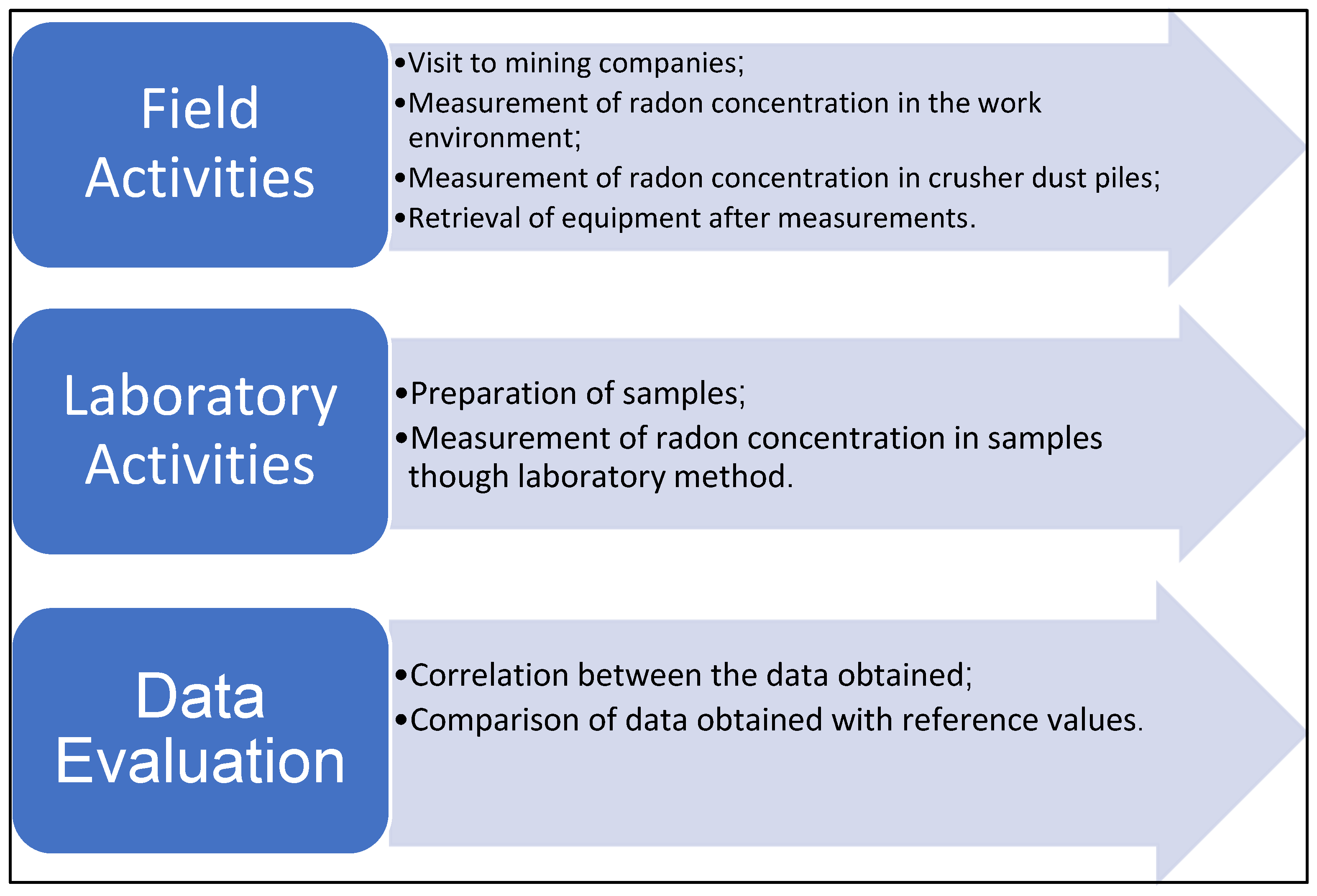
Physical and chemical agents in workplace environments can be hazardous for employees. Much of the exposure to ionizing radiation can occur due to the presence of radon in the workplace. Mining environments are more susceptible to containing radon gas because it emanates from soil or rocks. Radon is known to be associated with lung cancer as it is a gaseous chemical agent under normal conditions and is also radioactive. Since there is little knowledge about radon in Brazilian mining workplaces, this study aims to measure occupational exposure to radon in mining environments through a proposed methodology and to verify its compliance with international standards to confirm the potential risk of exposure for employees. Radon concentration in open-pit mining work environments was measured and used as a basis for comparison to assess the proposed new evaluation method, which will consist of laboratory evaluations of samples taken from the same workplaces. The radon concentration data in the work environments were compared to laboratory tests for statistical correlation. The results, compared to reference values, tolerance limits, and action levels, showed that radon, in outdoor mining workplaces, can be considered a low risk to employees’ health. The application of the methodology also indicated that the laboratory tests and the field evaluations presented a statistical correlation with each other, being an indication that the laboratory tests can be used to estimate the risks in a preliminary way. Another important point is the fact that it was observed that measurements in the laboratory were more practical and faster to perform when compared to field evaluations. These facts can bring future gains in the number of tests performed and workplace evaluated in mining environments.
Keywords: radon gas exposure risk; mining environments; radon gas measurement; ionizing radiation; scintillation cell detector radon gas exposure risk; mining environments; radon gas measurement; ionizing radiation; scintillation cell detector