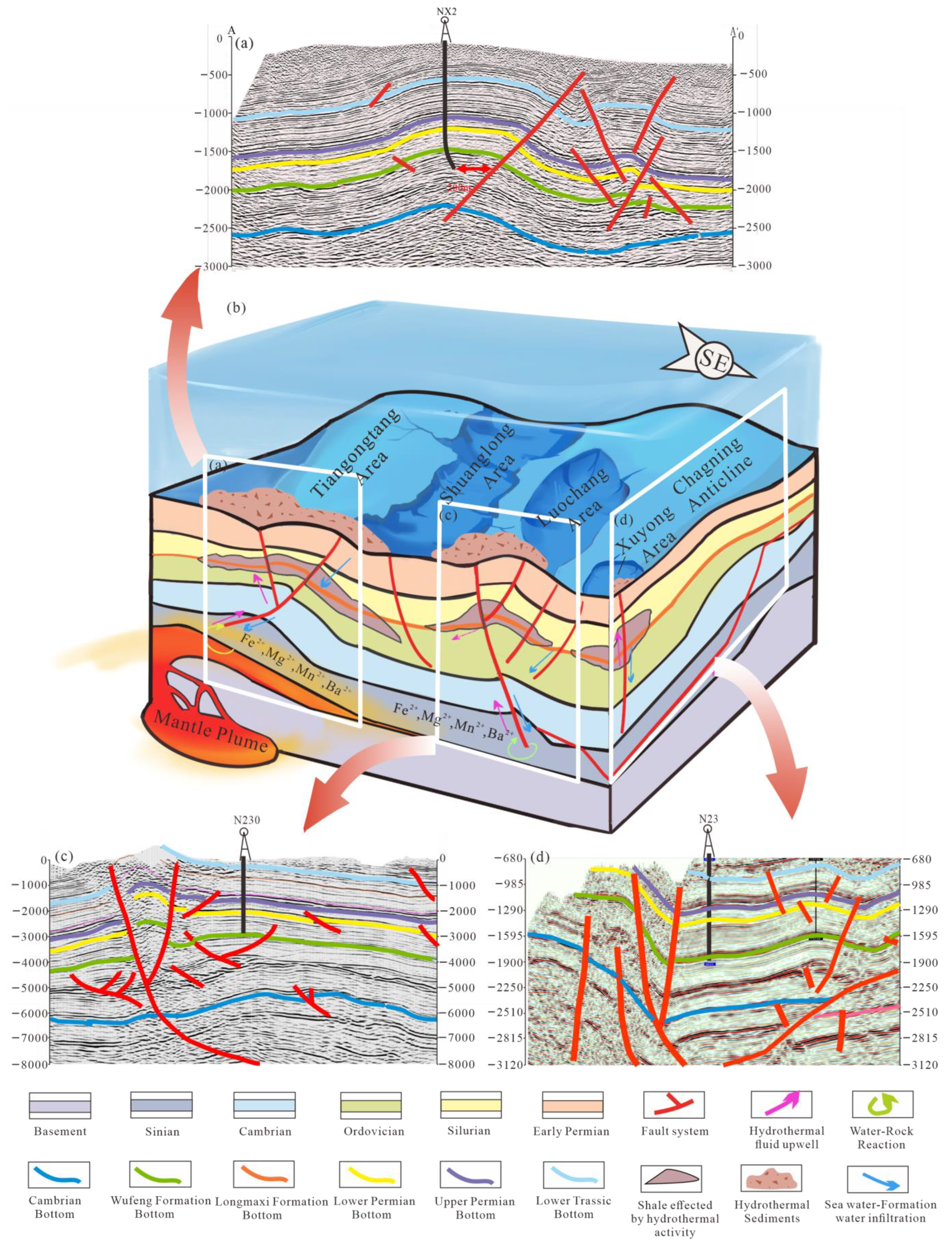
Influence of Low-Temperature Hydrothermal Events and Basement Fault System on Low-Resistivity Shale Reservoirs: A Case Study from the Upper Ordovician to Lower Silurian in the Sichuan Basin, SW China



Abstract
Share and Cite
Zhou, T.; Cai, J.; Mou, S.; Zhao, Q.; Shi, Z.; Sun, S.; Guo, W.; Gao, J.; Cheng, F.; Wang, H.; et al. Influence of Low-Temperature Hydrothermal Events and Basement Fault System on Low-Resistivity Shale Reservoirs: A Case Study from the Upper Ordovician to Lower Silurian in the Sichuan Basin, SW China. Minerals 2023, 13, 720. https://doi.org/10.3390/min13060720
Zhou T, Cai J, Mou S, Zhao Q, Shi Z, Sun S, Guo W, Gao J, Cheng F, Wang H, et al. Influence of Low-Temperature Hydrothermal Events and Basement Fault System on Low-Resistivity Shale Reservoirs: A Case Study from the Upper Ordovician to Lower Silurian in the Sichuan Basin, SW China. Minerals. 2023; 13(6):720. https://doi.org/10.3390/min13060720
Chicago/Turabian StyleZhou, Tianqi, Jingshun Cai, Shaomin Mou, Qun Zhao, Zhensheng Shi, Shasha Sun, Wei Guo, Jinliang Gao, Feng Cheng, Hongyan Wang, and et al. 2023. "Influence of Low-Temperature Hydrothermal Events and Basement Fault System on Low-Resistivity Shale Reservoirs: A Case Study from the Upper Ordovician to Lower Silurian in the Sichuan Basin, SW China" Minerals 13, no. 6: 720. https://doi.org/10.3390/min13060720
APA StyleZhou, T., Cai, J., Mou, S., Zhao, Q., Shi, Z., Sun, S., Guo, W., Gao, J., Cheng, F., Wang, H., Qi, L., & Liang, P. (2023). Influence of Low-Temperature Hydrothermal Events and Basement Fault System on Low-Resistivity Shale Reservoirs: A Case Study from the Upper Ordovician to Lower Silurian in the Sichuan Basin, SW China. Minerals, 13(6), 720. https://doi.org/10.3390/min13060720