1. Introduction
A vertex
u in a graph
G is said to
totally dominate a vertex
v if
u is adjacent to
v. A set
S of vertices in
G is a
total dominating set if every vertex of
G is totally dominated by at least one vertex of
S. Consequently, a graph
G has a total dominating set if and only if
G has no isolated vertices. The minimum cardinality of a total dominating set in
G is the
total domination number of
G. A total dominating set
S with
is called a
-set of
G. This concept was introduced by Cockayne, Dawes and Hedetniemi [
1] in 1980. More information on total domination in graphs (as well as some special classes of graphs) can be found in [
2,
3,
4,
5,
6,
7,
8], for example.
For a total dominating set
S of a graph
G, the number of vertices of
S that totally dominate a vertex
v of
G is denoted by
. While there exists no graph
G with a total dominating set
S such that
for every two distinct vertices
u and
v of
G, such sets exist for every two adjacent vertices
u and
v of
G. The concept of total domination has been studied extensively with many interesting results and applications (see [
5,
6], for example). A 2013 book by Henning and Yeo [
6] deals exclusively with total domination in graphs with many real life applications. Another area of research in graph theory is the study of graph coloring; its origin is the famous four-color problem. Today, graph coloring is one of the most popular areas of graph theory because of its numerous fascinating problems and applications to modern society. In a proper coloring of a graph, adjacent vertices are required to be colored differently. The minimum number of colors in a proper coloring of a graph
G is its chromatic number
. Combining total domination and proper graph coloring gave rise to proper total domination in graphs.
A total dominating set
S in a graph
G is a
proper total dominating set (or a
-dominating set) if
for every two adjacent vertices
u and
v of
G. This concept was introduced by Chartrand and studied in [
9,
10,
11,
12]. This concept has a close connection to the topics studied in [
13,
14,
15,
16] and the methodological and applied themes in proper total dominations align closely with many recent research topics in other areas of science (see [
17,
18], for example).
In general, it is challenging to determine whether a given graph possesses a
-dominating set. While several well-known classes of graphs have been shown to possess a
-dominating set, for many classes this remains unknown (see [
9,
11,
12]). Hence, the following observations are useful. A graph
G is
locally irregular if
for every two adjacent vertices
u and
v of
G (see [
19]). The vertex set
of a locally irregular graph
G is a total dominating set of
G since
for every vertex
v of
G. In fact, locally irregular graphs are the only graphs
G for which
is a
-dominating set.
Observation 1 ([
11])
. If S is a -dominating set of a connected graph G, then the subgraph induced by S is locally irregular without isolated vertices. Thus, while if and only if . Furthermore, the vertex set of a graph G is a -dominating set of G if and only if G is locally irregular. The set of vertices adjacent to a vertex v in a graph G is the neighborhood of v and the set is the closed neighborhood of v. Two vertices u and v in a graph G are called twins if . If u and v are adjacent vertices in a graph G such that , then u and v are adjacent twins.
Observation 2 ([
11])
. If u and v are adjacent twins of a connected graph G with -dominating set S, then exactly one of u and v belongs to S. Consequently, if G contains a complete subgraph of order such that every two vertices of are twins of G, then G has no -dominating set. In particular, every complete graph of order 3 or more has no -dominating set. The minimum cardinality of a
-dominating set in a graph
G is the
proper total domination number (
-domination number)
of
G. A
-dominating set
S with
is called a
-set of
G. The
-domination numbers have been determined for several well-known classes of graphs possessing a
-dominating set, including paths, cycles, trees, complete multipartite graphs, and Cartesian products
of a graph
G and
(see [
9,
11,
12]). Since proper total domination is more restrictive than total domination, it follows that
for every graph
G with a
-dominating set. Relationships between the classic total domination number and proper total domination number were investigated in [
9]. All pairs
of positive integers were determined for which there is a graph
G with a
-dominating set such that
and
. For each graph
G with a
-dominating set
S, the numbers in the set
give rise to a proper coloring of
G. The
proper total chromatic number of
G is the minimum value of
among all
-dominating sets
S of
G. Hence,
for every graph
G with a
-dominating set. Furthermore, it was shown in [
10] that for every pair
of positive integers with
, there is a graph
G with
and
. In general, it is challenging to determine the exact value of the
-domination number of a given graph having a
-dominating set. Among those graphs whose
-domination numbers have been determined are paths and cycles.
Theorem 1 ([
9])
. For an integer , let be a path of order n and a cycle of order n.- (a)
The path has a -dominating set if and only if . Furthermore, has a unique -dominating set and when .
- (b)
The cycle has a -dominating set if and only if . Furthermore, has a unique -dominating set and when and .
Results on paths and cycles have led to a study of classes of highly symmetric connected graphs related to paths and cycles. One such class consists of Cartesian products
where
G and
H are either paths or cycles in [
9,
12]. In particular, the grid
has a
-dominating set for all integers
with
(see [
9]). On the other hand, the prism
possesses a
-dominating set if and only if
is even. While the cylindrical graph
possesses a
-dominating set for every even integer
and every integer
, many cylindrical graphs
have no
-dominating set for odd integers
. For example,
possesses a
-dominating set if and only if
(see [
12]). For odd integers
, it is not known whether there is a characterization of cylindrical graphs
possessing a
-dominating set. While a cyclical graph
has a
-dominating set if at least one of
n and
m is even, the graph
does not possess a
-dominating set for each odd integer
. It is not known which cyclical graphs
possess a
-dominating set for odd integers
. Furthermore, for those grids, prims, cylindrical graphs, and cyclical graphs possessing a
-dominating set, the exact values of their
-domination numbers are not known in general. All of these lead us to consider two other well-known classes of highly symmetric graphs closely related to paths and cycles, namely, fans, wheels, and generalized fans and wheels.
For two vertex-disjoint graphs
F and
H, the graph
is the
join of
F and
H, that is,
and
. The graph
of order
is referred to as a
fan and the graph
of order
is a
wheel. More generally, for each positive integer
t, the graph
is referred to as a
generalized fan and the graph
is a
generalized wheel, where
is the empty graph of order
t. Here, we determine all generalized fans and all generalized wheels that possess a
-dominating set as well as their
-domination numbers. In
Section 2, all fans possessing a
-dominating set and their
-domination numbers are determined. In
Section 3, all wheels possessing a
-dominating set and their
-domination numbers are determined. We then extend results on fans and wheels to generalized fans and generalized wheels in
Section 4. We refer to the books [
5,
20] for notation and terminology not presented here.
2. Proper Total Domination in Fans
Since the fan has no -dominating set by Observation 2, we are only concerned with fans with . The following observation is useful.
Observation 3. Let G and H be connected graphs such that . If G does not have a -dominating set and H has a -dominating set, then every -dominating set of H contains at least one vertex not belonging to G.
Proof. Assume, to the contrary, that H has a -dominating set T such that . Let u and v be adjacent vertices of G. Since T is a -dominating set of H, it follows that , so T is a -dominating set of G, which is impossible. □
The following result describes those fans possessing a -dominating set.
Proposition 1. For an integer , the fan has a -dominating set if and only if .
Proof. In the fan
, let
and
. For
, the fan
has a
-dominating set. For example,
is a
-dominating set of
,
is a
-dominating set of
, and
is a
-dominating set of
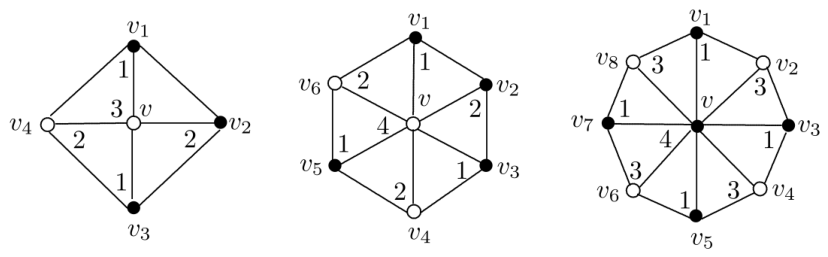
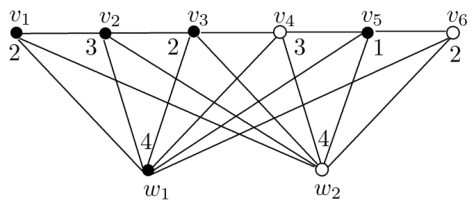
. (This is shown in
Figure 1).
Next, we show that does not have a -dominating set. Assume, to the contrary, that has a -dominating set S. Since is not locally irregular, it follows that is not a -dominating set by Observation 1 and thus . Furthermore, is locally irregular by Observation 1 again. Since has no -dominating set, it follows that by Observation 3.
- ⋆
First, suppose that . Since and the star of order 4 is the only connected locally irregular graph of order 4, it follows that , whose center is v. However, does not contain such an induced subgraph , which is a contradiction.
- ⋆
Next, suppose that . Since and is the only connected locally irregular graph of order 3, it follows that where . We may assume that either (1) or (2) . If (1) occurs, then , while if (2) occurs, then . A contradiction is produced in either case.
For , let . If is odd, then for odd integers i with , for even integers i with , and . If is even, then for odd integers i with , for even integers i with , , and . In either case, S is a -dominating set of . □
In order to determine the exact value of
for all those integers
n for which
has a
-dominating set, we first present some preliminary information. In the fan
, let
and
. For a
-dominating set
S of
, a
block B of with respect to S is a maximal set of consecutive vertices of
(or a maximal subpath of
) such that either all vertices of
B belong to
S or no vertices of
B belong to
S. The path
can therefore be expressed as one of the following four sequences, depending on the locations of the initial block and terminal block in the sequence:
such that
and
for
or
. The first block in a sequence is the
initial block of the sequence and the last block in a sequence is the
terminal block. First, we verify the following claims.
- Claim 1:
If B is a block with , then .
- Claim 2:
Let be a block with . If is the initial or terminal block, then and if is an interior block, then .
- Claim 3:
If is the initial block, then . Similarly, if is the terminal block where , then .
- ⋆
If Claim 1 is not true, then there is a block B with such that or . First, suppose that and where . If , then is dominated only by and v in S and is dominated only by and v in S. Thus, , which is impossible. If , then is dominated only by in S and is dominated only by in S. Thus, , which is impossible. Next, suppose that and for some integer . If , then is dominated only by , and v in S and is dominated only by and v in S. Thus, , which is impossible. If , then is dominated only by and in S and is dominated only by and in S. Hence, , which is impossible. This verifies Claim 1.
- ⋆
Assume, to the contrary, that Claim 2 is not true. First, suppose that is the initial block or the terminal block with . We may assume that for some integer . Since , it follows that and are dominated only by the vertex v. This implies that and , which is impossible. Next, suppose that is an interior block with . Then either or . For , let where and . If , then is dominated only by and v in S and is dominated only by and v in S. Thus, , which is impossible. If , then is dominated only by in S and is dominated only by in S. Hence, , which is impossible. For , let where , , and . Then and are dominated only by v. This implies that and , which is also impossible. This verifies Claim 2.
- ⋆
If Claim 3 is not true, then and thus by Claim 1. Since by Claim 2, it follows that where and . This implies that if and if , which is impossible. Similarly, if is the terminal block where , then . Thus, Claim 3 is true.
We are now prepared to determine the value of for all those integers n for which has a -dominating set.
Theorem 2. For an integer with , , for , , and for , Proof. In the fan , let and . First, suppose that and . For , let ; for , let ; for , let ; and for , let . In each case, S is a -dominating set of . Since , it remains to show that for . Assume, to the contrary, that for some integer n with . Let S be a -set of . Then and is a locally irregular graph (without isolated vertices) in . There are two graphs of order 3 without isolated vertices, namely and , while is not locally irregular. Thus, is the only locally irregular graph without isolated vertices of order 3. Hence, if , then . There are seven graphs of order 4 without isolated vertices, namely, , while only is locally irregular. Hence, if , then .
- ⋆
First, suppose that and . If , then either there exists that is adjacent to x such that or there exists that is adjacent to z such that , which is a contradiction. Thus, we may assume that . Then where and (since v is adjacent to every vertex of ). If , then ; if , then ; and if and , then . In each case, a contradiction is produced.
- ⋆
Next, suppose that and . Since v is adjacent to every vertex of , it is impossible to have an induced star of order 4 or more in whose center is not v. Thus, v is the center of . Let where . Then and . If , then . Thus, by Claim 2. Similarly, . However then, , which is impossible.
Thus, for .
Next, suppose that
. Since
is a
-dominating set of
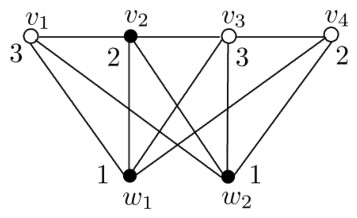
, it follows that
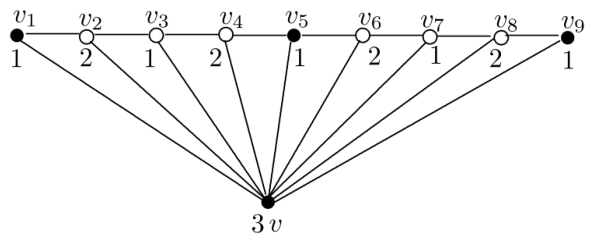
(see
Figure 2). Next, we show that
. Assume, to the contrary, that
. Let
S be a
-set of
. Since
is locally irregular,
. Thus, either (i)
for some integer
i with
or (ii)
where
and
. In either case, we may assume that
. If (i) occurs, then
is not dominated by any vertex of
S, a contradiction. If (ii) occurs, then
if
and
if
, also a contradiction. Thus,
.
For an integer , let where . We consider two cases.
Case 1. or for some integer . In this case, we show that
. Let
. Then
. Since
if
i is odd,
if
i is even, and
, it follows that
is a
-dominating set of
, so
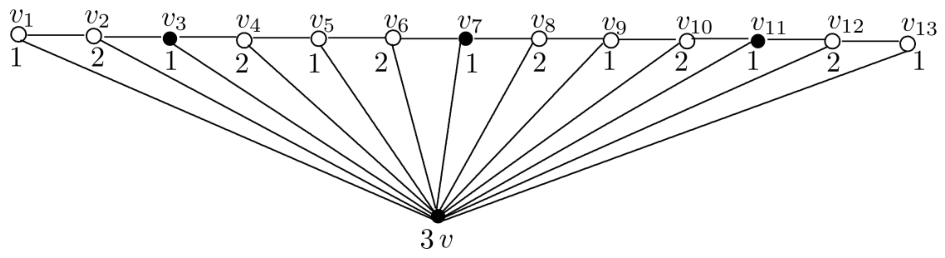
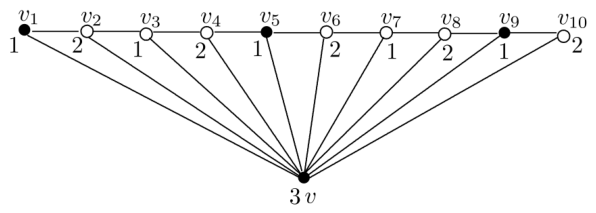
. (See
Figure 3 for
and a
-dominating set in
can be obtained by deleting the vertex
.) It remains to show that
. Assume, to the contrary, that there is an integer
for some integer
such that
has a
-dominating set
S for which
. By Claim 2, if
is a block of consecutive vertices on
such that
, then
. This implies that for every four consecutive vertices on
, at least one of these vertices belongs to
S. Thus,
and
. Further, there is a block
on
with
that is a 3-path
for some integer
j with
. However, in this case,
is not dominated by any vertex in
S, which is a contradiction. Notice that the set
is not a
-dominating set when
where
, since if
, then
contains two vertices of
and thus
. Therefore,
when
is necessary, as illustrated in
Figure 3.
Case 2. or for an integer . In this case, we show that
. Let
. Then
. Since
if
i is odd,
if
i is even, and
, it follows that
is a
-dominating set of
and thus
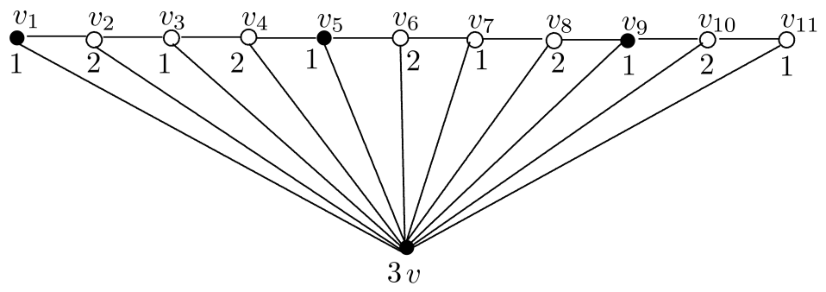
. (See
Figure 4 for
and a
-dominating set in
can be obtained by deleting the vertex
.) It remains to show that
. Assume, to the contrary, that that there is an integer
for some integer
such that
has a
-dominating set
S for which
. By Claims 1 and 2, for every four consecutive vertices in
, at least one of these vertices belongs to
S. Thus,
and
. Further, there is a block
in
with
that is a 3-path
for some integer
j with
. However then,
is not dominated by any vertex in
S, which is a contradiction. □
3. Proper Total Domination in Wheels
Since the wheel has no -dominating set, we assume that . First, we present some preliminary information. For the wheel , let and . For a -dominating set S of , a block B of with respect to S is a maximal set of consecutive vertices (or a maximal subpath) of if either all vertices of B belong to S or no vertices of B belong to S. The cycle can therefore be expressed as a sequence of blocks for some positive integer k such that and for . We verify the following claim.
- Claim:
For each integer i with , and .
Suppose that this claim is false. We may assume, without loss of generality, that either or . Let and where either or . If , then . If , then . Thus, and are impossible. Therefore, for . If , then ; while if , then . Thus, and are impossible. Consequently, for . This verifies the claim.
Proposition 2. For an integer , the wheel has a -dominating set if and only if n is even.
Proof. For the wheel
, let
and
. If
, then
is a
-dominating set of
, while if
, then
is a
-dominating set of
. If
, let
. See
Figure 5. Since
for odd integers
i with
,
for even integers
i with
, and
, it follows that
S is a
-dominating set of
.
There remains a need to verify the converse. Assume, to the contrary, that there is an odd integer such that has a -dominating set S. Then the cycle in is then expressed as a sequence of blocks for some positive integer k such that and for . By the claim, is even, which is a contradiction. □
We now determine the value of for every even integer .
Theorem 3. For an even integer , , , , and for , Proof. For the wheel where is an even integer, let and . Since where is a -set of , we may assume that . First, suppose that .
- ⋆
For , the set is a -dominating set of and thus . Assume, to the contrary, that has a -set S with . Then is locally irregular by Observation 1. If , then S is not a total dominating set of , a contradiction. If , then we may assume that where . However then, , a contradiction. Thus, , so
- ⋆
For , the set is a -dominating set of and thus . Assume, to the contrary, that has a -set S with . Then and is locally irregular by Observation 1. If , then . If , then S is not a total dominating set of , a contradiction. If , then we may assume that where . However then, . If , then is a star centered at v. We may assume that where and . If , then , a contradiction. By the claim, . Similarly, and thus , which is impossible since . Thus, and thus .
- ⋆
For , the set is a -dominating set of and thus . Assume, to the contrary, that has a -set S with . Then and is locally irregular by Observation 1. If , then . If , then S is not a total dominating set of , a contradiction. If , then we may assume that where . However, . If , then is a star centered at v. We may assume that where and . If , then , a contradiction. By the claim, and . However, , a contradiction. Thus, , so .
Next, suppose that . Thus, either or for some integer . We consider these two cases.
Case 1. for some integer . We show that
. Let
Then . Since if i is odd, if i is even, and , it follows that is a -dominating set of , so .
It remains to be shown that . Assume, to the contrary, that there is an integer for some integer such that has a -dominating set S for which . By the claim, for every four consecutive vertices on , at least one of these vertices belongs to S. Thus, and . Further, there is a block on such that . However, in this case, y is not dominated by any vertex in S, which is a contradiction. Therefore, and thus .
Case 2. for some integer . We show that
. Let
Then . Since if i is odd, if i is even and , , and , it follows that is a -dominating set of and thus .
It remains to show that . Assume, to the contrary, that there is an integer for some integer such that has a -dominating set S for which . By the claim, for every four consecutive vertices on , at least one of these vertices belongs to S. Thus, and . Further, there is a block such that . However then, y is not dominated by any vertex in S, which is a contradiction. Therefore, , so . □
4. Proper Total Domination in Generalized Fans and Wheels
In this section, we extend the results obtained in
Section 2 and
Section 3 to more generalized fans
and wheels
for every positive integer
t, where
is the empty graph of order
t. For a
-dominating set
S in a graph
G, let
First, we establish a connection between a
-dominating set in the graph
and a
-dominating set in the graph
for an integer
.
Theorem 4. For a graph G, let for a positive integer t.
- (a)
If has a -dominating set S, then S is also a -dominating set of for each integer and thus .
- (b)
If has a -dominating set T for some integer such that , then has a -dominating set.
Proof. Let . If , then in .
First, we verify (a). Suppose that
S is a
-dominating set in
. We show that
S is a
-dominating set of
for each integer
. Since a vertex in
is dominated only by a vertex in
G, it follows that
and
for
. Let
u and
v be adjacent vertices of
. Then at least one of
u and
v belongs to
G, say
. If
, then
since
S is a
-dominating set of
. If
, then
, again, since
S is a
-dominating set of
. Thus,
S is a
-dominating set of
. This is illustrated in
Figure 6 for
and
, so
and
. Furthermore, if
S is a
-set of
, then
S is a
-dominating set of
for each integer
and thus
.
Next, we verify (b). Suppose that T is a -dominating set of for some integer such that . We show that has a -dominating set.
- ⋆
First, suppose that . Then for . Let u and v be adjacent vertices of . We may assume that . If , then since T is a -dominating set of . If , then , again since T is a -dominating set of . Thus, T is a -dominating set of .
- ⋆
Next, suppose that
. Thus,
T contains at least one vertex in
. Let
where
and
. Then
and
. We may assume that
. Let
,
, and
. Then
for
. Next, let
. We show that
is a
-dominating set of
. Let
u and
v be adjacent vertices of
. We may assume that
. If
, then
and thus
. Thus, we may assume that
. If
, then
since
T is a
-dominating set of
. If
, then
and
. Since
, it follows that
. Thus,
is a
-dominating set of
. This is illustrated in
Figure 7 for
and
and thus
and
.
□
Figure 7.
A -dominating set in .
Figure 7.
A -dominating set in .
The condition that for every vertex x of G in Theorem 4 is necessary. For example, consider the generalized fan where and and let . Since , , and , it follows that T is a -dominating set of . By Proposition 1, the graph does not have a -dominating set.
The following are consequences of Propositions 1 and 2 and Theorem 4.
Corollary 1. For positive integers n and t where ,
- (a)
The generalized fan has a -dominating set if and only if ;
- (b)
The generalized wheel has a -dominating set if and only if n is even.
Proof. First, we verify (a). By Proposition 1, the graph does not have a -dominating set. For the converse, assume that . For the graph where , let and let and be two vertices in . Then is a -dominating set of . By Proposition 1 and Theorem 4, the graph has a -dominating set for integers and such that .
Next, we verify (b). An argument similar to that in the proof of Proposition 2 shows that if is odd and , then does not have a -dominating set. For the converse, if n is even and , then has a -dominating set by Proposition 2 and Theorem 4. □
Next, we determine the -domination numbers of those generalized fans and generalized wheels possessing a -dominating set for each integer . In order to show this, we first present a lemma.
Lemma 1. For a graph G, let for a positive integer t and let T be a -dominating set of H. If is a total dominating set of G, then is a -dominating set of G. In particular, if , then T is a -dominating set of G.
Proof. Let and let . Since each vertex is adjacent to every vertex in , it follows that . Furthermore, since S is a total dominating set of G, it follows that for every vertex x of G. Let u and v be adjacent vertices of G. Since T is a -dominating set of H, it follows that . Thus, . Therefore, S is a -dominating set of G.
In particular, if , then . Since T is a -dominating set of H, every vertex of G is totally dominated by a vertex of T and thus T is a total dominating set of G. Consequently, T is a -dominating set of G. □
The condition that
is a total dominating set of
G in Lemma 1 is necessary. For example, consider the fan
where
and
. Let
in
(see
Figure 8). Since
,
if
i is odd and
, while
if
i is even and
, it follows that
T is a
-dominating set of
. However,
is not a total dominating set of
, so it is not a
-dominating set of
. In fact,
has no
-dominating set by Theorem 1.
Theorem 5. For integers and , Proof. For the generalized fan , let and where and . First, we show that if , then . By Observation 1, it suffices to show that has a three-element -dominating set.
- ⋆
For , let . Since , , and for , it follows that S is a -dominating set of .
- ⋆
For , let . Since for , for , and for , it follows that S is a -dominating set of .
- ⋆
For , let . Since for , for , and for , it follows that S is a -dominating set of .
Thus, if and .
Next, we show that if , then for each integer . Since by Theorem 4, it remains to show that . Assume, to the contrary, that there exist integers and such that . Let T be a -set of . We consider two cases, according to whether or .
Case 1. . It follows by Lemma 1 that T is a -dominating set of . Since has a -dominating set if and only if by Theorem 1, there is a contradiction if . On the other hand, if , then has a unique -dominating set of cardinality , so by Theorem 1. However, then, by Theorem 2, which is impossible. Therefore, Case 1 cannot occur.
Case 2. . Let where and . We may assume, without loss of generality, that . Then and . Thus, and . Notice that for and for . Let . We show that is a -dominating set of . Let x and y be adjacent vertices of . Then at least one of x and y belongs to . First, suppose that , say and where . Since and for , it follows that . Hence, . Next, suppose that exactly one of x and y belongs to , say, and . Then and . Since , it follows that . Therefore, if , then . There remains for consideration the situation where . For this purpose, the block structure of the generalized fans needs to be investigated.
A block
B of
with respect to
S is a maximal set of consecutive vertices of
(or a maximal subpath of
) such that either all vertices of
B belong to
S or no vertices of
B belong to
S. The path
can therefore be expressed as one of the following four sequences, depending on the locations of the initial block and terminal block in the sequence
such that
and
for
or
. The following claims can be verified by arguments similar to that used in the case of the fans.
- Claim 1:
If B is a block with , then
- Claim 2:
Let be a block with . If is the initial or terminal block, then , while if is an interior block, then
- Claim 3:
If is the initial block, then . Similarly, if is the terminal block where , then
First, we show that if , then . Assume, to the contrary, that . By Claims 1 and 2, for every four consecutive vertices on , at least one vertex is in S, so . Thus, and for every block in S. If , then since S contains at least three vertices in , a contradiction. Thus, we may assume that . If , then since S contains at least three vertices in , a contradiction. Hence, and thus by Claim 3. This forces , , and for . Since , the terminal block is not in S and contains at least three vertices, which contradicts Claim 2. Therefore, if , then .
Thus, we may assume that . By Theorem 2, if , then , while if , then . We consider these two possibilities.
Subcase . . We show that for each integer . Assume, to the contrary, that for some integer n with and an integer . Let T be a -set of . Then and is a locally irregular graph (without isolated vertices) in . If , then , while if , then .
- ⋆
First, suppose that and . If , then since , there is a vertex of that is not totally dominated by any vertex in T, which is a contradiction. If , then we may assume that (i) where or (ii) . If (i) occurs, then (when ), (when ), and (when and ), which is impossible. If (ii) occurs, then we may assume that and . Since , it follows that , which is impossible.
- ⋆
Next, suppose that and . Thus, either (i) the center of is a vertex in or (ii) the center of is a vertex of and . If (i) occurs, we may assume that is the center of . Let where . Then and . By Claim 2, it follows that and . If , then , which is impossible. Thus, . Similarly, . This implies that , which is also impossible. If (ii) occurs, we may assume that and . Since , it follows that , which too is impossible.
Thus, for and .
Subcase . . We show that for each integer . Assume, to the contrary, that for some integer n with and an integer . Let T be a -set of . Then , an argument similar to that in Subcase when shows that a contradiction is produced. Thus, for and . □
We saw in Theorem 4 that for every integer . By Theorem 5, for every integer . Since by Theorem 2, it follows that and hence strict inequality is possible.
Theorem 6. For integers n and where is even, Proof. For the generalized wheel where is even and , let and . By Theorem 4, for every integer . It remains to show that . Since , it follows by Observation 1 that for every integer . Thus, we may assume that n is even and . Assume, to the contrary, that for some integers n and where is even. Let T be a -set of . We consider two cases, according to whether or .
Case 1. . By Lemma 1, T is a -dominating set of . Since has a unique -dominating set of cardinality , it follows that by Theorem 1. However, in this case, by Theorem 3. This is impossible since . Therefore, Case 1 cannot occur.
Case 2. . Let where and . We may assume, without loss of generality, that . Then and . Thus, and . Furthermore, for and for . Let . We show that is a -dominating set of . Let x and y be adjacent vertices of . Then at least one of x and y belongs to . First, suppose that , say and where . Since and for , it follows that . Hence, . Next, suppose that exactly one of x and y belongs to , say and . Then and . Since , it follows that . Therefore, if , then . There remains a need to consider a situation when . Once again, the block structure of the generalized wheels needs to be investigated.
A block B of with respect to S is a maximal set of consecutive vertices of (or a maximal subpath of ) if either all vertices of B belong to S or no vertices of B belong to S. The cycle can therefore be expressed as a sequence of blocks for some positive integer k such that and where . The following claim can be verified by the argument used in the case of .
- Claim:
For each integer i with , and .
First, we show that if n is even and , then . Assume, to the contrary, that . By the claim, for every four consecutive vertices on , there is at least one vertex in S and thus . Thus, and for every block in S. We may assume that . Since S contains at least three vertices in , it follows that , which is a contradiction. Therefore, if , then .
Thus, we may assume that n is even and . By Theorem 3, if , then , while if , then . We consider these two subcases.
Subcase . . We show that for every integer . Assume, to the contrary, that for some even integer and an integer . Let T be a -set of . Since is locally irregular, . If , then we may assume that . However, is not dominated by any vertex of T, which is impossible. If , then we may assume that (i) where or (ii) . If (i) occurs, then since , while if (ii) occurs, then . In either case, a contradiction is produced. Thus if and .
Subcase . . We show that for every integer . Assume, to the contrary, that for some integer and an integer . Let T be a -set of . Then . The argument used in Subcase shows that . Hence, and . Thus, either (i) the center of is a vertex in or (ii) the center of is a vertex of and . If (i) occurs, we may assume that is the center of where for . By Claim 2, it follows that and . If , then , which is impossible. Thus, and or , which is impossible if . If , then , which is impossible. If (ii) occurs, we may assume that and . However, then , which too is impossible. □