Impacts of Occlusion on the Symmetry of Gait Representations for Age and Gender Estimation


Abstract
1. Introduction
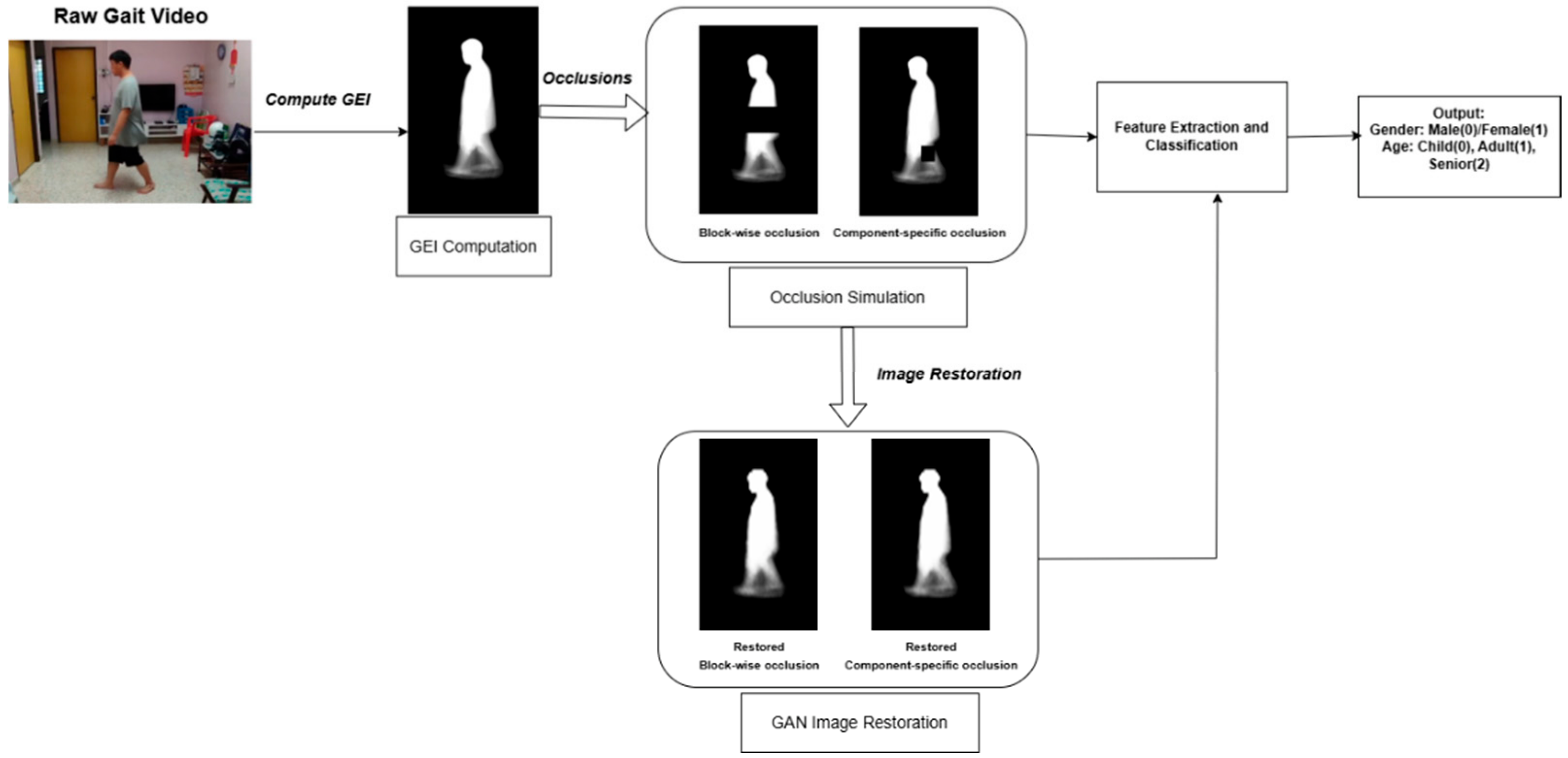
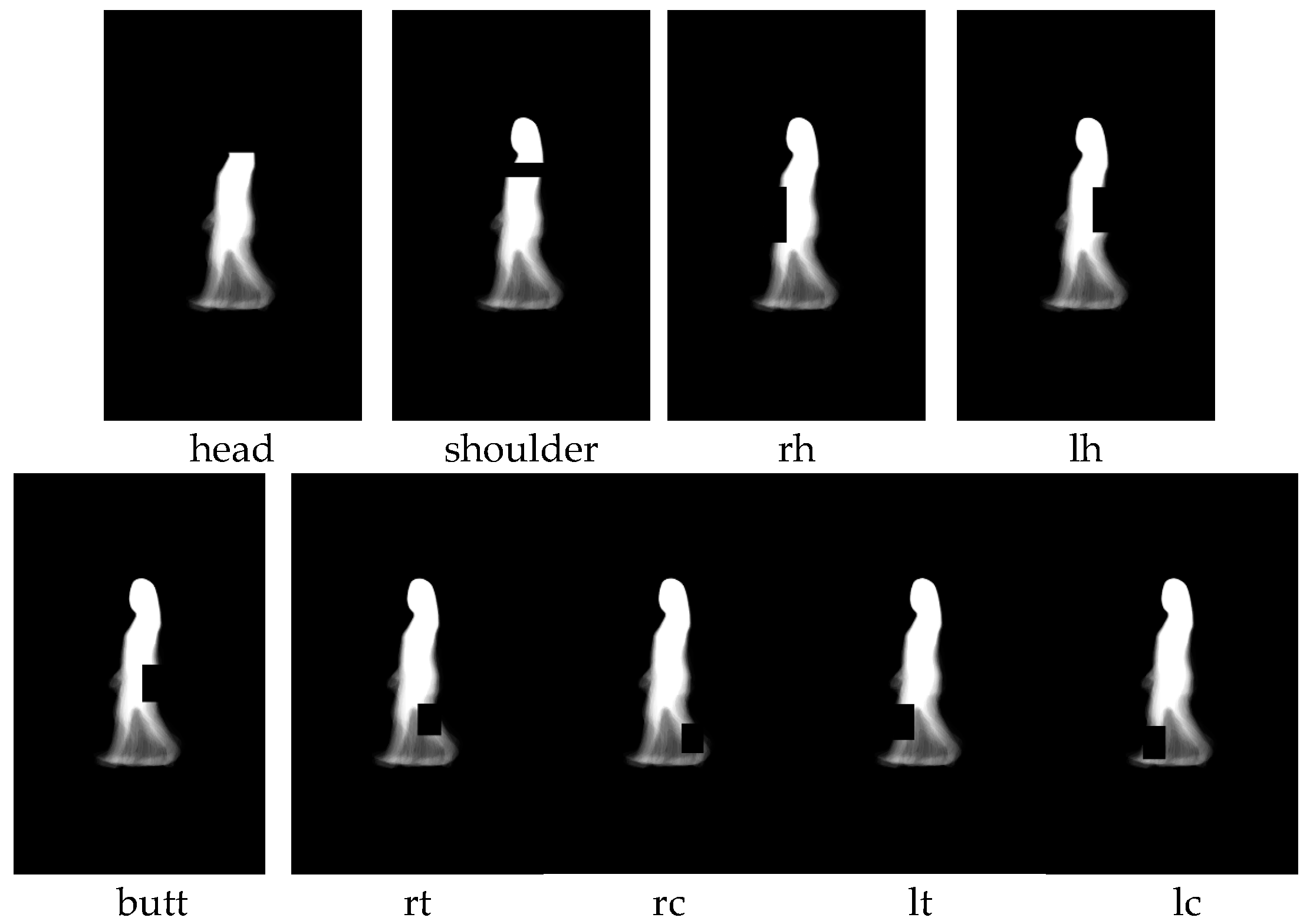
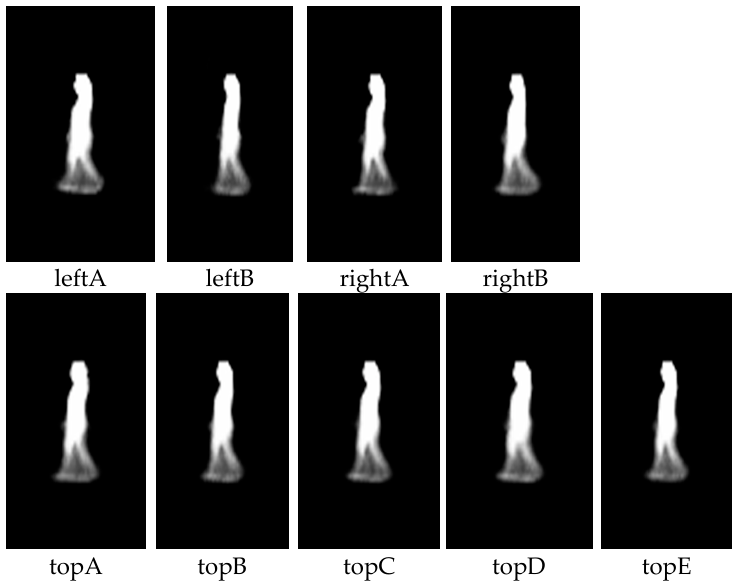
- A systematic investigation of the effects of block-wise and component-specific occlusions on gait-based age and gender estimation using Gait Energy Images (GEIs).
- A quantitative analysis of the relative importance of different body regions under occlusion, providing insights into which anatomical components contribute most significantly to age and gender estimation.
- An evaluation of the influence of occlusion size and location on recognition performance, highlighting the vulnerability of specific gait regions to information loss.
- An assessment of GAN-based image restoration for recovering discriminative gait information and mitigating the performance degradation caused by occlusion.
2. Materials and Methods
2.1. Data Collection
2.2. Gait Energy Image (GEI)
2.3. Occlusion Simulation
2.3.1. Block-Wise Occlusion
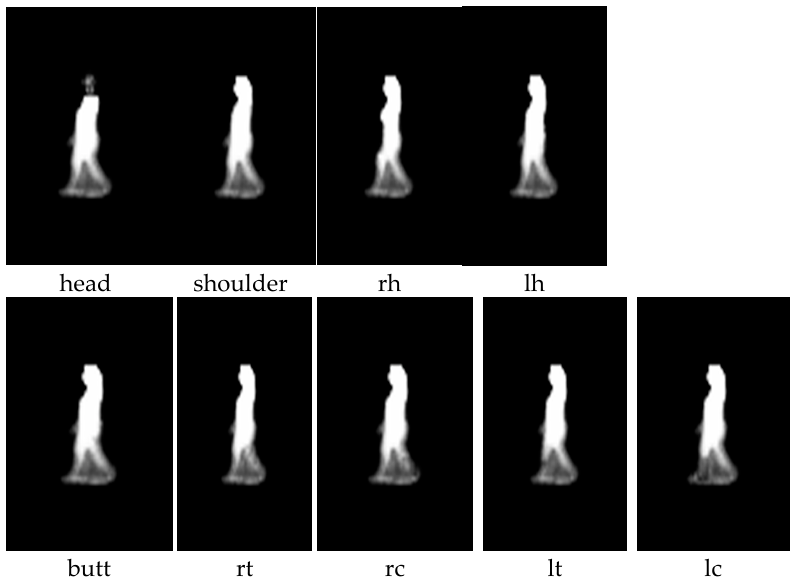
2.3.2. Component Specific Occlusion
2.4. Feature Extraction and Classification
2.5. GAN Image Restoration
3. Results
3.1. Assessment of Full GEI
3.2. Block-Wise Occlusion Results
3.3. Component-Specific Occlusion Results
3.4. Restored GEI
3.5. Evaluation Results Using Restored Block-Wise Occluded GEIs
3.6. Evaluation Results Using Restored Component-Specific Occluded GEIs
3.7. Comparison with State-of-the-Arts
3.8. Cross-Architecture Validation
4. Discussion
- As expected, models trained on occluded GEI data have lower test accuracy compared to models that use non-occluded GEI. This shows the detrimental effect of information loss due to occlusion. The bigger the occlusion proportion is, the less information can be obtained from the image for recognition.
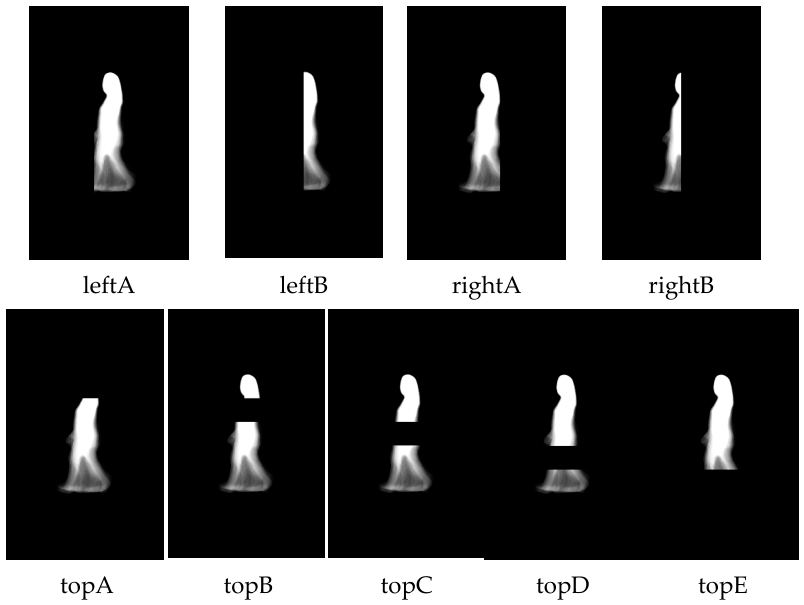
- In block-wise occlusion, the leftA and rightA occlusions yield a higher accuracy compared to others, such as leftB and rightB. This is because leftA and rightA affect smaller portions of the GEI silhouette, while leftB and rightB cover half of the body width. This confirms that the size of occlusions affects the gait recognition performance.
- Horizontal occlusions have accuracies ranging from 57% to 65% for the gender model in block-wise occlusion. This suggests that even with block-wise obstruction of upper body posture, head movement and shoulder swing, there is sufficient information for gender recognition. The observed drop in accuracy with occluding upper body (topA, topB) and lower limbs (topD, topE) indicates the contribution of these regions (e.g., stride length, body posture, arm swing) to gender recognition.
- The age model with occlusion in block-wise occlusion has similar results as the gender model but it has the lowest accuracy of 29% for topB occlusion. The topB occlusion covers the upper torso and shoulders of the subject GEI. This implies that information contained around the shoulder area is critical for age estimation. The possible reason could be that older people tend to have rounded shoulders, causing a stooped posture which differentiates them from subjects in other age groups.
- In component-specific occlusion, the lowest accuracy occurs with head occlusion for the gender model, while the age model generally has lower accuracy for each component compared to the gender model.
- For the gender model in component-specific occlusion, the left calf (lc) occlusion gives the highest accuracy. The right calf (rc) occlusion also has high accuracy. This means that the calf component might be a region that provides discriminative information for gender classification.
- For the age model in component-specific occlusion, shoulder occlusion yields the lowest accuracy for both model evaluations, which indicates that the shoulder is the most vital information for age estimation, which is consistent with the block-wise occlusion findings.
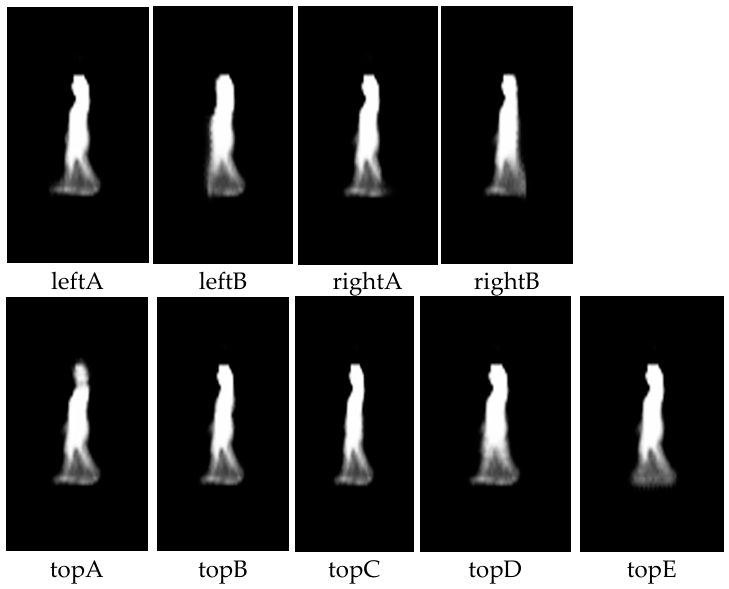
- The gender model trained on restored block-wise-occluded GEIs produces higher accuracy across various originally occluded areas.
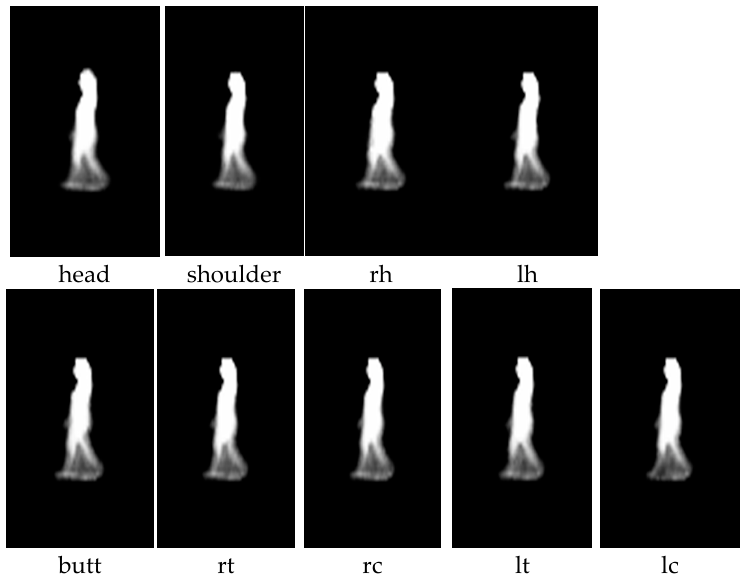
- For the age model, the accuracy improvement across nine parts helps the model to classify the age more accurately due to restored component-specific images.
- TopB occlusion that makes the age model struggle at first improves from 29% accuracy to 70% after restoration.
- Restoration in block-wise occlusion helps the models to improve significantly by restoring missing information, especially on occluded parts like leftB and rightB that occlude a large area.
- Restoration of component-specific occlusion also enhances the performance of both the gender and age models.
- The gender model can exceed 80% accuracy for most of the parts.
- GAN restoration performs well in restoring component-specific occlusions because they are relatively smaller than block-wise occlusions, yielding higher average PSNR and SSIM and a more realistic and accurate restored image.
- Specific GAN restores occluded GEIs better than general GAN because each occlusion can have its own custom settings, enabling GAN to adapt to various types of occlusions.
- The restoration framework employed in this study operates on GEIs rather than raw gait sequences. Consequently, the GAN reconstructs missing spatial information from the aggregated gait representation without explicitly modeling temporal continuity between consecutive frames. While GEIs have been widely adopted due to their compact representation and computational efficiency, temporal gait characteristics may contain additional discriminative information that is not captured in the current framework. Future studies may investigate sequence-based restoration approaches that incorporate temporal dependencies using recurrent networks, ConvLSTM architectures, or transformer-based models.
- Experimental results show that the Adult class achieved the highest F1-score (0.84), followed by the Child class (0.82), while the Senior class obtained a lower F1-score of 0.64. The reduced performance for the Senior class may be attributed in part to the smaller number of Senior participants in the dataset compared to the Adult group. Nevertheless, the model was still able to identify Senior subjects with reasonable precision and recall, indicating that the class remains distinguishable despite the demographic imbalance. Since all occlusion experiments were conducted using the same class distribution, the comparative analysis of occlusion effects remains consistent across experimental conditions.
- The cross-architecture validation experiment demonstrates that the primary findings of this study remain consistent across different classification backbones. Although ResNet18 achieved higher overall accuracy than the lightweight CNN because of its greater representational capacity, both models exhibited similar sensitivity to occlusions affecting the upper body. This observation suggests that the identified importance of specific gait regions is attributable to the underlying gait information rather than the characteristics of a particular classifier architecture.
- Although the occlusions considered in this study are synthetically generated, the findings provide practical insights into the spatial importance of different body regions for gait-based age and gender estimation. In particular, the results demonstrate that upper-body information contributes significantly to recognition performance and should therefore be prioritized when designing occlusion-aware gait analysis systems.
5. Limitations
6. Conclusions
Author Contributions
Funding
Institutional Review Board Statement
Informed Consent Statement
Data Availability Statement
Conflicts of Interest
References
- Ti, Y.F.; Connie, T.; Goh, M.K.O. GenReGait: Gender Recognition Using Gait Features. J. Inform. Web Eng. 2023, 2, 129–140. [Google Scholar] [CrossRef]
- Vora, C.; Katkar, V.; Lunagaria, M. GAIT Analysis Based on GENDER Detection Using Pre-Trained Models and Tune Parameters. Discov. Artif. Intell. 2024, 4, 19. [Google Scholar] [CrossRef]
- Alguliyev, R.; Aliguliyev, R.; Sukhostat, L. Human Gender Classification and Age Estimation Based on Gait Images Using Deep Learning. Multimed. Tools Appl. 2025, 84, 49055–49069. [Google Scholar] [CrossRef]
- Li, X.; Makihara, Y.; Xu, C.; Yagi, Y. GaitAGE: Gait Age and Gender Estimation Based on an Age- and Gender-Specific 3D Human Model. IEEE Trans. Biom. Behav. Identity Sci. 2025, 7, 47–60. [Google Scholar] [CrossRef]
- Saleem, A.A.; Siddiqui, H.U.R.; Sehar, R.; Dudley, S. Gender Classification Based on Gait Analysis Using Ultrawide Band Radar Augmented with Artificial Intelligence. Expert Syst. Appl. 2024, 249, 123843. [Google Scholar] [CrossRef]
- Aderinola, T.B.; Connie, T.; Ong, T.S.; Teoh, A.B.J.; Goh, M.K.O. AggreGait: Automatic Gait Feature Extraction for Human Age and Gender Classification with Possible Occlusion. Array 2025, 26, 100379. [Google Scholar] [CrossRef]
- Tan, V.W.S.; Ooi, W.X.; Chan, Y.F.; Connie, T.; Goh, M.K.O. Vision-Based Gait Analysis for Neurodegenerative Disorders Detection. J. Inform. Web Eng. 2024, 3, 136–154. [Google Scholar] [CrossRef]
- Song, X.; Hou, S.; Huang, Y.; Cao, C.; Liu, X.; Huang, Y.; Shan, C. Gait Attribute Recognition: A New Benchmark for Learning Richer Attributes from Human Gait Patterns. IEEE Trans. Inf. Forensics Secur. 2024, 19, 1–14. [Google Scholar] [CrossRef]
- Chen, Y.-J.; Chen, L.-X.; Lee, Y.-J. Systematic Evaluation of Features From Pressure Sensors and Step Number in Gait for Age and Gender Recognition. IEEE Sens. J. 2022, 22, 1956–1963. [Google Scholar] [CrossRef]
- Mukherjee, M.; Faisal, A.I.; Balakrishnan, N.; Kumar, S.; Deen, M.J. An Inferential Model for Understanding the Effects of Demographic and Gait Factors and Their Interactions on the Human Gait Index: A Beta Regression Approach. IEEE J. Biomed. Health Inform. 2025, 29, 7593–7606. [Google Scholar] [CrossRef] [PubMed]
- Lu, J.; Tan, Y.P. Gait-Based Human Age Estimation. IEEE Trans. Inf. Forensics Secur. 2010, 5, 761–770. [Google Scholar] [CrossRef]
- Hasan, K.; Uddin, M.Z.; Ray, A.; Hasan, M.; Alnajjar, F.; Ahad, M.A.R. Improving Gait Recognition Through Occlusion Detection and Silhouette Sequence Reconstruction. IEEE Access 2024, 12, 158597–158610. [Google Scholar] [CrossRef]
- Bharti, J.; Tomar, D.S.; Bhattacharjee, S. Gait Estimation of Occluded ROIs Using Interpolation Techniques and Testing Their Performance in Speed Variation in Gait. Procedia Comput. Sci. 2025, 258, 3826–3856. [Google Scholar] [CrossRef]
- Xu, C.; Makihara, Y.; Li, X.; Yagi, Y. Occlusion-Aware Human Mesh Model-Based Gait Recognition. IEEE Trans. Inf. Forensics Secur. 2023, 18, 1309–1321. [Google Scholar] [CrossRef]
- Li, T.; Ma, W.; Zheng, Y.; Fan, X.; Yang, G.; Wang, L.; Li, Z. A Survey on Gait Recognition against Occlusion: Taxonomy, Dataset and Methodology. PeerJ Comput. Sci. 2024, 10, e2602. [Google Scholar] [CrossRef] [PubMed]
- Qin, H.; Chen, Z.; Guo, Q.; Wu, Q.M.J.; Lu, M. RPNet: Gait Recognition With Relationships Between Each Body-Parts. IEEE Trans. Circuits Syst. Video Technol. 2022, 32, 2990–3000. [Google Scholar] [CrossRef]
- Wang, Z.; Hou, S.; Zhang, M.; Liu, X.; Cao, C.; Huang, Y. GaitParsing: Human Semantic Parsing for Gait Recognition. IEEE Trans. Multimed. 2024, 26, 4736–4748. [Google Scholar] [CrossRef]
- Kumar, S.S.; Singh, B.; Chattopadhyay, P.; Halder, A.; Wang, L. BGaitR-Net: An Effective Neural Model for Occlusion Reconstruction in Gait Sequences by Exploiting the Key Pose Information. Expert Syst. Appl. 2024, 246, 123181. [Google Scholar] [CrossRef]
- Ali, Z.; Moon, J.; Gillani, S.; Afzal, S.; Bukhari, M.; Rho, S. A Region-Aware Deep Learning Model for Dual-Subject Gait Recognition in Occluded Surveillance Scenarios. CMES Comput. Model. Eng. Sci. 2025, 144, 2263–2286. [Google Scholar] [CrossRef]
- Zhang, S.; Wang, Y.; Li, A. Gait Energy Image-Based Human Attribute Recognition Using Two-Branch Deep Convolutional Neural Network. IEEE Trans. Biom. Behav. Identity Sci. 2023, 5, 53–63. [Google Scholar] [CrossRef]
- Awai, S.; Chikano, M.; Konno, T. Gait Recognition Using Occlusion Classification in Security Cameras. In Proceedings of the 2023 IEEE 12th Global Conference on Consumer Electronics (GCCE), Nara, Japan, 10–13 October 2023; pp. 520–521. [Google Scholar] [CrossRef]
- Paul, A.; Jain, M.M.; Jain, J.; Chattopadhyay, P. Gait Cycle Reconstruction and Human Identification from Occluded Sequences. arXiv 2022, arXiv:2206.13395. [Google Scholar]
- Xu, C.; Tsuji, S.; Makihara, Y.; Li, X.; Yagi, Y. Occluded Gait Recognition via Silhouette Registration Guided by Automated Occlusion Degree Estimation. In Proceedings of the 2023 IEEE/CVF International Conference on Computer Vision Workshops (ICCVW), Paris, France, 4–6 October 2023; pp. 3191–3201. [Google Scholar]
- Gupta, A.; Chellappa, R. You Can Run but Not Hide: Improving Gait Recognition with Intrinsic Occlusion Type Awareness. In Proceedings of the 2024 IEEE/CVF Winter Conference on Applications of Computer Vision (WACV), Waikoloa, HI, USA, 3–8 January 2024; pp. 5881–5890. [Google Scholar]
- Dong, A.; Zhang, J.; Xu, W.; Jia, J.; Yun, S.; Yu, J. Wi-FiAG: Fine-Grained Abnormal Gait Recognition via CNN-BiGRU with Attention Mechanism from Wi-Fi CSI. Mathematics 2025, 13, 1227. [Google Scholar] [CrossRef]
- Mazzieri, R.; Pegoraro, J.; Rossi, M. Open-Set Gait Recognition from Sparse mmWave Radar Point Clouds. IEEE Sens. J. 2025, 25, 33051–33063. [Google Scholar] [CrossRef]
- Huan, R.; Dong, G.; Cui, J.; Jiang, C.; Chen, P.; Liang, R. INSENGA: Inertial Sensor Gait Recognition Method Using Data Imputation and Channel Attention Weight Redistribution. IEEE Sens. J. 2025, 25, 39197–39219. [Google Scholar] [CrossRef]
- Abirami, B.; Subashini, T.S.; Mahavaishnavi, V. Automatic Age-Group Estimation from Gait Energy Images. Mater. Today Proc. 2020, 33, 4646–4649. [Google Scholar] [CrossRef]
- Wang, X.; Yan, W.Q. Human Gait Recognition Based on Frame-by-Frame Gait Energy Images and Convolutional Long Short-Term Memory. Int. J. Neur. Syst. 2020, 30, 1950027. [Google Scholar] [CrossRef] [PubMed]
- Yan, J.; Yang, Z.; Lin, Y.; Zhou, W. Multi-Attention Augmented Spatio-Temporal Graph Convolution Network for Gait Recognition Based on IMUs Data. In Proceedings of the 2025 2nd International Conference on Electronic Engineering and Information Systems (EEISS), Nanjing, China, 23–25 May 2025; pp. 1–4. [Google Scholar]
- Yu, S.; Liao, R.; An, W.; Chen, H.; García, E.B.; Huang, Y.; Poh, N. GaitGANv2: Invariant Gait Feature Extraction Using Generative Adversarial Networks. Pattern Recognit. 2019, 87, 179–189. [Google Scholar] [CrossRef]
- Bicer, M.; Phillips, A.T.M.; Melis, A.; McGregor, A.H.; Modenese, L. Generative Adversarial Networks to Create Synthetic Motion Capture Datasets Including Subject and Gait Characteristics. J. Biomech. 2024, 177, 112358. [Google Scholar] [CrossRef] [PubMed]
- Xing, H.; Zhang, R. Gait Recognition for Exoskeleton Robots Based on Improved KNN-DAGSVM Fusion Algorithm. In Proceedings of the 2022 37th Youth Academic Annual Conference of Chinese Association of Automation (YAC), Beijing, China, 19–20 November 2022; pp. 364–369. [Google Scholar]



| Author | Method | Dataset | Classes | Results |
|---|---|---|---|---|
| Awai et al. [21] | Random Forest | CASIA-B dataset | Five occlusion patterns with conditions | Average Accuracy: 72.5% |
| Paul et al. [22] | Random Forest | CASIA-B, OU-ISIRLP | Five distinct percentages of occlusions | Dice Score: 0.898 Average Rank-1 Accuracy (%): 77.21 |
| Xu et al. [23] | Occlusion ratio estimator, GaitGL | OU-MVLP | 4 × 4 occlusion combinations | Average Rank-1 Rate (%): 73.6 Average EER (%): 1.45 |
| Chen et al. [9] | SMPL | OU-MVLP | 4 occlusion types with 4 angles each | Average Rank-1 Rate (%): 60.2 |
| Gupta et al. [24] | Detectron 2 CNN Occlusion Awareness | BRIAR GREW | (1) BRIAR (Rank-1): 100 m, 400 m, 500 m, Elevated angle, Aerial (2) GREW: Rank-1, Rank 5, Rank-10, Rank-20 | (1) Retrieval Accuracy (%) (GaitGL) (BRIAR): 34.66, 20.14, 16.90, 26.72, 26.83 (2) Retrieval Accuracy (%) (GaitGL) (GREW): 13.77, 25.91, 32.70, 40.60 |
| Hasan et al. [12] | ODR FEGR | CASIA B OU-MVLP | Silhouette sequence with reconstruction under 5 types of occlusion | Average Rank-1 Accuracy (%): CASIA-B: 84.5 OU-MVLP: 58.9 |
| Group | Gender | Count | Total | Percentage |
|---|---|---|---|---|
| Child | Male | 15 | 27 | 22.50% |
| Female | 12 | |||
| Adult | Male | 28 | 70 | 58.33% |
| Female | 42 | |||
| Senior | Male | 15 | 23 | 19.17% |
| Female | 8 |
| Model | Cov Layers | Pooling Layers | Dense Layers | Dropout Layers | Activation Layers |
|---|---|---|---|---|---|
| Gender | 3 | 3 | 3 | 2 | Sigmoid |
| Age | 3 | 3 | 3 | 2 | Softmax |
| Model | Architecture | Conv Layer | Kernel Size | Stride Size |
|---|---|---|---|---|
| Generator | Autoencoder | Convo2D, Convo2DTranspose | (3,3) (4,4), (5,5) | (1,1), (2,2) |
| Discriminator | CNN | Convo2D | (3,3) | (1,1), (2,2) |
| Group | Precision | Recall | F1-Score |
|---|---|---|---|
| Male | 0.86 | 0.84 | 0.85 |
| Female | 0.85 | 0.87 | 0.86 |
| Accuracy | 0.85 | ||
| Group | Precision | Recall | F1-Score |
|---|---|---|---|
| Child | 0.83 | 0.80 | 0.82 |
| Adult | 0.81 | 0.86 | 0.84 |
| Senior | 0.69 | 0.59 | 0.64 |
| Accuracy | 0.80 | ||
| Model | Test Accuracy (%) | |
|---|---|---|
| Gender | Age | |
| leftA | 88 | 81 |
| leftB | 66 | 67 |
| rightA | 87 | 83 |
| rightB | 56 | 61 |
| topA | 65 | 62 |
| topB | 57 | 29 |
| topC | 57 | 60 |
| topD | 63 | 60 |
| topE | 65 | 63 |
| Average | 67 | 63 |
| Model | Test Accuracy (%) | |
|---|---|---|
| Gender | Age | |
| head | 63 | 61 |
| shoulder | 73 | 48 |
| rh | 79 | 62 |
| lh | 68 | 64 |
| butt | 62 | 66 |
| lt | 75 | 71 |
| lc | 85 | 67 |
| rt | 73 | 61 |
| rc | 84 | 70 |
| Average | 74 | 63 |
| Model | Average PSNR (dB) | Average SSIM |
|---|---|---|
| leftA | 36.09 | 0.8826 |
| leftB | 29.85 | 0.9384 |
| rightA | 35.80 | 0.9581 |
| rightB | 30.14 | 0.9570 |
| topA | 30.11 | 0.9661 |
| topB | 34.06 | 0.9822 |
| topC | 34.08 | 0.9766 |
| topD | 34.12 | 0.9814 |
| topE | 33.25 | 0.9702 |
| Average | 33.05 | 0.9569 |
| Model | Average PSNR (dB) | Average SSIM |
|---|---|---|
| head | 31.03 | 0.9725 |
| shoulder | 34.18 | 0.9826 |
| rh | 33.62 | 0.8741 |
| lh | 34.76 | 0.9756 |
| butt | 37.82 | 0.9765 |
| lt | 38.14 | 0.9831 |
| lc | 39.05 | 0.9846 |
| rt | 37.63 | 0.9763 |
| rc | 39.15 | 0.9708 |
| Average | 36.15 | 0.9662 |
| Model | Test Accuracy (%) | |
|---|---|---|
| Gender | Age | |
| leftA | 86 | 76 |
| leftB | 78 | 68 |
| rightA | 82 | 78 |
| rightB | 80 | 73 |
| topA | 71 | 68 |
| topB | 74 | 70 |
| topC | 83 | 71 |
| topD | 77 | 74 |
| topE | 78 | 72 |
| Average | 78 | 72 |
| Model | Test Accuracy (%) | |
|---|---|---|
| Gender | Age | |
| head | 73 | 72 |
| shoulder | 84 | 73 |
| rh | 81 | 70 |
| lh | 83 | 73 |
| butt | 83 | 75 |
| lt | 83 | 76 |
| lc | 84 | 76 |
| rt | 81 | 77 |
| rc | 84 | 78 |
| Average | 81 | 74 |
| Block-Wise Occlusion | Gender Model Test Accuracy (%) | Age Model Test Accuracy (%) | ||||
|---|---|---|---|---|---|---|
| Proposed Method | KNN | Random Forest | Proposed Method | KNN | Random Forest | |
| leftA | 86 | 83 | 75 | 76 | 76 | 75 |
| leftB | 78 | 54 | 53 | 68 | 46 | 52 |
| rightA | 82 | 82 | 77 | 78 | 77 | 75 |
| rightB | 80 | 52 | 50 | 73 | 42 | 55 |
| topA | 71 | 62 | 70 | 68 | 62 | 78 |
| topB | 74 | 77 | 63 | 70 | 67 | 59 |
| topC | 83 | 78 | 58 | 71 | 68 | 57 |
| topD | 77 | 72 | 61 | 74 | 64 | 57 |
| Average | 78 | 70 | 63 | 72 | 62 | 63 |
| Block-Wise Occlusion | Gender Model Test Accuracy (%) | Age Model Test Accuracy (%) | ||||
|---|---|---|---|---|---|---|
| Proposed Method | KNN | Random Forest | Proposed Method | KNN | Random Forest | |
| head | 73 | 63 | 70 | 72 | 61 | 77 |
| shoulder | 84 | 84 | 74 | 73 | 72 | 76 |
| rh | 81 | 75 | 78 | 70 | 71 | 59 |
| lh | 83 | 75 | 66 | 73 | 68 | 70 |
| butt | 83 | 83 | 73 | 75 | 73 | 66 |
| lt | 86 | 82 | 76 | 76 | 74 | 70 |
| lc | 84 | 82 | 74 | 76 | 73 | 76 |
| rt | 81 | 81 | 78 | 77 | 72 | 69 |
| Average | 81 | 78 | 73 | 74 | 70 | 70 |
| Model | Non-Occluded | TopB | Shoulder | Restored TopB | Restored Shoulder |
|---|---|---|---|---|---|
| CNN (Gender) | 85 | 57 | 73 | 74 | 84 |
| ResNet18 (Gender) | 89 | 60 | 78 | 78 | 87 |
| CNN (Age) | 80 | 29 | 48 | 70 | 73 |
| ResNet18 (Age) | 86 | 34 | 53 | 74 | 77 |
Disclaimer/Publisher’s Note: The statements, opinions and data contained in all publications are solely those of the individual author(s) and contributor(s) and not of MDPI and/or the editor(s). MDPI and/or the editor(s) disclaim responsibility for any injury to people or property resulting from any ideas, methods, instructions or products referred to in the content. |
© 2026 by the authors. Licensee MDPI, Basel, Switzerland. This article is an open access article distributed under the terms and conditions of the Creative Commons Attribution (CC BY) license.
Share and Cite
Zheng, R.Q.C.; Connie, T.; Lim, Z.K.; Goh, M.K.O. Impacts of Occlusion on the Symmetry of Gait Representations for Age and Gender Estimation. Symmetry 2026, 18, 1082. https://doi.org/10.3390/sym18071082
Zheng RQC, Connie T, Lim ZK, Goh MKO. Impacts of Occlusion on the Symmetry of Gait Representations for Age and Gender Estimation. Symmetry. 2026; 18(7):1082. https://doi.org/10.3390/sym18071082
Chicago/Turabian StyleZheng, Ryan Qin Chin, Tee Connie, Zhe Khae Lim, and Michael Kah Ong Goh. 2026. "Impacts of Occlusion on the Symmetry of Gait Representations for Age and Gender Estimation" Symmetry 18, no. 7: 1082. https://doi.org/10.3390/sym18071082
APA StyleZheng, R. Q. C., Connie, T., Lim, Z. K., & Goh, M. K. O. (2026). Impacts of Occlusion on the Symmetry of Gait Representations for Age and Gender Estimation. Symmetry, 18(7), 1082. https://doi.org/10.3390/sym18071082