1. Introduction
Electroencephalography (EEG) is a non-invasive technique for monitoring brain activity with high temporal resolution, making it valuable for applications such as brain-computer interfaces (BCIs) and clinical diagnostics [
1]. Recent advances in wearable electronics have extended EEG monitoring from laboratory-only use to daily life applications. Mobile health (mHealth) applications have enabled out-of-clinic EEG monitoring through portable single-channel sensors. However, because these devices use a single-channel design and lack spatial redundancy, the acquired signals are highly susceptible to interference. Consequently, physiological artifacts such as eye movements (EOG) and muscle contractions (EMG) can interfere considerably with the neural signals hiding significant brain rhythms (i.e.,
) and decreasing the precision of further analysis [
2,
3]. Despite advances in artifact removal techniques, a universal and robust solution remains elusive. Furthermore, research indicates that high-quality denoising can improve the performance of downstream EEG tasks [
4].
Traditional techniques, such as Independent Component Analysis (ICA) and regression-based methods, have been widely used because they are relatively interpretable [
1]. However, these methods often depend on strict statistical assumptions or require manual adjustments. Moreover, when the spectra of artifacts overlap with neural signals, linear decomposition can result in “over-denoising,” where crucial neural information is inadvertently removed. To address these shortcomings, deep learning (DL) has emerged as a promising data-driven approach for EEG restoration [
3]. Furthermore, the architectural evolution from standard U-Nets to nested structures like UNet++ [
5] has significantly enhanced feature fusion efficiency through dense skip connections. Recent models, such as Convolutional Neural Networks (CNNs) [
6] and U-Net-based architectures [
7,
8], have shown strong performance in capturing complex, non-linear relationships. Notably, the IC-U-Net [
8] framework demonstrated the efficacy of using U-Net structures for sample-level EEG reconstruction by leveraging independent component mixtures. For single-channel EEG recordings, where spatial correlations are absent, dual-branch architectures [
9] and Transformer-based models [
10], as well as hybrid CNN–Transformer designs [
11], have been explored to effectively separate clean neural signals from contaminants. Meanwhile, efficient networks such as EDGeNet [
12] have been developed to enable fast and lightweight EEG denoising for real-time wearable applications.
Beyond the hardware constraints of portable devices, EEG artifact removal faces several intertwined challenges that span signal characteristics, algorithmic design, and deployment requirements. Physiological artifacts such as EOG and EMG are inherently non-stationary and exhibit substantial inter-subject variability [
2,
3], rendering static filtering or manual thresholding ineffective [
1]. Moreover, the intrinsic spectral overlap between artifacts and neural oscillations (e.g.,
/
rhythms with ocular activity,
-band with myogenic bursts) fundamentally limits purely temporal optimization strategies, which often suffer from spectral blurring or unintended suppression of neurophysiological content [
13]. Concurrently, the growing demand for real-time ambulatory monitoring imposes strict computational constraints, necessitating architectures that balance reconstruction fidelity with inference efficiency [
12]. Finally, the absence of ground-truth clean EEG in real-world recordings complicates both model training and objective evaluation, highlighting the need for generalizable, dual-domain learning strategies that do not rely solely on synthetic data assumptions [
4,
14]. While single-channel designs intensify these challenges due to the lack of spatial redundancy, they collectively motivate the development of adaptive [
15], frequency-aware frameworks capable of disentangling non-stationary interference from genuine neural dynamics [
16,
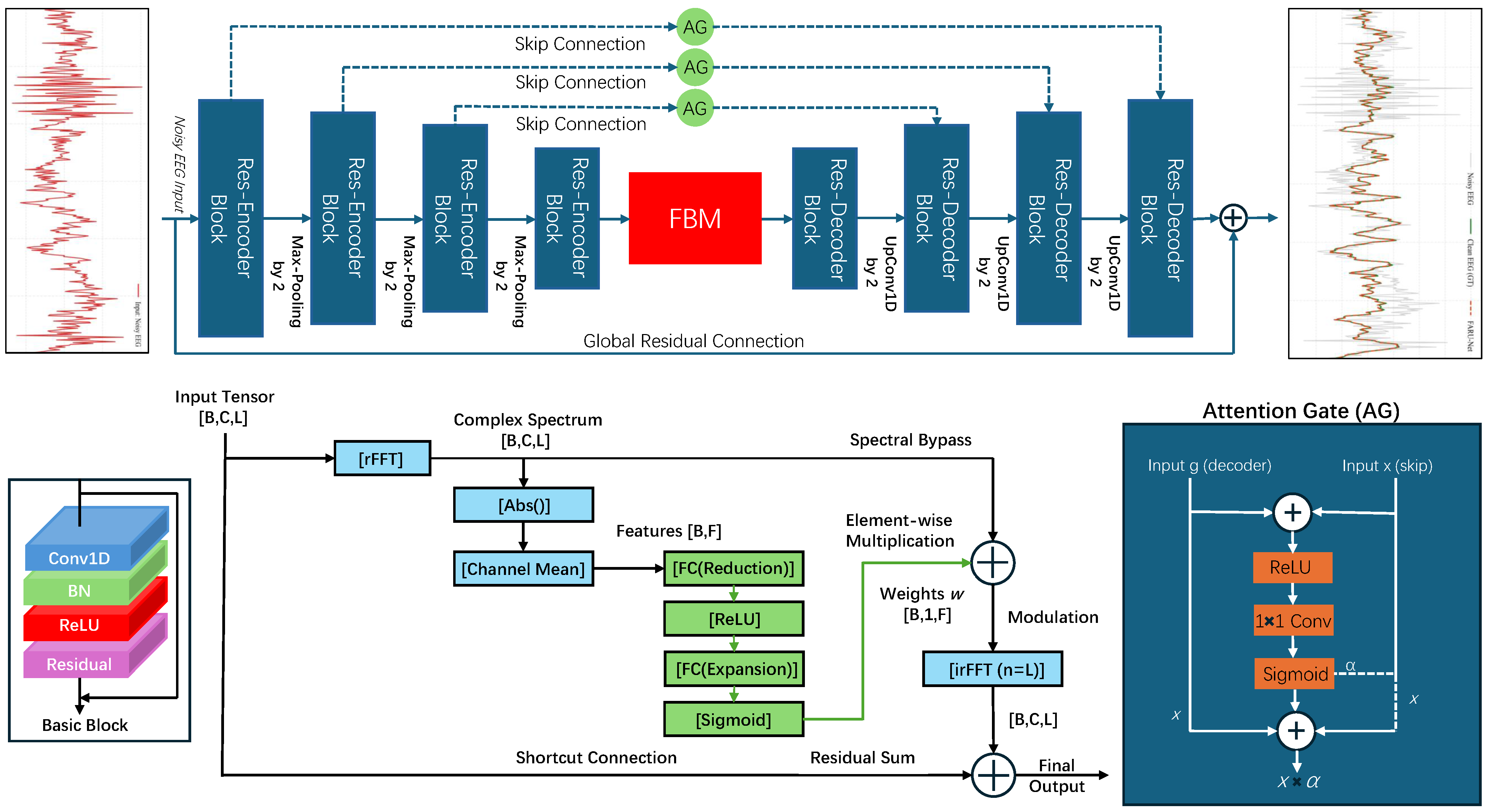
17]. To address this limitation, we propose FARU-Net, a frequency-aware residual U-Net architecture that jointly models temporal and spectral features. By incorporating explicit frequency-domain constraints into the learning process, the proposed framework aims to improve both waveform reconstruction accuracy and spectral fidelity.
Conventional deep learning filters often rely solely on time-domain supervision, such as Mean Squared Error (MSE). This approach can lead to the over-smoothing of high-frequency neural rhythms, causing spectral blurring. To address this, we present a spectral–temporal joint optimization framework [
18]. By explicitly applying frequency-domain magnitude constraints through the Frequency-aware Bottleneck Module (FBM), the proposed method prevents the loss of critical neurophysiological features [
19]. Furthermore, this joint-domain approach is adaptable. This framework can also be integrated into existing time-domain denoising models as a regularization strategy, improving both morphological accuracy and spectral fidelity.
The main contributions of this work are as follows:
We propose FARU-Net, a residual encoder–decoder architecture designed for high-fidelity EEG signal restoration.
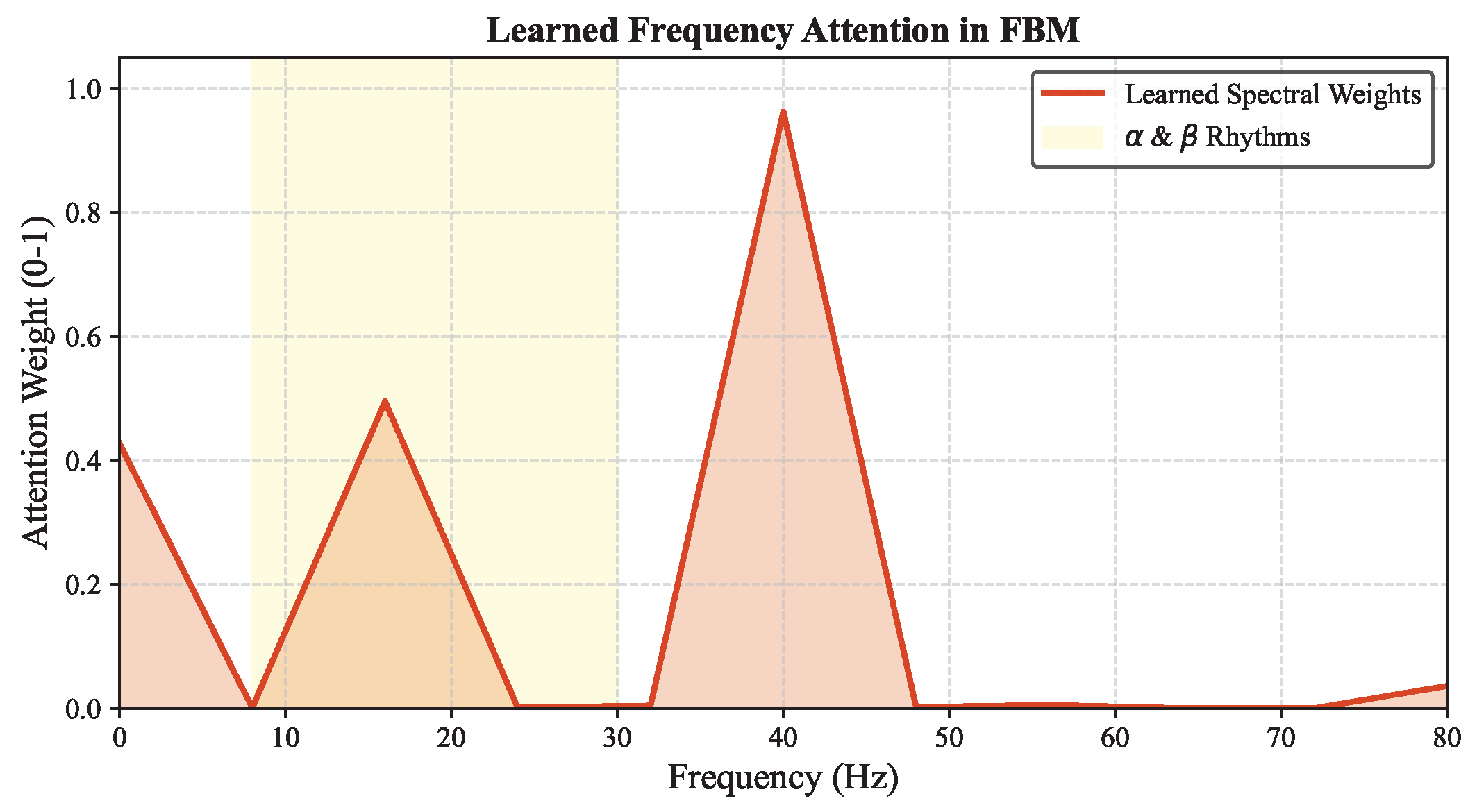
A Frequency-aware Bottleneck Module (FBM) is introduced to perform spectral recalibration in the latent space, enabling adaptive emphasis on task-relevant neural rhythms.
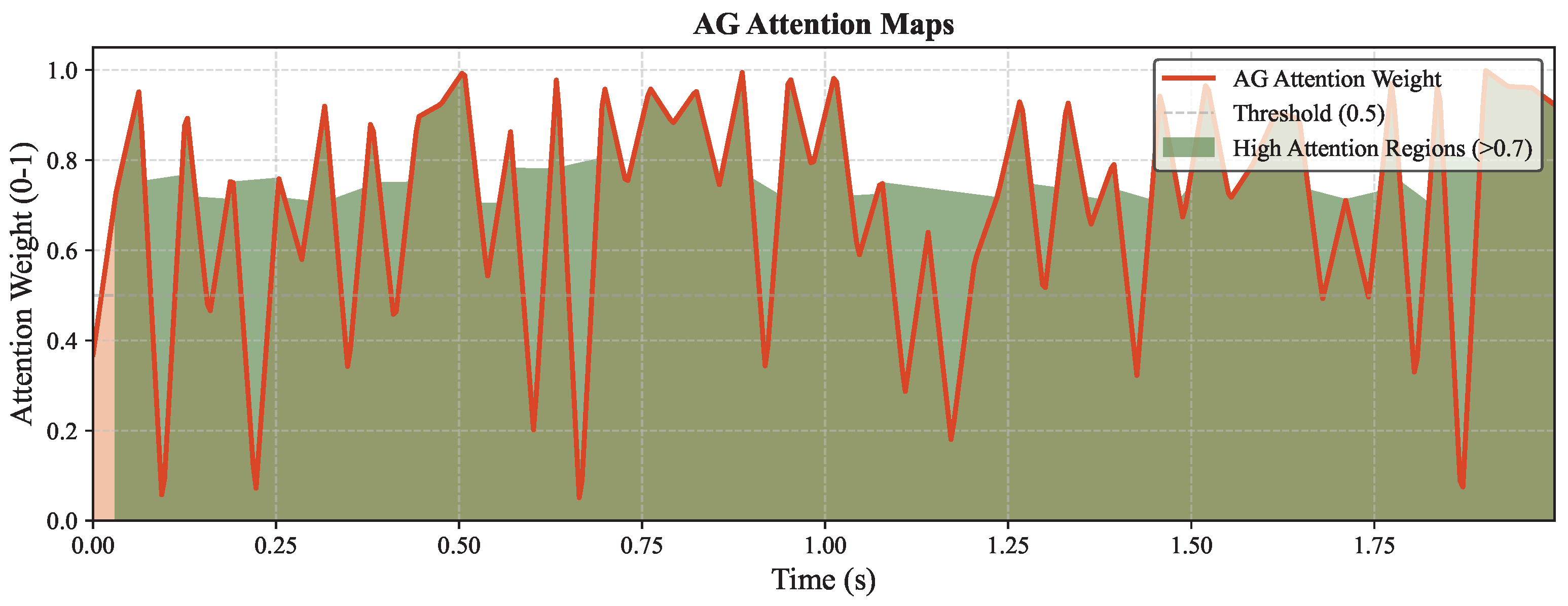
Attention Gates (AGs) are incorporated into skip connections to refine feature fusion and suppress irrelevant components.
A spectral–temporal joint loss function is developed to preserve both waveform morphology and frequency-domain characteristics.
The structure of this paper is organized as follows:
Section 2 provides an overview of the existing EEG denoising literature, setting the theoretical context [
1,
2].
Section 3 presents the mathematical formulation of the FARU-Net architecture and the hybrid loss function. The proposed method is thoroughly evaluated through comparative experiments in
Section 4, with
Section 5 concluding with a discussion on future research directions [
20].
4. Experiments
4.1. Data Preparation and Preprocessing
The proposed FARU-Net was primarily evaluated using the EEGdenoiseNet benchmark, a large-scale dataset comprising 4514 clean EEG segments, 3400 EOG segments, and 5598 EMG segments. To ensure scientific rigor and prevent data leakage, a systematic processing protocol was implemented. Following the benchmark’s standard partition scheme, the raw segments were independently split into training, validation, and test sets with an 80:10:10 ratio. Specifically, the 4514 clean EEG segments were partitioned into 3611 training, 452 validation, and 451 test segments. The corresponding EOG and EMG artifact segments were segregated using an identical splitting strategy to guarantee that artifact morphologies encountered during training remained strictly absent from the evaluation phases. All segments were subsequently center-cropped or reflect-padded to a uniform length of 512 samples to ensure consistent temporal alignment across the pipeline.
To further verify the practical utility of the denoised signals in real-world brain-computer interface (BCI) applications, downstream classification experiments were conducted using the PhysioNet Motor Imagery dataset. EEG recordings from the first 30 subjects (S001–S030) were selected from runs 4, 8, and 12, which correspond to left- and right-hand motor imagery tasks. The original signals, sampled at 160 Hz, were preprocessed using a 1–40 Hz FIR bandpass filter to suppress baseline drift and high-frequency noise. Task-related epochs spanning 0 to 3.19375 s post-stimulus were extracted and uniformly resampled to 512 points to match the input dimensionality of FARU-Net. Finally, the event labels corresponding to left- and right-hand imagery (original codes 2 and 3) were mapped to binary labels (0 and 1) for classification evaluation.
4.2. Implementation Details
The detailed hardware configurations, software environment, and hyperparameter settings are summarized in
Table 1. Following the EEGdenoiseNet protocol, we synthesized the dataset by linearly mixing clean EEG segments with EOG and EMG artifacts, yielding SNRs uniformly distributed between
dB and 2 dB [
14]. All experiments were conducted on a workstation equipped with an NVIDIA RTX 4090 GPU (24 GB VRAM), an Intel Xeon Gold 6430 CPU, and 120 GB of RAM, running Ubuntu 22.04. The implementation leverages Python 3.12 and PyTorch 2.8.0 with CUDA 12.8.
For FARU-Net, optimization was performed using the Adam optimizer with an initial learning rate of
and a batch size of 128, trained over 150 epochs under a cosine annealing scheduler. To ensure a fair and rigorous comparison, the hyperparameters for all baseline models were similarly optimized using the Optuna framework with a TPE sampler. The resulting optimal configurations were: DAE1D (Adam, LR:
, Batch: 32), Complex CNN (Adam, LR:
, Batch: 64), and Simple CNN (Adam, LR:
, Batch: 32). Architecturally, FARU-Net employs a base channel width of 128 with a depth of 4. Each input segment spans 512 samples (corresponding to a 2 s window at 256 Hz), which are transformed via torch.fft.rfft into a 257-bin frequency representation, achieving a resolution of 0.5 Hz. The critical frequency-domain weight coefficient
was determined via the Optuna framework using a TPE sampler. Across 200 optimization trials, the optimal value was identified as
(
Table 1), with subsequent ablation studies (
Section 4.4) confirming it provides the ideal trade-off between artifact suppression and rhythmic preservation.
4.3. Comparison with Baseline Models
To provide a thorough evaluation of FARU-Net, we compare its performance with several representative baseline models, all trained and tested under the same setup. These include DAE1D, Complex CNN, Simple CNN, MultiRes-UNet3+, LinkNet, U-Net [
7] and FPN. The comparison results are summarized in
Table 2. While our primary evaluation focuses on a challenging signal-to-noise ratio (SNR) range of −7 dB to 2 dB to rigorously assess the model’s performance [
14]. Further discussion of these results can be found in
Section 5.
As detailed in
Table 2, FARU-Net outperformed the compared models across the evaluated metrics, with the clearest advantage observed under high-noise conditions. At the
dB SNR level, FARU-Net yields a
of 0.4753, which constitutes a reduction in error of approximately 57.9% relative to the Simple CNN (1.1286) and 47.5% relative to the Complex CNN (0.9056). Compared to the most competitive baseline at this intensity, MultiRes-UNet3+ (0.7830), the proposed architecture maintains a distinct performance margin with a 39.3% improvement in temporal reconstruction accuracy. Furthermore, the model yields a substantial SNR improvement, as evidenced by the performance trends in
Table 2, where FARU-Net consistently suppresses mixed artifacts more effectively than the standard U-Net baseline (0.8122 for
) [
7].
This degree of morphological preservation is attributed to the Frequency-aware Bottleneck Module (FBM), which facilitates the extraction of global spectral dependencies that temporal-only filters typically omit, thereby maintaining the integrity of neurophysiological oscillations. While FARU-Net achieves competitive performance, we conduct an incremental ablation study to better understand the contribution of each module.
4.4. Comparison with Recent Methods
In addition to the baseline model comparisons presented above, we further supplement comparisons with two EEG denoising models proposed in 2024–2025: EEGDiR [
40] (Computers in Biology and Medicine) and TF-Denoiser [
16] (Electronics). Both methods were originally designed for single-artifact removal (EOG-only or EMG-only). For fair comparison, we retrained FARU-Net under the same single-artifact protocol using the public EEGDenoiseNet dataset [
14], with identical train/test splits and SNR ranges (
to 2 dB). The quantitative results for EMG and EOG artifact removal are presented in
Table 3 and
Table 4, respectively.
Notably, while EEGDiR employs the Retentive Network for temporal modeling and TF-Denoiser uses joint time-frequency optimization with multi-attention mechanisms, FARU-Net’s single-path architecture with explicit spectral bottleneck yields consistently better reconstruction fidelity. This suggests that targeted frequency-domain regularization combined with temporal modeling may be more critical than pure temporal or naive time-frequency approaches for EEG denoising tasks.
4.5. Ablation Study
4.5.1. Impact of Architectural Components and Network Depth
To evaluate the contribution of each individual component in FARU-Net, we conducted an incremental ablation study. The results, averaged over five independent test groups, are summarized in
Table 5. As shown in
Table 5, starting from the baseline ResU-Net (a) [
23], adding the Frequency-aware Bottleneck Module (b) yields the most significant performance improvement, underscoring the critical role of global spectral recalibration. Interestingly, integrating Attention Gates (AG) alone (Case c) causes a marginal CC drop (0.9682 to 0.9677), suggesting that without explicit spectral constraints, AGs may inadvertently suppress salient neural features amidst high-amplitude artifacts. However, introducing the spectral magnitude constraint
(Case d) fully realizes the synergy between global recalibration and local feature refinement, notably increasing ΔSNR from 26.40 dB (Case f) to 26.66 dB. This confirms that AGs act as fine-grained refiners only when operating under spectral supervision.
A key design choice in FARU-Net is the intentional omission of phase supervision in the loss function, distinguishing it from many existing dual-domain frameworks. This decision is rooted in the non-stationary nature of EEG signals; in single-channel scenarios, phase information is highly susceptible to stochastic artifacts and baseline drifts, making robust recovery exceptionally difficult. Our incremental ablation study in
Table 5 justifies this strategy: the introduction of phase constraints (Setting e) failed to yield performance gains and even slightly degraded the CC and ΔSNR. This confirms that spectral magnitude serves as a more stable indicator for neural oscillation recovery than the volatile phase. Consequently, by prioritizing magnitude consistency, FARU-Net achieves superior restoration while maintaining computational efficiency for real-time applications.
Beyond modular components, the optimal network depth was rigorously determined through a dual-validation strategy. Manual ablation across depths of 2, 3, and 4 (
Table 6) demonstrated that depth = 4 achieves peak reconstruction fidelity by optimally balancing receptive field expansion and feature preservation. This empirical finding was independently corroborated by the Optuna framework, which consistently identified depth = 4 as the global optimum across 200 independent trials.
4.5.2. Necessity of Time-Domain Supervision
To address whether frequency-domain supervision alone is sufficient for high-fidelity EEG reconstruction, we conducted a dedicated ablation study comparing three loss configurations: time-domain only (
), frequency-domain only (
), and the proposed joint optimization. The quantitative results are summarized in
Table 7. As shown in
Table 7, relying solely on frequency-domain supervision leads to a severe degradation in amplitude-related metrics, despite maintaining a relatively high correlation coefficient. This phenomenon can be attributed to the scale ambiguity introduced by global magnitude normalization. While the normalized spectral loss effectively guides the model to learn the correct distribution of neural rhythms, it is mathematically invariant to absolute signal energy. Consequently, the model converges to a solution that matches the spectral shape but produces arbitrarily scaled outputs, resulting in catastrophic RRMSE and negative ΔSNR values.
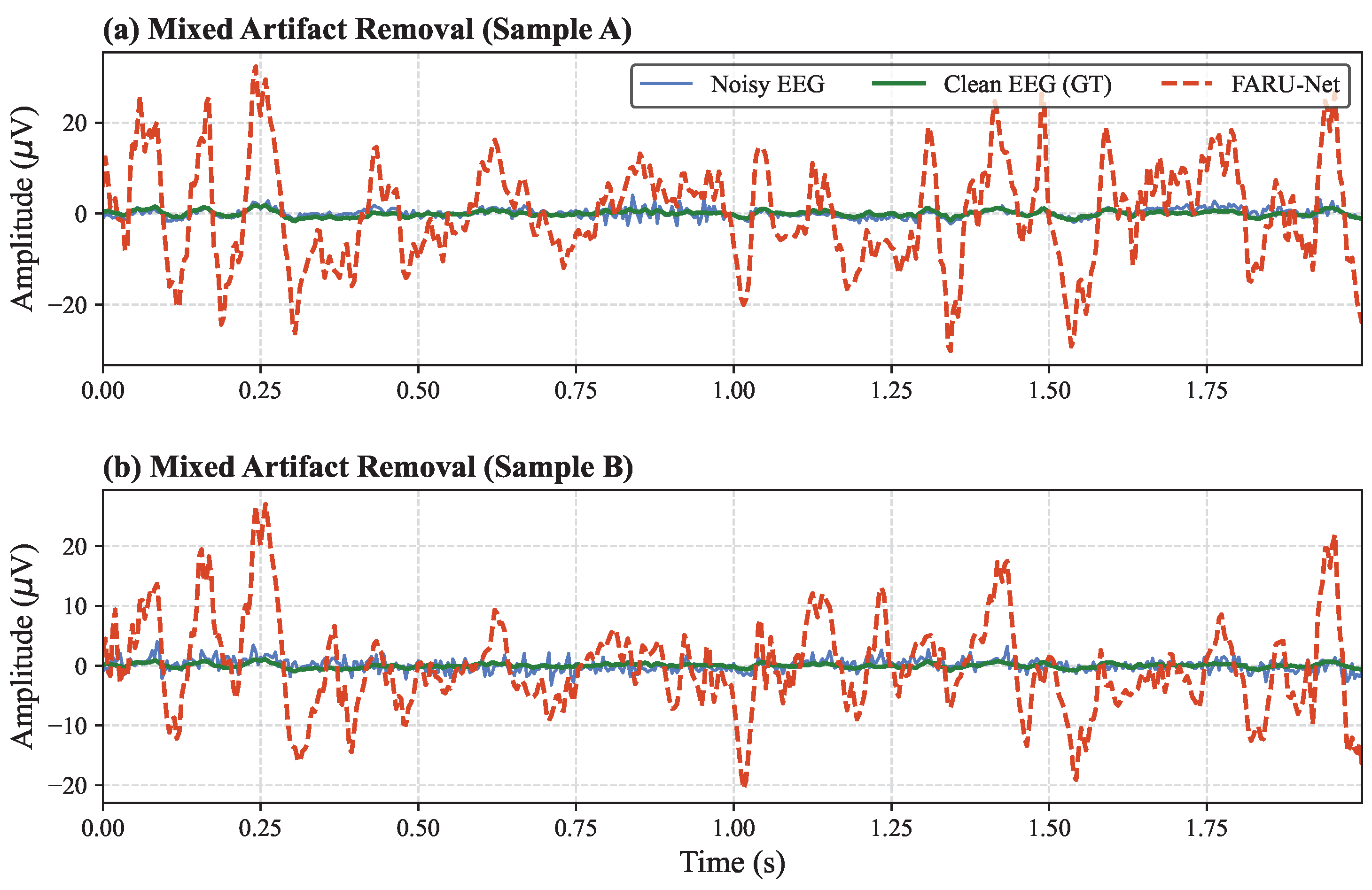
This scale ambiguity is visually corroborated in
Figure 2, which displays the time-domain waveforms reconstructed by the frequency-only model. As evident from the plots, although the model preserves the general oscillatory phase structure (consistent with the non-zero CC), the amplitude of the reconstructed signal diverges drastically from the ground truth, exhibiting severe scaling distortion. This qualitative evidence confirms that the reported quantitative degradation is intrinsic to the loss formulation rather than an artifact of training instability, and underscores why time-domain constraints are fundamentally necessary to anchor the absolute signal energy.
Conversely, the time-domain baseline successfully anchors the absolute amplitude and energy conservation, yet suffers from the well-documented “spectral blurring” effect, where high-frequency neural oscillations are unintentionally smoothed alongside artifacts. The proposed joint optimization elegantly resolves this trade-off: the time-domain MSE acts as a strict amplitude anchor, reducing scale ambiguity effectively, while the frequency-aware bottleneck retains fine-grained spectral characteristics. This synergistic mechanism confirms that time-domain constraints are not redundant but fundamentally necessary to ground the spectral learning process, enabling FARU-Net to achieve simultaneous temporal and spectral fidelity.
4.6. Qualitative Evaluation and Visualization
To better illustrate the denoising performance, we visualize both the temporal and spectral aspects of the reconstructed signals.
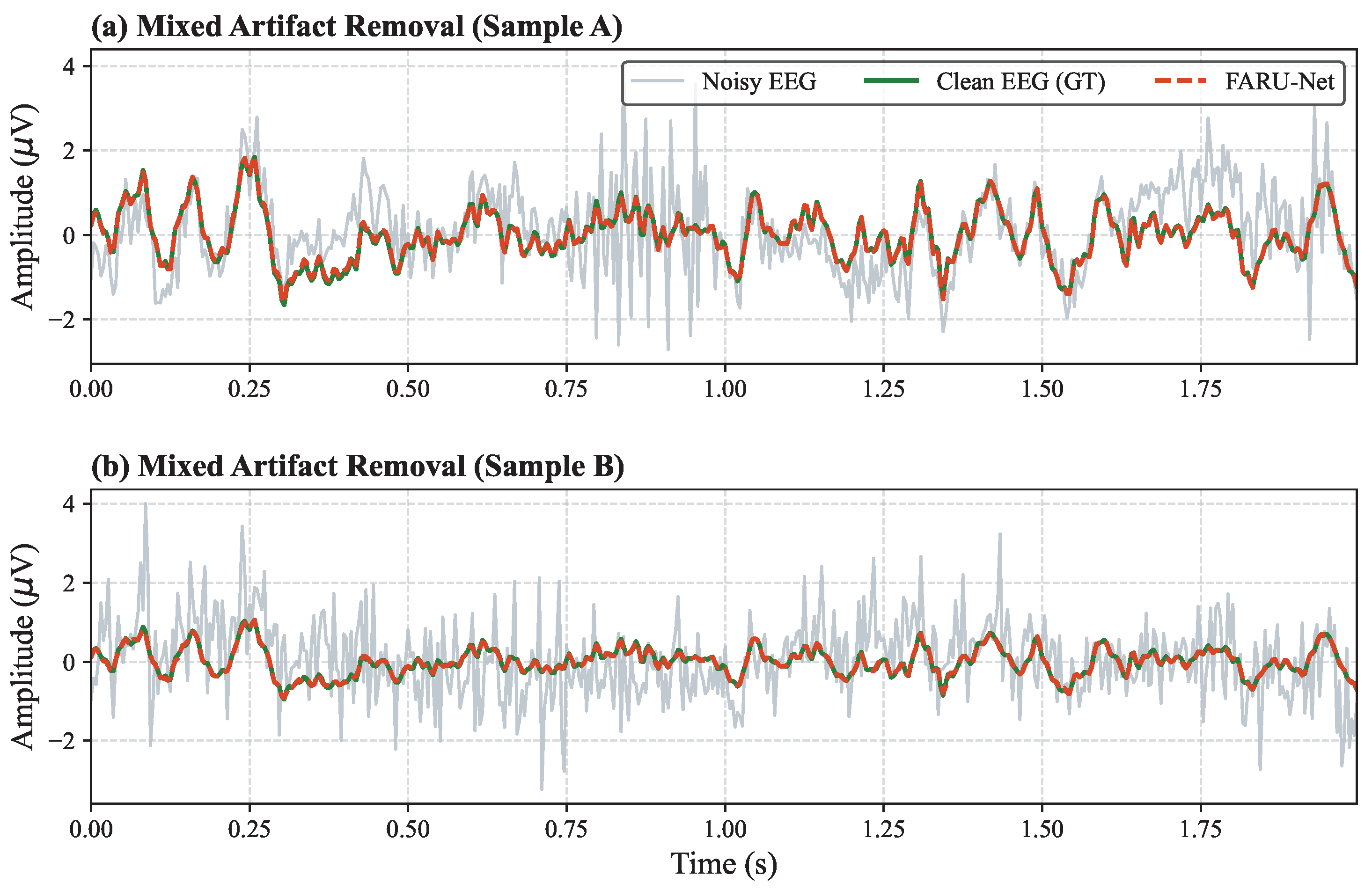
Figure 3 shows the time-domain waveforms of two randomly selected EEG segments, each heavily corrupted by mixed physiological artifacts [
14]. The noisy signals (solid grey lines) exhibit large amplitude fluctuations and high-frequency spikes that obscure the underlying neural activity. In contrast, the denoised signals generated by FARU-Net (dashed orange lines) closely match the ground-truth clean EEG (solid green lines), effectively preserving transient neural features [
41]. For comparison,
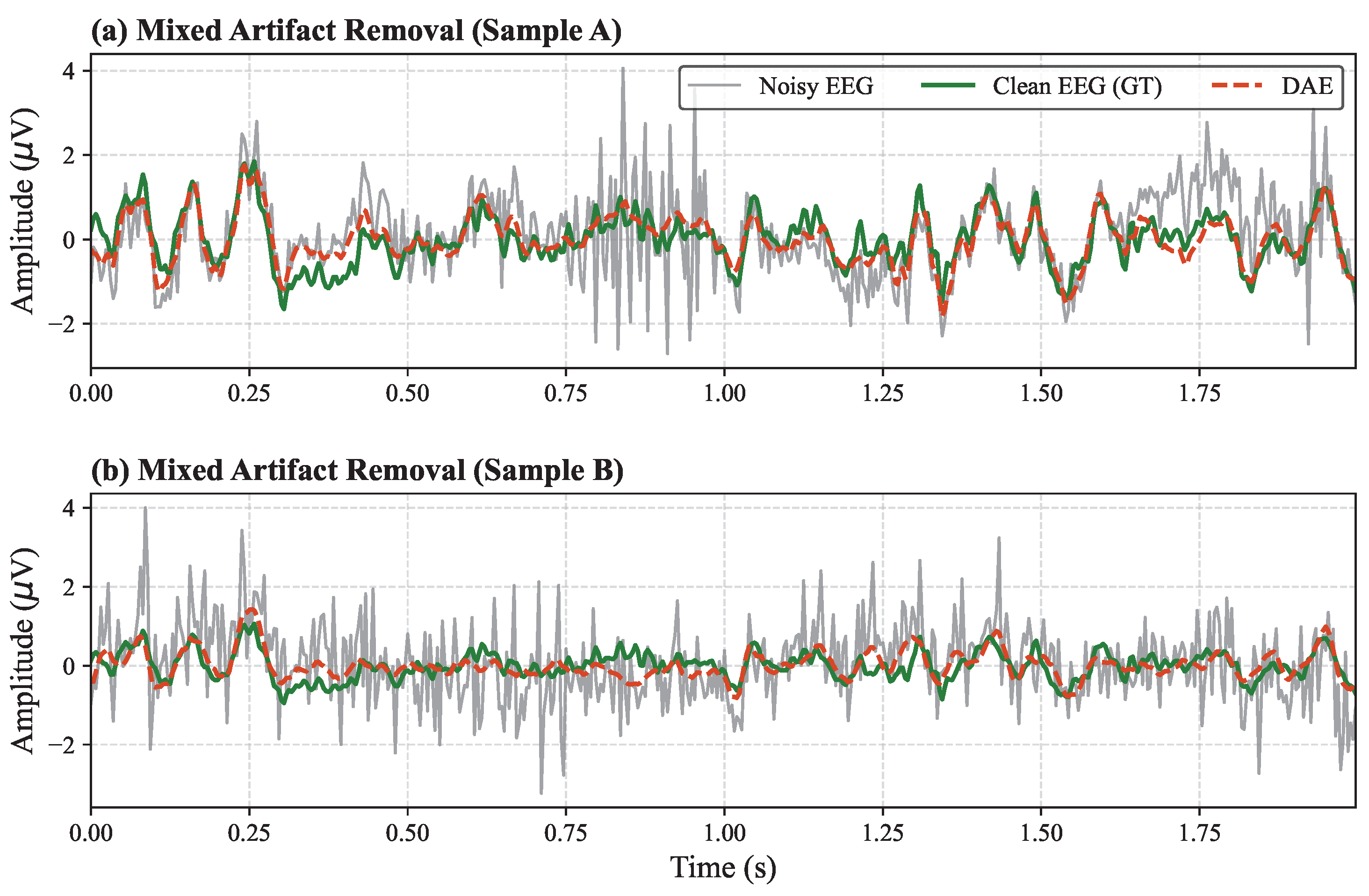
Figure 4 presents the results of the baseline DAE model under identical conditions. While the DAE model suppresses some broadband noise, it exhibits noticeable residual artifacts and morphological distortion, particularly around sharp signal transitions, indicating a limited capacity for precise temporal reconstruction.
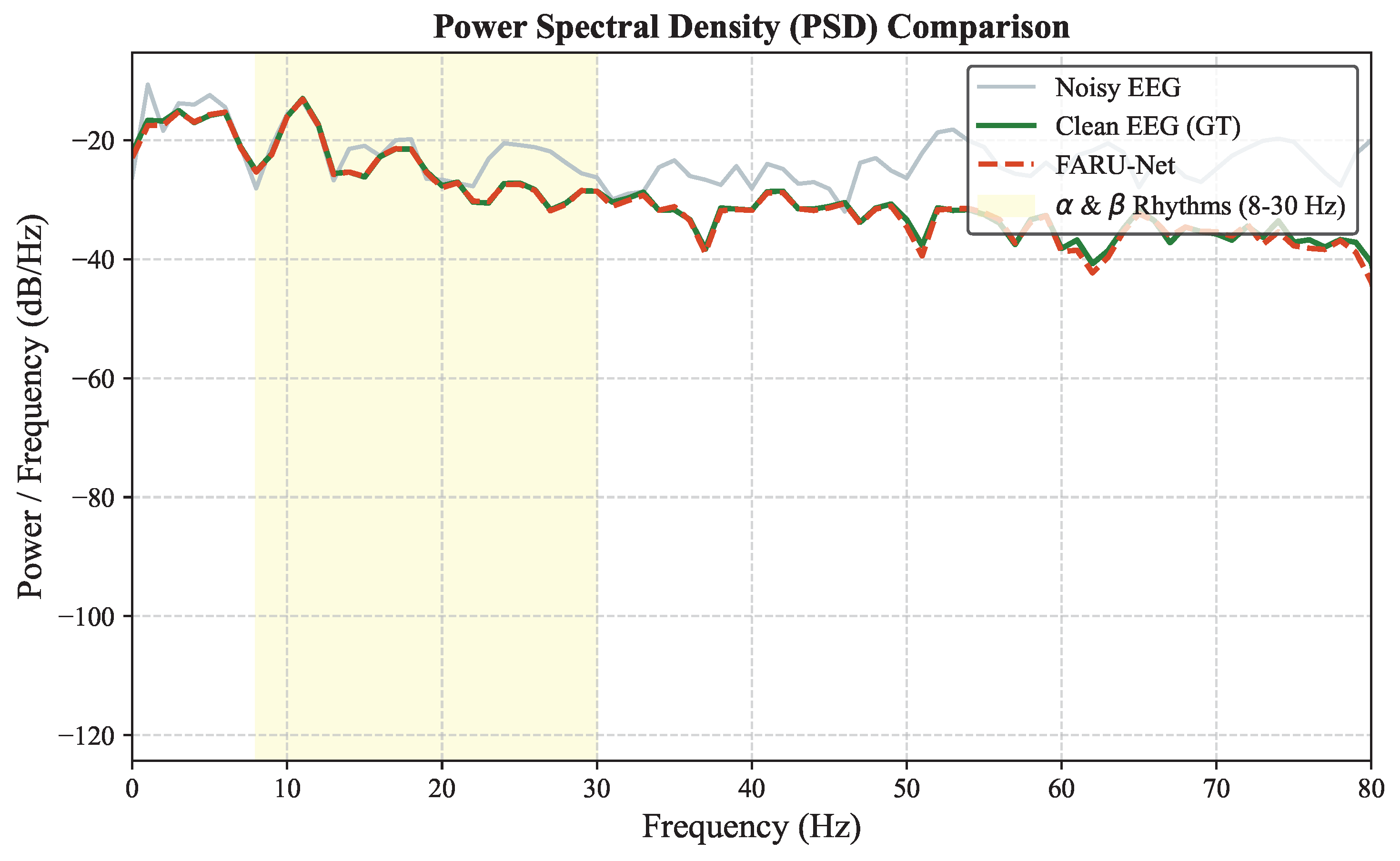
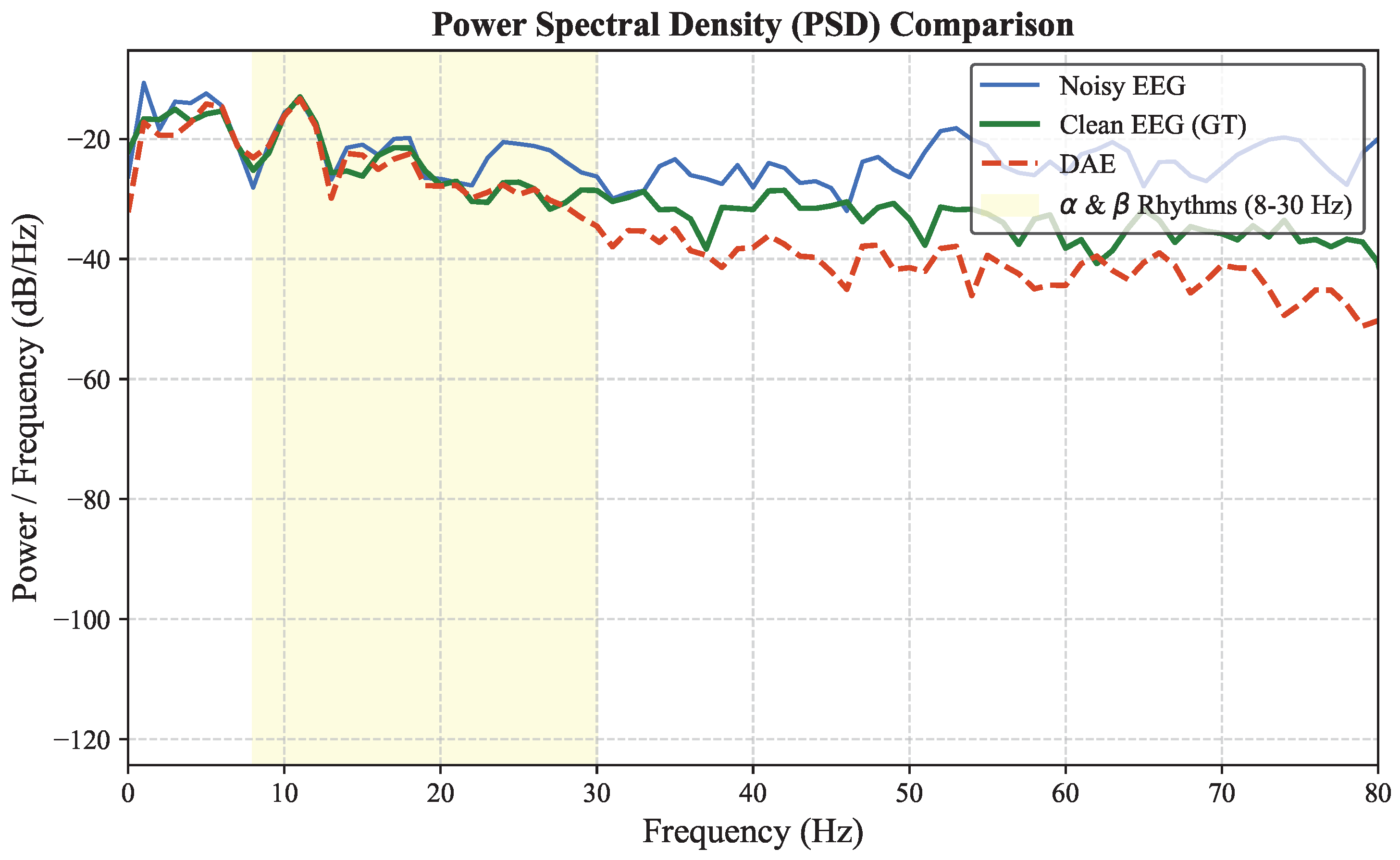
We also evaluate the spectral fidelity of the reconstructed signals through Power Spectral Density (PSD) analysis, as shown in
Figure 5. Deep learning models optimized only for the time domain often face the issue of “spectral blurring,” where high-frequency neural signals are unintentionally suppressed along with the artifacts. However, FARU-Net, utilizing the Frequency-aware Bottleneck Module (FBM), maintains excellent spectral consistency. In the yellow-shaded region corresponding to the
and
rhythms (8–30 Hz), FARU-Net closely matches the power distribution of the clean ground truth. At higher frequencies (>30 Hz), FARU-Net effectively attenuates the abnormal energy spikes caused by EMG artifacts, reducing them to the physiological noise floor. Conversely, the PSD curve of the DAE baseline (
Figure 6) reveals significant spectral leakage and incomplete artifact suppression in the high-frequency band, further corroborating its suboptimal generalization in mixed-noise scenarios. This qualitative comparison across both time and frequency domains highlights the architectural superiority of FARU-Net in disentangling neural oscillations from complex physiological interference.
While
Figure 3,
Figure 4,
Figure 5 and
Figure 6 provide qualitative evidence of FARU-Net’s denoising capability, we further quantify its statistical robustness through 20-fold cross-validation across varying signal-to-noise ratios (
Table 8). The fine-grained partitioning (
) provides a more conservative estimate of generalization performance by minimizing the variance introduced by data splitting.
4.7. Cross-Dataset Robustness Evaluation
To evaluate the generalization performance of FARU-Net under unsupervised, real-world conditions, we conducted a zero-shot validation using the C3 channel recordings from the first 30 subjects (S001–S030) of the PhysioNet Motor Imagery (MI) dataset [
42]. Unlike the controlled synthetic mixtures used in training, this dataset presents diverse physiological profiles and unmodeled instrumental noise. Given the intrinsic unavailability of ground-truth clean EEG in such scenarios, the Power Reduction Ratio (PRR) is employed as a quantitative proxy for denoising effectiveness, defined as:
where
represents the original contaminated EEG,
is the denoised signal generated by FARU-Net, and
T is the total length of the recording.
Table 9 presents the PRR results across these 30 subjects. It should be noted that while PRR serves as a quantitative proxy for denoising effectiveness in real-world data where ground-truth is unavailable, it is not an absolute denoising metric. A high PRR value does not inherently guarantee signal fidelity, as indiscriminate attenuation of neural components could also yield high values. Therefore, the validity of PRR results must be interpreted alongside the model’s adaptive behavior across diverse noise intensities.
The selection of the first 30 subjects (S001–S030) for zero-shot validation is based on two primary considerations:
Coverage of Physiological Diversity:As observed from
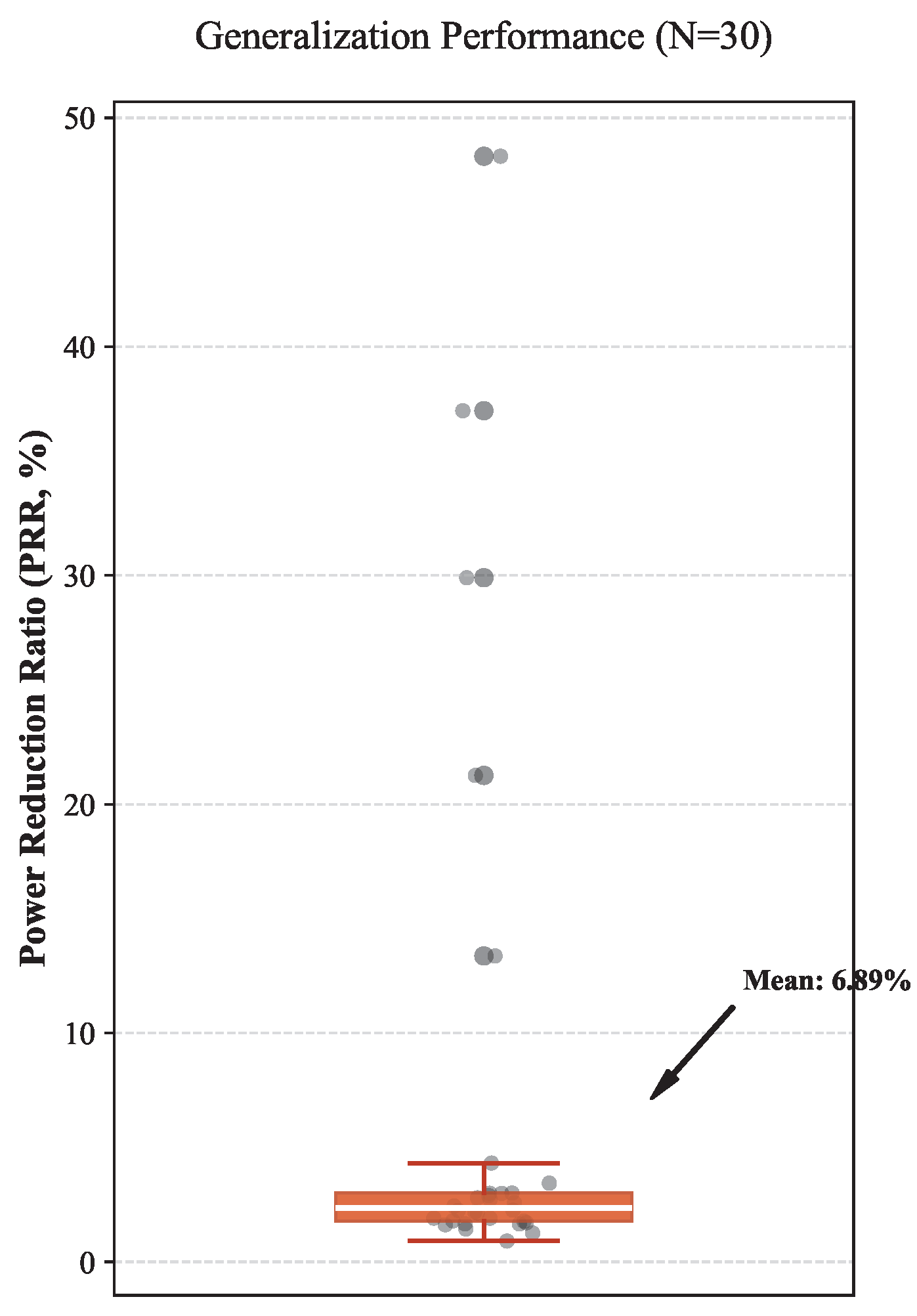
Table 9, the PRR exhibits significant individual variability, ranging from a minimal noise level (e.g., S025 at 0.91%) to extreme high-intensity artifact interference (e.g., S005 at 48.32%). This broad spectrum indicates that the sample size provides sufficient inter-subject variability to validate the adaptive suppression capability of FARU-Net across diverse physiological profiles.
Balance Between Computational Efficiency and Evaluation Depth: Since FARU-Net is designed for high-precision, point-to-point reconstruction, this refined processing workflow incurs substantial computational overhead when applied to the full dataset. Selecting these 30 representative subjects facilitates a comprehensive performance assessment within a resource-constrained environment while maintaining a rigorous depth of evaluation.
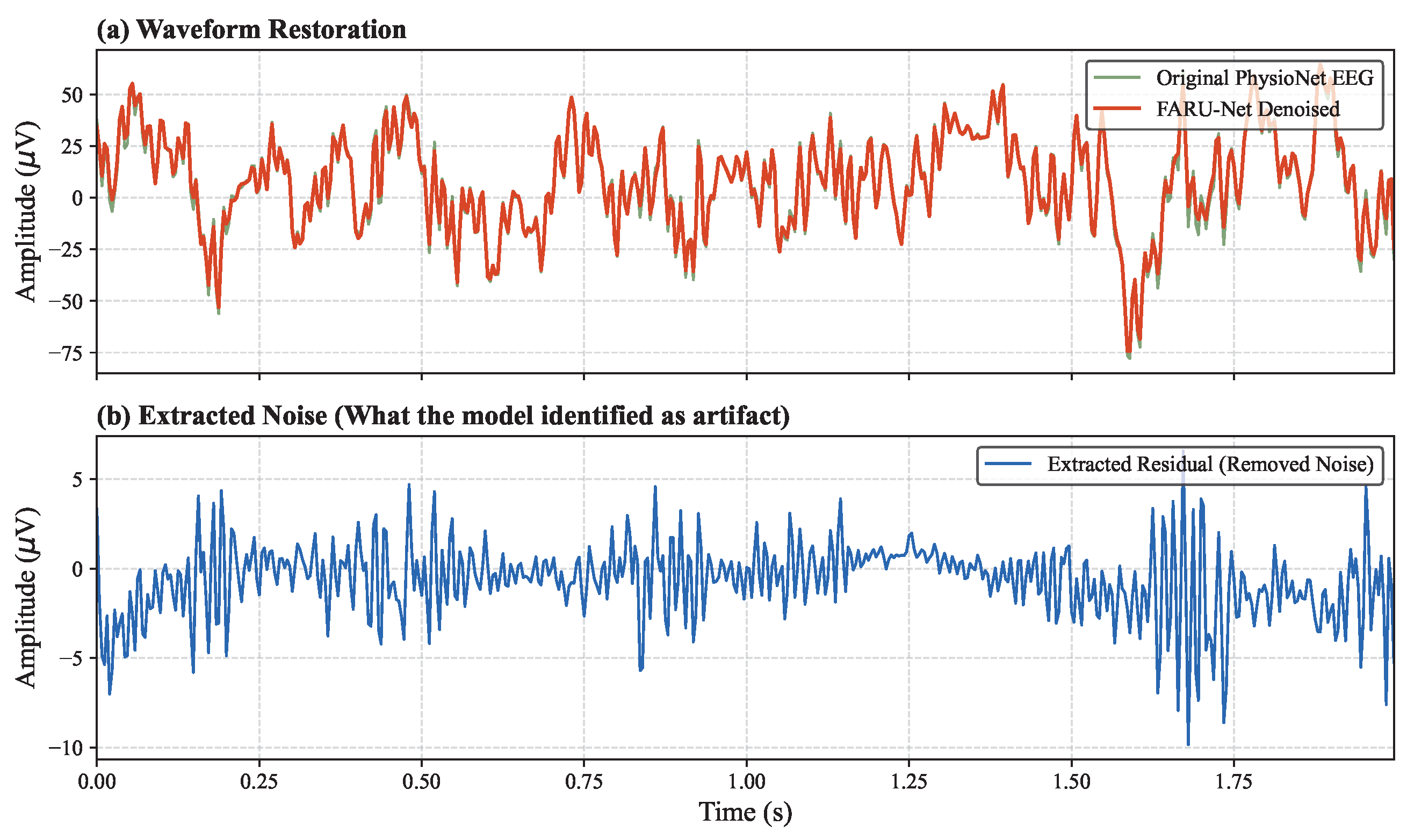
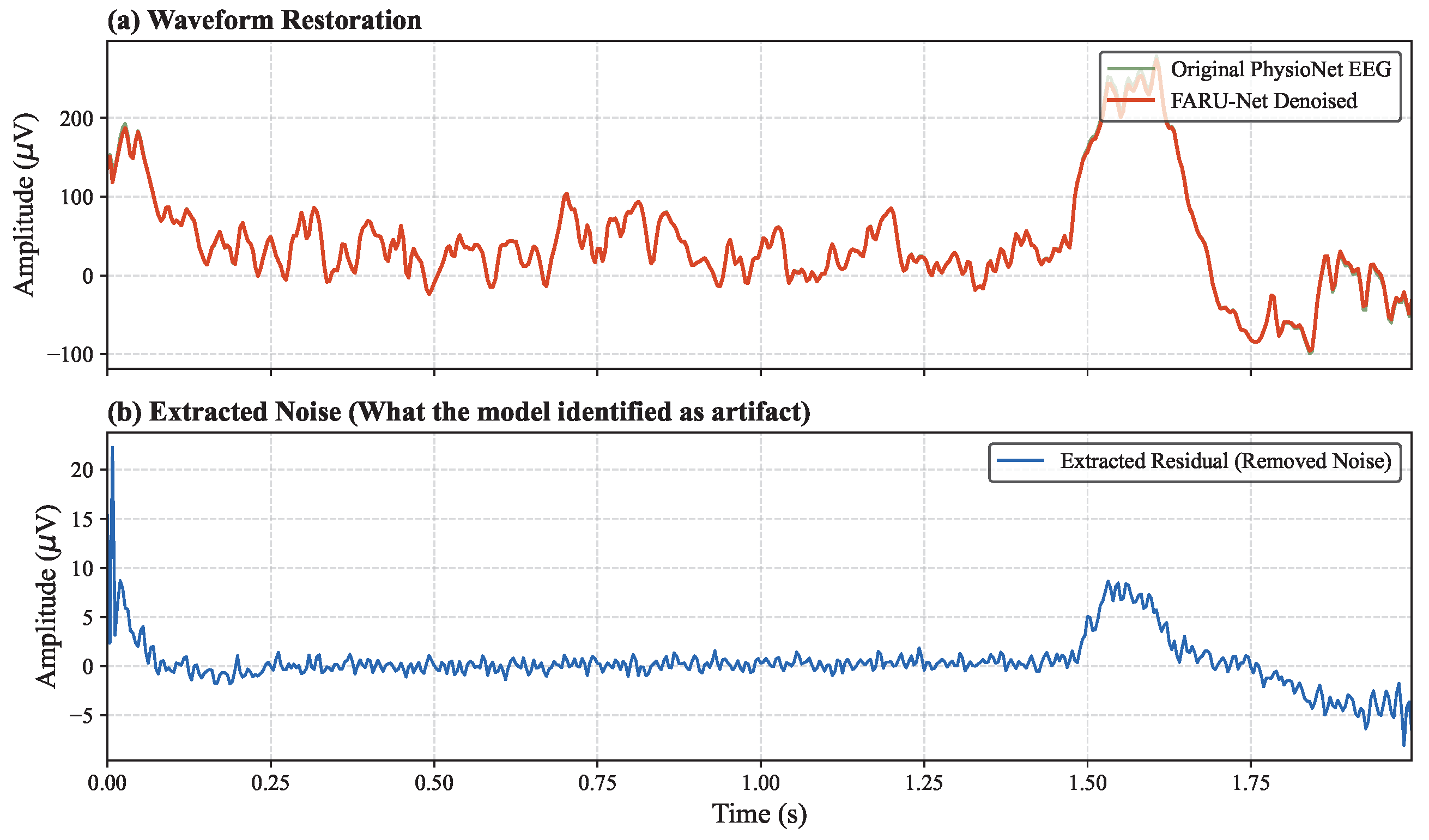
To gain qualitative insight into the model’s adaptability, a comparative residual analysis was conducted under varying recording conditions. As illustrated in
Figure 7 and
Figure 8, FARU-Net dynamically adjusts its suppression intensity based on the input noise morphology and signal dynamics. Crucially, as detailed in
Section 4.8, the subsequent improvement in Motor Imagery classification accuracy (from 79.69% to 81.23%) provides empirical evidence that the power reduction primarily eliminates non-neural interference. If the observed PRR were a result of excessive neural signal attenuation, the downstream decoding performance would inevitably degrade.
In segments characterized by continuous, fine-grained myogenic interference (
Figure 7), the residual remains focused on micro-scale stochastic spikes, effectively refining the neural waveform without excessive attenuation of low-amplitude oscillations. Conversely, in scenarios involving extreme signal fluctuations and large-scale baseline drifts (
Figure 8), FARU-Net scales its suppression strength to isolate high-amplitude artifacts reaching up to 20 μV. This adaptive, scale-aware mechanism ensures that the model maintains the integrity of rhythmic neural activity even when the signal-to-noise ratio is severely compromised by non-stationary physiological interference [
17].
The statistical distribution of PRR values, summarized in
Figure 9, further confirms this adaptability. The clear long-tail pattern, with a narrow interquartile range (Median ≈ 2.4%), indicates that the architecture remains conservative for low-noise recordings. Meanwhile, the prominent outliers (up to 48.32%) highlight the model’s capacity to adjust dynamically to suppress high-intensity artifacts when required.
4.8. Downstream BCI Task Validation and Spectral Analysis
While standard metrics like CC and RMSE measure morphological similarity, the practical value of EEG denoising is ultimately reflected in the performance of subsequent analytical tasks. We utilized EEG recordings from the first 30 subjects (S001–S030) of the PhysioNet Motor Movement/Imagery dataset [
42,
43], specifically the left-hand and right-hand motor imagery trials (runs 4, 8 and 12), to evaluate FARU-Net’s effectiveness in downstream binary classification. To focus the evaluation exclusively on signal quality, we employed a standard, lightweight convolutional classifier (EEGNet [
44]) to categorize left- versus right-hand motor execution across three distinct data conditions: raw contaminated EEG, EEG denoised via traditional ICA [
21], and EEG denoised by our proposed FARU-Net. The band-specific absolute power of three denoised EEG signals and the classification accuracy of EEGNet model under three kinds of EEG signals are adopted as core evaluation metrics.
To mathematically substantiate the classification results, we conducted a quantitative spectral analysis. The average Absolute Band Power (ABP) was computed using Welch’s method across three key physiological bands: the low-frequency band (1–8 Hz), the motor-imagery specific
and
band (8–30 Hz), and the high-frequency myogenic band (30–40 Hz). As demonstrated in our spectral analysis (
Table 10), FARU-Net achieves a superior balance between artifact suppression and neural signal preservation. While ICA aggressively attenuates low-frequency components, it inadvertently causes a substantial power deficit in the crucial 8–30 Hz neural band (dropping to 267.86 compared to 282.75 for FARU-Net). In contrast, FARU-Net effectively suppresses high-frequency myogenic artifacts (reducing 30–40 Hz power to 48.13) while maintaining robust spectral energy in the task-relevant neural region.
This spectral fidelity is complemented by exceptional preservation of temporal signal integrity (
Table 11). Unlike ICA, which severely distorts the signal distribution by reducing kurtosis to 0.4712 (a 60.6% drop from raw) and skewness to 0.2894, FARU-Net maintains the intrinsic non-Gaussian characteristics of neural activity (kurtosis: 1.1169; skewness: 0.5065), closely matching the raw signal statistics. Furthermore, FARU-Net achieves a high correlation with raw EEG (
) and a minimal RMSE (
), confirming that our method removes interference without introducing the waveform distortion or over-smoothing typical of blind source separation techniques.
Collectively, these dual-domain advantages directly translate to enhanced downstream utility. The classifier trained on FARU-Net denoised signals achieved the highest accuracy of 81.23%, outperforming both the raw contaminated data (79.69%) and the ICA baseline (78.93%). This empirical evidence confirms that FARU-Net’s adaptive recalibration effectively reduces non-neural interference while preserving valid EEG signals.
6. Conclusions and Future Work
This paper introduced FARU-Net, a dual-domain frequency-aware residual framework designed for high-fidelity EEG artifact removal. By modeling both temporal patterns and spectral hierarchies, the proposed approach addresses the receptive field constraints inherent in traditional time-domain-based deep learning models. The key findings of this study are summarized as follows:
Architectural Effectiveness: FARU-Net achieves competitive and effective performance, outperforming baseline models with a mean CC of 0.9681 and a ΔSNR of 26.66 dB.
Spectral Recalibration: The Frequency-aware Bottleneck Module (FBM) was instrumental in recalibrating the latent spectrum, enabling adaptive prioritization of crucial neural rhythms.
Improved Feature Fusion: The integration of Attention Gates (AGs) successfully reduced the semantic gap between encoder and decoder features, ensuring targeted suppression of residual noise.
Dual-Domain Consistency: The joint loss function maintained high consistency between time-domain waveforms and frequency-domain power distributions.
Despite these achievements, several challenges remain. The current model is optimized for single-channel denoising, failing to exploit the strong spatial correlations among multi-channel EEG signals. Restricted by the adopted dataset, this work only targets artifact removal of EOG and EMG interference, without considering other types of noise. Future research will extend the frequency-aware module to multi-channel networks via spatial-temporal-frequency attention mechanisms. We will also explore denoising methods for diverse noise types and improve computational efficiency, facilitating real-time application in wearable EEG monitoring and portable brain-computer interfaces.