1. Introduction
With the rapid development of big data technologies, artificial intelligence, and educational informatization, data-driven teaching evaluation and learning performance prediction have gradually become important research directions in educational research and practice. By modeling and analyzing students’ learning behaviors and academic performance data, it is possible not only to provide scientific support for teaching management and curriculum optimization, but also to enable early warning of learning risks and personalized instructional guidance for students [
1,
2]. Among various educational prediction tasks, course grade prediction has attracted extensive attention from researchers because it directly reflects teaching effectiveness and students’ learning quality.
In existing studies, machine learning techniques have been widely applied to grade prediction problems, including support vector machines [
3], decision trees [
4], neural networks, and K-nearest neighbors (KNN) [
5]. Among these methods, KNN is a representative instance-based, non-parametric classification algorithm. Owing to its simple structure, ease of implementation, and strong interpretability, KNN has demonstrated good applicability in small- and medium-scale educational datasets [
6]. Despite its simplicity, KNN is highly dependent on appropriate parameter settings, especially the selection of the neighbor count and distance function. Traditional approaches, including heuristic tuning and brute-force search, often incur high computational cost and are inadequate for capturing optimal configurations in complex data scenarios [
7].
To overcome the difficulty of manual parameter configuration, optimization techniques have been increasingly employed to automatically adjust key parameters in machine learning models. Among these methods, metaheuristic algorithms have attracted significant interest due to their ability to operate without gradient information and their effectiveness in exploring complex search spaces [
8,
9]. These characteristics enable them to handle both continuous and discrete optimization tasks efficiently. Typical examples of such approaches include particle swarm optimization (PSO) [
10], which performs optimization through velocity-position cooperation but is prone to premature convergence in multimodal problems; Differential Evolution (DE) [
11], which provides strong global exploration ability but may suffer from slow convergence in later iterations; Grey Wolf Optimizer (GWO) [
12], which simulates social hunting behavior and has good exploitation capability, yet often experiences diversity loss in high-dimensional search spaces; Secretary Bird Optimization Algorithm (SBOA) [
13], which introduces diversified movement strategies but still exhibits instability in complex landscapes; Graduate Student Evolutionary Algorithm (GSEA) [
14], which emphasizes adaptive learning behavior but may become trapped in local optima; Bounty Hunter Optimizer (BHO) [
15], Animated Oat Optimization (AOO) [
16], as well as various improved variants such as improved competitive particle swarm optimization [
17], Improved Dual-Center Particle Swarm Optimization Algorithm [
18], Strengthened grey wolf optimization algorithms [
19], and dual-mechanism enhanced secretary bird optimization algorithms [
20]. Although these methods improve optimization performance to some extent, most of them still face challenges related to insufficient population diversity, weak adaptive regulation, and unstable convergence when solving high-dimensional multimodal optimization problems. By simulating cooperative behaviors observed in nature or social systems, these algorithms improve parameter optimization efficiency to some extent. Nevertheless, numerous studies have shown that conventional swarm intelligence algorithms still suffer from insufficient population diversity, a tendency to fall into local optima, and limited convergence stability when tackling high-dimensional and multimodal optimization problems [
21,
22,
23,
24].
The Educational Competition Optimizer (ECO) [
25] is a recently proposed swarm intelligence optimization algorithm inspired by competition and development mechanisms within educational systems. ECO simulates competitive learning processes across three educational stages—primary school, middle school, and high school—to balance exploration and exploitation. However, the original ECO mainly relies on population mean information or a single best individual during the update process. As iterations proceed, population diversity rapidly decreases, leading to premature convergence, particularly in complex multimodal optimization problems, which limits its optimization performance [
26,
27].
In recent years, researchers have developed various improved ECO algorithms to enhance global search capability and convergence robustness. For example, Li proposed the Comprehensive Learning-based Education Competition Optimizer (CL-ECO) to bridge the gap between rigid hierarchical competition and flexible biological cooperation. The proposed method introduces a dimension-wise multi-exemplar social learning mechanism into the ECO framework. Similar to cooperative information sharing observed in animal groups, CL-ECO reconstructs the search trajectory by learning from peers across different decision variables, thereby promoting population diversity and adaptive exploration [
28]. Sun proposed a Multi-Strategy Enhanced Education Competition Optimizer (MEECO) to improve the performance of population-based optimization algorithms in complex search environments. The method integrates three complementary mechanisms, namely adaptive differential evolution, vertical crossover, and global-best-guided boundary handling [
29]. Hammad proposed a novel wrapper-based feature selection approach, ECO-OL, which integrates Orthogonal Learning (OL) with the Education Competition Optimizer (ECO) to construct a hybrid optimization algorithm [
30]. Qian proposed the Social-Driven Education Competition Optimizer (SDECO), which incorporates two key strategies to overcome the existing limitations. First, a new search phase, namely the university stage, is introduced to improve population diversity and avoid entrapment in local optima. Second, a socially driven learning strategy is integrated into the ECO framework through an adaptive mechanism, where the joint leadership of dominant groups and dominant individuals enhances the search capability of the population [
31]. However, despite these improvements, the existing enhanced ECO variants still suffer from shortcomings such as slow convergence speed and insufficient optimization accuracy.
To overcome these limitations, this paper proposes an Improved Educational Competition Optimizer (IECO) based on the original ECO framework. An elite exemplar-guided cooperative learning strategy is introduced to enable individuals to learn from a multi-level elite distribution structure rather than a single optimal solution, thereby alleviating excessive convergence pressure. In addition, a rank-adaptive stage-wise search control strategy based on fitness ranking is incorporated to dynamically allocate different search intensities to individuals. Furthermore, an elite-mean opposition-based learning strategy is employed to periodically refine the population, enhancing the algorithm’s ability to escape local optima. Through the collaborative design of multiple strategies, IECO significantly improves optimization accuracy, stability, and robustness when solving complex optimization problems.
On this basis, IECO is applied to optimize the hyperparameters of the KNN classifier, leading to the construction of an IECO-KNN grade prediction model, which is subsequently used for grade prediction in a tourism service communication course. By combining benchmark function experiments with real-world educational data analysis, the optimization performance and practical applicability of IECO and the proposed IECO-KNN model are systematically validated. This study not only enriches the theoretical framework of educational competition optimization algorithms but also provides an efficient and reliable solution for intelligent teaching evaluation and course grade prediction.
To further clarify the novelty of the proposed IECO, it should be emphasized that the contribution of this study does not lie in the isolated use of elite guidance, opposition-based learning, or adaptive control alone. Instead, the novelty lies in the problem-oriented integration of these mechanisms within the three-stage educational competition framework of ECO. Different from existing improved ECO-type methods that usually enhance only one search behavior or introduce a single perturbation operator, IECO constructs a coordinated “elite distribution guidance–rank-adaptive control–elite-mean opposition refinement” framework. In this framework, the elite exemplar-guided cooperative learning mechanism provides multi-source learning references, the rank-adaptive stage-wise control strategy dynamically assigns different search intensities according to individual fitness ranks, and the elite-mean opposition-based refinement strategy introduces symmetric exploration around the elite distribution center. Therefore, the three mechanisms are not simply superimposed, but are embedded into different functional levels of ECO to simultaneously address premature convergence, insufficient diversity, and weak late-stage exploitation.
The primary innovations presented in this paper are summarized as follows:
- (1)
A coordinated improved ECO framework, termed IECO, is proposed. Unlike conventional ECO variants that mainly rely on single elite guidance or local perturbation, IECO integrates elite distribution learning, rank-adaptive search regulation, and elite-mean opposition refinement into the three-stage educational competition process. This coordinated design enables the algorithm to preserve population diversity, dynamically balance exploration and exploitation, and enhance local refinement capability.
- (2)
Comprehensive performance evaluation of IECO is conducted. Extensive comparative experiments on the CEC2017 and CEC2022 benchmark function suites are carried out against several classical and advanced metaheuristic algorithms, validating the superior performance of IECO in terms of convergence accuracy, convergence speed, stability, and statistical significance.
- (3)
An IECO-KNN grade prediction model is constructed and applied. IECO is integrated into the hyperparameter optimization of the KNN classifier to develop an IECO-KNN grade prediction model, which is applied to a tourism service communication course. Experimental results demonstrate that the proposed model outperforms comparison methods in prediction accuracy and stability, indicating strong practical application potential.
The remainder of this paper is organized as follows:
Section 2 introduces the basic principles of the Educational Competition Optimizer and presents the proposed IECO in detail;
Section 3 evaluates the optimization performance of IECO on the CEC2017 and CEC2022 benchmark functions;
Section 4 constructs the IECO-KNN grade prediction model and applies it to a tourism service communication course; and
Section 5 concludes the paper and outlines directions for future research.
2. Educational Competition Optimizer and the Proposed Methodology
2.1. Educational Competition Optimizer
2.1.1. Population Initialization
Unlike many conventional metaheuristic algorithms, the Educational Competition Optimizer (ECO) initializes its population using a logistic chaotic mapping mechanism. The proposed mechanism emulates the disorderly dynamics associated with inadequate educational structure, which helps to enrich the diversity of the initial solutions. Consider a population of size
N, where the feasible search region is constrained between the lower bound
and the upper bound
. The initialization process based on the logistic chaotic map can be expressed as follows [
25]:
where
denotes the current chaotic value,
represents the next chaotic value, and
is a control parameter. In this study,
is set to 4 to ensure chaotic behavior. The generated chaotic values are then mapped to the search space using the following transformation:
where
represents the initialized position of the
-th individual in the population.
2.1.2. Elementary Education Phase
During this phase, the ECO method separates the entire population into two categories with different roles. In each iteration cycle, all individuals are ranked based on their fitness levels. A smaller portion with higher fitness values (approximately one-fifth of the population) is assigned as leading units, while the remaining majority act as followers. The leading units update their positions by referencing the overall average location of the group. Meanwhile, follower units choose appropriate leaders by evaluating spatial proximity between themselves and the available leaders [
25,
32].
This stage reflects the characteristics of early exploration, where both schools and students face relatively few constraints when exploring potential solutions. The behavioral mechanisms governing both leader-type individuals and follower-type individuals can be mathematically expressed as follows [
25,
32]:
where
denote the current positions of student agents,
represents the updated position;
is the average position of school agents;
represents a random vector generated from a Lévy distribution;
indicates the position of the closest leading agent;
corresponds to a Gaussian-distributed random variable;
denotes the adaptive search weight controlling the search amplitude, and
denote the current iteration index and
is the predefined maximum number of iterations, respectively.
2.1.3. Secondary Education Phase
At this stage, the population is once again categorized into two groups with distinct functions, though the distribution ratio differs from the previous phase. Individuals are first ranked according to their fitness values, after which a smaller elite subset (around 10%) is designated as guiding units, while the rest form the general group. Unlike the earlier phase, these guiding units refine their positions by jointly considering both the overall centroid of the population and the location of the current best-performing individual. In contrast, the remaining individuals determine their affiliation by selecting nearby guiding units based on spatial closeness [
32].
In addition, student agents are further divided into two subgroups according to their academic potential. The mathematical expressions governing the behaviors of school and student agents in this stage are defined as follows [
32].
where
indicates the position of the current optimal leader, and
reflects the mean location of all individuals in the population. The variable
consists of uniformly distributed random numbers within the range [0, 1]. The parameter controlling student potential
is set to 0.5 in this study [
33].
2.1.4. High Education Phase
In the high education stage, the population structure remains consistent with that of the middle school stage, with the same proportions of school agents and student agents. However, school agents adopt a more conservative and comprehensive update strategy. In addition to the population mean, both the best and the worst individuals in the population are considered when determining new positions. This comprehensive evaluation allows school agents to make more informed decisions that can better accommodate the diverse needs of the student population [
32].
In contrast, student agents directly select the currently best-performing school agent as their learning target. The corresponding mathematical formulations are given as follows [
32]:
where
represents the position of the worst-performing school agent, and
is a random number used to model individual student aptitude.
2.2. Proposed Improved Educational Competition Optimizer
2.2.1. Elite Exemplar-Guided Cooperative Learning Strategy
In the standard Educational Competition Optimizer (ECO), individuals mainly rely on the population mean, neighboring individuals, or the global best solution (GBest) as learning references during the three-stage competitive process. Although this single or weakly diversified learning mechanism provides a certain level of global exploration capability in the early stages, it tends to cause rapid convergence of individuals toward a single optimal solution in the middle and late iterations. Consequently, the diversity within the population declines rapidly, which increases the risk of early stagnation and reduces effectiveness when dealing with complex multimodal optimization tasks [
34].
To overcome this limitation, this study proposes an elite exemplar-guided cooperative learning strategy, which constructs multi-level historical elite pools and generates cooperative exemplar solutions. By guiding individuals to learn from an elite distribution structure rather than a single optimal solution, the proposed strategy achieves an effective balance between information sharing and diversity preservation.
Let the population size be
, and let
denote the historical best position of individual
. Individuals are ranked according to their fitness in ascending sequence, and a subset consisting of the leading
candidates is extracted to establish the elite group, expressed as follows:
with
denotes the total number of individuals,
indicates the current iteration index, and
refers to the predefined maximum iteration limit.
Meanwhile, an individual ranking ratio factor is introduced to characterize the relative search capability of each individual within the current population:
where
denotes the fitness ranking position of individual
.
Based on the elite pool, a collaborative elite example
is first constructed. An individual
is randomly selected from the elite pool, and for each dimension
, the following combination rule is applied:
where higher-ranked individuals have a higher probability of randomly absorbing dimensional information from the elite pool, thereby enhancing search diversity.
To further introduce a competitive learning mechanism, a competitive example is constructed from the first half of the historical best individual set. Its dimensional update rule is defined as follows:
where
is a reference individual randomly selected from this set.
Finally, the collaborative example and the competitive example are fused to obtain an elite-guided learning sample:
This sample replaces the neighborhood or global reference term in the original ECO during the three-stage search process, enabling more stable and multi-source elite guidance. The update rules of the improved ECO at different stages are as follows:
(1) Primary school stage (Stage 1):
(2) Middle school stage (Stage 2):
(3) High school stage (Stage 3):
where
denotes element-wise multiplication between vectors.
Through the elite-example-guided mechanism, individuals no longer learn solely from a single optimal solution but instead acquire diversified search information from the elite distribution structure, effectively alleviating premature convergence.
From an intuitive perspective, the elite exemplar-guided cooperative learning strategy can be regarded as a distributed learning process. Instead of forcing all individuals to move toward the current best solution, IECO allows individuals to learn from different elite dimensions. Geometrically, this mechanism forms a guiding region composed of multiple elite solutions rather than a single guiding point. As a result, individuals can search around several promising regions, which reduces the probability of population collapse and improves the ability to handle multimodal landscapes.
2.2.2. Rank-Adaptive Stage-Wise Search Control Strategy
In the standard ECO algorithm, all individuals adopt identical update intensities across different search stages, ignoring performance differences among individuals. This homogeneous search behavior often causes high-quality individuals to be excessively disturbed, while low-quality individuals lack sufficient exploration capability, thereby reducing overall optimization efficiency.
To address this issue, a rank-adaptive stage-wise search control strategy is introduced, which assigns a ranking-based control factor to each individual to achieve differentiated regulation of search intensity. This strategy acts on the control parameters in the ECO update equations without altering their original structural forms.
The individual rank factor is defined as follows:
Based on the rank factor, the original ECO parameters are adaptively modulated as follows:
The adaptive weight is designed in the form to achieve smooth and bounded regulation of search intensity. The term reflects the relative fitness ranking of the individual, while the scaling factor ensures that the adaptive weight varies within a moderate range instead of changing excessively. Consequently, poorly ranked individuals receive relatively larger perturbations to enhance exploration, whereas highly ranked individuals adopt smaller search amplitudes for fine-grained exploitation. This design improves the balance between global exploration and local refinement while maintaining stable population evolution.
By embedding the adaptive parameters into the three-stage update equations, individuals with poorer fitness are assigned larger step sizes and stronger perturbations to enhance exploration, whereas better-performing individuals conduct fine-grained local searches with smaller step sizes. This mechanism effectively balances exploration and exploitation throughout the optimization process.
The motivation of the rank-adaptive control strategy is to avoid homogeneous search behavior. In the original ECO, individuals with different fitness levels may adopt similar update amplitudes, which is not ideal for complex optimization problems. In IECO, poorly ranked individuals are regarded as requiring stronger exploration because they are located in less promising regions, whereas highly ranked individuals are regarded as valuable candidate solutions that should be protected and refined. Therefore, the rank-adaptive mechanism simultaneously enhances exploration for inferior individuals and exploitation for superior individuals.
2.2.3. Elite-Mean Opposition-Based Population Refinement Strategy
In complex optimization problems, relying solely on iterative updates is often insufficient to ensure that the population escapes local optima. To further enhance spatial exploration capability, this study introduces an elite-mean opposition-based population refinement strategy into the ECO framework. This strategy serves as a pre-iteration population correction operator and does not participate directly in the three-stage ECO update equations, thereby preserving the original algorithmic structure.
Specifically,
K elite individuals are randomly selected, and their mean position is computed as follows:
Afterward, the population is refined using a selection approach based on greedy criteria [
34]:
By performing symmetric sampling around the elite mean, this strategy introduces high-potential candidate solutions into the population, significantly improving the algorithm’s ability to escape local optima. Meanwhile, the greedy acceptance mechanism guarantees non-degenerative fitness evolution, thereby enhancing convergence speed and stability.
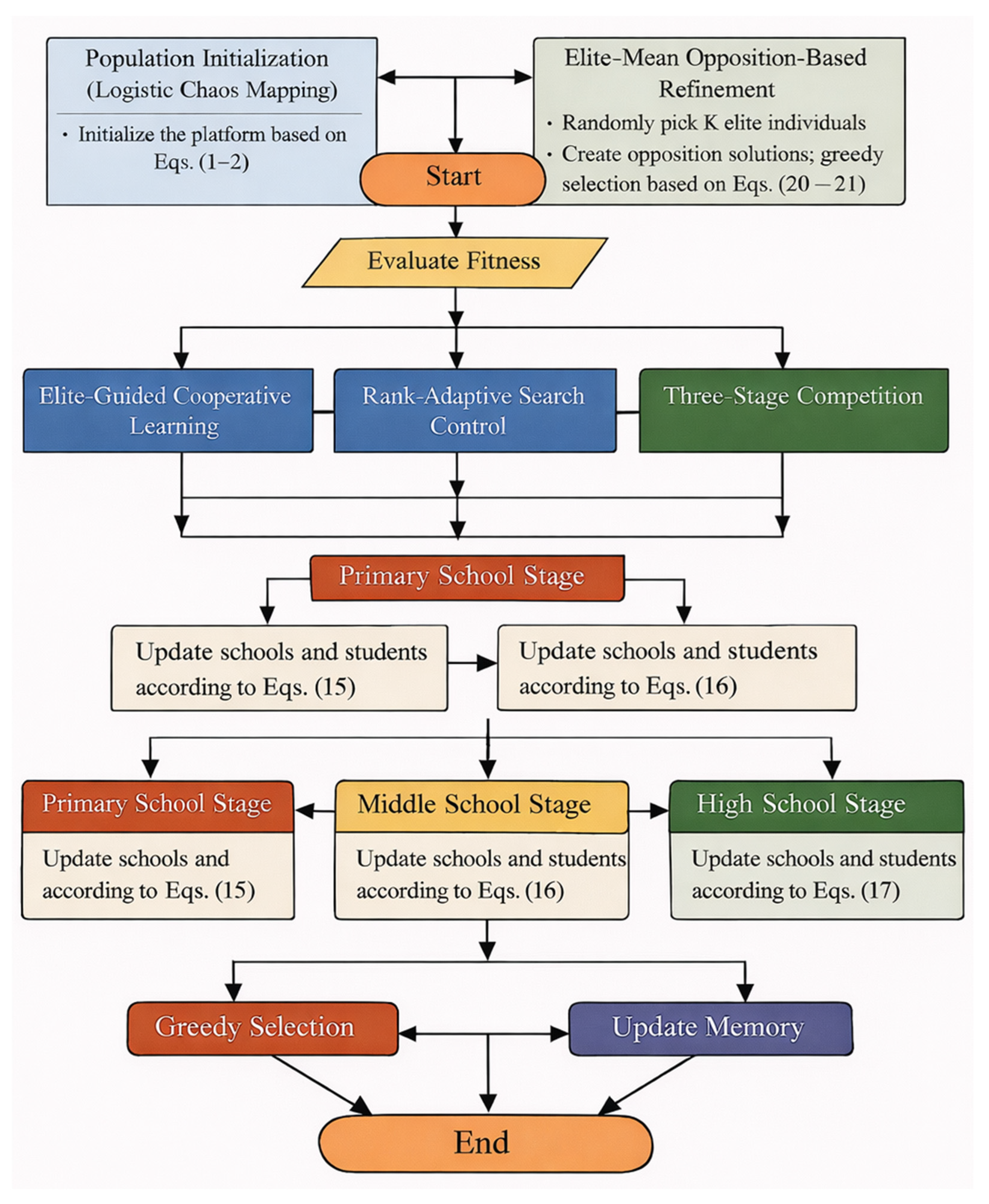
On the basis of the strategies described earlier, Algorithm 1 summarizes the implementation process of the IECO approach, and
Figure 1 provides a visual representation of its overall framework.
| Algorithm 1. Computational Steps of the IECO Framework |
1: Initialize IECO parameters H, G1, G2 and Compute G1Number = round(N·G1), G2Number = round(N·G2).
2: Initialize population X using Logistic chaotic mapping according to Equations (1) and (2).
3: Set global best and fbest and initialize personal best memory pbest and pbest_f.
4: while do
5: Sort population by fitness and randomly select K elite individuals.
6: Update population by greedy selection (Equations (20) and (21)).
7: Compute individual rank factor using Equation (18).
8: Update dynamic parameters and (Equation (19)).
9: Construct elite memory pools based on pbest (according to Equation (10)).
10: for
11: Construct cooperative exemplar and using Equations (12)–(14).
12: if do
13: Update individual position using Stage-1 formulas given in Equation (15).
14: if do
15: Update individual position using Stage-2 formulas given in Equation (16).
16: if do
17: Update individual position using Stage-3 formulas given in Equation (17).
18: Evaluate new fitness and perform greedy selection.
19: Update pbest global best if improved.
20: end for
21: Update the best solution found so far .
22: end while
23: Return . |
2.3. Computational Complexity Analysis
The computational complexity of IECO mainly consists of population initialization, fitness evaluation, population sorting, elite exemplar construction, adaptive parameter calculation, and position updating. Let denote the population size, denote the problem dimension, and denote the maximum number of iterations. The initialization complexity is . In each iteration, the fitness evaluation requires for most benchmark functions, while population sorting requires . The construction of elite exemplars and position updating both require . Therefore, the overall computational complexity of IECO can be expressed as .
Compared with the original ECO, IECO introduces additional operations such as elite pool construction, rank calculation, and elite-mean opposition refinement. These operations slightly increase the computational cost. However, they do not change the dominant complexity order of the algorithm. Since is usually larger than in high-dimensional optimization problems, the main computational burden remains . Therefore, IECO maintains the same order of computational complexity as ECO while achieving better optimization accuracy and stability.
In terms of practical runtime, IECO may require slightly longer execution time than the original ECO due to the additional elite cooperation and opposition refinement operations. Nevertheless, this additional cost is acceptable because IECO obtains significantly better solution quality and more stable convergence performance. This trade-off indicates that IECO is suitable for practical optimization tasks where solution accuracy and robustness are more important than marginal runtime reduction.
2.4. Analysis of IECO
The proposed IECO improves the original ECO mainly from three theoretical aspects: search guidance, adaptive search regulation, and population refinement. First, the elite exemplar-guided cooperative learning strategy changes the learning reference from a single best individual to a multi-elite distribution. This reduces the excessive attraction toward one solution and helps maintain multiple promising search directions. Second, the rank-adaptive stage-wise control strategy assigns different search intensities to individuals according to their fitness ranks. Poorly ranked individuals are encouraged to perform larger exploratory movements, while well-ranked individuals conduct more conservative local refinement. This differentiated control mechanism improves the balance between exploration and exploitation. Third, the elite-mean opposition-based refinement strategy introduces symmetric candidate solutions around the mean position of randomly selected elite individuals. Since the generated opposite solutions are accepted only when they improve fitness, the refinement process follows a greedy selection rule and does not deteriorate the current population quality.
From the convergence-behavior perspective, IECO does not provide a strict mathematical guarantee of reaching the global optimum, which is common for stochastic metaheuristic algorithms. However, the algorithm improves empirical convergence reliability through three mechanisms. The elite exemplar mechanism provides stable, high-quality guidance, the adaptive ranking mechanism prevents premature loss of diversity, and the greedy opposition refinement mechanism ensures that accepted candidate solutions do not worsen the current fitness. Therefore, the best-so-far fitness sequence generated by IECO is non-increasing for minimization problems, which supports stable convergence behavior in practical optimization.
3. Benchmark Function Experiments
3.1. Comparative Methods and Configuration Specifications
This section assesses the effectiveness of the proposed IECO approach by conducting experiments on two well-established and highly challenging benchmark sets for numerical optimization, specifically CEC2017 [
35] and CEC2022 [
36]. These benchmark sets include a variety of unimodal, multimodal, hybrid, and composition functions, which are commonly used to comprehensively assess the optimization capability, robustness, and scalability of metaheuristic algorithms.
To demonstrate the effectiveness of IECO, it is compared with several classical and recently proposed metaheuristic algorithms, including Particle Swarm Optimization (PSO) [
10], Grey Wolf Optimizer (GWO) [
12], Modified Particle Swarm Optimization (MPSO) [
37], Enhanced Grey Wolf Optimizer (EGWO) [
38], Hannibal Barca optimizer (HBO) [
39], Artificial Lemming Algorithm (ALA) [
40], Jaya algorithm (JAYA) [
41], Teaching-Learning-Based Optimization (TLBO) [
42], and Educational competition optimizer (ECO) [
25]. The parameter configurations of all algorithms are summarized in
Table 1.
The parameter settings listed in
Table 1 are determined according to the recommendations provided in the original literature of the corresponding algorithms. To ensure fairness and reproducibility, the default or commonly adopted parameter configurations are used whenever possible. For the proposed IECO, the parameters are selected based on preliminary experiments considering both optimization accuracy and convergence stability across representative benchmark functions.
For the sake of consistency and impartial evaluation, identical experimental configurations are adopted for all competing algorithms. Concretely, each method operates with a population of 30 individuals, a maximum of 500 iterations, and is repeated 30 independent times across all benchmark functions. The performance of the algorithms is evaluated using the average fitness value (Ave) and the standard deviation (Std), where lower values indicate better optimization performance. For clarity, the best results are highlighted in bold.
All simulations were performed on a Linux-based workstation equipped with an AMD Ryzen 9 5900× processor (Advanced Micro Devices, Santa Clara, CA, USA) running at 3.7 GHz and 32 GB of system memory. The algorithms are implemented in MATLAB 2024b.
3.2. Qualitative Analysis
3.2.1. Ablation Study
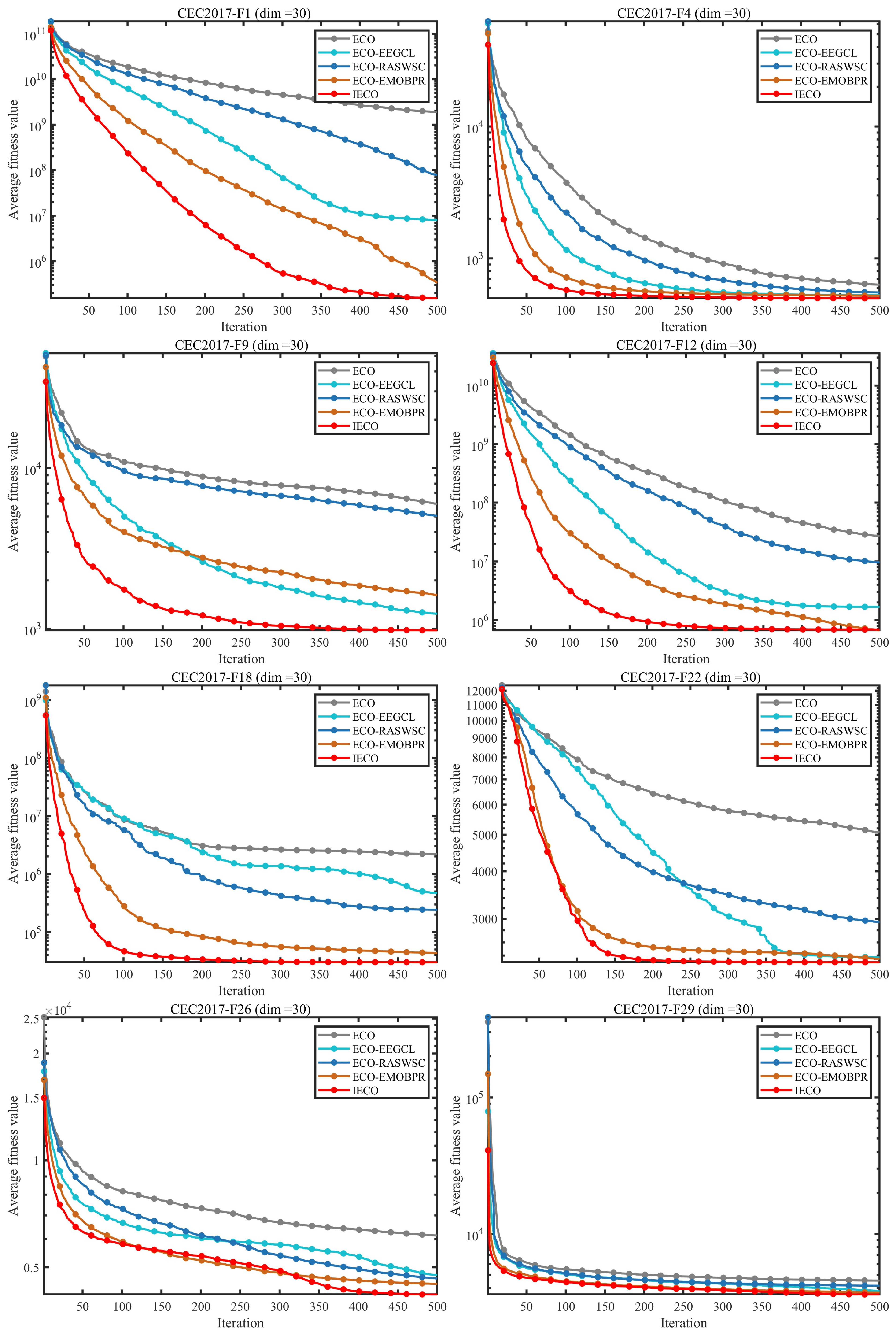
To separately validate the practical contributions of the three proposed improvement strategies, namely the Elite Example-Guided Collaborative Learning strategy (EEGCL), the Rank-Adaptive Stage-Wise Search Control strategy (RASWSC), and the Elite Mean Opposition-Based Reverse Perturbation strategy (EMORBPR), to the original Education Competition Optimizer (ECO), ablation experiments were conducted. By comparing the convergence behaviors of the original ECO, the variants incorporating each individual strategy separately, and the complete IECO integrating all three strategies on the CEC2017 benchmark functions, the specific role of each strategy in enhancing the search capability, convergence accuracy, and stability of the algorithm can be clearly identified, thereby avoiding potential misinterpretations caused by the coupling effects of multiple strategies. The experimental results are presented in
Figure 2.
Figure 2 illustrates the fitness convergence curves of ECO, ECO-EEGCL, ECO-RASWSC, ECO-EMORBPR, and the complete IECO on several representative CEC2017 benchmark functions. As observed from the figure, the convergence curves of the original ECO exhibit a significantly slowed decline during the middle and later stages of iterations on most displayed functions, such as F5, F14, and F18, and even enter a stagnation plateau prematurely. This phenomenon indicates that the original algorithm is prone to becoming trapped in local optima and lacks the capability to continuously explore better solutions. After introducing the EEGCL strategy individually, ECO-EEGCL achieves improved convergence accuracy on several functions, reflected by lower final fitness values. However, noticeable fluctuations can still be observed in its convergence curves, particularly during the middle iteration stages, suggesting that the multi-elite example guidance mechanism enhances population diversity to some extent, while the search stability remains insufficient when used alone. The ECO-RASWSC variant incorporating only the RASWSC strategy demonstrates a faster convergence rate during the early iterations on some functions; nevertheless, its final fitness values on multiple functions do not show substantial improvement compared with the original ECO, indicating that solely relying on rank-adaptive search intensity adjustment is insufficient to completely alleviate premature convergence. For ECO-EMORBPR, which introduces only the EMORBPR strategy, relatively rapid convergence can be observed during the early stages on several functions, such as F10 and F15. However, the convergence trend weakens significantly during the later iterations, and the final fitness values remain inferior to those of the complete IECO. This result demonstrates that the periodic elite mean opposition-based update mechanism helps the population escape local regions, but its sustained optimization capability is limited without the cooperation of other strategies.
In contrast, the complete IECO integrating all three strategies simultaneously achieves the best convergence performance across all presented benchmark functions. Its convergence curves consistently remain below those of all comparison algorithms, indicating the lowest final fitness values. Moreover, the convergence curves of IECO maintain a relatively smooth descending trend throughout the entire iterative process without exhibiting premature stagnation or severe oscillations. These results indicate that the three strategies exhibit effective synergistic effects: EEGCL maintains population diversity, RASWSC dynamically adjusts the search step size, and EMORBPR periodically introduces reverse exploration. Their combined action significantly enhances both the global search capability and convergence accuracy of the algorithm. Overall, the convergence curve comparisons in the ablation experiments demonstrate that although each individual strategy can improve the performance of the original ECO to a certain extent, only the simultaneous integration of all three strategies enables IECO to consistently achieve superior convergence performance across multiple benchmark functions, thereby validating the necessity and complementarity of the proposed improvement strategies.
3.2.2. Parameter Sensitivity Analysis
In intelligent optimization algorithms, the values of key parameters often influence the search behavior and final convergence performance of the algorithm. In the Logistic chaotic mapping, the control parameter
determines the chaotic degree of the initial population distribution, thereby potentially affecting the overall performance of the IECO algorithm. To investigate the influence of different
values on the performance of IECO, five groups of
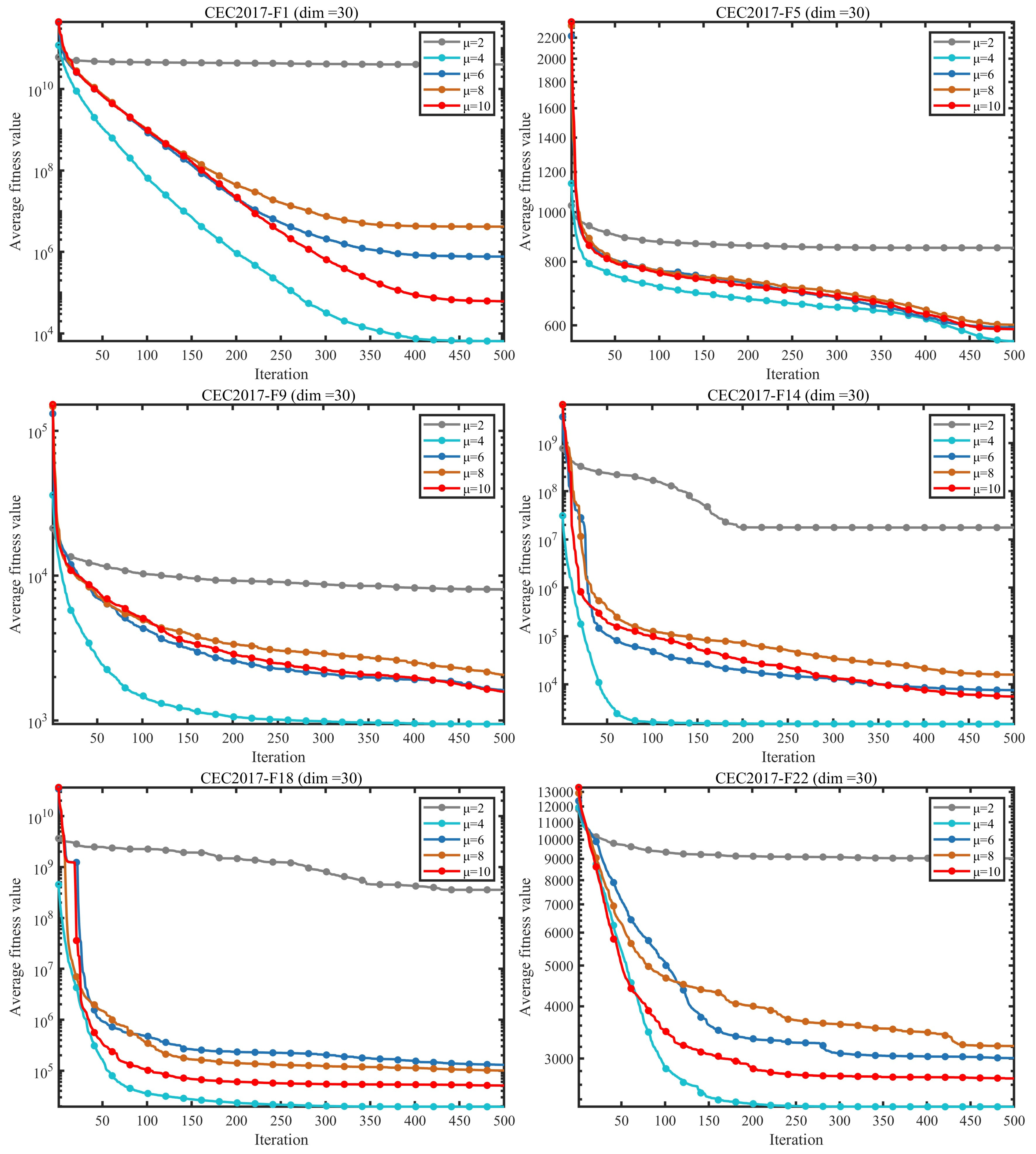
values, namely 2, 4, 6, 8, and 10, were considered in this study. The corresponding convergence curves on several representative CEC2017 benchmark functions were recorded, and the results are presented in
Figure 3. By comparing the convergence behaviors under different μ values, the sensitivity of IECO to this parameter and the optimal parameter setting can be evaluated.
As observed from the convergence curves of several benchmark functions shown in
Figure 3, such as F3, F7, F12, F18, and F20, when
, the convergence curves of IECO decline relatively slowly, and the final fitness values remain significantly higher than those obtained under other parameter settings. This indicates that the chaotic degree is relatively low under this setting, resulting in insufficient population diversity and limiting the global exploration capability of the algorithm. When
, the convergence speed is significantly accelerated, and the obtained final fitness values are the lowest among all tested parameter settings. Meanwhile, the convergence process remains relatively smooth, indicating that the Logistic mapping reaches a fully chaotic state under this parameter setting, leading to a more uniformly distributed initial population and enabling the algorithm to cover a broader search space during the early iterations. When
, the convergence speed becomes slower compared with
, and the final fitness values also increase, although the performance remains superior to that obtained with
. For
and
, the convergence behaviors are similar to those observed for
, and neither achieves the convergence performance obtained with
. In addition, slight fluctuations can be observed during the middle and later stages of iterations on several functions, suggesting that excessively large μ values do not provide further performance improvement.
Overall, the results presented in
Figure 3 demonstrate that
achieves the fastest convergence speed and the lowest final fitness values across all displayed benchmark functions, whereas excessively small values (e.g.,
) or excessively large values (e.g.,
, and 10) lead to varying degrees of performance degradation. Therefore,
is adopted in all experiments of this study to ensure that IECO obtains the optimal initial population distribution and overall optimization performance. Meanwhile, IECO is still capable of maintaining satisfactory convergence performance within a relatively wide range of
values, indicating that the proposed algorithm possesses a certain degree of robustness with respect to the parameter
.
3.2.3. Population Diversity Analysis
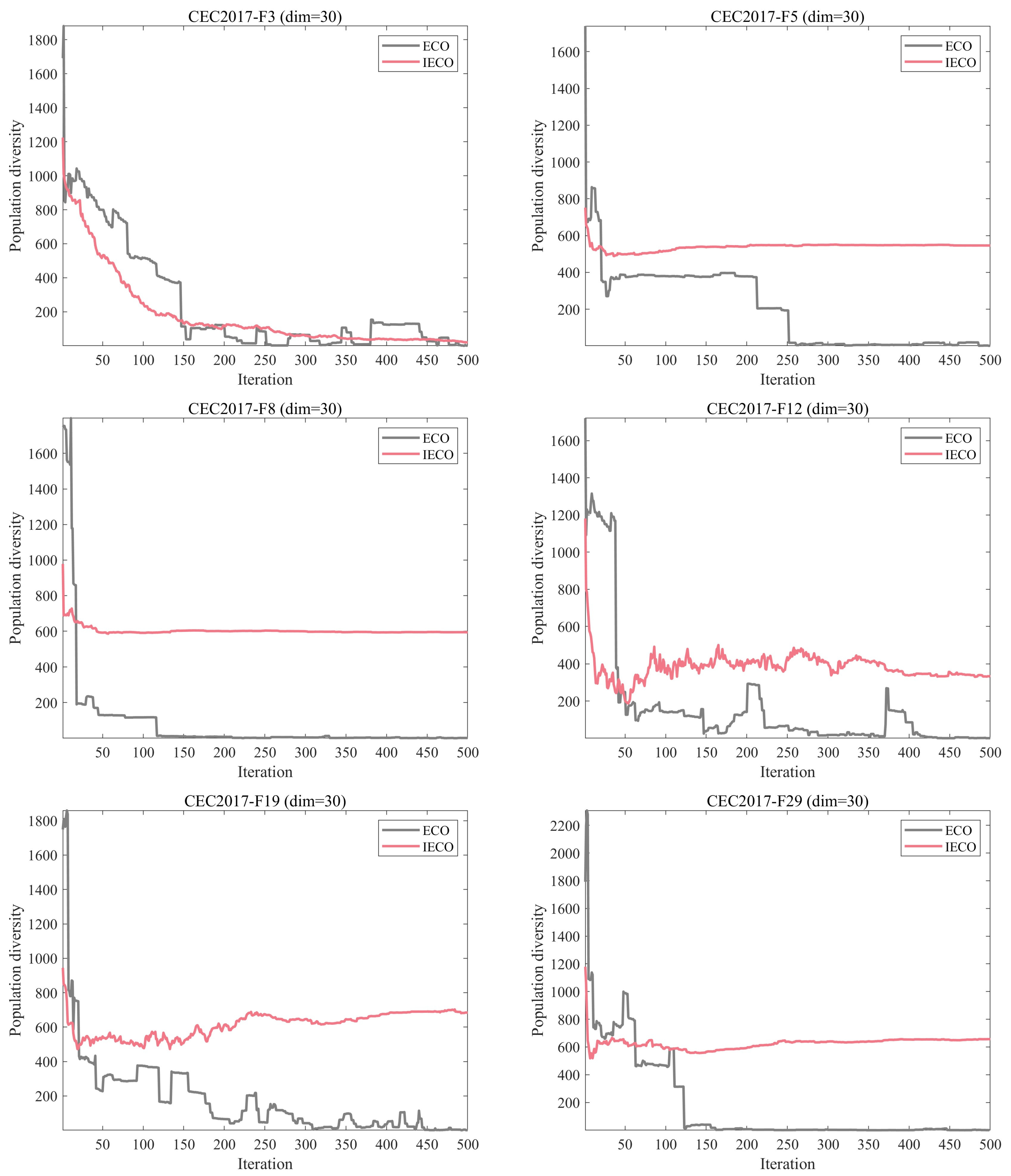
Population diversity is an important indicator for evaluating the global search capability of swarm intelligence algorithms. Higher population diversity enables the algorithm to extensively explore the search space during the early iterations, thereby reducing the risk of falling into local optima, whereas premature diversity loss often leads to premature convergence and deteriorates the final optimization accuracy. To evaluate the performance of IECO in maintaining population diversity, this subsection compares the diversity evolution curves of the original ECO and IECO on several representative CEC2017 benchmark functions. The corresponding results are illustrated in
Figure 4.
As observed from several benchmark functions shown in
Figure 4, such as F3, F5, F10, F14, F18, and F20, the population diversity of the original ECO decreases rapidly during the early iterations. Specifically, within approximately the first 100 iterations, the diversity curves of ECO sharply decline from a relatively high level to a much lower level and then remain nearly stable during the subsequent iterations. This rapid diversity loss indicates that the original ECO fails to effectively preserve the differences among individuals during the early exploration stage, causing the algorithm to prematurely enter a local convergence mode and making it difficult to escape the current search region for broader exploration in the later iterations.
In contrast, the population diversity curves of IECO remain consistently higher than those of the original ECO throughout the entire optimization process. Particularly during the early iterations, the diversity of IECO decreases more gradually, allowing the population to maintain relatively high diversity for a longer period. Even during the middle and later stages of iterations, the diversity level of IECO still remains higher than that of ECO and does not exhibit abrupt cliff-like declines. This phenomenon demonstrates that the proposed Elite Example-Guided Collaborative Learning strategy and Elite Mean Opposition-Based Reverse Perturbation strategy work cooperatively to effectively delay the diversity attenuation process through the introduction of multi-source elite information and periodic reverse exploration mechanisms.
It is noteworthy that on several functions, such as F14 and F20, the diversity curves of IECO still exhibit slight fluctuations during the later iterations instead of becoming completely flat. This indicates that the algorithm retains a certain degree of exploration capability even during the local exploitation stage, enabling it to maintain attention to other potential regions in the search space while performing fine-grained optimization. Overall, the results presented in
Figure 4 demonstrate that, compared with the original ECO, IECO achieves higher population diversity levels and a more gradual diversity decay trend across all displayed benchmark functions, which provides strong support for its superior convergence accuracy and robustness in solving complex optimization problems.
3.3. Experimental Results and Analysis of CEC Test Suites
3.3.1. CEC2017 Benchmark Function Experiments
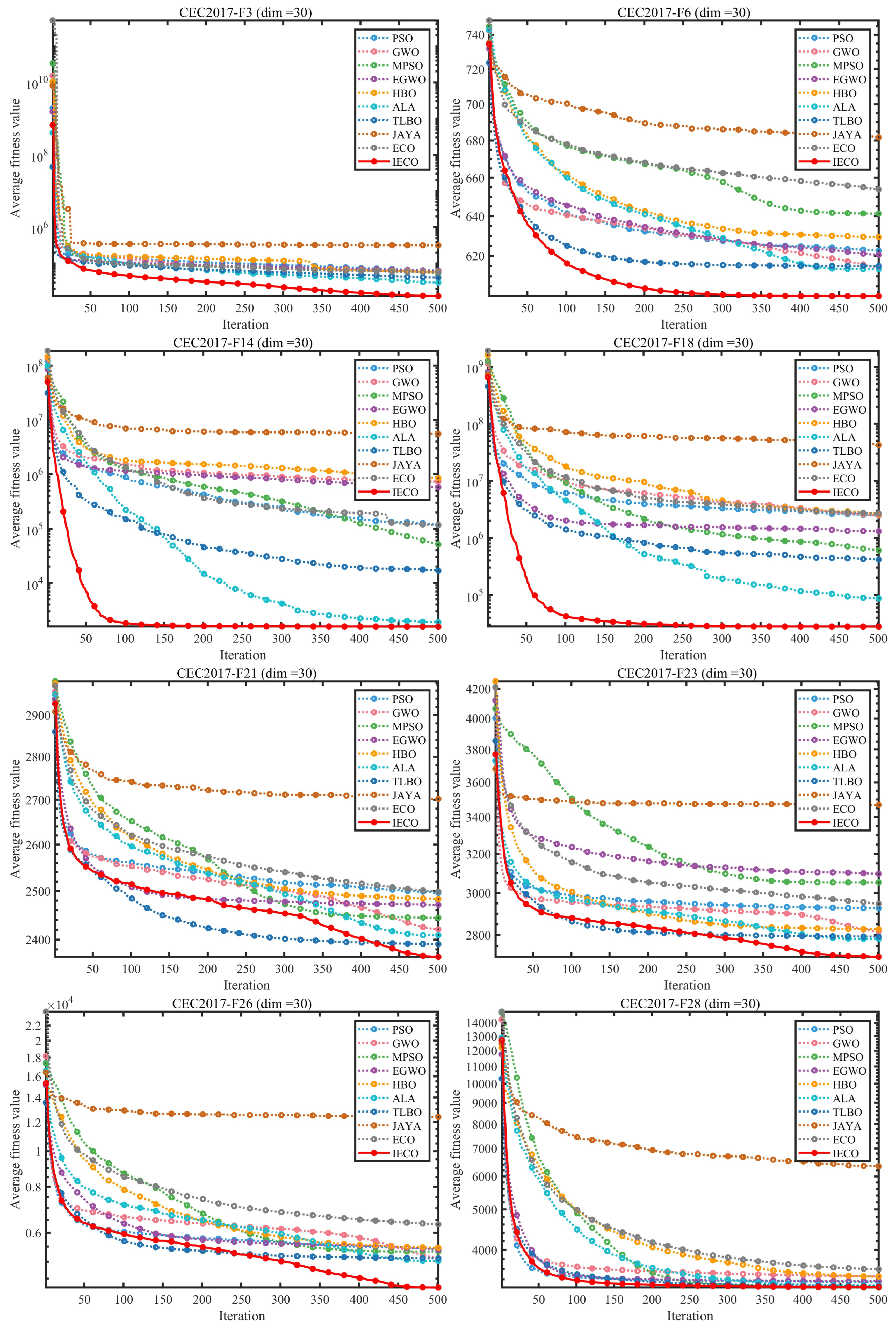
The results obtained by IECO and seven competing methods on the 30-dimensional CEC2017 benchmark suite are summarized in
Table 2, including metrics such as average fitness (Ave) and standard deviation (Std). Additionally,
Figure 5 depicts the convergence trends for a selection of typical benchmark functions. Together, these results evaluate the optimization performance of IECO from both numerical accuracy and convergence behavior perspectives. “Ave” and “Std” denote the average fitness value and standard deviation obtained over 30 independent runs, respectively. Lower values indicate better optimization performance. The best results for each function are highlighted in bold.
It can be clearly observed from
Table 2 that IECO achieves the average fitness values on all 30 CEC2017 benchmark functions, demonstrating overwhelming optimization superiority across unimodal, multimodal, hybrid, and composition functions. In particular, on several high-dimensional and highly complex functions with strong local optimum characteristics, such as F2, F12, F14, F18, and F26, the optimization accuracy of IECO improves by several orders of magnitude compared with algorithms such as PSO, GWO, and ECO. These results fully demonstrate that, through the synergistic cooperation of the Elite Example-Guided Collaborative Learning strategy, the Rank-Adaptive Search Control strategy, and the Elite Mean Opposition-Based Reverse Learning strategy, IECO effectively overcomes the shortcomings of traditional metaheuristic algorithms, including premature convergence and rapid population diversity loss, thereby achieving strong global exploration and local exploitation capabilities. Meanwhile, the standard deviations of IECO on the vast majority of benchmark functions are the smallest among all comparison algorithms, indicating that the algorithm exhibits extremely small fluctuations across multiple independent runs and possesses significantly superior robustness and reliability. In contrast, the original ECO, PSO, and GWO exhibit relatively large standard deviations on several benchmark functions, reflecting insufficient stability of optimization results. The JAYA algorithm performs poorly on most benchmark functions in terms of both average fitness values and standard deviations, resulting in the weakest overall optimization performance among all compared algorithms. Furthermore, the performance improvement of IECO over the original ECO is highly significant, directly validating the effectiveness of the proposed improvement strategies in enhancing optimization accuracy, convergence speed, and stability. In addition, IECO comprehensively outperforms recently proposed improved metaheuristic algorithms, such as MPSO and EGWO, further demonstrating the rationality and advancement of the proposed IECO framework.
To more intuitively illustrate the convergence trends and dynamic optimization processes of different algorithms, the convergence curves of several representative CEC2017 benchmark functions are presented in
Figure 5. As observed from the convergence curves, IECO exhibits the steepest descending trend during the early iterations, enabling it to rapidly escape the initial random search stage and efficiently approach the global optimum region. Within approximately 100 to 200 iterations, IECO has already significantly outperformed all other comparison algorithms, demonstrating an extremely fast early-stage convergence speed. During the middle and later stages of iterations, most comparison algorithms exhibit obvious premature stagnation phenomena, where the fitness values decrease very slowly or even cease to improve, making it difficult to escape local optima.
In contrast, IECO continues to maintain a stable and sustained downward trend in fitness values, allowing continuous deep and refined searches throughout the optimization process. Even near the termination of iterations, IECO is still capable of further improving the solution quality and ultimately converges to the lowest fitness values. Algorithms such as PSO, GWO, and the original ECO are significantly inferior to IECO in terms of both convergence speed and search depth, exhibiting low search efficiency during the early stage and becoming trapped in local optima during the later stage. Although algorithms such as HBO, ALA, and TLBO perform relatively well on several functions, their overall convergence performance and stability still remain inferior to those of IECO. Meanwhile, the convergence curves of the JAYA algorithm consistently remain at the highest positions across all displayed benchmark functions, indicating the poorest optimization performance.
Overall, the numerical results and convergence curve analyses on the CEC2017 benchmark suite jointly demonstrate that IECO significantly outperforms existing classical and advanced metaheuristic algorithms in terms of convergence accuracy, convergence speed, and operational stability on 30-dimensional complex optimization problems, thereby fully validating the synergistic effectiveness of the proposed improvement strategies and the superior global optimization capability of the proposed algorithm.
3.3.2. CEC2022 Basic Benchmark Function Experiment
The results of IECO alongside seven reference algorithms on the CEC2022 test functions are listed in
Table 3 and
Table 4 for 10-variable and 20-variable cases, respectively, including evaluation metrics such as average fitness (Ave) and standard deviation (Std).
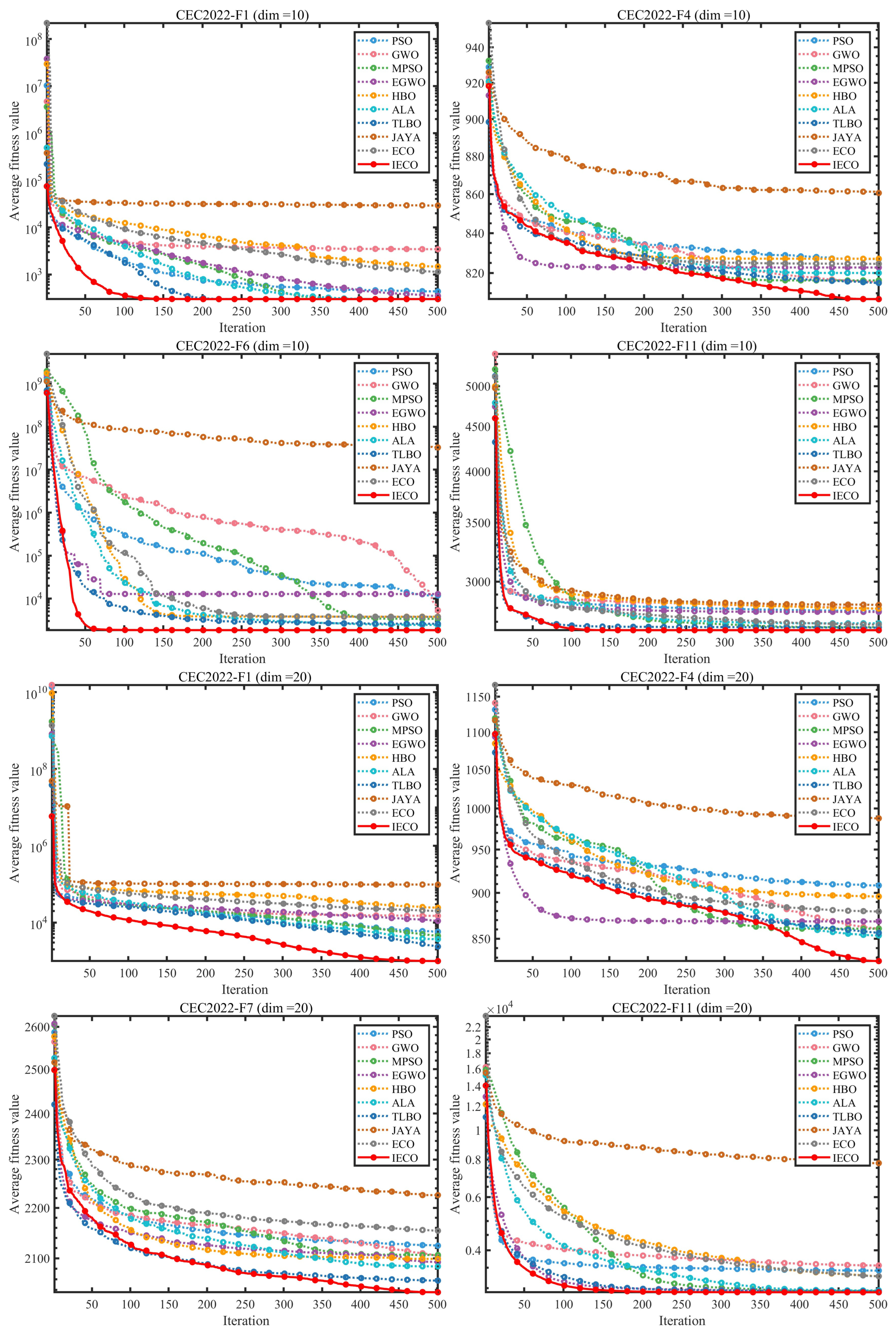
Figure 6 further illustrates the convergence curves of several representative functions. The numerical results and convergence behaviors jointly verify the generality and superiority of IECO across optimization problems with different dimensional complexities.
From the 10-dimensional results presented in
Table 3, it can be observed that IECO achieves the best or near-best average fitness values on all 12 benchmark functions. Specifically, IECO ranks first on 10 functions, including F1, F3, F5, F6, F7, F8, F9, F10, F11, and F12. In particular, on F3, IECO achieves an average value of 6.0000 × 10
2 with an extremely small standard deviation of 5.2453 × 10
−6, indicating the highest optimization accuracy and the smallest fluctuation among all compared algorithms. On F6, the average fitness value and standard deviation of IECO are 1.8330 × 10
3 and 2.0043 × 10
1, respectively, which are significantly better than those of ALA (2.4036 × 10
3 and 1.4387 × 10
3) and TLBO (2.5849 × 10
3 and 9.4797 × 10
2), demonstrating a clear performance advantage. On F12, IECO obtains an average value of 2.8638 × 10
3 with a standard deviation of 8.6460 × 10
−1. Although the average fitness value is slightly higher than that of ALA (2.8625 × 10
3), the smaller standard deviation indicates that IECO exhibits better consistency across multiple independent runs.
The 20-dimensional results shown in
Table 4 indicate that, as the dimensionality increases, the average fitness values of all algorithms generally increase, reflecting the higher optimization difficulty. Nevertheless, IECO still maintains the best average fitness values across all 12 benchmark functions. IECO ranks first on functions such as F1, F3, F5, F6, F8, F9, F10, F11, and F12. Particularly noteworthy is that IECO again achieves the theoretical optimum value of 6.0000 × 10
2 on F3 with an extremely small standard deviation of 5.2453 × 10
−6, demonstrating that the algorithm can still stably converge to the global optimum even when the dimensionality increases. On F6, the average fitness value of IECO (1.8330 × 10
3) is significantly lower than those of the other algorithms, whereas JAYA exhibits the worst performance with an average value of 3.2758 × 10
7, further highlighting the superiority of IECO on high-dimensional and complex optimization problems. On F12, IECO achieves an average value of 2.8638 × 10
3 with a standard deviation of 8.6460 × 10
−1. Although its average fitness value is slightly higher than that of ALA (2.8625 × 10
3), the difference between the two algorithms is extremely small, while IECO still maintains a smaller standard deviation, indicating lower performance fluctuations.
The convergence curves shown in
Figure 6 further illustrate the search behaviors of different algorithms under the 10-dimensional setting. On representative functions such as F1, F3, F5, F6, and F8, the convergence curves of algorithms such as PSO, GWO, and HBO exhibit obvious plateau phenomena during the early iterations, with relatively slow descending speeds. The performance of JAYA is particularly unsatisfactory, as its convergence curves consistently remain at relatively high positions. Although ECO performs better than several traditional algorithms, its convergence curves still exhibit noticeable fluctuations during the middle and later stages of iterations. In contrast, IECO demonstrates the smoothest and most continuous descending trends across all displayed benchmark functions, and its convergence curves consistently remain below those of all comparison algorithms. Taking F3 as an example, the convergence curve of IECO rapidly decreases to a value close to the theoretical optimum within approximately 50 iterations and then remains stable during the subsequent optimization process, whereas the other algorithms fail to achieve comparable precision. On F6, the convergence curve of IECO continues to decline steadily throughout the entire optimization process without exhibiting premature stagnation, indicating strong, sustained search capability.
Overall, the results presented in
Table 3 and
Table 4 together with the convergence curves in
Figure 6 demonstrate that IECO consistently outperforms all comparison algorithms on both the 10-dimensional and 20-dimensional CEC2022 benchmark functions. Under both low-dimensional and high-dimensional conditions, IECO achieves the highest convergence accuracy and the smallest performance fluctuations. These results further verify that IECO possesses excellent scalability with respect to dimensionality and strong robustness, enabling it to effectively adapt to optimization problems with different levels of complexity, thereby providing strong support for its potential application in practical engineering problems.
3.4. Performance Stability Evaluation
In the performance evaluation of metaheuristic algorithms, relying solely on average fitness values and convergence curves is insufficient to comprehensively reflect their practical applicability. In real-world scenarios, an algorithm is required to maintain stable optimization performance across multiple independent runs and avoid significant performance degradation caused by stochastic factors or unfavorable initial conditions. Stability, as a key indicator of algorithmic robustness, directly determines the reliability of an algorithm when applied to complex optimization problems. An algorithm with poor stability may achieve excellent results in a single run, yet fail to consistently deliver satisfactory solutions under slight environmental or initialization variations.
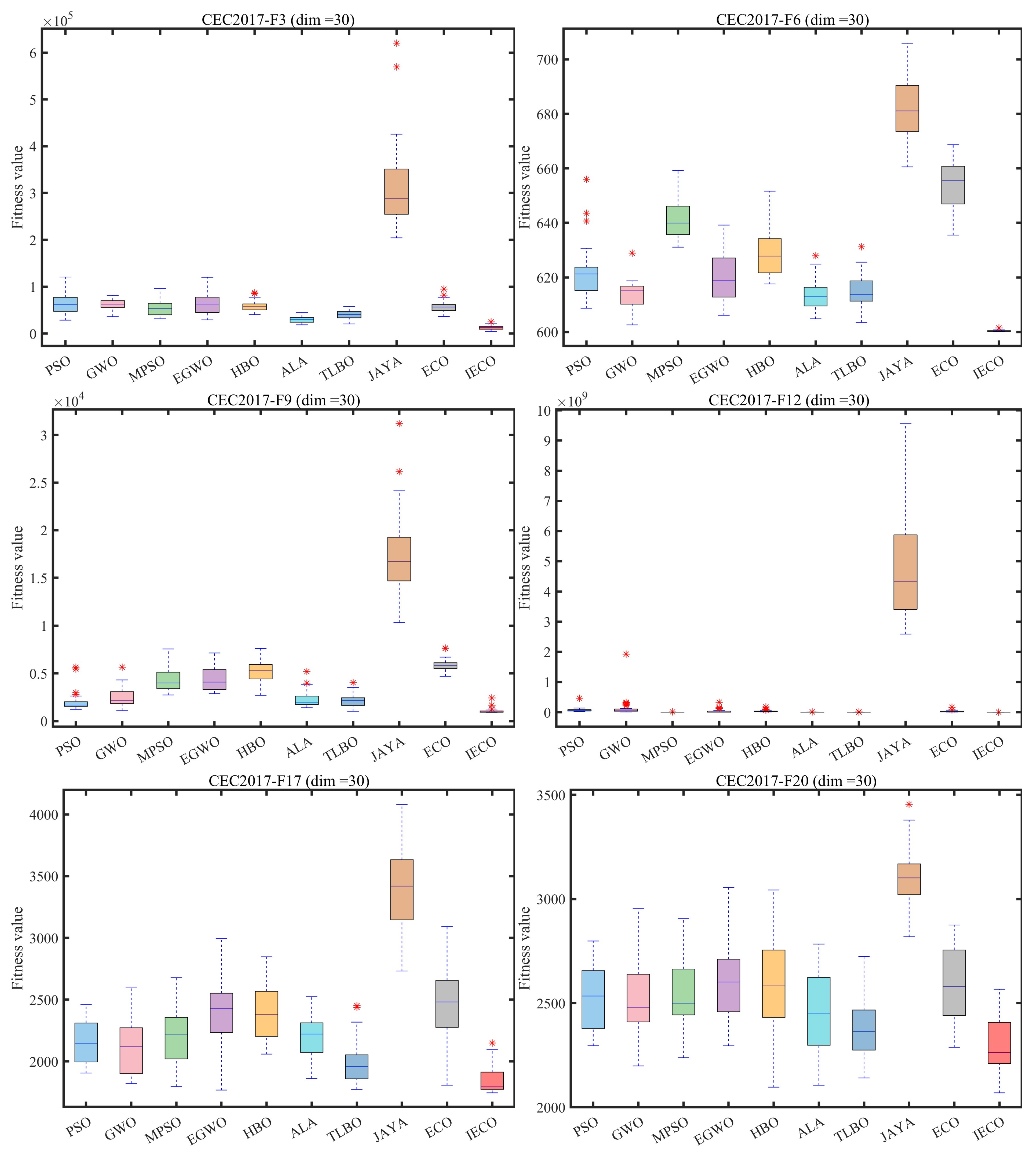
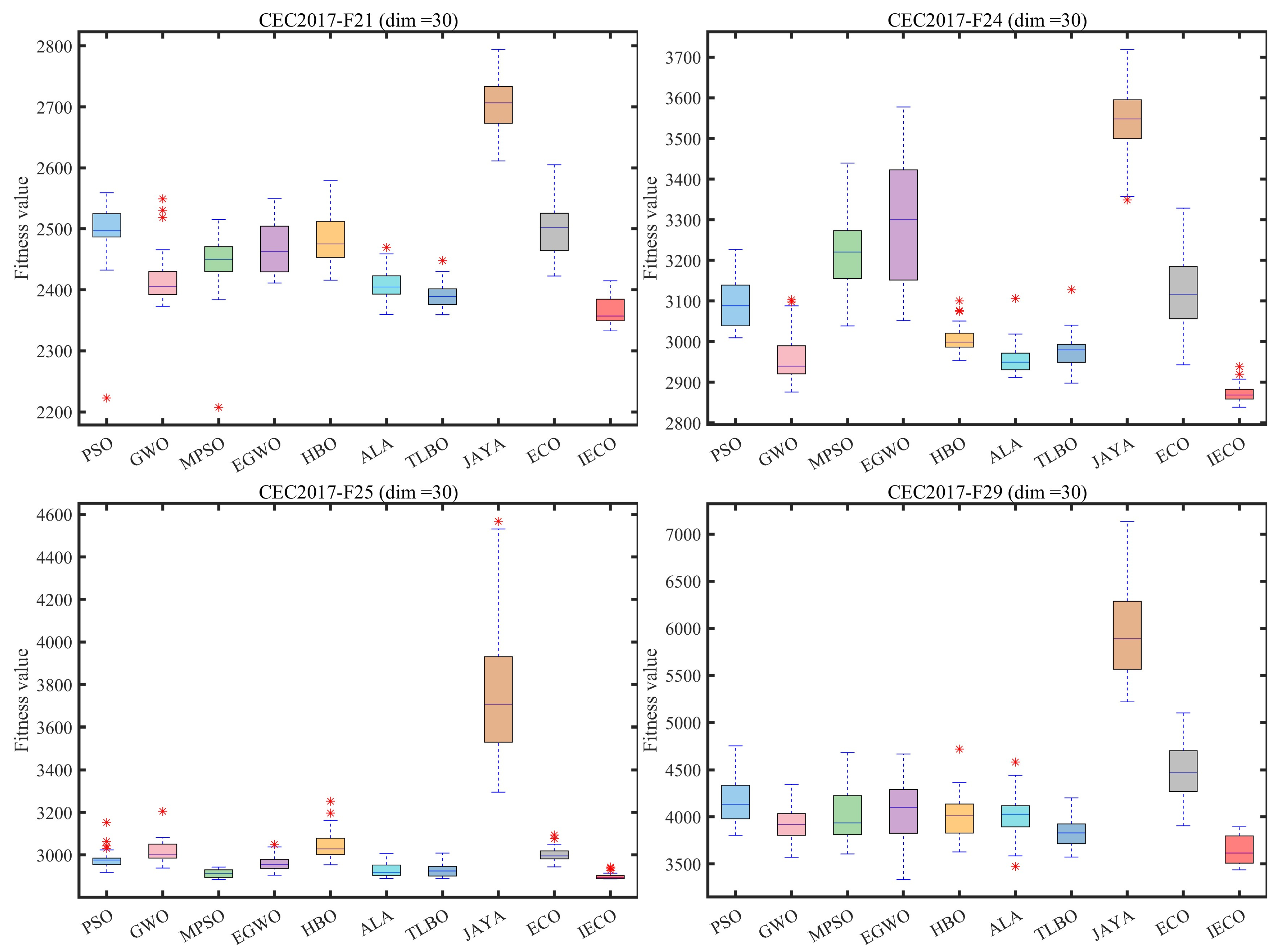
To further evaluate the robustness of the proposed IECO algorithm, a stability analysis is conducted in this section using box plots, as shown in
Figure 7. The box plots illustrate the distribution characteristics of fitness values obtained from 30 independent runs of IECO and the seven comparison algorithms on the CEC2017 benchmark functions with 30 dimensions. The analysis focuses on three aspects: data dispersion, median performance, and the presence of outliers, thereby providing a systematic comparison of the stability of different algorithms and supporting the reliability of IECO in practical applications.
Figure 7 presents the box plots of IECO and the comparison algorithms on selected CEC2017 benchmark functions. In each box plot, the lower and upper edges of the box correspond to the first quartile (Q1) and the third quartile (Q3), respectively, while the box height represents the interquartile range (IQR), reflecting the degree of result dispersion. The horizontal line inside the box denotes the median value, indicating the typical performance level of the algorithm. The points outside the whiskers represent outliers, which correspond to extreme performance fluctuations during repeated runs.
As observed from several benchmark functions shown in
Figure 7, such as F3, F5, F10, F14, F18, F20, F22, and F25, the boxplots of IECO consistently exhibit the most compact distribution characteristics among all comparison algorithms. Specifically, the box heights of IECO, which represent the interquartile ranges, are significantly smaller than those of the other algorithms, indicating that the results obtained from 30 independent runs are highly concentrated with minimal performance fluctuations. Meanwhile, the median lines of IECO, representing the typical optimization performance, are located near the lower portions of the boxplots on most benchmark functions, and the overall positions of the boxplots are significantly lower than those of the comparison algorithms. This demonstrates that IECO not only possesses superior stability but also achieves better median performance than all competing algorithms.
In contrast, the boxplots of the other comparison algorithms exhibit varying degrees of dispersion. For example, PSO and GWO generally present relatively large box heights, and several obvious outliers can be observed on multiple benchmark functions, represented by scattered points beyond the boxplot ranges. This phenomenon indicates that these algorithms occasionally become trapped in poor local optima during some independent runs, resulting in relatively poor performance consistency. The performance of JAYA is particularly unsatisfactory, as its boxplots consistently remain at the highest positions on the vertical axis across all benchmark functions, accompanied by relatively large box heights, indicating the lowest convergence accuracy and insufficient stability. Although the original ECO achieves better median values than PSO and GWO on several functions, such as F10 and F22, its box heights remain noticeably larger than those of IECO, and outliers are still observed on certain benchmark functions, suggesting that the stability of ECO still requires further improvement.
It is noteworthy that on functions such as F14 and F18, the boxplots of ALA and TLBO are relatively compact with comparatively low median values, demonstrating relatively good stability. However, the boxplots of IECO on these functions are still located at lower positions and exhibit even more compact distributions, indicating that IECO further improves the reliability of optimization results while maintaining high optimization accuracy. In addition, on functions such as F5 and F20, although several comparison algorithms, including HBO and MPSO, achieve acceptable median values, their boxplots still exhibit relatively large interquartile ranges or contain outliers, suggesting that their optimization performance is more susceptible to random factors. In contrast, IECO demonstrates consistently stable optimization behavior.
Overall, the boxplot results presented in
Figure 7 demonstrate that IECO achieves the best stability and the highest convergence accuracy across all displayed benchmark functions. Its compact boxplot distributions, absence or near absence of outliers, and the lowest median positions collectively indicate that IECO can continuously and stably obtain high-quality solutions across multiple independent runs. This advantage mainly benefits from the synergistic cooperation of the Elite Example-Guided strategy for maintaining population diversity, the Rank-Adaptive strategy for dynamically adjusting search intensity, and the Elite Mean Opposition-Based strategy for escaping local optima. Together, these mechanisms effectively reduce the algorithm’s sensitivity to the initial population and random factors, thereby significantly enhancing the overall robustness of the proposed algorithm.
3.5. Statistical Performance Examination
A rigorous comparison of optimization algorithms requires statistical tools to distinguish meaningful performance gaps from those arising by chance. Therefore, this section employs two widely recognized nonparametric tests—the Wilcoxon rank-sum test and the Friedman average ranking test—to further assess the effectiveness of the IECO method. These tests are particularly suitable for algorithm comparison because they do not assume normality of the data distribution and can robustly evaluate performance differences across multiple benchmark functions.
To address the randomness inherent in metaheuristic algorithms, all algorithms are independently executed 30 times under identical experimental settings. In addition to the average fitness and standard deviation, statistical significance analysis is conducted to determine whether the observed performance differences are caused by random fluctuations or by the intrinsic effectiveness of the proposed IECO. Specifically, the Wilcoxon rank-sum test is used for pairwise comparison between IECO and each competing algorithm, while the Friedman test is employed to evaluate the overall ranking differences among all algorithms.
3.5.1. Wilcoxon Rank Sum Test
As a nonparametric statistical tool, the Wilcoxon rank-sum test avoids any assumption about data distribution, making it suitable for performance comparison between IECO and competing methods. In this study, a significance level of 0.05 is employed [
43]. A
p-value below this threshold implies rejection of the null hypothesis (i.e., no difference between algorithms), indicating that IECO performs significantly better. Otherwise, the null hypothesis is retained [
33,
44]. Detailed results are provided in
Table 5,
Table 6 and
Table 7.
The CEC2017 results presented in
Table 5 indicate that, among all 30 benchmark functions, the numbers of functions on which IECO achieves
p-values smaller than 0.05 when compared with PSO, GWO, JAYA, and ECO are 29, 30, 30, and 30, respectively. Except for F10 in the comparison with PSO (
p = 9.3341 × 10
−2), where no statistically significant difference is observed, IECO significantly outperforms the compared algorithms on all remaining benchmark functions. Compared with MPSO, EGWO, HBO, ALA, and TLBO, IECO also demonstrates statistically significant superiority on the majority of benchmark functions. Specifically, among the 30 functions, IECO significantly outperforms MPSO on 24 functions, while no significant difference is observed on 6 functions (F2, F4, F11, F16, F22, and F28). Compared with EGWO, IECO significantly outperforms 27 functions, with no significant difference observed on F2, F13, and F15. Compared with HBO, IECO significantly outperforms 29 functions, with no significant difference only on F1. Compared with ALA, IECO significantly outperforms 27 functions, with no significant difference on F4, F13, and F30. Compared with TLBO, IECO significantly outperforms 26 functions, while no significant difference is observed on F4, F11, F15, and F28. These results demonstrate that IECO exhibits statistically significant performance differences from most comparison algorithms on the vast majority of benchmark functions, and these differences consistently favor IECO.
The 10-dimensional CEC2022 results shown in
Table 6 further demonstrate that, across all 12 benchmark functions, the
p-values obtained from the comparisons between IECO and PSO, GWO, TLBO, JAYA, and ECO are all smaller than 0.05, indicating that IECO significantly outperforms these algorithms on every benchmark function. Compared with MPSO, IECO significantly outperforms 11 functions, with no significant difference only on F8 (
p = 2.5805 × 10
−1). Compared with EGWO, IECO significantly outperforms 10 functions, while no significant difference is observed on F2 (
p = 3.2508 × 10
−1) and F8 (
p = 9.2344 × 10
−1). Compared with HBO, IECO significantly outperforms 11 functions, with no significant difference only on F8 (
p = 7.1719 × 10
−1). Compared with ALA, IECO significantly outperforms 11 functions, with no significant difference only on F8 (
p = 7.0127 × 10
−2). According to the (+/=/−) statistics, IECO never exhibits statistically inferior performance to any comparison algorithm, and the number of functions without significant differences remains very limited, mainly concentrated on F8.
The 20-dimensional CEC2022 results presented in
Table 7 are generally consistent with those obtained under the 10-dimensional setting. In the comparisons between IECO and PSO, GWO, TLBO, JAYA, and ECO, the
p-values of all 12 benchmark functions remain smaller than 0.05, indicating that IECO significantly outperforms these algorithms on every benchmark function. Compared with MPSO, EGWO, HBO, and ALA, the numbers of functions on which IECO achieves statistically significant superiority are 11, 10, 11, and 11, respectively, while the functions without significant differences remain mainly concentrated on F2 and F8. It is worth noting that even on the functions where no statistically significant difference is observed, the average fitness values and standard deviations of IECO are still superior or highly comparable to those of the comparison algorithms, indicating that IECO is at least not inferior to the competing methods on these benchmark functions.
Overall, the Wilcoxon rank-sum test results presented in
Table 5,
Table 6 and
Table 7 lead to the following conclusions. First, IECO demonstrates overwhelming statistical superiority over PSO, GWO, JAYA, and ECO, significantly outperforming these algorithms on nearly all benchmark functions. Second, compared with improved algorithms such as MPSO, EGWO, HBO, ALA, and TLBO, IECO also exhibits statistically significant advantages on the majority of benchmark functions, with only a few functions, such as F2, F4, and F11 in CEC2017 and F2 and F8 in CEC2022, showing no significant differences. Third, across all benchmark functions and all comparison algorithms, IECO never exhibits statistically inferior performance to any competing algorithm. These results fully demonstrate that IECO possesses statistically significant performance superiority over the original ECO and the other mainstream metaheuristic algorithms, and this advantage remains consistent across different benchmark suites and dimensional conditions.
3.5.2. Global Performance Comparison via Friedman Test
Another widely adopted distribution-free method, the Friedman test, is used to assess the relative performance of several algorithms over multiple benchmark tasks. It operates by assigning ranks to each algorithm on every function, followed by computing metrics such as the mean rank (M.R.) and total rank (T.R.), where lower values indicate better overall results. In contrast to two-algorithm comparisons, this test delivers a global performance ordering, which is particularly useful in multi-method evaluation scenarios [
33,
45,
46].
To comprehensively evaluate the overall performance of IECO, the Friedman mean rank test is applied to rank IECO and the seven comparison algorithms on the CEC2017 benchmark functions with 30 dimensions, as well as the CEC2022 benchmark functions with 10 and 20 dimensions. The corresponding mean ranks and total ranks are reported in
Table 8.
As shown in
Table 8, IECO consistently ranks first with a significant advantage across all three experimental scenarios. Specifically, in the 30-dimensional CEC2017 benchmark tests, IECO achieves an average rank of 1.57 and an overall rank of 1, which are substantially better than those of the second-ranked TLBO (average rank of 3.10) and the third-ranked ALA (average rank of 3.83). In contrast, the original ECO obtains an average rank of 7.47 and an overall rank of 9, placing it second from the bottom among all compared algorithms and outperforming only JAYA (average rank of 10.00). This substantial gap clearly demonstrates that the three proposed improvement strategies significantly enhance the comprehensive optimization performance of the original ECO, enabling it to improve from a poorly ranked algorithm to the top-performing method.
In the 10-dimensional and 20-dimensional CEC2022 benchmark tests, IECO also demonstrates outstanding performance. Under both dimensional settings, IECO achieves an average rank of 1.33 and an overall rank of 1, thereby consistently maintaining the leading position. The second-ranked algorithm under both the 10-dimensional and 20-dimensional conditions is ALA (average rank of 3.25), followed by TLBO (average rank of 3.42). It is noteworthy that the average ranks achieved by IECO on the CEC2022 benchmark suite (1.33) are even lower than its average rank on the CEC2017 benchmark suite (1.57), indicating that the superiority of IECO over the comparison algorithms becomes even more pronounced on the CEC2022 benchmark problems. Meanwhile, the original ECO achieves an average rank of 6.92 and an overall rank of 8 under both dimensional settings, again outperforming only JAYA (average rank of 9.92). This further confirms the evident performance limitations of the original ECO when solving complex optimization problems.
From the overall ranking results, the relative ordering of the algorithms remains highly consistent across different benchmark scenarios. IECO consistently ranks first, followed by ALA, TLBO, MPSO, EGWO, GWO, HBO, ECO, and PSO, while JAYA remains the worst-performing algorithm in all scenarios. This stable ranking pattern demonstrates that the performance superiority of IECO possesses strong repeatability and dimensional robustness, and its advantage does not fluctuate significantly with changes in benchmark suites or problem dimensionality.
Overall, the Friedman test results presented in
Table 8 lead to the following conclusions. First, IECO achieves the lowest average ranks and the best overall rankings across all experimental scenarios on both the CEC2017 and CEC2022 benchmark suites, indicating that its overall optimization performance surpasses that of all comparison algorithms. Second, there exists a substantial gap between IECO and the second-ranked algorithms, as reflected by the differences in average ranks (1.57 vs. 3.10 and 1.33 vs. 3.25), demonstrating that the superiority of IECO is not accidental but represents a statistically significant advantage. Third, while the original ECO consistently ranks near the bottom across all benchmark scenarios, the improved IECO, integrating the three proposed strategies, rises to the top position. This result further validates the effectiveness and necessity of the proposed improvement strategies from the perspective of global ranking performance.
4. Tourism Service Communication Course Grade Prediction
4.1. Formulation of the KNN Model
The K-nearest neighbors (KNN) technique is a widely used nonparametric classification approach that relies on instance-based learning. The fundamental principle of this method is to evaluate the similarity between a query sample and all available training instances by computing their distances. Afterward, a subset consisting of the K closest samples is identified, and the category of the query sample is assigned according to the majority class among these selected neighbors [
47,
48,
49]. Due to its straightforward structure, ease of application, and clear interpretability, KNN is especially effective for classification problems involving datasets of limited or moderate size.
Assume that the training set is represented as follows [
49,
50]:
where
indicates a class, while
denotes other class. For a given query sample
, the distance between
and each element in the training set is computed. Typical distance measures include the Euclidean metric, the Manhattan metric, and the more general Minkowski formulation, which is defined as follows [
49,
50]:
In this formulation, setting
yields the Euclidean metric, whereas
reduces the expression to the Manhattan metric.
Once all pairwise distances have been obtained, the training instances are arranged in ascending order according to their distance values, and the subset containing the K closest samples is denoted as
. The predicted label of the query sample is then determined using a majority voting scheme, which can be expressed as follows [
49,
50]:
where
represents an indicator function. To further enhance the stability and reliability of the classification results, a weighted voting mechanism can be introduced. In this case, neighbors that are closer to the query sample contribute more significantly to the final decision by being assigned larger weights [
49,
50]:
where
is a small constant introduced to avoid division by zero.
The performance of KNN largely depends on the proper configuration of its key parameters. Among these, the number of nearest neighbors
significantly affects the model behavior: smaller values tend to increase sensitivity to noisy data, whereas larger values may result in overly generalized decisions and reduced sensitivity to local variations. Additionally, the selection of distance metrics and voting mechanisms further influences the classification results [
49,
51,
52]. Therefore, adopting an intelligent optimization method to automatically tune these parameters is an effective way to improve both the accuracy and stability of the model.
4.2. Development of the IECO-KNN Prediction Framework
As a similarity-based classification technique, the KNN algorithm assigns labels to samples by comparing them with known instances. Its simplicity and training-free nature make it a popular choice for tasks involving relatively small or medium-sized datasets, including applications in financial forecasting and educational evaluation [
7,
49,
53]. However, its performance is highly dependent on parameter selection. Key factors such as the number of nearest neighbors and the distance calculation method significantly affect the classification outcome, and unsuitable choices may result in decreased accuracy and poor robustness.
To mitigate the sensitivity of KNN to parameter configuration, an adaptive optimization mechanism is introduced by integrating the Improved Educational Competition Optimizer (IECO), forming a hybrid prediction model referred to as IECO-KNN. Instead of relying on manually selected parameters, this approach leverages an intelligent search process to automatically determine suitable values within a predefined parameter domain, with the goal of improving predictive reliability and overall model performance.
In this framework, each candidate solution generated by IECO encodes a specific parameter setting for the KNN model, including both the neighborhood size and the distance-related exponent. During the search process, these candidate solutions are continuously evaluated using the classification outcomes produced on the training dataset. Guided by its optimization dynamics, IECO iteratively updates the population, gradually steering the search toward more promising regions of the parameter space.
The optimization procedure terminates once a predefined stopping condition is satisfied, such as reaching the maximum iteration limit or achieving convergence. At this point, the best-performing parameter configuration is selected and used to construct the final KNN classifier, which is then employed for prediction tasks.
Through this integration, the proposed model transforms the traditional parameter tuning process into an automated optimization problem, effectively avoiding subjective or empirical selection. As a result, the IECO-KNN framework demonstrates improved adaptability and stability. The parameter boundaries considered during optimization are provided in
Table 9.
In this study, the objective function for IECO is defined as the average classification error calculated through inner cross-validation:
where
denotes the number of folds in the inner cross-validation (e.g., 5-fold),
represents the number of misclassified samples in the
-th fold, and
denotes the total number of samples in that fold.
Throughout the search procedure, IECO continuously refines the candidate solutions with the aim of reducing the defined objective function, ultimately yielding an optimal parameter configuration . To provide a robust and unbiased assessment of model performance, a nested cross-validation framework is employed. Specifically, a 10-fold outer cross-validation scheme is utilized for performance evaluation, while an inner cross-validation loop is dedicated to parameter tuning. To further ensure consistency, stratified sampling is adopted so that the class distribution remains balanced across all folds. In addition, the entire experimental process is repeated several times, and the averaged outcomes are taken as the final reported results.
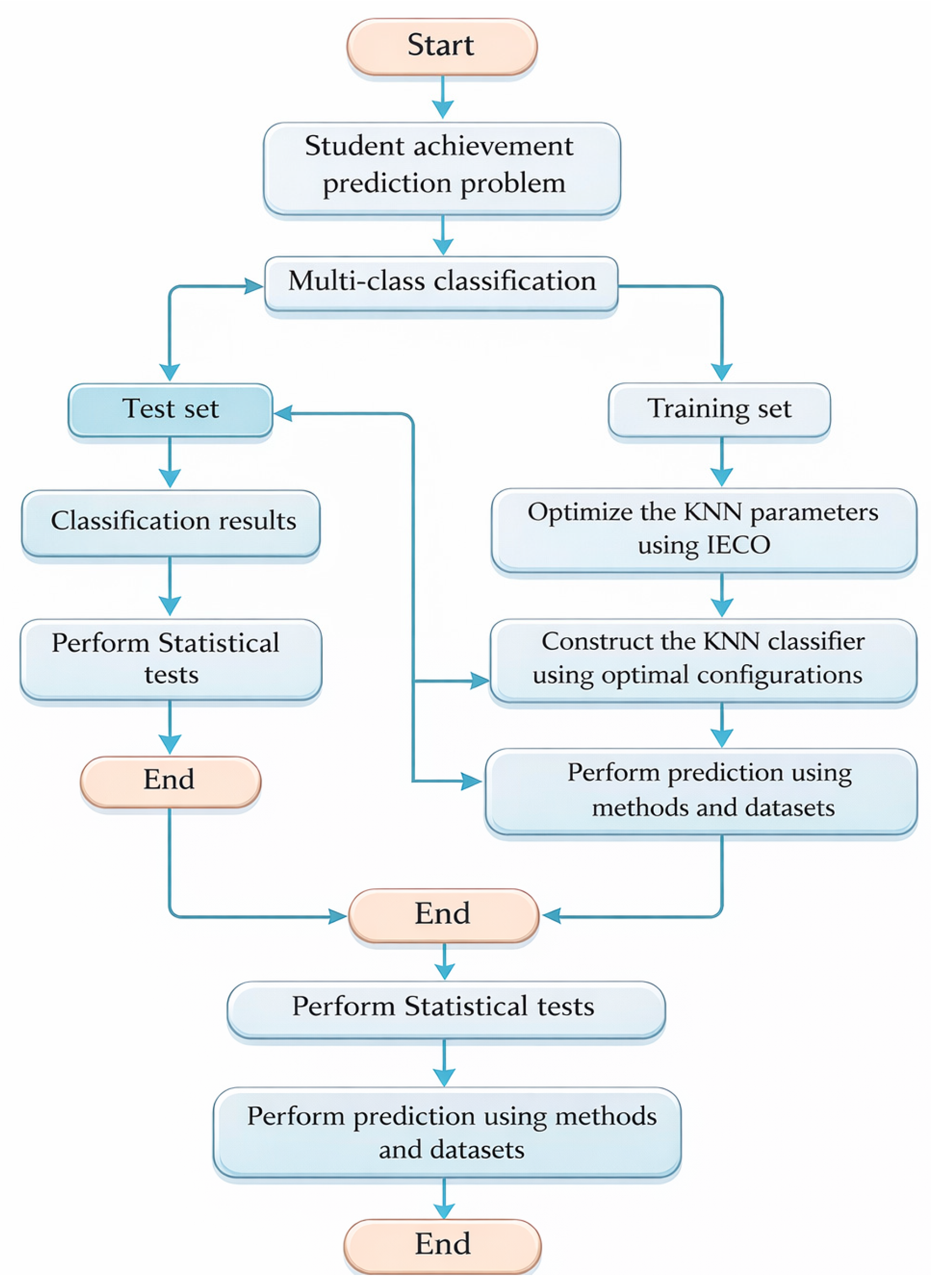
The overall structure of the IECO-KNN classification framework is visually summarized in
Figure 8.
To further validate the effectiveness of the proposed IECO-KNN model in practical applications, a self-collected grade dataset is used for performance evaluation. The dataset consists of 20 grade-related features and a total of 120 samples, which are collected from the examination results of 120 students.
4.3. Analysis of Feature Influence
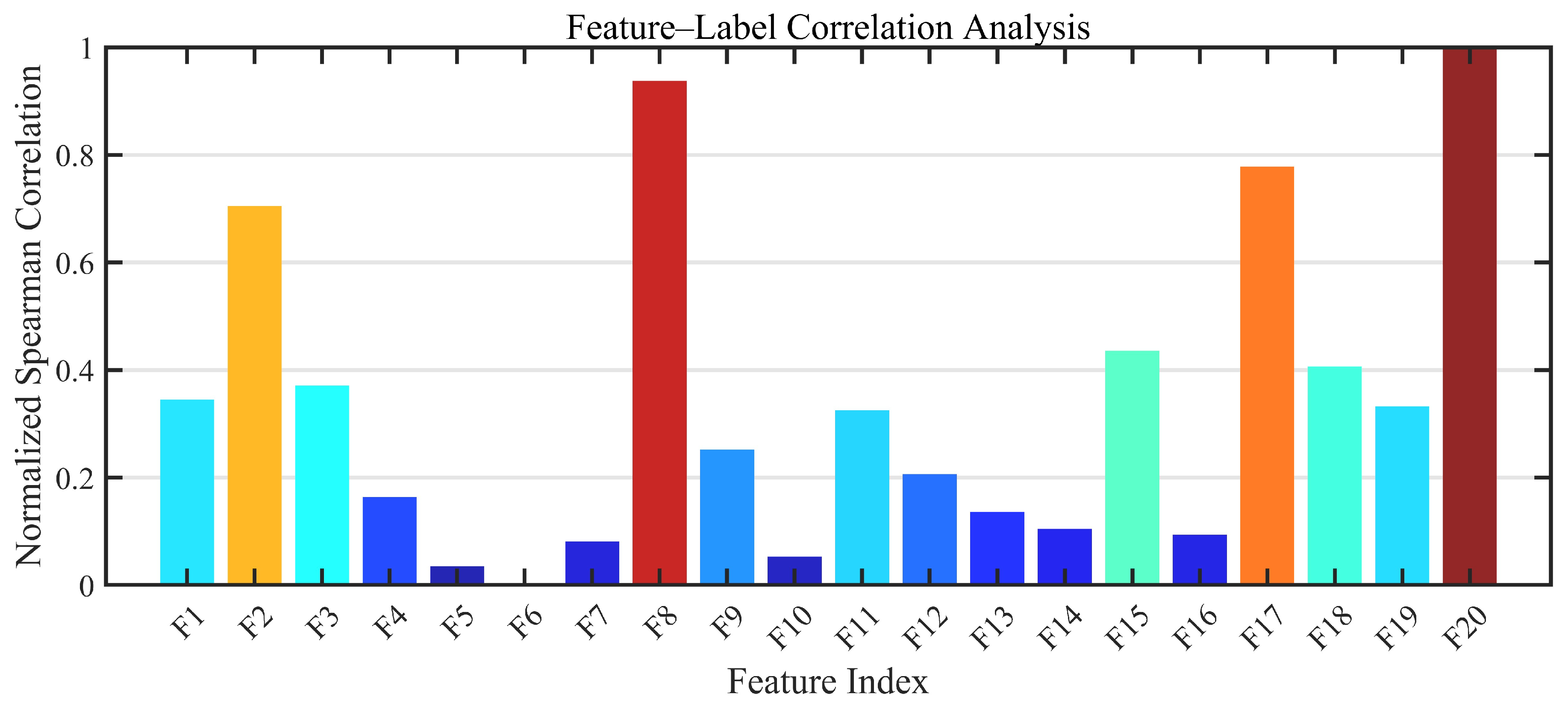
To accurately identify the key factors influencing the final grades of the tourism service communication course, the correlation coefficients between the 20 features and the grade labels are calculated and visualized using a bar chart, as shown in
Figure 9. The color gradient on the right side of the figure, ranging from blue to red, intuitively reflects the decreasing influence weights of the features, where darker red indicates stronger correlation and greater influence on course performance, while darker blue indicates weaker correlation.
According to the ranking of correlation coefficients, the three most influential features are learning interest in the course, frequency of classroom discussion, and channels for acquiring additional course-related information. This result indicates that students’ intrinsic motivation and active participation behaviors play a dominant role in determining course performance. Strong learning interest enhances engagement, frequent classroom discussions deepen understanding and application of knowledge, and diversified extracurricular information channels expand students’ knowledge scope. Together, these factors form the key driving forces behind improved academic performance.
In contrast, features such as revision methods for the course, students’ hometown cities, and prior experience with related courses or practical training exhibit the lowest correlation coefficients and have limited influence on final grades. This finding suggests that performance in the tourism service communication course depends more on active engagement and interest-driven learning during the learning process, rather than differences in revision styles, geographical background, or prior experience. Even students with limited foundational knowledge can achieve satisfactory performance if they demonstrate strong interest and active participation in both classroom and extracurricular learning activities.
Overall, the correlation analysis presented in
Figure 9 clearly identifies the core factors affecting course performance and provides targeted guidance for teaching optimization. Instructors may focus on stimulating students’ learning interest through engaging teaching designs, promoting interactive classroom discussions, and recommending diversified extracurricular learning resources, while placing less emphasis on students’ background differences or prior experience.
4.4. Experimental Evaluation and Result Analysis
In the experimental setup, the original score data are first preprocessed through normalization to reduce the impact of varying feature scales on model performance. The dataset is then divided using a 10-fold cross-validation scheme, in which each subset is alternately treated as the testing portion while the remaining subsets are used for training, thereby enhancing the robustness and consistency of the evaluation.
For each training phase, the IECO algorithm is applied to automatically tune the parameters of the KNN model based on the training data. The resulting optimized model is subsequently utilized to generate predictions on the corresponding validation subset. The prediction results from all folds are aggregated to obtain the overall classification performance on the entire dataset.
To comprehensively and objectively evaluate the performance of the IECO-KNN model and the comparison algorithms, four commonly used classification metrics are adopted: Accuracy (ACC), Cohen’s Kappa coefficient (Kappa), Macro-Precision (MacroP), and Macro-Recall (MacroR). These metrics characterize classification performance from different perspectives. ACC reflects overall classification accuracy, Kappa measures the agreement between predicted and true labels while accounting for class imbalance, MacroP evaluates the average precision across classes, and MacroR measures the average recall across classes. Together, these metrics provide a comprehensive and unbiased assessment of model performance.
Figure 10 presents box plots of the four classification metrics obtained by KNN classifiers optimized using IECO and the seven comparison algorithms, including PSO, GWO, MPSO, EGWO, HBO, ALA, and ECO. In the box plots, the compactness of the boxes reflects result stability, the median values indicate typical performance levels, and the absence of outliers indicates stronger robustness.
As observed from the Accuracy boxplot in
Figure 10, the median value of the IECO-KNN model is close to 0.98, which is significantly higher than those of all comparison algorithms. Meanwhile, IECO-KNN exhibits the smallest box height and no outliers, indicating that it not only achieves the highest classification accuracy across 30 independent runs but also maintains highly concentrated results with extremely small performance fluctuations. In comparison, the KNN model optimized by ALA achieves a median value of approximately 0.96, with a slightly larger box height than IECO-KNN and a few outliers. The KNN models optimized by PSO, GWO, and the original ECO exhibit lower median values and more dispersed boxplot distributions, with several runs deviating significantly from the typical performance level, indicating insufficient stability during the parameter optimization process. The KNN model optimized by JAYA demonstrates the worst performance, with both the median value and overall boxplot position significantly lower than those of the other algorithms.
In the Kappa coefficient boxplot, IECO-KNN again demonstrates the best performance. Its median value approaches 0.97, and the boxplot remains compact without outliers, indicating a high degree of consistency between the predicted labels and the true labels. The KNN models optimized by ALA and TLBO also achieve relatively good Kappa values, with median values of approximately 0.94 and 0.93, respectively. However, both algorithms exhibit larger box heights and more outliers than IECO-KNN. In contrast, the boxplots of PSO, GWO, and ECO are considerably wider, and several runs produce significantly lower Kappa values, suggesting that these algorithms occasionally become trapped in poor parameter configurations during repeated independent optimization processes. The JAYA algorithm exhibits the lowest Kappa boxplot position and the widest distribution range, further confirming its unstable performance.
The Macro-Precision boxplot further demonstrates the superiority of IECO-KNN. Its median value also exceeds 0.97, and the box height is the smallest among all compared algorithms, with no outliers observed. These results indicate that IECO can consistently identify KNN parameter configurations capable of effectively balancing the precision across different categories. The median values of ALA and TLBO are approximately 0.95 and 0.94, respectively, with relatively compact boxplot distributions, although they still remain slightly inferior to IECO-KNN. The boxplots of PSO, GWO, HBO, and ECO exhibit lower median values and larger interquartile ranges, accompanied by obvious outliers in some runs, indicating insufficient reliability in terms of the precision metric.
In the Macro-Recall boxplot, IECO-KNN also achieves the best overall performance. Its median value is close to 0.97, and the boxplot remains compact without outliers, indicating that the model maintains consistently high recall values across different categories without obvious class imbalance problems. The median recall values of ALA and TLBO are approximately 0.94 and 0.93, respectively. Although their boxplots are relatively concentrated, their overall performance levels still remain lower than those of IECO-KNN. In comparison, the boxplots of PSO, GWO, ECO, and JAYA exhibit lower median values and larger box heights, and several runs produce significantly lower recall values, indicating that these algorithms may neglect the classification performance of certain categories during the optimization process.
Overall, the four boxplots presented in
Figure 10 lead to the following conclusions. First, IECO-KNN achieves the highest median values and the most compact boxplot distributions across all four evaluation metrics without any outliers, demonstrating both the best classification performance and the strongest stability. Second, although the KNN models optimized by ALA and TLBO exhibit relatively good performance, they still remain noticeably inferior to IECO-KNN across all evaluation metrics. Third, the KNN models optimized by PSO, GWO, HBO, and the original ECO exhibit considerable performance fluctuations across multiple evaluation metrics, and outliers appear in several independent runs, indicating insufficient reliability for KNN hyperparameter optimization tasks. Fourth, JAYA consistently demonstrates the worst performance across all evaluation metrics, with the lowest boxplot positions and highly dispersed distributions, suggesting that it is unsuitable for this type of optimization task. These results fully demonstrate that the proposed IECO algorithm can stably and efficiently identify optimal hyperparameter configurations for the KNN classifier, thereby significantly improving the accuracy, consistency, and robustness of course grade prediction tasks.
5. Conclusions and Future Directions
This study proposed an Improved Educational Competition Optimizer (IECO) to address the limitations of the original ECO algorithm, including premature convergence, insufficient population diversity, and unstable optimization performance. To enhance the search capability of ECO, three strategies were introduced: an elite exemplar-guided cooperative learning strategy, a rank-adaptive stage-wise search control strategy, and an elite-mean opposition-based population refinement strategy. These mechanisms collaboratively improved global exploration, local exploitation, and population robustness.
Experimental evaluations on the CEC2017 and CEC2022 benchmark suites demonstrated that IECO achieves superior optimization accuracy, convergence speed, and stability compared with several representative metaheuristic algorithms. Furthermore, the Wilcoxon rank-sum test and Friedman ranking test confirmed the statistical significance and robustness of the proposed method.
In addition, IECO was combined with the KNN classifier to construct an IECO-KNN grade prediction model for a tourism service communication course. The experimental results showed that the proposed model achieved better performance in terms of accuracy, Cohen’s Kappa coefficient, macro-precision, and macro-recall compared with other optimization-based KNN models. Correlation analysis further identified learning interest, classroom interaction frequency, and extracurricular information acquisition as important factors influencing students’ academic performance.
Although IECO demonstrated promising optimization capability and practical applicability, the current study was conducted on a single educational dataset. Future work will focus on reducing the computational complexity of IECO, extending the algorithm to multi-objective and constrained optimization problems, and validating the proposed IECO-KNN framework on more diverse educational datasets and intelligent learning scenarios.
Overall, the proposed IECO and IECO-KNN framework provide an effective and reliable solution for complex optimization and educational prediction tasks, offering both theoretical significance and practical value for intelligent education systems.