1. Introduction
Fractional calculus has become an important mathematical framework for modeling complex dynamical phenomena with memory and hereditary effects. In contrast to classical integer-order operators, fractional-order derivatives and integrals provide additional flexibility for representing long-range dependence, anomalous dynamics, and nonlocal behavior, which explains their increasing use in physics, engineering, and applied mathematics [
1,
2,
3]. In recent years, several generalized fractional operators have also been introduced in order to enlarge the modeling capacity of the classical Caputo and Riemann–Liouville settings. In particular, local proportional derivatives and their associated fractional operators have attracted considerable attention because of their analytical tractability and their potential in applications [
4,
5,
6].
On the other hand, neural networks constitute a central class of nonlinear dynamical systems with wide applicability in optimization, pattern recognition, signal processing, associative memory, and intelligent control. Because of their strong nonlinearity and intrinsic memory effects, neural networks are natural candidates for fractional-order modeling. This has motivated a large body of work on fractional-order neural networks, including Hopfield-type architectures and memristive neural systems, where rich phenomena such as stability transitions, multistability, bifurcations, and chaos have been reported [
7,
8,
9]. More recently, delay effects, bifurcation mechanisms, and synchronization transitions in fractional neural systems have also been analyzed in greater detail, further highlighting the influence of fractional dynamics on collective behavior [
10,
11,
12]. In addition, memristive couplings and heterogeneous neuron structures have led to even richer dynamical patterns and implementation-oriented studies [
13,
14,
15].
Among the various dynamical properties of neural networks, synchronization is of particular interest because of its fundamental role in cooperative dynamics, secure communication, signal transmission, and networked information processing. Classical synchronization problems for neural systems have been extensively studied in the integer-order setting, including delayed and distributed-delay models [
16]. In the fractional-order setting, synchronization has been addressed for several classes of uncertain, fuzzy, chaotic, delayed, and memristive systems using a variety of control strategies such as sliding-mode control, adaptive control, state feedback, and pinning control [
17,
18,
19]. Recent advances include synchronization of delayed reaction–diffusion neural networks, delayed fractional-order neural networks under adaptive sliding-mode control, and fixed/preassigned-time synchronization in impulsive BAM neural networks [
20,
21,
22]. Other related developments concern synchronization under energy-balance mechanisms, synchronization of non-autonomous delayed neural networks, and comparison-principle-based synchronization criteria for multi-order fractional chaotic neural networks [
23,
24,
25]. Moreover, exponential and intermittent synchronization criteria have also been established for fuzzy memristor neural networks and fractional-order chaotic neural networks, and fixed-time synchronization has been further extended to Hopfield neural networks with proportional delay [
26,
27,
28]. For the convenience of the reader, a concise comparison between the most closely related synchronization studies and the present contribution is provided in
Table A1 of
Appendix A.
Despite these important contributions, most of the available literature is developed for standard Caputo-type operators, delayed fractional neural systems, or more specialized architectures such as fuzzy, memristive, impulsive, and reaction–diffusion neural networks. Comparatively less attention has been devoted to synchronization analysis for neural networks driven by the proportional Caputo fractional derivative with respect to another function, even though this operator offers a promising intermediate framework between local proportional calculus and nonlocal fractional dynamics [
5,
6]. From a methodological viewpoint, deriving synchronization criteria in such a setting requires tools that are compatible with the specific structure of the underlying operator, together with suitable integral inequalities and asymptotic estimates for Mittag–Leffler functions [
3,
29].
Motivated by the above observations, this paper investigates the synchronization problem for a class of proportional Caputo fractional-order neural networks under a simple linear state-feedback controller. The considered master–slave framework is formulated in terms of the proportional Caputo derivative with respect to another function, which generalizes several existing fractional neural network models. Under a standard Lipschitz assumption on the activation functions, we derive sufficient conditions ensuring the convergence of the synchronization error to zero. The analysis relies on an explicit representation of the error dynamics, a generalized Gronwall-type inequality, and an asymptotic estimate involving Mittag–Leffler functions. In this way, the obtained result provides a tractable synchronization criterion whose dependence on the proportional parameter , the fractional order , the gain matrix, and the network coupling matrix is made explicit.
The main contributions of this work can be summarized as follows:
We formulate and analyze a master–slave synchronization problem for neural networks driven by the proportional Caputo fractional derivative with respect to another function, thereby extending the synchronization framework beyond the standard Caputo setting [
4,
5,
6].
By combining the explicit integral representation of solutions with a generalized Gronwall inequality, we establish a new sufficient synchronization condition for the controlled error system [
29].
The derived criterion explicitly reveals the role of the proportional parameter , the fractional order , the Lipschitz constant of the activation functions, and the interconnection matrix, which provides a transparent theoretical condition that is easy to verify in practice.
Numerical experiments based on a well-known fractional Hopfield neural network benchmark illustrate both the effectiveness of the proposed approach and the conservative nature of the sufficient criterion [
8].
The present paper can be viewed as a generalization of the synchronization result established in [
30], since the considered master–slave neural network model is formulated here in terms of the proportional Caputo fractional derivative with respect to another function. This extension enlarges the analytical framework and provides a more flexible setting for synchronization analysis. More precisely, the work [
30] studies synchronization of fractional-order neural networks driven by the standard proportional Caputo fractional derivative (i.e., the case
) under a linear state-feedback controller, and establishes sufficient conditions for the convergence of the synchronization error in terms of the proportional parameter, the fractional order, and the network matrices. In the present paper, this framework is extended to the more general proportional Caputo derivative
with respect to another function , which recovers [
30] as the special case
, while accommodating non-trivial monotone changes of time scale and yielding a synchronization criterion that is explicitly compatible with this generalized operator.
The remainder of this paper is organized as follows.
Section 2 recalls the necessary preliminaries on proportional fractional operators and auxiliary results.
Section 3 presents the master–slave neural network model and establishes the main synchronization theorem.
Section 4 is devoted to numerical experiments that validate the theoretical findings. Finally,
Section 5 concludes the paper. For the convenience of the reader, the principal notation used throughout the paper is summarized in
Table A2 of
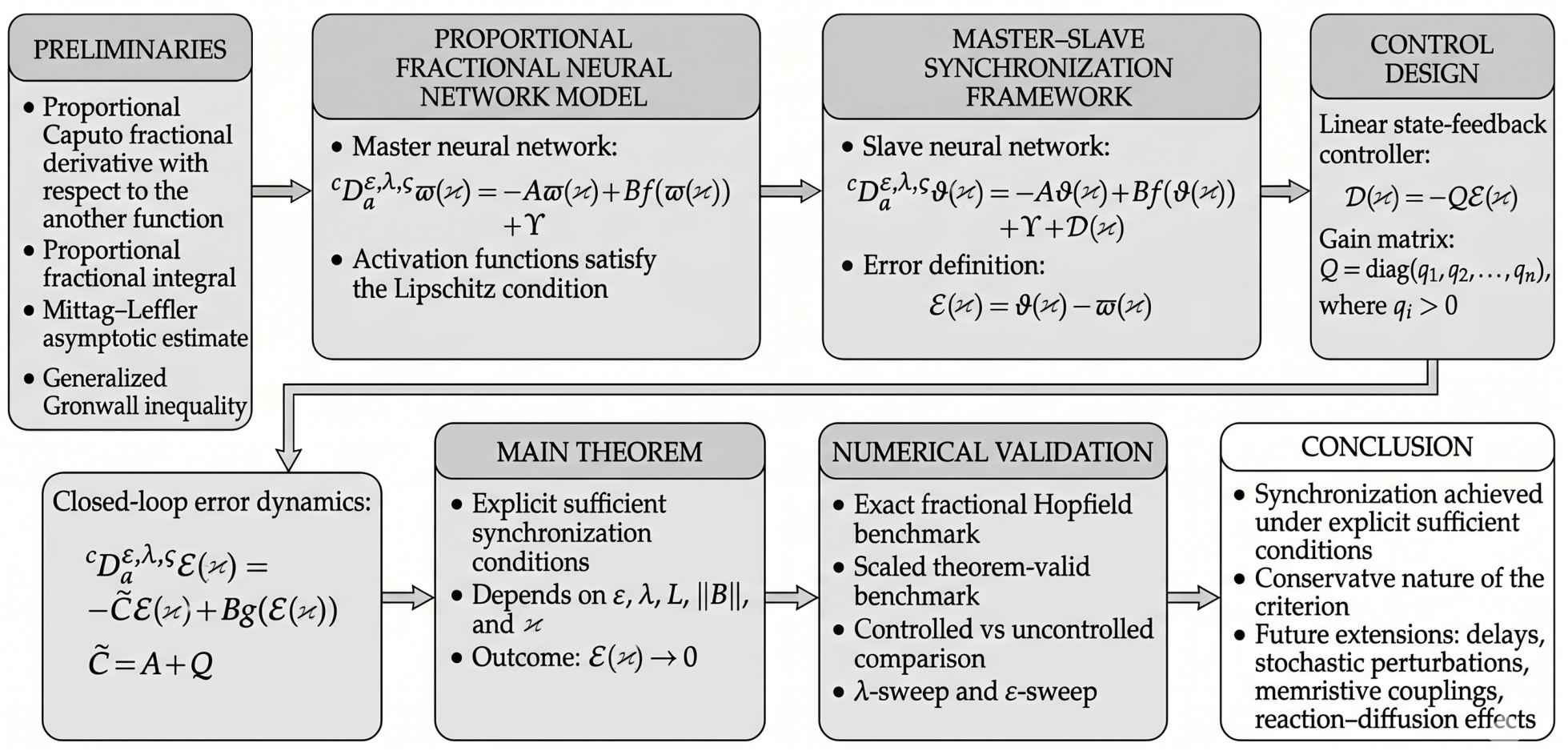
Appendix B. Also, the overall workflow of the proposed synchronization analysis is summarized in
Figure 1.
2. Preliminaries
In this section, we recall some basic notions and auxiliary results that will be used throughout the paper. We begin with the -proportional fractional integral and the corresponding -proportional Caputo fractional derivative, which constitute the analytical framework of the present study. These operators generalize the classical fractional operators by incorporating both a proportional parameter and an auxiliary function , thereby providing additional flexibility for modeling memory effects and nonlocal dynamics. We also recall an asymptotic property of the Mittag–Leffler function that will play a central role in the proof of the synchronization result.
Definition 1 ([
5])
. For and , the ς—proportional fractional integral of of order ε is given byHere, τ is a dummy integration variable distinct from the fractional order ε and the proportional parameter λ. Definition 2 ([
5])
. For and , the —proportional Caputo fractional derivative of f of order ε is given bywhere The same dummy variable τ is used here to keep the notation consistent with Definition 1. Lemma 1 ([
3])
. For , we haveHere, z is a generic complex (or real positive) argument introduced to avoid any conflict with the proportional parameter λ used elsewhere in the paper. Remark 1. The parameter ε represents the fractional order of the operator, whereas λ plays the role of a proportional parameter. The auxiliary function ς allows one to define the operators with respect to another function, which enlarges the classical fractional framework and makes the model more flexible for applications.
Remark 2. If one chooses , then the above operators reduce to the proportional fractional integral and proportional Caputo fractional derivative in the usual time variable. Moreover, when , the exponential factor disappears and the operators reduce to their classical counterparts with respect to the function ς. In particular, if and , then one recovers the standard Caputo fractional derivative of order ε.
Remark 3. The operatormay be viewed as an interpolation between the identity operator and a derivative with respect to the function ς. This property explains the role of λ in balancing local and differential effects in proportional fractional models. Remark 4. The Mittag–Leffler function naturally appears in the solution representation of fractional differential equations and plays a role analogous to that of the exponential function in integer-order systems. Lemma 1 will be used later to derive an exponential-type estimate for the synchronization error, which is essential for establishing its asymptotic convergence to zero.
Throughout the paper, we impose the following standing assumption on the auxiliary function :
Hypothesis 0. The function is continuously differentiable, strictly increasing (i.e., for all ), and unbounded (i.e., as ).
Remark 5. Assumption H0 guarantees that, for every fixed , the mapranges over the compact intervalas s varies in . This interval is contained in , and therefore the global supremum defining gives a valid uniform upper bound for all admissible arguments appearing in Theorem 1. Moreover, since ς is unbounded, these compact intervals exhaust the whole half-line as . This property is essential for the exponential decay of the error and for the validity of the change-of-variable used in the derivation of the explicit integral representation (12) below. The canonical choice used in the numerical experiments clearly satisfies . For convenience, we also recall here the generalized Gronwall inequality with singular kernel, which will be used in the proof of the main result. The following lemma is a direct consequence of [
29]’s Theorem 2 adapted to the
-fractional setting.
Lemma 2 (Generalized Gronwall inequality with singular kernel [
29])
. Let , let ς satisfy assumption , and let be continuous functions, with v nondecreasing. Assume that u satisfies the integral inequalityfor some constant . Then We emphasize that the cited reference [
29] establishes the inequality for the singular kernel
with
, which is precisely the kernel appearing in the proof of our main theorem. Hence, the application below is justified by the precise theorem stated above.
The previous definitions and auxiliary results provide the main analytical tools required in the sequel. In particular, the -proportional Caputo fractional derivative allows us to formulate the neural network model in a generalized fractional setting, while the asymptotic estimate of the Mittag–Leffler function and the generalized Gronwall inequality will be instrumental in controlling the long-time behavior of the error system. Based on these preliminaries, we now turn to the synchronization analysis of the considered proportional fractional-order neural networks.
3. Main Results
In this section, we formulate the considered class of proportional
-fractional-order neural networks and investigate their synchronization behavior in a master–slave framework. The main objective is to derive an explicit sufficient condition under which the synchronization error converges to zero. The analysis is based on the proportional Caputo fractional operator introduced in
Section 2, combined with a Lipschitz condition on the activation functions and a generalized Gronwall inequality. The final criterion will reveal the joint influence of the network interconnection matrix, the proportional parameter
, the fractional order
, and the control gain matrix.
We now consider a class of proportional
-fractional-order neural networks given by
Throughout this section and the remainder of the paper, the independent variable
represents the time variable along which the neural network evolves. The lower bound
denotes the initial time, and the notation
(rather than
t) is used in order to remain consistent with the symbols already employed in the definition of the
-proportional Caputo operator in
Section 2. A more compact representation of system (
1) in matrix form is
with
and
for
, where
n denotes the total number of neurons. The vector
collects the neuron activation functions, while
is the state vector. The matrix
describes the interconnection weights between neurons, and
represents the external input.
To carry out the synchronization analysis, we impose a standard regularity assumption on the activation functions.
Hypothesis 1. For each activation function , the Lipschitz condition holds:where , and the norm is defined by Remark 6. If we setthen one readily obtains the vector inequalityThis estimate will be used repeatedly in the sequel to control the nonlinear term in the error system. Remark 7 (Existence and uniqueness of solutions)
. Under Assumption , the right-hand side of (2) is globally Lipschitz with respect to the state ϖ. By standard arguments for fractional differential equations driven by a generalized proportional Caputo derivative with respect to another function [4,5,6], this Lipschitz property guarantees the existence and uniqueness of a global continuous solution to (2) on for any prescribed initial condition . The same conclusion applies to the slave system (6) and, consequently, to the error system (8), so that the synchronization analysis carried out below is performed on well-defined trajectories. We now introduce the corresponding master–slave synchronization setting. System (
2) is regarded as the master (drive) system, while the slave (response) system is defined by
Equivalently, in matrix form,
where
denotes a control input to be designed.
The purpose of the controller is to force the slave system to follow the master system asymptotically. To measure this objective, we define the synchronization error by
Subtracting (
2) from (
6), one obtains the error dynamics
where
To achieve synchronization, we choose a linear control law of the form
where
The matrix
Q is referred to as the gain matrix. Substituting this controller into (
7) yields the closed-loop error system
where
The next result provides an explicit sufficient condition ensuring the convergence of the synchronization error. Its proof combines the explicit integral representation of solutions, the Lipschitz estimate (
4), the generalized Gronwall inequality recalled in
Section 2, and the asymptotic behavior of the Mittag–Leffler function. In particular, the theorem shows that synchronization can be guaranteed whenever the interconnection matrix is sufficiently small in comparison with the control effect and the proportional parameter.
Theorem 1. Assume that and are satisfied. Then, the solution of system (8) converges to zero if the following conditions hold:andwhere Proof. The closed-loop error system (
8) is a linear
-proportional Caputo fractional differential equation perturbed by the nonlinear term
. By applying the variation-of-constants formula for
-proportional Caputo systems (see, e.g., [
30]’s Theorem 3.1 and Corollary 3.2 and [
5]’s Section 3), the unique solution of (
8) is given by
The first term corresponds to the free response of the closed-loop linear part driven by
, while the convolution-type integral encodes the action of the nonlinear perturbation
propagated through the Mittag–Leffler kernel. Since
is diagonal with positive diagonal entries, the matrix Mittag–Leffler function
is bounded on
. Hence, there exists a finite constant
This constant is independent of
and will be absorbed into the final multiplicative constant.
Hence,
For every fixed
and every
, the quantity
is nonnegative. Therefore, from the definition
we immediately obtain
Thus, no surjectivity of the map
for fixed
is required; it is enough that all admissible arguments belong to
. Let
Then
By the generalized Gronwall inequality with singular kernel stated in Lemma 2 (see [
29]), with
and the constant nondecreasing function
, we deduce
Returning to
and using Lemma 1, there exists a positive constant
M such that
Combining the two exponential factors in (
16) and setting
, we obtain
Let
A direct computation shows that
if and only if
which is exactly equivalent to the two sufficient conditions (
9) and (
10): condition (
9) ensures that the right-hand side is real-valued and meaningful (so that one can take the
-th power), while condition (
10) guarantees the strict inequality
. Substituting back into (
17) yields
with
. Since
as
(by Assumption
), this proves that
as
. □
Remark 8. Theorem 1 provides a sufficient synchronization condition expressed in terms of explicit and easily interpretable quantities. In particular, the criterion shows that synchronization can be ensured when the combined effect of the Lipschitz constant of the activation functions, the network interconnection matrix, and the Mittag–Leffler bound remains sufficiently small with respect to the proportional parameter λ. Therefore, the result makes transparent the interplay between the intrinsic network dynamics and the designed control gain matrix.
Remark 9 (On the conservatism of the criterion)
. As confirmed by the numerical experiments of Section 4, the sufficient conditions (9) and (10) may be violated while the synchronization error still converges to zero (e.g., when in the exact Mahmoud benchmark). The conservatism originates from three sources: (i) the use of the worst-case bound , which is independent of the actual decay of as ; (ii) the replacement of the matrix Mittag–Leffler function by its norm in the convolution integral, which discards information on the orthogonal directions of ; and (iii) the use of the generalized Gronwall inequality, which provides a uniform majorant rather than a sharp estimate. Less conservative criteria could potentially be obtained by combining a modified Henry–Gronwall inequality (using fractional exponential weights) with sharper asymptotic Mittag–Leffler bounds, by exploiting spectral properties of , or by employing Lyapunov-type approaches in fractional Sobolev norms. The derivation of such refined criteria is left for future research. The main theorem established in this section ensures the asymptotic convergence of the synchronization error for the considered proportional fractional-order neural networks under a simple linear control law. In the next section, we provide numerical experiments illustrating both the applicability of the derived criterion and the influence of the proportional and fractional parameters on the synchronization process.
4. Numerical Experiments
In this section, we illustrate the theoretical result established in Theorem 1 by means of numerical simulations. As a benchmark architecture, we consider the three-neuron fractional Hopfield neural network introduced by Mahmoud et al. in [
8]. For the reader’s convenience, we briefly recall the exact form of this benchmark, since the original paper is not always readily accessible. The model studied in [
8] is a three-neuron fractional-order Hopfield neural network of the form
,
, with a single fractional order
, the standard hyperbolic-tangent activation function, and a constant interconnection matrix
. In its original delay-free Caputo form, the model reads
The numerical values of the interconnection matrix
have been double-checked against the chaotic-regime parameters reported in Mahmoud et al. [
8]’s Section 3, and no sign or value discrepancy has been detected. The diagonal self-inhibition coefficients
correspond to the standard identity self-decay matrix
used in the cited reference. In the present work, this benchmark is reformulated within the proportional Caputo framework of
Section 3 as
where
Since
,
, Assumption
is satisfied with Lipschitz constant
. Throughout the simulations, we set
and consider the corresponding master–slave synchronization problem under the linear feedback law
The numerical study is organized as follows. First, we consider the exact benchmark associated with (
19) in order to assess the behavior of the original literature model under control. Next, we introduce a scaled version of the same benchmark, chosen so that all sufficient conditions of Theorem 1 are satisfied, thereby yielding a strict numerical validation of the theorem. Finally, we investigate the influence of the proportional parameter
and the fractional order
on the synchronization process. For the convenience of the reader, the computational workflow used to verify the sufficient conditions of Theorem 1, simulate the master–slave systems, and generate the numerical illustrations is summarized in Algorithm
A1 of
Appendix C.
4.1. Exact Mahmoud Benchmark
We first consider the exact benchmark with
and the initial conditions
For this configuration, the numerical evaluation of the sufficient conditions in Theorem 1 gives
and
The quantity
has been evaluated in a reproducible way as follows. Since
is diagonal in the benchmark, the matrix Mittag–Leffler function reduces to a diagonal matrix with scalar entries
. For
, this scalar kernel on the negative real axis is bounded and attains its maximum at the origin in the present diagonal benchmark; hence
For
, this gives
. This is the value used in the numerical script, and it was also checked by evaluating the kernel over a fine grid of nonnegative
r values, which confirmed that the maximum occurs at
for the present parameter set. Therefore, the first sufficient condition of Theorem 1 is not satisfied, and the theorem cannot be invoked for the exact benchmark under these parameters. This observation is summarized in
Table 1. Nevertheless, the simulation still shows convergence of the synchronization error to zero, which indicates the conservative character of the sufficient criterion.
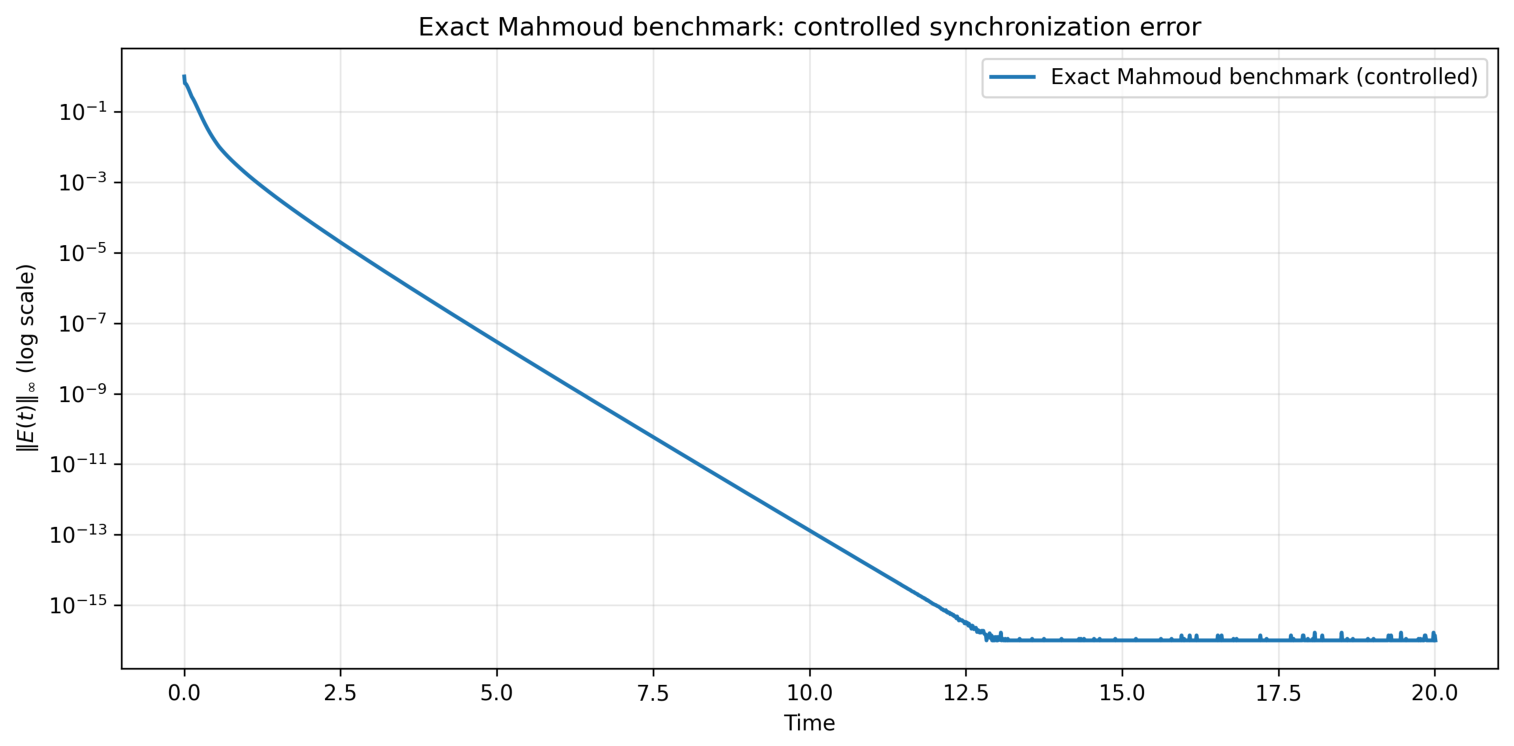
Figure 2 shows the evolution of the synchronization error norm for the exact benchmark. Although the sufficient conditions are violated, the error still decreases rapidly and reaches the numerical level
at the final time. In addition, the error becomes smaller than
at
and smaller than
at
. Hence, this experiment shows that synchronization may still occur numerically even when the sufficient conditions of Theorem 1 are not fulfilled.
Remark 10 (On the apparent coincidence in
Table 1)
. For the scaled benchmark, one observes that and that the quantity takes the same numerical value. This follows from the specific diagonal benchmark computation used here: because , and , so up to numerical roundoff. Consequently, . This equality is not imposed by the scaling factor ρ itself; it results from the adopted estimate of k for the diagonal case and does not
affect the verification of the sufficient conditions. Both inequalities (9) and (10) are checked from the raw values shown in Table 1, and the scaled benchmark satisfies them strictly. Remark 11 (Derivation of the admissible bound
)
. The admissible upper bound for λ reported in Table 1 is computed directly from condition (10). For the scaled benchmark one has with , hencewhich matches the value reported in the table. The chosen value thus lies strictly below this bound, so condition (10) is satisfied with a comfortable margin. 4.2. Scaled Theorem-Valid Benchmark
To strictly validate Theorem 1, we next consider a scaled version of the same benchmark. More precisely, we replace
B by
while keeping the same activation function
and the same matrix
. The control gain is again chosen as
and the proportional/fractional parameters are selected as
For these values,
Table 1 shows that all sufficient conditions of Theorem 1 are satisfied:
Hence, this scaled benchmark provides a strict numerical validation of the theorem.
The master system starts from
while the slave system is initialized at
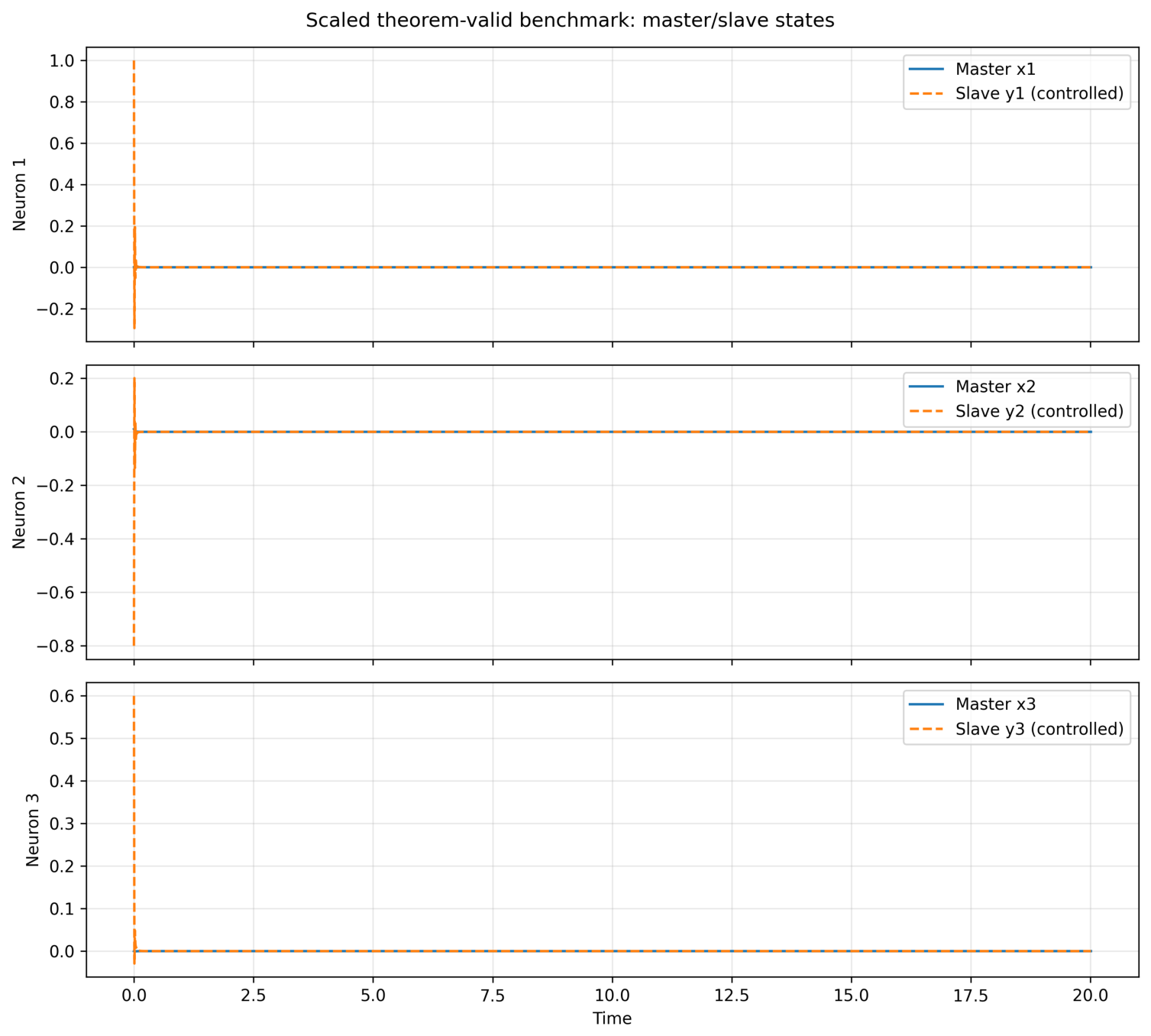
Figure 3 displays the master and slave trajectories for the three neurons. One observes that all slave states converge rapidly toward the corresponding master states. In fact, both trajectories approach the equilibrium point at the origin, while the synchronization error tends to zero.
This conclusion is confirmed more explicitly in
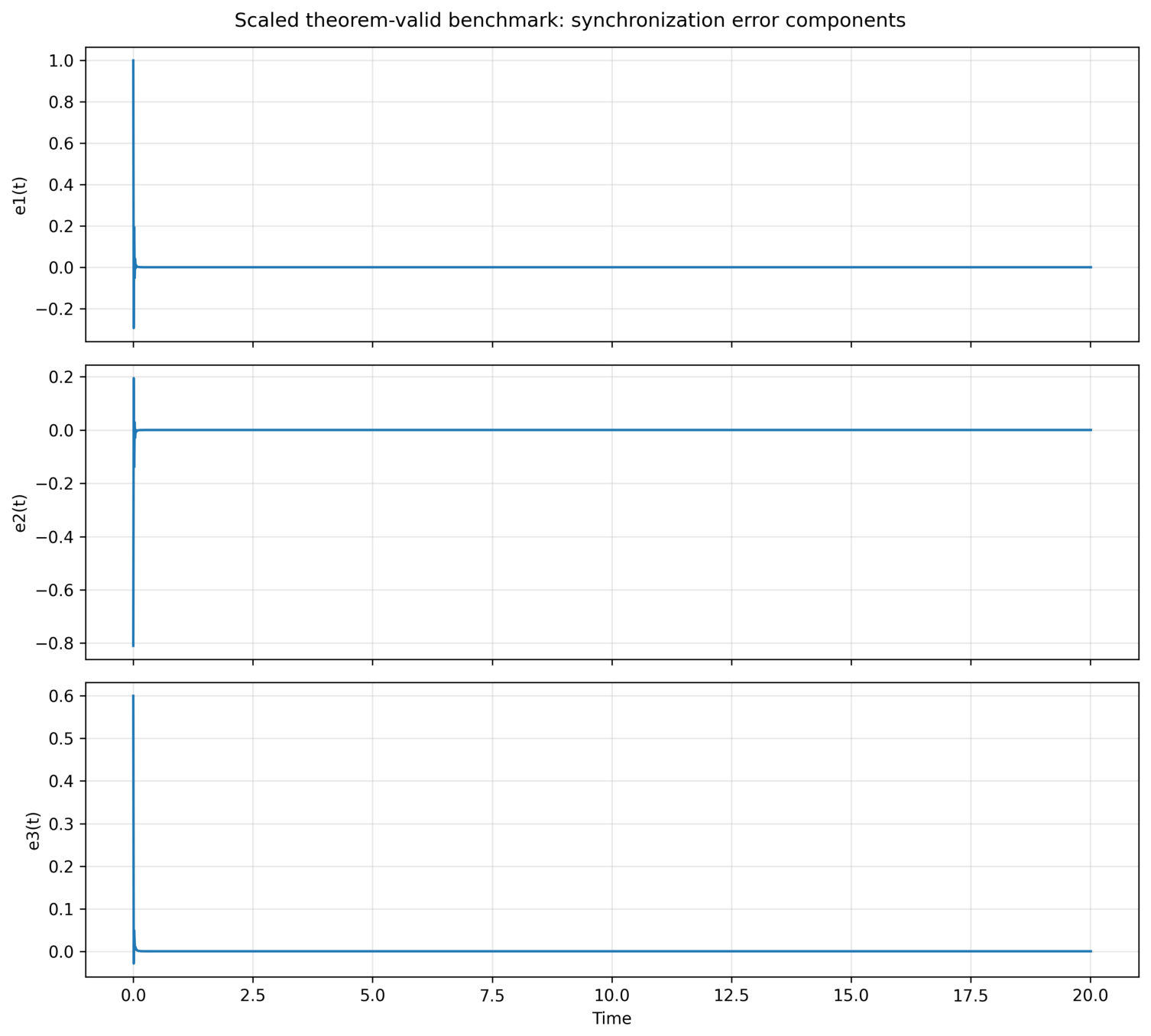
Figure 4, where the three error components
,
, and
are plotted. The initial error is
and all three components decay rapidly to zero without visible oscillatory behavior. For instance,
and
At
, all three components are already of order
.
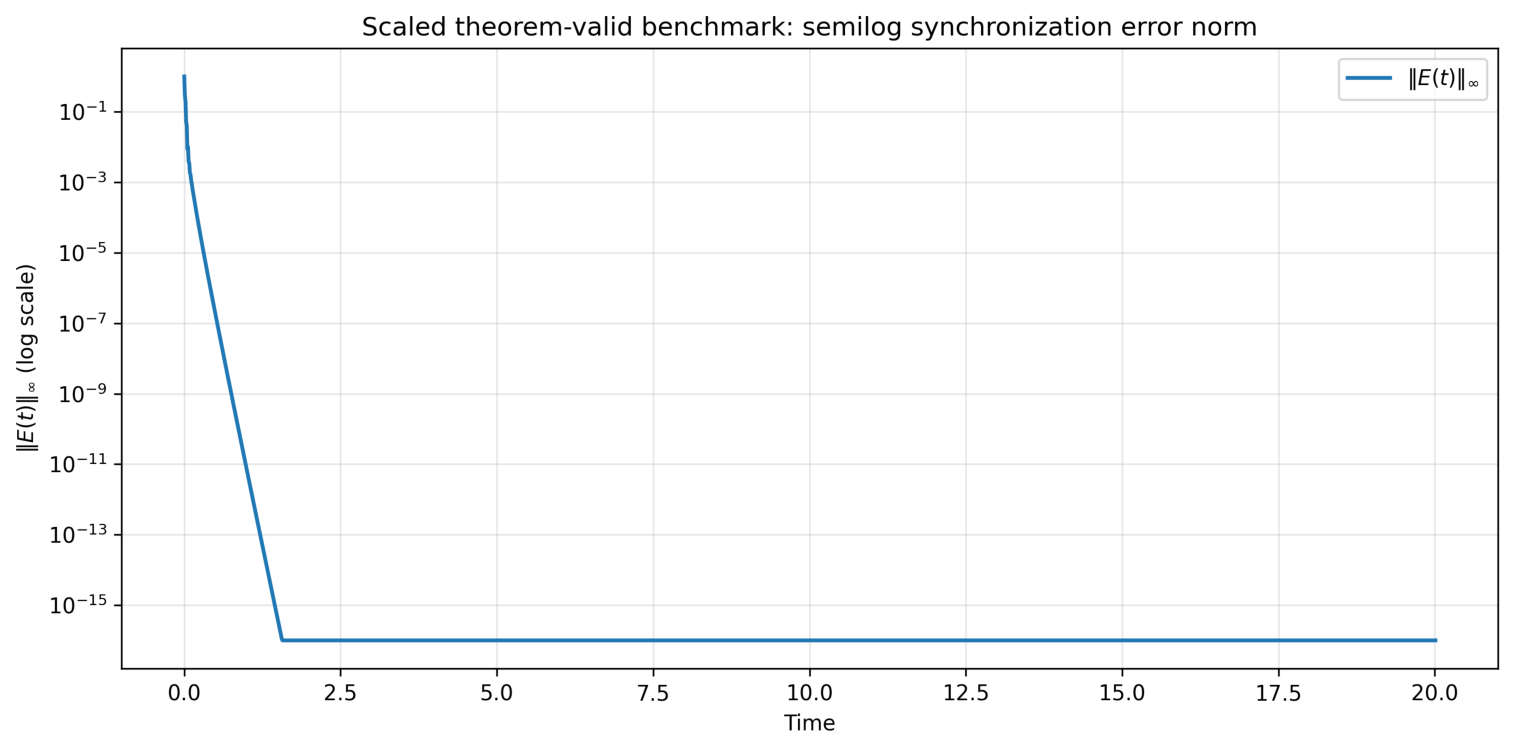
The semilogarithmic representation of the error norm in
Figure 5 reveals an almost straight-line decay after a short transient, which is consistent with the exponential-type estimate obtained in the proof of Theorem 1. The controlled error satisfies
and
Moreover, the error becomes smaller than
at
and smaller than
at
. Therefore, the numerical results are fully consistent with the convergence predicted by Theorem 1.
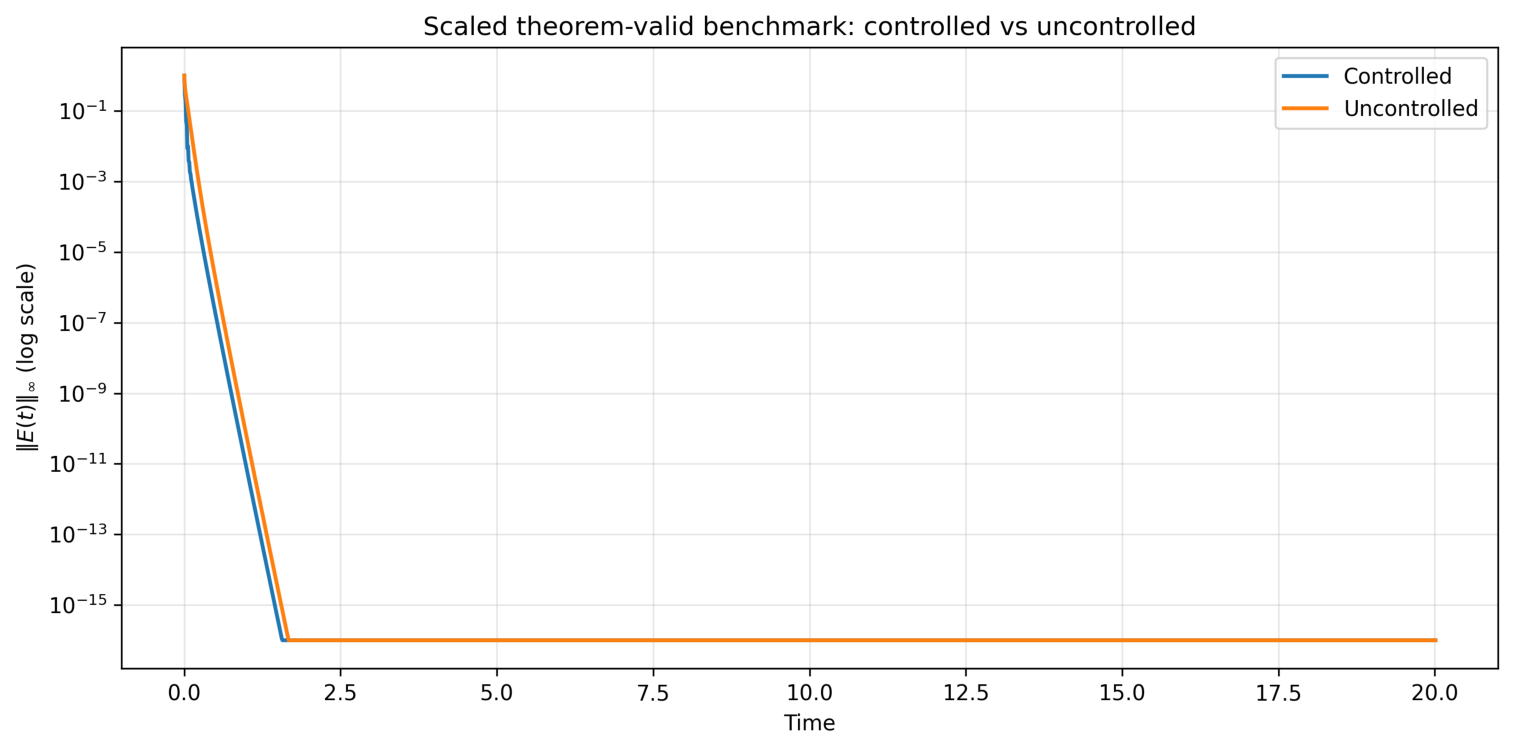
To further assess the effect of the control law,
Figure 6 compares the controlled and uncontrolled error norms for the same scaled benchmark. In both cases, the error eventually converges numerically to zero; however, the controlled case exhibits a significantly faster transient decay. In particular, the controlled error drops below
at
and below
at
, while the uncontrolled case reaches the same thresholds only at
and
, respectively. Thus, in this example, the linear controller does not create synchronization from a diverging regime, but it substantially accelerates the synchronization process.
To quantify the improvement more precisely, we measured two indicators commonly used in synchronization studies: the settling time
at threshold
, defined as
, and the empirical exponential convergence rate
obtained from a least-squares fit of
against
t on the interval
. The corresponding values are reported in
Table 2. The controlled case reduces the settling time at
by a factor of 3 (
s vs.
s) and at
by a factor of approximately
(
s vs.
s), while the empirical convergence rate is increased from
to
, i.e., an improvement of roughly
. These quantitative figures substantiate the qualitative observation that the controller improves the transient synchronization rate.
The quantitative comparison is summarized in
Table 3.
4.3. Influence of the Proportional Parameter
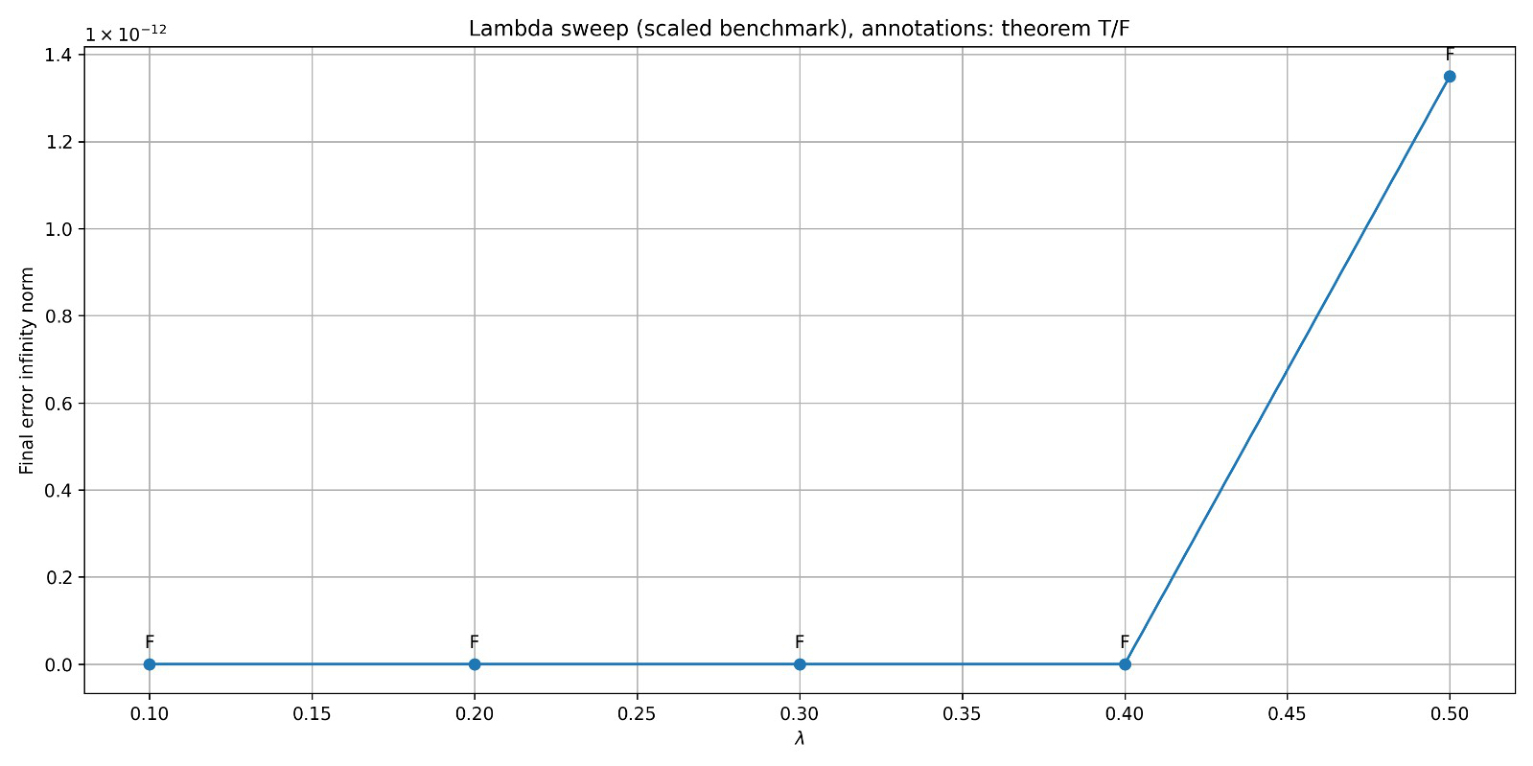
We now investigate the influence of the proportional parameter
on the synchronization performance for the scaled benchmark. Keeping
fixed, we tested
For all these values, the theorem flag becomes false because the admissible upper bound predicted by Theorem 1 is
whereas all tested values lie above this threshold. Nevertheless, the simulations still show convergence of the synchronization error to very small values for all tested values of
. The corresponding final errors are reported in
Table 4. This confirms once again that Theorem 1 provides a sufficient but conservative criterion.
At the same time,
Figure 7 clearly shows that larger values of
slow down synchronization. Indeed, the time needed to reach
increases from
at
to
at
, while the time to reach
increases from
to
. Therefore, even outside the theorem-valid region, the parameter
has a pronounced effect on the transient synchronization rate.
4.4. Influence of the Fractional Order
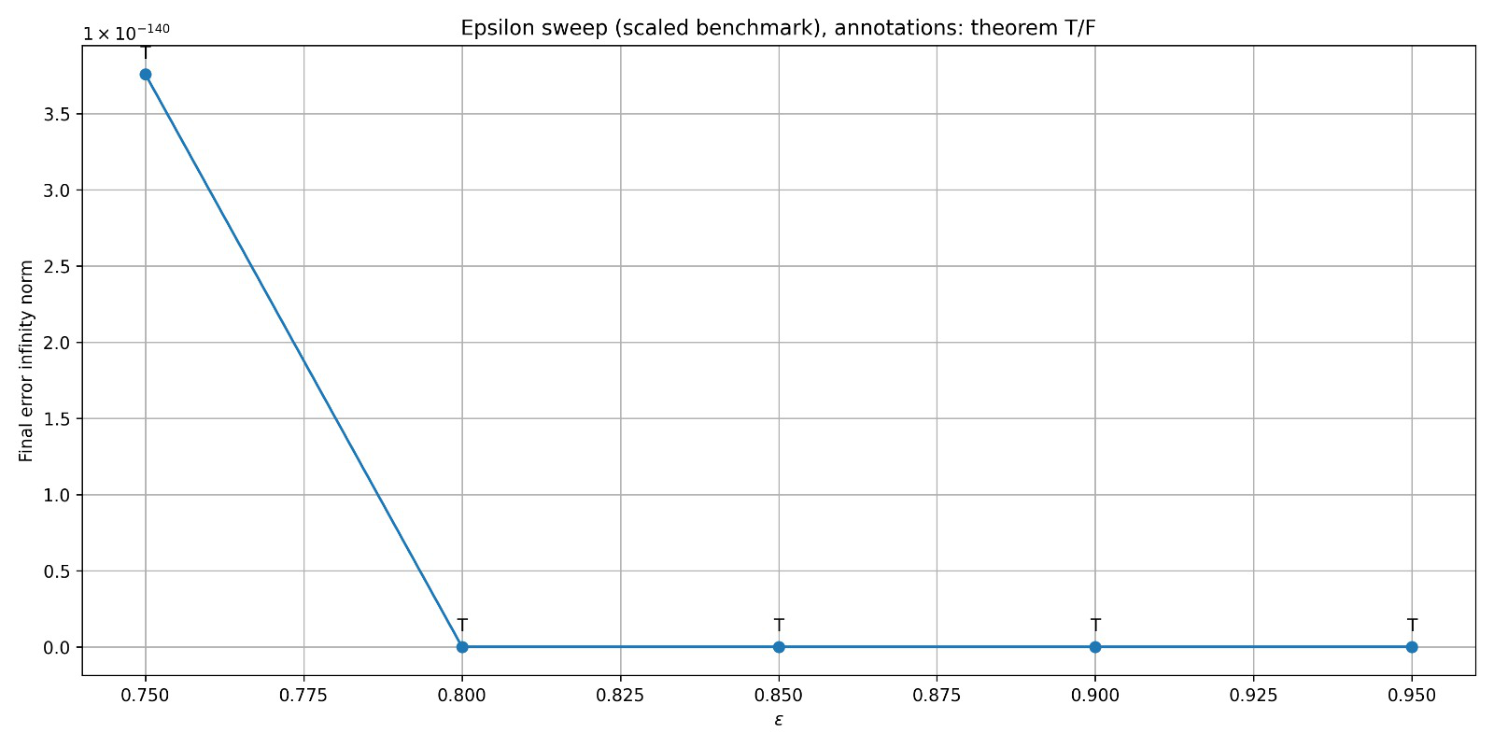
Finally, we analyze the role of the fractional order
for the theorem-valid scaled benchmark, keeping
fixed. The values tested are
In all these cases, the theorem remains satisfied, since the admissible upper bound on
stays above the chosen value
. The corresponding final errors are reported in
Table 5. They remain extremely small for all tested values of
, which demonstrates the robustness of the synchronization mechanism in the whole tested interval.
Moreover,
Figure 8 shows that larger values of
lead to a faster convergence. For instance, the time at which
decreases from
when
to
when
, while the time needed to reach
decreases from
to
. Hence, in the present example, increasing the fractional order improves the transient synchronization rate.
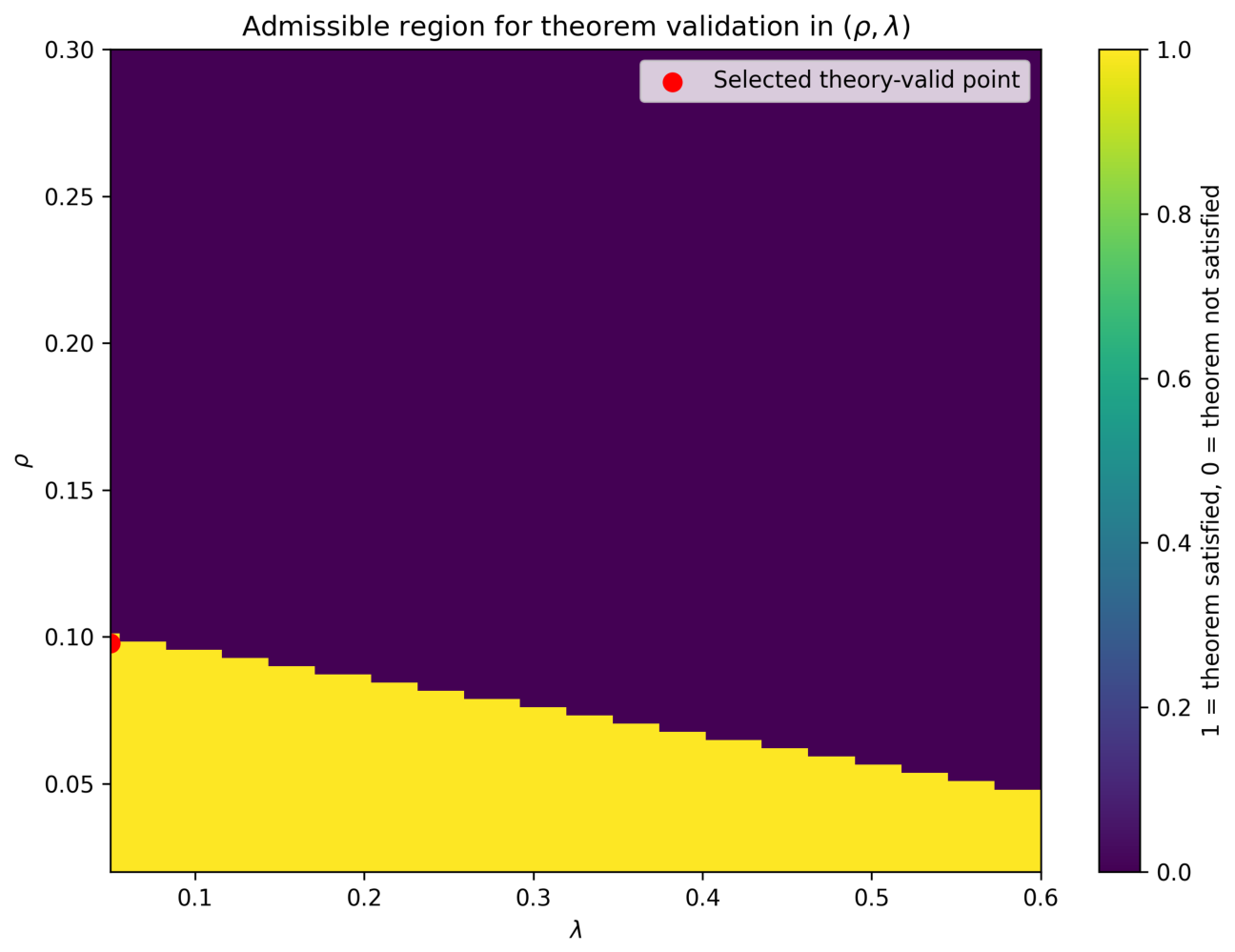
The admissible region in the
-plane is depicted in
Figure 9. The red point corresponds to the selected theorem-valid scaled benchmark
, which lies inside the admissible domain predicted by Theorem 1. This figure provides a useful visualization of the conservative character of the sufficient criterion and clarifies how the scaling factor
and the proportional parameter
jointly affect theorem validity.
In summary, the numerical study leads to the following conclusions:
The exact literature benchmark is useful to illustrate the behavior of the original neural network and to show the conservative nature of Theorem 1;
The scaled benchmark strictly validates Theorem 1, since all sufficient conditions are satisfied and the synchronization error converges rapidly to zero;
The controller clearly improves the transient synchronization rate;
Increasing slows down convergence, whereas increasing accelerates synchronization.
5. Conclusions
In this paper, we studied the synchronization problem for a class of proportional Caputo fractional-order neural networks with respect to another function. By introducing a master–slave formulation together with a linear state-feedback controller, we derived a sufficient condition guaranteeing the convergence of the synchronization error to zero. The proof relied on the explicit solution representation of the error system, a generalized Gronwall inequality, and an asymptotic estimate involving the Mittag–Leffler function. In this way, the obtained result provides an analytically tractable synchronization criterion whose dependence on the fractional order, the proportional parameter, the Lipschitz constant of the activation functions, and the interconnection matrix is made explicit. The numerical experiments confirmed the theoretical findings from two complementary viewpoints. First, a scaled version of a well-known fractional Hopfield neural network benchmark was shown to satisfy all sufficient conditions of the main theorem, and the corresponding synchronization error converged rapidly to zero, thus providing a strict numerical validation of the proposed result. Second, the original unscaled benchmark also exhibited synchronization under control, even though the theorem conditions were not satisfied, which illustrates the conservative character of the derived criterion. In addition, the simulations revealed that the linear controller significantly improves the transient synchronization rate, that larger values of the proportional parameter slow down convergence, and that increasing the fractional order enhances the synchronization speed in the considered example.
It is also important to acknowledge the main limitations of the present study. (i)
Conservatism of the criterion. As clearly observed in
Section 4, the sufficient conditions (
9) and (
10) may be violated while synchronization still occurs numerically; the criterion is therefore sufficient but far from necessary, and refining it (e.g., via sharper Mittag–Leffler bounds, modified Henry–Gronwall inequalities, or spectral techniques) is a natural next step. (ii)
Difficulty in computing k. The constant
does not admit a closed-form expression in general and must be estimated numerically, which limits the analytical transparency of the criterion. (iii)
Limited illustration of non-trivial ς. For computational simplicity, the simulations have been carried out with
; a systematic numerical study with non-trivial auxiliary functions
(e.g.,
or
) would further illustrate the additional modeling flexibility offered by the proposed framework.
In view of these limitations, concrete directions for future research include: extending the framework to proportional fractional neural networks with time delays (constant, time-varying, or proportional), with stochastic perturbations, with impulses, or with memristive and reaction–diffusion couplings; designing adaptive, event-triggered, finite-time, fixed-time, or preassigned-time controllers tailored to the proportional Caputo setting; and developing computer-aided LMI-based or contraction-based synchronization criteria that explicitly exploit the auxiliary function in order to mitigate the conservatism of the present approach.




 ,
,