Article

A Novel Methodology for Distance and Similarity Measures in Hesitant Fuzzy Sets: Enhancing Pattern Recognition and Decision-Making


by
Zahid Hussain
1,
Sania Zahra
1,
Rashid Hussain
1,
Mehboob Ali
2 and
Panagiotis Chountas
3,*
1
Department of Mathematical Sciences, Karakoram International University, Gilgit 15100, Pakistan
2
Department of Statistics, Government College Gilgit, Gilgit 15100, Pakistan
3
School of Computer Science and Engineering, University of Westminster, 115 New Cavendish Street, London W1W 6UW, UK
*
Author to whom correspondence should be addressed.
Symmetry 2026, 18(6), 947; https://doi.org/10.3390/sym18060947
Submission received: 6 March 2026 / Revised: 8 April 2026 / Accepted: 10 April 2026 / Published: 31 May 2026
(This article belongs to the Special Issue Symmetry and Fuzzy Set)

Abstract

Various distance and similarity measures have been proposed for hesitant fuzzy sets (HFSs) in the literature. However, some of these approaches are either inadequate or fail to produce reliable results for different scenarios. In this paper, we introduce a novel methodology for computing distance and similarity measures between two HFSs based on an axiomatic framework. A key challenge arises when the lengths of two hesitant fuzzy elements (HFEs) differ. Traditionally, it is assumed that a pessimist would repeatedly add the minimum value, while an optimist would add the maximum value until the HFEs are of equal length. However, this approach may introduce bias and is not intuitively acceptable. To overcome this limitation, we propose an innovative and intuitive technique that ensures fairness by repeatedly adding zero to equalize HFE lengths. This method aligns with intuition and satisfies all axioms of distance and similarity measures. Several numerical examples demonstrate its effectiveness compared to existing methods. Additionally, we apply our approach to develop a hesitant fuzzy TODIM (HF-TODIM) model for interactive and multi-criteria decision-making. To validate its applicability, we use it to evaluate different livestock species and identify the most profitable option. The results confirm that our method is well-suited for handling complex and uncertain hesitant fuzzy information in a balanced and intuitive manner.

1. Introduction

The idea of fuzzy sets (FSs) was proposed by Zadeh [1] and they have been broadly used in variety of fields. With the rapid development of society, the real world has become more ambiguous, multifarious, and vague. Owing to the limitations of individuals’ intellectual capabilities and levels of understanding, the means of information expression have also transformed. Therefore, many extensions and generalizations of fuzzy sets have been proposed in the literature. These include Atanassov intuitionistic fuzzy sets [2]; Type-2 fuzzy sets [3]; Pythagorean fuzzy sets by Yager [4,5], an extension of intuitionistic fuzzy set (IFS) theory; q-rung Orthopair fuzzy sets (q-ROFSs) by Yager [6], and so on. The need to address hesitation and vagueness in real-world problems has long been a research challenge, leading to the development of various theories and methodologies. Fuzzy sets, along with their extensions, provide a wide range of tools capable of handling uncertainty and vagueness across different types of problems.
In real-world decision-making procedures, it is not easy to determine the degree of involvement of a fuzzy set due to a lack of information or data, time constraints, and other factors. This situation can represent an individual’s hesitation more quantitatively than other conventional extensions of fuzzy sets. Therefore, hesitant fuzzy sets are an extremely advantageous approach for dealing with hesitation and has become a prevalent topic in multiple-attribute decision-making under hesitant fuzzy environments [7,8]. A hesitant fuzzy set (HFS) [9] is a generalization of a fuzzy set (FS) that allows us to signify the circumstances in which different membership functions can conceivably measured. HFSs are extremely helpful in situations where individuals hesitate when providing their preferences about items in a decision-making procedure. To deal with these cases, Torra [9] introduced the concept of a HFS as an extension of a fuzzy set in which the membership degree of a given element, called a hesitant fuzzy element (HFE), is defined as set of possible values. This situation can be found in a group decision-making problems [10,11,12]. HFSs are applied in various scientific fields such as pattern recognition, clustering analysis, and multi-criteria decision-making problems [13,14,15,16,17,18]. Many scholars have paid attention to this issue and have proposed several aggregation operators based on HFSs. For instance, Xu and Xia [19] established a series of aggregation operators for hesitant fuzzy data, and further investigated the associations among these aggregation operators. Rodríguez et al. [20] provided the state-of-the-art and future research directions and investigated hesitant fuzzy linguistic (HFL) term sets for decision-making. Yang and Hussain [21] and Zhang and Xu [22] used HFSs in a clustering study. Yang and Hussain [21] suggested distance and similarity measures of HFSs based on the Hausdorff metric with application to multi-criteria decision-making and clustering. Zheng et al. [18] utilized distance and similarity measures among HFSs through application to pattern recognition. Hussain and Yang [23] proposed entropy based on the Hausdorff metric with the construction of hesitant fuzzy TOPSIS. Xu and Xia [24] suggested a multiplicity of hesitant fuzzy distance measures and ordered distance measures for HFSs and deliberated their properties. However, the axiomatic definitions of distance and similarity measures only fulfill three properties. The more sensible definitions of distance and similarity measures, in general, should have four properties like the notions of fuzzy sets of Zadeh [1], IFSs [2], interval-valued fuzzy sets [25], and Type-2 fuzzy sets [3]. It is noticed that quantity of membership degree in hesitant fuzzy elements (HFEs) of two different HFSs might be different. To handle this kind of situation, [24] put a least degree of membership, highest degree of membership, or any membership from the smaller HFEs to lengthen it to the equivalent length of the larger HFEs. Chen et al. [15] and Yan et al. [26] coined distance measures between HFSs with applications. Zeng et al. [27] suggested distance measures of HFSs with application to image segmentation. Ranjbar and Effati [28] worked on group decision-making in the analytic hierarchy process using HFSs. Gupta and Kumar [29] coined similarity measures between hesitant fuzzy sets with applications. Peng and Zeng [30] proposed similarity measures between HFSs with applications. Similarity measures for PFSs were proposed by Hussain et al. [31].
Until now, the selection of an appropriate degree of membership has largely depended on the decision-makers’ preferences. Pessimists might choose the lowest values to produce unfavorable outcomes, whereas optimists may select the highest values to obtain more favorable results. However, the final outcome may vary significantly if the shorter hesitant fuzzy elements are extended by assigning different membership degrees, potentially leading to inconsistent results. Therefore, in this paper, we propose a novel and intuitive approach to compute the distance and similarity between HFEs of unequal lengths by extending the shorter ones with zeros, instead of using the minimum, maximum, or any arbitrary value. Finally, we apply the proposed distance and similarity measures to develop an algorithm for a hesitant fuzzy TODIM (HF-TODIM) and demonstrate its effectiveness in addressing a complex multi-criteria decision-making problem from real life.

1.1. Research Gap

Although numerous distance and similarity measures have been proposed for hesitant fuzzy sets (HFSs), these are inadequate or unreliable across varying decision-making scenarios, particularly when the lengths of hesitant fuzzy elements differ. Specifically, existing approaches often assume biased methods for handling differences in hesitant fuzzy element (HFE) lengths, such as repeatedly adding the minimum or maximum values until lengths are equal. These methods can introduce bias and lack intuitive acceptance. This highlights a key research gap in developing a more balanced and theoretically sound method for handling unequal HFE lengths. To address this, this study introduces a novel and axiomatic approach that equalizes HFE lengths by adding zeros, ensuring fairness, intuitive appeal, and compliance with all necessary axioms.

1.2. Motivation

The motivation behind this study was the limitations and inconsistencies observed in existing distance and similarity measures for hesitant fuzzy sets, especially when applied to complex decision-making scenarios. Traditional techniques for handling hesitant fuzzy elements of unequal lengths, such as padding with repeated minimum or maximum values, often introduce bias and lack intuitive justification, undermining the reliability of the results. This motivated the development of a more balanced, fair, and axiomatically sound methodology that equalizes HFE lengths by adding zeros, thereby avoiding bias and aligning with human intuition. The proposed method not only satisfies all axioms of distance and similarity measures but also proves its effectiveness through numerical examples and practical application in a hesitant fuzzy TODIM model.
Here are the main contributions of the article:
(i).
Proposed a Novel Distance and Similarity Measure: Developed a new methodology for computing distance and similarity measures between two HFSs, ensuring consistency with axiomatic definitions.
(ii).
Addressed the Issue of Unequal HFE Lengths: Identified limitations in traditional approaches that adjust unequal HFE lengths by adding minimum or maximum values, which may lead to biased results. Introduced a more intuitive and fair method by adding zero repeatedly to balance the lengths of HFEs.
(iii).
Theoretical Validation: Demonstrated that the proposed method satisfies all necessary axioms for distance and similarity measures in HFSs.
(iv).
Numerical Comparisons: Conducted numerical experiments to compare the proposed method with existing approaches, highlighting its advantages in accuracy and fairness.
(v).
Improved Pattern Recognition and Application in Multi-Criteria Decision-Making: Showcased the practical advantages of the new approach in applications requiring precise pattern recognition. Integrated the proposed measure into hesitant fuzzy TODIM to enhance interactive and multi-criteria decision-making processes. Applied the methodology to a real-world decision-making problem in livestock species selection, proving its effectiveness in handling uncertain and complex fuzzy data.
The paper is structured as follows:
Section 1. This section provides an overview of HFSs, their significance in decision-making, and the challenges associated with existing distance and similarity measures. The motivation and objectives of the study are also discussed.
Section 2. Fundamental concepts related to HFSs, HFEs, and existing distance and similarity measures are introduced. The limitations of traditional methods, particularly in handling unequal HFE lengths, are analyzed.
Section 3. A novel methodology for calculating distance and similarity measures in HFSs is presented. The proposed approach ensures a fair and unbiased comparison by introducing a new technique for balancing HFE lengths using zero addition. The theoretical framework and axiomatic validation of the proposed measures are also provided.
Section 4. Numerical examples are presented to compare the proposed method with existing approaches. The results highlight the advantages of the new method in terms of accuracy, fairness, and consistency with intuition.
Section 5. The proposed similarity measure is applied in recognition of a hesitant fuzzy pattern and the proposed distance measure is applied to the HF-TODIM method. A case study on livestock species selection is conducted to demonstrate the practical applicability and effectiveness of the approach in handling real-world decision-making problems.
Section 6. The final section summarizes the key findings and contributions of the study. Potential future research directions, such as extending the methodology to other fuzzy decision-making models, are also discussed.

2. Preliminaries

In this section, we briefly discuss some basic concepts regarding HFSs. Throughout this paper, we use X = x 1 , x 2 , , x n to represent the set of universal discourse, HFSs stands for hesitant fuzzy sets and HFEs, hesitant fuzzy elements.
Definition 1
 ([9]). Let X be a fixed set, a HFS on X is in terms of a function that when applied to X returns a subset of [0, 1] which can be represented as following mathematical symbol,
A = x , h A x | x X
where h A x is the set of values in [0, 1], denoting the possible membership degrees of the element x X to the set A . For convenience, we call h A x a HFE.
It is noted that the number of elements in different HFEs may be different. For example, let X = x 1 , x 2 , x 3 , x 4  be the universe of discourses of a HFS  A  with h A x 1 = 0.5 , 0.8 , 0.9 ,   h A x 2 = 0.2 , 0.5 ,   h A x 3 = 0.1 , 0.5 , 0.5 , 0.6 , and h A x 4 = 0.2 , 0.3 , where h A x i HFEs and the HFS are is denoted by
A = x 1 , h A x 1 , x 2 , h A x 2 , x 3 , h A x 3 , x 4 , h A x 4
Yet, the number of values in HFEs for HFS A  on X may be different,  l A 1 x i h A 1 x i l A 2 x i h A 2 x i . In this manuscript, we signify  l h x i  as the quantity of elements in h x i  and place the elements in HFEs of HFSs, in downward order.
To handle this type of condition, Xu and Xia [24] proposed the following approach: the shorter element is extended by assigning the lowest degree of membership, the highest degree of membership, or any other degree of membership, until it reaches the same length as the longer element. The choice of different degrees of memberships essentially depends on the decision makers’ risk partialities. Idealists anticipate necessary results and might put the highest degree of membership, whereas doubters imagine opposed outcomes and might put the least degree of membership. While the results may differ if the shorter element is extended by assigning different degrees of membership, this is realistic because the decision makers’ risk preferences can have a direct impact on the final decision. In this manuscript, we extend the shorter HFEs of two unequal HFSs by adding a zero value instead of using any other value (minimum or maximum).
Definition 2
 ([21]). Let A 1  and A 2  be any two HFSs on the universe of discourse X = x 1 , x 2 , , x n .
i   A 1 A 2   i f f   h A 1 σ j x i h A 2 σ j x i ,   f o r   i = 1 , 2 , , n   a n d   j = 1 , 2 , , l x i ; i i   A 1 = A 2   i f f   h A 1 σ j x i = h A 2 σ j x i ,   f o r   i = 1 , 2 , , n   a n d   j = 1 , 2 , , l x i .
In Definition 2, l x i = m a x l A 1 x i h A 1 σ j x i ,   l A 2 σ j h A 2 σ j x i , where h A 1 σ j x i   and   h A 2 σ j x i are the HFEs of the HFSs A 1   and   A 2 , respectively.
Definition 3
 ([18]). On behalf of a hesitant fuzzy set A  on X = x 1 , x 2 , , x n , s h A x i = i = 1 n h A x i l h A x i  is termed as a score function of h A x i , where l h A x i  is the quantity of elements in h A x i For two HFSs, A 1  and A 2 , if s h A 1 x i > s h A 2 x i ,  then h A 1 x i > h A 2 x i , if s h A 1 x i < s h A 2 x i ,  then h A 1 x i < h A 2 x i , and if s h A 1 x i = s h A 2 x i ,  then h A 1 x i = h A 2 x i .
Distance and similarity measures are the two essential concepts in fuzzy set theory and have received considerable attention in recent years due to their increasing utilization in various research areas, such as in [7,13,16,32]. For the distance between HFSs, refs. [19,24] first provided the following simple definition.
Definition 4
 ([19,24]). Let A 1  and A 2  be any two HFSs on X = x 1 , x 2 , , x n , then the distance measure between A 1  and A 2  is defined as d A 1 , A 2 , which satisfies the subsequent properties:
  P 1     0 d A 1 , A 2 1 ;   P 2     d A 1 , A 2 = 0   i f f   A 1 = A 2 ;   P 3     d A 1 , A 2 = d A 2 , A 1 .
Definition 5
 ([33,34]). Let A 1 , A 2  and A 3  be three hesitant fuzzy sets on X = x 1 , x 2 , , x n , then the distance measure between A 1 , A 2 , and A 3  must satisfy the conditions (P1P3) along with the following condition:
P 4   Let   A 1 A 2 A 3   then   d A 1 , A 2 d A 1 , A 3 and   d A 2 , A 3 d A 1 , A 3 .
P 4  is said to be the containment property of the distance measure. It is not satisfied by adding minimum or maximum values to balance the unequal lengths of hesitant fuzzy elements of two hesitant fuzzy set.
Definition 6
 ([19,24]). Let A 1  and A 2  be two HFSs on X = x 1 , x 2 , , x n , then the similarity measure between A 1  and A 2  is defined as s A 1 , A 2 , which satisfies the subsequent properties:
  P 1   0 s A 1 , A 2 1 ;   P 2   s A 1 , A 2 = 1   i f f   A 1 = A 2 ;   P 3   s A 1 , A 2 = s A 2 , A 1 .
Definition 7
 ([21]). Suppose that A 1 = x i , h A 1 x i | x i X  and A 2 = x i , h A 2 x i | x i X  be any two HFSs.
Then a new distance measure D N A 1 , A 2  satisfies the subsequent axioms:
  1       0 D N A 1 , A 2 1 ;   2       D N A 1 , A 2 = D N A 2 , A 1 ;   3       D N A 1 , A 2 = 0   i f   A 1 = A 2 , that   is   h A 1 j x i = h A 2 j x i ;   4       I f   A 1 A 2 A 3   then     D N A 1 , A 2 D N A 1 , A 3   and D N A 2 , A 3 D N A 1 , A 3 .
Property 1
 ([21]). If D is the distance measure among two hesitant fuzzy sets A 1  and A 2 , then S A 1 , A 2 = 1 D A 1 , A 2  is the similarity measure among A 1  and A 2 .
Property 2
 ([21]). If S is the similarity measure among two HFSs A 1  and A 2 , then D A 1 , A 2 = 1 S A 1 , A 2  is the distance measure among A 1  and A 2 .
From the above-mentioned properties, we have noted that the distance measure and similarity measure among two HFSs are dual concepts.
Xu and Xia [19,24] suggested the hesitant Hamming distance and Euclidean distance, respectively, be as follows:
d h A 1 , A 2 = 1 n i = 1 n 1 l x i j = 1 l x i A 1 j x i A 2 j x i .
d e A 1 , A 2 = 1 n i = 1 n 1 l x i j = 1 l x i A 1 j x i A 2 j x i 2 .
Until now, the distance and similarity measures among HFSs reported in the literature have extended shorter HFEs by assigning the lowest, highest, or some other degree of membership to balance their lengths; however, this approach is not considered ideal. From a human perspective, our intuition suggests that if a decision maker does not participate in a decision-making process, it is unreasonable to assign the maximum, minimum, or any other value to their input. Choosing such values often leads to confusion, uncertainty, and unreliable outcomes, as the results may change and the desired accuracy cannot be achieved. Clearly, assigning maximum, minimum, or arbitrary values can produce inconsistent and unrelated conclusions. Therefore, the following section is devoted to proposing a new intuitive method for handling HFSs of unequal lengths.

3. A Novel Approach for Distance and Similarity in Hesitant Fuzzy Sets of Unequal Cardinality

In this section, we define a novel and intuitive way of calculating distance and similarity measures among two unequal HFSs. We introduce a novel way to construct distance and similarity between unequal lengths of HFEs of two HFSs, by extending it with zero instead of using minimum, maximum, or any other value. Our proposed method extends the shorter HFEs of two HFSs by adding zeros to balance their lengths. This approach is intuitively acceptable because it is logical: if a decision maker has not participated in the decision-making process, assigning any value to their input would be meaningless and unreasonable. Let us relate a hesitant fuzzy set to a daily life example: In an office there are six decision makers, who are going to select a new employee for their office. Let two candidates, x 1 and x 2 , be selected for interview. For x 1 all six decision makers give their personal remarks and for x 2 , only three decision makers give their suggestions; the other three decision makers remain silent. When comparing candidates, assigning remarks on behalf of decision makers who remain silent is meaningless. Similarly, for unequal HFEs of two HFSs, adding the minimum, maximum, or any other value to equalize their lengths is inappropriate and illogical. This was a momentary technique introduced by [19,24]. This technique has been used until now, but it is not intuitively acceptable or satisfactory because it does not satisfy the axiomatic definitions of distance and similarity measures for HFEs of unequal lengths in HFSs. We propose extending the shorter HFEs by repeatedly adding zeros until their lengths become equal. In this way, the desired results can be achieved in accordance with our intuition. The proposed approach satisfies all the axioms of distance and similarity measures between HFEs of unequal lengths in HFSs, which were not satisfied by the methods in [19,24]. Furthermore, we introduce novel similarity and distance measures among two HFSs. This also illustrates that the proposed distance and similarity measures satisfy the axioms of distance and similarity. However, extending the shorter HFEs of HFSs by assigning the minimum, maximum, or any other value to balance their lengths may not satisfy these axioms. Hence, the extension of shorter HFEs of HFSs should follow our proposed approach in all distance and similarity measures.

3.1. Novel Distance and Similarity Measures Between HFSs

In this sub-section, we construct novel similarity and distance measures among two HFSs by using an exponential function. Let X = x 1 , x 2 , …. x n be a fixed set. Assume A 1 = x i , h A 1 x i | x i X and A 2 = x i , h A 2 x i | x i X are any two HFSs in X. The proposed new distance measure between A 1 and A 2 can be defined as:
D N A 1 , A 2 = 1 n i = 1 n 1 l x i j = 1 l x i h A 1 j x i e h β j x i h A 2 j x i e h α j x i
Theorem 1.
Let X = x 1 , x 2 , …. x n  be a finite universal set. The proposed distance D N A 1 , A 2  between two hesitant fuzzy sets A 1  and A 2  satisfies all the axioms in Definition 7.
Axiom 1.
0 D N A 1 , A 2 1
Proof. 
Distance D N A 1 , A 2 contains absolute, i.e., h A 1 j x i e h β j x i h A 2 j x i e h α j x i , and absolute always gives a positive value; thus, D N A 1 , A 2 0 and D N A 1 , A 2 0 , 1 . As the distance is normalized, it always takes values from unit interval 0 , 1 . Hence, this proves Axiom 1 of Definition 7, i.e., 0 D N A 1 , A 2 1 . □
Axiom 2.
D N A 1 , A 2 = D N A 2 , A 1
Proof. 
Let D N A 1 , A 2 = 1 n i = 1 n 1 l x i j = 1 l x i h A 1 j x i e h β j x i h A 2 j x i e h α j x i , 1 n i = 1 n 1 l x i j = 1 l x i h A 1 j x i e h β j x i + h A 2 j x i e h α j x i , 1 n i = 1 n 1 l x i j = 1 l x i h A 2 j x i e h β j x i h A 1 j x i e h α j x i = D N A 2 , A 1 . Hence, this proves Axiom 2 of Definition 7. □
Axiom 3.
D N A 1 , A 2 = 0   i f f   A 1 = A 2 , that   is   h A 1 j x i = h A 2 j x i .
Proof. 
Let D N A 1 , A 2 = 0 , 1 n i = 1 n 1 l x i j = 1 l x i h A 1 j x i e h β j x i h A 2 j x i e h α j x i = 0 , 1 n i = 1 n 1 l x i j = 1 l x i h A 1 j x i e h β j x i h A 2 j x i e h α j x i = 0 , h A 1 j x i e h β j x i h A 2 j x i e h α j x i = 0 , h A 1 j x i e h β j x i = h A 2 j x i e h α j x i , and so h A 1 j x i = h A 2 j x i . Hence, A 1 = A 2 . Conversely, let A 1 = A 2 , then D N A 1 , A 2 = 1 n i = 1 n 1 l x i j = 1 l x i h A 1 j x i e h β j x i h A 2 j x i e h α j x i = 0 . Hence, this proves Axiom 3 of Definition 7. □
Axiom 4.
i f A 1 A 2 A 3   then     D N A 1 , A 2 D N A 1 , A 3   and D N A 2 , A 3 D N A 1 , A 3
Proof. 
Let A 1 A 2 A 3 , then h A 1 j x i h A 2 j x i h A 3 j x i . Also, e h A 1 j x i e h A 2 j x i e h A 3 j x i for each x i X . It follows that h A 1 j x i e h A 2 j x i h A 2 j x i e h A 1 j x i h A 1 j x i e h A 3 j x i h A 3 j x i e h A 1 j x i , h A 2 j x i e h A 3 j x i h A 3 j x i e h A 2 j x i h A 1 j x i e h A 3 j x i h A 3 j x i e h A 1 j x i , 1 l x i j = 1 l x i h A 1 j x i e h A 2 j x i h A 2 j x i e h A 1 j x i 1 l x i j = 1 l x i h A 1 j x i e h A 3 j x i h A 3 j x i e h A 1 j x i , 1 l x i j = 1 l x i h A 2 j x i e h A 3 j x i h A 3 j x i e h A 2 j x i 1 l x i j = 1 l x i h A 1 j x i e h A 3 j x i h A 3 j x i e h A 1 j x i , D N A 1 , A 2 D N A 1 , A 3 and D N A 2 , A 3 D N A 1 , A 3 . Thus, Axiom 4 of Definition 7 is proved. □

3.2. New Similarity Measure Between HFSs

In this sub-section, we construct a novel similarity measure between two HFSs by using Properties (1) and (2), which clearly shows that distance and similarity measures are dual in nature. According to this concept we define a new similarity as:
Definition 8.
Assume that A 1 = x i , h A 1 x i | x i X  and A 2 = x i , h A 2 x i | x i X  be any two HFSs, then a new similarity measure between HFSs S N A 1 , A 2  satisfies the subsequent axioms:
  1     0 S N A 1 , A 2 1 ;   2     S N A 1 , A 2 = S N A 2 , A 1 ;   3     S N A 1 , A 2 = 1   i f   A 1 = A 2 ,   t h a t   i s   h A 1 j x i = h A 2 j x i ;   4     I f   A 1 A 2 A 3   then     S N A 1 , A 2 S N A 1 , A 3   and     S N A 2 , A 3 S N A 1 , A 3 .
Let X = x 1 , x 2 , …. x n  be a fixed set, assume A 1 = x i , h A 1 x i | x i X  and  A 2 = x i , h A 2 x i | x i X  be any two HFSs in X, then a new similarity measure between  A 1  and  A 2  can be defined as:
S N A 1 , A 2 = 1 D N A 1 , A 2 = 1 1 n i = 1 n 1 l x i j = 1 l x i h A 1 j x i e h A 2 j x i h A 2 j x i e h A 1 j x i
Theorem 2.
Let X = x 1 , x 2 , …. x n  be a finite universal set. The proposed similarity S N A 1 , A 2  between two hesitant fuzzy sets A 1  and A 2  satisfies all the axioms in Definition 8.
Axiom 1.
0 S N A 1 , A 2 1 .
Proof. 
As the similarity measure S N A 1 , A 2 contains absolute, i.e., h A 1 j x i e h β j x i h A 2 j x i e h α j x i , so S N A 1 , A 2 0 and S N A 1 , A 2 0 , 1 . Since the similarity measure is normalized, it always takes values from unit interval 0 , 1 . Hence, this proves Axiom 1 of Definition 8, i.e., 0 S N A 1 , A 2 1 . □
Axiom 2.
S N A 1 , A 2 = S N A 2 , A 1 .
Proof. 
Let S N A 1 , A 2 = 1 1 n i = 1 n 1 l x i j = 1 l x i h A 1 j x i e h β j x i h A 2 j x i e h α j x i , 1 1 n i = 1 n 1 l x i j = 1 l x i h A 1 j x i e h β j x i + h A 2 j x i e h α j x i , 1 1 n i = 1 n 1 l x i j = 1 l x i h A 2 j x i e h β j x i h A 1 j x i e h α j x i = S N A 2 , A 1 . Hence, this proves Axiom 2 of Definition 8. □
Axiom 3.
S N A 1 , A 2 = 1   i f f   A 1 = A 2 , that   is   h A 1 j x i = h A 2 j x i .
Proof. 
Let S N A 1 , A 2 = 1 , 1 1 n i = 1 n 1 l x i j = 1 l x i h A 1 j x i e h β j x i h A 2 j x i e h α j x i = 1 , 1 1 n i = 1 n 1 l x i j = 1 l x i h A 1 j x i e h β j x i h A 2 j x i e h α j x i = 1 , h A 1 j x i e h β j x i h A 2 j x i e h α j x i = 0 , h A 1 j x i e h β j x i = h A 2 j x i e h α j x i , and so h A 1 j x i = h A 2 j x i . Hence, A 1 = A 2 . Conversely, let A 1 = A 2 , then S N A 1 , A 2 = 1 1 n i = 1 n 1 l x i j = 1 l x i h A 1 j x i e h β j x i h A 2 j x i e h α j x i = 1 . Hence, this proves Axiom 3 of Definition 8. □
Axiom 4.
I f   A 1 A 2 A 3   then     S N A 1 , A 2 S N A 1 , A 3   and     S N A 2 , A 3 S N A 1 , A 3 .
Proof. 
S N A 1 , A 2 = 1   i f   A 1 = A 2 , that is, h A 1 j x i = h A 2 j x i . Since S N A 1 , A 2 = 1 D N A 1 , A 2 , here D N A 1 , A 2 = 0 if A 1 = A 2 , that is,   h A 1 j x i = h A 2 j x i proved by Definition 7. Then, S N A 1 , A 2 = 1 0 . Hence, we proved that S N A 1 , A 2 = 1 . Similarly, to prove Axiom 4 of Definition 8, let A 1 A 2 A 3 , then h A 1 j x i h A 2 j x i h A 3 j x i and e h A 1 j x i e h A 2 j x i e h A 3 j x i for each x i X . Then D N A 1 , A 2 D N A 1 , A 3 and D N A 2 , A 3 D N A 1 , A 3 is proved, as we know that the distance and similarity measures are dual in nature; therefore, it is obvious that S N A 1 , A 2 S N A 1 , A 3 and S N A 2 , A 3 S N A 1 , A 3 . □

4. Numerical Analysis and Comparisons

In this section, we present several examples to compare the proposed technique for calculating distance and similarity measures between HFSs with previously available methods for extending unequal HFEs to equal lengths. In works such as [19,24], the results show that our proposed technique of extending shorter length of HFEs of HFSs works more efficiently and accurately.
Example 1.
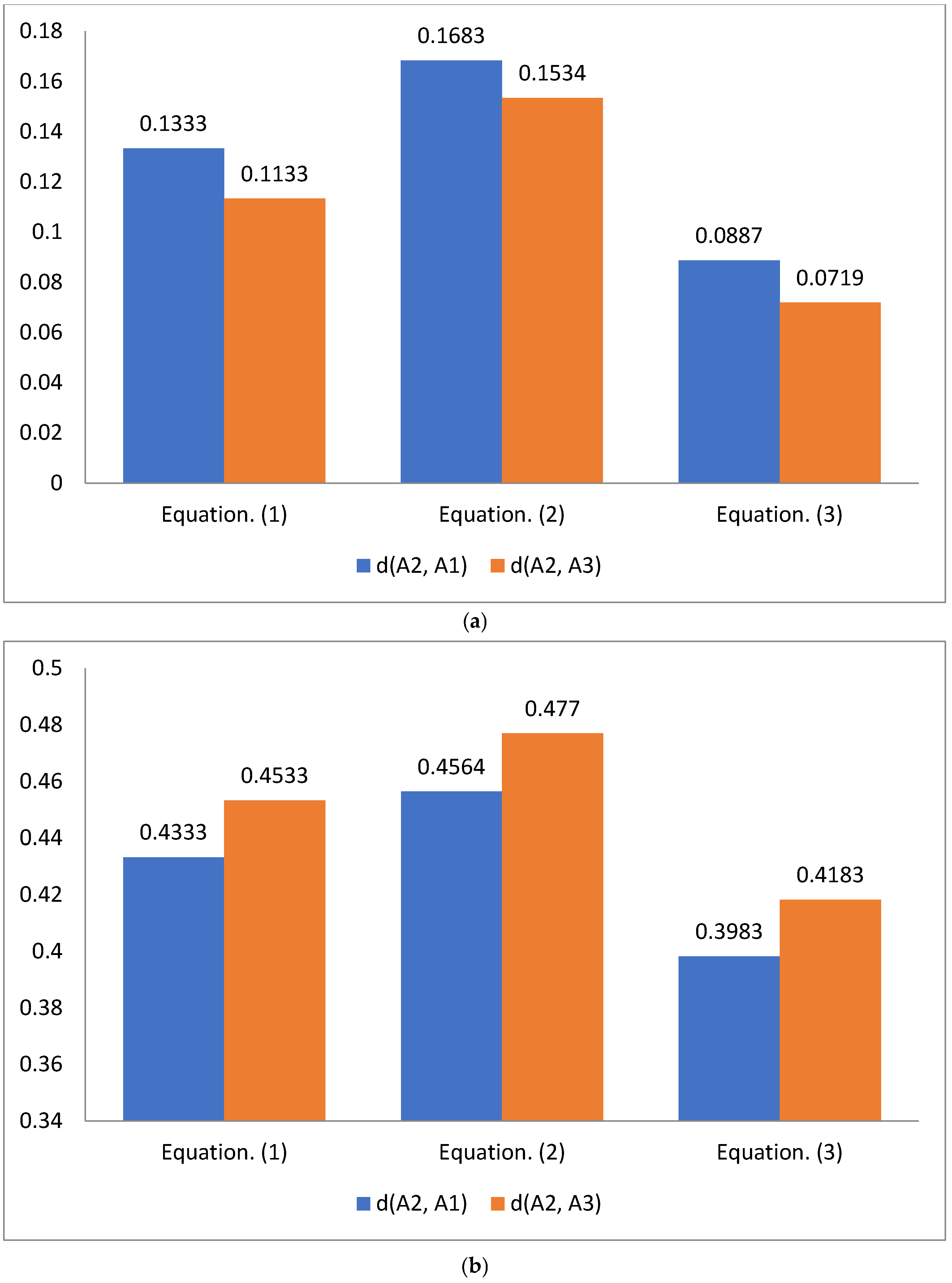
Consider A 1 , A 2 , and A 3  be three hesitant fuzzy sets (HFSs) on the universe of a singleton discourse with X = x  where A 1 = x , 0.85 , 0.6 , 0.45 , A 2 = x , 0.6 , and A 3 = x , 0.85 , 0.6 , 0.51 . Then, following the procedure given by [24],  A 2  is extended by adding minimum or maximum values. Consequently, A 2 = x , ( 0.6 , 0.6 , 0.6 ) ,  we have A 3 A 1 A 2  as a result. The outcome should be d A 2 , A 3 d A 2 , A 1 . By using Equation (1), we have d h A 2 , A 1 = 0.1333  and d h A 2 , A 3 = 0.1133 .  Using Equation (2), we have d e A 2 , A 1 = 0.1683  and d e A 2 , A 3 = 0.1534 . Using Equation (3), we have D N A 2 , A 1 = 0.0887  and D N A 2 , A 3 = 0.0719 .
This clearly shows a contradiction in the axiomatic definition of distance measure among two HFSs. Now, using our supposition and extending A 2  as A 2 = x , 0.6 , 0 , 0 ,  we have γ α β  as a result, and the outcome should be d A 2 , A 3 d A 2 , A 1 . By using Equation (1) we have d h A 2 , A 1 = 0.4333  and d h A 2 , A 3 = 0.4533 . Also, using Equation (2) we have d e A 2 , A 1 = 0.4564  and d e A 2 , A 3 = 0.4770 , and using Equation (3) we have D N A 2 , A 1 = 0.3983  and D N A 2 , A 3 = 0.4183 .
The results clearly demonstrate that our proposed method of extending the shorter HFE of an HFS by zero complies with axiomatic Definition 7 of distance measures, whereas the method suggested by [19,24] fails to meet this requirement. This comparison is clearly shown in below in Figure 1a,b, respectively.
Example 2.
Assume that we have three HFSs A 2 , A 3 , and A 3  on the universe of a discourse with X = x 1 , x 2 , where
  A 1 = x 1 , 0.85 , 0.6 , 0.51 , x 2 , 0.95 , 0.3 , 0.21 ;   A 2 = x 1 , 0.85 , 0.6 , 0.45 , x 2 , 0.95 , 0.3 , 0.15 ;   and   A 3 = x 1 , 0.6 , x 2 , 0.3 .
Moreover, follow the existing procedure [19,24] so that A 3  is extended by adding minimum or maximum values. Consequently,   A 3 = x 1 , ( 0.6 , 0.6 , 0.6 ) , x 2 , 0.3 , 0.3 , 0.3 ,  and we have A 1 A 2 A 3 . As a result, the outcome should be d A 1 , A 3 d A 2 , A 3 .
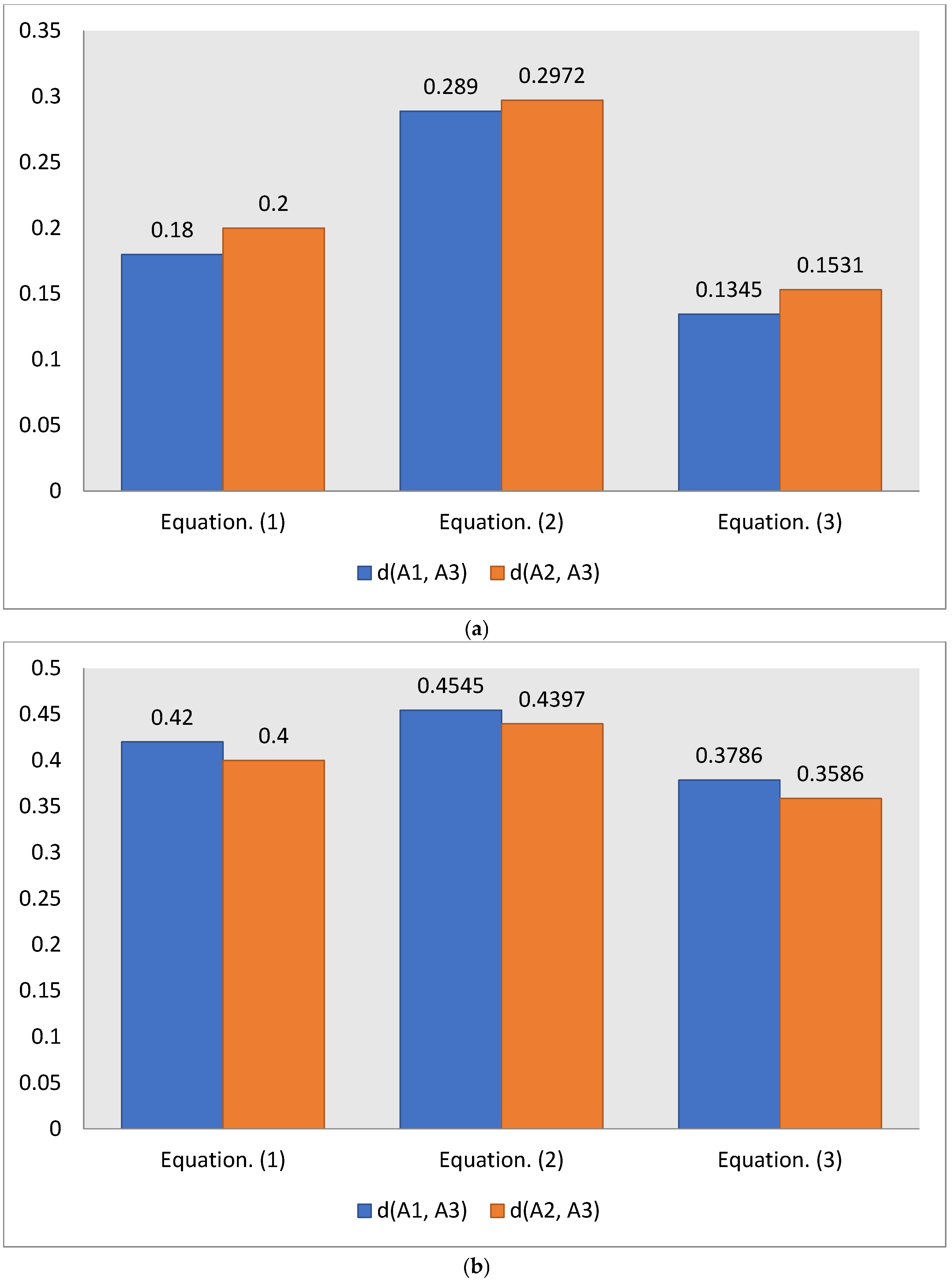
By using Equation (1), we have d h A 1 , A 3 = 0.1800  and d h A 2 , A 3 = 0.2000 . Using Equation (2), we have d e A 1 , A 3 = 0.2890  and d e A 2 , A 3 = 0.2972 . Also, by using Equation (3) we have D N A 1 , A 3 = 0.1345  and D N A 2 , A 3 = 0.1531 . This example clearly shows disagreement in the axiomatic definition of distance measure between unequal HFSs. Now, if by using our supposition and h3 is extended as A 3 = x 1 , 0.6 , 0 , 0 , x 2 , 0.3 , 0 , 0 , we have A 1 A 2 A 3  as a result, and the outcome should be d A 1 , A 3 d A 2 , A 3 . By using Equation (1) we have d h A 1 , A 3 = 0.4200  and d h A 2 , A 3 = 0.4000 , using Equation (2) we have d e A 1 , A 3 = 0.4545  and d e A 2 , A 3 = 0.4397 . Also, by using Equation (3) D N A 1 , A 3 = 0.3786  and D N A 2 , A 3 = 0.3586 .
Results unquestionably reveal that our proposed method of extending shorter the HFE of HFS by zero meets the definition of distance measure, while the existing method did not. This is also shown graphically in Figure 2a,b.
Suppose that there are n patterns present, which are denoted by hesitant fuzzy sets A j = x i , h A j x i , where x i X and i = 1 , 2 , 3 , …. , n on X = x 1 , x 2 , ….. , x m . Assume that there is a known sample which is denoted by a HFS h = x i , h x i , x i X .
Let S A i , A = M a x 1 i n S A i , A . Rendering to the opinion of highest similarity measure among HFSs, we can make a decision that the sample A belongs to pattern A i .
Example 3.
Assume three patterns be symbolized by singleton HFSs on X = x 1  as follows: A 1 = x 1 , 0.9 , 0.9 , 0.7 ; A 2 = x 1 , 0.9 , 0.7 , 0.7 ; A 3 = x 1 , 0.9 , 0.7 , 0.1 .  Consider a sample h, which will be familiar, where A = x 1 , 0.9 , 0.7 , . If h is extending by the minimum value as A = x 1 , 0.9 , 0.7 , 0.7 , then S N A 2 , A = 1 .  And if h is extending by the maximum value as A = x 1 , 0.9 , 0.9 , 0.7 , then S N A 1 , A = 1 . But it is not intuitionally acceptable, because adding 0.7 or 0.9 to A  is an inaccurate idea. A  should belong to pattern hi but adding different values give us different outcomes, which is not according to our necessity. If we apply our supposition that h is expanding, like A = x 1 , 0.9 , 0.7 , 0 , then by using our proposed new similarity measure in Equation (4) S N A 1 , A = 0.7364 , S N A 2 , A = 0.7664 , and S N A 3 , A = 0.9667 .  According to the principle of maximum similarity measure among hesitant fuzzy sets, we can come to a decision that the sample A  belongs to pattern A 3 , which is intuitionally an acceptable and reasonable way.

5. Application to Multi-Criteria Decision-Making

In this section, we apply the proposed method for calculating distance measures between unequal HFSs to a multi-criteria decision-making (MCDM) problem. Recently, MCDM problems [31,35] involving hesitant fuzzy information have gained increasing attention and significance [13,21,29]. Although several MCDM approaches have been developed [35,36,37,38,39,40,41], none of them adequately address decision-making problems while considering the psychological behavior of the decision maker. The TODIM method (an acronym in Portuguese for interactive and multi-criteria decision-making) is one such approach that incorporates behavioral aspects into the decision-making process. Suggested by Goomes and Lima [42,43], it is a distinct multi-criteria technique based on prospect theory [44], and has been demonstrated to be a priceless implement designed for cracking the MCDM problem, considering the DM’s behavior.

5.1. The Hesitant Fuzzy TODIM (HF-TODIM)

The TODIM technique is used to measure the dominance degree of each alternative over the others by launching a multi-criteria value function footed on prospect theory [44]. Based on the achieved dominance degrees, the placing of alternatives can be resolute. The major benefit of the TODIM technique is its aptitude for catching the decision maker’s (DM’s) behavior. In the algorithm of TODIM approach, we follow the steps below:
Step 1.
Recognize the hesitant fuzzy decision matrix (HFDM) R = r i j m × n  given by the DM in MCDM problem where r i j  is the hesitant fuzzy numbers (HFNs).
Step 2.
Convert the decision matrix R = r i j m × n  into a normalized HFDM L = r i j 4 × 4  where r i j  for beneficial criteria and r i j c  for cost criteria.
Step 3.
The weights of each criteria  C j , j = 1 , 2 , 3 , , n  can be considered by adding another criteria, which is ideal criteria C I  in normalized HFDM L = r i j m × n .
Calculate the distance between ideal criteria C I and C j , j = 1 , 2 , 3 , , n .
Step 4.
According to TODIM the criterion with the highest weight is frequently observed as the reference criteria C r , specifically,
C r = C j : max   w ^ j , j = 1 , 2 , 3 , , n
Compute the relative weights of every criteria C j  by using  w ^ j r = w ^ j w ^ r , where w ^ j  is weight of criteria  C j  and  w ^ r  is the weight of reference criteria  C r  and  0 w ^ j r 1 .
Step 5.
Determine the dominance degree of the alternative A ˜ i  over each alternative A ˜ t  with respect to criteria C j  by using
ϕ j A ˜ i , A ˜ t = w ^ j r d I i j , I t j j = 1 n w ^ j r , i f   I i j > I t j 0 , i f   I i j = I t j 1 θ j = 1 n w ^ j r d I i j , I t j w ^ j r ,     i f   I i j < I t j        
The term ϕ j A ˜ i , A ˜ t , signified by partial dominance, represents the contribution of C j  to the relation δ ˜ A ˜ i , A ˜ t , as soon as relating the alternative A ˜ i  with alternative A ˜ t .
The values I i j  and I t j  are the score of the alternatives A ˜ i  and A ˜ t , respectively, with respect to the criteria C j . The value w j r  signifies the weight of C j  divided by the weight of the reference r, i.e., w ^ j r = w ^ j w ^ r . The term d I i j , I t j  represents the distance between two hesitant fuzzy numbers I i j  and I t j , calculated by Equation (3). Three cases can arise: if I i j > I t j  then ϕ j A ˜ i , A ˜ t  signifies a gain; if I i j = I t j  then ϕ j A ˜ i , A ˜ t  represents a nil; if I i j < I t j  then ϕ j A ˜ i , A ˜ t  represents a loss. Definition 3 is used in each case. The parameter θ  signifies the reduction factor of the losses.
In order to illustrate the function ϕ j A ˜ i , A ˜ t  visually, we express it in a dominance degree matrix with respect to C j  as:
                                                      A ˜ 1               A ˜ 2                                     A ˜ m ϕ j ϕ j A ˜ i , A ˜ t m × m = A ˜ 1 A ˜ 2 A ˜ m 0 ϕ j A ˜ 1 , A ˜ 2 ϕ j A ˜ 1 , A ˜ m ϕ j A ˜ 2 , A ˜ 1 0 ϕ j A ˜ 2 , A ˜ m ϕ j A ˜ m , A ˜ 1 ϕ j A ˜ m , A ˜ 2 0
where j = 1 , 2 , 3 , , n .
Step 6.
Approximate the overall dominance degree of the alternative A i  over each alternative A t  via δ ˜ A ˜ i , A ˜ t = i = 1 n ϕ j A ˜ i , A ˜ t , i , t = 1 , 2 , 3 , , n
                                                          A ˜ 1               A ˜ 2                                     A ˜ m δ ˜ = δ ˜ A ˜ i , A ˜ t m × m = A ˜ 1 A ˜ 2 A ˜ m 0 δ ˜ A ˜ 1 , A ˜ 2 δ ˜ A ˜ 1 , A ˜ m δ ˜ A ˜ 2 , A ˜ 1 0 δ ˜ A ˜ 2 , A ˜ m δ ˜ A ˜ m , A ˜ 1 δ ˜ A ˜ m , A ˜ 2 0
Step 7.
Drive the overall value of each alternative A i , i = 1 , 2 , 3 , , n  according to the following expression:
ε i = i = 1 n δ ˜ A ˜ i , A ˜ t m i n i = 1 n δ ˜ A ˜ i , A ˜ t m a x i = 1 n δ ˜ A ˜ i , A ˜ t m i n i = 1 n δ ˜ A ˜ i , A ˜ t
Step 8.
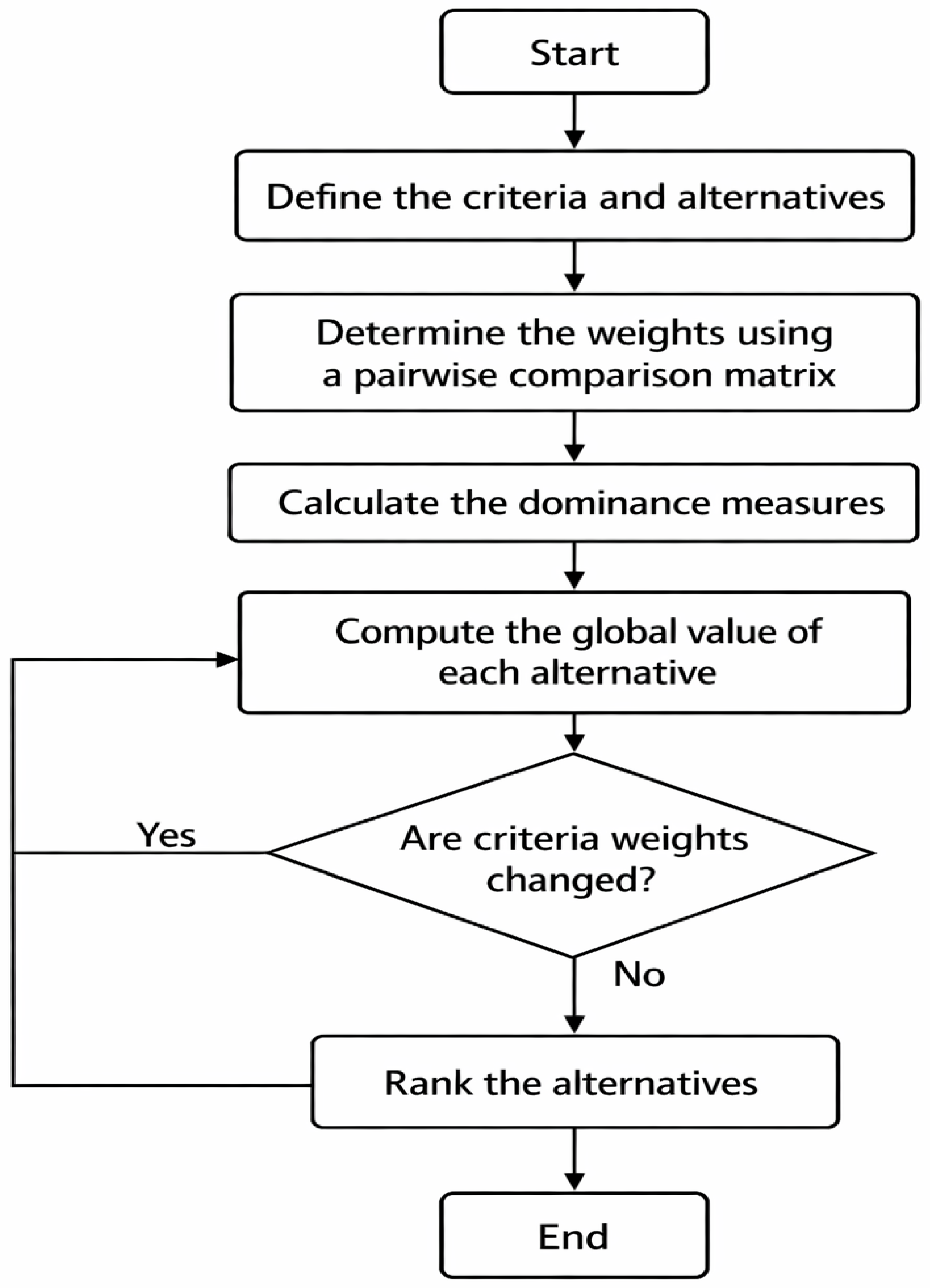
Conclude the ranking of the alternatives according to the overall values. The flowchart of the proposed algorithm is shown in below Figure 3.
Algorithm 1: Pseudo code of the proposed method
Input:
        A = {A1, A2, …, Am}                      // Set of alternatives
        C = {C1, C2, …, Cn}                      // Set of criteria
        X = [x_ij] (m × n matrix)               // Decision matrix
        W = {w1, w2, …, wn}                    // Weights of criteria
        θ > 0                                                  // Loss attenuation factor
Output:
        Ranking of alternatives
------------------------------------------------------------
Step 1: Normalize Decision Matrix
        For each criterion j = 1 to n:
                If Cj is benefit type:
                        r_ij = x_ij/max(x_j)
                Else (cost type):
                        r_ij = min(x_j)/x_ij
------------------------------------------------------------
Step 2: Compute Relative Weights
        Select a reference criterion Cr (usually highest weight)
        For each criterion j:
                w′_j = w_j/w_r
------------------------------------------------------------
Step 3: Initialize Dominance Matrix
        For all i, k:
                δ(Ai, Ak) = 0
------------------------------------------------------------
Step 4: Calculate Dominance Degrees
        For each pair of alternatives (Ai, Ak), where i ≠ k:
                For each criterion j = 1 to n:
                        d = r_ij − r_kj
                        If d > 0 then:                // Gain
                                φ_j = sqrt(w′_j * d)
                        Else if d < 0 then:      // Loss
                                φ_j = −(1/θ) * sqrt(w′_j * |d|)
                        Else:
                                φ_j = 0
                        δ(Ai, Ak) = δ(Ai, Ak) + φ_j
------------------------------------------------------------
Step 5: Compute Global Dominance Value
        For each alternative Ai:
                G(Ai) = Σ δ(Ai, Ak) for all k = 1 to m
------------------------------------------------------------
Step 6: Normalize Global Values
        G_min = min(G(Ai))
        G_max = max(G(Ai))
        For each Ai:
                G_norm(Ai) = (G(Ai) − G_min)/(G_max − G_min)
------------------------------------------------------------
Step 7: Rank Alternatives
        Sort alternatives in descending order of G_norm(Ai)
------------------------------------------------------------
Step 8: Decision
        Select alternative with highest G_norm(Ai)
End
Example 4.
The livestock sector plays an important role in the economy of Pakistan and in the rural socio-economic system. It makes a significant contribution to human food supply, family nutrition, soil productivity, livelihoods, transportation, and agricultural traction. It has a high potential for growth and deficiency alleviation in Pakistan, particularly in Punjab where about 30–40% of earnings in rural areas result from livestock-related activities. In the livestock sector of Pakistan, milk is the primary and most significant product. Pakistan is ranked as the fourth-largest producer of milk in the world, after India, the USA, and China. The share of livestock within the agricultural sector is substantial, due to its significant contribution. It plays an essential role in scarcity diminution strategies, and this sector may be residential very rapidly, as all required inputs for this sector are accessible in plentiful quantities in this country. Agriculture is the second-largest sector in Pakistan and livestock plays a considerable role in the agriculture sector, contributing approximately 56% of its value [45]. Additionally, the livestock sector employs about 30 million people, the majority of whom live in rural areas of the country. To enhance and sustain agricultural development, it is particularly important for the Government of Pakistan to expand its focus on improving the livestock sector. Although the livestock sector has improved considerably in recent years, it can still be improved further, so that it can engage more people, and thus it serve for the betterment of our country. Livestock includes milk, eggs, meat, fertilizer, hides, and horns, and there are many livestock species, such as cattle, buffaloes, sheep, goats, chicken, and pigs.
To suggest which livestock species is more feasible to improve the livestock sector as well as the agriculture sector in Pakistan with minimum investment, there are four possible alternatives: A ˜ 1  sheep, A ˜ 2  goats, A ˜ 3  buffalo, and A ˜ 4  cattle. The following four main criteria are known for calculating these four livestock species: (1) Meat is the most important livestock product and provides elevated nutrient content; it is considered a necessary human food: C 1  meat’s quality. (2) Fertilizer and draught power provided by the animal enhance the supply of organic matter to advance land fertility: C 2  best fertilizer. (3) The nutritional needs and skilled labors for animal care: C 3  food and care for animals, (4) Many by-products, together with leather products, wool products, fats, and butter, play a considerable role in Pakistan’s capability to produce foreign exchange: C 4  export marketing.
For convenience, we use a HFDM to express the results evaluated by the decision makers. The assessments of the alternatives A ˜ i  under the criteria C j  are displayed in Table 1 in the form of a hesitant fuzzy decision matrix L = r i j 4 × 4 .
As C 3 is the cost attribute, we have to find the complement of C 3 like, C 3 c = 0.2 , 0.25 , 0.39 , 0.6 , 0.28 , 0.56 , 0.79 , 0.2 , 0.36 , 0.5 , 0.56 , 0.69 .
Thus, the normalized HF-decision matrix is given in Table 2 and the weights of C j , j = 1, 2, 3, 4 are calculated by adding another criteria in the normalized HF-decision matrix. These are displayed in Table 3.
As a cost criterion is involved, Table 1 is then normalized, and the results are displayed in Table 2 below.
Now, we add the ideal criteria in the normalized hesitant fuzzy decision matrix. This is expressed in Table 3.
Weights of the criterion C j , j = 1 , 2 , 3 , 4 are as w ^ 1 = 0 . 282 ,   w ^ 2 = 0 . 264 ,   w ^ 3 = 0 . 233 ,   w ^ 4 = 0 . 220   respectively. Since w ^ 1 is maximum of all weights then it is considered as a reference weight, as w ^ r = 0 . 282   , and C 1 is the reference criteria. Consequently, the relative weights of all criteria C j , j = 1 , 2 , 3 , 4 are w ^ 1 r = 1 ,   w ^ 2 r = 0 . 936 ,   w ^ 3 r = 0 . 826   and   w ^ 4 r = 0 . 780 , respectively. Now, we want to calculate the dominance degree of alternative A ˜ i over each alternative A ˜ t and set θ = 3.542 . For the dominance degree, we first have to calculate the distance d I i j , I t j for each criterion; we use Equation (3) which is our proposed hesitant fuzzy distance measure. Then, the dominance degree matrices with respect to criteria C j , j = 1 , 2 , 3 , 4 are
                A ˜ 1 A ˜ 2               A ˜ 3               A ˜ 4 ϕ 1 = A ˜ 1 A ˜ 2 A ˜ 3 A ˜ 4 0 0.2037 0.3558 0.2210 0.2037 0 0.2856 0.2210 0.3558 0.2856 0 0.2709 0.2210 0.2210 0.2709 0 ,
                A ˜ 1 A ˜ 2               A ˜ 3               A ˜ 4 ϕ 2 = A ˜ 1 A ˜ 2 A ˜ 3 A ˜ 4 0 0.1769 0.3144 0.1908 0.1890 0 0.3171 0.1433 0.3359 0.3387 0 0.3008 0.2038 0.1531 0.2816 0 ,
                A ˜ 1 A ˜ 2               A ˜ 3               A ˜ 4 ϕ 3 = A ˜ 1 A ˜ 2 A ˜ 3 A ˜ 4 0 0.1826 0.1217 0.1799 0.1509 0 0.1872 0.1613 0.1473 0.2266 0 0.2418 0.2178 0.1953 0.1998 0
and
                A ˜ 1 A ˜ 2               A ˜ 3               A ˜ 4 ϕ 4 = A ˜ 1 A ˜ 2 A ˜ 3 A ˜ 4 0 0.1961 0.2402 0.1638 0.1529 0 0.2822 0.1919 0.3080 0.3618 0 0.2554 0.2101 0.2460 0.1992 0 .
The overall dominance degree matrix of the alternative A ˜ i over each alternative A ˜ t can be found by using Step 6 and the overall dominance degree matrix is
            A ˜ 1 A ˜ 2           A ˜ 3                   A ˜ 4 δ ˜ = A ˜ 1 A ˜ 2 A ˜ 3 A ˜ 4 0 0.0019 1.0321 0.7555 0.0889 0 1.0721 0.7175 1.1470 1.2127 0 1.0689 0.8527 0.8154 0.9515 0 .
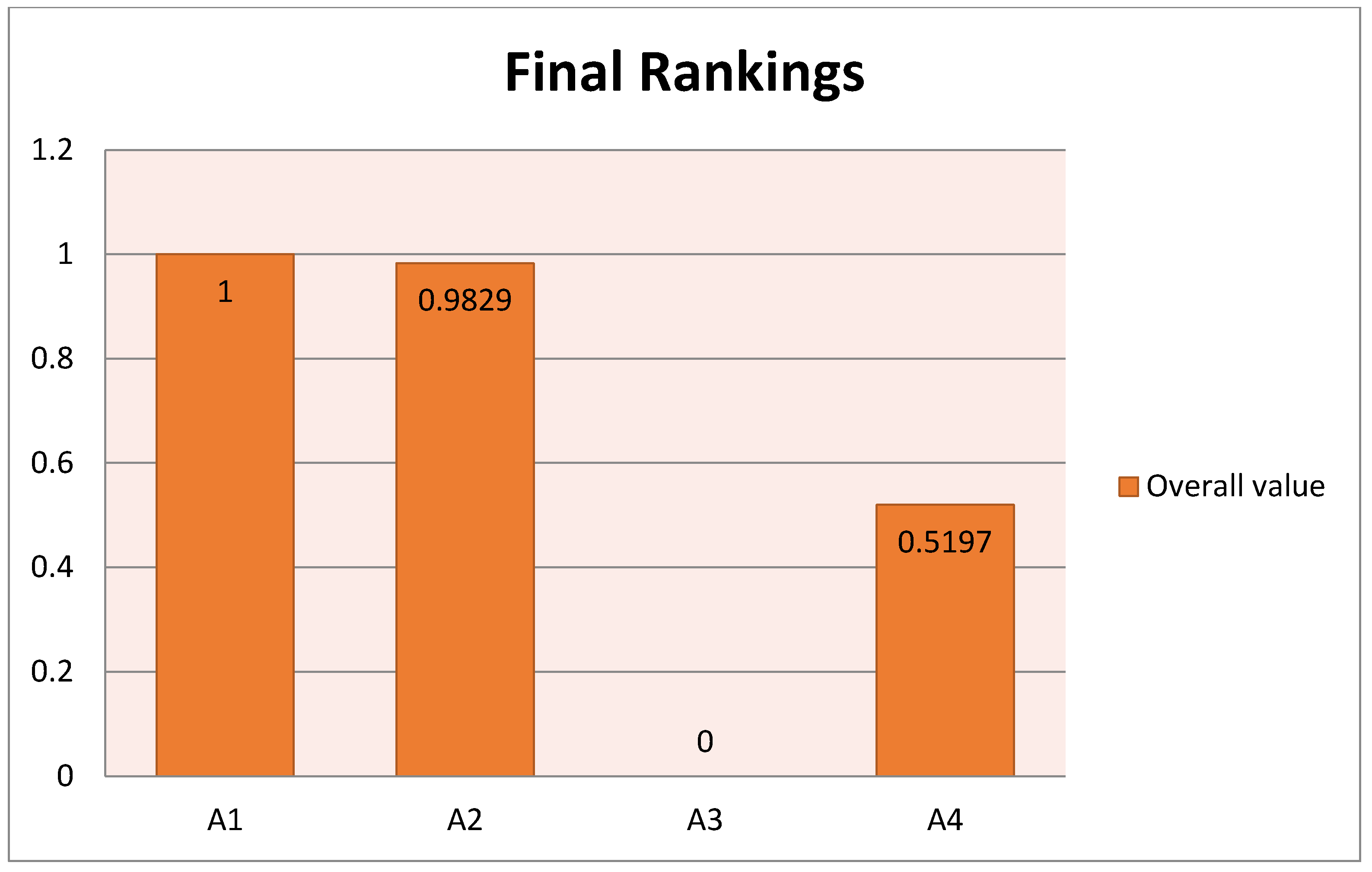
Subsequently, we compute the livestock species’ overall values of the first decision maker (DM) by using Step 7. In a similar way, the species’ overall values of other DMs can be achieved. For the calculated weights of the DMs, the overall values of livestock species A ˜ 1 , A ˜ 2 , A ˜ 3   and   A ˜ 4 can be calculated as 1, 0.9829, 0, 0.5197, respectively. Thus, the ranking of the livestock species is A ˜ 1 A ˜ 2 A ˜ 4 A ˜ 3 , and A ˜ 1 is most advantageous variety for the profitable outcome. This result is shown graphically in Figure 4 below.

5.2. Comparative Analysis

Comparative analysis of proposed MCDM method with other methods is shown in Table 4 below.
Table 4 shows that A ˜ 1 is the best alternative among all other alternatives.

6. Conclusions

In this paper, we propose a novel and intuitively acceptable approach for calculating distance and similarity measures between hesitant fuzzy sets of unequal lengths. Through several numerical examples, we demonstrate that extending shorter hesitant fuzzy elements by adding zeros is a more reasonable and intuitive method compared to existing techniques. We also establish that all existing distance and similarity measures, which rely on the use of minimum, maximum, or other arbitrary values in shorter HFEs, can be redefined using our approach, except for the Hausdorff distance. Furthermore, we introduce a new distance and similarity measure based on an exponential function, which satisfies the axiomatic definitions of distance and similarity. To demonstrate its practical applicability, we applied the proposed similarity measure to pattern recognition and used the distance measure to develop a hesitant fuzzy TODIM (HF-TODIM) model for solving real-world multi-criteria decision-making problems. Specifically, we analyzed various livestock species and employed HF-TODIM to identify the most profitable option. The results indicated that sheep offer the highest returns with minimal investment. Our proposed method is particularly relevant to the agricultural sector, offering a valuable decision-support tool for individuals considering livestock farming or dairy production.
Future work could focus on adapting the proposed measures for dynamic hesitant bipolar soft fuzzy data [28] and large-scale datasets and neutrosophic fuzzy data [13], especially in real-time decision-making contexts. Applying this approach to additional real-world problems in fields such as healthcare, finance, supply-chain management, and the social sciences could further validate its practical usefulness and impact. Moreover, enhancing the computational efficiency of the proposed methodology will be crucial for applications requiring fast and scalable decision-making solutions.

Author Contributions

Conceptualization, Z.H., S.Z. and M.A.; Methodology, Z.H., S.Z., R.H., M.A. and P.C.; Software, R.H. and M.A.; Validation, R.H. and P.C.; Formal analysis, R.H., M.A. and P.C.; Investigation, S.Z., R.H. and P.C.; Resources, Z.H. and P.C.; Data curation, S.Z.; Writing—original draft, S.Z.; Writing—review & editing, Z.H. and M.A.; Visualization, M.A.; Supervision, Z.H.; Project administration, R.H. and P.C.; Funding acquisition, P.C. All authors have read and agreed to the published version of the manuscript.

Funding

This research received no external funding.

Data Availability Statement

All the associated data is included within the article.

Acknowledgments

The authors would like to thank the editorial board of Symmetry for handling the manuscript.

Conflicts of Interest

The authors declare that they have no known competing financial interests or personal relationships that could have appeared to influence the work reported in this paper.

References

  1. Zadeh, L.A. Fuzzy sets. Inf. Control 1965, 8, 338–353. [Google Scholar] [CrossRef]
  2. Atanassov, K.T. Intuitionistic fuzzy sets. Fuzzy Sets Syst. 1986, 20, 87–96. [Google Scholar] [CrossRef]
  3. Mendel, J.M.; John, R.B. Type-2 fuzzy sets made simple. IEEE Trans. Fuzzy Syst. 2002, 10, 117–127. [Google Scholar] [CrossRef]
  4. Yager, R.R. Pythagorean fuzzy subsets. In Proceedings of the 2013 Joint IFSA World Congress and NAFIPS Annual Meeting (IFSA/NAFIPS), Edmonton, AB, Canada, 24–28 June 2013; pp. 57–61. [Google Scholar]
  5. Yager, R.R.; Abbasov, A.M. Pythagorean membership grades, complex numbers, and decision making. Int. J. Intell. Syst. 2013, 28, 436–452. [Google Scholar] [CrossRef]
  6. Yager, R.R. Generalized orthopair fuzzy sets. IEEE Trans. Fuzzy Syst. 2016, 25, 1222–1230. [Google Scholar] [CrossRef]
  7. Tong, X.; Yu, L. MADM based on distance and correlation coefficient measures with decision-maker preferences under a hesitant fuzzy environment. Soft Comput. 2016, 20, 4449–4461. [Google Scholar] [CrossRef]
  8. Xia, M.; Xu, Z. Hesitant fuzzy information aggregation in decision making. Int. J. Approx. Reason. 2011, 52, 395–407. [Google Scholar] [CrossRef]
  9. Torra, V. Hesitant fuzzy sets. Int. J. Intell. Syst. 2010, 25, 529–539. [Google Scholar] [CrossRef]
  10. Das, A.K.; Gupta, N.; Mahmood, T.; Tripathy, B.C.; Das, R.; Das, S. An efficient water quality evaluation model using weighted hesitant fuzzy soft sets for water pollution rating. In Mechatronics: Concepts, Tools, Applications, and New Trends, 1st ed.; Kumar, A., Kumar, P., Rathee, S., Kumar, B., Eds.; CRC Press: Boca Raton, FL, USA, 2025; p. 17. [Google Scholar] [CrossRef]
  11. Das, A.K.; Gupta, N.; Granados, C. Weighted hesitant bipolar-valued fuzzy soft set in decision-making. Songklanakarin J. Sci. Technol. 2023, 45, 681–690. Available online: https://api.semanticscholar.org/CorpusID:276699437 (accessed on 9 April 2026).
  12. Das, A.K.; Patra, S.; Granados, C. An innovative approach to hesitant bipolar fuzzy soft sets in multi-criteria group decision-making. Adv. Comp. Int. 2025, 5, 4. [Google Scholar] [CrossRef]
  13. Ali, M.; Hussain, Z.; Yang, M.S. Hausdorff distance and similarity measures for single-valued neutrosophic sets with application in multi-criteria decision making. Electronics 2022, 12, 201. [Google Scholar] [CrossRef]
  14. Ali, Z.; Yang, M.S. On circular q-rung orthopair fuzzy sets with Dombi aggregation operators and application to symmetry analysis in artificial intelligence. Symmetry 2024, 16, 260. [Google Scholar] [CrossRef]
  15. Chen, N.; Xu, Z.; Xia, M. Correlation coefficients of hesitant fuzzy sets and their applications to clustering analysis. Appl. Math. Model. 2013, 37, 2197–2211. [Google Scholar] [CrossRef]
  16. Düğenci, M. A new distance measure for interval valued intuitionistic fuzzy sets and its application to group decision making problems with incomplete weights information. Appl. Soft Comput. 2016, 41, 120–134. [Google Scholar] [CrossRef]
  17. Hussain, Z.; Abbas, S.; Yang, M.S. Distances and similarity measures of q-rung orthopair fuzzy sets based on the Hausdorff metric with the construction of orthopair fuzzy TODIM. Symmetry 2022, 14, 2467. [Google Scholar] [CrossRef]
  18. Zeng, W.; Li, D.; Yin, Q. Distance and similarity measures between hesitant fuzzy sets and their application in pattern recognition. Pattern Recognit. Lett. 2016, 84, 267–271. [Google Scholar] [CrossRef]
  19. Xu, Z.; Xia, M. On distance and correlation measures of hesitant fuzzy information. Int. J. Intell. Syst. 2011, 26, 410–425. [Google Scholar] [CrossRef]
  20. Rodríguez, R.M.; Martínez, L.; Torra, V.; Xu, Z.; Herrera, F. Hesitant fuzzy sets: State of the art and future directions. Int. J. Intell. Syst. 2014, 29, 495–524. [Google Scholar] [CrossRef]
  21. Yang, M.S.; Hussain, Z. Distance and similarity measures of hesitant fuzzy sets based on Hausdorff metric with applications to multi-criteria decision making and clustering. Soft Comput. 2019, 23, 5835–5848. [Google Scholar] [CrossRef]
  22. Zhang, X.; Xu, Z. Novel distance and similarity measures on hesitant fuzzy sets with applications to clustering analysis. J. Intell. Fuzzy Syst. 2015, 28, 2279–2296. [Google Scholar] [CrossRef]
  23. Hussain, Z.; Yang, M.-S. Entropy for hesitant fuzzy sets based on Hausdorff metric with construction of hesitant fuzzy TOPSIS. Int. J. Fuzzy Syst. 2018, 20, 2517–2533. [Google Scholar] [CrossRef]
  24. Xu, Z.; Xia, M. Distance and similarity measures for hesitant fuzzy sets. Inf. Sci. 2011, 181, 2128–2138. [Google Scholar] [CrossRef]
  25. Garg, H.; Kumar, K. Linguistic interval-valued Atanassov intuitionistic fuzzy sets and their applications to group decision making problems. IEEE Trans. Fuzzy Syst. 2019, 27, 2302–2311. [Google Scholar] [CrossRef]
  26. Yan, F.; Zhou, X.; Wang, Y.; Chen, L.; Li, W. Novel distance measure for hesitant fuzzy sets and its application to K-Means clustering. Int. J. Fuzzy Syst. Appl. (IJFSA) 2022, 11, 1–32. [Google Scholar] [CrossRef]
  27. Zeng, W.; Ma, R.; Li, D.; Yin, Q.; Xu, Z. Distance measure of hesitant fuzzy sets and its application in image segmentation. Int. J. Fuzzy Syst. 2022, 24, 3134–3143. [Google Scholar] [CrossRef]
  28. Ranjbar, M.; Effati, S. Group decision making in the analytic hierarchy process by hesitant fuzzy numbers. Sci. Rep. 2023, 13, 21864. [Google Scholar] [CrossRef] [PubMed]
  29. Gupta, R.; Kumar, S. Novel similarity measure between hesitant fuzzy set and their applications in pattern recognition and clustering analysis. J. Eng. Appl. Sci. 2024, 71, 5. [Google Scholar] [CrossRef]
  30. Peng, Z.; Zhang, X. A new similarity measure of hesitant fuzzy sets and its application. Int. J. Fuzzy Syst. 2024, 27, 1585–1599. [Google Scholar] [CrossRef]
  31. Hussain, Z.; Alam, S.; Hussain, R.; Rahman, S.U. New similarity measure of Pythagorean fuzzy sets based on the Jaccard index with its application to clustering. Ain Shams Eng. J. 2023, 15, 102294. [Google Scholar] [CrossRef]
  32. Hwang, C.M.; Yang, M.S. New similarity measures between generalized trapezoidal fuzzy numbers using the Jaccard index. Int. J. Uncertain. Fuzziness Knowl.-Based Syst. 2014, 22, 831–844. [Google Scholar] [CrossRef]
  33. Farhadinia, B. Information measures for hesitant fuzzy sets and interval-valued hesitant fuzzy sets. Inf. Sci. 2013, 240, 129–144. [Google Scholar] [CrossRef]
  34. Farhadinia, B. A novel method of ranking hesitant fuzzy values for multiple attribute decision-making problems. Int. J. Intell. Syst. 2013, 28, 752–767. [Google Scholar] [CrossRef]
  35. Hussain, Z.; Abbas, N.; Hussain, R. Intuitionistic fuzzy entropy and its application to hydro power plant site selection with multicriteria decision making. OPSEARCH 2025. [Google Scholar] [CrossRef]
  36. Chen, X.; Suo, C.; Li, Y. Distance measures on intuitionistic hesitant fuzzy set and its application in decision-making. Comput. Appl. Math. 2021, 40, 84. [Google Scholar] [CrossRef]
  37. Hussain, R.; Hussain, Z. Belief and plausible divergence measures: A novel approach to multicriteria decision making with modified CODAS. Comp. Appl. Math. 2024, 43, 329. [Google Scholar] [CrossRef]
  38. Hussain, R.; Hussain, Z.; Ali, M.; Akhtar, Y.; Sayyam, M. Advancing decision making with distance and similarity measures for belief and plausibility in Fermatean fuzzy sets. Sci. Rep. 2025, 15, 40303. [Google Scholar] [CrossRef] [PubMed]
  39. Hussain, R.; Hussain, Z.; Sarhan, N.M.; Juraev, N.; Ur Rahman, S. Distance and similarity measures on belief and plausibility under q-rung orthopair fuzzy sets with applications. Sci. Rep. 2024, 14, 18959. [Google Scholar] [CrossRef] [PubMed]
  40. Hussain, Z.; Afzal, H.; Hussain, R.; Nasimullah. Similarity measures of Pythagorean fuzzy sets based on Lp metric and its applications to multicriteria decision-making with Pythagorean VIKOR and clustering. Comput. Appl. Math. 2023, 42, 301. [Google Scholar] [CrossRef]
  41. Hussain, S.; Hussain, Z.; Hussain, R.; Bakhet, A.; Arafat, H.; Zakarya, M.; Al-Thaqfan, A.A.I.; Ali, M. A Novel Framework for Belief and Plausibility Measures in Intuitionistic Fuzzy Sets: Belief and Plausibility Distance, Similarity, and TOPSIS for Multicriteria Decision Making. Axioms 2024, 13, 858. [Google Scholar] [CrossRef]
  42. Gomes, L.; Lima, M. From modeling individual preferences to multicriteria ranking of discrete alternatives: A look at prospect theory and the additive difference model. Found. Comput. Decis. Sci. 1992, 17, 171–184. [Google Scholar]
  43. Gomes, L.; Lima, M. TODIM: Basics and application to multicriteria ranking of projects with environmental impacts. Found. Comput. Decis. Sci. 1992, 16, 113–127. [Google Scholar]
  44. Kahneman, D.; Tversky, A. Prospect theory: An analysis of decision under risk. Econometrica 1979, 47, 263–291. [Google Scholar] [CrossRef]
  45. Rehman, A.; Jingdong, L.; Chandio, A.A.; Hussain, I. Livestock production and population census in Pakistan: Determining their relationship with agricultural GDP using econometric analysis. Inf. Process. Agric. 2017, 4, 168–177. [Google Scholar] [CrossRef]
Figure 1. (a) Comparison analysis of proposed hesitant fuzzy distance with existing distance measures for adding minimum value. (b) Comparison analysis of proposed hesitant fuzzy distance with existing distance measures for adding maximum value.
Symmetry 18 00947 g001
Figure 2. (a) Comparative analysis of existing and proposed measure for adding minimum value. (b) Comparative analysis of existing and proposed measure for adding maximum value.
Symmetry 18 00947 g002
Figure 3. Flow chart of the proposed HF-TODIM algorithm (see Algorithm 1).
Symmetry 18 00947 g003
Figure 4. Final ranking of alternatives.
Symmetry 18 00947 g004
Table 1. Hesitant fuzzy decision matrix.
C 1 C 2 C 3 C 4
A ˜ 1 0.6 , 0.6 , 0.4 0.9 , 0.5 , 0.2 , 0.2 0.8 , 0.75 , 0.61 , 0.4 0.7 , 0.65 , 0.3 , 0.21
A ˜ 2 0.6 , 0.42 , 0.1 0.7 , 0.4 , 0.3 0.72 , 0.44 , 0.21 0.9 , 0.7 , 0.4
A ˜ 3 0.21 , 0.01 0.2 , 0.01 0.8 , 0.64 , 0.5 0.51 , 0.21
A ˜ 4 0.5 , 0.42 , 0.1 0.5 , 0.41 , 0.22 0.44 , 0.31 0.6 , 0.5 , 0.2
Table 2. Normalized hesitant fuzzy decision matrix.
C 1 C 2 C 3 C 4
A ˜ 1 0.6 , 0.6 , 0.4 0.9 , 0.5 , 0.2 , 0.2 0.6 , 0.39 , 0.25 , 0.2 0.7 , 0.65 , 0.3 , 0.21
A ˜ 2 0.6 , 0.42 , 0.1 0.7 , 0.4 , 0.3 0.79 , 0.56 , 0.28 0.9 , 0.7 , 0.4
A ˜ 3 0.21 , 0.01 0.2 , 0.01 0.5 , 0.36 , 0.2 0.51 , 0.21
A ˜ 4 0.5 , 0.42 , 0.1 0.5 , 0.41 , 0.22 0.69 , 0.56 0.6 , 0.5 , 0.2
Table 3. Adding the ideal criteria in normalized hesitant fuzzy decision matrix.
C I C 1 C 2 C 3 C 4
A ˜ 1 1 , 1 , 1 , 1 0.6 , 0.6 , 0.4 0.9 , 0.5 , 0.2 , 0.2 0.6 , 0.39 , 0.25 , 0.2 0.7 , 0.65 , 0.3 , 0.21
A ˜ 2 1 , 1 , 1 0.6 , 0.42 , 0.1 0.7 , 0.4 , 0.3 0.79 , 0.56 , 0.28 0.9 , 0.7 , 0.4
A ˜ 3 1 , 1 , 1 0.21 , 0.01 0.2 , 0.01 0.5 , 0.36 , 0.2 0.51 , 0.21
A ˜ 4 1 , 1 , 1 0.5 , 0.42 , 0.1 0.5 , 0.41 , 0.22 0.69 , 0.56 0.6 , 0.5 , 0.2
Table 4. Comparison of HF-TODIM with other MCDM methods.
MethodsFinal RankingBest Alternative
HF-TODIM A ˜ 1 A ˜ 2 A ˜ 4 A ˜ 3 A ˜ 1
TOPSIS A ˜ 1 A ˜ 2 A ˜ 3 A ˜ 4 A ˜ 1
VIKOR A ˜ 1 A ˜ 3 A ˜ 4 A ˜ 2 A ˜ 1
Disclaimer/Publisher’s Note: The statements, opinions and data contained in all publications are solely those of the individual author(s) and contributor(s) and not of MDPI and/or the editor(s). MDPI and/or the editor(s) disclaim responsibility for any injury to people or property resulting from any ideas, methods, instructions or products referred to in the content.