Article

Multi-Strategy Improved Teaching–Learning-Based Optimization for Global Optimization and Real-World Engineering Problems

1
School of International Studies, Zhejiang University, Hangzhou 310023, China
2
School of Arts, Renmin University of China, Beijing 100872, China
*
Author to whom correspondence should be addressed.
These authors contributed equally to this work.
Symmetry 2026, 18(6), 942; https://doi.org/10.3390/sym18060942 (registering DOI)
Submission received: 8 May 2026 / Revised: 23 May 2026 / Accepted: 27 May 2026 / Published: 30 May 2026
(This article belongs to the Special Issue Symmetry in Mathematical Optimization Algorithm and Its Applications)

Abstract

To address the limitations of the traditional Teaching–Learning-Based Optimization (TLBO) algorithm when solving high-dimensional, multimodal, strongly nonlinear, and constrained global optimization problems—such as single search direction, inefficient population information exchange, insufficient local exploitation capability, susceptibility to premature convergence, and low solution accuracy—this paper proposes a multi-strategy collaborative enhanced Teaching–Learning-Based Optimization algorithm (CSTLBO). While retaining the fundamental two-phase framework of the original TLBO, namely the teacher phase and learner phase, three novel strategies are sequentially incorporated: a Collaborative Differential Guidance (CDG) strategy to enrich global search directions, an Elite-Guided Collaborative Interaction (EGCI) strategy to enhance efficient transmission of high-quality population information, and a Quadratic Interpolation Local Refinement (QILR) strategy to improve fine-grained exploitation in promising regions. Together, these strategies enable an adaptive trade-off between broad search capability and refined local optimization. The effectiveness of CSTLBO is systematically assessed using the CEC2017 and CEC2022 benchmark suites, with comparative analyses conducted against multiple advanced algorithms and the baseline TLBO method. Experimental results demonstrate that CSTLBO exhibits significant superiority in terms of convergence speed, solution accuracy, robustness, and statistical performance, particularly in the 100-dimensional CEC2017 benchmark problems and the WSN deployment problem, while maintaining competitive performance on the 10- and 20-dimensional CEC2022 benchmarks. The superiority of CSTLBO is further validated through the Wilcoxon rank-sum test and Friedman mean rank test. Furthermore, the proposed algorithm is applied to the coverage deployment optimization problem in Wireless Sensor Networks (WSNs), a typical high-dimensional engineering problem involving multiple conflicting deployment indicators, which is formulated as a weighted single-objective optimization problem in this study. The results show that CSTLBO achieves a coverage rate of up to 95.71% with a fitness value as low as 0.1344, outperforming the compared algorithms in overall performance. Owing to its simple structure, low computational complexity, and strong generalization capability, CSTLBO provides an efficient and reliable solution for complex global optimization problems and practical engineering applications.

1. Introduction

In the fields of scientific computing and engineering applications, a wide range of complex global optimization problems frequently arise, such as parameter identification, path planning, resource scheduling, and network deployment. These problems are typically characterized by nonlinearity, multimodality, high dimensionality, and multiple constraints, which render traditional gradient-based deterministic optimization methods inadequate due to their strong dependence on initial conditions, requirement for derivative information, and susceptibility to being trapped in local optima [1,2]. To effectively address such “hard-to-optimize” problems, metaheuristic algorithms inspired by biological behaviors, physical laws, and social phenomena have been developed and have become a prominent research focus in the optimization community [3]. By simulating population-based search processes and employing stochastic strategies to balance exploration and exploitation in the solution space, these algorithms offer advantages such as low requirements on the analytical properties of objective functions, ease of implementation, and strong global search capability. Consequently, they have experienced rapid development over the past decades [3,4,5].
Within the broad domain of metaheuristic algorithms, numerous classical and efficient approaches have been proposed. For instance, Particle Swarm Optimization (PSO), introduced by Kennedy and Eberhart in 1995, simulates the social behavior of bird flocking by incorporating individual cognition and social learning mechanisms. It is simple in structure and converges rapidly, but it is prone to premature convergence when dealing with high-dimensional multimodal problems [6]. The Grey Wolf Optimizer (GWO), proposed by Mirjalili et al. in 2014 [7], mimics the hierarchical leadership and hunting behavior of grey wolves, achieving a good balance between exploration and exploitation, and has been widely applied in various engineering problems [8]. In addition, Differential Evolution (DE), developed by Storn and Price [9], is recognized as one of the most competitive algorithms for real-parameter optimization due to its powerful global search ability and distinctive differential mutation mechanism. Numerous improved variants such as JADE [10] and SHADE [11] have been proposed. Recently, a variety of novel intelligent optimization algorithms have also emerged, including the Bounty Hunter Optimizer (BHO) [12], Snow Ablation Optimizer (SAO) [13], Undivided Family Interaction Algorithm (UFIA) [14], Fourier Transform Optimizer (FTO) [15], Bézier Curve-Based Optimization (BCO) [16], Bounty hunter optimizer (BHO) [12], and Detective Behavior Algorithm (DBA) [17], all of which have demonstrated unique advantages in their respective application domains.
Among these approaches, the Teaching–Learning-Based Optimization (TLBO) algorithm, proposed by Rao et al. in 2011, stands out due to its parameter-free nature, which significantly simplifies implementation and enhances its applicability [18]. TLBO simulates the pedagogical process through two stages: the teacher phase, representing knowledge dissemination from the teacher to learners, and the learner phase, modeling peer-to-peer interaction among students. Owing to its simplicity and competitive performance, TLBO has attracted considerable attention and has been successfully applied in fields such as mechanical design, power systems, scheduling optimization, and structural engineering [19,20,21]. However, with the increasing complexity of real-world applications, several inherent limitations of the original TLBO algorithm have become evident. First, in the teacher phase, the population update relies solely on the best individual (teacher) and the population mean, which can lead to rapid loss of diversity and premature convergence, particularly in multimodal landscapes [22]. Second, in the learner phase, each individual interacts only with a randomly selected peer, resulting in limited information exchange and reduced learning efficiency, which slows convergence in later iterations [23,24]. Third, the algorithm lacks an effective mechanism to exploit high-quality local information embedded in elite individuals, leading to insufficient local refinement near the optimal solution and reduced solution accuracy [25,26].
To overcome these shortcomings, numerous improvement strategies have been proposed from different perspectives. Some studies focus on enhancing the update mechanism. For example, Abhishek et al. proposed an improved TLBO (iTLBO) method for trajectory control, optimizing proportional–integral–derivative controller parameters and validating performance on a two-degree-of-freedom helicopter system [27]. Jagadesh et al. introduced a weighted adaptive binary TLBO (WA-BTLBO) for feature selection in breast cancer detection using mammographic images [28]. Yugal et al. developed a chaotic version of TLBO incorporating multiple chaotic mechanisms and local search methods to achieve a better balance between global and local search and improve solution quality [29]. Kumar et al. proposed a hybrid TLBO integrating genetic crossover and mutation strategies to enhance search capability and convergence speed, applying mutation in the teacher phase and crossover in the learner phase [30]. Muhammad et al. embedded a group discussion strategy into the learner phase, where randomly selected groups interact to reduce premature convergence, although this approach introduces additional sensitivity to population size parameters [21].
Although these variants have improved TLBO performance to some extent, most existing methods either introduce excessive control parameters, thereby compromising the simplicity of TLBO, or focus on addressing a single limitation without providing a systematic solution from a collaborative optimization perspective. As a result, their performance improvements remain limited when tackling high-dimensional multimodal functions and complex engineering problems [23,31]. In particular, enhancing global exploration, collaborative learning, and local exploitation simultaneously without introducing additional parameters remains an open and challenging research problem.
To address these issues and meet the demands of complex engineering optimization, this paper proposes a Collaborative Search Teaching–Learning-Based Optimization (CSTLBO) algorithm. While fully preserving the dual-phase framework and parameter-free advantage of the original TLBO, CSTLBO introduces a set of hierarchical and complementary strategies. First, a Collaborative Differential Guidance (CDG) strategy is incorporated into the teacher phase, which integrates multidimensional difference information from elite, suboptimal, worst, and random individuals, combined with adaptive weighting to generate diverse search directions, thereby enhancing global exploration and preventing premature convergence. Second, an Elite-Guided Collaborative Interaction (EGCI) strategy is designed for the learner phase, combining traditional pairwise learning with elite–worst collaborative guidance to improve information exchange efficiency and accelerate convergence. Finally, a Quadratic Interpolation Local Refinement (QILR) strategy is introduced to capture curvature information of the fitness landscape via second-order interpolation, enabling fine-grained local exploitation and significantly improving solution accuracy in the later stages of optimization.
Different from existing TLBO variants that usually improve only one search stage or directly hybridize TLBO with external operators, the proposed CSTLBO emphasizes a hierarchical collaborative search mechanism within the original teacher–learner framework. Specifically, CDG extends the teacher phase from single-teacher guidance to multi-source differential guidance by simultaneously considering elite, sub-elite, worst, and random individuals. EGCI improves the learner phase by replacing purely random pairwise interaction with elite-guided cooperative information exchange. QILR further introduces a quadratic interpolation mechanism to refine promising regions using local curvature information. Therefore, the novelty of CSTLBO lies not in a simple accumulation of multiple operators, but in the complementary integration of exploration enhancement, cooperative interaction, and local refinement while preserving the simplicity and basic structure of TLBO.
To comprehensively evaluate the effectiveness of the proposed algorithm, extensive experiments are conducted on the CEC2017 and CEC2022 benchmark test suites, and comparisons with several state-of-the-art algorithms are performed. Furthermore, CSTLBO is applied to a typical high-dimensional wireless sensor network (WSN) deployment optimization problem. Using coverage rate, redundancy, and movement distance as evaluation metrics, the practical applicability and superiority of the proposed method are validated.
The main contributions of this paper are summarized as follows:
(1)
Three collaborative and complementary strategies are proposed to systematically address the issues of limited search diversity, inefficient information exchange, and weak local exploitation in TLBO, significantly improving optimization performance without increasing algorithmic complexity.
(2)
Extensive experiments on CEC2017 with 100-dimensional problems, CEC2022 with 10- and 20-dimensional problems, and an 80-dimensional WSN deployment problem demonstrate that CSTLBO has strong robustness and generalization ability across different problem scales.
(3)
The successful application of CSTLBO to WSN deployment optimization provides an effective and practical solution for real-world engineering problems in areas such as the Internet of Things and intelligent monitoring.
The remainder of this paper is organized as follows. Section 2 introduces the standard TLBO and the proposed CSTLBO framework along with its improvement strategies. Section 3 presents performance comparisons and analyses based on benchmark functions. Section 4 applies the proposed algorithm to the WSN deployment optimization problem. Finally, Section 5 concludes the paper and discusses future research directions.

2. Teaching–Learning-Based Optimization and Proposed Methodology

2.1. Teaching–Learning-Based Optimization

The Teaching–Learning-Based Optimization (TLBO) algorithm [18] is a population-based metaheuristic method inspired by the pedagogical interaction between a teacher and learners in a classroom. The fundamental idea is that the knowledge level of a class can be improved through two main processes: learning from the teacher and learning through interactions among learners. In the optimization context, each candidate solution is treated as a learner, and the best individual in the population is regarded as the teacher.
Assume that the population consists of P o p learners, each represented by a D -dimensional vector:
X i = [ x i , 1 , x i , 2 , , x i , D ] , i = 1 , 2 , , P o p
where D denotes the dimensionality of the problem. The fitness value of each learner is evaluated by an objective function:
f i t i = f ( X i )
The overall population can be represented as a matrix:
x = [ X 1 X 2 X N ]
At each iteration, the mean of the population is calculated as:
M = 1 N i = 1 N X i
The best individual in the population is selected as the teacher:
X t e a c h e r = X b e s t , f ( X b e s t ) = m i n ( f i t i )
The TLBO algorithm consists of two main phases: the Teacher Phase and the Learner Phase.
(1) Teacher Phase
In the Teacher Phase, the teacher attempts to elevate the mean performance of the class toward its own level. However, in practice, the mean cannot be directly moved to the teacher’s position, and the update process is governed by a stochastic teaching mechanism.
The difference between the current mean and the desired mean is defined as:
D i f f e r e n c e i = r i ( X t e a c h e r T F M ) T F = round ( 1 + r a n d ( 0 , 1 ) )
where r i [ 0 , 1 ] is a random vector, T F is the teaching factor, which takes either 1 or 2.
Using this difference, each learner is updated as:
X i n e w = X i + Difference i
This phase enhances the global search capability by guiding individuals toward the best solution while considering the population distribution.
(2) Learner Phase
In the Learner Phase, individuals improve their knowledge through mutual interaction. Each learner randomly interacts with another learner and updates its position based on their relative performance.
For each learner X i , another learner X j ( j i ) is randomly selected. The update rule is defined as:
X i n e w = { X i + r i ( X i X j ) , if f ( X i ) < f ( X j ) X i + r i ( X j X i ) , otherwise
where r i [ 0 , 1 ] is a random vector.
Similarly, a greedy selection mechanism is applied:
X i = { X i n e w , if f ( X i n e w ) < f ( X i ) X i , otherwise
This phase enhances local search capability and promotes information exchange among individuals, improving population diversity.
The TLBO algorithm has several advantages. First, it does not require algorithm-specific control parameters such as crossover rates or mutation factors, which simplifies implementation. Second, it combines global guidance (Teacher Phase) and local interaction (Learner Phase), achieving a balance between exploration and exploitation. However, due to its reliance on mean-based updates and random pairwise interactions.

2.2. Collaborative Search Teaching–Learning-Based Optimization

The Teaching–learning-Based Optimization (TLBO) algorithm is a simple and effective population-based optimization method inspired by the teaching and learning process. However, although TLBO has strong global applicability, it still exhibits several limitations when solving complex, multimodal, and high-dimensional optimization problems.
In particular, the original TLBO suffers from the following drawbacks: (1) the teacher phase relies on a single teacher and population mean, which limits the diversity of search directions; (2) the learner phase is based on pairwise interactions, which restricts information exchange among individuals; and (3) the algorithm lacks an explicit mechanism to fully exploit elite individuals, resulting in insufficient local refinement and slower convergence in later iterations.
To address these issues, this paper proposes the Collaborative Search Teaching–learning-Based Optimization (CSTLBO). Without modifying the original TLBO framework, three collaborative strategies are introduced, namely Collaborative Differential Guidance (CDG), Elite-Guided Cooperative Interaction (EGCI), and Quadratic Interpolation Local Refinement (QILR). These strategies are designed to progressively enhance exploration ability, improve information utilization efficiency, and strengthen local exploitation capability.

2.2.1. Collaborative Differential Guidance Strategy (CDG)

In the standard TLBO, the teacher phase guides the population using only the best individual and the population mean. Although this strategy ensures basic convergence behavior, it suffers from limited diversity of search directions, especially in multimodal optimization problems where multiple local optima exist.
To overcome this limitation, the CDG strategy introduces multiple collaborative information sources, including elite, sub-elite, worst, and random individuals. The main idea is to construct a richer and more informative search direction by integrating different levels of population knowledge.
Specifically, four difference vectors are constructed:
Δ 1 = X b e s t ( t ) X i ( t ) Δ 2 = X b e t t e r ( t ) X w o r s t ( t ) Δ 3 = X ¯ ( t ) X r 1 ( t ) Δ 4 = X r 2 ( t ) X i ( t )
These vectors represent different search behaviors, including elite guidance, contrast learning between good and bad individuals, population trend exploration, and random exploration. Compared with the original TLBO, this mechanism significantly enriches the information sources used for generating new solutions.
To further improve adaptability, a weighting mechanism is introduced. The contribution of each direction is determined based on both the geometric distance and the fitness quality of the current individual. This ensures that more informative directions have a greater influence on the search process.
The final collaborative search term is defined as:
K A i ( t ) = S F i k = 1 4 L F k Δ k L F k = D k k = 1 4 D k + ϵ S F i = f i f m a x
By embedding this term into the teacher phase, the updated rule becomes:
X i n e w ( t ) = X i ( t ) + r ( X t e a c h e r ( t ) T F X ¯ ( t ) + KA i ( t ) )
The CDG strategy effectively addresses the issue of limited search direction diversity in TLBO. By incorporating multiple population-level information sources, the algorithm is able to explore the search space more comprehensively. In addition, the adaptive weighting mechanism improves the balance between exploration and exploitation, which helps the algorithm maintain strong global search capability in the early stage while improving convergence stability in later stages.

2.2.2. Elite-Guided Cooperative Interaction Strategy (EGCI)

In the original TLBO learner phase, each individual learns from only one randomly selected peer. Although this mechanism is simple and efficient, it severely limits the amount of information exchange within the population, leading to slow convergence and insufficient exploitation of high-quality solutions.
To improve learning efficiency, the EGCI strategy introduces a cooperative learning mechanism that integrates both pairwise interaction and population-level guidance.
For each individual, a learning direction is first generated through peer comparison:
S t e p i = X i ( t ) X j ( t )
If the selected peer has better fitness, the direction is reversed to ensure correct learning orientation. This mechanism ensures that individuals always move toward better solutions.
However, relying only on pairwise learning is still insufficient in complex optimization problems. Therefore, a cooperative term is introduced, which combines elite guidance and worst-guided exploration:
C o o p i = 1 2 ( X b e s t ( t ) X r 1 ( t ) ) + 1 2 ( X r 2 ( t ) X w o r s t ( t ) )
This term allows individuals to simultaneously learn from high-quality solutions while maintaining diversity through interaction with inferior solutions.
The final update rule becomes:
X i n e w ( t ) = X i ( t ) + r S t e p i + λ C o o p i
The EGCI strategy significantly improves the efficiency of information exchange within the population. By combining elite guidance and worst-based exploration, it enhances both convergence speed and global search capability. Moreover, it reduces the risk of premature convergence caused by limited pairwise learning, which is a common issue in standard TLBO.

2.2.3. Quadratic Interpolation Local Refinement Strategy (QILR)

Although CDG and EGCI significantly enhance global exploration and cooperative learning, the original TLBO framework still lacks an effective mechanism for fine-grained local exploitation around promising regions.
To address this limitation, the QILR strategy introduces a quadratic interpolation-based local refinement mechanism. Unlike linear update strategies, quadratic interpolation is capable of capturing curvature information of the search landscape, enabling more accurate estimation of the local optimum.
For each individual, two auxiliary solutions are randomly selected to construct a second-order interpolation model:
X p 2 = X p X p , X q 2 = X q X q , X c 2 = X i X i
The numerator and denominator are defined as:
N u m = ( X p 2 X q 2 ) f b e s t + ( X q 2 X c 2 ) f p + ( X c 2 X p 2 ) f q D e n = ( X p X q ) f b e s t + ( X q X c ) f p + ( X c X p ) f q
The updated solution is computed as:
X i n e w ( t ) = 1 2 N u m D e n
If the denominator becomes too small, the global best solution is used as a fallback strategy.
The QILR strategy significantly enhances the local exploitation capability of CSTLBO. By introducing second-order information, the algorithm can more accurately approximate the shape of the fitness landscape, which improves both convergence speed and final solution accuracy, especially in the later stages of optimization.
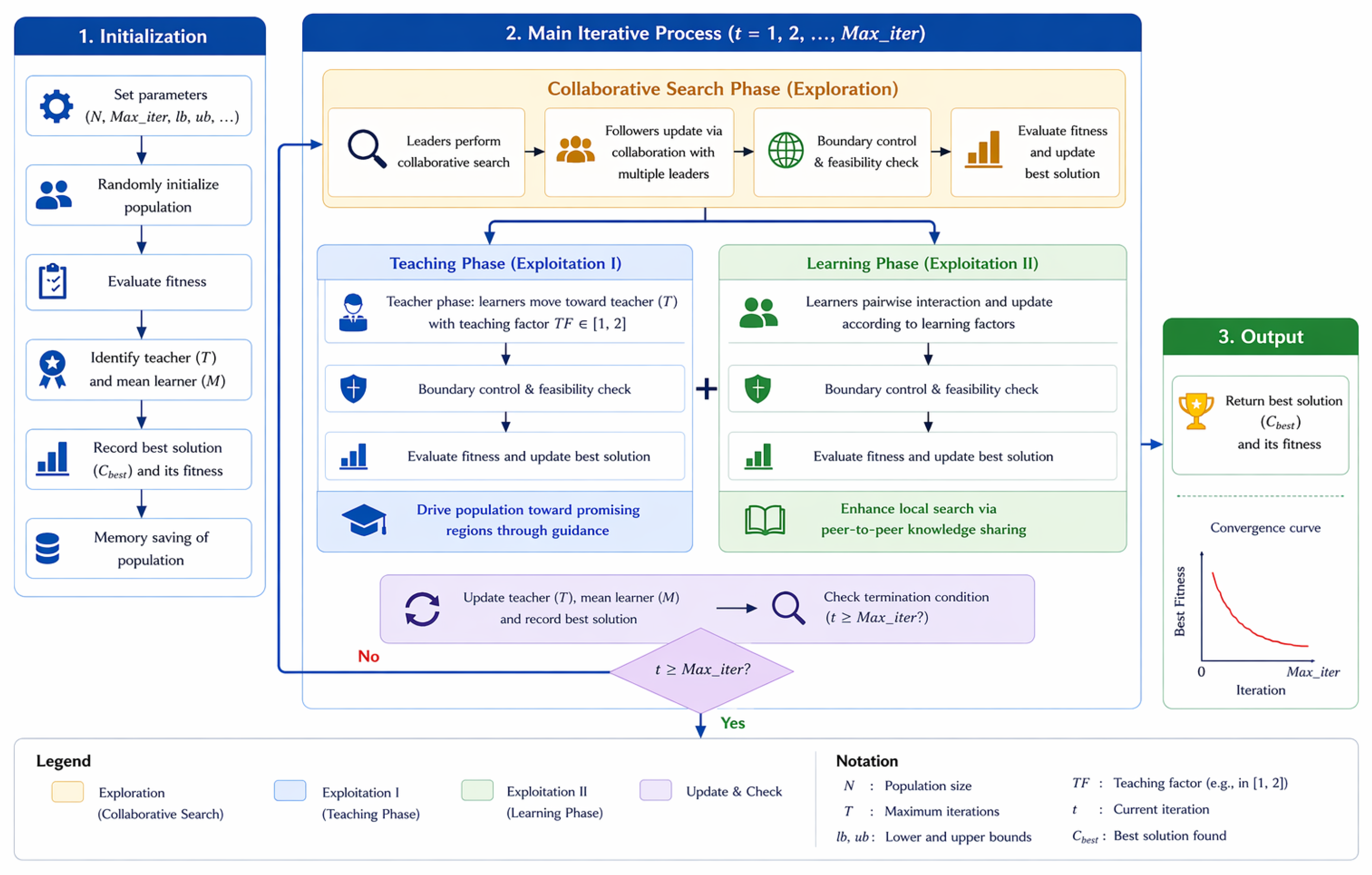
The three proposed strategies are applied sequentially in each iteration. First, CDG is used to enhance global exploration by enriching search directions. Then, EGCI improves population cooperation and information exchange. Finally, QILR performs fine-grained local refinement around promising solutions. This sequential design forms a hierarchical optimization mechanism that effectively balances exploration and exploitation throughout the search process. CDG mainly contributes to global diversity, EGCI enhances cooperative learning, and QILR ensures accurate local convergence.
To summarize, the pseudocode and flowchart of the proposed CSTLBO are presented in Algorithm 1 and Figure 1, respectively.
Algorithm 1. Pseudocode of CSTLBO.
Input: P o p , T , D , l b , u b , and objective function f ( ) .
Output: Best fitness value X b e s t , and best solution m i n ( f i t i ) = f ( X b e s t ) .
1: Initialize population X = { X 1 , X 2 , , X P o p } within the search bounds [ l b , u b ] .
2: Evaluate the fitness of all individuals: f i = f ( X i ) , i = 1 , 2 , , P o p .
3: Determine global best: X b e s t and m i n ( f i t i ) = f ( X b e s t ) .
4: while  I t = 1 : M a x I t  do
5: Sort population based on fitness, Compute mean solution M and Identify X b e s t .
6:   for  i = 1 : P o p  do
7:   %% CDG Strategy
8:   Randomly select X r 1 and X r 2 and Compute collaborative differences Δ 1 Δ 4 .
9:   Compute weights L F and scaling factor S F and Construct guidance term K A .
10:    Update X i using teacher-based rule with K A .
11:    %% EGCI Strategy
12:      Randomly select X i ( j i ) , Compute learning step S t e p i and Construct cooperative term C o o p i
13:     Update X i using S t e p i + C o o p i
14:     Compute joint decision score S p and p
15:     %% QILR Strategy
16:     Randomly select X p and X q and Construct quadratic interpolation model N u m and D e n .
17:     Generate new solution X i n e w and evaluate fitness.
18:     Greedy selection: update X i if improved
19:   end for
20:   Update global best X b e s t and f ( X b e s t ) .
21: end while
22: Return the global best solution X b e s t and its fitness f ( X b e s t ) .
The three strategies are executed in a fixed sequence in each iteration for two main reasons. First, this design preserves the simplicity and reproducibility of the original TLBO framework, avoiding additional control parameters or complex strategy-selection rules. Second, the fixed sequence follows a natural hierarchical search logic: CDG first expands the search direction and improves global exploration, EGCI then enhances cooperative information exchange among individuals, and QILR finally refines promising regions to improve local accuracy. In this way, the algorithm maintains a stable exploration–exploitation transition within each iteration.
Nevertheless, a fixed strategy layout may not always be optimal for all problem types. For example, local refinement may consume additional function evaluations when global exploration is still more important. Therefore, adaptive strategy activation or probability-based strategy selection will be investigated in future work to further reduce unnecessary computational cost and improve runtime efficiency.

2.3. Computational Complexity Analysis

The computational complexity of the proposed CSTLBO is analyzed in terms of population size N , problem dimension D , and maximum iterations T . For the standard TLBO algorithm, the main computational cost arises from the teacher phase, learner phase, and fitness evaluations, all of which involve vector operations over the population. Therefore, its overall time complexity can be expressed as O ( T × N × D ) .
For the proposed CSTLBO, additional operations are introduced, including population sorting and collaborative search strategies (CDG, EGCI, and QILR). The sorting operation requires O ( N log N ) per iteration, while the three strategies mainly involve vector-based calculations with complexity O ( N × D ) . Thus, the overall per-iteration complexity becomes O ( N × log N + N × D ) , and the total complexity is O ( N × log N + N × D ) .
Since in most optimization problems D log N , the dominant term remains O ( T × N × D ) . Therefore, compared with the standard TLBO, the proposed CSTLBO maintains the same computational complexity order while achieving improved optimization performance through enhanced collaborative search mechanisms.
It should be noted that although CSTLBO preserves the same asymptotic complexity order as TLBO, the introduced CDG, EGCI, and QILR strategies inevitably increase the constant computational cost in each iteration. Specifically, CDG requires additional difference-vector construction, EGCI introduces cooperative guidance calculations, and QILR needs quadratic interpolation-based local refinement. Therefore, CSTLBO may require slightly longer runtime than the original TLBO.

3. Performance Evaluation and Analysis

3.1. Competing Methods and Experimental Parameter Setup

To validate the effectiveness of the proposed approach, a collection of standard benchmark problems is utilized to assess the performance of CSTLBO. The results are compared with several classical optimization methods, including Particle Swarm Optimization (PSO) [6], and Grey Wolf Optimizer (GWO) [7], along with their improved variants, Velocity Pausing Particle Swarm Optimization (VPPSO) [32] and Representative-based Grey Wolf Optimizer (RGWO) [33]. In addition, comparisons are carried out with several recently proposed algorithms, such as Secretary Bird Optimization Algorithm (SBOA) [34]; B-Spline Curves Optimizer (BSO) [35], Stochastic Social Learning Optimization (SSLO) [36], Gekko Japonicus Algorithm (GJA) [37] and the canonical Teaching–Learning-Based Optimization (TLBO) algorithm [18]. Detailed parameter configurations of all competing methods are provided in Table 1.
To guarantee a fair comparison and mitigate the influence of stochastic factors, a consistent experimental framework was adopted for all algorithms. The population size was fixed at 30, and the maximum number of iterations was set to 1000. Each method was executed independently for 30 runs. Performance evaluation was carried out using statistical metrics, including the mean (Ave) and standard deviation (Std), where the best results are marked in bold. All experiments were performed on a Windows 11 platform, using a computer equipped with an Intel Core™ i5-13400 (13th Gen) processor (2.5 GHz) and 16 GB RAM. MATLAB R2024b was employed as the simulation environment.

3.2. Sensitivity and Strategy Contribution Analysis

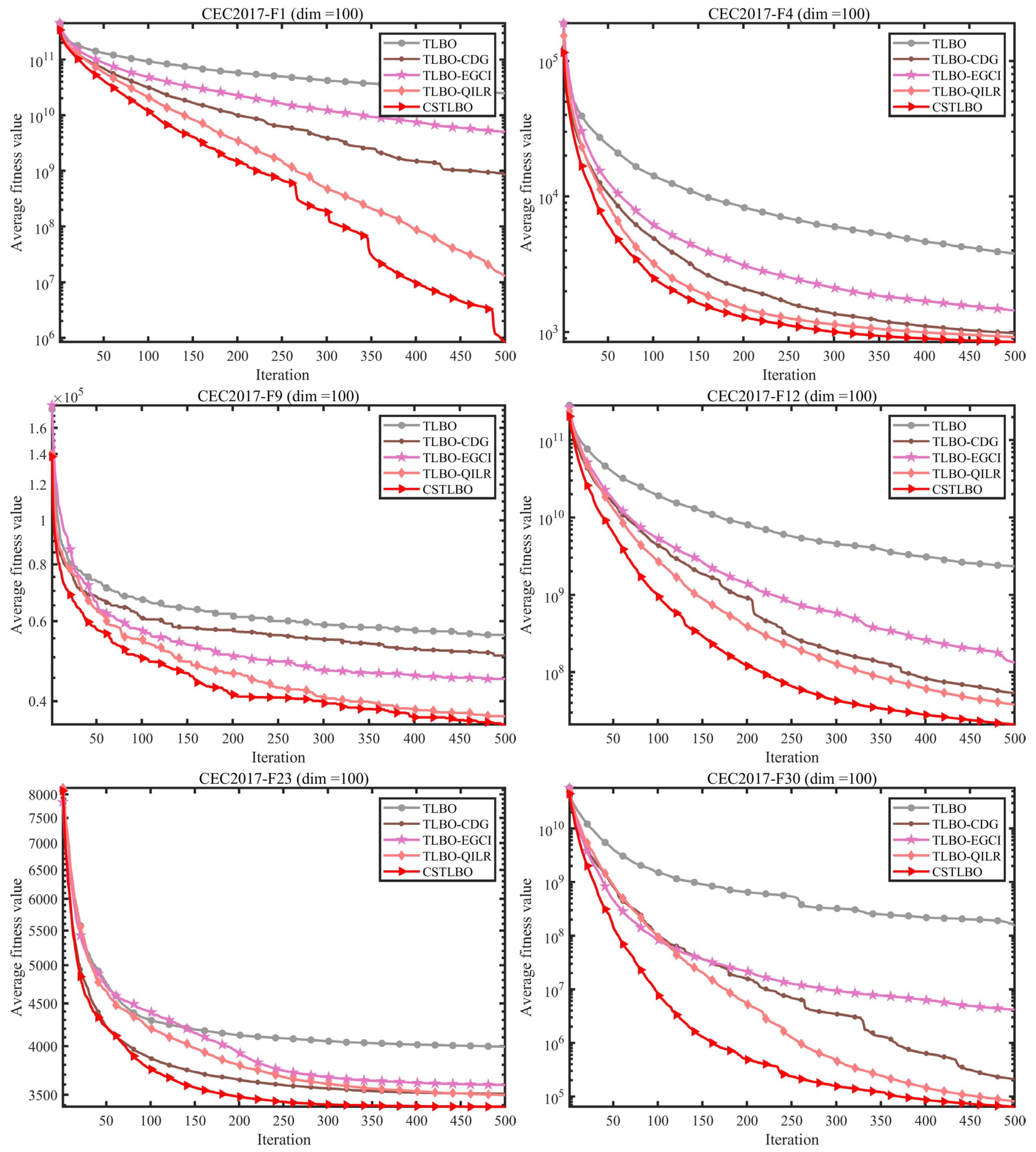
To verify the independent contributions of the three proposed enhancement strategies—Collaborative Differential Guidance (CDG), Elite-Guided Collaborative Interaction (EGCI), and Quadratic Interpolation Local Refinement (QILR)—to the performance improvement of CSTLBO, an ablation study was conducted in this section. Specifically, the complete CSTLBO algorithm was compared with three single-strategy variants, namely TLBO-CDG, TLBO-EGCI, and TLBO-QILR, as well as the original TLBO algorithm on the 100-dimensional CEC2017 benchmark suite. By analyzing the convergence behaviors of these algorithmic variants, the specific role of each strategy in the overall optimization performance can be comprehensively investigated. Figure 2 presents the convergence curves of different algorithm variants on six representative benchmark functions.
Several important observations can be drawn from Figure 2. For Function F1 (unimodal), the complete CSTLBO converges to the lowest objective value within approximately 200 iterations. In contrast, the convergence rates of TLBO-CDG and TLBO-EGCI decrease significantly, and their final optimization accuracies are also noticeably inferior to those of the complete CSTLBO. Similarly, the final solution accuracy achieved by TLBO-QILR remains lower than that of the complete version, indicating that a single enhancement strategy is insufficient to achieve the performance gains obtained through multi-strategy collaboration on unimodal problems.
For Functions F4 and F7 (multimodal), the complete CSTLBO consistently maintains the lowest objective values throughout the optimization process, while exhibiting smooth and stable convergence behavior. By comparison, TLBO-CDG experiences obvious stagnation during the middle optimization stage, indicating that relying solely on the collaborative differential guidance strategy is still insufficient for effectively escaping local optima without the assistance of other mechanisms. The convergence speed of TLBO-EGCI is substantially slower than that of the complete CSTLBO, demonstrating that the information exchange efficiency provided by a single elite-guided collaborative interaction strategy is limited. Meanwhile, TLBO-QILR exhibits insufficient exploration capability during the early search stage, resulting in a relatively slow decline in the convergence curve.
For Functions F15 and F19 (hybrid and composition functions), the convergence curve of the complete CSTLBO continues to decrease gradually during the later optimization stage, whereas the three single-strategy variants all enter a plateau phase much earlier. In particular, TLBO-QILR shows almost no further improvement after 500 iterations, while TLBO-CDG and TLBO-EGCI also fail to achieve the final optimization accuracy attained by the complete CSTLBO. These observations confirm that the synergistic cooperation among the three proposed strategies provides an irreplaceable contribution to improving the final optimization accuracy on complex benchmark landscapes.
Overall, the convergence results on all six benchmark functions consistently demonstrate that although the three single-strategy variants all outperform the original TLBO algorithm, they still exhibit a clear performance gap compared with the complete CSTLBO. Specifically, the collaborative differential guidance strategy mainly enhances global exploration capability during the early search stage, the elite-guided collaborative interaction strategy improves information exchange efficiency during the middle stage, and the quadratic interpolation local refinement strategy is primarily responsible for enhancing local exploitation accuracy during the later optimization stage. Only through the cooperative interaction of all three strategies can CSTLBO achieve the fastest convergence speed and the highest final optimization accuracy across all tested benchmark functions.

3.3. Benchmark Function Evaluation

3.3.1. Results on CEC2017 Benchmark Test Suite

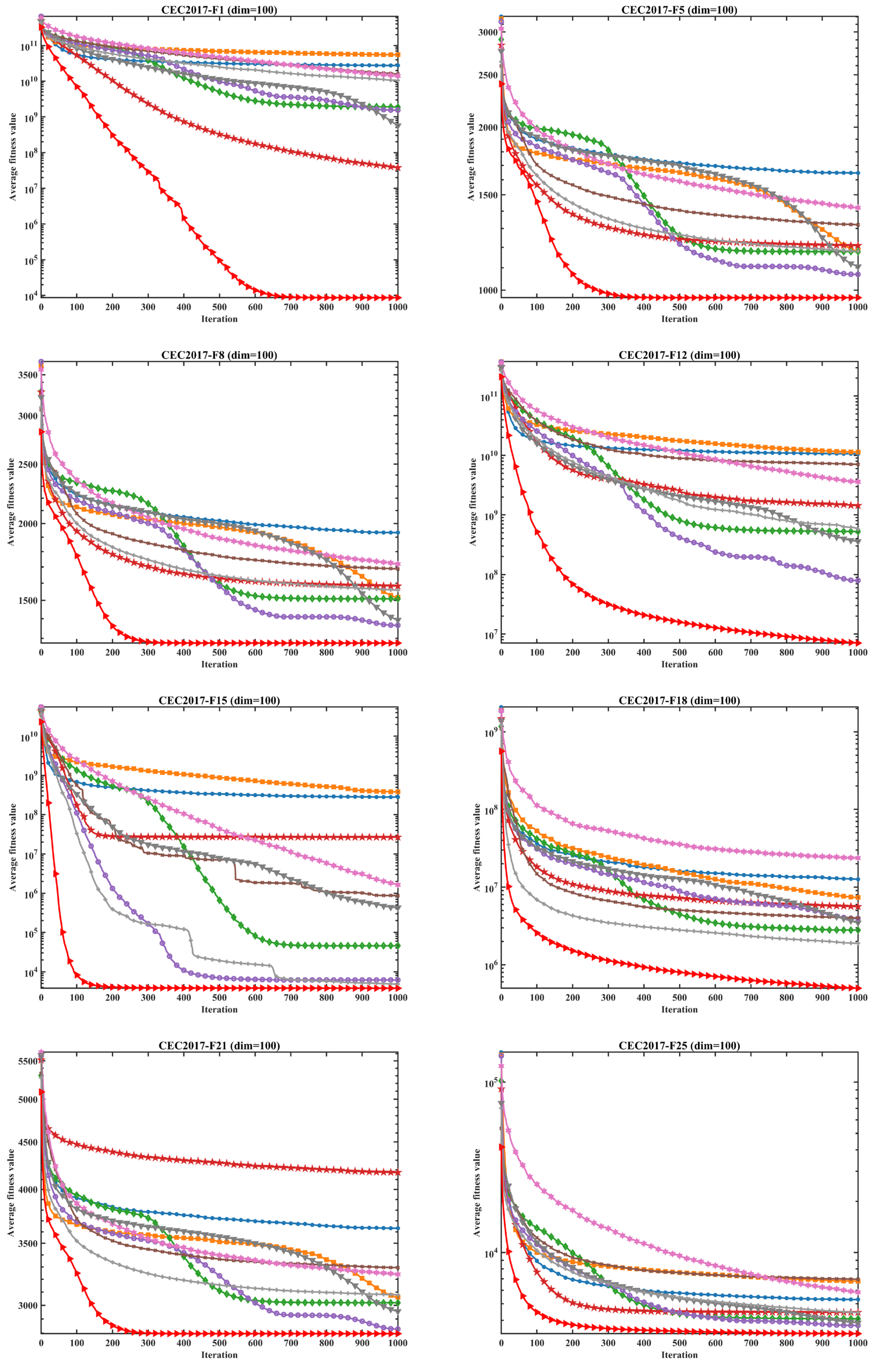
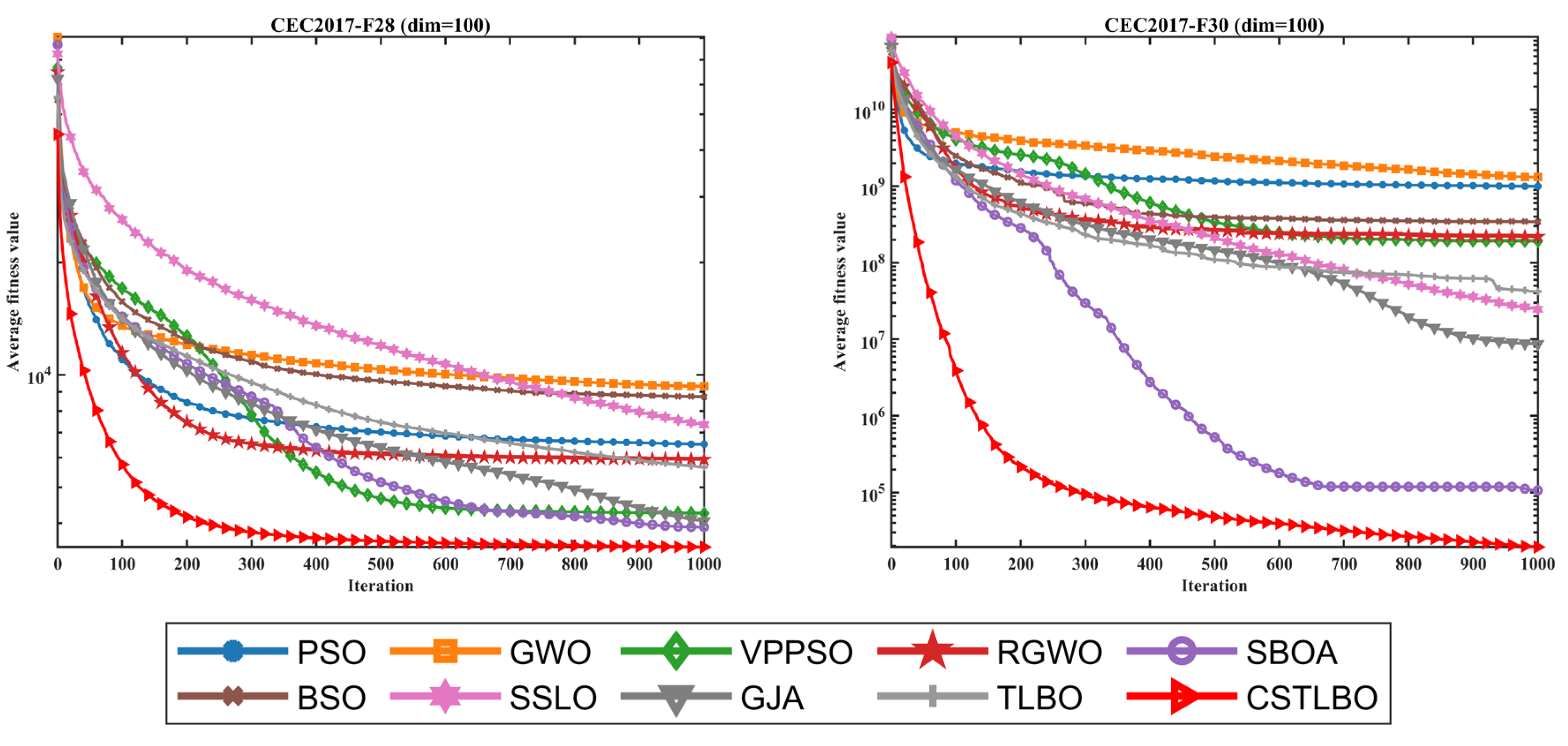
To comprehensively evaluate the overall performance of the proposed CSTLBO algorithm on high-dimensional and complex global optimization problems, the CEC2017 benchmark suite is adopted in this study. The problem dimension is set to 100, with a maximum number of iterations of 1000 and a population size of 30. All algorithms are independently executed 30 times to ensure statistical reliability. The performance is assessed using the average value (Ave) and standard deviation (Std), and the convergence behavior is further analyzed through convergence curves. The experimental results are summarized in Table 2 and Figure 3.
For unimodal functions (F1–F3), which contain only one global optimum, they are mainly used to evaluate the local exploitation ability and convergence speed of the algorithms. As shown in Table 2, CSTLBO achieves the best average results on all three functions F1, F2, and F3, with a significant advantage over the comparison algorithms. Specifically, the average value of F1 is 8.6351E+03, which is much lower than that of TLBO (1.0504E+10) and PSO (2.7535E+10). For F2, the average value is 1.7897E+99, which is significantly better than all other algorithms. For F3, the average value is 1.3390E+05, also achieving the best performance. Meanwhile, the standard deviations of CSTLBO are relatively low, indicating strong convergence stability and robustness. From the convergence curves in Figure 3, it can be observed that CSTLBO rapidly approaches the optimal solution in the early stage, and its convergence speed is significantly faster than other algorithms. It reaches a stable convergence state in the middle stage, demonstrating excellent local exploitation capability.
For multimodal functions (F4–F10), which contain numerous local optima, they are mainly used to test the global exploration ability and the capability of escaping from local optima. On functions F4 to F10, the average values obtained by CSTLBO are better than those of the original TLBO and most comparison algorithms. For example, the average value of F4 is 7.2542E+02, F7 is 1.5971E+03, and F8 is 1.2772E+03, all significantly lower than classical algorithms such as PSO and GWO. In terms of standard deviation, CSTLBO shows relatively small fluctuations, indicating good consistency across multiple runs. As observed from the convergence curves in Figure 3, traditional algorithms such as PSO, GWO, and TLBO tend to stagnate in the middle stage of iterations and struggle to escape local optima. In contrast, CSTLBO maintains a continuous downward trend throughout the optimization process and is capable of effectively overcoming local optima even in complex multimodal landscapes, demonstrating stronger global exploration ability and resistance to premature convergence.
For hybrid functions (F11–F20), which are composed of multiple basic functions and exhibit strong nonlinearity and a high density of local optima, they are used to evaluate the ability of the algorithm to balance exploration and exploitation in complex environments. As shown in Table 2, CSTLBO demonstrates significant advantages on functions F11–F20. The average value of F11 is 4.1587E+03, F12 is 7.0222E+06, F13 is 5.3339E+03, F15 is 3.7908E+03, F18 is 4.9841E+05, and F19 is 4.0166E+03, all of which are much better than the comparison algorithms. For functions such as F16, F17, and F20, CSTLBO also achieves the best or near-best results, while maintaining relatively low standard deviations, indicating strong robustness. From the convergence curves, it can be seen that CSTLBO maintains a steep convergence trend even in the later stage, while the comparison algorithms generally converge slowly with lower accuracy. This demonstrates that the proposed strategies effectively enhance the performance of the algorithm in solving complex hybrid problems.
For composition functions (F21–F30), which are constructed by combining different types of functions and exhibit highly irregular and non-convex search spaces, higher requirements are imposed on both global exploration and local exploitation capabilities. On functions F21 to F30, CSTLBO still maintains superior performance. The average values of F25, F28, and F30 are 3.3355E+03, 3.4526E+03, and 1.9331E+04, respectively, all achieving the best results. For other functions such as F21, F23, F24, F27, and F29, CSTLBO also obtains the best average values. At the same time, CSTLBO exhibits relatively small standard deviations, indicating reliable robustness. As shown in Figure 3, CSTLBO does not exhibit significant oscillations or premature stagnation in complex composition functions, and its convergence process remains stable with higher final accuracy. In contrast, the comparison algorithms are more likely to fall into local optima, resulting in slower convergence and lower solution accuracy.
Overall, the 100-dimensional CEC2017 results demonstrate that CSTLBO provides a more effective balance between exploration and exploitation than the compared algorithms. Instead of only improving individual benchmark functions, CSTLBO shows consistent advantages across unimodal, multimodal, hybrid, and composition functions. This indicates that the proposed collaborative strategies improve both global search reliability and local refinement accuracy. From a practical perspective, the faster convergence of CSTLBO implies that high-quality solutions can be obtained within fewer iterations, while the smaller standard deviations indicate better repeatability in stochastic optimization. These characteristics are important for real engineering applications, where both solution quality and algorithmic stability are required.

3.3.2. Results on CEC2022 Benchmark Test Suite

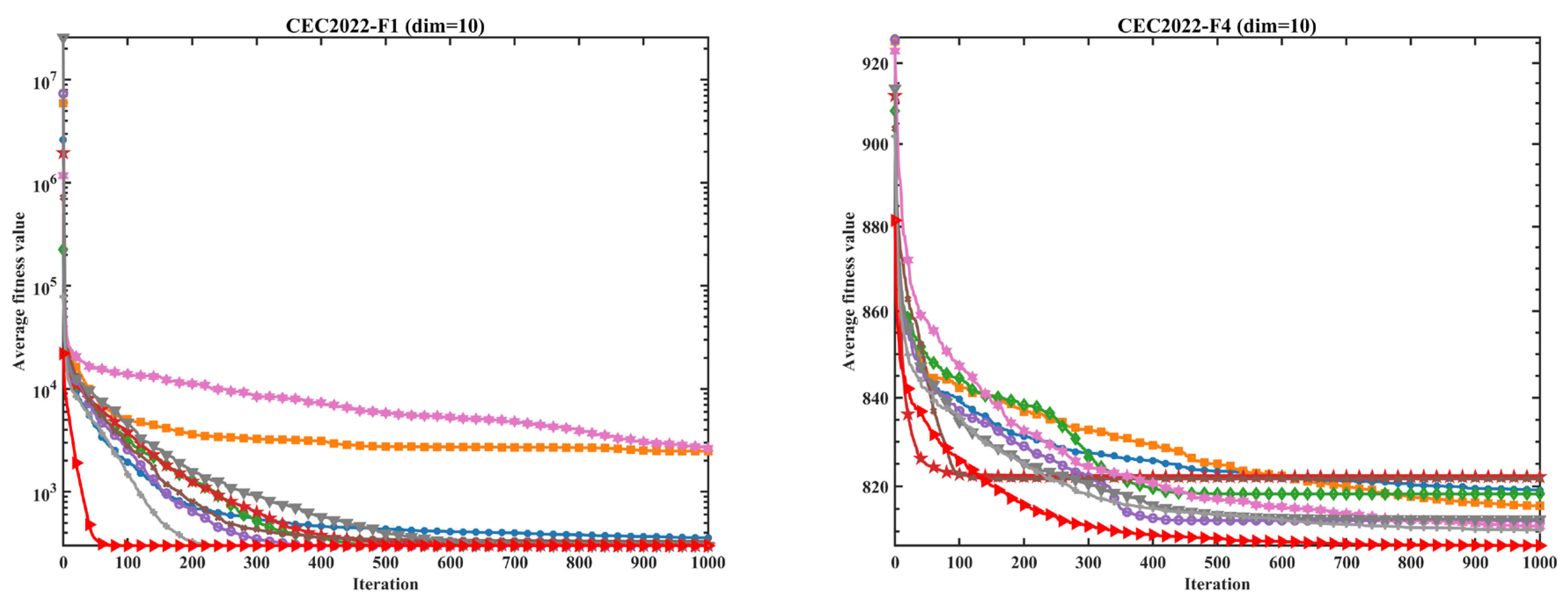
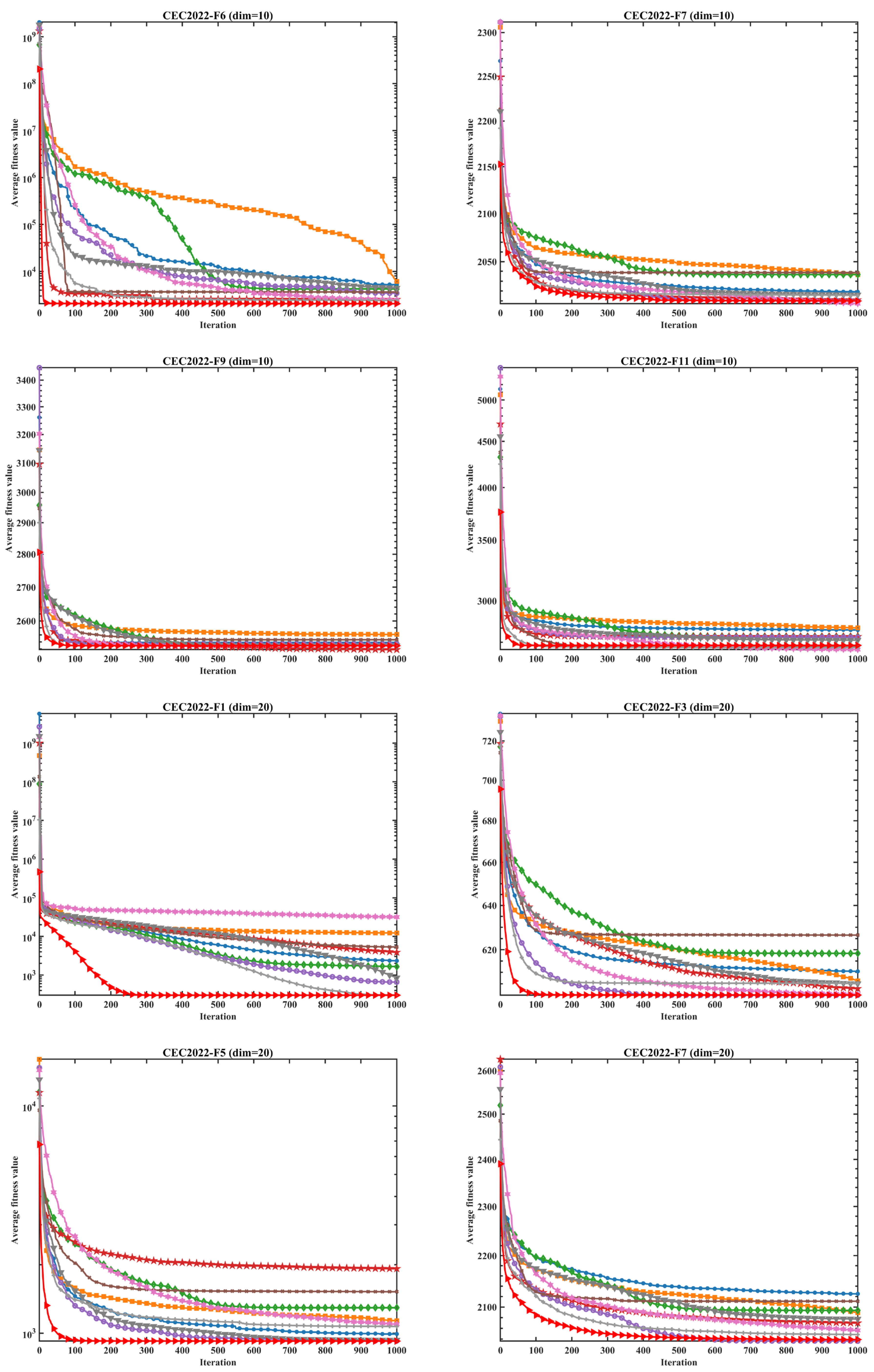
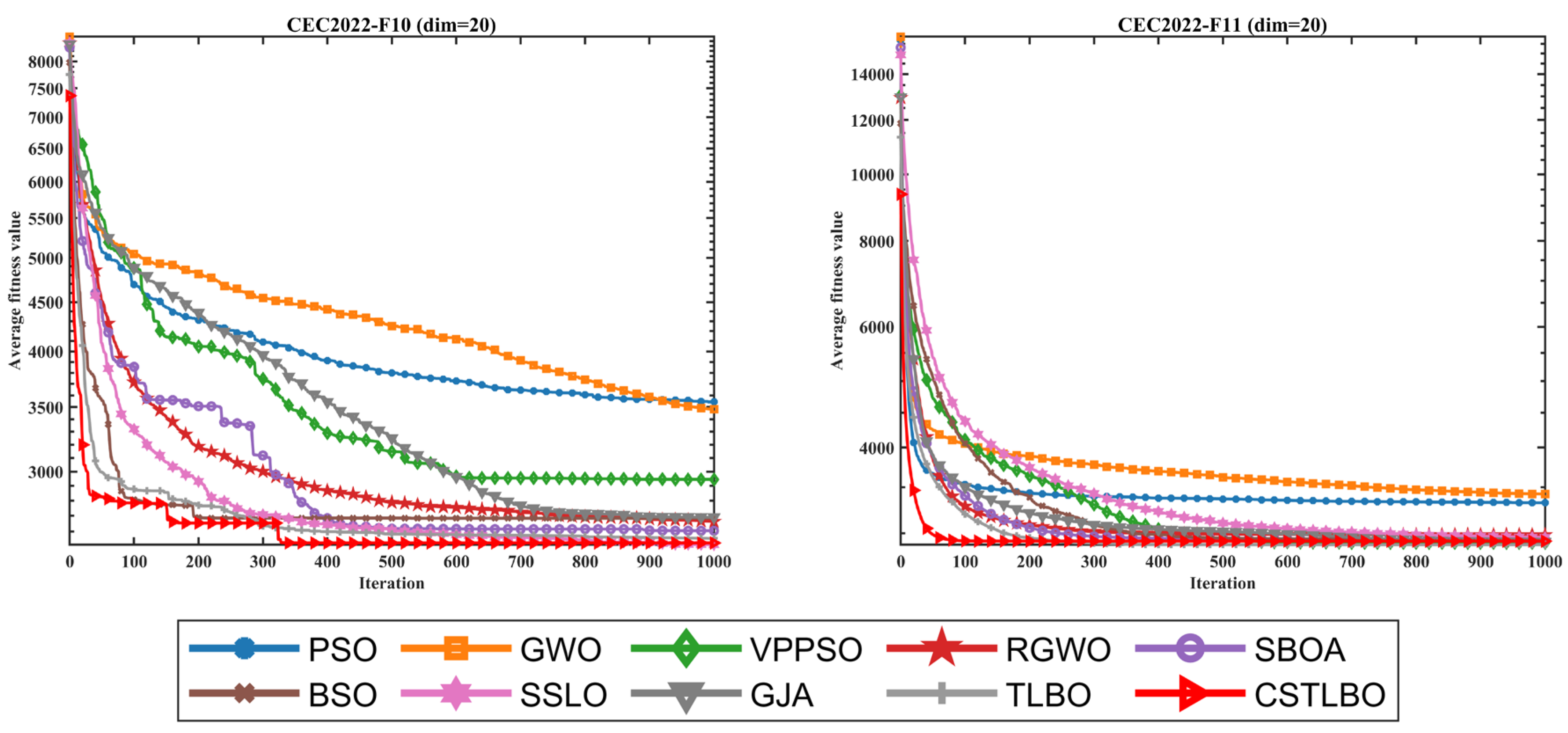
To systematically evaluate the proposed CSTLBO algorithm in terms of solution accuracy, convergence speed, and robustness on low- and medium-dimensional complex optimization problems, comparative experiments are conducted based on the CEC2022 benchmark suite. The experiments are performed under two-dimensional settings, i.e., 10 and 20 dimensions, with a population size uniformly set to 30 and a maximum number of iterations of 1000. Each algorithm is independently executed 30 times. The average value (Ave) and standard deviation (Std) are adopted as quantitative performance metrics, while convergence curves are employed for qualitative analysis of the dynamic optimization process. The experimental results are presented in Table 3 and Table 4 and Figure 4.
For the unimodal function F1, whose search space contains only a single global optimum, it is primarily used to assess the local exploitation capability and convergence speed of the algorithms. As observed from Table 3 and Table 4, CSTLBO achieves the best average values on F1 under both 10- and 20-dimensional settings. Specifically, in 10 dimensions, the average value reaches 3.0000E+02, which exactly matches the theoretical optimum. In 20 dimensions, it also stably converges to 3.0000E+02, significantly outperforming comparative algorithms such as PSO, GWO, and TLBO. Moreover, the standard deviation is close to zero, indicating almost no variation across multiple runs and demonstrating excellent stability. The convergence curves in Figure 4 further reveal that CSTLBO exhibits a rapid descending trend in the early iterations, approaching the theoretical optimum within only a few iterations. Its convergence speed is markedly faster than that of other algorithms, and it maintains a smooth and stable convergence in the later stages without oscillation or stagnation, fully demonstrating its superior local exploitation and fast convergence capability on unimodal functions.
For the multimodal functions F2–F5, which contain numerous local optima and complex landscapes, they are mainly used to evaluate the global exploration ability and the capability of escaping local optima. Under both 10- and 20-dimensional conditions, CSTLBO achieves better average values on F2, F3, F4, and F5 compared with the original TLBO and most competing algorithms. In 10 dimensions, the average values for F4 and F5 are 8.0769E+02 and 9.0115E+02, respectively; in 20 dimensions, F4 decreases to 8.2960E+02 and F5 to 9.2226E+02, demonstrating superior solution accuracy. In terms of standard deviation, CSTLBO generally yields smaller values, indicating higher consistency. As illustrated in Figure 4, PSO, GWO, and the original TLBO tend to fall into local optima and exhibit premature convergence stagnation on multimodal functions, whereas CSTLBO maintains a continuous descending trend throughout the iterations. Even in the presence of numerous local optima, it can effectively escape and continue optimization, demonstrating stronger global exploration capability and resistance to premature convergence.
The hybrid functions F6–F8 are constructed by combining multiple basic functions, characterized by strong nonlinearity and dense local optima, and are used to evaluate the algorithm’s ability to balance global exploration and local exploitation in complex search environments. The results in Table 3 and Table 4 show that CSTLBO consistently achieves superior average values on F6–F8 under both 10- and 20-dimensional settings. In 10 dimensions, the average values are 2.4019E+03 for F6, 2.0119E+03 for F7, and 2.2220E+03 for F8; in 20 dimensions, it maintains a leading advantage, with relatively small standard deviations, indicating strong robustness. From the convergence curves in Figure 4, it can be observed that CSTLBO still maintains a steep convergence trend in these complex scenarios and continues effective fine-grained optimization in the later stages, steadily improving solution accuracy. In contrast, most comparative algorithms exhibit slower convergence in the middle stages and significantly reduced optimization efficiency in the later stages. This demonstrates that the proposed collaborative search strategy effectively enhances the adaptability and optimization performance on complex hybrid functions.
The composition functions F9–F12 are formed by combining different types of functions, resulting in non-convex and irregular search spaces, which impose higher requirements on both global search and local refinement capabilities. Under both 10- and 20-dimensional conditions, CSTLBO consistently outperforms the comparative algorithms on F9–F12. In 10 dimensions, F9 stably converges to 2.5293E+03 and F11 reaches 2.6114E+03; in 20 dimensions, F9 achieves 2.4808E+03, with both accuracy and stability surpassing other algorithms. Meanwhile, CSTLBO exhibits smaller standard deviations, indicating more reliable performance. As shown in Figure 4, CSTLBO does not exhibit significant oscillations or premature stagnation in the irregular landscapes of composition functions. Its convergence process remains smooth, and it achieves higher final solution accuracy, whereas most comparative algorithms are prone to being trapped in local optima, resulting in inferior convergence speed and solution quality.
Overall, across the CEC2022 benchmark functions under both 10- and 20-dimensional settings, CSTLBO consistently achieves better average values and smaller standard deviations on unimodal, multimodal, hybrid, and composition functions. Its overall performance in terms of solution accuracy, convergence speed, and robustness is significantly superior to the nine comparative algorithms. As indicated by the convergence curves in Figure 4, CSTLBO demonstrates fast global exploration in the early stage, enabling rapid identification of promising regions; stable convergence in the middle stage, effectively balancing exploration and exploitation; and strong local refinement capability in the later stage, allowing precise optimization within promising regions. These results indicate that the proposed multi-strategy collaborative enhancement mechanism is not only effective for high-dimensional optimization problems but also exhibits excellent overall performance in low- and medium-dimensional scenarios, thereby validating the generality and effectiveness of the CSTLBO algorithm.

3.4. Statistical Analysis Methods

To rigorously validate the performance superiority of the proposed CSTLBO algorithm over other comparative methods from a statistical perspective and to eliminate the influence of randomness on experimental conclusions, two non-parametric statistical tests—namely the Wilcoxon rank-sum test and the Friedman mean rank test—are employed to conduct a comprehensive analysis on the experimental results of the CEC2017 and CEC2022 benchmark functions. The Wilcoxon test is used to determine whether there exist statistically significant differences between CSTLBO and each comparative algorithm, while the Friedman test is utilized to rank the overall performance of all algorithms across multiple test functions.

3.4.1. Analysis of Wilcoxon Rank-Sum Test Results

The Wilcoxon rank-sum test [4,5] is conducted with a significance level of α = 0.05. In the results, “+” indicates that CSTLBO significantly outperforms the comparative algorithm, “=” denotes no significant difference, and “−” indicates inferior performance of CSTLBO. Table 5 presents the statistical results under three testing scenarios: CEC2017 (100 dimensions), CEC2022 (10 dimensions), and CEC2022 (20 dimensions).
On the CEC2017 100-dimensional high-dimensional benchmark, CSTLBO demonstrates strong statistical superiority. Compared with PSO, CSTLBO achieves 27 wins, 0 ties, and 3 losses. Against GWO, BSO, and GJA, it attains a perfect record of 30 wins, 0 ties, and 0 losses. Compared with VPPSO, the result is 28 wins, 0 ties, and 2 losses; against SSLO, 29 wins, 0 ties, and 1 loss; and against the original TLBO, 26 wins, 0 ties, and 4 losses. These results indicate that, for high-dimensional complex optimization problems, CSTLBO significantly outperforms the comparative algorithms in terms of solution accuracy and convergence performance, with only marginal exceptions, demonstrating strong statistical reliability.
On the CEC2022 10-dimensional low-dimensional benchmark, CSTLBO still maintains an overwhelming advantage. It achieves 12 wins, 0 ties, and 0 losses against GWO and VPPSO; 11 wins, 0 ties, and 1 loss against PSO and GJA; 10 wins, 0 ties, and 2 losses against BSO; and 9 wins, 0 ties, and 3 losses against RGWO, SBOA, and SSLO. Even when compared with the original TLBO, it records 5 wins, 0 ties, and 7 losses, indicating that CSTLBO remains competitive and stable across both simple and complex low-dimensional functions.
On the CEC2022 20-dimensional medium-dimensional benchmark, CSTLBO continues to exhibit clear superiority. It achieves 11 wins, 0 ties, and 1 loss against PSO, VPPSO, and BSO; 11 wins, 0 ties, and 1 loss against GWO; 10 wins, 0 ties, and 2 losses against RGWO and SSLO; 10 wins, 0 ties, and 2 losses against GJA; 8 wins, 0 ties, and 4 losses against SBOA; and 10 wins, 0 ties, and 2 losses against the original TLBO.
Overall, across the three experimental scenarios, CSTLBO significantly outperforms PSO, GWO, VPPSO, RGWO, SBOA, BSO, SSLO, GJA, and the original TLBO on the vast majority of test functions and dimensions. Cases of equivalent performance are rare, and inferior cases occur only sporadically. This strongly indicates that the observed performance improvements of CSTLBO are not due to random fluctuations but rather stem from the effectiveness of the proposed enhancement strategies.

3.4.2. Analysis of Friedman Mean Rank Test Results

The Friedman test is used to provide a global ranking of all compared algorithms, with the mean rank (M.R) and total rank (T.R) serving as key indicators. A smaller mean rank corresponds to better overall performance across all test functions. Table 6 presents the mean ranks and rankings of all algorithms under the CEC2017 (100 dimensions), CEC2022 (10 dimensions), and CEC2022 (20 dimensions) benchmarks.
On the CEC2017 100-dimensional dataset, CSTLBO achieves a mean rank of only 2.13 and ranks first overall. In comparison, PSO (8.47), GWO (7.00), BSO (7.73), and SSLO (7.23) exhibit relatively high mean ranks, indicating inferior overall performance. VPPSO (5.03), RGWO (5.40), GJA (3.83), and the original TLBO (5.77) perform better than traditional methods but still fall significantly behind CSTLBO. This demonstrates that, in high-dimensional, multimodal, and complex optimization problems, CSTLBO possesses markedly superior overall optimization capability compared with state-of-the-art algorithms.
On the CEC2022 10-dimensional benchmark, CSTLBO maintains the top position with a mean rank of 2.67. SBOA ranks second with 2.75, followed by the original TLBO with 3.42. In contrast, PSO (8.25), GWO (8.08), and BSO (7.67) exhibit relatively poor performance. This indicates that CSTLBO can still achieve stable and efficient optimization performance in low-dimensional problems, without suffering from performance degradation often observed in some algorithms.
On the CEC2022 20-dimensional benchmark, CSTLBO further improves its mean rank to 2.25, again ranking first with a more pronounced advantage. SBOA ranks second with 2.67, followed by the original TLBO with 3.92, while PSO, GWO, and BSO remain at lower ranks. These results confirm that CSTLBO maintains consistently strong performance across low-, medium-, and high-dimensional scenarios, demonstrating excellent generality and robustness.
The results of the Wilcoxon and Friedman tests are mutually consistent and jointly confirm the superiority of CSTLBO from different perspectives. The Friedman test provides a global ranking of all algorithms, while the Wilcoxon test offers pairwise statistical significance evidence. Notably, both tests reveal a consistent trend: the advantage of CSTLBO is most pronounced in the 100-dimensional high-dimensional setting, followed by the 20-dimensional medium-dimensional case, and is relatively less significant in the 10-dimensional low-dimensional scenario. This trend aligns well with the design motivations of the proposed CDG, EGCI, and QILR strategies, which are specifically intended to address challenges in complex, high-dimensional, and multimodal optimization problems, such as limited search direction diversity, insufficient information exchange, and weak local refinement capability. In simpler low-dimensional problems, these issues are less critical, resulting in relatively smaller performance gains. However, as problem complexity increases, the advantages of CSTLBO become increasingly evident. This finding is of significant practical importance, as real-world engineering optimization problems are often characterized by high dimensionality, nonlinearity, and multiple constraints, making CSTLBO particularly well-suited for such applications.

4. Application to WSN Deployment Optimization Problem

4.1. Wireless Sensor Network Deployment Optimization Model

Wireless Sensor Network (WSN) deployment is a typical multi-objective optimization problem, in which sensor nodes must be optimally positioned within a monitoring region to achieve high coverage, low redundancy, and minimal movement cost. In practical scenarios, these objectives are inherently conflicting [38,39]. Sparse node distribution may lead to insufficient coverage and monitoring blind areas, whereas excessive clustering of nodes results in redundant coverage and inefficient resource utilization. In addition, since sensor nodes are usually initially deployed at random locations, the optimization process often involves repositioning nodes, which introduces movement cost and energy consumption [40]. Therefore, an effective deployment strategy should simultaneously consider coverage performance, redundancy control, and movement efficiency.
In this study, the deployment region is modeled as a two-dimensional square area Ω = [ 0 , L ] × [ 0 , L ] , where L denotes the side length of the monitoring region. Suppose that N sensor nodes are deployed within this region, and each node is characterized by a sensing radius R . The initial position of the i -th node is denoted by A i = ( x i 0 , y i 0 ) , while its optimized position is represented as X i = ( x i , y i ) . Accordingly, the deployment configuration of the entire network can be expressed as a 2 N -dimensional decision vector X = [ x 1 , x 2 , , x N , y 1 , y 2 , , y N ] . All decision variables are subject to boundary constraints 0 x i L and 0 y i L , ensuring that all nodes remain within the monitoring region.
To evaluate the coverage performance, a grid-based discretization approach is adopted. Specifically, the monitoring area is divided into L × L grid points, and each grid point represents a sampling location. For any grid point ( x g , y g ) , the Euclidean distance to the i -th sensor node is given by [41]
D i ( x g , y g ) = ( x g x i ) 2 + ( y g y i ) 2
If D i ( x g , y g ) R , the grid point is considered to be covered by node iii. The coverage count at each grid point is then defined as
c o v e r C o u n t ( x g , y g ) = i = 1 N I ( D i ( x g , y g ) R )
where I ( · ) is the indicator function. Based on this definition, the overall coverage ratio is calculated as
C o v e r a g e = 1 L 2 x g = 1 L y g = 1 L I ( c o v e r C o u n t ( x g , y g ) > 0 )
which represents the proportion of grid points covered by at least one sensor node. A higher coverage value indicates better monitoring capability of the network.
However, maximizing coverage alone may lead to excessive overlap among sensing regions. To quantify this effect, the redundancy coverage is defined as
R e d u n d a n c y = 1 L 2 x g = 1 L y g = 1 L I ( c o v e r C o u n t ( x g , y g ) 2 )
This metric reflects the proportion of grid points covered by two or more nodes. A high redundancy value implies inefficient utilization of sensing resources, which is undesirable in practical applications. Therefore, redundancy should be minimized to ensure a more balanced node distribution.
In addition to coverage-related metrics, the movement cost of sensor nodes is also taken into account. Let A i = ( x i 0 , y i 0 ) denote the initial position of node i , and X i = ( x i , y i ) its optimized position. The movement distance of node iii is defined as
d i = ( x i x i 0 ) 2 + ( y i y i 0 ) 2
and the average movement distance of all nodes is given by
M o v e = 1 N i = 1 N d i
To ensure consistency in scale with other objectives, the movement cost is normalized using the maximum possible displacement, which is approximated by the diagonal length of the region:
M o v e n o r m = M o v e 2 L
This normalization confines the movement cost within the range [0,1], preventing it from dominating the optimization process.
It should be emphasized that the WSN deployment problem in this study is not solved as a true multi-objective optimization problem with a Pareto front. Although coverage ratio, redundancy ratio, and movement distance are conflicting deployment indicators, they are integrated into a single scalar objective function through a weighted aggregation strategy. Therefore, the proposed CSTLBO is applied to a weighted single-objective WSN deployment optimization model.
Considering the three objectives—maximizing coverage, minimizing redundancy, and minimizing movement cost—the deployment problem is formulated as a weighted multi-objective optimization model. To facilitate optimization using a single-objective framework, a weighted sum approach is adopted, and the objective function is defined as
f ( X ) = w 1 ( 1 C o v e r a g e ) + w 2 M o v e n o r m + w 3 R e d u n d a n c y
where w 1 , w 2 , w 3 are non-negative weight coefficients satisfying w 1 + w 2 + w 3 = 1 . The term 1 − C o v e r a g e is used to transform the coverage maximization objective into a minimization form. In this study, the weights are set as w 1 = 0.5 , w 2 = 0.25 , and   w 3 = 0.25 , which prioritizes coverage performance while maintaining a balance between movement efficiency and redundancy control.
The weight coefficients were selected according to the practical priority of WSN deployment. In most monitoring applications, coverage performance is the primary requirement because insufficient coverage directly leads to blind monitoring areas. Therefore, the coverage-related term is assigned the largest weight of 0.5. Meanwhile, movement distance and redundancy are also important because excessive relocation increases deployment cost and energy consumption, while redundant coverage may reduce resource utilization efficiency. Thus, the movement and redundancy terms are assigned equal weights of 0.25. This setting ensures that the optimization process gives priority to maximizing sensing coverage while simultaneously controlling deployment cost and redundant sensing.
Based on the above formulation, the WSN deployment problem can be expressed as a continuous, nonlinear optimization problem:
m i n X f ( X ) subjectto 0 x i L , 0 y i L , i = 1 , 2 , , N
This model exhibits several challenging characteristics, including high dimensionality, strong nonlinearity, and coupling among decision variables. The coverage and redundancy metrics depend on the collective spatial distribution of all nodes, making the search landscape highly complex and multimodal. Therefore, traditional optimization methods are often insufficient for solving this problem efficiently, which motivates the use of advanced metaheuristic algorithms such as the proposed CSTLBO.
From an engineering perspective, the constructed model provides a realistic and comprehensive description of WSN deployment requirements. By simultaneously considering coverage performance, redundancy control, and movement cost, the model enables the derivation of practical deployment solutions that achieve a balance between sensing effectiveness and resource efficiency.

4.2. Experimental Setup

To comprehensively evaluate the performance of the proposed Collaborative Search Teaching–Learning-Based Optimization (CSTLBO) algorithm, a series of experiments are conducted under a unified simulation framework. All algorithms are implemented in MATLAB and executed on the same computing platform to ensure fairness and reproducibility.
In this study, the Wireless Sensor Network (WSN) deployment problem is considered within a two-dimensional square monitoring region Ω = [ 0 , L ] × [ 0 , L ] . A total of N = 40 sensor nodes are randomly distributed in the region, and each node is associated with a sensing radius R = 5 . Since each node position is represented by two variables ( x i , y i ) , the dimensionality of the optimization problem is D = 2 N = 80 . The search space is bounded within [ 0 , L ] for all decision variables.
All optimization algorithms are executed with the same population size and maximum number of iterations. To reduce the influence of stochastic behavior, each algorithm is independently run 30 times. The performance is evaluated in terms of average fitness value, standard deviation, convergence behavior, coverage ratio, redundancy ratio, and average movement distance.
The multi-objective function is constructed using a weighted aggregation strategy, where the weights are set to emphasize coverage performance while maintaining a balance between movement cost and redundancy. Specifically, the weight coefficients are assigned as w 1 = 0.5 , w 2 = 0.25 , and   w 3 = 0.25 . The weight coefficients were selected according to the practical priority of WSN deployment. In most monitoring applications, coverage performance is the primary requirement because insufficient coverage directly leads to blind monitoring areas. Therefore, the coverage-related term is assigned the largest weight of 0.5. Meanwhile, movement distance and redundancy are also important because excessive relocation increases deployment cost and energy consumption, while redundant coverage may reduce resource utilization efficiency. Thus, the movement and redundancy terms are assigned equal weights of 0.25. This setting ensures that the optimization process gives priority to maximizing sensing coverage while simultaneously controlling deployment cost and redundant sensing.
The detailed experimental parameters used in this study are summarized in Table 7.

4.3. Results and Analysis of WSN Deployment Optimization

To further verify the feasibility, effectiveness, and practical value of the proposed CSTLBO algorithm in real-world engineering optimization scenarios, it is applied to the WSN coverage deployment optimization problem. WSN deployment is a typical high-dimensional, nonlinear, multi-constraint, and multi-objective practical optimization problem. Its core objective is to maximize regional coverage, minimize redundant coverage, and reduce node movement cost under the constraints of a limited number of sensor nodes and sensing radius. These requirements impose stringent demands on the global exploration capability, local exploitation accuracy, and convergence stability of the optimization algorithm. The experimental results are presented in Table 8, Figure 5 and Figure 6. The performance of the proposed algorithm is comprehensively evaluated from multiple perspectives, including average fitness value, standard deviation, mean rank, coverage ratio, redundancy ratio, average movement distance, convergence behavior, and computational time. Among them, coverage ratio reflects the sensing effectiveness of the network, redundancy ratio measures the degree of overlapping sensing and resource utilization, movement distance indicates deployment cost, and computational time reflects practical implementation efficiency.
Table 8 presents a comprehensive comparison of ten algorithms on the WSN deployment optimization problem, including average fitness value, standard deviation, mean rank, coverage rate, redundancy rate, average movement distance, and average runtime. From the core optimization metrics, it can be observed that CSTLBO significantly outperforms the other algorithms in terms of solution accuracy, robustness, coverage performance, and movement efficiency.
Regarding the overall optimization objective, CSTLBO achieves the lowest average fitness value of 0.1344, ranking first among all algorithms. It further improves upon advanced methods such as GWO (0.1461), GJA (0.1458), and SBOA (0.1426), and reduces the fitness value by as much as 44.68% compared with the original TLBO (0.2429). This demonstrates that the proposed algorithm can effectively balance the three key objectives—coverage, redundancy, and movement cost—thus obtaining a superior trade-off solution. The standard deviation of CSTLBO is 0.0077, the smallest among all methods, indicating highly stable performance across multiple independent runs and strong robustness against stochastic disturbances, outperforming PSO (0.0103), VPPSO (0.0123), and RGWO (0.0120). The mean rank result further confirms its superiority, with CSTLBO ranking first at 1.67.
In terms of key WSN performance indicators, CSTLBO achieves a coverage rate of 95.71%, outperforming GWO (92.36%), VPPSO (93.84%), and GJA (94.73%), and improving by more than 15% compared with the original TLBO. This enables near-complete elimination of sensing blind spots, meeting the requirements of full-area monitoring. The redundancy rate is 14.02%, remaining within a reasonable range, which avoids excessive overlap of sensing regions while maintaining high coverage, thereby improving energy efficiency and communication resource utilization. The average movement distance is 21.0280, the lowest among all algorithms, indicating that CSTLBO can achieve optimal deployment with minimal positional adjustments, effectively reducing node energy consumption and deployment costs, making it more suitable for practical engineering constraints.
In terms of computational efficiency, CSTLBO requires an average runtime of 9.0351 s, which is comparable to GWO (9.0478 s) and TLBO (8.8933 s). Although multiple collaborative improvement strategies are introduced, no significant computational overhead is incurred, achieving a desirable balance between performance enhancement and time complexity. This suggests strong potential for real-time optimization and online deployment.
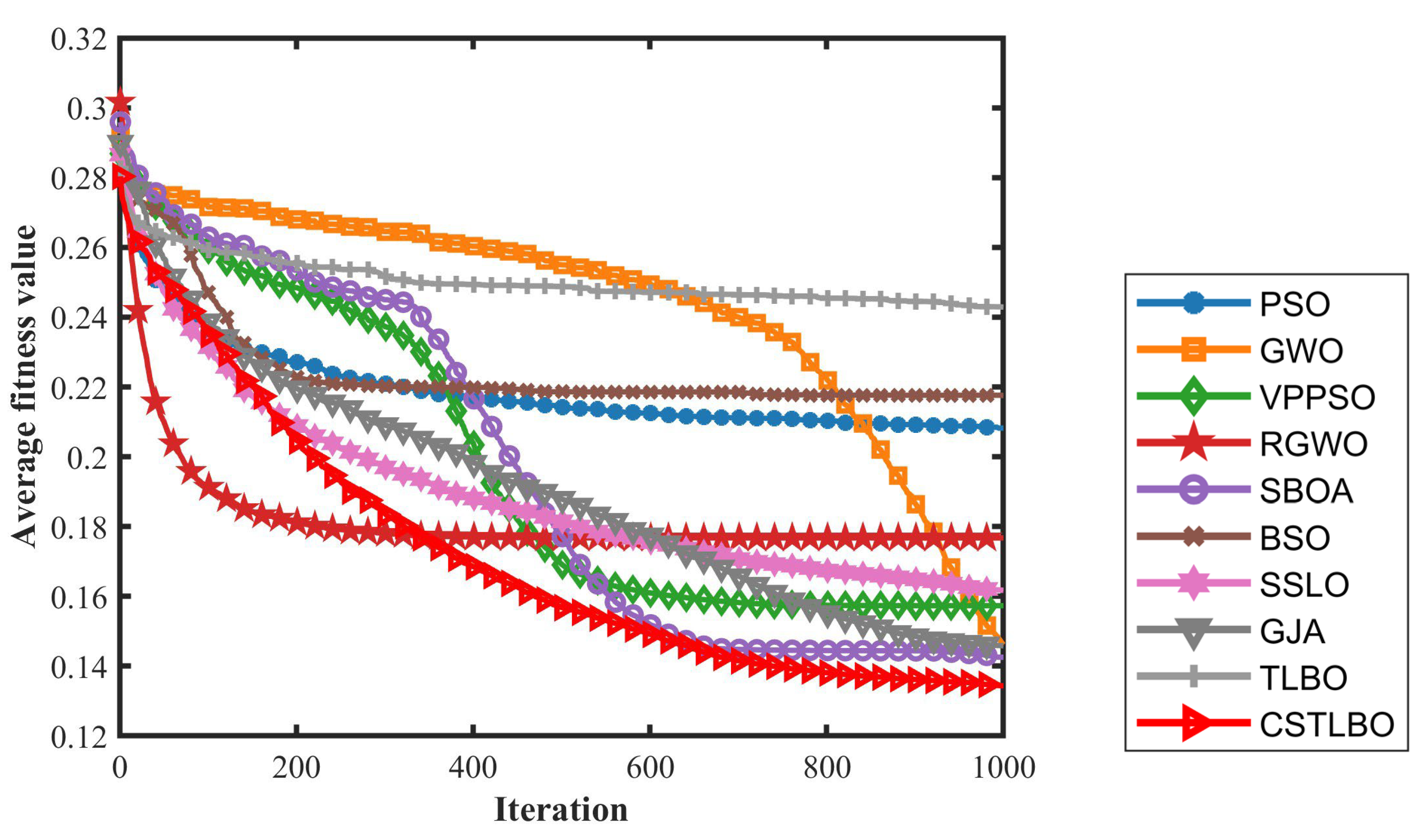
Figure 5 illustrates the convergence curves of all algorithms on the WSN deployment optimization problem, reflecting optimization speed, convergence stability, and final solution accuracy. It is evident that CSTLBO demonstrates clear advantages throughout the entire iteration process.
In the early stage (0–200 iterations), CSTLBO exhibits a significantly steeper descent compared with other algorithms, rapidly escaping poor initial solutions and quickly locating high-quality node configurations with high coverage and low redundancy, demonstrating strong global exploration capability. In the middle stage (200–600 iterations), CSTLBO maintains a smooth and stable convergence process without oscillations, premature stagnation, or fluctuations, indicating that the collaborative differential guidance and elite cooperative interaction strategies effectively enhance population information utilization and prevent entrapment in local optima. In the later stage (600–1000 iterations), CSTLBO continues a slow but steady downward trend, leveraging the quadratic interpolation-based local refinement strategy to perform fine-grained exploitation in promising regions, ultimately converging to the lowest objective value.
In contrast, algorithms such as PSO, BSO, and the original TLBO converge slowly in the early stage and quickly stagnate in the middle stage, failing to escape local optima. Algorithms such as GWO, SBOA, and GJA exhibit relatively fast convergence but achieve lower final accuracy than CSTLBO. Improved variants such as VPPSO, RGWO, and SSLO show better convergence stability but still fail to simultaneously surpass CSTLBO in both convergence speed and solution quality. These results demonstrate that CSTLBO effectively balances global exploration and local exploitation in complex WSN optimization problems, achieving both rapid convergence and high solution accuracy.
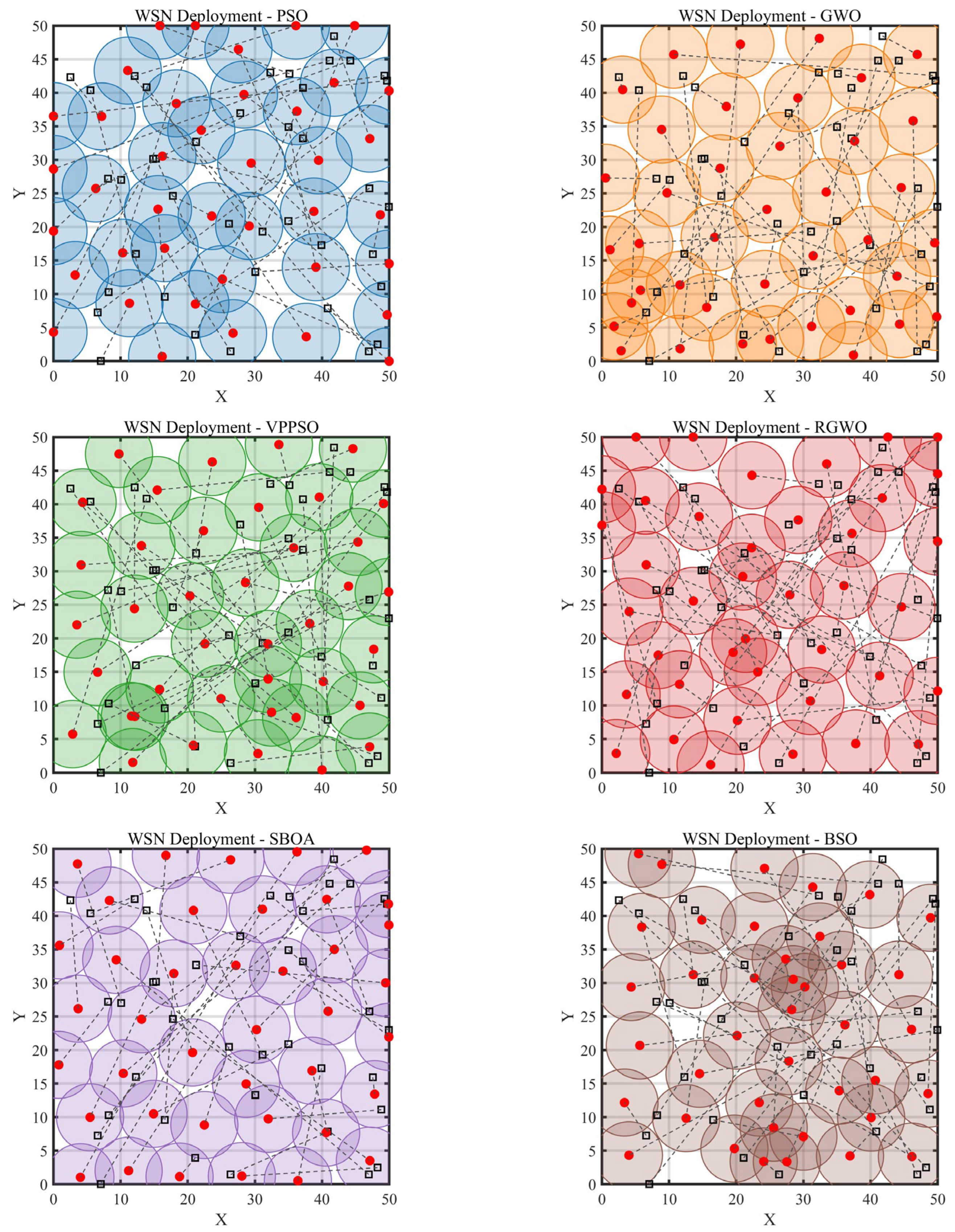
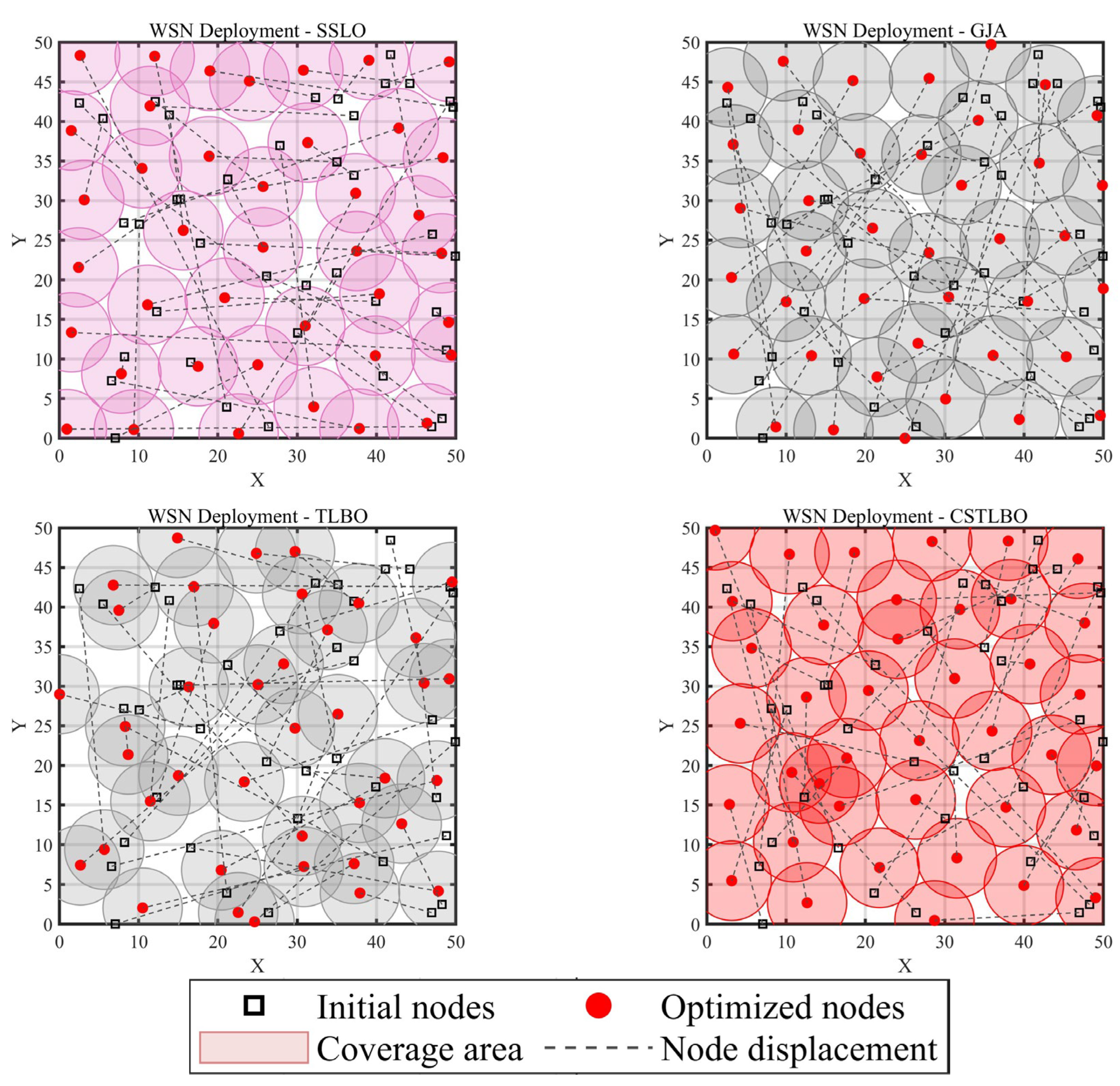
Figure 6 presents the spatial distribution of sensor nodes, coverage regions, and movement trajectories after optimization, providing an intuitive visualization of node layout uniformity, coverage completeness, and redundancy control.
In terms of coverage completeness, CSTLBO achieves full-area coverage with no obvious blind spots in either boundary or central regions, significantly outperforming other algorithms. Regarding distribution uniformity, the nodes optimized by CSTLBO exhibit no clustering, aggregation, or excessive sparsity, resulting in a well-balanced layout that effectively avoids the common issue of “central congestion and peripheral sparsity” observed in algorithms such as the original TLBO and PSO. In terms of redundancy control, the overlap between sensing regions is moderate, without large-scale redundant coverage, which is consistent with the redundancy rate reported in Table 8. From the perspective of movement trajectories, CSTLBO guides nodes along shorter and more efficient paths, resulting in smaller overall displacement and reduced energy consumption and hardware wear.
In comparison, PSO, BSO, and the original TLBO produce disorganized node distributions, with excessive clustering in local regions leading to high redundancy, while corner and boundary areas remain insufficiently covered. Algorithms such as GWO, SBOA, and GJA improve distribution uniformity to some extent but still exhibit blind spots and local overlaps. Only CSTLBO simultaneously achieves high coverage, low redundancy, and short movement distance, producing node layouts that better satisfy practical engineering requirements.
By integrating the quantitative results in Table 8, the convergence behavior in Figure 5, and the visualization in Figure 6, it can be concluded that, for the WSN deployment optimization problem—a typical high-dimensional, multi-constraint, and multi-objective engineering task—the proposed CSTLBO algorithm consistently outperforms PSO, GWO, VPPSO, RGWO, SBOA, BSO, SSLO, GJA, and the original TLBO in terms of overall optimization performance, convergence characteristics, robustness, coverage quality, and resource utilization efficiency.
Specifically, the collaborative differential guidance strategy expands the search directions and enhances global exploration efficiency; the elite-guided cooperative interaction mechanism strengthens population information exchange and accelerates convergence; and the quadratic interpolation-based local refinement strategy improves local exploitation accuracy and enhances final solution quality. The synergistic integration of these three strategies enables CSTLBO to effectively overcome the limitations of the traditional TLBO, such as premature convergence, slow convergence speed, and low solution accuracy in complex engineering problems. The experimental results demonstrate that CSTLBO not only performs excellently on standard benchmark functions but also exhibits high reliability, practicality, and generality in real-world engineering scenarios, providing an efficient and robust optimization solution for applications such as WSN deployment, environmental monitoring, intelligent IoT systems, and regional surveillance.

5. Conclusions and Future Work

This paper addresses the insufficient search capability of the traditional TLBO algorithm in complex optimization problems by proposing a multi-strategy collaborative enhanced algorithm, termed CSTLBO. By incorporating three mechanisms—Collaborative Differential Guidance, Elite Collaborative Learning, and Quadratic Interpolation Local Optimization—the proposed method effectively enhances global exploration ability, improves information exchange efficiency, and strengthens local exploitation accuracy. Experimental results demonstrate that, on the CEC2017 and CEC2022 benchmark test suites, CSTLBO significantly outperforms several classical and state-of-the-art optimization algorithms in terms of solution accuracy, convergence speed, and stability. Furthermore, statistical test results provide additional evidence supporting its superior performance. In an 80-dimensional wireless sensor network deployment optimization problem, CSTLBO achieves a coverage rate of 95.71%, a redundancy rate of 14.02%, and an average movement distance of 21.0280. The results indicate that the proposed method attains the best overall optimization performance, effectively reducing node movement cost and resource redundancy while satisfying coverage requirements, thus demonstrating strong potential for engineering applications.
Nevertheless, CSTLBO still has several limitations. The results confirm that CSTLBO is effective for the tested 100-dimensional CEC2017 benchmark functions, the 10- and 20-dimensional CEC2022 benchmark problems, and the 80-dimensional WSN deployment optimization problem. However, its performance on ultra-large-scale optimization problems with thousands of dimensions has not yet been fully verified. In addition, although the proposed strategies do not change the asymptotic computational complexity order of the original TLBO, the integration of CDG, EGCI, and QILR inevitably introduces additional constant runtime overhead due to extra vector operations, cooperative interaction calculations, and local refinement procedures. Therefore, the balance between optimization performance and computational efficiency still requires further investigation, especially for large-scale and real-time optimization tasks.
Future research can be conducted in several directions. First, an adaptive strategy selection mechanism can be developed to dynamically adjust the contribution and activation probability of different strategies according to the search state, thereby reducing unnecessary computational overhead and improving search efficiency. Second, lightweight local refinement mechanisms and parallel computing implementations can be explored to further enhance the scalability and runtime performance of CSTLBO. Third, CSTLBO can be extended to multi-objective, discrete, and dynamic optimization domains to further improve its generalization capability. In addition, integrating deep learning or reinforcement learning techniques may enhance the intelligent decision-making ability and adaptive search behavior of the algorithm. Finally, applying the proposed method to a wider range of real-world engineering problems, such as UAV path planning, energy scheduling, resource allocation, and intelligent control, would further validate its practical effectiveness and engineering applicability.

Author Contributions

Conceptualization, D.W. and N.H.; Methodology, D.W. and N.H.; Software, D.W. and N.H.; Validation, D.W. and N.H.; Writing—original draft, D.W. and N.H.; Writing—review & editing, D.W. and N.H.; Visualization, D.W., N.H. and Z.L.; Supervision, D.W., N.H. and Z.L.; Project administration, Z.L. All authors have read and agreed to the published version of the manuscript.

Funding

This research received no external funding.

Data Availability Statement

The original contributions presented in this study are included in the article. Further inquiries can be directed to the corresponding author.

Conflicts of Interest

The authors declare no conflicts of interest.

References

  1. Lai, Z.-T.; Wang, Z.-J.; Liu, S.; Chen, Z.-G.; Zhan, Z.-H.; Kwong, S.; Zhang, J. Adaptive pattern learning particle swarm optimization for large-scale optimization. Swarm Evol. Comput. 2026, 101, 102268. [Google Scholar] [CrossRef]
  2. Yu, M.; Du, J.; Xu, X.; Xu, J.; Jiang, F.; Fu, S.; Zhang, J.; Liang, A. A multi-strategy enhanced Dung Beetle Optimization for real-world engineering problems and UAV path planning. Alex. Eng. J. 2025, 118, 406–434. [Google Scholar] [CrossRef]
  3. Yu, M.; Xu, J.; Liang, W.; Qiu, Y.; Bao, S.; Tang, L. Improved multi-strategy adaptive Grey Wolf Optimization for practical engineering applications and high-dimensional problem solving. Artif. Intell. Rev. 2024, 57, 277. [Google Scholar] [CrossRef]
  4. Yu, M.; Zhang, J.; Yu, L.; Yang, H.; Lu, H.; Wei, X.; Xu, J. Alzheimer’s disease brain image segmentation using multi-feature fusion in 3D Rényi entropy model and quantum hybrid optimization. Artif. Intell. Rev. 2026, 59, 95. [Google Scholar] [CrossRef]
  5. Yu, M.; Yang, H.; Wei, X.; Fu, S.; Xu, J.; Zhang, J. Carbon Footprint Efficiency Ratio: A Unified Indicator for Green Evaluation of Evolutionary Algorithms. IEEE Trans. Emerg. Top. Comput. Intell. 2026, 59, 1–14. [Google Scholar] [CrossRef]
  6. Kennedy, J.; Eberhart, R. Particle swarm optimization. In Proceedings of the ICNN’95—International Conference on Neural Networks, Perth, WA, Australia, 27 November–1 December 1995; Volume 1944, pp. 1942–1948. [Google Scholar]
  7. Mirjalili, S.; Mirjalili, S.M.; Lewis, A. Grey Wolf Optimizer. Adv. Eng. Softw. 2014, 69, 46–61. [Google Scholar] [CrossRef]
  8. Lu, B.; Zhang, X. Multi-strategy improved grey wolf optimizer algorithm and its application in engineering optimization problems. Clust. Comput. 2026, 69, 46–61. [Google Scholar] [CrossRef]
  9. Storn, R.; Price, K. Differential evolution–a simple and efficient heuristic for global optimization over continuous spaces. J. Glob. Optim. 1997, 11, 341–359. [Google Scholar] [CrossRef]
  10. Zhang, J.; Sanderson, A.C. JADE: Adaptive differential evolution with optional external archive. IEEE Trans. Evol. Comput. 2009, 13, 945–958. [Google Scholar] [CrossRef]
  11. Tanabe, R.; Fukunaga, A. Success-history based parameter adaptation for differential evolution. In Proceedings of the 2013 IEEE Congress on Evolutionary Computation, Cancun, Mexico, 20–23 June 2013; pp. 71–78. [Google Scholar]
  12. Yu, M.; Yang, H.; Zhang, J.; Ouyang, K.; Fu, S.; Tan, P.; Jiang, F.; Xu, J. Bounty hunter optimizer: A novel metaheuristic with an application to multi-UAV mobile edge computing and path planning. Knowl.-Based Syst. 2026, 341, 115836. [Google Scholar] [CrossRef]
  13. Deng, L.; Liu, S. Snow ablation optimizer: A novel metaheuristic technique for numerical optimization and engineering design. Expert Syst. Appl. 2023, 225, 120069. [Google Scholar] [CrossRef]
  14. Basetti, V.; Shiva, C.K.; Tiwari, S.; Karri, R.R.; Arya, Y.; Sen, S. Solving nonlinear engineering problems using UFIA: A social inspired metaheuristic algorithm. Chaos Solitons Fractals 2026, 225, 120069. [Google Scholar] [CrossRef]
  15. Saad, M.R.; Emam, M.M.; Hosney, M.E.; Samee, N.A.; Alkanhel, R.I.; Houssein, E.H. Fourier transform optimizer: A novel physics-inspired metaheuristic algorithm for optimization problems. Knowl.-Based Syst. 2026, 340, 115651. [Google Scholar] [CrossRef]
  16. Mazen, A.; Faied, M.; Krishnan, M. Bézier Curve-Based Optimization Framework for Multirobot Motion Planning in Unknown Environments. IEEE Trans. Control Syst. Technol. 2026, 34, 1248–1258. [Google Scholar] [CrossRef]
  17. Cheng, J.; De Waele, W. Detective Behavior Algorithm (DBA): A New Metaheuristic for Design and Engineering Optimization. Knowl.-Based Syst. 2026, 338, 115434. [Google Scholar] [CrossRef]
  18. Rao, R.V.; Savsani, V.J.; Vakharia, D.P. Teaching–learning-based optimization: A novel method for constrained mechanical design optimization problems. Comput.-Aided Des. 2011, 43, 303–315. [Google Scholar] [CrossRef]
  19. Tejani, G.G.; Sharma, S.K.; Mishra, S. Parallel sub class modified teaching learning based optimization. Sci. Rep. 2025, 43, 303–315. [Google Scholar] [CrossRef]
  20. Silva-Quiñonez, R.A.; Sánchez-Sainz, H.; Garcia-Triviño, P.; Sarrias-Mena, R.; Carrasco-González, D.; Fernández-Ramírez, L.M. Optimal Control for On-Load Tap-Changers and Inverters in Photovoltaic Plants Applying Teaching Learning Based Optimization. Electronics 2025, 14, 3989. [Google Scholar] [CrossRef]
  21. Sagheer, M.; Asif Jan, M.; Shah, Z.; Mashwani, W.K.; Adeeb Khanum, R.; Shutaywi, M. Enhancing teaching learning based optimization algorithm through group discussion strategy for CEC 2017 benchmark problems. Soft Comput. 2025, 29, 895–932. [Google Scholar] [CrossRef]
  22. Kommadath, R.; Maharana, D.; Sivadurgaprasad, C.; Kotecha, P. Parallel computing strategies for Sanitized Teaching Learning Based Optimization. J. Comput. Sci. 2022, 63, 101766. [Google Scholar] [CrossRef]
  23. Umbarkar, A.J.; Sheth, P.M.; Hong, W.-C.; Jagdeo, S.M. MapReduce teaching learning based optimization algorithm for solving CEC-2013 LSGO benchmark Testsuit. Intell. Syst. Appl. 2024, 24, 200460. [Google Scholar] [CrossRef]
  24. Tao, X.; Wang, Y.; Sun, Y.; Du, C.; Tang, S.; Li, J.; Ren, D. Heterogeneous teaching–learning based optimization with local search for the covering delivering problem in last mile delivery. Expert Syst. Appl. 2024, 252, 124176. [Google Scholar] [CrossRef]
  25. Pan, L.; Cheng, W.-L.; Lim, W.H.; Sharma, A.; Jately, V.; Tiang, S.S.; Alharbi, A.H.; El-kenawy, E.-S.M. A robust wrapper-based feature selection technique based on modified teaching learning based optimization with hierarchical learning scheme. Eng. Sci. Technol. Int. J. 2024, 61, 101935. [Google Scholar] [CrossRef]
  26. Kalphana, I.; Kesavamurthy, T. Crossover Teaching Learning Based Optimization for channel estimation in MIMO system. Expert Syst. Appl. 2024, 249, 123532. [Google Scholar] [CrossRef]
  27. Chaudhary, A.; Bhushan, B. An improved teaching learning based optimization method to enrich the flight control of a helicopter system. Sādhanā 2023, 48, 222. [Google Scholar] [CrossRef]
  28. Kanya Kumari, L.; Naga Jagadesh, B. An adaptive teaching learning based optimization technique for feature selection to classify mammogram medical images in breast cancer detection. Int. J. Syst. Assur. Eng. Manag. 2022, 15, 35–48. [Google Scholar] [CrossRef]
  29. Kumar, Y.; Singh, P.K. A chaotic teaching learning based optimization algorithm for clustering problems. Appl. Intell. 2018, 49, 1036–1062. [Google Scholar] [CrossRef]
  30. Kumar, Y.; Dahiya, N.; Malik, S.; Khatri, S. A New Variant of Teaching Learning Based Optimization Algorithm for Global Optimization Problems. Informatica 2019, 43, 65–75. [Google Scholar] [CrossRef]
  31. Mandal, G.; Manna, A.K.; Das, S.C.; Bhunia, A.K. Optimization of a deteriorated inventory model with bi-level credit periods and variable demand via tournament teaching learning based optimization algorithm. Int. J. Syst. Assur. Eng. Manag. 2025, 16, 1689–1710. [Google Scholar] [CrossRef]
  32. Shami, T.M.; Mirjalili, S.; Al-Eryani, Y.; Daoudi, K.; Izadi, S.; Abualigah, L. Velocity pausing particle swarm optimization: A novel variant for global optimization. Neural Comput. Appl. 2023, 35, 9193–9223. [Google Scholar] [CrossRef]
  33. Banaie-Dezfouli, M.; Nadimi-Shahraki, M.H.; Beheshti, Z. R-GWO: Representative-based grey wolf optimizer for solving engineering problems. Appl. Soft Comput. 2021, 106, 107328. [Google Scholar] [CrossRef]
  34. Fu, Y.; Liu, D.; Chen, J.; He, L. Secretary bird optimization algorithm: A new metaheuristic for solving global optimization problems. Artif. Intell. Rev. 2024, 57, 123. [Google Scholar] [CrossRef]
  35. Minh, H.-L.; Cuong-Le, T. An integrated B-spline curves optimization framework with gradient learning capability for high-rise structural design and deep learning models. Appl. Soft Comput. 2026, 195, 114975. [Google Scholar] [CrossRef]
  36. Ye, J.; Sunat, K.; Chiewchanwattana, S. Stochastic social learning optimization: Combining social learning and bucket theory for efficient optimization. Knowl.-Based Syst. 2026, 341, 115767. [Google Scholar] [CrossRef]
  37. Zhang, K.; Zhao, H.; Li, X.; Fu, C.; Jin, J. Gekko Japonicus Algorithm: A Novel Nature-inspired Algorithm for Engineering Problems and Path Planning. J. Bionic Eng. 2026, 23, 431–471. [Google Scholar] [CrossRef]
  38. Yao, N.; Liu, D.; Chen, B.; Hao, X.; Yin, R. Differential-game algorithm for resource optimization of wireless sensor network. Appl. Soft Comput. 2026, 191, 114641. [Google Scholar] [CrossRef]
  39. Wang, B.; Yan, Y.; Zhu, L.; Yin, S.; Yang, Y. MESDO: A Multi-Strategy Supply Demand Optimization for Global Optimization and Deployment of Wireless Sensor Network. Mathematics 2025, 13, 3727. [Google Scholar] [CrossRef]
  40. Liu, J.; Wu, H.; Li, Y.; Hu, P. A multi-mechanism improved flow direction algorithm for solving wireless sensor networks coverage problem in complex scenarios. Expert Syst. Appl. 2025, 301, 130483. [Google Scholar] [CrossRef]
  41. Sun, M.; Zhang, S.; Jiang, W. A Multi-Strategy Hybrid-Enhanced Educational Competition Optimizer for Global Optimization and Real-World Engineering Applications. Symmetry 2026, 18, 602. [Google Scholar] [CrossRef]
Figure 1. Overall framework of the proposed Collaborative Search Teaching–Learning-Based Optimization (CSTLBO).
Symmetry 18 00942 g001
Figure 2. Convergence comparison of different strategy variants in the ablation study on CEC2017 (dim = 100).
Symmetry 18 00942 g002
Figure 3. Convergence profiles of various algorithms on selected CEC2017 benchmark test functions.
Symmetry 18 00942 g003aSymmetry 18 00942 g003b
Figure 4. Convergence profiles of various algorithms on selected CEC2022 benchmark test functions.
Symmetry 18 00942 g004aSymmetry 18 00942 g004bSymmetry 18 00942 g004c
Figure 5. Evolution of the objective function values for different algorithms in the WSN coverage optimization task.
Symmetry 18 00942 g005
Figure 6. Comparative visualization of node deployment solutions obtained by different algorithms for the WSN coverage optimization problem.
Symmetry 18 00942 g006aSymmetry 18 00942 g006b
Table 1. Parameter setup of the benchmark algorithms used for comparison.
AlgorithmsParameter DescriptionAssigned Value
PSO c 1 , c 2 ,   w 2, 2, 0.8
GWO a [0,2]
VPPSO c 1 , c 2 ,   w , α , N 1 , N 2 2, 2, 0.8, [1,0], 0.15, 0.15
RGWO σ initial , σ final , Exponent 1, 0, 2
SBOA C F , K [ 0 , 1 ] , { 1 ,   2 }
BSO l r , τ 0.5 ,   0.5
SSLO C R , w , α 0.9 ,   [ 1 , 0 ] , 1.4588
GJA β s , β e , α 1.2, 0.3, 0.6
TLBO T F { 1 ,   2 }
Table 2. Comparative results of all algorithms on the CEC2017 benchmark suite with 100-dimensional problems.
FunctionMetricPSOGWOVPPSORGWOSBOABSOSSLOGJATLBOCSTLBO
F1Ave2.7535E+105.5182E+101.8850E+093.7897E+071.5480E+091.5817E+101.3955E+105.6982E+081.0504E+108.6351E+03
Std6.8333E+091.0118E+101.1378E+099.7171E+062.6098E+099.6349E+091.1966E+092.0247E+084.8249E+091.0117E+04
F2Ave1.2274E+1392.3454E+1292.0691E+1252.6543E+1322.4753E+1068.2341E+1473.0927E+1309.3156E+1081.6408E+1331.7897E+99
Std6.7228E+1391.2504E+1309.3906E+1251.4538E+1331.3145E+1074.4620E+1481.5976E+1313.4823E+1098.9866E+1339.2934E+99
F3Ave5.3027E+054.3224E+053.4115E+054.1768E+052.8687E+053.2054E+056.1124E+054.3295E+053.5464E+051.3390E+05
Std8.2223E+046.3352E+043.2422E+047.1401E+042.3724E+041.7826E+046.1600E+046.6362E+042.9014E+041.4453E+04
F4Ave3.6304E+035.4002E+031.4288E+031.9306E+031.0762E+036.8328E+032.7235E+031.1856E+031.9678E+037.2542E+02
Std1.3500E+031.6867E+032.6859E+021.6283E+031.3885E+023.7893E+032.8284E+021.0963E+024.8996E+027.2587E+01
F5Ave1.6462E+031.1820E+031.1783E+031.2090E+031.0692E+031.3213E+031.4205E+031.1056E+031.1797E+039.6839E+02
Std9.6948E+015.9612E+017.2280E+015.9210E+017.3374E+018.3343E+014.4968E+019.1592E+017.5366E+015.4121E+01
F6Ave6.6145E+026.4195E+026.5973E+026.3883E+026.3439E+026.6821E+026.2763E+026.4201E+026.5006E+026.1624E+02
Std1.4103E+014.8942E+005.5600E+005.6492E+005.4062E+007.4625E+002.3370E+004.3768E+005.1893E+004.1172E+00
F7Ave2.3156E+032.1298E+032.1949E+032.0521E+032.0925E+032.9107E+032.4346E+031.6654E+032.4064E+031.5971E+03
Std1.1254E+021.5592E+022.8840E+021.1531E+021.5829E+021.8231E+026.3363E+011.0450E+021.8461E+021.5875E+02
F8Ave1.9333E+031.5171E+031.5088E+031.5828E+031.3655E+031.6880E+031.7174E+031.3930E+031.5584E+031.2772E+03
Std9.3294E+016.1011E+019.6586E+015.5811E+016.6113E+011.0599E+024.3208E+018.9612E+019.3507E+017.4588E+01
F9Ave5.6291E+044.1304E+042.3939E+043.5030E+042.2341E+043.2512E+043.6290E+043.2655E+045.2880E+042.4825E+04
Std1.7752E+041.3012E+045.4083E+035.3096E+033.8877E+038.4155E+036.7935E+038.4167E+037.3468E+038.3668E+03
F10Ave2.8422E+041.7358E+041.5188E+041.6084E+041.5528E+042.1865E+042.1965E+041.5769E+043.1086E+043.0753E+04
Std1.3957E+033.1625E+031.5011E+033.3276E+031.5106E+034.0842E+038.6481E+021.3064E+039.4915E+022.0451E+03
F11Ave3.8729E+047.3768E+043.7269E+047.4863E+041.9360E+046.6488E+041.2946E+052.0340E+041.1229E+044.1587E+03
Std8.8155E+031.5710E+049.8110E+032.8332E+045.9263E+032.0053E+042.3250E+045.4174E+033.8278E+031.7391E+03
F12Ave1.0626E+101.1417E+105.2590E+081.4352E+097.9363E+077.0938E+093.6054E+093.5860E+085.7495E+087.0222E+06
Std5.5943E+096.7063E+091.9779E+082.8815E+093.7335E+075.5766E+096.2396E+081.6951E+087.8853E+083.2139E+06
F13Ave1.4952E+091.3829E+095.8201E+043.0592E+043.1009E+041.1064E+082.0068E+071.1016E+061.8985E+045.3339E+03
Std1.8999E+091.1201E+091.7506E+045.5150E+041.0420E+052.7743E+081.0196E+071.7522E+051.5197E+043.7743E+03
F14Ave1.1314E+077.5945E+063.0326E+064.9195E+062.5274E+065.3405E+062.4882E+073.6983E+061.0182E+065.4868E+05
Std6.4673E+063.7143E+061.1252E+062.5393E+061.5839E+063.3990E+069.2324E+061.4886E+065.4157E+051.9534E+05
F15Ave2.8064E+083.8220E+084.5776E+042.6722E+076.1298E+038.7009E+051.6402E+064.2913E+054.8427E+033.7908E+03
Std3.6942E+085.3059E+081.6239E+041.4634E+083.7209E+032.3602E+061.6895E+067.6568E+045.7389E+032.0593E+03
F16Ave9.6019E+036.5410E+037.1296E+037.0291E+035.1895E+037.7194E+038.3067E+036.1037E+035.7764E+034.9096E+03
Std8.7296E+021.0686E+038.5697E+021.1054E+036.2305E+021.1482E+034.6829E+027.2698E+026.7279E+025.9899E+02
F17Ave7.8712E+035.6526E+035.4653E+035.7614E+034.7676E+037.2110E+036.5066E+035.4444E+035.1787E+034.2813E+03
Std8.3757E+022.0282E+034.2471E+021.4273E+036.3713E+021.5558E+032.6944E+025.9738E+027.1510E+025.5065E+02
F18Ave1.2643E+077.3553E+062.7965E+065.6223E+063.9516E+064.0195E+062.3707E+073.4856E+061.8811E+064.9841E+05
Std7.0814E+064.0545E+061.5378E+065.9460E+062.6498E+062.0391E+067.4430E+061.7125E+068.6072E+051.5857E+05
F19Ave3.2678E+083.8157E+086.4737E+065.3160E+036.7664E+033.5425E+062.3949E+069.2857E+055.4342E+034.0166E+03
Std3.8284E+081.0029E+094.0264E+064.5585E+035.6978E+036.7527E+062.1537E+063.2690E+054.4530E+031.9346E+03
F20Ave6.8582E+034.8899E+035.2221E+035.2657E+034.5353E+035.8612E+036.4518E+034.9507E+036.8473E+036.5218E+03
Std4.9572E+023.6231E+025.2455E+025.9254E+025.7763E+028.0874E+023.2162E+026.5268E+027.2939E+024.7151E+02
F21Ave3.6325E+033.0600E+033.0192E+034.1716E+032.8283E+033.2936E+033.2398E+032.9556E+033.0794E+032.7961E+03
Std1.2569E+021.0235E+029.7267E+015.8082E+027.7468E+011.6789E+024.8037E+011.0614E+021.0803E+027.2850E+01
F22Ave3.1164E+042.1874E+041.9724E+042.0367E+041.8624E+042.3804E+042.4417E+041.6851E+042.9979E+042.6556E+04
Std1.2993E+035.2117E+032.5994E+033.6675E+031.6694E+032.2730E+038.4515E+025.9014E+037.6479E+031.2386E+04
F23Ave4.7749E+033.6914E+033.7508E+036.0967E+033.3169E+034.6137E+033.5767E+033.4765E+033.8671E+033.3333E+03
Std2.4117E+028.0705E+011.5252E+025.7312E+028.9995E+013.0128E+022.9567E+011.0250E+021.3062E+027.3686E+01
F24Ave5.7752E+034.3948E+034.3545E+037.0502E+033.9670E+036.3111E+034.2213E+033.9449E+035.1860E+034.0933E+03
Std4.3807E+029.9752E+011.6652E+021.1863E+031.3467E+024.7735E+024.3536E+011.0766E+022.3454E+021.2649E+02
F25Ave5.2892E+036.7853E+034.0801E+034.4435E+033.7279E+036.9619E+035.8432E+033.8675E+034.4353E+033.3355E+03
Std6.0207E+021.0127E+031.4776E+026.9551E+021.1679E+021.5787E+033.2275E+029.1955E+012.6244E+024.8365E+01
F26Ave2.0990E+041.7276E+041.8449E+042.0783E+041.7608E+042.8890E+041.5925E+041.4986E+042.7109E+041.8746E+04
Std2.7465E+031.6335E+033.4119E+037.0592E+034.0564E+033.2581E+035.5229E+024.2428E+031.6248E+035.0837E+03
F27Ave3.9801E+034.1377E+034.2260E+034.9607E+033.7488E+036.2072E+033.9494E+033.7985E+034.8416E+033.8760E+03
Std2.0975E+021.8099E+022.4908E+022.1799E+039.9573E+017.1481E+027.1002E+011.2164E+023.3878E+021.1466E+02
F28Ave6.5139E+039.3192E+034.2562E+035.9333E+033.9074E+038.7356E+037.3504E+034.0513E+035.6546E+033.4526E+03
Std1.6282E+031.3064E+033.1888E+021.8996E+031.9480E+021.8849E+038.5021E+021.3696E+027.7868E+023.2549E+01
F29Ave1.0355E+048.9423E+039.5531E+037.9190E+036.8726E+031.1921E+048.4906E+037.5404E+038.2978E+036.4641E+03
Std1.0204E+038.1115E+027.2148E+024.1078E+035.8434E+021.3227E+033.1690E+026.8294E+027.8573E+024.5496E+02
F30Ave9.9659E+081.3140E+091.9310E+082.1922E+081.0663E+053.4365E+082.4764E+078.7208E+064.2054E+071.9331E+04
Std1.1199E+091.1492E+097.5183E+077.5639E+086.3527E+044.5890E+087.6746E+062.7286E+061.3373E+087.5529E+03
Table 3. Comparative results of all algorithms on the CEC2022 benchmark suite with 10-dimensional problems.
FunctionMetricPSOGWOVPPSORGWOSBOABSOSSLOGJATLBOCSTLBO
F1Ave3.5555E+022.3413E+033.0913E+023.0111E+023.0000E+023.3438E+023.1109E+033.0016E+023.0000E+023.0000E+02
Std2.4354E+012.1779E+032.4382E+011.0495E+001.1988E−095.8027E+011.6649E+034.6972E−021.5722E−116.5919E−14
F2Ave4.2332E+024.2892E+024.0941E+024.2276E+024.0545E+024.1591E+024.0525E+024.0715E+024.0383E+024.0147E+02
Std2.8418E+012.9112E+011.7075E+013.2217E+013.8757E+002.6926E+012.9388E+001.8105E+011.2906E+012.3093E+00
F3Ave6.0137E+026.0127E+026.0494E+026.0011E+026.0004E+026.0870E+026.0000E+026.0058E+026.0019E+026.0002E+02
Std7.1017E−011.5874E+003.8063E+003.3617E−021.3439E−014.4227E+002.8142E−044.1437E−013.1305E−011.0026E−01
F4Ave8.1694E+028.1614E+028.1819E+028.2255E+028.1157E+028.1990E+028.1038E+028.1324E+028.1056E+028.0769E+02
Std5.6783E+008.6134E+007.5163E+008.4319E+004.5217E+007.0982E+003.4035E+005.5349E+003.8786E+003.6622E+00
F5Ave9.0292E+029.0684E+029.0542E+029.0912E+029.0001E+029.6121E+029.0112E+029.0030E+029.0173E+029.0115E+02
Std2.6610E+001.1024E+011.5079E+012.5514E+013.8871E−024.6090E+011.2625E+005.3694E−013.5769E+001.9547E+00
F6Ave4.8702E+035.3938E+034.5767E+031.0293E+044.1819E+032.8380E+032.5860E+034.3896E+032.4728E+032.4019E+03
Std2.1311E+032.2816E+032.3160E+033.7305E+041.7448E+031.3703E+036.9808E+022.1032E+038.5991E+028.3799E+02
F7Ave2.0178E+032.0288E+032.0380E+032.0134E+032.0112E+032.0390E+032.0066E+032.0195E+032.0150E+032.0119E+03
Std7.9200E+008.8518E+001.0309E+019.8275E+009.6282E+001.1148E+015.1796E+006.9479E+001.0543E+011.0265E+01
F8Ave2.2326E+032.2235E+032.2234E+032.2191E+032.2147E+032.2227E+032.2173E+032.2256E+032.2193E+032.2220E+03
Std3.2327E+016.7091E+006.7530E+005.7218E+009.5506E+004.6999E+005.3157E+002.2364E+018.9293E+004.1726E+00
F9Ave2.5385E+032.5608E+032.5294E+032.5148E+032.5293E+032.5488E+032.5293E+032.5293E+032.5293E+032.5293E+03
Std3.1659E+013.4986E+012.8763E−011.0424E+013.8697E−132.0166E+014.5704E−097.4006E−038.4866E−137.1364E−12
F10Ave2.5885E+032.5610E+032.5189E+032.5664E+032.5401E+032.5009E+032.5117E+032.5648E+032.5117E+032.5290E+03
Std8.5196E+015.9979E+014.1675E+015.8845E+015.3243E+013.5460E−014.3217E+015.8370E+013.4729E+014.8368E+01
F11Ave2.8040E+032.8132E+032.7080E+032.7175E+032.7134E+032.6773E+032.6534E+032.7305E+032.6707E+032.6114E+03
Std1.7377E+021.7692E+021.5695E+021.4237E+021.3644E+021.2032E+021.0910E+021.5105E+021.0324E+021.0910E+02
F12Ave2.8688E+032.8670E+032.8627E+032.8804E+032.8621E+032.8781E+032.8615E+032.8661E+032.8697E+032.8701E+03
Std6.4122E+006.5568E+001.4130E+003.9973E+011.9847E+001.6762E+011.5586E+003.3367E+005.6757E+006.4314E+00
Table 4. Comparative results of all algorithms on the CEC2022 benchmark suite with 20-dimensional problems.
FunctionMetricPSOGWOVPPSORGWOSBOABSOSSLOGJATLBOCSTLBO
F1Ave2.3444E+031.2253E+041.6498E+033.8645E+036.5762E+025.3320E+033.1584E+048.4926E+023.0308E+023.0000E+02
Std8.4298E+024.3965E+039.9168E+023.9203E+033.4832E+022.6641E+036.8202E+034.6460E+025.0785E+001.1691E−10
F2Ave4.8319E+025.0691E+024.6094E+024.9498E+024.5591E+025.0404E+024.5004E+024.5876E+024.4781E+024.5301E+02
Std3.5937E+014.0695E+011.6268E+014.1580E+011.3686E+013.5265E+018.8351E+001.8590E+011.7249E+011.7653E+01
F3Ave6.1047E+026.0631E+026.1837E+026.0295E+026.0010E+026.2651E+026.0054E+026.0511E+026.0530E+026.0017E+02
Std6.8193E+003.3958E+008.1871E+003.0143E+002.4067E−017.5254E+002.1700E−012.6555E+003.3438E+002.4217E−01
F4Ave8.9671E+028.5616E+028.5679E+028.7908E+028.3511E+028.5510E+028.5115E+028.4998E+028.4437E+028.2960E+02
Std1.9400E+012.1386E+011.5303E+011.7845E+011.0413E+011.4026E+018.1156E+001.9039E+011.2356E+011.0472E+01
F5Ave9.9106E+021.1339E+031.2941E+031.9237E+039.2481E+021.5219E+031.0953E+039.3307E+021.0697E+039.2226E+02
Std7.1395E+011.7502E+023.5906E+023.9092E+024.3891E+013.1669E+028.4215E+012.6429E+012.1891E+021.5963E+01
F6Ave1.0577E+062.3166E+063.7424E+034.8408E+037.2837E+034.5352E+031.3671E+053.1580E+044.6729E+034.1151E+03
Std6.9752E+056.2407E+061.8458E+035.5879E+035.7234E+032.2453E+031.1855E+059.0726E+031.9986E+032.3548E+03
F7Ave2.1251E+032.0893E+032.0937E+032.0698E+032.0362E+032.1110E+032.0561E+032.0773E+032.0483E+032.0391E+03
Std6.1004E+013.5799E+013.9077E+013.8963E+019.7935E+002.9295E+011.2511E+014.6865E+011.2638E+011.0986E+01
F8Ave2.2785E+032.2633E+032.2402E+032.2629E+032.2246E+032.2367E+032.2260E+032.2661E+032.2338E+032.2293E+03
Std5.7365E+015.3357E+012.9451E+015.6122E+012.1921E+002.2840E+011.5407E+005.4469E+012.1942E+012.1676E+01
F9Ave2.4972E+032.5175E+032.4901E+032.4935E+032.4808E+032.5207E+032.4815E+032.4821E+032.4808E+032.4808E+03
Std2.3126E+012.9984E+011.4139E+011.1637E+012.2017E−051.6697E+014.5940E−011.0427E+002.6627E−085.8845E−09
F10Ave3.5447E+033.4838E+032.9451E+032.6624E+032.6044E+032.6833E+032.5187E+032.6900E+032.5572E+032.5297E+03
Std8.6276E+028.9558E+027.4773E+021.7666E+021.9048E+025.6354E+026.1694E+011.5188E+021.8651E+025.9857E+01
F11Ave3.3238E+033.4240E+032.9067E+032.9842E+032.9437E+032.9300E+032.9595E+032.9163E+032.8875E+032.9233E+03
Std2.5782E+022.5494E+026.9148E+011.5354E+021.6078E+027.5966E+011.4474E+028.7334E+011.0434E+024.3018E+01
F12Ave3.0068E+032.9823E+032.9741E+032.9262E+032.9460E+033.0917E+032.9465E+032.9966E+033.0103E+032.9852E+03
Std6.6727E+013.7041E+012.4939E+017.1623E+017.0602E+005.6819E+013.5463E+006.4638E+013.2462E+012.3047E+01
Table 5. Statistical significance (p-values) of 9 algorithms on the CEC test functions.
AlgorithmCEC2017-100 (+/=/−)CEC2022-10 (+/=/−)CEC2022-20 (+/=/−)
PSO(27/0/3)(11/0/1)(11/0/1)
GWO(30/0/0)(12/0/0)(11/0/1)
VPPSO(28/0/2)(12/0/0)(11/0/1)
RGWO(25/0/5)(9/0/3)(10/0/2)
SBOA(24/0/6)(9/0/3)(8/0/4)
BSO(30/0/0)(10/0/2)(11/0/1)
SSLO(29/0/1)(9/0/3)(10/0/2)
GJA(30/0/0)(11/0/1)(10/0/2)
TLBO(26/0/4)(5/0/7)(10/0/2)
Table 6. Mean Rank comparison using the Friedman Test.
SuitesCEC2017CEC2022
Dimensions1001020
Algorithms M . R T . R M . R T . R M . R T . R
PSO8.47 10 8.25 10 8.08 10
GWO7.00 7 8.08 9 7.83 8
VPPSO5.03 4 6.67 7 5.83 5
RGWO5.40 5 5.42 5 6.00 7
SBOA2.40 2 2.75 22.67 2
BSO7.73 9 7.67 8 8.00 9
SSLO7.23 8 4.17 4 4.58 4
GJA3.83 3 5.92 6 5.83 5
TLBO5.77 6 3.42 3 3.92 3
CSTLBO2.13 1 2.67 1 2.25 1
Table 7. Parameter Settings for WSN Deployment Optimization.
CategoryParameterSymbolValue
WSN ModelNumber of sensor nodes N 40
Monitoring area size L 50
Sensing radius R 5
Problem dimension D 80
Lower bound l b 0
Upper bound u b 50
Algorithm ParametersPopulation size P o p 30
Maximum iterations T 1000
Number of runs-30
Objective WeightsCoverage weight w 1 0.5
Movement weight w 2 0.25
Redundancy weight w 3 0.25
Table 8. Comprehensive performance comparison of different algorithms for WSN deployment optimization.
AlgorithmMeanStdMean RankRank OrderCoverageRedundancyMoveAvg Time/s
PSO0.2082 0.0103 8.37 8 0.8481 0.1759 24.9660 9.5331
GWO0.1461 0.0112 3.30 4 0.9236 0.131321.2415 9.0478
VPPSO0.1573 0.0123 4.77 5 0.9384 0.1700 23.7658 11.7784
RGWO0.1768 0.0120 6.70 7 0.8921 0.1390 24.9139 11.8670
SBOA0.1426 0.0090 2.83 2 0.9355 0.1391 21.3671 9.5993
BSO0.2175 0.0170 8.70 9 0.8461 0.2543 21.7811 8.2073
SSLO0.1617 0.00485.63 6 0.9066 0.1535 21.6889 7.6004
GJA0.1458 0.0094 3.17 3 0.9473 0.1488 23.2678 7.9612
TLBO0.2429 0.0098 9.87 10 0.8055 0.2707 22.0432 8.8933
CSTLBO0.13440.0077 1.6710.95710.1402 21.02809.0351
Disclaimer/Publisher’s Note: The statements, opinions and data contained in all publications are solely those of the individual author(s) and contributor(s) and not of MDPI and/or the editor(s). MDPI and/or the editor(s) disclaim responsibility for any injury to people or property resulting from any ideas, methods, instructions or products referred to in the content.