Next Article in Journal
Colored Degree Factors in Regular and Triangle-Inflated Cubic Graphs
Previous Article in Journal
GIS-Centric Operational Control of Medium-Voltage Distribution Networks: A Cost-Effective Framework Eliminating ADMS Dependency Through Embedded Switching Intelligence and Real-Time Topological Visualization
 
 
Correction published on 11 June 2026, see Symmetry 2026, 18(6), 1002.
Article

Active Disturbance Rejection-Based Tracking Control of Robotic Manipulators Under a Universal Symmetry Constraint Framework


1
School of Electrical and Energy Engineering, Nantong Institute of Technology, Nantong 226002, China
2
School of Mechanical and Power Engineering, Nanjing Tech University, Nanjing 211816, China
*
Author to whom correspondence should be addressed.
Symmetry 2026, 18(6), 919; https://doi.org/10.3390/sym18060919
Submission received: 10 April 2026 / Revised: 17 May 2026 / Accepted: 25 May 2026 / Published: 27 May 2026 / Corrected: 11 June 2026
(This article belongs to the Section B: Mathematics)

Abstract

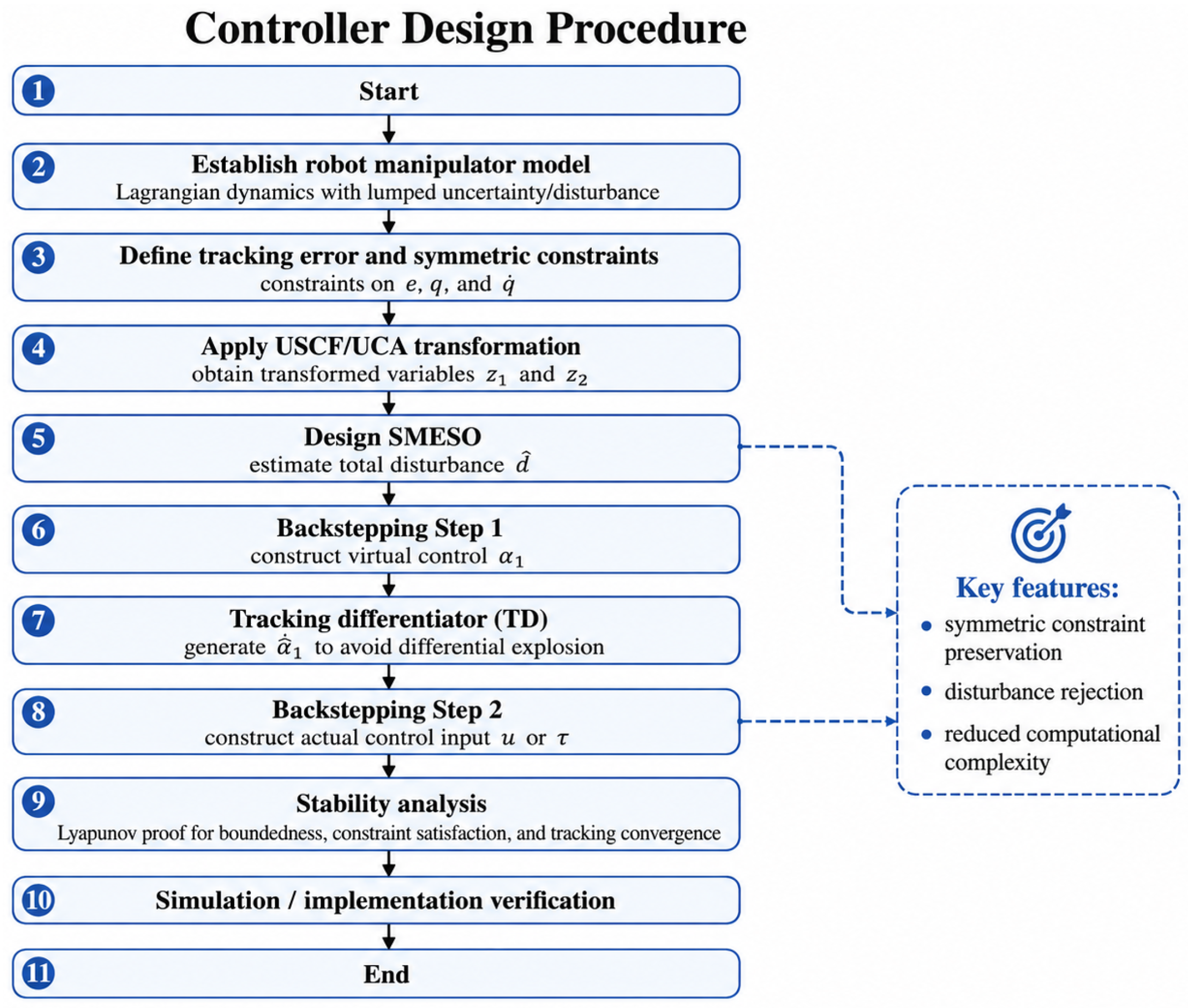
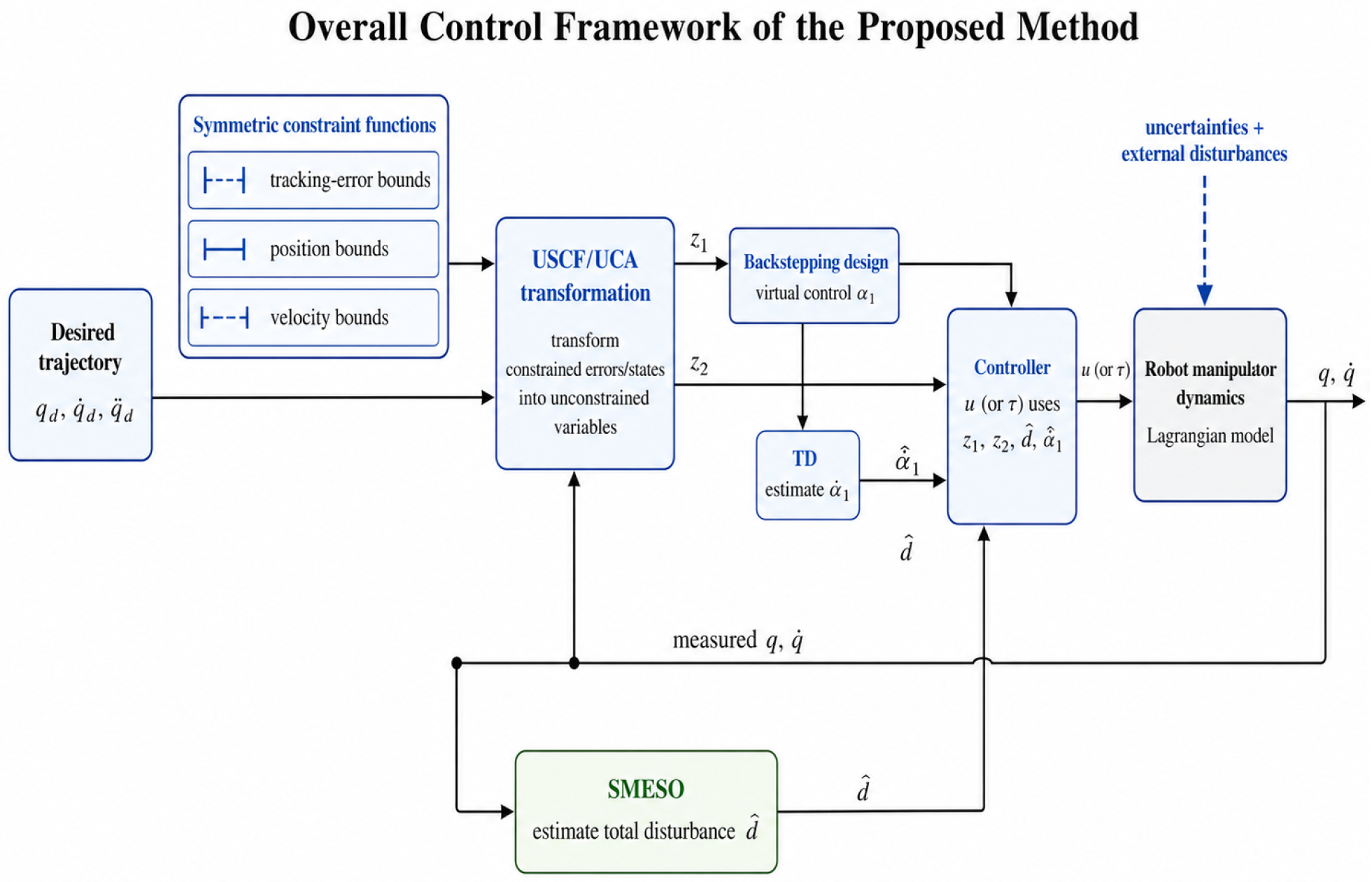
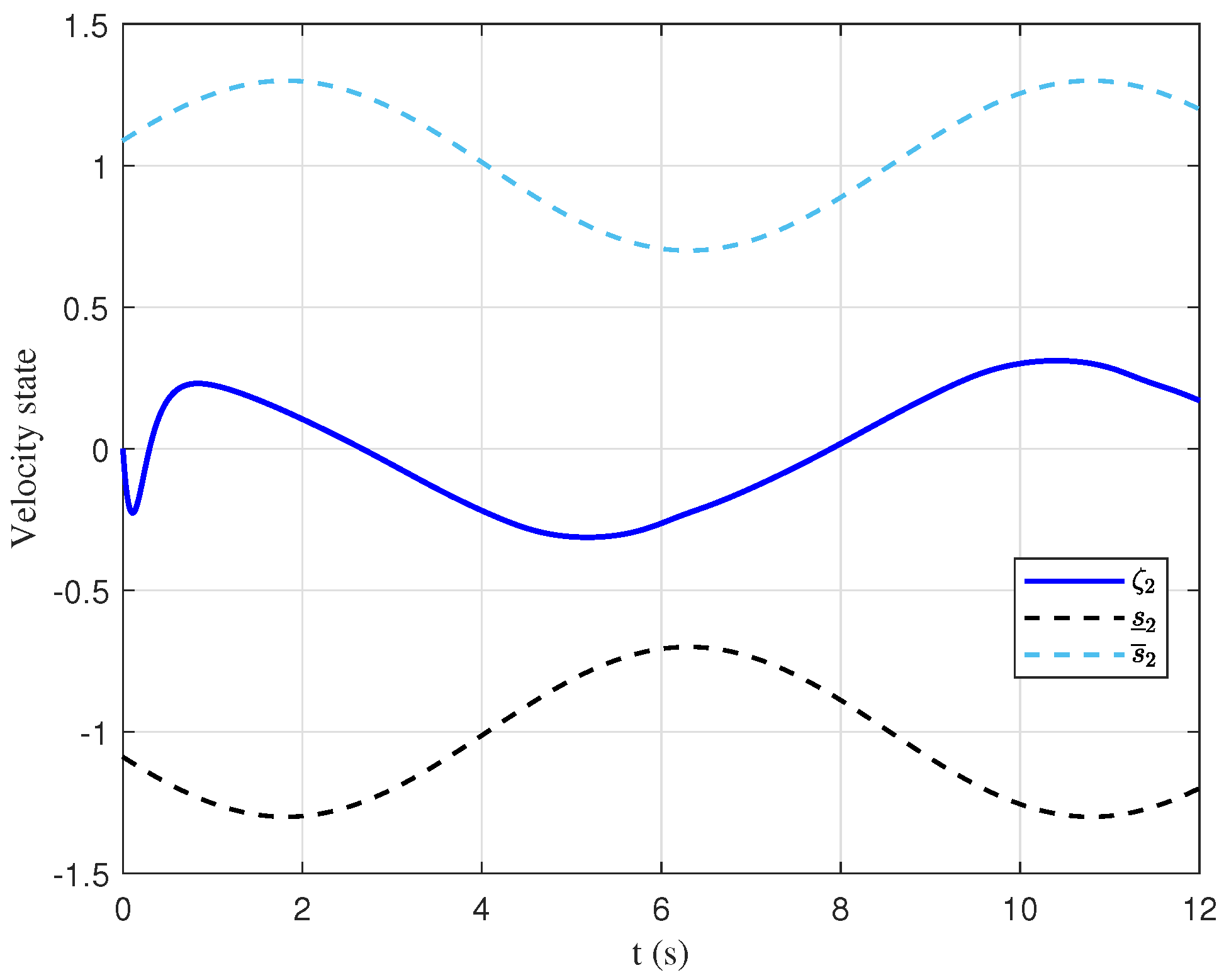
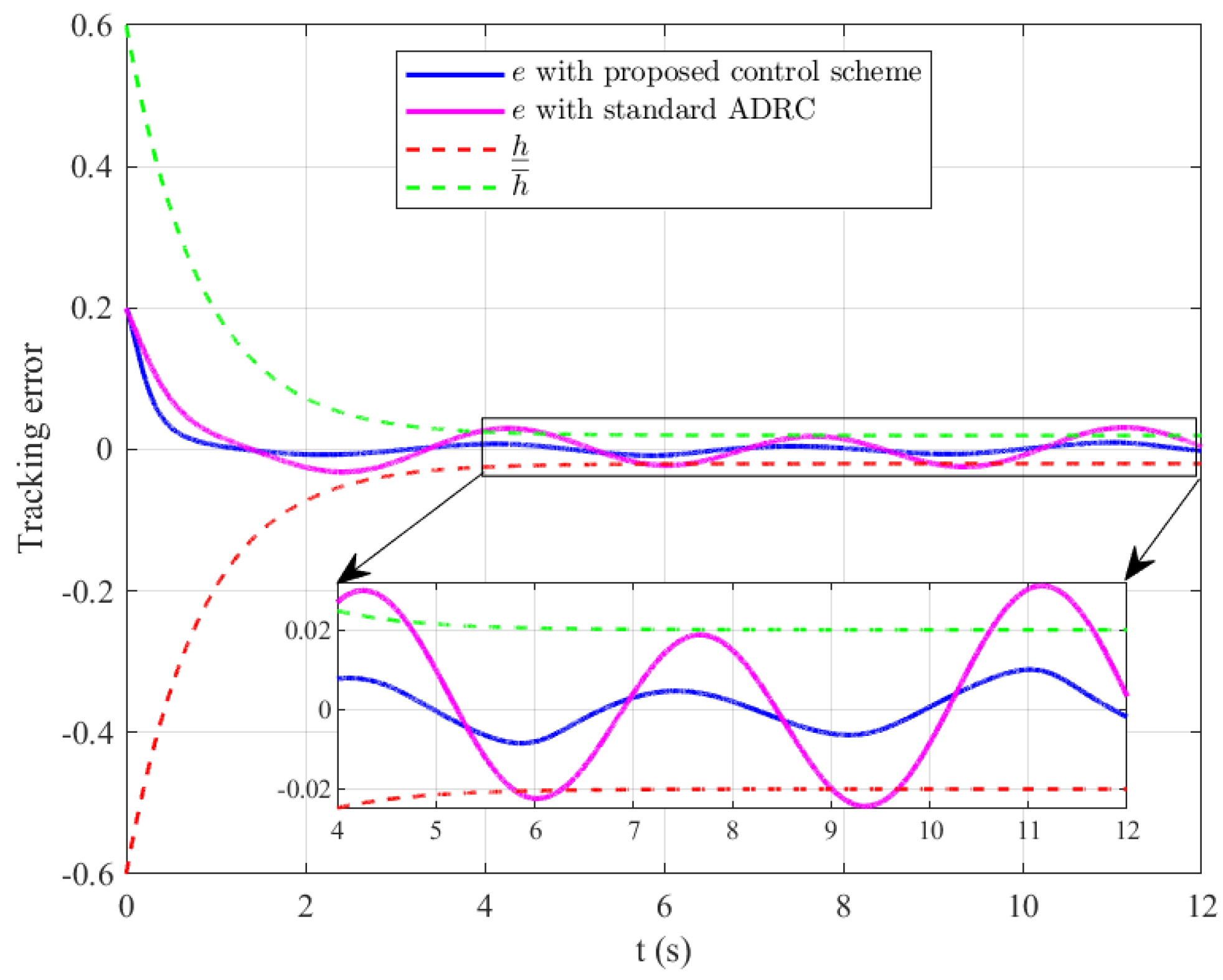
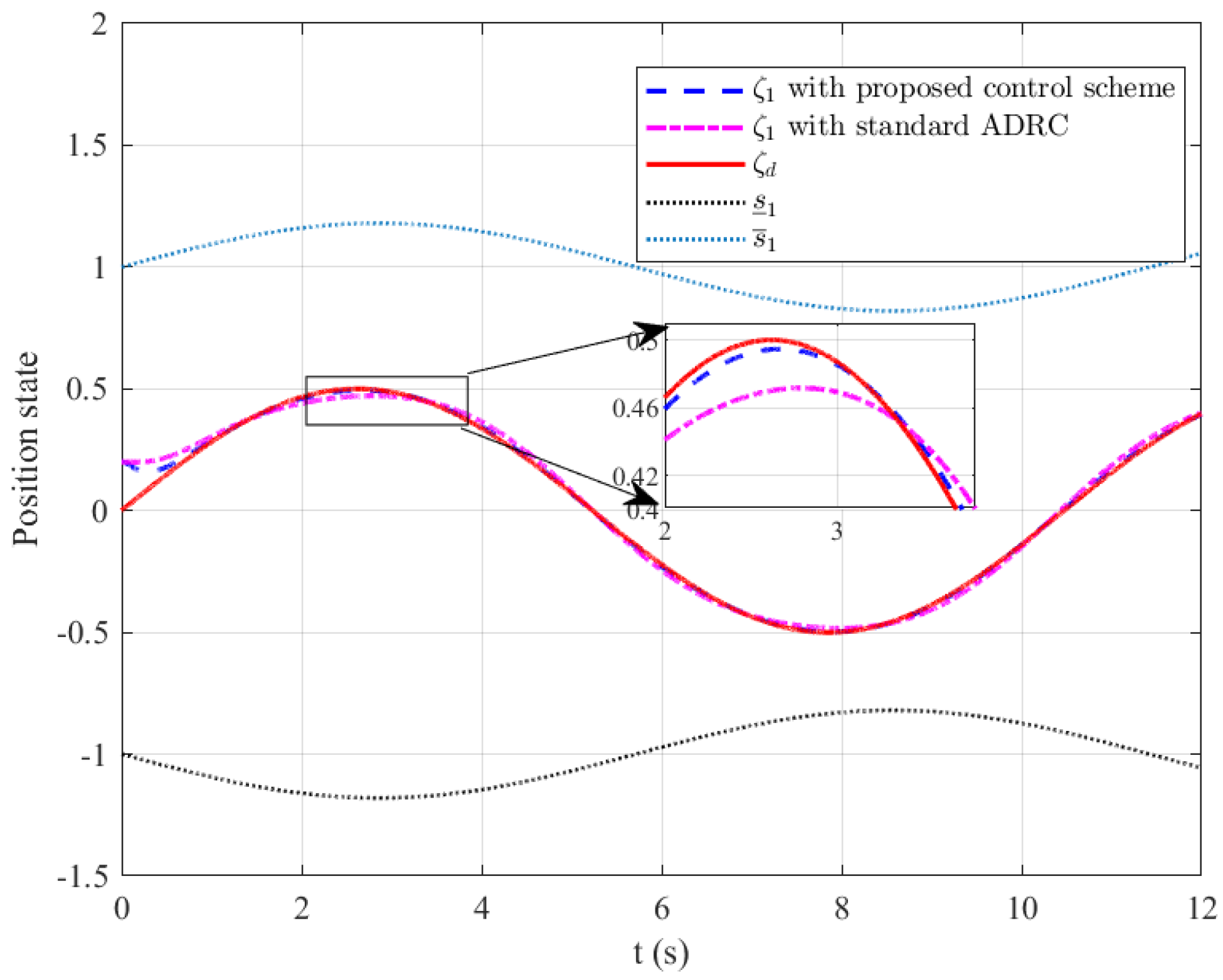
This paper addresses the tracking control problem of robotic manipulators under a universal symmetry constraint framework in the presence of lumped uncertainties and external disturbances. Unlike conventional constrained control schemes that treat tracking error bounds and state bounds separately, the proposed method explicitly exploits the symmetric structure of the prescribed constraints and formulates both tracking error constraints and full-state constraints in a unified manner. Based on the Euler–Lagrange dynamics of robotic manipulators, a universal symmetry constraint transformation is introduced to convert the original constrained system into an equivalent unconstrained form while preserving the intrinsic symmetry of the admissible sets. To enhance robustness against uncertainties and disturbances, a sliding-mode extended state observer is designed to estimate the total disturbance online. Meanwhile, a tracking differentiator is incorporated into the recursive design to avoid repeated differentiation of virtual control signals. On this basis, a disturbance-compensated backstepping controller is developed for the transformed manipulator system. It is shown that all closed-loop signals remain bounded, the prescribed symmetric tracking error and state constraints are never violated, and the tracking error converges asymptotically when the observer and differentiator errors vanish asymptotically. Simulation results obtained from a robotic manipulator verify the effectiveness of the proposed control strategy.
Keywords: robotic manipulators; universal symmetry constraint framework; sliding mode-based extended state observer; tracking differentiator robotic manipulators; universal symmetry constraint framework; sliding mode-based extended state observer; tracking differentiator