Article

Symmetry-Based Route Optimization for International Land Logistics Using an Extended Traveling Salesman Problem with Distance–Time Constraints and Real-Time Google Maps Data


by
Jarun Bootdachi
1,* and
Sakarin Nonthapot
2
1
Department of Business Administration, Faculty of Interdisciplinary Studies, Khon Kaen University, Nong Khai 43000, Thailand
2
Department of Social Sciences, Faculty of Interdisciplinary Studies, Khon Kaen University, Nong Khai 43000, Thailand
*
Author to whom correspondence should be addressed.
Symmetry 2026, 18(6), 1023; https://doi.org/10.3390/sym18061023 (registering DOI)
Submission received: 21 May 2026 / Revised: 8 June 2026 / Accepted: 11 June 2026 / Published: 14 June 2026
(This article belongs to the Section Engineering and Materials)

Abstract

This study develops novel mathematical models to capture the complexities of international land logistics by extending the classical Traveling Salesman Problem (TSP) within a symmetry-aware optimization framework. A focused review of literature provides the theoretical basis for model formulation and highlights the limitations of conventional distance-only approaches. In international transport, shorter routes are often assumed to reduce energy use; however, this assumption overlooks the decisive influence of travel time and traffic variability. In this context, symmetry offers a useful analytical lens, as balanced relationships among distance, time, and fuel consumption can reveal more efficient logistics structures. Accordingly, two models are proposed: the Traditional Traveling Salesman Problem in terms of Distance Concentration (TTSPD), which minimizes route length, and the Extended Traveling Salesman Problem in terms of Distance and Time Concentration (ETSPDT), which jointly considers distance, travel time, and fuel consumption. Furthermore, TTSPD was employed to validate ETSPDT, since it is based on the traditional TSP. Both models are solved exactly using the Solver Add-in in Microsoft Excel 2024 with data derived from Google Maps. The results show that ETSPDT achieves superior energy efficiency and average speed, demonstrating the practical value of multidimensional, symmetry-informed optimization for sustainable supply chain and logistics management.

1. Introduction

Contemporary competitive advantage in land-based supply chain operations is increasingly shaped by the capabilities of road freight service providers [1,2,3]. Empirical evidence suggests that manufacturing firms are progressively outsourcing transportation-related activities, functions that typically fall outside their core competencies, to third-party logistics (3PL) providers. This strategic reallocation allows firms to concentrate more intensively on their primary strengths, particularly production and service delivery, thereby strengthening their competitive position and operational focus [3,4,5]. In this regard, land transport service providers may be regarded as 3PL entities that are responsible not only for the physical movement of goods, but also for the coordination and integration of associated information flows. Their role is critical in facilitating the timely, accurate, and efficient delivery of raw materials and finished products to designated production facilities, while adhering strictly to client specifications and scheduling requirements [5,6,7].
For instance, when a land transportation provider fails to deliver goods or raw materials from suppliers to end users within the required timeframe, a manufacturer’s production capacity may be severely constrained, as inputs cannot be converted into finished goods according to schedule. Such delays interrupt the continuous movement of industrial products across downstream supply chain stages, thereby undermining operational efficiency and supply chain continuity. More broadly, land transportation providers represent a pivotal node in industrial supply chains because their performance directly shapes production outcomes and logistics reliability. In this context, symmetry may be interpreted as balanced and coordinated interdependence among supply chain actors, such that disruptions at one point produce disproportionate effects throughout the system. Accordingly, symmetry offers a valuable analytical lens for examining structural alignment, temporal consistency, and coordinated functionality in supply chain resilience and performance.
A principal challenge confronting international road freight service providers lies in the strategic selection of the most efficient transportation routes, particularly those that minimize total travel distance. Because land transportation costs are strongly correlated with distance traveled, largely due to fuel consumption, route optimization constitutes a critical operational priority. In practice, international freight operations typically involve fixed delivery destinations and predetermined shipment volumes, as specified by consignors [8,9,10]. Accordingly, the central logistical objective is to design routing strategies that reduce travel distance while simultaneously ensuring timely delivery. Achieving such optimization not only strengthens a firm’s competitive position in the freight transportation sector but also fosters greater integration and coordination across manufacturing and distribution activities, thereby enhancing the overall efficiency and responsiveness of the supply chain.
International land freight operations are often organized through contractual arrangements that establish fixed shipment volumes and predetermined routes. Typically, such systems involve a single origin and a single destination, without intermediate loading or unloading points beyond the designated endpoints [11,12,13]. From a structural perspective, this configuration exhibits a form of symmetry closely related to the classical Traveling Salesman Problem (TSP), in which a vehicle departs from one location, visits a sequence of designated delivery nodes exactly once, and ultimately returns to its point of [14,15,16]. Accordingly, this inherently ordered and balanced configuration can be interpreted as a form of operational symmetry, in which the routing structure preserves a consistent relationship between origin, sequence of service, and return path. Accordingly, the use of TSP-based optimization methods in international freight logistics offers a rigorous means of minimizing transportation distance, reducing operational inefficiencies, and strengthening the competitiveness of land freight operators. At the same time, such approaches contribute to the coordinated performance of global manufacturing supply chains by improving route design, resource utilization, and overall logistical coherence.
Small-scale industrial enterprises often face intense pressure to minimize transportation costs while ensuring the timely and reliable delivery of materials to manufacturing partners [17,18]. In practice, these firms must coordinate raw material flows from multiple geographically dispersed sources, often through third-party courier networks, to downstream production facilities. This task requires strict adherence to delivery schedules and the careful management of handling constraints associated with small shipment volumes, thereby creating substantial logistical complexity. From a theoretical perspective, this setting corresponds closely to the classical transportation problem, which seeks the optimal allocation of commodities from supply nodes, such as producers and raw material suppliers, to demand nodes, with the objective of minimizing total transportation cost under supply, demand, and capacity constraints [19,20,21]. Within this framework, transportation optimization provides a rigorous analytical basis for improving both cost efficiency and operational reliability in small-scale industrial logistics systems.
More broadly, the balanced allocation of resources in such networks reflects the principle of symmetry, understood here as the harmonization of supply and demand relations across spatially distributed nodes. This symmetry-oriented perspective is especially relevant in contemporary supply chain and logistics management, where the integration of optimization, network equilibrium, and operational coordination can enhance overall system performance. Accordingly, embedding transportation optimization within raw material logistics supports efficient resource allocation and contributes to more resilient, coordinated, and conceptually coherent supply chain architectures.
Historically, international land transportation has been evaluated mainly by distance minimization, whereas temporal efficiency has often been overlooked. Yet transport networks operate in dynamic and uncertain environments, where the shortest route is not always the fastest. Congestion, flooding, accidents, and other disruptions can substantially reshape route performance. In supply chain and logistics management, therefore, spatial and temporal dimensions should be assessed together to obtain a more valid measure of efficiency. This approach reflects the principle of symmetry, which calls for the balanced consideration of interdependent factors in decision-making. Accordingly, route selection should rely on composite metrics, such as the travel-time-to-distance ratio, rather than geometry alone.
This study seeks to develop robust mathematical models to optimize international product delivery in cross-border land logistics, with particular attention to symmetry in supply chain and logistics management. It extends the classical Traveling Salesman Problem by integrating both temporal and spatial dimensions, thereby capturing the operational complexities of international road-based export activities. The proposed framework is then evaluated against the conventional distance-based TSP to assess its comparative effectiveness. The findings are expected to offer strategic guidance for logistics planners and contribute to more efficient, cost-effective, and timely delivery systems. The anticipated outcomes are expected to provide strategic insights for logistics service planners, fostering innovative approaches to streamline international supply chain operations and promote faster, more cost efficiency regarding product delivery in the context of international land transport.

2. Literature Review

The Traveling Salesman Problem (TSP) is a paradigmatic optimization challenge that seeks the shortest route through a given set of cities, each visited exactly once before returning to the origin. Originally formulated as an abstract model of route optimization, it has profoundly shaped the development of the Vehicle Routing Problem (VRP) and related logistics research. In supply chain and logistics management, the TSP underpins applications such as distribution network design, transportation planning, and delivery scheduling. Moreover, its structural symmetry, expressed through interchangeable city permutations and equivalent route reversals, has attracted substantial scholarly attention. Such symmetry not only reduces redundant search spaces but also informs the design of more efficient algorithms. Accordingly, the TSP remains central to contemporary academic inquiry and advanced operational optimization.
Recent studies have examined the computational difficulty of large-scale Travelling Salesman Problem (TSP) instances through heuristic methods. In this regard, ref. [22] employed the Greedy Algorithm to obtain near-optimal routes, showing that efficient solutions can be derived within limited computational time. Similarly, ref. [23] extended the Greedy approach to large TSP instances and integrated four RTX A4000 GPUs, demonstrating that hardware acceleration substantially improved computational speed and enabled the rapid identification of optimal or near-optimal solutions. In addition, ref. [24] proposed a K-means clustering framework to pre-group nodes before TSP optimization, thereby improving efficiency and reducing total travel distance. Collectively, these studies highlight the value of heuristic optimization in addressing complex routing problems. Moreover, when viewed through the lens of symmetry, such approaches suggest that structural regularities can be exploited to enhance solution efficiency in supply chain and logistics management, offering promising directions for advanced academic research and practical deployment.
Subsequent research has increasingly examined the Travelling Salesman Problem (TSP) through metaheuristic methods designed to address complex routing and logistics challenges. In this context, symmetry offers a valuable analytical perspective by revealing structural regularities that can simplify solution spaces and improve computational efficiency in supply chain and logistics management. For example, Genetic Algorithms (GA) have been shown to reduce travel distance and enhance logistical performance [25], while hybrid GA–Genetic Programming approaches use stochastic initialization and iterative refinement to approximate high-quality solutions more effectively [26]. Similarly, combining Ant Colony Optimization (ACO) with GA in distribution settings, such as cement delivery, underscores the strong dependence of solution quality on problem-specific conditions [27,28]. Collectively, these studies demonstrate the practical relevance of symmetry-aware optimization in advancing combinatorial decision-making.
Ref. [29] applied exact algorithms to optimize transportation time in intelligent vehicle network distribution, integrating temporal and cost variables within a Traveling Salesman Problem framework. Their results revealed substantial performance differences across sunny, snowy, rainy, and foggy conditions. Subsequently, ref. [30] expanded this line of research by proposing a Pareto-based multi-objective decision-making method, showing that total, product, and quadratic weighting schemes produce different rankings of Pareto-optimal solutions. Together, these studies highlight the importance of accounting for environmental variability and multi-criteria weighting in robust path-optimization strategies.
Complementing these findings, ref. [31] provided a comparative evaluation of exact algorithms, linear programming, heuristics, and metaheuristics on a standardized TSP dataset. Although exact methods produced globally optimal solutions, heuristic and metaheuristic techniques consistently achieved near-optimal results at much lower computational cost. Building on these advances, refs. [32,33] introduced dynamic programming and Delaunay graph simplification, respectively, demonstrating their potential to improve computational efficiency in exact and linear programming approaches. In symmetric supply chains and logistics systems, such methodical balance between optimality and efficiency remains essential.
Extensive literature indicates that exact algorithms can yield globally optimal solutions to the Traveling Salesman Problem (TSP), whereas heuristic and metaheuristic methods generally produce near-optimal approximations. As an NP-hard problem, the TSP exhibits computational complexity that grows sharply with dataset size, markedly extending solution times [32,33,34,35,36]. This challenge has driven considerable research aimed at enhancing algorithmic efficiency, reflecting ongoing efforts to balance solution optimality with practical tractability.
On the other hand, several research articles have introduced multi-dimensional models in transportation optimization. In particular, the initial five-dimensional TSP model attempts to represent data across multiple dimensions before route selection is made. For example, this optimization approach aggregates factors such as travel time, cost, risk, and other relevant criteria, and then combines these results to determine the most suitable route. However, this method has notable limitations [37,38,39]. First, it cannot fully integrate all information into a single exact representation, as ambiguity in the definition of individual dimensions and the potential for improper integration may produce distorted outcomes. Second, the resulting output often provides only an approximation, lacks guarantee of optimality, and can be difficult to interpret and visualize in real-world operational settings. Moreover, although previous studies have examined optimization across different dimensions, these dimensions are typically calculated separately before optimization, making the resulting solutions difficult to interpret and apply in practical transportation operations. Consequently, further research is needed to develop a method that can accurately integrate multiple transportation dimensions while remaining readily applicable in real transportation contexts through the use of available real-time data.
Over recent decades, route optimization research has primarily emphasized minimizing travel distance, reflecting a traditional concern with spatial efficiency. By comparison, relatively few studies have systematically examined travel time, and even fewer have jointly considered distance and time while explicitly incorporating vehicle energy consumption, a key proxy for transportation cost in logistics. This imbalance has created a notable gap in the literature, especially in relation to a more symmetric and holistic evaluation of operational efficiency. Such an integrated perspective is increasingly important in supply chain and logistics management, where the balanced treatment of temporal, spatial, and energetic factors can improve decision-making.
Addressing this gap is essential, as the interplay among travel distance, travel time, and fuel consumption directly shapes cost efficiency, environmental performance, and long-term logistical sustainability. Within the context of symmetry and supply chain and logistics management, this study proposes a comprehensive framework for the traveling salesman problem (TSP) that jointly considers these dimensions. By integrating distance, time, and vehicle fuel factors, the framework offers fresh insights into land-based logistics optimization. It enables decision-makers to enhance operational efficiency, reduce costs, and promote sustainable transportation, while also advancing conceptual understanding of symmetry-based approaches in order to strategically manage operations in the complex logistical networks.

2.1. International Land Logistics

International land logistics is a fundamental element of global supply chain management, involving the organized movement of goods across national borders through terrestrial transport systems. From a network perspective, it may be represented as a multi-node, multi-destination flow structure in which cargo moves from origin points to diverse foreign destinations. Land logistics service providers play a central role in coordinating and executing these flows by optimizing routing, scheduling, and resource allocation under uncertain conditions. In this context, symmetry offers a useful analytical lens, as balanced network structures, reciprocal flows, and equitable allocation patterns can improve efficiency, robustness, and resilience. Accordingly, symmetry-based approaches are increasingly valuable for enhancing the reliability and resilience of cross-border supply chains.
International road freight transportation involves the movement of goods for which cargo volumes are contractually fixed, with operations typically defined by a single origin and destination [11,12,13]. Conceptually, this logistical framework bears strong resemblance to the Traveling Salesman Problem (TSP). In this context, a freight vehicle departs from a domestic hub carrying a specified quantity of goods or raw materials, as determined by pre-established production requirements, and subsequently visits multiple international destinations each corresponding to a manufacturing site or organizational facility requiring a single delivery. After completing all delivery obligations, the vehicle returns to its country of origin [14,15,16]. Accordingly, the integration of TSP-based optimization techniques into international road freight operations offers significant potential to enhance the competitive positioning of transport operators, while simultaneously improving the efficiency, reliability, and responsiveness of global supply chains.
In summary, international land logistics is commonly understood as cross-border road freight transport, in which goods move from a supplier’s origin to multiple destination points across national boundaries. Such operations usually follow direct, non-return routes and are governed by formal shipping documentation and country-specific regulations. Because national transport rules, especially speed limits, vary considerably, compliance with legal velocity thresholds is essential. This means that optimization must account not only for spatial distance, but also for travel time and regulatory constraints. In this regard, the Extended Travelling Salesman Problem (ETSP) offers a rigorous framework for integrating routing decisions, time-dependent restrictions, and vehicle energy consumption into a single optimization model. Compared with the classical Travelling Salesman Problem, the ETSP better reflects the complexity of real-world logistics and supports more balanced decisions. From the perspective of symmetry, such models are particularly valuable in supply chain optimization, where structural balance can enhance efficiency, robustness, and planning consistency.

2.2. Traveling Salesman Problem: TSP

TSP is classically conceptualized as the transport optimization problem that seeks to determine the most efficient route for a salesman required to visit a given set of cities exactly once before returning to the origin. Over the years, the TSP has emerged as a fundamental framework for minimizing the total distance or associated cost of traversing all specified locations, thereby serving as a prototypical example of a minimization problem in operations research. Within this context, notations of indices and parameters in TSP can be described as in Table 1, and the canonical mathematical formulation of the TSP can be formally articulated as follows.
The Traveling Salesman Problem (TSP) is conventionally formulated in terms of the pairwise transport distances associated with a given delivery itinerary. This formulation is primarily employed to optimize the allocation of products across a predefined set of terminal nodes or usage points. The TSP principal objective is to minimize the cumulative travel distance, thereby identifying the optimal route for a delivery vehicle. Consequently, the corresponding mathematical formulation can be rigorously expressed as follows.

2.2.1. Objective Function

The purpose of TSP is to minimize all selective paths in order to identify the optimum route for a delivery vehicle.
min T S P   f y = j = 1 n · k = 1 n y j k d j k  

2.2.2. Constraints

The transport vehicle has an ability to deliver goods to each international destination for each delivery only once.
j = 1 n y j k =   1                                                 k     { 1 , 2 , 3 , n }  
The transport vehicle has an ability to leave each international destination for each delivery only once.
k = 1 n y j k =   1                                                 j     { 1 , 2 , 3 , n }
The transport vehicle does not exhibit the sub contour activity.
j , k S n y j k S 1                             S V ,   2 | S | n 2
The decision variable governing the selection of the transportation routes.
y j k 1,0                                                   j ,   k { 1,2 , 3 , n }
where
y j k = 1 The driver selectively drives vehicle from location j to location k.
y j k = 0 The driver unselectively drives vehicle from location j to location k.

2.3. Problem Formulation

In international land logistics, service inefficiency is often assessed through transportation cost minimization. Consolidating bulky goods at the country of origin and moving them across borders over long distances imposes substantial financial burdens. Yet transport cost depends not only on distance but also on time, which significantly influences international road freight expenses. Fuel consumption, for example, is affected by mileage as well as delays caused by congestion, accidents, and roadworks, all of which increase duration without adding value. From a symmetry perspective in supply chain design, distance and time should be treated as complementary variables. Accordingly, their joint consideration enables more accurate freight planning and total cost estimation.
Efficient international road transportation depends on three interrelated factors: distance, time, and cost, with transport cost shaped by both spatial and temporal variables. Although the classical Traveling Salesman Problem (TSP) has been extensively studied, it typically prioritizes distance alone (TTSPD), leaving a gap in frameworks that jointly model time and distance. To address this limitation, we extend the TSP to an Extended Traveling Salesman Problem (ETSPDT), which explicitly incorporates both dimensions and reformulates the objective function to capture fuel consumption. By linking energy use to transportation cost, this framework enables a more rigorous assessment of delivery efficiency. Within supply chain and logistics management, such models support the analysis of symmetry in route structure and operational balance, offering valuable insights for optimizing container truck delivery systems under real-world constraints.

2.3.1. Traditional Traveling Salesman Problem in Term of Distance Concentration: TTSPD

In the context of international road transport for cross-border product distribution, the classical objective has been to identify a route that minimizes the total travel distance per tour. The process entails dispatching shipments from the supplier in the origin country, consolidating them, and transporting them across multiple destinations before returning to the point of origin. This operational problem can be rigorously formalized as TTSPD, in which historical transport distances serve as the primary input for estimating associated costs. Accordingly, the TTSPD admits a well-defined mathematical formulation coupled with having notations of additional parameters as in Table 2, which provides a foundational framework for subsequent cost optimization analyses.
The TTSPD paradigm is fundamentally predicated upon the spatial distances traversed within a product delivery itinerary. It is conventionally employed to allocate goods across a network of terminal nodes or points of consumption. The central aim of this framework lies in the minimization of aggregate travel distance, thereby delineating the most efficient routing scheme. Crucially, the optimization of such routes is inherently subordinate to the overarching objective of curtailing transportation costs, with particular emphasis on a reduction in vehicular fuel expenditure. In this regard, fuel consumption exhibits a direct dependence on vehicle velocity, which is itself contingent upon the driver’s proficiency in negotiating inter-node transitions. Consequently, the mathematical formulation of the resulting model can be expressed in the following formal terms.
Objective Function
The primary objective function is to indicate the shortest part.
min T T S P D   f y = j = 1 n · k = 1 n y j k d j k
The subsequent objective function is the consequence from the primary objective function, since each travel from location j to location j might let the driver perform the dissimilar velocity ( v j k ), which will subsequently indicate the different energy consumption rate. In addition, transport cost consequently is the summation of each energy consumption multiplying with each distance in the designed route.
Transport cost   T T S P D   f y = j = 1 n · k = 1 n e j k y j k d j k
Constraints
The transport vehicle only has one time to visit each international destination.
j = 1 n y j k =   1                                                 k     { 1 , 2 , 3 , n }
The transport vehicle only has one time to leave each international destination.
k = 1 n y j k =   1                                                 j     { 1 , 2 , 3 , n }
The next path is primarily selected under the shortest transport distance form.
j = 1 n d j k y j k = m i n   d j k         k     { 1 , 2 , 3 , n }
The transport vehicle does not have the activity of the sub contour.
j , k S n y j k S 1               S V ,   2 | S | n 2
The decision variable for selecting the transport path.
y j k     1,0                                                   j ,   k     { 1,2 , 3 , n }
where
y j k = 1 The driver selectively drives vehicle from location j to location k.
y j k = 0 The driver unselectively drives vehicle from location j to location k.
Overall, the TTSPD formulation is a discrete binary integer optimization model derived from the classical traveling salesman problem. It is single-objective when either the total transport distance or transport cost is minimized independently; however, it can be extended to a multi-objective framework when both criteria are optimized simultaneously. Due to the binary routing decisions and subtour-elimination constraints, the model is nonconvex. Moreover, it remains linear if fuel consumption is treated as a constant parameter but becomes nonlinear when fuel consumption is modeled as a function of vehicle velocity. For problems involving a large number of destinations, the model is also large-scale and therefore computationally challenging.

2.3.2. Extended Travelling Salesman Problems Based in Term of Distance and Time Concentration: ETSPDT

This study addresses the computational solution of the Closed-Loop Traveling Salesman Problem (CLTSP), a combinatorial optimization problem that identifies the most efficient cyclic route from a given origin to multiple destinations, subject to the constraint that each location is visited exactly once before returning to the departure point. In international road freight logistics, this problem becomes especially complex, as vehicles must leave a domestic terminal, cross national borders, and deliver goods sequentially to geographically dispersed locations while preserving the closed-loop structure. From a symmetry perspective, the route exhibits a circular configuration in which the origin and destination nodes are treated within a unified spatial framework. Exploiting such symmetry can improve route evaluation and solution efficiency. Therefore, developing optimal CLTSP solutions is essential for enhancing operational performance and reducing transportation costs in transnational supply chains.
In real-world logistics, the shortest route is not always the fastest. Flooding, congestion, accidents, and other exogenous disruptions can increase travel time even on geographically shorter paths. Accordingly, route optimization should account for both spatial and temporal factors. To this end, the present study extends the classical model by integrating distance and time into a unified mathematical framework, yielding the ETSPDT. The model incorporates additional parameters, as summarized in Table 3, and its theoretical basis and formal definition are presented in the following sections. From a symmetry perspective, this formulation preserves structural balance while capturing asymmetric operational conditions, thereby offering a robust basis for advanced supply chain and logistics applications.
The primary objective of the ETSPDT is to determine an optimal routing strategy for each agent, encompassing the transportation of goods across multiple international destinations and the subsequent return to the domestic origin. This optimization problem seeks to minimize the cumulative travel time in proportion to the total distance traversed, while concurrently incorporating the vehicle’s energy consumption profile as a critical operational constraint. In essence, the task is reduced to identifying the route that simultaneously maximizes temporal efficiency and energy economy, a goal that can be rigorously formalized through the subsequent mathematical problem formulation.

Objective Function

The primary objective function is to indicate the fastest movement when considering transport time and transport distance at the same time.
min E T S P D T   f y = j = 1 n · k = 1 n y j k l t j k j = 1 n · k = 1 n y j k d j k
The second objective function is the minimization from the primary objective function, since each transport time ( l t j k ) coupled with distancing ( d j k ) might let the driver perform the dissimilar velocity ( v j k ), which will indicate the different energy consumption rate. In addition, transport cost consequently is the summation of each energy consumption multiplying with each distance in the designed route.
min Transport cost   E T S P D T   f y = j = 1 n · k = 1 n e j k y j k d j k
Constraints
The transport vehicle only has one time to visit each international destination.
j = 1 n y j k =   1                                                 k     { 1 , 2 , 3 , n }
The transport vehicle only has one time to leave each international destination.
k = 1 n y j k =   1                                                 j     { 1 , 2 , 3 , n }
The next path is primarily selected under the condition of the lowest fuel consumption based on each transport time per transport distance, which will be able to be transformed to a dissimilar velocity.
j = 1 n e j k y j k d j k = m i n   e j k y j k d j k         k     { 1 , 2 , 3 , n }
where e j k . The fuel consumption depends on v j k = 1/( l t j k / d j k ).
The transport vehicle does not have the activity of the sub contour.
j , k S n y j k S 1               S V ,   2 | S | n 2
The decision variable is for selecting the transport path.
y j k     1,0                                                   j ,   k     { 1,2 , 3 , n }
where
y j k = 1 The driver selectively drives vehicle from location j to location k.
y j k = 0 The driver unselectively drives vehicle from location j to location k.
Equations (13)–(19) underpin the derivation of globally optimal transportation routes, whereby each transport agent executes a time-minimizing trajectory from its domestic parking facility, transits international borders to deliver goods across multiple foreign destinations, and ultimately returns to its point of origin, thereby ensuring maximal operational efficiency and adherence to logistical constraints.
On the whole, the proposed ETSPDT formulation is a deterministic, nonlinear, nonconvex binary integer optimization model. Structurally, it belongs to the class of extended travelling salesman problems because it imposes standard routing requirements, including a single visit and single departure for each destination, together with subtour elimination constraints. The model is primarily single-objective, with minimization of the total transport-time-to-distance ratio serving as the main criterion, while transport cost is introduced as an additional operational performance measure associated with energy consumption. Since the decision variables are binary and the number of route-selection variables grows quadratically with the number of destinations, the model is combinatorial in nature and may become large-scale for practical instances involving many international locations.

2.4. The Accurate Distance Between Two Locations

From antiquity to the present, scholars and practitioners have persistently sought to devise systematic methods for quantifying the spatial separation between distinct locations. These endeavors frequently rely on computational algorithms that determine distances from the latitudinal and longitudinal coordinates of the points under consideration. A canonical example is the application of the Pythagorean theorem, which yields the length of the side opposite the right angle in a triangle commonly referred to as the Euclidean distance [40,41]. Yet, when distances are measured along a great circle, the geodesic that constitutes the shortest path between two points on a sphere planar approximations become inadequate. This approach explicitly accounts for the non-uniformity of latitude and longitude by incorporating the Earth’s curvature, typically through the Haversine formula, which employs trigonometric functions to adjust for the planet’s spherical geometry. In this framework, therefore, a “straight line” is more accurately conceptualized as a curved arc [42,43]. While such methods provide a meaningful approximation of inter-location distances, they remain inherently approximate, as they do not capture the true travel distance.
In international land logistics, conventional distance metrics such as Euclidean, great-circle, and Haversine measures quantify spatial separation but fail to capture the constraints of real-world road networks. Reliance on such idealized straight-line distances can produce suboptimal or hazardous transport routes, intersecting agricultural, horticultural, or urban areas. Consequently, classical distance-based approaches are insufficient for decision-support models, necessitating frameworks that integrate network topology, road hierarchies, and vehicular constraints to enable mathematically rigorous optimization of cross-border goods distribution.
At present, the application Google Maps facilitates the precise quantification of geospatial distances between arbitrary locations. Functioning as an advanced computational tool, it enables optimized navigation by determining the minimal-cost path connecting any two points on the Earth’s surface. The platform, developed by Google Inc., represents the spatial network as a graph-based data structure and employs Dijkstra’s algorithm to systematically identify the globally shortest path. This algorithm rigorously evaluates all feasible trajectories, iteratively updating tentative distances to converge on the path that minimizes cumulative traversal cost. In parallel, Google Maps assimilates real-time GPS information from active users to model prevailing traffic dynamics, thereby providing refined estimates of expected travel time [44,45,46]. Consequently, the system embodies a synthesis of classical graph-theoretic optimization and contemporary data-driven analytics, ensuring both computational efficiency and practical navigational accuracy.
Moreover, a systematic analysis of multiple geospatial points enables the precise quantification of inter-location distances and robust estimation of travel times, effectively positioning Google Maps as a real-time traffic analytics platform. Integrating such dynamic data into computational algorithms is expected to enhance the fidelity of transportation optimization models. Accordingly, the present study employs a methodology that computes distances and travel durations across heterogeneous transportation nodes by leveraging real-time streams from the Google Maps database, ensuring both computational rigor and empirical relevance.

2.5. Conceptual Framework

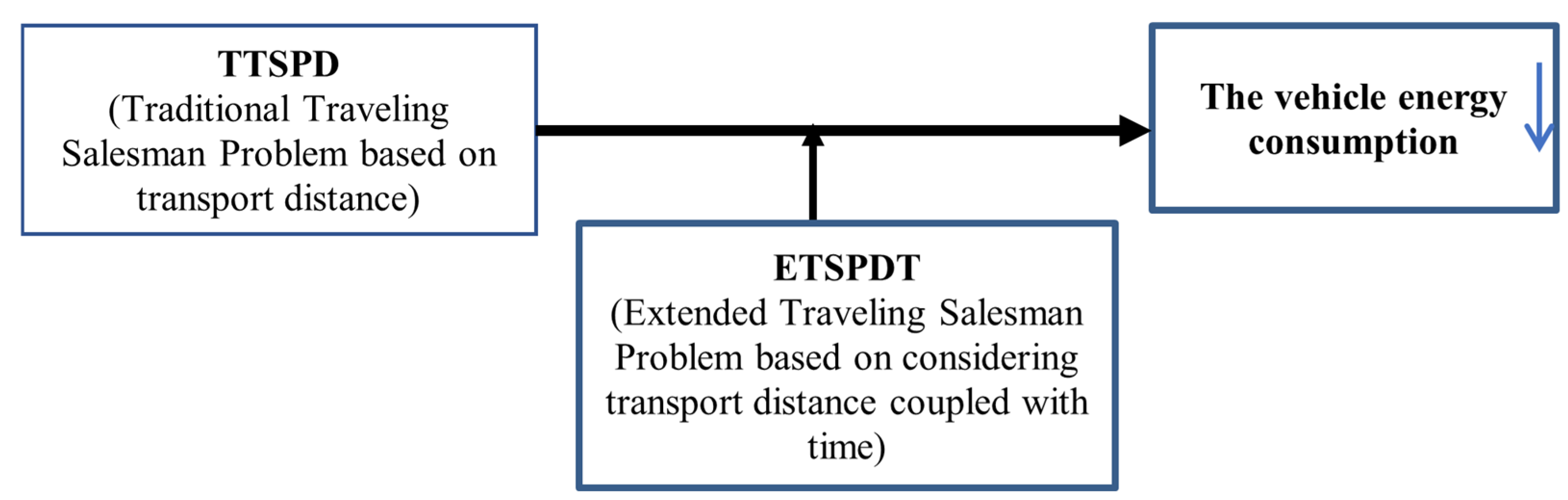
The Traveling Salesman Problem (TSP) has traditionally been framed as a distance-minimization model, in which the shortest route among multiple destinations is assumed to reduce transportation cost and energy consumption. However, this symmetry between distance and efficiency is often disrupted in real logistics systems by traffic congestion, border delays, and road disruptions, where stationary vehicles continue to consume fuel and time. To address this limitation, the present study first considers the Traditional TSP defined by distance (TTSPD) as a baseline and then develops an Extended TSP incorporating Distance and Time (ETSPDT). This dual-parameter formulation captures both spatial and temporal dimensions, thereby reflecting the asymmetric realities of international road freight transport. Initially, TTSPD was the first model derived from the fundamental concept of the traditional TSP, which primarily focuses on path distance before route selection. It was employed to validate ESTPDT, which extends this framework by considering distance and time simultaneously, thereby serving as the driving development model in this research. Expectedly, comparative results indicate that ETSPDT more effectively represents energy-use dynamics and offers a stronger theoretical foundation for cross-border logistics optimization. Accordingly, the model supports more accurate decisions aimed at reducing energy consumption and transport cost. Figure 1 illustrates this progression from classical distance-based optimization to a symmetry-aware, dual-parameter approach.

3. Research Method

3.1. Initial Population

This study assesses the cost-effectiveness of transportation by comparing vehicle energy consumption between the TTSPD and ETSPDT models. Direct measurement of actual travel distances and durations in real-world conditions is challenging, primarily due to substantial financial and logistical constraints. As an alternative, Google Maps was employed, leveraging aggregated real-time GPS data from users to provide accurate distance estimates and reliable travel time predictions under prevailing traffic conditions. International road freight destinations were randomly selected using Google Maps, with initial departure points in Thailand similarly determined from the Administrative Report [47]. Cross-border districts within ASEAN countries with established land connectivity specifically Cambodia, the Lao People’s Democratic Republic, Myanmar, and Vietnam (CLMV nations) were also identified randomly. All geographic references were standardized using city or district names, omitting specific organizations.
Consistent with quantitative methodological standards, particularly the “rule of thumb” principle [48], the study ensured that the number of transport paths exceeded thirty. For each route, comprehensive data, including distance d j k and estimated travel time t j k , were systematically collected. This approach integrates real-time geospatial information with rigorous sampling to approximate actual transport distances, durations, and traffic conditions, providing a reliable foundation for subsequent energy consumption and cost-effectiveness analyses.

3.2. Vehicle Energy Consumption Rate

Within the methodological frameworks employed in this study, vehicle energy consumption emerges as a direct consequence of the objective functions defined in each mathematical model, thereby providing a quantitative basis for evaluating transportation efficiency. This modeling perspective aligns with real-world logistics, where trucks represent the predominant means of international road freight, facilitating the cross-border movement of goods and reflecting the operational realities captured by the models.
Recently, ref. [49] investigated fuel consumption and its determinants in three-axle container trucks, identifying road slope (S, %), vehicle velocity (V, km/h), and total vehicle weight (W, tons) as the primary factors. Based on these variables, they developed predictive fuel consumption models (C, L/km) for two operational scenarios.
In the first scenario (W: 11.7–28 t, S: 2–7%, V > 50 km/h), fuel consumption was described by C = (105.635S − 3.64516V − 8.00992W + 15.2035SW − 20.5096S2 − 0.0270028S2W2)/1000 while the second scenario (W: 11.7–28 t, S: 0.6–2%, V > 50 km/h), the model was C = (38.8019S + 2.47673V + 14.595W − 0.207869VW − 1.24498SV + 0.135391SVW)/1000.
To apply this framework to international road freight, an average truck load was considered, reflecting that vehicles are fully loaded only at the origin and progressively unload en route, arriving empty at the final destination. Additionally, mean slope values were employed to represent route gradients, acknowledging variability along the transport path. These parameters were subsequently integrated into the analysis, providing a practical basis for evaluating energy consumption across international freight routes as outlined below.
The energy consumption rate for the truck contains the product weight 19.85 tones.
Stage 1 The transport condition: slope: 4.5%, and velocity below 50 km/h.
e j k = ( 1043.63968 3.64516 v j k ) / 1000
Stage 2 The transport condition: slope: 1.3%, and velocity above 50 km/h.
e j k = ( 340.15322 3.13255 v j k ) / 1000
The TTSPD approach was initially formulated to determine the shortest path, from which the corresponding transport time for each route was derived. Path velocity ( v j k ) was then computed as the ratio of distance to transport time. By contrast, the ETSPDT method prioritized time efficiency by minimizing transport time per unit distance, with path selection guided by the inverse of minimal fuel energy consumption ( e j k ) per distance, serving as a proxy for ( v j k ). For both frameworks, velocities were categorized according to speed thresholds—for example, below or above 50 km/h for container truck transport. One of Equations (20) and (21) was subsequently applied to determine the energy consumption rate ( e j k ) for each path, which then fed into Equations (7) and (13) to assess cost-effectiveness under TTSPD and ETSPDT, respectively.
In essence, Equations (20) and (21) provide the basis for evaluating cost-effectiveness, facilitating the optimization of international truck freight. Objective functions were first converted into path velocities, which were then used to calculate energy consumption and total fuel usage, ultimately yielding the transportation costs associated with each logistical model.

3.3. Data Analysis

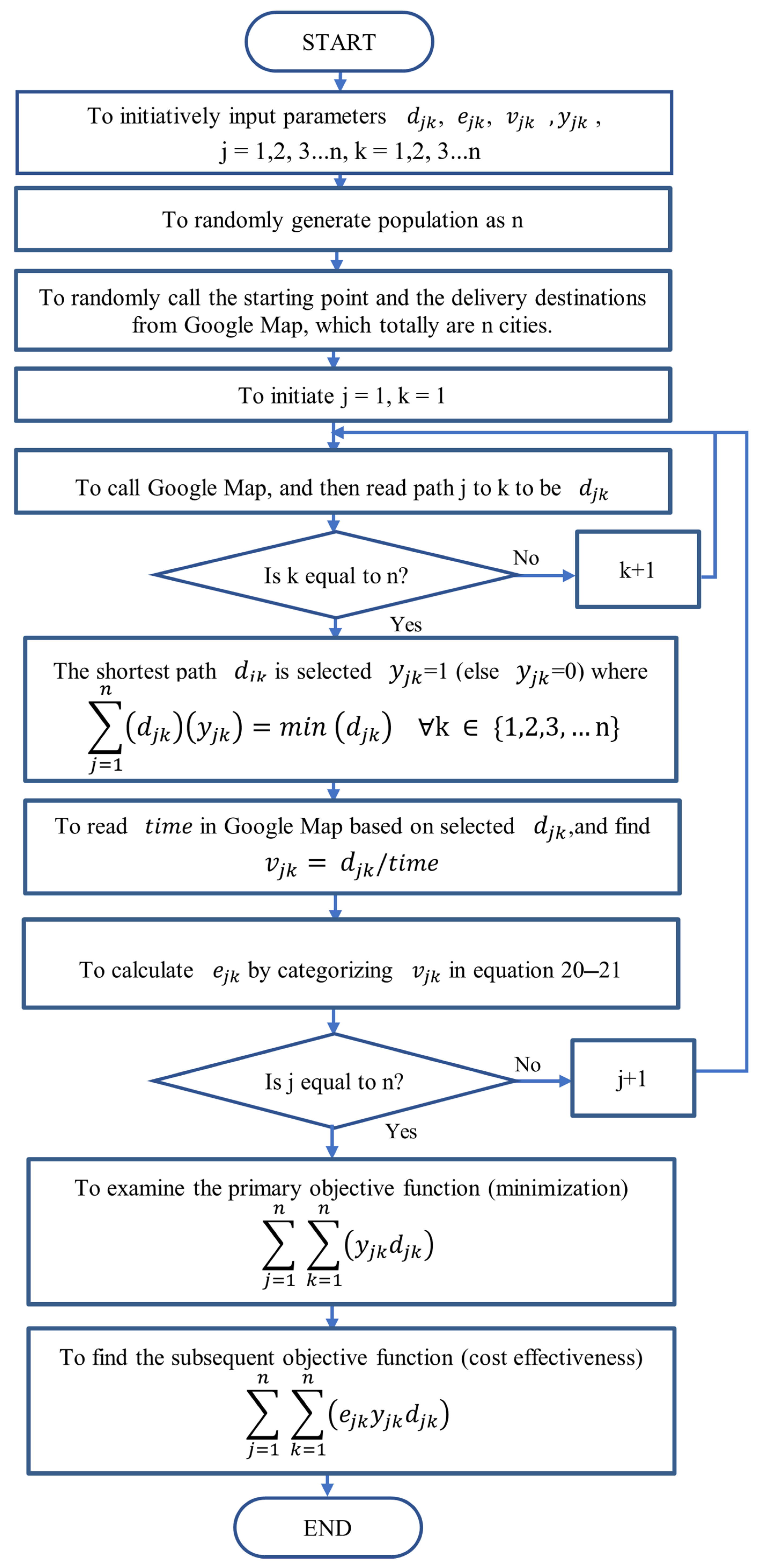
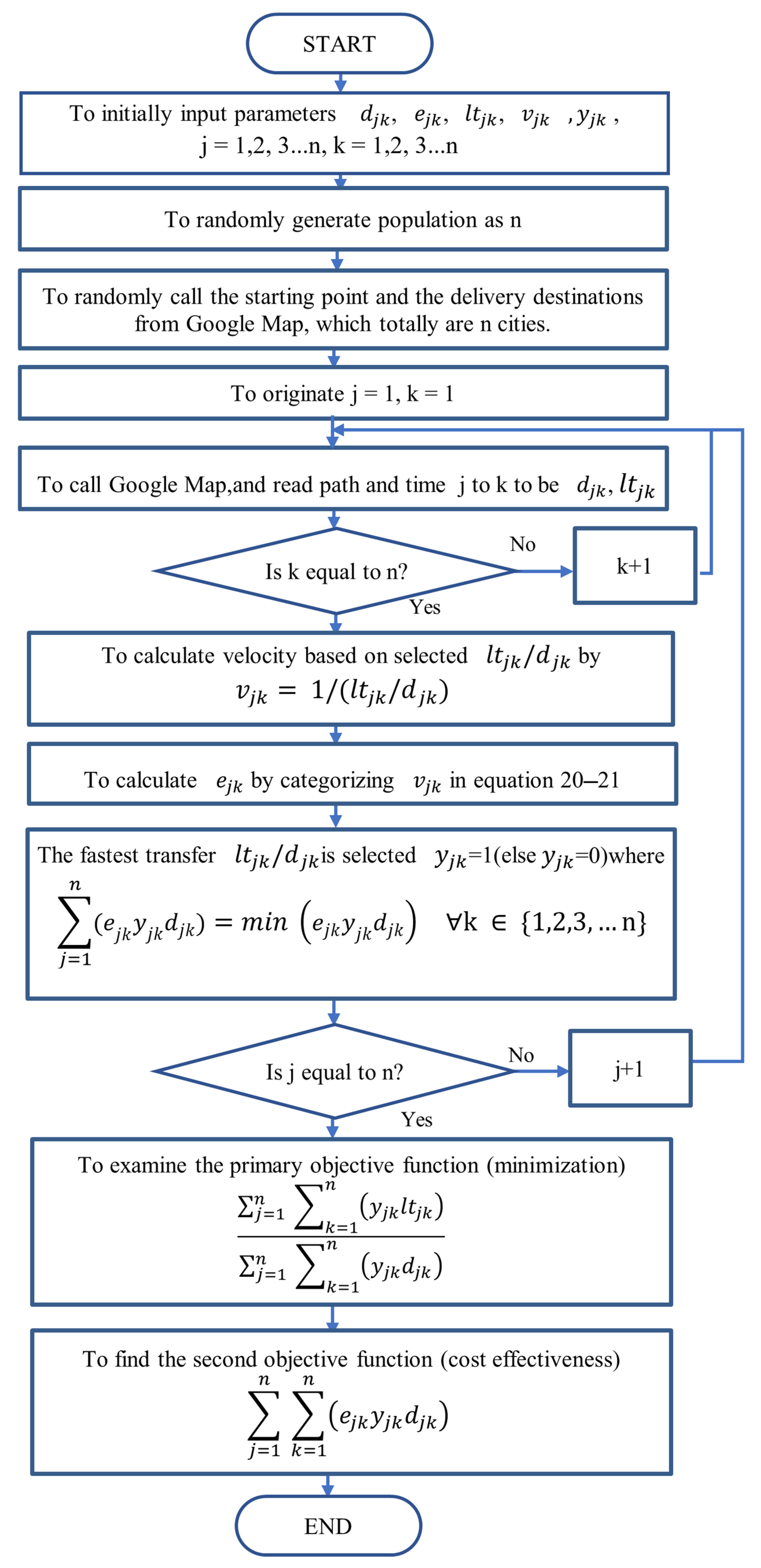
The data employed in this study were primarily subjected to quantitative analysis. Initially, the dataset comprising various visited locations was randomly obtained through the Google Maps application. These data points were then systematically analyzed to assess cost effectiveness based on the theoretical frameworks of the TTSPD and ETSPDT. The outcomes of these exploratory analyses yielded novel insights that may serve as practical guidelines for optimizing international logistics operations specifically by reducing fuel consumption in cross-border road freight transportation. Furthermore, the comprehensive data analysis was conducted using the Solver Add-in tool within Microsoft Excel 2024. The two mathematical models grounded in the TTSPD and ETSPDT concepts were subjected to numerical validation through the procedures that are exhibited in Figure 2 and Figure 3, respectively. Moreover, TTSPD and ETSPDT can be solved by applying linear programming algorithms, as illustrated in Algorithms 1 and Algorithm 2 below.
Algorithm 1 Algorithm Solve TTSPD by Linear Programing Solver
Input:  d j k , e j k , v j k   ,   y j k ,   n
Output:
  Optimal route to indicate the shortest part j = 1 n . k = 1 n y j k d j k   ,
  Transport Cost j = 1 n . k = 1 n e j k y j k d j k  
1: Read data d j k , e j k , n
2: Define the binary decision variable y j k  
   y j k = 1 The driver selectively drives vehicle from the location j to the location k.
   y j k = 0 The driver unselectively drives vehicle from the location j to the location k.
3: Define objective function to minimize total transport distance: j = 1 n · k = 1 n y j k d j k
4: Add visit-once constraints: j = 1 n y j k =     1   ,           k
5. Add leave-once constraints: k = 1 n y j k =     1   ,           j
6. Add subtour elimination constraints: j , k S n y j k S 1 , S V , 2 | S | n 2
7. Call Linear Programing Solver
8. Extract selected arcs where y j k = 1
9. Compute
  Total Distance j = 1 n · k = 1 n y j k d j k and
  Subsequent Transport Cost j = 1 n · k = 1 n e j k y j k d j k  
10. Return optimal route by concentrating on distance
End Algorithm.
Algorithm 2 Algorithm Solve ETSPDT by Linear Programing Solver
Input:  d j k , e j k , v j k ,   y j k ,   n
Output:
  Optimal route to indicate the fastest movement by considering transport time and distance at the same time: j = 1 n · k = 1 n y j k l t j k j = 1 n · k = 1 n y j k d j k ,
  Transport Cost: j = 1 n · k = 1 n e j k y j k d j k  
1: Read data d j k , e j k , n
2: Define the binary decision variable y j k  
   y j k = 1 The driver selectively drives vehicle from the location j to the location k.
   y j k = 0 The driver unselectively drives vehicle from the location j to the location k.
3: Define objective function to minimize total transport distance: j = 1 n · k = 1 n y j k d j k
4: Add visit-once constraints: j = 1 n y j k =     1     ,           k
5. Add leave-once constraints: k = 1 n y j k =     1     ,           j
6. Add the next path constraints: v j k = 1/( l t j k / d j k )
7. Add subtour elimination constraints: j , k S n y j k S 1 , S V , 2 | S | n 2
8. Call Linear Programing Solver
9. Extract selected arcs where y j k = 1
10. Compute
  Total Distance j = 1 n · k = 1 n y j k l t j k j = 1 n · k = 1 n y j k d j k
  Transport Cost j = 1 n · k = 1 n e j k y j k d j k  
11. Return optimal route by considering transport time and distance at the same time
End Algorithm.

4. Results

4.1. Initial Data

This study employed a probabilistic random sampling framework to identify points of origin based on administrative datasets from Thailand, in conjunction with corresponding international delivery destinations in the Lao People’s Democratic Republic (Lao PDR) and Cambodia (n), as geospatially resolved via the Google Maps platform. A total of 23 delivery nodes, including the primary departure terminal, were systematically incorporated into the analysis. The delivery trajectory was initiated from Ubon Ratchathani, Thailand, from which consignments were stochastically allocated to 10 destinations in Lao PDR and 12 in Cambodia, respectively. Each origin and destination node, represented by precise intercontinental coordinates, was rigorously tabulated and subsequently visualized to facilitate comprehensive spatial analysis, as presented in Table 4.
As summarized in Table 4, the present study considered a set of 23 essential locations distributed across three countries, each requiring visitation. Consequently, the total number of candidate transport routes was 529 tracks, corresponding to all ordered pairs of origin and destination cities.
Inter-location distances were systematically obtained using the Google Maps platform, from which a comprehensive symmetrical distance matrix ( d j k ) was constructed, representing feasible vehicular travel distances in kilometers (km), as detailed in Table 5. The minimal observed route length was 1.5 km, corresponding to the segment connecting Ban Fang Deng and Ban None Champa in Lao PDR, whereas the maximal route extended 830 km, linking Paksong in Lao PDR to Preah Sihanouk in Cambodia. It is noteworthy that the distances associated with outbound and return journeys were not always symmetric, reflecting Google Maps’ integration of dynamic traffic conditions and potential directional or accessibility constraints inherent to specific road segments. Hence, the derived distance matrix not only encapsulates contemporaneous traffic patterns but also constitutes a rigorously defined framework for the determination of accurate and operationally viable transport pathways.

4.2. Delivery Based on TTSPD

To determine the most efficient route, the shortest distances were analyzed from the initial departure point through multiple international destinations, culminating at the final terminal and returning to the origin. The optimal path d j k was selected via the decision variable y j k following the traditional distance-based transportation problem framework illustrated in Figure 2. The resulting shortest route and corresponding vehicle movements are summarized in Table 6.
As seen in Table 6, the journey began in Ubon Ratchathani, Thailand, proceeded through Laos PDR—visiting Ban Vangtao Nok, Phonthong, Ban None Champa, Ban Fang Deng, Pakse, Batiengchaleunsouk, Paksong, Sanasomboun, Pathouphone, and Soukhoumma—and then entered Cambodia, traversing Stung Treng, Tboung Khmum, Prey Veng, Svay Rieng, Phnom Penh, Kampong Speu, Kampong Chhnang, Kandal, Kampot, Sihanoukville, Battambang, and Pailin, before reaching Preah Sihanouk. The route concluded with a return to Ubon Ratchathani. Distances and transportation orders were derived according to the TTSPD methodology.
As shown in Table 6, the functions of TTSPD were determined. Originally, the shortest route minimization was the primary objective function for this scenario of international delivery, which was 2850.6 km coupled with using the total transport time 52.7 h. In addition, the fuel consumption was its cost effectiveness function, which in total was predicted to be 1193.5 L regarding carrying by truck.

4.3. Delivery Based on ETSPDT

To determine the optimal minimization of the total travel time per unit of transport distance, in conjunction with fuel consumption, the analysis simultaneously considered temporal, spatial, and energetic factors prior to route selection. The itinerary was structured to originate from the home location, proceed sequentially through designated international destinations, reach the final foreign nodes, and subsequently return to the initial departure point. Prior to evaluating the total travel time normalized by transport distance, it was necessary to construct and analyze the symmetrical time matrix, which encodes the travel durations between each pair of locations i and j. This symmetrical matrix was generated using the Google Maps platform, and the resulting data are summarized in Table 7, providing the foundational inputs for subsequent optimization calculations.
The minimum travel time observed was 0.8 h, corresponding to the delivery route from Ban None Champa to Ban Fang Deng in Lao PDR, whereas the maximum transport duration reached 12.88 h, encompassing the route from Kampot in Cambodia to Soukhoumma in Lao PDR. Discrepancies between outbound and return distances were occasionally noted, a phenomenon attributable to the route calculations implemented by the Google Maps platform, which are conditioned on prevailing traffic patterns and may not accurately reflect the actual trajectories traversed. Accordingly, the resulting distance matrix, generated from data acquired via the Google Maps application, provides not only a representation of contemporary traffic dynamics but also a methodological basis for the determination of optimal travel routes with enhanced precision and reliability.
To quantify transport efficiency, the transport time determinants ( l t j k ) from Table 7 were normalized by the corresponding transferable path parameters in Table 5, yielding a measure of transportability presented in Table 8. The analysis revealed substantial variation in transport rates, with the slowest being 5.33 h per 100 km from Ban None Champa to Ban Fang Deng in Lao PDR, and the fastest being 1.14 h per 100 km from Kampong Speu to Preah Sihanouk in Cambodia.
The optimal transferable path was encoded via a binary indicator where y j k = 1 for the fastest path and y j k = 0 otherwise. Following the Extended Traveling Salesman Problem framework based on distance and time or ETSPDT (Figure 3), fuel consumption along these paths was computed and is reported in Table 9. The results indicate a minimum fuel usage of 1.46 L for Ban None Champa to Ban Fang Deng in Lao PDR, while the maximum consumption reached 185.91 L from Kampong Chhnang to Svay Rieng in Cambodia, reflecting the combined influence of distance, travel time, and path characteristics. Furthermore, the operational functions of the ETSPDT were evaluated, with energy consumption optimized and quantified based on the transport time for each movement along the specified routes, as summarized in Table 10. The transport route can be represented as the ordered sequence:
As exhibited in Table 10, this representation highlights the sequential cross-border movements, clearly distinguishing the segments within Thailand, the Lao PDR, and Cambodia, while preserving all intermediate locations for precise operational analysis.
Route: Ubon Ratchathani (TH) → Phonthong, Pakse, Sanasomboun, Ban None Champa, Ban Fang Deng, Paksong, Batiengchaleunsouk (Lao PDR) → Stung Treng, Pathouphone (Lao PDR), Tboung Khmum, Prey Veng, Kampong Chhnang, Phnom Penh, Preah Sihanouk, Kampong Speu, Kampot, Kandal, Battambang, Svay Rieng, Pailin, Soukhoumma} (Cambodia)→Ubon Ratchathani (TH).
Additionally, the whole transport distance was 4148.7 km while the gross transportation time was 70.8 h; this resulted in the vehicle movability being 1.7 h per 100 km, which was able to be transformed to a whole vehicle speed for this trip of 58.6 km per hour. Subsequently, the fuel consumption was its cost effectiveness function, which in total was predicted to be 733.82 L regarding carrying by truck in order to completely deliver goods to all destinations following the ETSPDT concept.

4.4. Effective Comparison

This section presents a systematic comparative analysis of the classical Traveling Salesman Problem, defined solely by distance (TTSPD), and its extended formulation, which incorporates both distance and temporal dimensions (ETSPDT). Positioned within the context of international delivery operations, this comparison not only advances the central objectives of the study but also highlights the operational significance of integrating time-sensitive constraints into route optimization. From the perspective of symmetry, the analysis further reveals how structural regularities and balanced decision patterns can be leveraged to improve the design of efficient distribution strategies. In supply chain and logistics management, such symmetry-based considerations are particularly valuable, as they contribute to more coherent planning, reduced operational complexity, and improved robustness in network coordination. Building on this foundation, the study identifies the most effective alternative managerial strategy for international distribution, thereby providing actionable insights that may enhance decision-making efficiency, strategic flexibility, and overall performance within complex logistical systems.
As shown in Table 11, a comparative analysis is performed between the traditional traveling salesman problem based solely on distance (TTSPD) and its extended formulation incorporating both distance and time (ETSPDT). Both models are applied to an international transportation problem with a uniform set of delivery destinations and subsequently evaluated within their respective mathematical frameworks. The ETSPDT formulation explicitly accounts for speed variability along routes as a function of travel time and distance, thereby targeting fuel consumption minimization. In contrast, TTSPD is restricted to shortest-path optimization. Although both approaches aim to reduce transportation costs via fuel usage, their operational mechanisms differ substantially.
Quantitatively, ETSPDT results in increases in total distance and travel time of approximately 45.5% and 34.3%, respectively, yet achieves a higher average velocity (+8.3%). Crucially, this leads to a markedly lower average fuel consumption rate (−57.1%) and a corresponding reduction in fuel costs (−38.5%) relative to TTSPD. These results indicate that ETSPDT delivers superior energy efficiency and constitutes a more effective framework for minimizing transportation costs.

5. Discussion

Within the domain of international land logistics services, this study develops a set of mathematical models designed to capture the structural complexities of cross-border delivery operations, with particular attention to cost-effectiveness assessment. In this framework, vehicle energy consumption, especially in truck transportation, is employed as a practical proxy for estimating overland logistics costs across interconnected networks. From a symmetry perspective, the models reflect balanced and structured relationships among routing, allocation, and energy-use parameters, thereby revealing underlying regularities in logistics systems that may otherwise remain obscured. Such symmetry-based formulations are particularly valuable in supply chain management, as they facilitate the identification of optimal operational patterns while preserving consistency across multiple international destinations. Among the proposed alternatives, the model demonstrating the greatest cost efficiency is ultimately selected as a decision-support tool for managerial planning, supporting strategic vehicle allocation and routing decisions in complex cross-border logistics environments.
To ensure practical relevance, the study begins with an examination of critical challenges within Thailand’s contemporary economic landscape. This is followed by a comprehensive review of the extant literature to identify significant research gaps in the field of international road freight transportation. Subsequently, a series of scientific models is developed to address the identified challenges in international land logistics. Both conventional and newly proposed models are systematically represented through flowcharts to facilitate algorithmic implementation, prior to the collection of secondary data from Google Maps for numerical experimentation. All formulated mathematical models are then rigorously analyzed and comparatively evaluated in terms of their cost-effectiveness. Finally, the study articulates several key implications for both academic research and practical application, thereby providing a robust foundation for the future advancement of planning and operational strategies in international land transportation services.

5.1. Research Implications

To address the development of an alternative model for optimizing international land logistics via an extended Traveling Salesman Problem (TSP), this study builds upon the classical TSP framework and augments it with additional constraints to enable energy consumption estimation. Two models are formulated. The first is an optimization model that minimizes total travel distance: subject to standard TSP constraints. The second extends this formulation by incorporating travel time and fuel consumption relating distance and travel time between nodes which results in fuel consumption. Empirical data are derived from administrative records in Thailand and the Google Maps platform, from which pairwise distances and travel times are extracted. The resulting dataset is analyzed using quantitative and visual methods. From the perspective of symmetry, the proposed modeling approach seeks to preserve structural consistency across routing decisions, cost relationships, and network configurations. In logistics systems, symmetry provides a useful analytical lens through which recurring patterns and balanced interdependencies can be identified, particularly in multi-node supply chain networks.
Results demonstrate that the distance-based model (TTSPD) yields higher energy consumption than the extended model (ETSPDT). In TTSPD, routing decisions depend solely on distance minimization, implicitly determining vehicle speed. In contrast, ETSPDT jointly considers distance and time, enabling the explicit optimization of fuel consumption. This highlights a key limitation of single-criterion models: minimizing distance alone does not ensure energy efficiency. In practice, transportation systems are influenced by dynamic factors such as traffic conditions, weather, and infrastructure quality, all of which affect travel time. Consequently, optimal real-world routes often diverge from shortest-path solutions. Incorporating time as a decision variable allows the model to better approximate realistic operating conditions and improve energy efficiency.
Furthermore, the joint variation of distance and time significantly affects route selection prior to final path construction. These findings support the hypothesis that distance, time, and fuel consumption jointly define the constraint structure governing transport efficiency. The results validate the multi-criteria framework illustrated in Figure 1, demonstrating that integrated optimization is more cost-effective than single-objective approaches. Overall, this study contributes to the literature on international land logistics by proposing a tractable multi-criteria TSP extension with practical relevance for transport planning, particularly in developing regions.

5.2. Practical Implications

As illustrated in Table 11, the effectiveness of the Traveling Salesman Problem (TSP) in addressing challenges associated with international land logistics is clearly demonstrated. In practice, planners in this domain are required not only to optimize vehicle routing in order to minimize travel distances for cross-border deliveries, but also to conduct comprehensive evaluations that integrate multiple interrelated factors, including travel distance, transit time, and fuel consumption rates, all of which dynamically influence overall vehicular energy expenditure. Moreover, in the context of international road networks, logistics planners may adopt the Extended Traveling Salesman Problem based on the Distance and Time (ETSPDT) model, as it has been shown to improve transportation cost-efficiency while accommodating the added complexity of temporal and spatial constraints.

5.3. Limitation and Future Direction

This study is not without limitations. First, the secondary data employed in the analysis were randomly collected from the Google Maps application, with a focus on predominantly developing countries in the Southeast Asian region. As a result, the characteristics and performance of road networks in developed countries may produce substantially different findings. Second, the scope of the investigation was restricted to international road freight transport conducted by trucks. This limitation reflects a fundamental mathematical constraint of the proposed models: although they may generate an “optimal” route based on a single snapshot of real-time distance and travel-time data obtained from Google Maps, that route can quickly become suboptimal or even infeasible as traffic conditions change. Accordingly, cross-border land transportation in other contexts may involve distinct route optimization strategies and exhibit different levels of operational efficiency. Taken together, these limitations highlight the need for future research to further advance and refine the existing body of knowledge in international land logistics.

6. Conclusions

This study seeks to develop a novel mathematical model for addressing persistent challenges in international land logistics by evaluating its cost efficiency relative to conventional routing approaches. The analysis is formulated as an extension of the Traveling Salesman Problem (TSP) and applied in the context of truck-based freight transportation. To support the model, supplementary transport data were randomly extracted from administrative records in Thailand and augmented with spatial and temporal logistics variables, namely distance and travel time, obtained from the Google Maps platform.
Traditionally, international land logistics and land-based delivery systems have prioritized the minimization of total travel distance under the assumption that shorter routes naturally reduce travel time, fuel consumption, and overall transportation cost. However, in real-world road networks, vehicle movement is rarely governed by distance alone. Traffic congestion, road surface conditions, weather variability, and other stochastic disruptions significantly alter travel time and energy expenditure. Although drivers often attempt to select the shortest routes, they may ultimately experience longer delays and greater fuel use due to congestion and network instability. In response, alternative routes such as bypasses are frequently adopted to improve efficiency and avoid bottlenecks.
This gap between theoretical routing assumptions and practical transportation behavior motivates the present study to propose an extended mathematical framework based on the TSP. The proposed model jointly optimizes travel distance and travel time while placing primary emphasis on minimizing vehicle fuel consumption. These objectives are formulated as complementary optimization criteria within the broader setting of international land logistics services. In this respect, the model reflects an important structural principle in logistics optimization: the balance between symmetry and asymmetry in transport networks. While classical routing problems often assume symmetrical distance relationships between locations, actual supply chain systems are frequently asymmetric due to direction-dependent travel times, road conditions, border procedures, and congestion patterns. Recognizing and modeling such asymmetry is essential for producing solutions that are both theoretically sound and operationally realistic.
To develop the framework, a comprehensive review of the relevant literature was first conducted. Thereafter, the traditional Traveling Salesman Problem based solely on distance (TTSPD) was reformulated in accordance with its classical structure. In parallel, an extended model incorporating both distance and time (ETSPDT) was developed. The two models were then tested and evaluated through computational analysis using the Solver Add-in in Microsoft Excel 2024, following their respective algorithmic flow structures. Secondary data, including delivery locations, road network linkages across ASEAN countries, and corresponding travel distances and times derived from Google Maps, were randomly collected and integrated into the analysis. Besides, the results demonstrate the effectiveness of both TTSPD and ETSPDT in representing vehicle energy consumption, and the key findings may be summarized as follows.
Firstly, the study establishes that optimizing transportation in international land logistics should not rely solely on minimizing travel distance as a proxy for reducing fuel consumption. Instead, it requires an integrated consideration of both travel distance and travel time in relation to vehicle speed, as variations in velocity significantly influence energy consumption rates. Consequently, distribution planning based exclusively on distance is insufficient for achieving optimal energy efficiency in practical logistics operations.
Secondly, the findings indicate that optimizing vehicle energy consumption can be more effectively achieved through an extended TSP framework that incorporates both distance and time. This approach provides a robust alternative model for logistics planners managing international product distribution. Notably, the proposed model demonstrates substantial potential for reducing vehicle energy costs, particularly in the context of cross-border road transportation planning.
From a broader supply chain management perspective, the study contributes to the growing body of literature on routing efficiency, operational resilience, and sustainability. The concept of symmetry is particularly relevant here, as it provides a useful analytical lens for examining whether transport networks behave uniformly in both directions. Besides this, incorporating symmetry considerations into routing models enhances both theoretical rigor and managerial relevance. As a result, combining symmetry-aware modeling with time–distance optimization allows researchers to develop more accurate and actionable decision-support tools for modern logistics systems.

Author Contributions

Conceptualization, J.B. and S.N.; methodology, J.B.; software, J.B.; validation, J.B. and S.N.; formal analysis, J.B.; investigation, J.B.; resources, J.B.; data curation, J.B.; writing—original draft preparation, J.B.; writing—review and editing, J.B.; visualization, J.B.; supervision, S.N.; project administration, J.B.; funding acquisition, J.B. All authors have read and agreed to the published version of the manuscript.

Funding

This research is funded by the Young Researcher Development Project of Khon Kaen University Year 2025.

Data Availability Statement

The initial sources of transport datasets in this research including transport time and distance were wholly gathered from Google Maps application. It is publicly available at present, and can be freely assessed by all researchers through https://maps.google.com.

Acknowledgments

The authors thanks Research Administration Division of Khon Kaen University, Thailand for organizing the scholarship campaign in order to support this research project.

Conflicts of Interest

The authors declare no conflicts of interest.

Abbreviations

The following abbreviations are used in this manuscript:
hhour
kmkilometer
Lliter

References

  1. Haag, L.; Sandberg, E.; Sallnäs, U. Towards an increased understanding of learning: A case study of a collaborative relationship between a retailer and a logistics service provider. Int. J. Retail Distrib. Manag. 2022, 50, 44–58. [Google Scholar] [CrossRef]
  2. Chen, I.S.; Fung, P.K.; Yuen, S.S. Dynamic capabilities of logistics service providers: Antecedents and performance implications. Asia Pac. J. Mark. Logist. 2019, 31, 1058–1075. [Google Scholar] [CrossRef]
  3. Liu, C.; Lee, M. Integration, supply chain resilience, and service performance in third-party logistics providers. Int. J. Logist. Manag. 2018, 29, 5–21. [Google Scholar] [CrossRef]
  4. Oruangke, P. Role of the logistics industry in Thailand’s economy. J. Econ. Chiang Mai Univ. 2017, 22, 14–17. [Google Scholar]
  5. Alkhatib, S.F.; Darlington, R.; Nguyen, T.T. Logistics service providers (LSPs) evaluation and selection: Literature review and framework development. Strateg. Outsourcing Int. J. 2015, 8, 102–134. [Google Scholar] [CrossRef]
  6. Grawe, S.J.; Ralston, P.M. Intra-organizational communication, understanding, and process diffusion in logistics service providers. Int. J. Phys. Distrib. Logist. Manag. 2019, 49, 662–678. [Google Scholar] [CrossRef]
  7. Williams, Z.; Garver, M.S.; Richey, R.G. Security capability and logistics service provider selection: An adaptive choice study. Int. J. Phys. Distrib. Logist. Manag. 2019, 49, 330–355. [Google Scholar] [CrossRef]
  8. Zhu, J.; Ye, H.; Yao, L.; Cai, Y. Algorithm for solving traveling salesman problem based on self-organizing mapping network. J. Shanghai Jiaotong Univ. Sci. 2022, 29, 463–470. [Google Scholar] [CrossRef]
  9. Gupta, A.; Singh, R.K.; Mathiyazhagan, K.; Suri, P.K.; Dwivedi, Y.K. Exploring relationships between service quality dimensions and customers satisfaction: Empirical study in context to Indian logistics service providers. Int. J. Logist. Manag. 2023, 34, 1858–1889. [Google Scholar] [CrossRef]
  10. Dong, R.; Wang, S.; Wang, G.; Wang, X. Hybrid optimization algorithm based on wolf pack search and local search for solving traveling salesman problem. J. Shanghai Jiaotong Univ. Sci. 2019, 24, 41–47. [Google Scholar] [CrossRef]
  11. Jiang, Y.; Qiao, G.; Lu, J. Impacts of the new international land–sea trade corridor on the freight transport structure in China, central Asia, the ASEAN countries and the EU. Res. Transp. Bus. Manag. 2020, 35, 100419. [Google Scholar] [CrossRef]
  12. Beifert, A.; Shcherbanin, Y.; Vinokurov, E. Trans-Eurasian Land Transport Corridors: Assessment of Prospects and Barriers; IIASA Report: Laxenburg, Austria, 2018. [Google Scholar]
  13. Kasraian, D.; Maat, K.; Stead, D.; Van Wee, B. Long-term impacts of transport infrastructure networks on land-use change: An international review of empirical studies. Transp. Rev. 2016, 36, 772–792. [Google Scholar] [CrossRef]
  14. Liu, S.; Zhang, Y.; Tang, K.; Yao, X. How good is neural combinatorial optimization? A systematic evaluation on the traveling salesman problem. IEEE Comput. Intell. Mag. 2023, 18, 14–28. [Google Scholar] [CrossRef]
  15. Pan, X.; Jin, Y.; Ding, Y.; Feng, M.; Zhao, L.; Song, L.; Bian, J. H-TSP: Hierarchically solving the large-scale traveling salesman problem. Proc. AAAI Conf. Artif. Intell. 2023, 37, 9345–9353. [Google Scholar] [CrossRef]
  16. Roberti, R.; Ruthmair, M. Exact methods for the traveling salesman problem with drone. Transp. Sci. 2021, 55, 315–335. [Google Scholar] [CrossRef]
  17. Jothi Basu, R.; Subramanian, N.; Cheikhrouhou, N. Review of full truckload transportation service procurement. Transp. Rev. 2015, 35, 599–621. [Google Scholar] [CrossRef]
  18. Ni, L.; Wang, X. Load factors of less-than-truckload delivery tours: An analysis with operation data. Transp. Res. Part E Logist. Transp. Rev. 2021, 150, 102296. [Google Scholar] [CrossRef]
  19. Qiuping, N.; Yuanxiang, T.; Broumi, S.; Uluçay, V. A parametric neutrosophic model for the solid transportation problem. Manag. Decis. 2023, 61, 421–442. [Google Scholar] [CrossRef]
  20. Shivani; Rani, D.; Ebrahimnejad, A. An approach to solve an unbalanced fully rough multi-objective fixed-charge transportation problem. Comput. Appl. Math. 2022, 41, 129. [Google Scholar] [CrossRef]
  21. Zabiba, M.S.; Al-Dallal, H.A.; Hashim, K.H.; Mahdi, M.M.; Shiker, M.A. A new technique to solve the maximization of the transportation problems. AIP Conf. Proc. 2023, 2414, 040042. [Google Scholar] [CrossRef]
  22. Alkafaween, E.; Elmougy, S.; Essa, E.; Mnasri, S.; Tarawneh, A.S.; Hassanat, A. IAM-TSP: Iterative approximate methods for solving the travelling salesman problem. Int. J. Adv. Comput. Sci. Appl. 2023, 14, 420–428. [Google Scholar] [CrossRef]
  23. Astoquillca-Yaranga, D.J.; Berger-Vidal, E. Heurística de Intercambio 2Opt Best Improvement_r y Nivel de Eficacia de las soluciones del Problema del Agente Viajero Simétrico. Rev. Peru. Comput. Sist. 2023, 5, 65–81. [Google Scholar] [CrossRef]
  24. Davoodi, M.; Rezaei, J. Bi-sided facility location problems: An efficient algorithm for k-centre, k-median, and travelling salesman problems. Int. J. Syst. Sci. Oper. Logist. 2023, 10, 2235814. [Google Scholar] [CrossRef]
  25. Asih, H.M.; Rahman, S.A.; Usandi, K.; Saputra, Q.A.E.; Della Marza, A. Enhancing logistics efficiency: A case study of genetic algorithm-based route optimization in distribution problem. OPSI 2023, 16, 208–216. [Google Scholar] [CrossRef]
  26. Gil-Gala, F.J.; Durasević, M.; Sierra, M.R.; Varela, R. Evolving ensembles of heuristics for the travelling salesman problem. Nat. Comput. 2023, 22, 671–684. [Google Scholar] [CrossRef]
  27. Xia, Y. Study on the use of the ant colony algorithm and genetic algorithm for travelling salesman problem path planning. In 2023 International Conference on Data Science & Informatics (ICDSI); IEEE: New York, NY, USA, 2023; pp. 49–54. [Google Scholar]
  28. Winursito, Y.C.; Nugraha, I.; Syaifullah, H.; Dicky, M. Designing the distribution route for 40 kg cement using ant colony optimization algorithm at PT SBI Tuban. Int. J. Eco-Innov. Sci. Eng. 2023, 4, 8–12. [Google Scholar]
  29. Chen, S.; Wang, Z.; Liu, Z.; Yang, X.; Wang, H. Time-dependent vehicle speed variation based global path planning for intelligent connected vehicles. Int. J. Automot. Manuf. Mater. 2023, 2, 5. [Google Scholar] [CrossRef]
  30. Patil, P.Y.; Das, S. Application of multi-criteria decision-making methods to select multi-objective optimization based pareto-optimal solutions. In Computing, Communication and Learning; Springer: Cham, Switzerland, 2023; pp. 285–296. [Google Scholar]
  31. Akhmetov, I.; Pak, A. TSP review: Performance comparison of the well-known methods on a standardized dataset. In 2023 19th International Asian School-Seminar on Optimization Problems of Complex Systems (OPCS); IEEE: New York, NY, USA, 2023; pp. 4–9. [Google Scholar]
  32. Shoran, V.; Dabas, H.; Rathee, G.; Rakesh, N.; Agrawal, P.K.; Gulhane, M. Revolutionizing transportation and logistics: Dynamic programming and bit masking approach for optimizing the travelling salesman problem. Int. J. Comput. Digit. Syst. 2024, 16, 1–10. [Google Scholar] [CrossRef]
  33. Tuononen, J.; Fränti, P. Simple and fast TSP initialization by Delaunay graph. In Fifth International Conference on Image, Video Processing, and Artificial Intelligence; SPIE: Bellingham, WA, USA, 2024; pp. 114–120. [Google Scholar]
  34. Ahmed, Z.H.; Choudhary, M.T.; Al-Dayel, I. Effects of crossover operator combined with mutation operator in genetic algorithms for the generalized travelling salesman problem. Int. J. Ind. Eng. Comput. 2024, 15, 18. [Google Scholar]
  35. Mardešić, N.; Erdelić, T.; Carić, T. Solving the travelling salesman problem: A genetic algorithm-based approach. In Proceedings of the 8th International Workshop on Data Science, Zagreb, Croatia, 25 October 2023. [Google Scholar]
  36. Murugananthan, V.; Rehan, M.Y.E.S.; Srinivasan, R.; Kavitha, M.; Kavitha, R. Traveling salesman problem with ant colony optimization. In Proceedings of the 8th International Workshop on Data Science, Zagreb, Hrvatska, 25 October 2023; pp. 481–485. [Google Scholar]
  37. Anh, N.T.N.; Quan, N.H.; Van-Hop, N. Hierarchical reinforcement learning and game-theoretic model for stochastic crowd-sourcing delivery. Neural Comput. Appl. 2026, 38, 461. [Google Scholar] [CrossRef]
  38. Kushwaha, K.; Kumar Jana, R. Data-driven hybrid neural ensembles-evolutionary framework for dynamic multi-objective green transportation problem. Process Integr. Optim. Sustain. 2026, 1–30. [Google Scholar] [CrossRef]
  39. Qin, H.; Li, T.J.; Chen, L. Improved meta-learning for multi-objective adaptive laser cutting path optimization. Int. J. Adv. Manuf. Technol. 2026, 144, 1213–1226. [Google Scholar] [CrossRef]
  40. Suwanda, R.; Syahputra, Z.; Zamzami, E.M. Analysis of Euclidean distance and Manhattan distance in the K-means algorithm for variations number of centroid K. J. Phys. Conf. Ser. 2020, 1566, 012058. [Google Scholar] [CrossRef]
  41. Liberti, L.; Lavor, C. Euclidean Distance Geometry; Springer: Berlin, Germany, 2017. [Google Scholar]
  42. Prasetya, D.A.; Nguyen, P.T.; Faizullin, R.; Iswanto, I.; Armay, E.F. Resolving the shortest path problem using the haversine algorithm. J. Crit. Rev. 2020, 7, 62–64. [Google Scholar]
  43. Yang, I.; Jeon, W.H.; Moon, J. A study on a distance-based coordinate calculation method using inverse haversine method. J. Dig. Contents Soc. 2019, 20, 2097–2102. [Google Scholar] [CrossRef]
  44. Szigeti-Pap, C.; Kis, D.; Albert, G. Understanding map misinterpretation: Factors influencing correct map reading and common errors. ISPRS Int. J. Geo-Inf. 2023, 12, 479. [Google Scholar] [CrossRef]
  45. McQuire, S. One map to rule them all? Google Maps as digital technical object. Commun. Public 2019, 4, 150–165. [Google Scholar] [CrossRef]
  46. Mehta, H.; Kanani, P.; Lande, P. Google Maps. Int. J. Comput. Appl. 2019, 178, 41–46. [Google Scholar] [CrossRef]
  47. Department of Provincial Administration. Administrative Data; Ministry of Interior: Bangkok, Thailand, 2024.
  48. Black, W.; Babin, B.J. Multivariate data analysis: Its approach, evolution, and impact. In The Great Facilitator: Reflections on the Contributions of Joseph F. Hair, Jr. to Marketing and Business Research; Springer: Cham, Switzerland, 2019; pp. 121–130. [Google Scholar]
  49. Posada-Henao, J.J.; Sarmiento-Ordosgoitia, I.; Correa-Espinal, A.A. Effects of road slope and vehicle weight on truck fuel consumption. Sustainability 2023, 15, 724. [Google Scholar] [CrossRef]
Figure 1. The research conceptual framework. Source: the Authors.
Symmetry 18 01023 g001
Figure 2. Flow chart of TTSPD. Source: The Authors.
Symmetry 18 01023 g002
Figure 3. Flow chart of ETSPDT. Source: The Authors.
Symmetry 18 01023 g003
Table 1. Notations of indices and parameters in TSP. Source: the Authors.
NotationsDescription
    j , k   Indexes present the delivery destinations j or k when j ,   k = 1, 2, 3, … n
j Each customer located at destination node j
d j k The transport distance from location j to location k .
n The number of destinations in this international road freight transport trip.
S The number of destinations in the designated route.
V This refers to all destination.
y j k This refers to the transport journey from location j to k when y j k ∈ {1,0}
T S P y Total transportation distance in one trip.
Table 2. Notations of additional parameters in TTSPD computation. Source: the Authors.
NotationsDescription
v j k Velocity which vehicle can perform from location j to k .
e j k Fuel consumption rate from location j to k , depended on v j k .
T T S P D y Total transport distance in one trip following the concept of Traditional Traveling Salesman Problem based on distance.
T r a n s p o r t   c o s t   T T S P D y The total cost in one trip following the concept of Traditional Traveling Salesman Problem based on distance.
Table 3. Notations of additional parameters in ETSPDT computation. Source: the Authors.
NotationsDescription
l t j k Transport time which the transport vehicle can perform from location j to location k .
E T S P D T y The rate of the total transport time per total transport distance, which explains CLTSP in the international road freight context.
T r a n s p o r t   c o s t   E T S P D T y The total cost in one trip following the concept of Extended Travelling Salesman Problems based on distance and time (ETSPDT).
Table 4. The random visiting cities Source: the Authors.
No.CityCountryPosition
1Ubon RatchathaniThailandStarting point: Loading point
2PakseLao PDRInternational Destination
3SanasombounLao PDRInternational Destination
4BatiengchaleunsoukLao PDRInternational Destination
5PaksongLao PDRInternational Destination
6PathouphoneLao PDRInternational Destination
7PhonthongLao PDRInternational Destination
8Ban Fang DengLao PDRInternational Destination
9SoukhoummaLao PDRInternational Destination
10Ban None ChampaLao PDRInternational Destination
11Ban Vangtao NokLao PDRInternational Destination
12Tboung KhmumCambodiaInternational Destination
13BattambangCambodiaInternational Destination
14Preah SihanoukCambodiaInternational Destination
15Phnom PenhCambodiaInternational Destination
16KandalCambodiaInternational Destination
17Stung TrengCambodiaInternational Destination
18Kampong SpeuCambodiaInternational Destination
19Svay RiengCambodiaInternational Destination
20Kampong ChhnangCambodiaInternational Destination
21Prey VengCambodiaInternational Destination
22KampotCambodiaInternational Destination
23PailinCambodiaInternational Destination
Table 5. Symmetrical Distance matrix (km) for road line transport. Source: the Authors.
(j, k)1234567891011121314151617181920212223
10139178171188205120125140125103504418742544619327582629572560675464
2136039.131.44965.819.120.185.919.538.4462525790592640223630549619524723571
317539.1070.58810558.159.212558.677.4501564830631679262669588659563762610
416831.470.504283.750.551.511750.969.8480556808610658240648567637542740602
518548.988420101686913568.487.3498574826627676258665585655559758620
620265.910583.7101084.585.598.984.9104436652764565614196603523593497696698
711719.158.250.56884.404.995.64.719.3481506809610659241649568638542741552
812220.159.251.56985.54.9096.61.524.1482511810611660242650569639543742557
914085.812511713598.995.596.6096115429480757558607189597516586490689526
1012219.558.650.968.484.94.71.596024481511809611659242649568638543742557
1199.938.377.569.887.310419.324.1115240500489828630678260668587657562760535
12505462501480498436481482429481500036633613118024617512617063.1274440
13417524563556573651505510481510488367046929038045930741120235640677.5
147437918308088267648098107578108283364680215289575166345273294101542
15544592631609627565610611558611629131290215075.137654.212294.191.2152364
1661963967865767561365865960665867717936528975.40423129149169118164439
173272232622402581962412421892422602464595753764240414334404308507505
1858263066964866560364965059764966817530616654.21294140184111133123381
19629549589567585523568569516569587126410345122149334185021580.6261485
20623620659638656594639640587639658171202273941844041112150160210276
2156152456354155949754254349054356163.135529491.411830813480.91590230429
226767237627417596977427436907427612744061011521645071232612102300480
2347658362261563271056456954056954744378.95453664565183834872784324820
Table 6. The path for transporting following TTSPD. Source: the Authors.
Orderj to kDistance (km):
y j k d j k
Time (h)Velocity (km/h):
v j k
Fuel Consumption Rate (L/km):
e j k Stage 1
Fuel Consumption Rate (L/km):
e j k Stage 2
Amount
(L):
e j k y j k d j k
11–11103.01.761 0.1515.3
211–719.30.455 0.173.2
37–104.70.1360.91 4.3
410–81.50.1190.98 1.5
58–220.10.5440.88 17.8
62–431.40.7480.87 27.2
74–542.00.856 0.166.9
85–388.01.657 0.1614.3
93–6105.02.2470.87 91.6
106–998.93.0330.92 91.3
119–17189.04.3440.88 167.2
1217–12246.04.161 0.1536.9
1312–2163.11.252 0.1811.2
1421–1980.91.6500.86 69.8
1519–15122.02.5490.87 105.7
1615–1854.21.3420.89 48.3
1718–20111.02.153 0.1819.5
1820–16184.03.7490.86 158.9
1916–22164.03.251 0.1829.5
2022–14101.02.3430.89 89.4
2114–13468.06.276 0.1047.8
2213–2377.51.6490.86 67.0
2323–1476.07.662 0.1468.9
Total2850.652.7 1193.5
Table 7. Symmetrical Time matrix (h) for road line transport. Source: the Authors.
(j, k)1234567891011121314151617181920212223
102.332.933.163.811.932.13.12.081.688.616.3811.059.0811.015.639.5810.859.29.6311.237.51
22.300.70.650.861.530.360.482.060.430.737.418.1511.759.7811.183.510.38.859.918.5511.939.28
32.980.701.351.562.231.051.162.751.111.418.118.8312.4510.4811.884.2119.5510.619.2512.639.96
42.910.631.3300.751.8611.112.71.061.367.758.7812.0810.1111.513.8310.639.1810.258.8812.269.9
53.130.851.550.7102.061.21.312.91.261.567.958.9812.2810.3111.714.0310.839.3810.459.0812.4610.1
63.831.562.261.882.1101.92.0131.962.267.2111.0111.559.5810.983.310.18.659.718.3511.7312.13
71.930.351.0611.231.8800.162.160.130.367.757.7812.0810.1111.513.8310.639.1810.258.8812.288.9
82.110.461.161.11.331.980.1802.280.080.557.857.9612.210.2311.633.9310.739.310.368.9812.389.08
93.112.082.782.712.953.032.22.3102.262.568.258.1512.5810.6312.014.3311.139.6810.759.3812.789.26
102.080.451.151.081.311.960.160.082.2600.517.837.9512.1810.2111.613.9110.719.2610.338.9612.369.06
111.70.711.411.351.582.230.350.512.530.508.17.5512.4510.4811.884.1810.989.5310.619.2312.638.66
128.587.518.217.858.067.287.867.988.37.938.2305.734.812.753.864.13.362.333.231.215.257.1
136.438.188.98.839.0611.067.8388.187.967.585.9606.34.536.417.784.787.062.965.636.41.58
1411.0611.8812.5812.212.4311.6312.2112.3312.6512.2812.584.836.1602.84.138.451.954.953.654.212.437.53
159.039.8510.5510.1610.49.6110.1810.310.6110.2610.552.74.32.7501.936.411.32.561.82.032.95.66
1610.9811.2311.9311.5511.781111.5811.712.0111.6511.933.86.254.151.9607.812.683.253.752.73.217.63
175.583.554.253.884.13.313.94.014.333.964.264.057.768.386.417.8106.935.486.555.188.568.88
189.5610.3811.0810.710.9310.1510.7310.8311.1610.811.083.334.611.91.32.636.9503.452.112.712.255.98
1910.788.939.639.259.488.689.269.389.79.339.632.286.764.912.513.215.53.4504.261.614.78.13
209.1110.0510.7510.3610.69.8110.410.510.8310.4610.753.282.753.611.853.736.632.084.3802.953.714.13
219.68.639.338.969.188.48.989.19.419.059.351.215.434.212.012.75.212.751.632.9304.186.8
2211.2812.112.812.4112.6511.8612.4512.5512.8812.5112.85.336.232.3333.268.662.264.783.734.2507.61
237.639.3810.0810.0310.2512.269.039.29.389.168.787.41.657.715.967.838.986.28.484.387.057.810
Table 8. Symmetrical Rate matrix (h/100 km) via road line. Source: the Authors.
(j, k)1234567891011121314151617181920212223
101.651.681.711.681.851.61.682.211.661.631.71.521.481.661.771.721.641.721.61.711.661.61
21.6901.792.071.752.321.882.382.392.21.91.61.551.481.651.741.561.631.611.61.631.651.62
31.71.7901.911.772.121.81.952.21.891.821.611.561.51.661.741.61.641.621.611.641.651.63
41.7321.8801.782.221.982.152.32.081.941.611.571.491.651.741.591.641.611.61.631.651.64
51.691.731.761.6902.031.761.892.141.841.781.591.561.481.641.731.561.621.61.591.621.641.62
61.892.362.152.242.0802.242.353.032.32.171.651.681.511.691.781.681.671.651.631.681.681.73
71.641.831.821.981.82.2203.262.252.761.861.611.531.491.651.741.581.631.611.61.631.651.61
81.722.281.952.131.922.313.6702.365.332.281.621.551.51.671.761.621.651.631.621.651.661.63
92.222.422.222.312.183.062.32.3902.352.221.921.691.661.91.972.291.861.871.831.911.851.76
101.72.31.962.121.912.33.45.332.3502.121.621.551.51.671.761.611.651.631.611.651.661.62
111.71.851.811.931.82.141.812.112.22.08001.621.541.51.661.751.61.641.621.611.641.661.61
121.691.621.631.631.611.661.631.651.931.641.6401.561.432.092.141.661.921.841.91.911.911.61
131.541.561.581.581.581.691.551.561.71.561.551.6201.341.561.681.691.551.711.461.581.572.03
141.481.51.511.51.51.521.51.521.671.511.511.431.3101.31.421.461.171.431.331.432.41.38
151.651.661.671.661.651.71.661.681.91.671.672.061.481.2702.561.72.392.091.912.221.91.55
161.771.751.751.751.741.791.751.771.981.771.762.121.711.432.5901.842.072.182.212.281.951.73
171.71.591.621.611.581.681.611.652.291.631.631.641.691.451.71.8401.671.641.621.681.681.75
181.641.641.651.651.641.681.651.661.861.661.651.91.51.142.392.031.6701.871.92.031.821.56
191.711.621.631.631.621.651.631.641.871.631.641.81.641.422.052.151.641.8601.981.991.81.67
201.461.621.631.621.611.651.621.641.841.631.631.911.361.321.962.021.641.872.0301.841.761.49
211.711.641.651.651.641.691.651.671.921.661.661.911.521.432.192.281.692.052.011.8401.811.58
221.661.671.671.671.661.71.671.681.861.681.681.941.532.31.971.981.71.831.831.771.8401.58
231.61.61.621.631.621.721.61.611.731.61.61.672.091.411.621.711.731.611.741.571.631.620
Table 9. Symmetrical Fuel consumption matrix (L) by using truck. Source: the Authors.
(j, k)1234567891011121314151617181920212223
1020.9627.4626.928.9135.1717.4419.21123.0618.9815.2579.0156.3996.3182.94101.5351.7387.2199.7283.1688.47102.568.02
221.0606.4527.247.9258.353.3217.976.5917.126.7366.9172.64102.3389.11102.9331.3493.5880.0589.4377.64108.6784.16
327.336.45012.4414.3891.569.6910.67109.7410.2413.0173.4678.99108.9995.62109.3937.92100.186.695.9484.16115.1890.46
426.7627.0612.2706.9173.629.1845.03103.6244.2112.5270.1478.83105.5492.19105.9834.5296.6783.1692.6680.73111.7990.1
528.677.8214.286.5087.3511.0512.08117.9811.6314.3971.6780.31106.9293.82107.6936.0198.2884.6994.1982.34113.3891.67
635.3358.6291.7973.7687.78074.4875.9791.3375.1991.0965.71100.82101.5687.8101.2930.292.3378.8488.2676.38107.38111.6
717.573.239.789.1811.3574.2704.5684.344.283.3270.0969.02105.4692.19105.9634.4796.6383.1192.6180.73111.9880.51
819.417.7710.6744.9512.2575.774.62085.891.4621.371.2471.05107.0593.51107.1735.6397.7584.4993.8981.84113.0882.43
9123.1376.64109.96103.69118.3791.4484.5586.09085.32101.1876.0474.71114.898.04110.37167.17102.7589.3599.2686.4911885.32
1019.0817.2710.5744.3712.0775.194.41.4685.32020.9371.0570.92106.8593.29106.9835.3997.5684.0693.5881.61112.8582.19
1115.596.5513.0112.4314.5890.853.2321100.9620.84073.3967.12109.1495.66109.4137.7799.9186.496.0383.97115.2578.44
1278.6668.1174.6471.337366.571.472.7576.4672.2274.92051.2640.76113.96157.2537.4430.9721.5129.7911.1548.464.25
1357.1273.0979.9479.4581.38101.469.7471.6375.0171.1167.5754.04050.1640.4858.6971.342.6664.8525.5250.5757.4267.02
1496.37104.07110.78107.21109.02102.65107.27108.83115.59108.15110.9241.0747.81021.4134.9573.0212.1942.0228.8935.6990.162.15
1582.3889.9196.4192.894.8688.1292.9994.2997.8793.8596.48113.5437.3720.47067.7258.848.32106.1316.5980.2426.7450.48
16101.24103.45109.92106.41108.44101.5106.69107.88110.34107.4109.93156.0757.3835.2568.11072.11111.99130.6148.61104.3529.5370.2
1751.231.9738.5235.1336.930.3135.3236.56167.1735.9938.7336.8771.0871.9958.872.11063.3449.8459.3647.3978.3881.81
1886.9794.51101.0297.4899.4592.8997.7998.89103.0298.58101.0630.7140.4611.0348.32111.5663.57031.8419.46115.0120.7753.55
1998.9881.0187.4983.9985.979.1884.0685.4289.5384.8487.5821.0461.5641.41105.7130.2950.0731.85039.1414.7743.3774.34
2078.4591.0797.6193.9395.9689.3894.3695.4910095.0797.6530.2322.2328.1817.01158.9460.319.2185.91027.2434.1936.1
2188.1378.5785.0881.6983.5176.9481.8883.286.7482.6485.3811.1548.0535.6980.23104.3547.72116.0469.7927.05038.5961.14
22103.03110.6117.09113.45115.51108.77113.86114.93118.91114.53117.1249.0755.2189.4427.5729.9479.4720.8644.1334.3939.24068.43
2368.8984.7991.3491.0692.9112.781.4983.386.2982.8279.3167.6168.5964.754.0871.9282.5956.1678.0439.2864.0270.760
Table 10. The path for transporting following ETSPDT. Source: the Authors.
Orderj to kDistance (km):
y j k d j k
Time (h)Velocity (km/h):
v j k
Fuel Consumption Rate (L/km):
e j k Stage 1
Fuel Consumption Rate (L/km):
e j k Stage 2
Amount
(L):
e j k y j k d j k
11 to 111031.761 0.1515.3
211 to 7190.455 0.173.2
37 to 2190.455 0.173.2
42 to 3390.756 0.176.5
53 to 10591.153 0.1710.2
610 to 820.1190.98 1.5
78 to 5691.352 0.1812.3
85 to 4420.759 0.156.5
94 to 172403.863 0.1434.5
1017 to 61963.359 0.1530.3
116 to 124367.260 0.1565.7
1212 to 21631.252 0.1811.2
1321 to 201592.954 0.1727.1
1420 to 15941.951 0.1817.0
1515 to 142152.878 0.1020.5
1614 to 181662.085 0.0712.2
1718 to 221232.355 0.1720.8
1822 to 161643.350 0.1829.9
1916 to 133656.358 0.1657.4
2013 to 194117.158 0.1664.9
2119 to 234858.160 0.1574.3
2223 to 95409.458 0.1686.3
239 to 11403.1450.88 123.1
Total4148.770.8 733.8
Table 11. The comparison of effectiveness between TTSPD and ETSPDT. Source: the Authors.
DescriptionTTSPDETSPDTDifferent Evaluation
ETSPDT-TTSPDRate (%)
1. Overall transport distance (km)2850.64148.71298.145.5
2. Overall transport duration (h)52.770.818.134.3
3. Average vehicle speed (km/h)54.158.64.58.3
4. Average fuel consumption (L/km)0.420.18−0.24−57.1
5. Total energy consumption (fuel in liters)1193.5733.8−459.7−38.5
Disclaimer/Publisher’s Note: The statements, opinions and data contained in all publications are solely those of the individual author(s) and contributor(s) and not of MDPI and/or the editor(s). MDPI and/or the editor(s) disclaim responsibility for any injury to people or property resulting from any ideas, methods, instructions or products referred to in the content.