Article

Hydrochemical Characteristics of Low-Temperature Convective Geothermal Fluids in Jiaodong Peninsula


1
Shandong No. 3 Exploration Institute of Geology and Mineral Resources, Yantai 264004, China
2
Observation and Research Station of South Yellow Sea Earth Multi-Sphere, MNR, Yantai 264004, China
3
Yantai Technology Innovation Center of Deep Gold Deposit Exploration, Yantai 264004, China
4
College of Earth Science and Engineering, Shandong University of Science and Technology, Qingdao 266590, China
5
Shandong Key Laboratory of Geothermal Clean Energy, Jining 272100, China
6
Sinopec Green Energy Geothermal Development Co., Ltd., Xiong’an 071800, China
*
Author to whom correspondence should be addressed.
Symmetry 2026, 18(6), 1019; https://doi.org/10.3390/sym18061019 (registering DOI)
Submission received: 8 April 2026 / Revised: 26 May 2026 / Accepted: 4 June 2026 / Published: 13 June 2026
(This article belongs to the Section Engineering and Materials)

Abstract

Jiaodong Peninsula is one of the regions with the most abundant medium–low-temperature convective geothermal resources in the eastern coastal area of China. Analyzing geothermal fluid characteristics can help understand its hydrochemical discharge characteristics and renewal capacity, and these characteristics also exhibit distinct geochemical symmetry that reflects the genesis and evolution of geothermal systems. In this study, we conducted a water quality analysis of 15 natural hot spring geothermal fluids, as well as their adjacent bedrock and Quaternary water, in the Jiaodong Peninsula. We measured deuterium and oxygen isotopes, and the γ Na/γ Cl and γ SO4/γ Cl ratios of geothermal fluids, focusing on the geochemical symmetry of these indicators to reveal the evolutionary rules of geothermal fluids. The hydrochemical types of geothermal fluids in the Jiaodong Peninsula included Cl–Na, Cl–Na·Ca, HCO3·SO4–Na, and SO4·HCO3–Na, with mineralization degrees of 0.45–7.68 g/L and pH values of 7.3–8.63. The geothermal fluid primarily originated from the infiltration recharge of atmospheric rainfall and had no hydraulic connection with the shallow Quaternary water and adjacent bedrock water near the geothermal field. The geothermal fluid in the study area had not yet reached water–rock equilibrium. For geothermal fields with higher γ Na/γ Cl and γ SO4/γ Cl ratios, the corresponding geothermal fluid circulation depth was relatively shallow, indicating a poorly sealed hydrodynamic environment with strong renewal capacity, where the geothermal fluid is in a continuous supply–runoff–discharge process. The γ Na/γ Cl and γ SO4/γ Cl ratios of some geothermal fields were close to those of seawater; this symmetric difference was caused by the large circulation depth and long residence period of the geothermal fluid, which had experienced a high degree of decarbonization. Our findings on the hydrochemical characteristics and geochemical symmetry of medium–low-temperature geothermal fluids in the Jiaodong Peninsula will help deepen the understanding of the formation and evolutionary mechanism of this type of geothermal resource.

1. Introduction

Jiaodong Peninsula is located in the northeast coastal area of the North China Plain in the eastern part of Shandong Province. The peninsula is adjacent to the Bohai Sea and the Yellow Sea in the north, opposite the Liaodong Peninsula. The total land area is 30,000 km2. The region has been affected by the collision between the Pacific and Eurasian plates, including the tectonic activity of the circum-Pacific plate, since the Mesozoic. The study area is widely developed with NNE, NE, and NW trending fault structures [1]. The tectonic trace combination of ages, periods, and properties has facilitated the formation of low-temperature convective geothermal resources in the Jiaodong Peninsula [2,3]. The chemical and isotope compositions of the geothermal water can provide insights into some of the key hydrogeological features of geothermal systems [4]. Analyzing the hydrochemical characteristics of geothermal fluid is the most effective way to understand geothermal resources. As early as the 1960s, stable isotopes of water (δ2H and δ18O) have been extensively used to trace the origin of water [5,6]. Zheng et al. [7] and Rosa María Barragán et al. [8] used hydrogen and oxygen isotopes to analyze the possible flow direction and supply source of geothermal fluid in Tibet. Hydrogen–oxygen isotopes, chloride and bromide ions can effectively trace seawater mixing in coastal geothermal systems. Geothermal systems along the coasts of Fujian and western Guangdong are affected by modern and paleo-seawater intrusion, which profoundly changes the hydrogeochemical characteristics of geothermal fluids [9,10]. Li Huiti et al. used the results of hydrochemistry and isotope analysis of geothermal fluid to explore the hydrogeochemical characteristics of geothermal fields and the origin and age of hot water [11]. Yang Xunchang et al. used the hydrochemical characteristics of geothermal fluid in the Guantao Formation of northern Shandong plain to analyze the migration direction of geothermal fluid [12]. Liu Zhao et al. used hydrochemical characteristics to analyze the thermal reservoir characteristics of Gudui geothermal field in Cuomei County, Tibet [13]. Hydrochemical analysis of geothermal fluid is widely used in geothermal geological surveys. Jiaodong area has also carried out a lot of research work on the hydrochemistry of geothermal fluid in the past, but it is more focused on the analysis of basic hydrochemistry characteristics or the hydrochemistry characteristics of a single geothermal field [14,15,16,17], lacking systematic and in-depth research on the symmetric relationships between hydrochemical indicators. Herein, the “symmetric relationships” refers to the inherent quantitative correlation and mutual constraint law between different hydrochemical indicators (e.g., major ions, trace elements, and physicochemical parameters) in geothermal fluid, which reflects the co-evolution law of various chemical components during the formation, migration, and transformation of geothermal fluid. Its practical significance lies in providing a new quantitative analysis framework for revealing the genetic mechanism of geothermal fluid, identifying the material source of chemical components, and judging the hydrodynamic environment of the geothermal reservoir—these are the key points that previous studies have not involved. In addition, the contents of reactive elements, i.e., Na, K, Ca, Mg, Li, and Si, have been used to estimate groundwater temperatures, based on the assumption of temperature-dependent mineral–water equilibria [18,19,20,21].
More than 20 artificial geothermal wells have been constructed in the Jiaodong area. However, due to the lack of research on the occurrence of geothermal fluid, there have been many failed exploration wells, causing significant economic losses [22]. Meanwhile, the discovery of a medium–high-temperature geothermal field during the exploration process of the No. 29 gold vein in the Jiudian gold mine also shows that the deep geothermal resources in the Jiaodong area are abundant. With the implementation of the national energy structure optimization and reform policy, geothermal energy is expected to play an increasingly important role in the future. Jiaodong Peninsula is also a pilot area for the conversion of new and old energy production methods in Shandong Province, and exploration of geothermal resources in the Jiaodong area will be expanded in the future. In this study, by analyzing the hydrochemical characteristics of medium–low-temperature convective geothermal fluid in the Jiaodong area, it will help to enhance the understanding of the formation of such types of geothermal resources and enrich the research on symmetry in hydrogeological systems.

2. Regional Geology

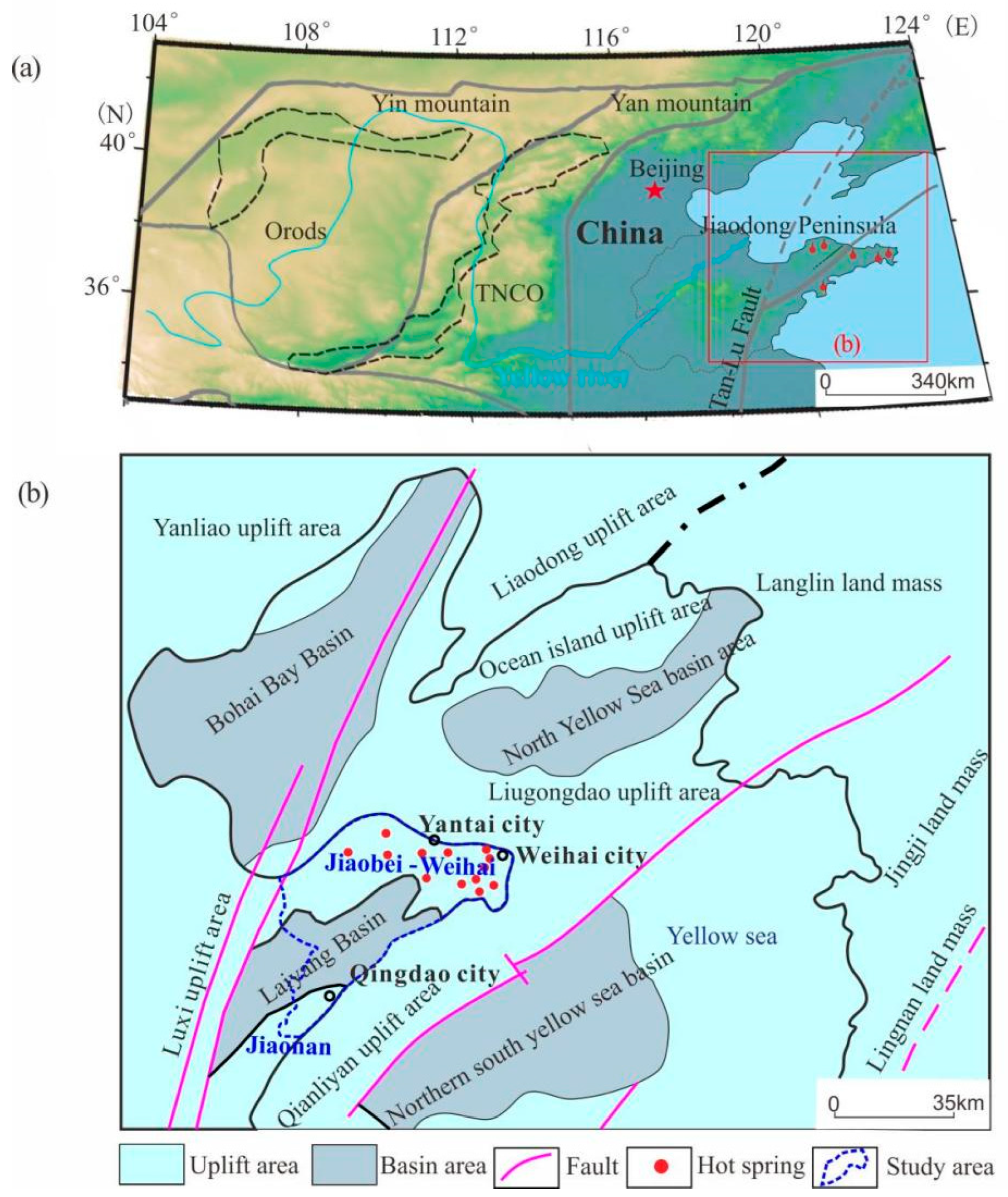
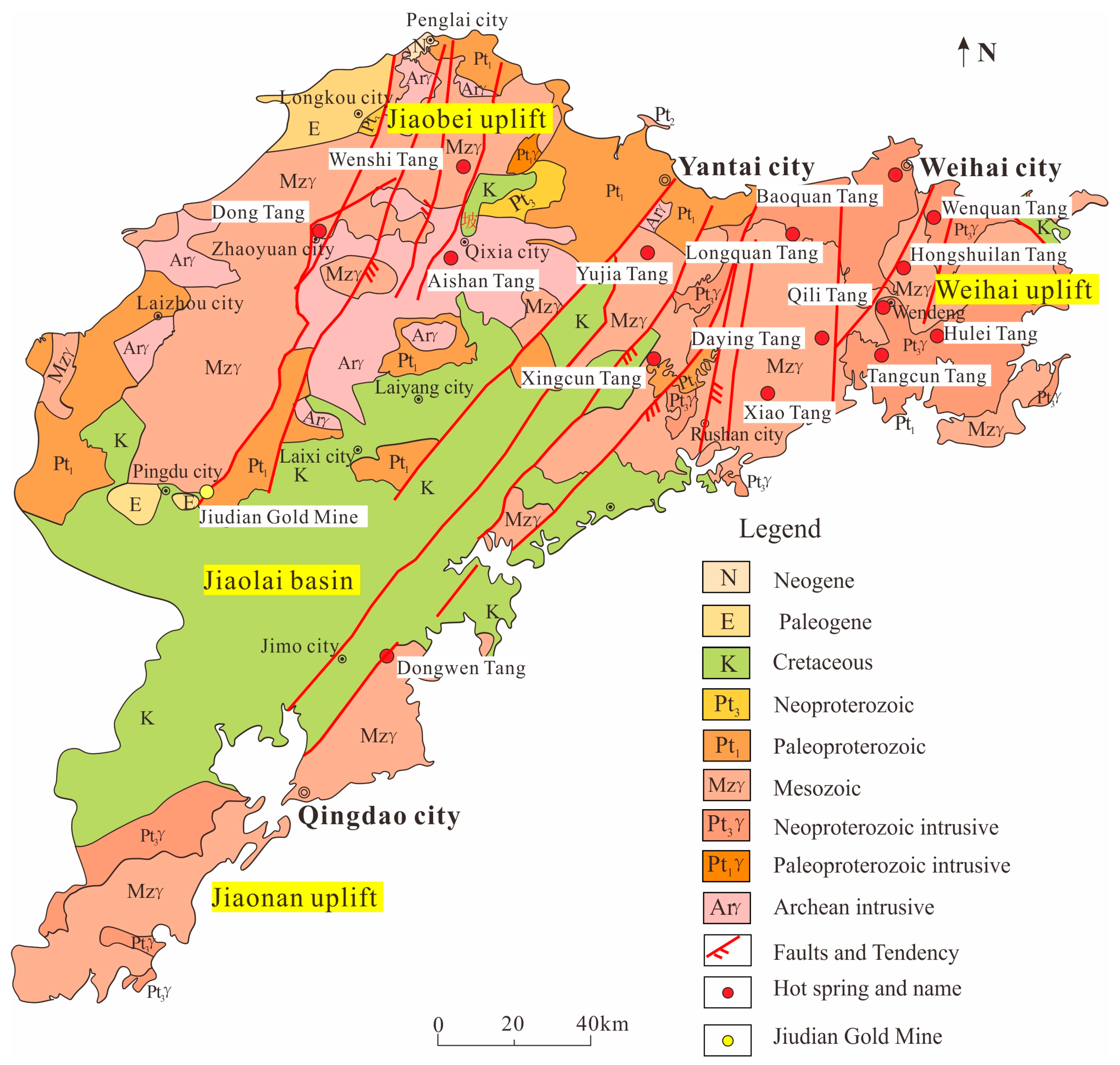
Jiaodong Peninsula belongs to the North China stratigraphic region and the East Shandong stratigraphic division. Affected by regional geological structure, the formation lithology in the study area consists of Cretaceous sedimentary sandstone in the Jiaolai Basin, while Archean, Proterozoic, and Mesozoic intrusive rocks are distributed in the Jiaonan–Weihai uplift and the Jiaobei uplift (Figure 1). The natural hot springs in the area are exposed along the axis of the uplift area dominated by intrusive rocks. Precambrian basement rock and intrusive rock with high thermal conductivity are widely exposed in the study area, and sedimentary caprock with low thermal conductivity is absent, a feature conducive to the formation of hot springs [23,24].
According to the “Classification Scheme for Stratigraphic and Intrusive Rock Structural Units in Shandong Province” [26], most of the study area is located in the North China Plate, which includes the Jiaobei uplift, the Jiaolai Basin, and the Sulu Orogenic Belt that includes the Weihai uplift and the Jiaonan uplift. The main structural features are the Qixia anticline, the Rushan–Weihai anticline, and the Jiaolai syncline. During its long history of geological development, Jiaodong Peninsula has experienced tectonic deformation, and its metamorphic base has developed multi-stage folds, ductile deformation, and shear deformation of different tectonic facies. Meanwhile, the collision between the Eurasian and Pacific plates has made the structural morphology of Jiaodong Peninsula more complex and variable, with widely developed NNE-, NE-, and NW-trending faults (Figure 2). The widely distributed faults in the study area provide basic structural conditions for the recharge and infiltration of geothermal fluid into underground channels, deep circulation runoff, hydrothermal convection in the deep crust, and upwelling along thermal storage channels.

3. Sampling and Data Analysis

Samples were collected from 15 hot springs to analyze the hydrochemical characteristics of geothermal fluid in the Jiaodong Peninsula (Figure 2). A total of 45 samples were taken for the major and trace element analyses, namely 15 samples of natural hot spring geothermal fluid, 15 samples of bedrock water, and 15 samples of Quaternary water near the hot spring exposure areas. Prior to the collection of the borehole water samples, the water was pumped for ~30 min. Sampling from different wells ensured that the bedrock and Quaternary water samples taken were not affected by geothermal fluid (Table 1). To ensure the quality of hydrochemical data, ion charge balance error (ICBE) was adopted for internal consistency verification. The results show that the absolute ICBE values of all samples are less than 5%, indicating high accuracy and good internal consistency of the measured data. The datasets are valid for subsequent Na–K–Mg ternary diagram analysis and hydrochemical genetic interpretation. For the element analyses, the samples were filtered (0.2 or 0.45 µm cellulose acetate) into acid-washed polypropylene bottles. The testing institution for full element analysis was the Jinan Mineral Resources Supervision and Testing Center of the Ministry of Land and Resources. A total of 12 samples were taken for hydrogen (δ2H) and oxygen (δ18O) isotope analyses. They were collected in amber glass bottles and analyzed within 1–2 days; the data were obtained at the Institute of Hydrogeology and Environmental Geology, Chinese Academy of Geological Sciences. The deuterium and oxygen isotope analysis results of the geothermal fluid are listed in Table 2. The results for geothermal fluid, Quaternary water, and bedrock water in Baoquan Tang, Longquan Tang, Jimo East Hot Springs, and Zhaoyuan East Tang are measured data; other data were collected from previous research.

4. Results and Discussion

4.1. Composition Characteristics of Geothermal Water

The hydrochemical composition of geothermal fluid is related to its burial conditions, the surrounding rock lithology, recharge conditions, the circulation depth, and water–rock interactions [27]. The properties of the geothermal reservoir rock largely determine the composition of the geothermal fluid, as this is the material basis for hydrochemical formation [28]. During the formation and migration of geothermal fluid, the fluid constantly reacts with the surrounding rock and dissolves the minerals present in the rock. Generally, the deeper the circulation of geothermal fluid, the longer the circulation time, the more prolonged the water–rock interaction, the higher the mineral content, and the more complex the hydrochemical type.
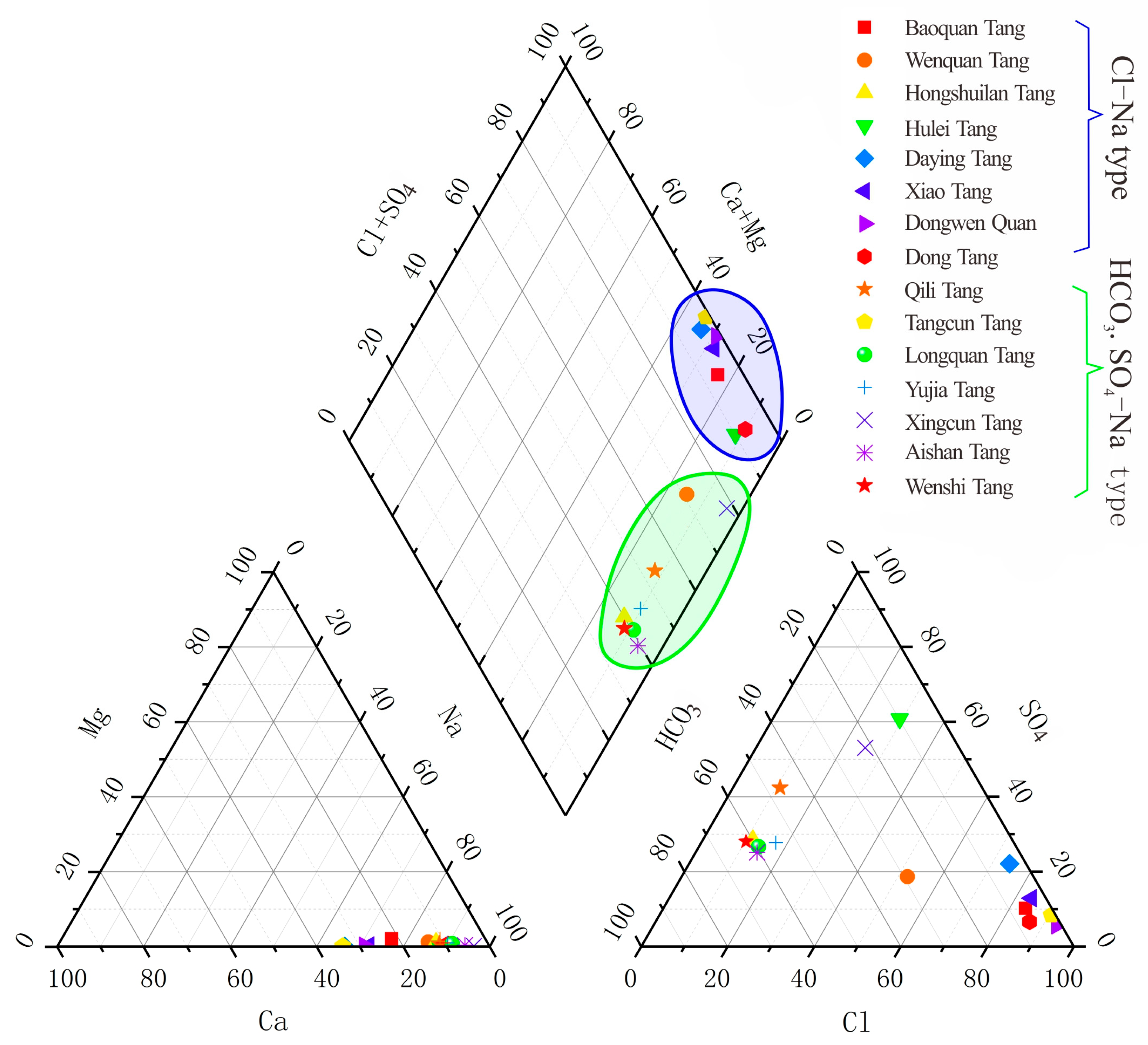
The mineralization degree of the hot spring water ranged from 0.45 to 7.68 g/L, with wide variation from low-mineralized to medium mineralized water (Table 1). Among these, the mineralization degrees of Baoquan Tang and Dongwen Tang, areas near the sea, were greater than 3 g/L because the geothermal fluid was also composed in part of seawater. The pH values ranged from 7.3 to 8.63, being alkaline as a whole. For the major components, the content of cation Na+ was the highest, followed by Ca2+. The main anion was Cl, mostly followed by HCO3 and SO42−. The hydrochemical types included Cl–Na, Cl–Na•Ca, HCO3•SO4–Na, and SO4•HCO3–Na (Figure 3). The distribution of these hydrochemical types shows a certain symmetric pattern corresponding to the regional fault network: Cl–Na and Cl–Na•Ca types are mainly distributed in areas with deep circulation and good sealing, while HCO3•SO4-Na and SO4•HCO3–Na types are concentrated in areas with shallow circulation and strong fluid activity, reflecting the symmetric response of hydrochemical characteristics to tectonic and hydrodynamic conditions.
The Jiaodong geothermal fluid is rich in beneficial elements and components. Among these, the content of F was 1.52–10.95 mg/L; metasilicic acid was 71–141 mg/L; Ba2+ was 0.05–0.41 mg/L; Li+ was 0.04–1.82 mg/L; and Sr2+ was 0.4–32.5 mg/L. The high content of trace elements is one of the main characteristics of the Jiaodong hot springs geothermal fluid.

4.2. Recharge Source of Geothermal Fluid

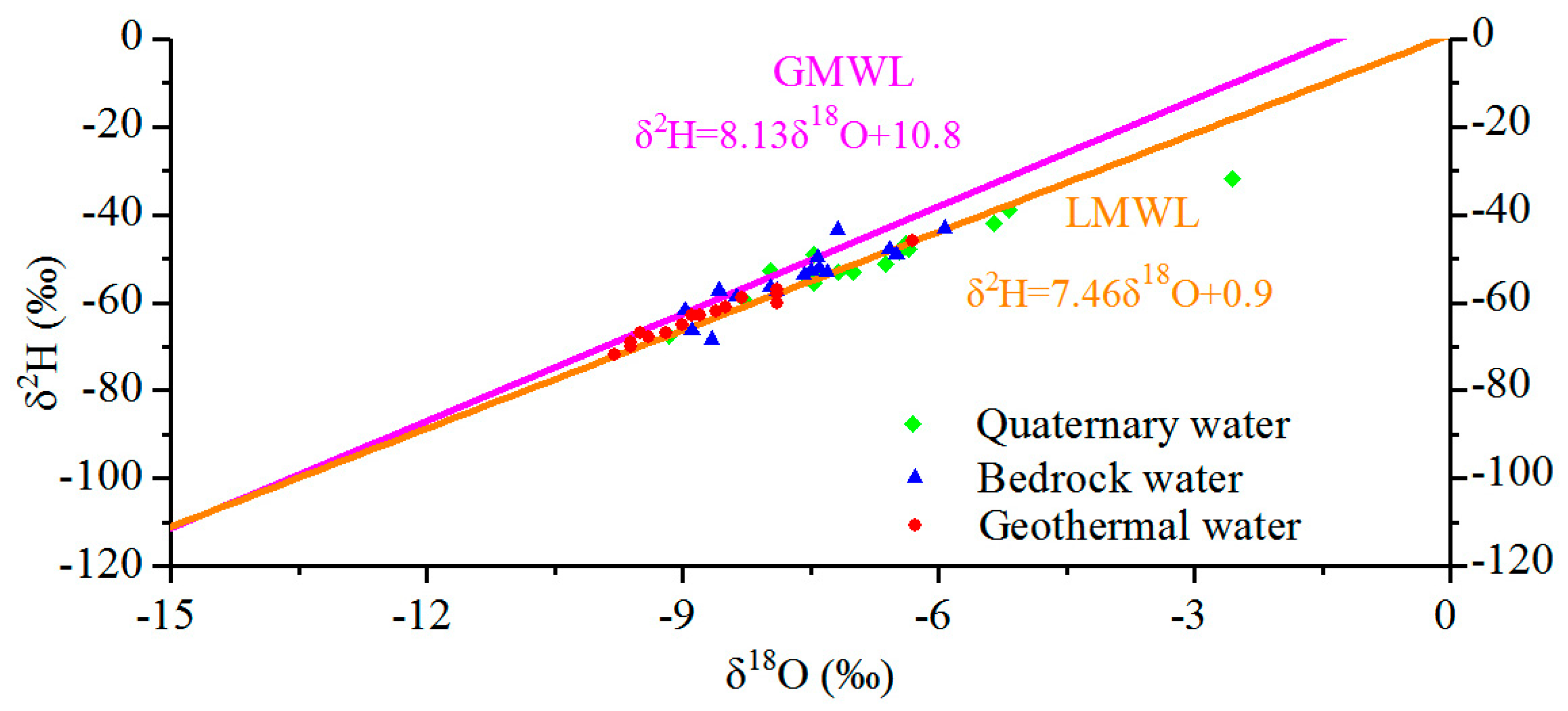
Because water from various sources is composed of different isotopes of hydrogen and oxygen, their composition in geothermal water can be used to identify the sources of geothermal fluid. The source of geothermal water can be determined by the positions of δ2H and δ18O data points on a δ2H–δ18O diagram [29]. If the δ2H and δ18O data points mostly fall near the atmospheric drawdown line, this indicates that the water originates from atmospheric precipitation; however, there are some cases where the δ2H and δ18O values of groundwater originate from atmospheric precipitation but deviate from the atmospheric drawdown line, a phenomenon that may be due to isotope exchange or other factors [30,31,32].
The δ2H and δ18O values of the hot spring geothermal fluid in the study area (Figure 4) were located near the Global Meteoric Water Line and the Local Meteoric Water Line in eastern China, and there was no clear oxygen drift, indicating that the source of the water in the geothermal fluid was primarily from atmospheric rainfall rather than endogenous water bodies or ancient sealed water in the Earth’s depths. The uniform distribution of isotope data points near the meteoric water line reflects the symmetric characteristics of atmospheric precipitation recharge in the regional geothermal system, where the isotope composition of geothermal fluid is consistent with the regional precipitation isotope background, showing a balanced and symmetric recharge pattern.
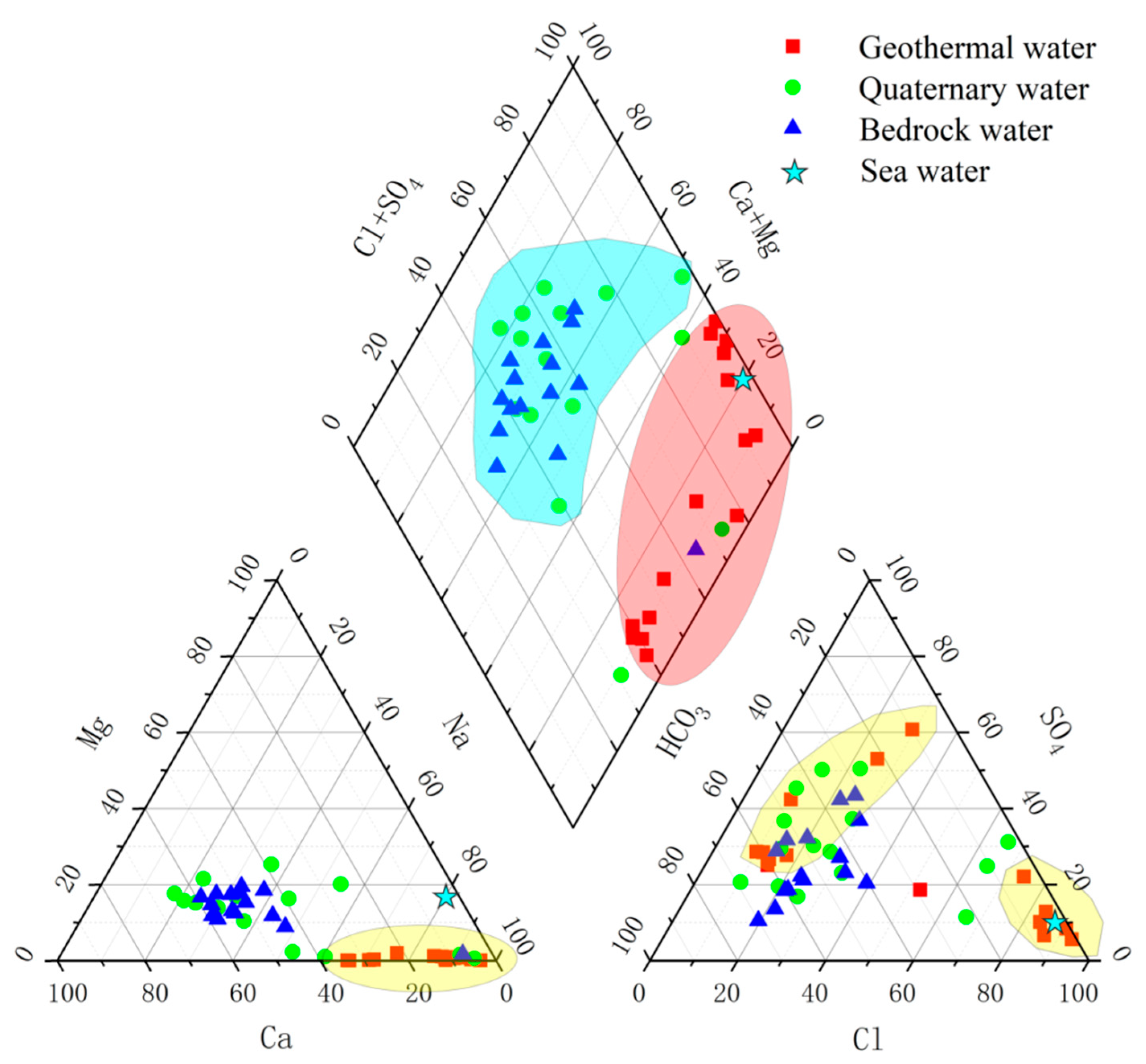
A Piper diagram of the natural hot spring and its surrounding bedrock deep wells and Quaternary shallow wells is shown in Figure 5 [33]. The hydrochemical type of geothermal fluid was significantly different from those of Quaternary water and bedrock water around the geothermal field, and the cations in the geothermal fluid were largely Na+ (yellow area in the bottom left corner), while the Quaternary and bedrock water around the geothermal field contained Ca2+ and Mg2+ ions. The Cl ion content in the geothermal fluid was significantly higher than that in the surrounding water (yellow area in the bottom right corner). By comparing the red and blue color areas in piper diagrams, the hydrochemical characteristics of geothermal water are significantly different from those of cold water. At the same time, the contents of Ba, Li, Sr, and dissolved silica in the geothermal fluid were significantly higher than those of the same ions in Quaternary shallow wells and bedrock deep wells near the hot springs, and the mineralization degree of the geothermal water was significantly higher than that of Quaternary shallow wells and bedrock deep wells. The above-mentioned characteristics demonstrate that the supply source of geothermal fluid is not Quaternary water or bedrock fissure water near the hot springs. Natural hot spring geothermal fluid has no or only weak hydraulic connections with the regional Quaternary water and bedrock water near the hot spring [34]. The water is supplied by atmospheric rainfall that infiltrates the surface through fissures; then the water migrates to the deeper layers along structural faults, and hydrothermal convection occurs at the deep areas of the Earth’s crust, and according to previous research, the depth of the circulation depth is generally calculated between 2 and 5 km [35]. The heated geothermal fluid rises along thermal storage channels, following weaker geological structures, to form hot springs.

4.3. Water–Rock Interaction

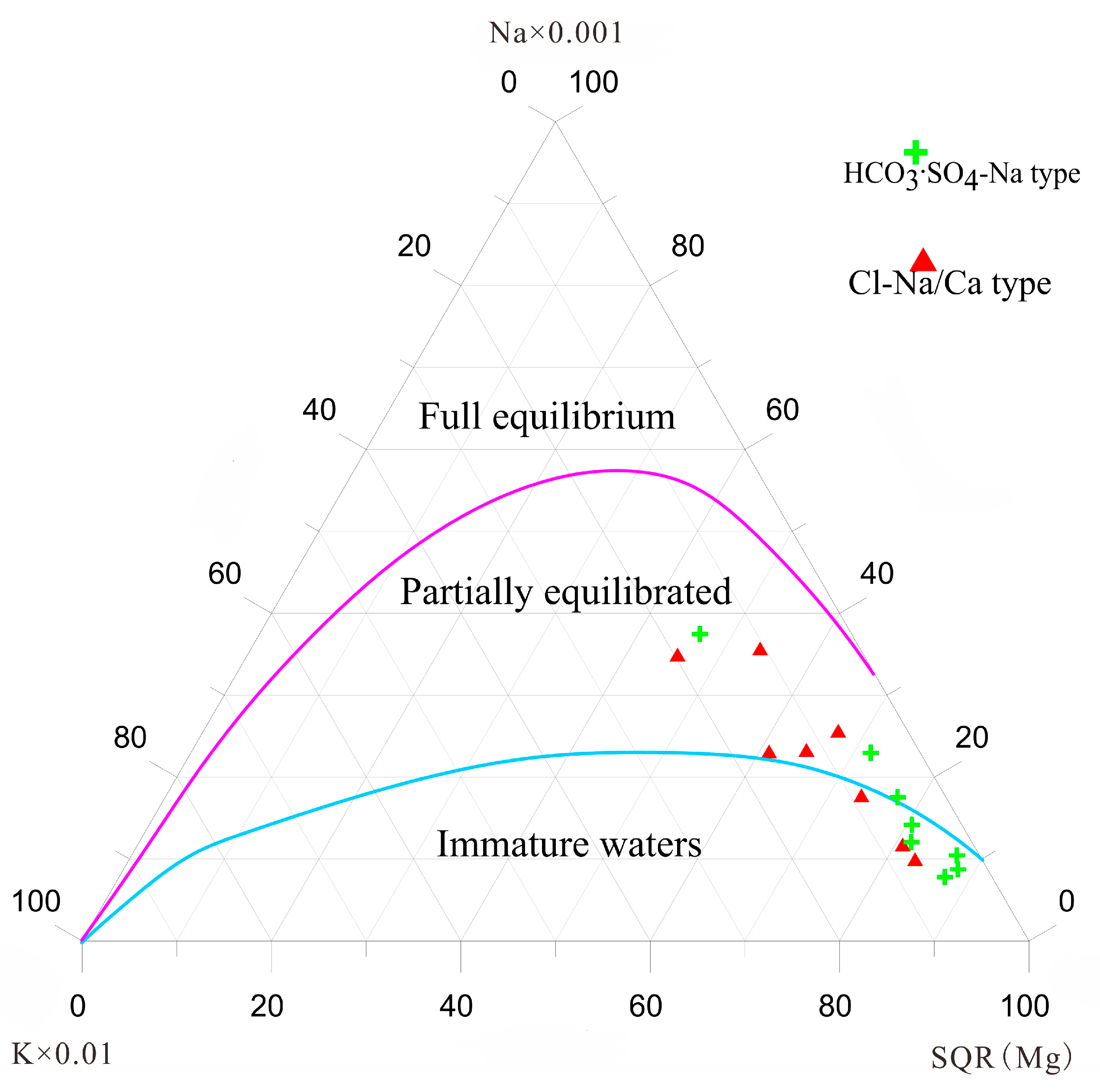
A Na–K–Mg triangular plot is a graphical method used to distinguish geothermal water from fully balanced water, partially balanced water, and immature water [18]. The graph can distinguish the types of geothermal water samples and can be used to evaluate the state of equilibrium and the mixing trend between hot water and the surrounding rock [36,37,38,39]. We used this method to evaluate the equilibrium state of geothermal water in Jiaodong.
The analysis is based on two chemical reactions:
Na-feldspar + K = K-feldspar + Na
2.8K-feldspar + 1.6H2O + Mg = 0.8 mica + 0.2 chlorite + 5.4SiO2 + 2K
When reactions (1) and (2) reach equilibrium, Na and K are saturated and stable at a certain temperature; when the local hot water rises to the surface, the temperature decreases; the equilibrium state is broken, and Na and K are in a non-equilibrium state. When the new equilibrium is reached, Na and K are in partial equilibrium.
The contents of Na, K, and Mg in the geothermal water in the study area were linearly transformed and projected onto an Na–K–Mg trilinear diagram.
The Na–K–Mg triangular plot is shown in Figure 6. Most of the geothermal water samples in the Jiaodong area are located in the “partially equilibrated” and “immature waters” areas and thus have not reached the water–rock balance. The distribution of Cl–Na (Ca) type water is relatively scattered, with most points located in the partially equilibrated area and others being located in the immature waters area; HCO3•SO4–Na-type water or SO4•HCO3–Na-type water occurs near the boundary between partially equilibrated and immature waters, with more points in the immature waters zone. The geothermal water and surrounding rock minerals in the Jiaodong area have not reached a chemical balance, and there is a low degree of water–rock interaction. This is because the geothermal fields in the Jiaodong area are open convection geothermal fields, and the geothermal water has continually been supplied by runoff discharge, and thus the water–rock interaction has not reached equilibrium. There was only a weak correlation between the degree of water–rock interaction and the hydrochemical type of the geothermal water.
Although the geothermal water and surrounding rock minerals in the Jiaodong area have not reached a chemical balance, but according to Table 3, it can be seen that Calcite and dolomite in all water samples are supersaturated, which provides favorable conditions for decarbonation precipitation. Quartz and chalcedony are universally supersaturated, leading to easy precipitation of siliceous minerals. Fluorite shows slight supersaturation at most sampling sites. Barite is undersaturated only at Yujia Tang and Xingcun Tang, while supersaturated in other samples.

4.4. Ion Proportional Coefficient Analysis of Na, Cl and SO4

The ratio coefficient of each ion in geothermal fluid can indirectly explain the type of geothermal fluid. The conventional ion coefficients γ Na/γ Cl and γ SO4/γ Cl were selected for evaluation, and the origins of geothermal water were analyzed by comparing the differences in ion coefficients between geothermal water and seawater [35,40]. The ion ratio coefficients of γ Na/γ Cl and γ SO4/γ Cl in geothermal fluid in various regions are listed in Table 4.

4.4.1. γ Na/γ Cl

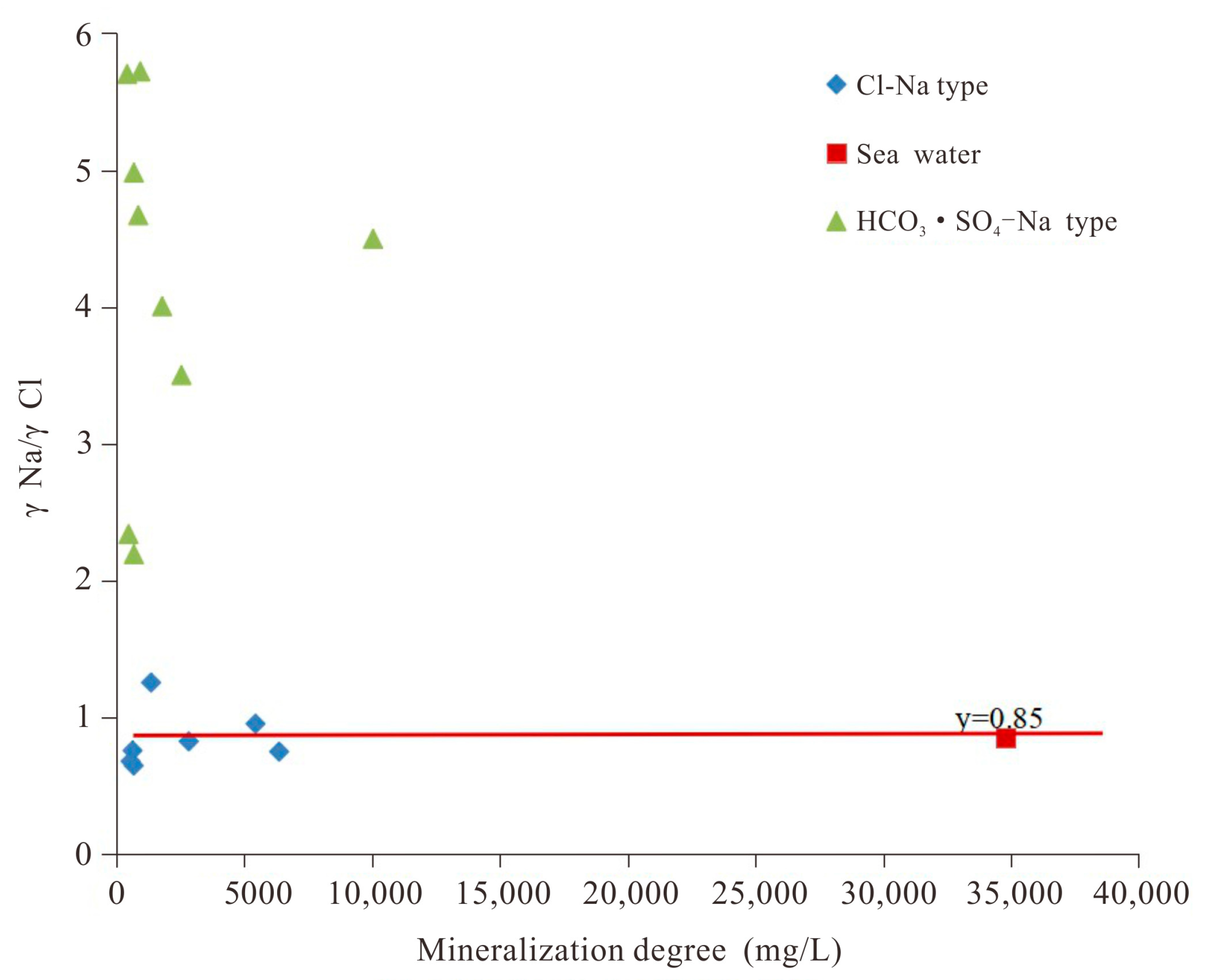
The metamorphic coefficient (γ Na/γ Cl) reflects the degree of groundwater concentration and metamorphism as well as the hydrogeochemical environment of the thermal reservoir. It is generally assumed that the smaller the metamorphic coefficient (γ Na/γ Cl), the better the sealing and concentration of groundwater, and the deeper the metamorphism; this is reflected in the relatively reduced water environment. If the metamorphic coefficient (γ Na/γ Cl) is less than 0.85, the groundwater is generally stagnant, indicating that the groundwater is in a relatively stagnant state. The greater the metamorphic coefficient, the stronger the groundwater activity.
The γ Na/γ Cl values of geothermal water with hydrochemical types of Cl–Na and Cl–Na•Ca were close to or less than the γ Na/γ Cl value of seawater, being generally about 0.85 (Figure 7), indicating that the geothermal water is in a relatively stagnant state; this is perhaps due to the mixing with seawater. The γ Na/γ Cl values of other geothermal fields are generally greater than 2, far greater than the γ Na/γ Cl value of seawater (0.85), reflecting the strength of the convection type of geothermal water, geothermal water activity, and renewable ability. The distribution of γ Na/γ Cl values shows a symmetric gradient with the circulation depth: as the circulation depth increases, the γ Na/γCl value gradually decreases and approaches the seawater value, forming a symmetric relationship between ion ratio and depth.

4.4.2. γ SO4/γ Cl

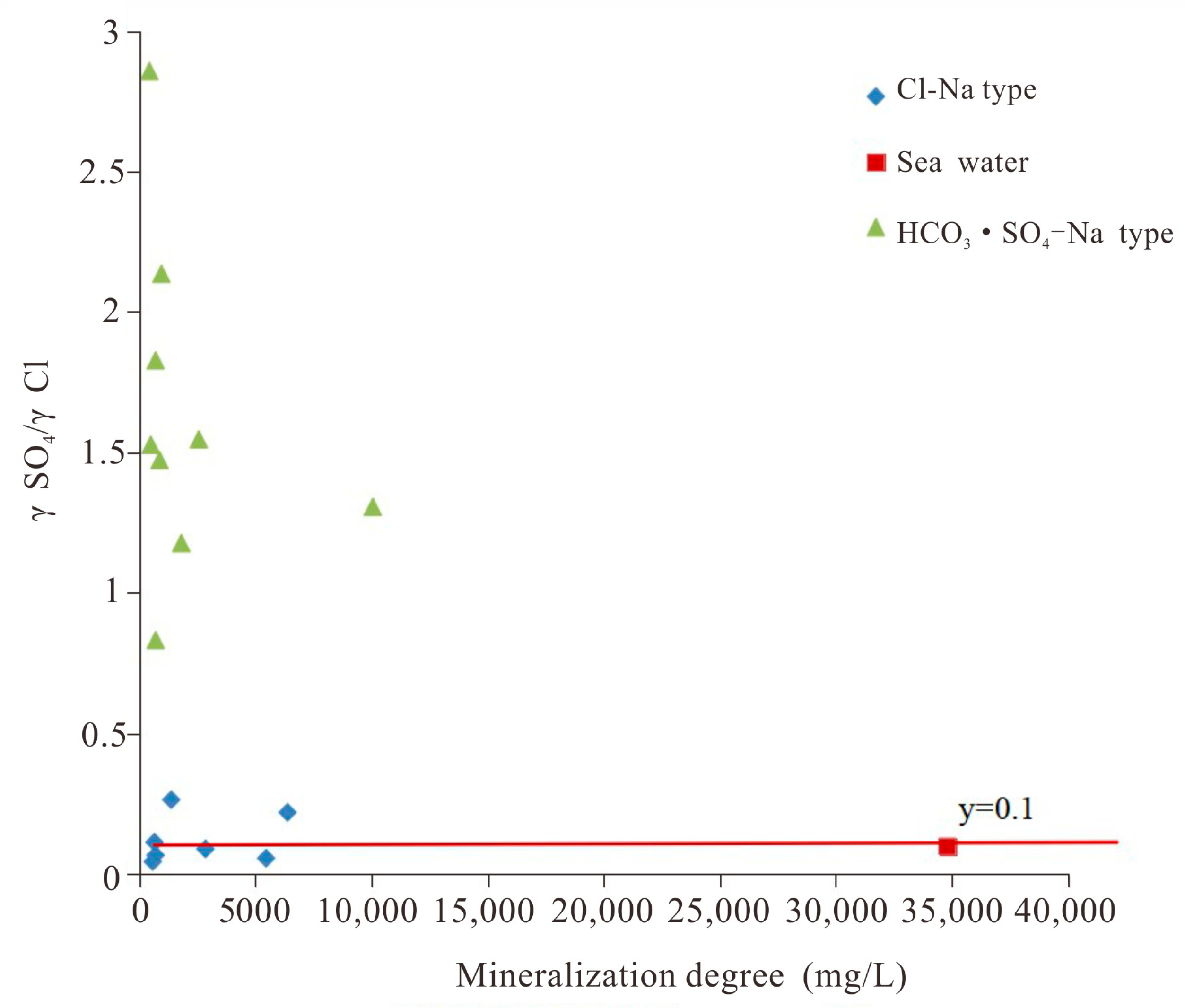
The desulfurization coefficient (γ SO4/γ Cl) indicates the redox environment of groundwater. In general, the smaller (γ SO4/γ Cl), the better the sealing of groundwater, and conversely.
According to the desulfurization coefficients (Figure 8), the γ SO4/γ Cl values of geothermal water with hydrochemical types of Cl–Na and Cl–Na•Ca were generally close to the value of seawater (0.10), indicating that the geothermal water has good sealing performance. The main reason involves the mixing of geothermal water and seawater. The γ SO4/γ Cl values of other geothermal fields were generally greater than 1.00, far greater than the value of seawater (0.10), reflecting the poor sealing of the geothermal water hydrodynamic environment and stronger renewable ability.
The metamorphic coefficient (γ Na/γ Cl) and (γ SO4/γ Cl) indicated that the hydrodynamic environment of Cl–Na and Cl–Na•Ca geothermal water is well sealed; the groundwater is in a relatively stagnant state, and its salinity is generally high. The hydrodynamic environments of HCO3•SO4–Na and SO4•HCO3–Na geothermal water were poor; there is high groundwater activity with relatively low salinity. This contrast reflects the symmetric duality of the regional geothermal hydrodynamic environment, where two types of geothermal systems (stagnant and convective) coexist and complement each other, forming a symmetric distribution pattern in the Jiaodong Peninsula.
Comparisons of the ion ratio coefficient with the circulation depth of geothermal fluid showed that the greater the ratios of γ Na/γ Cl and γ SO4/γ Cl, the stronger the activity of geothermal fluid and the greater the renewable ability. Meanwhile, the circulation depths of geothermal fluids with higher ratios were shallower than those of geothermal fields with lower ratios, indicating that the deeper the circulation depth, the weaker the renewable ability of geothermal fluid.

4.5. Hydrochemical Evolution Mechanism Analysis of Geothermal Water

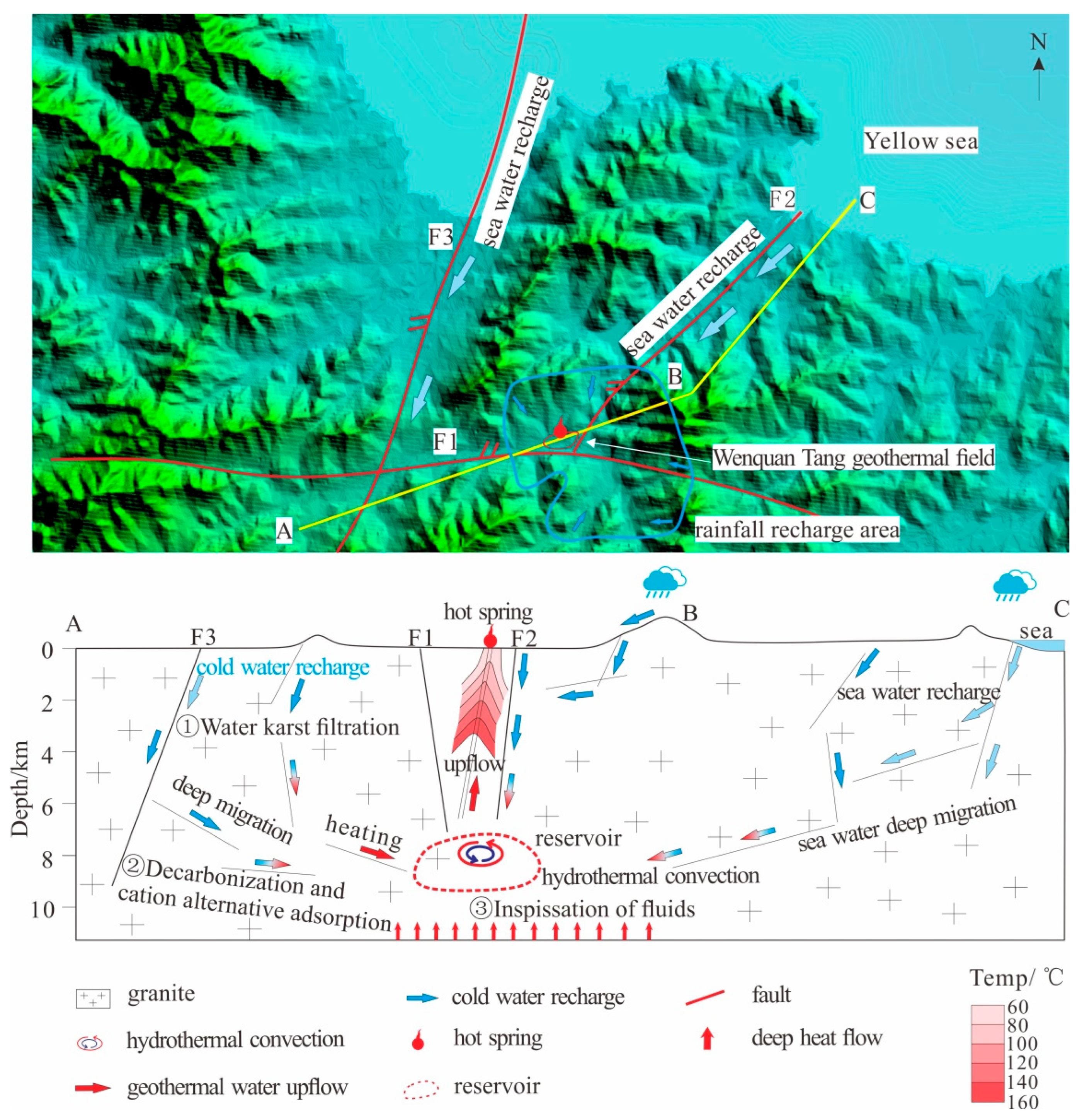
Our analysis of hydrochemical characteristics found that the geothermal fluid in Jiaodong has no hydraulic connection with the nearby Quaternary water and bedrock water, but, rather, is primarily from the infiltration recharge of atmospheric rainfall that is far away from the geothermal fluid. For the geothermal fields close to the sea, the geothermal waters are mainly of meteoric origin with a minor degree of seawater mixing and/or possible salt input in the coastal areas, followed by modification via water–rock interactions and mixing with non-thermal groundwaters. The circulation depth of geothermal fluid was between 2 and 5 km [17]. At the same time, through the ratio of γ Na/γ Cl and γ SO4/γ Cl of geothermal fluid, it is found that the circulation depth of geothermal fields with generally large ratios of γ Na/γ Cl and γ SO4/γ Cl is relatively shallow, mostly distributed below 5 km, and their hydrochemical types are mainly HCO3•SO4–Na and SO4•HCO3–Na, while the circulation depth of geothermal fields with similar ratios of γ Na/γ Cl and γ SO4/γ Cl to seawater may have circulation depths exceeding 6 km (even more than 10 km), with hydrochemical types mainly Cl–Na and Cl–Na•Ca. This correlation between ion ratios, circulation depth, and hydrochemical types reflects the symmetric regularity of the regional geothermal system, where the geochemical evolution of geothermal fluid follows a symmetric pattern with the change in circulation depth. The geothermal fluid in the Jiaodong area is not in a state of water–rock balance, which is mainly due to the fact that the geothermal fluid in Jiaodong belongs to the open convection geothermal field controlled by the fault structure and is in the process of continuous recharge, runoff, and discharge. The geothermal fluid constantly reacts with the surrounding rock, but it is not easy to achieve water–rock balance. The geothermal fluid in the recharge area is dominated by leaching, with rapid water alternation and low mineralization. As the geothermal fluid continues to migrate to the deep crust, it continues to decarbonate with the surrounding rock and alternate adsorption of cations, and the mineralization of the fluid further increases. The hydrochemical types are mainly HCO3•SO4–Na and SO4•HCO3–Na. If the geothermal fluid further migrates to the deep crust for deeper circulation at this time, the components of the geothermal fluid will further decarbonate, the mineralization will increase, and the hydrochemical type will be mainly Cl–Na and Cl–Na•Ca (Figure 9).
Overall, hot springs in the study area belong to medium–low temperature geothermal resources controlled by fault structures, and they outcrop at the intersection of NE-, NNE- and NW-trending deep faults. Geothermal manifestations are more abundant in fault intersection zones, because the intersection of two groups of faults forms highly fractured belts that serve as high-permeability channels for geothermal fluid migration. As shown in Figure 9, atmospheric precipitation infiltrates underground through permeable surface fractures in high-altitude recharge mountainous areas and migrates toward the deep crust. During migration along water-conducting faults, continuous water–rock interaction alters the hydrochemical properties of groundwater. Meanwhile, groundwater absorbs heat from surrounding rocks and deep heat-conducting faults via thermal conduction and is heated into geothermal fluid at depth. When migrating to fractured reservoirs formed by intersecting deep faults, geothermal fluid rapidly ascends along reservoir channels under hydrostatic pressure and buoyancy, eventually forming hot springs.

5. Conclusions

(1)
The Jiaodong geothermal fluid is a medium–low-temperature convective resource controlled by the local fault structure. The geothermal resource is exposed in the Jiaobei uplift and the Jiaonan Weihai uplift, and its hydrochemical types are dominated by Cl–Na, Cl–Na•Ca water, and HCO3•SO4–Na, SO4•HCO3–Na water. Deuterium and oxygen isotope analysis showed that the geothermal fluid originates from atmospheric rainfall, and there is no hydraulic connection between the geothermal fluid and the surrounding bedrock water body or Quaternary water body, indicating that after atmospheric rainfall infiltrates below ground, it enters the deep crust along surface fissures as deep circulation runoff, and upwelling after hydrothermal convection heating at the appropriate location forms hot springs.
(2)
The results showed that the geothermal fluid in Jiaodong has not reached a state of water–rock equilibrium; the geothermal fluid is in the process of continuous recharge, runoff, and discharge. The geothermal fields with generally large ratios of γ Na/γ Cl and γ SO4/γ Cl of geothermal fluid have relatively shallow circulation depths, indicating poor hydrodynamic environments. There is strong groundwater activity and high renewable ability. The ratios of γ Na/γ Cl and γ SO4/γ Cl in some geothermal fields are close to those of seawater due to the deep circulation depth, the long residence time of geothermal fluid, and the relatively weak groundwater activity, forming a symmetric relationship between ion ratio and depth. The geothermal fluid has experienced a high degree of decarburization. The geothermal fields close to the sea are affected by shallow seawater recharge. The distribution of geothermal fluid properties and hydrodynamic environments shows a symmetric pattern, which enriches the research on symmetry in hydrogeological and geothermal systems.

Author Contributions

Investigation, M.S., P.J., X.G., Y.B., F.K., Z.Y., L.Y., J.Z. (Jinhua Zhu) and P.F.; Writing—original draft, M.S., P.J., X.G., M.H., Y.B., F.K. and X.R.; Writing—review & editing, M.S., J.Z. (Jie Zhang) and F.K.; Project administration, M.S., J.Z. (Jie Zhang), M.H. and F.K. All authors have read and agreed to the published version of the manuscript.

Funding

This research was funded by the Natural Science Foundation of Shandong Province (grant number ZR2022QD060), the National Natural Science Foundation of China (grant numbers 42072331, U25D9017), and the Taishan Scholar Foundation (No. tstp20230626).

Data Availability Statement

The original contributions presented in this study are included in the article. Further inquiries can be directed to the corresponding author.

Acknowledgments

We are grateful to editors and reviewers for their constructive comments and valuable suggestions that significantly improved this manuscript.

Conflicts of Interest

Author Xiaoqing Ren was employed by Sinopec Green Energy Geothermal Development Co., Ltd. The remaining authors declare that the research was conducted in the absence of any commercial or financial relationships that could be construed as a potential conflict of interest.

References

  1. Jin, B.F.; Zhang, Y.J.; Luan, G.Z. Geothermal characteristics of warm springs in Jiaodong Peninsula. Hydrogeol. Eng. Geol. 2000, 31, 31–37. [Google Scholar] [CrossRef]
  2. Shi, M.; Kang, F.X.; Zhang, J.; Gao, S.; Yu, X.J. Discussion on the deep heat flow diversion-acculturation between uplift and depression in different tectonic units in the Jiaodong Peninsula. Acta Geol. Sin. 2021, 95, 1594–1605. [Google Scholar] [CrossRef]
  3. Shi, M.; Kang, F.X.; Yin, T.; Gao, S.; Sui, H.B.; Guo, X.; Yu, X.J. Occurrence mechanism of convective geothermal systems in Jiaodong Peninsula, China. Front. Earth Sci. 2022, 10, 898414. [Google Scholar] [CrossRef]
  4. Heine, F.; Zosseder, K.; Einsiedl, F. Hydrochemical zoning and chemical evolution of the deep Upper Jurassic thermal groundwater reservoir using water chemical and environmental isotope data. Water 2021, 13, 1162. [Google Scholar] [CrossRef]
  5. Craig, H. The isotopic geochemistry of water and carbon in geothermal areas. In Nuclear Geology on Geothermal Areas; Consiglictorio di Geologia Nucleare: Spoleto, Italy, 1963; pp. 17–53. [Google Scholar]
  6. Tiwari, S.K.; Rai, S.K.; Bartarya, S.K.; Gupta, A.K.; Negi, M. Stable isotopes (δ13C-DIC, δD, δ18O) and geochemical characteristics of geothermal springs of Ladakh and Himachal (India): Evidence for CO2 discharge in northwest Himalaya. Geothermics 2016, 64, 314–330. [Google Scholar] [CrossRef]
  7. Zheng, S.H.; Zhang, Z.F.; Ni, B.L.; Hou, F.G.; Shen, M.Z. Hydrogen and oxygen isotopic studies of thermal waters in Xizang. Acta Sci. Nat. Univ. Pekin. 1982, 1, 102–109. [Google Scholar]
  8. Barragán, R.M.; Arellano, V.M.; Portugal, E.; Sandoval, F. Isotopic (δ18O, δD) patterns in Los Azufres (Mexico) geothermal fluids related to reservoir exploitation. Geothermics 2005, 34, 527–547. [Google Scholar] [CrossRef]
  9. Liu, C.L.; Li, Y.S.; Hong, B.Y.; Cao, S.W.; Wang, W.L.; Li, J.F. Geochemical characteristics and formation mechanisms of the seawater-recharged geothermal systems in Yantian of Fujian, China. Hydrogeol. Eng. Geol. 2023, 50, 158–167. [Google Scholar] [CrossRef]
  10. Lei, Y.K.; Wang, S.; Huang, X.L.; Lin, J.Y.; Han, Y.J.; Chen, Z.H.; Qi, S.H. Hydrochemical characteristics and formation evolution of high-salinity medium-low temperature geothermal systems along the western Guangdong coast. Earth Sci. 2025, 50, 3616. [Google Scholar] [CrossRef]
  11. Li, H.T.; Zhang, S.Q.; Bai, J.Q.; Zhou, J.Y.; Shi, W.D.; Zhao, Y. Hydrochemistry and origin of the Yaoshuitan geothermal field, Xining, Qinghai. Acta Geol. Sin. 2007, 81, 1299–1304. [Google Scholar]
  12. Yang, X.C.; Kang, F.X.; Wang, X.P.; Fu, Q.J.; Liu, Z.T. Hydrochemical features of geothermal reservoir geotemperature field in sandstone porosity and enrichment mechanism of geothermal water: A case study of geothermal reservoir of Guantao Formation in the Lubei Area. Acta Geol. Sin. 2019, 93, 738–750. [Google Scholar] [CrossRef]
  13. Liu, Z.; Chen, K.; Nan, D.W. Hydrochemical characteristics of geothermal water in Gudui, Xizang (Tibet). Geol. Rev. 2017, 63, 353–354. [Google Scholar]
  14. Zhang, T. Study on hydrochemistry and isotopic characteristics of geothermal water in Jiaodong area. Land Resour. Shandong Prov. 2011, 27, 11–16. [Google Scholar] [CrossRef]
  15. Zhao, H.; Yin, T.; Shi, M.; Jiang, H.Y. Recharge runoff and discharge characteristics of geothermal fluid of Jiaodong geothermal fields. Shandong Land Resour. 2019, 35, 65–73. [Google Scholar] [CrossRef]
  16. Song, M.C.; Song, Y.X.; Li, J.; Liu, H.B.; Li, J.; Dong, L.L.; He, C.Y.; Wang, R.S. Thermal doming-extension metallogenic system of Jiaodong type gold deposits. Acta Petrol. Sin. 2023, 39, 1241–1260. [Google Scholar] [CrossRef]
  17. Zheng, T.T.; Stefansson, A.; Kang, F.X.; Shi, M.; Jiang, H.Y.; Sui, H.B. Geochemical and isotope constraints on the hydrogeology and geochemistry of geothermal waters in the Shandong Peninsula, China. Geothermics 2023, 108, 102628. [Google Scholar] [CrossRef]
  18. Giggenbach, W.F. Geothermal solute equilibria: Derivation of Na-K-Mg-Ca geoindicators. Geochim. Cosmochim. Acta 1988, 52, 2749–2765. [Google Scholar] [CrossRef]
  19. Fahrurrozie, A.; Saputra, M.P.; Nugraha, T. The application of Na-K-Mg, Na-K/Mg-Ca and K-Mg/Quartz diagrams to evaluate water geochemistry in West Java geothermal prospects. In Proceedings of the World Geothermal Congress, Nusa Dua, Indonesia, 19–25 April 2015; Available online: https://worldgeothermal.org/geothermal-data/conference-paper-database (accessed on 10 October 2025).
  20. Fournier, R.O. Chemical geothermometers and mixing models for geothermal systems. Geothermics 1977, 5, 41–50. [Google Scholar] [CrossRef]
  21. Fournier, R.O. A revised equation for the Na/K geothermometer. Trans. Geotherm. Resour. Counc. 1979, 3, 221–224. [Google Scholar]
  22. Shi, M.; Kang, F.X.; Zhang, J.; Yin, T.; Han, M.Z. Occurrence mechanism and geothermal exploration model of low-medium temperature convective geothermal systems in Jiaodong Peninsula. Geol. Rev. 2019, 65, 1276–1287. [Google Scholar] [CrossRef]
  23. Xiong, L.P.; Zhang, J.M. Mathematical simulation of heat flow refraction and redistribution. Chin. J. Geol. 1984, 4, 445–454. [Google Scholar]
  24. Li, X.L.; Liu, B.H.; Sun, X.G.; Wang, Y.H. Relationship between silica heat flow and regional geological conditions in Shandong Peninsula. J. Ocean Univ. Qingdao 1997, 1, 75–83. [Google Scholar] [CrossRef]
  25. Gong, C.L.; Lei, H.Y.; Wang, Y.M.; Liu, Z.H.; Guan, B.C.; Hu, X.Q.; Lu, J.B. Hydrocarbon geological characteristics and structural evolution in the eastern depression of North Yellow Sea Basin. Mar. Geol. Quat. Geol. 2009, 1, 79–86. [Google Scholar] [CrossRef]
  26. Shandong Provincial Department of Land and Resources. Classification Scheme for Stratigraphic and Intrusive Rock Structural Units in Shandong Province. 2024, Document No. [2014]185. Available online: http://www.sdsddy.ac.cn/uploads/soft/170424/1-1F424102259.pdf (accessed on 24 September 2025).
  27. Jin, B.F.; Zhang, Y.J.; Luan, G.Z. Characteristics of geothermal resources in Jiaodong Peninsula. J. Yantai Norm. Univ. (Nat. Sci.) 1999, 4, 297–301. [Google Scholar] [CrossRef]
  28. Pandey, S.N.; Vishal, V.; Chaudhuri, A. Geothermal reservoir modeling in a coupled thermo-hydro-mechanical-chemical approach: A review. Earth-Sci. Rev. 2018, 185, 1157–1169. [Google Scholar] [CrossRef]
  29. Zhang, B.B.; Xu, Q.; Gao, D.Q.; Zuo, H.J.; Ren, R.R.; Xu, W.B. Characteristics and Drivers of δD and δ18O in Precipitation over Subtropical China. Terr. Ecosyst. Conserv. 2022, 2, 13–20. [Google Scholar] [CrossRef]
  30. Chen, Z.Y.; Qi, J.X.; Zhang, Z.J. Application of Isotope Hydrogeological Methods in Typical Northern Basins; Science Press: Beijing, China, 2010; pp. 271–282. [Google Scholar]
  31. Arnason, B. Hot groundwater systems in Iceland traced by deuterium. Nord. Hydrol. 1977, 8, 93–102. [Google Scholar] [CrossRef]
  32. Stefánsson, A.; Arnórsson, S.; Sveinbjörnsdóttir, Á.E.; Heinemaier, J.; Kristmannsdóttir, H. Isotope (δD, δ18O, 3H, δ13C, 14C) and chemical (B, Cl) constraints on water origin, mixing, water-rock interaction and age of low-temperature geothermal water. Appl. Geochem. 2019, 108, 1741–1758. [Google Scholar] [CrossRef]
  33. Ray, R.K.; Mukherjee, R. Reproducing the Piper trilinear diagram in rectangular coordinates. Groundwater 2008, 46, 893–896. [Google Scholar] [CrossRef]
  34. Lu, X.R.; Zhou, A.G.; Wang, M.T.; Yang, L.; Lu, H. Characteristic analysis of phreatic water quality evolution by Piper diagram in Huaihe River drainage area, Jiangsu Province. Geotech. Investig. Surv. 2010, 38, 42–47. [Google Scholar]
  35. Xing, L.T.; Zhang, F.J.; Li, C.S.; Yang, L.Z.; Wang, L.Y. Hydrochemical characteristics of shallow groundwater in the North Shandong Plain. J. Irrig. Drain. 2015, 6, 90–94. [Google Scholar] [CrossRef]
  36. Gianelli, G.; Teklemariam, M. Water-rock interaction processes in the Aluto-Langano geothermal field (Ethiopia). J. Volcanol. Geotherm. Res. 1993, 56, 429–445. [Google Scholar] [CrossRef]
  37. Wang, H.; Chai, R. Application of geothermometers in geothermal systems. J. Hebei Univ. Eng. 2009, 3, 54–58. [Google Scholar] [CrossRef]
  38. Juliarka, B.R.; Niasari, S.W. Geothermal exploration using geochemical data: A case study of the Parang Wedang geothermal field, Indonesia. In Proceedings of the AIP Conference Proceedings; AIP Publishing: Melville, NY, USA, 2016; Volume 1755, p. 100003. [Google Scholar] [CrossRef]
  39. Aydin, H.; Karakuş, H.; Mutlu, H. Hydrogeochemistry of geothermal waters in eastern Turkey: Geochemical and isotopic constraints on water-rock interaction. J. Volcanol. Geotherm. Res. 2020, 390, 106708. [Google Scholar] [CrossRef]
  40. Gao, S.Q.; Liu, K.; Sun, W.J.; Guo, C.B. Water chemistry and strontium isotope geochemistry characteristic of granitic banded thermal reservoirs. Yangtze River 2022, 53, 36–42. [Google Scholar] [CrossRef]
Figure 1. (a) Location of the study area; (b) Regional tectonic unit partition map in North China (modified from Gong et al. [25]).
Symmetry 18 01019 g001
Figure 2. Geology and structure of bedrock and distribution diagram of hot springs in Jiaodong Peninsula.
Symmetry 18 01019 g002
Figure 3. Piper diagrams of hot spring hydrochemical types in Jiaodong Peninsula.
Symmetry 18 01019 g003
Figure 4. δ2H-δ18O in the hot water of geothermal fields in Jiaodong Peninsula.
Symmetry 18 01019 g004
Figure 5. Piper diagrams of Jiaodong natural hot springs and surrounding bedrock deep wells, shallow Quaternary wells.
Symmetry 18 01019 g005
Figure 6. Na–K–Mg equilibrium diagram of geothermal fluid in the Jiaodong geothermal field.
Symmetry 18 01019 g006
Figure 7. The relationship between geothermal fluid hydrochemistry types and γ Na/γ Cl-mineralization degree in Jiaodong Hot Springs.
Symmetry 18 01019 g007
Figure 8. The relationship between geothermal fluid hydrochemistry types andγ SO4/γ Cl-mineralization degree in Jiaodong Hot Springs.
Symmetry 18 01019 g008
Figure 9. Schematic diagram of geothermal fluid component discharge and deep circulation processes in Jiaodong Wenquan Tang.
Symmetry 18 01019 g009
Table 1. Water quality analysis of natural hot springs, bedrock wells, and Quaternary wells in Jiaodong (units: mg/L).
Sample DotSampling Well TypeTemperature (°C)pHNa+K+Ca2+Mg2+ClSO42−HCO3FH2SiO3BaLiSrTDS
BaoQuan TangHot spring677.631553.0077.00439.2041.462906.25355.15208.992.3988.000.131.4720.405555.74
Quaternary well147.1677.0723.21122.1040.84146.8898.23336.700.3341.3000.020.54805.32
Bedrock well147.3267.742.19134.2042.80126.25108.31351.210.2245.8000.030.52776.62
Wenquan TangHot spring587.48314.0019.9050.484.65386.07138.53214.793.80111.200.070.972.001113.86
Quaternary well167.2323.061.6436.6112.0641.7745.3469.960.2822.100<0.020.24240.14
Bedrock well147.4929.711.1942.3413.0737.3420.15133.520.2828.500<0.020.23274.67
Hongshuilan
Tang
Hot spring747.30184.0013.0025.462.3556.96141.05296.065.23136.500.090.591.50681.79
Quaternary well156.7827.744.05100.7027.7437.34110.83153.840.4135.0000.020.58554.14
Bedrock well146.9729.790.7355.5110.5339.8725.19119.010.3933.8000.030.90319.74
Qili TangHot spring668.46170.809.1022.431.3546.20178.83197.388.92136.500.060.311.6641.95
Quaternary well167.50206.500.8117.193.6652.53105.79354.127.6144.4000.160.62609.42
Bedrock well158.9468.534.0372.3518.96126.5865.49130.620.4431.2000.020.71513.58
Hulei TangHot spring608.36262.1013.3034.330.53172.78357.6758.055.89141.10<0.050.302.20985.25
Quaternary well156.7673.3111.6664.2026.81109.4978.08150.930.5430.200<0.020.53556.31
Bedrock well146.7036.131.5555.5713.1956.9640.3075.470.2139.400<0.020.41369.68
Tangcun TangHot spring517.581355.0057.90695.902.833227.79299.7334.831.5271.300.121.5332.55724.11
Quaternary well167.0629.5124.9931.8121.0035.4468.01127.710.3918.6000.020.37315.65
Bedrock well147.6630.341.3262.2115.9360.7652.89136.420.4434.1000.020.59349.85
Daying TangHot spring627.97393.4011.60197.500.35810.11241.8040.642.5176.400.090.4711.31739.74
Quaternary well147.49229.808.52144.504.09468.35181.3578.371.9644.9000.307.911114.37
Bedrock well147.1624.061.0021.614.5321.6120.1549.340.3043.700<0.020.14186.65
Xiao TangHot spring567.57633.5018.00244.302.741291.12198.9852.251.9078.800.111.53212483.06
Quaternary well157.2873.042.51102.0020.28259.4945.3487.080.2148.9000.041.57595.28
Bedrock well146.6620.280.8629.9212.1222.7840.3029.030.1927.900<0.020.37242.49
Longquan TangHot spring598.63131.503.0011.601.2144.5086.66194.478.9176.700.120.081.70444.41
Quaternary well156.5224.809.2361.9023.9031.00110.0878.370.2238.5000.020.45447.42
Bedrock well146.7226.007.2829.5012.7229.6049.1872.560.2029.7000.010.23260.24
Yujia TangHot spring578.54106.703.8010.801.1641.1065.58130.628.5590.400.010.280.4379.48
Quaternary well148.0428.201.8013.3010.3426.3025.7681.270.201.50000.14149.02
Bedrock well147.0331.400.3146.9016.8534.4067.97133.520.4620.4000.010.34308.32
Xingcun TangHot spring288.63163.103.705.800.2678.20163.9466.6710.9582.900.010.041.20523.38
Quaternary well147.96162.503.657.601.0476.10168.6389.9811.4082.7000.041.10540.19
Bedrock well147.98134.600.9210.402.5164.70124.13104.499.6845.6000.031.58434.66
Dongwen TangHot spring627.701943.00109.20790.706.374413.70269.3352.252.91107.100.411.8232.007660.23
Quaternary well167.48544.8034.98470.0024.011314.00620.6455.153.8413.1000.689.883056.78
Bedrock well147.1953.300.2886.8021.3077.5098.3789.980.4223.6000.020.52547.70
Aishan TangHot spring527.99204.405.9011.500.8170.10124.13298.979.2992.000.050.180.90646.65
Quaternary well156.8358.200.86175.0043.7152.60224.83217.690.3727.0000.040.701006.05
Bedrock well147.0841.202.7399.1028.1351.90107.73179.960.2324.0000.020.58577.97
Wenshi TangHot spring547.39342.3012.7040.403.7792.30266.99571.815.85128.300.040.523.201149.56
Quaternary well146.8964.200.70121.6030.1280.20107.73101.590.4030.1000.031.00791.73
Bedrock well147.2351.600.36103.8020.9780.2072.60116.100.3141.2000.030.76640.29
Dong TangHot spring817.751052.0072.30109.307.701701.50131.15136.424.14116.500.291.4119.303243.99
Quaternary well147.0053.101.52134.6033.6596.40131.15206.080.1723.2000.030.70760.07
Bedrock well147.4168.202.63113.9038.29132.10112.42354.120.7022.5000.034.50684.96
Table 2. Results of δ18O and δ2H analyses of geothermal water, Quaternary water and bedrock water.
Sampling SpotSample Typeδ18O (‰)δ2H (‰) Sample Typeδ18O (‰)δ2H (‰)Sample Typeδ18O (‰) δ2H (‰)
Baoquan TangQuaternary water−9.17−67.4Bedrock
water
−6.58−47.97Geothermal water−7.90−60.0
Wenquan Tang−7.98−52.63−8.89−66.37−8.30−59.0
Hongshuilan Tang−6.36−47.7−8.57−57.3−8.80−63.0
Qili Tang−5.18−38.9−5.93−43.1−8.60−62.0
Hulei Tang−6.47−48.3−7.31−53.2−6.30−46.0
Daying Tang−6.62−51.2−7.49−52.8−8.50−61.0
Tangcun Tang−5.36−42.0−8.37−58.7−7.90−57.0
Xiao Tang−7.47−49.2−7.40−52.2−9.20−67.0
Xingcun Tang−6.39−46.7−7.42−49.8−9.80−72.0
Longquan Tang−7.55−54.3−7.58−53.7−9.60−70.0
Yujia Tang−7.18−53.0−7.98−56.6−9.60−69.0
Wenshi Tang−7.01−53.1−7.90−57.3−9.50−67.0
Aishan Tang−7.46−55.4−8.97−61.8−7.90−58.0
Dong Tang−2.56−31.9−6.49−49.2−8.90−63.0
Dongwen Tang−7.50−53.4−7.18−43.5−9.00−65.0
Table 3. Calculation results of mineral saturation indices in geothermal water based on PHREEQC.
Sample SpotCalciteDolomiteQuartzBariteFluorite
Baoquan Tang1.3647.861.020.970.37
Wenquan Tang0.4245.971.130.510
Hongshuilan Tang0.1145.351.220.670.01
Qili Tang1.0447.031.220.610.42
Hulei Tang0.5745.51.230.490.22
Tangcun Tang0.7245.230.930.850.17
Daying Tang0.7444.90.960.80.18
Xiao Tang0.5245.250.980.760
Longquan Tang0.9347.060.960.620.16
Yujia Tang0.6546.51.04−0.570.1
Xingcun Tang0.1645.141−0.20.03
Dongwen tang1.0546.171.111.290.75
Aishan Tang0.4645.941.040.370.17
Wenshi Tang0.6546.441.190.550.27
Dong Tang0.7546.521.150.980.32
Table 4. The proportion coefficient of γ Na/γ Cl and γ SO4/γ Cl ions in geothermal water in hot fields around Jiaodong.
Sample Spotγ Na/γ Clγ SO4/γ ClMineralization (mg/L)Hydrochemical Type
Baoquan Tang0.8240.0905660.23Cl-Na
Wenquan Tang1.2540.2651221.26Cl-Na
Hongshuilan Tang4.9811.828829.82HCO3·SO4-Na
Qili Tang5.7012.857740.64SO4·HCO3-Na
Hulei Tang2.3391.5281014.28SO4·Cl-Na
Tangcun Tang0.6470.0685741.53Cl-Na·Ca
Daying Tang0.7490.2201760.06Cl-Na·Ca
Xiao Tang0.7570.1142509.19Cl-Na·Ca
Longquan Tang4.6691.473541.65HCO3·SO4-Na
Yujia Tang4.0041.178444.79HCO3·SO4-Na
Xingcun Tang3.5011.547556.76SO4·Cl-Na
Dongwen Tang0.6790.0457686.36Cl-Na·Ca
Aishan Tang4.4971.307796.14HCO3·SO4-Na
Wenshi Tang5.7202.1361435.47HCO3·SO4-Na
Dong Tang0.9530.0573312.20Cl-Na
seawater0.850.1034,800.00Cl-Na
Disclaimer/Publisher’s Note: The statements, opinions and data contained in all publications are solely those of the individual author(s) and contributor(s) and not of MDPI and/or the editor(s). MDPI and/or the editor(s) disclaim responsibility for any injury to people or property resulting from any ideas, methods, instructions or products referred to in the content.