Review

Unified Description of Pseudoscalar Meson Structure from Light to Heavy Quarks

by
Bilgai Almeida-Zamora
1,2,
Luis Albino
1,2,3,
Adnan Bashir
3,4,
Jesús Javier Cobos-Martínez
1 and
Jorge Segovia
2,*
1
Departamento de Física, Universidad de Sonora, Boulevard Luis Encinas J. y Rosales, Hermosillo 83000, Sonora, Mexico
2
Departamento de Sistemas Físicos, Químicos y Naturales, Universidad Pablo de Olavide, E-41013 Sevilla, Spain
3
Departmento de Ciencias Integradas, Universidad de Huelva, E-21071 Huelva, Spain
4
Instituto de Física y Matemáticas, Universidad Michoacana de San Nicolás de Hidalgo, Morelia 58040, Michoacán, Mexico
*
Author to whom correspondence should be addressed.
Symmetry 2026, 18(6), 1017; https://doi.org/10.3390/sym18061017 (registering DOI)
Submission received: 21 April 2026 / Revised: 3 June 2026 / Accepted: 10 June 2026 / Published: 12 June 2026
(This article belongs to the Section Physics)

Abstract

We review the structure of pseudoscalar mesons within an algebraic model formulated in the light-front framework. The approach provides a unified description of leading-twist parton distribution amplitudes, light-front wave functions, generalized parton distributions, parton distribution functions, elastic electromagnetic form factors, charge radii, and impact-parameter space distributions, all obtained from the same underlying Bethe–Salpeter wave-function representation. The analysis covers light mesons ( π , K ) , the mixed η η system, heavy–light states ( D , D s , B , B s , B c ) , and heavy quarkonia ( η c , η b ) , thereby enabling a systematic study of quark-mass effects, flavor-symmetry breaking, and the transition from emergent hadronic mass to heavy-quark dynamics. Where available, results are compared with experimental measurements, functional methods such as lattice-QCD calculations and Dyson–Schwinger Equation formalism, and other phenomenological approaches. The algebraic model thus offers a transparent, symmetry-preserving, and analytically tractable framework for connecting the longitudinal, transverse-momentum, and spatial structure of pseudoscalar mesons across all quark-mass regimes.

1. Introduction

Understanding the structure of hadrons as bound states of quarks and gluons remains one of the central challenges in modern nuclear and particle physics. Quantum Chromodynamics (QCD), established as the theory of strong interactions in the 1970s [1,2], successfully describes the dynamics of colored quarks and gluons through a local non-Abelian S U ( 3 ) c gauge symmetry. Two defining features characterize QCD: asymptotic freedom, whereby the interaction strength becomes weak at short distances, and confinement, namely the empirical absence of free colored states in nature [3,4]. Together with dynamical chiral symmetry breaking (DCSB), these emergent phenomena govern the formation and structure of hadrons and account for most of the visible mass in the universe [5,6].
At high energies, asymptotic freedom enables perturbative calculations that have been extensively validated experimentally [7,8]. In contrast, the low-energy regime of QCD is intrinsically nonperturbative. There, the strong coupling becomes large and phenomena such as confinement and DCSB dominate the infrared dynamics, rendering perturbative expansions ineffective. This difficulty has motivated the development of a broad set of nonperturbative approaches aimed at connecting the QCD Lagrangian with hadronic observables [9].
Among these approaches, lattice QCD provides a systematically improvable discretized formulation of the QCD path integral [10]. Over the past decades, lattice simulations have achieved remarkable success in hadron spectroscopy and in the calculation of static and selected partonic observables [11,12]. Nevertheless, direct access to light-front quantities and real-time dynamics remains challenging. Continuum functional methods based on Dyson–Schwinger equations (DSEs) and Bethe–Salpeter equations (BSEs) provide an important complementary framework capable of addressing hadron structure across the full kinematical domain [13].
The DSEs constitute an infinite tower of coupled integral equations for the Green’s functions of QCD, whereas the BSEs describe relativistic bound states [14,15,16]. When truncated in symmetry-preserving ways, the combined DSE–BSE framework establishes a direct connection between the underlying QCD dynamics and measurable hadronic observables [17]. In particular, these methods naturally incorporate DCSB and enable detailed studies of dressed quark propagators and Bethe–Salpeter amplitudes [18,19]. Over the last two decades, they have become one of the principal continuum approaches to hadron phenomenology.
Despite their success, realistic DSE–BSE calculations remain computationally demanding, especially when addressing multidimensional partonic observables. This has motivated the development of effective QCD-inspired models that preserve key symmetries while allowing analytic insight. The Nambu–Jona-Lasinio (NJL) model, for example, has long provided a useful framework for studying chiral symmetry breaking and meson phenomenology [20]. However, its lack of confinement and dependence on a hard ultraviolet cutoff limit its predictive power [21]. Similarly, contact-interaction (CI) models within the DSE–BSE framework yield symmetry-preserving and computationally tractable descriptions of hadrons [22], but the momentum-independent nature of the interaction suppresses essential dynamical features, including the correct asymptotic behavior of form factors [23].
The algebraic model considered in this review provides an intermediate framework between highly simplified effective models and full numerical DSE–BSE calculations. Inspired by the Nakanishi Integral Representation of the Bethe–Salpeter amplitude [24,25], the model employs analytic parametrizations for dressed quark propagators and Bethe–Salpeter amplitudes that preserve key aspects of confinement and DCSB while maintaining analytic tractability. A central advantage of this construction is that it enables closed-form light-front projections of the Bethe–Salpeter wave function, thereby providing direct access to light-front wave functions (LFWFs) and a broad class of partonic observables within a unified framework.
In contrast to NJL and CI approaches, the algebraic model incorporates momentum-dependent structures that allow realistic descriptions of hadron internal dynamics. The framework has been successfully applied to the calculation of parton distribution amplitudes (PDAs) [26,27,28], parton distribution functions (PDFs) [29,30], electromagnetic form factors (EFFs) [31], and generalized parton distributions (GPDs) [32,33], together with numerous subsequent developments [34,35,36,37,38,39,40,41,42]. Although the approach is not derived directly from first principles, its analytic accessibility makes it a valuable complement to lattice QCD and numerical continuum studies, particularly for exploring correlations among different hadronic observables and for investigating regions of phase space that remain difficult to access otherwise.
The present review summarizes recent developments in the application of the algebraic model to pseudoscalar mesons across all quark-mass regimes, including light mesons, heavy–light systems, and heavy quarkonia [43,44,45,46]. Similar algebraic constructions can also be generalized to vector mesons and, within quark–diquark approaches, to baryons, while retaining much of the analytic tractability characteristic of the framework [47]. Particular emphasis is placed on the unified description of longitudinal momentum distributions, transverse-momentum structure, elastic observables, and spatial imaging encoded in generalized parton distributions. Beyond reviewing the formalism and its phenomenological applications, we highlight both the strengths and current limitations of the algebraic framework, as well as its role within the broader program of nonperturbative QCD studies.

2. The Algebraic Model: Formalism

Within phenomenological descriptions of strongly interacting bound states in QCD, the algebraic model (AM) provides a framework in which meson observables can be computed analytically while preserving essential features of QCD dynamics. Its construction is inspired by solutions of the Dyson–Schwinger and Bethe–Salpeter equations, which encode the role of dynamical chiral symmetry breaking and confinement in shaping hadron properties [15,48,49].
A central ingredient in any QCD-inspired framework is the quark propagator, as it encodes nonperturbative phenomena sucha as DCSB and exhibits features of confinement through its analytical structure. In the DSE formalism, the fully dressed quark propagator in Euclidean space is typically expressed as
S q ( p ) 1 = i γ · p A ( p 2 ) + B ( p 2 ) ,
where A ( p 2 ) is the wave-function renormalization and B ( p 2 ) is the scalar self-energy related to the mass function M ( p 2 ) = B ( p 2 ) / A ( p 2 ) . In realistic numerical DSE studies, A ( p 2 ) and B ( p 2 ) are obtained by solving the gap equation with model-dependent gluon interaction kernels. This procedure, while systematic, is computationally intensive and less suitable for closed-form analyses of hadronic observables.
In the AM, the analytic complexity of the quark propagator is effectively encoded in a parametrization that preserves the essential features of the propagator. A widely used form is
S q ( p ) = i γ · p + M q p 2 + M q 2 ,
where M q is interpreted as a constituent-like mass scale dynamically generated by DCSB. Even though M q is treated as a parameter, it effectively encodes the dynamical mass that quarks acquire in the infrared due to strong interactions. Notably, it is not a current quark mass but rather a manifestation of DCSB.
With the dressed quark propagator specified, one may proceed to the description of mesons as relativistic quark–antiquark bound states. Within the DSE–BSE framework, mesons emerge as poles in the quark–antiquark scattering matrix, and their properties are encoded in the corresponding Bethe–Salpeter amplitudes.
In the DSE–BSE formalism, mesons appear as poles in the quark–antiquark scattering matrix. The existence of these bound-state poles with factorizable residues leads to the homogeneous BSE, an eigenvalue equation whose solutions determine the bound-state masses. The corresponding eigenvectors define the Bethe–Salpeter amplitudes (BSAs), which encode the momentum and Dirac structure of the quark–antiquark correlation and thereby provide information about the internal structure of the meson. In terms of the quark–antiquark relative momentum k and total bound-state momentum P, the homogeneous Bethe–Salpeter equation for a meson M reads [50]
Γ M ( k ; P ) = d 4 q ( 2 π ) 4 K ( k , q ; P ) S q ( q + ) Γ M ( q ; P ) S h ¯ ( q ) ,
where Γ M is the meson’s BSA, with Dirac indices omitted for simplicity, S q ( h ¯ ) are the fully dressed quark (antiquark) propagators carrying momenta q ± = q ± η ± P , with η + + η = 1 , and K is the quark–antiquark scattering kernel. In principle, solving this equation with kernels derived from QCD would yield the complete meson spectrum and structure. However, the nonperturbative complexity of QCD renders exact solutions impractical.
To retain predictive power while preserving symmetries, one adopts controlled truncations of the DSE–BSE system. The most widely used is the rainbow–ladder truncation, which ensures that the axial-vector Ward–Takahashi identity is satisfied. As a consequence, pseudoscalar mesons, such as the pion and kaon, emerge as the Goldstone bosons associated with DCSB, being massless in the chiral limit while remaining as tightly bound quark–antiquark states [18,51].
A key technical advantage of the algebraic model is its reliance on the Nakanishi Integral Representation (NIR) to express the BSAs [24,25]. Originally introduced in the context of perturbation theory for relativistic bound states, the NIR provides a way to cast the BSA in terms of an integral over a weight function, thereby simplifying the analytic continuation to light-front variables [24]. This innovation allows the BSA to be written as
Γ M ( k ; P ) = 1 1 d z 0 d γ ρ M ( γ , z ) k 2 + z k · P + 1 4 P 2 + γ + M q 2 n O M ,
where ρ M ( γ , z ) is the Nakanishi weight function, O M the Dirac operator appropriate to the channel (e.g., γ 5 for pseudoscalars, γ μ for vectors), and n a positive integer specifying the power of the denominator in the representation. By adopting simple but physically motivated forms for ρ M , the BSE reduces to an algebraic problem, thereby enabling closed-form analytic solutions [26,32].
In traditional approaches, distinct techniques are often required to extract PDAs, PDFs and GPDs, each involving nontrivial projections of the BSA onto the light-front. In contrast, the NIR allows these projections to be carried out in a unified and analytic fashion, since the entire LFWF can be reconstructed from the same weight function that defines the covariant BSA [33,52], as we shall discuss in Section 3.1.
At the very heart of the connection between the BSA and the LFWF lies the Bethe–Salpeter wave function (BSWF), which combines the dressed quark propagators with the BSA and provides the natural object for light-front projections. For a meson M , the corresponding BSWF is defined as
χ M ( k ; P ) = S q ( k + ) Γ M ( k ; P ) S h ¯ ( k ) ,
where the momenta k ± carried by the quark and antiquark propagators are defined consistently with Equation (3), namely k ± = k ± η ± P , with η + + η = 1 .
In particular, the BSWF provides the natural starting point for light-front projections of meson partonic distributions. For instance, the leading-twist PDA φ M ( x ) of a meson M is obtained through the light-front projection of the BSWF, i.e.,
f M φ M ( x ) = d 4 k ( 2 π ) 4 δ n · k x n · P Tr γ 5 γ · n χ M ( k ; P ) ,
where n is a lightlike vector ( n 2 = 0 ). In the algebraic model, the NIR yields a representation of the PDA projection in terms of integrals over the Nakanishi weight function, cf. Equations (4)–(6). With further physically motivated simplifications of ρ M ( γ , z ) , this representation enables the derivation of closed analytic forms for φ M ( x ) that are consistent with both symmetry constraints and lattice QCD benchmarks [26,33]. The algebraic model therefore provides a direct connection between the covariant Bethe–Salpeter formalism and the light-front description of mesons, enabling analytic studies of partonic observables across different kinematic regimes. The explicit realization of these simplifications will be discussed in the next subsection.

Algebraic Ansatz for the Pion Bethe–Salpeter Amplitude

Within the algebraic model, the BSA of the pion is represented through an analytic ansatz inspired by the NIR [24,25]. This parametrization preserves the essential features of chiral symmetry and dynamical mass generation, while providing analytic tractability in both Euclidean and light-front formulations. In its original implementation [26,27], the algebraic ansatz employed for the quark (antiquark) propagator and pion BSA reads
S q ( k ) = ( i γ · k + M q ) Δ ( k 2 , M q 2 ) ,
n M Γ M ( k , P ) = i γ 5 1 1 d z ρ M ν ( z ) Δ ^ ( k + z 2 , M q 2 ) ν ,
where the mass scale M q is interpreted as a constituent quark mass, n M is a normalization constant, and the denominators are expressed as Δ ( s , t ) = 1 s + t and Δ ^ ( s , t ) = t Δ ( s , t ) . Moreover, k ± z = k 1 z 2 η P , with P 2 = m M 2 and η 0 , 1 . On the other hand, the function ρ M ν ( z ) can be regarded as a spectral density, whose analytical structure has a crucial impact on the BSA and meson observables, and ν > 1 is a model-parameter which controls the asymptotic behavior of the BSA.
As an illustrative example, the particular choice 2 ρ M ν ( z ) = δ ( 1 + z ) + δ ( 1 z ) assigns equal probability to configurations in which either the valence quark carries all the meson’s momentum and the antiquark none, or vice versa, thereby corresponding to a point-like meson [26]. Remarkably, when combined with η = 0 , this spectral density yields Γ M ( k , P ) 1 / k 2 . In contrast, the asymptotic meson’s profile Γ M ( k , P ) 1 / ( k 2 ) ν is obtained if
ρ M ν ( z ) = 1 π Γ ( ν + 3 2 ) Γ ( ν + 1 ) ( 1 z 2 ) ν .
The algebraic model has been used in modern Dyson–Schwinger and Bethe–Salpeter studies of mesons; see, e.g., Refs. [28,29,30,32,34,35,36,37,38,39,40,41,42]. Notably, in some of these works, e.g., [40,41,42], a mass-scale parameter Λ is introduced in the BSA, replacing M q Λ in the denominator of Equation (8). As a further step, and following Ref. [43], we have promoted Λ Λ ( w ) , with w = z 1 , in order to incorporate an arbitrary yet convenient z-dependence. This allows us to rewrite the BSA, Equation (8), as
n M Γ M ( k , P ) = i γ 5 1 1 d w ρ M ν ( w ) Δ ^ ( k w 2 , Λ w 2 ) ν ,
where k w = k + w 2 P and Λ w 2 Λ 2 ( w ) . Remarkably, for any admissible choice of the spectral density ρ M ν ( z ) , Poincaré covariance ensures that physical observables do not depend on the momentum partitioning parameter η . Accordingly, and for convenience, we have set η = 0 in the above Equation (10), which in turn allows us to cast the BSWF as
χ M ( k , P ) = S q ( k ) Γ M ( k , P ) S h ¯ ( p ) ,
with p = k P and k = k P / 2 , where we have correspondingly set η = η = 0 , cf. Equation (5). Hence, combining Equations (7), (10), and (11), the BSWF becomes
n M χ ( k , P ) = M q , h ¯ ( k , P ) 1 1 d w D q , h ¯ ν ( k , P ) Λ w 2 ν ρ M ν ( w ) ,
where D q , h ¯ ν ( k , P ) is a product of quadratic denominators and M q , h ¯ ( k , P ) contains a tensor structure that characterizes the Bethe–Salpeter wave function, i.e.,
D q , h ¯ ν ( k , P ) = Δ ( k 2 , M q 2 ) Δ ( k w 1 2 , Λ w 2 ) ν Δ ( p 2 , M h ¯ 2 ) ,
M q , h ¯ ( k , P ) = γ 5 M q γ · P + γ · k ( M h ¯ 2 M q 2 ) + σ μ ν k μ P ν + i ( k · p M q M h ¯ ) .
On the other hand, Feynman parametrization enables the denominators in Equation (13) to be combined into a single one, yielding
D q , h ¯ ν = Γ ( ν + 2 ) Γ ( ν ) 0 1 d a 0 1 d b 0 1 d c a ν 1 δ ( 1 a b c ) D ν + 2 ,
where a, b and c are the corresponding Feynman parameters, and
D = a ( k w 1 2 + Λ w 2 ) + b ( p 2 + M h 2 ) + c ( k 2 + M q 2 ) .
After performing algebraic manipulations, together with a suitable change of variables and rearrangements, we obtain
D = ( k α P ) 2 + Ω M 2 ( α , β , w ) ,
where we have defined the Ω M 2 ( α , β , w ) function as
Ω M 2 ( α , β , w ) = β M q 2 + ( 1 β ) Λ w 2 + α 1 2 ( 1 β ) ( 1 w ) ( M h 2 M q 2 ) α ( α 1 ) + 1 4 ( 1 β ) ( 1 w 2 ) P 2 ,
with β = 1 a and α = b 1 2 a ( w 1 ) . Therefore, the product of quadratic denominators becomes
D q , h ¯ ν = ν ( ν + 1 ) 0 1 d β 1 2 ( β 1 ) ( w 1 ) 1 2 ( w + 1 ) β ( w 1 ) d α ( 1 β ) ν 1 ( k α P ) 2 + Ω M 2 ( α , β , w ) ν + 2 .
Substituting the above Equation (19) into Equation (12), and performing a subsequent rearrangement in the order of integration between α and w, the BSWF can be written as
n M χ ( k , P ) = M q , h ¯ ( k , P ) ν ( ν + 1 ) 0 1 d α 1 1 2 α d w 2 α w 1 + 1 1 d β + 1 2 α 1 d w 2 α + w 1 w + 1 1 d β ( 1 β ) ν 1 ρ ˜ M ν ( w ) ( k α P ) 2 + Ω M 2 ( α , β , w ) ν + 2 ,
where ρ ˜ M ν ( w ) = Λ w 2 ν ρ M ν ( w ) . From this point, the analytical calculation cannot be carried out further, since the integration over β cannot be performed due to the simultaneous presence of two β -dependent terms, namely ( 1 β ) ν and Ω M 2 ( α , β , w ) , Equation (18). In order to retain an analytically tractable formulation, it is necessary to eliminate the explicit β -dependence from the denominator of the above Equation (20). To this end, we specify the phenomenologically motivated functional form of Λ w 2 as
Λ w 2 = M q 2 1 4 ( 1 w 2 ) m M 2 + 1 2 ( 1 w ) ( M h ¯ 2 M q 2 ) .
The specific form chosen for Λ w 2 is motivated by the need to incorporate a flexible momentum dependence while preserving analytic tractability. Moderate variations of this ansatz do not alter the qualitative behavior of the resulting observables, although quantitative details may exhibit some model dependence. The function Ω M 2 , Equation (18), is now simplified to
Ω M 2 ( α ) = M q 2 + α ( α 1 ) m M 2 + α ( M h ¯ 2 M q 2 ) = Λ 1 2 α 2 ,
and the BSWF is thus expressed as
n M χ ( k , P ) = M q , h ¯ ( k , P ) ν ( ν + 1 ) 0 1 d α 1 1 2 α d w 2 α w 1 + 1 1 d β + 1 2 α 1 d w 2 α + w 1 w + 1 1 d β ( 1 β ) ν 1 ρ ˜ M ν ( w ) ( k α P ) 2 + Λ 1 2 α 2 ν + 2 ,
where the only β dependence appears in the numerator through the factor ( 1 β ) ν , allowing the β -integral to be performed analytically. This yields the following expression for the BSWF,
n M χ ( k , P ) = 2 ν ( ν + 1 ) M q , h ¯ ( k , P ) 0 1 d α 1 1 2 α d w α 1 w ν + 1 2 α 1 d w 1 α 1 w ν ρ ˜ M ν ( w ) ( k α P ) 2 + Λ 1 2 α 2 ν + 2 .
It is important to highlight that the parameter ν > 1 controls the ultraviolet behavior of the Bethe–Salpeter amplitude, ensuring that it remains finite at large momenta, consistent with its interpretation as a bound-state wave function [17]. Notably, ν does not serve as a regulator of divergences; instead, it governs the asymptotic falloff of the meson’s Bethe–Salpeter wave function. Consequently, different choices of ν modify the asymptotic power-law behavior and endpoint structure of the associated light-front observables, including PDAs, PDFs, and GPDs. In this study, we adopt ν = 1 , which leads to the expected power-law behavior for mesons [48], and reproduces the results found in Refs. [32,33,39].
The functional dependence of Λ on w leads to substantial simplifications in the analytic treatment of the Bethe–Salpeter wave function, making it possible to derive closed-form expressions for several hadronic observables. Equation (21) also preserves a number of desirable physical features. First, it contains the constant contribution M q 2 inherited from earlier formulations [32,33,39,40,41,42,53], which successfully describe a broad class of observables related to generalized parton distributions. Second, the linear dependence on w naturally accommodates mesons composed of quarks with different flavors. Finally, the coefficients in Equation (21) are chosen such that Λ w 2 remains positive definite, implying the condition
| M h ¯ M q | < m M < M h ¯ + M q
for the constituent quark masses.
Although alternative parametrizations of Λ w 2 could in principle be considered, generic choices would typically reintroduce nontrivial β -dependence into Equation (20), thereby spoiling the analytic integrability that constitutes one of the main advantages of the algebraic framework. The parametrization adopted in Equation (21) therefore represents a compromise between physical flexibility and analytic tractability.

3. Applications to Meson Observables

3.1. Light-Front Wave Function

Following the formalism developed in Refs. [43,44], the algebraic model provides a unified framework for the computation of light-front wave functions (LFWFs) of pseudoscalar mesons from the light to the heavy sector. In what follows, we summarize the general procedure for obtaining the meson LFWF and highlight its connection with the corresponding PDA.
In the light-front formalism, hadronic bound states are described by wave functions that depend explicitly on the longitudinal momentum fraction carried by each constituent and their transverse momenta. These LFWFs encode the full dynamical information of the system and serve as a direct bridge between the Bethe–Salpeter amplitude and experimentally accessible observables such as PDAs, PDFs, and GPDs [54,55]. Within the algebraic model, the NIR provides a natural framework to project the covariant BSA onto the light-front, ensuring that the resulting LFWFs retain the analytic structure and symmetry properties of the underlying Dyson–Schwinger and Bethe–Salpeter framework [56,57]. By expressing the BSA as an integral over the Nakanishi weight function, one obtains closed-form expressions for the LFWFs that are consistent with confinement and chiral symmetry breaking, while remaining computationally tractable [33,58]. This formalism thus enables a unified, model-independent approach to describe hadron structure both in momentum space and on the light-front.
The LFWF encapsulates the internal structure of mesons in terms of quark and antiquark momentum fractions and transverse momenta. It can be obtained from the covariant Bethe–Salpeter amplitude through its projection onto the light-front hypersurface, which effectively isolates the valence component of the bound state. For a pseudoscalar meson M , the corresponding LFWF is obtained through the projection
ψ M q ( x , k 2 ) = Tr d 2 k π δ ( n · k x n · P ) γ 5 γ · n χ M ( k , P ) ,
where the four-momentum integral has been decomposed as
d 4 k ( 2 π ) 4 = 1 16 π 3 d 2 k · 1 π d 2 k ,
and only the longitudinal momentum k is to be integrated over in the LFWF projection, Equation (26). Here, the light-like vector n μ satisfies n 2 = 0 and n · P = m M . Notably, the LFWF can also be characterized in terms of its Mellin moments, defined as
x m ψ M q = 0 1 d x x m ψ M q ( x , k 2 ) .
Hence, substituting Equation (26) in the above Equation (28), and integrating over x, one obtains
x m ψ M q = Tr 0 1 d x d 2 k π x m δ ( n · k x n · P ) γ 5 γ · n χ M ( k , P ) , = Tr d 2 k π 1 n · P n · k n · P m γ 5 γ · n χ M ( k , P ) ,
Using the Bethe–Salpeter wave-function definition, Equation (24), this expression becomes
x m ψ M q = ν ( ν + 1 ) n · P d 2 k π n · k n · P m Tr γ 5 γ · n M q , h ( k , P ) 0 1 d α 1 1 2 α d w 2 α w 1 + 1 1 d β + 1 2 α 1 d w 2 α + w 1 w + 1 1 d β ( 1 β ) ν 1 Λ 2 w 2 ν ρ M ν ( w ) n M σ ν + 2 .
Since the trace acts solely on the Dirac structure γ 5 γ · n M q , h , its evaluation yields
Tr γ 5 γ · n M q , h = 4 N c n · P M q + n · k n · P ( M h M q ) ,
and consequently, the Mellin moments take the form
x m ψ M q = 4 N c ν ( ν + 1 ) 0 1 d α 1 1 2 α d w 2 α w 1 + 1 1 d β + 1 2 α 1 d w 2 α + w 1 w + 1 1 d β × d 2 k π n · k n · P m M q + n · k n · P ( M h M q ) ( 1 β ) ν 1 Λ 2 w 2 ν ρ M ν ( w ) n M σ ν + 2 ,
where σ = ( k α P ) 2 + Λ 1 2 α 2 . In order to evaluate the k -integration, we define the auxiliar integral
I = d 2 k π M q + n · k n · P ( M h M q ) ( n · k ) m ( k α P ) 2 + Λ 1 2 α 2 ν + 2 .
Introducing the decomposition k = k + k , with n · k = n · k , n · k = 0 , and shifting k k + α P , we obtain the expression
I = d 2 k π M q + n · k + α n · P n · P ( M h M q ) ( n · k + α n · P ) m ( k 2 + k 2 + Λ 1 2 α 2 ) ν + 2 ,
which can be expanded using the binomial theorem,
( a + b ) m + l = j = 0 m + l m + l j a j b m + l j ,
which in turn allows us to define
I j l = d 2 k π ( n · k + α n · P ) m + l ( k 2 + k 2 + Λ 1 2 α 2 ) ν + 2 = j = 0 m + l m + l j ( α n · P ) m + l j d 2 k π ( n · k ) j ( k 2 + k 2 + Λ 1 2 α 2 ) ν + 2 ,
where only the j = 0 term contributes, since odd-j contributions vanish by translational symmetry of the integration measure, whereas even-j terms, with j 2 , are proportional to ( n 2 ) j / 2 and thus vanish because n μ is a light-like vector, n 2 = 0 . Consequently,
I j = 0 l = ( α n · P ) m + l d 2 k π 1 ( k 2 + k 2 + Λ 1 2 α 2 ) ν + 2 = ( α n · P ) m + l ( ν + 1 ) 1 ( k 2 + Λ 1 2 α 2 ) ν + 1 .
Inserting Equation (37) into Equation (34), we obtain
I = ( α n · P ) m ( ν + 1 ) M q 2 + α ( M h M q ) ( k 2 + Λ 1 2 α 2 ) ν + 1 ,
and substituting this result into Equation (32), the Mellin moments thus read as
x m ψ M q = 4 N c ν n M 0 1 d α α m 1 1 2 α d w 2 α w 1 + 1 1 d β + 1 2 α 1 d w 2 α + w 1 w + 1 1 d β × α M h + ( 1 α ) M q ( 1 β ) ν 1 Λ 2 w 2 ν ρ M ν ( w ) ( k 2 + Λ 1 2 α 2 ) ν + 1 .
Finally, by recognizing the definition of the Mellin moments, Equation (28), the explicit form of the LFWF is immediately obtained as
ψ M ( x , k 2 ) = 4 N c ν n M 1 1 2 x d w 2 x w 1 + 1 1 d β + 1 2 x 1 d w 2 x + w 1 w + 1 1 d β × x M h + ( 1 x ) M q ( 1 β ) ν 1 Λ 2 w 2 ν ρ M ν ( w ) ( k 2 + Λ 1 2 x 2 ) ν + 1 .
This compact expression provides the algebraic model’s prediction for the meson’s LFWF. Notably, integrating over the transverse-momentum dependence of the above LFWF, ψ M ( x , k 2 ) , one obtains the corresponding meson’s PDA, which encodes the longitudinal structure of the bound state in terms of the light-front momentum fraction x. Namely,
f M ϕ M q ( x ) = 1 16 π 3 d 2 k ψ M ( x , k 2 ) ,
where f M denotes the meson’s leptonic decay constant. It is important to emphasize that the LFWF encodes the full three-dimensional momentum-space structure of the hadron, encompassing both the longitudinal momentum fraction x and the transverse momentum k . In contrast, PDA provides a reduced, one-dimensional description in terms of the longitudinal momentum fraction alone. Specifically, ϕ ( x ) represents the probability amplitude for finding a quark and an antiquark within the hadron carrying definite fractions of the longitudinal momentum,
x q = x , x q ¯ = 1 x .
According to Equation (40), the only term exhibiting dependence on the transverse momentum k is the denominator ( k 2 + Λ 1 2 x 2 ) ν + 1 . The integration over the transverse degrees of freedom therefore reduces to an analytic expression
1 16 π 3 d 2 k 1 ( k 2 + Λ 1 2 x 2 ) ν + 1 = 1 16 π 2 1 ν ( Λ 1 2 x 2 ) ν .
Substituting the explicit form of the LFWF and performing the integration over k , one obtains a closed expression for the PDA:
ϕ M q ( x ) = 4 N c ν n M f M 1 1 2 x d w 2 x w 1 + 1 1 d β + 1 2 x 1 d w 2 x + w 1 w + 1 1 d β × x M h + ( 1 x ) M q ( 1 β ) ν 1 Λ 2 w 2 ν ρ M ν ( w ) 1 16 π 2 1 ν ( Λ 1 2 x 2 ) ν .
Note that the normalization of the resulting PDA is fixed consistently through the standard meson decay-constant normalization condition.
The comparison between Equations (44) and (40) reveals an elegant algebraic connection between the LFWF and the corresponding PDA, leading to the following compact relation
ψ M ( x , k 2 ) = 16 π 2 f M ν Λ 1 2 x 2 ν ( k 2 + Λ 1 2 x 2 ) ν + 1 ϕ M q ( x ) .
This identity establishes that, within the algebraic model, the light-front structure of the meson can be reconstructed directly from its longitudinal amplitude, providing a unified connection between the LFWF and the PDA.
The validity of this construction is intrinsically connected to the Nakanishi-inspired algebraic ansatz employed for the Bethe–Salpeter amplitude and should therefore be interpreted within the scope of an effective leading-valence description of pseudoscalar mesons. While the resulting expressions preserve the essential symmetry and support properties expected from the underlying DSE–BSE framework, quantitative predictions remain dependent on the chosen spectral parametrization and model assumptions.

3.2. Generalized Parton Distributions

A fundamental aspect in the investigation of hadron structure is the connection between GPDs and LFWFs. While LFWFs encode the full three-dimensional momentum-space information, GPDs provide a complementary perspective by correlating the longitudinal momentum fractions of partons with their transverse spatial distributions [59]. Within the light-front framework, GPDs can be expressed in terms of overlap integrals of LFWFs corresponding to different light-front momentum fractions and transverse momenta. Following Refs. [43,55,60], in the DGLAP region ξ < x < 1 , the valence-quark GPD can be written as
H M q ( x , ξ , t ) = d 2 k ( 2 π ) 4 ψ M q * x , ( k ) 2 ψ M q x + , ( k + ) 2 ,
where the variables
x ± = x ± ξ 1 ± ξ , k ± = k Δ 2 1 x 1 ± ξ ,
encode the longitudinal and transverse-momentum shifts between the incoming and outgoing quark states, with ξ representing the longitudinal skewness and t = Δ 2 the invariant momentum transfer.
Substituting the LFWF given by Equation (45) into Equation (46), one obtains
H M q ( x , ξ , t ) = ( 16 π 2 f M ν ) 2 16 π 3 Λ 1 2 x 2 ν Λ 1 2 x + 2 ν ϕ M q ( x ) ϕ M q ( x + ) × d 2 k ( k ) 2 + Λ 1 2 x 2 ν + 1 ( k + ) 2 + Λ 1 2 x + 2 ν + 1 .
To evaluate the integral, we rewrite the denominators using Equation (47):
D = ( k ) 2 + Λ 1 2 x 2 ν + 1 ( k + ) 2 + Λ 1 2 x + 2 ν + 1 = k 2 + 1 x 1 ξ k · Δ + Δ 2 4 1 x 1 ξ 2 + Λ 1 2 x 2 ν + 1 × × k 2 1 x 1 + ξ k · Δ + Δ 2 4 1 x 1 + ξ 2 + Λ 1 2 x + 2 ν + 1 .
We then employ Feynman’s parametrization,
1 A ν + 1 B ν + 1 = Γ ( 2 ν + 2 ) Γ ( ν + 1 ) 2 0 1 d u u ν ( 1 u ) ν u A + ( 1 u ) B 2 ν + 2 ,
where
A = k 2 + 1 x 1 ξ k · Δ + Δ 2 4 1 x 1 ξ 2 + Λ 1 2 x + 2 ,
B = k 2 1 x 1 + ξ k · Δ + Δ 2 4 1 x 1 + ξ 2 + Λ 1 2 x 2 .
After combining and rearranging terms, the denominator becomes
u A + ( 1 u ) B = k + c Δ 2 + ( 1 x ) 2 ( 1 ξ 2 ) 2 Δ 2 u ( 1 u ) + u ( Λ 1 2 x + 2 Λ 1 2 x 2 ) + Λ 1 2 x 2 ,
with the definitions
a = 1 x 1 ξ , b = 1 x 1 + ξ , c = 1 2 a u + ( 1 u ) b .
Substituting back into Equation (48) and performing the shift k k c Δ , one finds
H M q ( x , ξ , t ) = ( 16 π 2 f M ν ) 2 16 π 3 Γ ( 2 ν + 2 ) Γ ( ν + 1 ) 2 Λ 1 2 x 2 ν Λ 1 2 x + 2 ν ϕ M q ( x ) ϕ M q ( x + ) 0 1 d u × d 2 k u ν ( 1 u ) ν k 2 + ( 1 x ) 2 ( 1 ξ 2 ) 2 Δ 2 u ( 1 u ) + u ( Λ 1 2 x + 2 Λ 1 2 x 2 ) + Λ 1 2 x 2 2 ν + 2 .
Carrying out the integration over k and absorbing numerical constants into a normalization factor N , the final expression for the GPD reads
H M q ( x , ξ , t ) = N Λ 1 2 x 2 ν Λ 1 2 x + 2 ν ϕ M q ( x ) ϕ M q ( x + ) Γ ( 2 ν + 2 ) Γ ( ν + 1 ) 2 0 1 d u u ν ( 1 u ) ν M 2 ( u , x , ξ , t ) 2 ν + 1 ,
where
M 2 ( u , x , ξ , t ) = ( 1 x ) 2 ( 1 ξ 2 ) 2 t u 2 + ( 1 x ) 2 ( 1 ξ 2 ) 2 t + Λ 1 2 x + 2 Λ 1 2 x 2 u + Λ 1 2 x 2 ,
and Δ 2 = t . In the present framework, the meson GPDs are constructed within the overlap representation of light-front wave functions, focusing primarily on the DGLAP region ( | x | ξ ), where the active parton interpretation in terms of valence degrees of freedom remains valid. In this domain, the overlap formalism naturally preserves the support properties and positivity constraints associated with generalized parton distributions.

3.3. Kinematic Limits and Spatial Structure in GPDs

GPDs encapsulate a three-dimensional structure of hadrons, providing a unified description that connects EFFs, PDFs, and spatial parton imaging. These complementary observables can be extracted from GPDs through specific kinematic limits or suitable integral projections [43,55,61]:
1.
Forward Limit: Parton Distribution Functions
In the limit ξ 0 and t 0 , the GPD reduces to the conventional parton distribution function:
q M ( x ) = H M q ( x , 0 , 0 ) .
It illustrates that GPDs not only extend the concept of PDFs but also consistently reduce to them when no momentum is transferred to the hadron.
It is worth noting that, within the parton model, the structure functions are expected to depend solely on the Bjorken variable x and not on the squared momentum transfer Q 2 , a property referred to as Bjorken scaling. Nonetheless, high-precision experiments revealed logarithmic deviations from this behavior. Such scaling violations are explained through the property of asymptotic freedom, which states that the strong coupling constant decreases at high energies, thereby enabling perturbative corrections arising from gluon emission and quark–antiquark pair production. These quantum corrections are systematically described by the DGLAP evolution equations [62,63,64,65], which govern the Q 2 -dependence of PDFs.
2.
Zeroth Mellin Moment: Elastic Form Factor (EFF)
The contribution of the quark q to the meson’s elastic electromagnetic form factor is given by the zeroth Mellin moment:
F M ( t ) = 1 1 d x H M q ( x , ξ , t ) ,
For a spinless meson, EFF can be expressed as the sum of independent quark and antiquark contributions. This decomposition arises naturally from the definition of GPD H ( x , ξ , t ) , which is defined in the domain x [ 1 , 1 ] . In this framework, the region x > 0 corresponds to quark degrees of freedom, while x < 0 represents antiquarks. The total meson form factor can therefore be written as
F M ( t ) = e q F M q ( t ) + e h ¯ F M h ¯ ( t ) ,
where e q , h ¯ denote the electric charges of the valence quark and antiquark, respectively, in units of the positron charge. Consequently, the meson form factor can be expressed in terms of its quark GPDs as
F M ( t ) = e q 0 1 d x H M q ( x , ξ , t ) + e h ¯ 0 1 d x H M h ¯ ( x , ξ , t ) ,
where the antiquark contribution is related to the negative-x region of the quark GPD via
H M h ¯ ( x , ξ , t ) = H M q ( 1 x , ξ , t ) .
Although GPDs depend explicitly on the skewness parameter ξ , their integrals over x are independent of it. This property follows from Lorentz invariance and the so-called polynomiality condition, which requires that the Mellin moments of GPDs be polynomials in ξ . Specifically,
1 1 d x x n H M q ( x , ξ , t ) = k = 0 n + 1 A n k ( t ) ξ k ,
implying that H M q ( x , ξ , t ) is at most of degree n + 1 in ξ . It should be noted, however, that the present implementation does not constitute a complete proof of polynomiality for arbitrary Mellin moments. While the overlap representation employed here correctly reproduces the lowest moments associated with normalization and electromagnetic form factors, a fully covariant realization of polynomiality generally requires the explicit incorporation of ERBL-region contributions and non-valence Fock-state components.
The zeroth moment, corresponding to the elastic form factor, is constant and therefore independent of ξ , as expected from a physical observable that depends only on the invariant momentum transfer t = Q 2 . Consequently, one obtains
F M q ( t ) = 0 1 d x H M q ( x , 0 , t ) .
The charge radius of a hadron provides a measure of the spatial distribution of its electric charge and is directly related to the electric form factor. In terms of the charge density, the meson electric form factor (EFF) is defined as
F M ( Q 2 ) = d 3 r ρ ( r ) e i q · r ,
where ρ ( r ) is the charge density and Q 2 = | q | 2 . For sufficiently small Q 2 , a Taylor expansion of the exponential yields
e i q · r 1 + i ( q · r ) 1 2 ( q · r ) 2 + O ( Q 4 ) ,
and, upon substitution into Equation (64), the linear term vanishes by symmetry, giving
F M ( Q 2 ) 1 1 6 Q 2 r M 2 + O ( Q 4 ) ,
where the mean-square charge radius is defined as
r M 2 = d 3 r ρ ( r ) r 2 .
Consequently, at low momentum transfer, the EFF encodes the charge radius through its slope at Q 2 = 0 :
r M 2 = 6 d F M ( Q 2 ) d Q 2 Q 2 = 0 .
Summing the contributions from the quark and antiquark, the squared meson charge radius can be written as
r M 2 = e q ( r M q ) 2 + e h ¯ ( r M h ¯ ) 2 ,
where e q and e h ¯ denote the electric charges of the valence quark and antiquark. In the isospin-symmetric limit, e q + e h ¯ = 1 , such that F M ( t ) = F M q ( t ) and, consequently, r M = r M q . This demonstrates that, for symmetric systems, the meson charge radius coincides with the charge radius of the constituent quark.
3.
Impact-Parameter Dependent GPDs (IPS-GPDs)
For zero skewness ( ξ = 0 ), the Fourier transform of the GPD with respect to the transverse-momentum transfer Δ yields the distribution of partons in transverse position space:
u M ( x , b ) = 0 d Δ 2 π Δ J 0 ( b Δ ) H M q ( x , 0 , t ) ,
where J 0 ( z ) is the zeroth-order Bessel function and b denotes the transverse impact parameter. This compact expression shows that the spatial distribution of partons in the transverse plane is dictated by the radial dependence of the GPD on the squared transverse-momentum transfer, with the Bessel function acting as the kernel that modulates this behavior.
Finally, note herein that the present analysis is primarily intended as an effective description of the valence structure of pseudoscalar mesons at the hadronic scale. A systematic treatment of the ERBL region, including the matching between DGLAP and ERBL domains, and the role of higher Fock-state contributions, lies beyond the present scope and would require a more elaborate covariant formulation of the generalized parton distributions.

4. Results

4.1. Pseudoscalar Mesons: Light Sector

In this section, we present results for the light pseudoscalar mesons, namely the pion and kaon, within the framework of the algebraic model (AM). These systems provide a natural testing ground for approaches to hadron structure, since they embody the interplay between dynamical chiral symmetry breaking and confinement, two key nonperturbative features of QCD. The analysis includes the computation of light-front wave functions (LFWFs), parton distribution amplitudes (PDAs), parton distribution functions (PDFs), electromagnetic form factors (EFFs), and generalized parton distributions (GPDs), all derived consistently from the same underlying Bethe–Salpeter amplitude. This framework enables a unified description of the internal structure of light pseudoscalar mesons across complementary representations of hadron dynamics.
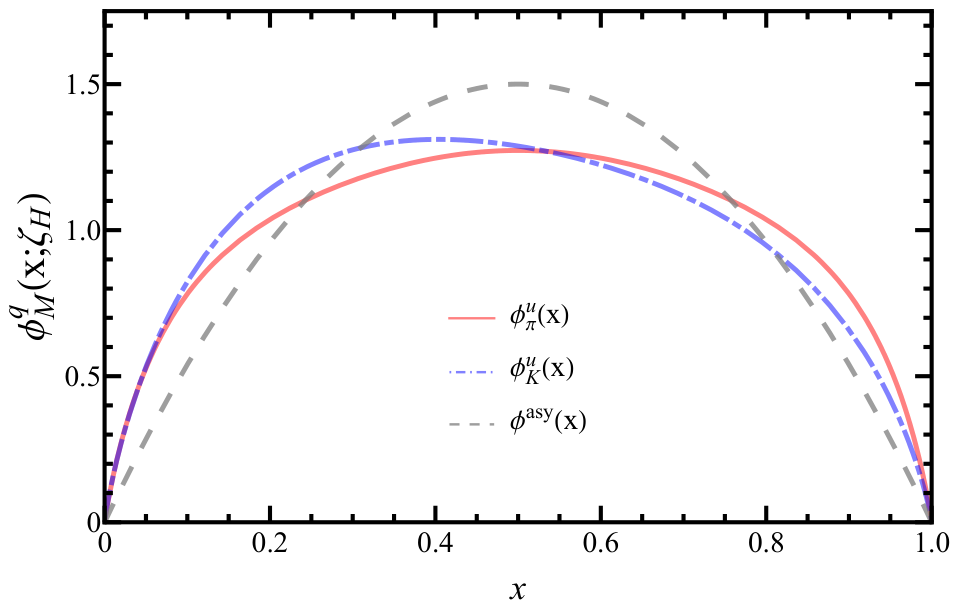
After deriving a consistent set of algebraic expressions for several parton distributions and related observables, we turn our attention to specifying the input elements of the AM. Our starting point is Equation (45), which establishes a direct link between the leading-twist LFWF and the PDA. This relation enables the direct reconstruction of the LFWF once ϕ M q ( x ) is specified, thereby providing access to the meson’s internal structure at the hadronic scale ζ H . Considering the demonstrated predictive power of the DSE approach in calculating PDAs, we employ as model inputs the results obtained within that framework [66,67]. The particular forms of the PDAs used in this work are listed below, with x ¯ = 1 x
ϕ π u ( x ) = 20.226 x x ¯ [ 1 2.509 x x ¯ + 2.025 x x ¯ ] , ϕ K u ( x ) = 18.04 x x ¯ [ 1 + 5 x 0.032 x ¯ 0.024 5.97 x 0.064 x ¯ 0.048 ] .
As illustrated in Figure 1, the broad shape of the pion PDA is a well-known manifestation of dynamical chiral symmetry breaking, which enhances momentum sharing away from the asymptotic limit. The kaon PDA is additionally skewed due to flavor-symmetry breaking, reflecting the larger average momentum fraction carried by the heavier strange quark.
To compute the LFWFs we must specify the parameter ν and the constituent quark masses M q . We adopt ν = 1 , which guarantees the correct asymptotic behavior of the Bethe–Salpeter wave function and is consistent with prior DSE–BSE analyses [48]. The constituent masses are fixed by benchmarking against experimental determinations and theory constraints: empirical charge radii [68], Dyson–Schwinger equation predictions [69,70,71,72,73], and lattice-QCD results [74,75]. In practice, we determine each M q via the relation in Equation (69), using the aforementioned results as inputs. The set of constituent-quark masses that define the algebraic model, together with the corresponding charge radii, is collected in Table 1.
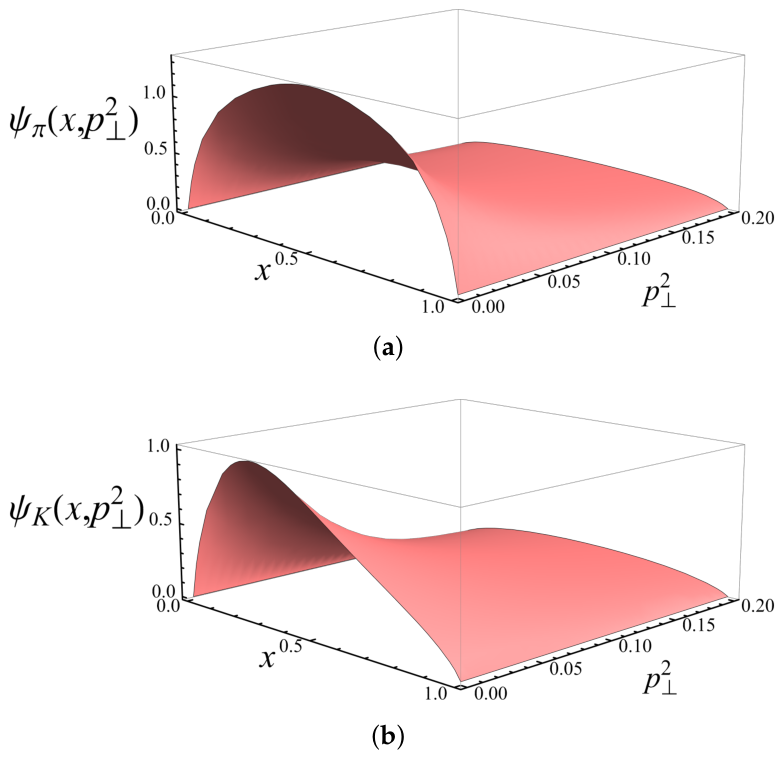
The three-dimensional surfaces displayed in Figure 2 illustrate the LFWFs ψ π ( x , p 2 ) and ψ K ( x , p 2 ) for the pion and kaon, respectively. Each LFWF encodes the probability amplitude to find a quark and an antiquark inside the meson carrying longitudinal momentum fractions x and 1 x , and relative transverse momentum p . The LFWF thus provides a direct representation of the internal structure of mesons in mixed longitudinal–transverse-momentum space.
In both cases, the LFWFs exhibit a maximum at intermediate values of x, reflecting the most probable momentum sharing between the valence quark and antiquark. The distributions vanish at the endpoints, x = 0 and x = 1 , in accordance with QCD expectations and the behavior of leading-twist distribution amplitudes. As p 2 increases, the wave functions decrease smoothly, illustrating how configurations with large transverse momentum are suppressed. This decay encodes confinement physics—large relative momenta between constituents are less probable due to the strong interaction binding them.
Comparing the two panels, one observes a noticeable asymmetry in the kaon’s LFWF with respect to x = 0.5 . This behavior is a direct manifestation of flavor-symmetry breaking: the kaon contains a heavier strange quark (s) and a lighter up quark (u), so the longitudinal momentum is preferentially carried by the heavier constituent. In contrast, the pion—composed of quarks with nearly equal masses—displays a symmetric profile centered around x = 0.5 .
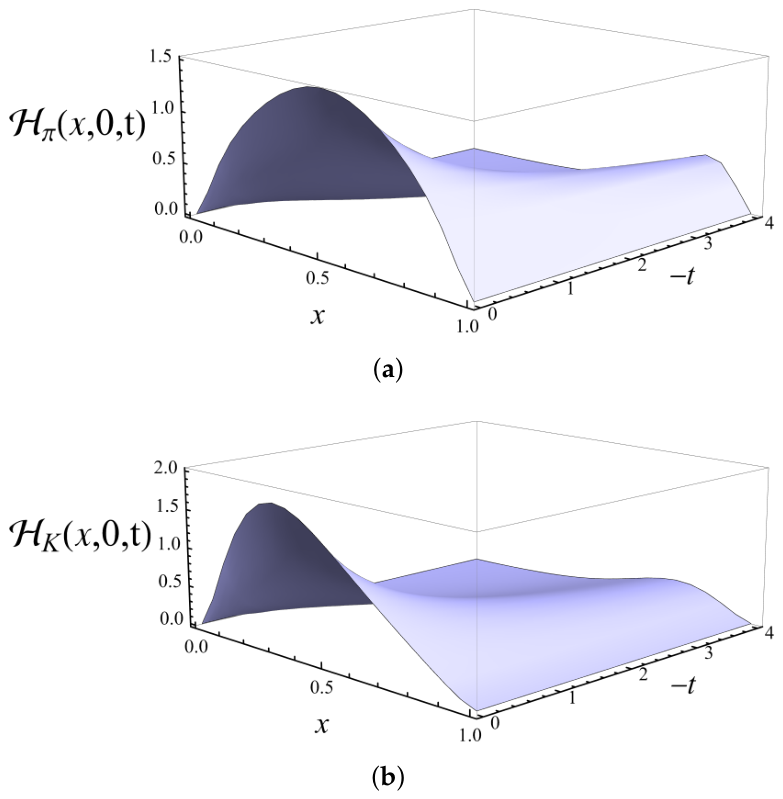
Figure 3 displays the valence-quark GPDs H π ( x , 0 , t ) and H K ( x , 0 , t ) for the pion and kaon, respectively. These quantities encode correlated information about the longitudinal momentum fraction x and the transverse-momentum transfer squared t = Δ 2 , thus providing a three-dimensional view of hadron structure in mixed momentum and position space.
In both mesons, the GPDs exhibit the characteristic bell-shaped profile along x, peaking around the region where the quark and antiquark share the longitudinal momentum most equally. For the pion, which is an isospin-symmetric system, the distribution is symmetric around x = 0.5 . In contrast, the kaon GPD displays a noticeable asymmetry toward larger x values. This skewness arises from the explicit breaking of flavor symmetry due to the mass difference between the u and s quarks: the heavier strange quark tends to carry a larger fraction of the total longitudinal momentum.
These surfaces illustrate the dual role of GPDs as a bridge between momentum and coordinate space descriptions of hadron structure. They unify form-factor and parton-density information, allowing one to visualize how partons are distributed both in longitudinal momentum and in the transverse plane. The observed asymmetry in the kaon, compared with the pion, highlights the sensitivity of GPDs to explicit flavor-symmetry breaking and to the mass hierarchy among the constituent quarks.
At t = 0 , the GPDs reduce to the corresponding PDFs, recovering the longitudinal momentum structure of the valence quarks. As the momentum transfer | t | increases, the magnitude of H M ( x , 0 , t ) decreases, reflecting the decreasing probability of finding partons with a large transverse separation, an effect directly tied to the spatial localization of the quarks inside the meson. This falloff behavior encapsulates the underlying confinement mechanism: hadrons appear as compact bound states whose internal structure becomes less correlated at higher resolution.
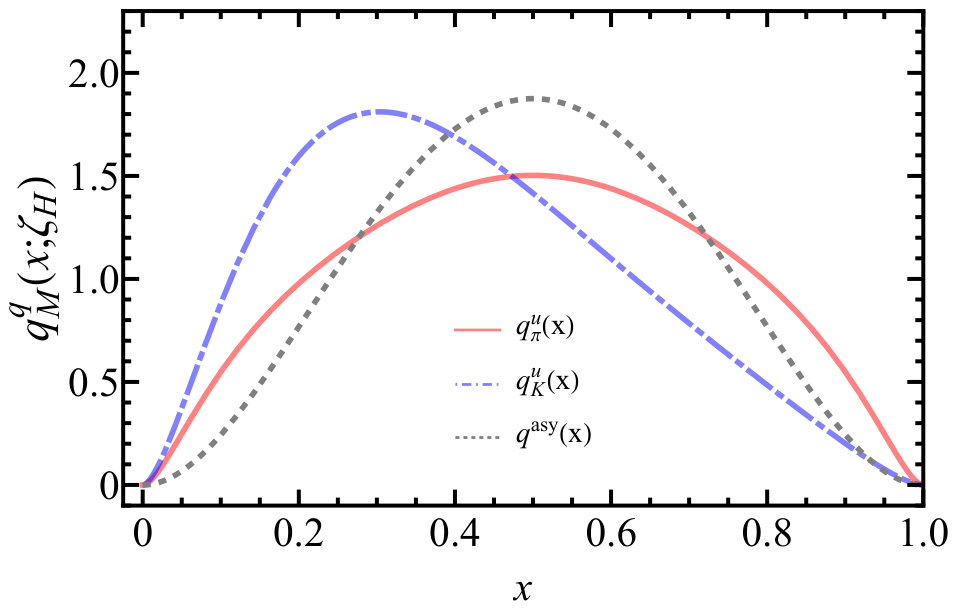
Figure 4 compares the valence u–quark PDFs of the pion and kaon at the hadronic scale ζ H . The red solid curve, q π u ( x ) , is symmetric under x 1 x as expected in the isospin limit, with a broad maximum around x 0.5 and vanishing behavior at the endpoints, x 0 , 1 . This bell-shaped profile reflects the nearly equal sharing of longitudinal momentum between the pion’s valence constituents and embodies the generic endpoint suppression predicted for leading-twist, valence-like distributions.
The blue dot–dashed curve, q K u ( x ) , is visibly shifted toward smaller x and is narrower than q π u ( x ) . This distortion is a direct manifestation of explicit flavor-symmetry breaking in the kaon: because the strange quark is heavier than the up quark, the s ¯ typically carries a larger fraction of the meson’s longitudinal momentum, forcing the u distribution to be softer (peak at x < 0.5 ) and more strongly suppressed as x 1 . Complementarily, one expects q K s ¯ ( x ) to be harder, with its peak displaced toward larger x and a slower falloff near the x 1 endpoint. These features mirror the corresponding PDAs and LFWFs discussed earlier: the heavier constituent biases the longitudinal momentum partition and compresses the x-profile.
The gray dashed reference curve, q asy ( x ) , illustrates the canonical valence-like shape; the pion distribution is comparatively more dilated, while the kaon u-PDF is comparatively more compressed. The relative hardness/softness at large x connects with perturbative counting rules: heavier constituents generally correlate with a harder partner distribution and a softer light-quark distribution as x 1 . Upon DGLAP evolution to higher ζ , both curves broaden toward small x and soften at large x, yet the qualitative ordering (kaon u softer than pion u) persists.
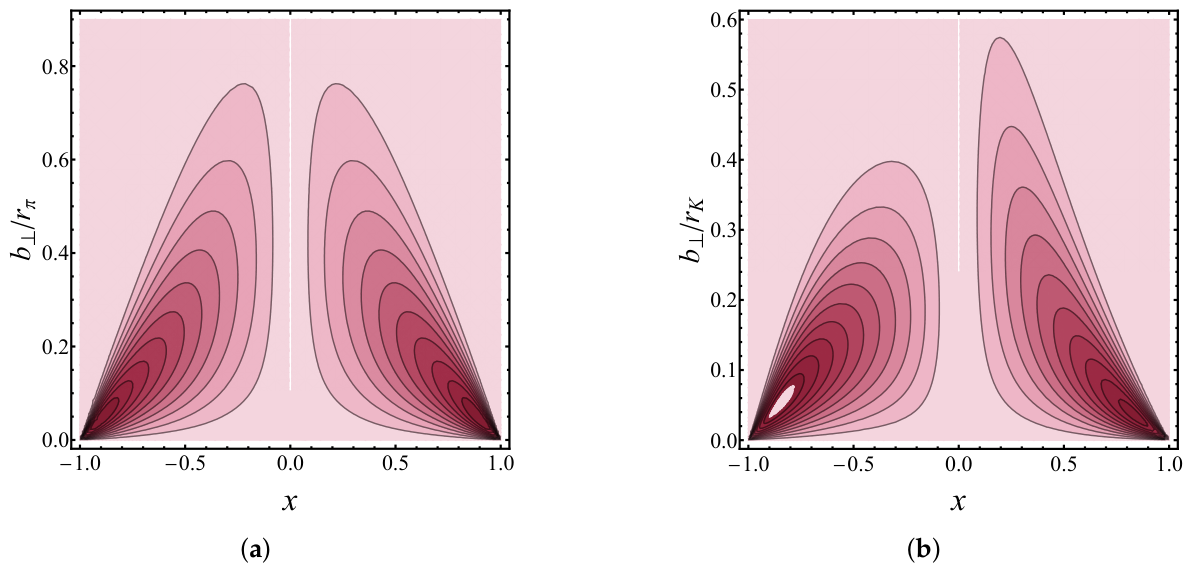
The IPS-GPDs for the pion and kaon provide direct insight into the transverse spatial distribution of partons correlated with their longitudinal momentum fraction. These distributions are obtained through the Fourier transform of the zero-skewness GPD and are shown in Figure 5. In this representation, the quark (antiquark) contributions populate the regions x > 0 ( x < 0 ), enabling a transparent visualization of flavor-dependent spatial asymmetries.
For the pion, isospin symmetry ensures a left–right symmetric IPS-GPD, reflecting the equal contribution of the dressed u and d valence quarks to the transverse center of momentum. In contrast, the kaon exhibits a pronounced asymmetry in impact-parameter space: the heavier s quark is more tightly localized and dominates the transverse center of momentum, while the lighter u quark displays a broader spatial distribution with its maximum shifted toward larger transverse distances. This behavior arises from the explicit breaking of flavor symmetry and is consistent with the skewed structure observed in the kaon PDA and PDF.
Overall, these results demonstrate that increasing the constituent-quark mass leads to a contraction of the transverse spatial distribution and a reduction of its spatial extent, while simultaneously modifying the longitudinal momentum profile. The IPS-GPDs therefore provide a direct connection between the momentum-space structure encoded in the GPDs and the transverse spatial distribution of partons inside light pseudoscalar mesons.

4.2. Pseudoscalar Mesons: Heavy–Light Sector

In this section, we turn our attention to the heavy–light meson sector, which encompasses bound states formed by one heavy quark (c or b) and one light partner (u, d, or s). These systems, such as the D, D s , B, B s , and B c mesons, serve as an essential bridge between the dynamics of light- and heavy-quark physics. They offer a unique window into the interplay between nonperturbative confinement effects and heavy-quark symmetry, allowing for a unified description within the same algebraic framework introduced earlier.
At this point, all necessary components are in place to compute the LFWFs from the PDAs within the framework of the algebraic model. Equipped with these tools, we proceed to determine the LFWFs for the lowest-lying heavy–light pseudoscalar mesons, namely the D, D s , B, B s , and B c states. The calculations rely on input PDAs previously determined in the literature.
Over the past decade, the detailed pointwise behavior of light-meson PDAs has been determined with remarkable precision [26,28,34,35,38,69,76,77,78,79,80,81,82,83,84,85]. In contrast, heavy–light systems remain comparatively less explored, as empirical and lattice constraints are still limited [86,87,88,89,90,91,92]. To date, only a few comprehensive studies have provided unified analyses of all heavy–light pseudoscalar PDAs [93,94]. In this work, we employ the rainbow–ladder parametrizations from Ref. [93], which are well-defined within their applicable domain for the D, D s , B, B s , and B c mesons:
ϕ 0 ( x ) = 4 N α β x x ¯ e 4 α 2 x x ¯ β 2 ( x x ¯ ) ,
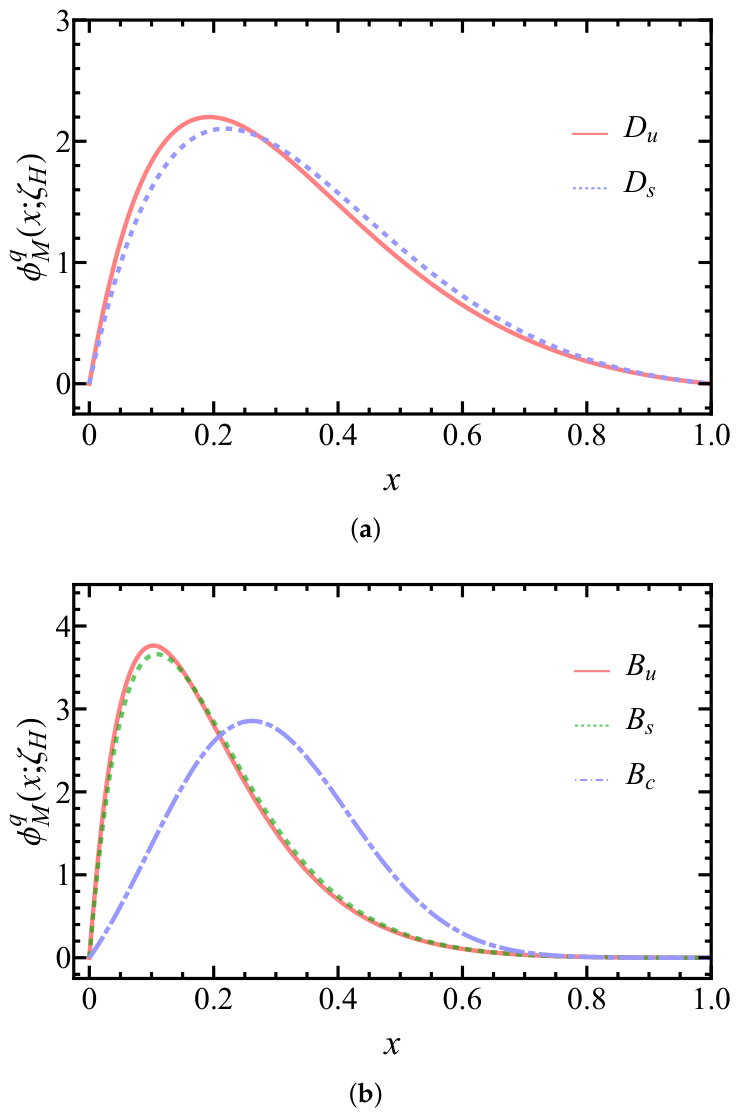
where N α β ensures proper normalization, and x ¯ = 1 x . The fitted ( α , β ) parameters used to characterize each PDA are listed in Table 2, and the resulting distributions are shown in Figure 6. As the mass asymmetry between the valence quarks increases, the PDAs become more asymmetric and sharply peaked toward the heavier constituent. This trend reflects the pronounced momentum imbalance between the heavy and light quarks, which plays a decisive role in shaping the internal structure of heavy–light mesons.
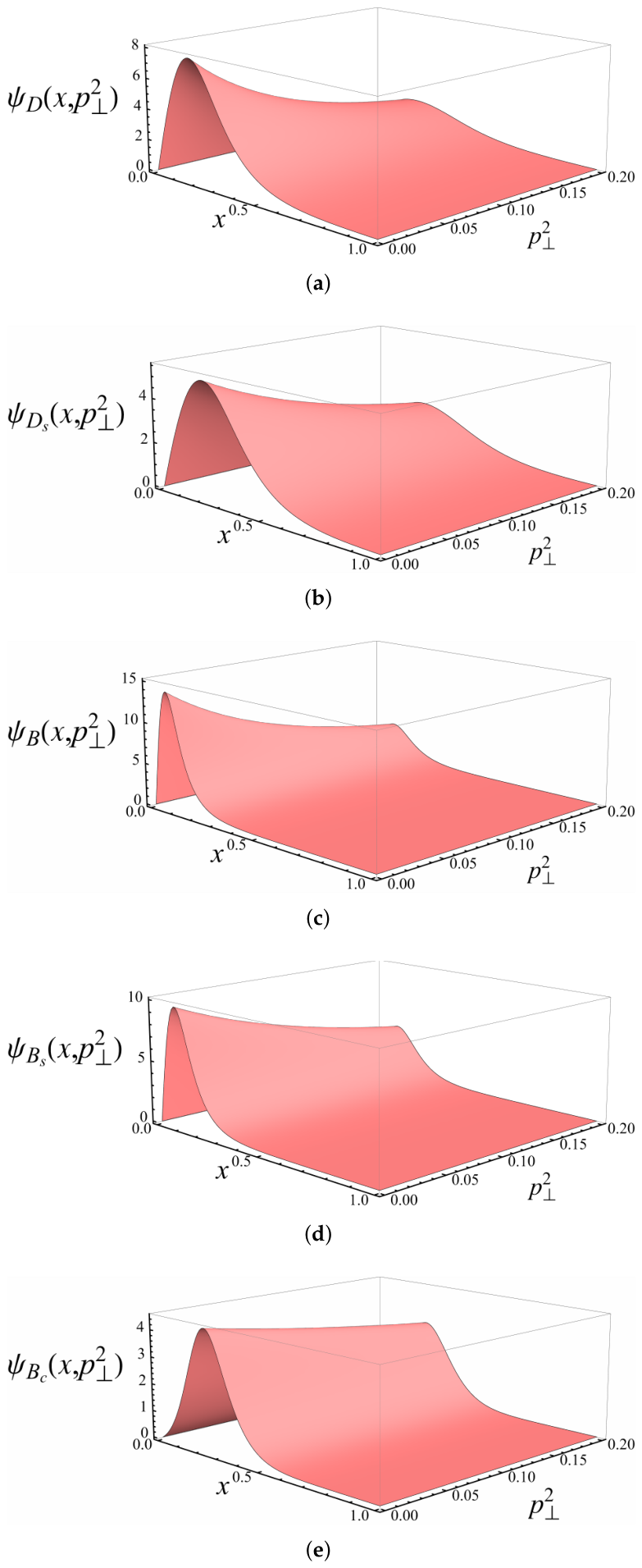
With all inputs established, we proceed to compute the LFWFs for the D, D s , B, B s , and B c mesons, employing their connection to the corresponding PDAs as defined in Equation (45). The parameters required for these calculations are listed in Table 3. As shown therein, the static properties of the heavy–light pseudoscalar mesons obtained within this framework exhibit excellent agreement with available experimental data reported by the Particle Data Group [95], as well as with recent Lattice QCD determinations [96]. This consistency underscores the reliability of the algebraic model in describing systems that interpolate between the light and heavy-quark regimes, effectively capturing the essential nonperturbative dynamics governing their internal structure.
Figure 7 presents the leading-twist LFWFs for the lowest-lying heavy–light pseudoscalar mesons, namely D, D s , B, B s , and B c . A prominent feature of all these distributions is their pronounced asymmetry, which originates from the mass difference between the valence quark and antiquark constituents. Examining their dependence on the longitudinal momentum fraction x and the transverse momentum squared p 2 , distinct patterns emerge.
In the charm sector, the D-meson LFWF exhibits a sharper dependence on x, yielding a narrower distribution compared to the broader and more symmetric profile of the D s meson. Conversely, in the bottom sector, the LFWFs display a systematic evolution: the B meson shows the narrowest distribution in x, while the B s and B c wave functions become progressively wider. This indicates that as the light valence quark becomes heavier, the longitudinal momentum is distributed more evenly between the two constituents. In contrast, for lighter valence quarks, the probability distribution becomes increasingly localized around smaller x, reflecting a stronger momentum imbalance within the bound state.
Regarding the transverse-momentum dependence, all wave functions display the expected damping with increasing p 2 . For the D meson, the LFWF amplitude decreases sharply as p 2 increases from 0 to 0.2 GeV 2 , while in the D s meson, this decline is more gradual. A similar trend is observed for the bottom mesons, although the suppression with p 2 becomes even milder as the heavy-quark mass increases. Hence, as the mass of the valence light quark rises, the LFWF becomes less sensitive to transverse momentum, revealing that systems with heavier constituents are more compact in configuration space but extend further in momentum space.
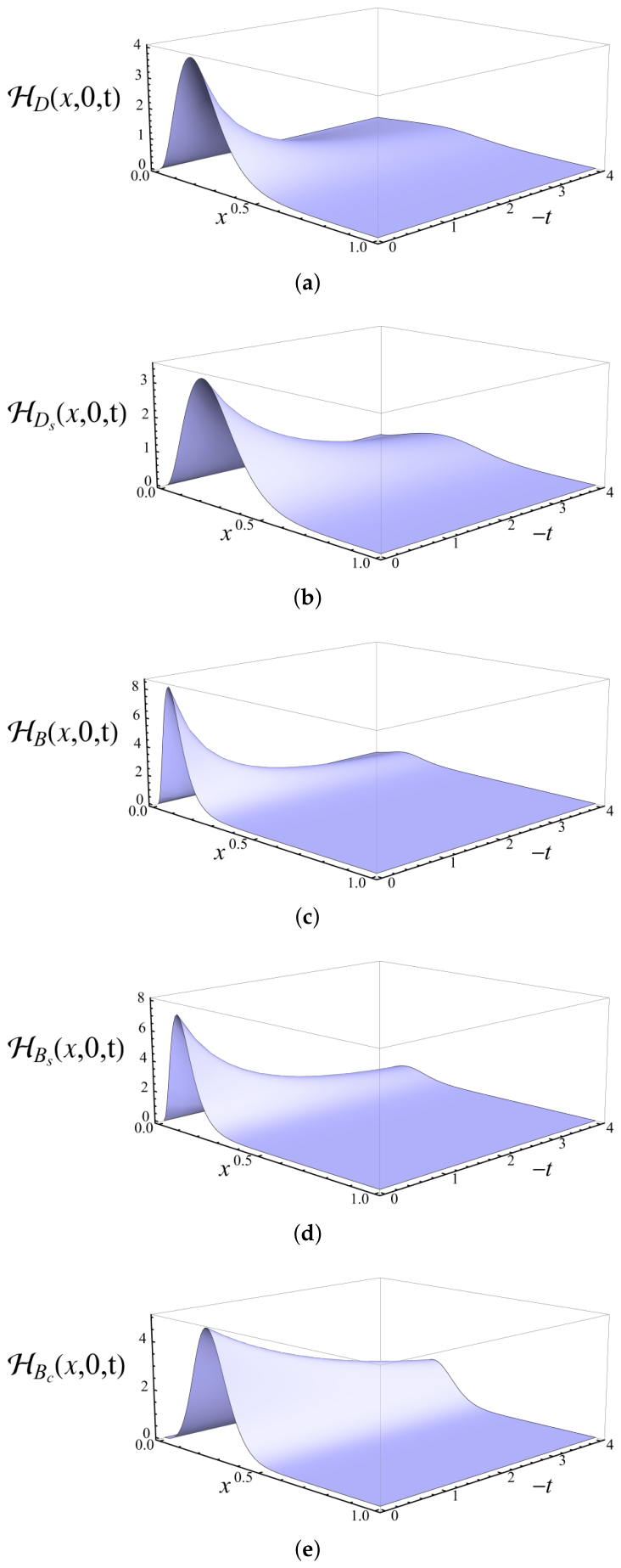
Having established the LFWFs for the heavy–light pseudoscalar mesons, we now proceed to compute their corresponding GPDs. Following the formalism introduced in Equation (55), we evaluate the valence-quark GPDs for the D- and B-mesons. This analysis allows us to explore how the internal partonic correlations evolve with the heavy-quark mass and how the three-dimensional structure of these mesons manifests in both momentum and impact-parameter space.
Figure 8 shows the valence-quark GPDs. For the case of H D ( x , 0 , t ) and H D s ( x , 0 , t ) , both distributions are strongly asymmetric in x, reflecting the characteristic momentum imbalance of heavy–light systems in which the charm quark carries most of the longitudinal momentum. The D s GPD peaks at slightly larger values of x than the D meson, consistent with the heavier strange quark sharing a larger fraction of the total momentum.
In the t-dependence, both GPDs decrease monotonically as t increases, but the D s meson exhibits a noticeably slower falloff. This behavior indicates a more compact transverse structure for the D s , in contrast with the more diffuse spatial profile of the D meson driven by its lighter u / d valence quark. Overall, the comparison highlights how increasing the mass of the light quark leads to a GPD that is less asymmetric in x and harder in t, signaling enhanced binding and reduced transverse extent.
The GPDs of the bottom mesons displayed in Figure 8 exhibit the characteristic signatures of heavy–light systems dominated by the large bottom-quark mass. In all three cases, the GPD is strongly peaked at small values of the light-quark momentum fraction x, reflecting the pronounced momentum imbalance between the heavy b quark and its lighter partner. This peak is sharpest for the B meson, where the valence light quark is the lightest, indicating that the bulk of the longitudinal momentum is carried by the bottom quark. As the mass of the light quark increases, moving from B to B s and finally to B c , the peak shifts slightly toward larger x and becomes less abrupt, signaling a more balanced longitudinal momentum sharing within the meson.
The dependence on the momentum transfer t follows a similar pattern across the three systems. The B-meson GPD decreases rapidly with increasing t , consistent with a compact transverse spatial distribution. In contrast, the falloff becomes progressively slower for the B s and especially the B c meson, indicating increasingly localized partonic distributions in impact-parameter space as the combined quark mass grows. Altogether, these results reveal a coherent and systematic influence of both the heavy- and light-quark masses on the longitudinal and transverse structure encoded in the GPDs, providing a unified physical picture across the spectrum of heavy–light pseudoscalar mesons.
In the forward limit, corresponding to vanishing momentum transfer and skewness ( t = 0 , ξ = 0 ), the GPD reduces to the valence-quark PDF:
q 0 ( x ) = H 0 ( x , 0 , 0 ) .
At the hadronic scale ζ H , where the meson is described solely in terms of its dressed valence degrees of freedom, the associated antiquark distribution is simply Q ¯ 0 ( ζ H ; x ) = q 0 ( ζ H ; 1 x ) . This identity highlights that, at this scale, the valence constituents exhaust the longitudinal momentum of the bound state. Beyond the hadronic scale, QCD evolution generates gluon and sea-quark contributions that redistribute longitudinal momentum and become increasingly relevant in the small-x region and at larger momentum transfers.
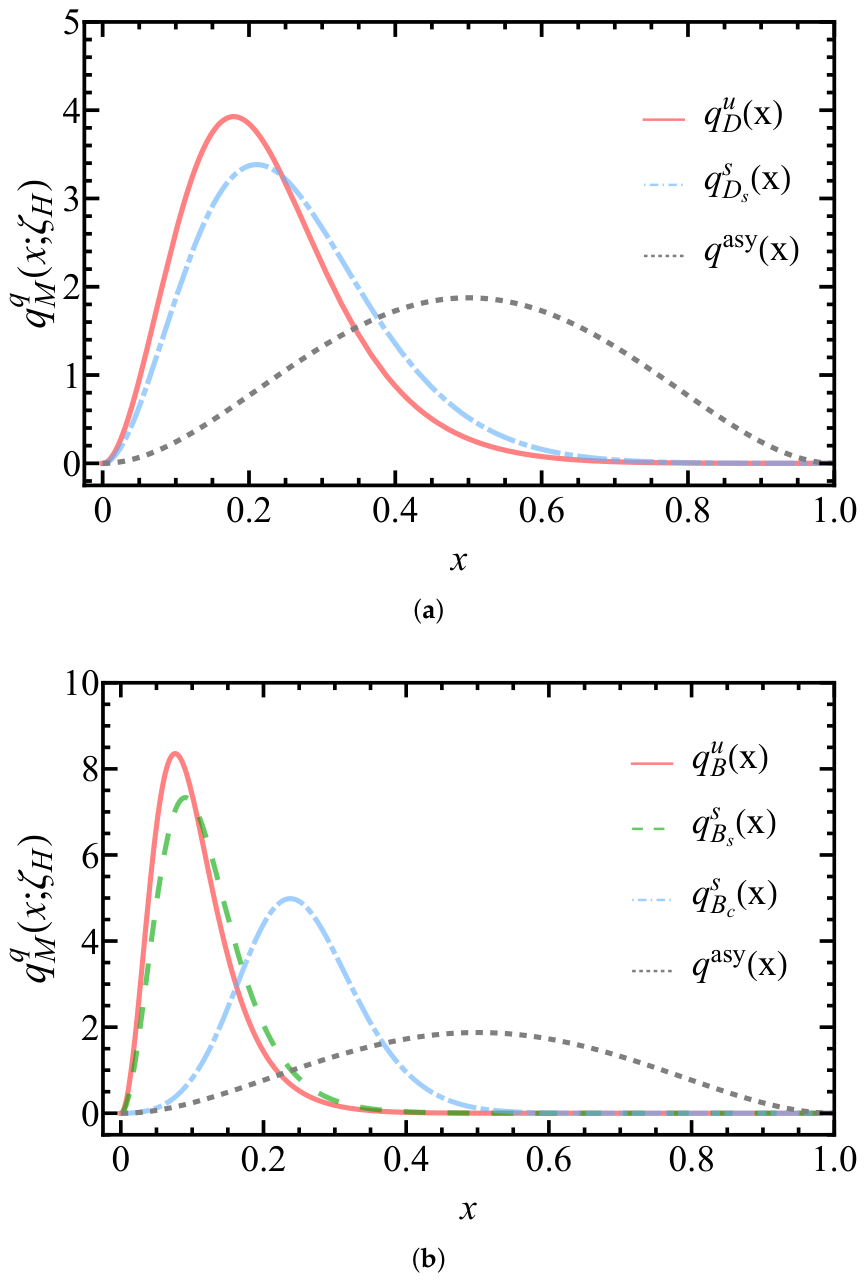
Figure 9 displays the resulting valence light-quark PDFs for the lowest-lying pseudoscalar charmed mesons and their bottom analogs. For reference, the dashed black curve shows the conformal parton-like profile q ( x ) = 30 x 2 ( 1 x ) 2 . All model predictions are noticeably more sharply peaked than this benchmark and exhibit the characteristic x-asymmetry expected in heavy–light systems. A systematic flavor dependence is also evident: as the mass of the light valence quark increases, the PDFs become broader and their maxima shift toward larger momentum fractions. This effect is most pronounced in the B c meson, whose valence light-quark distribution is significantly displaced relative to those of the B and B s mesons.
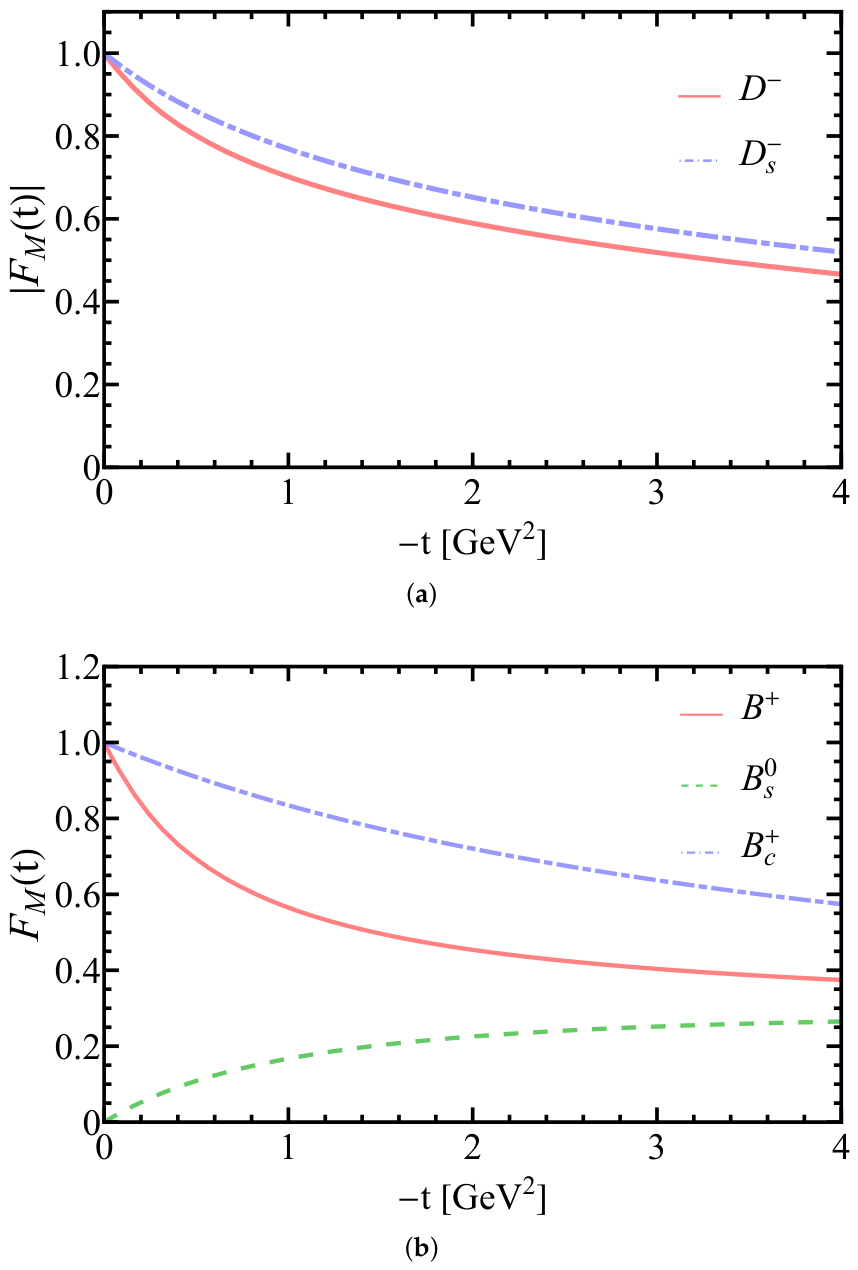
Figure 10 presents the elastic EFFs obtained for the lowest-lying pseudoscalar charmed mesons and their bottom counterparts. In all cases, the curves correspond to the charged mesons composed of a light valence quark q and a heavy antiquark Q ¯ , namely D = d c ¯ , D s = s c ¯ , B + = u b ¯ , B s + = s b ¯ , and B c + = c b ¯ .
A clear systematic behavior is observed: the EFF exhibits a slower decrease with increasing momentum transfer when the mass difference between the valence constituents is reduced. Moreover, within each heavy-quark sector, the various mesons display a similar asymptotic falloff of their form factors. This qualitative behavior is consistent with earlier investigations [97,98,99,100]. Nevertheless, a direct comparison with those results is not pursued here, since the corresponding hadronic scales are not specified, preventing a meaningful quantitative assessment.
The charge radii extracted from the slopes of the EFFs at Q 2 = 0 are collected in Table 4, together with available lattice QCD results and predictions from other theoretical approaches. For both the D- and B-meson sectors, our results show good overall agreement with existing studies. It is also instructive to contrast these predictions with those obtained using the contact-interaction (CI) framework. Within the algebraic model, the charge radii (in fm) are found to be 0.374 , 0.289 , 0.478 , 0.264 , and 0.217 , respectively, whereas the CI yields systematically smaller values: no result for D , and 0.260 , 0.340 , 0.240 , and 0.170 for the remaining mesons.
This systematic enhancement of the charge radii in the algebraic model can be traced back to its momentum-dependent interaction, which produces softer Bethe–Salpeter amplitudes and consequently broader spatial distributions. In contrast, the momentum-independent kernel of the CI leads to harder amplitudes and more localized charge distributions. Physically, the momentum dependence of the Bethe–Salpeter amplitude encodes nontrivial relative-momentum correlations associated with confinement and dynamical chiral symmetry breaking. This generates softer form factors and broader transverse spatial distributions than those obtained in momentum-independent contact-interaction models.
To further quantify these differences, we evaluate the relative deviations between the charge radii predicted by the algebraic model and those obtained with the CI. For the D s , B + , B s + , and B c + mesons, the algebraic model yields radii that are approximately 11.2 % , 40.6 % , 10.0 % , and 27.6 % larger, respectively. These sizeable discrepancies highlight the crucial role played by momentum dependence in determining the spatial structure of heavy–light mesons. In particular, the larger deviations observed for the B + and B c + systems suggest that the algebraic model provides a more realistic description of internal dynamics when heavy bottom quarks are involved.
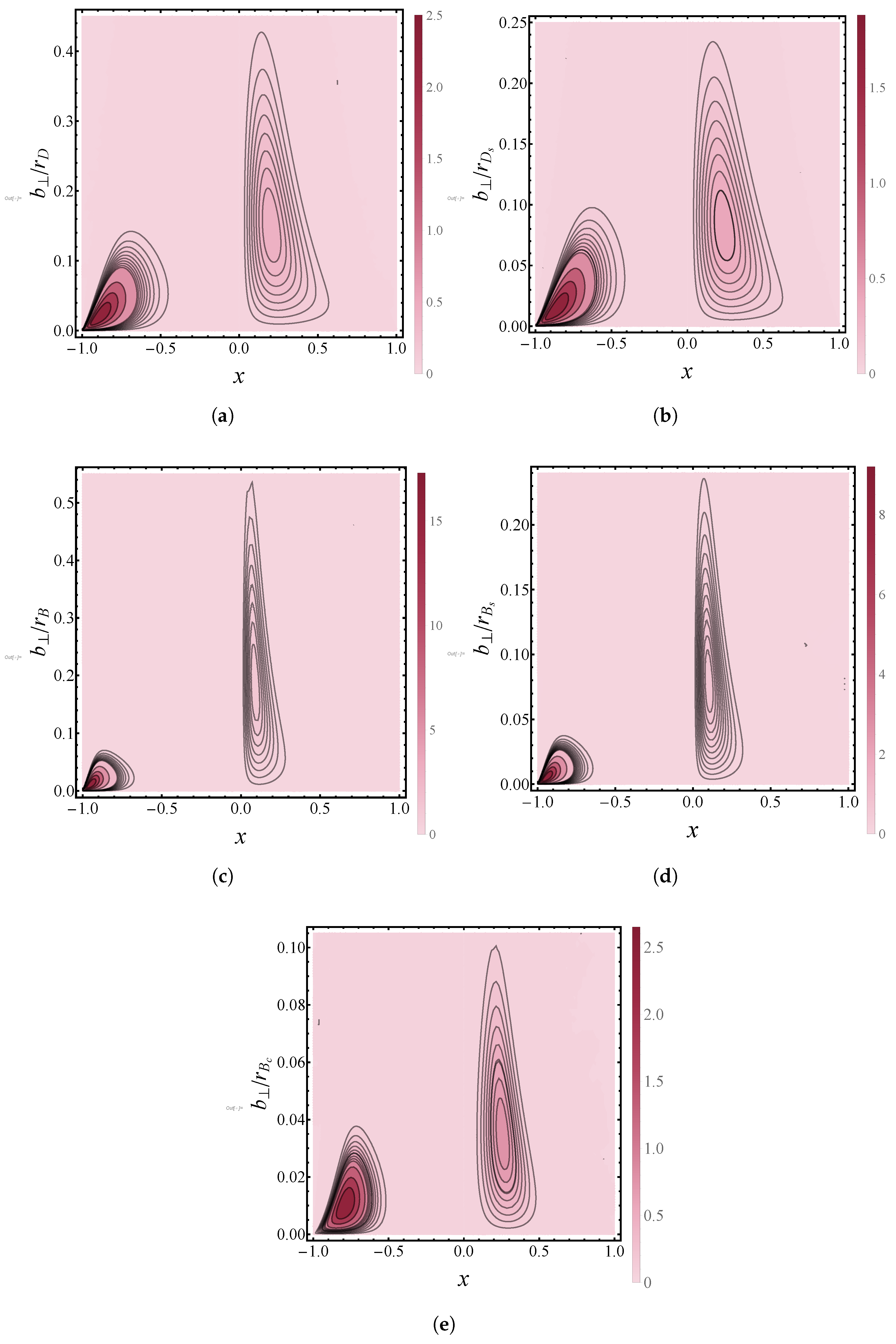
Figure 11 presents the IPS-GPDs for the D, D s , B, B s , and B c mesons, where the quark and antiquark contributions populate the regions x > 0 and x < 0 , respectively. For the charmed systems, the heavy antiquark is predominantly localized near the transverse center of momentum, whereas the light quark exhibits its highest probability at transverse distances of approximately 0.14 r D and 0.08 r D s . As the mass of the light valence quark increases from d to s, the corresponding IPS-GPD becomes broader in the longitudinal momentum fraction x while simultaneously narrowing in impact-parameter space, accompanied by a reduction in the peak magnitude. This behavior signals a stronger transverse localization associated with heavier constituents.
An analogous but more pronounced trend is observed in the bottom sector, reflecting the larger mass hierarchy between the valence quarks. In these systems, the heavy antiquark dominates the transverse center of momentum to an even greater extent. The most probable transverse locations of the light quark occur at approximately 0.18 r B , 0.07 r B s , and 0.035 r B c , respectively. In particular, the B c meson displays a highly compact transverse structure, with the charm quark and bottom antiquark located in close proximity within the transverse plane. Overall, increasing the constituent quark masses leads to IPS-GPDs that are increasingly concentrated toward the center of transverse momentum, broader in x, more localized in b , and characterized by a reduced peak height.

4.3. Pseudoscalar Mesons: Heavy–Heavy Sector

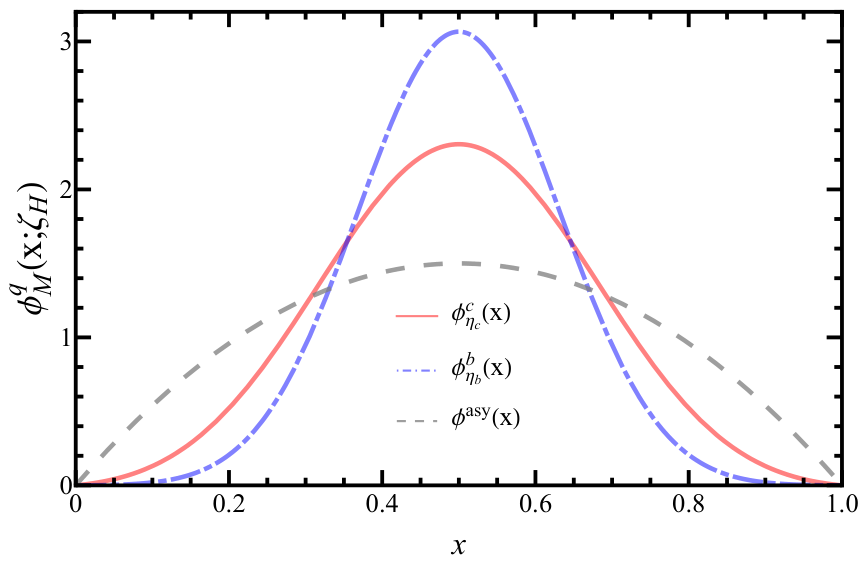
We now turn to the heavy–heavy pseudoscalar sector, focusing on the charmonium and bottomonium ground states, η c and η b . Given the demonstrated reliability of the Dyson–Schwinger equation (DSE) approach in determining heavy-quark PDAs, we adopt as inputs the results obtained within that framework [43,66,67]. In contrast to heavy–light mesons, the equal-mass nature of the valence constituents in η c and η b ensures that their PDAs are symmetric under x 1 x and, moreover, they are strongly concentrated around x = 1 / 2 , reflecting the suppression of endpoint configurations characteristic of heavy quarkonia. The explicit parametrizations of the PDAs employed in this work are summarized below, with x ¯ = 1 x ,
ϕ η c c ( x ) = 9.222 x x ¯ exp 2.89 ( 1 4 x x ¯ ) , ϕ K u ( x ) = 12.264 x x ¯ exp 6.25 ( 1 4 x x ¯ ) .
As illustrated in Figure 12, the PDAs of η c and η b are significantly narrower than those of light pseudoscalar mesons, exhibiting a progressive compression as the quark mass increases. This behavior signals the transition toward the nonrelativistic regime, in which the heavy quark and antiquark share the longitudinal momentum almost equally. This behavior is well documented in modern continuum and lattice analyses and is faithfully captured within the algebraic model framework employed here [43,66,67].
To compute the heavy-quark LFWFs, we again fix the parameter ν = 1 , ensuring the correct ultraviolet behavior of the Bethe–Salpeter wave function and maintaining consistency with previous DSE–BSE studies. The dressed heavy-quark masses are determined by benchmarking against experimental and theoretical constraints, including lattice-QCD determinations of quarkonium charge radii and continuum analyses within the DSE framework. The resulting set of constituent masses and the corresponding static observables that define the algebraic model in the heavy–heavy sector are reported in Table 5, taken from Ref. [43].
The resulting LFWFs for η c and η b , shown in Figure 13, display a strong localization in both longitudinal momentum fraction x and transverse momentum k 2 . As the quark mass increases from charm to bottom, the LFWFs become increasingly compressed in x and exhibit a markedly slower falloff in k 2 , indicating a more compact transverse structure. This behavior reflects the reduced relativistic motion of heavy quarks and aligns with expectations from nonrelativistic QCD-inspired descriptions [43].
The valence-quark GPDs for η c and η b , as shown in Figure 14, are obtained through the overlap representation of the corresponding LFWFs. At zero skewness, the resulting GPDs are symmetric in x and exhibit a narrow longitudinal profile centered at x = 1 / 2 . Furthermore, the t-dependence becomes increasingly hard as the quark mass grows, with η b showing a significantly slower decrease with t than η c . This reflects the smaller spatial extent of bottomonium compared to charmonium and is consistent with previous continuum and lattice-based studies [43].
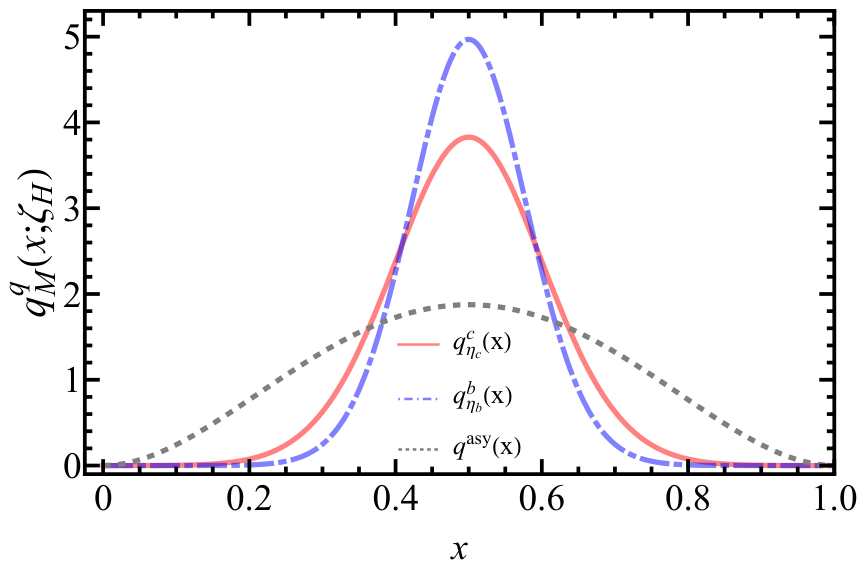
In the forward limit, the GPDs reduce to the valence-quark PDFs for η c and η b . These PDFs, seen in Figure 15, are sharply peaked around x = 1 / 2 and are substantially narrower than those of light and heavy–light mesons. The narrowing increases with the heavy-quark mass, signaling the dominance of configurations in which the quark and antiquark equally share the longitudinal momentum. This behavior highlights the transition toward the nonrelativistic regime in heavy quarkonia [43].
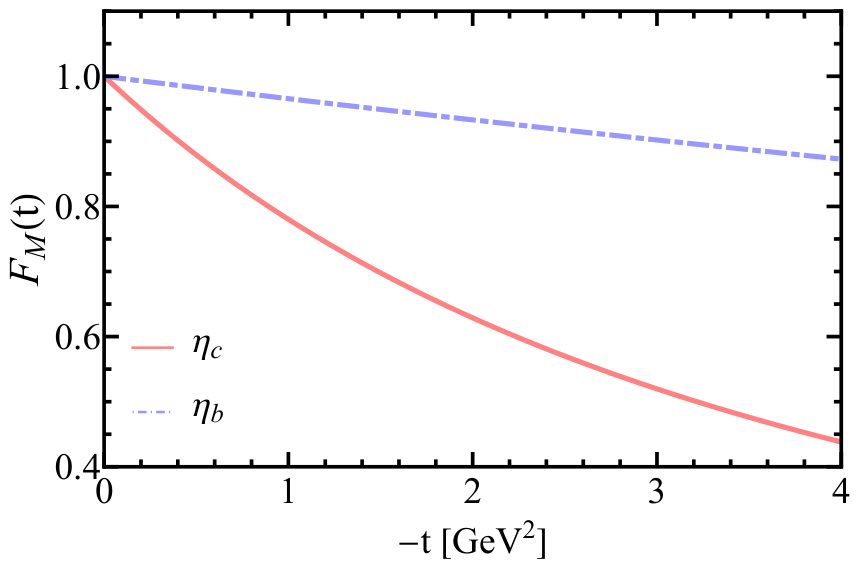
The EFFs are obtained from the zeroth Mellin moment of the GPDs and are shown in Figure 16. For η c and η b , the form factors decrease slowly with increasing momentum transfer, reflecting their compact spatial structure. The corresponding charge radii are found to be small and decrease significantly from η c to η b , in agreement with lattice QCD determinations and continuum model predictions. The algebraic model results reproduce these trends quantitatively, reinforcing the role of quark mass in shaping the spatial size of heavy quarkonia [43,74,75].
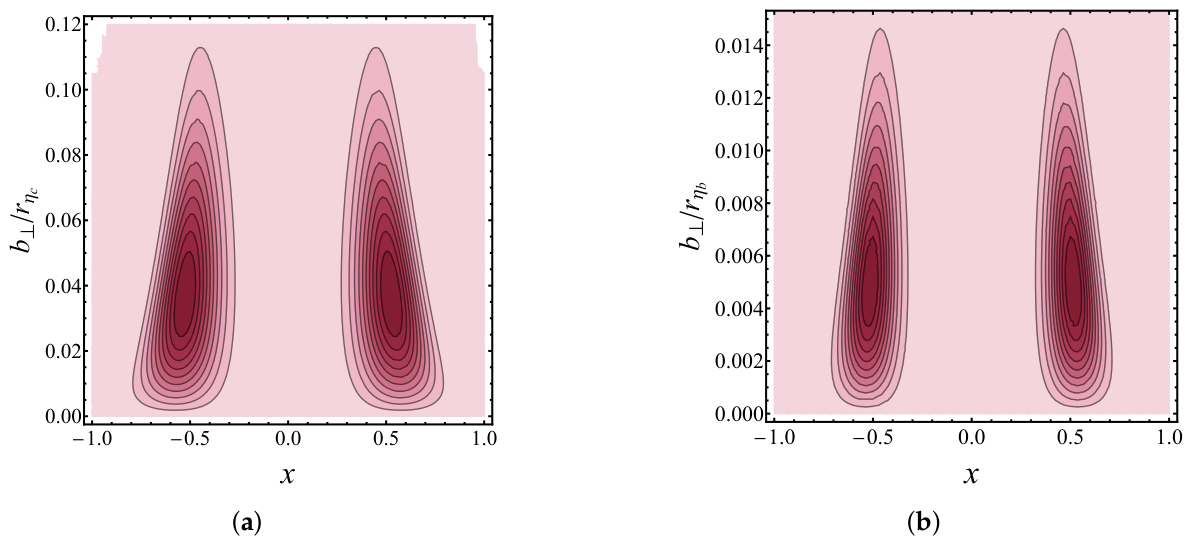
The IPS-GPDs provide a spatial imaging of the heavy quarkonia in the transverse plane (see Figure 17). Due to flavor symmetry, the quark and antiquark distributions are identical and centered at the transverse center of momentum. As the quark mass increases, the IPS-GPDs become increasingly localized in b , with η b exhibiting a notably narrower transverse profile than η c . This confirms that heavier quarkonia are more compact objects, both longitudinally and transversely, and further illustrates the strong correlation between momentum and spatial distributions encoded in GPDs [43].
Although the present algebraic construction is not formulated as a heavy-quark effective theory and does not explicitly implement systematic 1 / m Q expansions, it nevertheless captures the dominant structural trends associated with increasing quark masses within a unified nonperturbative framework.

4.4. The Mixed η η System

The η η system occupies a distinctive position within the pseudoscalar meson spectrum. Unlike the pion and kaon, whose structure is largely governed by emergent hadronic mass (EHM), and unlike heavy quarkonia, where explicit Higgs-generated masses dominate, the η and η mesons lie at the interface between these two regimes. Their structure reflects the interplay between dynamical chiral symmetry breaking, flavor mixing, and the non-Abelian axial anomaly.
The extension of the algebraic light-front framework to the mixed η η system has been presented in detail in Ref. [46], where the model was adapted to consistently incorporate flavor mixing while preserving its analytic tractability. Here, we summarize the essential elements and emphasize the structural patterns that emerge when these states are embedded into the unified light-to-heavy picture developed throughout this review.
To describe the η η system, we work under S U ( 2 ) isospin symmetry, i.e., M u = M d M l . Within this approximation, the neutral pion decouples from the η η sector, which contains non-negligible s s ¯ components. Consequently, the physical η and η states can be expressed in a generic flavor basis as
χ η , η ( q , P ) = T l χ l η , η ( q , P ) + T s χ s η , η ( q , P ) ,
where T l = diag ( 1 / 2 , 1 / 2 , 0 ) and T s = diag ( 0 , 0 , 1 / 2 ) . Thus, the mixed system is characterized by four Bethe–Salpeter wave functions (BSWFs).
Following the widely adopted single-angle mixing scheme (SA-MS) [103,104], the physical states are written as
η η = U ( θ ) η l η s , U ( θ ) = cos θ sin θ sin θ cos θ ,
where
η l 1 2 ( u u ¯ + d d ¯ ) , η s s s ¯ .
In the limit θ = 0 , the physical states reduce to the pure flavor configurations. In realistic QCD, however, θ 0 quantifies the mixing between light and strange components that generates the observed η and η mesons.
At the level of BSWFs, the mixing relation becomes
χ η ( q , P ) χ η ( q , P ) = U ( θ ) χ η l ( q , P ) χ η s ( q , P ) .
An important practical advantage of the SA-MS representation is that it avoids potential violations of the positivity condition that could arise from directly modeling the heavy η state with typical dressed-quark masses in the range M u , s 0.3 0.6 GeV. In this scheme, one can consistently map between physical and flavor bases both at the level of BSWFs and decay constants:
f η l 0 0 f η s = U 1 ( θ ) f η l f η s f η l f η s .
Once the mixing structure is fixed, the corresponding light-front wave functions (LFWFs) follow directly from the universal algebraic expression introduced earlier in this review:
ψ η l [ s ] l [ s ] ( x , k 2 ) = 16 π 2 f η l , s ν Λ 1 2 x 2 ν ( k 2 + Λ 1 2 x 2 ) ν + 1 φ η l [ s ] l [ s ] ( x ) .
Since realistic distribution amplitudes (DAs) for the η η system are typically provided in the physical basis, the mapping between bases becomes essential. Using the inverse rotation, the LFWFs satisfy
ψ η l l ( x , k 2 ) = cos θ ψ η l ( x , k 2 ) + sin θ ψ η l ( x , k 2 ) , ψ η s s ( x , k 2 ) = sin θ ψ η s ( x , k 2 ) + cos θ ψ η s ( x , k 2 ) ,
and, after integrating over transverse momentum, the DAs obey
φ η l l ( x ) = cos 2 θ φ η l ( x ) + sin 2 θ φ η l ( x ) , φ η s s ( x ) = sin 2 θ φ η s ( x ) + cos 2 θ φ η s ( x ) .
These relations allow the η l and η s DAs to be expressed in terms of the better-established η and η distributions. With this mapping in place, the remainder of the analysis proceeds exactly as in the other pseudoscalar sectors: once the effective quark masses and decay constants are fixed, the LFWFs, GPDs, PDFs, electromagnetic form factors, charge radii, and impact-parameter space distributions can be computed self-consistently within the same framework.
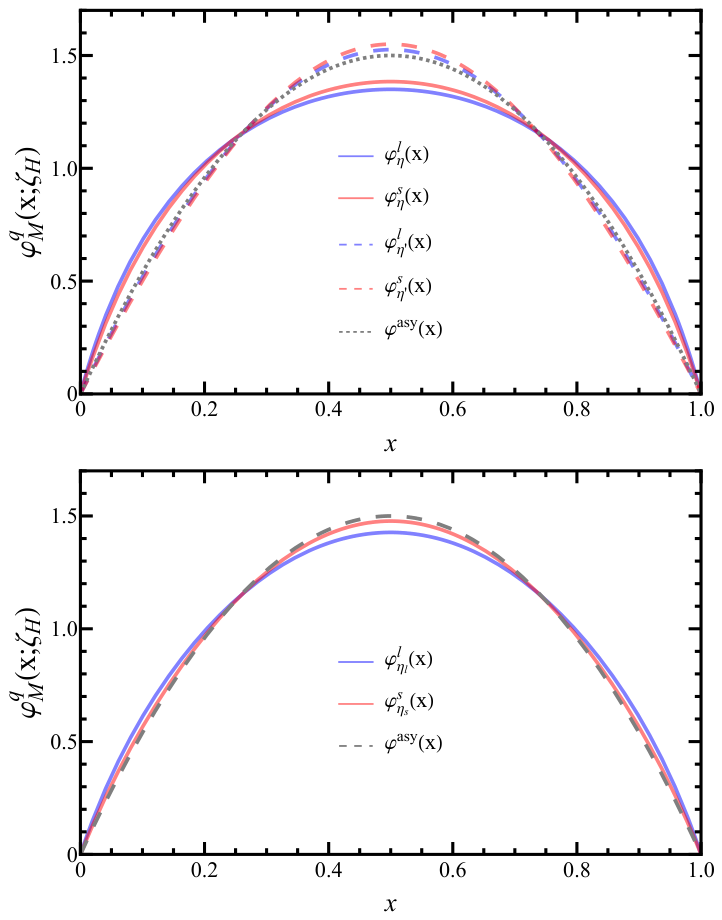
The DAs used as model inputs were obtained in Ref. [85] and are here parameterized following Ref. [61]. We adopt the compact forms
φ η l , s ( x ; ζ ) : = n ρ ln 1 + x ( 1 x ) ( ρ η l , s ) 2 ,
φ η l , s ( x ; ζ ) : = n ρ x ( 1 x ) exp x ( 1 x ) ( ρ η l , s ) 2 ,
with parameters ρ η l ( s ) = 0.329 ( 0.421 ) and ρ η l ( s ) = 1.700 ( 1.221 ) ; n ρ ( ρ ) denotes the normalization constant for each DA. Figure 18 displays these inputs (upper panel) and the η l , s DAs derived via the SA-MS mapping (lower panel). Two notable features are evident: (i) the η -related DAs are narrower and sit close to the asymptotic distribution
φ asy ( x ) = 6 x ( 1 x ) ,
and (ii) the s-quark components are systematically slightly more compressed than their light-quark counterparts, signaling the approach toward heavier-mass behavior.
To proceed numerically we adopt the dressed-quark masses used previously for the pion/kaon sector [43],
M u = 0.317 GeV , M s = 0.574 GeV ,
and determine the effective masses m η l , m η s and the SA-MS mixing angle θ by requiring a realistic description of the corresponding decay constants. This calibration yields
m η l = 0.17 GeV , m η s = 0.84 GeV , θ = 41 . 5 ,
and the decay constants listed in Table 6 and Table 7. With these choices, one obtains
f η l 1.01 f π , f η s 1.49 f π ,
which are compatible with lattice determinations and phenomenological averages within quoted uncertainties [103,105].
Translating these numbers into the octet–singlet basis gives
f 8 1.35 f π , f 1 1.2 f π ,
and the octet/singlet mixing angles are θ 8 = 22 . 86 and θ 1 = 2 . 33 , consistent with earlier phenomenological analyses [103,106].
Using the phenomenological expressions in Refs. [104,108] we estimate the two-photon decay widths,
Γ η γ γ = 9 α em 2 64 π 3 m η 3 5 9 f η l f η l 2 + 2 9 f η s f η s 2 2 ,
Γ η γ γ = 9 α em 2 64 π 3 m η 3 5 9 f η l f η l 2 + 2 9 f η s f η s 2 2
with the decay constants of Table 6, we find
Γ η γ γ = 0.52 keV , Γ η γ γ = 4.76 keV ,
values that agree well with the PDG averages [109] and other recent studies [85,110,111]. Improved measurements are expected in forthcoming experimental programs [112].
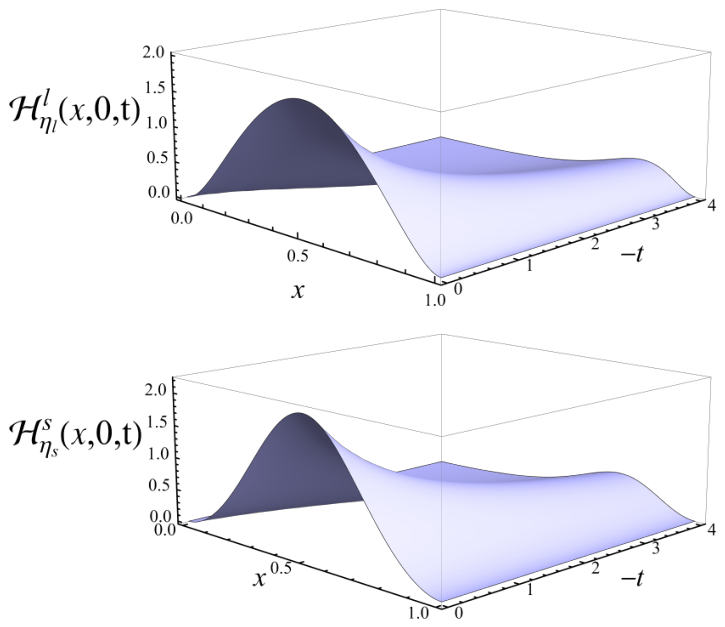
Using the input LFWFs derived from Equation (79) and the SA-MS mapping of Equation (80), we compute the valence-quark GPDs. The results, shown in Figure 19, indicate that the η s component presents a slightly milder t = Δ 2 dependence than the η l component, consistent with a more localized transverse distribution for the former.
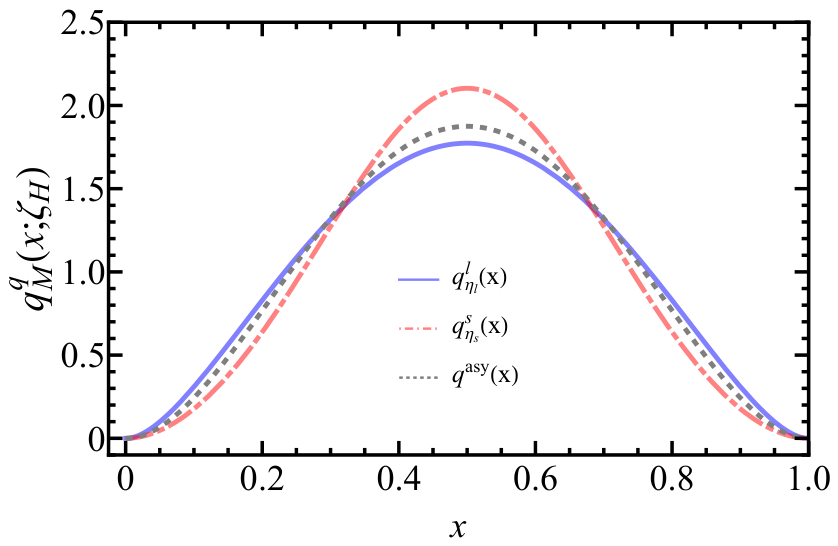
The forward limit of the GPDs yields the valence PDFs, which are displayed in Figure 20. The η s PDF is narrower than the η l one, mirroring the behavior observed in the DAs. For reference, we show the parton-like profile
q pl ( x ) 30 x 2 ( 1 x ) 2 ,
which lies between the η l and η s distributions and emphasizes how the strange component delineates a transition towards heavier-mass dynamics.
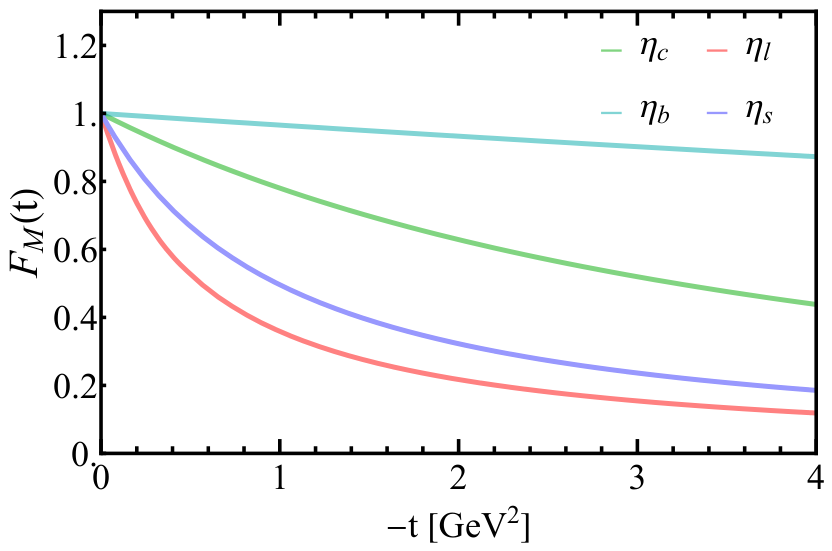
Electromagnetic form factors (EFFs), obtained from the zeroth Mellin moment of the GPDs, are shown in Figure 21 alongside the η c and η b results taken from Ref. [43]. The EFFs soften progressively with decreasing system mass; equivalently, heavier systems display a milder Δ 2 fall-off. Charge radii, computed as
r M 2 = 6 d F M ( Q 2 ) d Q 2 Q 2 = 0 ,
are reported in Table 8. The radii decrease with increasing meson mass, and the product f M r M remains approximately constant through the charm sector, a behavior previously noted in QCD studies [84].
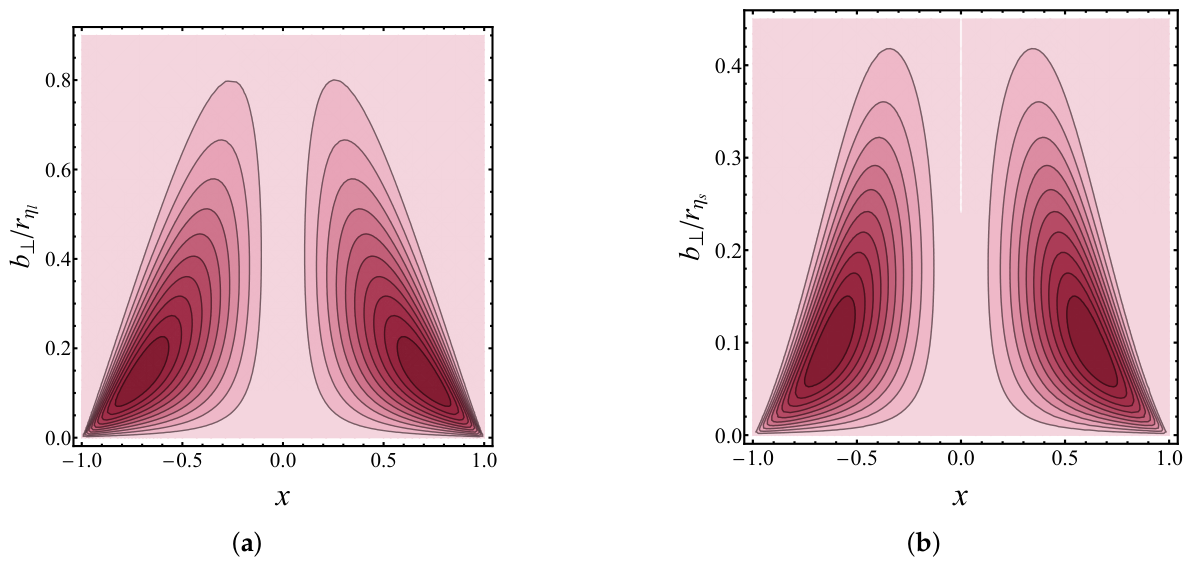
Impact-parameter space GPDs (IPS-GPDs) are shown in Figure 22. The η s IPS-GPD is more compressed in | b | than the η l one, reflecting the smaller charge radius and the larger effective mass. The observed trend, sharper peaks and x max 1 / 2 as the mass increases, is consistent with the expectation that heavy systems approach point-like behavior in the transverse plane [61].
The numerical results collected above confirm a coherent physical picture: increasing the effective quark mass produces longitudinal compression, transverse localization and a milder Δ 2 evolution of form factors. The η η system, through its mixed η l and η s components, provides a clear demonstration of this continuous structural evolution.

5. Conclusions

In this review, we have presented a unified analysis of the internal structure of pseudoscalar mesons across different quark-mass regimes within an algebraic model formulated in the light-front framework. The approach provides a common Bethe–Salpeter representation for leading-twist parton distribution amplitudes, light-front wave functions, generalized parton distributions, parton distribution functions, elastic electromagnetic form factors, charge radii, and impact-parameter space distributions.
For light pseudoscalar mesons, such as the pion and kaon, the results highlight the role of nonperturbative QCD dynamics and flavor-symmetry breaking. The broad PDAs and LFWFs, together with the asymmetries observed in the kaon sector, reflect the influence of explicit quark-mass differences. These features are consistently manifested in the corresponding PDFs, GPDs, and IPS-GPDs, linking longitudinal momentum distributions with transverse spatial structure [55,66,67].
In the heavy–light sector, encompassing the D, D s , B, B s , and B c mesons, the framework captures the systematic transition induced by increasing quark-mass asymmetry. As the heavy-quark mass grows, the distributions become increasingly asymmetric in the longitudinal momentum fraction, while showing stronger localization in impact-parameter space, consistent with the qualitative expectations associated with heavy-quark symmetry. The corresponding electromagnetic form factors become harder and the extracted charge radii decrease, in agreement with lattice-QCD calculations and continuum studies [69,75,113]. These results indicate the importance of momentum-dependent interactions in reproducing realistic spatial distributions, in contrast with momentum-independent approaches such as the contact interaction.
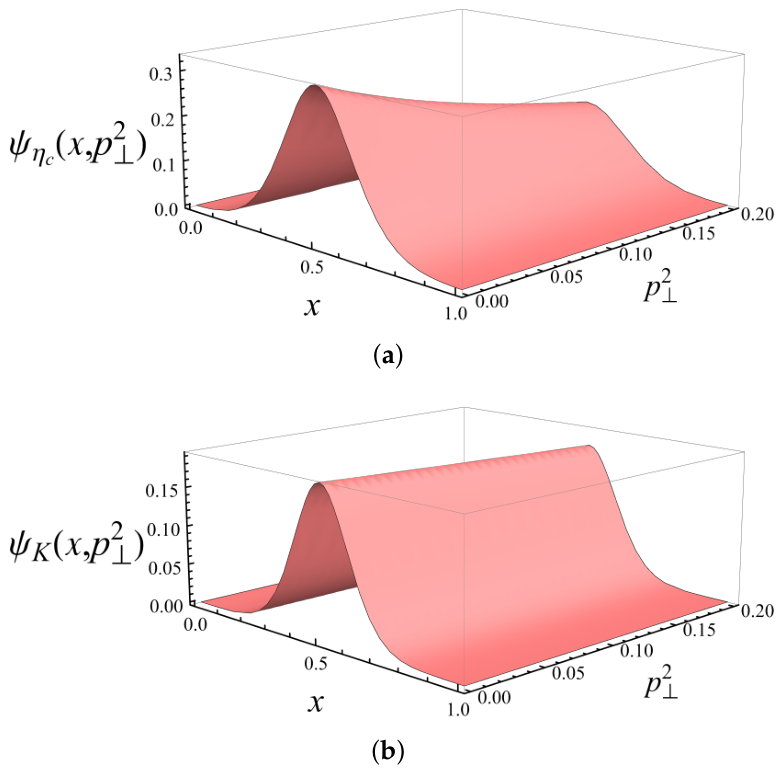
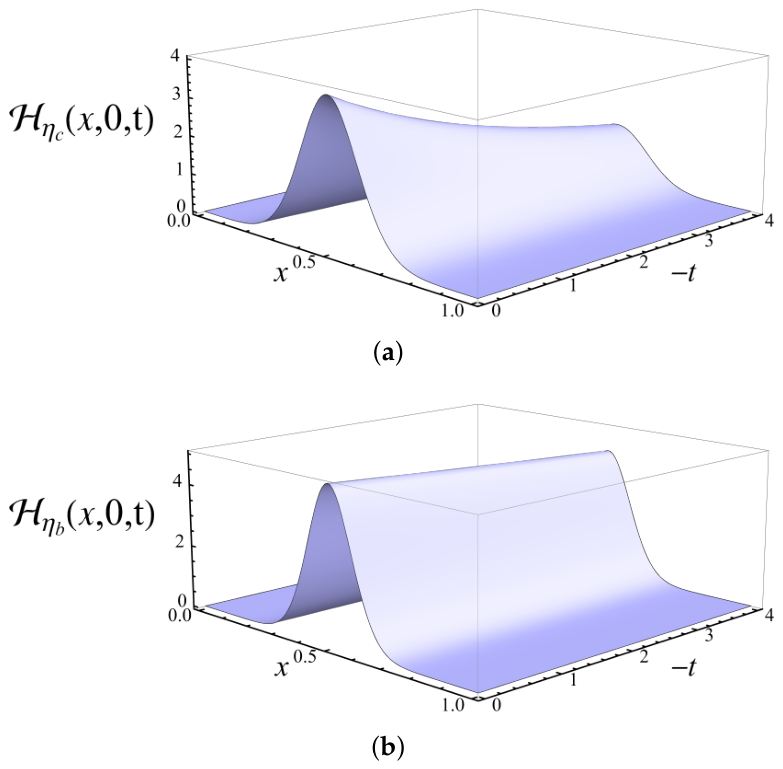
For heavy–heavy pseudoscalar mesons, η c and η b , the equal-mass nature of the valence constituents restores symmetry under x 1 x in all partonic distributions. The PDAs, LFWFs, and PDFs are sharply peaked around x = 1 / 2 , signaling the suppression of endpoint configurations and the onset of nonrelativistic dynamics. This behavior is consistent with expectations from the heavy-quark limit, in which the meson wave function becomes increasingly dominated by symmetric momentum configurations and relativistic longitudinal fluctuations are progressively suppressed. Correspondingly, the GPDs exhibit a hard dependence on the momentum transfer and the IPS-GPDs reveal compact transverse spatial profiles, with η b being significantly more localized than η c . The resulting transverse localization and harder momentum-transfer dependence of the form factors are qualitatively compatible with the increasingly compact bound-state structure expected as the heavy-quark mass increases. These findings are consistent with expectations from lattice QCD and Dyson–Schwinger equation studies [43,75,113].
The mixed η η system provides an additional test of the framework in a sector where dynamical chiral symmetry breaking, flavor mixing, and the non-Abelian axial anomaly are intertwined. Within the single-angle mixing scheme, the algebraic model yields a consistent description of the η l and η s components and connects their DAs, LFWFs, GPDs, PDFs, form factors, charge radii, and IPS-GPDs. The resulting pattern shows a continuous evolution from light-meson dynamics toward heavier-mass behavior, with increasing effective quark mass producing longitudinal compression, transverse localization, and a milder momentum-transfer dependence of the form factors.
Overall, the algebraic model reviewed here provides a unified framework connecting momentum-space and coordinate-space descriptions of hadron structure across a broad range of quark-mass regimes. Its analytic tractability enables the consistent computation of multiple observables—including PDAs, LFWFs, PDFs, GPDs, electromagnetic form factors, charge radii, and impact-parameter distributions—from the same underlying Bethe–Salpeter structure, thereby offering a useful complement to lattice QCD and continuum functional approaches.
The results summarized in this work show that the framework is capable of describing, within a common formalism, the transition from the strongly relativistic dynamics characteristic of light pseudoscalar mesons to the increasingly localized and symmetric structures observed in heavy quarkonia, while naturally accommodating the intermediate heavy–light sector. In this manner, the algebraic approach captures the systematic influence of quark masses and symmetries on the three-dimensional structure of pseudoscalar mesons and provides a coherent phenomenological bridge between different nonperturbative QCD regimes.
Beyond the pseudoscalar sector, the flexibility of the formalism also motivates further applications to more complex hadronic systems, including vector mesons and baryons, where similar algebraic constructions may preserve much of the analytic simplicity and unified interpretative power exhibited throughout the present review.

Author Contributions

Conceptualization, A.B., J.J.C.-M. and J.S.; methodology, A.B. and J.S.; software, B.A.-Z. and L.A.; validation, B.A.-Z., L.A. and J.S.; formal analysis, B.A.-Z., L.A. and J.S.; investigation, B.A.-Z. and L.A.; resources, B.A.-Z., L.A., A.B., J.J.C.-M. and J.S.; writing—original draft preparation, B.A.-Z. and J.S.; writing—review and editing, B.A.-Z., L.A., A.B., J.J.C.-M. and J.S.; visualization, B.A.-Z., L.A., A.B., J.J.C.-M. and J.S.; supervision, A.B., J.J.C.-M. and J.S.; project administration, A.B., J.J.C.-M. and J.S.; funding acquisition, A.B., J.J.C.-M. and J.S. All authors have read and agreed to the published version of the manuscript.

Funding

B. Almeida Zamora acknowledges SECIHTI (CVU No. 935777) for PhD and Postdoctoral fellowships. L.A. acknowledges financial support from SECIHTI (CVU No. 446053) through the program “Posdoctorados por México”, and Ayuda B3 “Ayudas para el desarrollo de líneas de investigación propias” del V Plan Propio de Investigación y Transferencia 2018-2020 de la Universidad Pablo de Olavide, de Sevilla. A.B. wishes to acknowledge the Coordinación de la Investigación Científica of the Universidad Michoacana de San Nicolás de Hidalgo, Morelia, Mexico, grant no. 4.10, the Consejo Nacional de Humanidades, Ciencias y Tecnologías, Mexico, project CBF2023-2024-3544 as well as Beatriz Galindo’s support during his scientific stay at the University of Huelva, Huelva, Spain. J.J. Cobos-Martínez acknowledges financial support from the University of Sonora under grant USO315007861. Otherwise, this work has been partially financed by Ministerio Español de Ciencia e Innovación under grant No. PID2019-107844GBC22; Junta de Andalucía under contract Nos. PAIDI FQM-370 and PCI+D+i under the title: “Tecnologías avanzadas para la exploración del universo y sus componentes” (Code AST22-0001).

Data Availability Statement

The data are not publicly available. The data are available from the authors upon reasonable request.

Acknowledgments

The authors acknowledge the use of the computer facilities of C3UPO at the Universidad Pablo de Olavide, de Sevilla.

Conflicts of Interest

The authors declare no conflicts of interest.

References

  1. Yang, C.N.; Mills, R.L. Conservation of Isotopic Spin and Isotopic Gauge Invariance. Phys. Rev. 1954, 96, 191–195. [Google Scholar] [CrossRef]
  2. Fritzsch, H.; Gell-Mann, M.; Leutwyler, H. Advantages of the Color Octet Gluon Picture. Phys. Lett. B 1973, 47, 365–368. [Google Scholar] [CrossRef]
  3. Wilson, K.G. Confinement of Quarks. Phys. Rev. D 1974, 10, 2445–2459. [Google Scholar] [CrossRef]
  4. Greensite, J. An Introduction to the Confinement Problem; Springer: Berlin/Heidelberg, Germany, 2011; Volume 821. [Google Scholar] [CrossRef]
  5. Wilczek, F. Mass without mass II: The medium is the mass-age. Phys. Today 2000, 53, 13–14. [Google Scholar] [CrossRef]
  6. Brodsky, S.J.; Deur, A.; Roberts, C.D. The Secret to the Strongest Force in the Universe. Sci. Am. 2024, 330, 32–39. [Google Scholar]
  7. Gross, D.J.; Wilczek, F. Ultraviolet Behavior of Nonabelian Gauge Theories. Phys. Rev. Lett. 1973, 30, 1343–1346. [Google Scholar] [CrossRef]
  8. Politzer, H.D. Reliable Perturbative Results for Strong Interactions? Phys. Rev. Lett. 1973, 30, 1346–1349. [Google Scholar] [CrossRef]
  9. Weinberg, S. The Quantum Theory of Fields. Volume 2: Modern Applications; Cambridge University Press: Cambridge, UK, 2013. [Google Scholar] [CrossRef]
  10. Wilson, K.G. The renormalization group and critical phenomena. Rev. Mod. Phys. 1983, 55, 583–600. [Google Scholar] [CrossRef]
  11. Gattringer, C.; Lang, C.B. Quantum Chromodynamics on the Lattice; Springer: Berlin/Heidelberg, Germany, 2010; Volume 788. [Google Scholar] [CrossRef]
  12. Aoki, S.; Aoki, Y.; Bečirević, D.; Blum, T.; Colangelo, G.; Collins, S.; Morte, M.D.; Dimopoulos, P.; Dürr, S.; Fukaya, H.; et al. FLAG Review 2019: Flavour Lattice Averaging Group (FLAG). Eur. Phys. J. C 2020, 80, 113. [Google Scholar] [CrossRef]
  13. Cloet, I.C.; Roberts, C.D. Explanation and Prediction of Observables using Continuum Strong QCD. Prog. Part. Nucl. Phys. 2014, 77, 1–69. [Google Scholar] [CrossRef]
  14. Alkofer, R.; von Smekal, L. The Infrared behavior of QCD Green’s functions: Confinement dynamical symmetry breaking, and hadrons as relativistic bound states. Phys. Rept. 2001, 353, 281. [Google Scholar] [CrossRef]
  15. Maris, P.; Roberts, C.D. Dyson–Schwinger equations: A Tool for hadron physics. Int. J. Mod. Phys. E 2003, 12, 297–365. [Google Scholar] [CrossRef]
  16. Chang, L.; Roberts, C.D. Sketching the Bethe-Salpeter kernel. Phys. Rev. Lett. 2009, 103, 081601. [Google Scholar] [CrossRef]
  17. Maris, P.; Tandy, P.C. Bethe-Salpeter study of vector meson masses and decay constants. Phys. Rev. C 1999, 60, 055214. [Google Scholar] [CrossRef]
  18. Bender, A.; Roberts, C.D.; Von Smekal, L. Goldstone theorem and diquark confinement beyond rainbow ladder approximation. Phys. Lett. B 1996, 380, 7–12. [Google Scholar] [CrossRef]
  19. Bhagwat, M.S.; Holl, A.; Krassnigg, A.; Roberts, C.D.; Tandy, P.C. Aspects and consequences of a dressed quark gluon vertex. Phys. Rev. C 2004, 70, 035205. [Google Scholar] [CrossRef]
  20. Nambu, Y.; Jona-Lasinio, G. Dynamical Model of Elementary Particles Based on an Analogy with Superconductivity. 1. Phys. Rev. 1961, 122, 345–358. [Google Scholar] [CrossRef]
  21. Hatsuda, T.; Kunihiro, T. QCD phenomenology based on a chiral effective Lagrangian. Phys. Rept. 1994, 247, 221–367. [Google Scholar] [CrossRef]
  22. Gutierrez-Guerrero, L.X.; Bashir, A.; Cloet, I.C.; Roberts, C.D. Pion form factor from a contact interaction. Phys. Rev. C 2010, 81, 065202. [Google Scholar] [CrossRef]
  23. Cloet, I.C.; Eichmann, G.; El-Bennich, B.; Klahn, T.; Roberts, C.D. Survey of nucleon electromagnetic form factors. Few Body Syst. 2009, 46, 1–36. [Google Scholar] [CrossRef]
  24. Nakanishi, N. Partial-Wave Bethe-Salpeter Equation. Phys. Rev. 1963, 130, 1230–1235. [Google Scholar] [CrossRef]
  25. Nakanishi, N. A General survey of the theory of the Bethe-Salpeter equation. Prog. Theor. Phys. Suppl. 1969, 43, 1–81. [Google Scholar] [CrossRef]
  26. Chang, L.; Cloet, I.C.; Cobos-Martinez, J.J.; Roberts, C.D.; Schmidt, S.M.; Tandy, P.C. Imaging dynamical chiral symmetry breaking: Pion wave function on the light front. Phys. Rev. Lett. 2013, 110, 132001. [Google Scholar] [CrossRef] [PubMed]
  27. Chang, L.; Roberts, C.D.; Schmidt, S.M. Light front distribution of the chiral condensate. Phys. Lett. B 2013, 727, 255–259. [Google Scholar] [CrossRef][Green Version]
  28. Gao, F.; Chang, L.; Liu, Y.X.; Roberts, C.D.; Schmidt, S.M. Parton distribution amplitudes of light vector mesons. Phys. Rev. D 2014, 90, 014011. [Google Scholar] [CrossRef]
  29. Chang, L.; Mezrag, C.; Moutarde, H.; Roberts, C.D.; Rodríguez-Quintero, J.; Tandy, P.C. Basic features of the pion valence-quark distribution function. Phys. Lett. B 2014, 737, 23–29. [Google Scholar] [CrossRef]
  30. Chang, L.; Thomas, A.W. Pion Valence-quark Parton Distribution Function. Phys. Lett. B 2015, 749, 547–550. [Google Scholar] [CrossRef]
  31. Higuera-Angulo, I.M.; Hernández-Pinto, R.J.; Raya, K.; Bashir, A. Electromagnetic and two-photon transition form factors of the pseudoscalar mesons: An algebraic model computation. Phys. Rev. D 2024, 110, 034013. [Google Scholar] [CrossRef]
  32. Mezrag, C.; Chang, L.; Moutarde, H.; Roberts, C.D.; Rodríguez-Quintero, J.; Sabatié, F.; Schmidt, S.M. Sketching the pion’s valence-quark generalised parton distribution. Phys. Lett. B 2015, 741, 190–196. [Google Scholar] [CrossRef]
  33. Mezrag, C.; Moutarde, H.; Rodriguez-Quintero, J. From Bethe–Salpeter Wave functions to Generalised Parton Distributions. Few Body Syst. 2016, 57, 729–772. [Google Scholar] [CrossRef]
  34. Shi, C.; Chen, C.; Chang, L.; Roberts, C.D.; Schmidt, S.M.; Zong, H.S. Kaon and pion parton distribution amplitudes to twist-three. Phys. Rev. D 2015, 92, 014035. [Google Scholar] [CrossRef]
  35. Raya, K.; Chang, L.; Bashir, A.; Cobos-Martinez, J.J.; Gutiérrez-Guerrero, L.X.; Roberts, C.D.; Tandy, P.C. Structure of the neutral pion and its electromagnetic transition form factor. Phys. Rev. D 2016, 93, 074017. [Google Scholar] [CrossRef]
  36. Chen, C.; Chang, L.; Roberts, C.D.; Wan, S.; Zong, H.S. Valence-quark distribution functions in the kaon and pion. Phys. Rev. D 2016, 93, 074021. [Google Scholar] [CrossRef]
  37. Bedolla, M.A.; Raya, K.; Cobos-Martínez, J.J.; Bashir, A. ηc elastic and transition form factors: Contact interaction and algebraic model. Phys. Rev. D 2016, 93, 094025. [Google Scholar] [CrossRef]
  38. Li, B.L.; Chang, L.; Ding, M.; Roberts, C.D.; Zong, H.S. Leading-twist distribution amplitudes of scalar- and vector-mesons. Phys. Rev. D 2016, 94, 094014. [Google Scholar] [CrossRef]
  39. Chouika, N.; Mezrag, C.; Moutarde, H.; Rodríguez-Quintero, J. A Nakanishi-based model illustrating the covariant extension of the pion GPD overlap representation and its ambiguities. Phys. Lett. B 2018, 780, 287–293. [Google Scholar] [CrossRef]
  40. Zhang, J.L.; Raya, K.; Chang, L.; Cui, Z.F.; Morgado, J.M.; Roberts, C.D.; Rodríguez-Quintero, J. Measures of pion and kaon structure from generalised parton distributions. Phys. Lett. B 2021, 815, 136158. [Google Scholar] [CrossRef]
  41. Raya, K.; Cui, Z.F.; Chang, L.; Morgado, J.M.; Roberts, C.D.; Rodriguez-Quintero, J. Revealing pion and kaon structure via generalised parton distributions. Chin. Phys. C 2022, 46, 013105. [Google Scholar] [CrossRef]
  42. Raya, K.; Rodríguez-Quintero, J. Highlights of pion and kaon structure from continuum analyses. Rev. Mex. Fis. Suppl. 2022, 3, 0308008. [Google Scholar] [CrossRef]
  43. Albino, L.; Higuera-Angulo, I.M.; Raya, K.; Bashir, A. Pseudoscalar mesons: Light front wave functions, GPDs, and PDFs. Phys. Rev. D 2022, 106, 034003. [Google Scholar] [CrossRef]
  44. Almeida-Zamora, B.; Cobos-Martínez, J.J.; Bashir, A.; Raya, K.; Rodríguez-Quintero, J.; Segovia, J. Algebraic model to study the internal structure of pseudoscalar mesons with heavy-light quark content. Phys. Rev. D 2024, 109, 014016. [Google Scholar] [CrossRef]
  45. Almeida-Zamora, B.; Cobos-Martínez, J.J.; Bashir, A.; Raya, K.; Rodríguez-Quintero, J.; Segovia, J. Heavy-light Pseudoscalar Mesons: Light-Front Wave Functions and Generalized Parton Distributions. Proc. Sci. 2025, 456, 051. [Google Scholar] [CrossRef]
  46. Albino, L.; Raya, K.; Hernández-Pinto, R.J.; Almeida-Zamora, B.; Segovia, J.; Huet, A.; Bashir, A. Multidimensional landscape of the η and η’ mesons. Phys. Rev. D 2026, 113, 034019. [Google Scholar] [CrossRef]
  47. Almeida-Zamora, B.; Cobos-Martínez, J.J.; Bashir, A.; Raya, K.; Rodríguez-Quintero, J.; Segovia, J. Light-front wave functions of vector mesons in an algebraic model. Phys. Rev. D 2023, 107, 074037. [Google Scholar] [CrossRef]
  48. Roberts, C.D.; Williams, A.G. Dyson–Schwinger equations and their application to hadronic physics. Prog. Part. Nucl. Phys. 1994, 33, 477–575. [Google Scholar] [CrossRef]
  49. Eichmann, G.; Alkofer, R.; Krassnigg, A.; Nicmorus, D. Nucleon mass from a covariant three-quark Faddeev equation. Phys. Rev. Lett. 2010, 104, 201601. [Google Scholar] [CrossRef]
  50. Salpeter, E.E.; Bethe, H.A. A Relativistic equation for bound state problems. Phys. Rev. 1951, 84, 1232–1242. [Google Scholar] [CrossRef]
  51. Munczek, H.J. Dynamical chiral symmetry breaking, Goldstone’s theorem and the consistency of the Schwinger-Dyson and Bethe-Salpeter Equations. Phys. Rev. D 1995, 52, 4736–4740. [Google Scholar] [CrossRef]
  52. Carbonell, J.; Karmanov, V.A. Solving Bethe-Salpeter equation for two fermions in Minkowski space. Eur. Phys. J. A 2010, 46, 387–397. [Google Scholar] [CrossRef]
  53. Chouika, N.; Mezrag, C.; Moutarde, H.; Rodríguez-Quintero, J. Covariant Extension of the GPD overlap representation at low Fock states. Eur. Phys. J. C 2017, 77, 906. [Google Scholar] [CrossRef]
  54. Brodsky, S.J.; Pauli, H.C.; Pinsky, S.S. Quantum chromodynamics and other field theories on the light cone. Phys. Rept. 1998, 301, 299–486. [Google Scholar] [CrossRef]
  55. Diehl, M. Generalized parton distributions. Phys. Rept. 2003, 388, 41–277. [Google Scholar] [CrossRef]
  56. Carbonell, J.; Karmanov, V.A. Solutions of the Bethe-Salpeter equation in Minkowski space and applications to electromagnetic form factors. Few Body Syst. 2011, 49, 205–222. [Google Scholar] [CrossRef][Green Version]
  57. Frederico, T.; Salme, G.; Viviani, M. Two-body scattering states in Minkowski space and the Nakanishi integral representation onto the null plane. Phys. Rev. D 2012, 85, 036009. [Google Scholar] [CrossRef]
  58. de Paula, W.; Frederico, T.; Salmè, G.; Viviani, M. Advances in solving the two-fermion homogeneous Bethe-Salpeter equation in Minkowski space. Phys. Rev. D 2016, 94, 071901. [Google Scholar] [CrossRef]
  59. Polyakov, M.V. Generalized parton distributions and strong forces inside nucleons and nuclei. Phys. Lett. B 2003, 555, 57–62. [Google Scholar] [CrossRef]
  60. Brodsky, S.J.; Diehl, M.; Hwang, D.S. Light cone wave function representation of deeply virtual Compton scattering. Nucl. Phys. B 2001, 596, 99–124. [Google Scholar] [CrossRef]
  61. Raya, K.; Bashir, A.; Binosi, D.; Roberts, C.D.; Rodríguez-Quintero, J. Pseudoscalar Mesons and Emergent Mass. Few Body Syst. 2024, 65, 60. [Google Scholar] [CrossRef]
  62. Dokshitzer, Y.L. Calculation of the Structure Functions for Deep Inelastic Scattering and e+e- Annihilation by Perturbation Theory in Quantum Chromodynamics. Sov. Phys. JETP 1977, 46, 641–653. [Google Scholar]
  63. Gribov, V.N.; Lipatov, L.N. Deep inelastic e p scattering in perturbation theory. Sov. J. Nucl. Phys. 1972, 15, 438–450. [Google Scholar]
  64. Lipatov, L.N. The parton model and perturbation theory. Yad. Fiz. 1974, 20, 181–198. [Google Scholar]
  65. Altarelli, G.; Parisi, G. Asymptotic Freedom in Parton Language. Nucl. Phys. B 1977, 126, 298–318. [Google Scholar] [CrossRef]
  66. Cui, Z.F.; Ding, M.; Gao, F.; Raya, K.; Binosi, D.; Chang, L.; Roberts, C.D.; Rodríguez-Quintero, J.; Schmidt, S.M. Kaon and pion parton distributions. Eur. Phys. J. C 2020, 80, 1064. [Google Scholar] [CrossRef]
  67. Ding, M.; Gao, F.; Chang, L.; Liu, Y.X.; Roberts, C.D. Leading-twist parton distribution amplitudes of S-wave heavy-quarkonia. Phys. Lett. B 2016, 753, 330–335. [Google Scholar] [CrossRef]
  68. Particle Data Group; Zyla, P.A.; Barnett, R.M.; Beringer, J.; Dahl, O.; Dwyer, D.A.; Groom, D.E.; Lin, C.-J.; Lugovsky, K.S.; Pianori, E.; et al. Review of Particle Physics. Prog. Theor. Exp. Phys. 2020, 2020, 083C01. [Google Scholar] [CrossRef]
  69. Chang, L.; Cloët, I.C.; Roberts, C.D.; Schmidt, S.M.; Tandy, P.C. Pion electromagnetic form factor at spacelike momenta. Phys. Rev. Lett. 2013, 111, 141802. [Google Scholar] [CrossRef]
  70. Eichmann, G.; Fischer, C.S.; Williams, R. Kaon-box contribution to the anomalous magnetic moment of the muon. Phys. Rev. D 2020, 101, 054015. [Google Scholar] [CrossRef]
  71. Bhagwat, M.S.; Krassnigg, A.; Maris, P.; Roberts, C.D. Mind the gap. Eur. Phys. J. A 2007, 31, 630–637. [Google Scholar] [CrossRef]
  72. Miramontes, Á.; Bashir, A.; Raya, K.; Roig, P. Pion and Kaon box contribution to aμHLbL. Phys. Rev. D 2022, 105, 074013. [Google Scholar] [CrossRef]
  73. Raya, K.; Bashir, A.; Miramontes, A.S.; Roig Garces, P. Dyson–Schwinger equations and the muon g-2. Rev. Mex. Fis. Suppl. 2022, 3, 020709. [Google Scholar] [CrossRef]
  74. Dudek, J.J.; Edwards, R.G.; Mathur, N.; Richards, D.G. Radiative physics in charmonium from lattice QCD. J. Phys. Conf. Ser. 2007, 69, 012006. [Google Scholar] [CrossRef]
  75. Dudek, J.J.; Edwards, R.G.; Richards, D.G. Radiative transitions in charmonium from lattice QCD. Phys. Rev. D 2006, 73, 074507. [Google Scholar] [CrossRef]
  76. Segovia, J.; Chang, L.; Cloët, I.C.; Roberts, C.D.; Schmidt, S.M.; Zong, H.S. Distribution amplitudes of light-quark mesons from lattice QCD. Phys. Lett. B 2014, 731, 13–18. [Google Scholar] [CrossRef]
  77. Braun, V.M.; Collins, S.; Göckeler, M.; Pérez-Rubio, P.; Schäfer, A.; Schiel, R.W.; Sternbeck, A. Second Moment of the Pion Light-cone Distribution Amplitude from Lattice QCD. Phys. Rev. D 2015, 92, 014504. [Google Scholar] [CrossRef]
  78. Li, B.L.; Chang, L.; Gao, F.; Roberts, C.D.; Schmidt, S.M.; Zong, H.S. Distribution amplitudes of radially-excited π and K mesons. Phys. Rev. D 2016, 93, 114033. [Google Scholar] [CrossRef]
  79. Gao, F.; Chang, L.; Liu, Y.x. Bayesian extraction of the parton distribution amplitude from the Bethe–Salpeter wave function. Phys. Lett. B 2017, 770, 551–555. [Google Scholar] [CrossRef]
  80. Chang, Q.; Brodsky, S.J.; Li, X.Q. Light-front holographic distribution amplitudes of pseudoscalar mesons and their application to B-meson decays. Phys. Rev. D 2017, 95, 094025. [Google Scholar] [CrossRef]
  81. Zhang, J.H.; Chen, J.W.; Ji, X.; Jin, L.; Lin, H.W. Pion Distribution Amplitude from Lattice QCD. Phys. Rev. D 2017, 95, 094514. [Google Scholar] [CrossRef]
  82. Gao, F.; Chang, L.; Liu, Y.X.; Roberts, C.D.; Tandy, P.C. Exposing strangeness: Projections for kaon electromagnetic form factors. Phys. Rev. D 2017, 96, 034024. [Google Scholar] [CrossRef]
  83. Zhang, J.H.; Jin, L.; Lin, H.W.; Schäfer, A.; Sun, P.; Yang, Y.B.; Zhang, R.; Zhao, Y.; Chen, J.W. Kaon Distribution Amplitude from Lattice QCD and the Flavor SU(3) Symmetry. Nucl. Phys. B 2019, 939, 429–446. [Google Scholar] [CrossRef]
  84. Chen, M.; Ding, M.; Chang, L.; Roberts, C.D. Mass-dependence of pseudoscalar meson elastic form factors. Phys. Rev. D 2018, 98, 091505. [Google Scholar] [CrossRef]
  85. Ding, M.; Raya, K.; Bashir, A.; Binosi, D.; Chang, L.; Chen, M.; Roberts, C.D. γ*γη,η transition form factors. Phys. Rev. D 2019, 99, 014014. [Google Scholar] [CrossRef]
  86. Braun, V.M.; Ivanov, D.Y.; Korchemsky, G.P. The B meson distribution amplitude in QCD. Phys. Rev. D 2004, 69, 034014. [Google Scholar] [CrossRef]
  87. Lee, S.J.; Neubert, M. Model-independent properties of the B-meson distribution amplitude. Phys. Rev. D 2005, 72, 094028. [Google Scholar] [CrossRef]
  88. Grozin, A.G. B-meson distribution amplitudes. Int. J. Mod. Phys. A 2005, 20, 7451–7484. [Google Scholar] [CrossRef]
  89. Beneke, M.; Rohrwild, J. B meson distribution amplitude from Bγℓν. Eur. Phys. J. C 2011, 71, 1818. [Google Scholar] [CrossRef]
  90. Braun, V.M.; Khodjamirian, A. Soft contribution to Bγℓν and the B-meson distribution amplitude. Phys. Lett. B 2013, 718, 1014–1019. [Google Scholar] [CrossRef]
  91. Bell, G.; Feldmann, T.; Wang, Y.M.; Yip, M.W.Y. Light-Cone Distribution Amplitudes for Heavy-Quark Hadrons. J. High Energy Phys. 2013, 11, 191. [Google Scholar] [CrossRef]
  92. Beneke, M.; Braun, V.M.; Ji, Y.; Wei, Y.B. Radiative leptonic decay Bγℓν with subleading power corrections. J. High Energy Phys. 2018, 07, 154. [Google Scholar] [CrossRef]
  93. Binosi, D.; Chang, L.; Ding, M.; Gao, F.; Papavassiliou, J.; Roberts, C.D. Distribution Amplitudes of Heavy-Light Mesons. Phys. Lett. B 2019, 790, 257–262. [Google Scholar] [CrossRef]
  94. Serna, F.E.; da Silveira, R.C.; Cobos-Martínez, J.J.; El-Bennich, B.; Rojas, E. Distribution amplitudes of heavy mesons and quarkonia on the light front. Eur. Phys. J. C 2020, 80, 955. [Google Scholar] [CrossRef]
  95. Particle Data Group; Workman, R.L.; Burkert, V.D.; Crede, V.; Klempt, E.; Thoma, U.; Tiator, L.; Agashe, K.; Aielli, G.; Allanach, B.C.; et al. Review of Particle Physics. Prog. Theor. Exp. Phys. 2022, 2022, 083C01. [Google Scholar] [CrossRef]
  96. Chiu, T.W.; Hsieh, T.H. B(s) and B(c) mesons in lattice QCD with exact chiral symmetry. Proc. Sci. 2007, LAT2006, 180. [Google Scholar] [CrossRef][Green Version]
  97. Moita, R.M.; de Melo, J.P.B.C.; Tsushima, K.; Frederico, T. Exploring the flavor content of light and heavy-light pseudoscalars. Phys. Rev. D 2021, 104, 096020. [Google Scholar] [CrossRef]
  98. Das, T.; Choudhury, D.K.; Bordoloi, N.S. Charge radii of heavy flavored mesons in a potential model. arXiv 2016, arXiv:1608.06896. [Google Scholar] [CrossRef]
  99. Hwang, C.W. Charge radii of light and heavy mesons. Eur. Phys. J. C 2002, 23, 585–590. [Google Scholar] [CrossRef]
  100. Hernández-Pinto, R.J.; Gutiérrez-Guerrero, L.X.; Bashir, A.; Bedolla, M.A.; Higuera-Angulo, I.M. Electromagnetic form factors and charge radii of pseudoscalar and scalar mesons: A comprehensive contact interaction analysis. Phys. Rev. D 2023, 107, 054002. [Google Scholar] [CrossRef]
  101. Li, N.; Wu, Y.J. Lattice study of D and Ds meson form factors with twisted boundary conditions. Eur. Phys. J. A 2017, 53, 56. [Google Scholar] [CrossRef]
  102. Can, K.U.; Erkol, G.; Oka, M.; Ozpineci, A.; Takahashi, T.T. Vector and axial-vector couplings of D and D* mesons in 2 + 1 flavor Lattice QCD. Phys. Lett. B 2013, 719, 103–109. [Google Scholar] [CrossRef]
  103. Feldmann, T.; Kroll, P.; Stech, B. Mixing and decay constants of pseudoscalar mesons: The Sequel. Phys. Lett. B 1999, 449, 339–346. [Google Scholar] [CrossRef]
  104. Feldmann, T.; Kroll, P.; Stech, B. Mixing and decay constants of pseudoscalar mesons. Phys. Rev. D 1998, 58, 114006. [Google Scholar] [CrossRef]
  105. Ottnad, K.; Bacchio, S.; Finkenrath, J.; Kostrzewa, B.; Petschlies, M.; Pittler, F.; Urbach, C.; Wenger, U. η, η mesons from lattice QCD in fully physical conditions. Eur. Phys. J. A 2025, 61, 169, Erratum in Eur. Phys. J. A 2025, 61, 227. https://doi.org/10.1140/epja/s10050-025-01700-8. [Google Scholar] [CrossRef]
  106. De Fazio, F.; Pennington, M.R. Radiative ϕ meson decays and ηη mixing: A QCD sum rule analysis. J. High Energy Phys. 2000, 7, 051. [Google Scholar] [CrossRef]
  107. Benayoun, M.; DelBuono, L.; O’Connell, H.B. VMD, the WZW Lagrangian and ChPT: The Third mixing angle. Eur. Phys. J. C 2000, 17, 593–610. [Google Scholar] [CrossRef]
  108. Feldmann, T.; Kroll, P. Flavor symmetry breaking and mixing effects in the ηγ and ηγ transition form factors. Eur. Phys. J. C 1998, 5, 327–335. [Google Scholar] [CrossRef]
  109. Navas, S.; Amsler, C.; Gutsche, T.; Hanhart, C.; Hernández-Rey, J.J.; Lourenço, C.; Masoni, A.; Mikhasenko, M.; Mitchell, R.E.; Patrignani, C.; et al. Review of particle physics*. Phys. Rev. D 2024, 110, 030001. [Google Scholar] [CrossRef]
  110. Xu, Y.; Sultan, M.A.; Raya, K.; Chang, L. Contact interaction treatment of V→Pγ for light-quark mesons. Phys. Rev. D 2024, 110, 094036. [Google Scholar] [CrossRef]
  111. Zamora, B.A.; Martínez, E.C.; Segovia, J.; Cobos-Martínez, J.J. Contact interaction model for the η and η’ mesons in a Schwinger-Dyson-Bethe-Salpeter approach to QCD: Masses, decay widths, and transition form factors. Phys. Rev. D 2023, 107, 114031. [Google Scholar] [CrossRef]
  112. Accardi, A.; Achenbach, P.; Adhikari, D.; Afanasev, A.; Akondi, C.S.; Akopov, N.; Albaladejo, M.; Albataineh, H.; Albrecht, M.; Almeida-Zamora, B.; et al. Strong interaction physics at the luminosity frontier with 22 GeV electrons at Jefferson Lab. Eur. Phys. J. A 2024, 60, 173. [Google Scholar] [CrossRef]
  113. Dudek, J.J.; Edwards, R.G. Two Photon Decays of Charmonia from Lattice QCD. Phys. Rev. Lett. 2006, 97, 172001. [Google Scholar] [CrossRef]
Figure 1. Pion and kaon parton distribution amplitudes evaluated at the hadronic scale ζ H . The distributions are obtained from the Dyson–Schwinger equations framework [66,67] and parametrized according to Equation (71). The asymptotic distribution ϕ asy ( x ) = 6 x ( 1 x ) is shown for comparison.
Symmetry 18 01017 g001
Figure 2. Light-front wave functions of the pion (upper panel (a)) and kaon (lower panel (b)) calculated from Equation (45). The wave functions are shown as ψ M ( x , k 2 ) ψ M ( x , k 2 ) / ( 16 π 2 f M ) . All unit masses are expressed in GeV.
Symmetry 18 01017 g002
Figure 3. Valence quark GPDs for the pion (upper panel (a)) and kaon (lower panel (b)) obtained from Equation (55) for ξ = 0 . Mass units are given in GeV.
Symmetry 18 01017 g003
Figure 4. Valence-quark PDFs at the hadronic scale ζ H . The solid (red) line represents the pion, while the dashed–dotted (blue) line corresponds to the light-quark distribution in the kaon. The dashed (gray) line shows the scale-free, parton-like distribution q s f ( x ) = 30 x 2 ( 1 x ) 2 for comparison.
Symmetry 18 01017 g004
Figure 5. Impact-parameter dependent GPDs for pion, in panel (a), and kaon, in panel (b). The quark and antiquark contributions correspond to the regions x > 0 and x < 0 , respectively. The resulting left–right asymmetry reflects the mass imbalance between the dressed valence constituents, with the heavier quark exerting a dominant influence on the transverse center of momentum.
Symmetry 18 01017 g005
Figure 6. Parton distribution amplitudes (PDAs) for heavy–light mesons evaluated at the hadronic scale ζ H . Panel (a) depicts the PDAs of charmed mesons whereas panel (b) shows the PDAs of open-bottom mesons.
Symmetry 18 01017 g006
Figure 7. Light-front wave functions of heavy–light pseudoscalar mesons as functions of the longitudinal momentum fraction x and the transverse momentum squared p 2 . Panel (a) shows the LFWF of the D meson, while panel (b) corresponds to the D s meson; (c) corresponds to the B, (d) B s , and (e) B c .
Symmetry 18 01017 g007
Figure 8. Generalized parton distributions of heavy–light pseudoscalar mesons as functions of the longitudinal momentum fraction x and the momentum transfer squared t . Panel (a) shows the GPD of the D meson, while panel (b) corresponds to the D s meson; (c) corresponds to B, (d) B s and (e) B c .
Symmetry 18 01017 g008
Figure 9. Parton distribution functions of pseudoscalar mesons. Panel (a) shows the PDFs of the D and D s mesons, while panel (b) displays those of the B, B s , and B c mesons. For completeness, the results are compared with the asymptotic distribution q ( x ) = 30 x 2 ( 1 x ) 2 . The comparison illustrates the impact of quark-mass effects on the longitudinal momentum distributions within the adopted light-front framework.
Symmetry 18 01017 g009
Figure 10. Elastic electromagnetic form factors of pseudoscalar mesons. Panel (a) shows the EFFs of the D and D s mesons, while panel (b) displays those of the B, B s , and B c mesons.
Symmetry 18 01017 g010
Figure 11. Impact-parameter dependent GPDs, where the quark and antiquark contributions are assigned to the regions x > 0 and x < 0 , respectively. The resulting left–right asymmetry reflects the mass imbalance between the dressed valence constituents, with the heavier quark exerting a dominant influence on the transverse center of momentum. Panel (a) shows the impact-parameter dependent GPD of the D meson, while panel (b) corresponds to the D s meson; (c) corresponds to B, (d) B s and (e) B c .
Symmetry 18 01017 g011
Figure 12. Leading-twist parton distribution amplitudes of the heavy–heavy pseudoscalar mesons η c and η b at the hadronic scale ζ H . The distributions are symmetric under x 1 x due to the equal-mass valence constituents and exhibit a pronounced localization around x = 1 / 2 , reflecting the increasingly nonrelativistic nature of heavy quarkonia as the quark mass increases.
Symmetry 18 01017 g012
Figure 13. Light-front wave functions of the heavy–heavy pseudoscalar mesons η c (panel (a)) and η b (panel (b)), computed from Equation (45) using the corresponding PDAs as inputs. Owing to the equal-mass valence constituents, the distributions are symmetric under x 1 x and display strong localization around x = 1 / 2 . The increasing quark mass from charm to bottom leads to a narrower longitudinal profile and a slower falloff with increasing transverse momentum k 2 , signaling the transition toward a more compact and less relativistic bound state.
Symmetry 18 01017 g013
Figure 14. Valence-quark generalized parton distributions of the heavy–heavy pseudoscalar mesons η c (panel (a)) and η b (panel (b)) at zero skewness, ξ = 0 , obtained from the overlap representation of the corresponding LFWFs. Owing to the equal-mass valence constituents, the GPDs are symmetric under x 1 x and sharply peaked around x = 1 / 2 . As the quark mass increases from charm to bottom, the distributions become narrower in x and exhibit a harder dependence on the momentum transfer t, reflecting the increasingly compact spatial structure of heavy quarkonia.
Symmetry 18 01017 g014
Figure 15. Valence-quark parton distribution functions of the heavy–heavy pseudoscalar mesons η c and η b , obtained as the forward limit of the corresponding generalized parton distributions, q ( x ) = H ( x , 0 , 0 ) . Due to the equal-mass valence constituents, the PDFs are symmetric under x 1 x and sharply peaked around x = 1 / 2 . The distribution becomes progressively narrower as the quark mass increases from charm to bottom, reflecting the suppression of endpoint configurations and the transition toward the nonrelativistic regime in heavy quarkonia.
Symmetry 18 01017 g015
Figure 16. Elastic electromagnetic form factors of the heavy–heavy pseudoscalar mesons η c and η b , obtained from the zeroth Mellin moment of the corresponding GPD. The form factors exhibit a slow decrease with increasing momentum transfer Q 2 , reflecting the compact spatial structure of heavy quarkonia. As the quark mass increases from charm to bottom, the EFF becomes harder, indicating a further reduction of the transverse spatial extent and a smaller charge radius for the η b compared to the η c .
Symmetry 18 01017 g016
Figure 17. Impact-parameter space generalized parton distributions of the heavy–heavy pseudoscalar mesons η c (panel (a)) and η b (panel (b)), obtained from the Fourier transform of the zero-skewness GPDs. Owing to the equal-mass valence constituents, the distributions are symmetric in x and centered at the transverse center of momentum. As the quark mass increases from charm to bottom, the IPS-GPD becomes more localized in impact-parameter space, signaling a progressively more compact transverse spatial structure in heavy quarkonia.
Symmetry 18 01017 g017
Figure 18. η η DAs. Upper panel: Input DAs in the generic flavor basis from Ref. [85]. Lower panel: η l , s DAs obtained through the SA-MS mapping, Equation (81). For comparison, the pion DA and the asymptotic profile φ asy ( x ) are shown.
Symmetry 18 01017 g018
Figure 19. Valence-quark GPDs of the η l (upper panel) and η s (lower panel) systems in the SA-MS. Curves show the x-dependence for several values of Δ 2 at ξ = 0 .
Symmetry 18 01017 g019
Figure 20. Valence-quark distribution functions for the η l and η s components at the hadronic scale ζ H .
Symmetry 18 01017 g020
Figure 21. Electromagnetic form factors of the η l and η s components. For comparison, the η c and η b profiles from Ref. [43] are included.
Symmetry 18 01017 g021
Figure 22. Valence-quark IPS-GPDs for the η l (panel (a)) and η s (panel (b)) systems in the SA-MS. Curves show the | b | -dependence for several values of x.
Symmetry 18 01017 g022
Table 1. Model parameters: meson and constituent-quark masses (in GeV). The values of M q are determined using Equation (69) together with the specified charge radii. The corresponding distribution amplitudes employed in the calculations are listed in Equation (71).
Meson m M r M (in fm)Quark M q
π + 0.140.659 [68,69]u0.317
K + 0.490.600 [70,72,73]s0.574
Table 2. The ( α , β ) -pairs that specify the PDAs of heavy–light mesons via Equation (72).
D D s B B s B c
α 0.265(30) 0.508 ( 30 ) 0.497 ( 70 ) 0.669 ( 60 ) 1.901 ( 70 )
β 1.435 ( 30 ) 1.391 ( 30 ) 2.166 ( 60 ) 2.177 ( 60 ) 2.163 ( 60 )
Table 3. Meson masses ( m M ) and leptonic decay constants ( f M ) for the lowest-lying heavy–light pseudoscalar states, expressed in GeV. The dressed quark masses ( M q ) are also given in GeV, while the electric charges ( e q ) are quoted in units of the positron charge. The corresponding antiquarks possess equal masses but opposite electric charges.
Mesons Quarks
m M f M M q e q
D1.88(5) 0.158 ( 8 ) u 0.533 2 / 3
D s 1.94 ( 4 ) 0.171 ( 6 ) d 0.533 1 / 3
B 5.30 ( 15 ) 0.142 ( 13 ) s 0.717 1 / 3
B s 5.38 ( 13 ) 0.179 ( 12 ) c 1.65 2 / 3
B c 6.31 ( 1 ) 0.367 ( 1 ) b 5.09 1 / 3
Table 4. Charge radii (in fm) of heavy–light pseudoscalar mesons. Owing to the absence of a universally defined hadronic scale in many alternative approaches, a direct one-to-one comparison is not always possible. Nevertheless, results from Refs. [97,98,99,100,101,102] are quoted for qualitative comparison and context.
D D s B + B s 0 B c +
| r 0 | 0.3740.2890.4780.2640.217
Covariant CQM[97]0.5050.377
PM[98]0.4600.7300.460
LFQM[99]0.4290.3520.6150.3450.208
CI[100]0.2600.3400.2400.170
Lattice[101]0.450(24)0.465(57)
Lattice[102]0.390(33)
Table 5. Model parameters: meson and constituent-quark masses taken from Ref. [43]. The values of M q are determined using Equation (69) together with the specified charge radii, which is also provided by [43]. The corresponding distribution amplitudes employed in the calculations are listed in Equation (71).
Meson m M (GeV)Quark M q (GeV) r M (fm)
η c 2.98c1.650.255
η b 9.39b5.090.088
Table 6. Leptonic decay constants in the generic flavor basis for the η η system. Results from CSM [85], Lattice QCD [105], and phenomenology [103,106,107] are shown for comparison. All quantities are in GeV.
f η l f η s f η l f η s
Herein0.070−0.0910.0620.103
CSM0.074−0.0920.0680.101
Lattice0.076(3)−0.077(4)0.062(3)0.093(3)
Phen.0.090(13)−0.093(28)0.073(14)0.094(8)
Table 7. Decay constants in the single-angle mixing scheme (SA-MS) and mixing angle θ for the η η system. All decay constants are given in GeV.
f η l f η s θ
Herein0.0930.137 41 . 50
CSM0.1010.138 42 . 95
Lattice0.098(3)0.121(2) 39.3 ( 2.0 )
Phen.0.116(11)0.122(9) 39.28 ( 8 )
Table 8. Masses, charge radii, and the product f M · r M . With the exception of η l and η s , the remaining entries are taken from Ref. [43].
m M [GeV] r M [fm] f M · r M
π 0.140.6590.307
η l 0.170.6550.308
η s 0.840.4720.330
η c 2.980.2550.301
η b 9.390.0880.217
Disclaimer/Publisher’s Note: The statements, opinions and data contained in all publications are solely those of the individual author(s) and contributor(s) and not of MDPI and/or the editor(s). MDPI and/or the editor(s) disclaim responsibility for any injury to people or property resulting from any ideas, methods, instructions or products referred to in the content.