Hankel-Structured Graph Learning for Meta-Verified Sylvester Reconstruction in Binary Waring Decomposition



Abstract
1. Introduction
- We propose a learning-assisted Sylvester solver for binary Waring decomposition in which a graph neural network (GNN) predicts plausible Waring ranks directly from Hankel-induced coefficient structure. This learning module serves as a structural front-end that guides the classical Sylvester reconstruction procedure while preserving the exact algebraic verification pipeline.
- We introduce a Meta-Solver mechanism that evaluates multiple candidate ranks rather than relying on a single rank prediction with a rigid residual threshold. By combining algebraic reconstruction features with learned confidence signals, the Meta-Solver improves rank selection robustness, particularly in settings where numerical residuals alone are insufficiently discriminative.
- We empirically demonstrate that the proposed framework improves rank identification and verified reconstruction success under low-to-moderate coefficient noise, and we report stress tests under shifted sampling regimes. Although the current implementation does not yet provide a runtime advantage over classical baselines, it illustrates how learning-based candidate verification can enhance robustness in algebraic decomposition pipelines.
2. Mathematical Preliminaries
2.1. Binary Waring Decomposition
- Uniqueness regime (informal).
2.2. Hankel (Catalecticant) Characterization
- 1.
- The coefficient sequence obeys a linear recurrence relation of order r, and the associated Hankel matrices become rank-deficient once their size exceeds the minimal rank. Equivalently, the minimal Waring rank is the smallest r for which the sequence admits a nontrivial linear recurrence.
- 2.
- There exists a degree-r polynomial:whose roots are precisely . The coefficients satisfy a linear system derived from the Hankel structure induced by (3).
2.3. Linear Recurrence and Reconstruction
- Recurrence system.
- Recovering roots and weights.
- Verification.
2.4. Classical Sylvester Rank Search
- Computational implications.
| Algorithm 1 Classical Sylvester Rank Search (incremental) |
|
for do Build Hankel blocks needed for (8) Solve for recurrence coefficients if no stable/nontrivial solution exists then continue end if Form and compute roots if roots are not distinct (or root finding fails) then continue end if Solve Vandermonde system (9) for weights Compute verification residual using (10) if then return rank r and decomposition parameters end if end for return failure (or switch to numeric heuristics/regularization) |
3. Graph Representation of Polynomial Structure
3.1. Coefficient Graph Construction
- Node features.
- Edge design principle.
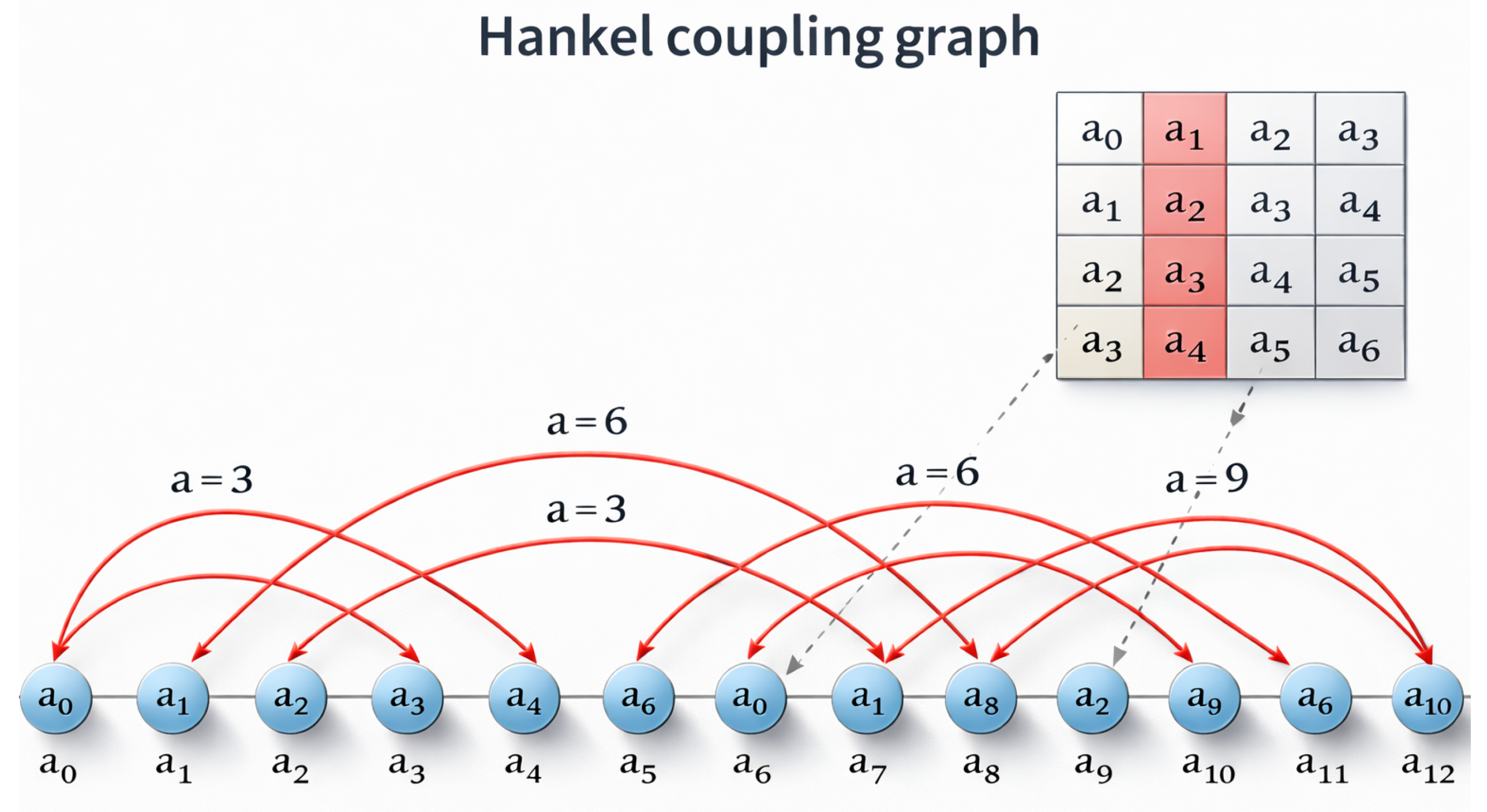
- Local adjacency edges .We connect consecutive indices along the coefficient sequence:These edges preserve the natural ordering of coefficients and allow for message propagation along the sequence.
- Hankel-coupling edges .Let denote the maximum candidate rank considered during training. For each , define the Hankel window length:For every window start , we consider the index set:Within each window, we connect pairs of indices that participate in the same Hankel anti-diagonal. Equivalently, we add an edgewhenever there exist such thatfor some integer .
- Edge multiplicity as an inductive bias.
- Practical summary.
- It is sparse and approximately banded along the coefficient index line.
- It reflects the shift-invariant reuse patterns of Hankel matrices.
- Its connectivity is controlled by two parameters: the maximum candidate rank and the sparsity radius .
- Why this graph encoding?
3.2. Structural Insight
3.3. Computational Complexity and Implementation Notes
4. Learning-Assisted Rank Prediction
4.1. Problem Formulation
- Optional auxiliary head (stability regime).
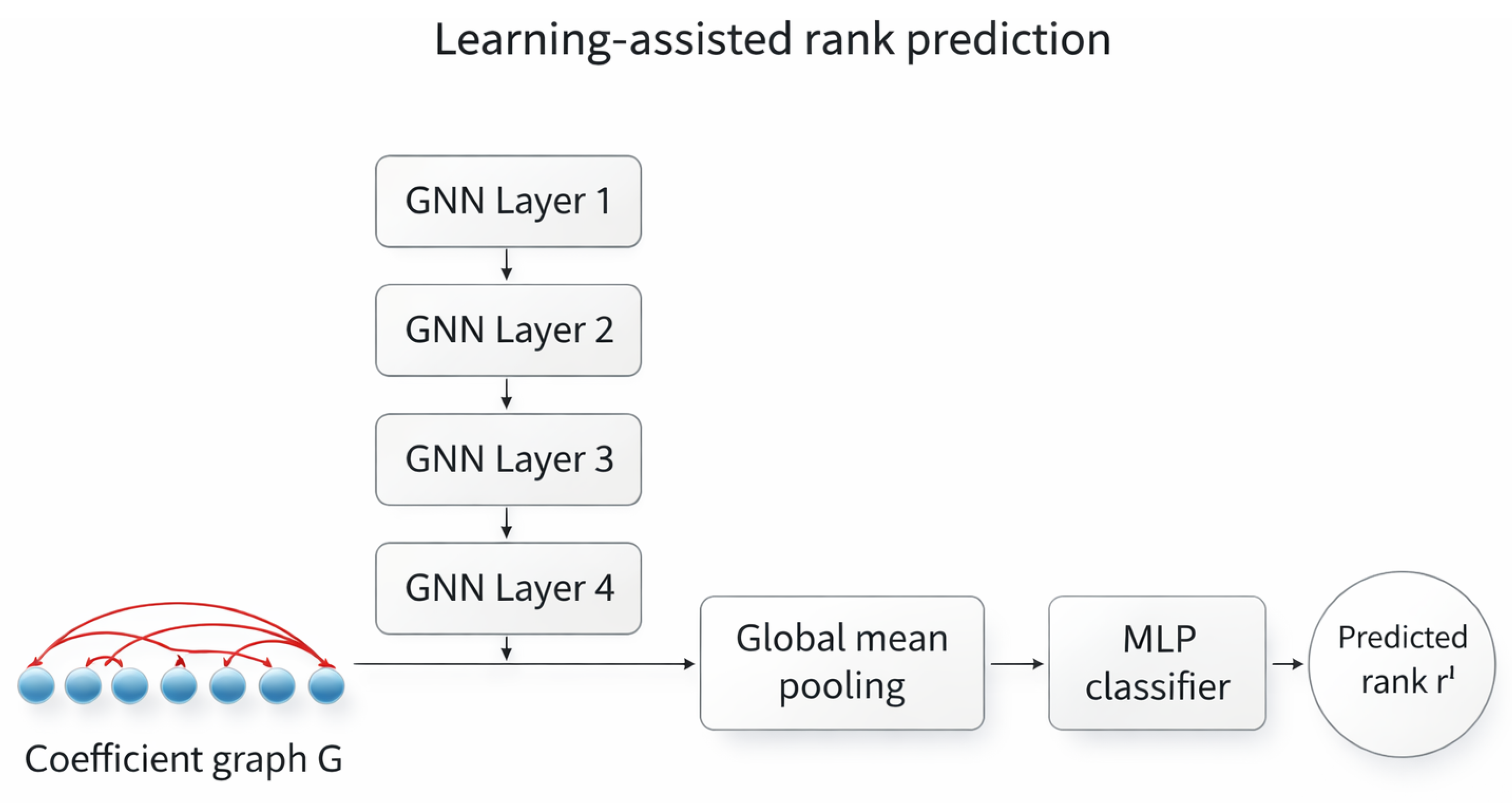
4.2. Network Architecture
- Message-passing layers.
- Graph-level representation.
- Classification head.
- Optimization.
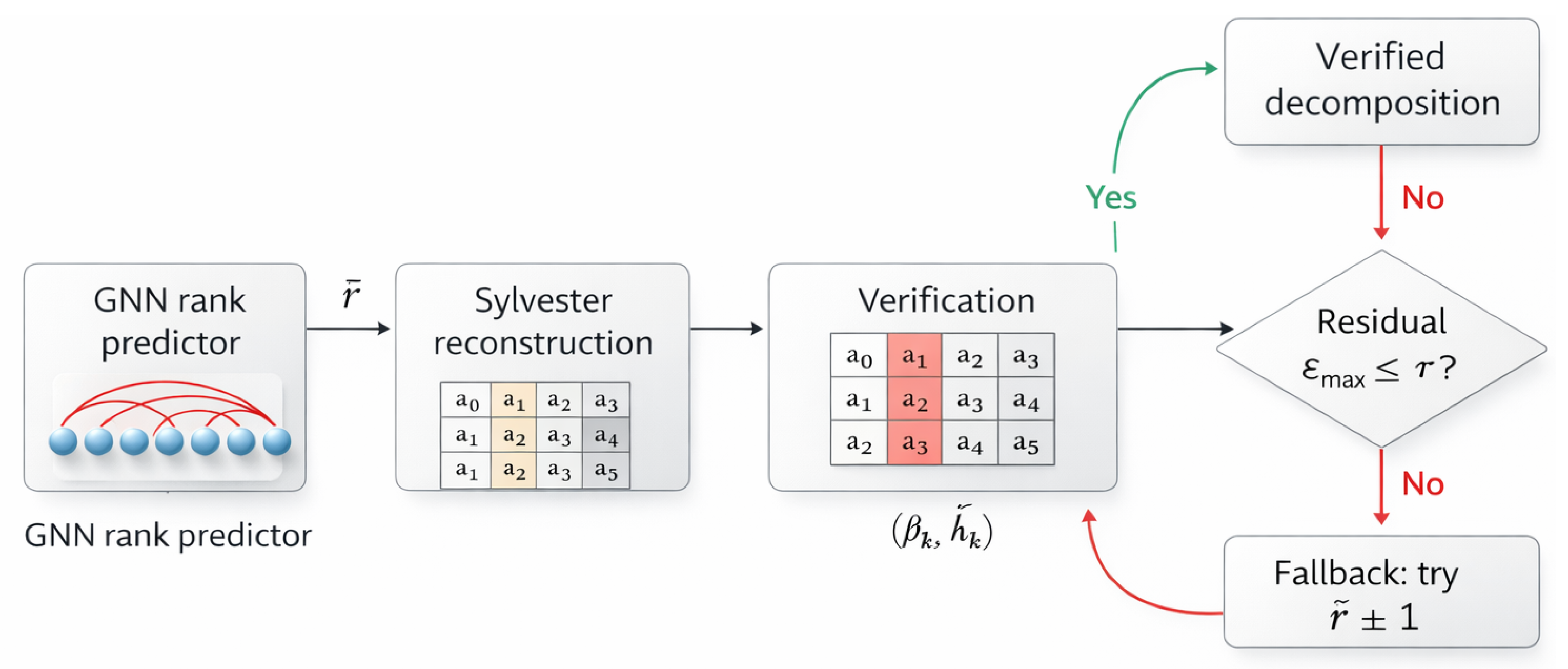
4.3. Hybrid Solver
4.4. Meta-Solver: Learned Candidate Verification Beyond Hard Residual Thresholding
| Algorithm 2 Learning-Assisted Sylvester Solver (rank-guided and verifiable) |
|
Build coefficient graph G from (Section 3) Predict rank (Optional) predict stability score Construct Hankel blocks for rank Solve the recurrence system (Section 2) Recover roots and weights Compute verification residual using Equation (10) if then return verified rank and decomposition else fallback: test ranks (or a small window) apply the same reconstruction and verification procedure return the first verified solution; otherwise declare failure end if |
| Algorithm 3 GNN + Meta-Solver (candidate-scored and verifiable) |
|
Build coefficient graph G from input coefficients a Run GNN to obtain posterior , predicted rank , and stability score Construct candidate set using the chosen strategy (Neighbor/Top-3/All) for each candidate rank do Run one-shot Sylvester reconstruction at rank Compute residual statistics and Form meta-feature vector Compute meta-score end for Select best candidate if then return and verified decomposition else return fallback result (reject/best candidate/) end if |
5. Experimental Setup
5.1. Dataset Generation
| Algorithm 4 Synthetic Dataset Generation for Binary Waring Decomposition |
| Require: Degree set ; rank range ; samples per degree N; noise levels Ensure: Dataset Initialize for each degree do for to N do Sample rank Sample distinct roots Sample weights Compute coefficients for each noise level do if then Sample else end if Normalize input Add sample to end for end for end for Shuffle and split into train/validation/test return |
5.2. Baselines
5.3. Metrics
- Rank identification accuracy: Let r denote the ground-truth rank and the predicted rank. Classification accuracy is defined as follows:
- Reconstruction error: The reconstruction quality is measured using the normalized residual:where the reconstructed coefficients are:
- Verified success rate: We report the proportion of instances whose reconstruction satisfies the verification criterion:
- Runtime: Computational efficiency is evaluated using the average wall-clock runtime per instance (in milliseconds), measured over the full test set under identical hardware and implementation conditions.
6. Results
6.1. Rank Prediction Accuracy
6.2. Runtime Comparison
6.3. Architecture and Distribution-Shift Stress Tests
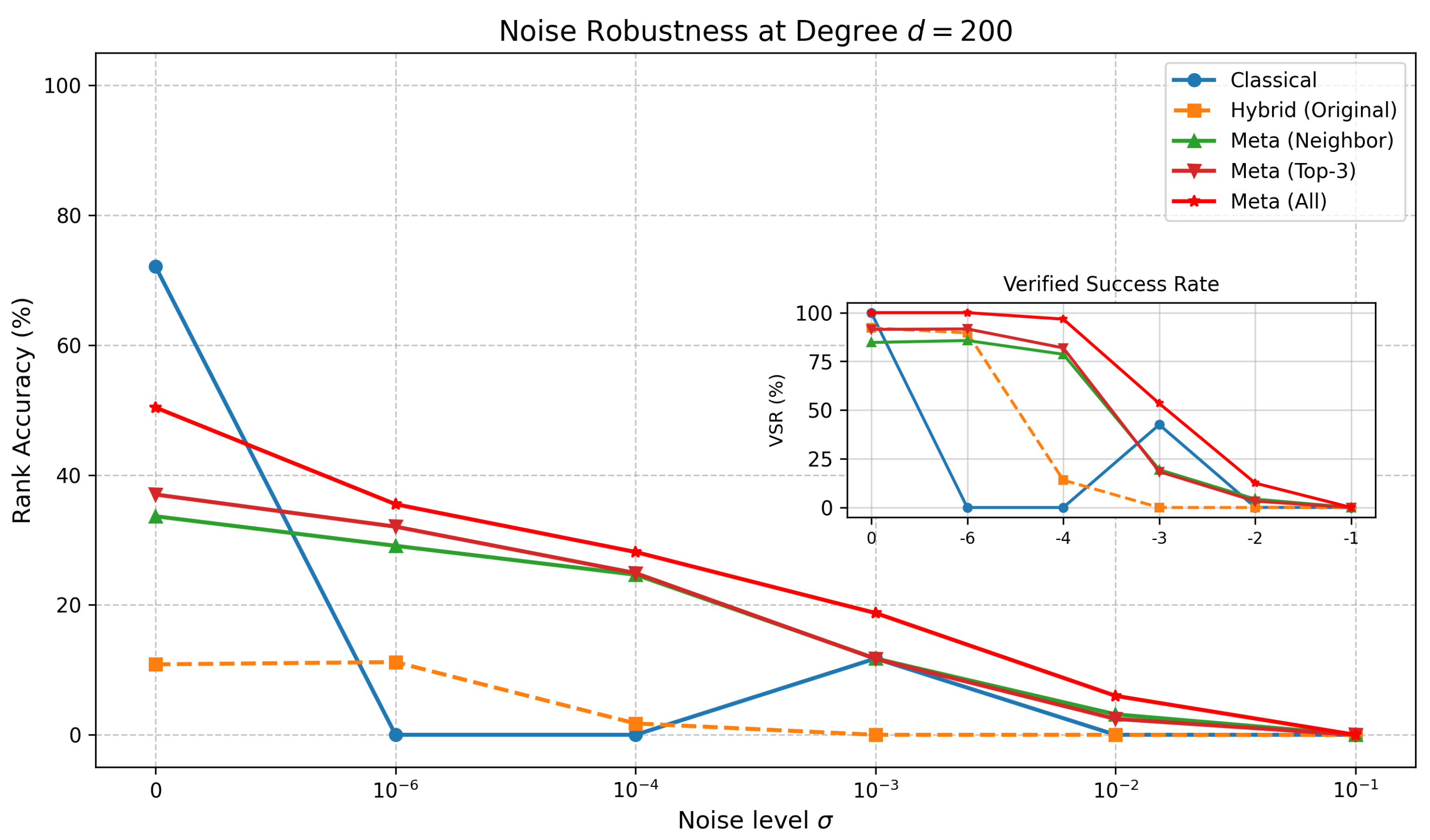
6.4. Noise Robustness
- At , Hybrid achieves Acc and VSR, while Meta (All) reaches Acc and VSR;
- At , Hybrid drops to Acc and VSR, whereas Meta (All) maintains Acc and VSR;
- At , Hybrid fails completely ( Acc, VSR), while Meta (All) still achieves Acc and VSR.
6.5. Ablation on GNN-Derived Meta-Features
7. Discussion
7.1. Coefficient Graphs as an Inductive Bias
7.2. Interpretability and Correctness Guarantees
7.3. Efficiency Considerations
7.4. Robustness and Numerical Conditioning
7.5. Limitations
- Distribution shift: The rank predictor is trained on parameterized synthetic distributions of . These distributions provide ground truth and reproducibility, but they do not cover all possible data-generating mechanisms. Performance may degrade if deployment data follow substantially different priors, although the verification step preserves correctness by rejecting candidates that do not pass reconstruction checks.
- Conditioning sensitivity: Instances with clustered roots remain numerically difficult for both classical and proposed methods.
- Inference overhead: Graph construction, neural inference, and meta-candidate scoring introduce runtime and memory overhead in the current prototype implementation.
- Meta-feature dependence: The strongest Meta-Solver variants rely on informative GNN-derived confidence cues, as confirmed by the ablation study.
7.6. Learning to Guide Exact Solvers
8. Conclusions
Author Contributions
Funding
Data Availability Statement
Acknowledgments
Conflicts of Interest
References
- Sylvester, J.J. An Essay on Canonical Forms, Supplement to a Sketch of a Memoir on Elimination, Transformation and Canonical Forms. In The Collected Mathematical Papers of James Joseph Sylvester, Reprinted as Paper 34; Cambridge University Press: Cambridge, UK, 1851; Volume I, pp. 203–216. [Google Scholar]
- Iarrobino, A.; Kanev, V. Power Sums, Gorenstein Algebras, and Determinantal Loci. In Lecture Notes in Mathematics; Springer: Berlin/Heidelberg, Germany, 1999; Volume 1721. [Google Scholar] [CrossRef]
- Landsberg, J.M.; Teitler, Z. On the Ranks and Border Ranks of Symmetric Tensors. Found. Comput. Math. 2010, 10, 339–366. [Google Scholar] [CrossRef]
- Comon, P.; Golub, G.H.; Lim, L.H.; Mourrain, B. Symmetric Tensors and Symmetric Tensor Rank. SIAM J. Matrix Anal. Appl. 2008, 30, 1254–1279. [Google Scholar] [CrossRef]
- Bernardi, A.; Gimigliano, A.; Idà, M. Computing the Symmetric Rank of Symmetric Tensors. J. Symb. Comput. 2011, 46, 34–53. [Google Scholar] [CrossRef]
- Sauer, T. Prony’s Method: An Old Trick for New Problems. In Snapshots of Modern Mathematics from Oberwolfach; Mathematisches Forschungsinstitut Oberwolfach: Oberwolfach, Germany, 2018. [Google Scholar]
- Comas, G.; Seiguer, M. On the Rank of a Binary Form. Found. Comput. Math. 2011, 11, 65–78. [Google Scholar] [CrossRef]
- Higham, N.J. Accuracy and Stability of Numerical Algorithms, 2nd ed.; SIAM: Philadelphia, PA, USA, 2002. [Google Scholar] [CrossRef]
- Wilkinson, J.H. Rounding Errors in Algebraic Processes; Prentice-Hall: Englewood Cliffs, NJ, USA, 1963. [Google Scholar]
- Markovsky, I. Low Rank Approximation: Algorithms, Implementation, Applications; Springer: Berlin/Heidelberg, Germany, 2018. [Google Scholar]
- Stewart, G.W.; Sun, J.G. Matrix Perturbation Theory; Academic Press: Cambridge, MA, USA, 1990. [Google Scholar]
- Kipf, T.N.; Welling, M. Semi-Supervised Classification with Graph Convolutional Networks. In Proceedings of the International Conference on Learning Representations (ICLR), Toulon, France, 24–26 April 2017. [Google Scholar]
- Gilmer, J.; Schoenholz, S.S.; Riley, P.F.; Vinyals, O.; Dahl, G.E. Neural Message Passing for Quantum Chemistry. In Proceedings of the 34th International Conference on Machine Learning (ICML), Sydney, Australia, 6–11 August 2017; Proceedings of Machine Learning Research. Volume 70, pp. 1263–1272. [Google Scholar]
- Bronstein, M.M.; Bruna, J.; Cohen, T.; Veličković, P. Geometric Deep Learning: Grids, Groups, Graphs, Geodesics, and Gauges. arXiv 2021, arXiv:2104.13478. [Google Scholar] [CrossRef]
- Battaglia, P.W.; Hamrick, J.B.; Bapst, V.; Sanchez-Gonzalez, A.; Zambaldi, V.; Malinowski, M.; Tacchetti, A.; Raposo, D.; Santoro, A.; Faulkner, R.; et al. Relational Inductive Biases, Deep Learning, and Graph Networks. arXiv 2018, arXiv:1806.01261. [Google Scholar] [CrossRef]
- Wang, S.; Wang, M. The Edge Connectivity of Expanded k-Ary n-Cubes. Discret. Dyn. Nat. Soc. 2018, 2018, 7867342. [Google Scholar] [CrossRef]
- Wang, M.; Wang, S. Diagnosability of Cayley graph networks generated by transposition trees under the comparison diagnosis model. Ann. Appl. Math. 2016, 32, 166–173. [Google Scholar]
- Zhao, L.; Wang, M.; Zhang, X.; Lin, Y.; Wang, S. An algorithm for the orientation of complete bipartite graphs. In Proceedings of the 2017 International Conference on Applied Mathematics, Modelling and Statistics Application (AMMSA 2017); Atlantis Press: Dordrecht, The Netherlands, 2017; pp. 361–364. [Google Scholar]
- Wang, M.-J.-S.; Yuan, J.; Lin, S.-W. Ordered and Hamilton Digraphs. Chin. Q. J. Math. 2010, 25, 317–326. [Google Scholar]
- Bernardi, A.; Brachat, J.; Mourrain, B. A Comparison of Different Notions of Ranks of Symmetric Tensors. arXiv 2012, arXiv:1210.8169. [Google Scholar] [CrossRef]
- Bernardi, A.; Brachat, J.; Comon, P.; Mourrain, B. Multihomogeneous Polynomial Decomposition Using Moment Matrices. In Proceedings of the International Symposium on Symbolic and Algebraic Computation (ISSAC), San Jose, CA, USA, 8–11 June 2011. [Google Scholar] [CrossRef]
- Kruskal, J.B. Three-Way Arrays: Rank and Uniqueness of Trilinear Decompositions, with Application to Arithmetic Complexity and Statistics. Linear Algebra Its Appl. 1977, 18, 95–138. [Google Scholar] [CrossRef]
- Golub, G.H.; Pereyra, V. The Differentiation of Pseudo-Inverses and Nonlinear Least Squares Problems Whose Variables Separate. SIAM J. Numer. Anal. 1973, 10, 413–432. [Google Scholar] [CrossRef]
- Golub, G.H.; Pereyra, V. Separable Nonlinear Least Squares: The Variable Projection Method and its Applications. Inverse Probl. 2003, 19, R1–R26. [Google Scholar] [CrossRef]
- Björck, Å. Numerical Methods for Least Squares Problems; SIAM: Philadelphia, PA, USA, 1996. [Google Scholar]
- Björck, Å.; Pereyra, V. Solution of Vandermonde Systems of Equations. Math. Comput. 1970, 24, 893–903. [Google Scholar] [CrossRef][Green Version]
- Gautschi, W.; Inglese, G. Lower Bounds for the Condition Number of Vandermonde Matrices. Numer. Math. 1987, 52, 241–250. [Google Scholar] [CrossRef]
- Golub, G.H.; Van Loan, C.F. Matrix Computations, 4th ed.; Johns Hopkins University Press: Baltimore, MD, USA, 2013. [Google Scholar]
- Demmel, J.W. Applied Numerical Linear Algebra; SIAM: Philadelphia, PA, USA, 1997. [Google Scholar]
- Scarselli, F.; Gori, M.; Tsoi, A.C.; Hagenbuchner, M.; Monfardini, G. The Graph Neural Network Model. IEEE Trans. Neural Netw. 2009, 20, 61–80. [Google Scholar] [CrossRef]
- Veličković, P.; Cucurull, G.; Casanova, A.; Romero, A.; Liò, P.; Bengio, Y. Graph Attention Networks. In Proceedings of the International Conference on Learning Representations (ICLR), Vancouver, BC, Canada, 30 April–3 May 2018. [Google Scholar]
- Bishop, C.M. Pattern Recognition and Machine Learning; Springer: Berlin/Heidelberg, Germany, 2006. [Google Scholar]
- Hamilton, W.L.; Ying, R.; Leskovec, J. Inductive Representation Learning on Large Graphs. arXiv 2017, arXiv:1706.02216. [Google Scholar] [CrossRef]
- Xu, K.; Hu, W.; Leskovec, J.; Jegelka, S. How Powerful are Graph Neural Networks? arXiv 2019, arXiv:1810.00826. [Google Scholar] [CrossRef]
- Morris, C.; Ritzert, M.; Fey, M.; Hamilton, W.L.; Lenssen, J.E.; Rattan, G.; Grohe, M. Weisfeiler and Leman Go Neural: Higher-Order Graph Neural Networks. Proc. Aaai Conf. Artif. Intell. 2019, 33, 4602–4609. [Google Scholar] [CrossRef]
- Dwivedi, V.P.; Joshi, C.K.; Luu, A.T.; Laurent, T.; Bengio, Y.; Bresson, X. Benchmarking Graph Neural Networks. J. Mach. Learn. Res. 2020, 24, 1–48. [Google Scholar]
- Wu, Z.; Pan, S.; Chen, F.; Long, G.; Zhang, C.; Yu, P.S. A Comprehensive Survey on Graph Neural Networks. IEEE Trans. Neural Netw. Learn. Syst. 2021, 32, 4–24. [Google Scholar] [CrossRef] [PubMed]
- Kingma, D.P.; Ba, J. Adam: A Method for Stochastic Optimization. arXiv 2014, arXiv:1412.6980. [Google Scholar] [CrossRef]
- Srivastava, N.; Hinton, G.E.; Krizhevsky, A.; Sutskever, I.; Salakhutdinov, R. Dropout: A Simple Way to Prevent Neural Networks from Overfitting. J. Mach. Learn. Res. 2014, 15, 1929–1958. [Google Scholar]
- Murphy, K.P. Machine Learning: A Probabilistic Perspective; MIT Press: Cambridge, MA, USA, 2012. [Google Scholar]
- Guo, C.; Pleiss, G.; Sun, Y.; Weinberger, K.Q. On Calibration of Modern Neural Networks. arXiv 2017, arXiv:1706.04599. [Google Scholar] [CrossRef]
- Chow, C.K. On Optimum Recognition Error and Reject Tradeoff. IEEE Trans. Inf. Theory 1970, 16, 346–347. [Google Scholar] [CrossRef]
- Cox, D.R. The Regression Analysis of Binary Sequences. J. R. Stat. Soc. Ser. B (Methodol.) 1958, 20, 215–232. [Google Scholar] [CrossRef]
- Hosmer, D.W.; Lemeshow, S.; Sturdivant, R.X. Applied Logistic Regression, 3rd ed.; Wiley: Hoboken, NJ, USA, 2013. [Google Scholar]
- Moitra, A.; Valiant, G. Settling the Polynomial Learnability of Mixtures of Gaussians. In Proceedings of the 51st Annual IEEE Symposium on Foundations of Computer Science, Las Vegas, NV, USA, 23–26 October 2010; pp. 93–102. [Google Scholar]



| Component | Design |
|---|---|
| Nodes | One node per coefficient index |
| Node features | |
| Local edges | for |
| Hankel edges | Pairs in Hankel windows with constant index-sum (restricted by radius ) |
| Edge features | Multiplicity (optionally normalized) |
| Goal | Encode Hankel-induced coefficient reuse patterns for message passing |
| Encoding | Advantage | Limitation in This Setting |
|---|---|---|
| Raw coefficient vector | Simple and inexpensive | Does not expose repeated Hankel-window reuse explicitly |
| Direct Hankel arrays | Close to the algebraic matrices used by the solver | Requires choosing matrix sizes and may duplicate the same coefficient many times |
| Local 1D convolutions | Efficient for nearby sequential patterns | Captures adjacency well but not all overlapping anti-diagonal couplings |
| Transformer sequence model | Flexible global interactions | Higher memory cost and weaker built-in Hankel inductive bias for moderate d |
| Coefficient graph | Sparse, solver-aligned, and able to aggregate local-to-global recurrence cues | Adds graph-construction overhead and is not claimed to be universally optimal |
| Degree d | Nodes | Edges | Graph Storage (KB) | Build Time (ms) | GNN Parameters |
|---|---|---|---|---|---|
| 50 | 51 | 570 | 12.01 | 67,979 | |
| 100 | 101 | 1170 | 24.61 | 67,979 | |
| 200 | 201 | 2370 | 49.81 | 67,979 |
| Rank Classification | Auxiliary Stability | |
|---|---|---|
| Input | CG G | CG G |
| Output | ||
| Use in solver | determine Hankel size for reconstruction | adjust VT and enable FB if needed |
| Hyperparameter | Value |
|---|---|
| GNN layers L | 4 |
| Hidden dimension h | 128 |
| Aggregation | Mean/normalized sum (GCN-style) |
| Readout | Global mean pooling |
| Classifier | 2-layer MLP (hidden dimension 128, ReLU) |
| Dropout | |
| Optimizer | Adam |
| Initial learning rate | |
| Batch size | 256 (graphs) |
| Training epochs | up to 200 with early stopping |
| Method | Reconstruction Attempts | Typical Cost |
|---|---|---|
| Classical Sylvester search | attempts | |
| Learning-assisted solver (ours) | C candidate attempts |
| Degree d | Method | Acc (%) | F1 (%) | VSR (%) |
|---|---|---|---|---|
| 50 | Classical | 70.70 | 67.53 | 100.00 |
| Hybrid (Original) | 12.55 | 3.50 | 93.85 | |
| Meta (Neighbor) | 34.35 | 32.51 | 83.30 | |
| Meta (Top-3) | 38.25 | 36.00 | 88.40 | |
| Meta (All) | 49.70 | 49.21 | 100.00 | |
| 100 | Classical | 70.75 | 68.84 | 100.00 |
| Hybrid (Original) | 11.20 | 3.07 | 92.50 | |
| Meta (Neighbor) | 32.05 | 31.16 | 86.45 | |
| Meta (Top-3) | 36.10 | 35.07 | 90.65 | |
| Meta (All) | 45.70 | 46.45 | 100.00 | |
| 200 | Classical | 71.95 | 71.03 | 100.00 |
| Hybrid (Original) | 11.60 | 3.23 | 89.90 | |
| Meta (Neighbor) | 30.70 | 30.23 | 83.80 | |
| Meta (Top-3) | 33.95 | 33.50 | 89.55 | |
| Meta (All) | 46.60 | 47.62 | 100.00 |
| Method | |||
|---|---|---|---|
| Classical | 0.9258 | 0.9320 | 1.6268 |
| Hybrid | 10.7652 | 18.8642 | 34.1328 |
| Meta (Neighbor) | 12.2912 | 21.1179 | 37.9936 |
| Meta (Top-3) | 12.3175 | 21.3234 | 38.4829 |
| Meta (All) | 16.3518 | 28.2235 | 49.4930 |
| Model | Parameters | Acc (%) | F1 (%) | Runtime (ms) |
|---|---|---|---|---|
| MLP | 95,114 | 10.00 | 4.69 | 0.007 |
| 1D CNN | 85,386 | 9.67 | 1.76 | 0.070 |
| Transformer | 398,346 | 8.00 | 1.48 | 1.069 |
| Pretrained RankGNN | 67,979 | 20.33 | 16.18 | 15.484 |
| Setting | Classical Acc | Classical VSR | Hybrid Acc | Hybrid VSR | Meta Acc | Meta VSR |
|---|---|---|---|---|---|---|
| In-distribution | 0.00 | 0.00 | 1.50 | 17.50 | 30.00 | 94.50 |
| Normal roots | 1.00 | 78.50 | 7.50 | 85.00 | 11.00 | 99.50 |
| Lognormal weights | 0.00 | 0.00 | 3.00 | 14.50 | 26.50 | 89.50 |
| Near-collision roots | 0.00 | 0.00 | 2.50 | 9.00 | 7.50 | 98.00 |
| Ill-conditioned weights | 0.00 | 0.00 | 3.50 | 16.50 | 23.00 | 92.50 |
| Method | ||||
|---|---|---|---|---|
| Classical Acc (%) | 73.65 | 0.00 | 0.00 | 11.55 |
| Classical VSR (%) | 100.00 | 0.00 | 0.00 | 43.15 |
| Hybrid Acc (%) | 11.95 | 11.30 | 1.80 | 0.00 |
| Hybrid VSR (%) | 91.05 | 90.45 | 15.55 | 0.00 |
| Meta (Neighbor) Acc (%) | 32.10 | 29.45 | 21.65 | 10.70 |
| Meta (Neighbor) VSR (%) | 84.35 | 84.95 | 73.90 | 24.20 |
| Meta (Top-3) Acc (%) | 36.20 | 31.85 | 21.95 | 13.35 |
| Meta (Top-3) VSR (%) | 89.25 | 91.00 | 80.35 | 34.30 |
| Meta (All) Acc (%) | 46.55 | 34.90 | 25.15 | 15.70 |
| Meta (All) VSR (%) | 100.00 | 100.00 | 96.30 | 50.25 |
| Degree d | Strategy | With GNN Features (%) | No GNN Features (%) | Change |
|---|---|---|---|---|
| 50 | Neighbor | 33.3 | 30.0 | |
| Top-3 | 38.7 | 32.3 | ||
| All | 51.4 | 37.8 | ||
| 100 | Neighbor | 30.9 | 28.0 | |
| Top-3 | 34.9 | 31.1 | ||
| All | 46.1 | 36.5 | ||
| 200 | Neighbor | 30.0 | 28.5 | |
| Top-3 | 32.4 | 29.2 | ||
| All | 45.1 | 34.6 |
Disclaimer/Publisher’s Note: The statements, opinions and data contained in all publications are solely those of the individual author(s) and contributor(s) and not of MDPI and/or the editor(s). MDPI and/or the editor(s) disclaim responsibility for any injury to people or property resulting from any ideas, methods, instructions or products referred to in the content. |
© 2026 by the authors. Licensee MDPI, Basel, Switzerland. This article is an open access article distributed under the terms and conditions of the Creative Commons Attribution (CC BY) license.
Share and Cite
Wang, W.; Liang, C.-W.; Wang, M.-J.-S.; Zhang, C. Hankel-Structured Graph Learning for Meta-Verified Sylvester Reconstruction in Binary Waring Decomposition. Symmetry 2026, 18, 1012. https://doi.org/10.3390/sym18061012
Wang W, Liang C-W, Wang M-J-S, Zhang C. Hankel-Structured Graph Learning for Meta-Verified Sylvester Reconstruction in Binary Waring Decomposition. Symmetry. 2026; 18(6):1012. https://doi.org/10.3390/sym18061012
Chicago/Turabian StyleWang, Wenjie, Chen-Wei Liang, Mu-Jiang-Shan Wang, and Chi Zhang. 2026. "Hankel-Structured Graph Learning for Meta-Verified Sylvester Reconstruction in Binary Waring Decomposition" Symmetry 18, no. 6: 1012. https://doi.org/10.3390/sym18061012
APA StyleWang, W., Liang, C.-W., Wang, M.-J.-S., & Zhang, C. (2026). Hankel-Structured Graph Learning for Meta-Verified Sylvester Reconstruction in Binary Waring Decomposition. Symmetry, 18(6), 1012. https://doi.org/10.3390/sym18061012