Article

Gravitational Effects Induced by Spin–Mass Interactions

1
College of Physics, Sichuan University, Chengdu 610065, China
2
Institute of Fundamental Physics and Quantum Technology, School of Physical Science and Technology, Ningbo University, Ningbo 315211, China
*
Authors to whom correspondence should be addressed.
Symmetry 2026, 18(6), 1010; https://doi.org/10.3390/sym18061010
Submission received: 21 April 2026 / Revised: 28 May 2026 / Accepted: 4 June 2026 / Published: 11 June 2026
(This article belongs to the Special Issue Symmetry in Dark Matter Models)

Abstract

It is well known that axions or axion-like particles can mediate spin-dependent interactions. If such interactions exist, they may violate the equivalence principle of general relativity, causing a polarized fermion with nonzero mass to experience different gravitational effects for different spin orientations. In this work, we derive the spin-dependent gravitational interaction generated by a spherically symmetric celestial body and apply the formalism to the Earth. We compare existing experimental searches for spin-dependent gravitational effects with the constraints implied by axion-mediated interactions. We further note that a rotating polarized neutron star may generate a time-dependent spin–mass interaction field acting on an unpolarized probe mass, which could be detected with high-frequency, high-Q torsion oscillators.

1. Introduction

Spin, as a fundamental property of elementary particles, stands on equal footing with mass as a defining characteristic of matter. Fundamental particles are classified according to the irreducible representations of the Poincaré group, which governs their behavior under spacetime transformations [1,2]. The two invariants of the Poincaré group are associated with the mass and spin of particles. Mass is related to spacetime translations, whereas spin is connected to rotational symmetry [2].
In a macroscopic body such as the Earth, the masses of its constituent particles generally add coherently because mass is a monopole quantity. By contrast, spin, being dipolar, usually averages to zero because the body is typically unpolarized. Although gravity is intrinsically very weak, its effects are readily perceptible precisely because it is sourced by mass, a monopole quantity whose contributions accumulate at large scales. According to Einstein’s general relativity, gravity couples to matter through the energy–momentum tensor. It is, therefore, natural to ask whether spin, as another intrinsic property of matter, might also influence spacetime as a source [3]. Furthermore, one may wonder whether mass could couple directly to spin [4,5,6], given that couplings between different degrees of freedom are common in modern physics.
Axion-mediated spin-dependent interactions couple mass to spin. Axions, originally predicted in the Peccei–Quinn (PQ) mechanism [7,8,9,10], can give rise to a variety of spin-dependent interactions [11,12,13]. More generally, if axion-like particles (ALPs) [14,15,16,17], denoted by ϕ , exist, they can generate a new interaction through their coupling to a fermion ψ ,
L ϕ = ψ ¯ ( g S + i g P γ 5 ) ψ ϕ ,
where g S and g P are the scalar and pseudoscalar coupling constants, respectively [11]. We note that axions and axion-like particles have not yet been experimentally discovered. Therefore, the interaction considered here should be understood as a hypothetical beyond-Standard-Model scenario. The purpose of this work is to explore the possible spin–mass effect that would arise if such particles and couplings exist. In this framework, the scalar–pseudoscalar (SP) interaction between a polarized fermion and an unpolarized nucleon can be expressed as [18,19]
V SP = 2 g S 1 g P 2 8 π m 2 σ 2 · r ^ 1 r λ + 1 r 2 e r / λ
Here g S 1 is the scalar coupling constant of the unpolarized particle, g P 2 is the pseudoscalar coupling constant of the polarized particle, m 2 is the mass of the polarized particle, σ 2 is its spin operator, r ^ is the unit vector from particle 1 to particle 2, and λ = / ( m ϕ c ) is the interaction range associated with the exchanged boson of mass m ϕ . This potential describes an interaction between an unpolarized particle (particle 1) and a polarized particle (particle 2). It couples the spin σ 2 of particle 2 to the mass of particle 1, represented by the scalar coupling g S 1 . In particular, it has been noted that the V SP potential violates the equivalence principle of general relativity, since the same particle may experience different interactions in a gravitational field depending on its spin state [20]. When extended to many-body systems—for example, by treating the Earth as an unpolarized source—the point-particle potential must be integrated over the source volume. In this case, the contribution from particle 1 is determined by the total number of unpolarized constituents, which is proportional to the total mass of the source.
In experimental contexts, because V SP is typically generated by unpolarized bulk matter, it is commonly referred to as a spin–mass interaction [21,22,23,24,25]. Moreover, when a polarized spin interacts with the Earth’s nucleons through this potential, the interaction is often termed a spin–gravity interaction [23,25,26]. Similar interactions are also predicted in various extensions of general relativity [3]. We also note that axion-mediated SP interactions are not the only possible theoretical context for discussing spin–gravity or mass–spin effects. Alternative mechanisms, such as gravitational Aharonov–Bohm-type effects, may also lead to phase shifts or effective spin-dependent phenomena in gravitational backgrounds [27,28,29]. A detailed comparison with these alternative models is beyond the scope of the present work, which focuses on the scalar–pseudoscalar interaction mediated by axions or axion-like particles.
If such interactions exist, a polarized spin would experience different gravitational effects depending on its spin state. In one scenario, the same particle, prepared in spin-up and spin-down states, would experience different gravitational accelerations on Earth. In another scenario, a spin-polarized celestial body, such as a neutron star, could generate an oscillating gravitational field as it rotates. In the present treatment, the ordinary gravitational field is incorporated as a fixed background. In the Earth-based calculation, this background determines the local free-fall acceleration g and the radial direction R ^ . The axion-mediated SP interaction is then treated as a small additional spin-dependent interaction on this background. We work in the weak-field, nonrelativistic limit relevant to laboratory spin-gravity tests and do not solve for a self-consistent modification of the spacetime metric by the axion field. In the following, we first calculate the effects of these mass–spin interactions for spherical celestial bodies. We then constrain the difference in gravitational acceleration between spin states using the most precise magnetometer measurements available and compare the derived results with the latest experimental measurements.

2. The Spin–Mass Potential from a Spherical Source

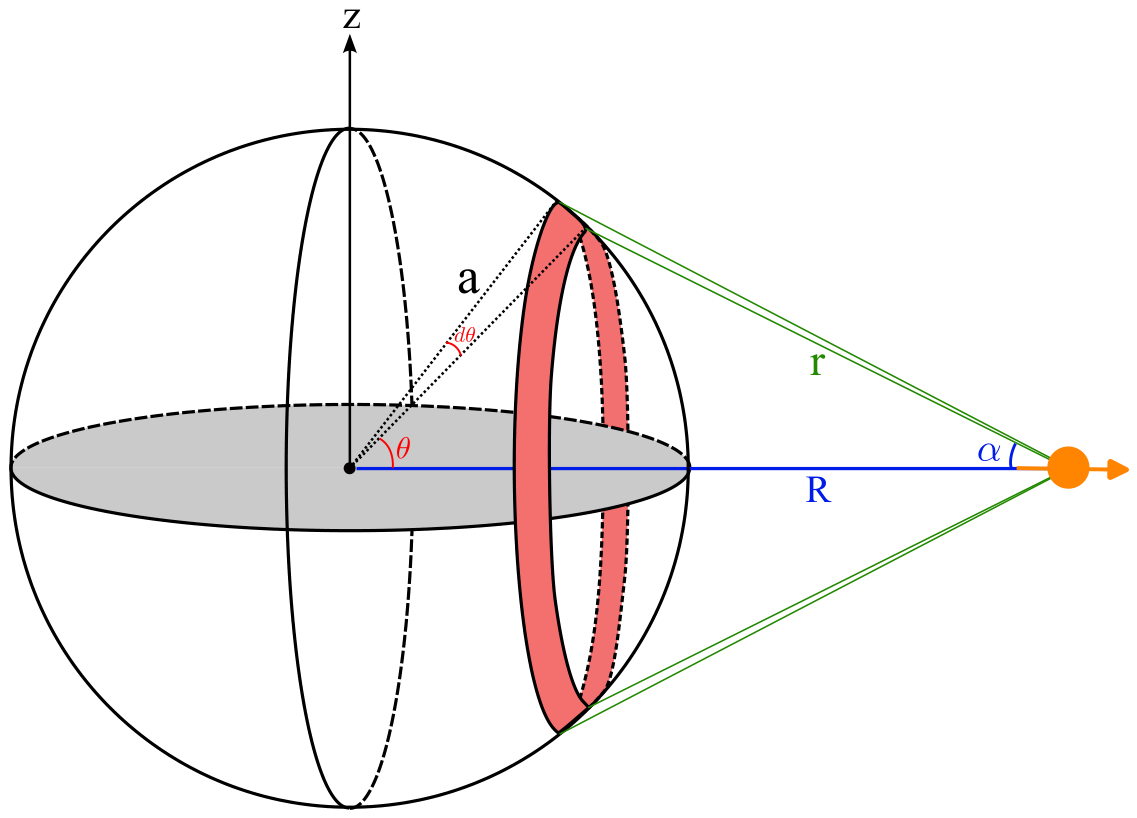
The following derivation is performed in the weak-field, nonrelativistic approximation. The background gravitational metric is not modified by the SP interaction; instead, the Earth provides the usual static, spherically symmetric gravitational background, and the SP potential is calculated as a perturbative spin-dependent contribution. To derive the spin–mass interaction in Equation (2) for a spherical source of radius R 0 , as shown in Figure 1, we follow the standard method for calculating the gravitational field of a spherical mass [30,31]. For a spin located at a distance R from the center, the source is decomposed into spherical shells, each of which is further divided into rings, as illustrated in Figure 1. The radius of a ring is a sin θ , and its area element is d f = 2 π a 2 sin θ d θ . Let r denote the distance from a point on the ring to the spin. Then
r 2 = a 2 + R 2 2 a R cos θ
Differentiating both sides yields
sin θ d θ = r d r a R
In spin-dependent gravity experiments, σ 2 is aligned with the gravitational direction, i.e., the R ^ direction shown in Figure 1, so that
σ 2 · r ^ = cos α R ^
Using
a 2 = R 2 + r 2 2 R r cos α
we obtain
cos α = R 2 + r 2 a 2 2 R r
For a ring element, because the potential contains the factor σ 2 · r ^ , only the component along R ^ remains after integration, by symmetry. We denote by ρ N the number density of unpolarized nucleons in the source. The spatial part of the spin-dependent potential is therefore
d V = 2 g S 1 g P 2 8 π m 2 ρ N ( σ 2 · R ^ ) ( 1 λ r + 1 r 2 ) exp ( r / λ ) cos α d f d a
Integrating over the spherical source gives
V ( R ) = 2 g S 1 g P 2 8 π m 2 ρ N ( σ 2 · R ^ ) R 0 d a π ( 1 λ r + 1 r 2 ) exp ( r / λ ) R 2 + r 2 a 2 2 R r 2 π a 2 sin θ d θ = 2 g S 1 g P 2 8 m 2 ρ N ( σ 2 · R ^ ) R 0 a 2 d a R a R + a ( 1 λ r + 1 r 2 ) exp ( r / λ ) R 2 + r 2 a 2 R d r R = 2 g S 1 g P 2 ρ N 4 m 2 R 2 ( R + λ ) λ e R R 0 λ R 0 λ + e R 0 + R λ R 0 + λ ( σ 2 · R ^ )
Once the potential is obtained, the corresponding force can be readily derived as
F = V ( R ) = R V ( R ) R ^ = 2 g S 1 g P 2 ρ N 4 m 2 R 3 R 2 + 2 R λ + 2 λ 2 ( R 0 λ ) e R R 0 λ + ( R 0 + λ ) e R 0 + R λ ( σ 2 · R ^ ) R ^
When the Earth is treated as a spherical source [32], the particle experiences different gravitational accelerations depending on whether its spin is aligned or anti-aligned with the local gravity direction. We denote the corresponding acceleration difference by δ as follows. When the spin is aligned with R ^ ,
m 2 g + = m 2 g + δ / 2
When the spin is anti-aligned with R ^ ,
m 2 g = m 2 g δ / 2
The Eötvös ratio is a dimensionless quantity characterizing the relative difference in free-fall accelerations of two test bodies. In the spin-gravity case considered in Ref. [33], the spin-dependent Eötvös ratio is defined as
η S = 2 ( g + g ) g + + g = δ g ,
where g + and g are the free-fall accelerations of atoms in the two opposite spin orientations.
Therefore, the difference in gravitational acceleration measured for the two spin orientations can be written as
δ = 2 g S 1 g P 2 ρ N 2 m 2 2 R 3 R 2 + 2 R λ + 2 λ 2 ( R 0 λ ) e R R 0 λ + ( R 0 + λ ) e R 0 + R λ
For the Earth, we write R = R 0 + h , where h denotes the height above the Earth’s surface. The exact expression then becomes
δ = 2 g S 1 g P 2 ρ N 2 m 2 2 ( R 0 + h ) 3 ( R 0 + h ) 2 + 2 ( R 0 + h ) λ + 2 λ 2 ( R 0 λ ) e h λ + ( R 0 + λ ) e 2 R 0 + h λ .
For heights much smaller than the Earth’s radius, h R 0 , one obtains
δ 2 g S 1 g P 2 ρ N 2 m 2 2 R 0 3 R 0 2 + 2 R 0 λ + 2 λ 2 ( R 0 λ ) e h λ + ( R 0 + λ ) e 2 R 0 + h λ .
In the additional limit λ R 0 , the second term in the square brackets is negligible, such that
δ 2 g S 1 g P 2 ρ N 2 m 2 2 R 0 3 R 0 2 + 2 R 0 λ + 2 λ 2 ( R 0 λ ) e h λ .
If, furthermore, h λ , this expression simplifies to
δ 2 g S 1 g P 2 ρ N 2 m 2 2 R 0 3 R 0 2 + 2 R 0 λ + 2 λ 2 ( R 0 λ ) .
In 2016, Ref. [33] tested whether atoms with opposite spin orientations undergo different free-fall accelerations in the Earth’s gravitational field, obtaining η S = ( 0.2 ± 1.2 ) × 10 7 . In 2019, Ref. [34] improved this test by comparing the accelerations of 87Rb atoms in two internal states with different proton spin but the same electron spin, yielding η S = ( 0.7 ± 9.2 ) × 10 9 , which is, to the best of our knowledge, the most precise result so far.
Assuming that η S follows a Gaussian distribution, the symmetric 95% confidence interval centered at zero, [ η 95 , η 95 ] , is determined by
η 95 η 95 1 2 π σ exp ( η μ ) 2 2 σ 2 d η = 0.95 ,
where μ and σ are the measured mean value and standard deviation, respectively. For
η S = ( 0.7 ± 9.2 ) × 10 9 ,
we obtain
η 95 1.84 × 10 8 ,
corresponding to the 95% symmetric bound
| η S | < 1.84 × 10 8 .
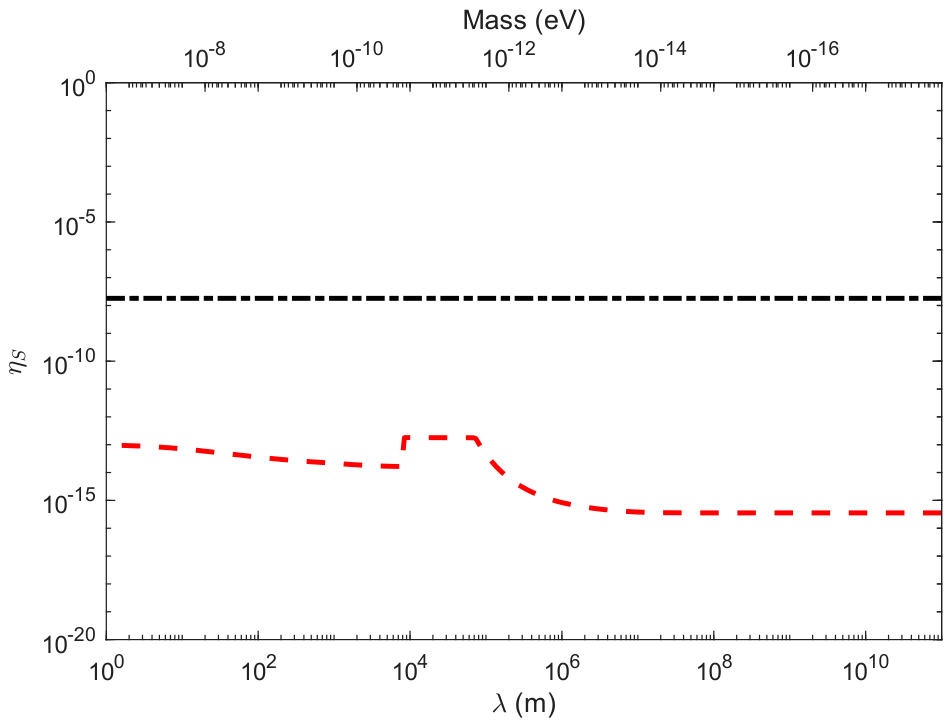
Ref. [35] provides the most stringent constraints on g S N g P e from combined astrophysical and laboratory bounds. Based on this result, we plot the Eötvös ratio induced by the interaction between the Earth’s nucleons and the electron spin via the SP-type potential in Equation (2). As shown in Figure 2, the derived Eötvös ratio is more than five orders of magnitude below the experimental result reported in Ref. [33], indicated by the black dashed line.

3. Conclusions and Discussion

In conclusion, we study the possible gravitational effects of the SP-type interaction. This exotic interaction is mediated by axions or axion-like particles, violates P- and T-symmetries, and is spin-dependent. If it exists, spin-polarized particles will experience different gravitational fields depending on their spin orientation. We analytically calculate the effect of a spherical body and apply the result to the Earth, thereby deriving the corresponding spin-dependent Eötvös ratio. Using the most stringent existing constraints on g S N g P e , we obtain the corresponding Eötvös ratio and compare it with the most precise direct measurement of gravitational acceleration for different spin orientations. We find that the current direct measurement remains several orders of magnitude above the level implied by the constraints on the SP-type interaction.
The SP-type interaction can also arise from massive polarized objects, such as neutron stars. A rotating polarized neutron star may generate a time-dependent spin–mass interaction field acting on an unpolarized probing mass. For an unpolarized monopole probe, the signal may phenomenologically resemble an anomalous gravitational force. Since a neutron star can rotate as fast as ∼1000 Hz [36], it may produce an oscillating effective field at the same frequency. Such a high-frequency signal is advantageous, as it is sufficiently high to avoid much of the frequency-dependent seismic and 1 / f noise [17,37,38,39]. For example, it could be detected with a planar double-torsional tungsten oscillator, which exhibits multiple resonant modes ranging from ∼100 Hz to many kHz [40], with a quality factor as high as 25,000 [41], provided that one of its resonant modes is tuned to the neutron-star rotation frequency. If one torsional eigenmode is tuned to the source frequency, e.g., f rot = 716.35 Hz for PSR J1748−2446ad [36], the weak periodic force can resonantly drive the oscillator and produce an enhanced mechanical response proportional to the quality factor Q. The signal would appear as a phase-coherent narrow spectral line, with an amplitude modulated by the sidereal-time-dependent [42,43] projection of the source direction in the laboratory frame. By demodulating the oscillator output using the known pulsar ephemeris and searching for the predicted directional modulation, one may distinguish a genuine astrophysical signal from terrestrial backgrounds.

Author Contributions

Conceptualization, Z.X. and H.Y.; writing—original draft preparation, R.W., Z.X. and H.Y.; writing—review and editing, R.W., Z.X. and H.Y. All authors have read and agreed to the published version of the manuscript.

Funding

This research was funded by the National Natural Science Foundation of China under grant U2230207.

Data Availability Statement

No new data were created or analyzed in this study. Data sharing is not applicable to this article.

Conflicts of Interest

The authors declare no conflicts of interest.

References

  1. Ramond, P. Field Theory: A Modern Primer, 2nd ed.; Westview Press: Boulder, CO, USA, 2001. [Google Scholar]
  2. Weinberg, S. The Quantum Theory of Fields, Volume 1: Foundations; Cambridge University Press: Cambridge, UK, 1995. [Google Scholar]
  3. Hehl, F.W.; von der Heyde, P.; Kerlick, G.D.; Nester, J.M. General relativity with spin and torsion: Foundations and prospects. Rev. Mod. Phys. 1976, 48, 393–416. [Google Scholar] [CrossRef]
  4. Leitner, J.; Okubo, S. Parity, Charge Conjugation, and Time Reversal in the Gravitational Interaction. Phys. Rev. 1964, 136, B1542–B1546. [Google Scholar] [CrossRef]
  5. Hari Dass, N.D. A New Spin Test for the Equivalence Principle. Gen. Relativ. Gravit. 1977, 8, 89–93. [Google Scholar] [CrossRef]
  6. Fadeev, P.; Stadnik, Y.V.; Ficek, F.; Kozlov, M.G.; Flambaum, V.V.; Budker, D. Revisiting spin-dependent forces mediated by new bosons: Potentials in the coordinate-space representation for macroscopic- and atomic-scale experiments. Phys. Rev. A 2019, 99, 022113. [Google Scholar] [CrossRef]
  7. Peccei, R.D.; Quinn, H.R. Constraints imposed by CP conservation in the presence of pseudoparticles. Phys. Rev. D 1977, 16, 1791–1797. [Google Scholar] [CrossRef]
  8. Peccei, R.D.; Quinn, H.R. CP Conservation in the Presence of Pseudoparticles. Phys. Rev. Lett. 1977, 38, 1440–1443. [Google Scholar] [CrossRef]
  9. Weinberg, S. A New Light Boson? Phys. Rev. Lett. 1978, 40, 223–226. [Google Scholar] [CrossRef]
  10. Wilczek, F. Problem of Strong P and T Invariance in the Presence of Instantons. Phys. Rev. Lett. 1978, 40, 279–282. [Google Scholar] [CrossRef]
  11. Moody, J.; Wilczek, F. New Macroscopic Forces? Phys. Rev. D 1984, 30, 130–138. [Google Scholar] [CrossRef]
  12. Dobrescu, B.A.; Mocioiu, I. Spin-Dependent Macroscopic Forces from New Particle Exchange. J. High Energy Phys. 2006, 2006, 005. [Google Scholar] [CrossRef]
  13. Wu, L.Y.; Yan, H. Exploring Exotic Spin-Dependent Interactions Beyond the Standard Model: Theoretical Foundations and Experimental Investigations. 2026; to be published.
  14. Svrcek, P.; Witten, E. Axions in string theory. J. High Energy Phys. 2006, 2006, 051. [Google Scholar] [CrossRef]
  15. Wei, K.; Xu, Z.; He, Y.; Ma, X.; Heng, X.; Huang, X.; Quan, W.; Ji, W.; Liu, J.; Wang, X.P.; et al. Dark Matter Search with a Resonantly-Coupled Hybrid Spin System. Rep. Prog. Phys. 2025, 88, 057801. [Google Scholar] [CrossRef]
  16. Ding, J.; Wang, J.; Zhou, X.; Liu, Y.; Sun, K.; Adeyeye, A.O.; Fu, H.; Ren, X.; Li, S.; Luo, P.; et al. Constraints on the Velocity and Spin Dependent Exotic Interaction at the Micrometer Range. Phys. Rev. Lett. 2020, 124, 161801. [Google Scholar] [CrossRef] [PubMed]
  17. Li, S.; Zhang, W.; Luo, R.; Liu, J.; Luo, P. Improved Limits on the Spin- and Velocity-Dependent Exotic Interaction in the Micrometer Range. Phys. Rev. Lett. 2025, 134, 251601. [Google Scholar] [CrossRef] [PubMed]
  18. Fu, C.B.; Gentile, T.R.; Snow, W.M. Limits on possible new nucleon monopole-dipole interactions from the spin relaxation rate of polarized 3He gas. Phys. Rev. D 2011, 83, 031504. [Google Scholar] [CrossRef]
  19. Bulatowicz, M.; Griffith, R.; Larsen, M.; Mirijanian, J.; Walker, T.G.; Fu, C.B.; Smith, E.; Snow, W.M.; Yan, H. A Laboratory Search for a Long-Range T-Odd, P-Odd Interaction from Axion-Like Particles Using Dual Species Nuclear Magnetic Resonance with Polarized Xe-129 and Xe-131 Gas. Phys. Rev. Lett. 2013, 111, 102001. [Google Scholar] [CrossRef]
  20. Ritter, R.C.; Goldblum, C.E.; Ni, W.T.; Gillies, G.T.; Speake, C.C. Experimental test of equivalence principle with polarized masses. Phys. Rev. D 1990, 42, 977–991. [Google Scholar] [CrossRef] [PubMed]
  21. Lee, J.; Almasi, A.; Romalis, M. Improved Limits on Spin-Mass Interactions. Phys. Rev. Lett. 2018, 120, 161801. [Google Scholar] [CrossRef]
  22. Youdin, A.N.; Krause, D., Jr.; Jagannathan, K.; Hunter, L.R.; Lamoreaux, S.K. Limits on Spin-Mass Couplings within the Axion Window. Phys. Rev. Lett. 1996, 77, 2170–2173. [Google Scholar] [CrossRef]
  23. Kimball, D.F.J.; Lacey, I.; Valdez, J.; Swiatlowski, J.; Rios, C.; Peregrina-Ramirez, R.; Montcrieffe, C.; Kremer, J.; Dudley, J.; Sanchez, C. A Dual-Isotope Rubidium Comagnetometer to Search for Anomalous Long-Range Spin-Mass (Spin-Gravity) Couplings of the Proton: A Dual-Isotope Rubidium Comagnetometer. Ann. Phys. 2013, 525, 514–528. [Google Scholar] [CrossRef]
  24. Feng, Y.K.; Ning, D.H.; Zhang, S.B.; Lu, Z.T.; Sheng, D. Search for Monopole-Dipole Interactions at the Submillimeter Range with a 129Xe-131Xe-Rb Comagnetometer. Phys. Rev. Lett. 2022, 128, 231803. [Google Scholar] [CrossRef]
  25. Zhang, S.B.; Ba, Z.L.; Ning, D.H.; Zhai, N.F.; Lu, Z.T.; Sheng, D. Search for Spin-Dependent Gravitational Interactions at Earth Range. Phys. Rev. Lett. 2023, 130, 201401. [Google Scholar] [CrossRef]
  26. Stadnik, Y.V.; Flambaum, V.V. Axion-induced effects in atoms, molecules, and nuclei: Parity nonconservation, anapole moments, electric dipole moments, and spin-gravity and spin-axion momentum couplings. Phys. Rev. D 2014, 89, 043522. [Google Scholar] [CrossRef]
  27. Ford, L.H.; Vilenkin, A. A gravitational analogue of the Aharonov-Bohm effect. J. Phys. A Math. Gen. 1981, 14, 2353–2357. [Google Scholar] [CrossRef]
  28. Hohensee, M.A.; Estey, B.; Hamilton, P.; Zeilinger, A.; Müller, H. Force-Free Gravitational Redshift: Proposed Gravitational Aharonov-Bohm Experiment. Phys. Rev. Lett. 2012, 108, 230404. [Google Scholar] [CrossRef] [PubMed]
  29. Overstreet, C.; Asenbaum, P.; Curti, J.; Kim, M.; Kasevich, M.A. Observation of a gravitational Aharonov-Bohm effect. Science 2022, 375, 226–229. [Google Scholar] [CrossRef] [PubMed]
  30. Greiner, W. Classical Mechanics: Point Particles and Relativity, 1st ed.; Springer: Berlin/Heidelberg, Germany, 1992. [Google Scholar]
  31. Yan, H.; Sun, G.A.; Peng, S.M.; Zhang, Y.; Fu, C.; Guo, H.; Liu, B.Q. Searching for New Spin- and Velocity-Dependent Interactions by Spin Relaxation of Polarized 3He Gas. Phys. Rev. Lett. 2015, 115, 182001. [Google Scholar] [CrossRef] [PubMed]
  32. Lai, Z.T.; Lu, J.X.; Geng, L.S.; Wei, K.; Ji, W. Potential of Constraining the Fifth Force Using the Earth as a Spin and Mass Source from Space. Chin. Phys. Lett. 2026, 43, 030202. [Google Scholar] [CrossRef]
  33. Duan, X.C.; Deng, X.B.; Zhou, M.K.; Zhang, K.; Xu, W.J.; Xiong, F.; Xu, Y.Y.; Shao, C.G.; Luo, J.; Hu, Z.K. Test of the Universality of Free Fall with Atoms in Different Spin Orientations. Phys. Rev. Lett. 2016, 117, 023001. [Google Scholar] [CrossRef]
  34. Shu, Y.B.; Zhang, T.; Chen, L.L.; Luo, Q.; Deng, X.B.; Xu, W.J.; Duan, X.C.; Fang, X.T.; Cao, L.S.; Hu, Z.K.; et al. Constraint on an Exotic Parity-Odd Spin- and Velocity-Dependent Interaction with Atom Interferometer. Phys. Rev. Lett. 2024, 133, 213401. [Google Scholar] [CrossRef]
  35. O’Hare, C.A.J.; Vitagliano, E. Cornering the axion with CP-violating interactions. Phys. Rev. D 2020, 102, 115026. [Google Scholar] [CrossRef]
  36. Hessels, J.W.T.; Ransom, S.M.; Stairs, I.H.; Freire, P.C.C.; Kaspi, V.M.; Camilo, F. A Radio Pulsar Spinning at 716 Hz. Science 2006, 311, 1901–1904. [Google Scholar] [CrossRef]
  37. Wu, K.Y.; Chen, S.Y.; Gong, J.; Peng, M.; Yan, H. Searching for exotic spin-dependent interactions using rotationally modulated source masses and an atomic magnetometer array. Phys. Rev. D 2022, 105, 055020. [Google Scholar] [CrossRef]
  38. Wu, K.Y.; Chen, S.Y.; Sun, G.A.; Peng, S.M.; Peng, M.; Yan, H. Experimental Limits on Exotic Spin and Velocity Dependent Interactions Using Rotationally Modulated Source Masses and an Atomic-Magnetometer Array. Phys. Rev. Lett. 2022, 129, 051802. [Google Scholar] [CrossRef] [PubMed]
  39. Yan, H.; Li, K.; Khatiwada, R.; Smith, E.; Snow, W.M.; Fu, C.B.; Chu, P.H.; Gao, H.; Zheng, W. A Frequency Determination Method for Digitized NMR Signals. Commun. Comput. Phys. 2014, 15, 1343–1351. [Google Scholar] [CrossRef]
  40. Yan, H.; Housworth, E.A.; Meyer, H.O.; Visser, G.; Weisman, E.; Long, J.C. Absolute Measurement of Thermal Noise in a Resonant Short-Range Force Experiment. Class. Quantum Gravity 2014, 31, 205007. [Google Scholar] [CrossRef]
  41. Long, J.C.; Chan, H.W.; Churnside, A.B.; Gulbis, E.A.; Varney, M.C.M.; Price, J.C. Upper Limits to Submillimetre-Range Forces from Extra Space-Time Dimensions. Nature 2003, 421, 922–925. [Google Scholar] [CrossRef]
  42. Wu, L.Y.; Zhang, K.Y.; Peng, M.; Gong, J.; Yan, H. New Limits on Exotic Spin-Dependent Interactions at Astronomical Distances. Phys. Rev. Lett. 2023, 131, 091002. [Google Scholar] [CrossRef]
  43. Zhang, K.Y.; Wu, L.Y.; Yan, H. New Limits on Ultralight Axionlike Dark Matter from Reanalyzed Data. Phys. Rev. Lett. 2025, 135, 131001. [Google Scholar] [CrossRef]
Figure 1. (Color online) Calculation of the spin–mass potential between a spherical shell and a spin. The shell has radius a, and the spin is located at a distance R from the center of the shell.
Symmetry 18 01010 g001
Figure 2. The 2 σ constraints on η S . The black dotted line represents the η S derived from Ref. [34], and the red dashed line represents the η S derived in this study from the published SP-interaction constraint on g S N g P e in Ref. [35]. Here g S N g P e corresponds to the general notation g S 1 g P 2 used in the main text, with particle 1 being the unpolarized nucleon source and particle 2 being the polarized electron. The slope change around λ 10 4 10 6 m follows from the published constraint curve in Ref. [35], which is used without additional extrapolation.
Symmetry 18 01010 g002
Disclaimer/Publisher’s Note: The statements, opinions and data contained in all publications are solely those of the individual author(s) and contributor(s) and not of MDPI and/or the editor(s). MDPI and/or the editor(s) disclaim responsibility for any injury to people or property resulting from any ideas, methods, instructions or products referred to in the content.