Article

Lateral Stability and Synchronization Control for Dual-Motor Steer-by-Wire Vehicles

1
School of Electrical and Electronic Engineering, Changchun University of Technology, Changchun 130012, China
2
College of Automotive Engineering, Jilin University, Changchun 130012, China
3
Changchun Yeal Automotive Parts Co., Changchun 130062, China
*
Authors to whom correspondence should be addressed.
Symmetry 2026, 18(5), 828; https://doi.org/10.3390/sym18050828 (registering DOI)
Submission received: 16 April 2026 / Revised: 5 May 2026 / Accepted: 7 May 2026 / Published: 12 May 2026

Abstract

The steer-by-wire (SBW) system represents an optimal solution for achieving intelligent vehicle steering. However, the current reliability of SBW motors and electronic control units remains limited. Disturbances, including variations in the external road environment and time-varying parameters, can significantly impact vehicle stability. To address these challenges, a hierarchical control strategy is proposed in this paper. In the upper layer, model predictive control (MPC) is employed to optimize the sideslip angle and yaw rate by tracking their reference values, thereby enhancing the stability of the SBW system. In the lower layer, a composite reaching law sliding mode control based on an extended state observer (ESO-CRLSMC) is developed to address dual-motor parameter mismatch and speed synchronization issues, thereby ensuring the reliability of the dual-motor system. Finally, hardware-in-the-loop experiments demonstrate that under time-varying disturbances and parameter mismatches, the proposed controller not only ensures vehicle handling stability but also improves steering response speed, robustness, and synchronization performance.

1. Introduction

Future automobiles will primarily consist of four types of electric vehicles (EV): low-emission vehicles (LEVs), hybrid electric vehicles (HEVs), battery electric vehicles (EVs), and fuel cell electric vehicles (FCEVs). As safety and comfort become increasingly prioritized, the steer-by-wire (SBW) system has emerged as the development trend for automotive steering systems. By reducing drivers’ mental and physical workload while enhancing overall vehicle active safety, SBW aims to achieve optimal steering performance and impart a certain level of intelligence to vehicles. As a critical component of lateral control in autonomous vehicles, the SBW system plays a key role in ensuring vehicle lateral stability [1]. Lateral stability is essential for maintaining driving safety and maneuverability, particularly under high-speed driving conditions or on low-adhesion road surfaces. However, when a single-motor configuration is employed in the steering actuator, a motor fault can lead to loss of steering capability. Additionally, the motor is subjected to significant load torque. Consequently, ensuring steering stability and safety has become the critical challenge for SBW system implementation [2,3,4].
For lateral stability enhancement, a variable steering ratio model dependent on vehicle speed and steering wheel angle was developed in [5]. The particle swarm optimization (PSO) algorithm was employed to optimize the model parameters in segments, thereby improving the stability of SBW vehicles under low-adhesion road conditions and crosswind disturbances. For electric vehicles equipped with front and rear SBW systems and four in-wheel motors, an integrated motion control method was proposed in [6]. This method generates yaw rate and lateral force commands based on neutral steering characteristics. The driving forces of individual wheels and the lateral forces of the front and rear wheels are then distributed via a yaw moment module, thereby achieving a balance between vehicle agility and stability. A hierarchical control structure was adopted in [7]. In the upper layer, robust adaptive sliding mode (ASM) control was employed to compute the corrective front wheel angle, enabling the yaw rate and sideslip angle to track their desired values. The lower layer was responsible for tracking control of the desired steering angle. In [8,9], robust MPC with feedback correction terms was employed to generate the desired front wheel angle and to achieve tracking control of the front wheel angle, respectively. The MPC algorithm exhibits excellent tracking accuracy for various signal types, with both root mean square error and mean absolute error being significantly reduced [10,11].
For steering safety, vehicle trajectory tracking under complete failure conditions was addressed in [12]. A non-singular terminal sliding mode controller was designed to track the desired front wheel angle via differential torque. Existing SBW systems typically employ a single-motor steering actuator with a mechanical steering backup. While this backup mechanism ensures steering functionality upon system failure, it introduces additional cost and weight. Consequently, considerable research has been directed toward dual-motor steering systems, which can maintain steering operation under single-point failures. Furthermore, dual-motor collaboration enables higher torque output, thereby expanding the application scope. A master–slave control structure consisting of a master motor and a slave motor was employed in [13]. The master motor tracks the upper-layer steering angle command, while the slave motor follows the master motor’s torque via torque control, thereby achieving torque distribution between the two motors. In [14], a master–slave control structure was adopted in combination with a sliding mode controller (SMC) and a disturbance observer (DOB). This integrated approach effectively enhances system robustness against model uncertainties and external disturbances. With the master–slave configuration, the slave motor can rapidly engage upon failure of the master motor. The intervention time of the slave motor is significantly shorter than the driver’s reaction time [15]. Considering the tracking and synchronization control of dual motors, a control strategy integrating super-twisting second-order sliding mode control with a mean deviation coupling structure was proposed in [16]. This strategy ensures robust tracking of each individual motor while effectively compensating for synchronization errors induced by factors such as driving force mismatch. However, during actual vehicle operation, challenges such as parameter perturbations and road disturbances can impair the steering accuracy and synchronization performance of dual-motor systems. To address these issues, fast integral terminal sliding mode control combined with an extended state observer was employed in [17,18] to enhance the stability and response speed of angle tracking. Furthermore, a cross-coupling synchronization controller based on super-twisting sliding mode was designed to suppress torque conflicts arising from parameter perturbations and load inconsistencies, thereby significantly improving the overall system performance under disturbance conditions. In cooperative control, speed synchronization of the dual motors must be ensured. The speed deviation between the two actuators is utilized to generate a compensation current, which is then superimposed on the dual-motor actuators, thereby achieving effective speed synchronization [19,20].
Inspired by the aforementioned studies, conventional model-predictive lateral control typically employs lateral velocity and yaw rate as state variables, with front wheel angle as the control variable. However, this approach considers only the yaw characteristics while neglecting roll characteristics, thereby limiting its adaptability to complex road conditions. Therefore, a hierarchical control structure is proposed in this paper. In the upper layer, an MPC-based lateral stability control strategy is developed. Utilizing state information from on-board sensors, this strategy employs the sideslip angle, yaw rate, and motor angle as state variables, with the front wheel angle as the control variable. Vehicle stability is ensured by solving for the optimal front wheel angle. In the lower layer, ESO-CRLSMC is employed to ensure the reliability of the dual-motor system under parameter asymmetry and external disturbances. The main contributions of this paper are summarized as follows: (1) A lateral stability model of the SBW system is established with a dual-motor configuration, enhancing system safety and reliability. (2) To ensure lateral stability during steering maneuvers, the sideslip angle, yaw rate, and motor angle are adopted as state variables, and MPC is utilized to derive the optimal front wheel angle. (3) ESO-CRLSMC is designed to address parameter mismatches and external disturbances in the dual-motor system.

2. Dual-Motor SBW System Model Considering Yaw Stability

2.1. Vehicle Lateral Dynamics Model

The dynamic equations of the vehicle subjected to lateral forces along the y axis and yaw moments about the center of mass are given as follows:
m a y = F x f l + F x f r sin δ r e f + F y f l + F y f r cos δ r e f + F y r l + F y r r + F L y
I z γ ˙ = [ ( F x f l + F x f r ) sin δ r e f + ( F y f l + F y f r ) cos δ r e f ] l f + [ ( F x f r F x f l ) cos δ r e f + ( F y f l F y f r ) sin δ r e f ] l b + ( F x r r F x r l ) l b ( F y r l + F y r r ) l r + F w
where F x f l , F x f r , F x r l , F x r r are front and rear longitudinal tire forces, F y f l , F y f r , F y r l , F y r r are front and rear lateral tire forces, respectively; γ represents the vehicle yaw rate; δ r e f is the reference front steering angle; m is the total vehicle mass; v x is the longitudinal velocity; a y is the lateral acceleration; C a f and C a r are the cornering stiffness values of the front and rear tires, respectively; F L y and F w are the bounded lumped disturbances; l f and l r are the distances from the center of mass to the front and rear axles, respectively; l b is half the track width; and I Z is the moment of inertia about the z axis.
The tire model is described by the “Magic Formula” tire model as follows [21]:
y ( x )   = D sin { C arctan [ B ( x + S h ) ( 1 E ) + E arctan ( B ( x + S h ) ) ] } + S v
In the Magic Formula, y ( x ) is the longitudinal tire force when x represents the slip ratio, and y ( x ) is the lateral tire force when x represents the slip angle. The parameters B , C , D , E , S h , and S v are the coefficients of the Magic Formula.
The Equation (3) indicates that the vehicle dynamics model exhibits strong coupling and nonlinear characteristics. In lateral control, particular attention is paid to the lateral motion characteristics of the vehicle. Typically, the vehicle dynamics model is simplified to a 2-DOF lateral dynamics model. To facilitate analysis, the following assumptions are made: the steering angle input is sufficiently small, allowing the approximations sin δ f 0 , cos δ f 1 , and β = arctan v y / v x ; the longitudinal velocity v x remains constant during vehicle operation; and the tire cornering characteristics operate within the linear range [22,23]. Under these assumptions, the lateral forces acting on the front and rear tires can be expressed as:
F y f = F y f l + F y f r 2 C a f α f = 2 C a f δ f β l f γ v x F y r = F y r l + F y r r 2 C a r α r = 2 C a r β + l r γ v x
Consequently, the vehicle dynamics model can be expressed as [24]:
β ˙ = 2 C a f + C a r m v x β + 2 l f C a f l r C a r m v x 2 1 γ + 2 C a f m v x δ r e f + F L y m v x γ ˙ = 2 l f C a f l r C a r I Z β + 2 l f 2 C a f + l r 2 C a r I Z v x γ + 2 l f C a f I Z δ r e f + F w I z
where β ˙ = a y / v x γ .
Following the approach in [9], the desired sideslip angle β d and desired yaw rate γ d are defined as:
γ d = min v x δ c m d l f + l r ( 1 + K v x 2 ) , 0.85 μ g v x s i g n ( γ ) β d = 0
where K = m ( l r / C a f l f / C a r ) / 2 ( l f + l r ) 2 is vehicle stability factor.

2.2. Steering Actuator Model

2.2.1. Dual-Motor Steering Model

The steering actuator primarily comprises steering motors, motor reducers, a rack-and-pinion mechanism, and steering wheels. A controller computes the current magnitude for the steering actuator motors and transmits the corresponding current signals to the dual motors. The two steering motors generate torque, which is transmitted through the reducers and pinions to collectively drive the rack, thereby steering the front wheels [25].
Due to its high efficiency and low output torque ripple, the permanent magnet synchronous motor (PMSM) is widely adopted as a steering actuator in SBW systems. The mathematical model of the PMSM in the d q coordinate system is given as follows [26]:
u d 1 = R 1 i d 1 + L 1 i ˙ d 1 n p ω 1 L 1 i q 1 u q 1 = R 1 i q 1 + L 1 i ˙ q 1 + n p ω 1 ( L 1 i d 1 + ψ d m 1 ) u d 2 = R 2 i d 2 + L 2 i ˙ d 2 n p ω 2 L 2 i q 2 u q 2 = R 2 i q 2 + L 2 i ˙ q 2 + n p ω 2 ( L 2 i d 2 + ψ d m 2 )
where i d 1 , i d 2 , i q 1 and i q 2 are the d q axis current components of PMSM1 and PMSM2, respectively; u d 1 , u d 2 , u q 1 and u q 2 are the corresponding voltage components; L 1 , L 2 are the inductances; R 1 and R 2 are the resistances; n p is the number of pole pairs; ω 1 and ω 2 are the electrical angular velocities; and ψ d m 1 , ψ d m 2 are the rotor flux linkages.
In practical engineering applications, to simplify the model and reduce costs, the desired d axis current of the PMSM is typically set to zero. The dynamic equation of the dual steering motors is then given as:
J s m θ ¨ 1 + B s m θ ˙ 1 + τ 1 = τ e m 1 J s m θ ¨ 2 + B s m θ ˙ 2 + τ 2 = τ e m 2 θ ˙ 1 = ω 1 θ ˙ 2 = ω 2 τ e m = τ e m 1 + τ e m 2 =     3 2 n p 2 ψ d m 1 i q 1 + 3 2 n p 2 ψ d m 2 i q 2
where J s m and B s m are the moment of inertia and viscous friction coefficient of the steering motor, respectively; θ 1 and θ 2 are the angular positions of PMSM1 and PMSM2, respectively; τ e m 1 and τ e m 2 are the electromagnetic torques of PMSM1 and PMSM2, respectively; and τ 1 and τ 2 are the resistance torques imposed by the rack-and-pinion mechanism on the steering motors, respectively.

2.2.2. Torque Ripple Disturbance Analysis

Under ideal conditions, the PMSM flux linkage ψ d m = ψ d 0 and the desired q axis current i q can be directly obtained. In practical applications, however, harmonics and current deviations inevitably exist, which generate torque ripple disturbances τ d i s . Therefore, these disturbances must be considered and compensated for during dual-motor steering control [27,28].
Consequently, the actual current i q of each motor can be expressed as:
i q = i q ( t ) + Δ i q o f f ( t )
where Δ i q o f f is the q axis current disturbance, which can be expressed as:
Δ i q off = 2 3 sin ( θ e + φ ) ( Δ i a 2 ) + Δ i a Δ i b + ( Δ i b 2 )
where Δ i a and Δ i b are the DC current offsets in the measured currents of phase a and phase b , respectively; θ e is the rotor electrical angle; and φ is the phase angle determined by Δ i a and Δ i b .
The τ e m for each motor in (8) can be expressed as:
τ e m = 3 2 n p 2 ( ψ d m 0 + ψ d m 6 θ + ψ d m 12 θ ) i q ( t ) + Δ i q off ( t ) = 3 2 n p 2 ψ d m 0 i q ( t ) + τ d i s = τ e m + τ d i s
where the first term τ e m is the motor reference torque signal; ψ d m 0 θ is the known average DC amplitude of the d axis flux linkage; and ψ d m 6 θ and ψ d m 12 θ represent the 6th and 12th harmonics, respectively. To simplify the design, only ψ d m 6 θ , ψ d m 12 θ are taken into consideration, as they constitute the primary source of torque ripple.
Consequently, the torque ripple disturbance τ d i s can be expressed as:
τ d i s = 3 2 p 2 ( ψ d m 6 θ + ψ d m 12 θ ) i q * ( t ) + Δ i q o f f ( t ) + ψ d m 0 Δ i q o f f ( t ) = 3 2 p 2 ( ψ d m 6 θ + ψ d m 12 θ ) i q + 3 2 p 2 ψ d m 0 Δ i q o f f ( t ) .
The first term in (12) represents the sum of the 6th and 12th harmonics, and can be expressed as:
3 2 p 2 ( ψ d m 6 θ + ψ d m 12 θ ) i q = τ em 6 cos ( 6 θ e ) + τ em 12 cos ( 12 θ e )
It satisfies the upper bound:
τ e m 6 cos ( 6 θ e ) + τ e m 12 cos ( 12 θ e ) | τ e m 6 | + | τ e m 12 | τ ¯ e m 6 + τ ¯ e m 12
where τ ¯ e m 6 and τ ¯ e m 12 are the upper bounds of the 6th and 12th harmonic amplitudes, respectively.
The second term in (12) satisfies the following condition:
3 2 p 2 ψ d m 0 Δ i q o f f ( t )   3 2 p 2 ψ d m 0 | Δ i q o f f | 3 2 p 2 ψ d m 0 Δ ¯ i q o f f = 3 2 ψ d m 0 ξ c
where the upper bound ξ c satisfies the following condition:
Δ i a 2 + Δ i a Δ i b + Δ i b 2 ξ c .
Based on (13)–(16), the torque ripple disturbance τ d i s generated by the dual motors can be characterized as an unknown yet bounded disturbance.

2.3. Dual-Motor Rack and Pinion Model

M r x ¨ r + B r x r + F r = N 1 T L 1 r p + N 1 T L 2 r p T r T L 1 = K d ( θ 1 N x r / r p ) T L 2 = K d ( θ 2 N x r / r p )
where M r and B r are the equivalent mass and damping coefficient of the rack and pinion mechanism, respectively; F r is the steering resistance imposed by the front wheels on the rack; r p is the pinion radius; T L 1 and T L 2 are the output torques of steering motor 1 and motor 2, respectively; T r is the friction force; K d is the stiffness of the steering motor shaft; and N is the reduction ratio of the reducer.

2.4. Vehicle Front Wheel Steering Model

J f δ ¨ f + B f δ ˙ f = T r T e T f w
where J f and B f are the moment of inertia and damping coefficient of the front steering wheel, respectively; T e is the steering resistance torque acting on the kingpin; and T f w is the equivalent friction torque of the front wheel kingpin.

2.5. Variable Steering Ratio Model

The SBW system replaces the mechanical linkages of conventional steering systems with electronic control units and bus communication technology. This configuration allows the steering ratio to be freely designed, thereby accommodating driver preferences for vehicle steering characteristics under various operating conditions. Consequently, driving difficulty is reduced while vehicle handling stability is enhanced.
Following the variation law of the desired steering ratio for SBW systems, and to balance vehicle agility at low speeds with stability at high speeds, the ideal steering ratio is designed based on a constant steady-state yaw rate gain. From the 2-DOF vehicle model, the steady state yaw rate gain G h can be derived as [29]:
G h = γ δ f = v x / L i 1 + K v x 2
where i is the steering ratio.
By maintaining the steady state yaw rate gain constant, let G h = K w ; the steering ratio can be derived as:
i = v x / L 1 + K v x 2 K w
At low vehicle speeds, the steering ratio approaches zero, which makes the steering response overly sensitive. At high vehicle speeds, a larger steering ratio helps to reduce steering sensitivity and mitigate the risk of driver misoperation. Consequently, the desired steering ratio is designed as follows:
i = 8 , v x < 20   k m / h v x / L ( 1 + K v x 2 ) K w , 20   k m / h v x 100   k m / h 24 , v x > 100   k m / h

3. Vehicle Yaw Stability Control

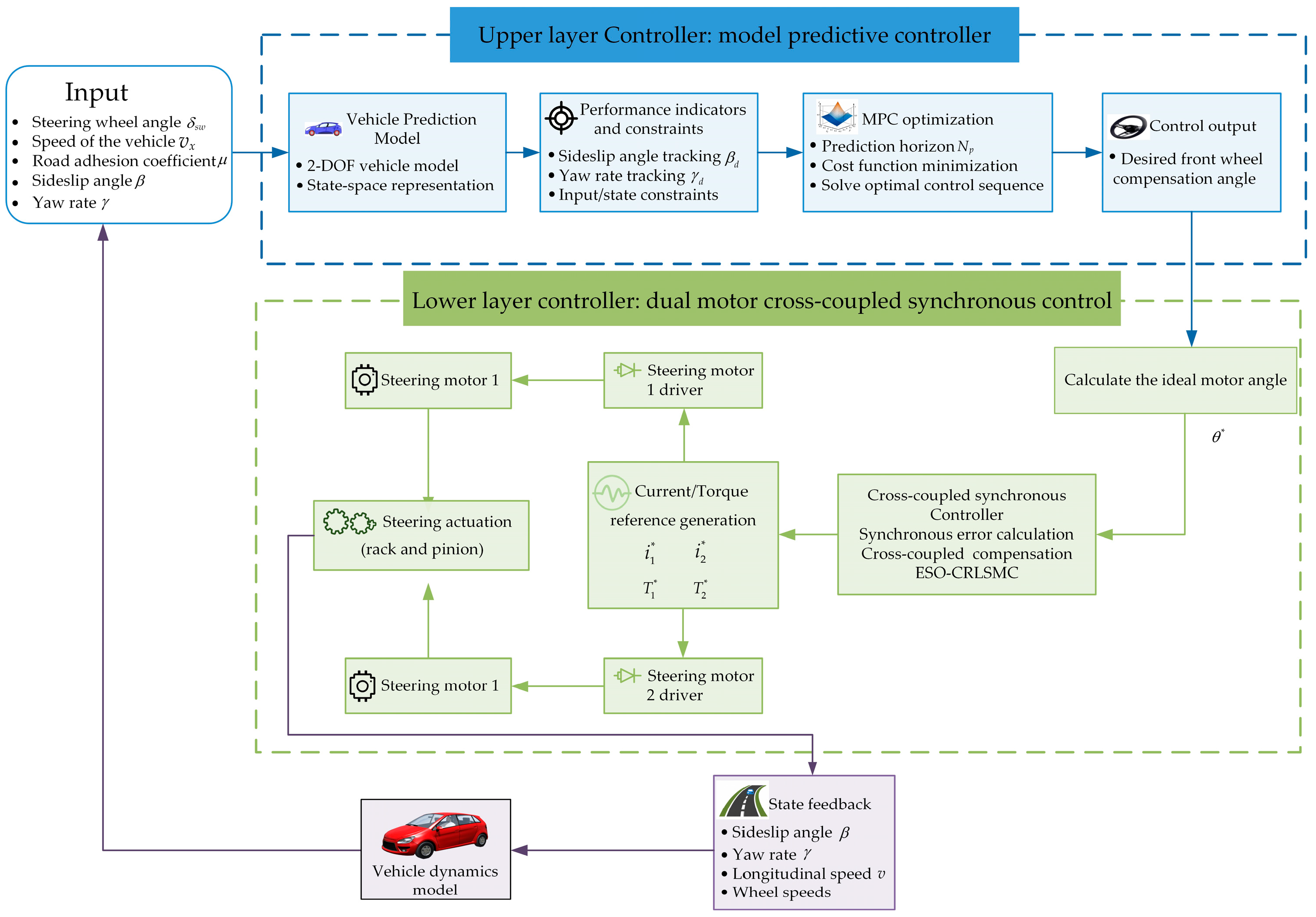
In actual vehicle operation, the vehicle is subject to multiple uncertainties, including lateral wind speed, road environment changes, and time-varying parameters. These factors become particularly critical on low-adhesion road surfaces, where the tires are prone to entering nonlinear regions during steering, increasing the risk of skidding and loss of control. To address these challenges, a hierarchical control strategy for lateral stability and synchronization control of dual-motor SBW vehicles is adopted in this paper. The block diagram of the system is shown in Figure 1. In the upper layer, MPC is employed to optimize the sideslip angle and yaw rate by tracking their reference values, thereby generating a compensatory front wheel angle that ensures vehicle steering stability. In the lower layer, based on the steering motor reference angle θ * obtained by the upper layer, a dual-motor configuration is adopted. To overcome issues including parameter mismatch and speed synchronization, the ESO-CRLSMC method is proposed to ensure the reliability of the dual-motor system and enhance the stability of the SBW system.
The state space equation of the SBW system is given as follows [29]:
x ˙ = A x + B u + B d w y = C x
where x = [ β , γ , θ s , θ ˙ s ] T , u = Δ θ is the control input, Δ θ is the compensation angle, θ s = x r / x p = G 2 δ f is the motor angle, w is the external disturbance,
A = C a f + C a r m v G 2 a C a f b C a r m v 2 1 C a f m v G 2 0 a C a f b C a r I Z a 2 C a f + b 2 C a r v I z a C a f I Z G 2 0 0 1 0 0 C a f t p + t m J R a C a f t p + t m J R v G 2 C a f t p + t m J R G 2 2 B R J R ,   B d = 0 1 m v x 1 0 e I z 1 0 0 0 1 0 0 ,   w = F y w d r n s ,   C = 0 0 1 0 ,   B = 0 0 C a f m v G 2 a C a f I z G 2 T .
The discrete time model is given as follows:
x ( k + 1 ) = A k x ( k ) + B k u ( k ) + B d k w ( k ) y ( k ) = C k x ( k )
where A k = e A T s , B k = 0 T s e A τ d τ B 2 , B d k = 0 T s e A τ d τ B d , C k = C .
To facilitate the subsequent solution, a new state variable x ˜ ( k ) = [ x ( k ) , u ( k 1 ) ] T is introduced. Consequently, (23) can be reformulated as:
x ˜ ( k + 1 ) = A ˜ x ˜ ( k ) + B ˜ Δ u ( k ) + B ˜ d w ( k ) y ˜ ( k ) = C ˜ x ˜ ( k )
where A ˜ = A k B k 0 1 × 4 I 1 × 1 , B ˜ = B k 0 1 × 1 , B ˜ d = B d k 0 1 × 1 , Δ u ( k ) = u ( k ) u ( k 1 ) , C = C k 0 1 × 1 .
The prediction equation is:
Y ( k ) = Λ k x ˜ ( k ) + Θ k Δ U ( k ) + Γ k w ( k )
where Y ( k ) = y ˜ ( k + 1 | k ) y ˜ ( k + 2 | k ) y ˜ ( k + p | k ) Δ u ( k ) = Δ u ( k ) Δ u ( k + 2 ) Δ u ( k + p ) ,
Λ k = C ˜ A ˜ C ˜ A ˜ 2 C ˜ A ˜ m C ˜ A ˜ p ,   Θ k = C ˜ B ˜ 0 0 C ˜ A ˜ B ˜ C ˜ B ˜ 0 C ˜ A ˜ N m B ˜ C ˜ A ˜ N m B ˜ C ˜ A ˜ N m B ˜ C ˜ A ˜ N p 1 B ˜ C ˜ A ˜ N p 2 B ˜ C ˜ A ˜ N p m B ˜ ,   Γ k = C ˜ B ˜ d C ˜ A ˜ B ˜ d + C ˜ B ˜ d i = 0 m 1 C ˜ A ˜ i B ˜ d i = 0 p 1 C ˜ A ˜ i B ˜ d ,
The prediction horizon N p is set to 20 and the control horizon N m is set to 5.
Given that the controller is designed to improve tracking accuracy with respect to target values while maintaining stability, the error between the vehicle states and their desired values is incorporated into the optimization function. Furthermore, owing to actuator limitations in practical systems, the system output should not exceed certain bounds. The objective function is therefore formulated as:
min Δ U ( k ) , ε J = j = 1 N p y ( k + j | k ) y r e f ( k + j ) Q 2 + j = 0 N c 1 Δ u ( k + j | k ) R 2 + K p ε 2
where the state weighting matrix is selected as Q = d i a g [ 100 , 80 , 10 , 1 ] and the control input weighting matrix is chosen as R = 0.7 ; ε 0 is the slack factor. Additionally, to prevent performance degradation due to overly restrictive constraints under favorable vehicle stability conditions, the vehicle stability factor K p is incorporated as a constraint weight.
The constraints are given as follows:
Δ U m i n Δ U ( k ) Δ U m a x U m i n U k 1 + C Δ U ( k ) U m a x Y m i n ϵ 1 Λ k x ˜ ( k ) + Θ k Δ U ( k ) + Γ k w ( k ) Y m a x + ϵ 1

4. Cross Coupling Synchronization Controller for Dual-Motor Parameter Mismatch

4.1. Controller Design

The upper-layer controller optimizes the ideal lateral slip angle and yaw rate to track their desired values, thereby obtaining the compensation steering angle required to ensure vehicle stability. In this section, a lower-layer dual-motor cross-coupled synchronous controller is designed to track the ideal front-wheel steering angle provided by the upper-level controller. This improves vehicle stability and safety while enhancing the overall driving experience.
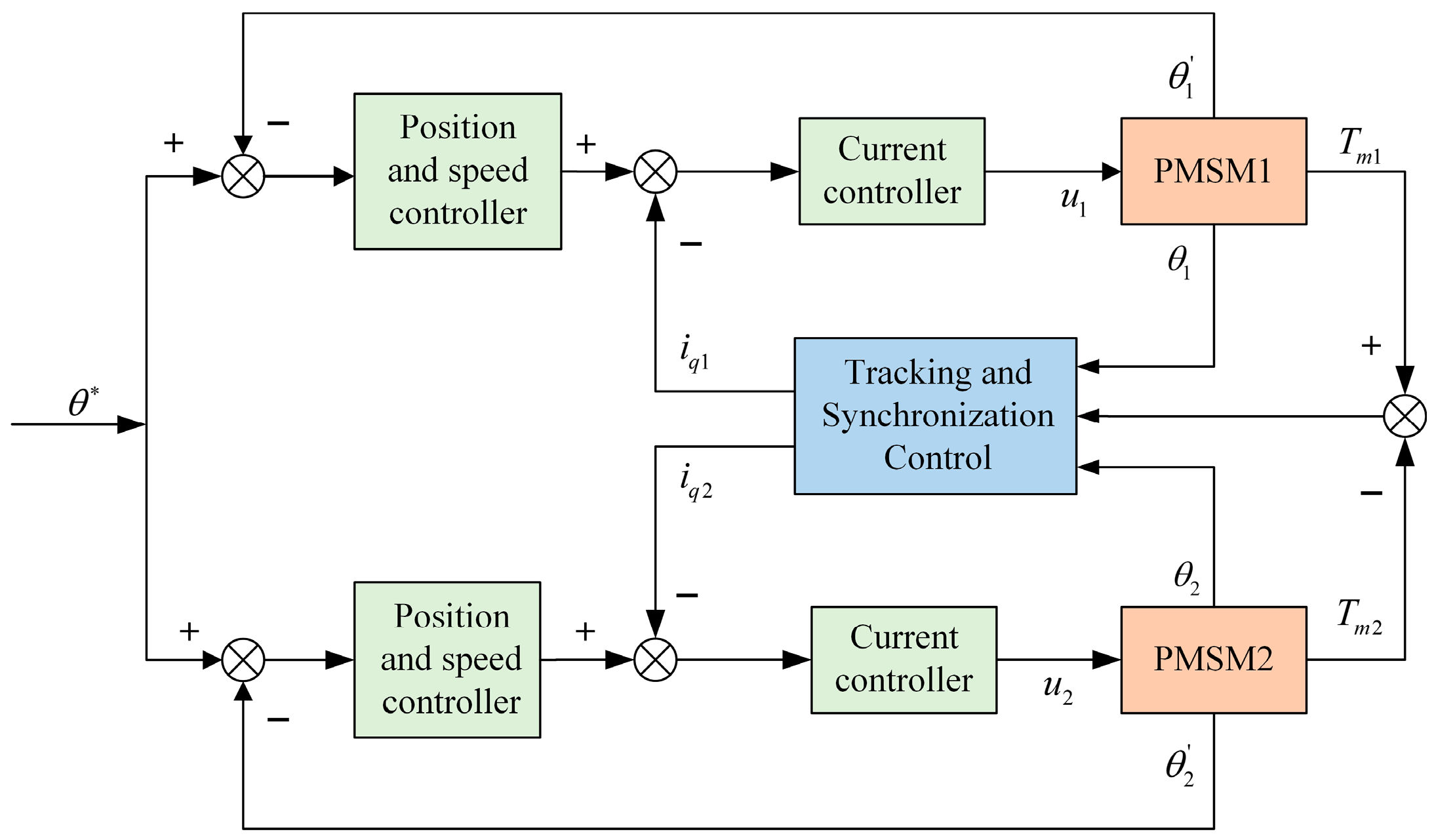
Employing a dual-motor system as the steering actuator enhances the stability of SBW vehicles. However, issues such as parameter asymmetry and speed asynchronization may arise in dual- motor systems. To address these challenges, ESO-CRLSMC is adopted in this paper, as illustrated in Figure 2. This controller ensures accurate tracking of the desired front wheel angle from the upper layer while maintaining synchronization between the two motors.
Based on the motor model given in Equation (8), the following state variables are defined as:
e i = θ i θ * e w = ω i ω j = e ˙ i e ˙ j
where for i = 1 , j = 2 ; i = 2 , j = 1 .
Taking the derivative of Equation (28) yields:
e ˙ i = ω i ω * e ˙ ω = e ¨ i e ¨ j
where
e ¨ i = ω ˙ i ω ˙ * = B e m J e m ω i + 3 n p ψ f 2 J e m i q i τ i + τ d i s J e m ω ˙ * = B e m J e m ( e ˙ i + ω * ) + 3 n p ψ f 2 J e m i q i τ i + τ d i s J e m ω ˙ * = B e m J e m e ˙ i + 3 n p ψ f 2 J e m i q i D i B e m J e m ω * ω ˙ *
The sliding mode surface is designed as follows:
s i = k 1 e i + k 2 e ω
where k 1 > 0 , k 2 > 0 are design parameters to be determined.
Taking the derivative of Equation (31) yields:
s ˙ i = k 1 e ˙ i + k 2 e ˙ ω = k 1 e ˙ i + k 2 e ¨ i k 2 e ¨ j = k 1 e ˙ i + k 2 B e m J e m ω i + 3 n p ψ f 2 J e m i q i D i ω ˙ * k 2 e ¨ j
To enhance the system convergence rate, exponential and power functions are incorporated into the sliding mode control. A piecewise switching function is employed to replace the conventional sign function for chattering suppression. The proposed reaching law is then given as follows [30]:
s ˙ i = ε 1 | s i | α f ( s i ) ε 2 e | s i | 1 f ( s i ) f ( s i ) = s i g n ( s i ) | s i | σ s i g n ( s i ) | s i | σ σ | s i | < σ
where ε 1 is the switching gain, ε 2 is the linear gain, and σ is the boundary layer thickness, 0 < σ < 1 .
From (31) and (32), the following can be derived:
i q i = 2 J e m 3 n p ψ f 1 k 2 k 1 e ˙ i + k 2 e ¨ j ε 1 | s i | α f ( s i ) ε 2 e s i 1 f ( s i ) + B e m J e m ω i + D i + ω ˙ *

4.2. Disturbance Observer Design

As indicated by (33), the sliding mode controller based on the improved composite reaching law exhibits certain robustness against system disturbances and parameter variations. However, the switching function inherent to the controller inevitably leads to chattering. To address this issue, an observer is designed for online disturbance estimation. The PMSM motion equation, incorporating motor parameter variations and load torque disturbances, is given as follows [31]:
θ ˙ i = ω i ω ˙ i = B e m J e m ω i + 3 n p ψ f 2 J e m i q i D i D ˙ i = 0
To facilitate load disturbance observation, (34) is reformulated into state space form. The state variables are defined as the PMSM angle θ i , angular velocity ω i , and load disturbance D i , while the control input is taken as the PMSM current i q :
x ^ ˙ = A x ^ + B u
where x ^ = ω i D i T , u = i q , A = 0 1 0 0 B e m J e m 1 0 0 0 , B = 0 3 n p ψ f 2 J e m 0 .
To enable online estimation of the total disturbance in the PMSM speed control loop, the following observer is designed:
e 1 = ω ^ i ω i ω ^ ˙ i = 3 n p ψ f 2 J e m i q i B e m J e m ω ^ i + D ^ i β 01 e 1 D ^ ˙ i = β 02 x 1
where ω ^ i , D ^ i are the observed values of ω i and D i , respectively; e 1 is the observation error; and β 01 , β 02 are the observer gain coefficients.
Taking the estimated total disturbance into account, a new control law is formulated based on Equation (33) as follows:
i q i = 2 J e m 3 n p ψ f 1 k 2 k 1 e ˙ i + k 2 e ¨ j ε 1 | s i | α f ( s i ) ε 2 e s i 1 f ( s i ) + B e m J e m ω i + D ^ i + ω ˙ *

4.3. Stability Analysis

The observation error is defined as D ˜ i = D i D ^ i . Its derivative is then given by D ˜ ˙ i = D ˙ i D ^ ˙ i = D ^ ˙ i . The Lyapunov function is chosen as follows:
V = 1 2 s 1 2 + 1 2 D ˜ 1 2
The derivative of V is given by:
V ˙ = s 1 s ˙ 1 + D ˜ 1 D ˜ ˙ 1 = s 1 k 1 e ˙ 1 + k 2 B e m J e m ω 1 + 2 n p ψ f 3 J e m i q 1 D 1 ω ˙ * k 2 e ¨ j D ˜ 1 D ^ ˙ 1 = s 1 k 2 1 k 2 ε 1 | s i | α f ( s i ) ε 2 e s i 1 f ( s i ) + D ^ 1 D 1 D ˜ 1 D ^ ˙ 1 = s 1 ε 1 | s i | α f ( s i ) ε 2 e s i 1 f ( s i ) + k 2 D ^ 1 D 1 D ˜ 1 D ^ ˙ 1 = s 1 ε 1 | s i | α f ( s i ) + ε 2 e s i 1 f ( s i ) D ˜ 1 s 1 k 2 + D ^ ˙ 1 < 0
When ε 1 > 0 , ε 2 > 0 and 0 < α < 1 are designed, we obtain V > 0 , V ˙ < 0 . According to Lyapunov stability theory, the sliding mode surface s i converges to zero, and the system is stable.

5. Simulation Results and Analysis

5.1. SBW Vehicle Model Validation

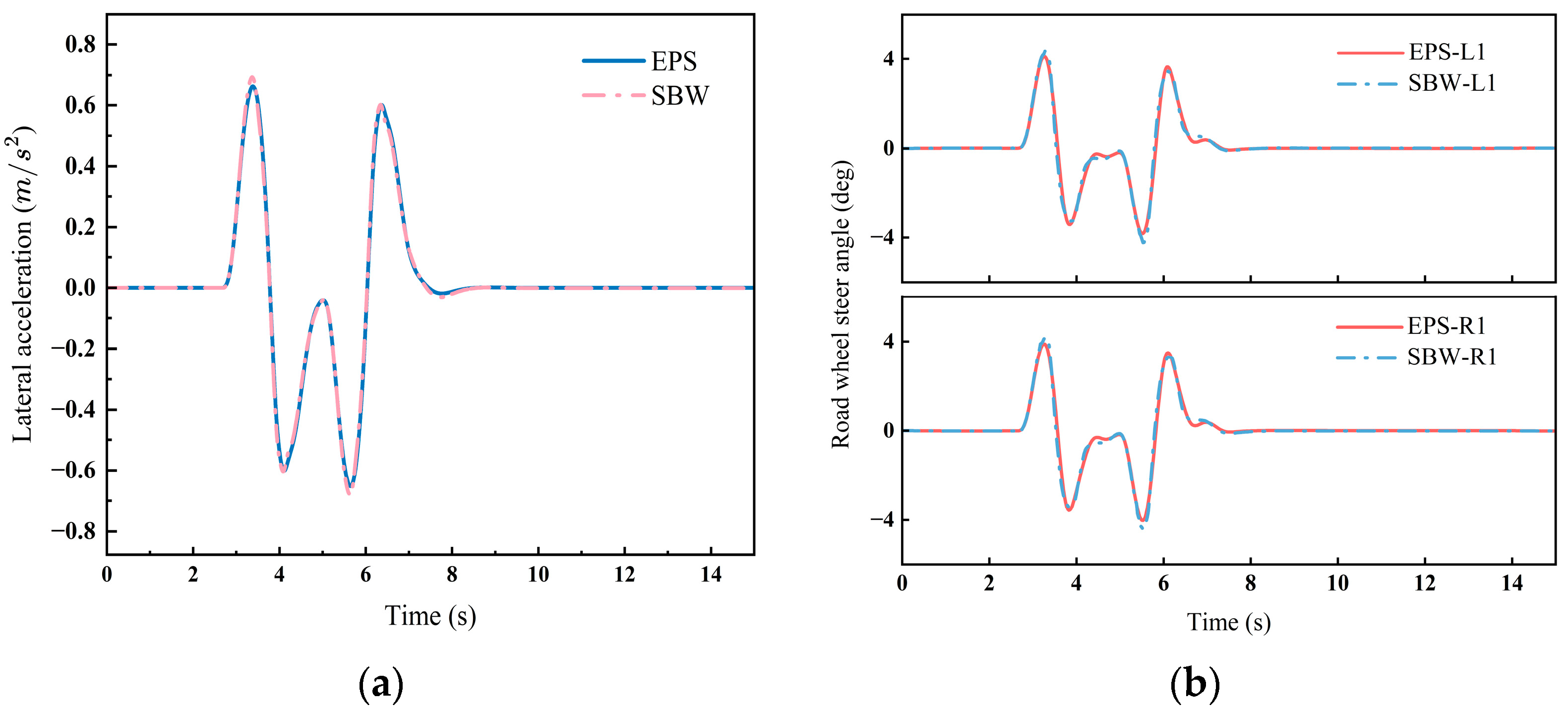
To validate the accuracy and feasibility of the proposed SBW model, the double lane change (DLC) maneuver under continuous rapid steering is adopted. A comparative analysis is conducted between the model established in this paper and the Carsim model of the electric power steering system. The simulation results are presented in Figure 3.
As observed from the vehicle lateral acceleration in Figure 3a and the left and right front wheel steering angles L 1 and R 1 in Figure 3b, under identical steering angle inputs, the output errors of the left and right front wheel steering angles and the lateral acceleration response of the proposed model remain within acceptable ranges during the steering maneuver. This demonstrates that the proposed model exhibits good consistency with the Carsim model of the EPS system and accurately captures the actual operating states of the vehicle.

5.2. Lateral Stability Analysis

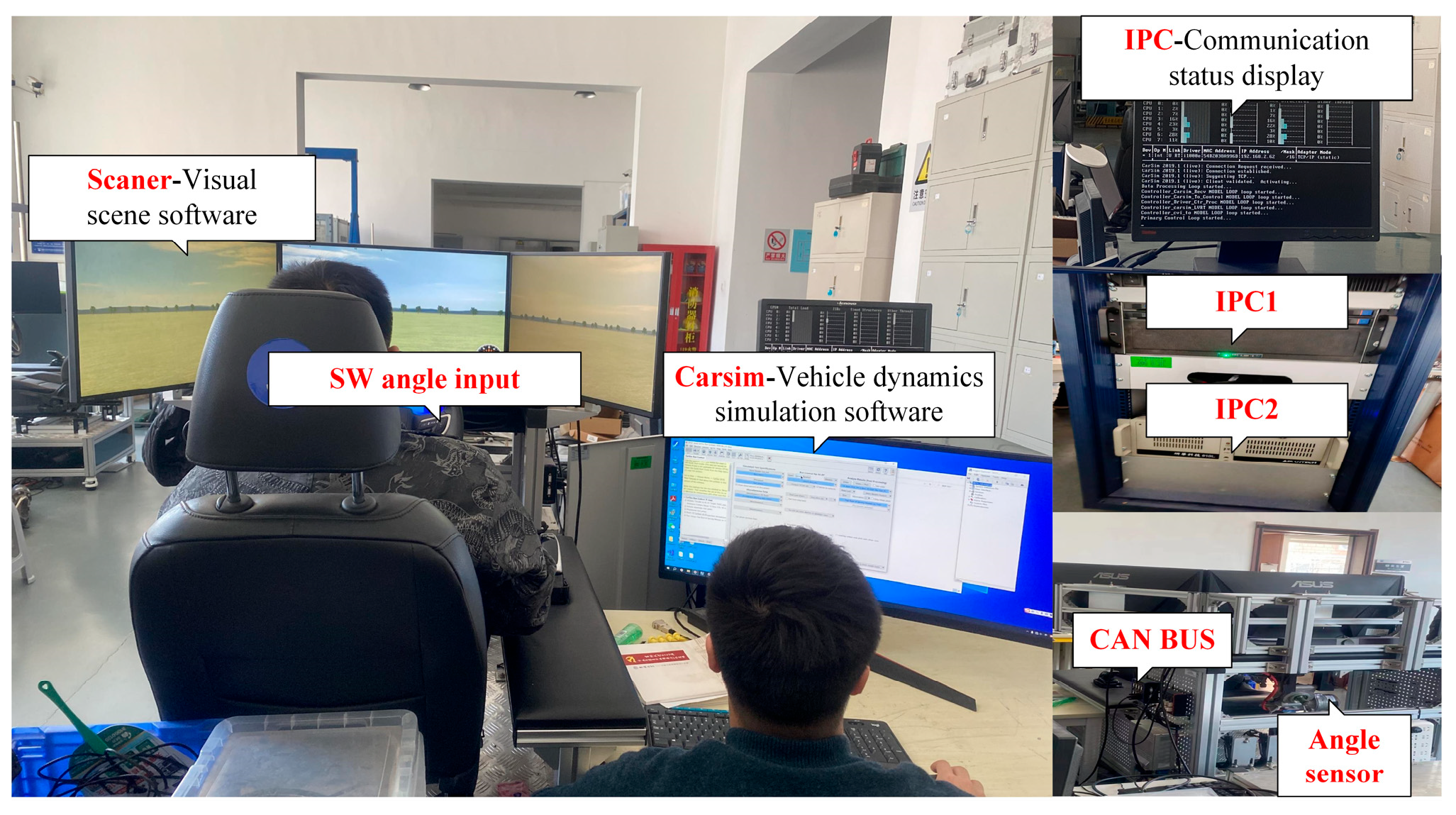
The established hardware-in-the-loop (HIL) test platform is shown in Figure 4. The platform primarily consists of a host computer, a slave computer, a CAN card, a controller, and a monitoring/calibration computer. The vehicle model is constructed using MATLAB/Simulink (R2023b) and is downloaded as embedded code into the vehicle control unit (VCU), which is developed based on the MPC5675K microcontroller. Via communication protocols such as CAN and UDP, the VCU signals are integrated with signals generated from a virtual real-time simulation environment, thereby enabling hardware-in-the-loop testing and simulation of the VCU.
To evaluate the effectiveness of the proposed lateral stability controller and to assess the system’s disturbance rejection capability, a strong crosswind disturbance is applied between t = 1 s and t = 13 s. The vehicle parameters employed in this study are summarized in Table 1.
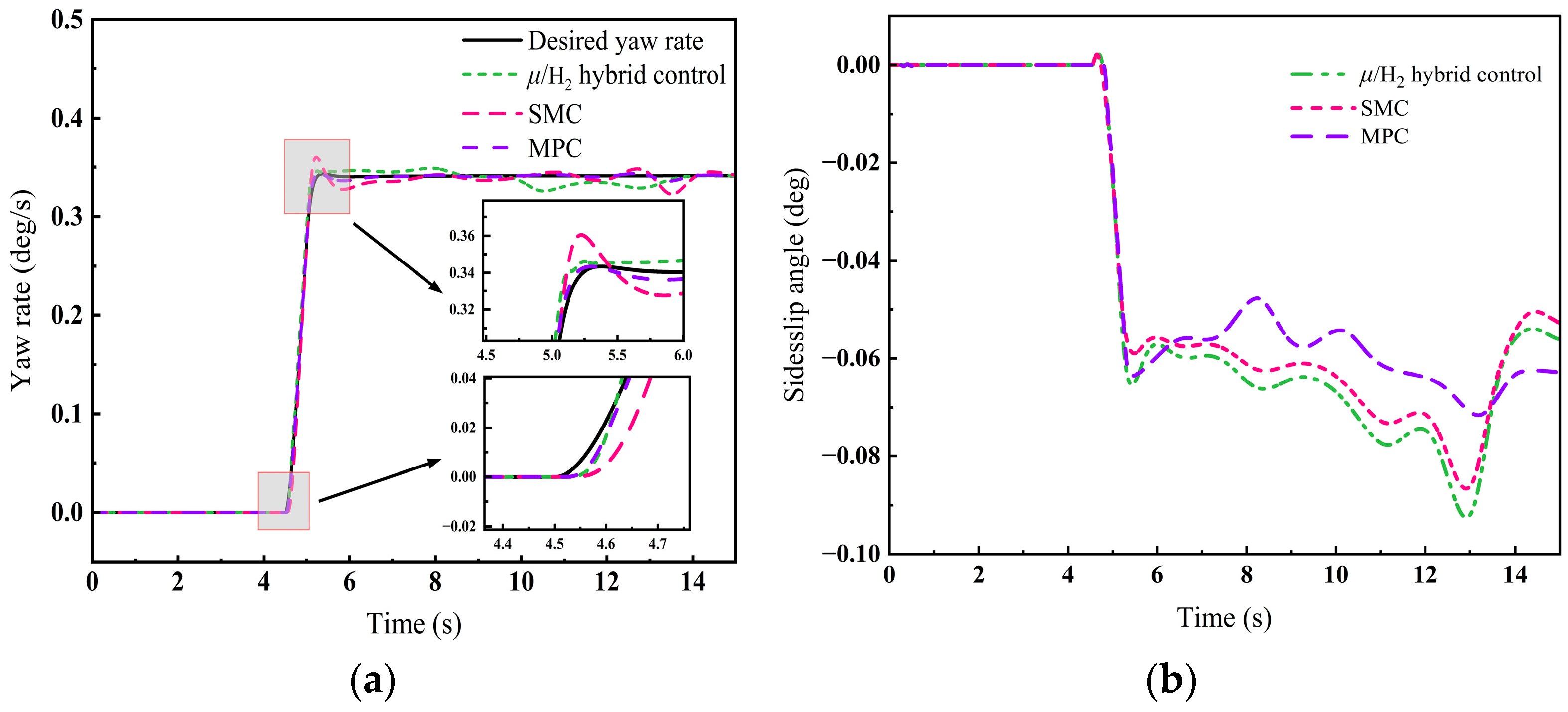
First, under the step input condition, the proposed upper-layer MPC is compared with both integral SMC from [32] and the μ / H 2 hybrid control from [33]. Simulation results at a vehicle speed of 54 km/h are presented in Figure 5.
As observed from the yaw rate response in Figure 5a, after the steering signal is applied at 5 s, MPC predicts the vehicle’s future state within a finite time horizon at each sampling point using a prediction model. It solves a constrained multi-objective optimization problem online, thereby generating an optimal front-wheel steering angle sequence that satisfies stability boundaries in advance. (MPC) predicts the vehicle’s future state within a finite time horizon at each sampling point using a prediction model. It solves a constrained multi-objective optimization problem online, thereby generating an optimal front-wheel steering angle sequence that satisfies stability boundaries in advance. After the steering maneuver is completed, the vehicle continues to travel in a straight line with a small tracking error. Under strong crosswind disturbances, MPC is capable of tracking the desired values with a small error, exhibiting strong robustness. In contrast, the μ / H 2 hybrid control shows a considerably larger tracking error.
Figure 5b illustrates the evolution of the sideslip angle during the steering maneuver. The peak sideslip angles for all three controllers occur at 13 s, when the lateral wind speed is at its highest. Specifically, the peak errors of SMC and hybrid control are 0.083 deg and 0.095 deg, respectively, whereas that of MPC is 0.07 deg. By maintaining the tire–road adhesion potential, MPC effectively constrains the vehicle’s sideslip mode.
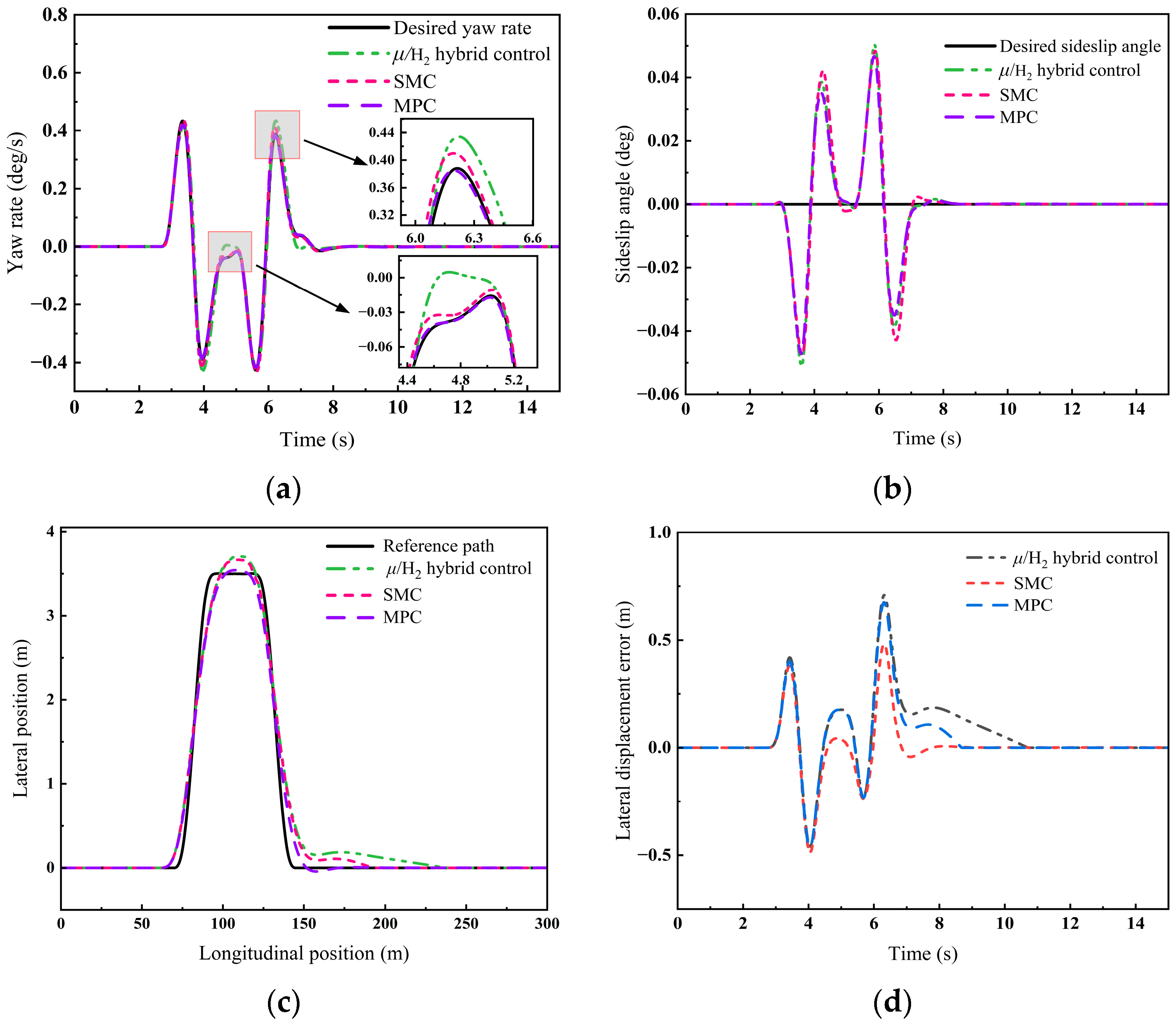
Under the DCL condition, when the vehicle speed is 54 km/h, the simulation results are shown in Figure 6.
As illustrated by the lateral displacement curves under DLC conditions in Figure 6c, at a vehicle speed of 54 km/h, the vehicle enters stable straight-line driving after 150 m. The MPC achieves a stable state at 175 m with the smallest tracking error, exhibiting superior tracking performance. Hybrid control and SMC reach stable states at 190 m and 230 m, respectively. From Figure 6d, the maximum tracking error for all three controllers occurs at 6.8 s. The peak tracking errors of hybrid control and SMC are approximately 0.75 m, whereas that of MPC is reduced to 0.46 m. As observed from the yaw rate response in Figure 6a, MPC generates feedforward control action before the vehicle enters the curve at 6 s, effectively reducing the yaw rate error and preventing significant deviation. In Figure 6b, the sideslip angle deviation corresponds to the steering conditions along the trajectory. The maximum sideslip angle of MPC throughout the maneuver is 0.045 deg, which is 17.24% lower than those of the other two controllers.
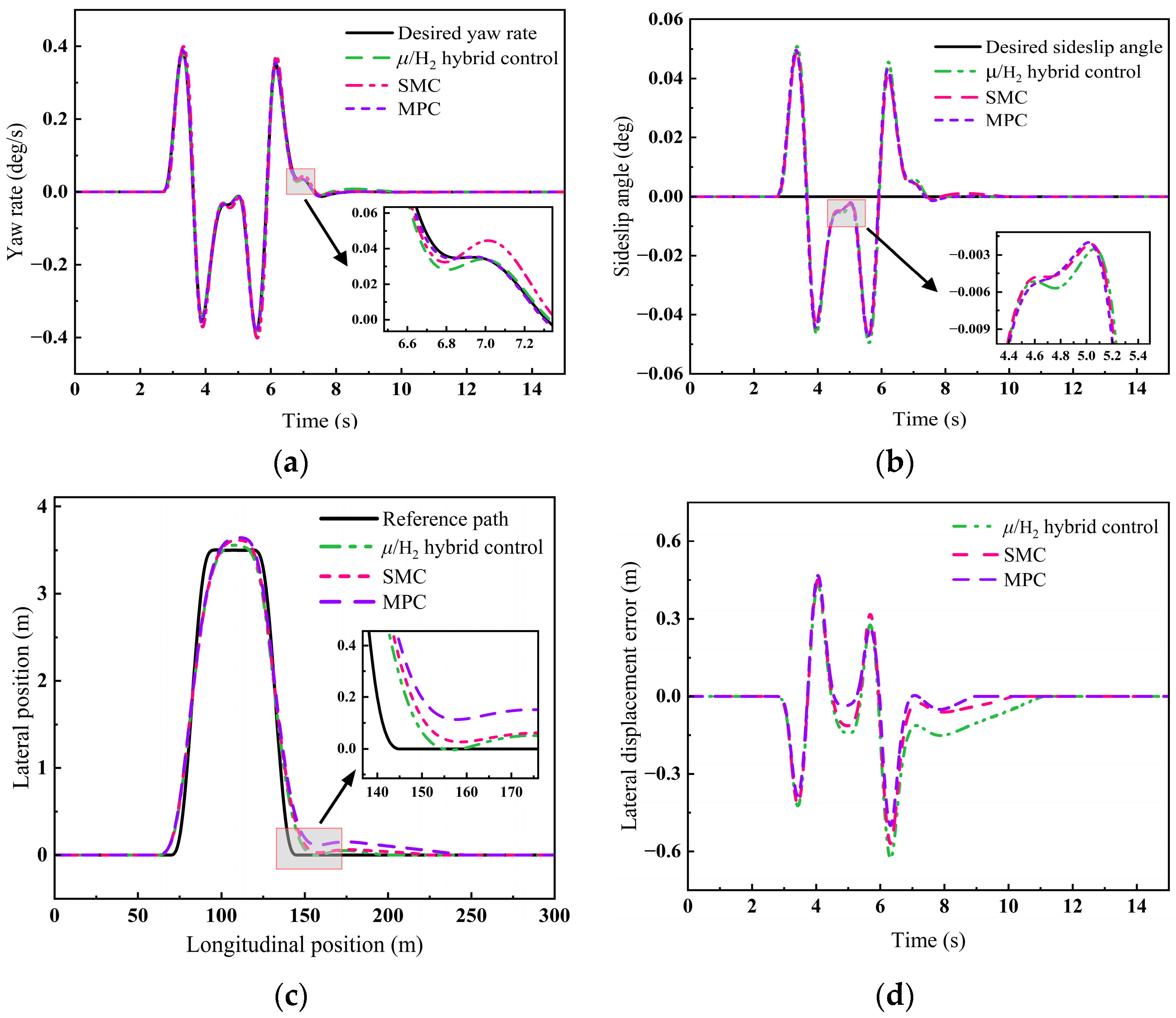
Simulation results at a vehicle speed of 30 km/h are presented in Figure 7.
At a vehicle speed of 30 km/h, as observed from the yaw rate responses in Figure 7a, all three controllers exhibit relatively large errors during the intervals of 5.2–6.0 s and 6.3–7.2 s. SMC maintains a consistently large error without notable fluctuations, whereas MPC exhibits a small error fluctuation range under disturbances and converges to the desired value with a minor error at 7.1 s, indicating a faster convergence rate. In Figure 7b, hybrid control shows significant deviations in sideslip angle at 4.7 s and 6.9 s. In contrast, the maximum sideslip angles of both SMC and MPC remain within 0.05 deg, and both reach a stable state with a small sideslip angle by 8 s, thereby ensuring a favorable driving experience for the driver. The lateral displacement and lateral displacement deviation results presented in Figure 7c,d are consistent with the above observations, further confirming that MPC is capable of tracking the desired path with a small error.

5.3. Synchronization Performance Analysis

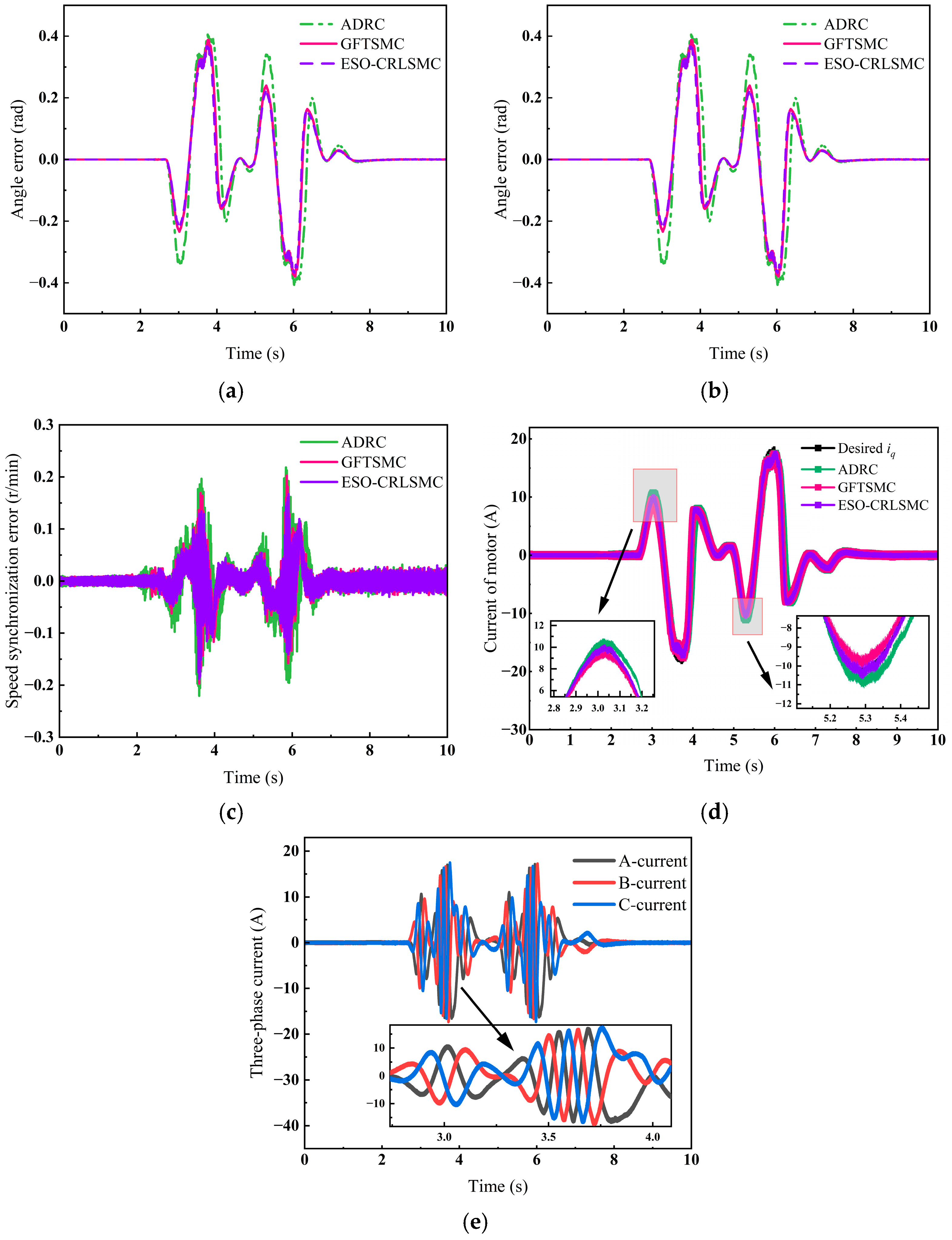
To evaluate the performance of the proposed cross-coupling synchronization controller for dual motors under parameter mismatch conditions, comparative analyses are conducted under DLC conditions against active disturbance rejection control (ADRC) [34] and global fast terminal sliding mode control (GFTSMC). The resistance (R), moment of inertia (J), and inductance (L) of motor 1 are configured to be twice those of motor 2. The angle tracking performance, synchronization performance, and current dynamic characteristics of the dual-motor SBW actuation system under different control strategies are compared, as presented in Figure 8.
As observed from the angle tracking in Figure 8a and the angle error in Figure 8b, at t = 5.2 s, the angle errors of ADRC, GFTSMC, and the proposed ESO-CRLSMC are 0.37 rad, 0.29 rad, and 0.22 rad, respectively. Compared with ADRC and GFTSMC, ESO-CRLSMC reduces the angle error amplitude by 68.1% and 31.8%, respectively, while achieving a faster synchronization speed. From the speed difference plots in Figure 8c, the maximum speed deviations between the two motors under the three controllers are 0.22, 0.20, and 0.17 rad/min, respectively. In comparison, ESO-CRLSMC reduces the speed synchronization error by 29.4% and 17.5% relative to the other two controllers. Figure 8d,e presents the d-axis current and three-phase current responses, respectively, demonstrating that the proposed controller maintains favorable tracking and synchronization performance even under external disturbances and dual-motor parameter mismatches.

6. Conclusions

This paper proposes a hierarchical control strategy to address the lateral stability of SBW vehicles and the synchronization issue under dual-motor parameter mismatch. In the upper layer, MPC is employed to enable the sideslip angle and yaw rate to track their desired values. In the lower layer, ESO-CRLSMC is adopted to ensure speed synchronization of the dual motors.
HIL test validation demonstrates the following: In the proposed hierarchical control strategy, the upper-layer MPC, when compared with hybrid control, reduces the maximum yaw rate tracking error by 58.3% and the sideslip angle error by 17.24% under high-speed conditions, while achieving a 32.6% reduction in the maximum yaw rate tracking error under low-speed conditions. Relative to SMC, MPC reduces the maximum yaw rate tracking error by 36.5% and the sideslip angle error by 12.14% under high-speed conditions, exhibiting superior path tracking capability under uncertain conditions. The lower-layer ESO-CRLSMC, in comparison with ADRC and GFTSMC, reduces the angle error amplitude by 68.1% and 31.8%, and reduces the speed synchronization error by 29.4% and 17.5%, respectively. The above experimental results indicate that the proposed control method effectively enhances the yaw stability and safety of vehicle steering, thereby providing a favorable driving experience.

Author Contributions

Conceptualization, P.M.; Methodology, P.M.; Software, Z.L.; Validation, Z.L.; Investigation, J.Z.; Resources, J.Z. and Z.Z.; Data curation, Z.Z.; Writing—original draft, P.M.; Writing—review & editing, N.Z.; Visualization, Z.Z.; Supervision, N.Z.; Project administration, N.Z. All authors have read and agreed to the published version of the manuscript.

Funding

This research was funded by the National Natural Science Foundation of China, grant number 52477041; Science and Technology Development Plan Project of Jilin Province, China, grant number YDZJ202601ZYTS018; and the State Key Laboratory of Automotive Simulation and Control Open Fund, grant number 20210237.

Data Availability Statement

The original contributions presented in this study are included in the article. Further inquiries can be directed to the corresponding author.

Conflicts of Interest

Author Jinghui Zhao was employed by the company Changchun Yeal Automotive Parts Co. The remaining authors declare that the research was conducted in the absence of any commercial or financial relationships that could be construed as a potential conflict of interest.

Abbreviations

The following abbreviations are used in this manuscript:
SBWSteer-by-wire
PMSMPermanent magnet synchronous motor
MPCModel predictive control
DLCDouble lane change
ADRCActive disturbance rejection control
GFTSMCGlobal fast terminal sliding mode control
ESO-CRLSMCComposite reaching law sliding mode control based on an extended state observer
2-DOFTwo degrees of freedom

References

  1. Shi, G.B.; Liu, T.Y.; Wang, S.; Guo, C.; Liu, Y. High authenticity steering feel control strategy for Steer-by-Wire system based on terminal sliding mode rack force observer. Proc. Inst. Mech. Eng. Part D-J. Automob. Eng. 2025, 239, 2869–2885. [Google Scholar] [CrossRef]
  2. Du, K.G.; Ma, B.X.; Li, J.W.; Wang, Y.F. Low-Complexity Control for Uncertain Time-Varying SbW Systems with Input Nonlinearity and Dual-Channel Event-Triggering Communication. IEEE Trans. Intell. Transp. Syst. 2025, 26, 8992–9003. [Google Scholar] [CrossRef]
  3. Wang, J.Z.; Zhao, Y.Q.; Lin, F.; Liu, Y.B. Active front steering-based lateral stability control for steer-by-wire vehicles with uncertainties via robust optimal control and terminal sliding mode. Proc. Inst. Mech. Eng. Part D-J. Automob. Eng. 2026. [Google Scholar] [CrossRef]
  4. Gonschorek, R.; Bertram, T. Robust two-degrees of freedom linear quadratic gaussian position control for the front axle actuator of a steer-by-wire system. Forsch. Ingenieurwesen 2023, 87, 697–710. [Google Scholar] [CrossRef]
  5. Chen, C.N.; Zhang, J.C.; Zheng, H.Y. A modified handling stability control strategy for steer-by-wire vehicles based on variable steering ratio and active front steering control. Proc. Inst. Mech. Eng. Part D-J. Automob. Eng. 2025, 239, 3027–3043. [Google Scholar] [CrossRef]
  6. Seo, Y.; Cho, K.; Nam, K. Integrated Yaw Stability Control of Electric Vehicle Equipped with Front/Rear Steer-by-Wire Systems and Four In-Wheel Motors. Electronics 2022, 11, 1277. [Google Scholar] [CrossRef]
  7. Zhang, J.; Wang, H.; Zheng, J.C.; Cao, Z.W.; Man, Z.H.; Yu, M.; Chen, L. Adaptive Sliding Mode-Based Lateral Stability Control of Steer-by-Wire Vehicles with Experimental Validations. IEEE Trans. Veh. Technol. 2020, 69, 9589–9600. [Google Scholar] [CrossRef]
  8. Liu, Z.J.; Cheng, S.; Ji, X.W.; Li, L.; Wei, L.T. A Hierarchical Anti-Disturbance Path Tracking Control Scheme for Autonomous Vehicles Under Complex Driving Conditions. IEEE Trans. Veh. Technol. 2021, 70, 11244–11254. [Google Scholar] [CrossRef]
  9. Wen, Y.H.; Jin, L.Q.; Li, A.D.; Zhong, Z.; Zhang, F.; Yin, C.J.; Zhang, Y. A model predictive control algorithm for angle tracking of steer-by-wire vehicles with variable steering ratio and active front steering. J. Braz. Soc. Mech. Sci. Eng. 2025, 47, 244. [Google Scholar] [CrossRef]
  10. Zhang, H.; Liu, Y.H.; Zhao, W.Z.; Hu, C.; Zhao, J. Human-Machine Shared Control for Steer-by-Wire Vehicles Using Improved Reinforcement Learning-Based MPC. IEEE Trans. Intell. Transp. Syst. 2025, 26, 12688–12700. [Google Scholar] [CrossRef]
  11. Xu, Z.; Shi, Q.; Wei, Y.J.; Wang, M.W.; Guo, C.L.; He, L. A Predictive Sliding Control Algorithm and Application to Angle Following of Steer-by-Wire. IEEE Trans. Syst. Man Cybern. Syst. 2025, 55, 2670–2680. [Google Scholar] [CrossRef]
  12. Chen, T.; Cai, Y.F.; Chen, L.; Xu, X.; Sun, X.Q. Trajectory tracking control of steer-by-wire autonomous ground vehicle considering the complete failure of vehicle steering motor. Simul. Model. Pract. Theory 2021, 109, 102235. [Google Scholar] [CrossRef]
  13. Zong, C.; Xiang, H.; He, L.; Sha, F. Study on control method of dual-motor for steer-by-wire system. In Proceedings of the 2012 2nd International Conference on Consumer Electronics, Communications and Networks (CECNet), Yichang, China, 21–23 April 2012; pp. 2890–2893. [Google Scholar]
  14. Hwang, H.; Choi, H.; Nam, K. Practical Synchronous Steering Angle Control of a Dual-Motor Driving Steer-by-Wire System. IEEE Access 2019, 7, 133100–133110. [Google Scholar] [CrossRef]
  15. He, L.; Chen, G.Y.; Zheng, H.Y. Fault Tolerant Control Method of Dual Steering Actuator Motors for Steer-by-Wire System. Int. J. Automot. Technol. 2015, 16, 977–987. [Google Scholar] [CrossRef]
  16. Zou, S.C.; Zhao, W.Z.; Wang, C.Y. Tracking and synchronization control strategy of vehicle dual-motor steer-by-wire system via super-twisting SOSMC and MDCS. Mech. Syst. Signal Process. 2023, 183, 109638. [Google Scholar] [CrossRef]
  17. Wang, Q.M.; Jiang, C.H.; Zhang, N.A.; Wang, Y.B. EV Tracking and Synchronization Control of Dual-Motor Steer-by-Wire System Under Road Disturbances and Parameter Perturbation. IEEE Trans. Energy Convers. 2025, 40, 2856–2869. [Google Scholar] [CrossRef]
  18. Zou, S.C.; Zhao, W.Z. Synchronization and stability control of dual-motor intelligent steer-by-wire vehicle. Mech. Syst. Signal Process. 2020, 145, 106925. [Google Scholar] [CrossRef]
  19. Zhao, W.; Ren, X.M.; Li, L.W. Synchronization and Tracking Control for Dual-motor Driving Servo Systems with Friction Compensation. Asian J. Control 2019, 21, 674–685. [Google Scholar] [CrossRef]
  20. Kim, M.; Chung, I.S.; Choi, J.; Nam, K. High-Order Model-Based Robust Control of a Dual-Motor Steer-by-Wire System with Disturbance Rejection. Actuators 2025, 14, 322. [Google Scholar] [CrossRef]
  21. Wen, X.X.; Du, J.H.; Du, Z.X.; Chen, L.; Yang, Z.; Xu, Z.Z. Running Stability for Monorail Vehicles Based on the Magic-Formula Tire Model. Int. J. Struct. Stab. Dyn. 2025, 25, 2650121. [Google Scholar] [CrossRef]
  22. Yang, H.H.; Liu, W.T.; Chen, L.; Yu, F. An adaptive hierarchical control approach of vehicle handling stability improvement based on Steer-by-Wire Systems. Mechatronics 2021, 77, 102583. [Google Scholar] [CrossRef]
  23. Li, Z.H.; Wang, P.; Liu, H.H.; Hu, Y.F.; Chen, H. Coordinated longitudinal and lateral vehicle stability control based on the combined-slip tire model in the MPC framework. Mech. Syst. Signal Process. 2021, 161, 107947. [Google Scholar] [CrossRef]
  24. Zhu, Y.Z.; Yuan, S.H.; Li, X.Y.; Li, A.; Gao, X. Torque Differential-Based Dynamic Modeling, Validation, and Steering Characteristics Analysis of Multi-Axial Skid-Steered Wheeled Vehicle. Actuators 2025, 14, 13. [Google Scholar] [CrossRef]
  25. Wang, X.Y.; Pan, L.; Tian, Y.; Liu, Y.C.; Li, L. Adaptive Fault-Tolerant Fixed-Time Sliding Mode Tracking Control for Steer-by-Wire System with Dual-Three-Phase PMSM. IEEE Trans. Veh. Technol. 2025, 74, 7554–7564. [Google Scholar] [CrossRef]
  26. Qiao, H.; Liu, Y.; Li, G. Command filter-based finite-time backstepping control for an uncertain PMSM-driven steer-by-wire system with prescribed performance. J. Frankl. Inst. 2026, 363, 108159. [Google Scholar] [CrossRef]
  27. Wang, H.; Man, Z.H.; Shen, W.X.; Cao, Z.W.; Zheng, J.C.; Jin, J.; Tuan, D.M. Robust Control for Steer-by-Wire Systems with Partially Known Dynamics. IEEE Trans. Ind. Inform. 2014, 10, 2003–2015. [Google Scholar] [CrossRef]
  28. Wang, H.; Kong, H.F.; Man, Z.H.; Tuan, D.M.; Cao, Z.W.; Shen, W.X. Sliding Mode Control for Steer-by-Wire Systems with AC Motors in Road Vehicles. IEEE Trans. Ind. Electron. 2014, 61, 1596–1611. [Google Scholar] [CrossRef]
  29. Xu, K.H.; Liang, W.H.; Zhao, W.Z.; Wang, C.Y.; Zou, S.C.; Zhou, X.C. Vehicle Stability and Synchronization Control of Dual-Motor Steer-by-Wire System Considering Multiple Uncertainties. IEEE Trans. Transp. Electrif. 2024, 10, 3092–3104. [Google Scholar] [CrossRef]
  30. Guo, X.; Huang, S.D.; Lu, K.Y.; Peng, Y.; Wang, H.X.; Yang, J.Y. A Fast Sliding Mode Speed Controller for PMSM Based on New Compound Reaching Law with Improved Sliding Mode Observer. IEEE Trans. Transp. Electrif. 2023, 9, 2955–2968. [Google Scholar] [CrossRef]
  31. Kim, D.; Lee, C. Design and Control of a Novel Steer-by-Wire System for Marine Vessels. J. Mar. Sci. Eng. 2025, 13, 582. [Google Scholar] [CrossRef]
  32. Ma, P.; Zhang, N.; Jiang, C.; Sun, K.; Cheng, S. Lateral Stability Control Based on Steer-by-Wire Vehicles. IFAC-PapersOnLine 2024, 58, 313. [Google Scholar] [CrossRef]
  33. Wang, C.Y.; Deng, K.; Zhao, W.Z.; Zhou, G.; Zhou, D. Stability control of steer by wire system based on μ synthesis robust control. Sci. China-Technol. Sci. 2017, 60, 16–26. [Google Scholar] [CrossRef]
  34. Zhao, L.F.; Cao, Q.X.; Hu, Y.P.; Xia, G.; Hu, J.F.; Wang, H.R.; Tian, B. Stability control of steer by wire system based on improved ADRC. Proc. Inst. Mech. Eng. Part D-J. Automob. Eng. 2022, 236, 2283–2293. [Google Scholar] [CrossRef]
Figure 1. Layered control strategy of vehicle stability.
Symmetry 18 00828 g001
Figure 2. Block diagram of the dual-motor tracking and synchronization control.
Symmetry 18 00828 g002
Figure 3. Model validation: (a) Lateral acceleration; (b) Left and right front wheel steering angles.
Symmetry 18 00828 g003
Figure 4. Hardware-in-the-loop test platform.
Symmetry 18 00828 g004
Figure 5. Simulation results of the step input of steering wheel angle: (a) Yaw rate; (b) Sideslip angle.
Symmetry 18 00828 g005
Figure 6. Simulation results at v = 54 km/h: (a) Yaw rate; (b) Sideslip angle; (c) The vehicle trajectory; (d) Lateral displacement error.
Symmetry 18 00828 g006
Figure 7. Simulation results at v = 30 km/h: (a) Yaw rate; (b) Sideslip angle; (c) The vehicle trajectory; (d) Lateral displacement error.
Symmetry 18 00828 g007
Figure 8. Simulation results under motor parameter mismatch: (a) Angle tracking; (b) Angle error; (c) Speed synchronization error; (d) Current of motor; (e) Three-phase current.
Symmetry 18 00828 g008
Table 1. Parameters of The SBW Vehicle.
ParameterValueParameterValue
m ( kg ) 110 J e q ( kg m 2 ) 3.5
l f , l r   ( m ) 1.04, 1.56 B e q ( kg m 2 ) 100
I Z ( kg m 2 ) 1314.1 K 0.2
C a f , C a r   ( N / rad ) 77,806, 58,982 t p , t m 0.03881, 0.04572
Disclaimer/Publisher’s Note: The statements, opinions and data contained in all publications are solely those of the individual author(s) and contributor(s) and not of MDPI and/or the editor(s). MDPI and/or the editor(s) disclaim responsibility for any injury to people or property resulting from any ideas, methods, instructions or products referred to in the content.