Article

Cavitation Bubble Collapse Dynamics near a Wall with a Spherical Cap Protrusion


1
Key Laboratory of Power Station Energy Transfer Conversion and System (Ministry of Education), School of Energy Power and Mechanical Engineering, North China Electric Power University, Beijing 102206, China
2
College of Mechanical and Transportation Engineering, China University of Petroleum-Beijing, Beijing 102249, China
3
School of Mechanical Engineering, Ningxia University, Yinchuan 750021, China
4
China Atomic Energy Publishing & Media Company Limited, Beijing 100048, China
*
Author to whom correspondence should be addressed.
Symmetry 2026, 18(5), 798; https://doi.org/10.3390/sym18050798
Submission received: 3 April 2026 / Revised: 20 April 2026 / Accepted: 3 May 2026 / Published: 7 May 2026

Abstract

Protrusions on the flow-passing surfaces of hydraulic machinery readily induce localized cavitation and exacerbate cavitation erosion damage. This study investigates the influence of a spherical cap protrusion on a flat wall on the collapse dynamics of cavitation bubbles. By integrating high-speed photography experiments with Kelvin impulse theory, an impulse model is constructed based on boundary treatment and potential flow superposition. The dynamic evolution characteristics of cavitation bubbles at both symmetric and asymmetric positions are systematically analyzed, with emphasis on the effects of the spherical cap angle and bubble azimuthal angle on bubble morphology evolution, bubble wall collapse velocity, and the magnitude and direction of the Kelvin impulse. The results indicate that as the spherical cap angle increases, the non-spherical collapse of bubbles at symmetric positions becomes substantially more pronounced, and the collapse mode transitions from flat wall-dominated to protrusion-dominated behavior. At asymmetric positions, a larger spherical cap angle intensifies the non-uniformity of the bubble wall collapse velocity: the minimum velocity continues to decrease, and the location of this extremum shifts toward the side adjacent to the protrusion. Meanwhile, the Kelvin impulse magnitude exhibits accelerating growth, and its direction reorients from perpendicular to the wall toward the protrusion structure.

1. Introduction

When cavitation occurs on hydraulic machinery surfaces, bubble collapse jets inflict severe impact and cause significant cavitation damage [1,2,3,4,5]. Surface irregularities from prolonged wear or insufficient machining accuracy further deteriorate the local flow field and exacerbate cavitation erosion [6,7,8,9,10,11]. To elucidate how such protrusions influence bubble dynamics, the present study focuses on the collapse and jet characteristics of cavitation bubbles near spherical cap protrusions with various angles on a flat wall.
The dynamics of cavitation bubble collapse near solid boundaries have been extensively investigated, including flat, concave, and convex walls. Research on flat walls has focused on two aspects: how the wall modulates bubble collapse morphology, and how the collapse-induced jet and shock wave impact the wall surface [12,13,14,15,16,17]. Using high-speed photography, Li et al. [12] observed that a rigid wall induces pronounced differences in bubble wall interface velocity. This disparity becomes more significant as the bubble–wall distance decreases. Reuter et al. [13] measured the Rayleigh prolongation factor of laser-induced cavitation bubbles near solid boundaries. They found a non-monotonic trend—first increasing and then decreasing—with increasing bubble–wall distance. The jet and shock wave induced during bubble collapse are primary contributors to wall cavitation damage. Li et al. [15] demonstrated that wall impact pressure exhibits a bimodal or multimodal distribution, primarily attributed to jet impact and bubble migration. Fluid compressibility also substantially influences jet impact effectiveness. Luo et al. [16] further reported that the dimensionless bubble–wall distance alters micro-jet characteristics. They also reported that the wall impact intensity differs markedly between the first and second collapse events depending on the separation distance.
Besides flat walls, concave boundaries—particularly curved and rectangular concave geometries—have received extensive attention [18,19,20,21,22,23]. Cui et al. [18] investigated cavitation bubble dynamics near curved concave surfaces. They found that the bubble–concave surface distance and the surface curvature collectively govern the jet pattern. At small stand-off distances, the jet directly impacts the boundary. As the distance increases, jet velocity rises and the collapse period shortens. Conversely, increasing curvature leads to a linear decrease in jet velocity. Trummler et al. [21] elucidated the effect of the aspect ratio of rectangular crevices on collapse dynamics. Within narrow crevices, internal pressure dominates, whereas in wide crevices, jet-induced pressure becomes the primary mechanism. Moreover, the superposition of incident and reflected stress waves amplifies the complexity of the collapse pressure. Andrews et al. [22,23] further discovered that for bubbles positioned asymmetrically near rectangular slot, the jet tends to deviate away from the slot. The deflection angle is governed by both slot depth and bubble–wall spacing.
Similarly, the influence of convex boundaries on bubble collapse has been widely investigated. Studies have addressed various protrusion configurations, including curved surfaces, triangular ridges, conical protrusions, and trapezoidal structures [24,25,26,27,28,29]. The core objective has been to elucidate how the geometric characteristics of protrusions modulate bubble oscillation, collapse morphology, and jet behavior. Zheng et al. [27] experimentally observed that cavitation bubbles positioned symmetrically above continuous triangular protrusions exhibit three distinct collapse modes. When the initial bubble size increases or the bubble–wall distance decreases, the protrusion interferes more strongly. This leads to a substantial increase in bubble migration distance during collapse. Li et al. [28] developed a numerical model of a conical protrusion. They demonstrated that as the cone angle increases, the bubble morphology deviates further from sphericity, and the collapse time correspondingly prolongs. They subsequently derived a quantitative relationship between the cone angle and the collapse time prolongation factor.
Within the subcategory of convex boundaries, spherical protrusions—characterized by uniform curvature distribution and geometric typicality—have recently emerged as a research focus in cavitation bubble dynamics. Existing studies have concentrated primarily on complete hemispherical protrusions, emphasizing their qualitative effects on bubble collapse mode, jet direction, and intensity. Wang et al. [30], employing Kelvin impulse theory and high-speed photography, investigated how a hemispherical protrusion on a flat wall influences bubble collapse jets. Their findings revealed that the jet behavior is jointly regulated by the protrusion and the flat wall and can be categorized into three dominant modes. Wang et al. [31] further examined bubble dynamics near two hemispherical protrusions. They reported that the inter-protrusion spacing modifies the flow field superposition effect. The jet direction and intensity are significantly influenced by the combined induction of the two protrusions. Mishra et al. [32] explored the effect of over-pressure on interacting cavitation bubble dynamics near curved surfaces in sub-cooled liquid nitrogen through numerical simulations. They elucidated how surface curvature and overpressure conditions regulate bubble morphology evolution, micro-jet velocity, and wall shear stress. Zhao et al. [33] quantitatively characterized the coupled regulation of boundary curvature and stand-off distance on bubble morphology, jet velocity, and impulse. They found that the jet velocity first increases and then decreases with increasing curvature.
In summary, significant progress has been made in the study of bubble dynamics near walls, including flat, concave, and convex boundaries. Existing research on convex walls has predominantly focused on complete hemispherical protrusions, clarifying their qualitative regulatory effects on cavitation bubble collapse patterns, jet direction, and intensity. However, the underlying mechanisms of how geometric parameters—such as the spherical cap angle—quantitatively influence cavitation bubble collapse dynamics remain unclear. This is particularly true in relation to variations in the protrusion degree of hemispherical features. To address this gap, the present study adopts an integrated experimental and theoretical approach. This study systematically analyzes the collapse and jet characteristics of cavitation bubbles near spherical cap protrusions on a flat wall, under both symmetric and asymmetric configurations. The research aims to elucidate the influence of parameters such as the spherical cap angle.

2. Physical Model and Kelvin Impulse Theory

2.1. Physical Model and Boundary Treatment

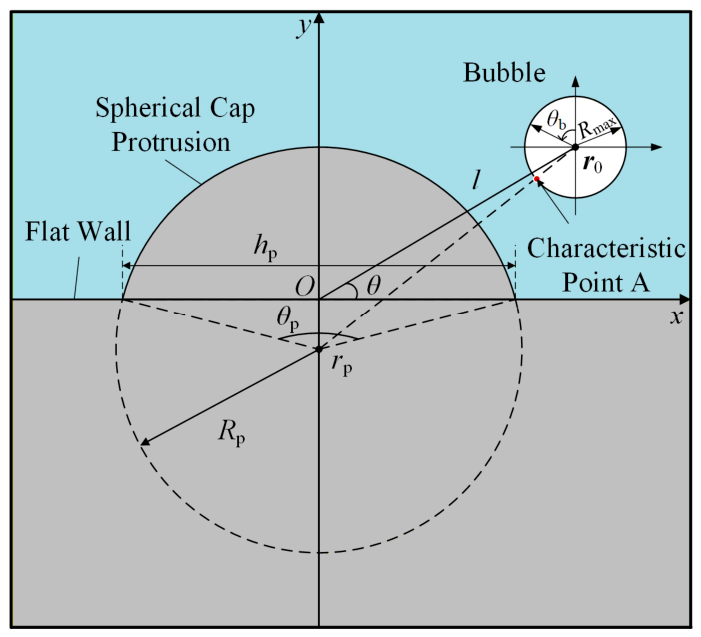
Figure 1 presents a schematic diagram of the physical model of a spherical cap protrusion on a flat wall. The blue and gray regions represent the liquid and the rigid boundary, respectively, while the white circle denotes the cavitation bubble. The midpoint of the chord length of the spherical cap is defined as the origin O. The radius of the parent sphere corresponding to the spherical cap protrusion and the maximum bubble radius are denoted as Rp and Rmax, respectively. The distance between the bubble center and the origin O is l, which is non-dimensionalized as l * = l / R max . The chord length of the spherical cap is hp, with its dimensionless form expressed as h p * = h p / R max . The central angle subtended by the circular arc of the spherical cap is θp, the azimuthal angle of the bubble is θ, and the circumferential angle is θb. The centroid of the parent sphere of the spherical cap protrusion is located at r p = 0 , d , satisfying d = h p / 2 cot θ p / 2 , and the radius of the parent sphere is expressed as R p = h p / 2 csc θ p / 2 . The initial position of the cavitation bubble is r 0 = x 0 , y 0 , and the distance between the centroid of the parent sphere and the bubble centroid is L = x 0 2 + y 0 + h p / 2 cot θ p / 2 2 .
To simplify the theoretical calculation of the flow field during bubble collapse, the following assumptions are adopted:
(1) The liquid is incompressible and its flow is irrotational. The bubble size is considerably smaller than the characteristic scale of the flow field. During collapse, the velocity of the bubble wall motion and the jetting liquid remains substantially lower than the speed of sound in water; therefore, liquid compressibility is neglected. Furthermore, the vorticity generated is extremely weak during bubble collapse; thus, the liquid flow is reasonably approximated as potential flow [34].
(2) The effect of bubble expansion and collapse on the surrounding liquid is equivalently represented as a time-varying point source with spherical symmetry located at a fixed position. Higher-order contributions—such as bubble translation and non-spherical deformation—are omitted, retaining only the dominant role of spherically symmetric bubble oscillation [35].
(3) The resultant external force acting on the bubble is characterized by the Bjerknes force, and the buoyancy force is neglected, as it accounts for less than 1‰ of the total force [36].
Notably, although the incompressible potential flow assumption is applicable to most stages of the bubble collapse process, it is physically limited in the final stage when the jet impacts the wall due to the sharp rise in water hammer pressure. Consequently, the aim of this paper is not to quantitatively analyses the highly non-linear, localized jet velocities observed in the late stages of bubble collapse, but rather to capture the trend of asymmetric collapse and the degree of jet directional deviation.
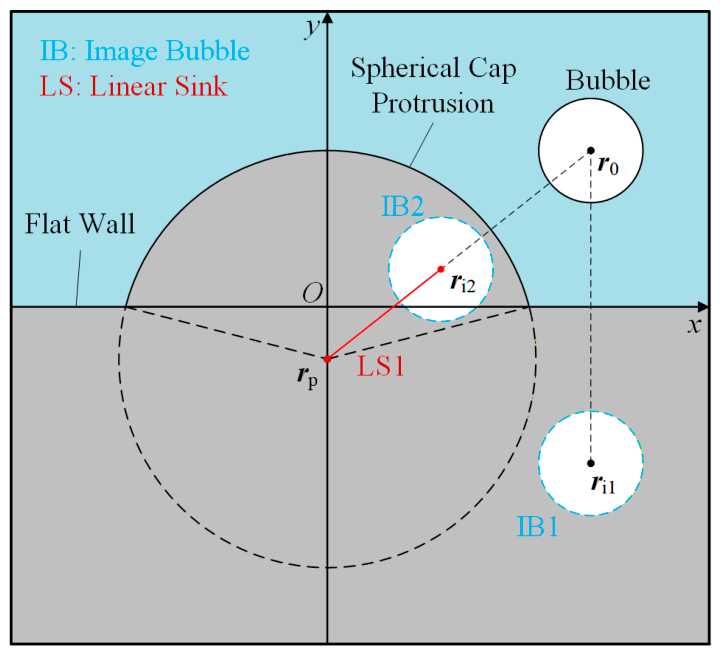
Figure 2 illustrates the boundary treatment for the spherical cap protrusion on a flat wall based on the method of images and the Weiss theorem [35]. As shown, two image bubbles (1 and 2) and one line sink are introduced. The position of image bubble 1 is defined as r i 1 = ( x 0 , y 0 ) , that of image bubble 2 as r i 2 = R p 2 / L 2 x 0 , d + R p 2 / L 2 y 0 d , and the line sink is distributed from r p to r i 2 . The velocity potential of the liquid in the vicinity of the bubble and boundaries is expressed as
Φ = φ + φ add
where
φ = m 4 π 1 | r r 0 |
m = 4 π R 2 R ˙
φ add = φ IB 1 + φ IB 2 + φ LS 1
with
φ IB 1 = m 4 π 1 | r r i 1 |
φ IB 2 = m R p 4 π L 1 | r r i 2 |
φ LS 1 = m 4 π R p 0 R p 2 L d s | r r 0 s L |
U = Φ
Here, φ denotes the velocity potential induced by the cavitation bubble and φ add represents the additional velocity potential contributed jointly by the spherical cap protrusion and the flat wall. The term m is the source intensity, R is the instantaneous bubble radius, and R ˙ is the radial velocity of the bubble wall. r is the distance from a given point in the fluid domain to the bubble centroid. The term φ IB 1 corresponds to the additional velocity potential induced by image bubble 1 (the image of the flat wall), while φ IB 2 and φ LS 1 are the additional velocity potentials induced by image bubble 2 and the line sink, respectively, which together represent the contribution of the spherical cap protrusion. U is the liquid velocity field.
According to previous studies on boundary treatments for walls with hemispherical protrusions [30,31], the coupling effect between the spherical cap protrusion and the flat wall has a negligible influence compared with the individual contributions from the wall and the spherical cap protrusion. Therefore, this coupling term is omitted in the present boundary treatment [30].

2.2. Kelvin Impulse Theory

The Kelvin impulse I represents the time-integrated effect of the Bjerknes force acting on a cavitation bubble during its expansion and collapse phases [37]. A comprehensive derivation of the Kelvin impulse theory can be found in the review literature [35]; here, only the key variables relevant to the present study are introduced. The Kelvin impulse is defined as follows:
I = 4 g ( r 0 ) π ρ 0 T R 4 R ˙ 2 d t
where
g ( r ) = 4 π m φ add
Here, ρ is the fluid density, T is the theoretical duration of the first complete oscillation period of the bubble obtained from the modified R-P equation, and t represents time. In this study, this model is used to characterize the overall tendency of jet orientation and collapse asymmetry, rather than to quantitatively resolve local interface deformation, jet penetration, or bubble–wall contact processes.

3. Experimental System and Procedure

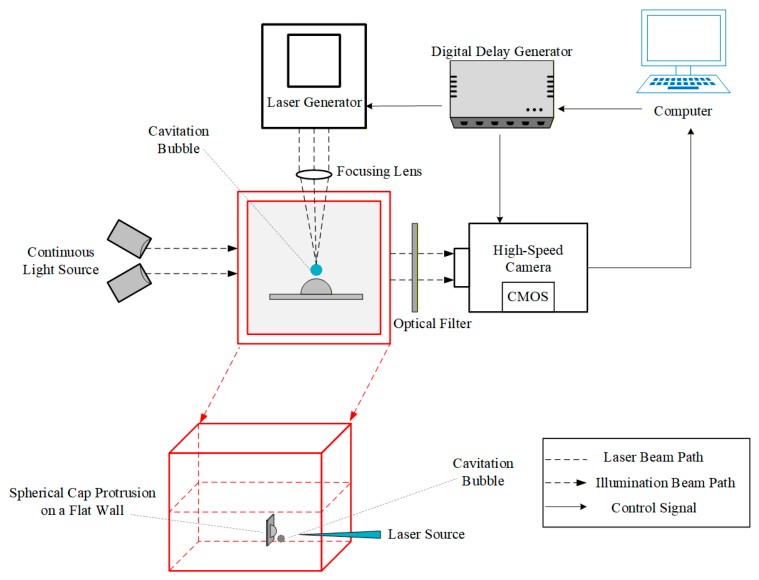
Figure 3 shows a schematic diagram of the experimental system employed to investigate the interaction between a cavitation bubble and a spherical cap protrusion on a flat wall. During the preparatory stage, the tank was filled with deionized water. Subsequently, the LED illumination source and the high-speed camera were activated, and the laser generator was pre-operated for at least five minutes to ensure operational stability. To achieve precise control over the relative positioning of the spherical cap protrusion and the bubble, the experimental model incorporating the flat wall and protrusion was mounted on a three-axis translation stage. At the onset of the experiment, the laser beam emitted from the generator passed through a focusing lens and concentrated onto a preset target location within the water tank. When the laser energy density in the focal region exceeded the breakdown threshold of water, a cavitation bubble was generated at the focus. By adjusting the output voltage of the laser generator and the energy attenuation rate, bubbles with various maximum radii were obtained.
To comprehensively capture the dynamic characteristics of cavitation bubble collapse near the spherical cap protrusion on the flat wall, the high-speed camera was configured with a frame size of 256 × 256 pixels and a frame rate of 100,000 fps. A high-precision three-axis motorized stage regulated the relative position between the bubble and the spherical cap protrusion. During the initial phase of the experiment, it was first confirmed through observation that the bubble and the spherical cap protrusion lay in the same plane. Thereafter, the bubble generation position was fixed. Furthermore, a digital delay generator synchronously controlled the laser generator and the high-speed camera to ensure precise capture of the transient bubble dynamics. All equipment was mounted on a vibration isolation platform to mitigate external disturbances. Table 1 summarizes the main experimental equipment and their corresponding specifications. In particular, the laser generator is the pulsed Nd:YAG laser, with a pulse width of less than 10 ns and the single pulse energy of 50 mJ, which is focused by a 75 mm focal length lens to produce a spot diameter of approximately 0.3 mm. The high-speed camera operates at 75,000 frames with an exposure time of 5 μs, and the image resolution is set to 224 × 270 pixels. The delay generator has a resolution of 5 ps and features four independent channels for precise synchronization of laser triggering and camera acquisition.
To ensure experimental reproducibility, the laser energy was maintained constant throughout each set of experiments, thereby ensuring consistency in the maximum bubble radius Rmax. Accordingly, a preliminary test of laser energy stability was conducted. Prior to each experiment under identical conditions, single cavitation bubbles were induced in a free field by laser irradiation. The voltage and energy attenuation rate were adjusted until the desired maximum bubble radius of Rmax = 1.6 mm was achieved. Once the target bubble size was obtained, bubble generation was repeated at least five times and the average maximum radius was calculated. When the mean error of the maximum bubble radius induced over five consecutive collapses remained within ±0.03 mm, the formal experiment was initiated.
To further verify experimental reproducibility, Table 2 presents the average maximum bubble radii and their fluctuation ranges under various laser energy levels. The error percentage data in the table show that the error in the maximum bubble radius consistently remained below 2%. This indicates that the laser generator employed in this study exhibited satisfactory stability for bubble generation and met the reproducibility requirements of the experiment.

4. Cavitation Bubble Dynamics at the Symmetric Position

4.1. Morphological Evolution of Cavitation Bubbles

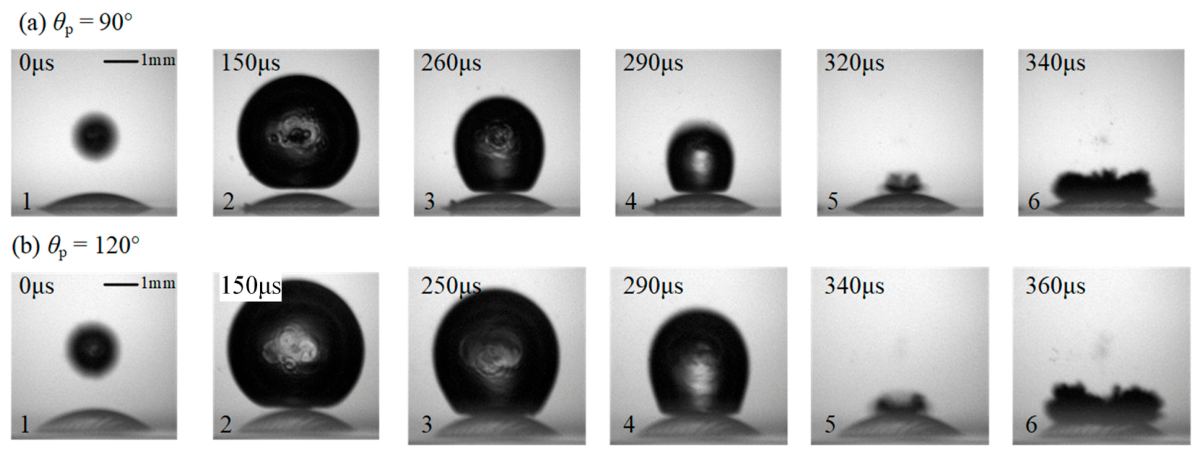
Figure 4 illustrates the morphological evolution of cavitation bubbles under different spherical cap angles θp. Figure 4a and Figure 4b correspond to θp = 90° and 120°, respectively. The first frame captures the initial inception of the bubble, the second frame depicts the bubble at its maximum radius, and frames 3 to 6 document the collapse and rebound process. In Figure 4a, when θp is relatively small, the protrusion exerts only a limited influence on the bubble, and the collapse behavior closely resembles the classic case of a bubble collapsing near a flat wall. During the early stage of collapse, the bubble maintains an approximately spherical shape, which subsequently transitions into an ellipsoidal form. The lower boundary of the bubble consistently remains at a distinct distance from the spherical cap protrusion without direct contact. At the fourth frame (t = 290 μs), a depression forms on the upper part of the bubble and develops into a jet, which ultimately impinges on the wall surface [38]. In Figure 4b, when θp is relatively large, the influence of the protrusion on the bubble becomes enhanced. During collapse, the bubble exhibits morphological evolution patterns analogous to those observed near particulate structures. At the third frame (t = 250 μs), a necking depression emerges at the contact region between the bubble and the protrusion. Subsequently, the bubble adheres to the protrusion surface and eventually collapses and rebounds upon it. The overall collapse morphology resembles the typical “pear-shaped” configuration characteristic of bubble collapse near spherical particles. It features the distinctive “neck structure” commonly associated with such scenarios [39].

4.2. Flow Field and Bubble Wall Collapse Velocity

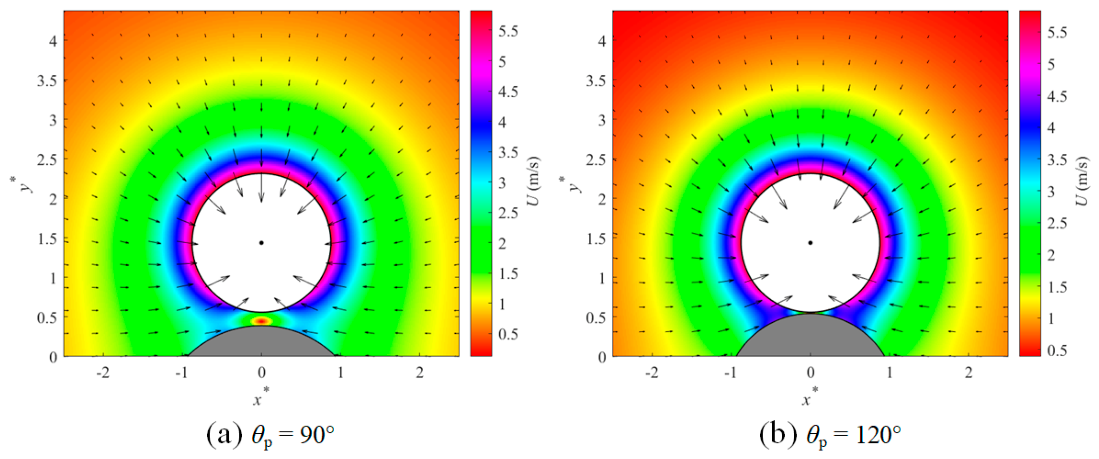
Figure 5 presents the velocity distribution of the surrounding liquid at a representative instant t* = 0.75 during bubble collapse. t* = 0.75 corresponds to the critical moment when the bubble is about to evolve from the spherical to the non-spherical shape. The velocity distribution is theoretically calculated from the velocity potential model in Section 2.1. Figure 5a and Figure 5b correspond to θp = 90° and θp = 120°, respectively. The white circular region denotes the cavitation bubble, while the gray region represents the spherical cap protrusion. As Figure 5 shows, a distinct low-velocity zone appears at the apex of the spherical cap protrusion. In Figure 5a, when θp is relatively small, the separation distance between the bubble and the protrusion apex is larger. Although the low-velocity zone affects the liquid velocity near the lower bubble wall, this influence remains limited. In Figure 5b, when θp is relatively large, the distance between the bubble and the protrusion apex decreases, thereby enhancing the effect of the low-velocity zone on the liquid velocity adjacent to the lower bubble wall. Consequently, the disparity in liquid velocity between the upper and lower regions of the bubble becomes more pronounced. As the spherical cap angle increases, the asymmetry of bubble collapse is further exacerbated, and the downward collapse velocity of the bubble increases. The comparison between Figure 5a and Figure 5b demonstrates that the observed differences in flow field distribution match the collapse behaviors recorded in the time-sequence images.
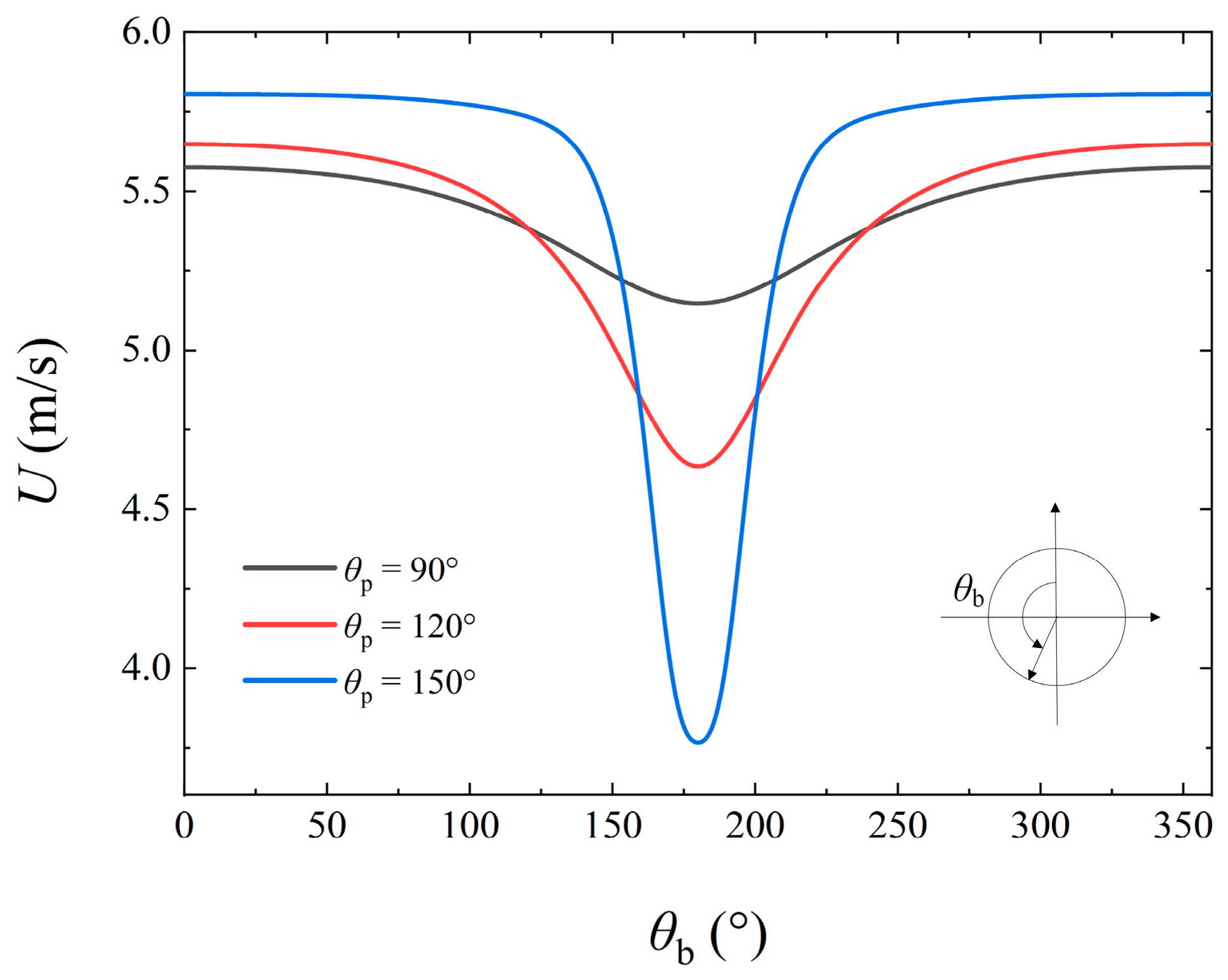
Figure 6 depicts the circumferential distribution of the bubble wall collapse velocity U under various spherical cap angles, θp, computed from the theoretical model described in Section 2.1. As illustrated, the bubble wall collapse velocity U exhibits a symmetric distribution pattern: it initially decreases and subsequently increases along the circumferential angle θb. Specifically, as θb increases from 0° to 180°, the velocity U decreases, reaching a minimum at θb = 180° (the lower pole of the bubble). Thereafter, as θb progresses from 180° to 360°, the velocity U increases. Furthermore, with increasing spherical cap angle θp, the inhibitory effect of the protrusion on the bubble wall collapse velocity becomes more pronounced: the velocity at the bubble lower pole diminishes, and the degree of bubble non-sphericity correspondingly increases. In contrast, velocity at other circumferential positions remains largely unaffected by the change in θp.
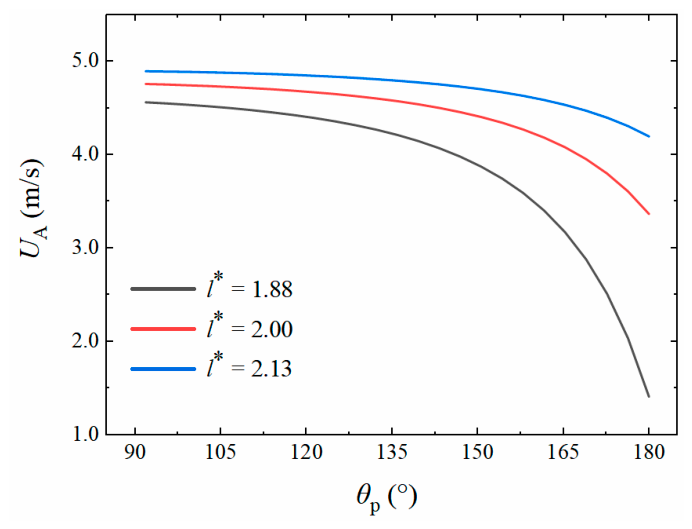
Figure 7 shows the variation in the velocity at the characteristic point A, denoted as UA, as a function of the spherical cap angle θp under different dimensionless stand-off distances, l*. In this study, characteristic point A is defined as the intersection of the bubble wall with the line connecting the bubble centroid and the origin O. Thus, point A lies directly above the apex of the protrusion. This point is selected because it is most sensitive to changes in the protrusion geometry. As θp increases, UA exhibits a monotonically decreasing trend, with a more pronounced rate of decline at larger θp. For instance, at l* = 1.88, UA decreases from 4.5 m/s to 1.4 m/s as θp increases from 90° to 180°. Moreover, as the dimensionless distance l* increases, the influence of the protrusion on characteristic point A weakens. Consequently, UA increases overall, and its sensitivity to variations in θp diminishes.

4.3. Kelvin Impulse Characteristics

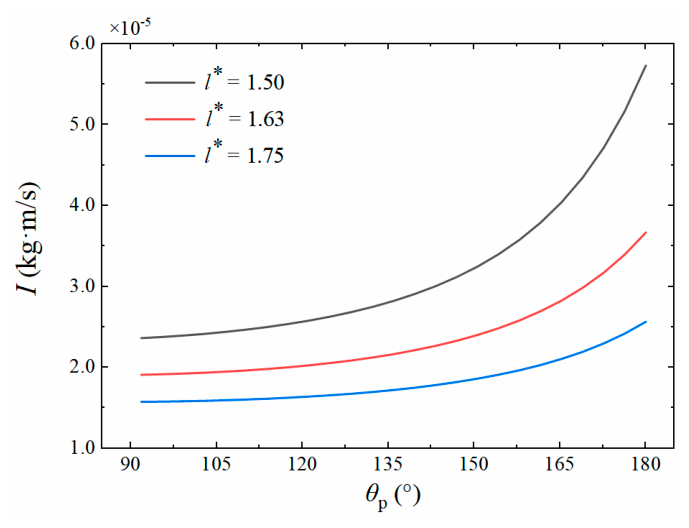
Figure 8 illustrates the variation in the Kelvin impulse magnitude I as a function of the spherical cap angle θp near the protrusion on a flat wall, under different dimensionless stand-off distances, l*. With increasing θp, the Kelvin impulse magnitude I exhibits an accelerating growth trend under the combined influence of the protrusion and the flat wall. Taking l* = 1.50 as an example, the impulse magnitude I increases from 2.25 × 10⁻⁵ kg·m/s to 5.75 × 10⁻⁵ kg·m/s as θp increases from 90° to 180°. This trend is primarily attributed to the exacerbated collapse asymmetry and the enhanced focusing of the downward jet, both induced by the larger θp. Furthermore, as l* increases, the overall impulse magnitude I decreases, and its growth rate with respect to θp decreases correspondingly. At larger dimensionless stand-off distances, l*, the influence of the protrusion on the bubble weakens, causing the collapse morphology to become more spherical. Consequently, the total impulse I is reduced, and its sensitivity to variations in the spherical cap angle θp diminishes.

5. Cavitation Bubble Dynamics at the Asymmetric Position

5.1. Morphological Evolution of Cavitation Bubbles

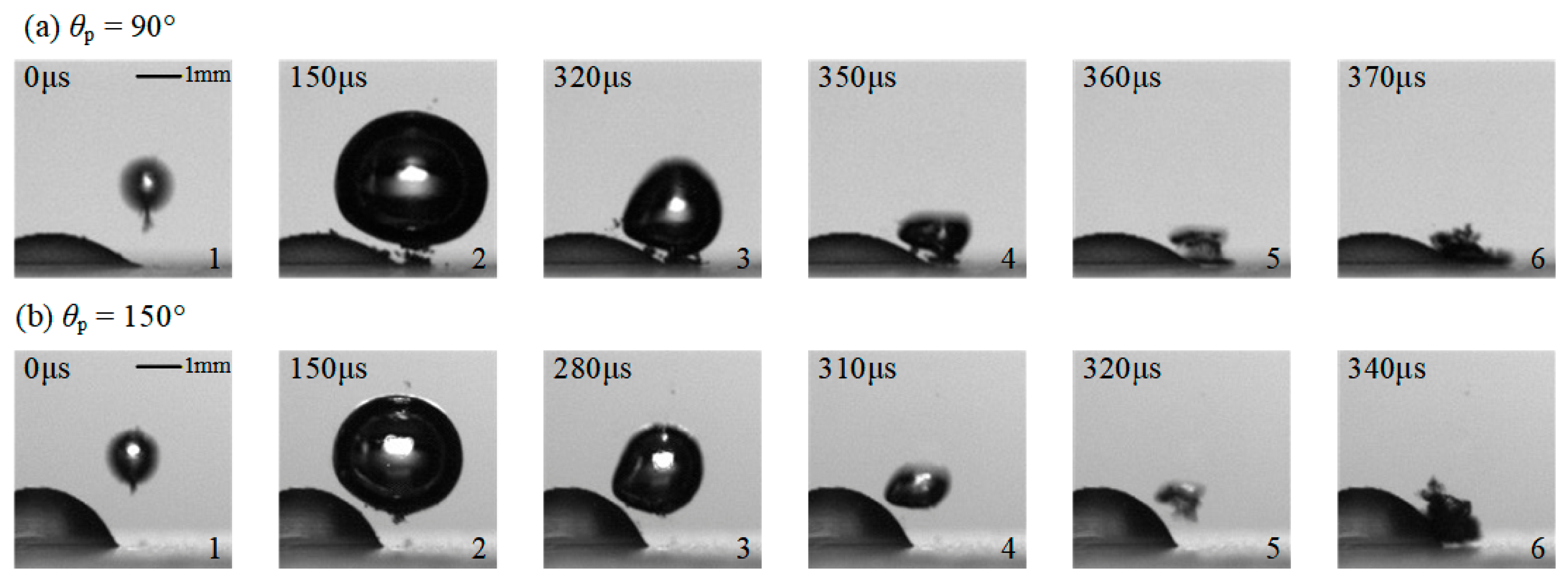
Figure 9 presents the morphological evolution of cavitation bubbles during collapse under a fixed azimuthal angle θ = 45° for different spherical cap angles θp. Figure 9a and Figure 9b correspond to θp = 90° and 150°, respectively. The first frame shows bubble inception, the second frame captures the instant of maximum bubble radius, and frames 3 through 6 document the collapse and rebound process. When θp is relatively small, as Figure 9a shows, the flat wall dominates the collapse process, and the protrusion exerts only a weak influence. The bubble migrates toward the wall as a whole. The effect of the protrusion manifests primarily as a certain degree of non-spherical deformation during bubble collapse. In the third frame, for instance, the lower left region of the bubble wall undergoes stretching. At the final stage of collapse, a jet oriented vertically toward the wall forms and penetrates the bubble.
In contrast, when θp is large, as Figure 9b shows, the protrusion plays a dominant role in the bubble collapse process. During collapse, the contraction velocity of the lower left bubble wall is suppressed, leading to a pronounced enhancement of non-spherical deformation. Toward the end of the collapse phase, the protrusion further influences the direction of jet development. As observed between t = 320 and 340 μs, the jet is no longer oriented perpendicular to the wall. Instead, its direction shifts toward the protrusion. Ultimately, the bubble remains attached to the protrusion surface, collapses, and undergoes rebound.

5.2. Flow Field and Bubble Wall Collapse Velocity

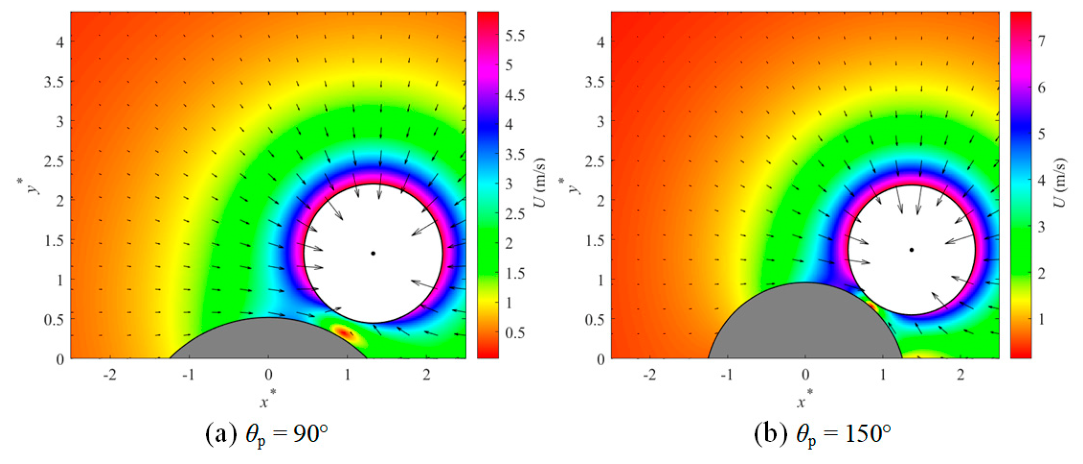
Figure 10 illustrates the velocity distribution of the surrounding liquid at a representative instant t* = 0.75 during cavitation bubble collapse at an asymmetric position. t* = 0.75 corresponds to the critical moment when the bubble is about to evolve from the spherical to the non-spherical shape. The velocity distribution is obtained from the theoretical model described in Section 2.1. Figure 10a and Figure 10b correspond to spherical cap angles θp = 90° and 150°, respectively. The white circular region denotes the cavitation bubble, while the gray region represents the spherical cap protrusion. In both cases, a distinct low-velocity zone appears in the interfacial region between the spherical cap protrusion and the lower portion of the bubble. Notably, the spherical cap angle θp significantly regulates both the location and the spatial extent of this low-velocity zone. At smaller θp, the low-velocity zone lies nearly directly beneath the bubble, and its interference with the bubble-induced flow field remains limited. At larger θp, however, the low-velocity zone shifts toward the lower left region of the bubble. The enhanced influence of the protrusion on the bubble amplifies the disparity in liquid velocity around the bubble periphery. This in turn induces more severe non-spherical deformation.
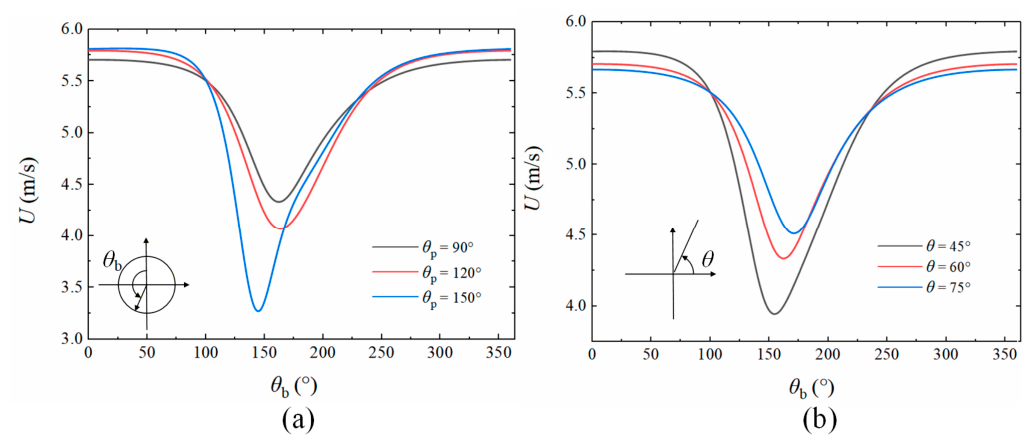
Figure 11 presents the circumferential distribution of the bubble wall collapse velocity U, computed from the theoretical model described in Section 2.1. Overall, the collapse velocity U along the circumferential angle θb exhibits a pattern of first decreasing and then increasing. Figure 11a compares the velocity distributions under different spherical cap angles θp at a fixed azimuthal angle θ = 45°. As θp increases, the disparity in the bubble wall collapse velocity distribution becomes more pronounced and the minimum velocity value decreases. Furthermore, the circumferential angle θb corresponding to this minimum velocity decreases. These observations indicate that the inhibitory effect of the protrusion on bubble wall collapse velocity intensifies. The asymmetry of bubble collapse is further exacerbated, and the location of the minimum velocity point shifts from the lower pole of the bubble toward its left side. Figure 11b shows the velocity distribution under a fixed spherical cap angle θp = 120° for various azimuthal angles θ. With increasing θ, the disparity in the bubble wall collapse velocity distribution diminishes, while the minimum velocity value increases. Concurrently, the circumferential angle θb corresponding to the minimum velocity increases. As the azimuthal angle θ increases, the bubble positions itself closer to the region directly above the flat wall, and the influence of the protrusion weakens. Consequently, the asymmetry of bubble collapse reduces, and the minimum velocity point migrates from the left side of the bubble toward the lower pole.
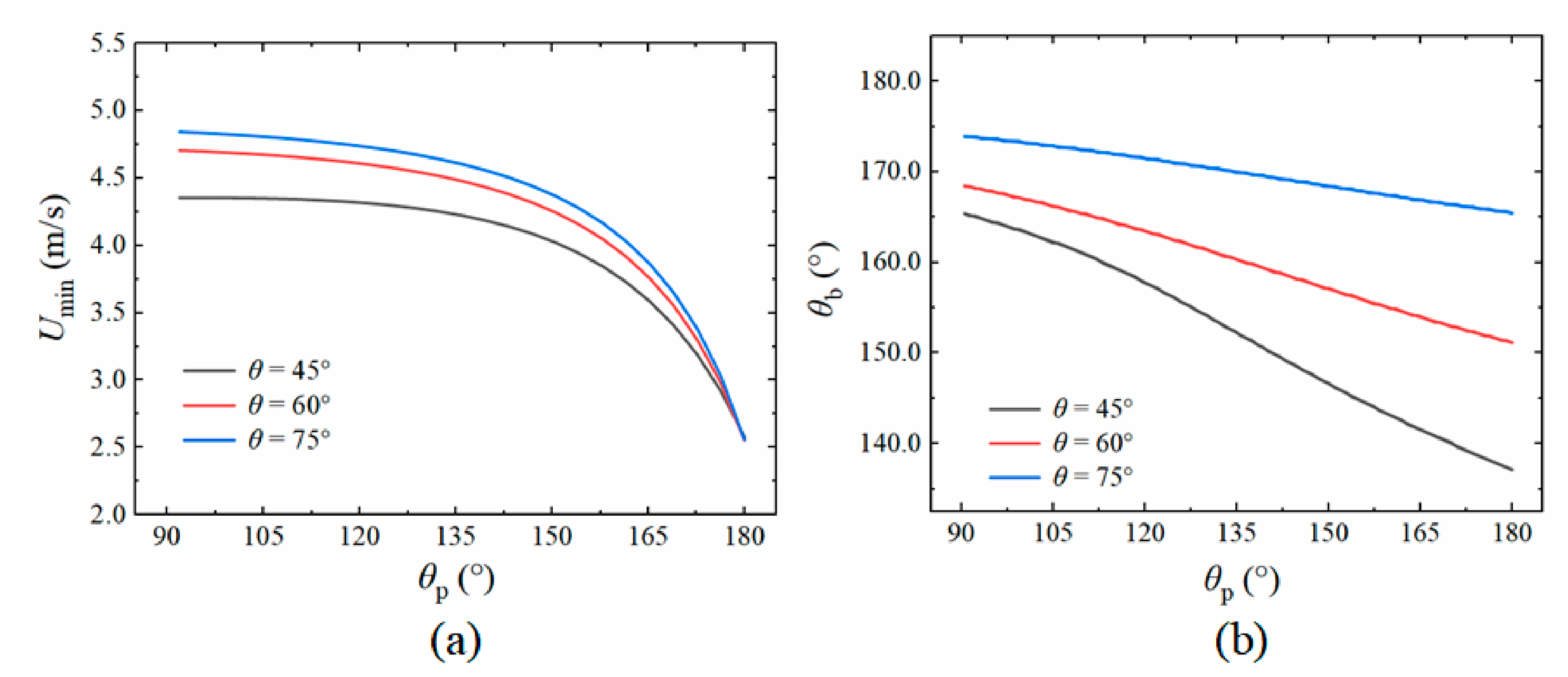
Figure 12 depicts the variation in the minimum bubble wall collapse velocity Umin and its corresponding circumferential angle, θb, as functions of the spherical cap angle θp, computed from the theoretical model described in Section 2.1. Figure 12a exhibits that as the spherical cap angle θp increases, the minimum bubble wall collapse velocity Umin decreases under all bubble orientation angles θ. For instance, at θ = 45°, Umin decreases from 4.25 m/s to 2.5 m/s as θp increases from 90° to 180°. The disparities among the curves diminish, and the values converge substantially at θp = 180°. This finding suggests that when the spherical cap approaches a complete hemisphere, the azimuthal angle no longer influences the minimum velocity Umin. Figure 12b shows that as θp increases, the circumferential angle θb corresponding to Umin consistently decreases. Taking the same case of θ = 45° as an example, θb diminishes from 165° to 136° when θp increases from 90° to 180°. This trend indicates that the inhibitory effect of the protrusion boundary on bubble wall collapse velocity intensifies with increasing θp. Consequently, the asymmetry of bubble collapse is exacerbated, and the minimum velocity point migrates from the lower bubble wall toward the lower left region.

5.3. Kelvin Impulse Characteristics

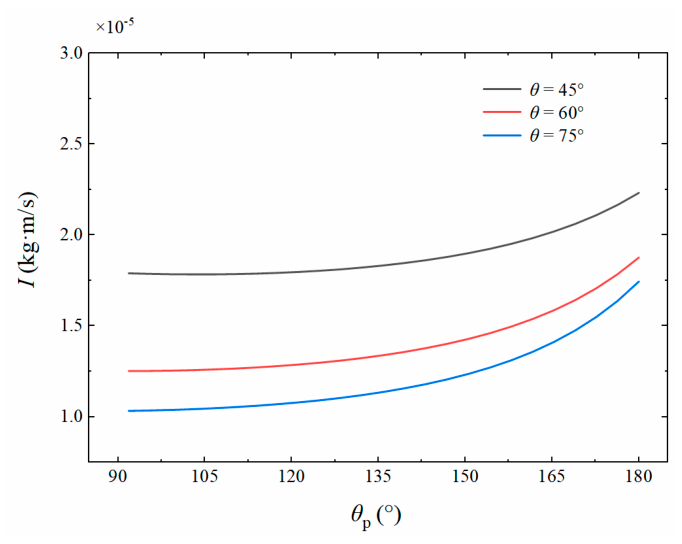
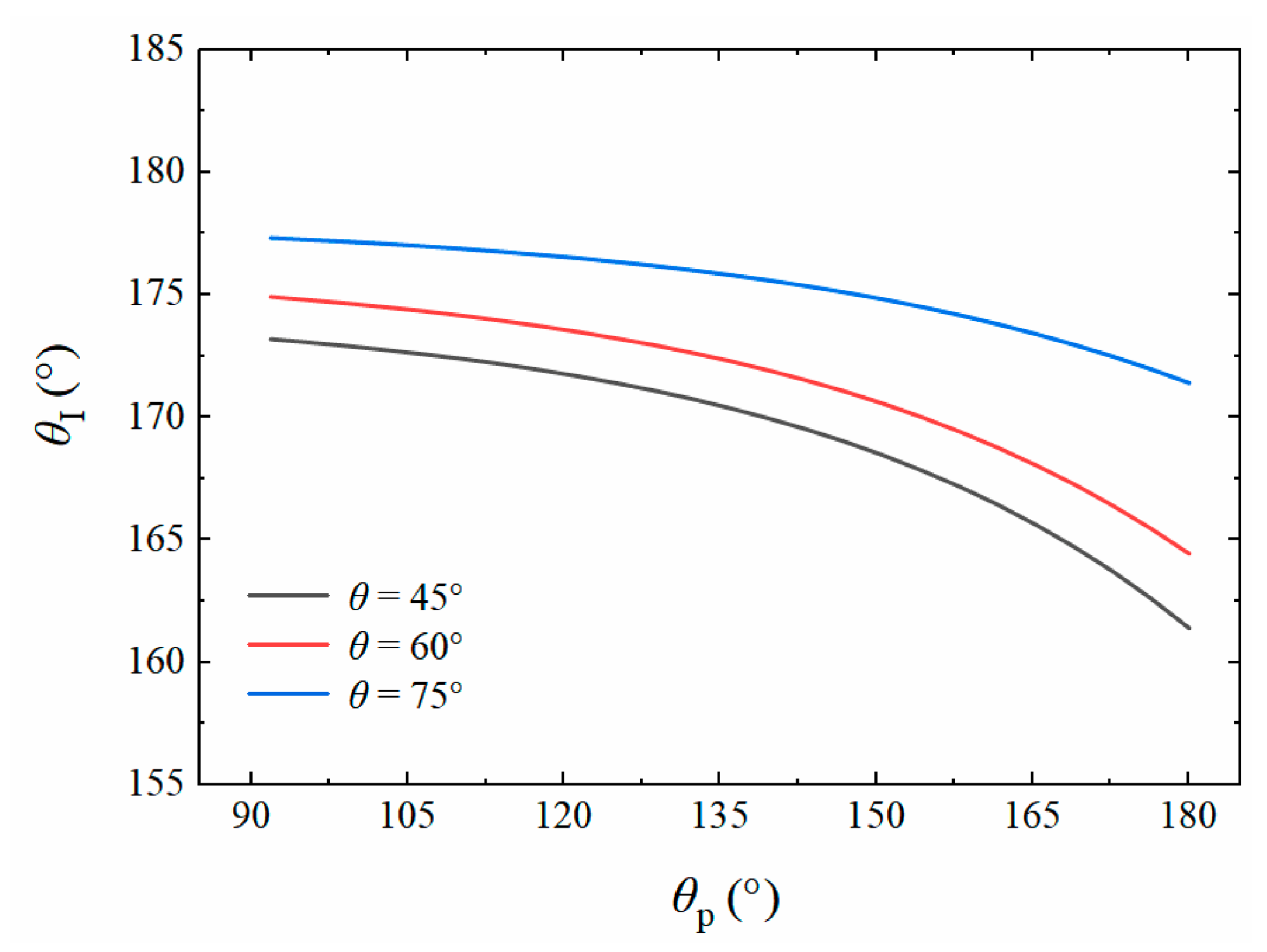
Figure 13 and Figure 14 illustrate the variation in the Kelvin impulse magnitude I and direction θI with spherical cap angle θp at asymmetric positions under different bubble azimuthal angles, θ. As Figure 13 shows, the impulse magnitude I increases monotonically with θp. Moreover, larger θ corresponds to a weaker influence of the protrusion on the bubble. Taking θ = 45° as an example, the impulse magnitude I increases from 1.75 × 10⁻⁵ kg·m/s to 2.25 × 10⁻⁵ kg·m/s as θp increases from 90° to 180°. Figure 14 exhibits that the Kelvin impulse direction angle θI decreases continuously with increasing θp. For the same case of θ = 45°, θI diminishes from 172.5° to 160.5° when θp increases from 90° to 180°. This trend indicates that the Kelvin impulse shifts—from vertically downward toward the wall to the left side of the spherical cap protrusion. This transition reflects a shift in the dominant mechanism governing the Kelvin impulse from the flat wall to the protrusion structure.

6. Conclusions

This study investigated the collapse dynamics of cavitation bubbles at symmetric and asymmetric positions near a spherical cap protrusion on a flat wall. The influence of the spherical cap θp and the bubble azimuthal angle θ on the bubble collapse process was systematically clarified. The dominant role of the boundary was interpreted, and a theoretical explanation based on the Kelvin impulse was proposed. The following main conclusions are drawn:
(1) When the bubble positions itself symmetrically, an increase in the spherical cap angle θp causes the protrusion to influence the bubble more strongly. The non-spherical collapse becomes more pronounced, and the collapse mode transitions from flat-wall-dominated behavior to a pattern resembling that observed near spherical particles.
(2) At asymmetric bubble positions, the spherical cap angle θp inhibits the bubble wall collapse velocity. As θp increases, the disparity in the bubble wall collapse velocity distribution becomes more pronounced. Taking the case of θ = 45° as an example, when θp increases from 90° to 180°, the minimum collapse velocity Umin decreases from 4.25 m/s to 2.5 m/s, and the circumferential angle θb diminishes from 165° to 136°.
(3) Under asymmetric positioning, the magnitude of the Kelvin impulse acting on the bubble increases with increasing spherical cap angle θp. Furthermore, as θp increases, the spherical cap protrusion exerts an increasingly dominant effect on the Kelvin impulse. Under the competitive interaction between the protrusion and the flat wall, the Kelvin impulse direction shifts from approximately perpendicular to the flat wall toward the spherical cap protrusion.
This study has shown that by adjusting the geometric parameters of the spherical cap protrusion, such as the spherical cap angle, it is possible to modulate the direction and intensity of the jet, thereby reducing localized erosion damage or redirecting the jet impact to non-critical areas. These findings provide guidance for the control of cavitation erosion in hydraulic machinery and are of significance for cavitation protection in fluid machinery.

Author Contributions

Conceptualization, J.Z. (Jiang Zhao), X.W. and Y.Z. (Yuning Zhang 1); methodology, M.Q., J.Z. (Jian Zhou) and J.H.; supervision, Y.Z. (Yuning Zhang 1), Y.Z. (Yuning Zhang 2) and X.Q.; project administration, Y.Z. (Yuning Zhang 1) and X.W.; funding acquisition, X.W.; software, J.H.; validation, M.Q., J.Z. (Jian Zhou) and J.Z. (Jiang Zhao); formal analysis, M.Q. and J.Z. (Jiang Zhao); writing—original draft, M.Q., Y.Z. (Yuning Zhang 2), and J.Z. (Jiang Zhao); writing—review and editing, X.W., Y.Z. (Yuning Zhang 1) and X.Q.; visualization, M.Q., J.Z. (Jiang Zhao) and J.Z. (Jian Zhou). All authors have read and agreed to the published version of the manuscript.

Funding

This work was financially supported by the National Natural Science Foundation of China (52506046), the Fundamental Research Funds for the Central Universities (2025MS015), the China Postdoctoral Science Foundation under Grant Number 2025M770612, and the Postdoctoral Fellowship Program of CPSF under Grant Number GZC20240466.

Data Availability Statement

The original contributions presented in this study are included in the article. Further inquiries can be directed to the corresponding author.

Conflicts of Interest

Author Xu Qiu is employed by the company China Atomic Energy Publishing & Media Company Limited. The remaining authors declare that the research was conducted in the absence of any commercial or financial relationships that could be construed as a potential conflict of interest.

References

  1. Sreedhar, B.; Albert, S.a.; Pandit, A. Cavitation damage: Theory and measurements–A review. Wear 2017, 372, 177–196. [Google Scholar] [CrossRef]
  2. Dular, M.; Bachert, B.; Stoffel, B.; Širok, B. Relationship between cavitation structures and cavitation damage. Wear 2004, 257, 1176–1184. [Google Scholar] [CrossRef]
  3. Knapp, R.T. Recent investigations of the mechanics of cavitation and cavitation damage. Trans. Am. Soc. Mech. Eng. 1955, 77, 1045–1054. [Google Scholar] [CrossRef]
  4. Plesset, M.; Ellis, A. On the mechanism of cavitation damage. Trans. Am. Soc. Mech. Eng. 1955, 77, 1055–1064. [Google Scholar] [CrossRef]
  5. Gonzalez-Avila, S.R.; van Blokland, A.C.; Zeng, Q.; Ohl, C.-D. Cavitation bubble collapse and wall shear stress generated in a narrow gap. In Proceedings of the 10th International Symposium on Cavitation (CAV2018), Baltimore, MD, USA, 14–16 May 2018. [Google Scholar]
  6. Hsiao, C.-T.; Choi, J.-K.; Singh, S.; Chahine, G.; Hay, T.A.; Ilinskii, Y.A.; Zabolotskaya, E.; Hamilton, M.F.; Sankin, G.; Yuan, F. Modelling single-and tandem-bubble dynamics between two parallel plates for biomedical applications. J. Fluid Mech. 2013, 716, 137–170. [Google Scholar] [CrossRef]
  7. Yuan, F.; Yang, C.; Zhong, P. Cell membrane deformation and bioeffects produced by tandem bubble-induced jetting flow. Proc. Natl. Acad. Sci. USA 2015, 112, E7039–E7047. [Google Scholar] [CrossRef] [PubMed]
  8. Mohammadzadeh, M.; Li, F.; Ohl, C.-D. Shearing flow from transient bubble oscillations in narrow gaps. Phys. Rev. Fluids 2017, 2, 014301. [Google Scholar] [CrossRef]
  9. Yuan, F.; Sankin, G.; Zhong, P. Dynamics of tandem bubble interaction in a microfluidic channel. J. Acoust. Soc. Am. 2011, 130, 3339–3346. [Google Scholar] [CrossRef]
  10. Li, Z.; Xu, Z.; Ma, L.; Wang, S.; Liu, X.; Yan, J. Cavitation at filler metal/substrate interface during ultrasonic-assisted soldering. Part I: Cavitation characteristics. Ultrason. Sonochem. 2018, 49, 249–259. [Google Scholar] [CrossRef]
  11. Benjamin, T.B.; Ellis, A.T. The collapse of cavitation bubbles and the pressures thereby produced against solid boundaries. Philos. Trans. R. Soc. London Ser. A Math. Phys. Sci. 1966, 260, 221–240. [Google Scholar]
  12. Li, X.; Duan, Y.; Zhang, Y.; Tang, N.; Zhang, Y. Retardant effects of collapsing dynamics of a laser-induced cavitation bubble near a solid wall. Symmetry 2019, 11, 1051. [Google Scholar] [CrossRef]
  13. Reuter, F.; Zeng, Q.; Ohl, C.-D. The Rayleigh prolongation factor at small bubble to wall stand-off distances. J. Fluid Mech. 2022, 944, A11. [Google Scholar] [CrossRef]
  14. Zhang, A.; Yao, X.; Feng, L. The dynamic behavior of a gas bubble near a wall. Ocean Eng. 2009, 36, 295–305. [Google Scholar] [CrossRef]
  15. Li, S.; Li, Y.-b.; Zhang, A.-m. Numerical analysis of the bubble jet impact on a rigid wall. Appl. Ocean Res. 2015, 50, 227–236. [Google Scholar] [CrossRef]
  16. Luo, J.; Xu, W.; Deng, J.; Zhai, Y.; Zhang, Q. Experimental study on the impact characteristics of cavitation bubble collapse on a wall. Water 2018, 10, 1262. [Google Scholar] [CrossRef]
  17. Yang, Y.X.; Wang, Q.X.; Keat, T. Dynamic features of a laser-induced cavitation bubble near a solid boundary. Ultrason. Sonochem. 2013, 20, 1098–1103. [Google Scholar] [CrossRef] [PubMed]
  18. Cui, R.-N.; Li, S.; Wang, S.-P.; Zhang, A.-M. Pulsating bubbles dynamics near a concave surface. Ocean Eng. 2022, 250, 110989. [Google Scholar] [CrossRef]
  19. Shervani-Tabar, M.; Rouhollahi, R. Numerical study on the effect of the concave rigid boundaries on the cavitation intensity. Sci. Iran. Trans. B Mech. Eng. 2017, 24, 1958–1965. [Google Scholar] [CrossRef][Green Version]
  20. Liu, Y.; Peng, Y. Study on the collapse process of cavitation bubbles near the concave wall by lattice Boltzmann method pseudo-potential model. Energies 2020, 13, 4398. [Google Scholar] [CrossRef]
  21. Trummler, T.; Bryngelson, S.H.; Schmidmayer, K.; Schmidt, S.J.; Colonius, T.; Adams, N.A. Near-surface dynamics of a gas bubble collapsing above a crevice. J. Fluid Mech. 2020, 899, A16. [Google Scholar] [CrossRef]
  22. Andrews, E.D.; Rivas, D.F.; Peters, I.R. Cavity collapse near slot geometries. J. Fluid Mech. 2020, 901, A29. [Google Scholar] [CrossRef]
  23. Andrews, E.D.; Peters, I.R. Modeling bubble collapse anisotropy in complex geometries. Phys. Rev. Fluids 2022, 7, 123601. [Google Scholar] [CrossRef]
  24. Takahira, H.; Fujikawa, S.; Akamatsu, T. Collapse motion of a single gas bubble near a plane or curved rigid wall. Trans. Jpn. Soc. Mech. Eng. 1989, 55, 2720–2728. [Google Scholar] [CrossRef]
  25. Tomita, Y.; Robinson, P.; Tong, R.; Blake, J. Growth and collapse of cavitation bubbles near a curved rigid boundary. J. Fluid Mech. 2002, 466, 259–283. [Google Scholar] [CrossRef]
  26. Aganin, A.; Kosolapova, L.; Malakhov, V. Bubble dynamics near a locally curved region of a plane rigid wall. Phys. Fluids 2022, 34, 097105. [Google Scholar] [CrossRef]
  27. Zheng, X.; Wang, X.; Lu, X.; Zhang, Y.; Zhang, Y.; Yu, J. An experimental study of cavitation bubble dynamics near a complex wall with a continuous triangular arrangement. Symmetry 2023, 15, 693. [Google Scholar] [CrossRef]
  28. Li, B.-B.; Jia, W.; Zhang, H.-C.; Lu, J. Investigation on the collapse behavior of a cavitation bubble near a conical rigid boundary. Shock Waves 2014, 24, 317–324. [Google Scholar] [CrossRef]
  29. Kim, D.; Kim, D. Underwater bubble collapse on a ridge-patterned structure. Phys. Fluids 2020, 32, 053312. [Google Scholar] [CrossRef]
  30. Wang, X.; Zhang, C.; Shen, J.; Zhang, Y.; Xi, X. Influence of a hemispherical bulge on a flat wall upon the collapse jet of cavitation bubbles. Phys. Fluids 2024, 36, 033302. [Google Scholar] [CrossRef]
  31. Wang, X.; Hu, S.; Wang, Y.; Guo, Z.; Zhang, Y. Collapse dynamics of a single cavitation bubble in proximity to a wall with two protrusions. Phys. Fluids 2025, 37, 063334. [Google Scholar] [CrossRef]
  32. Mishra, A.; Garva, A.; Roy, A.; Lakkaraju, R.; Ghosh, P. Effect of over-pressure on the dynamics of interacting cavitation bubbles near curved surfaces in sub-cooled liquid nitrogen. Phys. Fluids 2024, 36, 087161. [Google Scholar] [CrossRef]
  33. Zhao, J.; Bai, P.; Wang, J.; Wang, Y.; Cao, S. Dynamics of bubble collapse near rigid boundaries with different curvatures. Phys. Fluids 2025, 37, 033302. [Google Scholar] [CrossRef]
  34. Ren, Z.; Han, H.; Zeng, H.; Sun, C.; Tagawa, Y.; Zuo, Z.; Liu, S. Interactions of a collapsing laser-induced cavitation bubble with a hemispherical droplet attached to a rigid boundary. J. Fluid Mech. 2023, 976, A11. [Google Scholar] [CrossRef]
  35. Best, J.; Blake, J. An estimate of the Kelvin impulse of a transient cavity. J. Fluid Mech. 1994, 261, 75–93. [Google Scholar] [CrossRef]
  36. Wang, X.; Wu, G.; Shen, J.; Sun, Z.; Zhang, Y.; Zhang, L. Research on the collapse dynamics of a restricted cavitation bubble near a right-angle wall based on Kelvin impulse theory. Phys. Fluids 2023, 35, 073335. [Google Scholar] [CrossRef]
  37. Poulain, S.; Guenoun, G.; Gart, S.; Crowe, W.; Jung, S. Particle motion induced by bubble cavitation. Phys. Rev. Lett. 2015, 114, 214501. [Google Scholar] [CrossRef]
  38. Sun, Y.; Du, Y.; Yao, Z.; Zhong, Q.; Geng, S.; Wang, F. The effect of surface geometry of solid wall on the collapse of a cavitation bubble. J. Fluids Eng. 2022, 144, 071402. [Google Scholar] [CrossRef]
  39. Wang, X.; Wu, G.; Zheng, X.; Du, X.; Zhang, Y. Theoretical investigation and experimental support for the cavitation bubble dynamics near a spherical particle based on Weiss theorem and Kelvin impulse. Ultrason. Sonochem. 2022, 89, 106130. [Google Scholar] [CrossRef]
Figure 1. Schematic diagram of the physical model of a spherical cap protrusion on a flat wall. The grey area represents the interior of the wall, while the blue area represents the liquid region.
Symmetry 18 00798 g001
Figure 2. Schematic diagram of the boundary treatment for a spherical cap protrusion on a flat wall. The grey area represents the interior of the wall, while the blue area represents the liquid region.
Symmetry 18 00798 g002
Figure 3. Schematic diagram of the high-speed photography experimental system.
Symmetry 18 00798 g003
Figure 4. Typical dynamic behavior of cavitation bubbles under different spherical cap angles, θp. (a) θp = 90°. (b) θp = 120°. l* = 1.44. hp* = 1.88.
Symmetry 18 00798 g004
Figure 5. Liquid velocity distribution around the bubble at different spherical cap angles, θp. (a) θp = 90°. (b) θp = 120°. l* = 1.44. hp* = 1.88. x* and y* are the dimensionless position coordinates x and y, which are normalized by Rmax. The arrows indicate the direction vectors of the liquid velocity.
Symmetry 18 00798 g005
Figure 6. Circumferential distribution of bubble wall collapse velocity U at different spherical cap angles, θp. l* = 1.44. hp* = 1.88.
Symmetry 18 00798 g006
Figure 7. Variation in bubble wall collapse velocity at characteristic point A, UA, with spherical cap angle, θp, under different dimensionless stand-off distances. hp* = 1.88.
Symmetry 18 00798 g007
Figure 8. Variation in Kelvin impulse magnitude I with spherical cap angle, θp, at different dimensionless stand-off distances, l*. hp* = 1.88.
Symmetry 18 00798 g008
Figure 9. Typical dynamic behavior of cavitation bubbles at different spherical cap angles, θp. (a) θp = 90°. (b) θp = 150°. l* = 1.88. hp* = 2.5.
Symmetry 18 00798 g009
Figure 10. Liquid velocity distribution around the bubble at different spherical cap angles, θp. (a) θp = 90°. (b) θp = 150°. l* = 1.88. hp* = 2.5. x* and y* are the dimensionless position coordinates x and y, which are normalized by Rmax. The arrows indicate the direction vectors of the liquid velocity.
Symmetry 18 00798 g010
Figure 11. Circumferential distribution of bubble wall collapse velocity, U. (a) θ = 45°. (b) θp = 120°. l* = 2.13. hp* = 2.5.
Symmetry 18 00798 g011
Figure 12. Variation in the minimum bubble wall collapse velocity Umin and its corresponding circumferential angle θb with spherical cap angle θp. (a) Variation in Umin. (b) Variation in θb. l* = 2.25. hp* = 2.5.
Symmetry 18 00798 g012
Figure 13. Variation in the Kelvin impulse magnitude I with spherical cap angle θp at different bubble orientation angles θ. l* = 2.25.
Symmetry 18 00798 g013
Figure 14. Variation in the Kelvin impulse direction θI with spherical cap angle θp at different bubble orientation angles θ. l* = 2.25.
Symmetry 18 00798 g014
Table 1. Specifications of experimental equipment.
EquipmentModel and Specifications
Laser GeneratorPenny-100-S (Anshan ZY Laser Technology Co., Ltd., Anshan, China)
Laser energy: 0–30 mJ
High-Speed CameraPhantom v1212 (AMETEK, Inc., Wayne, NJ, USA)
Frame interval: 10 µs
Image resolution: 256 × 256 pix
Focusing LensLMH-10X532
Water TankMaterial: acrylic glass
Three-Axis StageKQ-100DE
Digital Delay GeneratorZKG027
Continuous Light SourceX33000WS
Table 2. Error analysis of the maximum bubble radius.
No.Rmax (mm)Error Percentage
11.36 ± 0.021.47%
21.45 ± 0.010.69%
31.54 ± 0.031.95%
41.63 ± 0.031.84%
51.72 ± 0.021.16%
Disclaimer/Publisher’s Note: The statements, opinions and data contained in all publications are solely those of the individual author(s) and contributor(s) and not of MDPI and/or the editor(s). MDPI and/or the editor(s) disclaim responsibility for any injury to people or property resulting from any ideas, methods, instructions or products referred to in the content.