Article

Shewhart-Type TBEA Charts for Monitoring Frequency and Amplitude with Symmetry Structure Under Generalized Weibull and Generalized Log-Logistic Distributions

by
Mustafa M. Hasaballah
1,*,
Arvind Pandey
2,
Pragya Gupta
2,
Oluwafemi Samson Balogun
3,
Farouq Mohammad A. Alam
4 and
Mahmoud E. Bakr
5
1
Department of Basic Sciences, Marg Higher Institute of Engineering and Modern Technology, Cairo 11721, Egypt
2
Department of Statistics, Central University of Rajasthan, Ajmer 305817, Rajasthan, India
3
Department of Computing, University of Eastern Finland, FI-70211 Kuopio, Finland
4
Department of Statistics, Faculty of Science, King Abdulaziz University, Jeddah 21589, Saudi Arabia
5
Department of Statistics and Operations Research, College of Science, King Saud University, P.O. Box 2455, Riyadh 11451, Saudi Arabia
*
Author to whom correspondence should be addressed.
Symmetry 2026, 18(5), 750; https://doi.org/10.3390/sym18050750
Submission received: 24 February 2026 / Revised: 16 April 2026 / Accepted: 21 April 2026 / Published: 27 April 2026

Abstract

Control charts for monitoring time between events (T) and amplitude (X) have been developed in recent years. Many TBEA charts depend on limited models such as exponential, normal, and gamma distributions and mainly rely on the ratio statistic ( X T ). This representation ignores the symmetric relationship between event occurrence and event magnitude. This paper proposes Shewhart-type TBEA charts constructed from three statistics ( Z 1 ) , ( Z 2 ) , and ( Z 3 ) based on ( X ) and ( T ) . The approach models symmetry between frequency and amplitude using generalized Weibull and generalized log-logistic distributions. The statistics maintain proportional invariance when both variables shift together, which enables balanced monitoring of the process. Several scenarios are examined for detecting upward shifts. Performance is assessed using numerical measures of detection efficiency and average run length. The results show improved detection compared with classical ratio-based TBEA charts. A real data example from a French forest fire database illustrates the ability of the proposed charts to detect simultaneous changes in occurrence rate and burn intensity.

1. Introduction

Control charts are widely utilized in various industrial and non-industrial sectors for statistical process monitoring approaches. Time between event and amplitude charts (TBEA) were employed in these procedures to track the duration of two successive events, T of event E and ampliude X of the event. Control charts must often be watched for scenarios where time reduces and amplitude increases since they might have dangerous and detrimental effects. For instance, in the observation of natural disasters, a rise in magnitude could be a sign of increased hazard. Similar to this, more serious and frequent patient occurrences may necessitate immediate attention in hospital settings.
Time between events (TBE) charts are necessary to enhance typical control charts, which are inadequate for monitoring high-quality processes. To enhance the conventional control charts for high-quality operations, Calvin [1] tracked the total number of conforming items between two nonconforming ones. Lucas [2], Vardeman and Ray [3], and numerous other scholars expanded on this idea of TBE. Radaelli [4] introduced the one- and two-sided Shewhart TBE charts and used an example where the count process was taken to be homogeneous to demonstrate their use. Gan [5] then presented an exponentially weighted moving average (EWMA) based TBE chart for tracking the rate of recurrence of unusual events using the inter-arrival intervals between occurrences. Subsequently, TBE monitoring techniques based on the exponential distribution were developed by Xie et al. [6]. An exponential TBE cumulative sum control chart (CUSUM) was created and examined for the Weibull and lognormal distributions by Borror et al. [7]. A gamma-based TBE chart with a novel approach to random shift modeling was presented by Zhang et al. [8].
Monitoring the frequency and amplitude of events is important, according to Cheng and Mukherjee [9].According to Cheng et al. [10], the time interval between two consecutive events provides a concept of frequency, while amplitude X provides an idea of how much it influences. In TBEA charts, an event E is affected by both its amplitude X and the time interval T between subsequent occurrences. Wu et al. [11] proposed tracking the time interval and the amplitude using an X-chart and a T chart (TBE chart). This work was enhanced by Wu et al. [12], who developed a TC-CUSUM chart that tracks TBEA using two CUSUM charts. Furthermore, Wu et al. [13] created a single rate chart based on a single statistic R to monitor simultaneous changes in both T and X, where T and X have Gamma and exponential distributions. Qu et al. [14] provided a single GCUSUM chart with exponential and normal distributions for amplitude X and time T, respectively. For more details see, [15,16,17,18,19,20,21,22,23,24,25,26,27,28,29]
Three statistics ( Z 1 , Z 2 , and Z 3 ) were introduced by Rahali et al. [30]) utilizing Shewhart type controal charts with T and X as different distributions. To improve responsiveness, real time and bivariate TBEA monitoring techniques have also been developed Xie et al. [31]. For increased dependability, measurement error modeling has also been incorporated into chart design [32]. Advanced distributional families have also been investigated recently for tracking time-between-events data. To enhance shift detection in skewed lifetime data a TBE chart based on the transmuted weighted exponential distribution was introduced by Bhatti et al. [33]. Chen [34] proposed to monitor correlated time-between-events variables while taking parameter estimation effects into account, control charts based on Gumbel’s bivariate exponential distribution. EWMA-based TBE charts have been developed by Xie [35] for gamma-distributed time-between-events data. Recent research has concentrated on employing control charts like Max-EWMA and rate-based EWMA under distributions like Weibull, gamma, exponential and beta to jointly monitor magnitude and time-between-events [36,37,38,39]. Furthermore, renewal reward process-based methods expand this framework by adding random failure thresholds and adaptable stochastic structures for more accurate modeling [40]. The previous work of TBEA chart primarily focused on standard distributions like exponential for T and X and also sloely focused on only one statistics X T . Nevertheless, these distributions might not be enough for modeling skewed and heavy-tailed data. Pandey and Gupta [41] used these three statistics for generalized distributions as generalized exponential, generalized Rayleigh and three parameter Weibull distribution. Therefore, we use T and X as generalized Weibull and generalized log logistics distributions using these three statistics in this study. The Rayleigh and exponential distributions, in particular, emerge as special cases of the Weibull distribution corresponding to particular values of the shape parameter. As a result, under suitable parameter settings, their generalized forms are frequently included within generalized Weibull frameworks. On the other hand, a broad variety of hazard shapes and tail behaviors can be accommodated by the generalized Weibull and generalized log-logistic distributions, which offer far more flexibility. This nesting trait improves their appropriateness for sophisticated statistical process monitoring applications by allowing more accurate modeling of complicated data while guaranteeing that simpler models are kept as special cases.
The chart design and control limitations are explained in Section 2. In Section 3, we first describe the employed distributions before offering the performance evaluation approach and numerical comparisons based on simulated data. Section 4 illustrates the application of the suggested charts using actual forest fire data. The paper’s conclusion is found in Section 5.

2. TBEA Chart Design

Let T and X denote the inter-arrival time and amplitude of event E, respectively. Assume that T and X are independent continuous random variables on [ 0 , ) . For U { T , X } , let f U and F U denote the PDF and CDF with parameter vector θ U .
The process parameters are given by θ U 0 (in-control) and θ U 1 (out-of-control). The corresponding means and standard deviations are ( μ U 0 , σ U 0 ) and ( μ U 1 , σ U 1 ) , respectively.
Since the scales of T and X can differ greatly, we define their standardized form in in-control as follows to ensure that they are treated fairly:
T = T μ T 0 , X = X μ X 0 .
These standardizations lead to E ( T ) = E ( X ) = 1 under in-control conditions. We look at statistics, Z { Z 1 , Z 2 , Z 3 } , which are functions of T and X, in order to monitor T and X simultaneously. Z increases when time declines and amplitude increases, and Z lowers when time rises and amplitude decreases, according to the characteristics of these statistics.

2.1. Statistic Z 1

The first statistic is defined as
Z 1 = X T ,
This statistic shows a possible process shift as X increases and/or T lowers. Z 1 has limits of ( , + ) , and its CDF and PDF are provided by
F Z 1 ( z θ Z ) = 1 μ X 0 0 F T ( ( x z ) μ T 0 θ T ) f X ( x μ X 0 θ X ) d x ,
f Z 1 ( z θ Z ) = μ T 0 μ X 0 0 f T ( ( x z ) μ T 0 θ T ) f X ( x μ X 0 θ X ) d x ,
where θ Z = ( θ T , θ X ) represents the vector of parameters for T and X.

2.2. Statistic Z 2

The second statistic is defined as
Z 2 = X T ,
and behaves similarly to Z 1 . Z 2 has limits as [ 0 , + ) , and its CDF and PDF are expressed as
F Z 2 ( z θ Z ) = 1 μ X 0 0 F T x μ T 0 z θ T f X ( x μ X 0 θ X ) d x ,
f Z 2 ( z θ Z ) = μ T 0 μ X 0 z 2 0 x f T x μ T 0 z θ T f X ( x μ X 0 θ X ) d x .

2.3. Statistic Z 3

The third statistic, considered a hybrid of Z 1 and Z 2 , is defined as
Z 3 = X + 1 T .
This statistic also increases when X increases and/or T decreases. The random variable Z 3 is defined on [ 0 , + ) , and its CDF and PDF are given by
F Z 3 ( z θ Z ) = F X ( z μ X 0 θ X ) μ X 0 0 z F T μ T 0 z x θ T f X ( x μ X 0 θ X ) d x ,
f Z 3 ( z θ Z ) = μ T 0 μ X 0 0 z 1 ( z x ) 2 f T μ T 0 z x θ T f X ( x μ X 0 θ X ) d x .
For the statistics Z 1 , Z 2 , and Z 3 as defined above, closed-form expressions for the Equations (2), (3), (5), (6), (8) and (9) are generally not available. However, these functions can be evaluated using numerical integration techniques.

2.4. Control Limits

The related CDF and PDF equations are substituted by θ Z = ( θ T , θ X ) to find the distributions of the statistics Z { Z 1 , Z 2 , Z 3 } for in-control and out-of-control cases. In particular, these parameters are substituted with θ Z 0 = ( θ T 0 , θ X 0 ) for the in-control case and θ Z 1 = ( θ T 1 , θ X 1 ) for the out of control case.
Based on these statistics, the control limits for TBEA charts are as follows,
LCL Z = F Z 1 ( α L θ Z 0 ) ,
UCL Z = F Z 1 ( 1 α U θ Z 0 ) ,
where the inverse CDF of Z under control is represented by F Z 1 ( · θ Z 0 ) . In this case, α represents a type-I error, with α L representing the lower-sided and α U representing the upper-sided type I error components:
α L = m α , α U = ( 1 m ) α ,
Here, n represent the detection power allocation factor
m = α L α L + α U .
The situation n = 0 is taken into consideration because it is frequently more crucial to identify increases in Z. As a result, the control limits are reduced to
α L = 0 , α U = 1 α ,
resulting in a single upper sided control limit
LCL Z = , UCL Z = F Z 1 ( 1 α θ Z 0 ) .
It is noteworthy that for the statistics Z 1 , Z 2 , and Z 3 , the inverse CDF F Z 1 ( · θ Z 0 ) cannot be stated in closed form. Consequently, the equation must be solved in order to calculate the control limits numerically,
F Z ( z θ Z 0 ) = α ,
using a one dimensional root finding algorithm.

2.5. Algorithm

The inverse cumulative distribution function for the statistics Z 1 , Z 2 , and Z 3 does not have a closed-form expression; instead, a numerical root-finding method is used to determine the upper control limit. The following is a description of the algorithm.
  • Identify the vector of in-control parameters θ Z 0 = ( θ T 0 , θ X 0 ) for the time-between-events variable T and the amplitude variable X.
  • Determine the type-I error probability α , and choose the desired in-control average time to signal (ATS).
  • Since the chart is intended to be an upper-sided monitoring system, set α L = 0 , α U = α .
  • Define the cumulative distribution function of z.
  • Apply one dimensional root function to solve
    F Z ( z θ Z 0 ) = 1 α ,
  • The root value obtained fron step 6 is taken as UCL.
  • This procedure is repeat for all the statistics and combination of parameters.

2.6. Time to Signal Properties

Based on TBEA charts, the statistic Z { Z 1 , Z 2 , Z 3 } yields the valur of β (type-II error) as
β = F Z ( UCL Z θ Z ) F Z ( LCL Z θ Z ) ,
The upper and lower control limits for the statistic Z are denoted by UCL Z and LCL Z , respectively.
The Shewhart type TBEA control control chart run length (RL) is followed by a geometric distribution with parameter 1 β . Consequently, the average run length (ARL) and standard deviation of the run length (SDRL) are provided by
ARL = E ( R L ) = 1 1 β , SDRL = σ ( R L ) = β 1 β .
Let T 1 , T 2 , T 3 , be the intervals between two successive events, respectively. The total of the run length times is the time to signal.
TS = l = 1 R L T l .
The average time to signal (ATS) and the standard deviation of time to signal (SDTS) given as follows:
ATS = E ( TS ) = E ( T ) · E ( R L ) = μ T · ARL = μ T · 1 1 β ,
and
SDTS = σ ( TS ) = V ( T ) · E ( R L ) + E 2 ( T ) · V ( R L ) .
SDTS = σ T 2 · 1 1 β + μ T 2 · β ( 1 β ) 2 .
When the process is in control, 1 β = α , and the ATS becomes
ATS 0 = μ T 0 · 1 α ,
So,
α = μ T 0 ATS 0 .
ATS 1 and SDTS 1 are out-of-control values that can be derived by replacing the expressions for ATS and SDTS with θ Z = θ Z 1 .

3. Comparative Studies

For the random variables U { T , X } , we examine two types of distributions, each with three parameters a, b and c. As a result, the parameter vector is determined by θ U 0 = ( a 0 , b 0 , c 0 ) under the in-control state and θ U 1 = ( a 1 , b 1 , c 1 ) under the out-of-control state. The following describes the distributions taken into consideration in this study.

3.1. Generalized Weibull Distribution

The generalized Weibull distribution is a popular method for model the life time data and also use in the survival analysis data. The generalized Weibull have properties as
f T ( t ; a , b , c ) = a b c t c 1 e b t c ( 1 e b t c ) a 1 , if t > 0 , a > 0 , b > 0 , c > 0 , 0 , otherwise .
F T ( t ; a , b ) = ( 1 e b t c ) k , if t > 0 , a > 0 , b > 0 , c > 0 , 0 , otherwise .

3.2. Generalized Log-Logistic Distribution

We used another distribution as the generalized log logistic distribution. In many fields, we have wide range of applications for the log logistic distribution. Here, we use the generalization of the log-logistic distribution. It has some progressive modifications instead of log-logistic distribution.
f T ( t ; a , b , c ) = a b c t c 1 ( 1 + b t c ) 1 a , if t > 0 , a > 0 , b > 0 , c > 0 0 , otherwise .
F T ( t ; a , b , c ) = 1 ( 1 + ( b t ) c ) a , if t > 0 , a > 0 , b > 0 , c > 0 0 , otherwise .
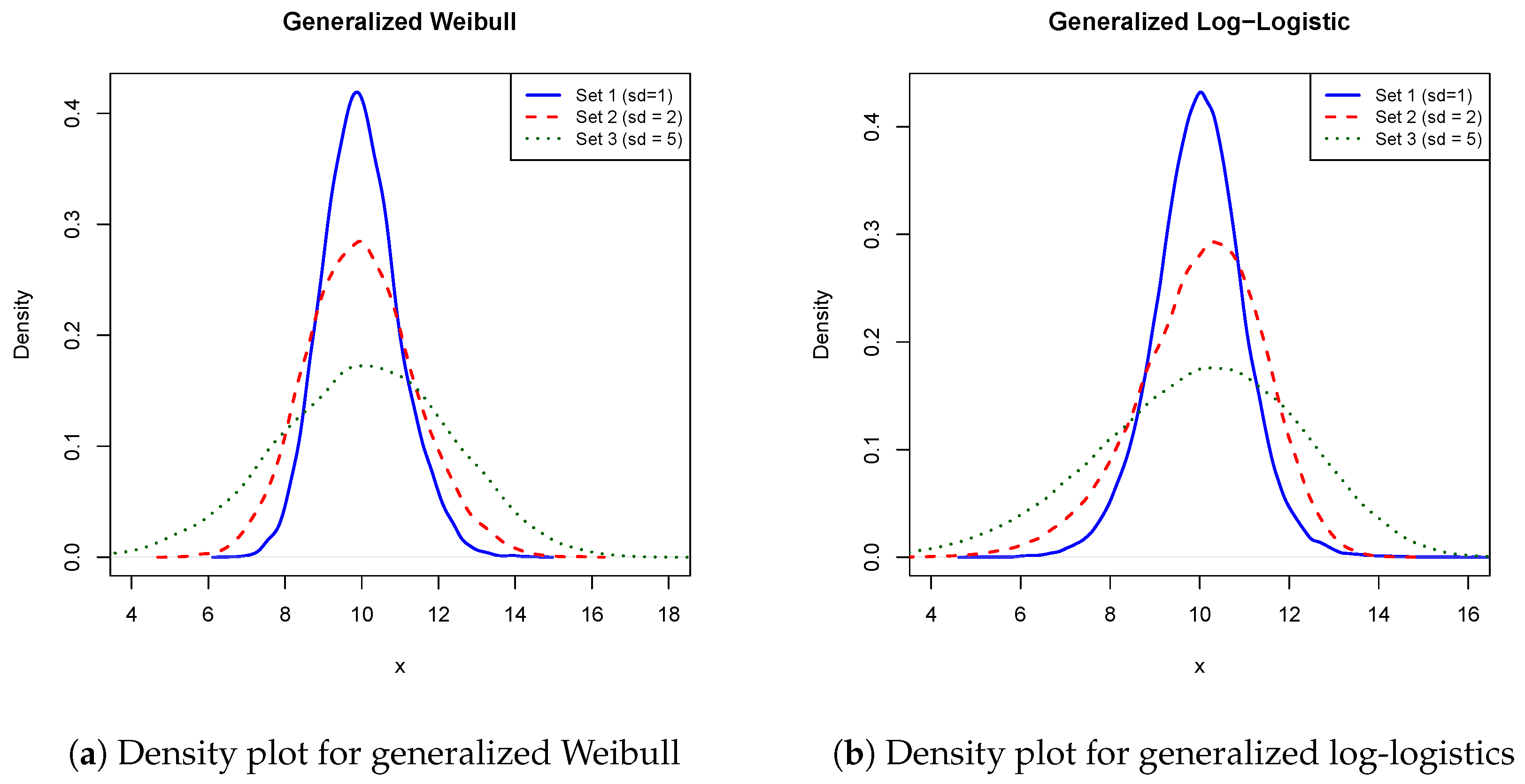
In order to represent the amplitude variable X and event time T, we take into consideration the generalized Weibull and generalized log logistic distributions. By changing the underlying distributions utilized to simulate the time between occurrences T and the amplitude X, different scenarios were taken into consideration in the simulation study. In this case, the standard deviation σ 0 varied between the values { 1 , 2 , 5 } but the in-control mean μ 0 = 10 was fixed.
The in-control distribution parameters a 0 , b 0 and c 0 as well as the related skewness coefficients γ 0 based on their in-control mean and variance are given in Table 1. In order to guarantee that the theoretical mean and standard deviation nearly matched the intended values, the parameter values were calculated numerically by solving systems of moment matching equations, as closed form for the mean and variance for these distributions are typically not available. A numerical moment-matching method was used to determine the parameter values. In particular, a system of equations that equated the theoretical moments of the assumed distribution to the corresponding sample moments was solved in order to retrieve the unknown values. Numerical optimization techniques were used to obtain stable and trustworthy approximations because these equations do not accept closed-form solutions. This method guarantees that the fitted distributions accurately capture the salient features of the data. Density charts for each of the three distributions are shown in Figure 1. The upper control limits for each of the three statistics are shown in Table 2. The table contains 54 potential combinations of the nine chosen distributions for T and X. The control ATS value is ATS 0 = 370.4 .
Changes in the mean of the underlying variables could cause the process to shift upward. In particular, the mean amplitude X may vary from μ X 0 to μ X 1 = δ X μ X 0 , where δ X 1 denotes the amplitude change. As an alternative, the mean inter-arrival time T could vary from μ T 0 to μ T 1 = δ T μ T 0 , where the amount of the change in time is indicated by δ T 1 . Both variables might change at the same time, so that μ X 1 = δ X μ X 0 and μ T 1 = δ T μ T 0 .
We do not evaluate the three TBEA charts using the ATS criterion for the statistics Z { Z 1 , Z 2 , Z 3 } directly since the actual values of δ X and δ T , which measure the magnitude of mean changes in amplitude and time, respectively, are typically unknown. Instead, we evaluate them using the following expected average times to signal(EATS). The estimated time needed for a control chart to generate a signal is represented by the expected average time to signal. A higher EATS is preferred under in-control circumstances since it shows fewer false alarms. Smaller EATS values are favored in out-of-control situations because they indicate quicker process change identification.
  • EATSX: We consider no change in time T when we calculate EATS for shifts in X (i.e., δ T = 1 ):
    EATS X = δ X X X f δ X ( δ X ) · ATS ( δ X , 1 )
  • EATST: We consider no change in amplitude X when we calculate EATS for shifts in T (i.e., δ X = 1 ):
    EATS T = δ T X T f δ T ( δ T ) · ATS ( 1 , δ T )
  • EATSXT: The expected ATS for simultaneous shifts in both X and T:
    EATS X T = δ X X X δ T X T f δ X ( δ X ) f δ T ( δ T ) · ATS ( δ X , δ T )
In this case, the range of potential increases in the mean of X (up to double the nominal value μ X 0 )) is represented by X X = { 1.1 , 1.2 , , 1.9 , 2.0 } and the range of potential decreases in the mean of T (down to half of μ T 0 )) is represented by X T = { 0.5 , 0.55 , , 0.9 , 0.95 } .
Both are assumed to follow discrete uniform distributions over X X and X T , respectively, since there is no previous knowledge about the distribution of δ X and δ T .
We examined the corresponding EATS values under three different circumstances in order to evaluate the monitoring performance of the three TBEA control chart statistics Z1, Z2, and Z3:
  • Amplitude shift only (X);
  • Time shift only (T);
  • Joint shift in X and T.
A methodical comparison of the EATS values for every simulation scenario taken into account in this research. The R code for Table 3, Table 4 and Table 5 are given in Appendix A. As seen in Table 3, the statistic Z1 consistently performs better when the shift solely affects the amplitude X. In particular, Z1 exhibits the lowest EATS values in 72% of cases. As opposed to Z1, Z2 and Z3 exhibit greater EATS values. For each combination, the average EATS values were roughly 21.45 for Z1, 33.48 for Z2, and 39.82 for Z3. These findings suggest that when amplitude shifts have place, Z1 is the most effective monitoring statistic. The findings for a change in the interval between events T, shown in Table 4. In 22 out of 36 cases (61%), the Z3 statistic performs best. Z2 performs best in 11 cases (31%), while Z1 performs best in just 3 cases (8%). For Z1, Z2, and Z3, the average EATS values under this shift are 40.72, 28.84, and 19.96, respectively. Due to certain circumstances, Z1 has a lower average EATS value, making it unsuitable for time shift monitoring statistics.Z3, on the other hand, produces more reliable outcomes. For tracking time shift, we therefore favor Z3 statistics. When both amplitude and time shifts occur simultaneously, as shown in Table 5, the Z1 statistic once more performs better. In 61% of cases, it yields the lowest EATS values; in 39% of cases, Z2 yields the lowest Eats value. Z1, Z2, and Z3 had average EATS values of 7.49, 7.93, and 8.72, respectively.
These results confirm that Z1 is the best statistic for identifying simultaneous changes in both X and T, with Z2 exhibiting intermediate efficiency and Z3 being the least effective.

4. Application to Real Data

An actual dataset of forest fires in the Provence-Alpes-Côte d’Azur region of southeast France is examined to demonstrate the practicality and utility of the proposed Shewhart-type Time between events and amplitude (TBEA) control charts see https://www.promethee.com/default/incendies or Bountzouklis [42]). This region is extremely vulnerable to wildfires due to its Mediterranean environment, especially during the summer. The dataset, which was taken from an official French forest fire database, documents two important features for every major fire incidence, which is defined as one that burns more than one hectare. These features include X, the amplitude represented by the burned surface area in hectares, and T, the interval in days between subsequent fire episodes.
Between October 2016 and September 2017, there were 92 recorded fire incidents. Two separate phases of the data are separated for analysis purposes. Phase 1 (Low Season) encompasses 47 fire occurrences from October 2016 to mid-June 2017, whereas Phase 2 (High Season) includes 45 fire incidents from mid-June 2017 to the end of September 2017.
The amplitude, or burned areas X, is greater in phase 2, while the interval between events T is shorter. This shows that fire activity and severity have increased.
The independence between T and X was confirmed using the Spearman’s and Kendall’s rank correlation tests, which are listed in Table 6, prior to creating control charts.
T and X are fitted to the three distributions under consideration. The calculated parameters and Kolmogorov–Smirnov (K-S) distances for the goodness of fit assessment are shown in Table 7. Based on the lowest K-S distances, the generalized log logistic distribution matched the time t variable the best, whereas the generalized Weibull distribution fit the amplitude.
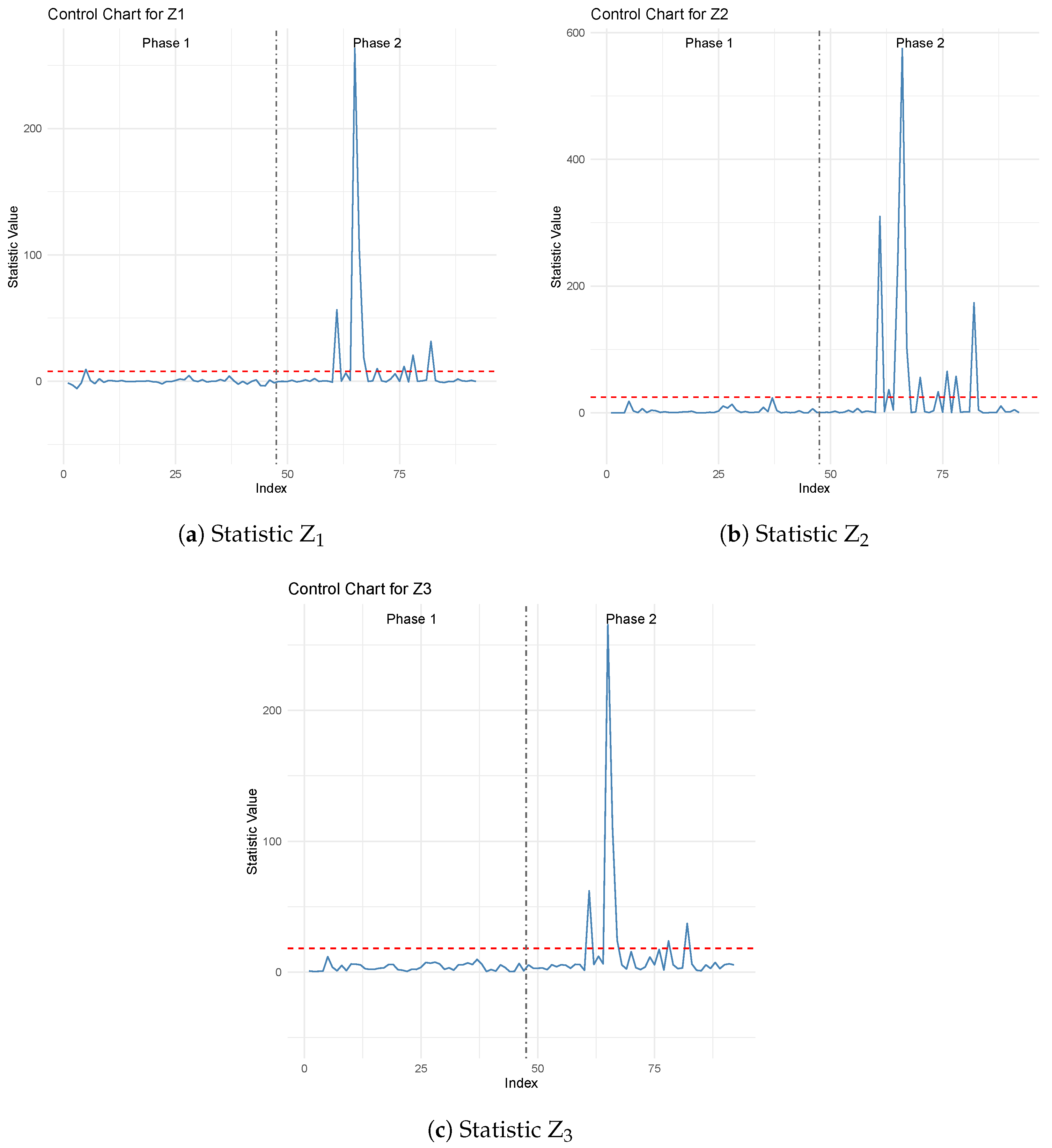
The top control limits for the TBEA charts utilizing statistics Z 1 , Z 2 , and Z 3 were computed as follows, assuming an in-control average time to signal (ATS0) of 730 days (about two years):
UCL Z 1 = 7.9141 , UCL Z 2 = 24.8250 , UCL Z 3 = 18.1545 .
Figure 2 shows the control charts created with the actual forest fire dataset to demonstrate the effectiveness of the suggested Shewhart-type TBEA control charts based on the three statistics Z 1 , Z 2 , and Z 3 . Several out-of-control signals during the high-risk Phase 2 are identified by the charts based on Z 1 and Z 3 , which show high sensitivity to increases in event frequency and amplitude. Overall, it is evident from the graphical findings how each statistic reacts to modifications in the underlying process.
The outcomes of applying these control limits to Phase 2 data are shown in Figure 2. All three control charts had a number of out-of-control points, particularly with Z 1 and Z 3 , indicating increased danger due to more frequent and severe fires. An out-of-control signal in the actual data indicates a shift in either the magnitude of events or the time between events. Such a signal suggests that the process might be impacted by an assignable cause, and more research is needed to pinpoint and fix the source of the fluctuation. When a signal goes out-of-control, the separate components ( T 0 ) and ( X 0 ) can be examined to determine the signal source. A change in the time between events is the cause of the signal if ( T 0 ) considerably deviates while ( X 0 ) stays constant. A shift in the event amplitude is responsible for the signal if ( X 0 ) deviates while ( T 0 ) stays constant. A simultaneous change in the frequency and magnitude of events is indicated by the signal if both variables diverge. In the forest fire dataset, the two monitored variables are the time between events (T) and the burned area (X). After an out-of-control signal is detected by the proposed statistics Z 1 , Z 2 , and Z 3 , the source of the signal is identified by examining the individual behavior of T and X relative to their in-control patterns. In Phase 2 of the data, it is observed that the time between events (T) shows a noticeable decrease, indicating more frequent occurrences, and the amplitude (X) shows a clear increase, indicating higher severity of events. Thus, both variables deviate from their in-control behavior. If there is a time shift only T deviates. If amplitude shift only X deviates. If there is a joint shift, both T and X deviate. Since in this example both T and X exhibit significant deviations, the out-of-control signal is attributed to a simultaneous shift in both time and amplitude. This illustration shows how the recommended TBEA control charts can detect notable changes in the size and frequency of important events. The method is extensively applicable to various domains where cooperative timing and severity monitoring are crucial, such as public health surveillance, industrial process safety, and environmental hazard tracking.

5. Conclusions

In this work, we use two generalized distributions to track the amplitude and interval between occurrences. We used the generalized Weibull and generalized log-logistics distributions for the three statistics ( Z 1 ), ( Z 2 ), and ( Z 3 ) in the TBEA charts, which are primarily based on traditional distribution. Here, we want to keep an eye on the amplitude of the event as well as the interval between subsequent occurrences. The joint data regarding time T and amplitude X in the process control are taken into account in this TBEA chart. It is highly helpful in manufacturing, environmental monitoring, infrastructure upkeep, and healthcare.
We examined the effects of time, magnitude, and simultaneous time and magnitude shifts in our study. Three distinct statistics are taken into consideration: the hybrid additive statistic ( Z 3 ), the ratio statistic ( Z 2 ), and the difference statistic ( Z 1 ). The consequences of these statistics vary depending on the shift circumstance.
In our investigation, Z 1 is the optimal option when amplitude changes take place. When the shift is introduced in time, Z 3 performs the best. Once more, Z 1 outperforms the other two in the simultaneous shift in both X and T. We use a real-world dataset on forest fire incidents in the Provence-Alpes-Côte d’Azur region to test the models’ practical applicability. The fire activity is detected by the models. The suggested TBEA control charts provide better sensitivity to process shifts and wider applicability across different data types than earlier research that was limited by conventional distributional assumptions.
Even while the suggested Shewhart-type TBEA charts successfully track event frequency and amplitude under the generalized Weibull and generalized log-logistic distributions, there are still a number of areas that need further investigation. To assess the robustness of the suggested statistics, the methodology can be expanded to other flexible lifetime distributions such modified gamma, Burr, and inverse Gaussian models. Future research may use copula-based models to include dependence patterns between the amplitude and time-between-events variables. To enhance the detection of minor shifts, memory-type control charts, such as EWMA or CUSUM versions of the suggested statistics, could be created. Lastly, creating effective computational tools and using the suggested monitoring framework in a variety of real-world applications will increase its practical utility.
All things considered, this study broadens the application and adaptability of TBEA control charts by connecting traditional process monitoring methods with contemporary, generalized distributional models.

Author Contributions

Conceptualization, A.P. and P.G.; Methodology, A.P. and P.G.; Software, A.P.; Validation, M.M.H., A.P., O.S.B., F.M.A.A. and M.E.B.; Formal analysis, M.M.H., P.G. and F.M.A.A.; Investigation, M.M.H. and F.M.A.A.; Resources, O.S.B. and M.E.B.; Data curation, O.S.B. and M.E.B.; Writing—original draft, A.P. and P.G.; Writing—review & editing, M.M.H. and F.M.A.A.; Visualization, O.S.B., F.M.A.A. and M.E.B.; Funding acquisition, M.E.B. All authors have read and agreed to the published version of the manuscript.

Funding

The study was funded by the Ongoing Research Funding program (ORF-2026-1004), King Saud University, Riyadh, Saudi Arabia.

Data Availability Statement

The dataset used in this study, relating to forest fire events in the Provence-Alpes-Côte d’Azur region of France, is publicly available and can be accessed at https://www.promethee.com/default/incendies (accessed on 1 January 2020). No additional datasets were generated or analyzed during the current study.

Acknowledgments

The authors would like to thank the Ongoing Research Funding program (ORF-2026-1004), King Saud University, Riyadh, Saudi Arabia.

Conflicts of Interest

The authors declare that they have no competing interests.

Appendix A

# Load gamma function from base R
set.seed(123)
gamma <- base::gamma
 
# Define the CDF of T
FT <- function(t, lt, kt, ct) {
(1 - exp(-lt * t^ct))^kt
}
 
# Define the PDF of X
fX <- function(x, lx, kx, cx) {
kx * lx * cx * x^(cx - 1) * (1+(lx*x^cx))^(-1-kx)
}
 
# Integral part
integral_part <- function(z, lt, kt, ct, lx, kx, cx, lT0, lX0) {
integrate(function(x) {
val <- FT(((x-z) * lT0) , lt, kt, ct) * fX(x * lX0, lx, kx, cx)
val <- ifelse(is.finite(val), val, 0) # Replace NaN/Inf
val
}, lower = z, upper = Inf)$value
}
 
# Full equation for F_Z1
F_Z1 <- function(z, lt, kt, ct, lx, kx, cx, lT0, lX0) {
1 - lX0 * integral_part(z, lt, kt, ct, lx, kx, cx, lT0, lX0)
}
 
# Function to compute ARL and ATS
compute_ARL_ATS <- function(z, lt, kt, ct,lx, kx, cx,lT0,lX0) {
FZ_z <- F_Z1(z, lt, kt, ct, lx, kx, cx, lT0, lX0)
FZ_negInf <- F_Z1(-Inf, lt, kt, ct, lx, kx, cx, lT0, lX0)
ARL <- 1 / (1 - (FZ_z - FZ_negInf))
ATS <- ARL * lT0
c(ARL = ARL, ATS = ATS)
}
z_values <- c( 0.2432316, 0.2870161, 0.3668042, 0.2842140 ,0.3232328, 0.4152024 ,0.4229013,
0.4547874, 0.5197651)
lT0 <- 10
lX0 <- 10
lt1<-c(2.430991e-04, 6.253249e-03, 3.298539e-03, 3.434090e-03, 3.590041e-03
, 2.152206e-03 ,1.451979e-04 ,3.001631e-04 ,3.087205e-04, 4.255932e-05)
 
kt1<-c(1.251618 ,3.534093 ,3.758281, 4.966352, 6.541432, 7.031501 ,4.105399, 6.030232
, 7.506609, 5.546437)
ct1<-c(5.042952, 3.305517, 3.517470, 3.420245, 3.330459 ,3.483672, 4.549931 ,4.168101,
4.088814 ,4.811502)
lt5<-c(0.21758855, 0.18220896, 0.13852289, 0.05003942, 0.05050421, 0.04665957
, 0.05084329, 0.02831884 ,0.02468238, 0.02598041
)
kt5<-c(3.462071, 3.954303, 4.187138, 2.913548, 3.598088, 4.229668 ,5.411018, 4.816735
,5.403639, 6.630809
)
ct5<-c(1.338890, 1.400459, 1.496428, 1.868080, 1.848840, 1.863134, 1.817902, 2.012709,
2.045101, 2.011604)
lt2<-c(0.0739383391, 0.0440793662, 0.0033219747, 0.0183344606, 0.0103871988
, 0.0015266836 ,0.0534830845, 0.0010593621, 0.0219626150, 0.0001193712)
 
kt2<-c( 3.930103 , 3.995221 , 1.975283 , 4.469787,  4.473844,  2.949145 ,17.681288
,  3.884478, 16.487951,  3.206186)
ct2<-c(2.020517 ,2.211813 ,3.299499 ,2.507955, 2.701784 ,3.444887 ,1.993234 ,3.483942
, 2.279850, 4.231651)
 
lx5<-c( 5.955255e-09 ,6.720160e-10 ,5.926903e-11, 2.200117e-12,
1.285388e-13, 2.351878e-15, 1.004173e-16 ,6.021727e-16 ,1.023340e-18
, 4.016459e-21)
kx5<-c(   116.116524 ,  153.349864,   250.616286,   913.514614,
1983.235145, 13433.952863, 36963.507899  ,   2.040064 ,45418.568148
,    1.112557)
 
cx5<-c(   5.728933 , 6.289653 , 6.845068 , 7.406846,  7.976512,  8.542909
,  9.112954, 11.800612, 10.253522, 15.649309)
 
lx2<-c(  3.408988e-13, 9.477852e-18, 2.555453e-23, 2.246908e-24
, 2.002843e-20 ,2.531880e-22, 2.861773e-24, 4.649489e-26, 1.474272e-25
,1.803214e-30)
cx2<-c( 11.629637, 15.848329 ,20.599645, 20.869835, 12.938970, 13.844748
, 14.780574 ,15.656143 ,16.566490, 17.455071)
kx2<-c( 1.862295e+00, 9.530165e-01, 6.691993e-01, 7.401362e-01
, 1.791646e+04, 4.955120e+04, 1.318256e+05 ,2.787973e+05 ,2.574675e+03
, 6.340101e+06)
lx1<-c(1.954243e-16 ,9.321170e-19, 2.802048e-21, 6.824408e-23
, 5.364333e-25 ,1.353918e-26, 9.842355e-29 ,7.939645e-31 ,9.905374e-35
,3.013873e-37)
cx1<-c(  14.03363 ,15.89731, 15.99075, 17.32607, 18.65587, 20.25053 ,21.43371
, 22.61833, 23.67953 ,24.96074)
kx1<-c(      8.029993,    4.820157 , 326.659699,  119.594944,  121.752658
, 17.610860 ,  25.261020,   30.475741 ,3024.236285, 6397.244982)
 
EATS1 <- mean(mapply(function(lti, kti,cti, lxi, kxi, cxi) {
compute_ARL_ATS(z_values[1], lti, kti,cti, lxi, kxi, cxi, lT0, lX0)["ATS"]
}, lt1, kt1,ct1, lx1, kx1, cx1))
EATS2 <- mean(mapply(function(lti, kti,cti, lxi, kxi, cxi) {
compute_ARL_ATS(z_values[2], lti, kti,cti, lxi, kxi, cxi, lT0, lX0)
}, lt2, kt2,ct2, lx1, kx1, cx1))
EATS3 <- mean(mapply(function(lti, kti,cti, lxi, kxi, cxi) {
compute_ARL_ATS(z_values[3], lti, kti,cti, lxi, kxi, cxi, lT0, lX0)
}, lt5, kt5,ct5, lx1, kx1, cx1))
EATS4 <- mean(mapply(function(lti, kti,cti, lxi, kxi, cxi) {
compute_ARL_ATS(z_values[4], lti, kti,cti, lxi, kxi, cxi, lT0, lX0)["ATS"]
}, lt1, kt1,ct1, lx2, kx2, cx2))
EATS5 <- mean(mapply(function(lti, kti,cti, lxi, kxi, cxi) {
compute_ARL_ATS(z_values[5], lti, kti,cti, lxi, kxi, cxi, lT0, lX0)
}, lt2, kt2,ct2, lx2, kx2, cx2))
EATS6 <- mean(mapply(function(lti, kti,cti, lxi, kxi, cxi) {
compute_ARL_ATS(z_values[6], lti, kti,cti, lxi, kxi, cxi, lT0, lX0)
}, lt5, kt5,ct5,  lx2, kx2, cx2))
EATS7 <- mean(mapply(function(lti, kti,cti, lxi, kxi, cxi) {
compute_ARL_ATS(z_values[7], lti, kti,cti, lxi, kxi, cxi, lT0, lX0)["ATS"]
}, lt1, kt1,ct1, lx5, kx5, cx5))
EATS8 <- mean(mapply(function(lti, kti,cti, lxi, kxi, cxi) {
compute_ARL_ATS(z_values[8], lti, kti,cti, lxi, kxi, cxi, lT0, lX0)
}, lt2, kt2,ct2, lx5, kx5, cx5))
EATS9 <- mean(mapply(function(lti, kti,cti, lxi, kxi, cxi) {
compute_ARL_ATS(z_values[9], lti, kti,cti, lxi, kxi, cxi, lT0, lX0)
}, lt5, kt5,ct5,  lx5, kx5, cx5))
 
f1<-c(EATS1,EATS4,EATS7)
f2<-c(EATS2,EATS5,EATS8)
f3<-c(EATS3,EATS6,EATS9)
da<-data.frame(f1,f2,f3)

References

  1. Calvin, T. Quality control techniques for zero defects. IEEE Trans. Compon. Hybrids Manuf. Technol. 1983, 6, 323–328. [Google Scholar] [CrossRef]
  2. Lucas, J.M. Counted data CUSUM’s. Technometrics 1985, 27, 129–144. [Google Scholar] [CrossRef]
  3. Vardeman, S.; Ray, D.O. Average run lengths for CUSUM schemes when observations are exponentially distributed. Technometrics 1985, 27, 145–150. [Google Scholar] [CrossRef]
  4. Radaelli, G. Planning time-between-events Shewhart control charts. Total Qual. Manag. 1998, 9, 133–140. [Google Scholar] [CrossRef]
  5. Gan, F.F. Designs of one- and two-sided exponential EWMA charts. J. Qual. Technol. 1998, 30, 55–65. [Google Scholar] [CrossRef]
  6. Xie, M.; Goh, T.N.; Ranjan, P. Some effective control chart procedures for reliability monitoring. Reliab. Eng. Syst. Saf. 2002, 77, 143–150. [Google Scholar] [CrossRef]
  7. Borror, C.M.; Keats, J.B.; Montgomery, D.C. Robustness of the time between events CUSUM. Int. J. Prod. Res. 2003, 41, 3435–3444. [Google Scholar] [CrossRef]
  8. Zhang, C.W.; Xie, M.; Liu, J.Y.; Goh, T.N. A control chart for the gamma distribution as a model of time between events. Int. J. Prod. 2007, 45, 5649–5666. [Google Scholar] [CrossRef]
  9. Cheng, Y.; Mukherjee, A. One Hotelling T2 chart based on transformed data for simultaneous monitoring the frequency and magnitude of an event. In 2014 IEEE International Conference on Industrial Engineering and Engineering Management (IEEM); IEEE: New York, NY, USA, 2014; pp. 764–768. [Google Scholar]
  10. Cheng, Y.; Mukherjee, A.; Xie, M. Simultaneously monitoring frequency and magnitude of events based on bivariate gamma distribution. J. Stat. Comput. Simul. 2017, 87, 1723–1741. [Google Scholar] [CrossRef]
  11. Wu, Z.; Jiao, J.; He, Z. A control scheme for monitoring the frequency and magnitude of an event. Int. J. Prod. Res. 2009, 47, 2887–2902. [Google Scholar] [CrossRef]
  12. Wu, Z.; Liu, Y.; He, Z.; Khoo, M.B.C. A cumulative sum scheme for monitoring frequency and size of an event. Qual. Reliab. Eng. Int. 2010, 26, 541–554. [Google Scholar] [CrossRef]
  13. Wu, Z.; Jiao, J.; He, Z. A single control chart for monitoring the frequency and magnitude of an event. Int. J. Prod. Econ. 2009, 119, 24–33. [Google Scholar] [CrossRef]
  14. Qu, L.; Wu, Z.; Khoo, M.B.C.; Castagliola, P. A CUSUM scheme for event monitoring. Int. J. Prod. Econ. 2013, 145, 268–280. [Google Scholar] [CrossRef]
  15. Shafae, M.S.; Dickinson, R.M.; Woodall, W.H.; Camelio, J.A. Cumulative sum control charts for monitoring Weibull-distributed time between events. Qual. Reliab. Eng. Int. 2015, 31, 839–849. [Google Scholar] [CrossRef]
  16. Cheng, C.S.; Chen, P.W. An ARL-unbiased design of time-between-events control charts with runs rules. J. Stat. Comput. Simul. 2011, 81, 857–871. [Google Scholar] [CrossRef]
  17. Alshahrani, F.; Almanjahie, I.M.; Khan, M.; Anwar, S.M.; Rasheed, Z.; Cheema, A.N. On Designing of Bayesian Shewhart-Type Control Charts for Maxwell Distributed Processes with Application of Boring Machine. Mathematics 2023, 11, 1126. [Google Scholar] [CrossRef]
  18. Benneyan, J.C. Number-between g-type statistical quality control charts for monitoring adverse events. Health Care Manag. Sci. 2001, 4, 305–318. [Google Scholar] [CrossRef]
  19. Wu, S.; Castagliola, P.; Celano, G. A distribution-free EWMA control chart for monitoring time-between-events-and-amplitude data. J. Appl. Stat. 2020, 48, 434–454. [Google Scholar] [CrossRef] [PubMed] [PubMed Central]
  20. Fang, Y.Y.; Khoo, M.B.C.; Teh, S.Y.; Xie, M. Monitoring of time-between-events with a generalized group runs control chart. Qual. Reliab. Eng. Int. 2016, 32, 767–781. [Google Scholar] [CrossRef]
  21. Castagliola, P.; Celano, G.; Rahali, D.; Wu, S. Control Charts for Monitoring Time-Between-Events-and-Amplitude Data. In Control Charts and Machine Learning for Anomaly Detection in Manufacturing. Springer Series in Reliability Engineering; Tran, K.P., Ed.; Springer: Cham, Switzerland, 2022. [Google Scholar] [CrossRef]
  22. Liu, J.Y.; Xie, M.; Goh, T.N.; Sharma, P.R. A comparative study of exponential time between events charts. Qual. Technol. Quant. Manag. 2006, 3, 347–359. [Google Scholar] [CrossRef]
  23. Qiu, P. Introduction to Statistical Process Control. Texts in Statistical Science; CRC Press: Boca Raton, FL, USA, 2014. [Google Scholar]
  24. Qu, L.; He, S.; Khoo, M.B.C.; Castagliola, P. A CUSUM chart for detecting the intensity ratio of negative events. Int. J. Prod. Res. 2018, 56, 6553–6567. [Google Scholar] [CrossRef]
  25. Qu, L.; Wu, Z.; Khoo, M.B.C.; Rahim, A. Time-between-event control charts for sampling inspection. Technometrics 2014, 56, 336–346. [Google Scholar] [CrossRef]
  26. Shamsuzzaman, M.; Xie, M.; Goh, T.N.; Zhang, H.Y. Integrated control chart system for time-between-events monitoring in a multistage manufacturing system. Int. J. Adv. Manuf. Technol. 2009, 40, 373–381. [Google Scholar] [CrossRef]
  27. Xie, Y.J.; Tsui, K.L.; Xie, M.; Goh, T.N. Monitoring time-between-events for health management. In Prognostics and Health Management Conference (PHM’10); IEEE: New York, NY, USA, 2010; pp. 1–8. [Google Scholar]
  28. Zhang, H.Y.; Shamsuzzaman, M.; Xie, M.; Goh, T.N. Design and application of exponential chart for monitoring time-between-events data under random process shift. Int. J. Adv. Manuf. Technol. 2011, 57, 849–857. [Google Scholar] [CrossRef]
  29. Zhang, Y.; Xie, M.; Goh, T.N. Economic design of control charts for monitoring time-between-events. Comput. Ind. Eng. 2011, 61, 1229–1238. [Google Scholar]
  30. Rahali, D.; Castagliola, P.; Taleb, H.; Khoo, M.B.C. Evaluation of Shewhart time-between-events-and-amplitude control charts for several distributions. Qual. Eng. 2019, 31, 240–254. [Google Scholar] [CrossRef]
  31. Xie, M.; Liu, J.; Castagliola, P. Real-time monitoring of bivariate time-between-events data. In Proceedings of the 12th International Conference on Quality and Reliability (ICQR 2021), Beijing, China, 23–24 July 2021. [Google Scholar]
  32. Shan, T.; Huang, W. Treating Measurement Errors in the Run Rule Schemes Integrated with Shewhart Chart. Math. Probl. Eng. 2021, 2021, 8405059. [Google Scholar] [CrossRef]
  33. Bhatti, M.A.; Iqbal, M.Z.; Kashif, M.; Farid, G. Time-between-events control charts basedon the transmuted weighted exponentialdistribution for shift detection. Adv. Appl. Stat. 2025, 92, 1447–1464. [Google Scholar] [CrossRef]
  34. Chen, P.; Song, Z.; Hu, X.; Zhang, J. Phase II control chart for monitoring Gumbel’s bivariate exponential distribution. Comput. Ind. Eng. 2024, 192, 110216. [Google Scholar] [CrossRef]
  35. Xie, F.; Liu, J.; Huang, J.; Dai, Y.; Sun, Q.; Hu, X.; Castagliola, P. Online process monitoring under quality data scarcity: Self-starting truncated EWMA schemes for time between events. Comput. Ind. Eng. 2026, 213, 111777. [Google Scholar] [CrossRef]
  36. Ali, S.; Akram, M.F.; Shah, I. Max-EWMA Chart Using Beta and Simplex Distributions for Time and Magnitude Monitoring. Math. Probl. Eng. 2022, 2022, 7306775. [Google Scholar] [CrossRef]
  37. Akram, M.F.; Ali, S.; Shah, I.; Muslim Raza, S.M. Max-EWMA Chart Using Beta and Unit Nadarajah and Haghighi Distributions. J. Math. 2022, 2022, 9374740. [Google Scholar] [CrossRef]
  38. Riaz, S.; Ali, S.; Shah, I.; Raza, S.M.M. A comparison of exponentially weighted moving average charts for time and magnitude monitoring. Int. J. Syst. Assur. Eng. Manag. 2025. [Google Scholar] [CrossRef]
  39. Talib, A.; Ali, S.; Shah, I.; Gul, F. Time and magnitude monitoring using Weibull based Max-EWMA chart. Commun. Stat.-Simul. Comput. 2024, 53, 4290–4306. [Google Scholar] [CrossRef]
  40. Ali, S. Monitoring time and magnitude based on the renewal reward process with a random failure threshold. J. Appl. Stat. 2021, 48, 247–284. [Google Scholar] [CrossRef] [PubMed]
  41. Pandey, A.; Gupta, P. Monitoring of frequency and amplitude using shewhart type TBEA charts for multiple distributions. Qual. Quant. 2026. [Google Scholar] [CrossRef]
  42. Bountzouklis, C.; Fox, D.M.; Bernardino, E.D. Predicting wildfire ignition causes in Southern France using eXplainable Artificial Intelligence (XAI) methods. Environ. Res. Lett. 2023, 18, 044038. [Google Scholar] [CrossRef]
Figure 1. Density curves illustrating the behavior of the considered distributions.
Symmetry 18 00750 g001
Figure 2. Graphical illustration of statistics Z1, Z2, and Z3 for the dataset.
Symmetry 18 00750 g002
Table 1. Values of the parameters for the fixed mean and varying variance of the distributions under consideration.
Distribution a 0 b 0 c 0 μ 0 σ 0 γ 0
Generalized Weibull11.61880.00033.93411010.0076
6.19790.00083.4342102−0.4810
1.32870.00014.3329105−0.2639
Generalized log logistics1.63441.9742 × 10−1615.42291010.3001
11.35131.1336 × 10−108.69951020.2154
160.20113.0159 × 10−85.1323105−0.1076
Table 2. The upper control limits U C L Z for the TBEA charts are determined by statistics Z 1 , Z 2 , and  Z 3 .
TXGWGLL
σ 0 125125
Statistic Z 1
GW10.00500.06370.21360.25720.34420.4889
20.05720.00010.14990.30000.37030.5126
50.15400.09680.00030.41760.4850.5751
GLL10.24320.2870.36680.27380.35470.4916
20.28420.32320.41520.31390.3890.5164
50.42290.45480.51980.44380.50140.6016
Statistic Z 2
GW11.01001.08091.33561.30681.47041.8984
21.05001.00031.23561.34761.50371.9225
51.13471.08061.00121.46901.62881.945
GLL11.26531.34711.52071.31831.48371.8721
21.30851.38321.56271.36391.51911.9134
51.44891.52371.67921.50141.65031.9942
Statistic Z 3
GW12.03342.12162.42112.30092.46712.8866
22.07532.07232.35742.33392.48672.9020
52.17212.13052.21112.45222.60952.8954
GLL12.25412.33112.50552.30272.45982.8334
22.29512.35792.52872.34392.48852.8578
52.42902.48472.60452.46862.59172.9222
Table 3. Performance comparison of TBEA charts in terms of E A T S X based on statistics Z 1 , Z 2 , and  Z 3 .
TXGWGLL
σ 0 125125
Statistic Z 1
GW121.551014.109921.082719.690015.278121.6931
227.989216.625825.120021.498515.149521.7438
533.104220.714226.160728.123719.354322.3386
GLL117.795010.902512.460022.216016.494721.8614
219.975311.971614.332623.765517.012322.1163
528.967116.969518.192732.798121.870425.6872
Statistic Z 2
GW110.431211.414818.788223.642139.463175.9221
210.995610.735015.143425.142040.202676.1981
512.596811.905211.437532.332350.147471.1973
GLL118.481922.688229.522827.507541.828378.0663
220.809024.514931.893327.465543.511476.8857
529.564534.297938.939637.612759.971681.1843
Statistic Z 3
GW110.593611.818723.691923.946145.2057100.9877
211.163011.222518.953424.315042.333599.8165
513.139012.338113.859731.190553.112582.5969
GLL117.951322.359630.429927.866046.4897100.4854
220.029323.075631.004226.426845.342297.1869
528.239131.736434.765534.762156.809690.4131
Table 4. Performance comparison of TBEA charts in terms of E A T S T based on statistics Z 1 , Z 2 , and  Z 3 .
TXGWGLL
σ 0 125125
Statistic Z 1
GW143.051628.445251.761238.960531.737848.5394
257.586433.78461.48741.248430.036046.8354
566.246741.889356.000253.368538.500744.3001
GLL133.275720.155722.180648.120435.636350.0033
236.318821.727926.388050.255236.784649.5604
557.271233.126334.472668.595245.722954.248.
Statistic Z 2
GW111.21397.251812.384527.371817.544020.3819
212.47766.52949.899029.415218.326721.6359
514.94127.61517.116540.468624.443725.3666
GLL137.717756.035894.446445.616533.189853.1667
237.778255.338192.466243.428033.941351.2362
544.320363.792079.692353.2307641.884450.4228
Statistic Z 3
GW110.615714.113527.933210.000110.000911.0772
212.119912.874022.885410.000010.004111.4288
513.400414.233516.210110.019510.153811.8888
GLL126.107616.552619.728545.215560.613695.3305
228.639617.055120.256043.638262.738994.7770
541.556223.457522.395854.774675.118088.3280
Table 5. Performance comparison of TBEA charts in terms of E A T S X T based on statistics Z 1 , Z 2 , and  Z 3 .
TXGWGLL
σ 0 125125
Statistic Z 1
GW19.01164.58234.247910.00185.60376.2672
29.13674.71724.651510.01915.69446.4777
59.13065.00204.671410.15936.20697.3404
GLL110.01835.55665.865710.00865.62476.2555
210.06765.60196.068810.01615.73396.5161
510.98046.25346.852310.12706.29807.5168
Statistic Z 2
GW19.84745.26774.591510.00615.65917.8940
29.57355.35184.863010.02915.74398.0453
59.01625.07855.23610.37526.27348.7075
GLL110.00835.56226.191310.01735.68328.1255
210.03105.61506.368410.04945.78888.3176
510.45156.01526.981610.56646.41619.1025
Statistic Z 3
GW110.001210.007710.674310.00435.6688.4887
210.000210.007410.5110.01845.72818.7130
510.017410.046410.310110.29756.26618.9588
GLL110.00505.54996.066210.01055.66858.6374
210.02075.58866.189710.03305.76328.7957
510.34455.90446.606410.43676.25259.0303
Table 6. Correlation structure for inter-arrival time and amplitude.
Phase121 & 2
Spearman
Coefficient0.260.020.13
p-value0.070.800.19
Kendall
Coefficient0.180.010.10
p-value0.090.920.20
Table 7. Parameter estimates and associated standard errors (SE) for the two distributions under consideration, including μ T 0 , σ T 0 , μ X 0 , and σ X 0 .
VariableDistribution a 0 b 0 c 0 KS μ 0 σ 0
XGW152.12173.85120.19010.063713.578122.8687
SE6.17820.072980.01928
GLL0.40500.09932.30770.0851
SE0.24470.05270.8408
TGW238.00274.76180.19890.21085.46816.8425
SE8.57880.15270.0213
GLL0.016912.51550.98320.1914
SE0.00694.43350.1069
Disclaimer/Publisher’s Note: The statements, opinions and data contained in all publications are solely those of the individual author(s) and contributor(s) and not of MDPI and/or the editor(s). MDPI and/or the editor(s) disclaim responsibility for any injury to people or property resulting from any ideas, methods, instructions or products referred to in the content.