A Physics-Informed Recurrent Neural Network with Fractional-Order Kinetics for Robust Lithium-Ion Battery State of Charge Estimation


Abstract
1. Introduction
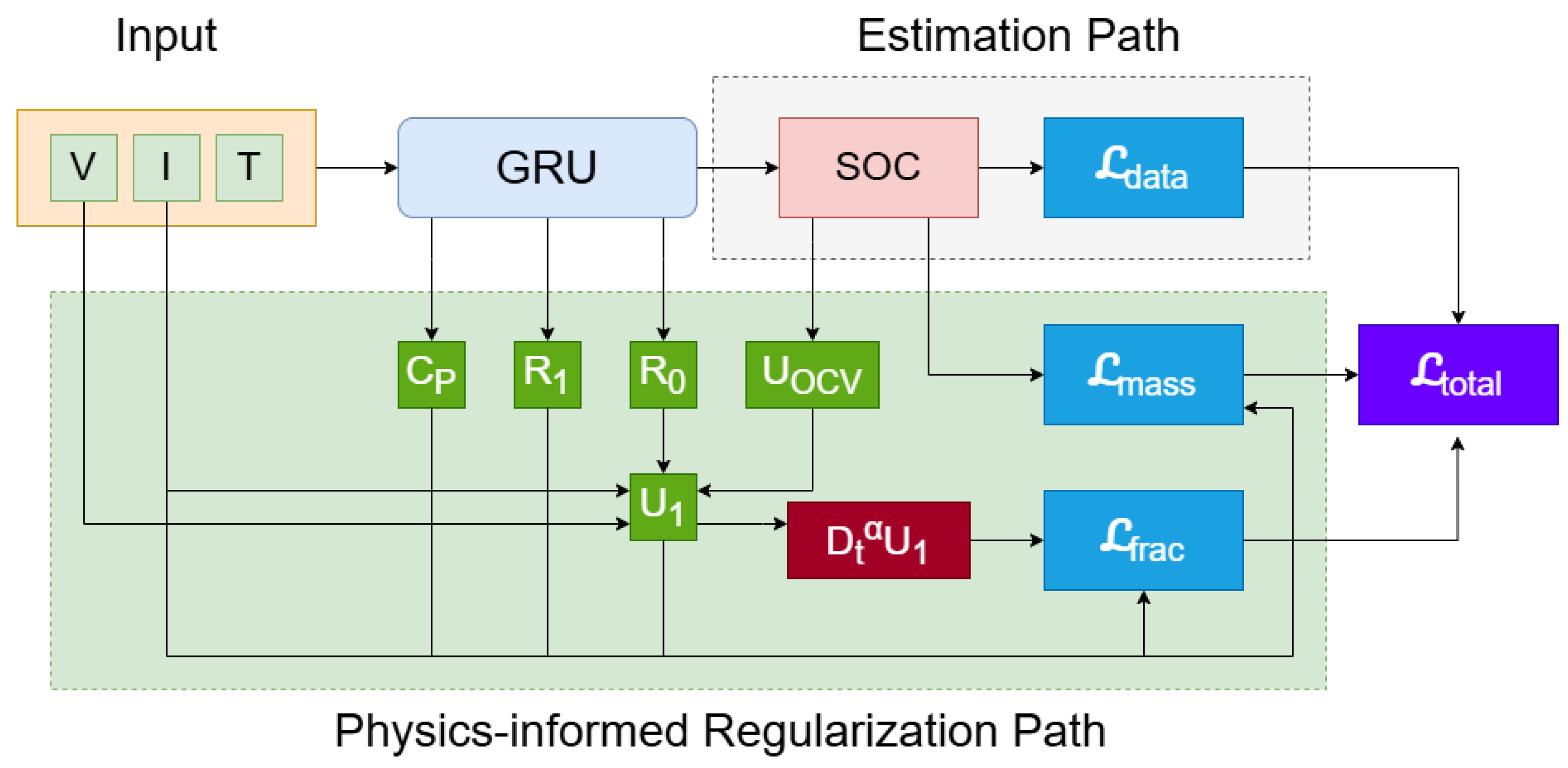
- We propose a hybrid architecture that combines a GRU with a fractional-order physical model, which embeds fractional-order calculus constraints into a PINN for battery SOC estimation.
- We formulate a composite loss function that integrates the data fitting error with the residuals of the fractional-order governing equations, specifically the Coulomb counting (mass conservation) and the fractional voltage dynamics equations. This constraint enforces physical consistency and improves the model’s generalization ability under noisy conditions.
- We introduce an efficient, vectorized computational strategy to overcome the severe performance bottlenecks typically associated with fractional-order derivatives. By parallelizing the G-L discrete approximation using advanced tensor operations, we drastically reduce computational overhead, making the end-to-end training and real-time inference of the FDE-GRU framework highly feasible.
- The proposed FDE-GRU is extensively evaluated and compared against traditional methods, including MLP, standard GRU, LSTM, and Transformer models. Experimental results demonstrate that FDE-GRU achieves superior accuracy and robustness.
2. Preliminaries
2.1. Fractional Calculus and Discrete Approximation
2.2. FO-ECM
2.3. GRU Network
3. Methodology
3.1. Problem Formulation
3.2. Proposed FDE-GRU Architecture
3.2.1. Overall of the FDE-GRU Framework
3.2.2. Backbone Network: GRU
3.2.3. Physical Parameters
3.2.4. Physics-Informed Loss Formulation
3.2.5. Implementation of Fractional Calculus
3.3. Optimization Algorithm
| Algorithm 1 Physics-Informed Training Strategy for FDE-GRU |
| Require: Dataset , where is a sequence of voltage, current and temperature measurements of length L, and are the corresponding true SOC values for each time step; Initial weights ; Physical parameters Require: Hyperparameters: Learning rate ; Fractional order ; Batch size B 1: Initialize network parameters and physics parameters 2: for epoch to do 3: for each batch in do 4: Forward Pass: 5: 6: Physics Computation: 7: Calculate via mapping layer 8: Derive polarization voltage 9: Compute using vectorized G-L solver (vmap) 10: Loss Calculation: 11: 12: 13: 14: 15: Backpropagation: 16: Compute gradients 17: Update using Adam optimizer 18: end for 19: end for 20: return Optimized model |
Adam Optimization Algorithm
- (1)
- Gradient Computation: The total gradient with respect to all trainable parameters is computed via backpropagation:This gradient incorporates contributions from both the data-fitting loss and the physics-based residuals, ensuring that parameter updates satisfy both empirical observations and physical laws.
- (2)
- Moment Estimation: Adam maintains exponentially decaying moving averages of past gradients (first moment, ) and squared gradients (second moment, ):where and are decay rates controlling the exponential decay of these moving averages. The first moment can be interpreted as an estimate of the gradient’s mean, while the second moment estimates the uncentered variance.
- (3)
- Bias Correction: Since and are initialized as zero vectors, they are biased toward zero during the initial training steps. To counteract this bias, corrected estimates are computed:
- (4)
- Parameter Update: Finally, the parameters are updated using the following rule:where is the learning rate (selected from via grid search), and is a small constant for numerical stability.
4. Experimental Setup
4.1. Datasets and Preprocessing
4.2. Model Implementation and Training Protocol
- Data Preprocessing: The input features comprise the raw measurements of Voltage, Current, and Temperature. The sequence length is set via a sliding window approach and fixed at 20 for all experiments.
- Network Configuration: To ensure a fair and robust comparison, all deep learning baselines and the data-driven backbone of our proposed physics-informed model are configured with comparable architectural scales, primarily centralized around a hidden state dimension of 32 and a linear output layer. Specifically, the GRU and LSTM models utilize a single recurrent layer with 32 hidden units, while the Bi-LSTM employs 32 units for each direction. The MLP contains two 32-unit hidden layers with ReLU activation. The CNN-LSTM prepends a 1D convolutional layer (32 filters, kernel size of 3, padding of 1) to a 32-unit LSTM. The Transformer uses 1 encoder layer, an embedding dimension of 128, 4 attention heads, and a feed-forward dimension of 512. For our proposed model, the 32-unit data-driven backbone is subsequently constrained by trainable physical parameters (e.g., , , ) to solve the FDEs.
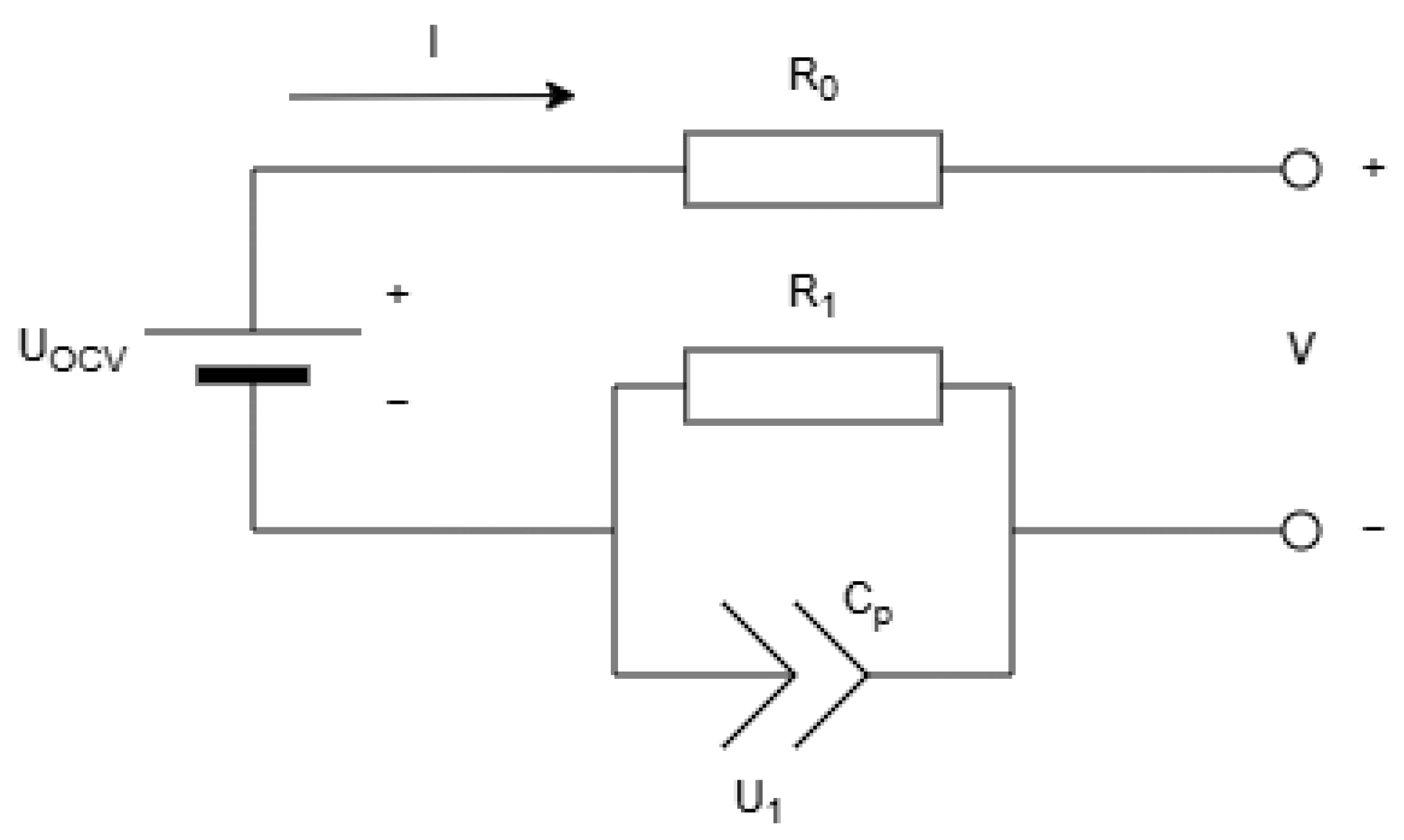
- Physics Parameters: Specifically for our proposed physics-informed model, the network incorporates both trainable and fixed physics-based parameters. The trainable parameters are the FO-ECM components , , and initialized as learnable variables with a starting value of 1.0. In contrast, the battery capacity Q is fixed at 2.9 Ah for the Panasonic dataset and 1.1 Ah for the CALCE dataset, and the scaling factor is set to 1.0. Additionally, the discrete fractional-order derivative uses a window length of 10 to balance computational efficiency with model performance.
- Training Settings: All methods are evaluated under a common set of learning rates and batch sizes to ensure consistent comparison. Specifically, batch sizes of 128 and 256 are combined with learning rates of , , , , and to explore the optimal trade-off between model convergence and generalization respectively. Each model is trained for 100 epochs using the Adam optimizer [39]. A fixed random seed ensures reproducibility. It is worth noting that a fixed 100-epoch strategy was employed primarily to provide a strictly uniform computational budget across all evaluated architectures for a fair comparative baseline. While the physics-based loss terms in FDE-GRU act as strong regularizers to mitigate overfitting, future studies will adopt dynamic early stopping to further eliminate unnecessary computational overhead.
4.3. Testing and Validation Evaluation
5. Results and Discussion
5.1. Overall Performance Comparison
5.2. Impact of Fractional Order Kinetics: An Ablation Study
- (1)
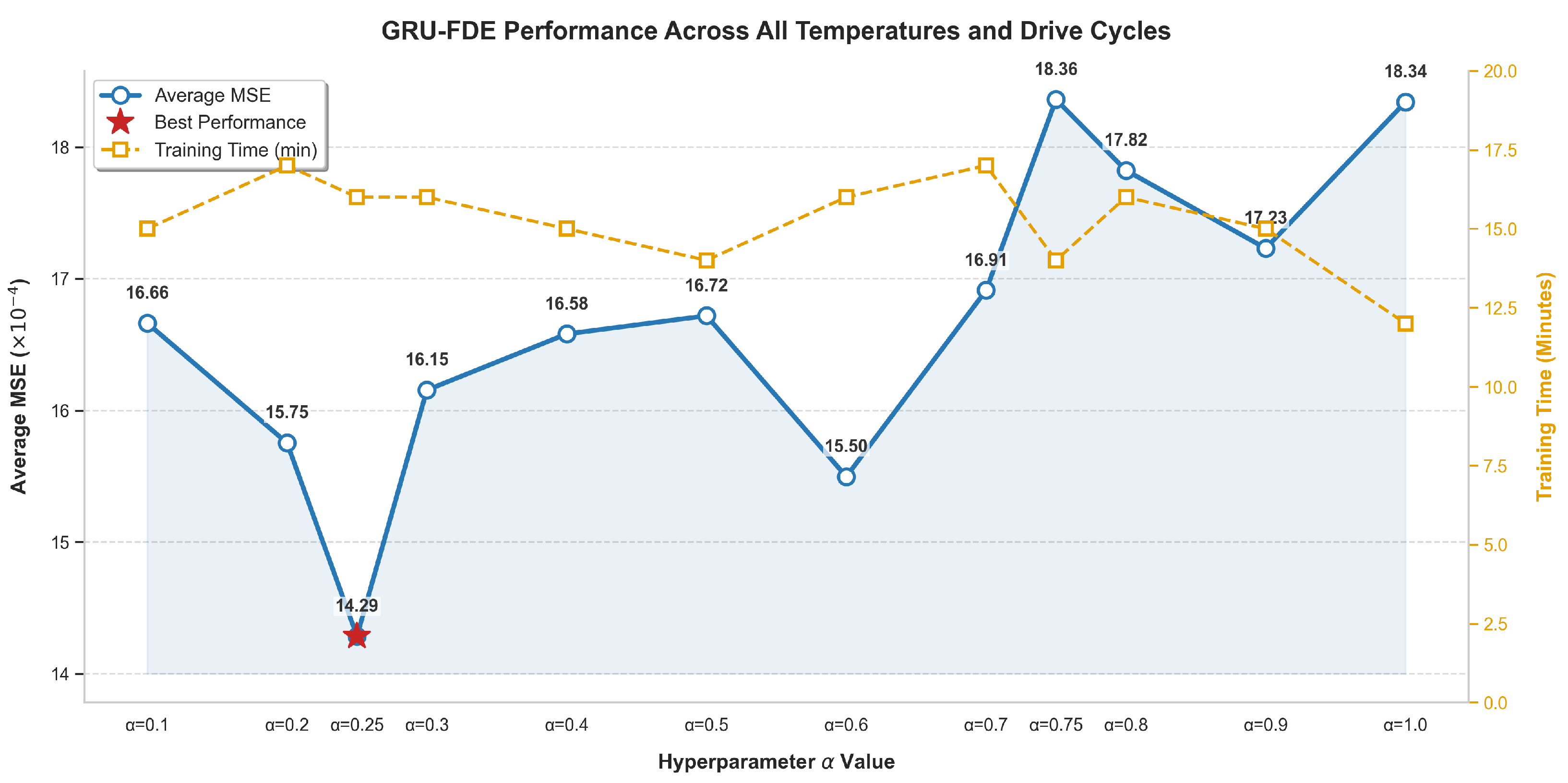
- Physics-Informed vs. Data-Driven: Even with integer-order constraints (), the physics-informed model (MSE ) significantly outperforms the pure data-driven GRU (MSE ). This confirms that embedding Kirchhoff’s laws and mass conservation explicitly regularizes the network, preventing unphysical predictions.
- (2)
- Fractional vs. Integer: Notably, the model with achieves the best performance among all tested configurations, yielding an improvement of approximately 22.1% over the integer-order counterpart (). The overall trend suggests that models with values in the lower to medium range (0.1–0.6) generally outperform those with values closer to 1.0. This observation supports the electrochemical hypothesis that battery relaxation dynamics may be better described by power-law decay (Mittag-Leffler function) rather than pure exponential decay. The optimal value of 0.25 in our experiments appears to capture the balance between modeling the long-memory effects characteristic of solid-phase lithium diffusion and maintaining numerical stability. However, we note that the specific optimal value may vary with battery chemistry and operating conditions, and further investigation is needed to establish a definitive physical interpretation.
5.3. Robustness Across Different Operating Temperature
5.4. Adaptability to Dynamic Drive Cycles
5.5. Further Comparison of FDE-GRU () and FDE-GRU ()
5.6. Error Distribution Analysis
5.7. Computational Complexity Analysis
6. Conclusions
Author Contributions
Funding
Data Availability Statement
Conflicts of Interest
Nomenclature
| Symbol | Description |
| Terminal voltage of the battery (V) | |
| Load current, positive for discharge (A) | |
| Battery ambient temperature (°C) | |
| Open-circuit voltage (V) | |
| Polarization voltage across the RC/CPE loop (V) | |
| Ohmic internal resistance () | |
| Polarization resistance () | |
| Generalized capacitance of the CPE () | |
| Fractional order of the derivative () | |
| Grünwald–Letnikov fractional derivative operator | |
| Q | Nominal capacity of the battery (Ah) |
| Coulombic efficiency | |
| h | Sampling time step (s) |
| Weighting coefficients for the fractional derivative | |
| k | Memory window length for fractional calculation |
| Hidden state vector of the GRU at time t | |
| Composite loss function | |
| Mass conservation residual loss (based on Coulomb counting) | |
| Fractional polarization residual loss (based on FDE) | |
| Network and physical parameters to be optimized |
Abbreviations
| Adam | Adaptive Moment Estimation |
| Bi-LSTM | Bidirectional Long Short-Term Memory |
| BMS | Battery Management System |
| CNN-LSTM | Convolutional Neural Network - Long Short-Term Memory |
| CPE | Constant Phase Element |
| DL | Deep Learning |
| ECM | Equivalent Circuit Model |
| EIS | Electrochemical Impedance Spectroscopy |
| EM | Electrochemical Model |
| EV | Electric Vehicle |
| FDE | Fractional-Order Differential Equation |
| F-EKF | Fractional Extended Kalman Filter |
| FO-ECM | Fractional-Order Equivalent Circuit Model |
| FOM | Fractional-Order Model |
| G-L | Grünwald–Letnikov |
| GRU | Gated Recurrent Unit |
| IDE | Integer-Order Differential Equation |
| KF | Kalman Filter |
| LHS | Left-Hand Side |
| LIB | Lithium-Ion Battery |
| LiFePO4 | Lithium Iron Phosphate |
| LSTM | Long Short-Term Memory |
| MAE | Mean Absolute Error |
| MLP | Multi-Layer Perceptron |
| MSE | Mean Squared Error |
| NCA | Nickel Cobalt Aluminum |
| NN | Neural Network |
| OCV | Open-Circuit Voltage |
| PINN | Physics-Informed Neural Network |
| RHS | Right-Hand Side |
| RMSE | Root Mean Squared Error |
| RNN | Recurrent Neural Network |
| SOC | State of Charge |
References
- Guo, W.; Feng, T.; Li, W.; Hua, L.; Meng, Z.; Li, K. Comparative life cycle assessment of sodium-ion and lithium iron phosphate batteries in the context of carbon neutrality. J. Energy Storage 2023, 72, 108589. [Google Scholar] [CrossRef]
- Lai, X.; Chen, Q.; Gu, H.; Han, X.B.; Zheng, Y.J. Life cycle assessment of lithium-ion batteries for carbon-peaking and carbon-neutrality: Framework, methods, and progress. J. Mech. Eng. 2022, 58, 3–18. [Google Scholar]
- Zhang, Y.; Yang, F.; Zang, C.; Zhou, Z.; Zhao, Y.; Wan, H. Development Prospect of Energy Storage Technology and Application Under the Goal of Carbon Peaking and Carbon Neutrality. In 2022 5th International Conference on Energy, Electrical and Power Engineering (CEEPE); IEEE: Piscataway, NJ, USA, 2022; pp. 1049–1054. [Google Scholar]
- Ali, M.U.; Zafar, A.; Nengroo, S.H.; Hussain, S.; Junaid Alvi, M.; Kim, H.J. Towards a smarter battery management system for electric vehicle applications: A critical review of lithium-ion battery state of charge estimation. Energies 2019, 12, 446. [Google Scholar] [CrossRef]
- Shete, S.; Jog, P.; Kumawat, R.; Palwalia, D. Battery management system for soc estimation of lithium-ion battery in electric vehicle: A review. In Proceedings of the 2021 6th IEEE International Conference on Recent Advances and Innovations in Engineering (ICRAIE); IEEE: Piscataway, NJ, USA, 2021; Volume 6, pp. 1–4. [Google Scholar]
- Mukherjee, S.; Chowdhury, K. State of charge estimation techniques for battery management system used in electric vehicles: A review. Energy Syst. 2025, 16, 1521–1564. [Google Scholar] [CrossRef]
- Chen, L.; Zeng, S.; Li, J.; Li, K.; Ma, R.; Liu, J.; Wu, W. Safety assessment of overcharged batteries and a novel passive warning method based on relaxation expansion force. J. Energy Chem. 2025, 105, 595–607. [Google Scholar] [CrossRef]
- Ji, C.; Zhang, S.; Wang, B.; Sun, J.; Zhang, Z.; Liu, Y. Study on thermal safety of the overcharged lithium-ion battery. Fire Technol. 2023, 59, 1089–1114. [Google Scholar] [CrossRef]
- Di Liberto, E.; Borchiellini, R.; Fruhwirt, D.; Papurello, D. A Review of Safety Measures in Battery Electric Buses. Fire 2025, 8, 159. [Google Scholar] [CrossRef]
- Movahedi, H.; Tian, N.; Fang, H.; Rajamani, R. Hysteresis compensation and nonlinear observer design for state-of-charge estimation using a nonlinear double-capacitor li-ion battery model. IEEE/ASME Trans. Mechatron. 2021, 27, 594–604. [Google Scholar] [CrossRef]
- Hasan, R. Fractional Modelling of Rechargeable Batteries. Ph.D. Thesis, The University of Waikato, Hamilton, New Zealand, 2021. [Google Scholar]
- Vandeputte, F.; Hallemans, N.; Lataire, J. Parametric estimation of arbitrary fractional order models for battery impedances. IFAC-PapersOnLine 2024, 58, 97–102. [Google Scholar] [CrossRef]
- Guo, D.; Yang, G.; Feng, X.; Han, X.; Lu, L.; Ouyang, M. Physics-based fractional-order model with simplified solid phase diffusion of lithium-ion battery. J. Energy Storage 2020, 30, 101404. [Google Scholar] [CrossRef]
- Mu, H.; Xiong, R.; Zheng, H.; Chang, Y.; Chen, Z. A novel fractional order model based state-of-charge estimation method for lithium-ion battery. Appl. Energy 2017, 207, 384–393. [Google Scholar] [CrossRef]
- Xiong, R.; Tian, J.; Shen, W.; Sun, F. A novel fractional order model for state of charge estimation in lithium ion batteries. IEEE Trans. Veh. Technol. 2018, 68, 4130–4139. [Google Scholar] [CrossRef]
- Zou, C.; Zhang, L.; Hu, X.; Wang, Z.; Wik, T.; Pecht, M. A review of fractional-order techniques applied to lithium-ion batteries, lead-acid batteries, and supercapacitors. J. Power Sources 2018, 390, 286–296. [Google Scholar] [CrossRef]
- Wang, Y.; Tian, J.; Sun, Z.; Wang, L.; Xu, R.; Li, M.; Chen, Z. A comprehensive review of battery modeling and state estimation approaches for advanced battery management systems. Renew. Sustain. Energy Rev. 2020, 131, 110015. [Google Scholar] [CrossRef]
- Liu, Y.; He, Y.; Bian, H.; Guo, W.; Zhang, X. A review of lithium-ion battery state of charge estimation based on deep learning: Directions for improvement and future trends. J. Energy Storage 2022, 52, 104664. [Google Scholar] [CrossRef]
- Zhang, D.; Zhong, C.; Xu, P.; Tian, Y. Deep learning in the state of charge estimation for li-ion batteries of electric vehicles: A review. Machines 2022, 10, 912. [Google Scholar] [CrossRef]
- Naguib, M.; Kollmeyer, P.J.; Emadi, A. State of charge estimation of lithium-ion batteries: Comparison of GRU, LSTM, and temporal convolutional deep neural networks. In Proceedings of the 2023 IEEE Transportation Electrification Conference & Expo (ITEC); IEEE: Piscataway, NJ, USA, 2023; pp. 1–6. [Google Scholar]
- Gole, A.C.; Aher, P.K.; Patil, S.L. SOC Estimation of a Li-ion Battery using Deep Learning Method: A comparative Study of LSTM and GRU Architecture. In Proceedings of the 2023 11th National Power Electronics Conference (NPEC); IEEE: Piscataway, NJ, USA, 2023; pp. 1–6. [Google Scholar]
- Zhu, Y.; Cheng, J.; Liu, Z.; Zou, X.; Wang, Z.; Cheng, Q.; Xu, H.; Wang, Y.; Tao, F. Remaining useful life prediction approach based on data model fusion: An application in rolling bearings. IEEE Sens. J. 2024, 24, 42230–42244. [Google Scholar] [CrossRef]
- Liu, Z.; Cai, L.; Zhang, J.; He, Y.; Ren, Z.; Ding, C. Predicting Airplane Cabin Temperature Using a Physics-Informed Neural Network Based on a Priori Monotonicity. Aerospace 2025, 12, 988. [Google Scholar] [CrossRef]
- Cuomo, S.; Di Cola, V.S.; Giampaolo, F.; Rozza, G.; Raissi, M.; Piccialli, F. Scientific machine learning through physics–informed neural networks: Where we are and what’s next. J. Sci. Comput. 2022, 92, 88. [Google Scholar] [CrossRef]
- Dang, L.; Yang, J.; Liu, M.Q.; Chen, B. Differential Equation-Informed Neural Networks for State-of-Charge Estimation. IEEE Trans. Instrum. Meas. 2024, 73, 1000315. [Google Scholar] [CrossRef]
- Singh, S.; Ebongue, Y.E.; Rezaei, S.; Birke, K.P. Hybrid modeling of lithium-ion battery: Physics-informed neural network for battery state estimation. Batteries 2023, 9, 301. [Google Scholar] [CrossRef]
- Puchalski, B. Neural approximators for variable-order fractional calculus operators (VO-FC). IEEE Access 2022, 10, 7989–8004. [Google Scholar] [CrossRef]
- Matusiak, M. Optimization for software implementation of fractional calculus numerical methods in an embedded system. Entropy 2020, 22, 566. [Google Scholar] [CrossRef]
- Podlubny, I. Fractional Differential Equations: An Introduction to Fractional Derivatives, Fractional Differential Equations, to Methods of Their Solution and Some of Their Applications; Elsevier: Amsterdam, The Netherlands, 1998; Volume 198. [Google Scholar]
- Sibatov, R.T.; Svetukhin, V.V.; Kitsyuk, E.P.; Pavlov, A.A. Fractional differential generalization of the single particle model of a lithium-ion cell. Electronics 2019, 8, 650. [Google Scholar] [CrossRef]
- Wang, J.; Zhang, L.; Xu, D.; Zhang, P.; Zhang, G. A Simplified Fractional Order Equivalent Circuit Model and Adaptive Online Parameter Identification Method for Lithium-Ion Batteries. Math. Probl. Eng. 2019, 2019, 6019236. [Google Scholar] [CrossRef]
- Bard, A.J.; Faulkner, L.R.; White, H.S. Electrochemical Methods: Fundamentals and Applications, 3rd ed.; John Wiley & Sons: Hoboken, NJ, USA, 2022. [Google Scholar]
- Westerhoff, U.; Kurbach, K.; Lienesch, F.; Kurrat, M. Analysis of lithium-ion battery models based on electrochemical impedance spectroscopy. Energy Technol. 2016, 4, 1620–1630. [Google Scholar] [CrossRef]
- Laakso, E.; Efimova, S.; Colalongo, M.; Kauranen, P.; Lahtinen, K.; Napolitano, E.; Ruiz, V.; Moškon, J.; Gaberšček, M.; Park, J.; et al. Aging mechanisms of NMC811/Si-Graphite Li-ion batteries. J. Power Sources 2024, 599, 234159. [Google Scholar] [CrossRef]
- Mainardi, F. Fractional Calculus and Waves in Linear Viscoelasticity: An Introduction to Mathematical Models; World Scientific: Singapore, 2022. [Google Scholar]
- Cho, K.; Van Merriënboer, B.; Gulcehre, C.; Bahdanau, D.; Bougares, F.; Schwenk, H.; Bengio, Y. Learning phrase representations using RNN encoder-decoder for statistical machine translation. arXiv 2014, arXiv:1406.1078. [Google Scholar] [CrossRef]
- Tay, Y.; Dehghani, M.; Bahri, D.; Metzler, D. Efficient transformers: A survey. ACM Comput. Surv. 2022, 55, 1–28. [Google Scholar] [CrossRef]
- Wen, Q.; Zhou, T.; Zhang, C.; Chen, W.; Ma, Z.; Yan, J.; Sun, L. Transformers in time series: A survey. arXiv 2022, arXiv:2202.07125. [Google Scholar]
- Adam, J.B.; Kinga, D. A method for stochastic optimization. arXiv 2014, arXiv:1412.1196. [Google Scholar] [CrossRef]
- Wang, S.; Teng, Y.; Perdikaris, P. Understanding and mitigating gradient flow pathologies in physics-informed neural networks. SIAM J. Sci. Comput. 2021, 43, A3055–A3081. [Google Scholar] [CrossRef]
- Rathore, P.; Lei, W.; Frangella, Z.; Lu, L.; Udell, M. Challenges in training pinns: A loss landscape perspective. arXiv 2024, arXiv:2402.01868. [Google Scholar] [CrossRef]
- Kollmeyer, P. Panasonic 18650PF Li-ion Battery Data. Mendeley Data 2018. [Google Scholar] [CrossRef]
- Center for Advanced Life Cycle Engineering (CALCE). Battery Data. 2024. Available online: https://calce.umd.edu/battery-data (accessed on 30 January 2025).
- Lu, X.; Li, H.; Chen, N. Analysis of the properties of fractional heat conduction in porous electrodes of lithium-ion batteries. Entropy 2021, 23, 195. [Google Scholar] [CrossRef]
- Hristov, J. Non-local kinetics: Revisiting and updates emphasizing fractional calculus applications. Symmetry 2023, 15, 632. [Google Scholar] [CrossRef]
- Jiang, Y.; Zhang, C.; Zhang, W.; Shi, W.; Liu, Q. Modeling charge polarization voltage for large lithium-ion batteries in electric vehicles. J. Ind. Eng. Manag. 2013, 6, 686–697. [Google Scholar] [CrossRef][Green Version]



| FDE-GRU () | FDE-GRU () | GRU | MLP | LSTM | CNN- LSTM | Bi- LSTM | Transformer | |
|---|---|---|---|---|---|---|---|---|
| MSE () | 14.29 | 18.34 | 22.19 | 29.29 | 24.53 | 26.86 | 23.39 | 27.88 |
| MAE (%) | 2.43 | 2.79 | 2.97 | 3.62 | 3.25 | 3.34 | 3.17 | 3.63 |
| RMSE (%) | 3.23 | 3.70 | 4.05 | 4.79 | 4.31 | 4.48 | 4.28 | 4.72 |
| FDE-GRU | BiLSTM | LSTM | GRU | CNN-LSTM | Transformer | |
|---|---|---|---|---|---|---|
| MSE () | 26.24 | 32.63 | 34.01 | 35.55 | 41.60 | 50.08 |
| RMSE (%) | 5.09 | 5.63 | 5.75 | 5.86 | 6.39 | 6.87 |
| MAE (%) | 3.75 | 4.18 | 4.31 | 4.39 | 4.55 | 5.07 |
| Model Configuration | Average MSE |
|---|---|
| FDE-GRU () | 14.29 |
| FDE-GRU () | 15.50 |
| FDE-GRU () | 16.15 |
| FDE-GRU () | 15.75 |
| FDE-GRU () | 16.72 |
| FDE-GRU () | 16.66 |
| FDE-GRU () | 16.58 |
| FDE-GRU () | 16.91 |
| FDE-GRU () | 17.23 |
| FDE-GRU () | 17.82 |
| FDE-GRU () | 18.34 |
| FDE-GRU () | 18.36 |
| Standard GRU | 22.19 |
| T/°C | FDE-GRU () | FDE-GRU () | GRU | MLP | LSTM | CNN- LSTM | Bi- LSTM | Transformer |
|---|---|---|---|---|---|---|---|---|
| −20 | 33.73 | 41.10 | 38.08 | 59.85 | 37.23 | 40.25 | 37.53 | 44.30 |
| −10 | 18.68 | 21.14 | 23.20 | 32.06 | 27.46 | 30.74 | 26.63 | 30.79 |
| 0 | 11.14 | 18.59 | 34.73 | 30.69 | 34.66 | 37.77 | 32.71 | 30.67 |
| 10 | 5.37 | 7.37 | 9.15 | 16.46 | 16.77 | 20.69 | 14.37 | 24.06 |
| 25 | 2.52 | 3.52 | 5.78 | 7.39 | 6.53 | 4.84 | 5.69 | 9.55 |
| T/°C | FDE-GRU | BiLSTM | LSTM | GRU | CNN-LSTM | Transformer |
|---|---|---|---|---|---|---|
| 0 | 32.84 | 46.15 | 48.48 | 44.13 | 46.26 | 53.55 |
| 10 | 31.17 | 33.70 | 34.98 | 36.06 | 39.78 | 48.03 |
| 20 | 22.99 | 42.62 | 38.52 | 45.69 | 43.22 | 65.85 |
| 25 | 24.79 | 30.14 | 31.83 | 33.17 | 41.04 | 60.78 |
| 30 | 24.06 | 24.54 | 28.95 | 31.75 | 40.40 | 52.53 |
| 40 | 24.72 | 27.12 | 27.23 | 30.77 | 39.79 | 29.44 |
| 50 | 23.14 | 24.13 | 28.11 | 27.29 | 40.74 | 40.39 |
| Condition | FDE-GRU () | FDE-GRU () | GRU | MLP | LSTM | CNN- LSTM | Bi- LSTM | Transformer |
|---|---|---|---|---|---|---|---|---|
| HWFET | 7.22 | 11.19 | 10.55 | 12.86 | 10.48 | 10.52 | 11.20 | 11.31 |
| LA92 | 7.67 | 8.81 | 8.58 | 17.16 | 9.61 | 10.11 | 9.87 | 12.53 |
| US06 | 35.72 | 46.68 | 56.12 | 71.73 | 65.65 | 72.60 | 57.05 | 71.84 |
| UDDS | 4.51 | 6.01 | 7.83 | 11.93 | 8.75 | 11.29 | 10.49 | 14.43 |
| NN | 16.30 | 19.02 | 27.85 | 32.78 | 28.17 | 29.76 | 28.32 | 29.28 |
| Condition | FDE-GRU | BiLSTM | LSTM | GRU | CNN-LSTM | Transformer |
|---|---|---|---|---|---|---|
| DST | 29.22 | 41.97 | 43.47 | 48.54 | 53.56 | 71.13 |
| US06 | 20.81 | 26.00 | 25.07 | 24.85 | 31.64 | 32.42 |
| FUDS | 28.70 | 29.92 | 33.51 | 33.26 | 39.61 | 46.70 |
| Model | Training Time (min) | Inference Latency (ms) |
|---|---|---|
| FDE-GRU | 16 | 0.57 |
| GRU | 10 | 0.56 |
| MLP | 7 | 0.05 |
| LSTM | 11 | 1.27 |
| CNN-LSTM | 12 | 1.54 |
| Transformer | 16 | 1.80 |
| BiLSTM | 13 | 2.44 |
Disclaimer/Publisher’s Note: The statements, opinions and data contained in all publications are solely those of the individual author(s) and contributor(s) and not of MDPI and/or the editor(s). MDPI and/or the editor(s) disclaim responsibility for any injury to people or property resulting from any ideas, methods, instructions or products referred to in the content. |
© 2026 by the authors. Licensee MDPI, Basel, Switzerland. This article is an open access article distributed under the terms and conditions of the Creative Commons Attribution (CC BY) license.
Share and Cite
Ke, L.; Dang, L. A Physics-Informed Recurrent Neural Network with Fractional-Order Kinetics for Robust Lithium-Ion Battery State of Charge Estimation. Symmetry 2026, 18, 652. https://doi.org/10.3390/sym18040652
Ke L, Dang L. A Physics-Informed Recurrent Neural Network with Fractional-Order Kinetics for Robust Lithium-Ion Battery State of Charge Estimation. Symmetry. 2026; 18(4):652. https://doi.org/10.3390/sym18040652
Chicago/Turabian StyleKe, Le, and Lujuan Dang. 2026. "A Physics-Informed Recurrent Neural Network with Fractional-Order Kinetics for Robust Lithium-Ion Battery State of Charge Estimation" Symmetry 18, no. 4: 652. https://doi.org/10.3390/sym18040652
APA StyleKe, L., & Dang, L. (2026). A Physics-Informed Recurrent Neural Network with Fractional-Order Kinetics for Robust Lithium-Ion Battery State of Charge Estimation. Symmetry, 18(4), 652. https://doi.org/10.3390/sym18040652