1. Introduction
This article is written on the occasion of Professor Jean-Pierre Gazeau’s 80th birthday. The authors have the privilege of knowing Jean-Pierre not only as an outstanding expert in quantum physics, but also as a generous collaborator and friend. Our joint research has focused on the development and application of coherent-state methods and integral quantization techniques in cosmology.
In this review, we summarize our research program based on coherent-state methods and covariant integral quantization, with particular emphasis on their applications in quantum cosmology. We present the main ideas underlying this framework. We review its key results, including the resolution of cosmological singularities and the semiclassical description of quantum dynamics, and discuss its relation to other approaches such as Loop Quantum Cosmology and Wheeler–DeWitt quantization. We also report recent developments, including new numerical results on multiverse-state dynamics in simplified models, which shed light on quantum correlations between geometry and perturbations.
Quantization lies at the foundation of theoretical physics, underpinning the transition from classical to quantum descriptions. While canonical and path-integral approaches are the most widely used, alternative schemes such as coherent-state or affine quantization offer technical advantages and new insights into the classical–quantum correspondence. In this review, we focus on these methods and their applications in quantum cosmology.
Cosmology provides a natural setting for exploring the consequences of quantizing gravity. It is widely believed that combining general relativity with quantum mechanics is essential for understanding the origin of the expanding universe and its primordial structure. At the same time, quantum cosmology faces deep conceptual challenges, including the problem of time, the nature of singularities, and the emergence of semiclassical spacetime. It also involves important technical choices, such as the selection of fundamental variables and the quantization scheme. For these reasons, quantum cosmology is an ideal testing ground for developing alternative approaches.
The plan of this review is as follows.
Section 2 recalls the basic properties of integral quantization.
Section 3 discusses coherent states, including affine coherent states, and their role in covariant integral quantization.
Section 4 summarizes applications to quantum cosmology.
Section 5 reviews recent results on multiverse dynamics of the cosmological wavefunction.
Section 6 presents original numerical results for a simplified model—the biverse model.
Section 7 briefly compares affine quantum cosmology with related approaches. We conclude in
Section 8.
2. Covariant Integral Quantization: General Features
Integral quantization is a procedure that relies on an operator-valued measure satisfying a resolution of the identity on a Hilbert space . The covariance properties of the measure play a central role, particularly when group representation theory is involved. This framework also emphasizes the inherent probabilistic aspects of the classical–quantum correspondence. In this sense, integral quantization both includes and generalizes the coherent-state quantization method.
A well-known example is the Weyl-Heisenberg group [
1], whose associated phase space is the Euclidean plane. In that case, one obtains a family of quantizations that reproduce the canonical commutation relations and lead to the standard spectrum of the harmonic oscillator. In this review, we instead focus on the affine group of the real line. Its natural phase space is the half-plane, which is well adapted to variables that are restricted to be positive, such as the cosmological scale factor. Within this setting, affine integral quantization automatically regularizes the dilation origin, replacing the singular classical motion with a well-defined quantum evolution.
Our joint contributions to this subject are presented in Refs. [
2,
3,
4,
5,
6].
2.1. What Is Quantization?
Quantization can be viewed as a mathematical rule that associates classical quantities with quantum operators. Formally, it is defined as a linear map
which takes a function
on a set
X from a space of complex-valued functions
(representing classical observables) and assigns to it a linear operator
acting on a Hilbert space
(representing quantum observables).
This mapping satisfies two basic conditions:
- (i)
The constant function corresponds to the identity operator I on ,
- (ii)
Any real-valued function corresponds to a self-adjoint (or essentially selfadjoint) operator in .
In physics, additional requirements are introduced depending on the structure of the classical space X and the function space . These may include a measure, a topology, or a manifold structure, as well as closure properties under algebraic operations and rules for time evolution. The elements of and are interpreted as observables, i.e., measurable physical quantities in the classical and quantum theories, respectively. The spectra of quantum operators play a central role, as they determine the possible outcomes of measurements.
A consistent quantization scheme should also possess a well-defined classical limit, allowing one to recover classical quantities as a particular limiting case of the quantum description—typically when certain scales (such as ℏ) become small.
It is worth noting, however, that the standard (von Neumann) interpretation–according to which every self-adjoint operator represents a physical observable–is not generally sustainable. Mathematically, most observables correspond to unbounded operators, and these do not, in general, share a common dense domain. Physically, a given self-adjoint operator may describe an observable for one quantum system but not for another.
A more careful definition, following Roberts’ approach [
7,
8], characterizes a quantum system by a family of
labeled observables. Each of these comes with both (i) a precise mathematical description, as a self-adjoint operator on
, and (ii) a physical interpretation specifying how the corresponding quantity can be measured. These operators are required to share a common dense invariant domain. This idea underlies the
rigged Hilbert space formulation of quantum mechanics developed in Refs. [
9,
10,
11], which provides a mathematically consistent framework for dealing with such observables.
2.2. Integral Quantization: General Setting
The conditions listed above can be conveniently satisfied by using the framework of measure and integration.
2.2.1. Family of Bounded Operators
Let
be a complex Hilbert space, and let
be a family of bounded operators on
labeled by points
x of a set
X. This family is said to resolve the identity if
where the equality holds in the weak sense—meaning that the integral exists when inserted between arbitrary vectors in
. This condition guarantees that the family
is integrable
with respect to the measure
v.
If the operators
are positive and have unit trace, it is customary to denote them by
, in analogy with density matrices in quantum mechanics. Given another positive, unit-trace operator
, the identity resolution above defines a natural probability distribution
w on
X:
2.2.2. Quantization via
Using the operators
, one can associate to each complex-valued function
on
X an operator
on
via the integral
This defines the integral quantization map. Under mild assumptions, the quantization map (1) naturally leads to integral quantization (4), where the measure element
can be replaced by a more general operator-valued measure
.
The formal integral (4) is interpreted through the sesquilinear form
defined on a dense subspace of
.
If
f is real and semi-bounded, and if
is positive, the Friedrich extension ([
12], Thm. X.23) ensures that
uniquely defines a self-adjoint operator. For functions that are not semi-bounded, there is generally no unique self-adjoint operator; one may instead work with the symmetric operator
and later consider self-adjoint extensions, when possible. The full classification of such operators is a subtle question and lies beyond the scope of this review.
2.2.3. Classical Interpretation
If
, the quantization scheme admits a natural
classical or
semiclassical interpretation. Given a reference state
, we obtain the relation
which expresses the quantum expectation value as an average of the classical function
with respect to the probability distribution
of Equation (
3).
More generally, if we have another family of positive, unit-trace operators
, we can define a
classical image or
lower symbol (A term introduced by Lieb, in contrast to the
upper symbol, which denotes the original function
f. Berezin used the related terms
covariant symbol and
contravariant symbol, respectively) of the operator
:
The map
generalizes the Segal–Bargmann transform [
13]. The function
serves as a semiclassical representation of
.
This formulation gives a concrete meaning to the notion of the classical limit. If one can define a suitable distance between the classical function and its semiclassical counterpart—depending on some external scale parameter—then studying how this distance behaves under parameter changes provides insight into the emergence of classical behavior.
One of the key advantages of the integral quantization scheme is that it allows one to analyze quantum operators through the functional properties of their lower symbols , making the study of spectra and semiclassical behavior more transparent.
2.2.4. Quantum Constraints
A particularly appealing feature of this framework is its ability to incorporate constraints. Suppose the space
is a smooth manifold of dimension
n. One can then define distributions on
X as the dual space
of compactly supported
n-forms
[
14]. Distributions such as
encode geometric constraints. Extending the quantization map to these distributions leads to the corresponding quantum operators
, which represent quantum constraints.
The common approach based on Dirac’s ideas [
15]—used in geometrodynamics and loop quantum gravity (see [
16,
17,
18,
19,
20] and references therein)—is to first quantize the function
to obtain
, and then define the physical states as those in the kernel of
. These two methods are generally inequivalent, though they may coincide in special cases. Their relation has been the subject of debate in various quantum gravity contexts.
As an illustrative example of a distributional constraint, we later discuss briefly the phase-space formulation of a fluid-filled Bianchi I model [
21], in which such a constraint restricts the physically admissible states to a subset of the phase space. The distribution is then quantized, and its semiclassical portrait is constructed.
2.3. Covariant Integral Quantization
The representation theory of Lie groups provides a powerful framework for constructing explicit examples of integral quantization.
Let
G be a Lie group equipped with a left Haar measure
, and let
be a unitary irreducible representation of
G acting on a Hilbert space
. Choose a bounded operator
on
, and define
We then consider the operator
where the integral is understood in the weak sense. Because the Haar measure is left-invariant,
R commutes with all representation operators
. According to Schur’s lemma ([
22], Chapter 5, Section 3), this means
R must be proportional to the identity operator:
The constant
can be expressed as
where
is any positive operator with unit trace, chosen so that the integral converges.
Rescaling the measure by this constant gives a resolution of the identity:
This provides the foundation for constructing quantization maps based on group representations.
2.3.1. Square-Integrable Representations and Coherent States
As a specific case, suppose
is a square-integrable unitary irreducible representation of the group
G. Choose a normalized “admissible” vector
such that [
23]
Setting
, we obtain the well-known resolution of the identity in terms of the states
namely
These states
are known as
coherent states or
wavelets for the group
G.
2.3.2. Integral Quantization on the Group
Using this setup, we can define the quantization of a complex-valued function
on
G as
This procedure is
covariant, meaning that the quantum operators transform consistently with the group action:
where
.
When
(a positive operator, possibly of the form
), this construction generalizes the Berezin transform or heat-kernel transform on
G:
This construction extends to the case where the representation is square-integrable only modulo a closed subgroup
. The quantization is then formulated on the coset space
, endowed with a quasi-invariant measure (see [
23]). Using a Borel section and admissible vectors, one obtains a covariant family of operators resolving the identity on
X, which leads to a corresponding integral quantization formula. The scheme can be further generalized by replacing the fiducial projector with a suitable bounded operator.
3. Affine Integral Quantization
3.1. General Settings
We now present a simple yet fundamental example of the covariant quantization procedure introduced in
Section 2.3. Here, the measure space
X is the upper half-plane,
where, for simplicity, we take the variables
q and
p to be dimensionless (physical units can always be restored later by inserting appropriate scaling factors). The set
X can be viewed as the affine group
, defined by the multiplication rule
which acts on the real line through
This group has two non-equivalent unitary irreducible representations (UIRs),
[
24,
25], both of which are square-integrable and play a central role in continuous wavelet analysis [
23,
26,
27,
28].
We focus on the representation
, acting on the Hilbert space
as
Choosing a normalized state
—called the
fiducial vector—generates the family of affine coherent states (or wavelets)
Because the representation
is square-integrable and
is admissible, these states satisfy the resolution of the identity
This leads naturally to a covariant integral quantization:
The idea of using an affine rather than the usual Weyl–Heisenberg quantization goes back to Klauder’s work [
29] on the problem of singularities in quantum gravity (see also [
30]). Klauder’s formulation is based on the affine Lie algebra and is therefore closer in spirit to canonical quantization, though not of the integral type discussed here.
In our construction, the operator
in the general Formula (8) is chosen to be a projector
One can generalize this by introducing a weighted operator
where
is a suitably chosen weight function on the half-plane.
3.2. Essential Quantum Observables
A first important feature of the map (22) is that it reproduces the canonical commutation relation (up to a constant factor) between
q and
p:
Here
Q is (essentially) self-adjoint, while
P is symmetric but has no self-adjoint extension [
12].
For powers of
q, the quantization remains canonical up to a scale factor:
A particularly interesting result concerns the quantization of the kinetic energy:
Thus, the quantization introduces an additional term—a centrifugal potential—whose strength depends only on the choice of the fiducial vector
. By selecting
appropriately, this term can be made arbitrarily small. Physically, this means that in affine (or wavelet) quantization, a quantum particle moving on the positive line cannot reach the origin.
Mathematically, it is known [
12,
31] that
is not essentially self-adjoint on
, whereas the regularized operator (26) is self-adjoint when
. This ensures that the quantum evolution is unitary for the entire motion, including near
.
3.3. Semiclassical Phase Space
By setting
we can evaluate the semiclassical map (16). For the choice
, this yields the lower symbol of the Hamiltonian
where
acts as a phase space probability distribution associated with the coherent state
.
As an explicit example, one may choose the fiducial vector
where
is a normalization factor. This choice of fiducial vector facilitates analytical calculations, as shown in [
32], where this procedure is applied to a quantum cosmological model.
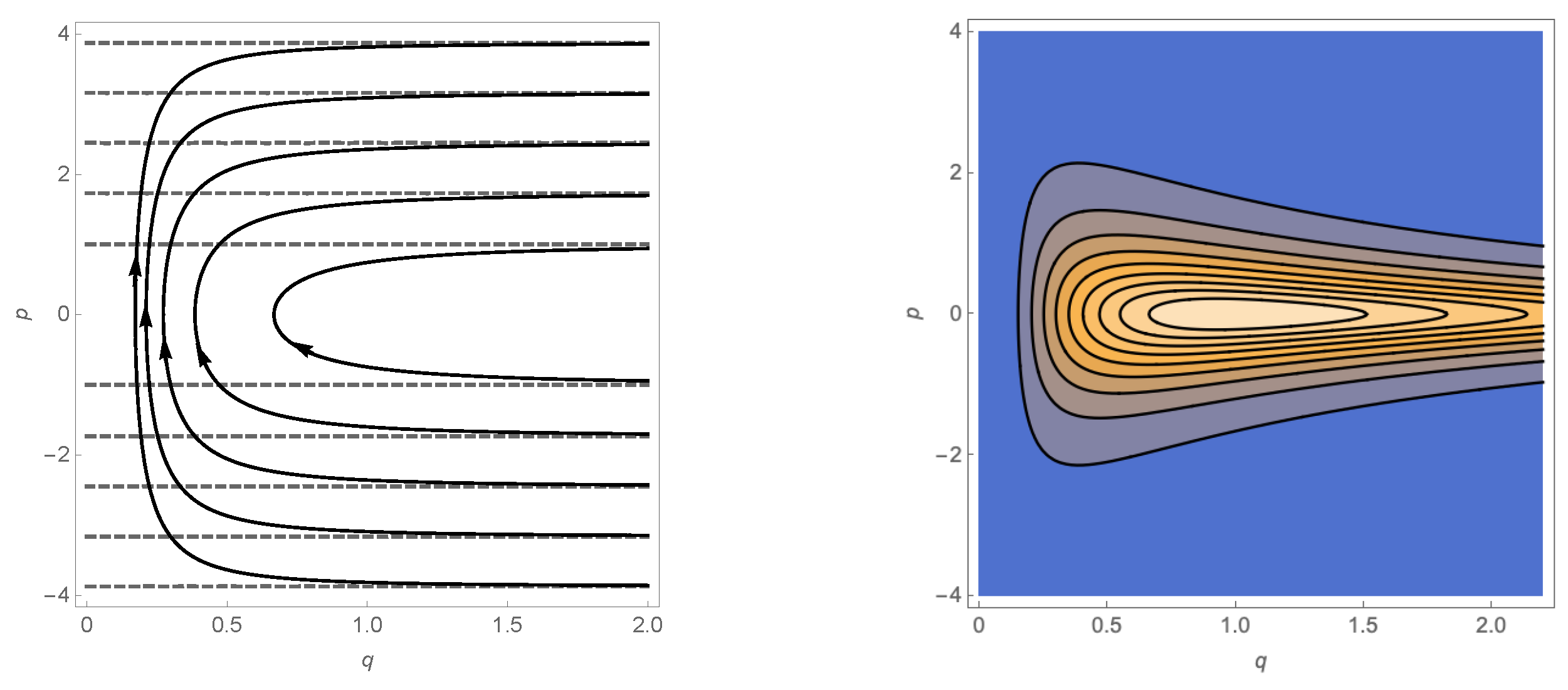
In
Figure 1, we use the fiducial vector (29) to plot a few semiclassical trajectories from the lower symbol of the Hamiltonian
, and the probability distribution for a coherent state
.
3.4. Exact Affine Coherent States
The affine coherent states discussed above not only define a quantization map but also give a practical way to study the semiclassical behaviour of the resulting quantum models through the Berezin transform (or lower symbol). For a free particle on the half-line—the simplest system relevant for quantum cosmology—generic affine coherent states approximate the evolution of expectation values of the basic variables quite well.
However, no choice of fiducial vector makes affine coherent states evolve in a simple parametric form under the Schrödinger equation. This limits how accurate their semiclassical description can be. In particular, while they often capture the average motion, they usually do not reproduce higher-order quantities such as dispersions. One idea for improving this is to let the fiducial vector evolve dynamically as well, but this approach has been shown to converge too slowly, and locally even move away from the correct quantum behaviour [
33].
A major step forward came with the results in [
34]. The key observation is that the Hamiltonian, the position-squared operator, and the dilation operator form a closed algebra, both classically and quantum mechanically; in fact, this algebra is
. Since the position-squared and dilation operators define a unitary irreducible representation of the affine group on the half-line, one can determine exactly when the Hamiltonian matches the generators of the affine group (up to suitable phase factors).
In [
34], this was turned into an eigenvalue problem for the fiducial vector and solved fully. The result is that if the fiducial vector
satisfies
with
then the affine coherent states
with their time-dependent phase factor, and with
and
following the semiclassical dynamics of
are exact solutions of the Schrödinger equation
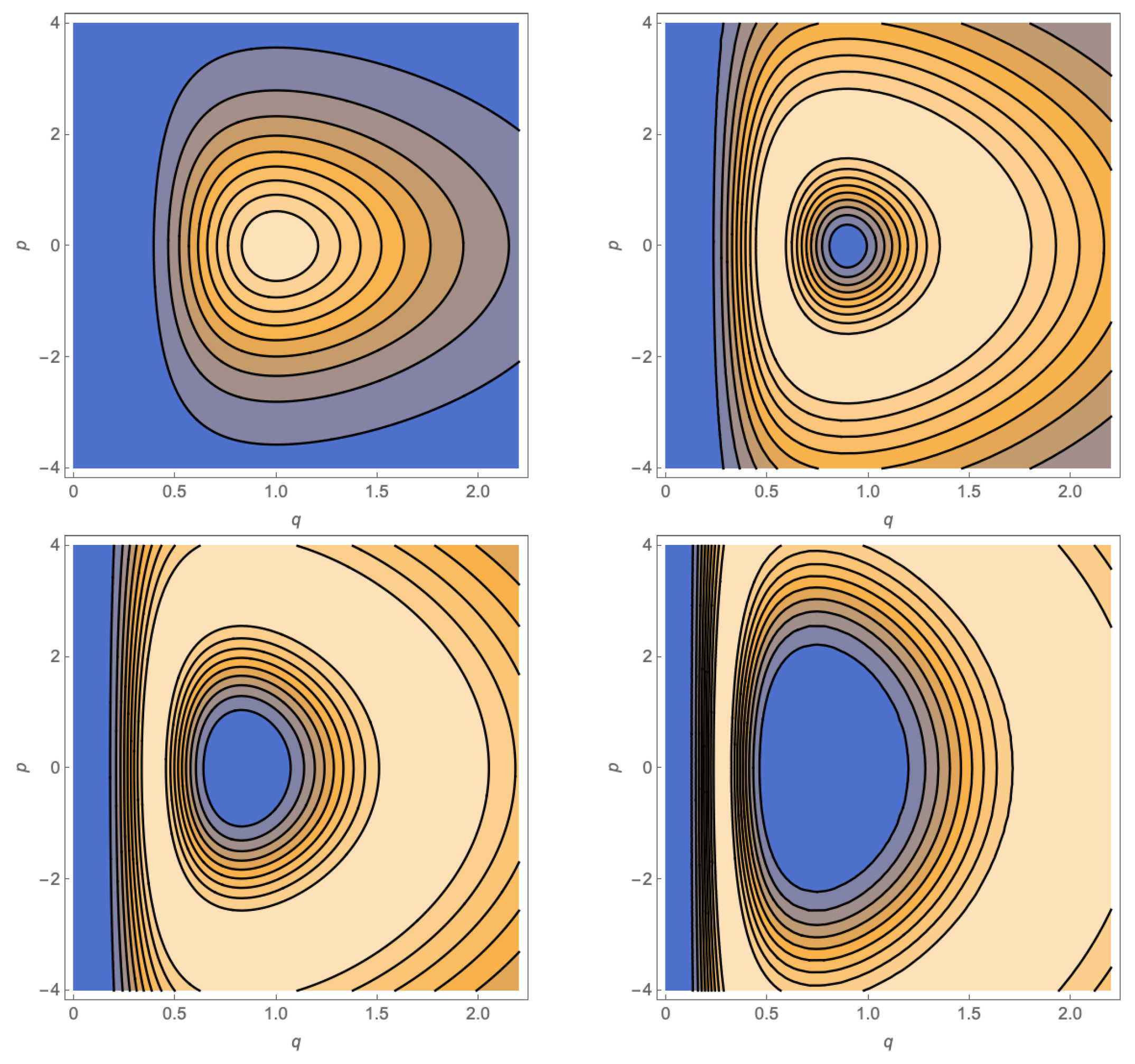
This construction produces infinitely many families of affine coherent states that reproduce the quantum “bounce” on the half-line exactly. Each family is labelled by an integer
n, which corresponds to the number of peaks in the position probability distribution.
Figure 2 shows examples of these phase-space distributions for the state
.
To sum up, the work of [
34] identifies infinitely many affine coherent-state families that evolve exactly according to the Schrödinger equation on the half-line. These states give a far more accurate semiclassical picture and reduce arbitrariness in the construction. They are particularly useful in quantum cosmology, where the positive variable represents the universe’s scale factor. In such models, understanding its regularized motion is key to exploring whether the big-bang singularity can be avoided—a topic we now address.
4. Affine Quantum Cosmology: Bouncing Models
In what follows, we apply the methods introduced above to study quantum models of the universe with the goal of speculating about the origin of cosmic expansion and the formation of primordial structure. We first discuss quantization of most common cosmological models—the Friedmann–Lemaître–Robertson–Walker (FLRW) models, which describe a homogeneous and isotropic universe. Then we turn to the Bianchi-type models, which describe homogeneous but anisotropic universes. All these classical models, unless coupled to exotic matter, suffer from an initial singularity—the big-bang singularity—where physical quantities such as curvature and density become infinite. Our main goal is therefore to develop quantized versions of these models that are free of the singularity, determine and explore the physics of their corresponding quantum solutions. We then turn to the perturbed FLRW universe with an infinite number of degrees of freedom and briefly discuss how the quantization of minisuperspace models extends to this case in a simple manner. A more complete quantization of the perturbed FLRW universe is presented in the next section. In what follows, the size and the expansion rate of the homogeneous universe are denoted by q and p, respectively.
4.1. Friedmann–Lemaître Models
In work [
35] we used affine coherent states to quantize FLRW models coupled to a perfect fluid.
Affine coherent-state quantization is not unique: it depends on the choice of fiducial vector, and therefore produces a family of quantum theories with free parameters rather than a single fixed model. However, these theories are qualitatively very similar because they all respect affine symmetry. As we argued in [
35], this freedom is not a drawback but an advantage—observations should ultimately determine the values of these free parameters.
In this framework, we quantized the Hamiltonian and other important observables, and studied their quantum dynamics using the fluid variable as an internal time. As shown in Equation (26), the affine coherent-state quantization of the kinetic energy—which represents the universe’s expansion energy—naturally generates a repulsive potential. This potential prevents the quantum state from reaching zero volume, removes the classical singularity, and ensures that the physical Hamiltonian is self-adjoint. As a result, the quantum dynamics is complete and mathematically well defined.
The resulting equations of motion can be solved analytically, and affine coherent states provide a powerful tool to study these solutions. In particular, they allow us to represent quantum states as probability distributions on phase space. This representation gives direct insight into how the universe avoids the singular state. Below, we briefly describe the dynamics of a closed FLRW universe filled with radiation (
and
), as studied in [
35].
In this case, the dynamics of the universe is periodic, and the Hamiltonian has a discrete spectrum, similar to that of the harmonic oscillator. The energy levels are
The corresponding eigenstates are
where
Here,
are the associated Laguerre polynomials [
36], and
is a normalization constant.
The evolution of quantum states is most naturally described in phase space. For a state
the phase-space representation is given by
where
q corresponds to the size of the universe and
p corresponds to the expansion rate. The corresponding time-dependent probability distribution follows directly from this expression.
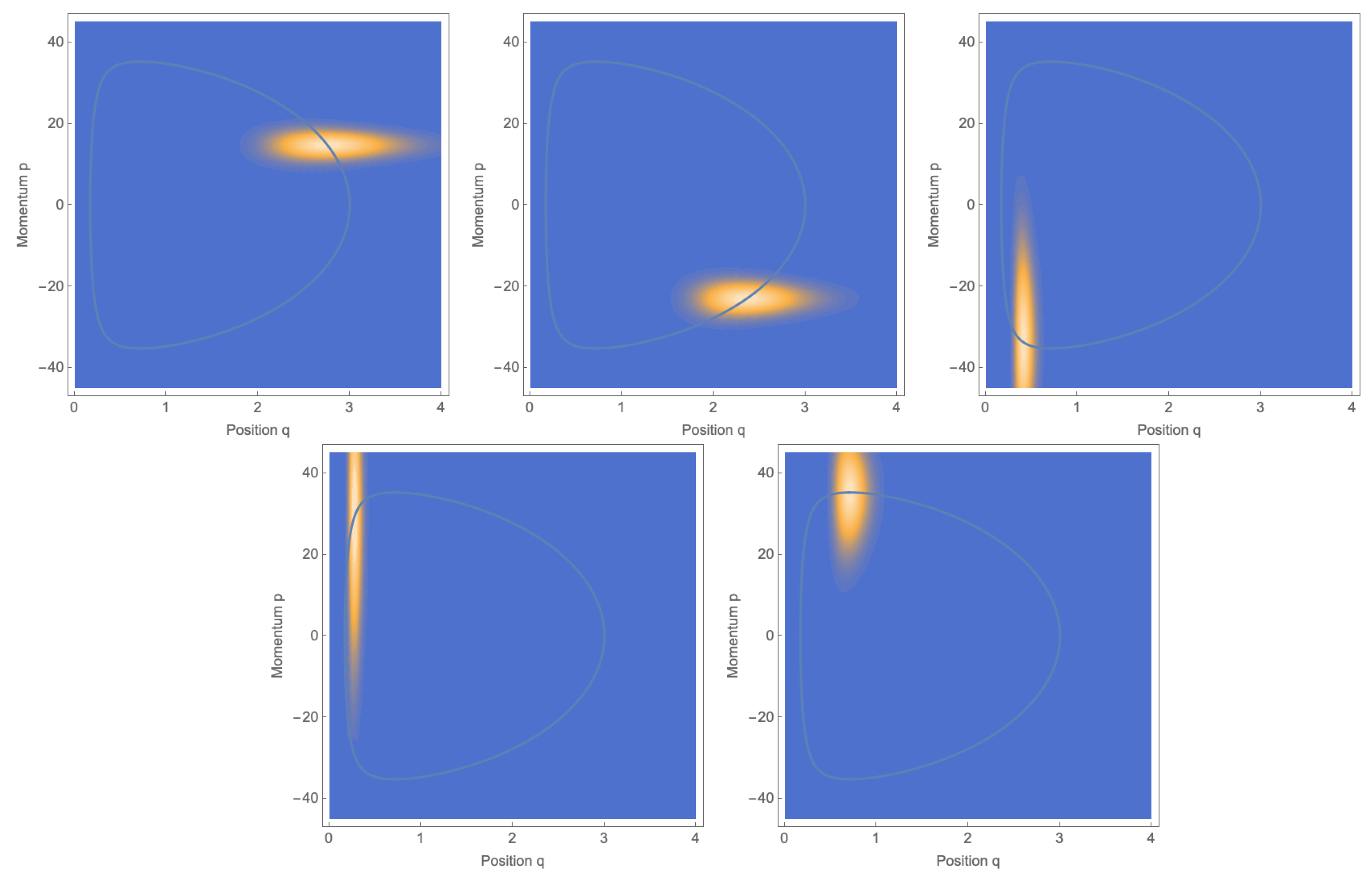
In
Figure 3, we show the non-stationary phase-space distribution for an initial state
, at several values of
T. Because this state is a superposition of many energy eigenstates, the universe exhibits semiclassical behavior. The wave function remains sharply peaked throughout the evolution. This peak can be tracked over time and used to define an effective trajectory in phase space.
Analytical solutions, however, are exceptional; most models require approximate methods. As discussed earlier, affine coherent states allow us to compute the lower symbols of classical observables, which encode the semiclassical behavior of the quantum theory. The lower symbol of the physical Hamiltonian makes it possible to approximate the quantum evolution using semiclassical trajectories in phase space. For many cosmological models, these trajectories offer a practical and transparent way to understand the underlying quantum dynamics.
4.2. Bianchi-Type Models
The subsequent works [
21,
37,
38,
39,
40,
41,
42,
43,
44] extended this methodology to less symmetric Bianchi-type models. These models allow the homogeneous universe to evolve anisotropically and thus introduce two additional degrees of freedom. In addition to the size
q and the expansion rate
p, one has the anisotropy variables
and
, together with their conjugate momenta
and
(the “shear”). Since these new degrees of freedom take values on the real line, they are naturally quantized using the Weyl–Heisenberg group, while the affine group remains the appropriate framework for quantizing the overall scale factor and its expansion.
4.2.1. Bianchi-I Universe
A particularly interesting mechanism for resolving the singularity in the simplest anisotropic spacetime—the Bianchi-I model coupled to a perfect fluid—was obtained in [
21]. The classical phase space contains two sectors, describing contracting and expanding solutions, separated by a region that is physically forbidden. This forbidden region, absent in the simpler isotropic models, indicates that anisotropic singularities are “stronger” and therefore harder to resolve.
Affine coherent-state quantization is an integral quantization method that can smooth out discontinuities in observables. In the Bianchi-I model, the boundary separating the physical and non-physical regions is such a discontinuity. By quantizing both the Hamiltonian and the physicality constraint,
one obtains a quantum Hamiltonian
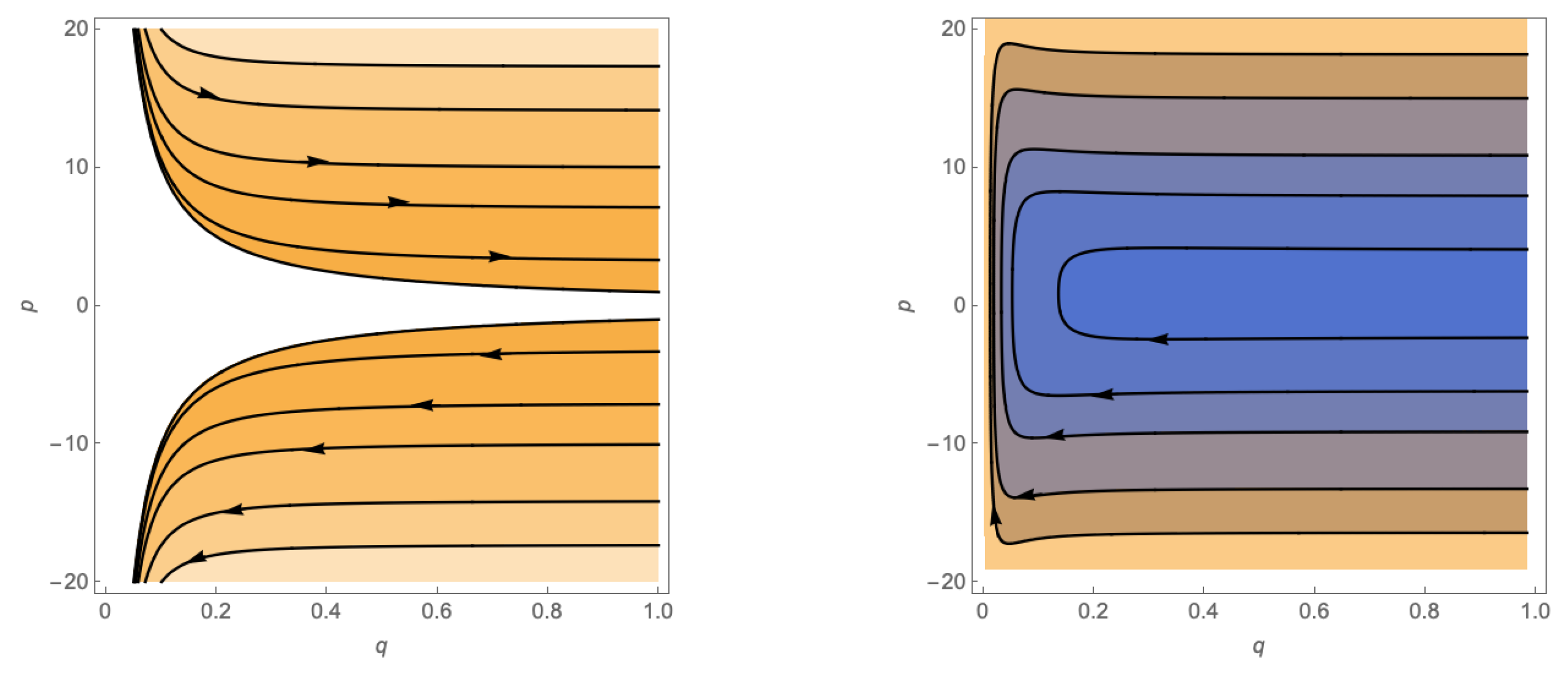
that includes non-local terms. Although the exact quantum dynamics is extremely complicated and not analytically solvable, the lower symbol of the Hamiltonian can be computed relatively easily, allowing one to derive semiclassical trajectories.
Figure 4 illustrates the resulting bouncing behavior: contracting trajectories tunnel through the classically forbidden region and re-emerge as expanding ones.
4.2.2. Bianchi-IX Universe
Works [
37,
38,
39,
40,
41,
42,
43,
44] develop and analyze a quantum theory of the Bianchi-IX model, also known as the mixmaster universe. Classically, this model approaches the singularity through an endless sequence of anisotropic oscillations: the universe’s volume shrinks, oscillates more and more rapidly, and finally collapses to a point in a finite proper time.
A key feature of this highly complex dynamics is the interaction between the isotropic and anisotropic degrees of freedom. Fortunately, it was shown that for many quantum solutions the Born–Oppenheimer (or refined Born–Huang) approximation can be reliably used, treating the anisotropies as light degrees of freedom [
37,
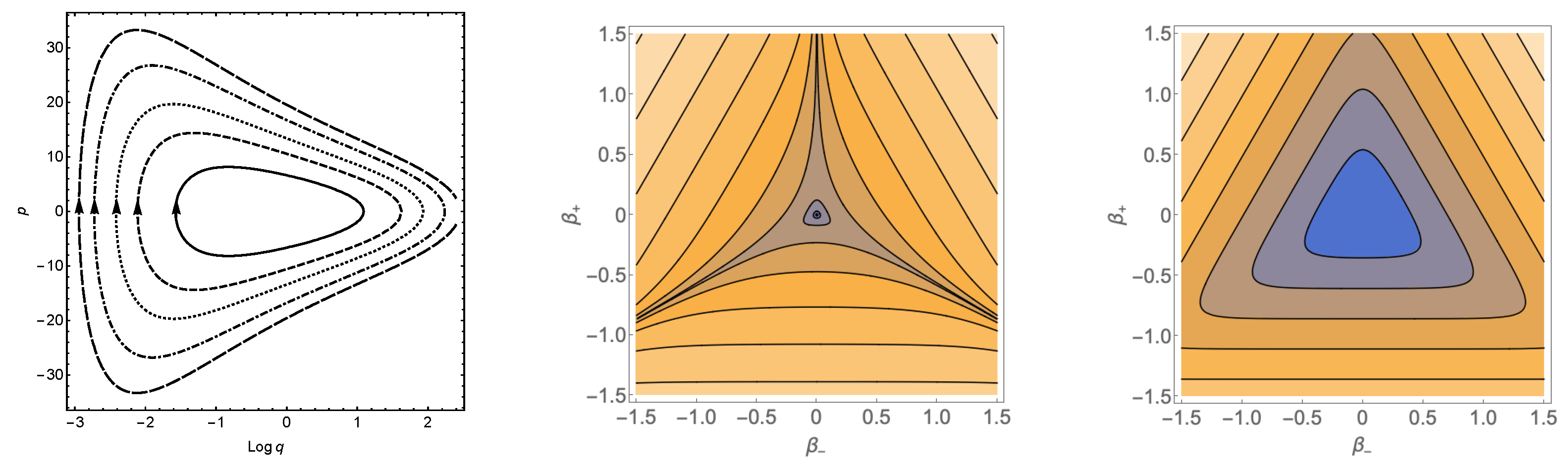
38]. In this regime, if the anisotropy is initially placed in its ground state (or a low-lying excited state in the vicinity of the phase space point
), it stays in that state throughout the contraction, bounce, and subsequent expansion of the universe (see
Figure 5).
However, the Born–Oppenheimer approximation fails for sufficiently “heavy” universes—those that reach very small volumes and correspondingly high contraction rates. In such cases, the anisotropic modes become unpredictably excited. To describe this regime, one uses the vibronic approximation, which accounts for transitions between anisotropy states [
39,
40]. It was found that a rapid contraction–bounce–expansion sequence can produce a significant number of such excitations. Because of energy conservation (the Hamiltonian constraint), this extra anisotropy energy then feeds into the isotropic dynamics and causes a substantial increase in the overall expansion rate.
This result motivated the hypothesis of an inflationary phase of purely geometric origin [
45]. To test this idea, however, one must go beyond the simplified harmonic approximation to the anisotropy potential
used in previous work [
41,
42]. That approximation made the vibronic analysis tractable, but it also produced unphysical behavior—namely, an unlimited growth of anisotropy excitations and, as a result, eternal inflation. In reality, the true anisotropy potential is more confining, suggesting that anisotropy production should be suppressed and that any geometric inflationary phase would last only a finite number of e-folds, consistent with cosmological expectations.
In [
44], we therefore analyzed the semiclassical mixmaster dynamics using the exact anisotropy potential—see
Figure 5 for the exact classical and quantum anisotropy potentials. We confirmed that anisotropy production is indeed suppressed but, contrary to earlier expectations, the excitation effect is actually too small to generate a sufficiently long period of accelerated expansion. The reason is that the exact potential is exponential and thus too steep to support a sustained slow-roll phase dominated by potential energy. This ultimately rules out the appealing idea of early-universe inflation driven solely by geometric anisotropy.
4.3. Perturbations in Bouncing Models
In Ref. [
46], the evolution of primordial gravitational waves on a quantized background was investigated. The central assumption was that the total wave function of the universe factorizes into a background part and a gravitational-wave part,
The background state was chosen to be the affine coherent state
(20), while the perturbative sector was described by a tensor product of wave functions in the mode amplitudes,
The quantum dynamics were obtained by minimizing the quantum action
where
T is the internal time used to deparametrize the Hamiltonian constraint, and obtain the physical Hamiltonian. The latter was derived up to second order. The zeroth-order part,
, is the FLRW Hamiltonian acting on the background variables (the scale factor and the expansion rate), whereas the second-order part,
acts both on the background variables through
and on the gravitational-wave variables
and
(the wave amplitude and its conjugate momentum).
Background quantum fluctuations enter
through the expectation value of the gravitational potential,
which replaces the classical potential
in the Mukhanov–Sasaki equation (i.e., the dynamical equation for
) and thus sources primordial gravitational waves.
This procedure leads to a semiclassical Mukhanov–Sasaki equation that incorporates background quantum fluctuations. In particular, these fluctuations:
generate a bounce in the background evolution via , regularizing the potential
modify the propagation speed of gravitational waves in very small universes through , making it slightly different from the speed of light.
The gravitational-wave evolution was solved analytically for a radiation-dominated universe, the mode functions
were determined, and the corresponding energy density was derived and analyzed. In Ref. [
46], the amplitude spectrum was obtained incorrectly due to an unjustified removal of the time dependence of the mode functions in the expanding branch. The issue was corrected in the subsequent work [
47]. Importantly, this mistake does not affect the present discussion, which relies only on the structure of the dynamics and not on the specific form of the amplitude spectrum.
This work represented the first attempt at constructing a consistent quantum field theory on quantum cosmological spacetimes using affine coherent states. It opened the way toward more complete formulations, including those based on multiverse states, described below.
A subsequent study [
47] refined the analysis of Ref. [
46] and examined how the primordial gravitational-wave power spectrum depends on the strength of background quantum fluctuations. It showed that these fluctuations strongly influence the dynamics near the bounce and can significantly suppress the primordial power spectrum.
5. Dynamics of a Perturbed Universe in a Multiverse State
In this section, we review recent results [
47,
48,
49] on the quantization of a perturbed FLRW universe. These works build on earlier approaches, but go beyond those presented in [
46,
47]. The key new idea is to drop the assumption that the wave function of the universe factorizes into separate background and perturbation parts. We then discuss the consequences of this more general framework.
We therefore consider the most general joint evolution of a homogeneous background universe and its perturbations. In this setting, the quantum-gravity state is generically entangled,
so that neither the background geometry nor the perturbations are in definite states. We call such a state a
multiverse state, since it has no classical counterpart. The
observed universe is assumed to correspond to a single branch of this multiverse state. However, interactions between different branches generically influence the primordial structure within each branch.
The complete dynamics of the system, up to second order, is governed by the Schrödinger-like equation
Here the physical Hamiltonian contains both the background (zero-order) and perturbative (second-order) contributions. The parameter
is the propagation speed,
k is a fixed wavenumber, and
is the Mukhanov–Sasaki operator describing the scalar perturbation degree of freedom.
The central point, emphasized in [
47,
48], is that these two parts of the Hamiltonian must be treated together. This automatically includes the backreaction of perturbations on the background. In the quantum theory, the second-order term also generates entanglement between background and perturbations, making tensor-product states unstable.
As a result, the dynamics generically produces multiverse states that cannot be written as tensor products. Since such states have no classical analogue, their interpretation requires selecting a single branch of the wave function, which effectively restores a product-state description. Nevertheless, the effects of entanglement remain encoded in the primordial structure within each branch and may, in principle, be observable. Affine coherent states provide a natural way to describe semiclassical branches and extract classical information from the full quantum state.
Equation (39) is difficult to solve because the background and perturbations evolve jointly and cannot be treated independently. In what follows, we present two complementary approaches: a coarse-grained approach and a perturbative approach. Both rely on approximations.
The coarse-grained approach restricts attention to a relevant subspace of the Hilbert space. This subspace captures the dominant dynamics of a factorized initial state evolving into a superposition of distinct branches. In contrast, the perturbative approach retains the full Hilbert space. It focuses on the perturbation state associated with a given background, assuming that the influence of all other branches can be treated perturbatively at leading order.
The two approaches are complementary. The coarse-grained approach selects a finite set of background states from a continuum of possibilities. It is therefore qualitative, but it makes explicit how the off-diagonal terms of the Hamiltonian generate entanglement between branches. The perturbative approach, by contrast, keeps the full continuum of states, but captures their effect only at leading order on the perturbation state associated with a given background.
In the absence of a clear interpretational framework for “multiverse states,” these approaches can also be viewed as two complementary points of view.
5.1. Coarse-Grained Approach
In the coarse-grained approach [
48], the perturbation states
are taken to be time-dependent product-state solutions associated with the respective background solutions
, and they satisfy
where
is the propagation speed of the perturbation,
k is a fixed wavenumber and
evolves under
.
Starting from the product state
the subsequent evolution is determined numerically and generically leads to a multiverse state of the form
where the coefficients
satisfy the equation of motion [
48]
where the indices in
refer to the background and perturbation sectors, respectively. The matrices
M and
S are given by overlaps between the background states and the perturbation states, respectively,
During the evolution, new background branches with are dynamically generated, and the perturbation state on the original branch becomes modified and non-Gaussian. This non-Gaussianity arises from the superposition of Gaussian perturbation states with different variances. Both effects are direct consequences of the entangled dynamics.
It is conjectured that, to follow the dynamics of a selected branch and its perturbation state, it may be sufficient to consider only a finite number of background and perturbation states. In [
48], a concrete example is constructed by truncating the Hilbert space to two background states,
and
, and two perturbation states,
and
. We refer to this setup as a
biverse. A numerical example presented in [
48] shows that the product state (41) indeed evolves into two branches with distinct and non-Gaussian structures.
5.2. Perturbative Approach
A complementary description of multiverse dynamics was developed in [
49]. This approach uses perturbation theory around a chosen product state with a preferred semiclassical background
. It assumes that the universe initially occupies a product state and then interacts perturbatively with a set of
virtual background states. This interaction modifies only the perturbation state within the selected branch.
Starting from the product state
the exact evolution reads
The operator
evolves the product state (44) according to Equation (40), while
generates the full evolution defined in Equation (39). We compute a perturbative expansion of the interaction picture evolution operator
and find that the leading correction appears at second order in the gravitational potential
. Besides their semiclassical interpretation, affine coherent states provide a practical computational tool for evaluating higher-order corrections via phase-space integrals such as
which can be computed explicitly in the coherent-state framework.
This perturbative scheme makes it possible to calculate leading-order corrections to the
n-point functions of primordial perturbations. First, the multiverse state is projected onto the predetermined semiclassical background branch
:
and then correlation functions of the form
are evaluated, from which the connected parts are extracted.
In particular, Ref. [
49] shows that multiverse dynamics generates a trispectrum, i.e., a non-Gaussian contribution to the four-point function, with a specific and characteristic shape. Its Fourier decomposition consists of parallelograms formed by two pairs of oppositely directed wave vectors. This configuration appears to differ from the standard shapes discussed in the literature (see, e.g., [
50,
51,
52,
53,
54,
55]). It is not associated with a bispectrum, which vanishes in this framework; the shape function is highly nonlocal and vanishes outside the parallelogram configurations.
Multiverse dynamics therefore has the potential to yield clean and testable predictions for primordial cosmological structures. 6. Dynamics of a Perturbed Friedmann Universe in a Biverse State
In this section, we present new results on the multiverse framework described above. We study a quantum cosmological model that incorporates interactions between different background states in a non-perturbative manner. The system is restricted to two background states and two perturbation states, i.e., the biverse. This basic framework has been derived in [
48] where the dynamics was briefly illustrated with a single numerical simulation showing the development of entanglement between the two background states. In what follows, we investigate this framework in more detail by performing a series of new numerical simulations and identifying some basic properties of the biverse dynamics that have not been discussed before.
6.1. Preliminaries
We will perform new simulations for the biverse model. To this end, we introduce the parameters used in this model. The following definitions come from our previous work [
48].
For a fluid-filled perturbed universe, the Schrödinger-like Equation (39) reads
where the background Hamiltonian
corresponds to the exactly solvable model (32), with
. The coefficient
K controls the strength of the repulsive potential shielding the singularity at
. The gravitational potential operator is defined as
where
w is the barotropic index and
is the self-adjoint dilation generator. The operator
denotes the perturbation mode with wavenumber
k, and
is the fluid-based conformal time.
To solve this equation, we use exact affine coherent states introduced in Equation (31), denoted here by
. These states satisfy the background equation of motion,
For each background state
, we construct a corresponding time-dependent perturbation state
satisfying
where
k is fixed.
We seek solutions of the full Equation (49) using the ansatz
where two background affine coherent states are selected together with their corresponding perturbation states. The dynamical equation, obtained by applying the Equation (49) to this family of states and projecting onto the Hilbert space spanned by them, was derived in [
48] and, upon identifying
, is given by Equation (43). In this case, the overlap matrix
M reads [
34,
48]:
where
is defined below Equation (30). The overlap matrix
S is time-dependent and is computed numerically.
6.2. New Simulations
We now present a set of numerical integrations of multiverse dynamics in the minimal biverse setup, with a single perturbation mode and two background states. This is the simplest setting in which such dynamics can be studied. In [
48] only a single example was presented; here we provide a broader set of simulations and analyze how the dynamics depends on the system parameters.
In all simulations, the universe begins in a contracting phase in a well-defined background state
, with the perturbation mode
in its ground state
. Thus,
We fix the strength of the repulsive potential to
and the barotropic index
. The results do not qualitatively depend on this choice, except in the case
, which is singular in the sense that it causes the gravitational potential (50) to vanish. We vary:
the background energies and ,
the time delay between their bounce times (with the first bounce at ),
the perturbation wave number k.
We study how the amplitudes
depend on these parameters. Their interpretation follows from the ansatz (53): each
describes how a perturbation state associated with one background branch appears in another. More precisely, under assumptions discussed below in
Section 6.3,
measures the amplitude of a structure induced in branch
by the dynamics associated with branch
. In all simulations, deviations from unitarity remain negligible compared to the induced amplitudes.
In
Figure 6 we show the evolution of two branches with energies
and
(in natural units), and a fixed bounce delay
. We consider perturbation modes with
,
, and
.
The system quickly evolves into a superposition of two branches, which are further modified near the bounce. Two distinct mechanisms can be identified. First, at early times, the amplitudes grow due to the nonvanishing overlap between the semiclassical background states. Second, near the bounce—where the gravitational potential is largest—the amplitudes are further amplified. Since the coherent states are not exactly orthogonal (), the coefficients only approximately correspond to distinct branches.
The most relevant information is contained in the behavior of near the bounce and in their asymptotic values. After the bounce, the amplitudes stabilize, indicating that the branches effectively decouple and carry a fixed primordial structure.
Figure 6 shows that the perturbation state
is only weakly imprinted on the
branch. In contrast, the emergence of the
branch is more pronounced and is mainly accompanied by the perturbation state
. This pattern appears in all cases. A possible explanation is that although both perturbation states initially coincide, they quickly diverge and their overlap becomes small. As a result, the interaction is dominated by the structure present in the initially dominant branch. We leave a detailed analysis of this mechanism for future work.
We also observe that the induced amplitudes increase for smaller values of k, i.e., for longer wavelengths. This can be understood as a longer interaction between long-wavelength modes and the gravitational potential.
In
Figure 7 we vary
while keeping
and
. As
approaches
, the overlap between the background states increases (
). This enhances both the initial overlap-driven growth and the interaction near the bounce, leading to larger final values of
. This helps identify which branches are dynamically relevant in more realistic models.
In
Figure 8 we vary the bounce delay
. As the bounce times approach each other, both the overlap and the interaction strength increase (
), again resulting in larger final amplitudes. This reflects stronger coupling between branches when their bounces occur close in time.
6.3. Discussion
The results above point to two main mechanisms governing the evolution of the amplitudes . First, branches that are closer in their semiclassical properties interact more strongly. Second, long-wavelength perturbations dominate the coupling between branches. These observations will be useful when constructing more realistic models, which should include a larger number of background and perturbation states.
Because the background states are not exactly orthogonal, the coefficients only approximately describe distinct branch universes. This makes their physical interpretation less direct. In particular, we observe a residual evolution of even before the gravitational potential becomes relevant. This effect originates from the nonvanishing overlap between the background states. Moreover, selecting a single branch as the observed universe is not equivalent to a simple projection. We now discuss these two issues.
Consider first the dependence on the choice of background states. Even if different choices span the same two-dimensional subspace, they lead to different perturbation states through Equation (52). As a result, the coefficients depend on this choice and cannot be directly compared across different bases. In general, the overlap between non-orthogonal background states leads to a residual evolution of even in the absence of the gravitational potential. Although choosing orthogonal states eliminates this residual effect, it does so at the expense of the parametric evolution of the background states and their semiclassical interpretation.
The physically relevant mechanism of entanglement between geometry and perturbations is driven by the gravitational potential. This effect cannot be removed by any choice of basis. As seen in the simulations, we clearly observe two distinct stages. First, the overlap-induced evolution quickly saturates, and become approximately constant. Then, near the bounce—where the gravitational potential is largest—the coefficients are strongly amplified before stabilizing again. This shows that the dominant contribution to comes from the non-diagonal terms of the gravitational potential acting near the bounce.
The second issue concerns the interpretation of a single branch. Since the background states are not orthogonal, projecting onto one branch necessarily introduces a small admixture of the other. For example, projecting onto
yields
where
. This leads to a more complicated interpretation of
. However, since
in our examples, the correction terms are small:
and
. One can therefore approximate the state by neglecting
and
, and interpret
and
as the amplitudes of the dominant Gaussian and subdominant non-Gaussian contributions within a single semiclassical branch.
In more realistic models, additional (unobserved) perturbation modes would further suppress the overlap between branches. This is the standard cosmological decoherence mechanism.
In future work, we will refine the definition of the amplitudes in order to reduce the contribution from overlap-induced effects and improve their physical interpretation. Nevertheless, some ambiguity appears unavoidable as long as one works with semiclassical background states.
7. Related Approaches
To place our affine quantum cosmology program in a broader context, we briefly mention some related approaches. We only highlight a few similarities and differences. The discussion is necessarily limited, as each of these approaches is a large research field.
The Wheeler–DeWitt equation [
17] has been widely studied in symmetry-reduced cosmological models. Early work by Misner showed that singularities may persist in the quantum theory [
56]. Some later studies have obtained nonsingular solutions in various settings (see, e.g., [
57,
58,
59,
60]). The main ambiguities of the Wheeler–DeWitt framework come from the choice of basic variables, factor ordering, and the choice of internal time. In Ref. [
61], it was argued that singularity resolution may require choosing an internal time that remains finite at the classical singularity. This led to the distinction between slow and fast gauge clocks.
Affine quantum cosmology can be viewed as a particular realization of the Wheeler–De-Witt framework. It typically uses a formulation with a fast-gauge clock, in which the Hamiltonian constraint is linear in the clock momentum (leading to the Schrödinger-like Equation (39)). The use of affine coherent states in quantum gravity was proposed by Klauder (see, e.g., [
30,
62,
63,
64] for early cosmological applications). This approach is naturally suited to variables with non-canonical ranges, such as positive-definite metric components. In cosmology, affine quantization can be interpreted as selecting a specific factor ordering. A key advantage is that it leads to a self-adjoint Hamiltonian and unitary dynamics, avoiding the need to impose additional boundary conditions. Such conditions have been widely debated in the Wheeler–DeWitt context, for example in the no-boundary [
65] and tunneling [
66,
67] proposals.
The Wheeler–DeWitt equation is often viewed as a low-curvature limit of a more fundamental theory. A leading candidate is Loop Quantum Gravity (LQG) [
68]. Its implementation in cosmology is known as Loop Quantum Cosmology (LQC). A central result of LQC is the replacement of the big-bang singularity by a quantum bounce [
69,
70]. The mathematical structure of LQC differs significantly from the present approach. In particular, geometric operators have discrete spectra, and connections are represented through holonomies.
In effective LQC models, the bounce occurs when the energy density reaches a value close to the Planck scale [
71]. In contrast, in affine quantum cosmology the bounce scale depends on the state and can occur at different energy densities. Despite these differences, the LQC dynamics reduces to the Wheeler–DeWitt equation in the large-volume, low-curvature limit [
72]. This suggests that affine quantum cosmology, being closely related to the Wheeler–DeWitt framework, may provide a coarse-grained description of an underlying discrete geometry, as realized in LQC.
A natural question is whether the large-volume limits of both approaches correspond to the same classical solutions. Addressing this would require a detailed comparison, for example in anisotropic models. This is beyond the scope of the present discussion.
Another possible difference concerns the evolution of perturbations. Since perturbations are sensitive to the bounce, the two approaches may lead to different predictions. However, a direct comparison is difficult because additional assumptions differ. In LQC, perturbations are typically initialized at the bounce, and inflation generates the observed spectrum [
73]. In affine quantum cosmology, initial conditions are set in a large contracting phase, and amplification occurs during contraction as modes exit the Hubble horizon.
Effective descriptions play an important role in quantum cosmology, since exact solutions are rarely available. In LQC, one approach replaces the Hilbert space with an infinite hierarchy of moments of basic observables [
74]. Truncating this hierarchy provides a practical approximation and captures the effects of quantum fluctuations.
In affine quantum cosmology, effective dynamics is described using affine coherent states. These states provide a simple approximation to the quantum evolution and usually reproduce the behavior of basic observables quite well. They depend on a choice of fiducial vector, which introduces some freedom into the construction. In principle, this freedom can be used to improve the approximation, for example by treating the parameters of the fiducial vector as dynamical and determining them variationally [
33]. However, in the example studied there, introducing additional parameters did not improve the accuracy of the results. For this reason, this direction was not pursued further, especially after exact coherent states for the core bounce model were found in [
34] (see
Section 3.4).
8. Conclusions
In this review, we have summarized a coherent-state and affine quantization program applied to quantum cosmology. This framework provides a geometrically adapted quantization scheme for systems with nontrivial phase-space structure, in particular those involving positive-definite variables such as the cosmological scale factor. A central outcome is a generic resolution of cosmological singularities: classical big-bang singularities are replaced by a quantum bounce generated by a repulsive potential term arising from the quantization procedure. The resulting dynamics is governed by self-adjoint Hamiltonians and admits a transparent semiclassical description in terms of affine coherent states, allowing for a phase-space interpretation of quantum evolution.
These methods have been applied to a range of cosmological models, including Friedmann and Bianchi spacetimes, where they consistently yield nonsingular dynamics and provide insight into the role of anisotropies and their backreaction. They have also been extended to include perturbations, leading—under the assumption of a factorized state—to a semiclassical description of quantum fields propagating on a quantum-corrected background.
More recently, the framework has been generalized to allow for non-factorizable quantum states of geometry and perturbations, giving rise to so-called multiverse states. These states, introduced in earlier work, describe the universe as a superposition of semiclassical branches whose dynamics is intrinsically entangled.
The new element presented in this review is a numerical investigation of this multiverse dynamics within a simplified setting. Specifically, we have analyzed the biverse model—previously defined in the literature—by performing a systematic study of its dynamics for different parameter choices. Our results clarify how an initially factorized state evolves into a superposition of branches and how the coupling between them depends on quantities such as wavelength, energy separation, and relative bounce timing. In particular, we find that the dominant interaction occurs near the bounce and that long-wavelength modes play a key role in mediating branch coupling.
These findings provide a first step toward a more detailed understanding of multiverse dynamics in quantum cosmology. They indicate that even in simplified models, entanglement between background and perturbations can lead to nontrivial modifications of semiclassical evolution. Extending this analysis to more realistic settings and identifying potential observational signatures remain important directions for future work.
In closing, we express our sincere appreciation to Prof. Jean-Pierre Gazeau, whose work has significantly influenced the development of coherent-state and integral quantization methods, and we look forward to his future contributions to this active and evolving field.