1. Introduction
The need to model and effectively manage uncertainty inherent in many interdisciplinary problems has led to the development of various theoretical frameworks, such as Probability Theory, Fuzzy Sets [
1], and rough sets [
2]. These approaches have made significant contributions to the literature by addressing different aspects of uncertainty and have been widely applied, particularly in data analysis and decision-making processes. In this context, soft set theory, proposed by Molodtsov [
3], provides a complementary framework by allowing objects to be represented through freely chosen parameters. Although soft set theory offers considerable flexibility in handling uncertainty due to its parametric structure, it does not directly take into account attribute-based perceptual similarities among objects.
On the other hand, the descriptive near set approach developed by Peters [
4,
5] provides a strong mathematical foundation for modeling perceptual indiscernibility by analyzing similarities among objects through their attribute values. Nevertheless, this approach does not incorporate the flexible representational capability provided by parametric structures. In this respect, the present study proposes a near soft set (NSS) framework that integrates the parametric expressive power of soft sets with the perceptual similarity-based approach of near sets. Through the integration of the concept of Nearness Approximation Spaces (NASs), this hybrid structure enables uncertainty to be modeled simultaneously through parameterization and through descriptive nearness relations among objects, thereby providing a more comprehensive and flexible analytical framework for complex decision-making problems.
In order to better understand the theoretical foundations of this integrated approach, the development and application areas of soft set theory and near set theory are considered, respectively. In this direction, the operational capabilities of soft set theory were first applied to decision-making problems by Maji et al. [
6]; however, the mathematical inconsistencies in the parameter reduction methods involved in that study were later resolved by Chen et al. [
7,
8] using the principles of rough set theory. In the subsequent process, soft set theory was integrated with hybrid structures and reached a broad range of applications. In the literature, the recognition of soft information patterns [
9], the analysis of symptom co-occurrence in disease diagnosis [
10], granulation strategies [
11], and real-life applications such as bank interview processes [
12] are among the pioneering examples of this development.
This developmental process of decision-making mechanisms gained momentum with the Uni-Int function proposed by Çağman and Enginoğlu [
13,
14]; this approach was later extended to int
m-int
n schemes by Feng et al. [
15] and to soft discernibility matrices by Feng and Zhou [
16]. In recent years, soft set theory has become an indispensable analytical tool in complex uncertainty scenarios, and various approaches such as N-soft topologies [
17], max-min average methods in medical diagnosis [
18], Bonferroni operators [
19], and soft expert structures integrating expert opinions [
20,
21,
22,
23] have contributed to this development.
In the process of theoretical maturation, the algebraic foundations of soft set operations were first established by Maji et al. [
24]; however, it was observed that the universal validity of classical operations remains limited in certain cases, which has led to the development of restricted and extended variants [
25,
26]. The theoretical framework was enriched by De Morgan laws [
27] and MV-algebras [
28], while inconsistencies related to symmetric difference and distributive laws were eliminated through critical revisions [
29,
30,
31]. Studies on soft subsethood and equality relations corrected earlier formulation errors [
32,
33], paving the way for the development of more comprehensive notions such as soft J-equality [
34] and relaxed operations [
35,
36,
37]. The theoretical development matured through the formulation of restricted and extended intersection, union, and difference operations that explicitly address discrete parameter cases and are supported by proofs based on function equality [
38,
39,
40].
At the core of soft set-based decision-making processes lie the AND and OR product operations, which enable the aggregation of multi-parameter information. Feng and Li [
41] related soft subset forms to these product operations and revealed rich algebraic structures such as semigroups and semirings. This framework was further developed through comprehensive analyses of the AND-product by Sezgin et al. [
42] and of the OR-product by Orbay et al. [
43]; under M-equality, the family of soft sets was shown to form commutative semirings with identity elements. Today, this operational structure has reached a strong theoretical and practical reference framework through the definition of soft difference-product [
44] and enhanced AND-operators. Among the recent developments is the soft union-star product proposed by Durak and Sezgin [
45], which is a group-theoretic operation defined on parameter spaces having an internal group structure. This structure preserves fundamental properties such as closure, associativity, commutativity, and idempotency, while also maintaining compatibility with generalized soft subset and equality notions.
On the other hand, near set theory, introduced by J.F. Peters in 2002 as a generalization of rough set theory, has provided an original framework, particularly for the mathematical modeling of perceptual similarities among objects [
5,
46]. The conceptual foundations of the theory are rooted in image analysis and pattern recognition problems and are based on the notion of perceptual nearness developed together with Pawlak. The philosophical background of this approach was shaped by the perceptual perspective presented in the study entitled “How Near”, written in 2002 and published in 2007 [
47]. Peters [
5] showed that objects possessing similar features can be regarded as perceptually near to one another and that, accordingly, the universe can be reconstructed on the basis of available information. This approach was further advanced by Peters and Wasilewski [
48] within the context of information science, where it was demonstrated that nearness relations play a central role in modeling perceptual information systems and object classification. From an application-oriented perspective, Peters [
49] developed the notion of tolerance near sets, thereby introducing a quantitative approach grounded in human perception to image matching and classification problems; moreover, the nearness measure proposed by Henry–Peters [
50,
51] made it possible to determine similarities between images.
The application of near set theory to algebraic structures began in 2012 with the study of İnan and Öztürk on groups and semigroups in nearness approximation spaces, marking a turning point in the development of this area [
52,
53]. Following these studies, Bağırmaz [
54,
55] investigated ideals and approximate structures on near semigroups, while Davvaz and collaborators [
56,
57] extended this theory to ring and module structures, thereby broadening the scope of the algebraic framework. In 2019, Öztürk and his co-authors defined near rings and
-semigroups on weak nearness approximation spaces and obtained fundamental results concerning the prime ideals of these structures [
58,
59,
60]. These developments enabled the systematic construction of nearness-based algebraic structures. Subsequently, the near
d-algebras defined by Öztürk in 2021 introduced a new perspective into the literature, and the theoretical foundations of these structures were examined in detail [
61]. In recent years, studies have focused on more complex and generalized algebraic structures. In particular, during the 2022–2023 period, Mostafavi and Davvaz investigated hyperstructures such as near polygroups, near semi-hypergroups, and Krasner hyper-rings, and systematically examined their fundamental properties [
62,
63,
64]. In addition, applications of the nearness approach to Cayley graphs were demonstrated, thereby revealing the combinatorial and graphical aspects of the theory [
65]. As of 2024, the literature has been substantially enriched by advanced notions such as normal substructures in near groups [
66], the concept of modulo and near cosets [
67], and ordered near semigroups [
68]. In the most recent studies, Jokar and Davvaz [
69] extended the notion of near approximation to lattice structures by presenting new characterizations in the context of upper and lower rough ideals; they also further expanded the theoretical framework on quotient
-near rings and ordered
-near semigroups [
70].
The interaction between soft set theory and near set theory was initially addressed through structures proposed on the basis of integrating soft sets with rough sets, and this approach was brought into a systematic framework through studies presented in the relevant literature [
33]. In this direction, the ensuing theoretical development paved the way for the emergence of hybrid structures integrating the parametric flexibility of soft sets with the perceptual sensitivity of near sets; eventually, the concept of NSSs emerged in the literature as a natural consequence of this need [
71,
72].
Studies on NSSs have rapidly expanded into different areas. In this context, in line with the algebraic development of NSSs, structures serving as a basis for continuous transformations were developed through binary operations defined on nonempty near soft elements; in particular, near soft elements and near soft topological groups were defined [
73]. On the other hand, recent studies clearly demonstrate the application power of NSSs, showing that these structures are effectively employed in areas such as bipolar near soft sets used in multi-criteria decision-making problems [
74] and advanced near-soft matrix-based cryptosystems designed to ensure the secure transmission of hidden information [
75].
In modern decision-making processes and pattern recognition problems, the modeling of uncertainty in data and the analysis of perceptual nearness among objects have generally been treated independently. While soft set theory, developed by Molodtsov, offers significant flexibility in representing uncertainty through its parametric structure, near set theory, developed by Pawlak, Henry, and Peters, focuses on the classification of objects based on attribute-based similarities. Nevertheless, the absence of an integrated framework combining the advantages of these two approaches leads to significant limitations in complex and multi-dimensional decision-making problems.
In this context, the following main gaps stand out in the literature:
Lack of Parametric Perception: Classical soft set models are successful in representing objects through parameters; however, they lack a nearness measurement mechanism capable of quantitatively evaluating the perceptual similarity among objects under these parameters. This situation leads to similar but not exactly overlapping alternatives being overlooked.
Limitation of Static Classification: Although near set theory can effectively model attribute-based similarities, it cannot provide the parametric flexibility required for multi-criteria and dynamic decision-making processes. This deficiency makes it difficult to integrate varying criteria across different decision contexts.
Operational Insufficiency: The AND and OR product operations defined on soft sets do not take into account perceptual overlap among objects during the aggregation of multi-parameter information. This may lead to information loss and reduced decision quality, particularly in high-sensitivity applications such as image processing and medical diagnosis.
Original Value of This Study: This study advances the NSS model to a higher theoretical level by integrating the perceptual nearness measure developed by Henry and Peters with the parametric structure of soft sets. In particular, the proposed AND and OR product operations not only enable data aggregation but also aim to preserve the perceptual consistency of the resulting structures. In this way, during the integration of different information sources (e.g., different expert opinions or different image processing outputs), attribute-based similarities among objects are mathematically preserved through the Nearness Measure (NM).
Contributions of the Study. The main contributions of this study can be summarized as follows:
AND and OR product operations on near soft sets are formally defined under nearness approximation spaces;
It is shown that the proposed near soft products preserve fundamental algebraic properties such as idempotency and absorption laws;
The concept of perceptual nearness is directly integrated into the soft product structure, thereby enabling similarity-based decision-making;
The boundary frequency indicator is introduced for the quantitative evaluation of participation in uncertainty;
An improved Uni–Int decision-making mechanism based on lower and upper near approximations is proposed;
The computational complexity of the proposed framework is analyzed, and its scalability for large-scale datasets is demonstrated.
2. Preliminaries
In this section, we present the fundamental definitions and terminology related to near sets and soft sets, which constitute the mathematical foundation of this study. By reviewing the structural properties of nearness approximation spaces and parameterized families of sets, we establish the necessary background for the development of the near soft set framework.
2.1. Near Sets
In this subsection, we recall the fundamental concepts and notations of near set theory introduced in [
4,
5].
Definition 1 (Characteristic of an Object). The characteristic of an object O is a mapping defined by
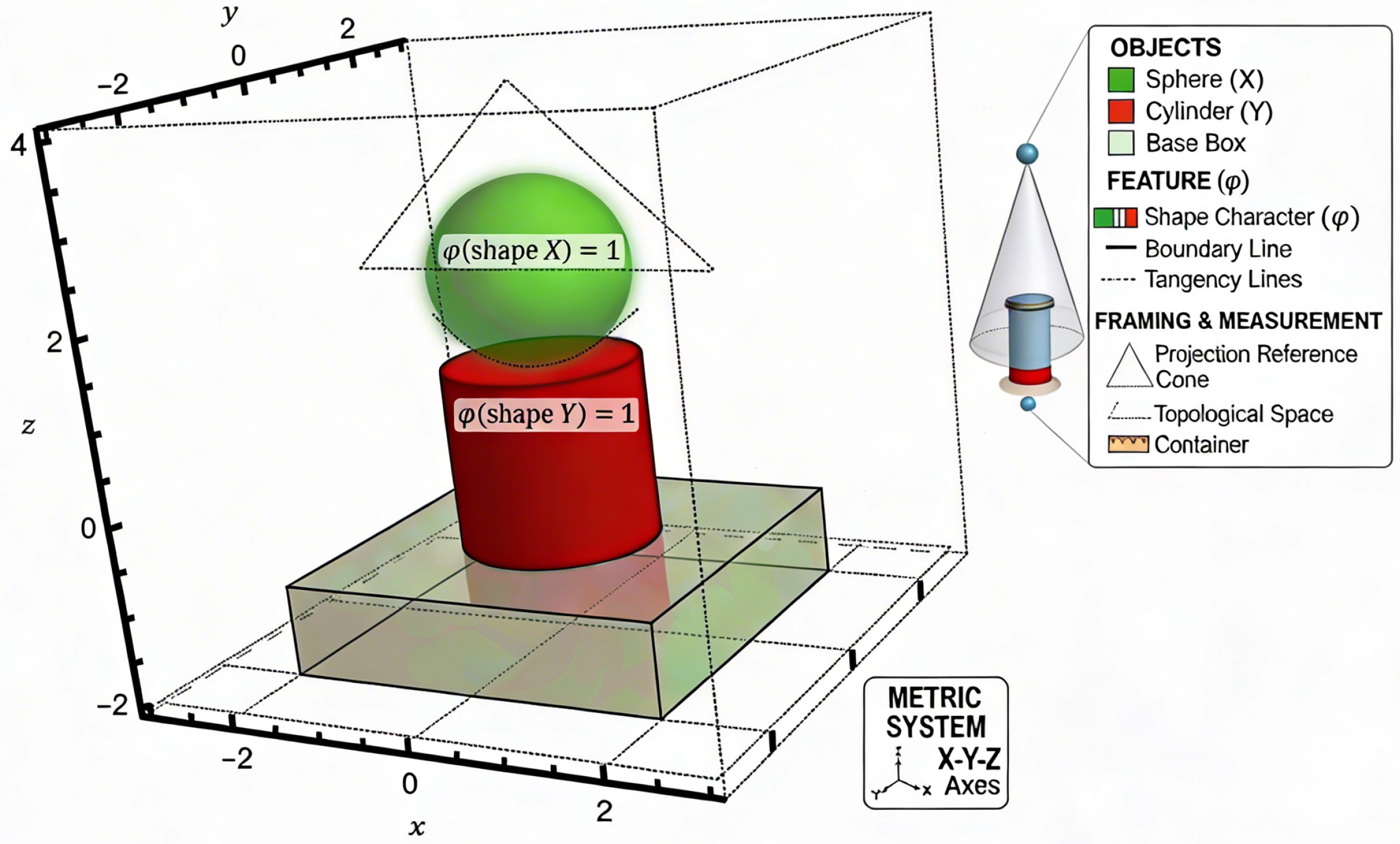
Definition 2 (Characteristically Near Shapes). Let be a set of characteristics of shapes . A pair of shapes are characteristically near, provided
Example 1 (Characteristically Near Shapes). Assume that both shapes in Figure 1 have the following characteristic: Hence, shapes in Figure 1 are characteristically near. The characterization of an object depends on both the quantity and the quality of the available information obtained through a collection of probe functions that measure object characteristics. Each object is described by a feature vector , whose components are determined by a selected subset of features.
Let denote the set of all available probe functions. A subset is selected according to the relevance of features to the problem domain. The functions form the descriptive basis of the objects and typically represent measurements obtained via sensors or specific evaluation criteria.
The symbols and notations used throughout this study are summarized in
Table 1. Accordingly, each object
is represented by
where
for
. This representation serves as the mathematical foundation for nearness-based approximation and pattern analysis.
We now formalize the fundamental notions of nearness through indiscernibility relations.
Let
be the indiscernibility relation induced by the feature set
B, where
denotes the difference between the feature values of the objects
p and
.
For each
, the equivalence class of
p with respect to
is defined as
The family of all such equivalence classes forms the quotient set
which induces a partition
on the universe of objects
.
Definition 3 ([
52])
. Let and . The objects p and are said to be minimally near to each other if there exists at least one probe function such thatThis principle is referred to as the Nearness Description Principle (NDP). Under this condition, the objects share at least one common description and may belong to the same equivalence class . Definition 4 ([
52])
. Let and . If every object in X is near to itself with respect to B, then X is called a near set relative to itself (reflexive nearness). 2.2. Nearness Approximation Space (NAS)
A Nearness Approximation Space (NAS) is a formal mathematical structure that models perceptual similarity among objects based on feature-wise indiscernibility relations. Introduced by Peters [
4,
5], NAS generalizes classical Pawlak [
2] approximation spaces by incorporating a family of nearness relations.
A nearness approximation space is defined as a quintuple:
The symbols and their respective interpretations within this space are summarized in
Table 2.
The nearness approximation space enables a granular analysis of the universe by considering multiple feature combinations. The lower approximation contains objects that certainly belong to X based on the descriptions in , whereas the upper approximation contains objects that possibly belong to X. The boundary region represents the region of perceptual uncertainty.
2.3. Near Soft Sets
In this subsection, we introduce the notion of a near soft set by integrating soft set theory with nearness approximation spaces. This framework incorporates perceptual similarity into parameterized families of subsets, thereby providing a robust structure for handling uncertain data.
Let be a nearness approximation space, where is the universe of discourse, and let E denote the set of parameters.
Definition 5 ([
3])
. Let be a universal set and E be a set of parameters. For any non-empty subset , a soft set over is an ordered pair , denoted by , whereis a set-valued mapping. Definition 6 ([
71])
. Let be a nearness approximation space and let be a soft set over . The lower and upper near approximations of σ with respect to are denoted by and , respectively, where and are set-valued mappings defined as follows:for all . The operators and are called the lower and upper near approximation operators on soft sets, respectively. If , then the soft set σ is called a near soft set. Example 2.
Let and . The object descriptions are given in Table 3. Define the soft set as The nearness classes are as follows:
For : , , .
For : , , , .
The approximations areSince the boundary region is well-defined and nonempty,the soft set is a near soft set. For , the classes are , , , and . The approximations remain consistent, preserving the NSS structure.
Definition 7 ([
71,
72,
76])
. Let be near soft sets with parameter set . Then: - (i)
is a null near soft set, denoted by , if - (ii)
is a B-universal near soft set, denoted by , if If , then is called the universal near soft set, denoted by .
- (iii)
is a near soft subset of , denoted by , if - (iv)
is a near soft superset of , denoted by , if .
- (v)
and are equal, denoted by , if and only if - (vi)
The difference of and , denoted by , is defined by
Definition 8 ([
71])
. Let be two near soft sets with parameter sets A and B, respectively, and let . - (i)
The intersection is defined for each by - (ii)
The union is defined for each by - (iii)
The complement of , denoted by , is defined by In this case, is called the near soft complement of , and it satisfies
It is important to distinguish the proposed near soft product operations from existing generalized soft products in the literature, such as fuzzy or intuitionistic soft products. While most generalized models focus on extending the membership degree of parameters, they still operate under a crisp indiscernibility assumption—meaning that objects are either distinct or identical. In contrast, the near soft AND and OR products introduced here are fundamentally different, as they are defined over Nearness Approximation Spaces (NASs). This enables our operations to account for the “nearness” of objects that are descriptively similar but not identical. Unlike standard soft products, which produce a single resultant set, our near soft products yield lower and upper approximations, thereby providing a dual-layer output that captures the boundary uncertainty inherent in human perception.
2.4. Near Soft AND and OR Products
In this subsection, we extend the fundamental product operations of soft set theory to the setting of nearness approximation spaces. The near soft AND and OR products serve as powerful tools for integrating multi-parameter information while preserving the perceptual indiscernibility of objects. By formalizing these operations, we establish a framework that not only combines different data sources but also refines the resulting sets through nearness approximations, thereby providing a more granular representation of uncertainty.
Definition 9. Let be a nearness approximation space, and let and be two near soft sets over .
- (i)
The near soft AND operation of and , denoted by , is defined as where and for each : - (ii)
The near soft OR operation of and , denoted by , is defined as where and for each
Example 3.
Let be the near soft set introduced in Example 2, and let be another near soft set constructed from the same information system (Table 3), defined byIn this example, we investigate the behavior of the near soft AND and OR product operations between and under different values of the nearness parameter r. - 1.
Near Soft AND Product .
For each , the intersection is first computed, and then its lower and upper approximations are determined.
- 2.
Near Soft OR Product .
Similarly, the union-based approximations are obtained as follows:
- 1.
Near Soft AND Product .
- 2.
Near Soft OR Product .
Remark 1.
The extension presented in Example 3 shows that increasing the nearness parameter r enlarges the boundary regions of near soft products by expanding the upper approximations, while the lower approximations preserve their conservative behavior. Moreover, it is observed that the near soft AND product generally produces larger boundary regions due to its intersection-based nature, whereas the near soft OR product tends to enlarge the lower approximation, thereby reducing certain forms of perceptual uncertainty. These structural behaviors are fully consistent with the philosophy of nearness approximation spaces and demonstrate the flexibility of near soft logical products in modeling similarity-based information.
Remark 2.
The computational behavior analyzed in Example 3 forms the operational foundation of the near soft decision-making framework developed in the subsequent section. Since boundary-oriented sets such as and the Uni–Int decision set are directly influenced by the size of boundary regions, different choices of the nearness parameter r may lead to different admissible decision objects. Therefore, the parameter r can be interpreted as a decision-sensitivity control parameter within near soft information systems.
Theorem 1.
Let be a nearness approximation space, and let and be two near soft sets over . Then,
- (i)
The near soft AND product is a near soft set over ;
- (ii)
The near soft OR product is a near soft set over .
Proof. We prove the first statement for the AND operation; the proof for the OR case follows analogously.
Step 1: Structural Definition. By Definition 9, the near soft AND product is defined as
, where the mapping
assigns each pair
to
. Here,
Step 2: Verification of Approximation Properties. In any nearness approximation space, for every subset
, the approximation operators satisfy
Setting
yields
Hence, for each
, we obtain
which ensures that the corresponding boundary region is well-defined.
Step 3: Conclusion. Since and are well-defined set-valued mappings into and satisfy the required approximation properties, it follows that is a near soft set over the parameter set .
The proof for the OR operation () proceeds in an analogous manner by replacing the intersection with the union and applying the same approximation properties. □
Proposition 1.
Let be a nearness approximation space and let , and be near soft sets over . Then the following properties hold:
- (i)
where ≅ denotes near soft equivalence under a natural parameter projection.
- (ii)
Monotonicity:
If , then - (iii)
Projected containment:
There exists a natural projection such that
Proof. - (i)
Let
. By Definition 9,
where
Restricting to the diagonal
yields
which coincides with
. Hence,
is near soft equivalent to
. The proof for the OR operation is analogous.
- (ii)
Suppose
. Then
for all
. For any
,
and
By the monotonicity of
and
, the inclusions are preserved, yielding the desired result.
- (iii)
Define
by
. Since
applying
and
preserves these inclusions. Hence,
Theorem 2 (De Morgan Laws)
. Let and be two near soft sets. Then, for all , the following identities hold:where all operations are taken over the parameter set . Proof. Let
. By the definition of the near soft AND operation,
Taking the relative complement in
and applying the classical De Morgan laws, we obtain
This coincides with the core mapping of
over
. Hence,
The second identity follows analogously. □
Theorem 3 (Absorption Laws for Near Soft Operations)
. Let be a nearness approximation space. Let and be two near soft sets over the same parameter set B. Then the following absorption laws hold: Proof. (i) AND–OR absorption. By Definition 9, the near soft OR operation
is given by
Hence, the near soft AND operation
is defined by
Using the classical absorption law of set theory,
we obtain
Since
by the definition of a near soft set, it follows that
(ii) OR–AND absorption. Similarly, by Definition 9,
Therefore,
Applying the classical absorption law,
we obtain
By the definition of the upper near approximation operator,
. Hence,
This completes the proof. □
Theorem 4 (Distributive Laws for Near Soft Operations)
. Let be a nearness approximation space. Let , , and be near soft sets defined over the same parameter set B. Then, the following distributive laws hold: Proof. We prove the first identity; the second follows analogously.
- (i)
AND–OR distributivity. Let
be arbitrary. By Definition 9,
Hence,
Using the classical distributive law in
,
Applying the monotonicity of the near approximation operators, we obtain
Therefore,
- (ii)
OR–AND distributivity. The second equality is obtained analogously by using the classical identity
together with the definitions of the near soft OR and AND operations. □
It is important to clarify that, although the algebraic identities established in this section (e.g., Theorem 1 and Proposition 1) may appear formally similar to classical soft product properties, their validity within the near soft framework is not a trivial adaptation. In classical soft set theory, these laws are derived from standard set-theoretic intersection and union operations. In the near soft setting, however, every operation is governed by nearness approximation operators ( and ), which are non-linear and satisfy specific monotonicity properties. The preservation of these identities demonstrates that the proposed near soft products constitute well-behaved extensions that maintain algebraic integrity, even when the underlying universe is partitioned into indiscernibility classes. This structural consistency is a crucial result, as it ensures that nearness-based granularity does not compromise the fundamental logic of IA, while still providing the additional advantage of boundary-driven decision analysis.
5. Conclusions
In this study, a rigorous theoretical and applicative framework for near soft sets is developed by systematically investigating the algebraic behavior and decision-making capability of near soft AND and OR product operations. By integrating the parameterized structure of soft sets with the nearness approximation spaces of near set theory, the proposed framework addresses a significant gap in the literature related to similarity-based uncertainty modeling.
From a theoretical perspective, the main contributions of the study can be summarized as follows. First, near soft AND and OR product operations are formally defined within the context of nearness approximation spaces. Second, it is shown that these operations preserve fundamental algebraic properties, including idempotency, absorption, distributivity, and De Morgan-type laws. These results demonstrate that near soft sets are not merely a technical extension of classical soft sets, but rather constitute a structurally consistent and mathematically well-founded framework in which perceptual nearness is directly embedded into the algebraic structure of IA.
From an applicative standpoint, the proposed Uni–Int decision-making mechanism extends classical soft decision models by explicitly incorporating near soft boundary regions. The comparative analysis reveals that, unlike classical soft product-based approaches, which produce crisp rankings, the near soft framework generates structured decision regions that distinguish strong, admissible, and uncertain alternatives. In addition, the sensitivity analysis with respect to the nearness parameter r indicates that increasing similarity tolerance enlarges boundary regions and shifts the decision emphasis from certainty toward admissibility, thereby providing a controllable mechanism for modeling decision flexibility.
Furthermore, an additional quantitative layer is introduced through the boundary frequency indicator, which measures how frequently individual alternatives participate in perceptual uncertainty across parameter combinations. This indicator enables a refined evaluation of admissible decision objects by capturing their consistent involvement in boundary regions, a feature that is not accessible within classical soft product frameworks.
Overall, the proposed near soft product-based decision model provides a flexible, interpretable, and mathematically grounded approach to similarity-aware decision-making. The framework is particularly suitable for applications in which object similarity, tolerance control, and boundary-driven admissibility are essential, such as medical diagnosis, pattern recognition, and information analysis.
Future research directions are expected to be developed along several lines. In particular, the proposed framework may be extended to more generalized uncertainty environments, such as fuzzy, intuitionistic fuzzy, and neutrosophic near soft structures. In addition, the adaptation of the model to real-world large-scale applications—such as image classification, medical decision support systems, and multi-criteria industrial optimization problems—is anticipated to be explored in future studies. Finally, the development of efficient computational algorithms and parallelizable implementations for large datasets is expected to constitute a promising direction for enhancing the practical applicability of the near soft decision-making framework.