1. Introduction
Dark matter and dark energy are arguably the two greatest mysteries of physics beyond the standard model today. There is ample evidence from nearly a century of data utilizing multiple observationally independent methods that dark matter exists. These observations show that dark matter makes its presence known dynamically on the scales of galaxies, groups, and clusters of galaxies as well as in the overall appearance of the large-scale, filamentary universe. Direct detection of dark matter particles is elusive both astronomically and in particle accelerators as well as other types of experiments. For this reason, with few real clues as to its true identity, there are many suggestions for possible dark matter particles that can be searched for with astronomical observations. If a lepton-number asymmetry exists in one or more types of active neutrinos in the early Universe [
1] this can provide flexibility in sterile neutrinos (dark matter) produced via the Shi–Fuller mechanism [
2], which better matches the X-ray and structure formation constraints. Sterile neutrinos may be produced from active neutrinos via the MSW resonant conversion process. This requires a lepton asymmetry near the era of big bang nucleosynthesis. Only neutrinos that evolve through resonances adiabatically are efficiently converted. The resonant process can produce an energy distribution for sterile neutrinos that is cold in that their relatively large rest mass implies they become nonrelativistic at an early epoch, making them a cold dark matter (CDM) candidate.
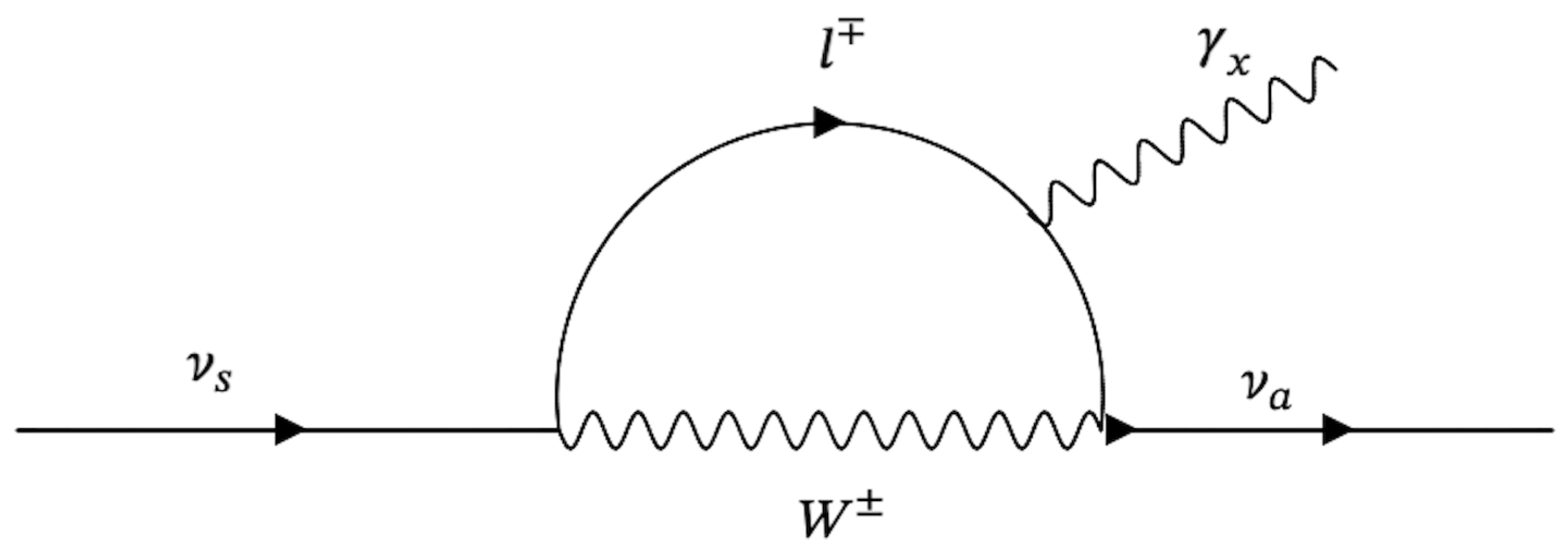
Figure 1 is a Feynmann diagram that shows the production of the X-ray signature. The incoming sterile neutrino couples with an active neutrino due to the small mixing angle. In the weak interaction loop, from the active neutrino a W-bozon is emitted which couples to a charged lepton. The positively charged lepton propagates and emits the X-ray. The lepton then reconnects with the W-bozon emitting the active neutrino.
Relatively recent investigations of the sterile neutrino as a candidate for dark matter have gained considerable attention due to the decay being easily accessible with astronomical X-ray detectors. The authors of Ref. [
3] were the first to point out the connection between the allowable parameter space for sterile neutrino dark matter decay and the detectability in galaxies and galaxy clusters by high-resolution X-ray observatories such as Chandra and XMM. As a result there have been searches of archival and new data including Chandra [
4], XMM [
5], Suzaku [
6], and HaloSat [
7]. A comprehensive summary of these results indicates that while there are detections of a feature at the sterile neutrino decay energy, the general consensus is that its attribution to dark matter is inconclusive at best. It is pointed out that the observations are made with similar CCD detectors that may contribute to the contradictory results through variations in calibration [
7].
In this paper, we investigate the spectra of 11 long observations of galaxy clusters taken with the proportional counter array (PCA) onboard the Rossi X-ray Timing Explorer (RXTE). The PCA consists of large area of gas-filled proportional counters that provide a large effective area and modest energy resolution.
2. Observations and Methodology
The sample of 11 clusters used in this study were all observed with the Rossi X-ray Timing Explorer (RXTE).
Table 1 has basic data for these clusters including the RXTE-specific observation ID, observation length, and background subtracted count rate.
Table 1 also has parameters used in model fitting: redshift and column density. The total cluster observation time is 3.1 megaseconds. The average number of source counts per cluster spectrum is 3.75 million. There are typically 57 channels in the spectrum and roughly 66,000 source counts per channel or less than 0.3% counting error. The systematic error is 0.5% [
8], which dominates the counting error.
The following sequence of HEASoft tools are run to obtain the analysis files: pcaprepobsid, pcamergeobsids, maketime, pcaextspect2. These programs essentially run the pipeline processing in standard 2 mode with default parameters. The general sequence is to process each short observation within an obsid. Then the multiple observations are merged into a single file. Good time intervals are selected based on, for example, pointing within 6 arc min of the target, insuring at least one PCA detector is on, and the elevation is at least 4 degrees above the Earth’s horizon. Source and background are extracted and deadtime correction applied. The background file utilized reflects the latest PCA background model. The response matrix is created using the appropriate gain at the time of the observation for the particular PCUs that were on. The dominant source of error is the Cosmic X-ray Background (CXB) fluctuations, which are modeled during spectral analysis.
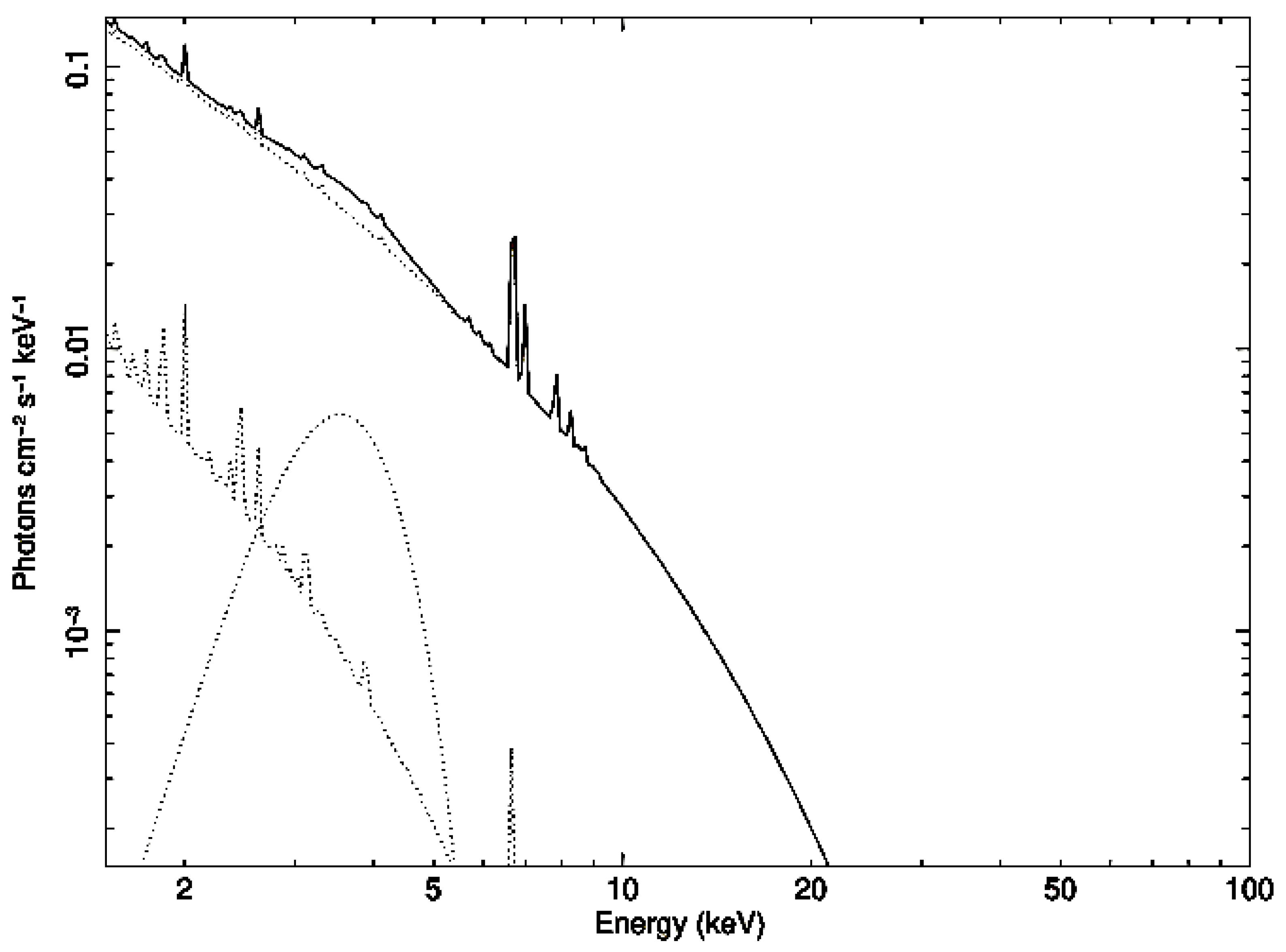
The continuum must be accurately modeled to accurately model the decay line in the X-ray spectrum. We modeled each cluster spectrum independently to obtain the residuals around the decay line for each cluster. Each cluster must be modeled independently because each cluster is characterized by a different emission-weighted temperature, abundance, emission integral, redshift, and column density of absorbing material in the Galaxy along the cluster’s observational line of sight. The broadband (2–30 keV) spectrum is modeled using a thermal (Apec) model and a power law with a high energy cutoff (cutoffpl); both models are part of the XSPEC suite of models in the HEASoft tools. The power law is used to model the fluctuations in the CXB that can occur within the PCA field of view, FWHM of 1°. The parameters for cutoffpl are power law index 1.29, cutoff at 41.13 keV, and variable amplitude equal to 8% of the mean CXB flux at 20 keV (requires a normalization of ±1.84 × 10
−4) [
9]. The column density is fixed at the weighted average obtained with the HEASARC n
H tool, which uses data from [
10]. The redshift, CXB spectral index, and high-energy cutoff are also fixed parameters. For the thermal component, the free parameters are plasma temperature, chemical abundance [
11], and emission integral. Each cluster spectrum is fit with the model described above using Xspec to obtain a minimum
. For the two clusters with multiple ObsIDs, Abell 754 and Abell 1656, a joint fit was performed of the two ObsIDs with an additional free parameter for the thermal normalization.
To look for emission from the 3.55 keV line from sterile neutrino decay, the residuals, obtained after accurately modeling the thermal emission for each cluster individually, were modeled to search for the signature of the decay. The PCA has an energy resolution of 18% at 6.7 keV, which is 1.2 keV. The energy calibration from the onboard Am
241 (an isotope of Americium 243) indicates that the line emission can be well-fit with a Gaussian [
12]. For a line centered at 3.55 keV, the Gaussian line profile will be spread over 2.35–4.75 keV. In standard 2 analysis, this is a channel range of 2–8 for epoch 3 observations (Abell 754, Abell 496, and Abell 1656) and 1–7 for epoch 4 and 5, which applies to the other 8 clusters in the sample. A maximum systematic error in the energy scale calibration of 0.5–2% [
12] is not accounted for as it does not change the energy bins used, which extend ∼4% beyond the energy range of interest.
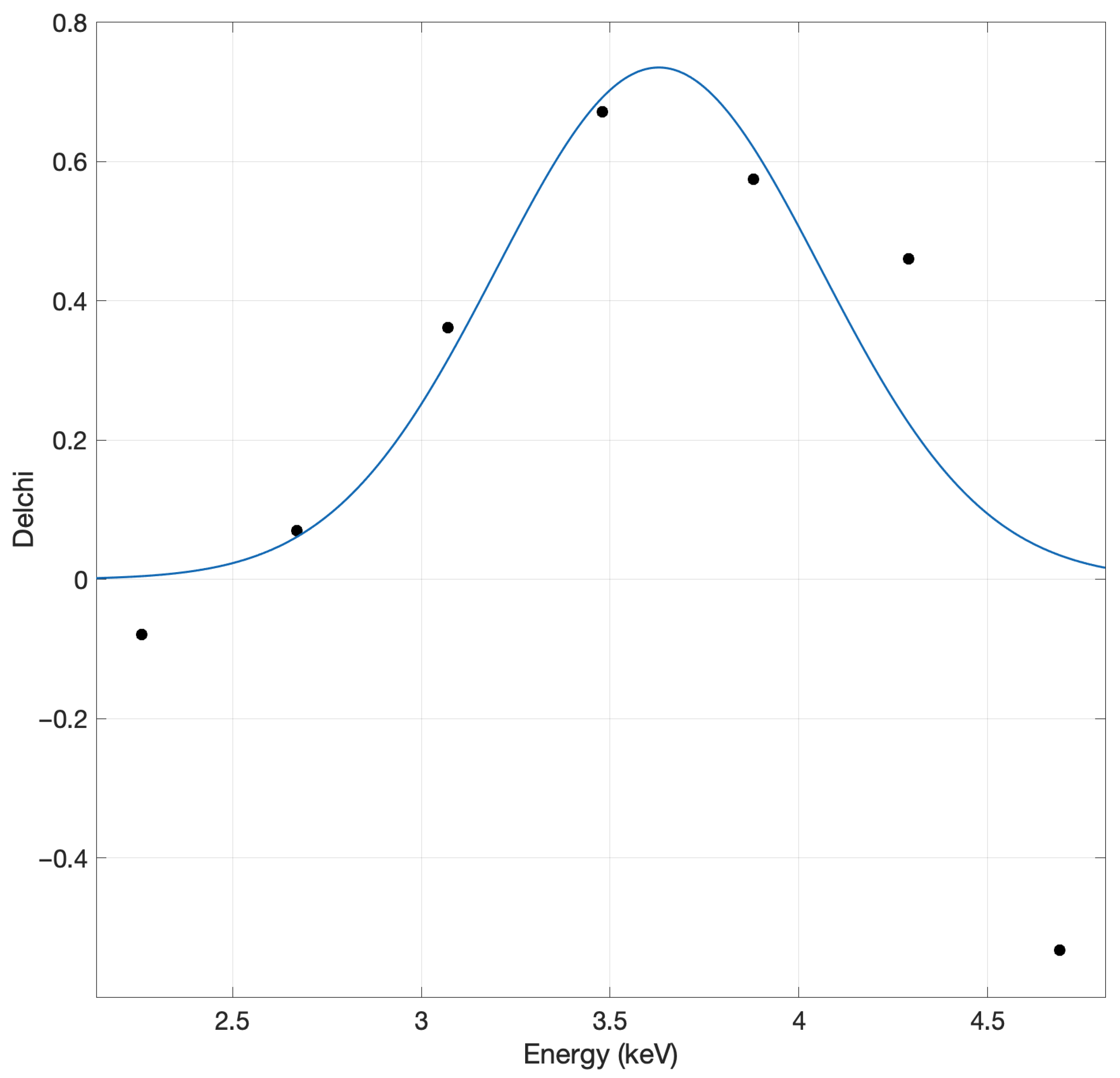
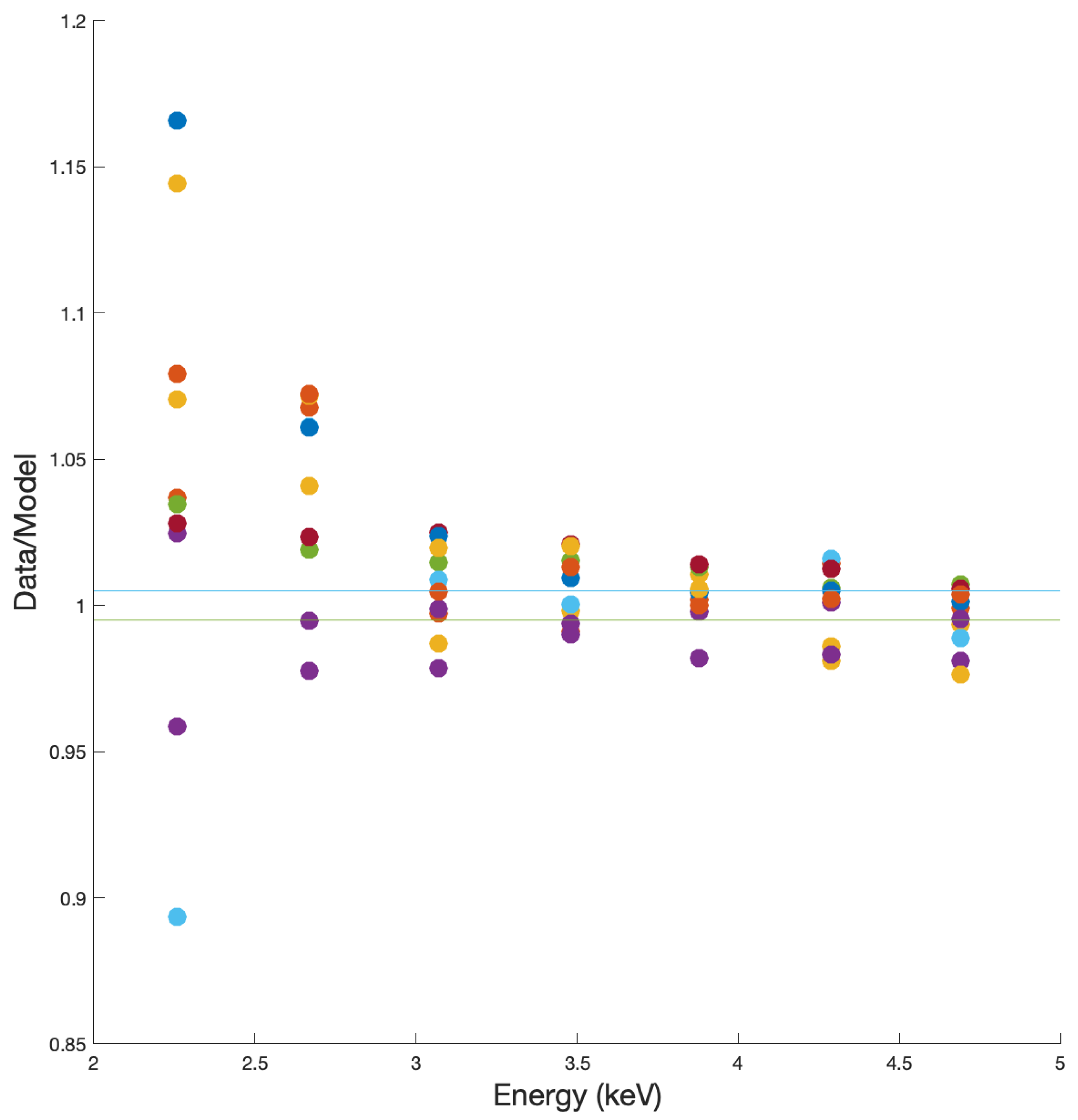
The delchi residuals, (data-model)/error, in each of the 7 PHA channels from each cluster are added together. The three clusters with channels 2–8 are matched as closely as possible in energy to 1–7 and are added to them. This creates a stacked 7-channel data set. A Gaussian function, as shown in Equation (
1), is fit to these data with the independent variable being the mid-channel energy and the dependent variable the summed delchi residuals. The mid-channel energies are (in keV) 2.26, 2.67, 3.07, 3.48, 3.88, 4.29, and 4.69. Delchi is chosen so that each excess compared to the model is weighted by its statistical error. The free parameters for the Gaussian are the normalization, A, the line center,
, and the line width,
. A 0.5% systematic error, which dominates the counting error, is used to weight each data point.
5. Conclusions
We have analyzed 3.1 megaseconds of Proportional Counter Array observations of 11 clusters. We find evidence of a significant correlation (R = 0.76) for a line centered at 3.6 keV with an average flux of 3.1 × 10
−5 ph cm
−2 s
−1. The mixing angle is calculated to be 2.4 × 10
−9. The Mixing angle for the individually detected clusters ranges from 2.0 to 21.6 × 10
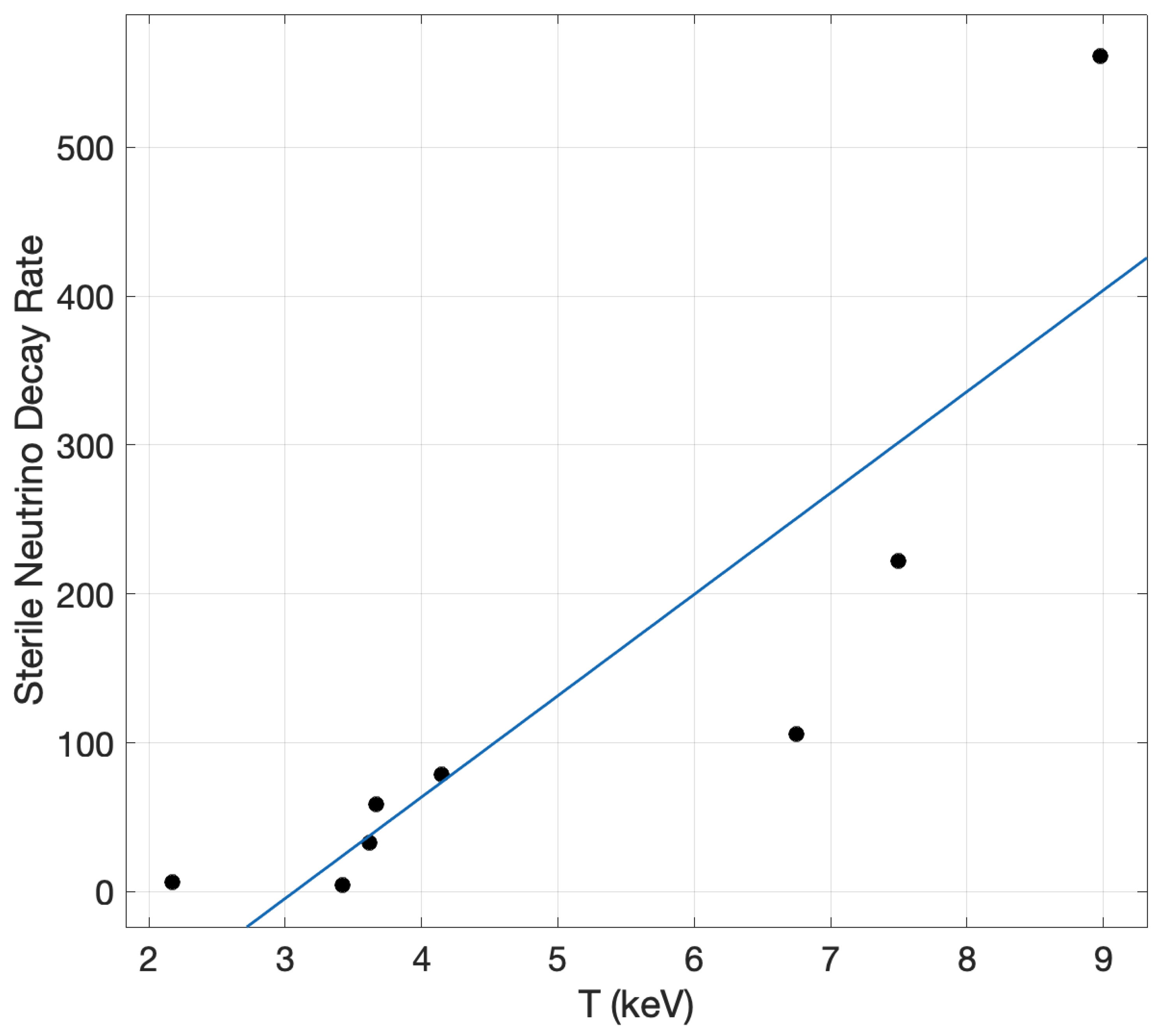
−10. The decay rate inferred from the line flux is strongly correlated (R = 0.87) with cluster temperature, which is due to hotter, more massive clusters having a larger amount of dark matter. Approximately half of this flux comes from the Coma cluster. We fit the Coma cluster spectrum with two different three-component models to test if the soft residuals could be attributed to thermal emission as opposed to a Gaussian line. The first includes a Gaussian fixed at 3.55 keV to model soft emission. The flux of the Gaussian is 5.6 × 10
−12 ph cm
−2 s
−1 or 1.3% of the total flux. The second three-component model uses a second thermal component to model soft emission. This model gives a temperature of 0–17 keV for the second thermal component and a lower temperature for the hot component. This indicates that the second thermal components is modeling high-energy residuals rather than low ones, where the neutrino decay would occur. Though our X-ray line fluxes exceed most reported detections and upper limits, they do not overproduce the dark matter predicted by [
3,
20]. We conclude that some of the Gaussian component could be thermal but not all of it. Thus some fraction of the Gaussian is attributable to the sterile neutrino decay.