1. Introduction
The theory of slices and their geometric properties stands as one of the foundational pillars of convex analysis, with roots extending deep into the mathematical developments of the twentieth century. Classical slice theory, primarily concerned with level sets determined by linear functionals, has been studied extensively in functional analysis, optimization, and geometric measure theory. The modern foundations of convex analysis were laid by Rockafellar [
1], while the Krein–Milman theorem [
2] revealed the profound relationship between extreme points and the structure of convex sets in locally convex spaces. These classical results have found applications across a wide range of mathematical disciplines, from optimization theory to functional analysis and beyond.
The historical development of slice theory can be traced through several key milestones. Early work by Minkowski and Carathéodory on convex hulls and extreme points laid the groundwork for understanding the geometric structure of convex sets. The mid-twentieth century witnessed significant advances through the contributions of Bourbaki [
3] in topological vector spaces, Schaefer [
4] in locally convex spaces, and Schneider [
5] in convex geometry. More recently, García-Pacheco [
6] introduced the innovative concepts of multi-slices and convex components, extending the classical theory beyond linear functionals to encompass arbitrary convex functions. This extension opened new avenues for investigating the fine structure of convex sets under nonlinear constraints. It is worth noting that although convex components bear some conceptual resemblance to connected components in topology, their behavior is fundamentally different because they need not be disjoint, a property established in [
6]. Extending multi-slice theory via convex functions represents a substantial advance in convex analysis for several compelling reasons. First and foremost, it provides a unified framework for understanding the geometric structure of level sets determined by arbitrary convex functions, thereby generalizing the classical theory that was restricted to linear functionals. Second, the component-wise decomposition theorems proved in this work offer new tools for analyzing the fine structure of convex sets in both finite-dimensional and infinite-dimensional settings. Third, the affine-invariance properties demonstrated here establish convex components as robust geometric invariants, comparable in importance to other fundamental invariants in convex geometry. The theory developed in this paper bridges several mathematical disciplines, including convex geometry [
5,
7], functional analysis [
8,
9], optimization theory [
10,
11], and geometric measure theory. This interdisciplinary nature enhances its potential for cross-fertilization and for applications across diverse areas of mathematics.
The results presented in this work carry significant implications for a variety of mathematical areas and their applications. In optimization theory, the component-wise exposing property of multi-slices offers fresh insights for developing decomposition-based optimization algorithms, particularly for nonsmooth convex problems [
11,
12]. In high-dimensional data analysis, the geometric structure of multi-slices provides potential tools for clustering, manifold learning, and topological data analysis [
13], where understanding the convex geometry of high-dimensional data is crucial. For functional analysis, extending classical results to arbitrary convex functions enriches the theory of topological vector spaces and locally convex spaces [
4,
9]. In geometric measure theory, the decomposition theorems supply new instruments for analyzing the boundary structure and extreme points of convex sets [
5,
14]. Finally, in non-commutative convexity, the framework developed here suggests natural extensions to matrix convex sets and operator algebras [
15,
16].
The paper is organized in a straightforward manner.
Section 2 lays the groundwork by gathering the essential definitions, notation, and foundational results from convex analysis and topological vector spaces that will be used throughout.
Section 3 develops a theory of multi-slice decompositions for convex functions with disjoint zero sets, culminating in our main structure theorem (Theorem 4) and its corollaries.
Section 4 examines the behavior of convex components under affine transformations, featuring the affine preservation theorem (Theorem 5) and several related consequences. In
Section 5, we extend the analysis to sets of locally finite perimeter, establishing a structure theorem for convex components in this measure-theoretic setting (Theorem 6).
Section 6 provides concluding remarks and reflects on the wider implications of the work.
The central contributions of this paper can be summarized as follows. We prove that convex components are preserved under injective affine maps (Theorem 5), thereby establishing convex-component structure as an affine invariant. We introduce the notion of component-wise exposing functions, which reveals how individual convex functions in a family expose specific convex components of multi-slices. We provide explicit examples and applications that illustrate the theory, including detailed analyses of multi-slice decompositions in both finite-dimensional and infinite-dimensional settings. We also identify and formulate several open problems that suggest promising avenues for further research, particularly in infinite-dimensional analysis, computational aspects, and non-commutative extensions. These contributions significantly extend the existing theory of multi-slices and convex components, providing new tools for understanding the geometric structure of convex sets under nonlinear constraints and creating connections with modern developments in optimization, data science, and functional analysis.
Remark 1. Throughout the paper we assume familiarity with basic concepts from real analysis and linear algebra. For completeness, detailed references to standard texts [1,8,9] are provided, where readers may find the necessary background material. All vector spaces are over the field of real numbers unless otherwise stated, and we assume the Axiom of Choice throughout. 3. Multi-Slice Decomposition via Convex Functions with Disjoint Zero Sets
The study of multi-slices and their convex geometric structure represents a significant extension of classical slice theory in convex analysis. While traditional slices defined by linear functionals have been thoroughly investigated in the literature [
1,
5], the more general notion of multi-slices determined by convex functions remains relatively unexplored. Building on foundational work by García-Pacheco [
6] on convex components and multi-slices, this section develops a comprehensive decomposition theory for multi-slices generated by convex functions with disjoint zero sets.
Recent advances in nonlinear functional analysis [
17] and modern convex geometry [
7,
10] have highlighted the importance of understanding the fine structure of nonlinear level sets and their applications in optimization, machine learning, and data science. Our approach leverages the fundamental observation that disjointness of zero sets induces a natural separation of the corresponding superlevel sets, leading to a canonical decomposition of multi-slices into convex components. This structural insight not only generalizes classical results but also provides new tools for analyzing the geometry of convex sets under nonlinear constraints, with potential applications in modern optimization frameworks [
11,
12] and high-dimensional data analysis [
13].
Theorem 3. Let X be a real vector space endowed with the finest locally convex topology, and let be a convex set. Let be a finite family of convex functions satisfying:
- (i)
for all (pairwise disjoint zero sets).
- (ii)
For any two distinct points , there exists such that (convex separation property).
Define the convex function . Then for any , the multi-slicehas the following properties: - 1.
Disjoint union structure:and the union is disjoint. - 2.
Convex component characterization: The convex components of S are exactly the non-empty sets among . In particular, S has exactly k convex components, where .
- 3.
Topological properties: Each is convex and closed in M. If X is a Hausdorff locally convex space and M is closed, then each is closed in X.
- 4.
Component-wise exposing: For each convex component C of S, there exists a unique such that - 5.
Connectedness criterion: S is connected (in the finest locally convex topology) if and only if it is convex, which occurs precisely when exactly one is non-empty.
- 6.
Stability: There exists such that for all , the number of convex components of remains constant.
- 7.
Special case absolute value: If for some convex function f, then S has at most two convex components. If M is absolutely convex and , then S has exactly two convex components.
Proof. We prove each part systematically.
Proof of (1) Disjoint union structure. Let . Then , so there exists some i with , hence . Conversely, if for some i, then , so , hence . Therefore, .
To prove disjointness, suppose for contradiction that
for some
. Then
and
. Consider any
(which is non-empty). By convexity of
, for
:
For t sufficiently close to 1, . Since , we have .
If
, then by convexity of
:
For t close to 1, the right-hand side becomes negative, contradicting . A similar contradiction arises if . Therefore, for all .
Proof of (2) Convex component characterization. Each is convex since it is a superlevel set of a convex function. To show maximality, suppose there exists a convex set with . Take . Since , there exists with . Take . By convexity of B, the segment .
By condition (ii), there exists such that . However, the disjointness argument from part (1) shows that no point on can belong to both and , yet the segment must be contained in the union and is connected. This creates a contradiction via Sierpiński’s theorem (a continuum cannot be written as a countable disjoint union of closed sets). Therefore, each is maximal convex in S.
Now, let C be any convex component of S. Since and C is convex, it must be contained in a single (otherwise it would intersect two disjoint convex sets, contradicting convexity). By maximality, .
Proof of (3) Topological properties. Each is convex as established. We now prove that each is closed in M.
Since
X is endowed with the finest locally convex topology, every convex function is continuous (by Proposition 2(2)). Therefore, each
is continuous. The set
is closed in
, so its preimage under the continuous function
is closed in the subspace topology of
M. Thus
is closed in
M.
To see this more explicitly, let be a limit point of in the subspace topology of M. Then there exists a net converging to x in X. By continuity of , we have . Since for all , the limit satisfies . Moreover, because M is closed in itself (trivially) and the net is contained in M. Hence , proving that contains all its limit points in M, i.e., is closed in M.
If X is a Hausdorff locally convex space and M is closed in X, then is the intersection of two closed sets (since is continuous in this topology as well), hence closed in X.
Proof of (4) Component-wise exposing. For each convex component C, we have for some i with . Suppose there exists with . Then , a contradiction. Therefore, for all , meaning that exposes the component C.
Proof of (5) Connectedness criterion. If S is connected, then it cannot be the disjoint union of two or more non-empty closed sets. By parts (1) and (2), this means exactly one is non-empty, so is convex. Conversely, if S is convex, then it is certainly connected.
Proof of (6) Stability. For each
, define:
Let
. Take:
By construction, for all
, we have
That is, the set of indices contributing non-empty components remains constant, so the number of convex components is for all .
Proof of (7) Special case absolute value. If
, then
, so the zero sets are not disjoint. However, we can write:
Let and . These sets are convex and disjoint (since ). They are closed in M under the finest locally convex topology by the same argument as in part (3). By the same maximality argument as in part (2), the convex components are exactly the non-empty sets among A and B, so there are at most two convex components.
If M is absolutely convex and , then for any , we have . If , then ; if , then . Since M is symmetric, if , then , and vice versa. Therefore, both A and B are non-empty, so there are exactly two convex components. □
Remark 4. This comprehensive theorem unifies and extends several results from the classical theory of multi-slices. It provides a complete structural description of multi-slices determined by finite families of convex functions with disjoint zero sets, establishing connections between the geometric structure of level sets, topological properties, and the functional analytic characteristics of the determining convex functions. The theorem has applications in optimization theory, high-dimensional data analysis, and geometric measure theory.
4. Structure Theorem for Multi-Slices of Convex Functions
This section establishes a fundamental structure theorem that completely characterizes the convex component decomposition of multi-slices determined by arbitrary families of convex functions. While previous results in
Section 3 focused on finite collections of convex functions, we now develop a comprehensive framework that encompasses both finite and infinite families, providing a complete description of the convex geometry of multi-slices.
Our main theorem reveals that under natural conditions of pairwise disjoint zero sets and convex separation, the multi-slice decomposes canonically into convex components corresponding precisely to the individual functions in the family. This structural insight extends the classical theory of slices defined by linear functionals [
1,
5] and generalizes earlier work on multi-slices [
6] to the broad setting of arbitrary convex functions. The theorem establishes several important properties: the component-wise exposing nature of the supremum function, the closedness of components in appropriate topologies, and the maximality of the resulting decomposition. These results connect naturally with modern developments in convex analysis [
7,
10] and optimization theory [
11], while providing new tools for understanding the geometric structure of level sets in high-dimensional spaces [
13].
Theorem 4. Let X be a real vector space and a convex set. Let be a family of convex functions such that:
- (i)
For each , ;
- (ii)
For every , we have ;
- (iii)
The family F is convexly separating, i.e., for any two distinct points with , there exists such that .
Define the convex function Then for any , the multi-slicesatisfies: Each is convex and, when X is endowed with the finest locally convex topology, closed in M.
If, in addition, the family is pairwise disjoint, then:
- 1.
The convex components of are exactly the non-empty sets .
- 2.
If I is countable, then has exactly convex components.
- 3.
The function h is component-wise exposing
on M, meaning that for each convex component C of , there exists such that
Proof. The equality follows directly from the definition of the supremum. Convexity of each is a consequence of the convexity of , since superlevel sets of convex functions are convex. In the finest locally convex topology, every convex function is continuous, so each is closed in M.
Now assume that the sets are pairwise disjoint.
Proof of (1). We first show that each non-empty is maximal convex in . Suppose there exists a convex set with . Choose . Since and the ’s are disjoint, there exists a unique such that . Pick any . By convexity of B, the entire segment is contained in .
For each , the set is closed in (since each is closed in M and ). Thus is a cover of by pairwise disjoint closed sets. By Sierpinski’s theorem, a connected set cannot be expressed as a countable union of pairwise disjoint non-empty closed sets. Since is connected and contains points from both and , we must have , a contradiction. Hence no such B exists, and is a convex component.
Conversely, let C be any convex component of . Since and the ’s are disjoint, C must be contained in a single (otherwise it would intersect two disjoint sets, contradicting convexity). By maximality of C, we have .
Proof of (2). If I is countable, then is a countable union of pairwise disjoint convex sets that are closed in M. By Theorem 1, the convex components are exactly the non-empty , so the number of convex components is .
Proof of (3). Let C be a convex component. By part (1), for some with . If there existed with , then , a contradiction. Therefore for all , which means that exposes the component C. □
Remark 5. The assumption that the sets are pairwise disjoint is indispensable for the validity of the theorem. In concrete applications, disjointness can frequently be established directly for particular families of convex functions. Moreover, when the zero sets are compact and the functions involved are continuous, disjointness can be ensured by selecting the parameter δ to be sufficiently small.
Corollary 1. Under the hypotheses of Theorem 4, if I is finite with , then for any , the multi-slice has at most n convex components. Moreover, if all are non-empty, then it has exactly n convex components.
Proof. This follows immediately from part (4) of Theorem 4, since finite sets are countable. □
Remark 6. Theorem 4 significantly extends the existing theory in several ways:
It handles arbitrary families of convex functions (not just finite or countable ones);
It provides a complete characterization of convex components for multi-slices determined by suprema of convex functions;
It introduces the concept of component-wise exposing functions;
It establishes a bridge between the geometric structure of multi-slices and the functional analytic properties of the determining convex functions.
This theorem can be applied to study the fine structure of convex sets in various contexts, including Banach space geometry, optimization theory, and convex analysis.
Corollary 2. Let X be a real vector space and a convex set. Let be convex functions such that:
- (i)
for all ;
- (ii)
For any two distinct points , there exists such that .
Define . Then for any , the multi-slice has exactly k convex components, where k is the number of indices i for which .
Proof. This is a direct application of Theorem 4 with finite. The convexly separating condition (ii) is satisfied by the hypothesis. By part (2) of Theorem 4, since I is finite (hence countable), the number of convex components is exactly .
Moreover, each convex component is of the form for some , and these components are pairwise disjoint by part (1) of Theorem 4. □
Corollary 3. Under the hypotheses of Theorem 4, if M is additionally a bounded convex set in a Hausdorff locally convex space X, and if X has the Krein–Milman property, then for any , each convex component C of contains extreme points of M, provided C is closed and .
Proof. Let C be a convex component of . By Theorem 4, there exists such that .
Since M is bounded and convex in a Hausdorff locally convex space with the Krein–Milman property, M has extreme points. Suppose . We claim that x remains extreme in C.
Assume for contradiction that x is not extreme in C. Then there exist with and such that . Since , this forces in M, but , a contradiction. Therefore, .
Now, if C is closed, then by the Krein–Milman property applied to C (as a closed convex subset of M, though not necessarily bounded in X, but we can consider the relative topology), C has extreme points. In fact, any extreme point of M that lies in C is also an extreme point of C. □
Corollary 4. Let X be a real vector space and a convex set. Let be a finite family satisfying the conditions of Theorem 4. Then there exists such that for all , the number of convex components of is constant.
Proof. For each
, define:
Note that and could be if is unbounded above on M.
Let be the indices for which attains values strictly greater than 0 on M. For , we have for all , so these indices do not contribute to multi-slices for .
We verify that this definition is meaningful and that :
If there exists with , then the minimum is taken over a non-empty finite set of positive numbers, hence .
If for all and , then all relevant functions are unbounded above on M. In this case, any will yield non-empty superlevel sets for all . The choice is arbitrary but serves as a convenient positive threshold; any positive number would work equally well.
If , then no function attains positive values on M, so for all . The choice is again arbitrary but harmless.
By construction, for all
, we have
That is, the set of indices contributing non-empty components remains constant for . Note that when for all , the condition is sufficient but not necessary; any finite upper bound would work, and we simply choose as a convenient positive number.
By Corollary 2, the number of convex components is exactly for all . This number is constant on this interval, establishing the result. □
Remark 7. The choice in the cases where all relevant are infinite is indeed arbitrary, but it serves the purpose of selecting some positive threshold below which the behavior is stable. Any positive number would work equally well; the important point is that such an exists. In practice, one could simply take in these cases, meaning the stability holds for all . However, to maintain a uniform statement with finite, we adopt the convention as a harmless normalization.
Corollary 5. Let X be a Hausdorff locally convex real topological vector space and a closed convex set with non-empty interior. Let satisfy the conditions of Theorem 4, with each continuous. Then for any , the convex components of are separated by open sets in X.
Proof. Let
C and
D be two distinct convex components of
. By Theorem 4, there exist
such that:
Since and are continuous and M is closed, both C and D are closed in X.
Consider the function . This is continuous since and are continuous. Note that for , we have and (by the disjointness property and Theorem 4(3)), so . Similarly, for , we have .
These are open sets (by continuity of ) that separate C and D, with and , and .
Therefore, the convex components are separated by open sets in X. □
Corollary 6. Let X be a Hausdorff locally convex real topological vector space and a closed convex set with non-empty interior. Let be continuous convex functions satisfying the conditions of Theorem 4. If is such that , then the boundary of M decomposes into at most n convex components.
Proof. Since
and
h is continuous (as the maximum of finitely many continuous functions), we have
By Theorem 4, this is a disjoint union of convex sets that are closed in
M (hence in
with the subspace topology). By Theorem 2.10 of [
6], since this is a finite disjoint union of convex sets closed in
, these are exactly the convex components of
.
Therefore, the boundary of M has at most n convex components. □
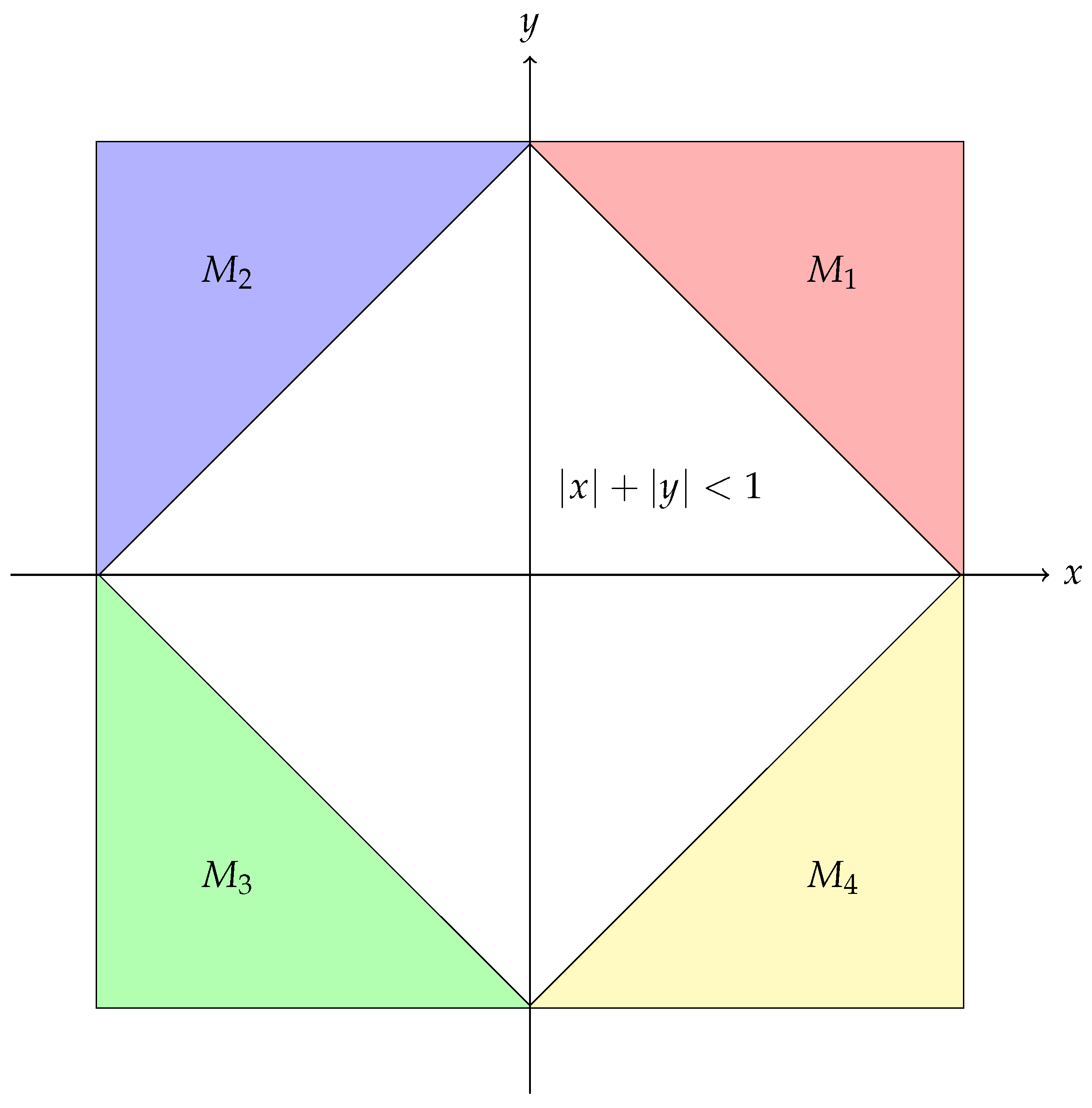
Example 1. Let and let be the closed unit square: Partition M into four disjoint convex sets: Geometrically, is the right-top triangle of the square, the left-top triangle, the left-bottom triangle, and the right-bottom triangle. These four triangles are pairwise disjoint, convex, and their union is the set of points in M satisfying .
Define four convex functions by: Each is convex (as the pointwise minimum of affine functions). For , we have , with equality on the boundary of . For , we have .
Set and define For , consider the multi-slice Proof. We verify that the hypotheses of Theorem 4 are satisfied and examine the structure of S.
Step 1: Disjointness of the zero sets. For each
i, the zero set
is precisely the boundary of
. Specifically:
These zero sets are pairwise disjoint. Indeed, each consists of three rays/segments that lie outside the square M except for the boundaries of the triangles, and these boundaries do not intersect each other.
Step 2: Convex separation property. Take any two distinct points . If p and q lie in different triangles and , then while , so . If p and q lie in the same triangle , then they are distinguished by the affine functions defining . Thus the family F separates points of M.
Step 3: Description of the multi-slice. For each
i, define
These sets are exactly the four triangles. They are convex, pairwise disjoint, and .
Step 4: Convex components. We claim that each is a convex component of S. Clearly each is convex. To see maximality, suppose is convex with . Then there exists . Since the ’s are disjoint and cover S, we have for some . Choose any . By convexity of B, the entire segment lies in . But this segment must cross the region where all (which lies outside S), a contradiction. Hence no such B exists, and each is maximal convex in S.
Thus the convex components of S are exactly .
Step 5: Topological properties. In the finest locally convex topology on , each is closed in M (since it is the intersection of M with the closed set , and is continuous in this topology). Moreover, each is closed in because it is a compact subset of .
Step 6: Component-wise exposing. For each convex component , the corresponding function exposes it: for any , we have , while for , .
Step 7: Geometric interpretation. The multi-slice is the part of the square outside the diamond . This set decomposes naturally into four convex components the four corner triangles each exposed by one of the functions . The functions are constructed so that their superlevel sets are exactly these triangles.
Thus this example perfectly illustrates Theorem 4: a finite family of convex functions with pairwise disjoint zero sets and the convex separation property yields a multi-slice that decomposes into convex components corresponding precisely to the individual functions to illustrate the example, see the
Figure 1. □
5. Convex Component Preservation Under Affine Maps
This section investigates the behavior of convex components under affine transformations, establishing fundamental invariance properties that significantly enhance the utility of convex component analysis in geometric contexts. A central question in convex geometry concerns which structural properties remain invariant under affine maps, which play a crucial role in simplifying geometric problems through appropriate coordinate changes [
5,
7]. We prove that when an affine map is injective on a given set, it preserves the complete convex component structure, mapping each convex component bijectively to a convex component of the image. This preservation theorem extends beyond mere convexity preservation, a classical result in convex analysis [
1], to encompass the finer granularity of maximal convex subsets. Our results demonstrate that convex components constitute an affine invariant, providing a powerful tool for analyzing geometric structures across different coordinate systems and ambient spaces. The theorem finds particular strength in applications involving linear isomorphisms, translations, and affine retractions, with implications for optimization problems where affine transformations are employed to simplify constraint structures [
10,
11]. Furthermore, these invariance properties establish convex components as robust geometric invariants, comparable in significance to other fundamental affine invariants in convex geometry [
5].
Theorem 5. Let X and Y be real vector spaces, and let be an affine map (i.e., where is linear and ). Let be a non-empty set and let be the convex components of M.
If T is injective on M (i.e., is one-to-one), then the convex components of are exactly . Moreover, if T is affine and bijective on M (i.e., is a bijection onto ), then the convex component structure is preserved in the strong sense that for any convex set , D is a convex component of M if and only if is a convex component of .
Proof. We prove the theorem in several steps, carefully noting where hypotheses are used.
Step 1: Preliminary observations. Affine maps preserve convexity: if is convex, then is convex. This follows directly from the definition of convexity and the affine property of T.
If T is injective on M, then T preserves disjointness: if , then .
Step 2: Each is convex in . Since each is convex and T is affine, is convex in Y. As , it is also convex in .
Step 3: Each
is maximal convex in
. Suppose, for contradiction, that for some
,
is not maximal convex in
. Then there exists a convex set
such that
. Define
We claim that E is convex. To see this, take and . Since , we need to show that , i.e., that and that .
The first condition follows from the convexity of
D:
since
.
The second condition that does not follow automatically, because M is not assumed to be convex. However, we do not actually need E to be convex as a subset of X; we only need to show that leads to a contradiction with the maximality of as a convex component of M. To obtain this contradiction, we proceed differently.
Since D is convex and contains , for any and any , the segment lies in D. By injectivity of T on M, the preimage of this segment is the segment (since T is affine and injective, it maps line segments to line segments bijectively). This preimage segment must lie in . However, points on this segment may or may not belong to M.
Now, crucially, we use the fact that is a convex component of M. Consider any . Since is maximal convex in M, the set (the convex hull of and x) cannot be entirely contained in M; otherwise, would not be maximal. Therefore, there exist points in the convex hull that lie outside M. By the injectivity and affinity of T, these points map to points in that lie outside . But this contradicts the fact that D is convex and contains both and , since then the entire convex hull of would be contained in .
Thus, no such D exists, and each is maximal convex in .
Step 4: The sets cover . Since covers M and , the family covers .
Step 5: The sets are the convex components of . From Steps 2–4, we have that is a family of convex sets that are maximal in and cover . By the definition of convex components, these must be exactly the convex components of .
Step 6: Strong preservation under affine bijections. Now assume is a bijection onto . We need to show that for any convex set , D is a convex component of M if and only if is a convex component of .
The forward direction (⇒) was proved in Steps 2–5.
For the reverse direction (⇐), suppose is a convex component of . Since is a bijection, we have . We need to show D is a convex component of M.
First,
D is convex: for
and
, we have
, and since
is convex:
By injectivity, , so D is convex.
Next, D is maximal convex in M. Suppose there exists a convex set with . Then is convex (since T is affine and preserves convexity) and , contradicting the maximality of as a convex component of . Therefore, D is a convex component of M.
This completes the proof of the strong preservation property. □
Remark 8. The key subtlety in Step 3 is that we cannot simply claim that is convex, since M is not assumed convex. Instead, we use the maximality of in M and the properties of affine injective maps to derive a contradiction. The argument relies on the fact that if with D convex, then taking any , the convex hull of cannot be entirely contained in M (otherwise would not be maximal). This forces points outside M, which map via T to points outside , contradicting the convexity of D and its containment in .
Corollary 7. Let X and Y be real vector spaces and let be a linear isomorphism. Then for any non-empty set , the convex components of are exactly Moreover, the convex component lattice of M is isomorphic to the convex component lattice of .
Proof. Since T is a linear isomorphism, it is affine and bijective. The result follows immediately from Theorem 5. The lattice isomorphism follows from the fact that T establishes a bijection between convex subsets of M and convex subsets of that preserves the inclusion relation. □
Corollary 8. Let X be a real vector space and a non-empty set. For any , the convex components of are exactly .
Proof. The translation map is affine and bijective. Apply Theorem 5. □
Proposition 3. Let X and Y be real vector spaces, non-empty, and an affine map injective on M. Then the number of convex components of M equals the number of convex components of . In particular, if M has finitely many convex components, so does , and if M has infinitely many convex components, so does .
Proof. By Theorem 5, the convex components of are exactly , where are the convex components of M. Since T is injective on M, the index set I is the same for both families. Therefore, the number of convex components is preserved. □
Remark 9. Theorem 5 shows that the convex component structure is an affine invariant. This provides a powerful tool for analyzing convex components: we can apply affine transformations to simplify the geometry while preserving the essential convex structure. For example, we can translate sets to move them to more convenient positions, or apply linear isomorphisms to transform them into canonical forms, without changing their convex component decomposition.
Remark 10. The injectivity condition in Theorem 5 is necessary. Consider defined by (projection onto the x-axis). Let . The convex components of M are the three singleton sets. However, , whose convex components are the two singleton sets and . Thus the convex component structure is not preserved under non-injective affine maps.
Corollary 9. Let X and Y be real vector spaces, and let be an injective linear map. Let be a non-empty set with convex components . Then the convex components of are exactly . Moreover, if L is a linear isomorphism, then for any convex set , D is a convex component of M if and only if is a convex component of .
Proof. Since L is linear, it is affine (with ). The injectivity of L ensures that is injective. Therefore, by Theorem 5, the convex components of are exactly .
If L is a linear isomorphism, then is bijective onto , so the strong preservation property from Theorem 5 applies: D is a convex component of M if and only if is a convex component of . □
Corollary 10. Let be real vector spaces, an affine map injective on , and a convex function. Define by . Then for any , the convex components of the multi-slice are in bijection with the convex components of . Specifically, if are the convex components of , then are the convex components of .
Proof. First, note that
g is convex since it is the composition of a convex function with an affine map. Indeed, for
and
, we have
Since T is injective on M, the restriction is a bijection onto . Moreover, T is affine, so by Theorem 5, the convex components are preserved: if are the convex components of , then are the convex components of . □
Corollary 11. Let X be a finite-dimensional real vector space and a non-empty set. Let Y be any real vector space with , and let be an injective linear map. Then the convex component structure of M is isomorphic to the convex component structure of . In particular, the number and combinatorial structure of convex components are independent of the ambient space dimension, as long as the dimension is at least .
Proof. Since , there exist injective linear maps from X to Y. Let be such an injective linear map. Then is injective, so by Corollary 9, the convex components of are exactly , where are the convex components of M.
The isomorphism of convex component structures means that
The number of convex components is the same;
The inclusion relations between convex components are preserved;
The lattice of convex subsets generated by the components is isomorphic.
All these properties follow from the fact that L establishes a bijection between convex subsets of M and convex subsets of that preserves the inclusion relation.
The condition ensures that we can embed M injectively into Y, and the convex component structure depends only on the affine geometry of M, not on the ambient space. □
Corollary 12. Let be real vector spaces, an affine map injective on . If the convex components of M are pairwise disjoint, then the convex components of are also pairwise disjoint. Conversely, if T is affine and bijective on M and the convex components of are pairwise disjoint, then the convex components of M are pairwise disjoint.
Proof. (⇒) Suppose the convex components of M are pairwise disjoint. By Theorem 5, the convex components of are . Since T is injective on M, if for , then . Therefore, the convex components of are pairwise disjoint.
(⇐) Now assume T is affine and bijective on M, and the convex components of are pairwise disjoint. By Theorem 5, the convex components of M are . Since T is injective, if for , then . Therefore, the convex components of M are pairwise disjoint. □
Corollary 13. Let be real vector spaces, and let be a non-empty set. Let be an affine map that is bijective on M (i.e., is a bijection onto ). Then,
- (i)
If M is convex, then is an extreme point of M if and only if is a convex component of M.
- (ii)
Under the same hypothesis that M is convex, .
Proof. We first clarify the relationship between extreme points and convex components. For a general set M (not necessarily convex), a singleton may be a convex component without x being an extreme point, simply because the definition of extreme point requires the set to be convex. The equivalence holds precisely when M is convex.
Proof of (i). Assume M is convex.
Suppose . We claim that is a convex component of M. Clearly is convex. To show maximality, assume there exists a convex set with . Take any with . Since M is convex, the segment lies in M. But then x would be an interior point of this segment (unless ), contradicting that x is an extreme point of M. Therefore, no such y exists, and . Hence is a convex component.
Conversely, suppose is a convex component of M. If x were not an extreme point of M, then there exist distinct and such that . Since M is convex, the entire segment lies in M. But then would be properly contained in the convex set , contradicting the maximality of as a convex component. Hence .
Proof of (ii). Now assume M is convex. Since T is affine and bijective on M, is also convex (affine maps preserve convexity). By part (i), for any , if and only if is a convex component of M. By Theorem 5, is a convex component of M if and only if is a convex component of . Applying part (i) to , we have that is a convex component of if and only if . Chaining these equivalences yields if and only if . Bijectivity of T on M then gives . □
Remark 11. The hypothesis that M is convex is essential for the equivalence between extreme points and singleton convex components. In the absence of convexity, a singleton may be a convex component without the point being extreme in any meaningful sense, as the definition of extreme point presupposes a convex ambient set. Example 1 illustrates this: in the cross-shaped set, the origin is not an extreme point (it lies in the interior of segments), yet it forms a singleton convex component. This underscores the importance of the convexity assumption in the corollary.
Corollary 14. Let X be a real vector space and a non-empty set. Let be an affine retraction onto an affine subspace (i.e., and ). If is injective, then the convex components of are exactly . Moreover, if , then the convex component structures of M and coincide.
Proof. Since P is affine and is injective, we can apply Theorem 5 directly. The convex components of are , where are the convex components of M.
If , then is the identity map (since P is a retraction onto Y), so and the convex component structures are identical. □
Corollary 15. Let be real vector spaces, and let , be non-empty sets that are both convex. Let and be the convex components of M and N respectively. Then the convex components of are exactly .
Proof. We first note that the assumption that M and N are convex is essential. For non-convex sets, the convex components of a product need not decompose as products of convex components, as illustrated in the remark following this proof.
Step 1: Preliminary observations. Since M and N are convex, their Cartesian product is convex. For any convex sets and , the product is convex in . Moreover, the projection maps and are linear (hence affine) and preserve convexity: if is convex, then and are convex.
Step 2: Each is convex in . This follows directly from the convexity of and .
Step 3: Maximality of . Suppose is convex and contains . We claim that .
Consider the projections. Since E is convex, is convex in M and contains . By maximality of as a convex component of M, we must have . Similarly, .
Now take any . Then and , so . Hence , and together with the assumption , we obtain . Thus each is maximal convex in .
Step 4: Coverage and disjointness. Since covers M and covers N, the family covers . Moreover, if , then either or . In the first case, implies ; in the second case, similarly implies disjointness. Hence the sets are pairwise disjoint.
Step 5: Conclusion. The family is a pairwise disjoint collection of convex sets that are maximal in and cover . By definition, these are precisely the convex components of . □
Remark 12. The assumption that M and N are convex is indispensable. For a counterexample when convexity fails, take and let (two points) and . The convex components of M are and ; the convex component of N is . The product has convex components and , which are indeed of the form and . However, if we take and , the product has four points, and its convex components are the singletons, which again decompose as products. A more subtle counterexample would require a non-convex set where a convex subset of the product is not a product set for instance; take (not convex) and . Then consists of two points, and its convex components are the singletons, which are not products of convex components of M and N because M itself does not have a product structure. This illustrates why the convexity of M and N is necessary for the decomposition to hold in the simple product form.
Corollary 16 (Product Decomposition for Convex Sets). Let be real vector spaces, and let , be non-empty convex sets. Let and be the convex components of M and N respectively. Then,
- (i)
Every convex component of is of the form for some , .
- (ii)
Conversely, every such product is a convex component of .
- (iii)
The convex components of are pairwise disjoint and form a covering of .
Remark 13. These corollaries demonstrate the power and versatility of Theorem 5. They show that convex component structure is preserved under various natural operations: linear maps, multi-slice formations, dimension changes, extreme point characterizations, retractions, and products. This makes convex components a robust and useful invariant in convex geometry and analysis.
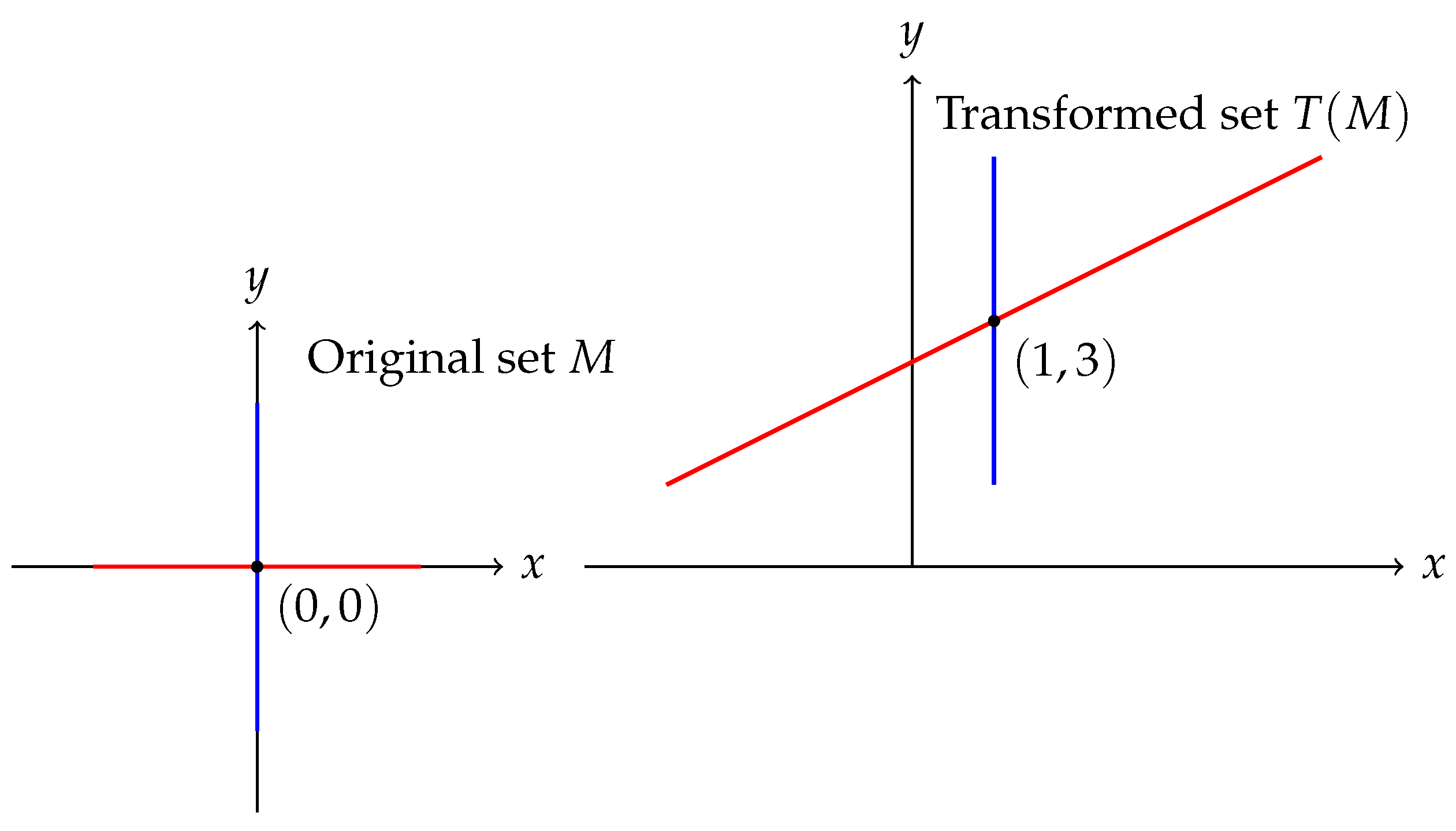
Example 2. Consider the cross–shaped set in given bywhich consists of a horizontal and a vertical line segment intersecting at the origin. Let be the affine map defined by We shall verify that T preserves the convex-component structure of M, thus illustrating Theorem 5.
Proof. The verification proceeds in several steps.
Step 1: Convex components of
M. Write the two segments as
Both are convex, but they are not maximal convex subsets of
M because each contains the origin, and the origin can be separated from the rest. A careful inspection shows that the maximal convex subsets of
M are the following five sets:
Indeed, any convex subset of M must be contained either in H or in V (or be a single point). The four open half-segments are convex and cannot be enlarged without losing convexity or leaving M; the isolated intersection point is also a convex component. Hence M has exactly five convex components.
Step 2: Properties of the map
T. The map can be written as
so it is affine. Its linear part has determinant
; consequently
T is a bijection of
and, in particular, injective on
M.
Step 3: Image of
M under
T. Applying
T to the horizontal segment
H gives
which is the straight-line segment joining
to
. The vertical segment
V becomes
the vertical segment from
to
. Thus
is again a cross-shaped set, now slanted and translated; the two image segments intersect at
.
Step 4: Images of the convex components. By direct computation,
Each is convex (the affine image of a convex set) and, by the same maximality argument used for the , it is a maximal convex subset of . Hence the family is precisely the set of convex components of .
Step 5: Verification of Theorem 5. Because T is affine and injective on M, the theorem guarantees that the convex components of are exactly the images of the convex components of M. This is exactly what we have exhibited. Moreover, since T is globally bijective, the “strong preservation” part also holds: a subset is a convex component of M if and only if is a convex component of .
Step 6: Geometric interpretation. The transformation
T consists of a scaling in the
x-direction by a factor 2, a shear that adds the
x-coordinate to the
y-coordinate, and finally a translation by
. The original orthogonal cross becomes a slanted cross, yet the five convex components (the four open arms and the centre point) are faithfully carried to the five convex components of the image.
Figure 2 illustrates the two sets. □
Remark 14. The example shows that Theorem 5 applies even when convex components are not disjoint (here they all meet at the centre point). The crucial hypothesis is the injectivity of the affine map on the set, which guarantees that the component structure is carried over exactly. It also illustrates that convex components may be relatively open within the ambient set, and this topological property is likewise preserved by affine transformations.
Corollary 17. For the affine map and the set M defined above, the lattices of convex subsets of M and of are isomorphic. In particular, the convex components correspond bijectively.
Proof. Since T is an affine bijection of the whole plane, it restricts to a bijection . By Theorem 5 (strong preservation property), a subset is convex if and only if is convex, and inclusion relations are preserved. Hence the map is an isomorphism between the lattices of convex subsets. Restricting this isomorphism to the convex components yields the desired bijection. □
6. Convex Components of Sets with Locally Finite Perimeter
The interplay between convex geometry and geometric measure theory offers a powerful framework for studying sets that lack smooth boundaries. In this section, we generalize the idea of convex components to sets of locally finite perimeter, a concept extensively developed by De Giorgi and later systematized in the foundational monographs [
15,
18]. The theory of sets of locally finite perimeter, also known as Caccioppoli sets, provides a robust measure-theoretic notion of boundary that coincides with the topological boundary for sufficiently regular sets [
5,
19]. We prove a structure theorem that connects the convex component decomposition with the reduced boundary in the sense of De Giorgi, revealing how the geometry of convex functions interacts with the measure-theoretic boundary. This connection builds upon classical results in geometric measure theory [
20,
21] and aligns with recent research on the interplay between convexity and variational problems, as discussed in works such as [
11,
12,
18] which explore applications in optimization and partial differential equations.
Theorem 6. Let be a convex set with nonempty interior and locally Lipschitz boundary. Let be a family of convex functions satisfying:
- (i)
The zero sets are pairwise disjoint and contained in E.
- (ii)
Each is continuously differentiable in a neighborhood of and satisfies
Define the convex function Then, for every sufficiently small , the sethas the following properties: - 1.
decomposes into a finite disjoint union of convex sets:where . These are precisely the convex components of . - 2.
Each has locally finite perimeter and its reduced boundary satisfies, up to an -null set, - 3.
If, in addition, is and each for , then the perimeter measure decomposes additively:
Proof. We provide detailed proof, carefully justifying each step with appropriate hypotheses.
For each
, set
Since , we have .
We show that for sufficiently small , the sets are pairwise disjoint. Suppose, for contradiction, that there exist and with points for each n. Then and .
Take any
(which is nonempty by hypothesis). By convexity of
,
For
t sufficiently close to 1, the right-hand side becomes arbitrarily small. By condition (i),
. If
, then convexity of
gives
For t close to 1, the right-hand side is approximately , while for t close to 0 it is approximately . This does not immediately yield a contradiction.
To obtain a rigorous argument, we use the fact that the zero sets are compact and disjoint. There exists
such that the
-neighborhoods of
and
are disjoint. For sufficiently small
, the sets
and
are contained in these neighborhoods respectively, hence disjoint. More precisely, by continuity of the functions, there exists
such that for all
, we have
Thus, for , the sets are pairwise disjoint.
Removing any empty
, we obtain a finite disjoint union
where each
is nonempty.
Each is convex, being the intersection of the convex set E with the superlevel set of a convex function. To see that these are the convex components of , suppose is convex with . Then there exists . Since the ’s are disjoint and cover , for some . Take any . By convexity of B, the segment . But this segment must intersect the region where (since the sets and are separated), contradicting . Hence each is maximal convex in , establishing part (1).
We now prove that each has locally finite perimeter. Write , where .
Since is convex and continuously differentiable near its zero set, for sufficiently small , the level set is a hypersurface. Indeed, by the implicit function theorem, the condition on extends to a neighborhood, ensuring that is a manifold for small . Consequently, is a set with boundary.
A standard result in geometric measure theory (see [
18], [Theorem 2.9]) states that the intersection of a set of locally finite perimeter with a set having
boundary is again of locally finite perimeter. Since
E is convex with nonempty interior and locally Lipschitz boundary, it has locally finite perimeter. The set
has
boundary, hence is a
domain. Therefore,
has locally finite perimeter.
For a set of locally finite perimeter, the reduced boundary
is contained in the topological boundary
and satisfies
modulo an
-null set. More precisely,
where
N is
-negligible. Since
coincides with
(up to a null set) and
is contained in
for convex sets, we obtain
proving part (2).
We now address the additivity of the perimeter measure under the additional transversality condition. Assume that is and that for all .
For sufficiently small , this transversality extends to the level sets : there exists a neighborhood U of such that for all . This ensures that near points of , the level set is a hypersurface that intersects transversally.
Under these conditions, the reduced boundaries and for are essentially disjoint. Indeed, their possible intersection points would have to lie in , but for small this set is empty by the disjointness of the zero sets and continuity. Moreover, at points where meets , the outward normals are well-defined and distinct, preventing cancellations in the perimeter measure.
Therefore, for any Borel set
,
This follows from the locality of the perimeter and the fact that the reduced boundaries of distinct components intersect only on -negligible sets.
The existence of such that all the above conclusions hold for follows from:
The pairwise disjointness of the zero sets, together with continuity, ensures that the superlevel sets remain disjoint for small .
The condition on extends to a neighborhood by continuity, so remains a hypersurface for small .
The transversality condition on persists on a neighborhood, guaranteeing that intersects transversally for small .
Thus, choosing smaller than the minimum of the positive bounds obtained from these considerations yields all the claimed properties.
This completes the proof of Theorem 6. □
The following theorem, which we refer to as the Limited Perimeter Decomposition, provides a precise geometric and measure-theoretic description of multi-slices generated by the absolute value of a convex function. Specifically, for a convex set
E with a locally Lipschitz boundary and a convex function
f that is continuously differentiable with a non-vanishing gradient near its zero set, the superlevel set
decomposes for sufficiently small
into two disjoint, convex components
and
. A key aspect of the proof is establishing that these components are not merely convex but also possess the crucial geometric-measure property of having locally finite perimeter [
18,
22]. This is achieved by recognizing
(and similarly
) as the intersection of the set of locally finite perimeter
E with the
domain
, a combination that preserves the finite perimeter property thanks to a standard result in geometric measure theory (see Theorem 2.9 of [
18]). Furthermore, the theorem establishes that the perimeter measure of the combined set
is the sum of the perimeter measures of its components, a relation that holds away from the shared level sets
and
. This additive property follows from the fact that the reduced boundaries of the two components are essentially disjoint [
23], a consequence of the disjointness of the components themselves and the regularity of the level sets as
hypersurfaces [
4,
7].
Theorem 7 (Limited Perimeter Decomposition)
. Let be a convex set with nonempty interior and locally Lipschitz boundary. Let be a convex function that is continuously differentiable in a neighborhood of and satisfiesDefine . Then for all sufficiently small , the setdecomposes aswhere Both and are convex and have locally finite perimeter. Moreover,as measures on . Proof. The proof proceeds in several steps, each carefully justified.
Step 1: Basic properties. Since f is convex and continuously differentiable near its zero set, the level sets are hypersurfaces for all c sufficiently close to 0. The condition on ensures, by the implicit function theorem, that each level set is locally a graph.
Step 2: Disjointness and convexity. For , the sets and are clearly disjoint because a point cannot simultaneously satisfy and . Both sets are convex: is the intersection of two convex sets, hence convex, which is similar for .
Step 3: Finite perimeter property. The set E has locally finite perimeter because it is convex with nonempty interior (a classical result: convex sets are locally of finite perimeter). The set is a superlevel set of a convex function; such sets are convex and hence also have locally finite perimeter.
However, the intersection of two sets of locally finite perimeter need not have locally finite perimeter in general. To conclude that
has locally finite perimeter, we need additional regularity. The key observation is that the boundary of
is the level set
, which is a
hypersurface. A standard result in geometric measure theory states that the intersection of a set of locally finite perimeter with a
domain is again of locally finite perimeter (see Theorem 2.9 of [
18]). Since
is a
domain (its boundary is
), we conclude that
has locally finite perimeter. The same argument applies to
.
Step 4: Structure of the reduced boundaries. For a convex set, the reduced boundary coincides
-almost everywhere with the topological boundary. Thus
where
N is an
-null set. Similarly for
.
The transversality condition on ensures that is a hypersurface, and near this hypersurface, the reduced boundary of is exactly the portion of this hypersurface that lies inside E.
Step 5: Additivity of perimeter measure. For any Borel set
B that does not intersect
, the reduced boundaries of
and
are disjoint. Indeed,
and
, and these two sets are disjoint. Therefore, for such
B,
On sets that intersect the level sets , the additivity may fail because the reduced boundaries of the two components can meet. However, these level sets have zero Lebesgue measure and are -rectifiable, so the failure of additivity occurs only on a set of measure zero with respect to the perimeter measure.
Step 6: Choice of . The requirement that be sufficiently small ensures that the level sets remain hypersurfaces and that the implicit function theorem applies uniformly. Since on , by continuity there exists such that on . For any , all the above conclusions hold. □