Article

Prestressing Design Targeting a Desired Structural Curvature State to Mitigate Time-Dependent Deflection of Long-Span Prestressed Concrete Bridges


1
School of Civil Engineering, Southeast University, Nanjing 211189, China
2
Key Laboratory of Concrete and Prestressed Concrete Structures of Ministry of Education, Southeast University, Nanjing 211189, China
3
Department of Civil and Environmental Engineering, Politecnico di Milano, Piazza Leonardo da Vinci n. 32, 20133 Milano, Italy
*
Author to whom correspondence should be addressed.
Symmetry 2026, 18(3), 456; https://doi.org/10.3390/sym18030456
Submission received: 7 February 2026 / Revised: 28 February 2026 / Accepted: 5 March 2026 / Published: 6 March 2026
(This article belongs to the Special Issue Symmetry and Finite Element Method in Civil Engineering)

Abstract

Excessive deflection during the service period of long-span prestressed concrete (PC) bridges remains a persistent challenge in bridge engineering. This study proposes a prestressing design strategy for PC bridges that targets a desired structural curvature (DSC) by counteracting self-weight and external loads, thereby controlling both the initial curvature and its time-dependent evolution associated with prestress losses. The proposed framework was verified through a numerical simulation of a long-term simply supported beam test lasting 1350 days, showing that the mid-span deflection was significantly mitigated and the stress distributions were changed under sustained loading. Furthermore, the applicability of the proposed method is demonstrated through evaluations of two in-service long-span PC girder bridges. Compared with the original designs, the proposed method effectively controls excessive mid-span deflection and improves the bending moment (BM) and stress distributions. For the three-span PC rigid frame bridge constructed using the symmetrical cantilever method, the mid-span deflection was reduced by approximately 63% at 3500 days of service and remained stable after retrofitting. For the five-span continuous PC bridge erected by means of symmetrical cantilever construction, the secondary mid-span deflection at 4800 days was reduced by nearly 70%, satisfying serviceability requirements. These results demonstrate that the proposed DSC-based prestressing design method provides an effective and practical solution for mitigating time-dependent deflection of long-span PC bridges and ensuring robust performance throughout the service life.

1. Introduction

Progressive long-term deflection has been observed in numerous long-span prestressed concrete (PC) bridges; however, its primary causes and effective design strategies are not yet well established. Table 1 lists long-span PC bridges that have experienced excessive long-term deflection, most of which are structurally symmetrical. These bridges have main spans ranging from 143 to 301 m, with measured deflections between 92 and 1200 mm observed after 3 to 28 years of service. For bridges constructed by the symmetrical balanced cantilever method (SBCM), excessive deflection leads to cracking and durability degradation, significantly impairing service performance, in severe cases, resulting in premature retrofitting or even demolition.
Over the past several decades, extensive efforts have been devoted to understanding the mechanisms governing long-term deflection in PC bridges. Existing studies generally attribute this phenomenon to several key factors. First, the complexity and uncertainty of concrete time-dependent constitutive models, such as creep and shrinkage, make accurate prediction of long-term structural responses difficult [11,12]. Experimental investigations indicate that the coefficient of variation of creep and shrinkage predictions may reach approximately 0.3 [13], reflecting considerable statistical dispersion in material behavior. Second, analytical approaches for prestress loss considering time-dependent development are insufficiently addressed in current design codes [14,15]. Field measurements have reported that relaxation losses of prestressing tendons may reach up to 15% under certain service conditions, which can substantially alter the internal force distribution and deformation development of PC girders [16]. Third, cracking behavior and long-term deflection are coupled, as progressive deformation may induce tensile cracking in concrete [17,18]. Once cracking occurs, flexural stiffness may decrease by 20–40% depending on reinforcement ratio and cracking extent [7]. Conversely, stiffness degradation and internal force redistribution resulting from cracking may further intensify mid-span deflection [19] and durability issues [20]. However, the initial curvature state of a structure fundamentally determines its long-term deformation tendency. Specifically, an initial downward curvature will be exacerbated by creep effects, leading to progressively increased deflection [21].
To investigate the deterioration process and evaluate the structural performance of existing PC bridges, numerous studies have focused on predicting long-term deflection. For example, Xue et al. proposed and validated a time-dependent deflection formula for fully prestressed beams based on the age-adjusted effective modulus method (AAEM) and long-term monitoring data [22]. Jia et al. developed a Bayesian framework to update time-dependent deflection models of PC bridges using long-term monitoring data [23]. In addition, several studies established long-term deflection databases to evaluate time-dependent performance of PC bridges [5,24]. Nevertheless, effective strategies for controlling excessive deflection remain to be developed in order to further extend the applicability of this structural system.
Existing studies on the control of long-term deflection in long-span PC bridges have adopted several main approaches. One practical approach involves the use of high-strength concrete to enhance structural stiffness and reduce deflection [25,26]. Another approach aims to reduce deflection by emphasizing adjustments to structural configuration [27,28] and optimizing span-length ratios to achieve more favorable force distributions [29]. In addition, considerable attention has been paid to deflection control through rational prestressing design [30,31,32], including the optimization of tendon layout and appropriate regulation of prestressing levels throughout the service life of the bridge system [33]. Prestressing can be interpreted as an equivalent load acting on the structure to counterbalance external actions [34]. Based on this interpretation, the load balancing method (LBM) proposed by T.Y. Lin was developed to balance external loads [35], and was subsequently extended to the serviceability analysis of PC structures [32]. During post-tensioning, the structure is subjected to a system of self-equilibrated forces that produces initial stresses and deformations, which may subsequently evolve due to concrete creep. When the LBM is appropriately applied, creep-induced delayed flexural deformations, which are proportional to the initial elastic response, may be effectively reduced, thus optimizing long-term stress redistribution.
The LBM is directly applicable to beams with continuous prestressing tendons but faces fundamental challenges in long-span PC bridges constructed by segmental cantilever methods. In such bridges, cantilever and closure tendons are arranged in different segments, so external loads cannot be balanced by vertical prestressing components; instead, BM is resisted by tendon eccentricity. Moreover, changes in structural configuration prevent long-term deflection control through initial alignment or elastic prestress effects alone. Therefore, quasi-permanent loads, time-dependent effects, and live load must be incorporated, requiring differentiated prestressing strategies to control stresses and mitigate excessive deflection.
This study proposes a prestressing design approach to control progressive long-term deflection in PC bridges by establishing a target desired structural curvature, which governs the associated BM and stress distributions. Through optimized configuration of the longitudinal prestressing tendons, the effects of multiple load combinations and time-dependent behaviors are effectively balanced at bridge completion, mitigating long-term mid-span deflection during service. In this manuscript, Section 2 introduces the DSC-based prestressing design procedure. Section 3 demonstrates its effectiveness via a long-term sustained loading test on a simply supported beam, and Section 3 further validates its applicability through two in-service long-span PC bridges. The proposed DSC-based prestressing design method provides a practical approach for controlling excessive long-term deflection in long-span PC bridges constructed using the SBCM.

2. The Desired Structural Curvature State for PC Bridges

2.1. The Concept of Desired Structural Curvature (DSC)

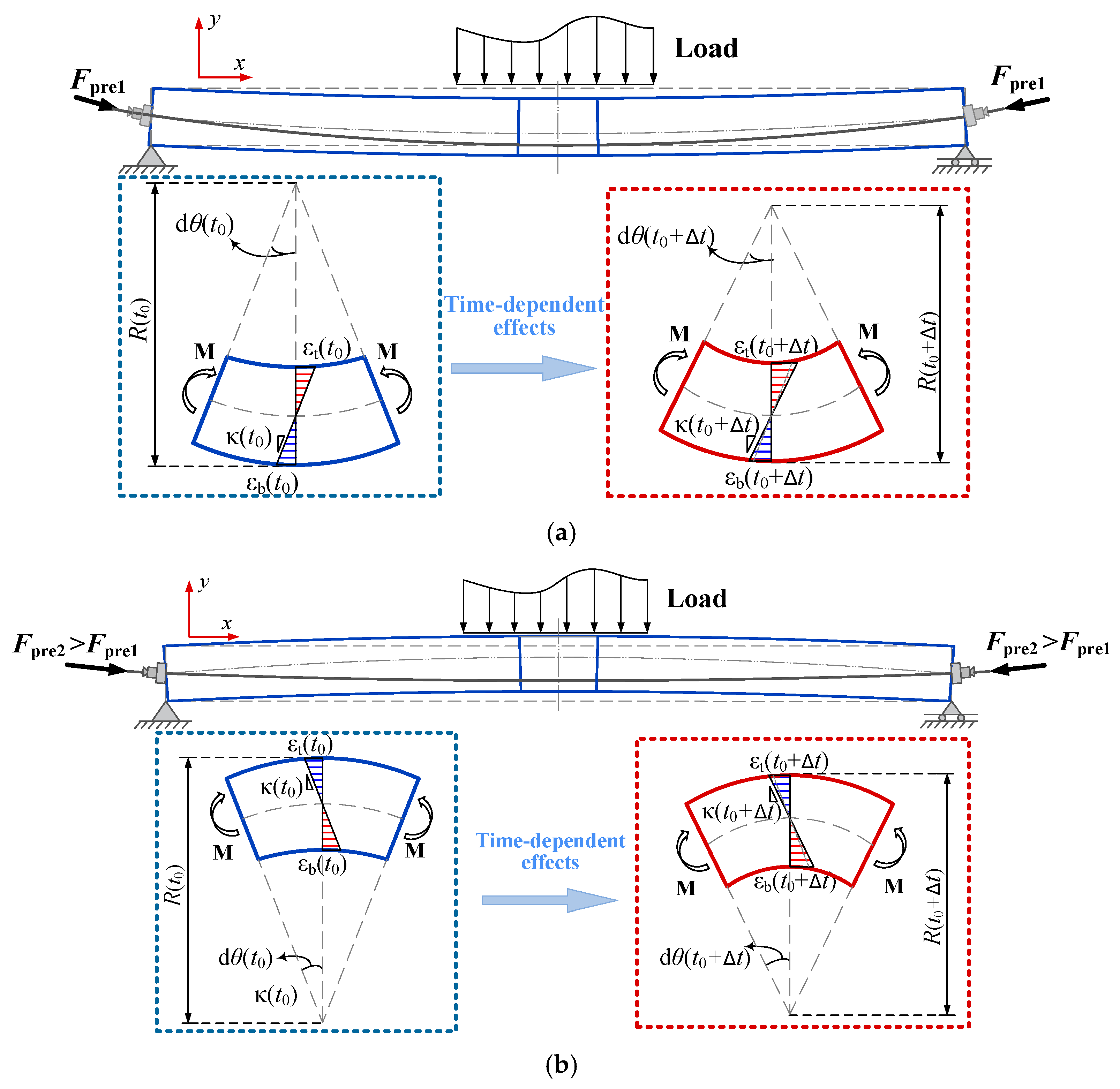
Curvature induced by bending characterizes the deformation of a flexural member and represents the strain gradient over the height of the cross-section. For a simply supported PC beam, the stress gradient will result in an increment of creep strains over time, leading to progressive long-term deflection as illustrated in Figure 1. The initial curvature κ t 0 of a simply supported PC beam induced by external loads and prestressing is a positive (sagging) curvature, which results in downward deflection. Time-dependent effects such as creep further increase the curvature magnitude and exacerbate the structural deformation, where R t 0 is the radius of curvature at initial time. If κ t 0 is negative, the beam will exhibit upward deformation, which may be further amplified by concrete creep. However, prestress losses including steel strand relaxation, may eventually cause a reversal of the deflection trend, leading to downward deflection [21]. Therefore, achieving the desired curvature state through appropriate prestressing design is decisive for controlling the long-term deflection of PC bridges.
For a PC bridge, the initial curvature state is calculated as follows:
κ ( x , t 0 ) = d θ ( x , t 0 ) d x = ε t ( x , t 0 ) ε b ( x , t 0 ) H ( x ) = M ( x , t 0 ) E c I c ( x )
where θ ( x , t 0 ) is the rotation angle; ε t ( x , t 0 ) and ε b ( x , t 0 ) are strains at the top and bottom flanges, respectively; H ( x ) is the section height; x is the distance along the member length; E c is the elastic modulus of concrete at the loading age; I c ( x ) is the moment of inertia of the cross section; and M ( x , t 0 ) = M Load ( x , t 0 ) + M Pre ( x , t 0 ) denotes the resultant time-dependent BM of the structure, including contributions from external loads and prestressing.
In this study, the following sign conventions are adopted: tensile stress and strain are taken as positive, whereas compressive values are negative; the BM is considered positive when tension occurs at the lower fiber; curvature is defined as positive when the lower fiber undergoes elongation; and deflection is regarded as negative in the downward direction. For a simply supported PC beam, the negative curvature state ( M Pre ( x , t ) > M Load ( x , t ) , κ ( x , t ) < 0 ) indicates an upward deflection according to the sign convention.
Considering the combined effects of external loads and concrete time-dependent behavior, the long-term curvature of a PC beam can be expressed as follows:
κ ( x , t ) M ( x , t ) E c ( t 0 ) I c ( x ) [ 1 + χ φ ( t , t 0 ) ]
where φ ( t , τ 0 ) is the creep coefficient and χ is the aging coefficient introduced in the AAEM approach [36]. This formula captures the primary coupling between stress redistribution and time-dependent material behavior.
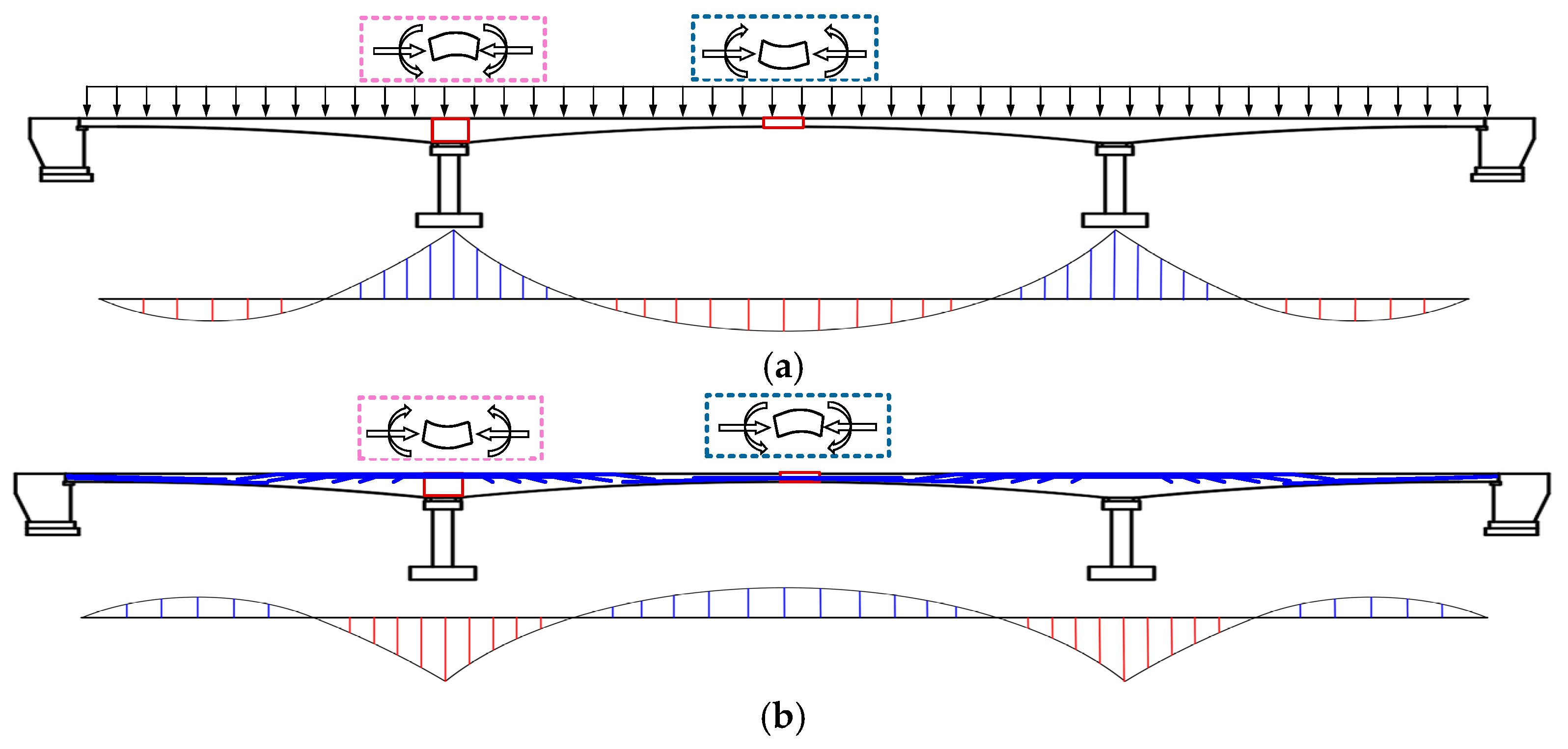
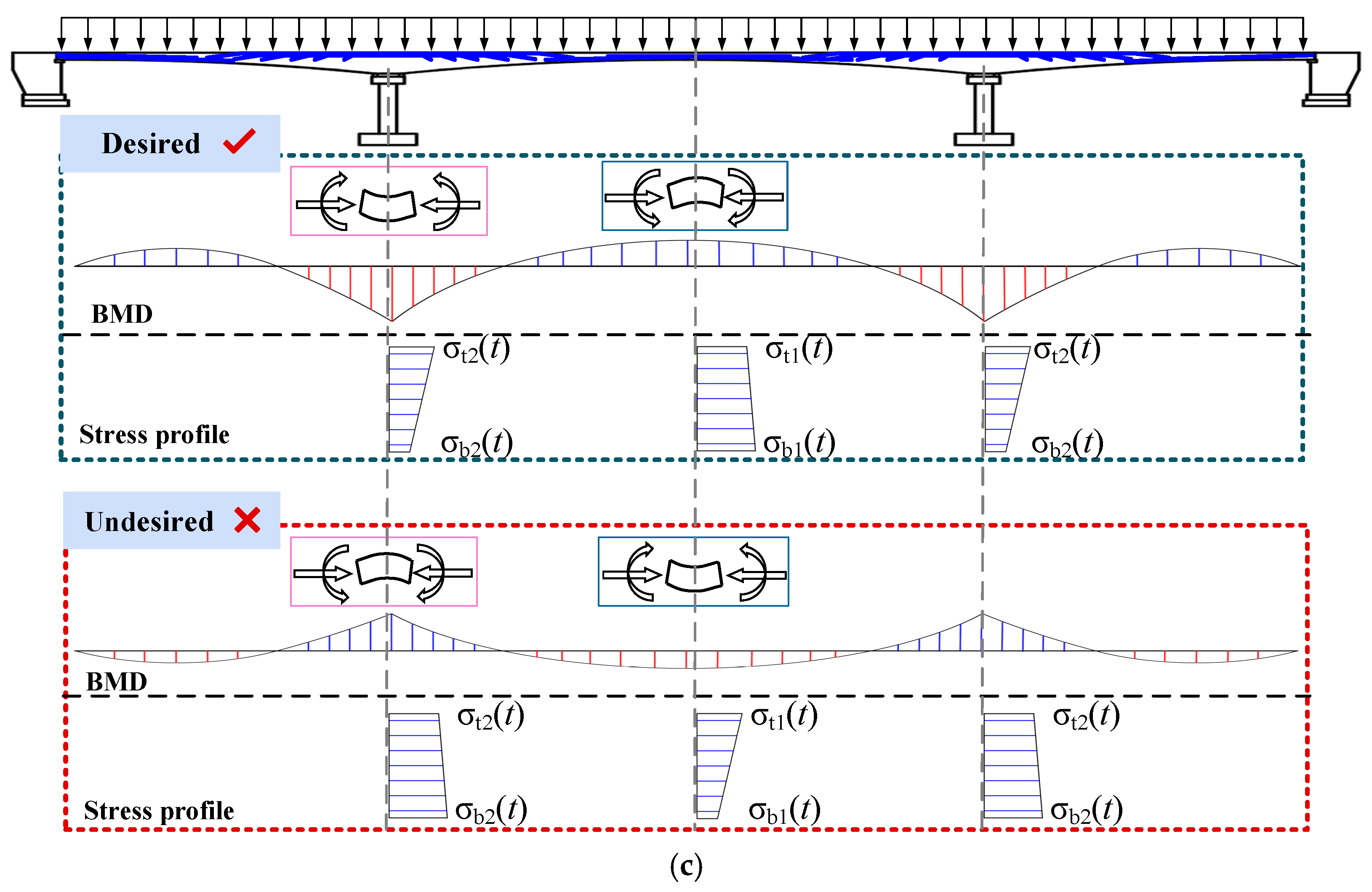
The LBM determines prestressing primarily through load equivalence by balancing dead load or dead load plus partial live load, whereas the proposed DSC concept focuses on defining a target curvature state at bridge completion and incorporates staged construction and time-dependent effects into the design process. For long-span PC bridges constructed by SBCM, where tendon layouts are discrete and long-term deformation is pronounced, such a curvature-based perspective offers an additional dimension to LBM design approaches, particularly in addressing long-term deformation behavior. The bridge structure at completion remains in an appropriate curvature state of axial compression and bending, enabling it to counteract load actions and time-dependent effects. This curvature state, designed to control long-term age-related deflection, is defined herein as the DSC. The objective of the DSC-based design is the mitigation long-term time-dependent deflection by balancing various load effects through prestressing. With the DSC design, the initial elastic deformation of the structure is maintained within a limited range, thereby reducing the subsequent development of time-dependent deformation. The main characteristics of the DSC, including the distributions of BM and stress, are illustrated in Figure 2. Red indicates positive values and blue represents negative values.
The desired BM state refers to a design requirement in which the appropriate resultant BM after prestress loss is reserved at critical sections of PC bridges to counteract unfavorable effects induced by variable actions during long-term service. For simply supported PC bridges, a certain level of negative BM should be reserved at the mid-span section to resist adverse effects arising from variable loads, such as live loads and other time-dependent actions. Conversely, for continuous PC bridges, a certain amount of positive BM is intentionally reserved at the pier table sections to counterbalance the negative BM induced by load actions and time-dependent effects [21].
The desired stress state requires that appropriate stress distributions be maintained in PC bridge structures to ensure favorable long-term performance. First, the entire cross-section should remain under a certain level of compressive stress. Second, for continuous PC bridges, the stress at the top flange near the pier sections exceeds that at the bottom flange, whereas at the mid-span section, the bottom flange stress should be greater than that at the top flange (Figure 2c). These stress distributions prevent the occurrence of tensile stresses under long-term service conditions and the other load combinations. Third, the stress level should not exceed the linear creep limit (30% of the compression strength), as recommended by Hamed [37].

2.2. Prestressing Design Strategy Based on DSC

2.2.1. The Longitudinal Prestressing System

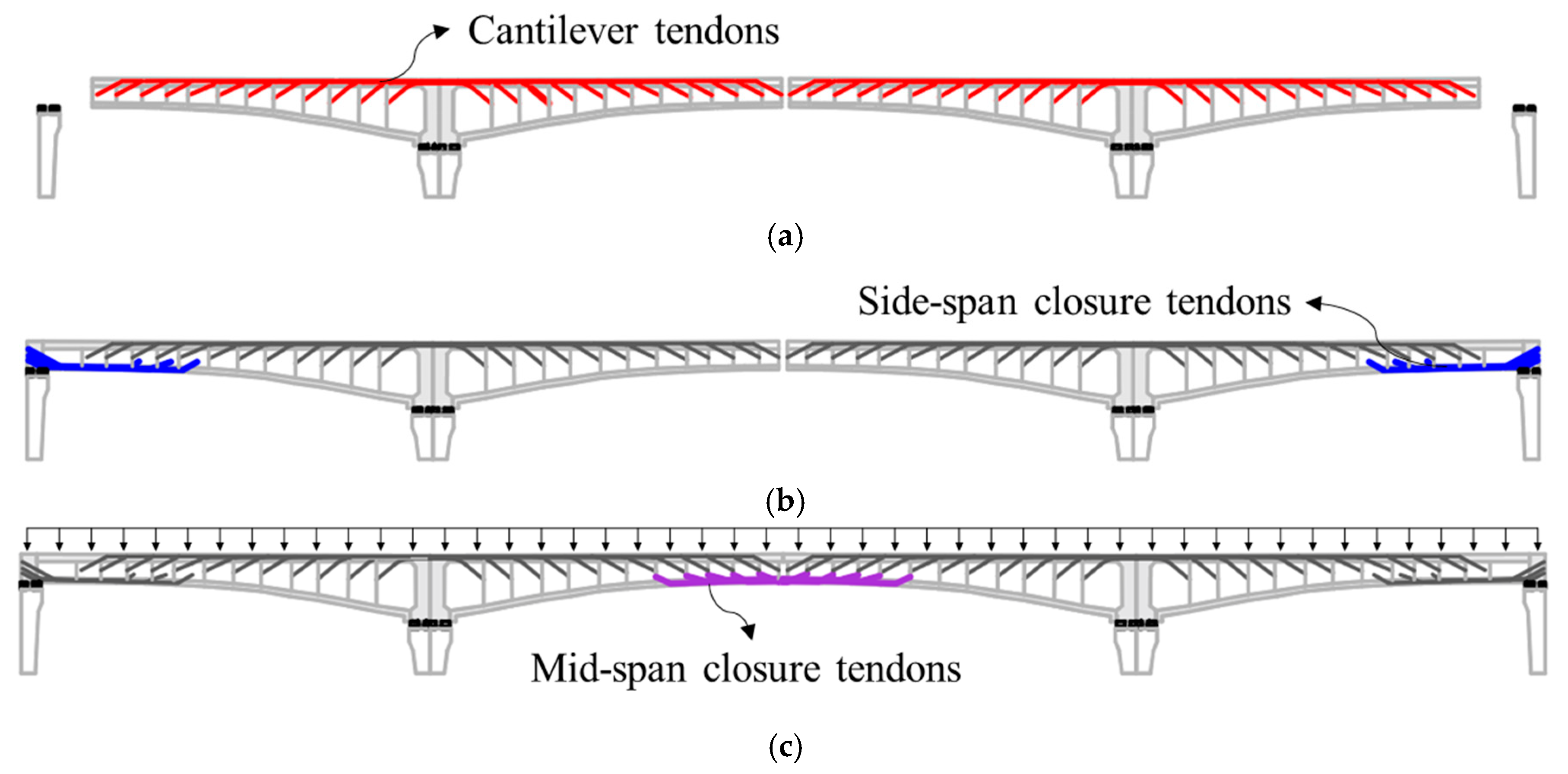
The longitudinal prestressing system of long-span PC continuous bridges constructed by the cantilever method comprises cantilever tendons and closure tendons. The cantilever tendons primarily resist negative BM during construction and service, whereas the closure tendons are installed after segmental closure and are classified as side-span and mid-span closure tendons, as illustrated in Figure 3.
The stress history of a critical section is governed by the magnitude and distribution of prestress force. By appropriately configuring the prestressing level, the evolution of sectional stress and curvature can be controlled. Under the Navier-Bernoulli condition, zero sectional curvature during aging is achieved when the linear strains at different heights within the cross section are identical. Accordingly, subsequent derivations impose a strain-compatibility condition requiring that the linear strain at the resultant point of the prestressing force be equal to that at the cross-sectional centroid, providing a mechanical basis for curvature control during the service period.

2.2.2. Design of Closure Tendons

The mid-span closure segment is typically the youngest in concrete age among all segments and possesses the lowest flexural stiffness due to its minimal girder height. As a result, curvature of the mid-span closure segment is more sensitive to variations after bridge completion, and its influence on the time-dependent deflection at mid-span is greater than that of other segments. Since the mid-span closure segment is not influenced by the construction of the cantilever segments, its curvature state can be treated as an independent design objective. On this basis, the prestressing of the mid-span closure tendons is designed first according to the DSC-based design, after which the side-span closure tendons are designed.
According to the AAEM, the resultant strain at time t is calculated as:
ε ( t , t 0 ) = σ c ( t 0 ) E c ( t 0 ) 1 + φ t , t 0 + σ c ( t ) σ c ( t 0 ) E φ t , t 0 + ε s ( t , t 0 )
in which the age-adjusted effective modulus:
E φ t , t 0 = E c ( t 0 ) 1 + 0.8 φ t , t 0
where the calculation time t is discretized in days. t 0 denotes the start time of cantilever construction, t 1 the completion time of cantilever construction, t 2 the time of side-span closure, t 3 the time of main-span closure, and t 4 the bridge completion time.
For the mid-span closure section, the concrete strain increment at the centroid of the prestressing tendons from t 4 is calculated by:
Δ ε m , p t , t 4 = σ m , p t 3 E c t 0 φ t , t 3 φ t 4 , t 3 + Δ σ m , p t 4 E c t 0 φ t , t 4 σ m , l 6 ( t , t 4 ) E φ t , t 4 1 S m + η m e m 2 I m A pm
where S m and I m are the section modulus and moment of inertia of the mid-span closure section, respectively; e m is the eccentricity of the mid-span closure tendons; η m represents the efficiency of the closure tendons, defined as the ratio of the initial BM to the resultant BM; A pm is the equivalent cross-sectional area of the mid-span closure tendons; and the prestress loss due to creep and shrinkage σ m , l 6 ( t , t 4 ) is given by [38]:
σ m , l 6 ( t , t 4 ) = E p Δ ε m , p t , t 4
and the stress increment σ m , p t 3 and Δ σ m , p t 4 can be obtained as:
σ m , p t 3 = M g 1 I m e m σ eff A pm ζ m 1 S m + η m e m 2 I m
Δ σ m , p t 4 = M g 2 + M l I m e m
where M g 1 , M g 2 , and M l are BMs induced by the structural self-weight, deck surfacing load, and live load, respectively. Because the time between the construction of the midspan closure segment and the deck paving is short, the creep effect can be neglected, thus φ t 4 , t 3 = 0 ; σ eff is the effective prestress stress after short-term losses, including friction loss, anchorage slip, and elastic shortening; ζ m is the short-term loss rate for the average steel strand length at the mid-span closure segment, as specified in the JTG 3362-2018 [38].
The strain increment at the centroid of the mid-span section from t 4 is calculated:
Δ ε m , z t , t 4 = σ m , z t 3 E c t 0 φ t , t 3 φ t 4 , t 3 σ m , l 6 ( t , t 4 ) S m E φ t , t 4 A pm
in which
σ m , z t 3 = σ eff A pm ξ m 1 S m
The time-dependent curvature at the mid-span section can be regulated by requiring that the time-dependent strain at the prestressing force resultant be equal to that at the centroid of the cross-section. By equating Equations (5) and (9), the required amount of mid-span closure tendons can be determined as:
A pm = 1 σ eff ζ m η m e m M m E p 1 + 0.8 φ t , t 4 S m E c t 0
in which
M m = M g 1 + M g 2 + M l
where E p is the Young’s modulus of prestressing tendons.
For side-span closure tendons, the effect of the secondary BM induced by the mid-span closure tendons on the side-span closure segment is governed by its location. Accordingly, the BM transmitted from the mid-span closure tendons is expressed as:
M mc = σ eff A pm ζ m e m 1 η m L ss L s
where L s is the length of the side span; and L ss is the distance from the side-span closure section to the end support of the side span.
For the side-span closure section, the concrete strain increment at the centroid of the prestressing tendons from t 4 is calculated by:
Δ ε s , p t , t 4 = σ s , p t 2 E c t 0 φ t , t 2 φ t 4 , t 2 + Δ σ s , p t 3 E c t 0 φ t , t 3 φ t 4 , t 3 + Δ σ s , p t 4 E c t 0 φ t , t 4 σ s , l 6 ( t , t 4 ) E φ t , t 4 1 S s + η s e s 2 I s A ps
where the prestress loss due to creep and shrinkage σ s , l 6 ( t , t 4 ) is given by [38]:
σ s , l 6 ( t , t 4 ) = E p Δ ε s , p t , t 4
and the stress increment σ s , p t 2 , Δ σ s , p t 3 and Δ σ s , p t 4 can be obtained as:
σ s , p t 2 = M g 1 I s e s σ eff A ps ζ s 1 S s + η s e s 2 I s
Δ σ s , p t 3 = M mc I s e s
Δ σ s , p t 4 = M g 2 + M l I s e s
where ζ s is the short-term loss rate at the side-span closure section; S s and I s are the section modulus and moment of inertia of the side-span closure section, respectively; e s is the eccentricity of the side-span closure tendons; η s represents the efficiency of the closure tendons, defined as the ratio of the initial BM to the resultant BM; A ps is the equivalent cross-sectional area of the side-span closure tendons in the longitudinal direction.
The strain increment at the centroid of the side-span section from t 4 is calculated:
Δ ε s , z t , t 4 = σ s , z t 2 E c t 0 φ t , t 2 φ t 4 , t 2 σ s , l 6 ( t , t 4 ) S s E φ t , t 4 A ps
in which
σ s , z t 2 = σ eff A ps ξ s 1 S s
Like the mid-span closure segment, the time-dependent curvature of the side-span closure segment is controlled by ensuring that the time-dependent strain at the prestressing centroid coincides with that at the section centroid, assuming a short time interval between the mid-span closure and side-span closures, thus φ t 4 , t 2 = 0 . Consequently, the following equation is derived:
M s σ eff A ps ζ s e s = A ps η s e s M s e s σ eff A ps ζ s I s S s + e s 2 E c t 0 I s E p 1 + 0.8 φ t , t 4 + A ps I s S s + η s e s 2
and
M s = M g 1 + M g 2 + M l + M mc
Substituting the design parameters into Equation (21) yields a quadratic equation. Of the two solutions, only the positive root satisfies physical requirements, and the negative root is excluded.

2.2.3. Design of Cantilever Tendons

Assume that the cantilever-constructed structure is subjected to m prestressing applied processes, with the i -th tensioning applied at time τ i ( i = 1 ~ m ). Therefore, the time interval ( t 1 ~ t 2 ) is subdivided into m subintervals. Neglecting the effect of long-term prestress loss on the time-dependent strain within each subinterval. For pier table section, the concrete strain increment at the centroid of the cantilever prestressing tendons from t 4 is calculated by:
Δ ε p , p t , t 4 = i = 1 m σ p , p τ i E c t 0 φ t , τ i φ t 4 , τ i + Δ σ p , p t 3 E c t 0 φ t , t 3 φ t 4 , t 3 + Δ σ p , p t 4 E c t 0 φ t , t 4 σ p , l 6 ( t , t 4 ) E φ t , t 4 1 S p + η p e p 2 I p A pp σ m , l 6 ( t , t 4 ) ( 1 η m ) e p 2 I p A pm
The strain increment at the centroid of the pier table section from t 4 is calculated:
Δ ε p , z t , t 4 = i = 1 m σ p , z τ i E c t 0 φ t , τ i φ t 4 , τ i σ p , l 6 ( t , t 4 ) S p E φ t , t 4 A pp
where ζ p is the short-term loss rate for the average cantilever tendons length at the pier table segment; σ p , l 6 t , t 4 is the average prestress loss from creep and shrinkage for cantilever tendons based on JTG 3362-2018 [38]; e p is the average eccentricity of the cantilever tendons; η p represents the efficiency of the cantilever tendons; A pp is the equivalent cross-sectional area of the cantilever closure tendons in the longitudinal direction. By equating Δ ε p , p t , t 4 and Δ ε p , z t , t 4 , the following equation is obtained:
M p + M p , loss = i = 1 m σ eff ζ p A pp , i e p φ t , τ i φ t 4 , τ 1
in which
M p = i = 1 m M g 1 , i φ t , τ i φ t 4 , τ 1 + M g 2 + M l φ t , t 4
and
M p , loss = σ eff A pm ζ m e m 1 η m φ t , t 4 σ p , l 6 t , t 4 A pp η p e p + σ m , l 6 t , t 4 A pm 1 η m e p 1 + 0.8 φ t , t 4
Substitution of the design parameters into Equation (25) results in a quadratic equation. Among the two solutions, the negative root is neglected.

2.2.4. DSC-Based Prestressing Design Framework

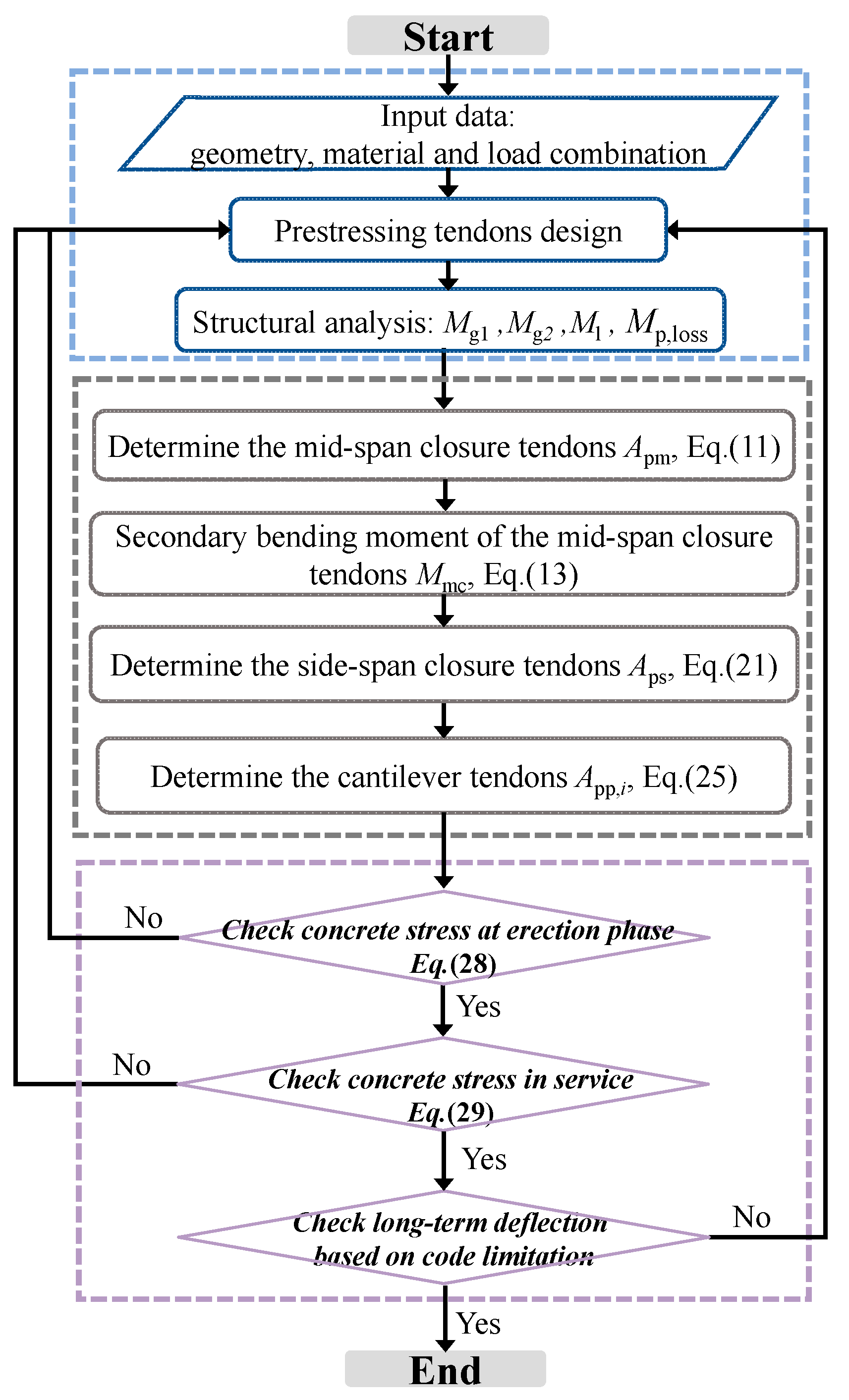
The DSC-based flowchart of the prestressing design method is illustrated in Figure 4. The overall framework is divided into three parts. First, the structural information is defined, including geometry, tendon layout, and load combinations. Second, the required quantities of cantilever tendons and closure tendons are determined following the procedures described in Section 2.2.2 and Section 2.2.3. Third, stress verification is performed for both the construction and service stages. If all limit-state requirements are satisfied, the prestressing design is finalized; otherwise, the tendon quantities are recalculated and the procedure is iterated until the design criteria are met. During construction, the stress state at each cross-section is required to satisfy the criteria associated with the corresponding construction stage as specified in JTG 3362-2018 [38]:
σ ct 0.7   f tk < 0 σ cc 0.7   f cu , k 0
where σ ct and σ cc denote the tensile and compressive stress levels during construction, respectively; f tk and f ck represent the characteristic tensile and compressive strengths of concrete, respectively.
In the service stage, the stress state of the cross-section is required to satisfy the specified limits for crack control and nonlinear creep under standard load combinations, which can be expressed as:
σ st 0.8   σ pc < 0 σ sc 0.3   f cu , k < 0
where σ st and σ sc are the tensile and compressive stress levels during service, respectively; σ pc represents the compressive prestress induced in the concrete after prestress losses.

3. Numerical Example of a Simply Supported PC Beam

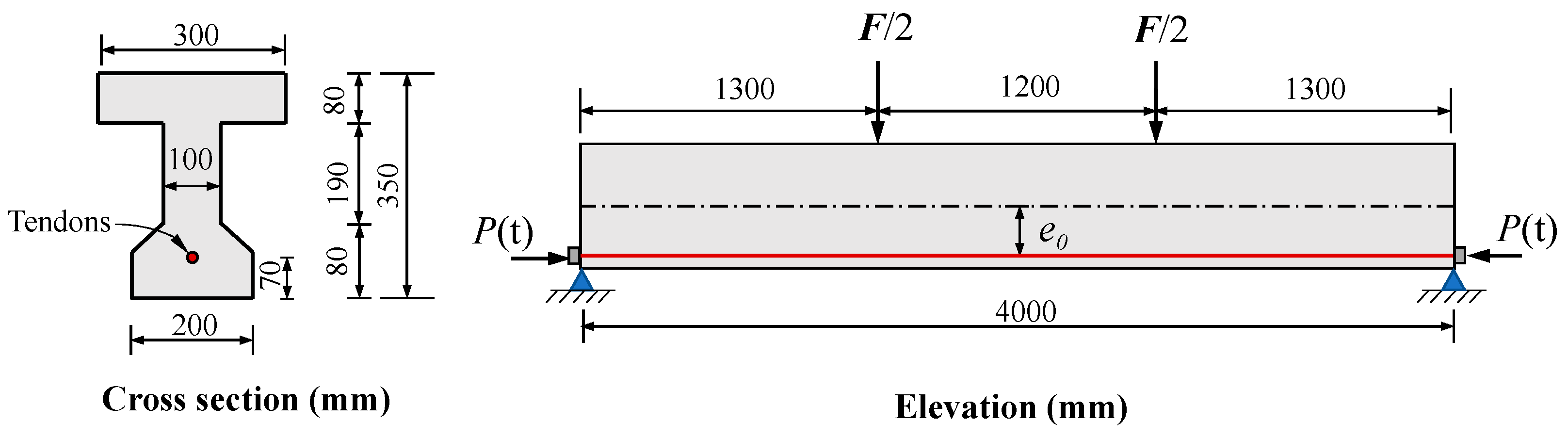
The DSC-based prestressing design was evaluated through numerical simulation by comparison with the sustained loading test of a simply supported PC beam conducted by Yang et al. [39]. In their study, the beam specimen PC5 was designed using the original prestressing scheme and tested under sustained loading. Based on the same specimen geometry and material properties, a numerical model adopting the original design was first established and validated against the experimental results. Subsequently, an alternative prestressing scheme following the proposed DSC method was implemented in the numerical model. The mid-span deflections and stress distributions obtained from the original and DSC-based designs were then compared. The configuration of the specimen is shown in Figure 5.
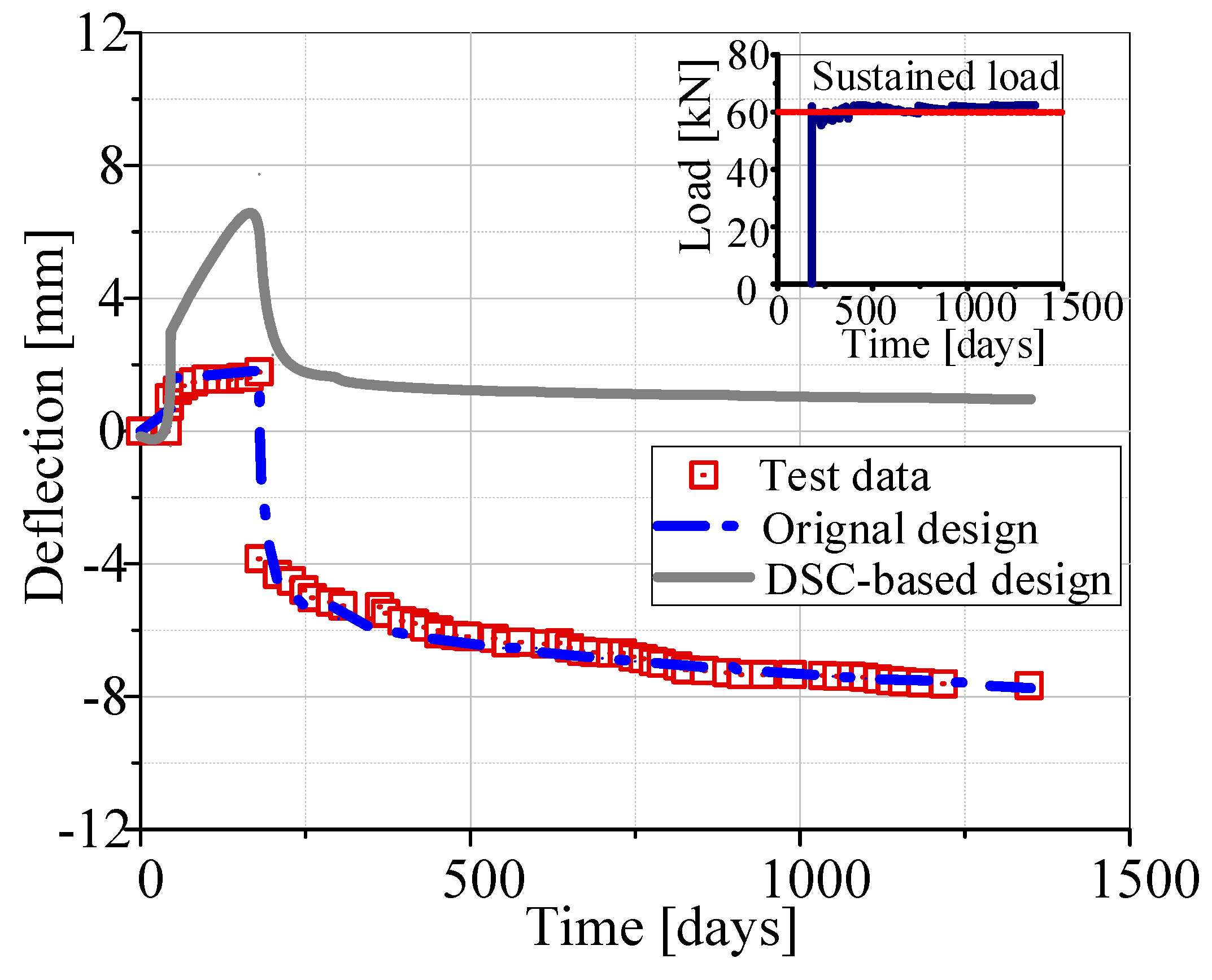
The tendons were tensioned at the concrete age of 45 days to 75% of their ultimate tensile strength, resulting in an effective prestress of 1259 MPa after instantaneous losses. The compressive strength and elastic modulus of the concrete are 42.5 MPa and 32.47 GPa, respectively. The experiment was conducted under an average ambient temperature of 20 °C and a relative humidity of 60%. The simply supported beam was modeled using 3D beam elements. The vertical displacement (Uy) was restrained at both supports. To avoid artificial axial restraint, the longitudinal displacement (Ux) was fixed at one support and released at the other, while the transverse displacement (Uz) was left free at both supports. All rotational degrees of freedom (Rx, Ry, Rz) were released at both supports, ensuring free rotation and a statically determinate support condition. The mid-span deflection results calculated by the different methods, along with the loading history monitored over a 1350-day period, are presented in Figure 6. While the original design resulted in an initial 2 mm upward camber that shifted to a −7.8 mm downward deflection after 1350 days, the DSC-based method produced a 6.5 mm initial camber and sustained a residual upward displacement of 0.5 mm. These results indicate that the DSC-based approach provides superior long-term deflection control for PC beams, effectively mitigating downward deflection over extended service periods.
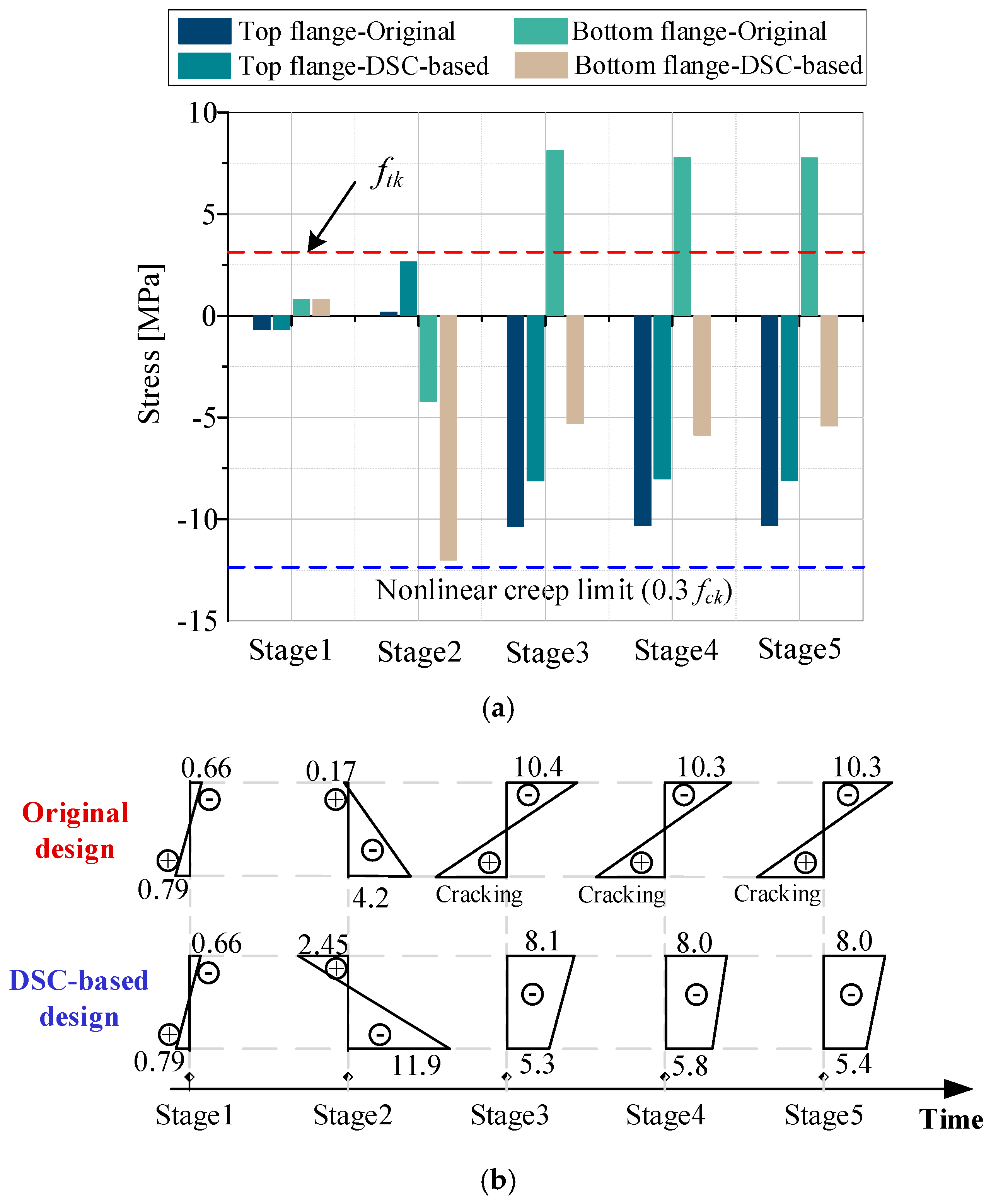
The DSC-based design method further requires verification of the stress state throughout the construction and service stages according to Figure 2. The evolution of sectional stresses is illustrated in Figure 7, where stages 1–5 correspond to self-weight, prestressing, sustained loading, and service durations of 500 and 1350 days, respectively. In the original design, tensile stress developed at the bottom flange after the application of sustained loads, leading to cracking. By contrast, the PC beam designed using the DSC-based method maintains compressive stresses over the entire cross-section during the later service stages. This stress state is consistent with the fundamental design philosophy of prestressed concrete beams and remains within the allowable limits for nonlinear creep based on Equation (20).

4. Case Studies of Two PC Bridges with Excessive Deflection

According to the structural sensitivity classification for creep and shrinkage analysis proposed by Bažant et al. [40], box girder bridges with main spans exceeding approximately 80 m are classified as long-span systems requiring refined time-dependent analysis. In this section, two long-span PC bridges currently in service are investigated as case studies, which were erected by the SBCM. In situ monitoring data from both bridges indicate that their deflections have exceeded the limits specified in JTG/T H21-2011 [41]. A comparative analysis between the original design and the DSC-based design is conducted to evaluate the time-dependent behavior, including BM, stress distributions, and long-term deflections.

4.1. Case Study 1: A Three-Span Rigid Frame PC Bridge (Bri-1)

4.1.1. Bridge Description

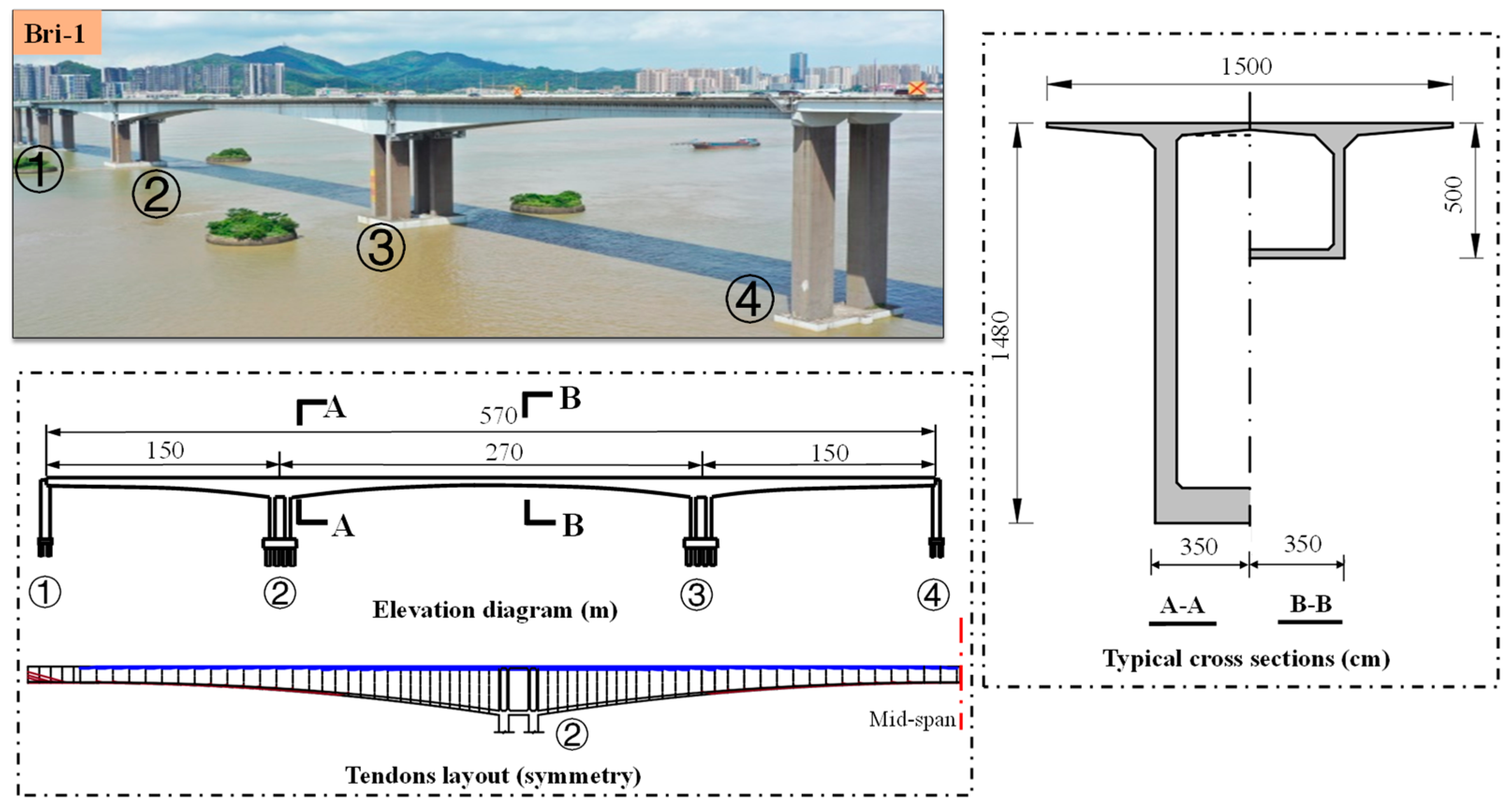
Bri-1 is a continuous rigid-frame bridge with a variable-depth box girder, which was completed in 1997. The girder height varies from 14.8 m at the pier to 5.0 m at mid-span, while the widths of the top and bottom flanges are 15.0 m and 7.0 m, respectively. The detailed geometric parameters are summarized in Table 2. The elevation layout and the typical cross-section of the bridge are illustrated in Figure 8. The material properties adopted for Bri-1 are listed in Table 3. After nine years of service, the mid-span deflection exceeded the allowable limit L 0 / 1000 [41]. To address this issue, the bridge was retrofitted by tensioning external prestressing tendons. Following the application of the external prestressing force, the mid-span deflection was reduced by 70 mm.

4.1.2. Finite Element (FE) Model and Model Validation

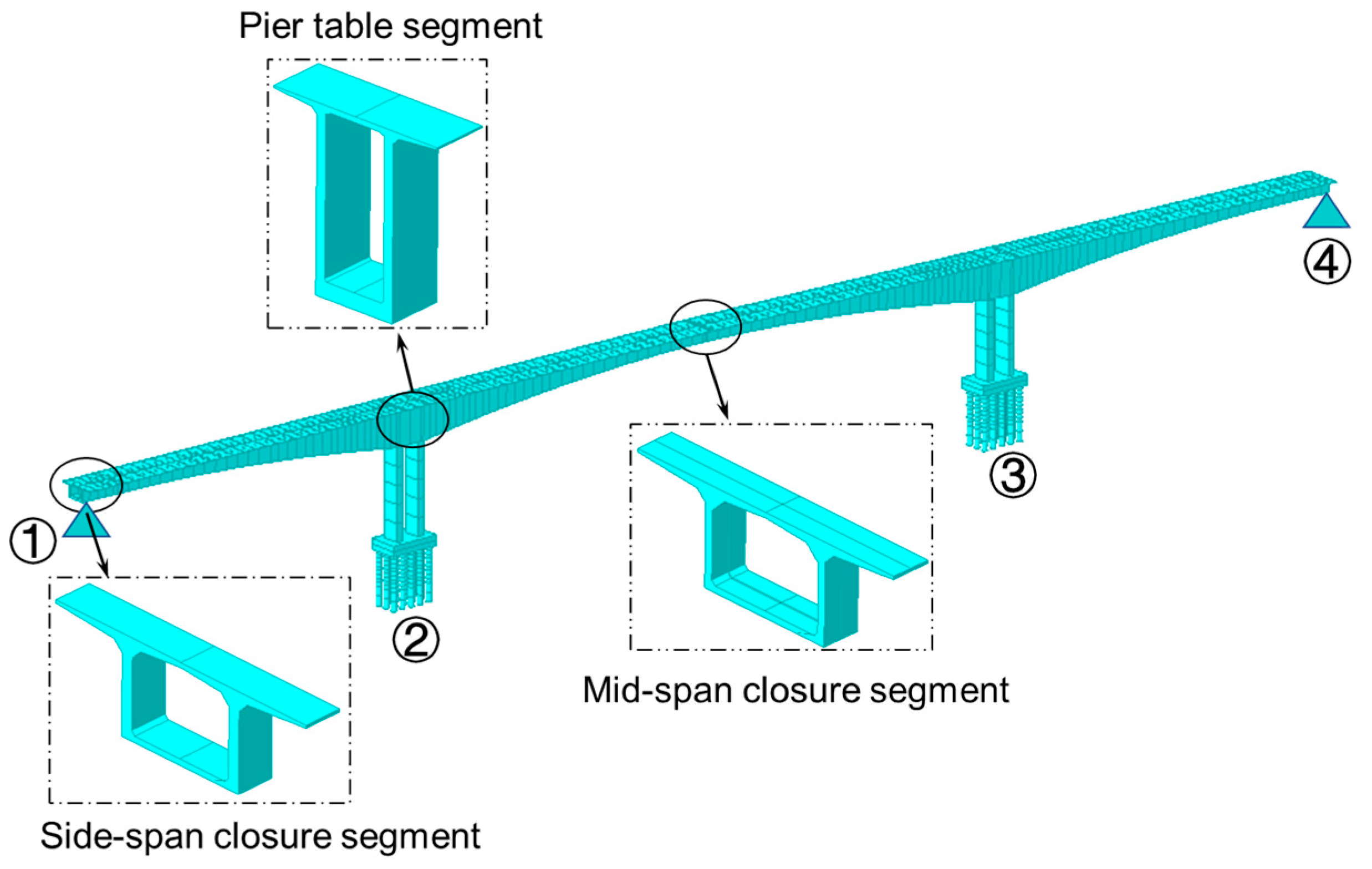
Based on the bridge structure and construction sequence of Bri-1, a FE model was built with 498 elements and 541 nodes. The prestressing force in the tendons was applied using the equivalent load method. Fixed boundary conditions were applied at the second and third supports, while vertical displacement constraints were imposed at the first and fourth supports. The FE model and selected cross-sections of Bri-1 are illustrated in Figure 9. The completeness of the extracted modes was verified using the Sturm sequence check. Creep and shrinkage effects were calculated using the JTG 3362–2018 code [38], and the live load consisted of a uniformly distributed load of 10.5 kN/m and a concentrated load of 360 kN, as specified in the same code. The shrinkage strain was assumed to be uniformly distributed within each construction segment, consistent with standard engineering practice [38].
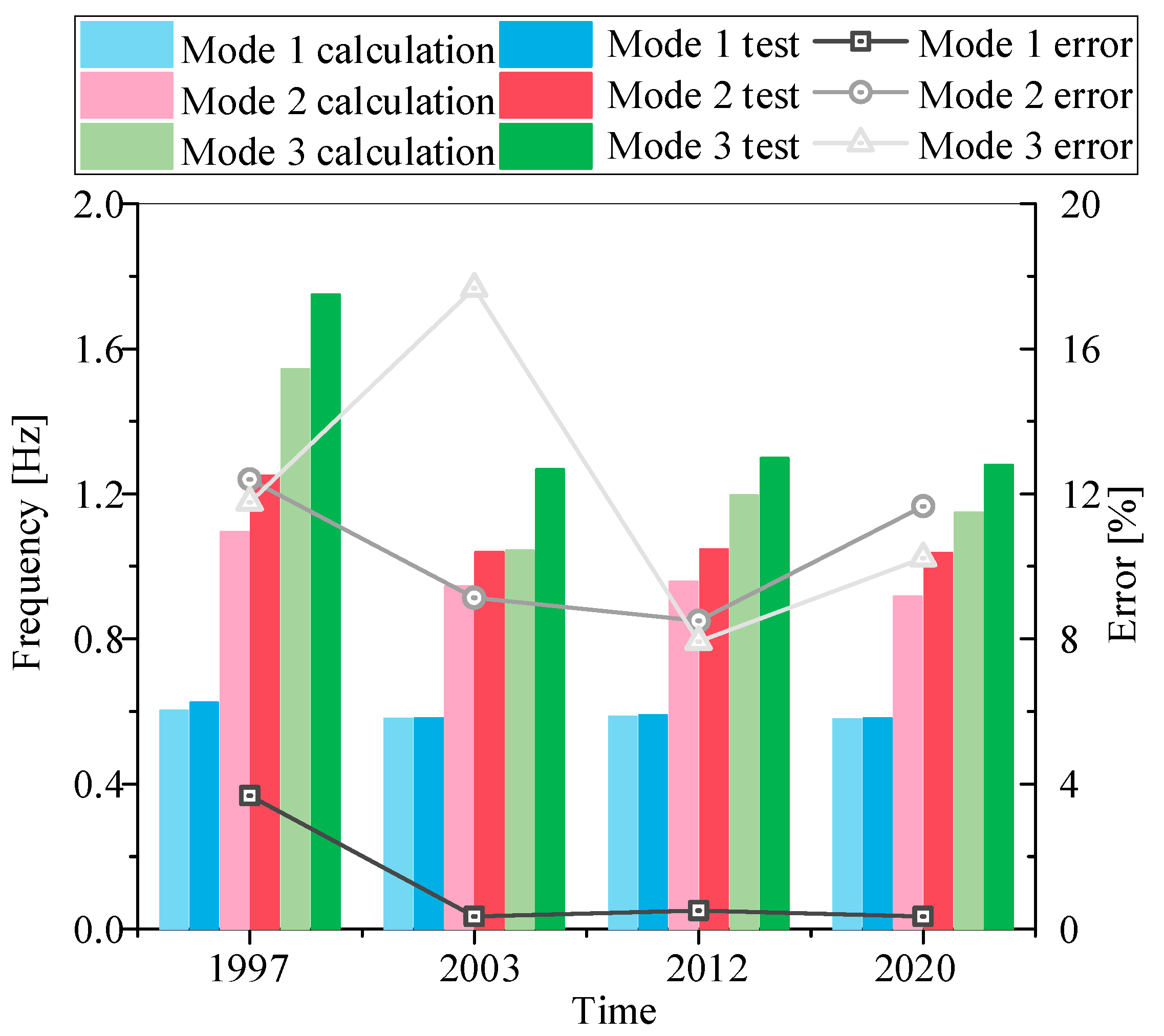
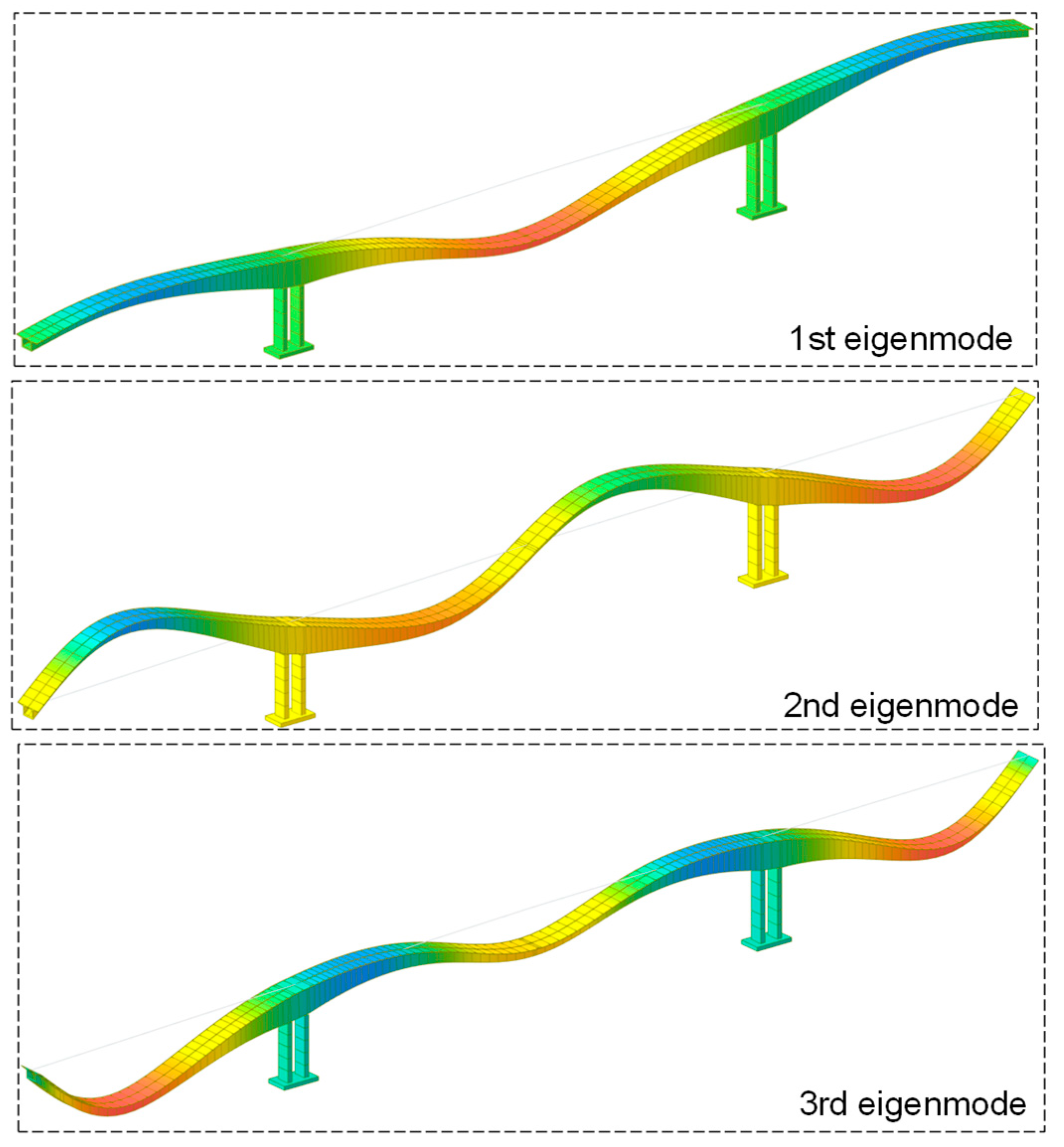
To verify the accuracy of the FE model, the first three vertical natural frequencies of the structure were evaluated based on load tests conducted after construction and at 6, 15, and 23 years after the bridge was completed. The calculated and measured results are presented in Figure 10. The discrepancies between the calculation and measurement results are within 4% for the first vertical mode, 12% for the second mode, and 18% for the third mode, demonstrating acceptable agreement. The measured natural frequencies at completion phase were consistently higher than the corresponding calculated values, suggesting that the actual global stiffness of the structure was greater than that assumed in the numerical model. Computed eigenmodes for the first three frequencies of Bri-1 at the completion stage are shown in Figure 11. However, a clear decreasing trend in natural frequencies was observed over time. Specifically, the measured first-order vertical natural frequency decreased from 0.625 Hz in 1997 to values ranging between 0.582 Hz and 0.589 Hz in subsequent tests. Similar reductions were observed in the second- and third-order vertical frequencies. These results indicate a significant degradation of structural stiffness in Bri-1 during its service life.

4.1.3. Time-Dependent Behaviors

  • BM state
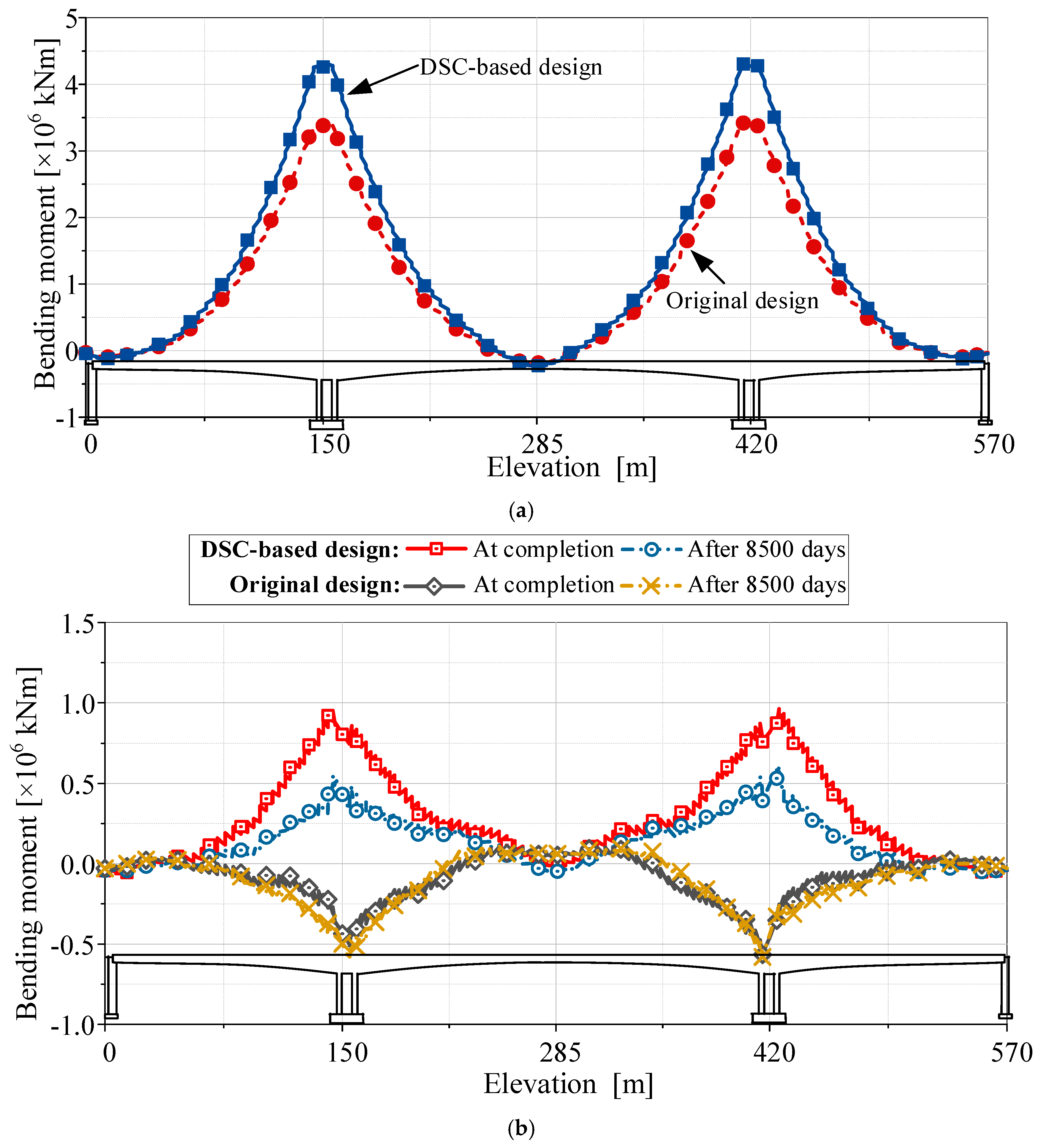
The resultant BM and the prestress-induced BM of Bri-1 at the completed stage and the 8500-day service stage are compared in Figure 12. In the original design, the resultant BM distribution at completion was opposite in sign to the prestress-induced BM, indicating that the prestressing system did not fully counterbalance the dead load and other permanent loads effects. As shown in Figure 2, This led to an unfavorable bending state of the structure. Moreover, the time-dependent BM further increased the resultant BM, which adversely affected the stress state and led to progressive mid-span deflection. By contrast, in the DSC-based design, the resultant BM distribution was generally consistent with that induced by prestressing in completion and 8500-day service stages. Although time-dependent effects reduced the positive BM, the resultant BM distribution remained essentially unchanged, which is advantageous for mitigating long-term deflection and improving serviceability performance of long-span rigid frame PC bridges.
  • Time-dependent stress distribution
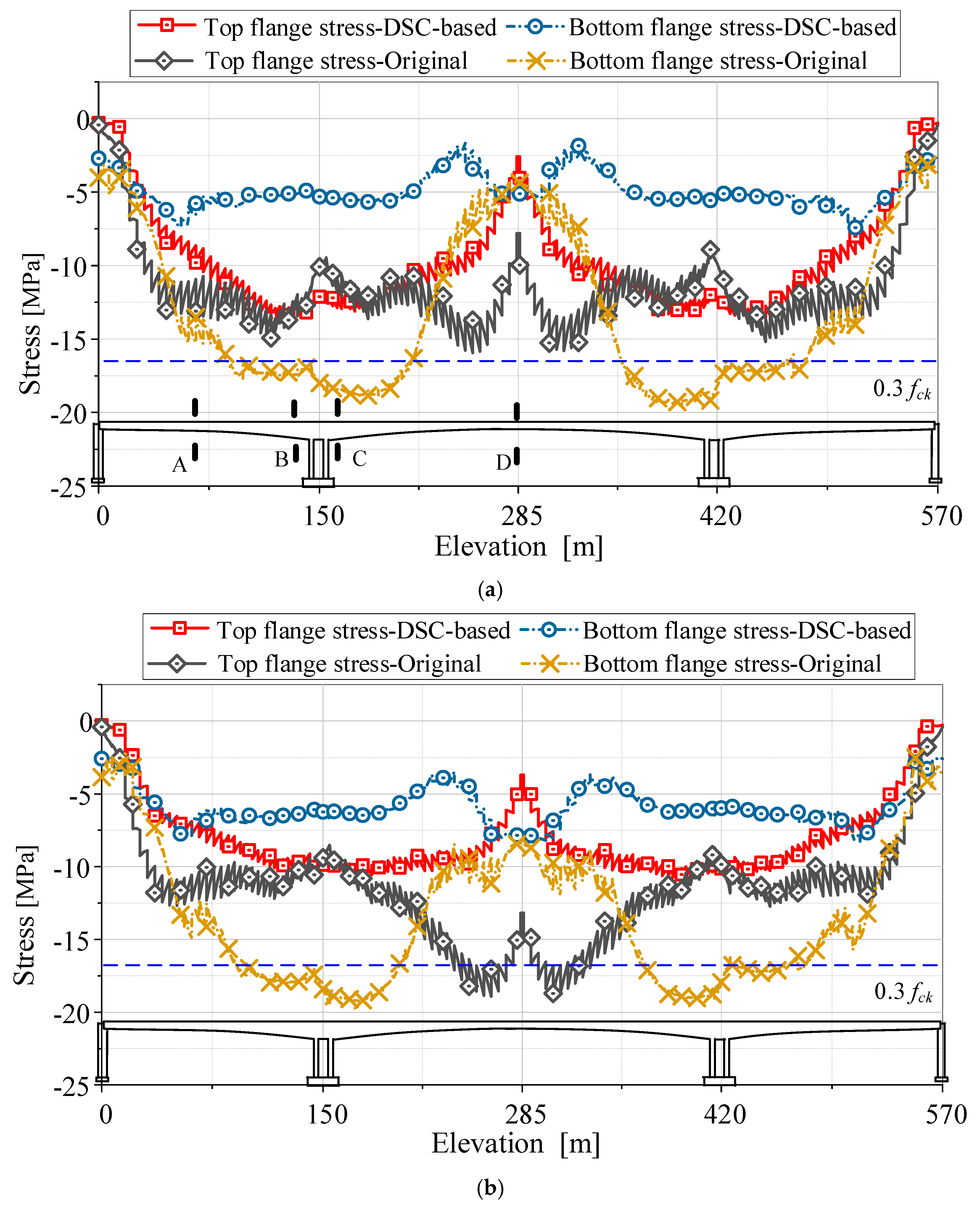
The time-dependent stress distributions at different service periods are presented in Figure 13, and the stress states of the selected sections are summarized in Table 4. According to the DSC-based stress profiles shown in Figure 2, the original design exhibited unfavorable stress distributions at most sections, except Section A-A. In particular, the stress levels at sections B-B and C-C exceeded the limits associated with nonlinear creep, which is averse to the long-term structural performance of long-span rigid frame PC bridges. For cases where elevated sustained stress levels may lead to nonlinear creep effects, a stress-dependent correction approach was adopted. Specifically, the nonlinear creep coefficient was estimated from the linear creep coefficient through a magnification function, following the method proposed by Hamed [37]. This approach employs a continuous and differentiable amplification function, which facilitates numerical implementation and enables consistent calculation of the compliance modulus within the time-stepping analysis framework. By incorporating this correction, the potential influence of stress-dependent creep behavior is rationally accounted for in the original design. In contrast, the DSC-based design significantly optimized the stress distribution at these critical sections, and a desired stress state was maintained even after 8500 days of service.
Figure 12. BM of Bri-1 based on different design method: (a) prestressing-induced BM; (b) resultant BM.
Symmetry 18 00456 g012
Table 4. Stresses at selected sections of Bri-1 (MPa).
Service StagesSectionsOriginal DesignStateDSC-Based DesignState
Top FlangeBottom FlangeTop FlangeBottom Flange
At completionA-A−13.6−15.1Desired−9.6−6.4Desired
B-B−10.7−17.6Undesired−12.7−5.2Desired
C-C−10.9−19.0Undesired−12.5−5.4Desired
D-D−7.8−4.6Undesired−2.5−5.1Desired
8500-day serviceA-A−11.5−13.0Desired−7.7−6.9Desired
B-B−10.7−17.5Undesired−9.9−5.7Desired
C-C−10.8−18.7Undesired−10.1−5.8Desired
D-D−13.3−7.7Undesired−3.6−7.7Desired
Figure 13. Stress distribution of Bri-1 at different service stages: (a) at bridge completion; (b) after 8500-day service.
Symmetry 18 00456 g013
  • Long-term deflection at mid span point
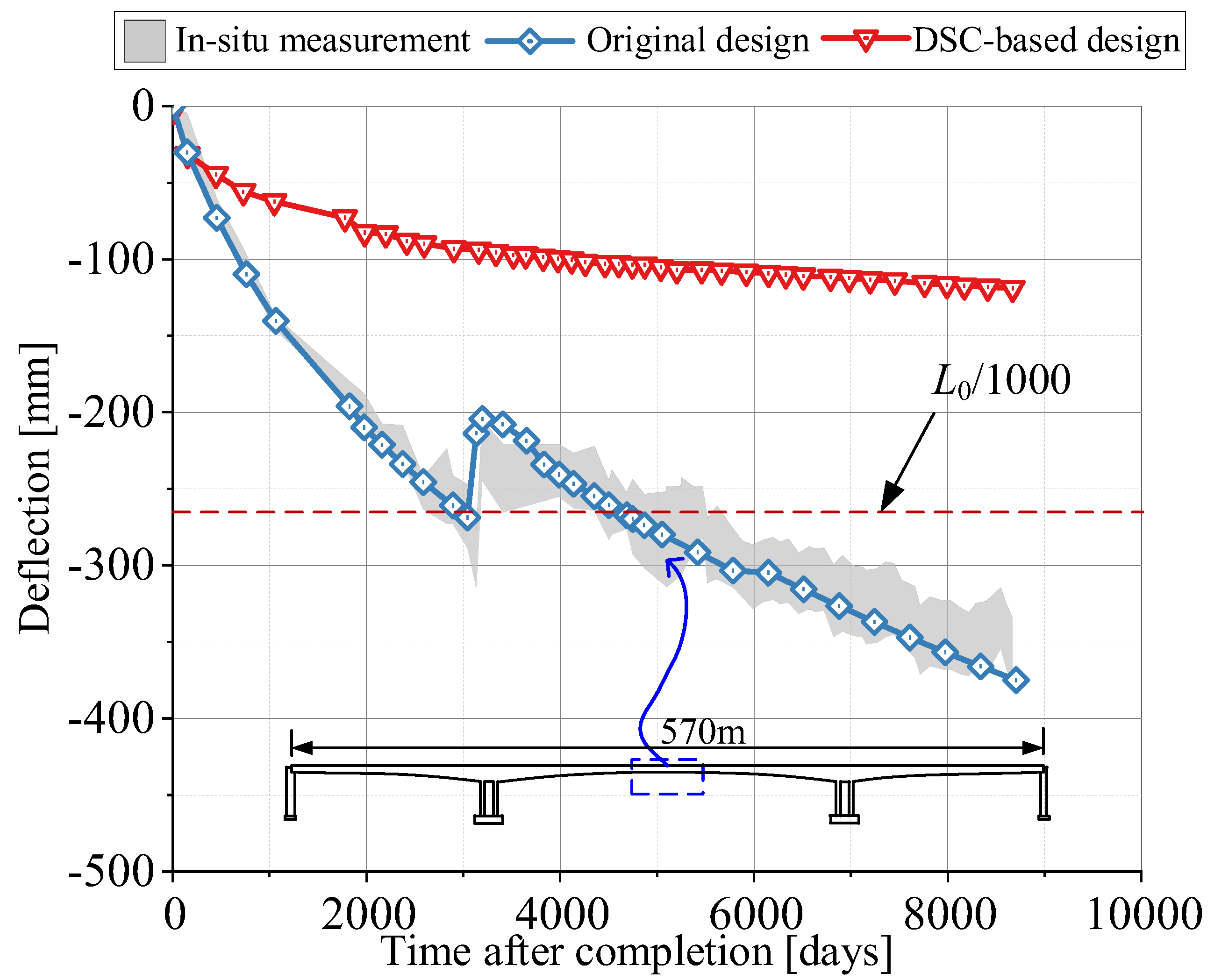
The calculated long-term mid-span deflection of Bri-1 for the original design and the DSC-based design are compared in Figure 14. For the original design, the serviceability limit was reached after approximately 3500 days of operation, which is consistent with the in situ measured data. This result indicates that the original design was unable to effectively control long-term deflection, even after the application of external prestressing tendons retrofitting. By contrast, the DSC-based design provided effective control of long-term deflection both before and after strengthening. Prior to retrofit, the mid-span deflection was reduced by approximately 170 mm, corresponding to a reduction of about 63% relative to the original design. After applying the same retrofitting process, the deflection response exhibited a stable and well-controlled trend. These results demonstrate that the DSC-based design is effective in mitigating long-term deflection in rigid-frame PC bridges.
A lifecycle net present value analysis was performed for Bri-1 under a discount rate of 5% [42]. Considering that the DSC-based design increases the initial prestressing cost to 1.3 Cp. Cp denotes the initial construction cost of the internal prestressing system in the original design [43], while the retrofitting cost of the original scheme is approximately 0.9 Cp occurring at 9.6 years, the total net present value of the original scheme reaches 1.5625 Cp. In comparison, the DSC scheme requires only 1.3 Cp, resulting in a lifecycle cost reduction of approximately 16.8%. Furthermore, the long-term mid-span deflection after 8500 days is reduced by more than 70%, substantially improving serviceability robustness and eliminating the risk of secondary intervention. A break-even analysis indicates that the critical retrofitting cost coefficient is approximately 0.48 Cp under a 5% discount rate. In practical bridge engineering, external prestressing retrofitting typically exceeds this threshold. Therefore, the proposed DSC-based design demonstrates robust economic superiority under realistic cost conditions.

4.2. Case Study 2: A Five-Span Continuous Variable-Depth PC Bridge (Bri-2)

4.2.1. Bridge Description

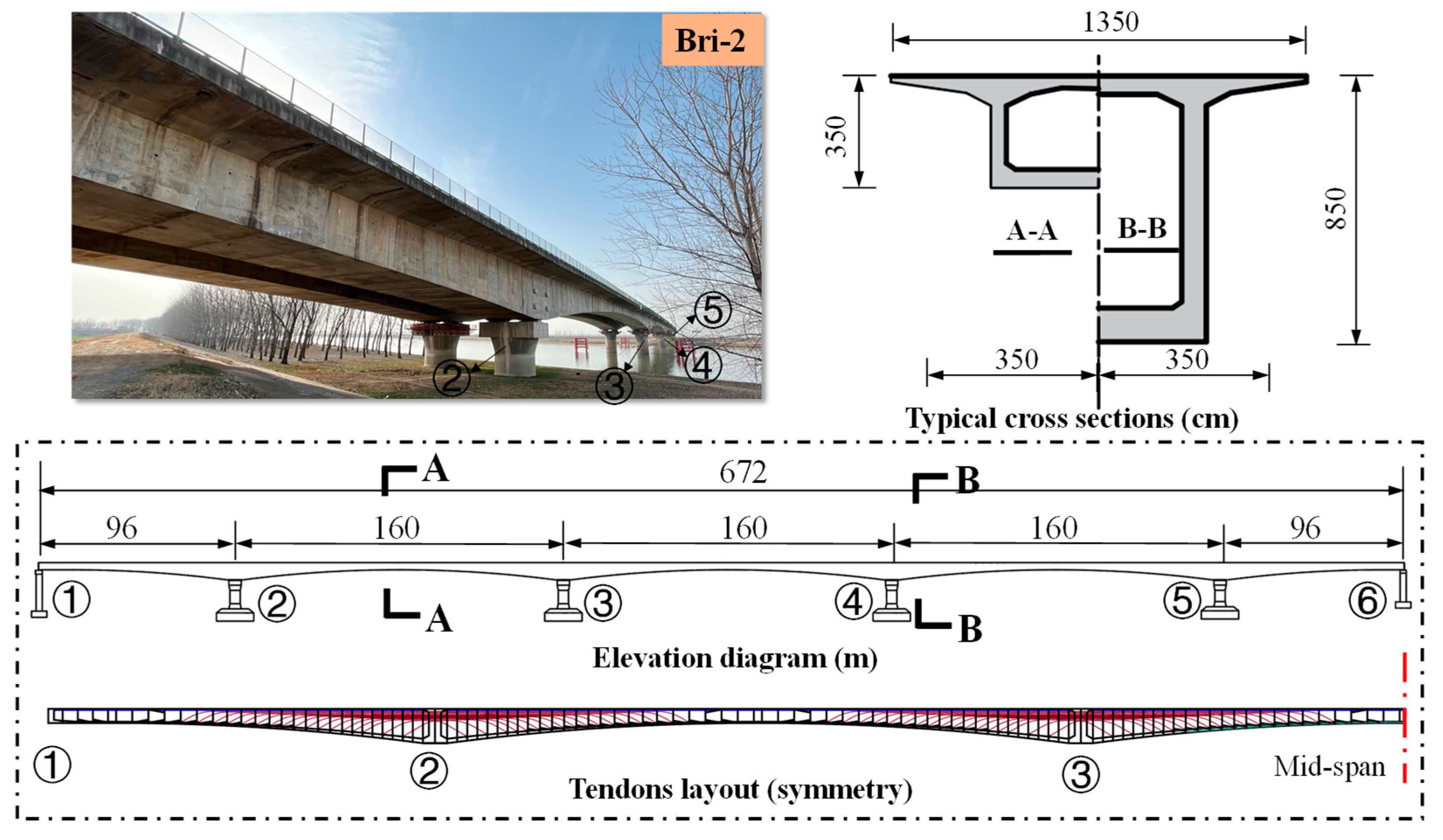
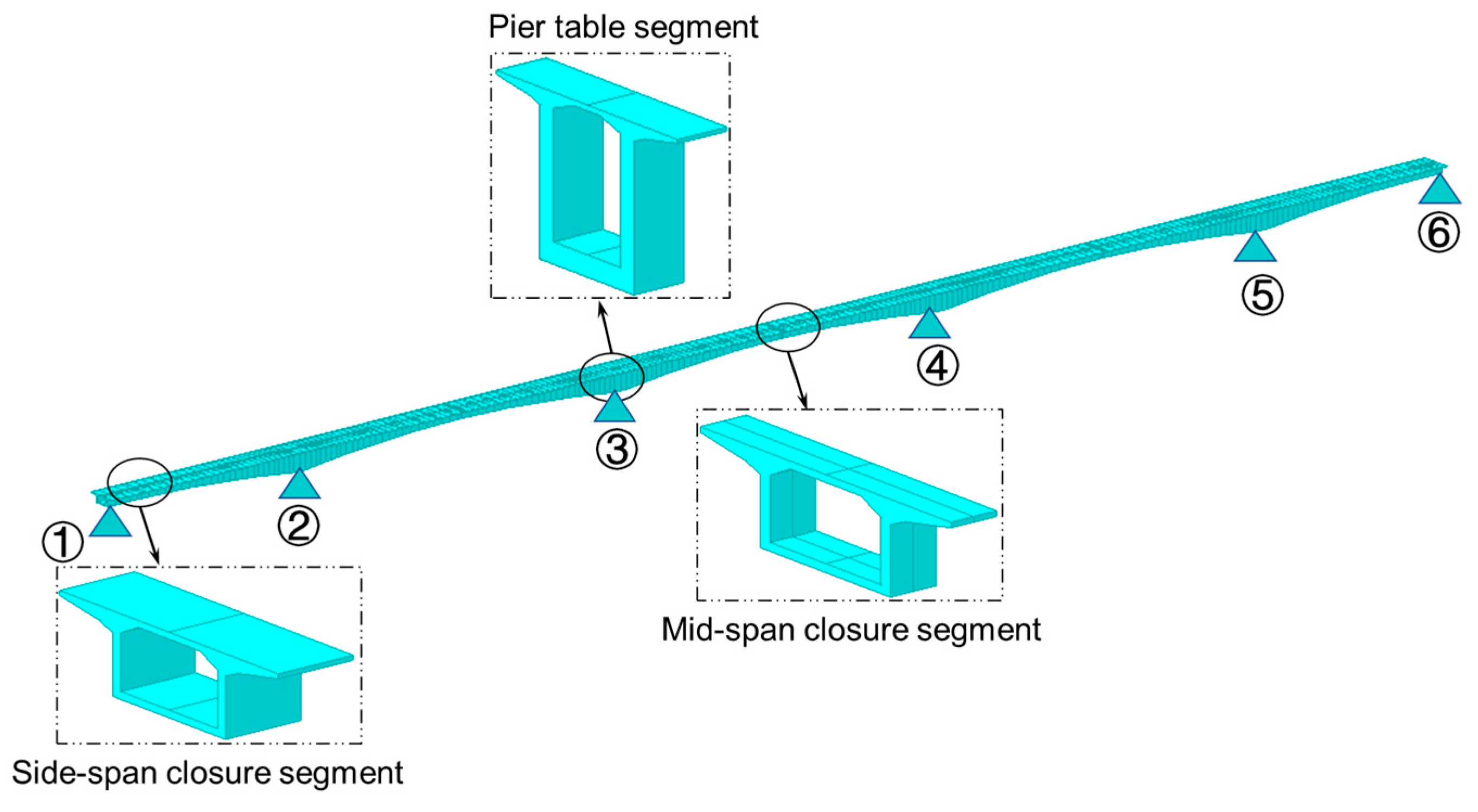
Bri-2 is a five-span continuous PC variable-depth box girder bridge, and a span arrangement of 96 m + 3 × 160 m + 96 m. The bridge was opened to traffic in 2008, using the balanced cantilever constructed method, and its elevation and typical cross section are illustrated in Figure 15. The widths of the top and bottom flanges are 13.5 m and 7.0 m, respectively, while the girder height varies longitudinally from 8.5 m at the piers to 3.5 m at mid-span. Correspondingly, the bottom flange thickness decreases from 1.1 m at the pier sections to 0.32 m at mid-span; both the girder height and bottom flange thickness follow quadratic parabolic distributions along the span. Detailed geometric parameters are summarized in Table 5, and the material properties of the concrete and prestressing tendons adopted for Bri-2 are presented in Table 6.
During the 14-year service period of Bri-2, the longitudinal alignment of the first and fifth spans remained essentially stable, whereas the second to fourth spans exhibited a continuous downward deflection. The average mid-span deflection rate of the third span was approximately 2.5 mm/year. In contrast, the second and fourth spans showed greater deflection development, with average deflection rates of 12.8 mm/year and 8.6 mm/year, respectively.

4.2.2. FE Model and Model Validation

The FE model approach for Bri-2 is identical to that adopted for Bri-1, except that the bridge supports restrain vertical and transverse displacements, while supports 2 and 5 additionally restrain longitudinal displacement. The entire bridge model comprises 215 elements and 239 nodes, as shown in Figure 16. The live load values are determined in accordance with the Chinese code JTG 3362–2018 [38].
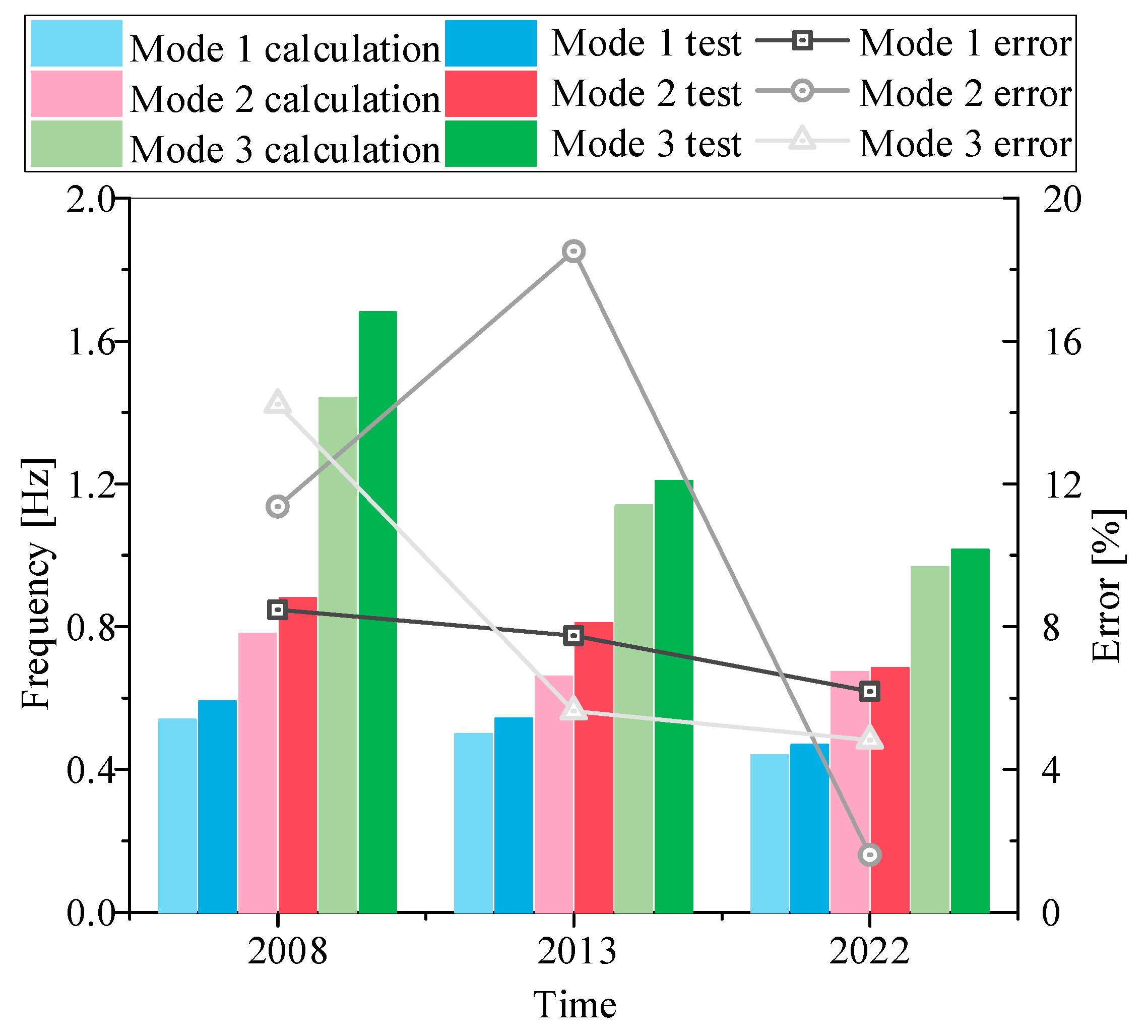
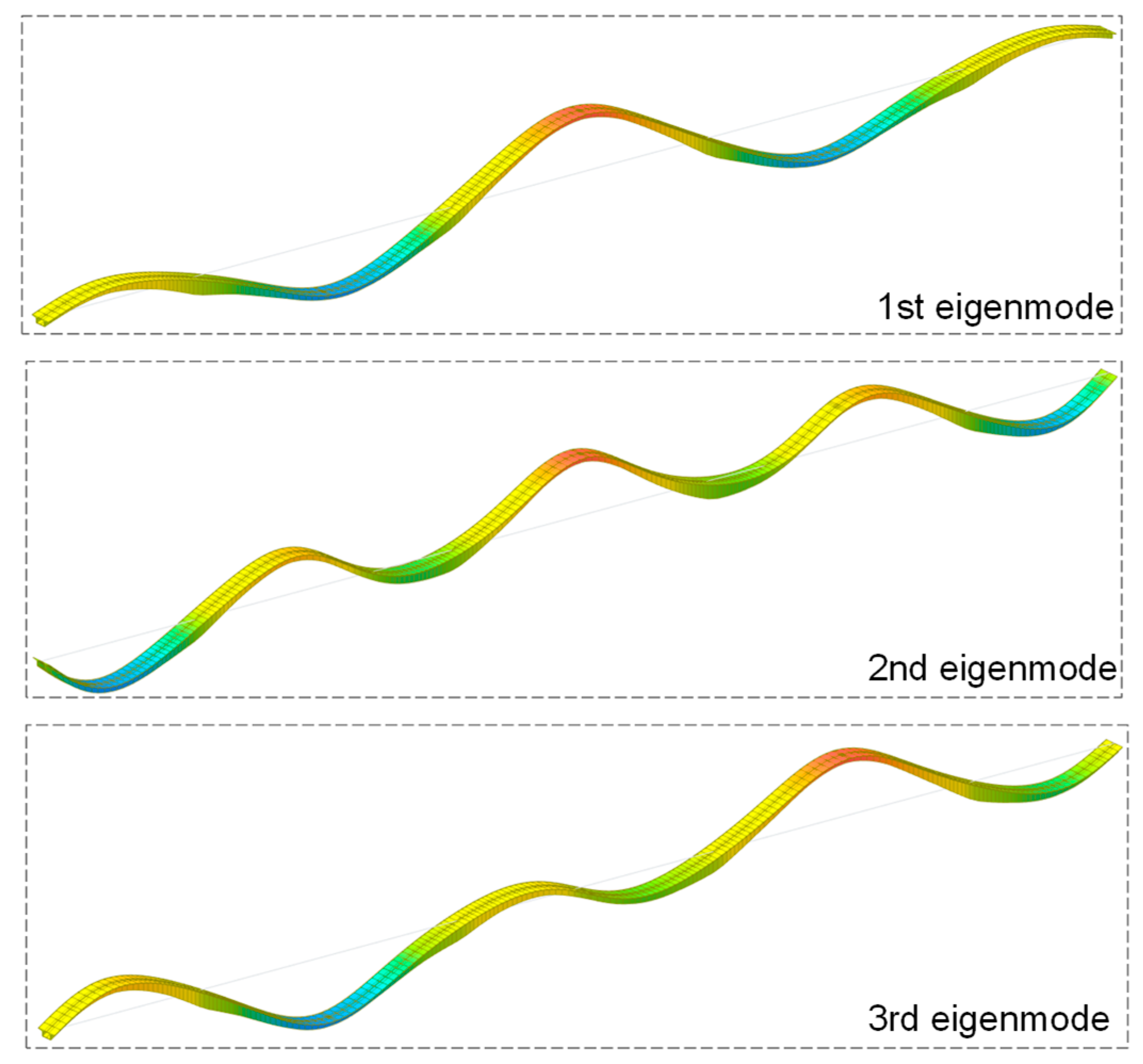
Since the bridge was completed in 2008, three load tests have been conducted. At the end of construction, the in situ measured first-order vertical natural frequency was 0.59 Hz, which was higher than the corresponding calculated value. After 14 years of service, the first-order vertical natural frequency decreased to 0.469 Hz. The second- and third-order vertical natural frequencies exhibited similar downward trends, indicating a continuous degradation of the structural performance. The discrepancy between the calculated and measured first-order vertical natural frequencies is less than 8% as shown in Figure 17. The maximum errors for the second- and third-order frequencies are approximately 19% and 15%, respectively. Computed eigenmodes for the first three frequencies of Bri-2 at the completion stage are shown in Figure 18. These results demonstrate that the FE model can capture the long-term performance of the structure.

4.2.3. Time-Dependent Behaviors

  • BM state
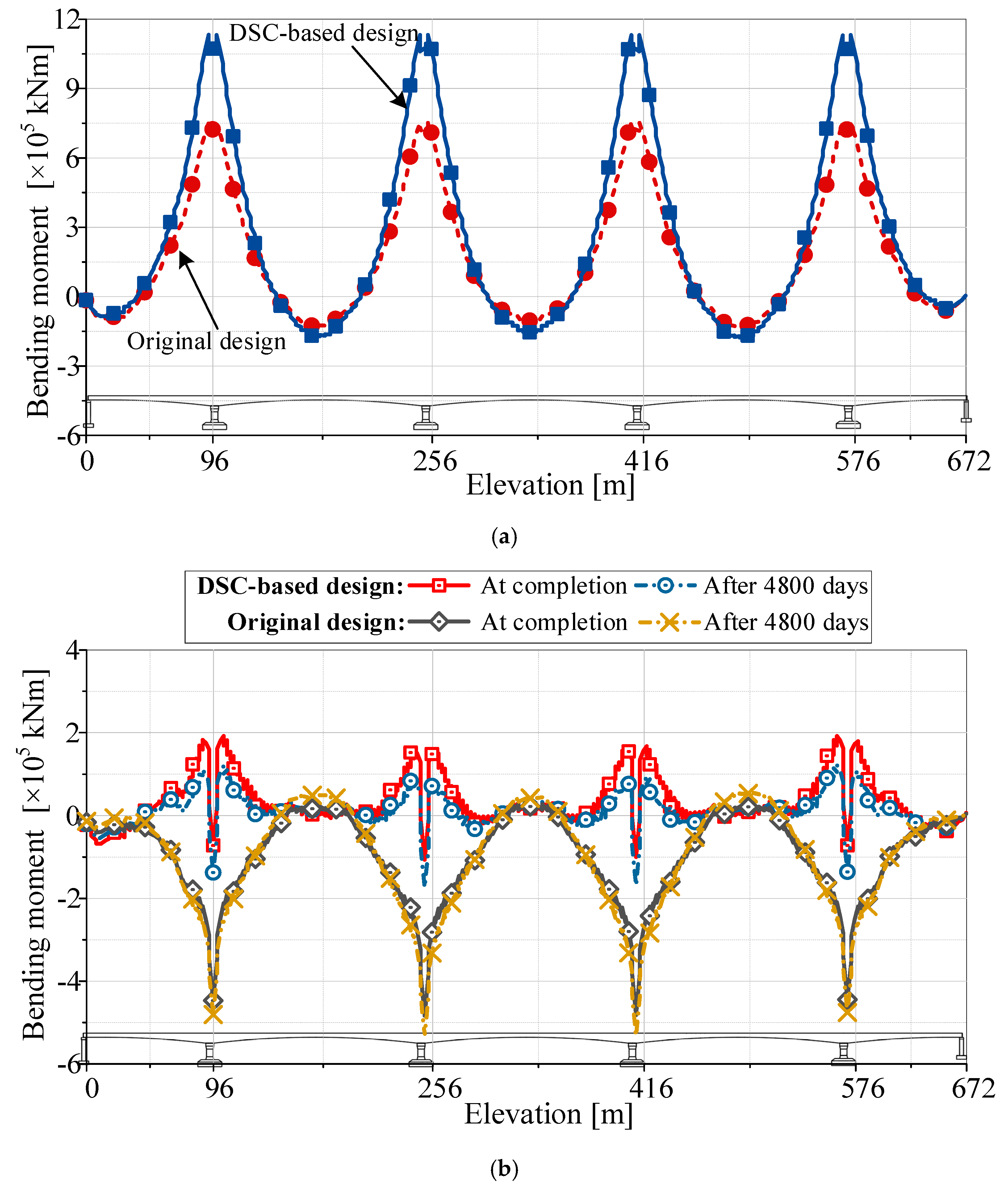
The distributions of the resultant BM and the prestressing-induced BM along the bridge longitudinal direction for the original design and the DSC-based design, both at completion and the 4800-day service stages were compared, as shown in Figure 19. For the original design, the resultant BM shows large negative peaks at the pier table segments, while the corresponding prestressing-induced BM is insufficient. This indicates that the prestressing force was not properly coordinated with the load combinations induced BM, resulting in a poor BM state. From the completion stage to the 4800-day service stage, time-dependent effects further amplify the resultant BM, especially in the mid-span regions, thereby increasing tensile stress demand in critical sections.
Compared with the original design, the DSC-based design reduces the pier table segment resultant BM from about −45 × 104 kNm to −7.5 × 10⁴ kNm, achieving a significant decrease of approximately 83.3%, which indicates a substantial mitigation of undesired negative bending effects at the piers. The prestressing BM is better aligned with the resultant BM envelope, effectively counteracting the dead load and long-term effects throughout the span. Moreover, the DSC-based prestressing design strategy achieves a more effective balance between external loads, time-dependent effects and prestressing actions, leading to a stable and desired BM distribution over long-term service. This improvement provides a solid mechanical basis for enhancing durability and long-term performance of continuous PC girder bridges.
  • Time-dependent stress distribution
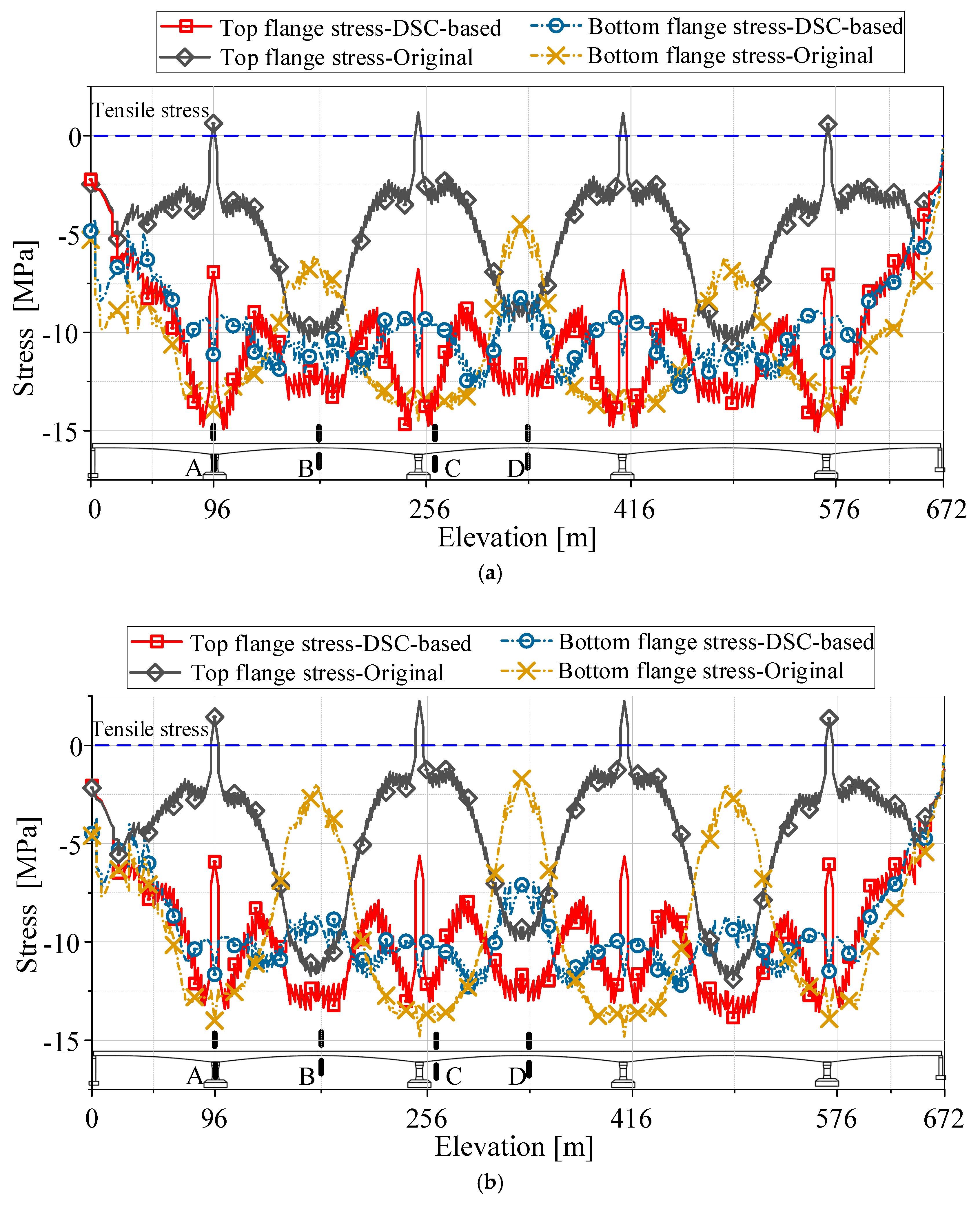
The stress distributions of Bri-2 at different service stages are illustrated in Figure 20, and the stress states of the four representative sections are summarized in Table 7. For the original design, tensile stress had already developed in the top flange at the pier table segments upon bridge completion. Moreover, the compressive stress in the top flange at the mid-span section exceeded that in the bottom flange, while the bottom flange at the pier table segments experienced higher compressive stress than the top flange, indicating an undesired stress distribution. After 4800 days of service, the tensile stress further increased, reaching a maximum value of approximately 2.35 MPa, which significantly elevates the risk of cracking and detrimentally affects structural durability. Compared with the original design, DSC-based design substantially improves the stress state of Bri-2. The stress distributions of these selected sections are substantially improved, with the cross-sections generally remaining in compression during both the completion stage and the service period. This stress state is beneficial for controlling crack development and ensuring the long-term serviceability and durability of the structure.
Figure 19. BM of Bri-2 based on different design method: (a) prestressing-induced BM; (b) resultant BM.
Symmetry 18 00456 g019
Table 7. Stresses at selected sections of Bri-2 (MPa).
Service StagesSectionsOriginal DesignStateDSC-Based DesignState
Top FlangeBottom FlangeTop FlangeBottom Flange
At completionA-A0.5−13.0Undesired−13.1−11.2Desired
B-B−11.8−1.8Undesired−11.2−10.6Desired
C-C−2.7−13.6Undesired−14.7−9.3Desired
D-D−8.8−3.8Undesired−11.1−8.0Undesired
4800-day serviceA-A1.1−14.1Undesired−11.7−11.5Desired
B-B−11.3−2.0Undesired−11.6−8.9Desired
C-C−2.1−13.2Undesired−13.6−10.4Desired
D-D−9.8−2.3Undesired−11.8−6.9Undesired
Figure 20. Stress distribution of Bri-2 at different service stages: (a) at bridge completion; (b) after 4800-day service.
Symmetry 18 00456 g020
  • Long-term deflection at second mid-span point
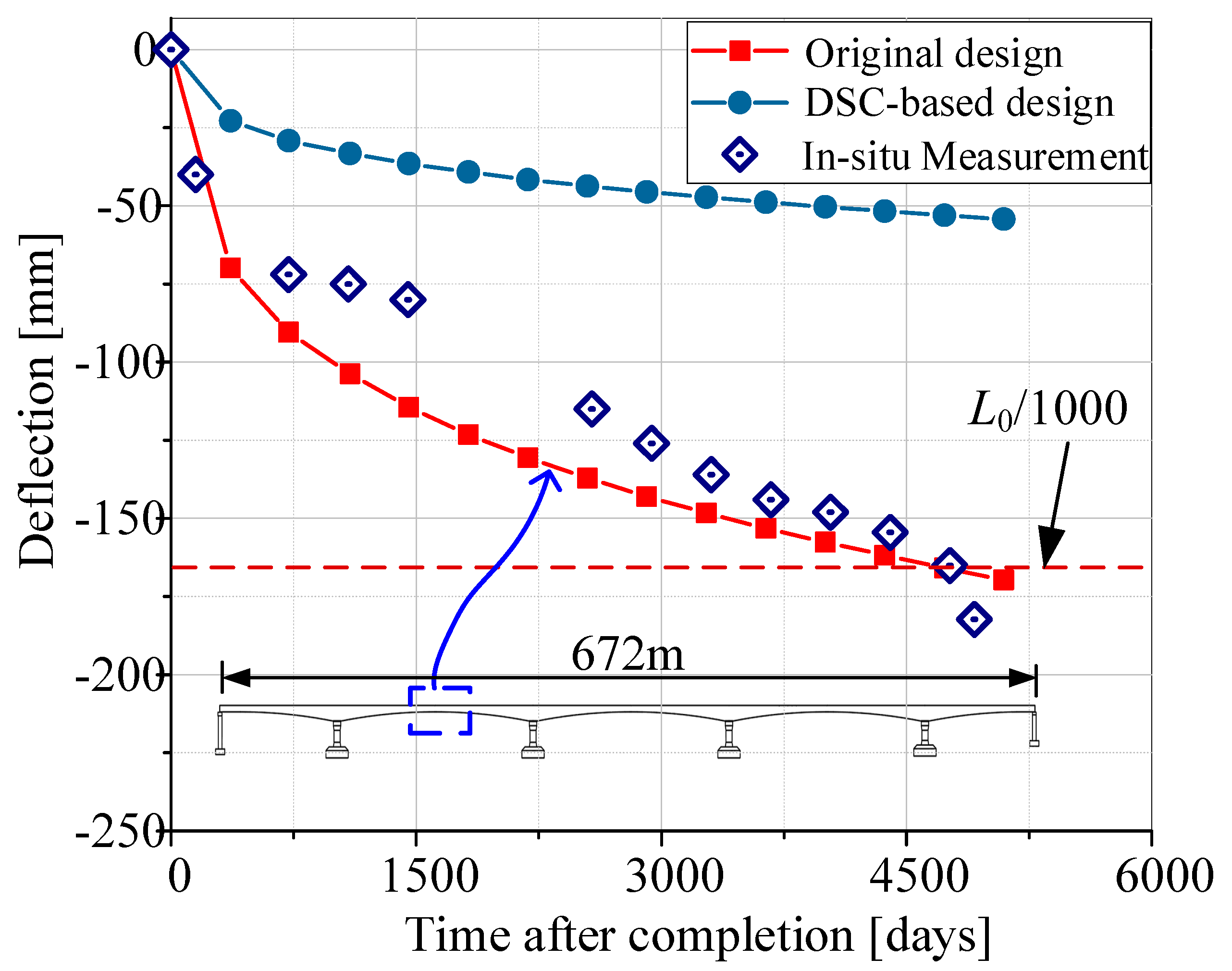
The long-term deflection evolution at the second mid-span section after bridge completion is presented in Figure 21. For the original design, the mid-span deflection increases rapidly with time, exhibiting a pronounced downward trend during the service period. The deflection exceeds −150 mm at approximately 3500 days and continues to increase, reaching about −180 mm at around 4800 days, thereby exceeding the serviceability limit specified in JTG/T H21-2011 [41]. This indicates inadequate control of time-dependent deformation in the original design. In contrast, the DSC-based design exhibits a substantially improved time-dependent deflection. The long-term deflection develops at a slower rate and remains within a relatively narrow range throughout the entire observation period. At 4800 days, the deflection is limited to approximately −55 mm, corresponding to a reduction of nearly 70% compared with the original design. These results demonstrate that the DSC-based prestressing strategy effectively suppresses excessive long-term deflection by enhancing the coordination between prestressing actions and time-dependent effects, thereby ensuring satisfactory long-term serviceability.

5. Conclusions

This study is dedicated to presenting a prestressing design method to mitigate excessive deflection in long-span PC bridges. The effectiveness and applicability of the proposed method are validated by evaluating two long-span PC girder bridges in service. The main conclusions are summarized as follows:
(1) The concept of a desired structural curvature state is proposed, in which both the target BM and the corresponding stress state are controlled through prestressing design to counteract external loads and time-dependent effects, effectively mitigating progressive deflection.
(2) For statically indeterminate PC continuous and rigid-frame girder bridges, a DSC-based prestressing design method is developed. This method enables the quantitative determination of the required prestressing forces and the quantities of cantilever, side-span closure, and mid-span closure tendons to control long-term deflection.
(3) Numerical simulations based on the sustained loading test of a simply supported PC beam by Yang et al. [39] demonstrate that the original prestressing design leads to continuous long-term deflection, while the DSC-based design with additional tendons significantly reduces mid-span deflection and enhances crack resistance.
(4) The case study of Bri-1, a three-span PC rigid-frame bridge, shows that the original prestressing design leads to progressive long-term deflection under the DSC evaluation framework. In contrast, the DSC-based design reduces mid-span deflection by 63% over 3500 days (prior to retrofit) and by more than 70% over 8500 days, while maintaining concrete stresses within the linear creep range. Furthermore, the DSC scheme achieves a lifecycle cost reduction of approximately 16.8%.
(5) Bri-2 is an in-service five-span continuous PC bridge. Comparative analysis indicates that the amount of prestressing in the original design is insufficient to restrain long-term deflection. Increasing the prestressing level according to the DSC approach reduces the mid-span deflection at 4800 days by nearly 70% and maintains compressive stress throughout the bridge, thereby eliminating the risk of tensile cracking.
Overall, these findings demonstrate that the DSC-based design method provides a practical and reliable solution for mitigating excessive deflection, with significant potential for application in the design and retrofitting of long-span PC bridges, as it can be directly applied within conventional structural analysis frameworks without requiring specialized materials or construction techniques.

6. Limitation and Future Work

It should be noted that the proposed DSC-based method is developed primarily for flexure-dominated PC girder bridges, particularly those constructed using SBCM and susceptible to excessive long-term deflection. Its extension to other bridge systems with different load-resisting mechanisms, such as cable-stayed bridge and arch bridge, require further theoretical refinement and validation. Moreover, for complex long-span bridge projects involving staged construction, asymmetric loading, or variable boundary conditions, the applicability of the DSC-based method under realistic construction scenarios should be further verified through field monitoring data and case studies. The DSC-based design framework can be integrated with conventional construction control, explicitly considers prestress loss at the design stage, and relies on standard monitoring means, including sectional strain, tendon force, and geometry-based measurements, confirming its practical feasibility and applicability. The development of digital construction control platforms incorporating curvature-based feedback mechanisms may provide a promising direction for enhancing the robustness of the method. Future research will extend the framework to investigate the coupled effects of reinforcement corrosion, prestress loss, and time-dependent material behavior on long-term deflection, supported by in situ monitoring and experimental validation.

Author Contributions

Conceptualization, Z.L.; methodology, Z.L. and S.W.; software, S.W.; validation, S.W.; formal analysis, S.W.; investigation, S.W.; resources, Z.L.; data curation, Z.L. and S.W.; writing—original draft preparation, S.W.; writing—review and editing, Z.L., S.W. and G.D.L.; visualization, S.W.; supervision, Z.L.; project administration, Z.L.; funding acquisition, Z.L. All authors have read and agreed to the published version of the manuscript.

Funding

This research was funded by the National Key R&D Program of China (No. 2019YFE0119800) and China Scholarship Council (202406090273).

Data Availability Statement

Data are contained within the article. The original contributions presented in this study are included in the article. Further inquiries can be directed to the corresponding author.

Conflicts of Interest

The authors declare no conflicts of interest.

Abbreviations

AAEMAge-adjusted effective modulus method
BMBending moment
BMDBending moment diagram
CGContinuous girder
DSCDesired structural curvature
FEFinite element
LBMLoad balancing method
PCPrestressed concrete
RFRigid frame
RFHRigid frame with midspan hinge
SBCMSymmetrical balanced cantilever method

References

  1. Takács, P.F. Deformations in Concrete Cantilever Bridges: Observations and Theoretical Modelling. Ph.D. Dissertation, Norwegian University of Science and Technology, Trondheim, Norway, 2002. [Google Scholar]
  2. Chai, Y.H. Service Performance of Long-Span Lightweight Aggregate Concrete Box-Girder Bridges. J. Perform. Constr. Facil. 2016, 30, 04014196. [Google Scholar] [CrossRef]
  3. Massicotte, B.; Picard, A.; Gaumond, Y.; Ouellet, C. Strengthening of a Long Span Prestressed Segmental Box Girder Bridge. PCI J. 1994, 39, 52–65. [Google Scholar] [CrossRef]
  4. Burdet, B. Deflection Monitoring of Prestressed Concrete Bridges Retrofitted by External Post-Tensioning. In Proceedings of the IABSE Symposium, Rio de Janeiro, Brazil, 25–27 August 1999. [Google Scholar]
  5. Bažant, Z.P.; Yu, Q.; Li, G.-H. Excessive Long-Time Deflections of Prestressed Box Girders. I: Record-Span Bridge in Palau and Other Paradigms. J. Struct. Eng. 2012, 138, 676–686. [Google Scholar] [CrossRef]
  6. Tilly, G. Performance and management of post-tensioned structures. Proc. Inst. Civ. Eng.-Struct. Build. 2002, 152, 3–16. [Google Scholar] [CrossRef]
  7. Wu, S.; Tong, T.; Fang, Y.; Ge, F. Numerical model for time-dependent cracking and deflection of large-span concrete bridge structures. Struct. Infrastruct. Eng. 2024, 1–16. [Google Scholar] [CrossRef]
  8. Xie, J.; Wang, G.; Zheng, X.-H. Review of Study of Long-term Deflection for Long Span Prestressed Concrete Box-girder Bridge. J. Highw. Transp. Res. Dev. (Engl. Ed.) 2007, 2, 47–51. [Google Scholar] [CrossRef]
  9. Huang, H.; Huang, S.-S.; Pilakoutas, K. Modeling for Assessment of Long-Term Behavior of Prestressed Concrete Box-Girder Bridges. J. Bridge Eng. 2018, 23, 04018002. [Google Scholar] [CrossRef]
  10. Li, S.; Yang, Y.; Pu, Q.; Yang, D.; Sun, B.; Li, X. Three-dimensional nonlinear creep and shrinkage effects of a long-span prestressed concrete box girder bridge. Struct. Concr. 2019, 20, 638–649. [Google Scholar] [CrossRef]
  11. Criel, P.; Reybrouck, N.; Caspeele, R.; Matthys, S. Uncertainty quantification of creep in concrete by Taylor expansion. Eng. Struct. 2017, 153, 334–341. [Google Scholar] [CrossRef]
  12. Wu, S.; Qiao, H. A hybrid LSTM-MPHI2 approach for time-dependent reliability analysis of long-span PC bridges. Structures 2026, 86, 111221. [Google Scholar] [CrossRef]
  13. Wu, S.; Liu, Z.; Tong, T. Nonlinear Creep Analysis of Long-span Prestressed Concrete Bridges. In Proceedings of the IABSE Symposium Manchester 2024: Construction’s Role for a World in Emergency, Manchester, UK, 10–14 April 2024; pp. 252–259. [Google Scholar]
  14. Bonopera, M.; Chang, K.-C. Novel method for identifying residual prestress force in simply supported concrete girder-bridges. Adv. Struct. Eng. 2021, 24, 3238–3251. [Google Scholar] [CrossRef]
  15. Giaccu, G.F.; Solinas, D.; Briseghella, B.; Fenu, L. Time-Dependent Analysis of Precast Segmental Bridges. Int. J. Concr. Struct. Mater. 2021, 15, 13. [Google Scholar] [CrossRef]
  16. Tong, T.; Zhao, C.; Wu, S.; Li, J.; Liu, Z. Lessons from time-dependent deflection in record span prestressed concrete bridges. Sci. Rep. 2025, 15, 39446. [Google Scholar] [CrossRef]
  17. Carino, N.J.; Slate, F.O. Limiting tensile strain criterion for failure of concrete. J. Proc. 1976, 73, 160–165. [Google Scholar] [CrossRef]
  18. Wang, J.; Xu, J.; Gao, D. Numerical relationship between creep deformation coefficients of prestressed concrete beams. Mater. Struct. 2016, 49, 1443–1453. [Google Scholar] [CrossRef]
  19. Tong, T.; Li, X.; Wu, S.; Wang, H.; Wu, D. Surrogate modeling for the long-term behavior of PC bridges via FEM analyses and long short-term neural networks. Structures 2024, 63, 106309. [Google Scholar] [CrossRef]
  20. Di Luzio, G.; Cedolin, L.; Beltrami, C. Tridimensional Long-Term Finite Element Analysis of Reinforced Concrete Structures with Rate-Type Creep Approach. Appl. Sci. 2020, 10, 4772. [Google Scholar] [CrossRef]
  21. Liu, Z.; Dai, W.; He, Z.; Ji, L.; Li, Z.; Zhao, J. Design Method for Rational Completion Status of Long Span PC Girder Bridges. Bridge Constr. 2010, 1, 40–44. (In Chinese) [Google Scholar]
  22. Xue, W.; Liu, T.; Zeng, M. Prediction of Long-Term Deflections for High-Speed Railway Prestressed Concrete Beams. ACI Struct. J. 2016, 113, 769–778. [Google Scholar] [CrossRef]
  23. Jia, S.; Han, B.; Ji, W.; Xie, H. Bayesian inference for predicting the long-term deflection of prestressed concrete bridges by on-site measurements. Constr. Build. Mater. 2022, 320, 126189. [Google Scholar] [CrossRef]
  24. Hedegaard, B.D.; Shield, C.K.; French, C.E.W. Smeared-Bar Model for Viscoelastic Analysis of Uncracked Reinforced Concrete Structures. J. Struct. Eng. 2015, 141, 04014167. [Google Scholar] [CrossRef]
  25. Zhu, Y.; Meng, D.; Zhang, Y.; Hussein, H.H.; He, S. Long-term performance of a continuous box-girder bridge constructed using precast segments with wet ultra-high-performance concrete (UHPC) joints. Case Stud. Constr. Mater. 2022, 17, e01285. [Google Scholar] [CrossRef]
  26. Zhang, Y.; Zhu, P.; Zhu, Y.; Bao, C.; Shao, X.; Shi, J. NC-UHPC composite structure for long-term creep-induced deflection control in continuous box-girder bridges. J. Bridge Eng. 2018, 23, 04018034. [Google Scholar] [CrossRef]
  27. Sun, Y.; Zhan, Y.; Li, P.; Li, Z.; Li, Y.; Zhang, Z. Long-term creep prediction for a PC bridge with stiffened steel truss based on field testing. Adv. Struct. Eng. 2025, 28, 13694332251325890. [Google Scholar] [CrossRef]
  28. Peng, Y.; Zhang, Z. Development of a Novel Type of Open-Web Continuous Reinforced-Concrete Rigid-Frame Bridge. J. Bridge Eng. 2020, 25, 05020005. [Google Scholar] [CrossRef]
  29. Kwak, H.-G.; Son, J.-K. Span ratios in bridges constructed using a balanced cantilever method. Constr. Build. Mater. 2004, 18, 767–779. [Google Scholar] [CrossRef]
  30. Elbadry, M.; Ghali, A.; Gayed, R.B. Deflection Control of Prestressed Box Girder Bridges. J. Bridge Eng. 2014, 19, 04013027. [Google Scholar] [CrossRef]
  31. Lin, T.Y. Load-Balancing Method for Design and Analysis of Prestressed Concrete Structures. ACI J. Proc. 1963, 60, 719–742. [Google Scholar] [CrossRef]
  32. Ghali, A.; Favre, R.; Elbadry, M. Concrete Structures: Stresses and Deformations: Analysis and Design for Serviceability; CRC Press: Boca Raton, FL, USA, 2018. [Google Scholar]
  33. Pan, Z.; You, F. Quantitative Design of Backup Prestressing Tendons for Long-Span Prestressed Concrete Box Girder Bridges. J. Bridge Eng. 2015, 20, 04014066. [Google Scholar] [CrossRef]
  34. Oh, B.H.; Yang, I.H. Realistic Long-Term Prediction of Prestress Forces in PSC Box Girder Bridges. J. Struct. Eng. 2001, 127, 1109–1116. [Google Scholar] [CrossRef]
  35. Birhane, F.N.; Kim, S.-I.; Jang, S.Y. Long-Term Deflection of Prestressed Concrete Bridge Considering Nonuniform Shrinkage and Crack Propagation by Equivalent Load Approach. Appl. Sci. 2020, 10, 7754. [Google Scholar] [CrossRef]
  36. Bažant, Z.P.; Jirásek, M. Creep and Hygrothermal Effects in Concrete Structures; Springer: Dordrecht, The Netherlands, 2018. [Google Scholar]
  37. Hamed, E. Non-linear creep effects in concrete under uniaxial compression. Mag. Concr. Res. 2015, 67, 876–884. [Google Scholar] [CrossRef]
  38. JTG 3362-2018; Code for Design of Highway Reinforced Concrete and Prestressed Concrete Bridges and Culverts. Ministry of Transport of the People’s Republic of China: Beijing, China, 2018.
  39. Yang, M.; Jin, S.; Gong, J. Concrete Creep Analysis Method Based on a Long-Term Test of Prestressed Concrete Beam. Adv. Civ. Eng. 2020, 2020, 3825403. [Google Scholar] [CrossRef]
  40. Bažant, Z.P.; Hubler, M.; Wendner, R. Model B4 for creep, drying shrinkage and autogenous shrinkage of normal and high-strength concretes with multi-decade applicability. Mater. Struct. 2015, 48, 753–770. [Google Scholar]
  41. JTG/T H21-2011; Standards for Technical Condition Evaluation of Highway Bridges. Ministry of Transport of the People’s Republic of China (MOT): Beijing, China, 2011.
  42. Lee, M.J.; Lee, K. Performance and cost effectiveness analysis of the active external post tensioning system. J. Asian Archit. Build. Eng. 2012, 11, 139–146. [Google Scholar] [CrossRef][Green Version]
  43. Cadenazzi, T.; Dotelli, G.; Rossini, M.; Nolan, S.; Nanni, A. Cost and environmental analyses of reinforcement alternatives for a concrete bridge. Struct. Infrastruct. Eng. 2020, 16, 787–802. [Google Scholar] [CrossRef]
Figure 1. Variation of curvature and strain profile with time for a PC beam: (a) positive curvature (downward); (b) negative curvature (upward).
Symmetry 18 00456 g001
Figure 2. Prestressing design strategy to achieve the DSC: (a) BM due to self-weight and external loads; (b) BM due to prestressing; (c) superposition of (a,b).
Symmetry 18 00456 g002aSymmetry 18 00456 g002b
Figure 3. Application of longitudinal prestressing tendons at critical erection stages: (a) cantilever tendons to resist negative BM over pier; (b) side-span closure tendons to resist positive BM; (c) mid-span closure tendons to resist positive BM.
Symmetry 18 00456 g003
Figure 4. DSC-based prestressing design flowchart.
Symmetry 18 00456 g004
Figure 5. Geometry and tendon profile of the test specimen reported by Yang et al. [39].
Symmetry 18 00456 g005
Figure 6. Mid-span deflection results from different design method.
Symmetry 18 00456 g006
Figure 7. Stress resultant of the mid-span section: (a) stress allowable ranges; (b) stress distributions (MPa).
Symmetry 18 00456 g007
Figure 8. Layout of Bri-1.
Symmetry 18 00456 g008
Figure 9. FE model of Bri-1.
Symmetry 18 00456 g009
Figure 10. First three frequencies and associated errors of Bri-1 at different service stages.
Symmetry 18 00456 g010
Figure 11. Computed eigenmodes for the first three frequencies of Bri-1 at completion stage.
Symmetry 18 00456 g011
Figure 14. Deflection at mid-span of Bri-1.
Symmetry 18 00456 g014
Figure 15. Layout of Bri-2.
Symmetry 18 00456 g015
Figure 16. FE model of Bri-2.
Symmetry 18 00456 g016
Figure 17. First three frequencies and associated errors of Bri-2 at different service stages.
Symmetry 18 00456 g017
Figure 18. Computed eigenmodes for the first three frequencies of Bri-2 at the completion stage.
Symmetry 18 00456 g018
Figure 21. Deflection at second mid-span of Bri-2.
Symmetry 18 00456 g021
Table 1. Long-span PC bridges with excessive long-term deflection.
Name of BridgeStructure TypeLocationSpan Arrangement (m)Deflection
(mm)
Years After CompletionSource
Stolma BridgeRFNorway94 + 301 + 72923[1]
Støvset BridgeRFNorway100 + 220 + 1002008[1]
Parrots Ferry BridgeRFUSA99 + 195 + 9963512[2]
Grand-mere BridgeCGCanada40 + 181 + 403009[3]
Lutrive BridgeCGSwitzerland58 + 130 + 144 + 6416014[4]
K-B BridgeRFHPalau72 + 241 + 72120012[5]
Kingston BridgeRFHUK63 + 143 + 6330028[6]
Humen Channel BridgeRFChina150 + 270 + 1502607[7]
Huangshi BridgeCGChina163 + 3 × 245 + 1633057[8]
Jiangjin BridgeCGChina140 + 240 + 14033010[9]
Lancang BridgeRFChina124 + 220 + 12423611[10]
Structure type abbreviations: Rigid frame (RF), Continuous girder (CG), Rigid frame with midspan hinge (RFH).
Table 2. Geometry of Bri-1.
Span Arrangement
(m)
Height/Span RatioWeb Thickness
(m)
Bottom Flange Thickness
(m)
Pier Table SegmentMid-Span Segment
150 + 270 + 1501/18.241/540.4~0.60.32~1.30
Table 3. Material properties of Bri-1.
MaterialsPropertiesValues
ConcreteDensity ρ 2550 kg/m3
Compression   strength   f c u , k 52.1 MPa
Characteristic   tensile   strength   f t k 2.7 MPa
Young s   modules   E c 35.1 GPa
Prestressing tendons Ultimate   strength   f p 1860 MPa
Young s   modules   E s 195 GPa
Initial   prestress   level   σ con 1302 MPa
Table 5. Geometry of Bri-2.
Span Arrangement
(m)
Height/Span RatioWeb Thickness
(m)
Bottom Flange Thickness
(m)
Pier Table SegmentMid-Span Segment
96 + 3 × 160 + 961/11.851/22.850.5~0.80.32~1.10
Table 6. Material properties of Bri-2.
MaterialsPropertiesValues
ConcreteDensity ρ 2600 kg/m3
Compression   strength   f c u , k 54.5 MPa
Characteristic   tensile   strength   f t k 2.75 MPa
Young s   modules   E c 35.8 GPa
Prestressing tendons Ultimate   strength   f p 1860 MPa
Young s   modules   E s 195 GPa
Initial   prestress   level   σ con 1200 MPa
Disclaimer/Publisher’s Note: The statements, opinions and data contained in all publications are solely those of the individual author(s) and contributor(s) and not of MDPI and/or the editor(s). MDPI and/or the editor(s) disclaim responsibility for any injury to people or property resulting from any ideas, methods, instructions or products referred to in the content.