Article

Choice of Quantum Vacuum for Inflation Observables

1
Higgs Centre for Theoretical Physics, School of Physics and Astronomy, University of Edinburgh, Edinburgh EH9 3FD, UK
2
Departamento de Fisica Teorica, Universidade do Estado do Rio de Janeiro, Rio de Janeiro 20550-013, RJ, Brazil
*
Author to whom correspondence should be addressed.
Symmetry 2026, 18(3), 399; https://doi.org/10.3390/sym18030399
Submission received: 29 January 2026 / Revised: 18 February 2026 / Accepted: 23 February 2026 / Published: 25 February 2026
(This article belongs to the Special Issue Symmetry and Cosmology)

Abstract

We investigate the modifications to inflationary observables that arise when adopting an α -vacuum instead of the standard Bunch–Davies vacuum for quantum fluctuations during inflation. Within the Starobinsky inflationary model, we compute and compare the scalar spectral index, its running, and the running of the running arising from different choices of the initial vacuum state. We further examine the energy scales associated with α -vacua and argue that, for any number of extra spatial dimensions, the relevant scale can be truncated at the Hubble scale, ∼ O ( 10 13 ) GeV , without conflict with current Cavendish-type experimental bounds on sub-millimeter gravity (∼ 250 μ m ). Our analysis demonstrates that the α -vacuum is subject to stringent constraints as a viable de Sitter-invariant alternative to the Euclidean (Bunch–Davies) vacuum, with the corrections that it induces in the inflationary observables being strongly limited by the latest Planck data.

1. Introduction

Inflation generically drives the universe into a quantum vacuum state in which quantum fluctuations seed the primordial curvature perturbations responsible for the anisotropies in the cosmic microwave background (CMB) and the formation of large-scale structures. The expression for the primordial power spectrum—from which the key inflationary observables are derived—depends sensitively on the choice of the quantum vacuum used to define the initial conditions for the perturbations. The conventional choice is the Bunch–Davies (BD) vacuum, defined by the condition
a ^ k | 0 = 0 as τ ,
where τ is the conformal time ( d τ = d t / a ( t ) , with a ( t ) the scale factor) and the mode functions asymptotically approach those of Minkowski spacetime in the far past [1]. This assumption—that the short-distance behavior of quantum fields in curved spacetime reduces to Minkowski space in the infinite past—motivates the BD vacuum as the “natural” choice for inflation.
However, it has long been recognized that the BD state is not the unique de Sitter-invariant vacuum. The seminal works of Mottola, Allen, and others [2,3,4] demonstrated that a one-parameter family of de Sitter-invariant vacua exists, the so-called α -vacua. These states are related to the Euclidean modes by a Mottola–Allen (Bogoliubov) transformation and reduce to the BD vacuum in the limit τ . In the α -vacuum, the transformation induces a natural momentum-space truncation at an energy scale Λ , above which the adiabatic notion of particles and the geometric interpretation of spacetime cease to be reliable. This reflects the expectation that trans-Planckian or stringy physics becomes important at sufficiently high energies, preventing the extrapolation of quantum field theory in curved spacetime to arbitrarily short wavelengths [5,6].
In this work, we do not interpret the α -vacuum as a fundamental alternative to the BD state but rather as an effective parameterization of unknown ultraviolet (UV) physics. Such modifications may arise from trans-Planckian effects, finite-time boundary conditions, or pre-inflationary dynamics that prevent the extrapolation of quantum field theory to arbitrarily short wavelengths. In this sense, the α -vacuum provides a controlled and model-independent framework to quantify possible deviations from the standard BD predictions.
In this work, we also focus on the late (slow-roll) stage of inflation, during which observable cosmological perturbations are generated and exit the Hubble radius. Our analysis is therefore insensitive to the details of the onset of inflation or possible pre-inflationary phases.
The modified initial conditions of the α -vacuum feed directly into corrections to the primordial power spectrum. Consequently, inflationary observables such as the scalar spectral index n s , its running α s d n s / d ln k , and the running of the running β s d 2 n s / d ( ln k ) 2 acquire contributions dependent on Λ . As expected, in the limit of a sufficiently high momentum cutoff, Λ , or, more physically, Λ H , these corrections vanish and the predictions continuously reduce to those of the standard BD vacuum.
A common assumption in effective field theory is to take the cutoff at the Planck scale,
Λ M Pl 10 18 GeV ,
which is motivated by the expectation that quantum-gravitational effects become dominant at this scale. Within this standard framework, trans-Planckian corrections are suppressed by powers of M Pl 1 and therefore render any distinction between the BD and α -vacua observationally negligible for CMB-relevant modes.
However, the Planck-scale choice for Λ is not mandatory and should be regarded as an effective assumption rather than a fundamental requirement. In particular, scenarios with large extra dimensions provide a well-motivated setting in which the fundamental gravitational scale is lowered relative to M Pl , while remaining consistent with laboratory tests of gravity and cosmological observations [7,8,9]. In such frameworks, the validity of the four-dimensional effective description naturally breaks down at scales below M Pl , allowing for a physically meaningful truncation at much lower energies. Accordingly, we consider the alternative possibility
Λ H infl 10 13 GeV ,
which corresponds to imposing the initial conditions during the slow-roll stage of inflation, where the quasi-de Sitter effective description of perturbations is valid (e.g., around Hubble radius crossing). This choice does not assume a specific UV completion but rather provides a conservative and self-consistent parameterization of unknown high-energy physics during inflation. As we show, even in this minimal scenario, the resulting α -vacuum corrections are tightly constrained by current CMB data [10], thereby placing strong bounds on deviations from the BD state.
The goal of this paper is to systematically quantify these corrections and determine to what extent α -vacua constitute a viable alternative to the BD state. We evaluate the scalar spectral index, its running, and the running of the running in both vacua, with particular emphasis on their dependence on the cutoff scale Λ and on the viability of low-scale truncations motivated by large-extra-dimension models. Throughout, we use the Starobinsky R 2 inflation model as an explicit case study, both for its phenomenological success and for its analytic tractability.
This paper is organized as follows. In Section 2, we review the α -vacuum formalism and show how the scalar of curvature primordial power spectrum is modified. In Section 3, we determine how the modified power spectrum causes corrections to the cosmological observables—in particular, to the spectral tilt and its runnings. We also discuss mechanisms for which the α -vacuum correction might become relevant, e.g., in the case of extra dimensions. In Section 4, we present the numerical results of our analysis. Finally, in Section 5, we present our conclusions and final remarks about other possible applications of our results.

2. Formalism

In a quasi-de Sitter background, scalar perturbations are quantized by expanding the field operator in creation and annihilation operators associated with a chosen vacuum state. The conventional choice is the BD vacuum, defined by requiring that, deep inside the horizon, in the limit τ , the spacetime appears Minkowskian and all modes reduce to positive-frequency plane waves [1,11]:
a ^ k | 0 BD = 0 .
Note that the reference to a Minkowski spacetime in the far past should be understood in the effective sense that, for modes deep inside the Hubble radius, spacetime can be treated as locally flat. Now, quantum field theory in curved spacetime does not generally admit a unique vacuum. In de Sitter space, the full S O ( 4 , 1 ) symmetry allows an infinite family of invariant states, the so-called α -vacua, first constructed by Mottola and Allen [2,4,12]. These vacua arise from a Bogoliubov transformation of the BD mode functions ϕ k BD ( τ ) :
ϕ k ( α ) ( τ ) = N α e α ϕ k BD ( τ ) + e α * ϕ k BD ( τ ) * ,
where α C labels the vacuum and N α ensures proper normalization. For α , one recovers the BD state.
The BD vacuum is privileged because it is uniquely selected by requiring regularity and minimal energy for modes deep inside the Hubble radius, where spacetime can be treated as approximately Minkowskian. More general α -vacua arise through Bogoliubov transformations, as in Equation (5), and can be interpreted as excited initial states relative to the BD vacuum. In this sense, transitions among different α -vacua reflect changes in the initial conditions induced by unknown UV physics, while the BD vacuum represents the preferred infrared attractor.

2.1. The Mottola–Allen Transformation

The family of de Sitter-invariant α -vacua may also be described through the Mottola–Allen transformation [2], which expresses new mode functions ϕ ˜ k ( τ ) in terms of the Euclidean (BD) modes:
ϕ ˜ k ( τ ) = A ϕ k ( τ ) + B ϕ k * ( τ ) ,
with A , B constants satisfying
| A | 2 | B | 2 = 1 ,
ensuring canonical commutation relations. The most general parameterization is
A = e i γ cosh α , B = e i ( γ + β ) sinh α ,
with α , β , γ R . A global phase is irrelevant, so one may set γ = 0 , yielding
ϕ ˜ k ( τ ) = cosh α ϕ k ( τ ) + e i β sinh α ϕ k * ( τ ) ,
with the BD vacuum corresponding to α = 0 , where A = 1 and B = 0 . Any α 0 defines a different but equally S O ( 4 , 1 ) -invariant de Sitter state.

2.2. Finite Initial Time, Momentum Cutoff, and the Form of e α

Physical considerations motivate the imposing of the initial condition not at τ but at a finite time τ 0 , representing the earliest epoch where the effective field theory is valid. Following [13,14], the Bogoliubov coefficient in Equation (5) can be written as
e α = e 2 i k τ 0 i 2 Λ H + i ,
where Λ is the physical momentum cutoff. The modes satisfy k = a ( τ 0 ) Λ , and, using the relation a ( τ 0 ) = 1 / ( H τ 0 ) , one obtains
e α = e 2 i Λ / H i 2 Λ H + i .

2.3. Bogoliubov Coefficients in Terms of the Cutoff Scale

The alternative parameterization of the Bogoliubov coefficients used in [13] is
B k = γ k A k , γ k = i 2 k τ 0 + i .
For 2 k τ 0 = 2 Λ / H , one then finds
| γ k | 2 = H 2 4 Λ 2 + H 2 , | A k | 2 = 4 Λ 2 + H 2 4 Λ 2 , | B k | 2 = H 2 4 Λ 2 ,
which implies
| A k | 2 + | B k | 2 = 1 + H 2 2 Λ 2 .
Combining Equation (10) with the modulus of γ k , one finds
e α + α * = H 2 4 Λ 2 + H 2 .
This identity allows the power spectrum to be expressed solely in terms of the physical cutoff Λ .
We emphasize that our analysis is performed within the quasi-de Sitter approximation appropriate to slow-roll inflation. Although the full, rigorous characterization of admissible initial states in generic curved backgrounds is beyond the scope of this work, the adopted parameterization is widely used to capture leading deviations from the BD vacuum in a controlled and phenomenological manner.

2.4. Power Spectrum in the α -Vacuum

The spectrum of the curvature perturbation in terms of γ k is [13,15]
P R ( k ) = H 2 2 π ϕ ˙ 2 1 + | γ k | 2 γ k e 2 i k τ 0 γ k * e 2 i k τ 0 1 | γ k | 2 .
Using the relations
γ k * e 2 i k τ 0 = e α , γ k e 2 i k τ 0 = e α * ,
the spectrum becomes
P R ( k ) = H 2 2 π ϕ ˙ 2 1 + e α + α * + e α + e α * 1 e α + α * .
Finally, substituting Equation (10), we arrive at the explicit expression
P R ( k ) = H 2 2 π ϕ ˙ 2 1 + H 2 2 Λ 2 H Λ sin 2 Λ H H 2 2 Λ 2 cos 2 Λ H .
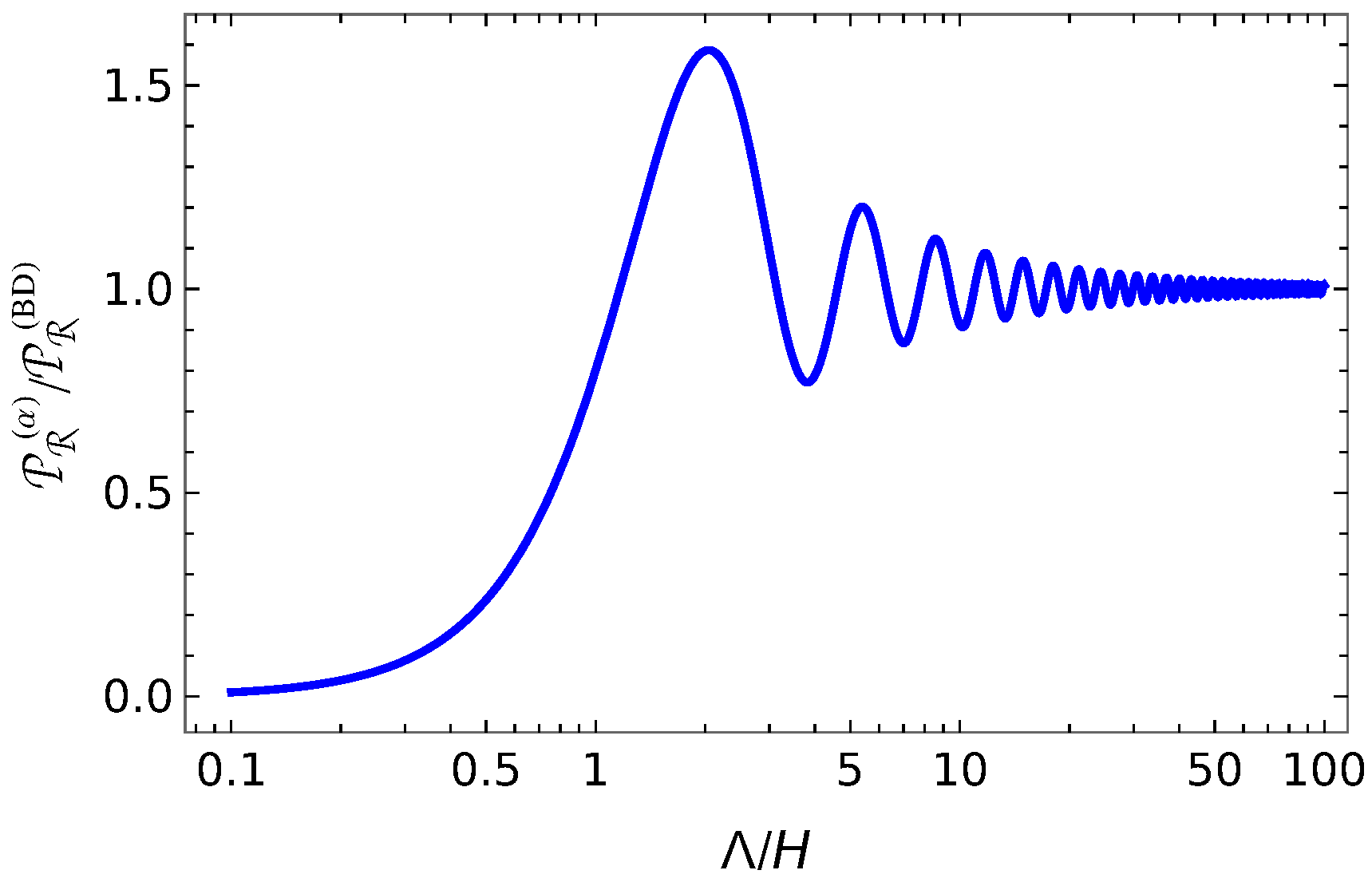
This expression makes explicit the oscillatory cutoff-sensitive correction characteristic of the α -vacua. In the limit H / Λ 0 , these corrections vanish and the BD result is recovered. In the next section, we examine how these modifications propagate into the scalar spectral index, its running, and the running of the running, and we assess observational constraints arising from trans-Planckian effects and scenarios with extra spatial dimensions. In Figure 1, we illustrate how the α -vacuum correction to the power spectrum in Equation (19) modifies the standard BD result.

3. Inflationary Observables in the α-Vacuum

In this section, we derive the corrected expressions for the scalar spectral index, its running, and the running of the running arising from the α -vacuum-modified power spectrum in Equation (19). We then compare these expressions with both the standard Bunch–Davies predictions and with current observational constraints.

3.1. The Scalar Spectral Index, Its Running, and the Running of the Running

The scalar spectral index is defined in the usual way,
n s ( k ) = d ln P R ( k ) d ln k ,
with the running and running of the running given by
α s = d n s d ln k ,
β s = d α s d ln k .
These quantities are evaluated at the pivot scale and compared to observational datasets such as those from Planck and the Atacama Cosmology Telescope (ACT) [10,16,17,18].
For reference, in the standard Λ CDM model using Planck TT (TT, TE, EE) + lowE + lensing (68% CL), we find [16]
n s = 0.9587 ± 0.0056 ( 0.9625 ± 0.0048 ) , α s = 0.013 ± 0.012 ( 0.002 ± 0.010 ) , β s = 0.022 ± 0.012 ( 0.010 ± 0.013 ) .
At the Hubble radius crossing, we have k * = a H , so, for N = ln a , the number of e-folds
d ln k d N = 1 ϵ H ,
where ϵ H = H ˙ / H 2 . In the slow-roll regime, we use ϵ H ϵ V , with the slow-roll coefficients defined in terms of the inflaton potential V ( ϕ ) as (note that we follow the conventions of Ref. [19])
ϵ V = M Pl 2 2 V , ϕ V 2 ,
η V = M Pl 2 V , ϕ ϕ V ,
ξ V 2 = M Pl 4 V , ϕ V , ϕ ϕ ϕ V 2 ,
ω V 3 = M Pl 6 V , ϕ 2 V , ϕ ϕ ϕ ϕ V 3 ,
where M Pl = ( 8 π G ) 1 / 2 2.4 × 10 18 GeV is the reduced Planck mass.
Applying Equations (20)–(22) to the modified power spectrum (19), we obtain the scalar index, its running, and the running of the running in the α -vacuum. Defining the dimensionless ratio
λ Λ H * ,
with H * evaluated at the pivot scale, we obtain the compact expressions
n s = 1 6 ϵ V + 2 η V + Δ n s ( λ ) ,
α s = 16 η V ϵ V 24 ϵ V 2 2 ξ V 2 + Δ α s ( λ ) ,
β s = 192 η V ϵ V 2 32 η V 2 ϵ V 24 ξ V 2 ϵ V 192 ϵ V 3 + 2 η V ξ V 2 + 2 ω V 3 + Δ β s ( λ ) ,
where the α -vacuum correction terms are given by
Δ n s ( λ ) = 2 ϵ V ( 2 λ 2 1 ) cos ( 2 λ ) 2 λ sin ( 2 λ ) + 1 2 λ 2 + 2 λ sin ( 2 λ ) + cos ( 2 λ ) 1 ,
Δ α s ( λ ) = 4 ϵ V ( 1 2 λ 2 ) cos ( 2 λ ) + 2 λ sin ( 2 λ ) 1 ( 2 ϵ V η V ) 2 λ 2 2 λ sin ( 2 λ ) cos ( 2 λ ) + 1 ,
Δ β s ( λ ) = 4 ϵ V ( 1 2 λ 2 ) cos ( 2 λ ) + 2 λ sin ( 2 λ ) 1 ( 2 η V 2 + ξ V 2 14 η V ϵ V + 16 ϵ V 2 ) 2 λ 2 2 λ sin ( 2 λ ) cos ( 2 λ ) + 1 .
Equations (30)–(32) generalize the results previously obtained in Refs. [20,21] to the full α -vacuum-corrected spectrum in Equation (19). As expected, in the limit λ (i.e., Λ H * ), the α -vacuum corrections vanish and Equations (30)–(32) reduce to the standard Bunch–Davies expressions [19]. However, for finite λ , the deviations can be significant, particularly in the spectral index n s , potentially leading to observable imprints within current experimental precision.

3.2. Tensor Spectrum and the Tensor-to-Scalar Ratio in the α -Vacuum

The presence of a α -vacuum also modifies the tensor perturbations, since the derivation of the tensor power spectrum parallels that of the scalar sector, differing only in the effective mass term and the absence of slow-roll suppression. In the BD vacuum, the tensor spectrum at horizon crossing is given by
P T BD ( k ) = 2 H 2 π 2 M Pl 2 ,
and the corresponding tensor-to-scalar ratio is [19]
r BD = P T BD P R BD 16 ϵ V ,
where the last equality holds at leading order in slow roll.
In the presence of α -vacuum modifications, the tensor mode functions undergo the same Bogoliubov transformation as in Equation (5), with the same coefficients A k and B k and therefore the same dependence on the ultraviolet (UV) cutoff Λ . Therefore, the corrected tensor spectrum takes the form
P T ( k ) = P T BD ( k ) 1 + e α + α * + e α + e α * ,
analogous to the scalar expression. Using Equation (10) and the same manipulations leading to Equation (19), the tensor spectrum can be written explicitly as
P T ( k ) = 2 H 2 π 2 M Pl 2 1 + H 2 2 Λ 2 H Λ sin 2 Λ H H 2 2 Λ 2 cos 2 Λ H ,
which mirrors the structure of Equation (19) for the scalar sector, but without the additional slow-roll suppression factors. Interestingly, because the scalar and tensor power spectra acquire identical multiplicative corrections from the α -vacuum, these factors cancel exactly in the ratio. Note that this cancellation holds at leading order in slow roll and for scale-independent Bogoliubov coefficients; more general initial states or higher-order corrections may break it. We, therefore, still obtain the standard slow-roll expression given in Equation (37), independently of the scale Λ that parameterizes the α -vacuum modification. This result has two important implications:
(i)
The α -vacuum corrections can significantly affect the observables of the scalar sector, such as n s , α s , and β s , potentially producing oscillatory signatures, but they do not alter the prediction of leading order for r.
(ii)
Although both scalar and tensor power spectra acquire identical multiplicative corrections in the α -vacuum, the tensor spectral index n T does not remain unchanged. Because n T is defined through the logarithmic derivative of the tensor spectrum, it receives an additional α -dependent contribution [20], while the tensor-to-scalar ratio r does not. As a consequence, the standard single-field consistency relation,
n T = r 8 ,
is generally violated at the level of observable quantities. Thus, an observationally measurable deviation from n T = r / 8 would provide a direct signature of non-Bunch–Davies initial conditions.
We emphasize, however, that subleading slow-roll corrections or additional model-dependent features (e.g., in models with non-canonical kinetic terms or modified dispersion relations) may break this exact cancellation. In the present framework, the tensor-to-scalar ratio remains unmodified despite potentially large oscillatory corrections in the scalar sector. Since the possible violation for the consistency relation Equation (40) due to the quantum vacuum choice is of the same order as expected for the spectral index for the scalar perturbations, we will focus on the changes in n s and its runnings.

3.3. Alpha-Vacuum Corrections at Sub-Planckian Energy Scales

From the expressions obtained in the previous subsection, it is clear that the deviation from the BD predictions in the α -vacuum is governed entirely by the dimensionless ratio λ Λ / H * . In the limit λ 1 , the oscillatory correction terms appearing in the scalar spectral index and its runnings become highly rapid and average to zero, thus recovering the standard BD expressions. However, for moderate values of λ , the oscillatory terms remain finite and produce non-negligible corrections to the observable quantities. Therefore, determining whether a tension exists between the BD and α vacua reduces to establishing whether physics permits a value of Λ / H * that is not parametrically large.
Typically, one assumes Λ H and identifies the UV cutoff with the Planck scale, Λ Pl O ( 10 18 ) GeV [5,13]. Under this choice, the arguments of the sinusoidal functions become enormous, and the oscillatory terms average out, yielding no observable deviation from the BD predictions. Consequently, a measurable distinction between the two vacua is only possible if there is a physical mechanism that allows the momentum cutoff to lie at a significantly lower scale—for example, at the inflationary Hubble scale Λ H infl O ( 10 13 ) GeV . In this regime, λ = Λ / H * is of order unity, and the α -vacuum corrections yield finite contributions to n s , α s , and β s , producing, in principle, observable deviations.
We therefore conclude that the phenomenological relevance of the α -vacuum hinges upon whether a consistent theoretical framework permits a sub-Planckian UV cutoff. In what follows, we show that the framework of large extra dimensions provides a natural and well-motivated mechanism for lowering the effective gravitational scale, thus allowing Λ to be as small as the Hubble scale during inflation. This possibility, originally motivated by the hierarchy problem [22], enables the oscillatory corrections to remain observable and ultimately allows one to distinguish between the BD and α vacua.
We emphasize that the α -vacuum does not resolve the trans-Planckian problem itself but instead provides an effective description of possible UV-sensitive corrections, whose observational imprints can be systematically constrained.

3.4. Large Extra Dimensions

The introduction of large extra spatial dimensions into cosmology is strongly motivated by attempts to address the hierarchy problem and to explore the phenomenology of low-scale quantum gravity. A considerable body of theoretical work has demonstrated that the presence of extra compactified dimensions can substantially impact primordial density perturbations, baryogenesis, reheating, and early-universe dynamics [7,8,9]. To our knowledge, the present work provides the first application of large extra dimensions to the study of the scalar spectral index and its runnings in the context of the α -vacuum.
Unlike the Planck-sized compact dimensions that arise in typical Kaluza–Klein or string-theoretic setups, the Arkani-Hamed–Dimopoulos–Dvali (ADD) scenario allows the compactification scale to be many orders of magnitude larger than L Pl 10 35 m [22,23]. In a ( 3 + 1 + n ) -dimensional bulk spacetime with n compact extra dimensions of common radius R, the Einstein–Hilbert action takes the form
S 4 + n = d 4 x d n y 1 2 M * 2 + n R ( 4 + n ) Λ 4 + n ,
where M * is the fundamental gravitational scale in the bulk, and R ( 4 + n ) is the ( 4 + n ) -dimensional Ricci scalar. Here, Λ 4 + n is the higher-dimensional analog of the cosmological constant; it should not be confused with the momentum-space cutoff appearing in the α -vacuum.
Compactification of the n extra dimensions leads to the standard relation between the ( 4 + n ) -dimensional scale M * and the effective four-dimensional Planck mass,
M Pl 2 M * 2 + n R n ,
which follows from the higher-dimensional generalization of Gauss’s law [24]. The simplest compactification topology is R 4 × M n , where M n is an n-dimensional compact manifold of characteristic volume R n [22].
The primary phenomenological constraint on the size of the extra dimensions arises from precision tests of Newtonian gravity. Cavendish-type experiments constrain deviations from the inverse-square law to length scales below approximately 250 μ m [25]. Using the conversion
1 mm 5.07 × 10 12 GeV 1 ,
this yields an upper bound
R < r cav 1.27 × 10 12 GeV 1 .
Rewriting Equation (42) as
R 1 M * M Pl M * 2 / n < r cav ,
we find the constraint
M Pl M * 2 / n < r cav M * .
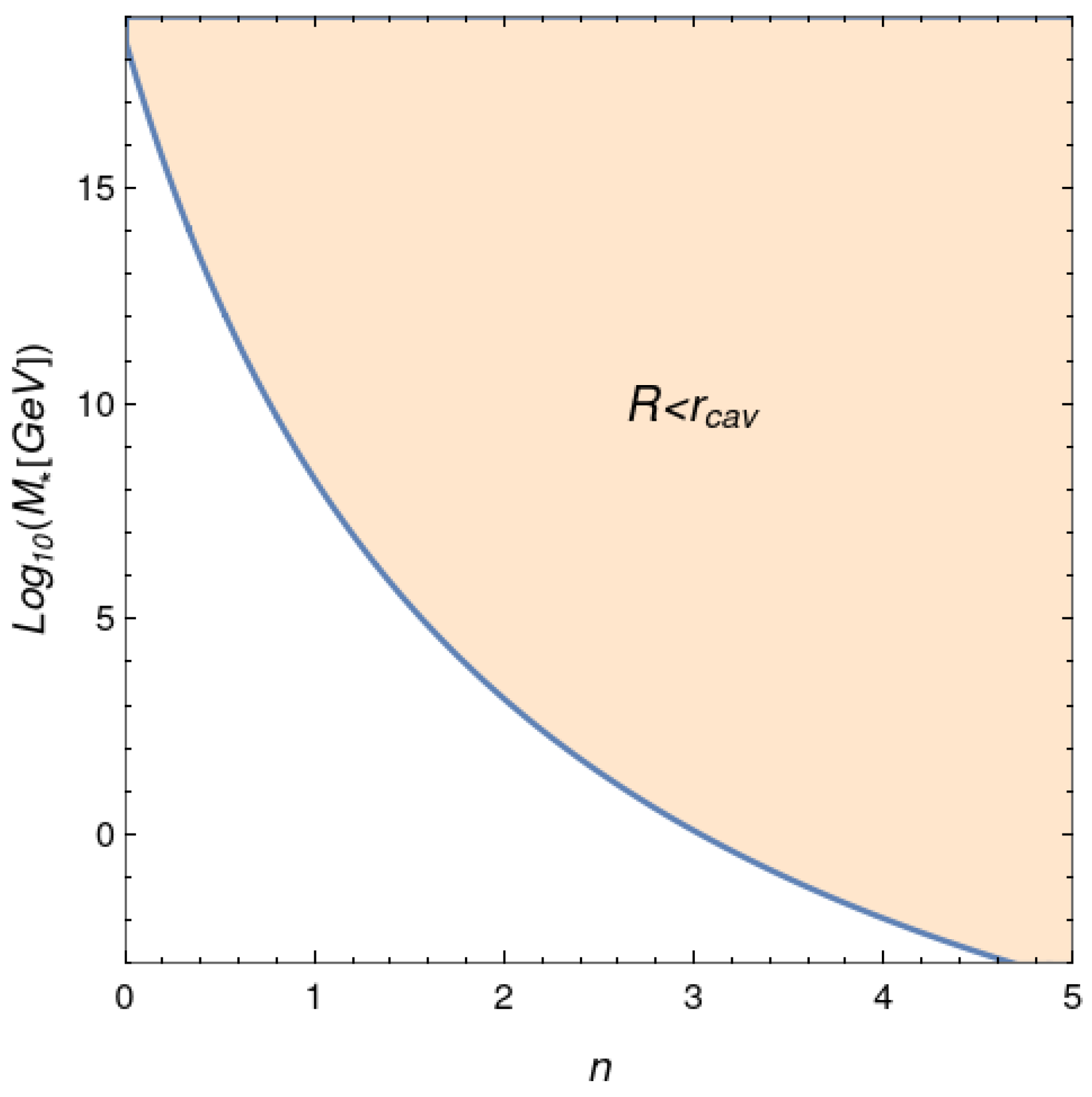
The range of allowed energy scales that satisfy R < r c a v is shown on the logarithmic plot in Figure 2.
For our purposes, the most relevant value of the bulk scale is the Hubble scale during inflation, M * Λ H O ( 10 13 ) GeV , corresponding to λ = Λ / H O ( 1 ) . Substituting M * 10 13 GeV into Equation (46), we obtain
2.44 × 10 5 2 / n < 1.27 × 10 25 ,
which implies
n > 2 log ( 2.44 × 10 5 ) log ( 1.27 × 10 25 ) 0.43 .
Since n must be a positive integer, the condition is trivially satisfied for all n Z + . Thus, within the ADD framework, a gravitational scale as low as M * H infl is entirely consistent with the current experimental bounds. This provides consistent and phenomenologically allowed justification for adopting a momentum cutoff at the Hubble scale in the α -vacuum formalism, thereby allowing the oscillatory corrections to the primordial spectra to be observable.
Finally, solving Equation (45) for M * yields
M Pl 2 / n r cav < M * ( 2 + n ) / n ,
or, equivalently,
2.44 × 10 36 / n 1.27 × 10 12 < M * ( 2 + n ) / n ,
demonstrating explicitly the lower bound on the gravitational scale for any chosen number of extra dimensions n. This completes the range of allowed values of M * consistent with experimental bounds and confirms that a cutoff at the inflationary Hubble scale falls well within the permissible region.

4. Numerical Comparison of Cosmological Observables

We now compute explicit predictions for the scalar spectral index n s , its running α s , and the running of the running β s in the α -vacuum using Equations (30)–(32). These predictions are compared with the corresponding BD values and with the Planck 2018 constraints [16].
As a representative inflationary model, we adopt the Starobinsky potential, whose excellent agreement with current CMB observations makes it an appropriate benchmark for comparing vacuum choices:
V ( ϕ ) = V 0 1 e 2 / 3 ϕ / M Pl 2 ,
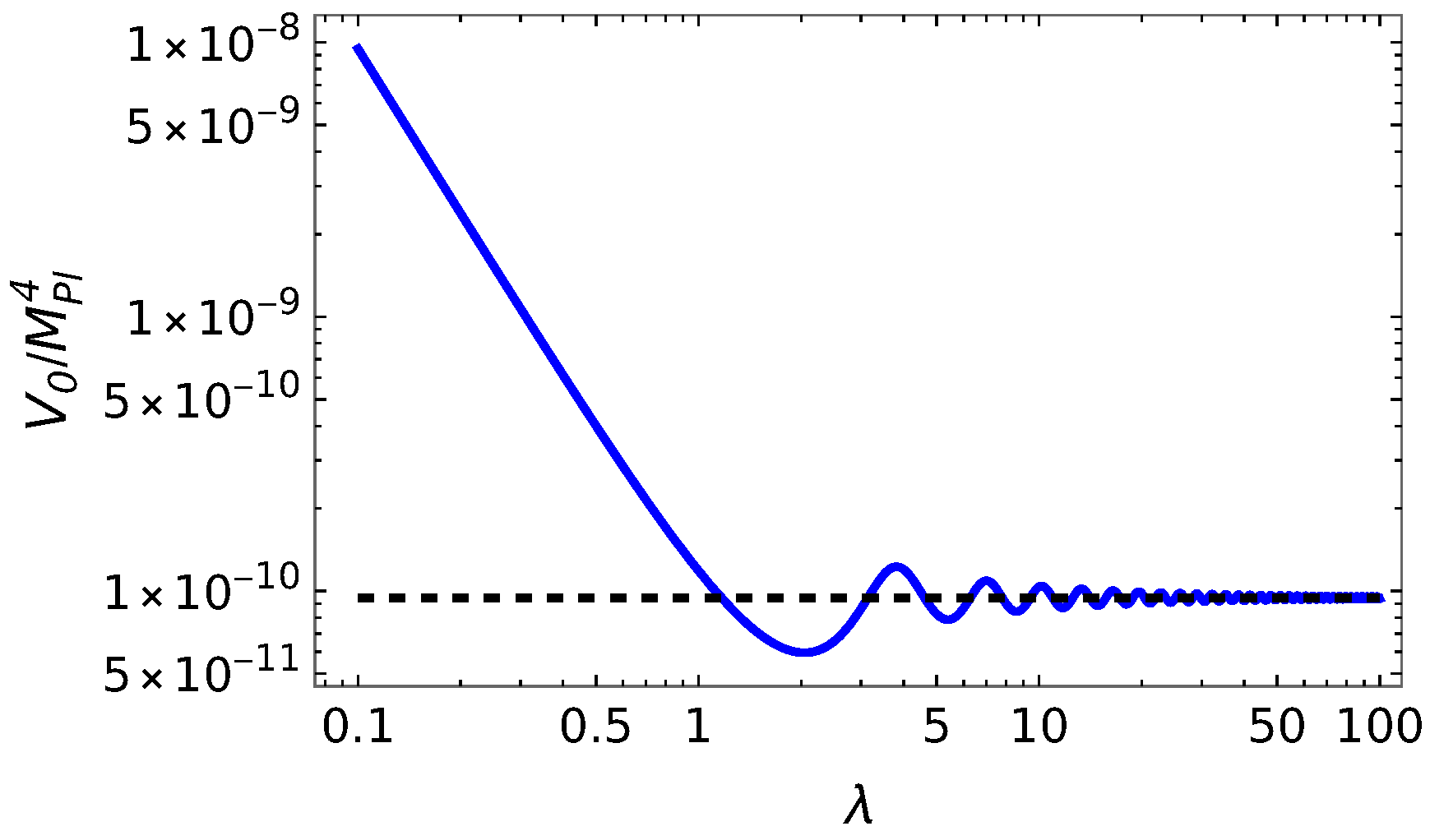
where the normalization scale V 0 is fixed through the CMB scalar amplitude A s 2.105 × 10 9 at the pivot scale k * = 0.05 Mpc 1 with a fiducial number of e-folds N * = 60 . In the BD vacuum, this yields V 0 BD / M Pl 4 = 9.456 × 10 11 . Because the scalar power spectrum depends on the quantum vacuum, V 0 acquires a corresponding λ -dependence in the α -vacuum, as illustrated in Figure 3.
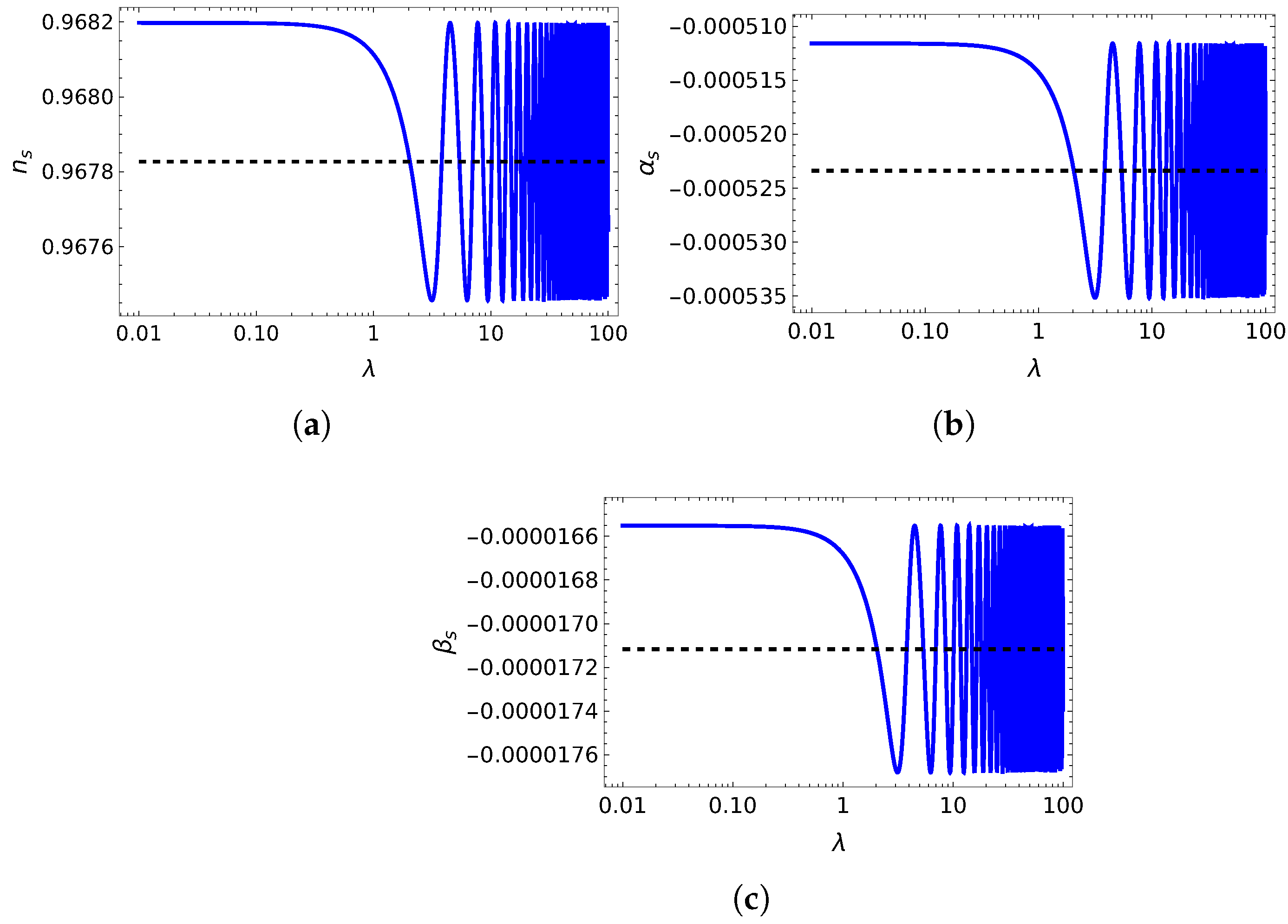
Figure 4 displays the λ -dependence of n s , α s , and β s in the Starobinsky model. In each case, the corrections saturate for λ O ( 1 ) , corresponding to a cutoff scale near the Hubble scale during inflation. To quantify the deviations from the BD case, we expand Equations (30)–(32) for small λ . Subtracting the BD expressions yields
Δ n s = 2 ϵ V + O ( λ 2 ) ,
Δ α s = 4 ϵ V 2 ϵ V η V + O ( λ 2 ) ,
Δ β s = 4 ϵ V 2 η V 2 + ξ V 2 14 η V ϵ V + 16 ϵ V 2 + O ( λ 2 ) ,
which provides a good approximation to the maximum corrections extracted numerically at λ 1 .
Table 1 summarizes the maximum deviations of the three observables for λ 1 , compared with the BD values and Planck 2018 constraints. The α -vacuum results assume Λ H (i.e., λ = O ( 1 ) ), consistent with the lower-energy cutoff motivated by the large-extra-dimension mechanism discussed previously. Note that this choice sets Λ / H O ( 1 ) , while maintaining consistency with the constraint (50). No preferred value of the truncation scale is assumed beyond this physical bound.
The differences between the BD and α -vacuum predictions are numerically small, as expected from the structure of the oscillatory corrections once the cutoff is constrained to lie near the Hubble scale. Nevertheless, the corrections are finite and non-zero—reflecting the fact that the α -vacuum is observationally distinguishable but only under the highly restricted circumstances that permit a sub-Planckian cutoff.
Finally, it is instructive to compare this with the recent ACT results [17,18], which, when combined with Planck [10,16] and DESI data [26,27], give the updated constraint
n s = 0.974 ± 0.003 .
Even though the α -vacuum corrections shift n s upward relative to the BD case, the magnitude of the shift for Λ H remains too small to reach the new preferred central value. Thus, while the α -vacuum yields consistent predictions within current uncertainties, it does not significantly alleviate the emerging tension in n s as far as the recent ACT results are concerned.
Although we here have focused on the Starobinsky model as a representative and well-motivated example, the structure of the corrections induced by the modified vacuum is generic and expected to persist in other slow-roll inflationary models. The quantitative impact depends on the background evolution, but the qualitative behavior of the deviations remains robust.

5. Conclusions

In this work, we have examined the impact of replacing the standard BD vacuum with the more general α -vacuum on the inflationary observables derived from the curvature power spectrum. As explicitly shown in Equations (30)–(32), the scalar spectral index, its running, and the running of the running acquire oscillatory UV-sensitive corrections. These corrections vanish smoothly in the limit of large momenta truncation and therefore reproduce the BD expressions when Λ .
In the usual high-energy effective field theory context, one adopts a cutoff at the Planck scale, Λ O ( 10 18 ) GeV, which effectively eliminates any distinction between the BD and α -vacua. Motivated by scenarios with large extra dimensions [7,8,9,22], we consider instead the possibility of a physical truncation near the Hubble scale during inflation, Λ H inf O ( 10 13 ) GeV. Within this framework, the trans-Planckian corrections are not necessarily Planck-suppressed, and the oscillatory terms appearing in the α -vacuum can contribute finite, albeit small, modifications to the inflationary observables.
Our detailed numerical analysis shows that deviations from the BD predictions remain very small—typically well within the current observational bounds from the Planck 2018 data [16]—even when the α -vacuum corrections take their largest possible amplitude. In this sense, the BD vacuum remains a robust attractor from the perspective of current CMB measurements. Nevertheless, the α -vacuum provides a controlled and theoretically consistent way to parameterize trans-Planckian effects, offering a phenomenological framework to assess potential signatures of non-standard initial states in future high-precision observations.
The consequences of adopting the α -vacuum may extend beyond the scalar power spectrum. In particular, any observable directly derived from P R ( k ) would inherit analogous corrections, although their quantitative impact requires dedicated analyses beyond the scope of the present work [28,29].
Finally, it is worth noting that the role of vacuum choice is a recurring theme in several areas of quantum field theory in curved spacetimes, including black hole physics and horizon thermodynamics [30,31]. Although the present work is restricted to inflationary perturbations, it would be interesting to explore whether similar effective parameterizations of initial states could be employed in other contexts. We leave such investigations, as well as possible connections to holographic frameworks [32], for future work.

Author Contributions

Conceptualization, M.W.-S., R.O.R. and A.B.; Methodology, R.O.R. and A.B.; Formal analysis, M.W.-S., R.O.R. and A.B.; Investigation, M.W.-S. and A.B.; Writing—original draft, M.W.-S., R.O.R. and A.B.; Writing—review & editing, R.O.R. and A.B.; Supervision, R.O.R. and A.B. All authors have read and agreed to the published version of the manuscript.

Funding

R.O.R. acknowledges the financial support via research grants from Conselho Nacional de Desenvolvimento Científico e Tecnológico (CNPq), Grant No. 307286/2021-5, and from Fundação Carlos Chagas Filho de Amparo à Pesquisa do Estado do Rio de Janeiro (FAPERJ), Grant No. E-26/201.150/2021. A.B. is partially funded by STFC.

Data Availability Statement

The raw data supporting the conclusions of this article will be made available by the authors on request.

Conflicts of Interest

The authors declare no conflicts of interest.

Abbreviations

The following abbreviations are used in this manuscript: Bunch–Davies (BD), cosmic microwave background (CMB), Atacama Cosmology Telescope (ACT), confidence level (CL), ultraviolet (UV), Arkani-Hamed–Dimopoulos–Dvali (ADD).

References

  1. Kundu, S. Inflation with General Initial Conditions for Scalar Perturbations. J. Cosmol. Astropart. Phys. 2012, 2012, 005. [Google Scholar] [CrossRef]
  2. Allen, B. Vacuum States in de Sitter Space. Phys. Rev. D 1985, 32, 3136. [Google Scholar] [CrossRef] [PubMed]
  3. Mottola, E.; Lapedes, A. Existence of Finite Action Solutions to the Coleman-De Luccia Equations. Phys. Rev. D 1984, 29, 773. [Google Scholar] [CrossRef]
  4. Chernikov, N.A.; Tagirov, E.A. Quantum Theory of Scalar Field in de Sitter Space-Time. Ann. L’Institut Henri Poincaré. Sect. A 1968, 9, 109–141. [Google Scholar]
  5. Chen, P.; Lin, K.N.; Lin, W.C.; Yeom, D.H. Possible origin of α-vacua as the initial state of the Universe. Phys. Rev. D 2025, 111, 083520. [Google Scholar] [CrossRef]
  6. Linde, A.D. Particle Physics and Inflationary Cosmology. Contemp. Concepts Phys. 1990, 5, 1–362. [Google Scholar]
  7. Anchordoqui, L.A.; Antoniadis, I. Large Extra Dimensions from Higher-Dimensional Inflation. Phys. Rev. D 2024, 109, 103508. [Google Scholar] [CrossRef]
  8. Mohapatra, R.N.; Perez-Lorenzana, A.; de Sousa Pires, C.A. Inflation in Models with Large Extra Dimensions Driven by a Bulk Scalar Field. Phys. Rev. D 2000, 62, 105030. [Google Scholar] [CrossRef]
  9. Green, A.M.; Mazumdar, A. Dynamics of a large extra dimension inspired hybrid inflation model. Phys. Rev. D 2002, 65, 105022. [Google Scholar] [CrossRef][Green Version]
  10. Aghanim, N.; Akrami, Y.; Ashdown, M.; Aumont, J.; Baccigalupi, C.; Ballardini, M.; Banday, A.J.; Barreiro, R.B.; Bartolo, N.; Basak, S.; et al. Planck 2018 Results. VI. Cosmological Parameters. Astron. Astrophys. 2020, 641, A6, Erratum in Astron. Astrophys. 2021, 652, C4. https://doi.org/10.1051/0004-6361/201833910. [Google Scholar]
  11. Bunch, T.S.; Davies, P.C.W. Quantum Field Theory in de Sitter Space: Renormalization by Point Splitting. Proc. Roy. Soc. Lond. A 1978, 360, 117–134. [Google Scholar] [CrossRef]
  12. Mottola, E. Particle Creation in de Sitter Space. Phys. Rev. D 1985, 31, 754. [Google Scholar] [CrossRef] [PubMed]
  13. Danielsson, U.H. A Note on Inflation and TransPlanckian Physics. Phys. Rev. D 2002, 66, 023511. [Google Scholar] [CrossRef]
  14. Xue, W.; Chen, B. Alpha-Vacuum and Inflationary Bispectrum. Phys. Rev. D 2009, 79, 043518. [Google Scholar] [CrossRef]
  15. Giesel, K.; Herold, L.; Li, B.F.; Singh, P. Mukhanov-Sasaki equation in a manifestly gauge-invariant linearized cosmological perturbation theory with dust reference fields. Phys. Rev. D 2020, 102, 023524. [Google Scholar] [CrossRef]
  16. Akrami, Y.; Ashdown, M.; Aumont, J.; Baccigalupi, C.; Ballardini, M.; Banday, A.J.; Barreiro, R.B.; Bartolo, N.; Basak, S.; Benabed, K.; et al. Planck 2018 results. X. Constraints on inflation. Astron. Astrophys. 2020, 641, A10. [Google Scholar] [CrossRef]
  17. Louis, T.; La Posta, A.; Atkins, Z.; Jense, H.T.; Abril-Cabezas, I.; Addison, G.E.; Ade, P.A.; Aiola, S.; Alford, T.; Alonso, D.; et al. The Atacama Cosmology Telescope: DR6 power spectra, likelihoods and ΛCDM parameters. J. Cosmol. Astropart. Phys. 2025, 11, 062. [Google Scholar] [CrossRef]
  18. Calabrese, E.; Hill, J.C.; Jense, H.T.; La Posta, A.; Abril-Cabezas, I.; Addison, G.E.; Ade, P.A.; Aiola, S.; Alford, T.; Alonso, D.; et al. The Atacama Cosmology Telescope: DR6 constraints on extended cosmological models. J. Cosmol. Astropart. Phys. 2025, 11, 063. [Google Scholar] [CrossRef]
  19. Ade, P.A.; Aghanim, N.; Armitage-Caplan, C.; Arnaud, M.; Ashdown, M.; Atrio-Barandela, F.; Aumont, J.; Baccigalupi, C.; Banday, A.J.; Barreiro, R.B.; et al. Planck 2013 results. XXII. Constraints on inflation. Astron. Astrophys. 2014, 571, A22. [Google Scholar] [CrossRef]
  20. Broy, B.J. Corrections to ns and nt from high scale physics. Phys. Rev. D 2016, 94, 103508. [Google Scholar] [CrossRef]
  21. Nezhad, H.B.; Shojai, F. The effect of α-vacua on the scalar and tensor spectral indices: Slow-roll approximation. Phys. Rev. D 2018, 98, 063512. [Google Scholar] [CrossRef]
  22. Arkani-Hamed, N.; Dimopoulos, S.; Dvali, G.R.; Kaloper, N. Infinitely large new dimensions. Phys. Rev. Lett. 2000, 84, 586–589. [Google Scholar] [CrossRef] [PubMed]
  23. Witten, E. String theory dynamics in various dimensions. Nucl. Phys. B 1995, 443, 85–126. [Google Scholar] [CrossRef]
  24. Kumar, V.H.S.; Suresh, P.K. Gravity and large extra dimensions. Adv. Astron. 2011, 2011, 189379. [Google Scholar] [CrossRef]
  25. Hoyle, C.D.; Kapner, D.J.; Heckel, B.R.; Adelberger, E.G.; Gundlach, J.H.; Schmidt, U.; Swanson, H.E. Sub-millimeter tests of the gravitational inverse-square law. Phys. Rev. D 2004, 70, 042004. [Google Scholar] [CrossRef]
  26. Adame, A.G.; Aguilar, J.; Ahlen, S.; Alam, S.; Alexander, D.M.; Alvarez, M.; Alves, O.; An, A.; Andrade, U.; Armengaud, E.; et al. DESI 2024 VI: Cosmological constraints from the measurements of baryon acoustic oscillations. J. Cosmol. Astropart. Phys. 2025, 2, 021. [Google Scholar] [CrossRef]
  27. Adame, A.G.; Aguilar, J.; Ahlen, S.; Alam, S.; Alexander, D.M.; Alvarez, M.; Alves, O.; An, A.; Andrade, U.; Armengaud, E.; et al. DESI 2024 III: Baryon acoustic oscillations from galaxies and quasars. J. Cosmol. Astropart. Phys. 2025, 4, 012. [Google Scholar] [CrossRef]
  28. Raccanelli, A.; Vlah, Z. Observed power spectrum and frequency-angular power spectrum. Phys. Rev. D 2023, 108, 043537. [Google Scholar] [CrossRef]
  29. Bolliet, B.; Mancini, A.S.; Hill, J.C.; Madhavacheril, M.; Jense, H.T.; Calabrese, E.; Dunkley, J. High-accuracy emulators for observables in ΛCDM, Neff, Σ, and w cosmologies. Mon. Not. Roy. Astron. Soc. 2024, 531, 1351–1370. [Google Scholar] [CrossRef]
  30. Hawking, S.W. Particle creation by black holes. Commun. Math. Phys. 1975, 43, 199–220, Erratum in Commun. Math. Phys. 1976, 46, 206. https://doi.org/10.1007/BF02345020. [Google Scholar] [CrossRef]
  31. Page, D.N. Hawking radiation and black hole thermodynamics. New J. Phys. 2005, 7, 203. [Google Scholar] [CrossRef]
  32. Chamblin, A.; Michelson, J. Alpha-vacua, black holes, and AdS/CFT. Class. Quant. Grav. 2007, 24, 1569–1604. [Google Scholar] [CrossRef]
Figure 1. Comparison between the α -vacuum prediction for the power spectrum given by Equation (19) and its BD limit, P R ( BD ) ( H 4 / ( 4 π 2 ϕ ˙ 2 ) , as a function of Λ / H . The BD result is recovered for Λ H .
Symmetry 18 00399 g001
Figure 2. Range of values that satisfy R < r c a v in terms of the number of extra spatial dimensions n and the energy scale of gravity on the bulk M * .
Symmetry 18 00399 g002
Figure 3. Normalization of the Starobinsky potential as a function of λ , computed using the full power spectrum result Equation (19). The dashed line shows the BD limit.
Symmetry 18 00399 g003
Figure 4. Predictions for (a) n s , (b) α s , and (c) β s using Equations (30)–(32), with N * = 60 . Solid: α -vacuum with λ -dependent corrections. Dashed: BD limit.
Symmetry 18 00399 g004
Table 1. Comparison of cosmological observables for the Starobinsky model between the BD vacuum, the α -vacuum (evaluated at its maximal correction for λ 1 ), and Planck 2018 [10,16]. All results assume N * = 60 .
ParameterPlanck 2018BD Vacuum α -Vacuum
n s 0.9647 ± 0.0043 0.9678 0.9682
α s 0.0011 ± 0.0099 5.23 × 10 4 5.11 × 10 4
β s 0.009 ± 0.012 1.71 × 10 5 1.66 × 10 5
Disclaimer/Publisher’s Note: The statements, opinions and data contained in all publications are solely those of the individual author(s) and contributor(s) and not of MDPI and/or the editor(s). MDPI and/or the editor(s) disclaim responsibility for any injury to people or property resulting from any ideas, methods, instructions or products referred to in the content.