

A Pre-Conditioning CQ Algorithm with Double Inertia and Self-Updated Stepsizes for Split Feasibility Problems in Hilbert Spaces


Abstract
1. Introduction
- To adopt double inertial steps to speed up the convergent rate of the algorithm (3) and create a new convergence result;
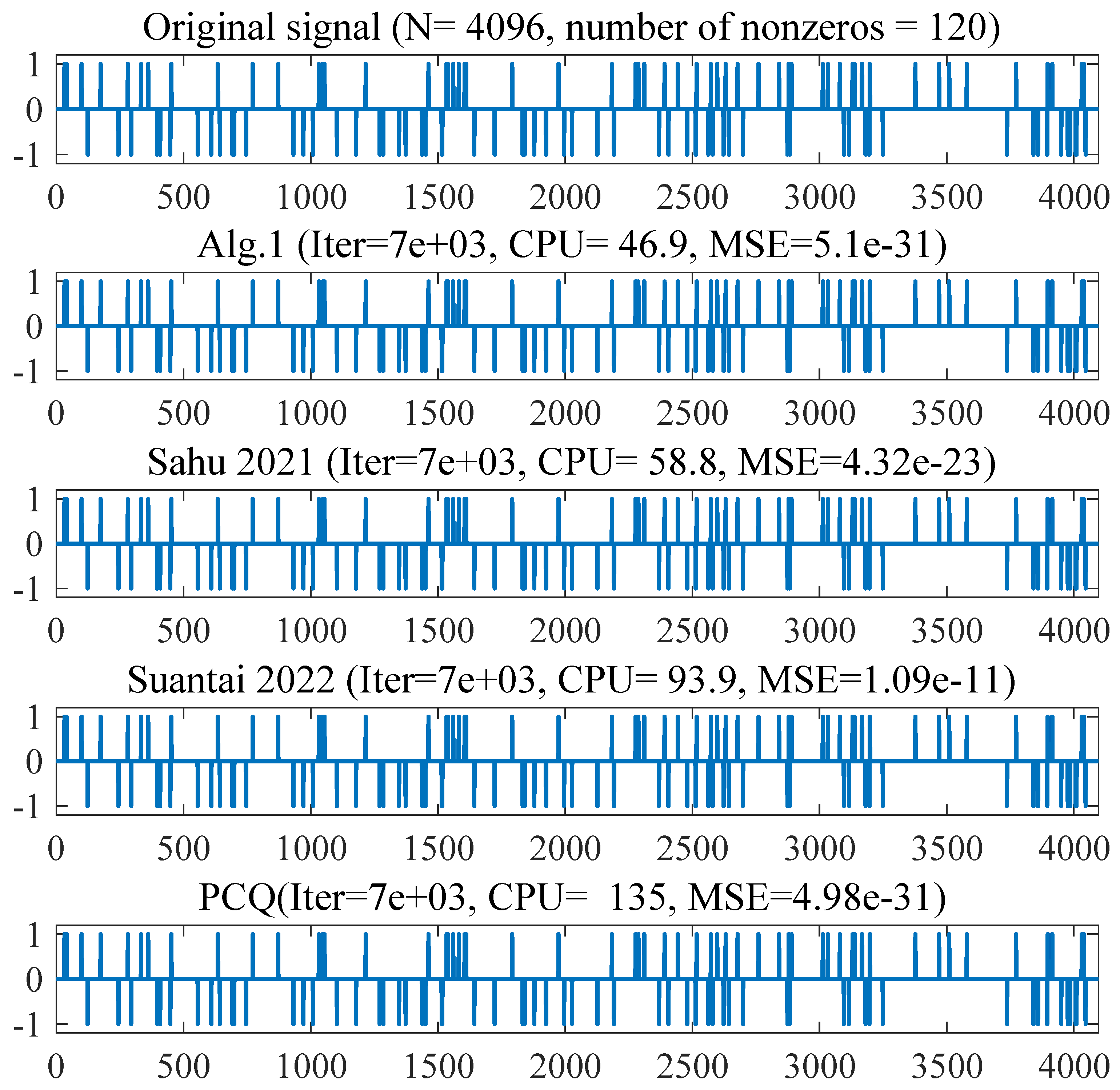
- To provide some practical examples such as signal recovery problems for demonstration and illustration.
2. Preliminaries
- (i)
- U is called nonexpansive on C if
- (ii)
- F is said to be firmly nonexpansive on C if
- Then, is a converging sequence, and where (for any ).
3. Weak Convergence
| Algorithm 1 A Pre-conditioning CQ Algorithm With Double Inertia and Self-updated Stepsizes For Solving SFP |
Step 0. Given ,, . Take the sequence fulfilling Lemma 2.3. Step 1. Given , and compute And where the stepsize is computed by |
4. Numerical Experiments
5. Conclusions
Author Contributions
Funding
Data Availability Statement
Conflicts of Interest
References
- Censor, Y.; Elfving, T. A multi-projection algorithm using Bregman projection in a product space. Numer. Algorithms 1994, 8, 221–239. [Google Scholar] [CrossRef]
- Byrne, C. A unified treatment of some iterative algorithms in signal processing and image reconstruction. Inverse Probl. 2004, 20, 103–120. [Google Scholar] [CrossRef]
- Byrne, C. Iterative oblique projection onto convex sets and the split feasibility problem. Inverse Probl. 2002, 18, 441–453. [Google Scholar] [CrossRef]
- Ha, N.S. Weak and strong convergence theorems for the mixed split feasibility problem in Hilbert spaces. J. Glob. Optim. 2025, 93, 1053–1077. [Google Scholar] [CrossRef]
- Zhang, D.; Ye, M. Ball selected relaxation inertial projection algorithm for multiple-sets split feasibility problem. Optim. Eng. 2025. [Google Scholar] [CrossRef]
- Cao, Y.; Peng, Y.; Chen, Y.; Shi, L. Several relaxed CQ-algorithms for the split feasibility problem with multiple output sets. J. Appl. Math. Comput. 2025, 71, 5231–5258. [Google Scholar] [CrossRef]
- Zhan, W.; Yu, H. A Novel Relaxed Method for the Split Feasibility Problem in Hilbert Spaces. Bull. Iran. Math. Soc. 2025, 51, 34. [Google Scholar] [CrossRef]
- Huong, V.T.; Xu, H.K.; Yen, N.D. Stability analysis of split equality and split feasibility problems. J. Glob. Optim. 2025, 92, 411–429. [Google Scholar] [CrossRef]
- Tong, X.; Ling, T.; Shi, L. Self-adaptive relaxed CQ algorithms for solving split feasibility problem with multiple output sets. J. Appl. Math. Comput. 2024, 70, 1441–1469. [Google Scholar] [CrossRef]
- Tuyen, T.M.; Ha, N.S. An explicit iterative algorithm for solving the split common solution problem with multiple output sets. Math. Meth. Oper. Res. 2025, 102, 105–129. [Google Scholar] [CrossRef]
- López, G.; Martin, V.; Wang, F.; Xu, H.K. Solving the split feasibility problem without prior knowledge of matrix norms. Inverse Probl. 2012, 28, 85004. [Google Scholar] [CrossRef]
- Yang, Q. On variable-step relaxed projection algorithm for variational inequalities. J. Math. Anal. Appl. 2005, 302, 166–179. [Google Scholar] [CrossRef]
- Bnouhachem, A.; Noor, M.A.; Khalfaoui, M.; Zhaohan, S. On descent-projection method for solving the split feasibility problems. J. Glob. Optim. 2012, 54, 627–639. [Google Scholar] [CrossRef]
- Dong, Q.L.; Yao, Y.; He, S. Weak convergence theorems of the modified relaxed projection algorithms for the split feasibility problem in Hilbert spaces. Optim. Lett. 2014, 8, 1031–1046. [Google Scholar] [CrossRef]
- Gibali, A.; Liu, L.W.; Tang, Y.C. Note on the modified relaxation CQ algorithm for the split feasibility problem. Optim. Lett. 2018, 12, 817–830. [Google Scholar] [CrossRef]
- Kesornprom, S.; Pholasa, N.; Cholamjiak, P. On the convergence analysis of the gradient-CQ algorithms for the split feasibility problem. Numer. Algorithms 2020, 84, 997–1017. [Google Scholar] [CrossRef]
- Alvarez, F.; Attouch, H. An inertial proximal method for maximal monotone operators via discretization of a nonlinear oscillator with damping. Set-Valued Anal. 2001, 9, 3–11. [Google Scholar] [CrossRef]
- Altiparmak, E.; Jolaoso, L.O.; ur Rehman, H. Pre-conditioning CQ algorithm for solving the split feasibility problem and its application to image restoration problem. Optimization 2025, 13, 3123–3141. [Google Scholar] [CrossRef]
- Bauschke, H.H.; Borwein, J.M. On projection algorithms for solving convex feasibility problems. SIAM Rev. 1996, 38, 367–426. [Google Scholar] [CrossRef]
- Byrne, C.L. Iterative projection onto convex sets using multiple Bregman distances. Inverse Probl. 1999, 15, 1295–1313. [Google Scholar] [CrossRef]
- Wang, P.; Zhou, H. A preconditioning method of the CQ algorithm for solving an extended split feasibility problem. J. Inequal. Appl. 2014, 1, 1–11. [Google Scholar] [CrossRef]
- Nesterov, Y. A method for solving the convex programming problem with convergence rate O(1/k2). Dokl. Akad. Nauk SSSR 1983, 269, 543–547. [Google Scholar]
- Attouch, H.; Peypouquet, J. The Rate of Convergence of Nesterov’s Accelerated Forward-Backward Method is Actually Faster Than 1/k2. SIAM J. Optim. 2016, 26, 1824–1834. [Google Scholar] [CrossRef]
- Attouch, H.; Peypouquet, J.; Redonta, P. Fast convex optimization via inertial dynamics with Hessian driven damping. J. Differ. Equ. 2016, 261, 5734–5783. [Google Scholar] [CrossRef]
- Attouch, H.; Chbani, Z.; Peypouquet, J.; Redont, P. Fast convergence of inertial dynamics and algorithms with asymptotic vanishing viscosity. Math. Program. 2018, 168, 123–175. [Google Scholar] [CrossRef]
- Attouch, H.; Peypouquet, J. Convergence of inertial dynamics and proximal algorithms governed by maximally monotone operators. Math. Program. 2019, 174, 391–432. [Google Scholar] [CrossRef]
- Suebcharoen, T.; Suparatulatorn, R.; Chaobankoh, T.; Kunwai, K.; Mouktonglang, T. An Inertial Relaxed CQ Algorithm with Two Adaptive Step Sizes and Its Application for Signal Recovery. Mathematics 2024, 12, 2406. [Google Scholar] [CrossRef]
- Alvarez, F. Weak convergence of a relaxed and inertial hybrid projection-proximal point algorithm for maximal monotone operators in Hilbert spaces. SIAM J. Optim. 2004, 14, 773–782. [Google Scholar] [CrossRef]
- Ma, X.; Jia, Z.; Li, Q. On inertial non-lipschitz stepsize algorithms for split feasibility problems. Comp. Appl. Math. 2024, 43, 431. [Google Scholar] [CrossRef]
- Ma, X.; Liu, H.; Li, X. The iterative method for solving the proximal split feasibility problem with an application to LASSO problem. Comp. Appl. Math. 2022, 41, 5. [Google Scholar] [CrossRef]
- Sahu, D.R.; Cho, Y.J.; Dong, Q.L.; Kashyap, M.R.; Li, X.H. Inertial relaxed CQ algorithms for solving a split feasibility problem in Hilbert spaces. Numer. Algorithms 2021, 87, 1075–1095. [Google Scholar] [CrossRef]
- Wang, Z.B.; Zhen, Y.L.; Long, X.; Chen, Z.-y. A Modified Tseng Splitting Method with Double Inertial Steps for Solving Monotone Inclusion Problems. J. Sci. Comput. 2023, 96, 1–29. [Google Scholar] [CrossRef]
- Limaye, B.V. Functional Analysis; New Age: New Delhi, India, 1996. [Google Scholar]
- Mondal, S.; Sivakumar, K.C. A Survey of Z-Matrices and New Results on the Subclass of F0-Matrices. In Inverse Problems, Regularization Methods and Related Topics. Industrial and Applied Mathematics; Pereverzyev, S.V., Radha, R., Sivananthan, S., Eds.; Springer: Singapore, 2025. [Google Scholar]
- Osilike, M.O.; Aniagbosor, S.C. Weak and strong convergence theorems for fixed points of asymptotically nonexpansive mappings. Math. Comput. Model. 2000, 32, 1181–1191. [Google Scholar] [CrossRef]
- Facchinei, F.; Pang, J.S. Finite-Dimensional Variational Inequality and Complementarity Problems; Springer: New York, NY, USA, 2003; Volume I. [Google Scholar]
- Suantai, S.; Panyanak, B.; Kesornprom, S.; Cholamjiak, P. Inertial projection and contraction methods for split feasibility problem applied to compressed sensing and image restoration. Optim. Lett. 2022, 16, 1725–1744. [Google Scholar] [CrossRef]
- Tibshirani, R. Regression shrinkage and selection via the Lasso. J. R. Stat. Soc. Ser. B 1996, 58, 267–288. [Google Scholar] [CrossRef]


| Algorithm 1 | Sahu 2021 [31] | Suantai 2022 [37] | PCQ | |||||
|---|---|---|---|---|---|---|---|---|
| Time | Time | Time | Time | |||||
| (240, 1024, 30) | 5.4772 | 1.7094 | 1.3328 | 2.0715 | 4.2953 | 2.9206 | 6.8805 | 3.9255 |
| (480, 2048, 60) | 7.7460 | 5.9345 | 1.7791 | 7.8245 | 2.5638 | 14.2064 | 7.3943 | 32.5748 |
| (720, 3072, 90) | 9.4868 | 51.0043 | 6.8132 | 70.7382 | 2.1654 | 117.7369 | 6.3745 | 134.6671 |
| (960, 4096, 120) | 10.9545 | 46.2216 | 3.8179 | 58.2518 | 1.9982 | 92.2356 | 6.6815 | 132.1087 |
Disclaimer/Publisher’s Note: The statements, opinions and data contained in all publications are solely those of the individual author(s) and contributor(s) and not of MDPI and/or the editor(s). MDPI and/or the editor(s) disclaim responsibility for any injury to people or property resulting from any ideas, methods, instructions or products referred to in the content. |
© 2026 by the authors. Licensee MDPI, Basel, Switzerland. This article is an open access article distributed under the terms and conditions of the Creative Commons Attribution (CC BY) license.
Share and Cite
Zhang, Y.; Ma, X. A Pre-Conditioning CQ Algorithm with Double Inertia and Self-Updated Stepsizes for Split Feasibility Problems in Hilbert Spaces. Symmetry 2026, 18, 321. https://doi.org/10.3390/sym18020321
Zhang Y, Ma X. A Pre-Conditioning CQ Algorithm with Double Inertia and Self-Updated Stepsizes for Split Feasibility Problems in Hilbert Spaces. Symmetry. 2026; 18(2):321. https://doi.org/10.3390/sym18020321
Chicago/Turabian StyleZhang, Yu, and Xiaojun Ma. 2026. "A Pre-Conditioning CQ Algorithm with Double Inertia and Self-Updated Stepsizes for Split Feasibility Problems in Hilbert Spaces" Symmetry 18, no. 2: 321. https://doi.org/10.3390/sym18020321
APA StyleZhang, Y., & Ma, X. (2026). A Pre-Conditioning CQ Algorithm with Double Inertia and Self-Updated Stepsizes for Split Feasibility Problems in Hilbert Spaces. Symmetry, 18(2), 321. https://doi.org/10.3390/sym18020321