1. Introduction
The detection of electric fields is of pivotal importance across diverse fields, including atmospheric electrical studies for analyzing lightning formation [
1,
2], real-time surveillance of high-voltage power grids to prevent equipment failure [
3,
4], forecasting weather by measuring the atmospheric electric field [
5], and biomedical engineering for monitoring faint cardiac and neural electric signals [
6]. The development of the field of biochemistry analysis is driven by integrated circuit materials and micro-electromechanical systems [
7]. Micro-electromechanical systems (MEMS) electric field sensors have become a research hotspot due to their miniaturized size (typically millimeter-scale), low power consumption (micro-watt level), and seamless compatibility with integrated circuits—distinct advantages over traditional devices such as electric field mills (bulky and high-power) and electro-optical sensors (expensive and complex) [
8,
9].
Among various transduction mechanisms, frequency modulation (FM) stands out due to its high resolution and semi-digital output, and the structure based on electrostatic coupling has been proven feasible [
10], which inherently mitigates electrical drift and noise interference—issues that are particularly prominent in amplitude modulation (AM) sensors. Specifically, AM sensors’ performance is highly reliant on the precise matching of driving and resonant frequencies, as frequency drift-induced mismatch can cause significant gain attenuation (e.g., a 67 dB reduction under 5% frequency error) and increased nonlinearity, while intricate optimization of excitation frequency parameters (e.g., blue-sideband excitation frequency) is often required to compensate for such deviations, indirectly reflecting the vulnerability of AM-based sensing schemes to frequency drift [
11,
12]. In addition, emerging sensing mechanisms based on the mode localization of weakly coupled resonators, by reading the changes in the amplitude ratio, have been proven to achieve a sensitivity improvement of several orders of magnitude over traditional sensors, which provides new design ideas for the development of high-performance FM sensors [
13]. However, existing FM-MEMS electric field sensors still suffer from critical limitations: narrow measurement ranges (mostly <100 kV/m), degraded sensitivity under environmental fluctuations (e.g., temperature variations), and inadequate exploration of key factors regulating resonant characteristics—especially the impact of perturbation voltage application strategies on resonant beam stiffness [
1]. Symmetry considerations are central to this study, especially in the design of the perturbation model: the lateral configuration unidirectionally breaks symmetry to enhance sensitivity, while the axial design maintains geometric symmetry to avoid local electric field concentration, and this symmetry mitigates nonlinear capacitance variations induced by displacement.
Recent efforts have focused on optimizing sensor structures like double-ended tuning forks (DETF) and Euler beams to boost performance [
14,
15]. For instance, Wang et al. [
2] developed a mode-localized DETF sensor with a resolution of 21.3 V/m, but it failed to systematically investigate how perturbation voltage application positions affect resonant beam stiffness, leading to suboptimal sensitivity tuning. Similarly, Zhang et al. [
3] reported an electrostatic induction-based sensor that exhibits limited dynamic ranges, restricting their use in scenarios requiring wide-field detection (e.g., high-voltage power grids). Moreover, most studies simplify perturbation voltage effects as a uniform stiffness change, overlooking the distinct influences of lateral versus axial application—this oversight results in sensor designs that cannot balance high sensitivity and wide measurement range, leaving a critical performance gap in precision engineering applications. This challenge is particularly pronounced in the context of measuring hybrid AC/DC electric fields near modern power transmission lines, where space charge interference and the lack of compact, integrated solutions are well-recognized issues [
16].
To address these drawbacks, this study develops a frequency-modulated MEMS electric field sensor, aiming to enhance measurement precision, expand measurement range, and reduce power consumption through integrated theoretical analysis, COMSOL simulation, and experimental validation. The core novelty of this work lies in the following aspect: it systematically explores the influence of perturbation voltage application positions (lateral and axial) on resonant beam stiffness—theoretical derivation reveals that lateral application induces negative stiffness perturbation (enhancing sensitivity for low electric fields) while axial application generates positive stiffness perturbation (extending measurement range for high fields).
The research adopts a comprehensive approach: theoretical derivation of electrostatic force models (incorporating parallel-plate capacitor principles to calculate field-induced forces), COMSOL simulation to optimize structural parameters and predict resonant frequency responses, lock-in amplifiers (for signal demodulation), and precision power supplies (for voltage regulation). Key performance metrics, including sensitivity, measurement range, and quality factor, are characterized to validate the design. This study is expected to provide a theoretical and experimental basis for high-performance FM-MEMS electric field sensors, promoting their application in precision monitoring across multiple fields.
2. Theory and Structural Design
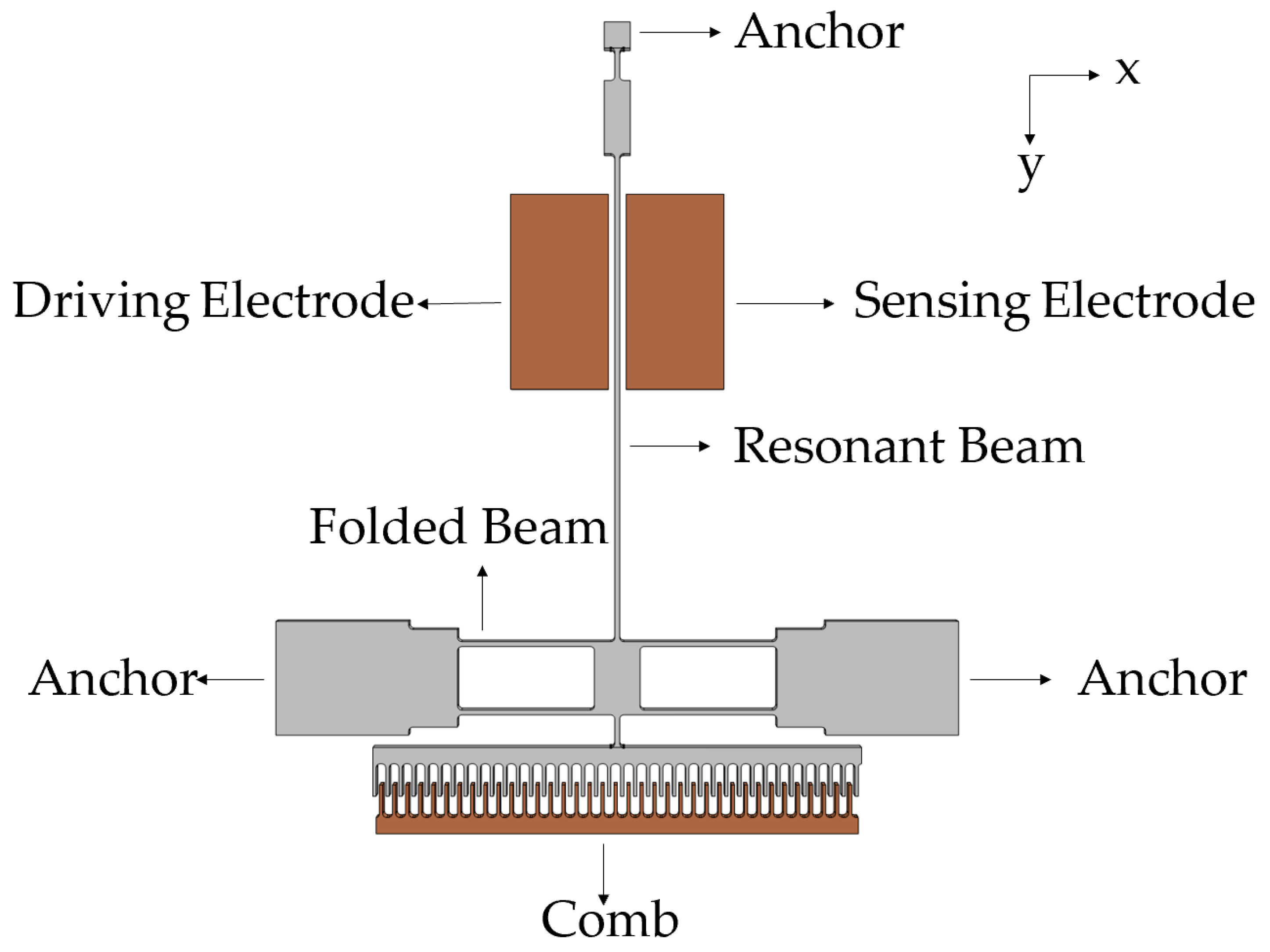
The sensitive structure of the sensor in this study is shown in
Figure 1, mainly consisting of driving electrodes, sensing electrodes, a resonant beam, fixed anchors, and other components. And the structural parameters are shown in
Table 1. The sensing electrodes and lateral driving electrodes adopt parallel-plate capacitors; to increase the effective capacitance area between electrode plates, the axial driving electrodes are designed in a comb-shaped structure. This design concept utilizes the fact that the sensitivity of sensors can be enhanced by the coming capacitor structure [
17].
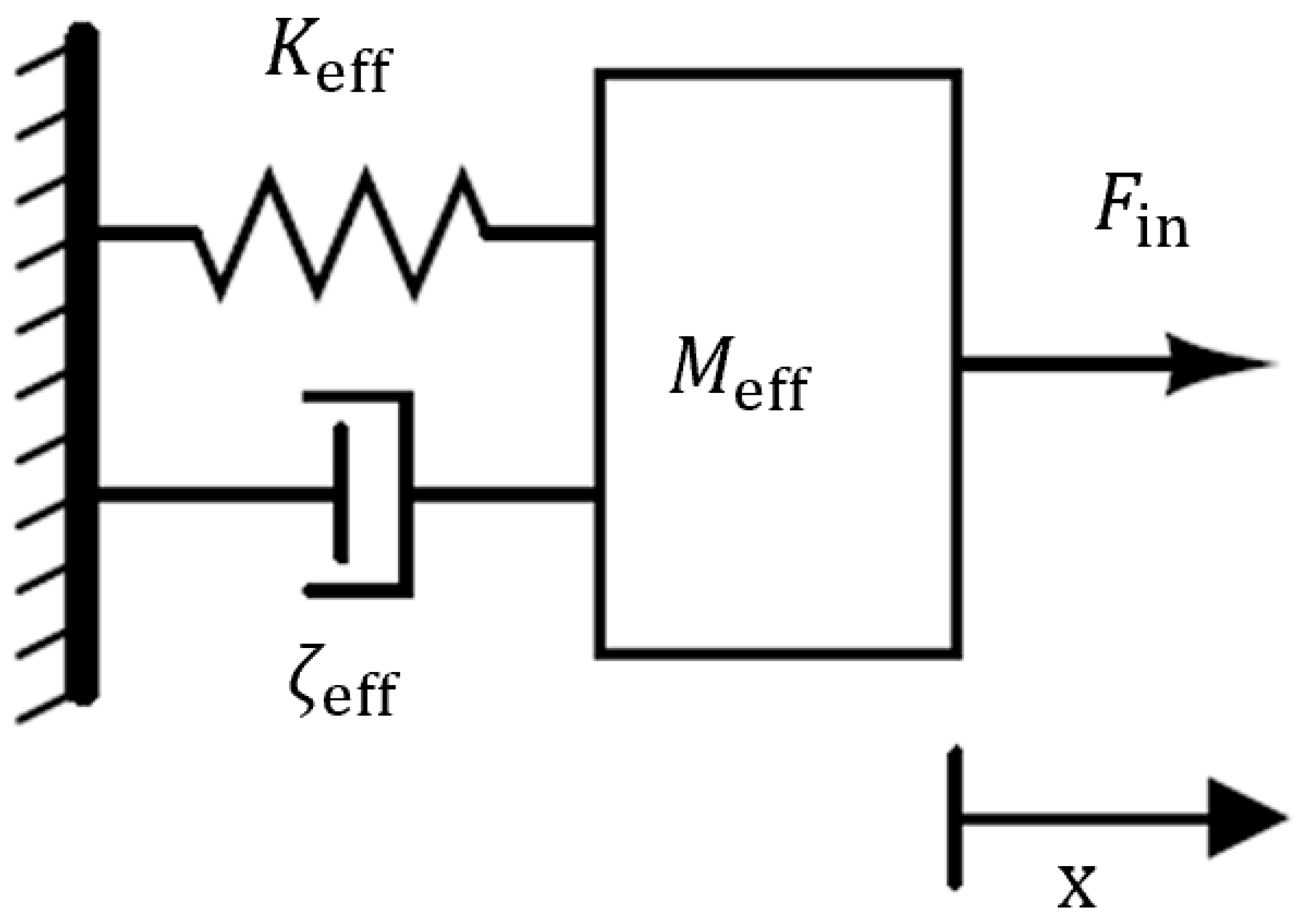
For resonant motion, a flexural mechanical beam can be described as a mass-spring-damper vibration system, as shown in
Figure 2, where
is the input force,
,
and
represent the effective mass, the effective total losses in the system, and the stiffness of the resonator, respectively. Using Newton’s second law of motion, the dynamic response of a single-degree-of-freedom mechanical resonator can be expressed as
Assuming the driving force F(t) balances the system damping to maintain resonance, the natural frequency derived from solving the equation is
In frequency-modulated electric field sensors, when the sensor is exposed to the electric field to be measured, charges are induced on its sensing electrodes, which in turn generate an electrostatic attractive or repulsive force between the resonator and the electrodes. The variation in this electrostatic force leads to a change in the effective stiffness of the resonator, thereby causing a shift in its resonant frequency. The following sections will further elaborate that an axially applied electrostatic force introduces a positive stiffness perturbation, whereas a laterally applied electrostatic force introduces a negative stiffness perturbation [
18].
Considering the stiffness perturbation
, Equation (1) becomes
In a high vacuum environment, if the influence of damping is ignored, the resonant frequency derived from solving the equation becomes
Since the stiffness perturbation
, it can be deduced that
Thus, the relationship holds.
The following section calculates . The stiffness perturbation of the resonant beam in the lateral and axial directions originates from the electrostatic force of the lateral parallel-plate capacitor and the electrostatic force of the axial comb-shaped capacitor, respectively.
For a capacitor, the total electrostatic field energy can be expressed as
Let x be the displacement and
be the electrostatic force, then
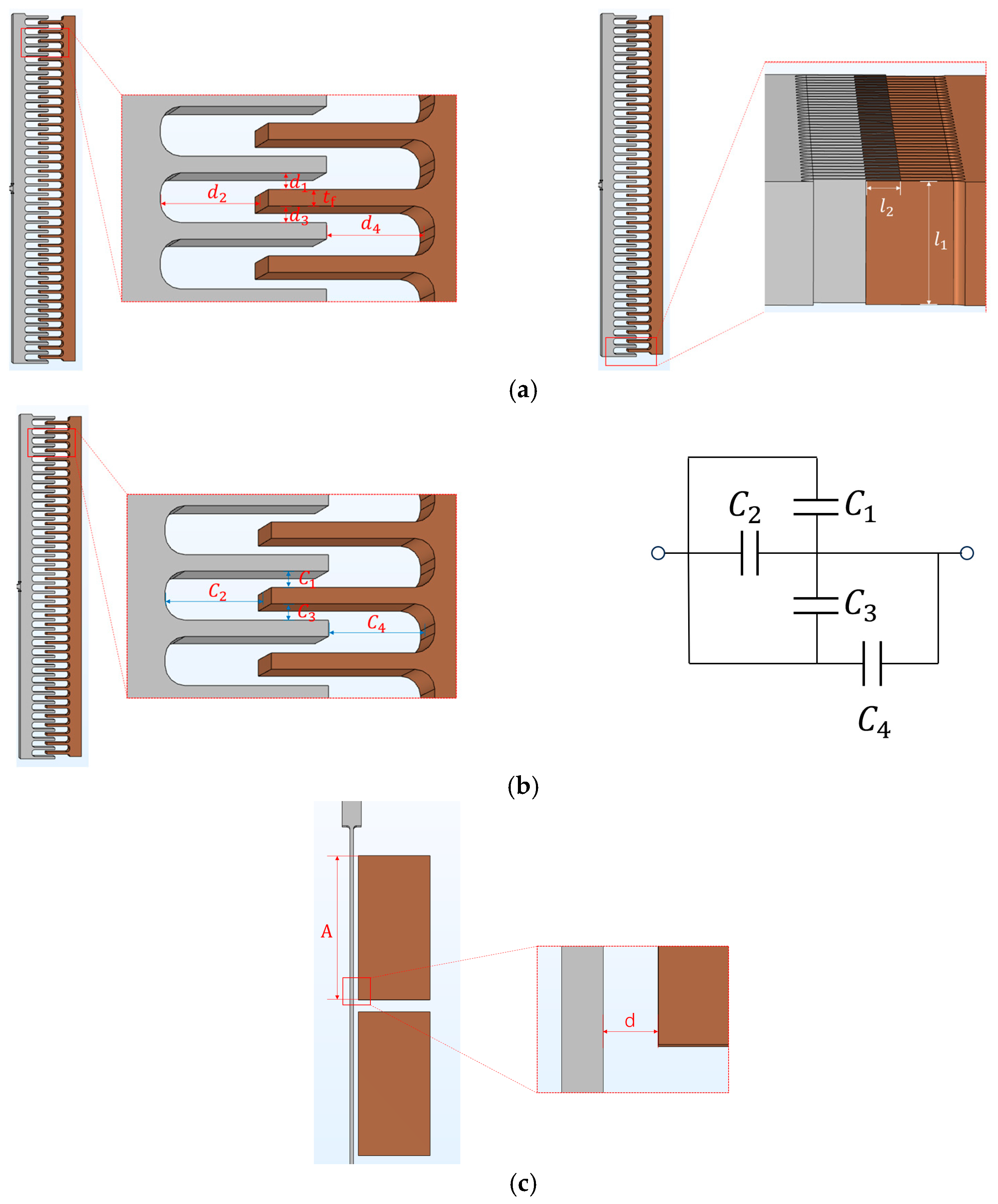
As shown in
Figure 3a,b, in the axial force model, the approximate total capacitance of each pair of finger electrodes (excluding fringe field effects) is considered to be composed of four different types of parallel-plate capacitors connected in parallel [
19]. The expression for each capacitor is as follows:
Let = =, = = ;
Considering a small displacement y of the structure in the y-direction (where y is much smaller than the spacing of the comb-shaped electrodes), the total capacitance becomes
The partial derivative of
with respect to y is
Since
, the term is expanded to the first-order infinitesimal via Taylor expansion
Thus, the magnitude of the electrostatic force is
According to Hooke’s law, the stiffness perturbation of the resonator caused by stress changes induced by axial force input can be expressed as
As shown in
Figure 3c, for the parallel-plate capacitor in the lateral force analysis when a small displacement x occurs in the x-direction:
Since
, the term is expanded to the first-order infinitesimal via Taylor expansion:
Thus, the electrostatic force is
The lateral force contributes to the “restoring stiffness” of the vibration, so the stiffness perturbation caused by the lateral force is
Considering axial and lateral perturbations separately, the relationship holds, leading to .
The frequency-electric field relationship was also demonstrated in Reference [
20].
Assuming
and
ranges from −20 V to 20 V, the maximum of
is
. So the axial and lateral perturbations calculated based on structural parameters in
Table 1 are
Obviously, the is 3.69 times as large as , which is consistent with the simulation and experimental results.
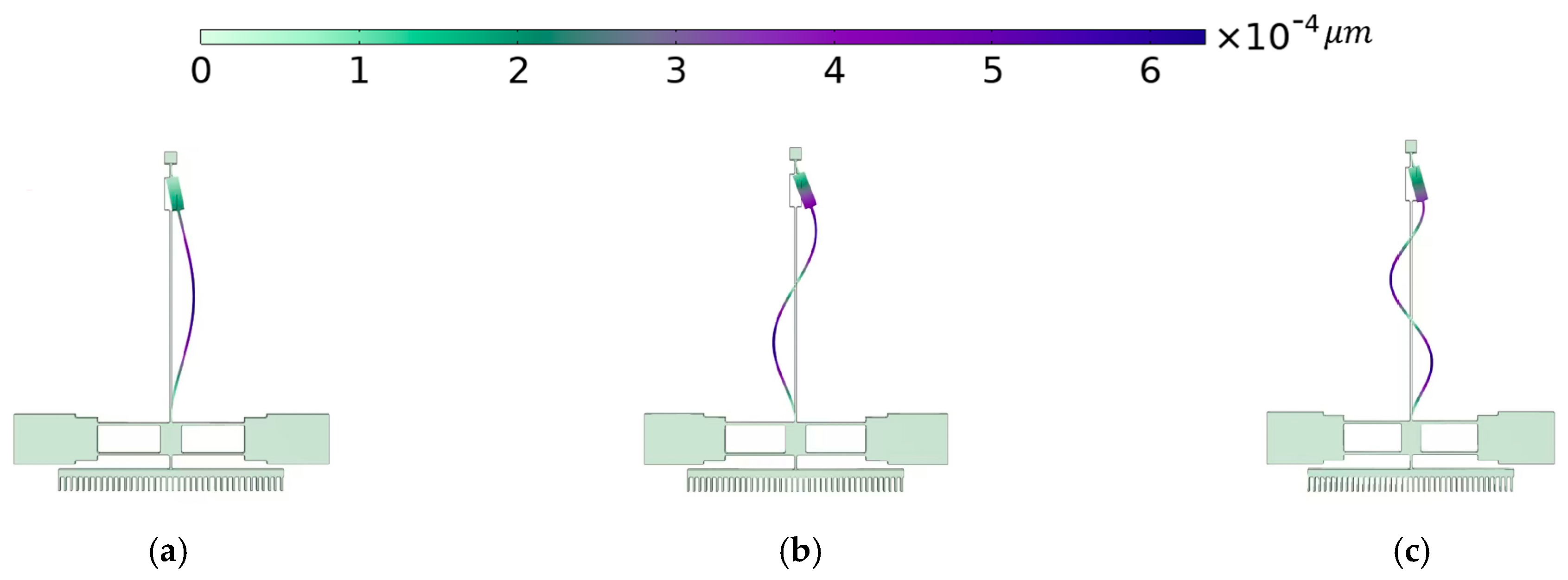
To obtain clearer and more intuitive modal shape diagrams, a 2D model was established using KLayout, and a 3D structure was constructed and simulated using COMSOL Multiphysics 6.3. The material of the structure was set to silicon.
Figure 4 presents the finite element simulation model and mode shapes of the resonator and the specific structure of the comb fingers, with the detailed parameters of the comb fingers provided in
Table 1. The anchor blocks at the top are fixed, while the mass blocks below the resonant beam are allowed to vibrate freely. The Solid Mechanics module was applied for eigenfrequency analysis, and a refined mesh was selected.
Boundary loads were used to simulate the electrostatic force of the capacitor, whose magnitude was determined based on the theoretical derivation above and the parameters in
Table 1. For simulating the axial force, the force was applied to the comb-shaped mass blocks at the bottom of the resonator; for the lateral force, the force was applied to partial areas on the side of the resonant beam.
As shown in
Figure 4, the simulation results are presented: the modal shapes of the first-order, second-order, and third-order modes, where the colors represent the displacement magnitude relative to the equilibrium position.
The final simulation results show that the first-order resonant frequency is approximately 175,396 Hz, the second-order is approximately 428,460 Hz, and the third-order is approximately 903,625 Hz. In actual experiments, the measured resonant frequency of the first-order mode is about 172,016 Hz. The experimental results are in good agreement with the simulation results, with a relative error of approximately 1.93%, which fully proves the reliability of the simulation.
3. Experimental Setup
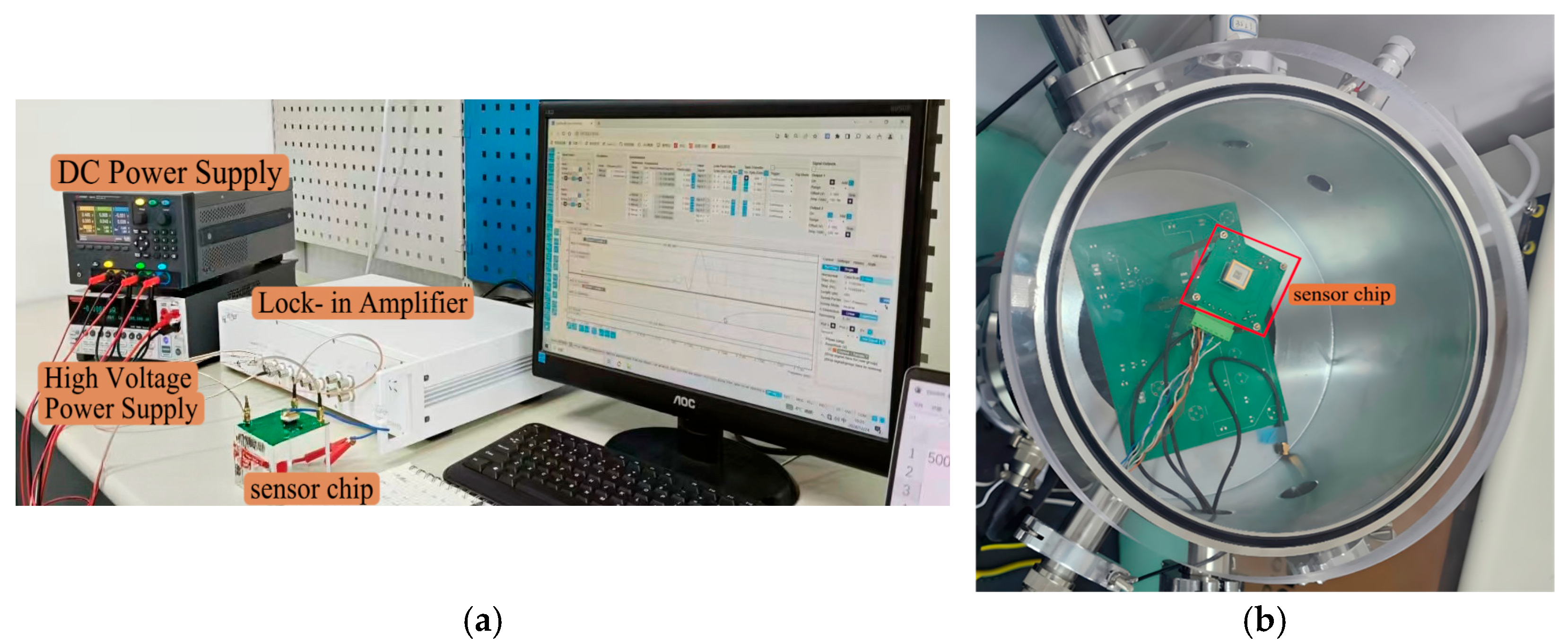
The resonant frequency and modal characteristics of frequency-modulated MEMS devices were obtained through simulation experiments. To measure the practical performance of the sensor, including its sensitivity, frequency response, and resolution, a test system was established as
Figure 5. This system consists of a vacuum pump for providing a vacuum experimental environment, a DC power supply, a lock-in amplifier from Zurich Instruments, a data acquisition and display computer, a sensor chip, and several connecting wires. The manufacturing of sensor chips is similar to the reported research [
15].
The sensor chip is placed inside the vacuum chamber connected to the vacuum pump, ensuring the experiment is conducted within a pressure range of 0.1 Pa to 0.01 Pa. The DC power supply is used to provide a DC bias voltage ( or ), which is applied to the DC bias electrode of the sensor chip. The potential difference between the DC bias voltage and the perturbation voltage () induces an electrostatic force, leading to the static displacement of the sensor.
The lock-in amplifier can generate an AC perturbation voltage that is applied to the driving electrode to drive the sensor operation. Moreover, adjusting the magnitude of the AC voltage () allows controlling the amplitude of the sensor’s resonant beam, enabling the measurement of different vibration modes. In addition, the lock-in amplifier is used for signal processing: the output signal of the sensor is connected to the input terminal of the lock-in amplifier, which performs internal demodulation, and frequency-amplitude spectra are obtained via the LabONE Q 1.0.2 software installed on the externally connected computer. The experiment mainly adopts the principle of single-variable control. The characteristic frequency values under different DC bias voltages and AC driving voltages within the same vibration mode were measured separately, and the corresponding sensitivity and resolution were calculated. The specific procedures are as follows:
Firstly, the relationship between the electric field and the applied voltage was calibrated. In this experiment, to ensure the device operates in the linear region, three sets of DC bias voltage values were set: 10 V, 15 V, and 20 V. For each set, three AC voltage magnitudes were configured: 1 mV, 1.5 mV, and 2 mV. Additionally, the DC perturbation voltage for each group was adjusted within the range of −20 V to 20 V, corresponding to an electric field intensity range of −193.4 kV/m to 193.4 kV/m. This is the measurement range of the sensor.
The electrostatic force was applied to the lateral and bottom surfaces of the sensor to perform lateral and axial measurements, respectively. After determining the variables, frequency sweeping was carried out around the characteristic frequency obtained from the simulation to acquire frequency-response curves. Based on these curves, the sensitivity and resolution under different experimental conditions were calculated accordingly.
4. Results
4.1. Frequency Response and Sensitivity Analysis
Frequency response is a fundamental characteristic of MEMS sensors, describing the relationship between the resonant frequency, vibration amplitude, and the applied perturbation voltage (corresponding to the actual electric field strength). This section focuses on the frequency response characteristics of the sensor under different perturbation directions (lateral, axial) and voltage combinations, providing raw data support for subsequent sensitivity analysis. All tests were conducted in a stable low-vacuum environment of 1 Pa, consistent with the experimental conditions for subsequent performance characterization.
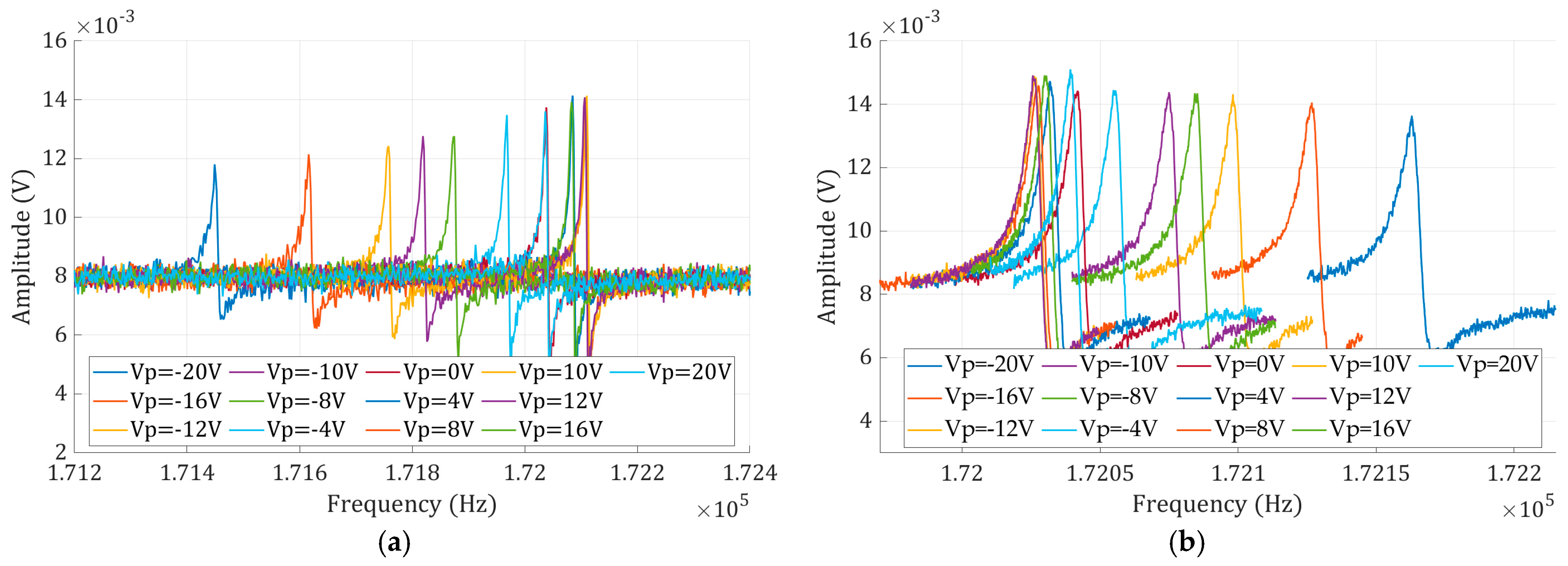
The frequency response tests covered three DC bias voltages and three AC drive voltages . The reference state corresponded to the condition . Under this state, the amplitude-frequency curve for lateral perturbation is positioned furthest to the right, indicating the maximum resonant frequency, while for axial perturbation, it is positioned furthest to the left, indicating the minimum resonant frequency. The corresponding perturbation voltage is defined as the reference voltage, and its frequency as the reference frequency (). The absolute difference between the resonant frequency at a given and is denoted as . This aligns with the theoretically derived sensitivity formula, where the applied voltage induces a negative stiffness perturbation in the lateral direction and a positive stiffness perturbation in the axial direction.
During testing,
was adjusted from −20 V to +20 V. The amplitude-frequency curves at different
values were acquired using a lock-in amplifier and LabONE software, with a focus on analyzing the direction and magnitude of the resonance peak shift relative to the reference position. Taking the combination
,
as an example, as
deviates from
and
increases,
increases. However, the amplitude-frequency curve for the lateral direction shifts towards lower frequencies, while the curve for the axial direction shifts towards higher frequencies, as shown in
Figure 6. The figure also shows that
increases nonlinearly with the difference in electric field strength from the reference point, which will be further analyzed in the sensitivity section.
Furthermore, the quality factor under axial perturbation is generally higher (15,640.1 at the reference position), and the peak shift magnitude is less sensitive to changes in (variation less than 10% when increases from 1 mV to 2.5 mV), indicating superior stability of the resonant system. The comparison of frequency responses for the two perturbation directions shows that the lateral direction exhibits a more significant leftward shift in the resonance peak when deviates from , laying the foundation for achieving higher sensitivity. In contrast, the axial direction shows a smaller rightward peak shift but a higher quality factor, reflecting better frequency selectivity. These differences are directly related to the stiffness perturbation effects induced by the different perturbation directions.
To investigate the influence of DC bias voltage and AC voltage on sensitivity, a voltage ranging from −20 V to +20 V (corresponding to an electric field strength from −193.4 kV/m to +193.4 kV/m following the same electric field generation plate as reference [
15]) was applied to the metal cover plate, with a step size of 4 V. For each value of
, in addition to the perturbation voltage
determined by the 4 V step, an additional perturbation at
was applied. This aligns with the sensitivity expression derived earlier, where such a perturbation results in the maximum resonant frequency shift for the lateral direction and the minimum for the axial direction. Three different DC bias voltages
and three AC driving voltages
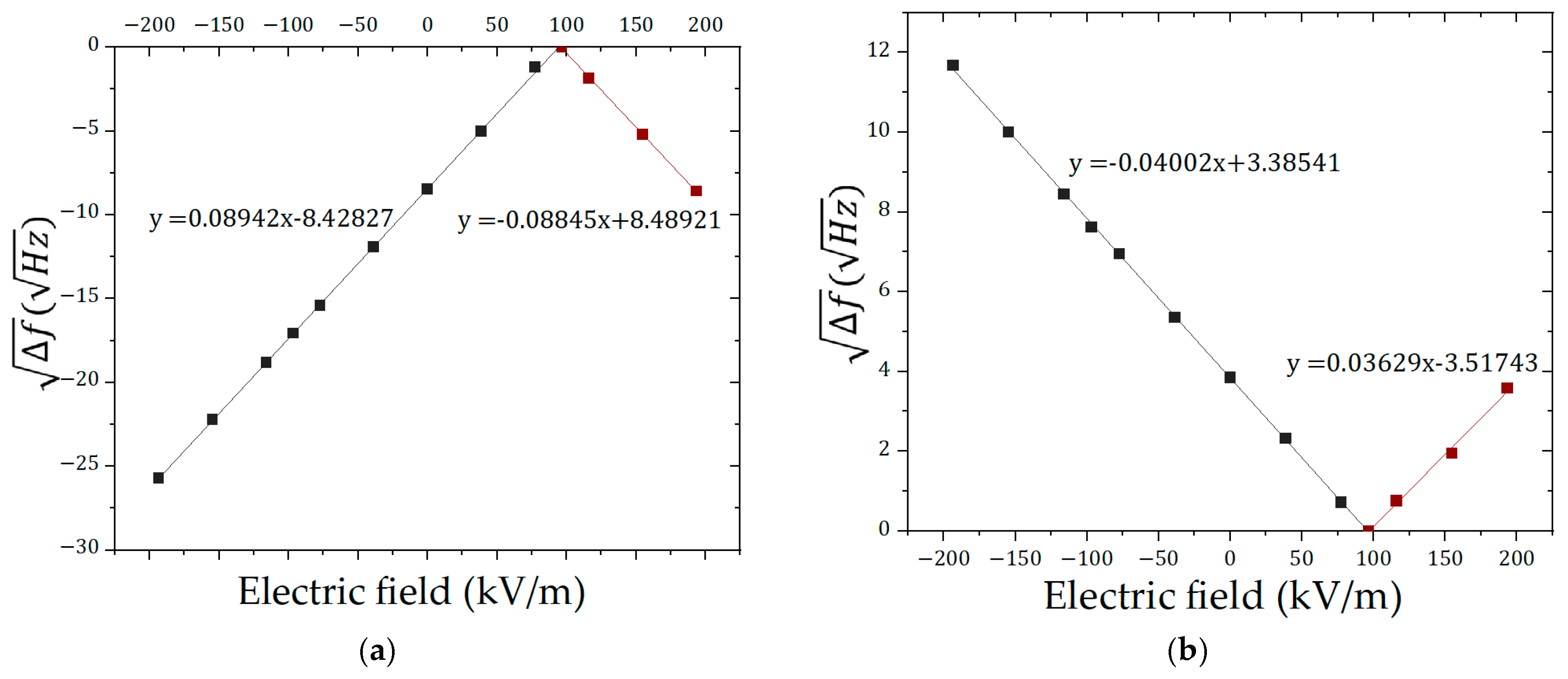
were selected. Nine sets of measurements were taken for each direction, and the sensitivity for each set was calculated, defined as the change in the square root of frequency per unit change in electric field strength. Using the calibrated voltage-to-electric field conversion factor, the electric field strength corresponding to each perturbation voltage was determined. The sensitivity curve for
and
is shown in
Figure 7, with electric field strength on the horizontal axis and
on the vertical axis. To visually distinguish the stiffness perturbations in different directions, the values for the lateral direction are plotted as
, placing its curve below the horizontal axis, while the axial direction (positive stiffness perturbation) is plotted as
, placing its curve above the axis. The figure clearly shows that
is a linear function of E, indicating that the frequency shift
has a quadratic relationship with the electric field strength E.
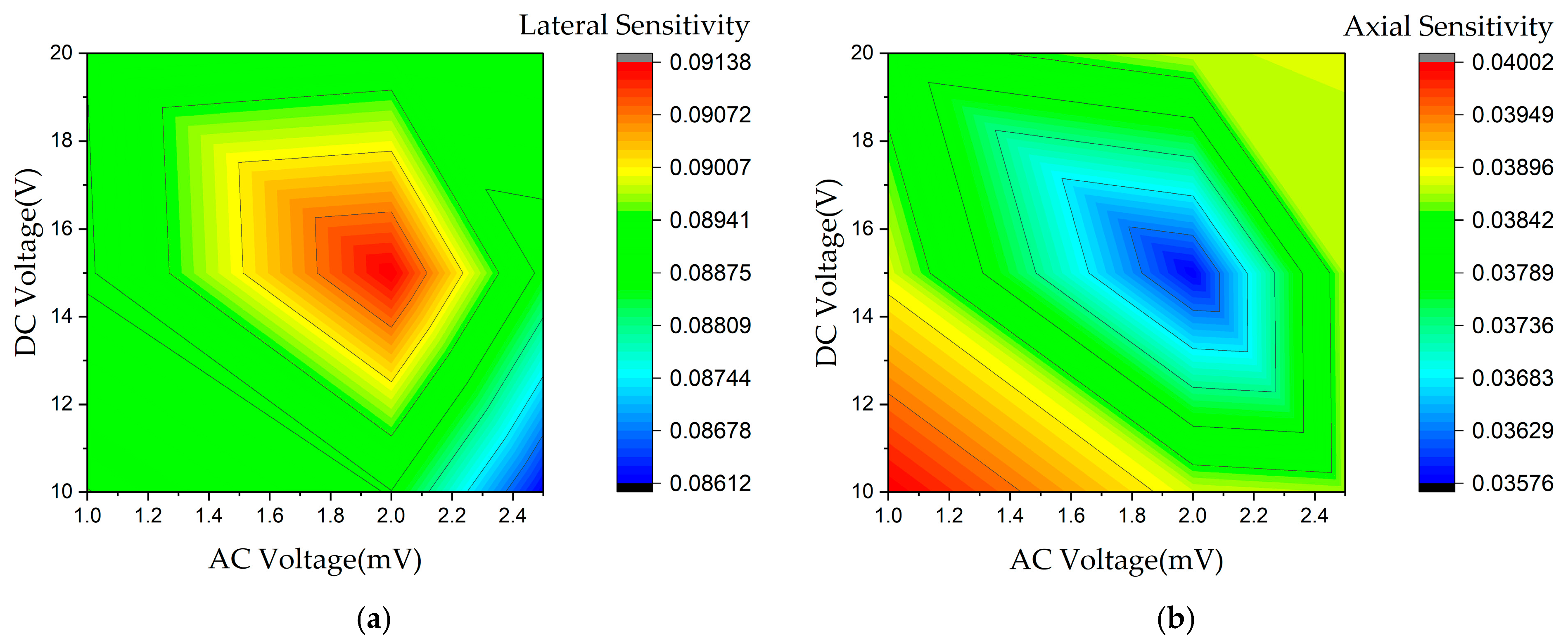
Heat maps
Figure 8 were then plotted with DC bias voltage and AC driving voltage as independent variables and sensitivity as the dependent variable. The results indicate that the lateral sensitivity reaches its maximum, while the axial sensitivity reaches its minimum, when
2 mV and
15 V.
In summary, the lateral sensitivity is distributed around 0.088 , and the axial sensitivity around 0.038 , confirming that the lateral configuration yields superior sensitivity. Overall, the optimal sensitivity for the lateral direction is achieved at 2 mV and 15 V. The difference in sensitivity between the two directions is associated with the symmetry in the perturbation modes, which indicates that an appropriate asymmetric design can enhance the sensor’s performance to a certain extent, while a symmetric design can ensure the structural stability.
4.2. Resolution Analysis
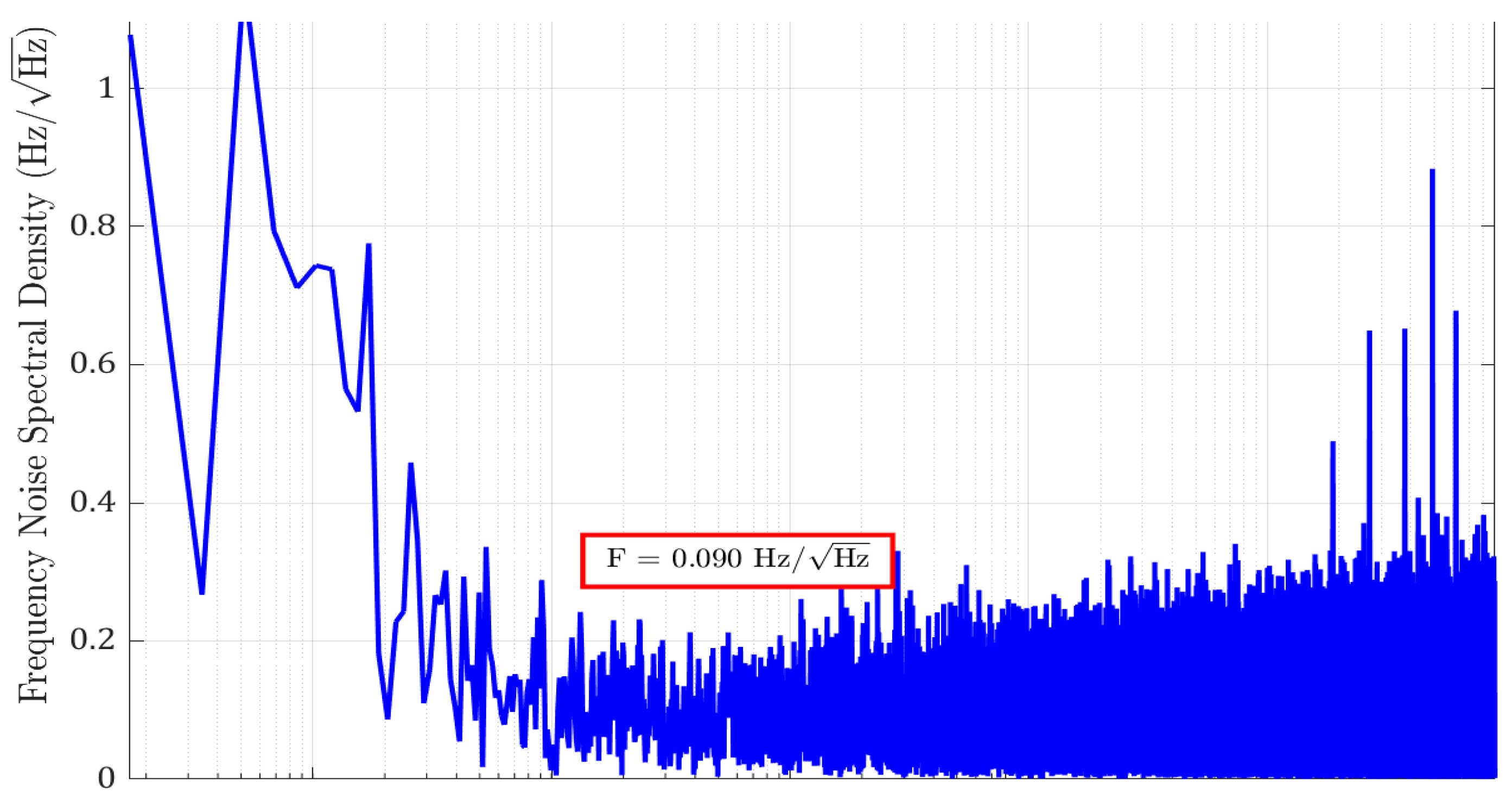
To investigate the resolution of the sensor, open-loop time-domain data was collected for 5 min using a lock-in amplifier under a zero external electric field. The noise power spectral density (NPSD) was then calculated via fast Fourier transform (FFT) in MATLAB. During the test, the AC bias voltage was set to
, and the average frequency noise was computed as
as shown in
Figure 9. Given the nonlinear response between frequency offset and electric field intensity in this study, the resolution (R) can be calculated using the average frequency noise amplitude ratio sensitivity [
21]:
For lateral perturbation (DC perturbation voltage applied to the side of the resonant beam), the resolution is:
where
is the sensitivity for lateral perturbation. Similarly, the axial resolution can be calculated as 2.37 kV/m.
A comparison of the noise analysis results for the two perturbation directions in the first-order linear region of the sensor reveals that the lateral perturbation achieves a smaller resolution, enabling the detection of weaker electric fields. The sensor operates in a well-developed electrostatic protection zone, and the laboratory temperature is constant, so the environmental noise sources can be ignored. Therefore, it is considered that the resolution in the report is the inherent performance of the sensor rather than the limitation of the measurement system.
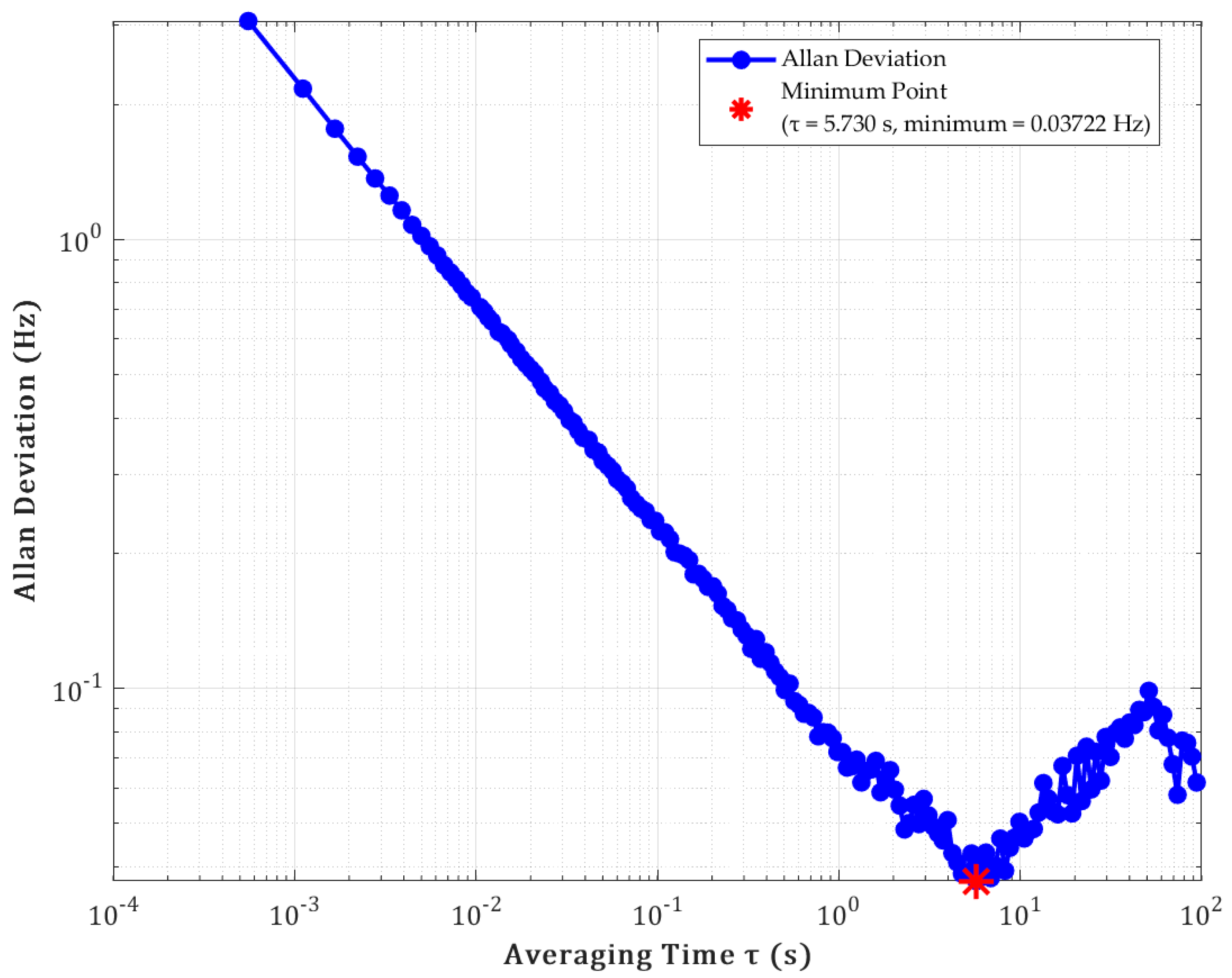
As shown in
Figure 10, it is an Allan variance graph of the sensor during an open-loop test with
= 30 mV and
7 V. The figure shows that the sensor in this study exhibits excellent short-term stability in the time stability test, with the Allan variance reaching a minimum of 0.03722 Hz at τ = 5.730 s. This indicates that the sensor has superior frequency stability and internal noise at this time scale, making it suitable for medium and short-term high-precision electric field measurements on the order of seconds. However, the long-term stability needs to be improved. This can be addressed in future research by optimizing the signal conditioning circuit [
22].




 ,
,