


Abstract
Finding Noether symmetries for time-dependent damped dynamical systems remains a significant challenge. This paper introduces a complete geometric algorithm for determining all Noether point symmetries and first integrals for the general class of Lagrangians , which model motion with general linear damping in a Riemannian space. We derive and prove a central Theorem that systematically links these symmetries to the homothetic algebra of the kinetic metric defined by . The power of this method is demonstrated through a comprehensive analysis of the damped Kepler problem. Beyond recovering known results for constant damping, we discover new quadratic first integrals for time-dependent damping with and . We also include preliminary results on the Noether symmetries of the damped harmonic oscillator. Finally, we clarify why a time reparameterization that removes damping yields a physically inequivalent system with different Noether symmetries. This work provides a unified geometric framework for analyzing dissipative systems and reveals new integrable cases.
1. Introduction
The search for first integrals (conservation laws) is a cornerstone in the analysis of dynamical systems. For systems described by autonomous Lagrangians, Noether’s theorem provides a profound and elegant bridge between continuous symmetries and conserved quantities. However, many physically significant systems—most notably those involving dissipation or external time-dependent constraints—are modeled by Lagrangians with explicit time dependence. A well known example is the damped harmonic oscillator, but the class is far broader, encompassing any system undergoing linear damping while moving under a potential in a Riemannian space. Developing systematic methods to uncover the hidden symmetries and conservation laws for these non-conservative, time-dependent systems is an interesting challenge.
A wide array of approaches exists in the literature for analyzing systems with damping. The search for constants of motion has been tackled through various mathematical methods, including the direct quadratic first integral ansatz [1,2], the Prelle–Singer procedure [3,4] and the invariant -formalism of Katzin and Levine [5,6,7]. For the fundamental case of the damped harmonic oscillator, numerous studies have cataloged its symmetries and integrals using diverse techniques [8,9,10,11]. In parallel, substantial research has focused on applied damping models, deriving symmetries and conserved quantities for specific physical systems such as those with viscoelastic damping characteristics [12,13]. The damped Kepler problem has likewise been extensively analyzed for both constant and specific time-dependent drag laws, often with emphasis on the existence and modification of the angular momentum integral [14,15,16,17].
While these studies provide valuable particular solutions or employ general but normally non-geometric methods, they collectively highlight a significant theoretical gap: the absence of a unified, geometrically formulated algorithm that systematically derives all Noether point symmetries for the entire class of Lagrangians defined by a time-dependent conformal factor, . In the present work we derive a general Theorem which fills this gap and, furthermore, we demonstrate its utility through novel applications.
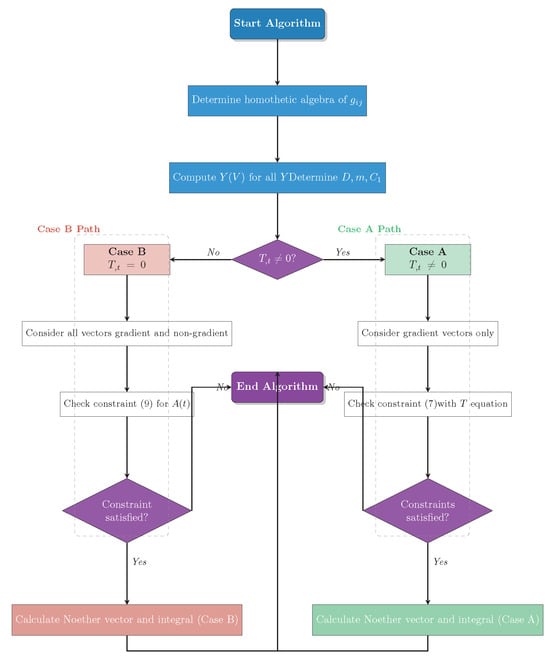
The outline of the paper is as follows. In Section 2 we state the geometric foundation of our approach, the core assumptions and the development strategy. In Section 3 we state the main Theorem 1 and the algorithm one should follow in the application of the Theorem. We also provide a flowchart which makes the procedure clear. In Section 4 we give the solution of the linear equation which is satisfied by the function . In Section 5 we apply Theorem 1 to the case of the Kepler motion. We consider two cases: constant damping, which is the standard case considered in the literature, and a time-dependent damping, which gives new integral cases. In Section 6 we present preliminary results on the Noether symmetries of the damped harmonic oscillator. In Section 7 we show that the damped case under a parameter transformation transforms to a time-dependent potential case, but, in general, the Noether symmetries do not. Finally, in Section 8 we draw our conclusions.
2. Geometrical Preliminaries and Assumptions
This section establishes the geometric foundation of our approach and states the core assumptions that define the scope and strategy of the subsequent development.
2.1. The Conformally Separable Lagrangian and Its Geometry
The fundamental object of study is a finite-dimensional dynamical system described by a time-dependent Lagrangian of conformally separable form:
is an autonomous, regular Lagrangian which defines a Riemannian (or pseudo-Riemannian) metric on the configuration manifold via its kinetic energy term:
The time-dependent conformal factor , where encodes the explicit time dependence, which physically models a general linear damping force proportional to in the resulting equations of motion.
The central geometric assumption is that the autonomous part is non-degenerate, ensuring that can be treated as a well-defined metric tensor. This permits the application of tools from Riemannian geometry, particularly the theory of symmetries of the metric tensor, to the symmetry analysis of the full, time-dependent system.
2.2. The Homothetic Algebra
The link between the damping-free dynamics governed by and the symmetries of the full system L arises from the homothetic algebra of the metric . The homothetic algebra contains two types of vector fields:
- The Killing vector fields defined by the requirement , which generate isometries. In a flat dimensional space there are gradient Killing vector fields generating translations and non-gradient Killing vector fields generating rotations. This is the maximum possible number of Killing vector fields in an dimensional space.
- The homothetic vector field defined by the requirement , with constant , which generates a scale transformation.
The set of all Killing vectors and the homothetic vector form a finite-dimensional Lie algebra of maximum dimension denoted , which is an invariant characteristic of the metric .
Remark 1.
The core hypothesis in our formulation is that the Noether point symmetries of the time-dependent Lagrangian are generated by and constrained by the homothetic algebra . The explicit time dependence introduced by modulates these symmetries but does not introduce new, independent spatial generators; it determines only the specific form of the temporal coefficient functions, and , via consistency conditions derived from the Noether identity.
2.3. Scope, Assumptions and Development Strategy
The main results of this paper are developed under the following explicit, foundational assumptions:
- The Lagrangian is of the conformally separable form given in Equation (1).
- We consider point transformations only. Generalized (higher-order) or dynamical symmetries are excluded from the present analysis.
- The configuration space geometry defined by is non-degenerate (i.e., ).
The development strategy for our formulation proceeds in three logically distinct stages:
- Stage I: Geometric Identification. Isolate the homothetic vectors as the sole potential spatial generators of Noether point symmetries for L. This reduces the infinite-dimensional symmetry search problem to a finite-dimensional algebraic one.
- Stage II: Constraint Imposition. Apply the standard Noether condition to the generic vector field . This process yields a coupled system of differential and algebraic constraints on the functions , , the parameters and the potential . The solution of this system leads to a natural classification into two mutually exclusive cases: Case A () and Case B (), each with its own specific conditions.
- Stage III: Theorem Synthesis. Synthesize the complete results of Stage II into a single, self-contained Theorem (presented in Section 3). This theorem provides a definitive, step-by-step algorithmic procedure for determining all Noether point symmetries and their associated first integrals for any system in the class defined by Equation (1).
This structured strategy ensures that the final algorithm is not an ad hoc compilation of steps but is the direct and necessary consequence of systematically solving the geometric constraints imposed by Noether’s theorem on the defined Lagrangian class. The novelty of the work lies precisely in this complete synthesis and the explicit, ready-to-use formulas that result from it.
3. Main Theorem and Algorithm
Following the geometric framework established in Section 2, we present the central theoretical result of this work: a complete characterization of the Noether point symmetries for the Lagrangian class .
3.1. Statement of the Theorem
Theorem 1
(Characterization of Noether Point Symmetries). Consider a dynamical system with a time-dependent Lagrangian of the form
where and is a non-degenerate metric on the configuration manifold. Let be the homothetic algebra of . The Euler Lagrange equations are
Then, every Noether point symmetry vector field is of the form
where is a homothetic vector with constant ψ ( for a Killing Vector, for an Homothetic vector). The functions and , along with the spatial generator , are determined by the following complete classification:
Case A:
The generator must be a gradient vector field, . It must satisfy the condition:
for real constants . The function is a non-constant solution of the linear ODE
subject to the compatibility constraint
The Noether function and the corresponding first integral are given by
Case B:
Let (a non-zero constant). The generator can be any element of (gradient or non-gradient) and must satisfy
for real constants . The conformal factor is constrained by the condition
The Noether function and the corresponding first integral are given by
3.2. Proof Strategy and Key Steps
A detailed proof of Theorem 1 is provided in the Appendix A. Here, we outline the logical structure that establishes the result, following the strategy outlined in Section 2.
- Application of the Noether Condition. The first prolongation of the general vector field (4) is applied to the Lagrangian . Enforcing the Noether condition, , yields a polynomial identity in the velocities .
- Splitting with Respect to Velocities. Setting the coefficients of the monomials and to zero generates the fundamental determining equations:
- Geometric Constraint from the Metric Equation. Equation (16) is the crucial geometric constraint. Its right-hand side is a function of time only multiplied by the metric. This forces the spatial part of the symmetry generator to be of the form , where must satisfy . Thus, is necessarily a homothetic vector field of . The ansatz with is the general solution to the metric equation, making the system compatible.
- Classification and Derivation of Constraints. Substituting into the remaining Equations (14) and (15) and enforcing integrability conditions for the Noether function f leads to the key relationsThe first relation defines D and, combined with (16), gives the formula for and the central compatibility constraints (7) and (11). The second relation yields the ODE for in Case A. The conditions on the potential, Equations (5) and (10), arise from the spatial dependence of the remaining equations.
- Integration for the Noether Function and First Integral. Finally, Equations (14) and (15) are integrated to find the explicit forms of the Noether function f and the resulting first integral I, completing the derivation.
This structured proof confirms that the conditions listed in Theorem 1 are not only sufficient but also necessary for a Noether point symmetry of the prescribed Lagrangian form to exist. The algorithm presented below is the direct procedural implementation of this theorem.
3.3. The Geometric Algorithm
Theorem 1 provides the foundation for the following step-by-step algorithm to determine all Noether point symmetries and their first integrals for a given system .
- Step 1:
- Determine the homothetic algebra of the metric defined by . Identify all Killing vectors (Killing vectors) and the homothetic vector, noting which are gradient fields.
- Step 2:
- Step 3:
- For each candidate from Step 2, classify the following:
- If the candidate constants suggest (Case B), check the constraint on the conformal factor (11). If satisfied, a Case B symmetry exists.
- Step 4:
- For each confirmed symmetry from Step 3, calculate the complete Noether vector using Equation (4) and the corresponding first integral using the appropriate formulae i.e., Equation (9) for Case A or Equation (13) for Case B.
Remark 2
(On the Algorithm’s Completeness). This algorithm is exhaustive. By Theorem 1, any Noether point symmetry must be generated by an element of the homothetic algebra and must fall into Case A or Case B. The steps systematically check all possibilities within these cases, guaranteeing that no symmetry is missed.
Remark 3
(On the Distinction from Reparameterized Systems Section 7). A crucial consequence of the theorem is the clear distinction between the symmetries of and those of a system related by a time reparameterization that removes the damping term. Such a transformation changes the fundamental Lagrangian structure from the conformally separable form assumed here. Therefore, the symmetry algebras computed by this algorithm and those for the reparameterized system are inequivalent, resolving a common point of confusion in the literature.
The application of Theorem 1 in practice is described in Figure 1.
Figure 1.
Flowchart of the geometric algorithm (Theorem 1) for determining Noether point symmetries of Lagrangians . The process begins with the homothetic algebra of the metric and classifies symmetries into Case A () or Case B () based on the constraints derived in the theorem.
4. Solution of the Equation
The role of the equation for when is central for the application of Theorem 1. The solution of this equation is as follows.
Case 1.
The equation becomes
and has solution
Case 2.
Define
Case B1: (Real and distinct roots)
The roots are
The general solution is
Case B2: (Repeated real root)
In this case
The general solution is
Case B3: (Complex conjugate roots)
The roots are
where
The general solution is
5. Application to the Damped Kepler Problem
We now demonstrate the efficacy and computational power of the geometric algorithm established in Theorem 1 by applying it to the classical Kepler problem with linear damping. This system, describing gravitational motion with a dissipative force, serves as an ideal benchmark due to its physical significance and the extensive prior analysis it has received e.g., [14,15,17].
The equation of motion in Euclidean space with Cartesian coordinates is
where and is the Kepler potential. The corresponding time-dependent Lagrangian is , with and the conformal factor determined by .
As outlined in Section 3.3, the first step of the algorithm is to determine the homothetic algebra of the kinetic metric . For , this algebra consists of n gradient Killing vectors , non-gradient Killing vectors generating rotations , and one gradient homothetic vector .
5.1. Constant Damping
For constant damping , we find and . Applying the classification procedure of Theorem 1 to the vectors of the homothetic algebra of yields the following results.
- Non-gradient Killing vectors (Angular Momentum): The rotation generators satisfy the constraints of Case B () with parameters . For and constant , the constraint (16) holds. Therefore, each produces a Noether symmetry. The resulting first integral is the corresponding component of angular momentum:
- Absence of Additional Noether Integrals: The gradient Killing vectors and the gradient homothetic vector fail to satisfy the joint system of constraints for any non-zero . This geometric obstruction explains the well-known fact that the Laplace–Runge–Lenz vector is not a point Noether integral for the constant linear damping.
We note that in case the integral reduces to the standard angular momentum integral of the Kepler potential. The orbit is in the plane .
Our result is in agreement with the established results of the relevant literature. Leach [14] and Margheri et al. [15] have shown that the only elementary conservation law is the exponential scaling of angular momentum. Our geometric algorithm derives this result systematically and straightaway from the underlying homothetic algebra, providing a clear rationale for this result.
5.2. Time-Dependent Damping
We now consider the more general case of time-dependent damping , where is a constant. Here, and .
- Non-gradient Killing vectors (Angular Momentum): The rotation generators satisfy Case B constraints for any , yielding the conserved quantity
- Gradient Homothetic Vector (New Symmetries): The application of Theorem 1 to the homothetic vector leads to constraint equations satisfied only for specific values of , revealing two exceptional integrable cases:
- For : The Lagrangian is . The constraints of Case A are satisfied, leading to a new quadratic first integral.
- For : The Lagrangian is . Here, the constraints of Case B are satisfied, yielding a different quadratic first integral.
These integrals have been verified by direct differentiation using the equation of motion (18) with .
The quadratic first integrals (21) and (22) for specific time-dependent damping laws appears to be a new finding. Previous studies on the damped Kepler problem have focused primarily on constant damping [15], specific singular drag laws [16] or asymptotic analysis [17]. The discovery of these integrable cases for and is a direct and non-trivial consequence of applying our systematic Theorem 1, demonstrating its power to reveal new results by exhaustively analyzing the constraints imposed by geometry. Obviously one may consider other forms of the function and obtain other Kepler systems and corresponding new Noether integrals.
6. The Linear Damped Oscillator
It is important to use Theorem 1 to determine the Noether integrals of the damped harmonic oscillator.
We read We note that the potential equals the gradient homothetic function, i.e., This is a unique property of the harmonic oscillator which distinguishes it form all other dynamical systems. This coupling between the potential and the homothetic vector (in is a distinctive feature of the (Euclidean) harmonic oscillator.
This “degeneracy” requires special treatment and the application of Theorem 1 is more complex. However preliminary results show that Theorem 1 does provide answers. For example, in the case of the gradient Killing vectors, one obtains the Noether vector
and the Noether integral
where is a solution of the linear equation
This equation has three solutions (see Section 4), depending on the value of the discriminant :
The gives the Over-damped harmonic oscillator;
The gives the Critically damped harmonic oscillator;
The gives the Under-damped harmonic oscillator.
It is easy to verify that .
Although a detailed study of the case of the linear damped oscillator will be reported elsewhere, we would like to make the following comments.
Remark 4.
Killing vectors provide linear Noether integrals; therefore, these integrals concern momentum (linear of angular). For the linear oscillator, the Noether integral derived from a gradient Killing vector indeed takes the form of a damped linear momentum balance, . More generally, for any damped system, the Noether integrals due to Killing vectors generalize the standard momentum map by the time-dependent factor . These are essentially the balances of the quantities conjugate to the cyclic coordinates associated with the isometries generated by the Killing fields. The homothetic vector, however, can produce qualitatively different, second-order first integrals (as demonstrated for the Kepler problem), due to the non-zero homothetic factor ψ and the associated terms involving the Hamiltonian.
Remark 5.
A notable feature of the Noether symmetry generated by the gradient Killing vectors for the damped harmonic oscillator is that the coefficient function satisfies the same second-order linear ODE as the physical coordinate , namely (cf. Equation (23)). This occurs because the constraint condition (5) for this system, with and , forces the parameter . Consequently, the generic Equation (6), , reduces precisely to the equation of motion of the damped oscillator. This is not the case for the other systems, as one can see by comparing Equations (3) and (6), because for other potentials, the constraint (5) does not force . This resonance between the symmetry parameter and the dynamical variable underscores the intimate coupling between the system’s geometry (m determined by ) and its dynamics. The three regimes of the oscillator (over-damped, critically damped, under-damped) are thus directly reflected in the functional form of the Noether symmetry generator.
7. Relation of a Linearly Damped Dynamical System and the Time-Dependent Harmonic Oscillator
Lagrange equations for the Lagrangian are
where encodes the damping Under the continuous transformation of the parameter (27) becomes
If we define the parameter by the requirement
then the equation of motion reads
or
where
The general solution of (29) is
Because the transformation is continuous, the function has an inverse , which can be used to compute explicitly for the damping factor Therefore, (27), by a proper transformation of the parameter t, takes the form of (31), which has no damping but instead a time-dependent potential of the form where is given by (32).
The following question arises:
“Do the two dynamical Equations (27) and (31) have the same Noether symmetries and consequently the same Noether integrals?”
If they do, then one may study one equation, and by applying the transformation of the parameter, obtain the results for the other equation.
In order to answer this question we work as follows. Consider the of (31), use the transformation to derive the corresponding (27) equation in the or vice versa, determine the Noether symmetries for both equations in the corresponding space and see if they coincide when one is transformed to the other under the t to s transformation.
The obvious (and interesting) case to apply this procedure is that of the damped “oscillator”:
where For this system, the Lagrangian is [18]:
so that Using (33) and one finds (plus an unimportant constant). The inverse transformation is , from which ; therefore, It follows that in the the Equation (34) becomes the undamped “oscillator” with dependent potential:
Using Theorem 1 one shows that the oscillator (34) admits the Noether symmetry where a solution of Equation (26):
corresponding to the gradient Killing vectors
In [19] Theorem 2, the authors compute the Noether symmetries of equations of the form (35). Applying this Theorem one finds that the gradient Killing vectors define the Noether symmetry where a solution of the equation:
8. Conclusions
In this work, we have addressed the systematic determination of Noether point symmetries and first integrals for a general class of non-conservative dynamical systems described by time-dependent Lagrangians of the form . The central outcome is a geometric algorithm (Theorem 1), which provides a complete and practical procedure for this task. The algorithm establishes a direct link between the Noether symmetries of the damped system and the homothetic algebra of the underlying kinetic metric, thereby embedding the search for conservation laws in a clear geometric framework.
The power and utility of this method were demonstrated through a comprehensive analysis of the damped Kepler problem. The algorithm efficiently recovered the well-known result that under constant damping, only the components of angular momentum persist as Noether integrals. More significantly, its systematic application to time-dependent damping led to the discovery of new quadratic first integrals for the specific damping parameters and . These results represent new integrable cases for this classic system.
The primary contributions of this work are therefore threefold:
- Theoretical: We have provided a unified, geometric algorithm that systematizes the Noether analysis of time-dependent Lagrangians of the form ;
- Practical: The method has been validated by recovering established results and, crucially, by discovering new conservation laws for a time-dependent Kepler problem;
- Conceptual: The framework elucidates a key geometric principle: a time reparameterization that removes explicit damping from the equations of motion does not yield an equivalent Lagrangian in the Noetherian sense, leading to different symmetry algebras.
The scope of the presented algorithm is broad. While applied here to the Kepler problem in Euclidean space and partially to the damped harmonic oscillator, Theorem 1 is formulated for a general Riemannian manifold. Future work could fruitfully explore applications to other potentials with various damping laws , cosmological systems, or motion in curved spaces. Furthermore, the case of the damped harmonic oscillator—where the potential is intimately related to the homothetic gradient function—presents a profound special case where geometry dictates a highly constrained and rich symmetry structure.
In summary, this work provides a robust and insightful geometric tool for the study of dissipative dynamics, bridging a gap in the systematic analysis of time-dependent Lagrangians and opening several avenues for further theoretical and applied research. Of particular interest will be the application our general geometric algorithm to the specific physical models studied in [13].
Funding
This research received no external funding.
Data Availability Statement
The original contributions presented in this study are included in the article. Further inquiries can be directed to the corresponding author.
Conflicts of Interest
The authors declare no conflict of interest.
Appendix A
Proof of Theorem 1.
For a Noether point symmetry the Lagrangian L must satisfy the Noether condition
where
is the first prolongation of Replacing one finds
This is an identity; therefore, the coefficients of the powers of must vanish. This results in the equations
The last equation implies Taking this into account, the remaining symmetry conditions become
From Equation (A5) it follows that , where is a homothetic vector or Killing vector of the metric with homothetic factor or 0 respectively, that is, (A5) becomes
We have to solve the system of equations
From (A9) it follows that for the vector is a gradient vector. We set
The Noether integral is
where is the Hamiltonian.
The integrability condition of :
Assume .
Assume ( .
In this case, the can be non-gradient. From it follows that Then we have
Using we find:
From this we end up with the following three equations for this case:
The constraint condition:
There is a constraint condition for T and . Using (A7) and (A13) we find
from which follows the constraint condition
In the case this becomes a constraint for :
The Noether function :
Assume , so that .
From (A9) we have
The
We compute
We use (A8) and find
Finally,
Assume .
The Noether vector:
For , the Noether vector is
where is a gradient Killing vector or homothetic vector. The Noether integral is
where is given in (A20).
For , the Noether vector is
where is a Killing vector or homothetic vector gradient or non-gradient. The Noether integral is
where given by (A21).
This completes the proof of Theorem 1. □
References
- Tsamparlis, M.; Mitsopoulos, A. Quadratic first integrals of autonomous conservative dynamical systems. J. Math. Phys. 2020, 61, 072703. [Google Scholar] [CrossRef] [Scilit]
- Tsamparlis, M.; Mitsopoulos, A. First integrals of holonomic systems without Noether symmetries. J. Math. Phys. 2020, 61, 122701. [Google Scholar] [CrossRef] [Scilit]
- Prelle, M.; Singer, M. Elementary first integrals of differential equations. Trans. Am. Math. Soc. 1983, 279, 215. [Google Scholar] [CrossRef]
- Duarte, L.G.S.; Duarte, S.E.S.; Da Mota, L.A.C.P.; Skea, J.E.F. Solving second-order ordinary differential equations by extending the Prelle-Singermethod. J. Phys. A Math. Gen. 2001, 34, 3015. [Google Scholar] [CrossRef] [Scilit]
- Katzin, G.H.; Levine, J. Dynamical symmetries and constants of the motion for classical particle systems. J. Math. Phys. 1974, 15, 1460. [Google Scholar] [CrossRef] [Scilit]
- Katzin, G.H.; Levine, J. A gauge invariant formulation of time-dependent dynamical symmetry mappings and associated constants of motion for Lagrangian particle mechanics. I. J. Math. Phys. 1976, 17, 1345. [Google Scholar] [CrossRef] [Scilit]
- Katzin, G.H.; Levine, J. Geodesic first integrals with explicit path-parameter dependence in Riemannian space–times. J. Math. Phys. 1981, 22, 1878. [Google Scholar] [CrossRef] [Scilit]
- Leach, P.G. Sl(3, R) and the repulsive oscillator. J. Phys. A Math. Gen. 1980, 13, 1991. [Google Scholar] [CrossRef] [Scilit]
- Cerveró, J.M.; Villarroel, J. SL (3, R) realisations and the damped harmonic oscillator. J. Phys. A Math. Gen. 1984, 17, 1777. [Google Scholar] [CrossRef] [Scilit]
- Choudhuri, A.; Ghosh, S.; Talukdar, B. Symmetries and conservation laws of the damped harmonic oscillator. Prasana J. Phys. 2008, 70, 657. [Google Scholar] [CrossRef] [Scilit]
- Farooq, M.U.; Safdar, M. Noether symmetries and first integrals of damped harmonic oscillator. arXiv 2022, arXiv:2205.10525. [Google Scholar] [CrossRef] [Scilit]
- Hasheminejad, S.; Cheraghi, M.; Jamalpoor, A. Active damping of sound transmission through an electrorheological fluid-actuated sandwich cylindrical shell. J. Sandw. Struct. Mater. 2018, 22, 833–865. [Google Scholar] [CrossRef] [Scilit]
- Seilsepour, H.; Zarastvand, M.; Talebitooti, R. Acoustic insulation characteristics of sandwich composite shell systems with double curvature: The effect of nature of viscoelastic core. J. Vib. Control 2022, 29, 1076–1090. [Google Scholar] [CrossRef] [Scilit]
- Leach, P.G.L. The first integrals and orbit equation for the Kepler problem with drag. J. Phys. A Math. Gen. 1987, 20, 1997. [Google Scholar] [CrossRef] [Scilit]
- Margheri, A.; Ortega, R.; Rebelo, C. Dynamics of Kepler problem with linear drag. Celest. Mech. Dyn. Astron. 2014, 120, 19. [Google Scholar] [CrossRef] [Scilit]
- Margheri, A.; Misquero, M. A dissipative Kepler problem with a family of singular drags. Celest. Mech. Dyn. Astron. 2020, 132, 17. [Google Scholar] [CrossRef] [Scilit]
- Kristiansen, K.U. Revisiting the Kepler problem with linear drag using the blowup method and normal form theory. Nonlinearity 2024, 37, 035014. [Google Scholar] [CrossRef] [Scilit]
- Bateman, H. On dissipative systems and related variational principles. Phys. Rev. 1931, 38, 815–819. [Google Scholar] [CrossRef] [Scilit]
- Karpathopoulos, L.; Paliathanasis, A.; Tsamparlis, M. Lie and Noether point symmetries for a class of nonautonomous dynamical systems. J. Math. Phys. 2017, 58, 082901. [Google Scholar] [CrossRef] [Scilit]
Disclaimer/Publisher’s Note: The statements, opinions and data contained in all publications are solely those of the individual author(s) and contributor(s) and not of MDPI and/or the editor(s). MDPI and/or the editor(s) disclaim responsibility for any injury to people or property resulting from any ideas, methods, instructions or products referred to in the content. |
© 2026 by the author. Licensee MDPI, Basel, Switzerland. This article is an open access article distributed under the terms and conditions of the Creative Commons Attribution (CC BY) license.