Article

First-Principles Investigation of Structural, Electronic, and Elastic Properties of Cu(In,Ga)Se2 Chalcopyrite Alloys Using GGA+U


by
Mohamed Gandouzi
1,*,
Owaid H. Alshammari
1,
Fekhra Hedhili
1,
Hissah Saedoon Albaqawi
1,
Nwuyer A. Al-Shammari
1,
Manal F. Alshammari
1 and
Takuo Tanaka
2
1
Department of Physics, College of Science, University of Ha’il, Ha’il P.O. Box 2440, Saudi Arabia
2
RIKEN Center for Advanced Photonics, 2-1 Hirosawa, Wako 351-0198, Saitama, Japan
*
Author to whom correspondence should be addressed.
Symmetry 2026, 18(1), 25; https://doi.org/10.3390/sym18010025
Submission received: 13 November 2025 / Revised: 15 December 2025 / Accepted: 18 December 2025 / Published: 23 December 2025
(This article belongs to the Section Engineering and Materials)

Abstract

This paper presents a theoretical study of the structural, electronic, and elastic properties of gallium-doped CuInSe2 using the GGA exchange-correlation functional with the Hubbard correction for five Ga compositions: 0, 0.25, 0.5, 0.75, and 1. The found lattice parameters decrease with gallium composition and obey Vegard’s law. Traditional DFT calculations fail to explain the band structure of Copper Indium Gallium Selenide compounds (CIGS). The use of Hubbard corrections of d-electrons of copper, indium, gallium, and p-electrons of selenium opens the gap, showing a semiconductor’s behavior of CuInGaSe2 alloys in the range 1.04 eV to 1.88 eV, which are in good agreement with available experimental data and current theory using an expensive hybrid exchange-correlation functional. The obtained formation energies for the different gallium compositions are close to −1 eV/atom, and the phonon spectra indicate the thermodynamic stability of these alloys. The values of the elastic constant satisfy the Born elastic stability conditions, suggesting that these compounds are mechanically stable. Moreover, we compute the bulk modulus (B), shear modulus (G), Young’s modulus (E), Poisson ratio (p), Pugh’s ratio (r), and average Debye speed ( v ), and the Debye temperature ( Θ D ) with the Ga composition. There is a symmetry between our results and the experimental data, as well as earlier simulation results.

1. Introduction

Due to the rapid demand for energy, the limitations of fossil fuels, taking care of nature and reducing environmental pollution, an interest in other friendly resources with low cost, especially renewable energy, is increasing [1]. Among these resources, the conversion of sunlight using appropriate and adequate materials with specific properties that are environmentally friendly, causing no harm to natural resources, is challenging for researchers. The compounds used for solar cell conversion are absorbers, semiconductor layers, including GaAs, CdTe, copper indium gallium selenide chalcopyrite alloys (CIGS) [2,3], copper zinc tin sulfide (CZTS), copper indium aluminum selenide, perovskite, and other materials having a direct gap ranging in the visible region, with a high absorption coefficient. Semiconductors like CuInSe2, CuGaS2, CuGaSe2, CuAlSe2, and CuAlS2 are all similar absorbers with a wide range of direct band gaps discovered as a result of efforts to improve the properties of CuInS2 over the years.
Thanks to their superior optical, electronic, and stability properties, (CIGS) based semiconductors are the leading materials technologies among thin-film solar cells [4,5,6]. Experimental work shows that the CIGS process has an absorber bandgap of 1.04 eV for CuInSe2 and 1.68 eV for CuGaSe2 [7,8,9]. In addition, the type of semiconductor materials n or p can be fixed by copper, indium, and selenium compositions in a CuInSe matrix [10,11]. Theoretically, using various codes, the traditional exchange correlation functionals, local density approximation (LDA), and the generalized gradient approximation (GGA), the energy gaps are underestimated for semiconductors and insulators [12,13]. In fact, Rongzhen Chen et al. obtained a band gap of 0.52 eV for CuInSe2 using the GGA plus Hubbard correction associated with localized d orbitals of copper. The band gap is shifted to 1.04 eV when the spin–orbit coupling effect is considered in the band structure calculation [14]. Moufdi Hadjab et al., using LDA approximation implemented in the Wien2k code, obtained a band gap of 0.0 eV for CuInSe2 and 0.2 eV for CuGaSe2 compounds [15]. Chunjie Wang et al. investigate the electronic and elastic properties of CuInS2 and CuInSe2 compounds using DFT implemented in the Castep software [16]. They obtained a band gap of 0.84 eV and 1.36 eV for CuInSe2 and CuInS2, respectively. A. Amudhavalli et al. analyzed the electronic, optical, elastic, and thermal properties of chalcopyrite CuBY2 compounds using LDA, LDA+U, and GGA exchange correlation functional implemented in the Vasp package [17]. They found gaps less than the experimental values for CuInSe2 and CuGaSe2 compounds. With the hybrid functional HSE06, they obtained a good agreement with the experimental values. In addition, Xu-Dong Chen et al. studied the band structure and the density of states of CuIn1−xGaxSe2 with x the gallium composition using the Hybrid (B3LYP) exchange correlation functional implemented in the Castep code [18]. They found band gap values align well with the experimental results. Therefore, many computational works have been performed to investigate the optoelectronic, structural, and elastic properties of chalcopyrite materials due to their solar cell applications using the traditional density LDA and GGA plus Hubbard correction exchange correlation functional. They found that the band gaps underestimate the experimental data [19,20,21,22,23]. However, the use of hybrid functional, which is very expensive and needs higher computational cost, strong physical hardware, gives good results aligned with the experimental data, especially for the band structure [14,18].
In this paper, we conduct the structural, density of states, band structure properties, and the elastic constants by the GGA plus Hubbard corrections of d-electrons of copper, indium, gallium, and the p-electrons of selenium for 5 compositions CuInSe2, CuIn0.75Ga0.25Se2, CuIn0.5Ga0.5Se2, CuIn0.25Ga0.75Se2, and CuGaSe2. The new finding is the introduction of the Hubbard correction term U employed to treat the highly correlated Se-3p electrons within the open source Package for Research in Electronic Structure, Simulation, and Optimization Quantum Espresso code [24]. Because it was expected that the existence of strong interactions between the copper d orbitals and the anion p orbitals for the selenides would reduce the band gap of the CuInSe2 system [25].

2. Calculation Method

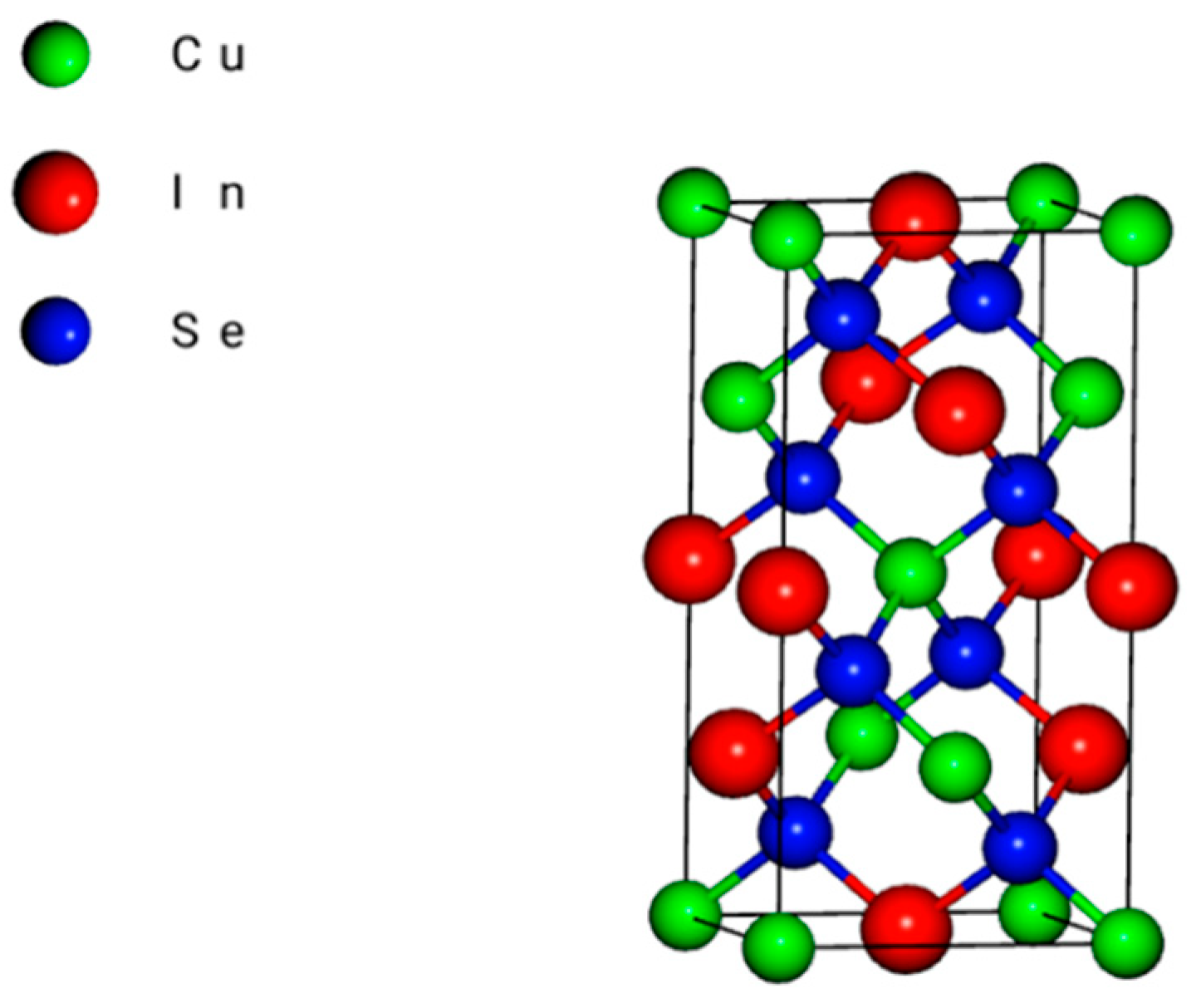
The investigation of the structural, density of states, and band structure was performed using GGA [26,27] proposed by Perdew-Burke-Ernzerhof (PBE) plus Hubbard correction implemented in the Quantum Espresso code [24,28]. The electron-ionic core interaction is treated using ultrasoft pseudopotentials [24]. For this calculation, the Kohn-Sham orbitals and charge density were expanded on a plane-wave basis set up to 50 Ry and 500 Ry for a kinetic energy cutoff, and the cutoff charge density, respectively. Electronic structure and density of states were performed with a dense k mesh 24 × 24 × 12 in the first Brillouin zone integration, a total-energy convergence threshold of 10−8 Ry, a force convergence threshold of 10−4 Ry/a.u for volume and relaxed atomic position optimizations. The calculations were conducted for CuInSe2 in the tetragonal structure with space group I4̄2d, as illustrated in Figure 1. The crystal structures of chalcopyrite semiconductors, CuInSe2 and CuGaSe2, and the quaternary compound CuIn1−xGaxSe2 alloys were obtained by incorporating gallium atoms in the indium site with different compositions. Therefore, we will study five structure configurations corresponding to the gallium composition x = 0, 0.25, 0.5, 0.75, and 1 in the tetragonal structure. In addition, we investigate the mechanical stability of CuIn1−xGaxSe2 alloys. The elastic constants C i j are obtained by Thermo_pw implemented in the Quantum Espresso code, which applies strain to the primitive vectors of the unstrained solid [29,30]. In our simulation, we use GGA+U to investigate the band gaps and density of CuInSe2, CuIn0.75Ga0.25Se2, CuIn0.5Ga0.5Se2, CuIn0.25Ga0.75Se2, and CuGaSe2 compounds. By applying the Hubbard correction related to localized d electrons ( U d C u , U d I n , U d G a ) of, respectively, copper, indium and gallium, and p states ( U p S e ) of the selenium element, we enhance the values of band gaps and our results are aligned with the experimental available data and close to the theoretical calculations obtained by hybrid exchange correlation functional.

3. Results and Discussion

3.1. Structural Properties

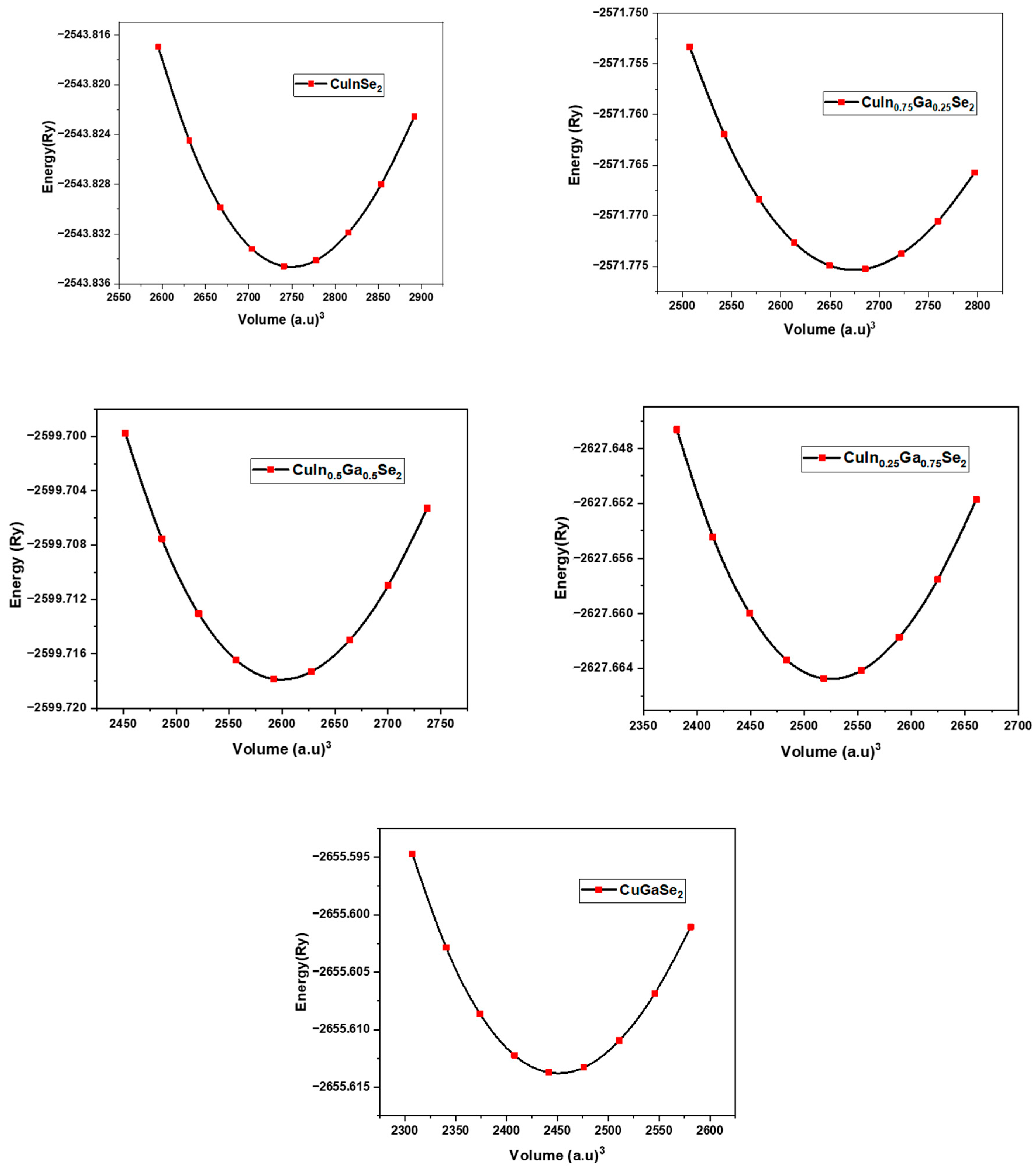
The DFT calculation of CuIn1−xGaxSe2 for the five compositions of gallium was carried out in the tetragonal structures with k mesh 6 × 6 × 3 in the first Brillouin zone, with a force convergence threshold of 10−4 Ry/a. The lattice constants, the distortion parameters, and the Bulk modulus of CuInSe2 pure obtained by minimizing the total energy (E) versus the volume (V) according to Murnaghan’s equation of state (EOS) [31,32] are, respectively, a = b = 5.8688 Å, c = 11.79138 Å, η = c 2 a = 1.00458,
E V = E 0 + B . V B ( B 1 ) B 1 V 0 V + V 0 V B 1
where E0 and V0 are the energy and volume at equilibrium, B and B’ are the compressibility modulus and its first derivative with respect to the pressure, respectively. Figure 2 illustrates the variation in the total energy versus volume for the five gallium compositions. The result of volume optimization for CuIn1−xGaxSe2 compositions is tabulated in Table 1, with the experimental data and other theoretical DFT results obtained by other computational codes such as WIEN2K, VASP, and CASTEP [33,34,35].
As seen in Table 1, our theoretical lattice parameters are in good agreement with the experimental values and other theoretical calculations using various exchange correlation functionals implemented in different DFT codes [33,34,39,40]. The decrease in lattice parameters of CuIn1−xGaxSe2 with increasing Ga composition can be explained by the smaller size of Ga compared to In, leading to shorter bonds and a more compact structure. Therefore, the bulk modulus increases with gallium composition, and CuIn1−xGaxSe2 becomes stronger and more resistant to compression. We also investigate Vegard’s law [32], which determines the effect of the Gallium composition on the CIGS lattice parameters. According to Vegard’s law, the lattice parameters a x , c ( x ) for a ternary or quaternary compound CuIn1−xGaxSe2 (CIGS), it can be expressed as:
a ( x ) = ( 1 x ) a C u I n S e 2 + x a C u G a S e 2
c ( x ) = ( 1 x ) c C u I n S e 2 + x c C u G a S e 2
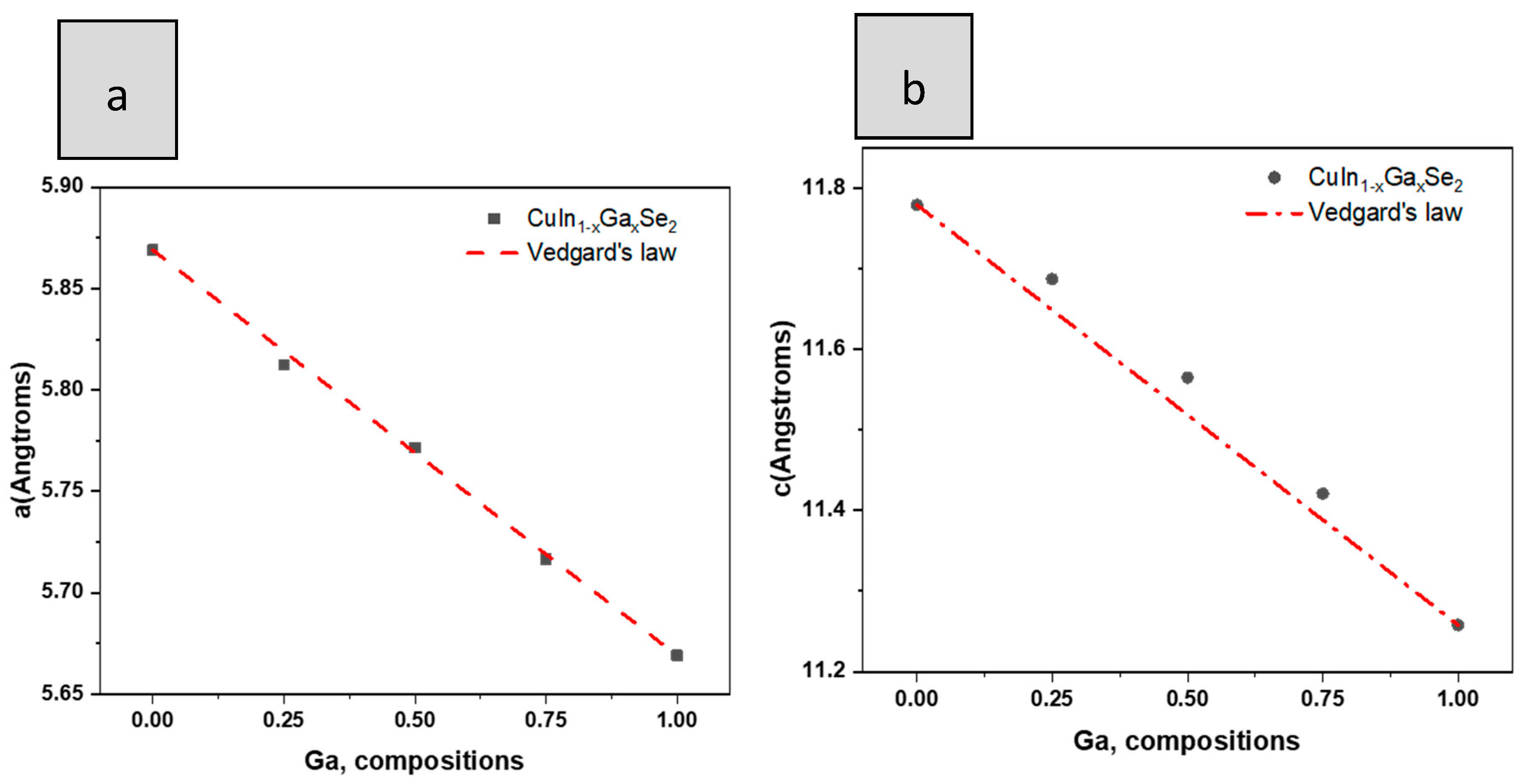
where x is the Gallium composition and a C u I n S e 2 and a C u G a S e 2 are the lattice parameters of pure CuInSe2 and CuGaSe2, respectively. As shown in Figure 3, the lattice parameters obtained by our DFT investigations decrease with the gallium composition. The observed decrease in a(x) and c(x) is due to the fact that Ga ( r G a = 76   p m ) has a smaller ionic radius than indium ( r I n = 94   p m ) , leading to a contraction of the unit cell as Ga substitutes In atom [41]. The slight deviations from Vegard’s law can be explained by many physical factors that affect the lattice parameters of structures, including the atomic size of atoms, the relative volume per valence electron in crystals, and the electron electrochemical differences between elements. Therefore, due to the different atomic size between In and Ga, the electronegativity character of elements reflects the distortion, and Vegard’s Law might not be perfectly obeyed.

3.2. Structural Stability

We check the structural stability thermodynamically of the CuIn1−xGaxSe2 alloys, by calculating the formation energy E F / a t o m ( e V )   using the following equation [42]:
E F / a t o m ( e V ) = E B u l k C u I n 1 x G a x S e 2 4   E C u ( b u l k ) + 1 x E I n ( b u l k ) + x E G a ( b u l k ) + 2 E S e ( b u l k ) 16
where E B u l k C u I n 1 x G a x S e 2 is the total energy of C u I n 1 x G a x S e 2 compounds, and E C u ( b u l k ) , E I n ( b u l k ) , E G a ( b u l k ) , and E S e ( b u l k ) are energies of Cu, In, Ga, and Se atoms, respectively, in their stable structures. As seen from the formation energies reported in Table 2, the negative values indicate that all the compositions are thermodynamically stable. In addition, the greater stability of CuGaSe2 compared to CuInSe2 is due to the smaller radius of gallium compared to indium, the stronger bonds, and the higher bulk modulus of Ga doped CuGaSe2 compound compared to the pristine.
In our work, we also check the mechanical stability of the different compounds C u I n 1 x G a x S e 2 . The elastic constants C i j   calculated by the Themo_pw code describes the mechanical response of materials to applied stresses and strains, providing insights into deformation, stability, and performance. In the tetragonal structure, the six independent elastic constants are C 11 , C 12   C 13 , C 33 , C 44 , and C 66 , and the mechanical stability based on Born-Huang criteria under small deformations [43] is:
C 11 > C 12   ; 2 C 13 2 < C 33 C 11 + C 12 C 44 > 0   ; C 66 > 0
As seen in Table 3, the different alloys C u I n 1 x G a x S e 2 satisfy the elastic stability requirements. Therefore, they are mechanically stable against elastic deformation.
In addition, the elastic constants C i j help us to evaluate the interatomic bonding, ductility, and thermodynamic properties such as melting temperature and specific heat. They allow us to determine the bulk modulus (B), shear modulus (G), Young’s modulus (E), Poisson ratio (p), Pugh’s ratio (r), the average Debye speed ( v ), and the Debye temperature ( Θ D ) [44]. These physical quantities are crucial for material applications.
As seen from Table 3, the values of the majority of elastic constants Cij, which are related to the material’s resistance against linear compression in a specific direction, increase with the gallium compositions. This fact proves that by the replacement of indium with gallium, the material CuIn1−xGaxSe2 becomes less compressible. This can be because Ga atoms are smaller and exhibit higher electronegativity than In, resulting in shorter and stronger Ga–Se bonds. Therefore, incorporating Ga enhances the rigidity of the lattice, which is critical for optimizing material performance in thin-film solar cell applications, where mechanical stability is important. Other research studied the elastic constants theoretically and experimentally. A good agreement between the values of Table 3 and the available experimental and theoretical data [21,33,39,40,45].
In addition, we investigate the variation in the bulk modulus (B) and shear modulus (G) with gallium composition in CuIn1−xGaxSe2 compounds. B and G increase with x in these compounds, indicating greater resistance to uniform compression and shear deformation as gallium content rises. This trend enhances the material’s mechanical stability and rigidity. As a result, CIGS materials become stiffer, less deformable, exhibit stronger bonding interactions, and show a reduction in the lattice constant. Such improvements are important for the structural integrity of CIGS-based solar cells. We also compute the Young modulus (E), representing the material’s resistance to uniaxial tensile stress. Similarly, E increases with gallium composition, reflecting greater stiffness or elasticity and greater robustness—crucial for device stability in solar cell applications.
To further understand the mechanical characteristics, we explore the ductile and brittle character of CuInGaSe2 alloys by calculating the variation in Pugh’s ratio, which is defined as the ratio of bulk modulus to shear modulus. The values of Pugh’s ratio vary between 2.376 for CuInSe2 and 1.831 for CuGaSe2, exceeding the critical value of 1.75, which indicates ductile behavior for these CIGS compounds. Notably, a similar trend in our results was observed by J.-W. Yang et al. in their work [45].
We also calculated the Debye temperature and Debye speed for CuIn1−xGaxSe2 compounds. The Debye temperature is linked to several physical properties, such as phonon frequencies, thermal conductivity, and low-temperature heat capacity. We found that CuGaSe2 has a higher Debye temperature than CuInSe2, which points to stronger interatomic bonds and a higher sound velocity. This matches the trend we observed in the average Debye speed, which increased with the gallium composition. This can be explained by the fact that Ga-Se bonds are stronger than In-Se bonds because gallium has higher covalency and electronegativity, and its atomic mass (69.7 u) is lower than that of indium (114.8 u). As a result, the material shows higher phonon frequencies and faster vibrational modes.

3.3. Band Structure and Density of States of CuInSe2 Using GGA

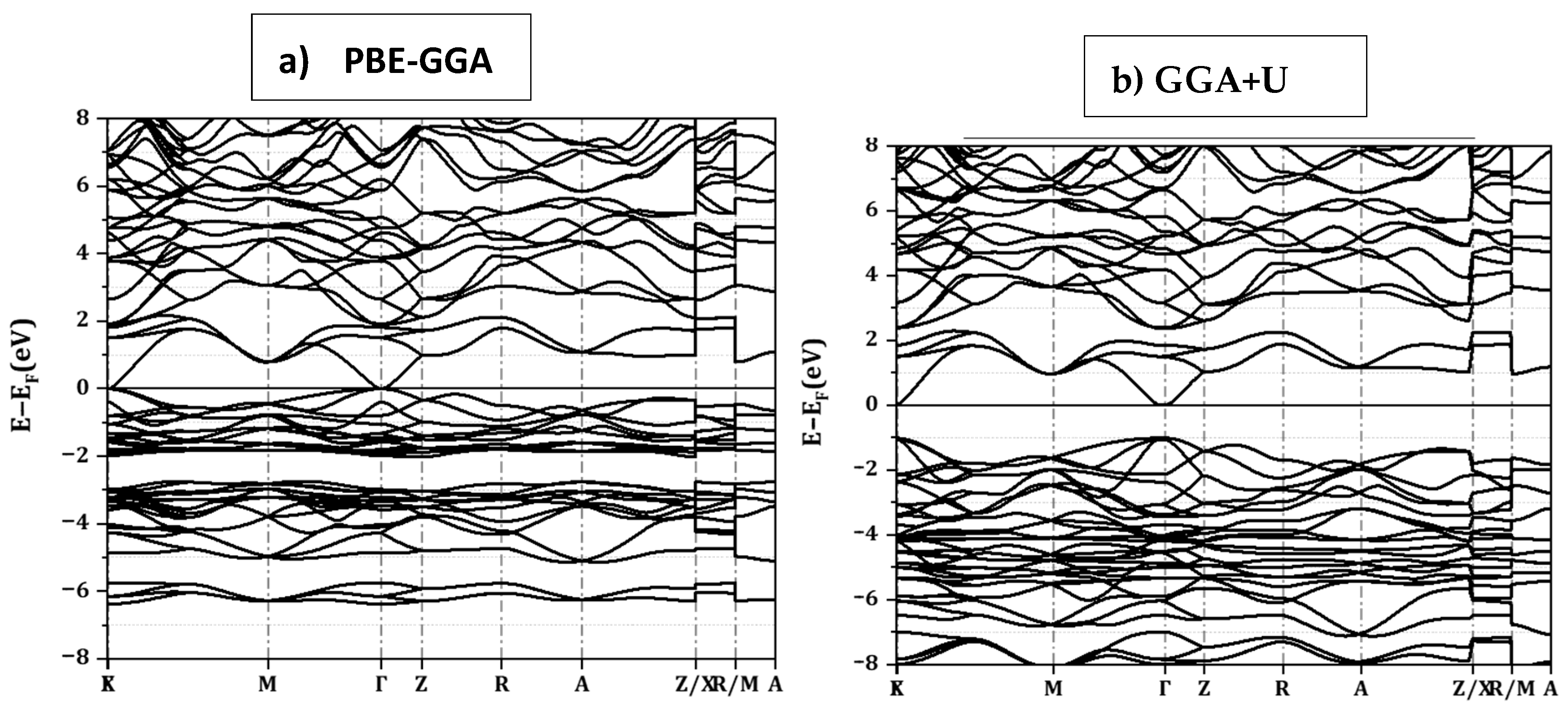
Using the results obtained from the structural optimization, we calculate the band structure and the density of states of CuInSe2 with a dense k mesh grid of 24 × 24 × 12 along the first Brillouin zone using the PBE-GGA exchange correlation functional. Figure 4 shows the band structure of CuInSe2 along the high-symmetry points in the first Brillouin zone. It clearly shows in Figure 4a the metallic character because the conduction and valence bands cross the Fermi level. This prediction contradicts the experimental behavior in which CuInSe2 chalcopyrite is a semiconductor, and GGA underestimates the band gap.
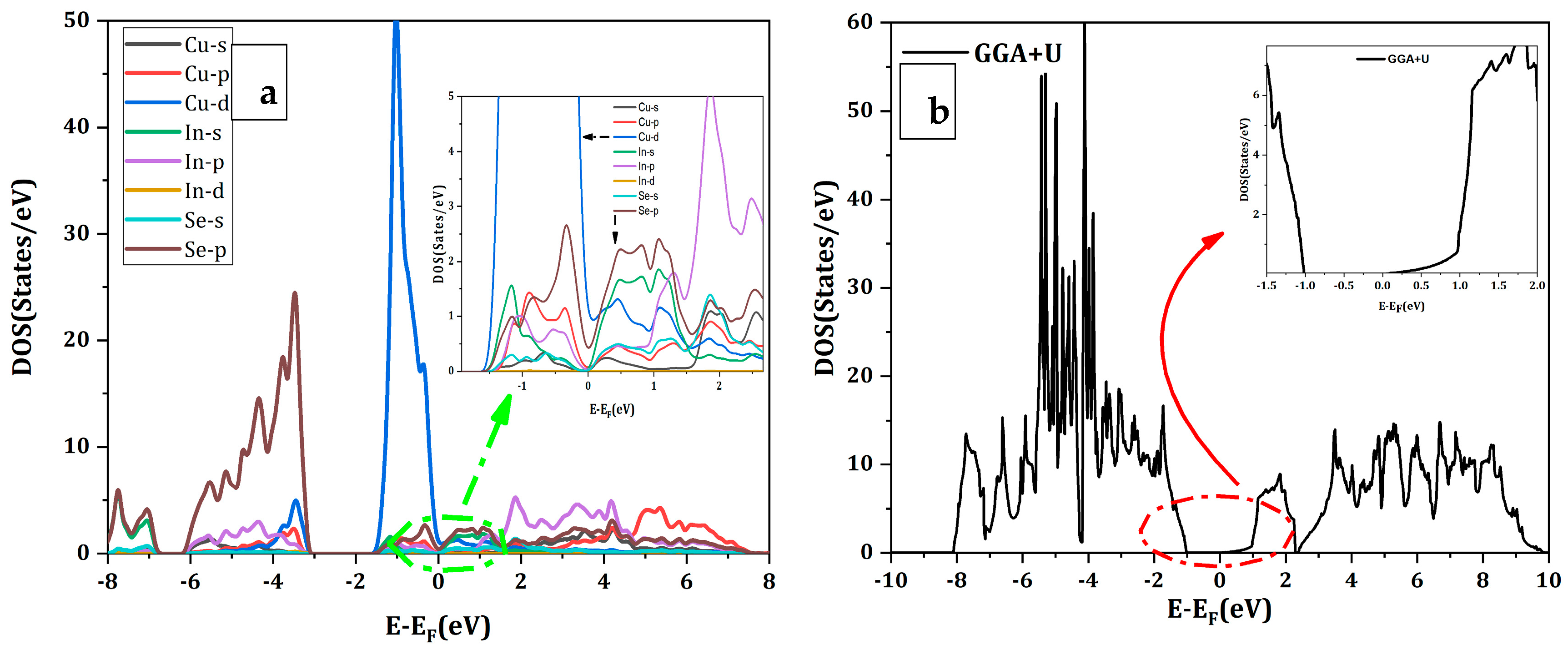
Moreover, to determine the contribution of each type of electron to the different bands, we calculate the total density of states and the partial density of states of CuInSe2 compounds. Figure 5 illustrates the total and partial density of states of CuInSe2 alloys using PPE-GGA and GGA+U.
As shown in Figure 5a, the conduction band crossing the Fermi level is mainly a mixture of 3d/Cu, and 4p/Se electrons, and the CuInSe2 material possesses a metallic character. This result contradicts the experiment, which is known to be a semiconductor with a band gap close to 1 eV. Therefore, the traditional DFT using GGA or LDA approximation underestimates the gap. Moreover, it is well known that for the oxides and compounds with transition metals (localized d and f electrons), the traditional DFT band gap is underestimated, and in many cases, gives a metallic character, in contradiction with experimental semiconductor behavior or even insulators (Mott insulator) [46,47]. To overcome this problem, we use the hybrid functional, modified Becke and Johnson (mBJ) method [12,48,49], or GGA+U, depending on the code. The last method is widely used due to its simple implementation on the majority of DFT codes, and it requires slightly computationally heavier calculations than the standard DFT method [47,50]. The materials strongly correlated are predicted theoretically to be conductive, while showing an insulating behavior experimentally. This fact was discovered by Sir Nevil Mott and is known as Mott insulators [46]. In these materials, band gaps exist between sub-orbitals of the same orbitals, such as p, d, and f electrons. A repulsive Coulomb term that describes the localized orbitals is added to the Hamiltonian of the system. The Hubbard model easily describes this Hamiltonian and takes into account the repulsion of electrons on the same orbitals, and can explain the transition between the conductive and insulating characters of these correlated systems [51]. Practically, in computational codes, DFT+U is applicable for localized orbitals, such as d, f orbitals, and even for p states [52,53]. In this approach, the localized states (p, d, and f) are close to the Fermi energy; therefore, we add the U in the Kohn-Sham equation to push these states away from the Fermi level and to open the gap. The value of correction U is determined by the first principles method or is inspected empirically when seeking an agreement between the experimental and theoretical band structure.

3.4. Band Structure and Densities of States of CuIn1−xGaxSe2 Compounds Using GGA+U

To correct the gaps of CuIn1−xGaxSe2 compounds for the different compounds, we use GGA+U implemented in the Quantum Espresso code. In this approach, in addition to the correlated d electrons of copper, indium, and gallium atoms, we add the effect of p electrons of the selenium element in the Kohn-Sham equation. The values of Hubbard corrections related to d states ( U d C u , U d I n , U d G a ) , and p states ( U p S e ) of selenium atom are reported in Table 4. In our work, we vary the value of U p S e until an agreement between the experimental and theoretical band gap is obtained.
The calculated band structure of CuInSe2 using the GGA+U is displayed in Figure 4b. CuInSe2 chalcopyrite behaves as a semiconductor with a direct band gap of around 1.04 eV. Therefore, the GGA+U enhances the band structure and switches the CuInSe2 character from metal to semiconductor. The bandgap value agrees well with other theoretical work using a hybrid functional implemented in the CASTEP code and experimental data [18,38].
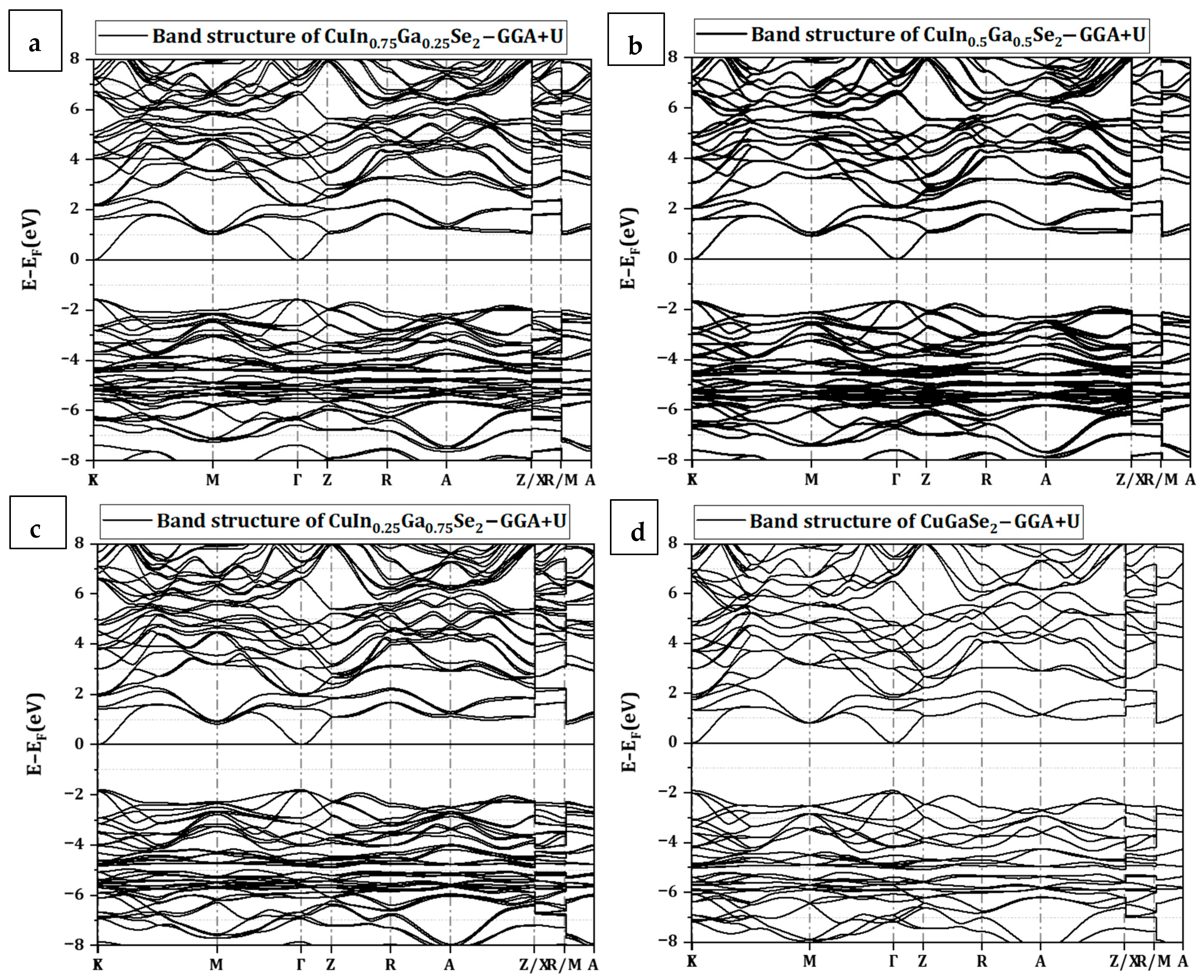
We compute the total density of states of the CuInSe2 compound using GGA+U. As shown in Figure 5b, the band structure of CuInSe2 is equal to 1.04 eV. The band structures of CuInxGa1−xSe2 alloys for the different compositions of gallium (x = 0.25, 0.5, 0.75, 1) are illustrated in Figure 6. As shown, the band gap is a direct gap varying with the gallium composition. The values of the band gaps for the five gallium compositions in our work and other theoretical and available experimental data are given in Table 5.
Our values obtained by GGA +U agree well with the experimental data and also with the theoretical results of Xu-Dong Chen et al., using the hybrid exchange correlation functional, and are much more accurate than the traditional DFT. The theoretical band gap of CuGaSe2 is 1.88 eV, obtained with an accuracy of 13% larger compared to the experimental value of 1.67 eV. This difference may be explained by the fact that GGA+U does not include the phonon scattering in the band structure calculation. Overall, by using GGA+U, by introducing the Hubbard correction related to 4p/Se electrons, we succeed in improving the band gaps, and our work aligns with the experimental data.
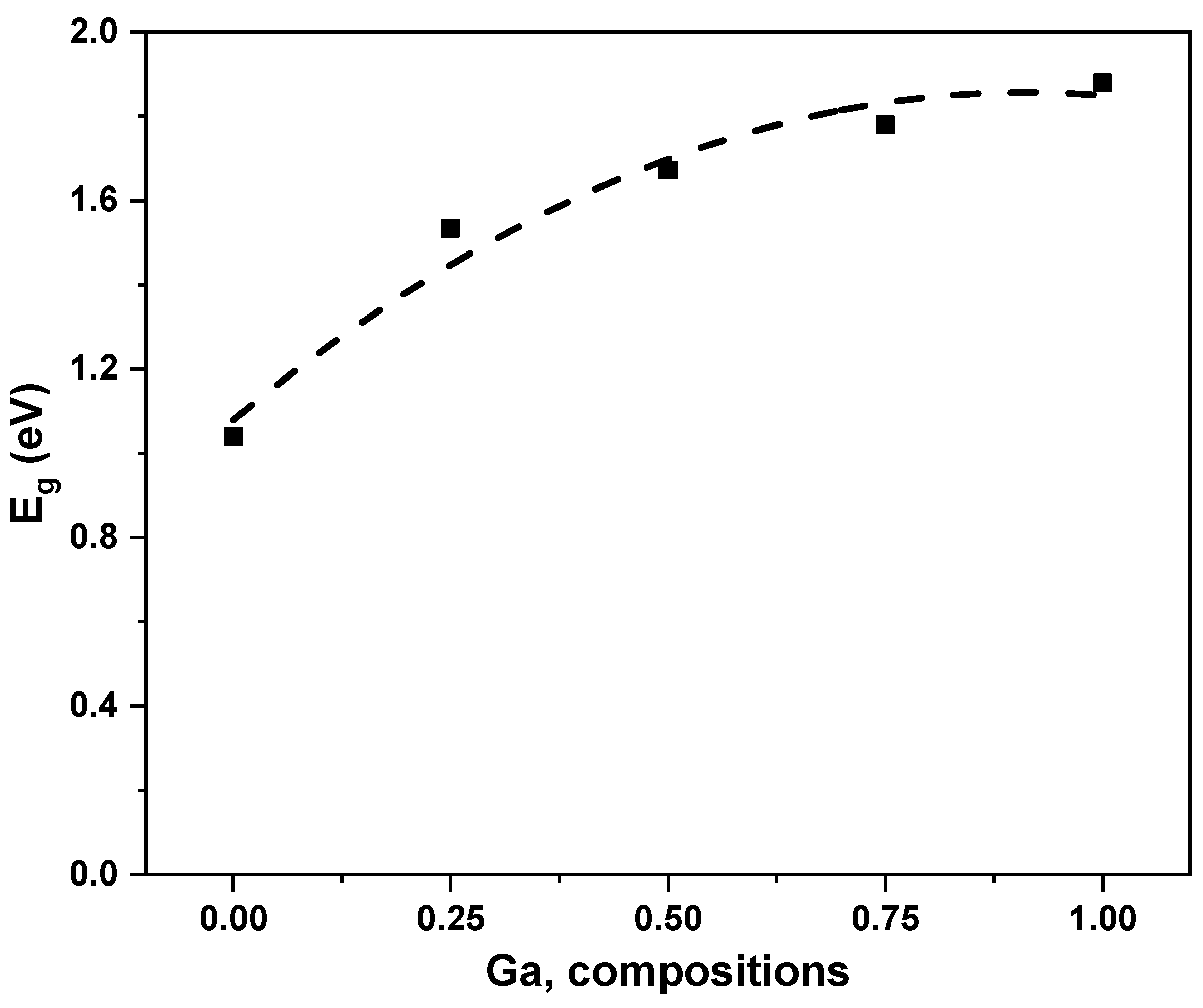
Next, we study the evolution of the band gap versus the composition, as shown in Figure 7. It increases with the Ga compositions, and the dependence is nonlinear. We explore this evolution by fitting the band gap with a quadratic polynomial using the bowing parameter b according to the equation [60,61]:
E g x = 1 x . E g , C u I n S e 2 + x . E g , C u G a S e 2 + b . x . ( 1 x )  
The bowing coefficient depends on the experimental technique of the growth of CIGS compounds. We obtain a bowing gap value of b varying in the range from 0.40 to 1.03 eV. For small compositions, the band gap increases with Ga composition. As the concentration of gallium increases in the CIGS matrix, the quadratic bowing is positive, and the band gap does not increase. The nonlinear variation in the band gap versus the gallium composition is due to the electronegativity difference between the mixed cation (In, Ga) in chalacopyrate, as evaluated theoretically by Tinoco et al. [62]. The band gap bowing evolution in Cu(In, Ga)Se2 chalcopyrite is more complicated because it is due to the variation in lattice constants, structural relaxation, charge distributions between cations, and strong interactions between the different atoms in CuInxGa1−xSe2 alloys. Experimentally, a measured bowing coefficient of Cu(In, Ga)Se2 varying from −0.07 to 0.24 eV depending on the growth method and the structure type (single-polycrystalline) [63]. Theoretically, S. H. Wei et al., using the first-principles band-structure theory, obtained a bowing coefficient of 0.21 eV. The DFT calculation of the bowing gap of CuIn1−xGaxSe2 is very complicated due to the parameters affecting the band structure, the difference in the electronegativity of cations (In, Ga), the lattice distortion, and the exchange correlation functional.
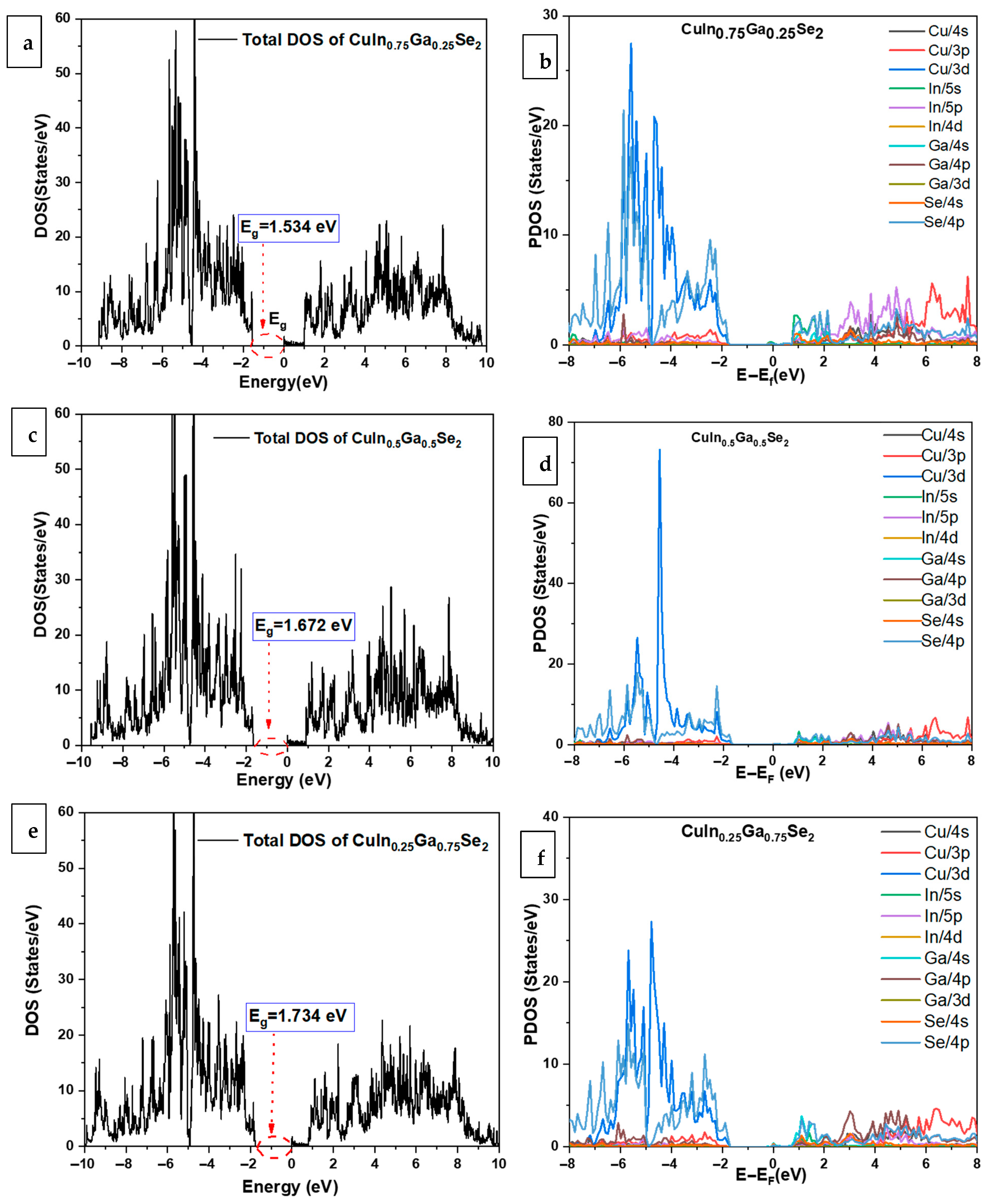
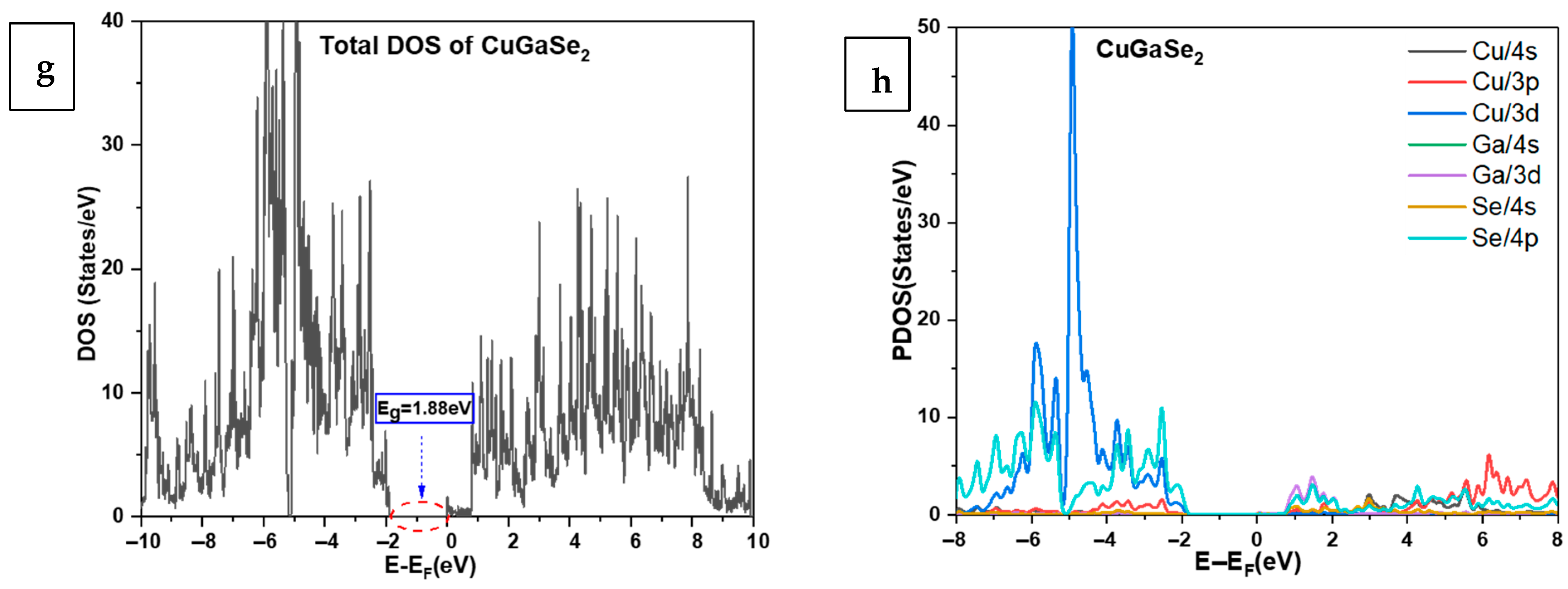
In addition, we calculate the total density of states to confirm the values of band gaps and the contribution of each orbital for the CuGaSe2 compound. As shown in Figure 8a–g, a good agreement between the band structure and density of states was observed. Therefore, the use of GGA+U deeply affects the hybridization of the electrons close to the Fermi level and introduces a band gap, showing the semiconductor of CIGS chalcopyrite. We also conduct the partial density of states for the different gallium compositions. For the Cu0.75Ga0.25 Se2 compound, as shown in Figure 8b, the upper valence band is mainly a mixture of Se/4p, Cu/3d, and Cu/4s electrons, and the conduction band is composed of In/5s, Se/4p, and Cu/3p orbitals. By substitutions of 2 atoms of gallium in the CuInSe2 matrix, the conduction band is always controlled by Se/4p, Cu/3d, and Cu/4s electrons, and the conduction band is a mixture of In/5s, Cu/3p, and Ga/4s orbitals. As the concentration of gallium increases in the CIGS compound, the contributions of Ga/4s electrons increase in the conduction band, and the In/5s electrons decrease, as shown in Figure 8b,d,f.
We also compute the DOS and PDOS of the CuGaSe2 compound. As illustrated in Figure 8g,h, the gap energy is close to 1.88 eV, consistent with the band structure. The upper valence band is around 2.5 eV, mainly due to the hybridization of Cu/3d, Se/4p, and Cu/3p electrons. The conduction band above the Fermi level is a mixture of Se/4p and Ga/4s, and Se/4s electrons. In summary, the band structure, DOS, and PDOS of CIGS chalcopyrite were investigated under the framework of GGA+U by the introduction of a new term related to the localized p electrons of the selenium atom, in addition to the localized d electrons of copper, indium, and gallium atoms, which enhances the band gaps. The obtained results are more accurate compared to traditional LDA and GGA methods, and comparable to the expensive hybrid functional. Also, our work agrees well with other theoretical calculations and experimental results.

3.5. Charge Redistribution Analysis

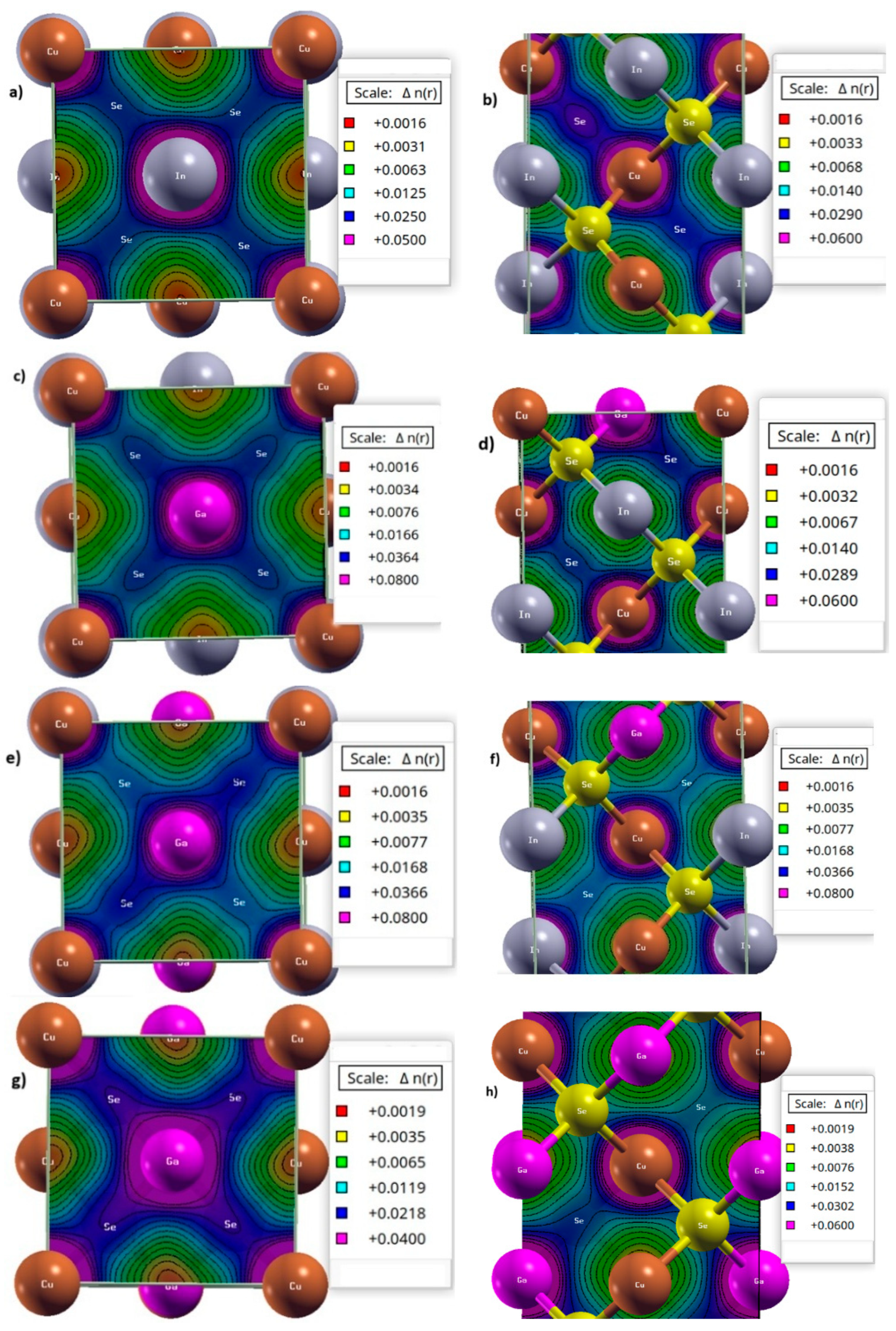
In this section, we analyze the charge density distribution and the nature of bonding with increasing gallium in the CuInSe2 matrix. For that, we computed the differential charge-density Δn(r) for the pristine and Ga-doped CuInSe2 compounds. In the pure CuInSe2 compound, as shown in Figure 9a,b, the Δn(r) scale indicates a significant charge accumulation around the selenium atoms and depletion from copper and indium atoms, inducing a strong ionic character of the bond. In addition, the charge accumulations in the regions between atoms of indium and copper and selenium neighbors provide evidence of a stronger covalent character. Therefore, CuInSe2 possesses a mixture of covalent and ionic bonds, which align with the experimental results [64].
When one Ga atom is substituted, the differential charge density sketched in Figure 9c,d, indicates a covalent character Ga-Se due to the accumulation of charge density between them, and charge depletion regions around the metallic atoms of copper and gallium. Therefore, a transfer of electrons to the selenium due to its electronegative behavior signifies the ionic bonds and the mixture of covalent-ionic characters in the CuIn0.75Ga0.25Se2 compound. The Ga doping significantly affects the bonds due to the smaller ionic radius of gallium compared to indium, resulting in shorter bonds with selenium. Additionally, gallium is slightly more electronegative, which pulls electrons into the bonding region.
For the other compositions, Figure 9e–h, the charge difference scale shows a dominant covalent bonding between gallium atoms and their neighbors, Se, as well as the presence of ionic character due to the transfer of electrons from the cores of (Cu, Ga) to the bonding region around the selenium. These redistributions of charges by doping align well with our results of structural, electronic properties, and elastic constants.

4. Phonon Dispersion of CuIn1−xGaxSe2 Alloys

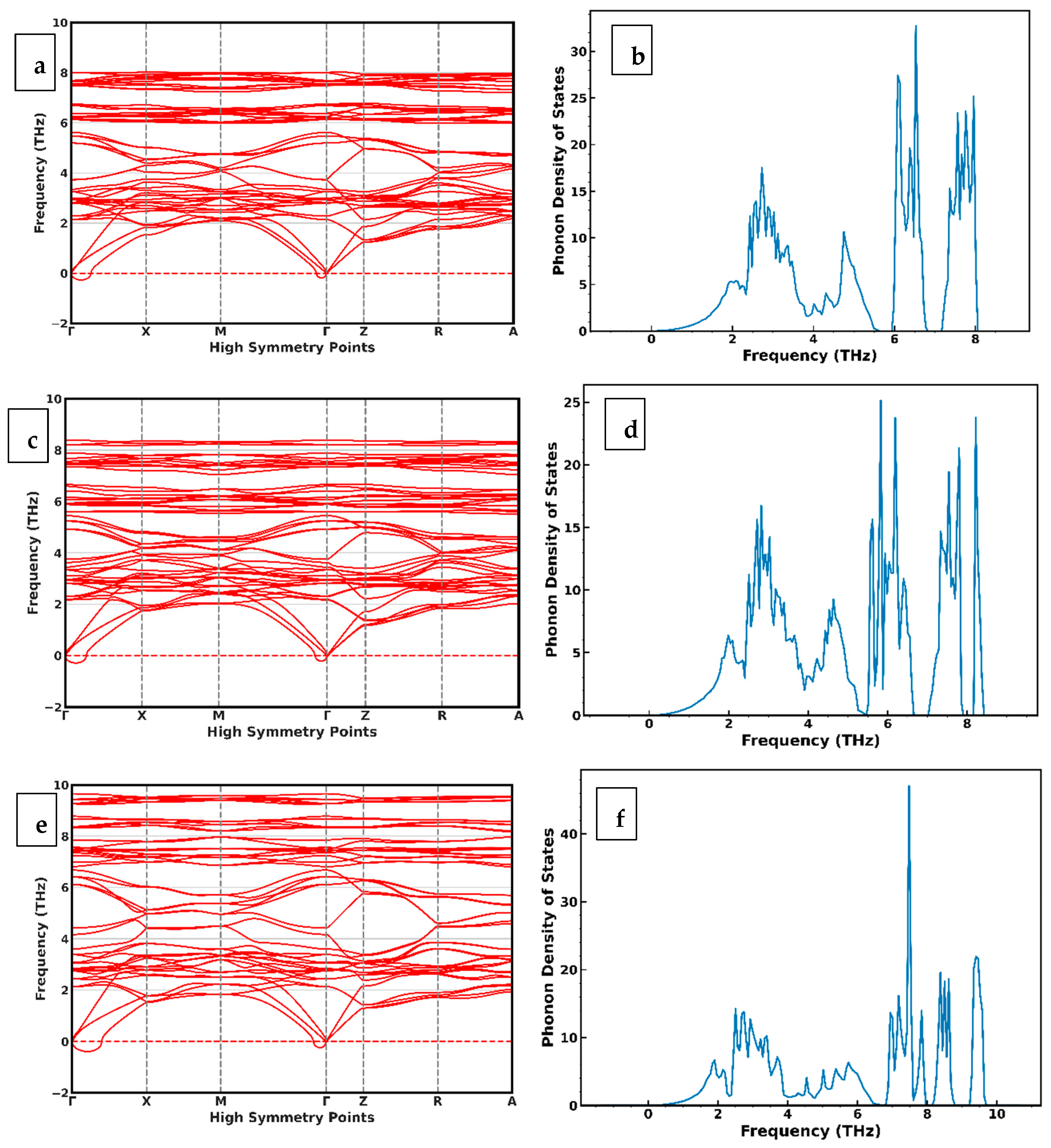
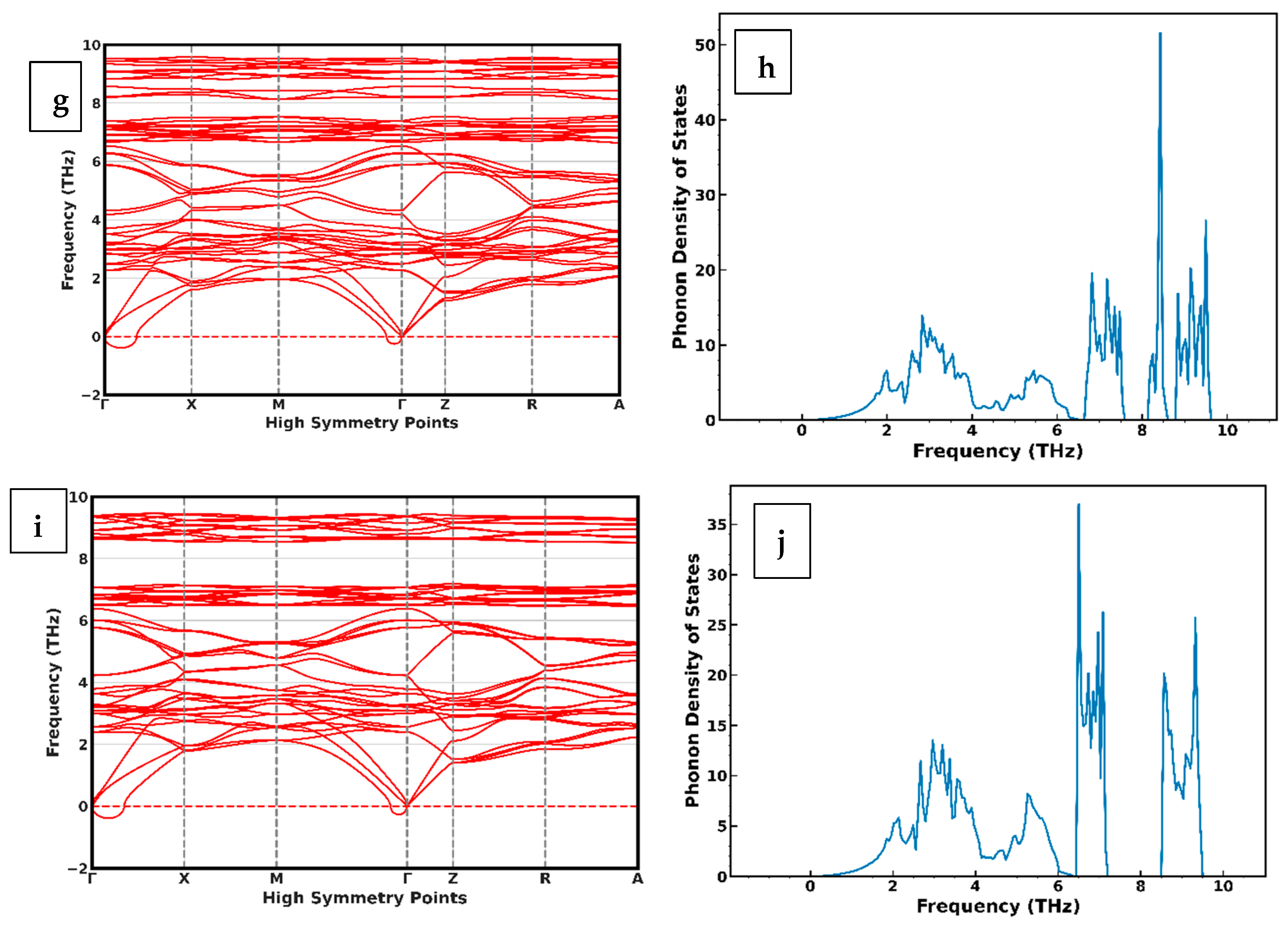
In addition to the investigations of the total energy curve, the formation energy, and the verification of the criteria of mechanical stability based on Born-Huang criteria under small deformations for the different alloys C u I n 1 x G a x S e 2 , we analyze their thermodynamic stability based on the phonon dispersion curves in the first Brillouin zone [65]. The phonon spectra sketched in Figure 10a,c,e,g,i for the five gallium compositions show real and positive phonon frequencies for the different phonon directions at points (X, M, Z, R, A), confirming that our compounds are stable against specific vibrational modes. The spectra also show very small negative frequencies of a single phonon at one end of the symmetry direction, which terminates at the point Γ, and may be due to the small size of the unit cell used in the phonon calculations. The phonon dispersion curves demonstrate three acoustic branches at long wavelengths at the Γ point center of the Brillouin zone, and 45 optical branches at higher frequencies. As shown, the maximum of the phonon dispersion curves shifts to higher frequencies, which proves the increase in the stiffness of structures with the gallium compositions. This result aligns well with the elastic constants and charge analysis discussed earlier. Moreover, we study the electron-phonon interaction by computing the phonon density of states [66]. As shown in Figure 10b,d,f,h,j, the lattice dynamics present prominent peaks in these spectra progressively shift to higher energies as the composition of gallium increases, leading to stiffening of C u I n 1 x G a x S e 2 lattice.

5. Conclusions

In summary, in this work, we have conducted the structural, thermodynamic, and mechanical stability, and the optoelectronic properties of CuIn1−xGaxSe2 compounds for the different gallium compositions under the framework GGA plus Hubbard corrections. The lattice constants decrease with the gallium composition following Vegard’s law. The thermodynamic stability is verified, and the formation energies are negative for the five CuIn1−xGaxSe2 structures. The analysis of structural stability reveals that the tetragonal structures   C u n 1 x G a x S e 2 are mechanically stable and satisfy Born-Huang criteria. The phonon dispersion curves prove the thermodynamic stability of C u I n 1 x G a x S e 2 alloys.
The study of elastic constants C i j , the bulk modulus (B), shear modulus (G), Young’s modulus (E), Poisson ratio (p), Pugh’s ratio (r), the average Debye speed ( v ), and the Debye temperature ( Θ D ) by the Thermo_pw code confirmed the stiffness, the lower compressibility, the ductile behavior, the higher Debye temperature, and the sound velocity for the different C u I n 1 x G a x S e 2 compositions.
The band structure of CIGS obtained by GGA plus Hubbard corrections of d localized and 4p/Se electrons is consistent with experimental data, and other theoretical work using hybrid functional. The band gaps of C u I n 1 x G a x S e 2 increase with the gallium amount from 1.04 eV for CuInSe2 to 1.88 eV for CuGaSe2. According to the analysis of the PDOS of CIGS compounds, the conduction band is mainly a mixture of Ga/4s and Se/4p orbitals, and the valence band consists of the hybridization of Cu/3d and Se/4p electrons. The 4p orbitals of selenium contribute deeply to both the valence and conduction bands of C I n 1 x G a x S e 2 , and play a crucial role in the band gap correction by adding Hubbard corrections related to 4p/Se in the Kohan Sham equation. This work can open the door for profiling the CIGS band gaps in solar cell applications and is also useful for further experimental investigations.

Author Contributions

Conceptualization, M.G. and F.H.; Software, M.G.; Validation, O.H.A. and M.G.; Formal analysis, H.S.A. and N.A.A.-S.; Investigation, M.G., F.H. and O.H.A.; Resources, M.G.; Data curation, F.H., T.T. and M.F.A.; Writing—original draft, M.G. and O.H.A.; Writing—review and editing T.T., N.A.A.-S. and M.F.A.; Visualization, H.S.A.; Supervision, M.G. and F.H.; Funding acquisition, F.H. All authors have read and agreed to the published version of the manuscript.

Funding

This research has been funded by Scientific Research Deanship at University of Ha’il-Saudi Arabia through project number RG-25 053.

Data Availability Statement

The original contributions presented in this study are included in the article. Further inquiries can be directed to the corresponding author.

Acknowledgments

This research has been funded by Research Deanship at University of Ha’il-Saudi Arabia through Project Number RG-25 053. The authors thank Scientific Research Deanship at University of Ha’il-Saudi Arabia for funding this research project.

Conflicts of Interest

The authors declare no conflicts of interest.

References

  1. Pekez, J.; Radovanovc, L.; Desnica, E.; Lambic, M. The increase of exploitability of renewable energy sources. Energy Sources Part B Econ. Plan. Policy 2016, 11, 51–57. [Google Scholar]
  2. Lee, T.D.; Ebong, A.U. A review of thin film solar cell technologies and challenges. Renew. Sustain. Energy Rev. 2017, 70, 1286–1297. [Google Scholar] [CrossRef]
  3. Ying, M.; Wen, J.; Zhao, Y. Numerical simulation of CuInSe2 solar cells using wxAMPS software. Chin. J. Phys. 2022, 76, 24–34. [Google Scholar]
  4. Ramanujam, J.; Singh, U.P. Copper indium gallium selenide based solar cells—A review. Energy Environ. Sci. 2017, 10, 1306–1319. [Google Scholar]
  5. Jackson, P.; Hariskos, D.; Lotter, E.; Paetel, S.; Wuerz, R.; Menner, R. New world record efficiency for Cu(In, Ga)Se2 thin-film solar cells beyond 20%. Prog. Photovolt. Res. Appl. 2011, 19, 894–897. [Google Scholar]
  6. Wada, T.; Maeda, T. Characteristics of chemical bonds in CuInSe2 and its thin film deposition processes used to fabricate solar cells. Jpn. J. Appl. Phys. 2011, 50, 05FA02. [Google Scholar]
  7. Shay, J.L.; Tell, B.; Kasper, H.M.; Schiavone, L.M. p−d Hybridization of the Valence Bands of I-III-VI2 Compounds. Phys. Rev. B 1972, 5, 5003. [Google Scholar]
  8. Shay, J.L.; Tell, B.; Kasper, H.M.; Schiavone, L.M. Electronic Structure of AgInSe2 and CuInSe2. Phys. Rev. B 1973, 7, 4485. [Google Scholar]
  9. Jaffe, J.E.; Zunger, A. Theory of the band-gap anomaly in ABC2 chalcopyrite semiconductors. Phys. Rev. B 1984, 29, 1882. [Google Scholar]
  10. Alberts, V.; Herberholz, R.; Walter, T.; Schock, H.W. Device characteristics of In-rich CuInSe2-based solar cells. J. Phys. D. Appl. Phys. 1997, 30, 2156–2162. [Google Scholar]
  11. Regmi, G.; Ashok, A.; Chawla, P.; Semalti, P.; Velumani, S.; Sharma, S.N.; Castaneda, H. Perspectives of chalcopyrite-based CIGSe thin-film solar cell: A review. J. Mater. Sci. Mater. Electron. 2020, 31, 7286–7314. [Google Scholar]
  12. Tran, F.; Blaha, P. Accurate Band Gaps of Semiconductors and Insulators with a Semilocal Exchange-Correlation Potential. Phys. Rev. Lett. 2009, 102, 226401. [Google Scholar] [CrossRef] [PubMed]
  13. Kim, S.; Lee, M.; Hong, C.; Yoon, Y.; An, H.; Lee, D.; Jeong, W.; Yoo, D.; Kang, Y.; Youn, Y. A band-gap database for semiconducting inorganic materials calculated with hybrid functional. Sci. Data 2020, 7, 387. [Google Scholar] [CrossRef] [PubMed]
  14. Chen, R.; Persson, C. Band structure and optical properties of CuInSe2. Adv. Mater. Res. 2014, 894, 254–258. [Google Scholar] [CrossRef]
  15. Hadjab, M.; Ibrir, M.; Berrah, S.; Abid, H.; Saeed, M.A. Structural, electronic and optical properties for chalcopyrite semiconducting materials: Ab-initio computational study. Opt.-Int. J. Light Electron Opt. 2018, 169, 69–76. [Google Scholar]
  16. Wang, C.; Li, X.; Wang, Y. First-principles Calculations on Electronic and Elastic Properties of CuInS2 and CuInSe2 at Ambient Pressure. In Proceedings of the 7th International Conference on Management, Education, Information and Control (MEICI 2017), Shenyang, China, 15–17 September 2017. [Google Scholar]
  17. Amudhavalli, A.; Rajeswarapalanichamy, R.; Padmavathy, R.; Manikandan, M.; Santhosh, M.; Iyakutti, K. Electronic structure, elastic, optical and thermal properties of chalcopyrite CuBY2 (B = In, Ga, In0.5 Ga0.5; Y = S, Se, Te) solar cell compounds. Mater. Today Commun. 2021, 26, 101790. [Google Scholar] [CrossRef]
  18. Chen, X.D.; Chen, L.; Sun, Q.Q.; Zhou, P.; Zhang, D.W. Hybrid density functional theory study of Cu(In1−xGax)Se2 band structure for solar cell application. AIP Adv. 2014, 4, 087118. [Google Scholar]
  19. Belhadj, M.; Tadjer, A.; Abbar, B.; Bousahla, Z.; Bouhafs, B.; Aourag, H. Structural, electronic and optical calculations of Cu(In,Ga)Se2 ternary chalcopyrites. Phys. Status Solidi 2004, 241, 2516. [Google Scholar]
  20. Soni, A.; Gupta, V.; Arora, C.M.; Dashora, A.; Ahuja, B.L. Ahuja: Electronic structure and optical properties of CuGaS2 and CuInS2 solar materials. Sol. Energy 2010, 84, 1481. [Google Scholar]
  21. Brik, M.G. Electronic, optical, and elastic properties of CuXS2 (X = Al, Ga, In) and AgGaS2 semiconductors from first principles calculations. Phys. Status Solidi C 2011, 8, 2582–2584. [Google Scholar]
  22. Aguilera, I.; Vidal, J.; Wahnon, P.; Reining, L.; Botti, S. First-principles study of the band structure and optical absorption of CuGaS2. Phys. Rev. B 2011, 84, 085145. [Google Scholar]
  23. Ghosh, A.; Thangavel, R.; Rajagopalan, M. Electronic and optical modeling of solar cell compound CuXY2 (X = In, Ga; Y = S, Se, Te), first-principles study via Tran-Blaha modified Becke-Johnson exchange potential approach. J. Mater. Sci. 2015, 50, 1710. [Google Scholar]
  24. Giannozzi, P.; Baroni, S.; Bonini, N.; Calandra, M.; Car, R.; Cavazzoni, C.; Ceresoli, D.; Chiarotti, D.L.; Cococcioni, M.; Dabo, I.; et al. QUANTUM ESPRESSO: A Modular and Open-Source Software Project for Quantum Simulations of Materials. J. Phys. Condens. Matter 2009, 21, 395502. [Google Scholar] [PubMed]
  25. Jaffe, J.E.; Zunger, A. Electronic structure of the ternary chalcopyrite semiconductors CuAls2, CuGaS2, CuInS2, CuAlSe2, CuGaSe2, and CuInSe2. Phys. Rev. B 1983, 28, 5822–5847. [Google Scholar]
  26. Martin, R.M.; Structure, E. Basic Theory and Practical Methods; Cambridge University Press: Cambridge, UK, 2004. [Google Scholar]
  27. Perdew, J.P.; Wang, Y. Accurate and simple analytic representation of the electron-gas correlation energy. Phys. Rev. B 1992, 45, 13244. [Google Scholar] [CrossRef]
  28. Gandouzi, M.; Alshammari, A.S.; Bouzidi, M.; Khan, Z.R.; Mohamed, M.; Nasrallah, T.B. DFT study of structural optoelectronic and thermoelectric properties of CuNiO ferromagnetic alloys. Phys. Scr. 2023, 98, 075936. [Google Scholar]
  29. Dal Corso, A. Elastic constants of beryllium: A first-principles investigation. J. Phys. Condens. Matter 2016, 28, 075401. [Google Scholar]
  30. Malica, C.; Dal Corso, A. Quasi-harmonic temperature dependent elastic constants: Applications to Silicon, Aluminum, and Silver. J. Phys. Condens. Matter 2020, 32, 315902. [Google Scholar]
  31. Murnaghan, F.D. The compressibility of media under extreme pressures. Proc. Natl. Acad. Sci. USA 1944, 30, 244–247. [Google Scholar]
  32. Vegard, L. The constitution of mixed crystals and the space occupied by atoms. Z. Für Phys. 1921, 5, 17–26. [Google Scholar]
  33. Sharma, S.; Verma, A.S.; Bhandari, R.; Jindal, V.K. Ab initio studies of structural, elastic and thermal properties of copper indium dichalcogenides (CuInX2: X = S, Se, Te). Comput. Mater. Sci. 2014, 86, 108–117. [Google Scholar]
  34. Domain, C.; Laribi, S.; Taunier, S.; Guillemoles, J.F. Ab initio calculation of intrinsic point defects in CuInSe2. J. Phys. Chem. Solids 2003, 64, 1657–1663. [Google Scholar] [CrossRef]
  35. Pluengphon, P.; Bovornratanaraks, T.; Vannarat, S.; Yoode, K.; Ruffolo, D.; Pinsook, U. Ab initio calculation of high pressure phases and electronic properties of CuInSe2. Solid State Commun. 2012, 152, 775–778. [Google Scholar] [CrossRef]
  36. Chandramohana, M.; Velumani, S.; Venkatachalam, T. Band structure calculations of Cu(In1−xGax)Se2. Mater. Sci. Eng. B 2010, 174, 200–204. [Google Scholar] [CrossRef]
  37. Venkatachalam, M.; Kannan, M.D.; Jayakumar, S.; Balasundaraprabhu, R.; Muthukumarasamy, N.; Nandakumar, A.K. CuInxGa1-xSe2 thin films prepared by electron beam evaporation. Sol. Energy Mater. Sol. Cells 2008, 92, 517–575. [Google Scholar]
  38. Shirakata, S.; Chichibu, S.; Isomura, S. Room-Temperature Photoreflectance of CuAlxGa1-xSe2 Alloys. Jpn. J. Appl. Phys. 1997, 36, 7160–7161. [Google Scholar]
  39. Łazewski, J.; Neumann, H.; Jochym, P.T.; Parlinski, K. Ab initio elasticity of chalcopyrites. J. Appl. Phys. 2003, 93, 3789–3794. [Google Scholar] [CrossRef]
  40. Verma, A.S.; Sharma, S.; Bhandari, R.; Srkar, B.K.; Jindal, V.K. Elastic properties of chalcopyrite structured solids. Mat. Chem. Phys. 2012, 132, 416–420. [Google Scholar]
  41. Shannon, R.D. Revised effective ionic radii and systematic studies of interatomic distances in halides and chalcogenides. Found. Crystallogr. 1976, 32, 751–767. [Google Scholar]
  42. Kim, K.; Zhou, B.-C.; Wolverton, C. First-principles study of crystal structure and stability of T1 precipitates in Al-Li-Cu alloys. Acta Mater. 2018, 145, 337–346. [Google Scholar]
  43. Mouhat, F.; Coudert, F.X. Necessary and Sufficient Elastic Stability Conditions in Various Crystal Systems. Phys. Rev. B 2014, 90, 224104. [Google Scholar] [CrossRef]
  44. Hill, R. The elastic behavior of a crystalline aggregate. Proc. Phys. Soc. A 1952, 65, 349. [Google Scholar]
  45. Yang, J.-W.; An, L. First-principles determination of pressure-induced structure, anisotropic elasticity and ideal strengths of CuInS2 and CuInSe2. Solid State Commun. 2020, 316–317, 113952. [Google Scholar]
  46. Himmetoglu, B.; Floris, A.; De Gironcoli, S.; Cococcioni, M. Hubbard-corrected DFT energy functionals: The LDA+U description of correlated systems. Int. J. Quantum Chem. 2014, 114, 14–49. [Google Scholar]
  47. Cococcioni, M. The LDA+U approach: A simple Hubbard correction for correlated ground states. Correl. Electrons Models Mater. Model. Simul. 2012, 2. Available online: https://www.cond-mat.de/events/correl12/manuscripts/cococcioni.pdf (accessed on 12 November 2025).
  48. Gandouzi, M.; Alshammari, A.S.; Khan, Z.R.; Bouzidi, M. DFT study of the structural and optoelectronic properties of Cd1−xAgxS half metallic alloys. Mater. Sci. Semicond. Process. 2021, 129, 105794. [Google Scholar]
  49. Gandouzi, M.; Khan, Z.R.; Alshammari, A.S. Theoretical and experimental investigations of the structural and optoelectronic properties of Zn1−xCdxO alloys. Comput. Mater. Sci. 2019, 156, 346–353. [Google Scholar]
  50. Gandouzi, M.; Alshammary, H.; Khan, Z.R.; Alshammari, A.S.; Hedhili, F. Experimental and DFT studies of structural and optoelectronic properties of CdS, Zn doped CdS, and (Zn-Ni) co-doping CdS nanomaterials. Phys. Scr. 2024, 99, 065935. [Google Scholar]
  51. Bruus, H.; Flensberg, K. Introduction to Many-Body Quantum Theory in Condensed Matter Physics; Oxford University Press: Oxford, UK, 2002; pp. 152–182. [Google Scholar]
  52. Huang, X.; Ramadugu, S.K.; Maso, S.E. Surface-Specific DFT + U Approach Applied to α-Fe2O3(0001). J. Phys. Chem. C 2016, 120, 9. [Google Scholar]
  53. Knotek, M.L.; Feibelman, P.J. Ion Desorption by Core-Hole Auger Decay. Phys. Rev. Lett. 1978, 40, 964–967. [Google Scholar] [CrossRef]
  54. Wang, L.; Maxisch, T.; Ceder, G. Oxidation energies of transition metal oxides within the GGA+U framework. Phys. Rev. B 2006, 73, 195107. [Google Scholar] [CrossRef]
  55. Mann, G.W.; Lee, K.; Cococcioni, M.; Smit, B.; Neaton, J.B. First-principles Hubbard U approach for small molecule binding in metal-organic frameworks. J. Chem. Phys. 2016, 144, 174104. [Google Scholar] [PubMed]
  56. Erhart, P.; Albe, K.; Klein, A. First-principles study of intrinsic point defects in ZnO: Role of band structure, volume relaxation, and finite-size effects. Phys. Rev. B 2006, 73, 205203. [Google Scholar]
  57. Janotti, A.; Segev, D.; de Walle, C.G.V. Effects of cation d states on the structural and electronic properties of III-nitride and II-oxide wide-band-gap semiconductors. Phys. Rev. B 2006, 74, 045202. [Google Scholar]
  58. Setyawan, W.; Gaume, R.M.; Lam, S.; Feigelson, R.S.; Curtarolo, S. High-Throughput Combinatorial Database of Electronic Band Structures for Inorganic Scintillator Materials. ACS Comb. Sci. 2011, 13, 382–390. [Google Scholar] [CrossRef]
  59. Gloeckler, M.; Sites, J.R. Band-gap grading in Cu(In,Ga)Se2 solar cells. J. Phys. Chem. Solids 2005, 66, 1891–1894. [Google Scholar]
  60. Albin, D.S.; Carapella, J.J.; Tuttle, J.R.; Noufi, R. The effect of copper vacancies on the optical bowing of chalcopyrite Cu(In,Ga)Se2 alloys. Mater. Res. Soc. Symp. Proc. 1992, 228, 267. [Google Scholar]
  61. Bouraoui, A.; Berredjem, Y.; Ain-Souya, A.; Drici, A.; Amara, A.; Kanzari, M.; Akkari, F.C.H.F.A.; Khemiri, N.; Bernede, J.C. Investigation of CuIn1-xGaxSe2 thin films co-evaporated from two metal sources for photovoltaic solar cells. J. Optoelectron. Adv. Mater. 2017, 19, 368–373. [Google Scholar]
  62. Tinoco, T.; Quintero, M.; Rincon, C. Variation of the energy gap with composition in AI BIII C2 VI chalcopyrite-structure alloys. Phys. Rev. B 1991, 44, 1613. [Google Scholar]
  63. Wei, S.-H.; Zunger, A. Band offsets and optical bowings of chalcopyrites and Zn-based II–VI alloys. J. Appl. Phys. 1995, 78, 3846–3856. [Google Scholar]
  64. Parkes, J.; Tomlinson, R.D.; Hampshire, M.J. Crystal data for CuInSe2. J. Appl. Cryst. 1973, 6, 414–416. [Google Scholar]
  65. Giannozzi, P.; de Gironcoli, S.; Pavone, P.; Baroni, S. Ab initio calculation of phonon dispersions in semiconductor. Phys. review. B Condens. Matter 1991, 43, 7231–7242. [Google Scholar]
  66. Kolesnikov, A.I.; Krishnamoorthy, A.; Nomura, K.-I.; Wu, Z.; Abernathy, D.L.; Huq, A.; Granroth, G.E.; Christe, K.O.; Haiges, R.; Kalia, R.K.; et al. Inelastic Neutron Scattering Study of Phonon Density of States of Iodine Oxides and First-Principles Calculations. J. Phys. Chem. Lett. 2023, 14, 10080−10087. [Google Scholar] [CrossRef]
Figure 1. The chalcopyrite CuInSe2 in tetragonal structure: green, red, and blue balls represent Cu, In, and Se, respectively.
Symmetry 18 00025 g001
Figure 2. Variation in the total energy versus the volume for the five CuIn1−xGaxSe2 alloys.
Symmetry 18 00025 g002
Figure 3. (a,b) are the lattice parameters as a function of Ga composition for the lattice parameters a and c, respectively.
Symmetry 18 00025 g003
Figure 4. Band structure of CuInSe2 using: (a) PBE-GGA exchange correlation functional, (b) GGA+U.
Symmetry 18 00025 g004
Figure 5. (a) Partial densities of states using PBE-GGA, and (b) density of states using GGA+U of CuInSe2 compound.
Symmetry 18 00025 g005
Figure 6. Band structures of CuInxGa1−xSe2 compounds using GGA+U.
Symmetry 18 00025 g006
Figure 7. Evolution of Eg of CuInxGa1−xSe2 versus the gallium compositions.
Symmetry 18 00025 g007
Figure 8. DOS and PDOS of CuInxGa1−xSe2 compounds for the five gallium compositions using GGA+U.
Symmetry 18 00025 g008aSymmetry 18 00025 g008b
Figure 9. Differential charge density (Δn(r)) maps for Ga-doped CuInSe2: (a,b) CuInSe2, (c,d) CuIn0.75Ga0.25Se2, (e,f) CuIn0.5Ga0.5Se2, and (g,h) CuGaSe2 compounds.
Symmetry 18 00025 g009
Figure 10. Phonon dispersion curve and Phonon density of states, respectively, for: (a,b) CuInSe2, (c,d) CuIn0.75Ga0.25Se2, (e,f) CuIn0.5Ga0.5Se2, (g,h) CuIn0.25Ga0.75Se2, and (i,j) CuGaSe2 compounds.
Symmetry 18 00025 g010aSymmetry 18 00025 g010b
Table 1. Lattice parameters for CuIn1−xGaxSe2 tetragonal structure: a = b and c are expressed in Angstroms, distortion parameters η = c 2 a , and Bulk modulus B (GPa). a Reference [28], b Reference [36], c Reference [37], d Reference [8], and e Reference [38].
CompoundsLattice Parameters: a = b (Å) − c (Å)Distortion ParametersBulk Modulus
Our WorkExperimental
Work
Other Work η = c 2 a B (GPa)
CuInSe25.869–11.7795.78 d–11.64 d5.82 a–11.76 a1.0034953.75
CuIn0.75Ga0.25Se25.813–11.6875.75 e–5.72 c
11.69 e–11.63 c
5.76 a–5.69 b
11.70 a–11.39 b
1.0053356.042
CuIn0.5Ga0.5Se25.772–11.5655.73 e–11.66 e5.75 a–5.67 b
11.43 a–11.54 b
1.0018756.514
CuIn0.25Ga0.75Se25.716–11.4215.72 e–11.63 e5.96 a–5.61 b
11.31 a–11.39 b
0.998958.750
CuGaSe25.669–11.2585.61 e–11.02 e5.63 a–11.15 a0.992959.160
Table 2. Formation energies of C u I n 1 x G a x S e 2 compounds for the different gallium compositions.
CompoundsFormation Energy (eV/atom)
CuInSe2−1.037
CuIn0.75Ga0.25Se2−1.043
CuIn0.5Ga0.5Se2−1.043
CuIn0.25Ga0.75Se2−0.983
CuGaSe2−1.069
Table 3. Elastic constant C 11 , C 12 , C 13 , C 33 , C 44 , C 66 , bulk Modulus B, shear modulus (G), Young’s modulus E, Poisson’s ratio (p), Pugh’s ratio (r), average Debye speed ( v ) , and Debye Temperature ( Θ D ) for C u I n 1 x G a x S e 2 compounds.
CuInSe2CuIn0.75Ga 0.25Se2CuIn0.5Ga 0.5Se2CuIn0.25Ga 0.75Se2CuGaSe2
C 11 (GPa)71.8675.8178.8182.9284.13
C 12 (GPa)44.8545.4145.9048.4245.62
C 13 (GPa)45.7146.4846.3147.1247.31
C 33 (GPa)70.19674.5277.2580.7783.68
C 44 (GPa)33.6735.3136.5039.1041.29
C 66 (GPa)31.6133.2938.0039.6641.68
B (GPa)53.7556.0456.5158.7559.16
G (GPa)22.6224.5226.5428.2032.30
E(GPa)59.4464.1468.7873.1181.98
p0.3140.3070.2960.2920.269
r2.3762.2852.1292.0831.831
v ( m / s ) 2242.642341.122443.562535.142616.61
Θ D ( K ) 226.95239.18254.80266.57278.63
Table 4. Hubbard values of elements Cu, In, Ga, and Se used in GGA+U [54,55,56,57,58].
ElementU (eV)
Se5.0
Cu10.4 [54,55]
In1.9 [56]
Ga3.9 [57]
Table 5. The calculated band gap of CuInxGa1−xSe2 chalcopyrite using GGA+U, and other theoretical and experimental work.
Band GapCalculated Eg (eV)Other Theoretical Work
[18]
Experimental Eg (eV)
CuInSe21.041.2051.04 [8,59]
CuIn0.75Ga0.25Se21.5341.275--
CuIn0.5Ga0. 5Se21.6721.416--
CuIn0.25Ga0. 75Se21.781.445--
CuGaSe21.881.5681.67 [38,59]
Disclaimer/Publisher’s Note: The statements, opinions and data contained in all publications are solely those of the individual author(s) and contributor(s) and not of MDPI and/or the editor(s). MDPI and/or the editor(s) disclaim responsibility for any injury to people or property resulting from any ideas, methods, instructions or products referred to in the content.