Article

Numerical Analysis of the Relationship Between Vanadium Flow Rate, State of Charge, and Vanadium Ion Uniformity


1
Yantai Research Institute, Harbin Engineering University, Harbin 150001, China
2
School of Advanced Materials and Green Chemical Engineering, Hubei Polytechnic University, Huangshi 435003, China
*
Authors to whom correspondence should be addressed.
Symmetry 2026, 18(1), 24; https://doi.org/10.3390/sym18010024
Submission received: 28 November 2025 / Revised: 13 December 2025 / Accepted: 19 December 2025 / Published: 23 December 2025
(This article belongs to the Section Engineering and Materials)

Abstract

Vanadium redox flow batteries, as a key technology for energy storage systems, have gained application in recent years. Investigating the thermal behavior and performance of these batteries is crucial. This study establishes a three-dimensional model of a vanadium redox flow battery featuring a serpentine flow channel design. By adjusting key battery parameters, changes in ion concentration and uniformity are examined. The model integrates electrochemical, fluid dynamics, and Physico-Chemical Kinetics phenomena. Electrolyte flow velocity and current density are critical parameters. Results indicate that increasing the electrolyte inlet flow velocity leads to convergence in the battery’s charge/discharge cell voltage, VO 2 + / VO 2 + , V 2 + / V 3 + and concentration distribution across the carbon felt and flow channels. Coincidently, the uniformity of vanadium ions across all oxidation states improves. Furthermore, the observed ion uniformity and battery cell voltage are shown to be significantly modulated by the system’s State of Charge, which sets the baseline electrochemical environment for flow rate effects.

1. Introduction

As a novel large-scale energy storage technology, flow batteries are playing an increasingly vital role in the energy sector due to their unique advantages, significantly advancing the achievement of carbon peak targets. Characterized by high safety, extended lifespan, and environmental friendliness, flow batteries stand as one of the preferred technologies for large-scale, long-duration energy storage [1,2].
Flow batteries typically offer energy storage durations exceeding 4 h, with some projects achieving up to 6 h, providing an effective solution to address the intermittency and variability of renewable energy sources. As the proportion of renewable energy sources like wind and solar power continues to grow within the energy mix, flow batteries play a crucial role in facilitating the integration of new energy sources and ensuring the secure and stable operation of power systems.
The long-duration energy storage capability of flow batteries is crucial for building new power systems centered on renewable energy. Within such systems, flow batteries can balance supply and demand, enhance grid flexibility and reliability, thereby supporting higher penetration of renewable energy integration. Furthermore, their extended cycle life enables frequent high-current charging and discharging, granting them significant commercial potential across diverse applications including grid-side, generation-side, and consumer-side scenarios [3].
Finite element analysis plays a crucial role in flow battery research. Through numerical simulation techniques, it models the several physics phenomena within flow batteries—such as flow fields, temperature fields, and electric fields—thereby providing deep insights into the mass transfer, heat transfer characteristics, and electrochemical reaction mechanisms occurring inside the battery [4].
Addressing fundamental scientific issues arising from multi-field coupling within flow batteries, Shah from the University of Southampton, UK, first proposed a two-dimensional transient model in 2008. This model can be used to predict the effects of applied current density, electrode thickness ratio, and local mass transfer coefficient on the performance of vanadium flow batteries [5,6]. Building upon this foundation, in 2009, You Dongjiang and colleagues at the Dalian Institute of Chemical Physics, Chinese Academy of Sciences, investigated the effects of applied current density, electrode porosity, and local mass transfer coefficient on battery performance [7]. In 2015, Lei Yaguo et al. from Xi’an Jiaotong University employed the Daun effect to more accurately simulate ion distribution within the ion exchange membrane, potential changes, and their influence on battery performance. In 2019, Yue Meng et al. from the Dalian Institute of Chemical Physics, Chinese Academy of Sciences, conducted a systematic and in-depth investigation into the impact of compression ratio on polarization and battery performance through a combination of numerical simulation and testing. They experimentally validated the performance advantages of battery modules achieving the optimal compression ratio. These studies focused on constructing and validating Physico-Chemical Kinetics coupling models to reveal the operational mechanisms of key internal components in flow batteries, thereby precisely guiding battery design and performance optimization [8].

2. Model

2.1. Electrochemical Reaction Mechanism and Assumptions

The VRFB consists of a proton exchange membrane, two electrodes separated by the membrane, two current collectors, two pumps for electrolyte circulation, and two tanks for electrolyte storage. VO 2 + / VO 2 + and V 2 + / V 3 + ion pairs represent the negative redox pair and positive redox pair in the VRFB, respectively. During VRFB operation, the electrolyte is first pumped into the flow field and enters the porous electrode via convection and diffusion. The redox reactions involving electron gain and loss within the porous electrode are as follows [9,10,11]:
Negative electrode:
V 2 + charge discharge V 3 + + e
Positive electrode:
VO 2 + + 2 H + + e charge discharge VO 2 + + H 2 O
For computational convenience, the following simplified and reasonable assumptions are made:
(1)
Isothermal conditions apply throughout the entire operating process of the VRFB [12].
(2)
The electrolyte is treated as an incompressible fluid [13].
(3)
Changes in electrolyte volume due to water permeation or resistance to water flow through the membrane are neglected [14].
(4)
Side reactions, including water electrolysis, are neglected [6,15,16].
(5)
Assume the electrolyte is a dilute solution [11].
(6)
Under the action of the pump, the gravitational force exerted on the electrolyte can be neglected [16,17,18].
(7)
Except for hydrogen ions, other ions are considered unable to pass through the ion exchange membrane [19].
(8)
The material properties of the electrodes, electrolyte, and membrane region are uniform [20,21].

2.2. Control Equations and Kinetic Equations

The electrolyte must first pass through the flow channel before being delivered to the electrode. All charged ions i in the flow channel obey the law of mass conservation, which can be described by the following equation:
N i = 0
where N i is the molar flux of charged ion i. Since the flow channel is solely used for electrolyte transport, the mass conservation in the flow channel implies that the change in molar flux is zero. The molar flux can be calculated using the following Nernst-Planck equation [22,23]:
N i = D i C i + u C i
The first term on the right-hand side of the equation represents the diffusion of charged ions, while the second term describes their convection. D i and C i denote the diffusion coefficient and concentration of charged ion i, respectively, and u is the velocity of the electrolyte.
Because the flow velocity of the electrolyte entering the battery is relatively low, the electrolyte flowing through the channels exhibits laminar flow. The Navier–Stokes equations can be used to describe the conservation of momentum within the channels [24,25,26,27].
ρ u = 0
ρ ( u ) u = [ p + μ ( u + u T ) ]
Here, ρ denotes the electrolyte density, p represents the fluid pressure, and μ is the dynamic viscosity coefficient of the electrolyte.
Mass transport within the electrodes, electrochemical reactions, and current flow are coupled via the following charge conservation equation [28]. The Butler-Volmer kinetics for the listed electrode reactions provide the local current density source term for this charge conservation equation. Simultaneously, the reaction rates derived from these kinetics serve as boundary conditions in the Nernst-Planck equations for vanadium ions, thereby completing the two-way coupling between charge, mass transport, and reactions.
i e + i s = i
where i e and i s represent the current density in the electrolyte and the current density at the electrode, respectively. Their calculation formulas are:
i e = F i z i N i
i s = σ s e f f Φ s
where N i is the flux of the charged substance; σ s e f f is the effective conductivity of the porous electrode; Φ s is the electrode potential. The formula for calculating σ s e f f is:
σ s e f f = ( 1 ε ) 1.5 σ s
where ε is the electrode porosity. The local reaction current density i can be expressed using the Butler-Volmer equation, which describes the electrochemical redox reactions in porous electrodes and simulates their fundamental reversible characteristics.
i 1 = F k pos c VO 2 + s c VO 2 + s ( e α pos F η pos R T e α pos F η pos R T )
i 2 = F k neg c V 2 + s c V 3 + s ( e α neg F η neg R T e α neg F η neg R T )
Equations (11) and (12) are applied to the positive and negative electrodes of the battery, respectively [12,17,29], where i 1 and i 2 denote the current densities at the anode and cathode, respectively; k pos and k neg represent the redox reaction rate constants; α pos and α neg denote the anode and cathode charge transfer coefficients, respectively; c i s is the concentration of charged ion i at the solid electrode/liquid electrolyte interface; η pos and η neg are the activation overpotentials at the anode and cathode, respectively, defined as follows [30]:
η pos = Φ s Φ i E 0 , pos
η neg = Φ s Φ i E 0 , neg
where Φ s and Φ l denote the potential of the porous electrode and the electrolyte, respectively. E 0 , pos and E 0 , neg represent the standard equilibrium potentials of the cathode and anode, respectively.

2.3. Boundary Conditions

All governing equations require well-defined boundary conditions to simulate the VRFB under specified operating conditions. The computational domain and key boundaries are illustrated in Figure 1.
At the inlet of the flow field, a constant inlet velocity (or mass flow rate) is specified, along with the initial concentration for each active species. At the outlet, a pressure-outlet condition (gauge pressure = 0 Pa, corresponding to atmospheric pressure) is applied, and the normal gradient for all species concentrations is set to zero (convective outflow). All other external walls are treated as no-slip walls with zero-flux boundaries for mass transport.
For the electrical circuit, the negative electrode current collector is set as ground (0 V). A galvanostatic (constant current density) condition of 40 mA/m2 is applied to the positive electrode current collector surface to drive the cell reaction. On all other non-current-collector boundaries (e.g., electrolyte boundaries, membrane interfaces), the normal electronic current flux is set to zero, implying that electron transport is confined to the solid conductive phases.
The membrane is modeled as an ionic transport barrier and an electronic insulator. At the interfaces between the porous electrodes and the membrane, continuity of ionic flux and species concentration is enforced for the active ions. Electron flux across these interfaces is zero. The model assumes no convective crossover through the membrane, focusing on the migration and diffusion of charge carriers [31].

2.4. Performance Parameters

The total concentration of active ions remains constant throughout the entire process at both the cathode and anode. To describe the charge–discharge behavior of quinone iron flow batteries, the state of charge (SOC) based on the concentration of active ions in the porous electrode can be expressed as follows [32]:
S O C = c VO 2 + c VO 2 + + c VO 2 + = c V 2 + c V 2 + + c V 3 +
The uniformity of active ion distribution within electrodes influences concentration polarization, and polarization phenomena affect the performance of flow batteries. Therefore, the uniformity factor U is defined as the ratio of the minimum to the maximum local concentration of a specific vanadium ion species across the electrode volume at a given time. Therefore, it quantitatively describes the spatial homogeneity of the ion distribution. A value closer to 1 indicates a perfectly uniform distribution, while lower values signify greater heterogeneity. By definition, the theoretical range of U is 0 < U ≤ 1. A value of “U= 1” is achieved only when the concentration is perfectly uniform across the entire electrode (Cmin = Cmax). A value approaching 0 would indicate extreme localization, where the concentration in most regions is much higher than in at least one region.
U = 1 1 c i ¯ 1 V ( c i c i ¯ ) 2 d V
Power and efficiency are also important methods for evaluating battery performance. The net power output P net during discharge can be calculated using the following formula, where P loss represents the power loss [33].
P net = P total P pump P loss
where P total represents the total power released during discharge, calculated as follows. Iavg denotes the average current, and E represents the electromotive force during discharge operation of the flow battery.
P total = I avg E
As the power source for electrolyte circulation, the power consumed by the pump must be considered. Therefore, the formula for calculating Ppumb is as follows:
P pump = 2 Q 0 Δ p φ
In the above equation, Q0 denotes the velocity of electrolyte entering the flow field, Δp represents the flow pressure drop from the inlet to the outlet of the flow field in the flow battery, and φ is the pump efficiency of the circulation pump.
Combining the above formula with the power-related calculation formula during the discharge period of the flow battery, the power-based work efficiency of the battery can be derived:
Ψ p = P net P total = 1 P pump + P loss P total

2.5. Numerical Details and Charge–Discharge Cell Voltage Simulation Testing

This study employs COMSOL 6.3 software to establish the model and equations, incorporating third-order current distribution, porous media, and the Brinkma equation [34]. Steady-state solvers are utilized for computations, with Table 1 listing the electrochemical and kinetic parameters employed in the simulations. Fluid dynamics research is an indispensable component for enhancing VRFB performance, significantly influencing mass transfer within porous electrodes. The model electrode area studied in this paper is 100 mm × 100 mm, with an electrode thickness of approximately 6 mm. The ambient temperature is set to 300 K. Other channel parameters are detailed in Table 2 [31,35,36,37,38].
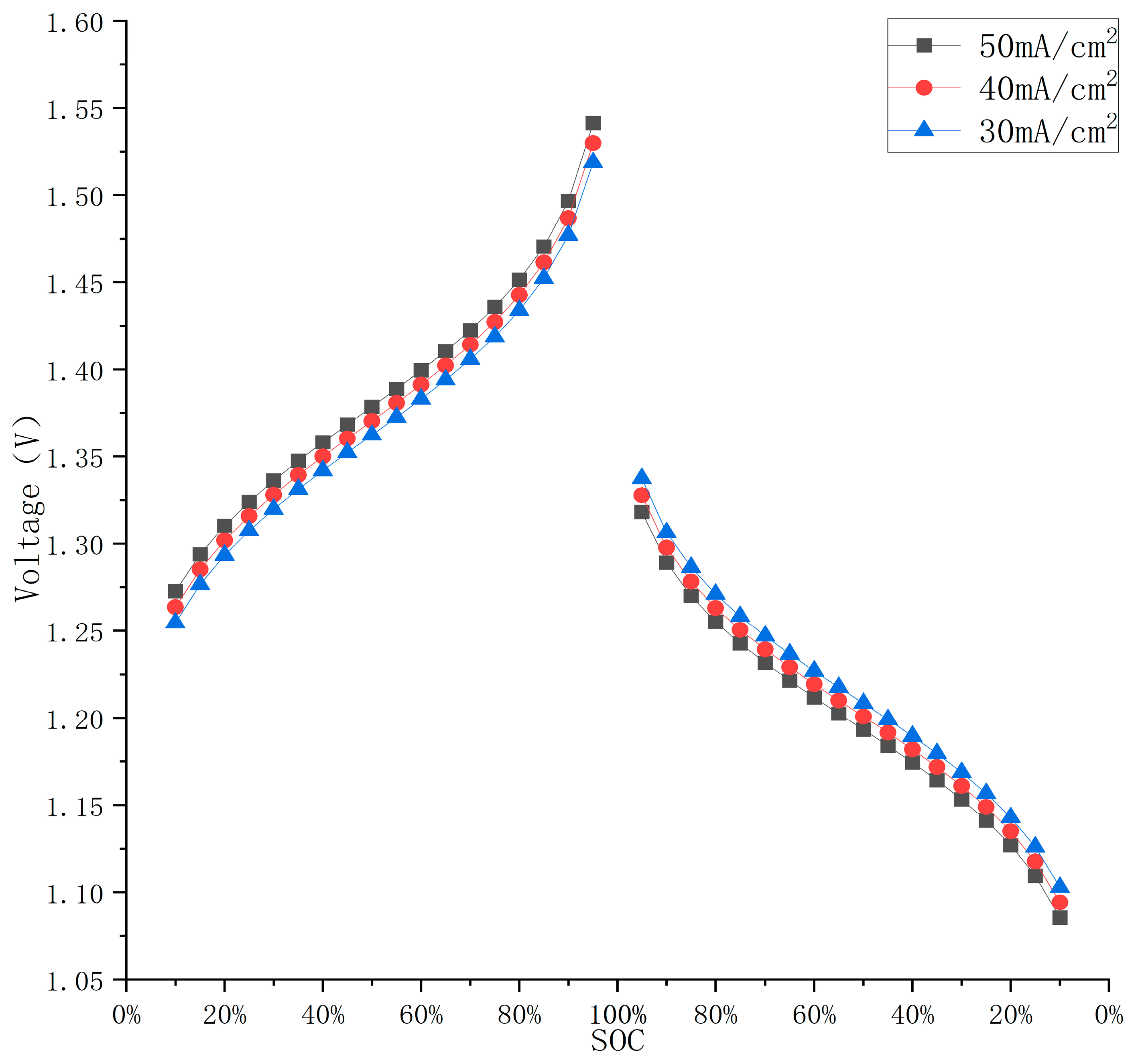
As shown in Figure 2, this model simulates the charge–discharge curves of a vanadium battery at different current densities when the inlet electrolyte flow rate is 5 mL/s. As evident in Figure 2, with increasing current density, the charging cell voltage corresponding to the left charging curve gradually rises, while the discharge cell voltage corresponding to the right discharge curve progressively decreases. This perfectly reflects the internal polarization phenomenon observed in experimental batteries, demonstrating that this numerical model can accurately predict the charging and discharging processes of VRFBs [39]. The charge–discharge cell voltage profiles exhibit a symmetric shape with respect to the SOC axis, reflecting the reversible electrochemical behavior of the system.

3. Results and Discussion

3.1. Velocity Distribution of Electrolyte Under Porous Carbon Felt

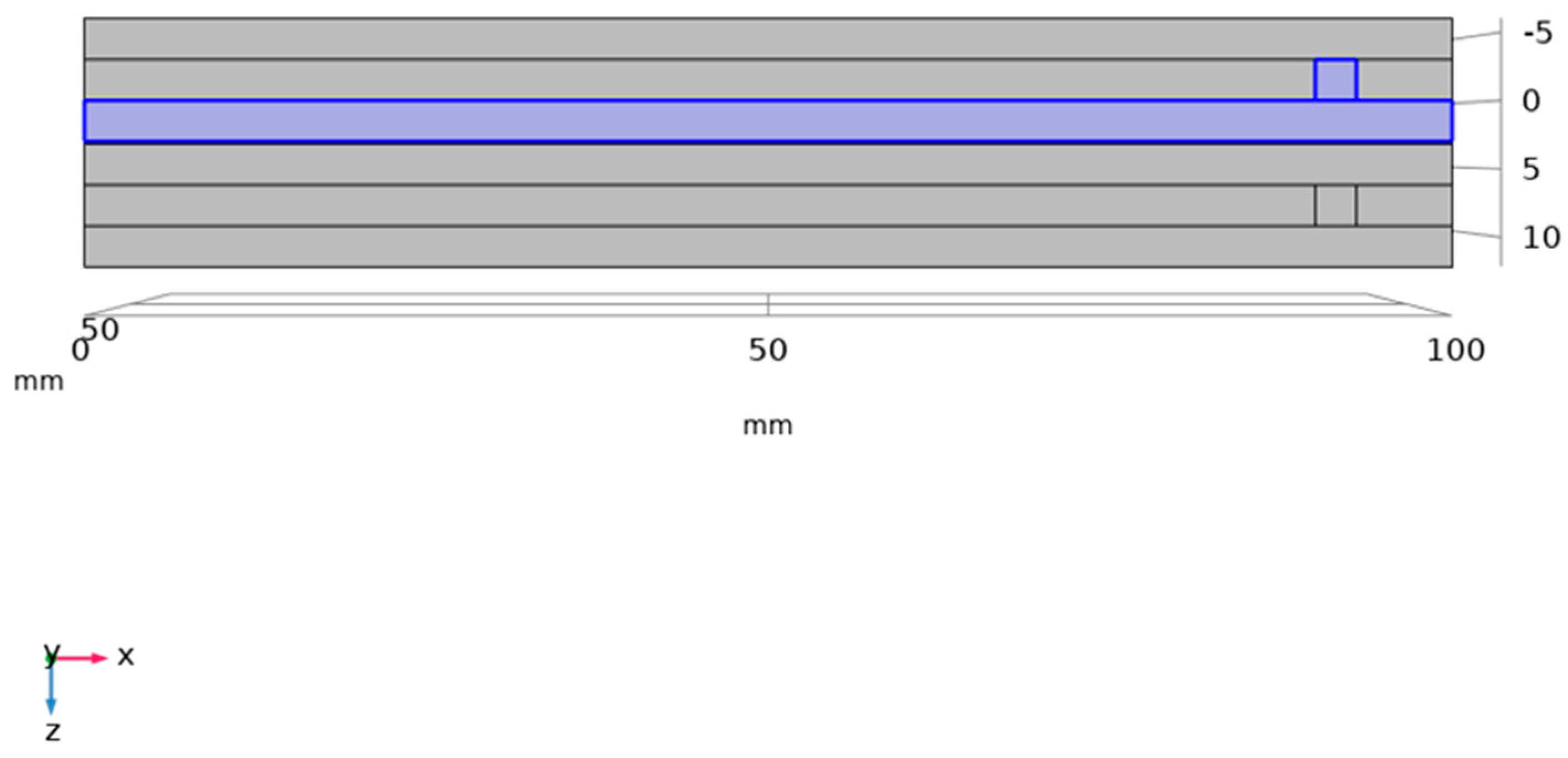
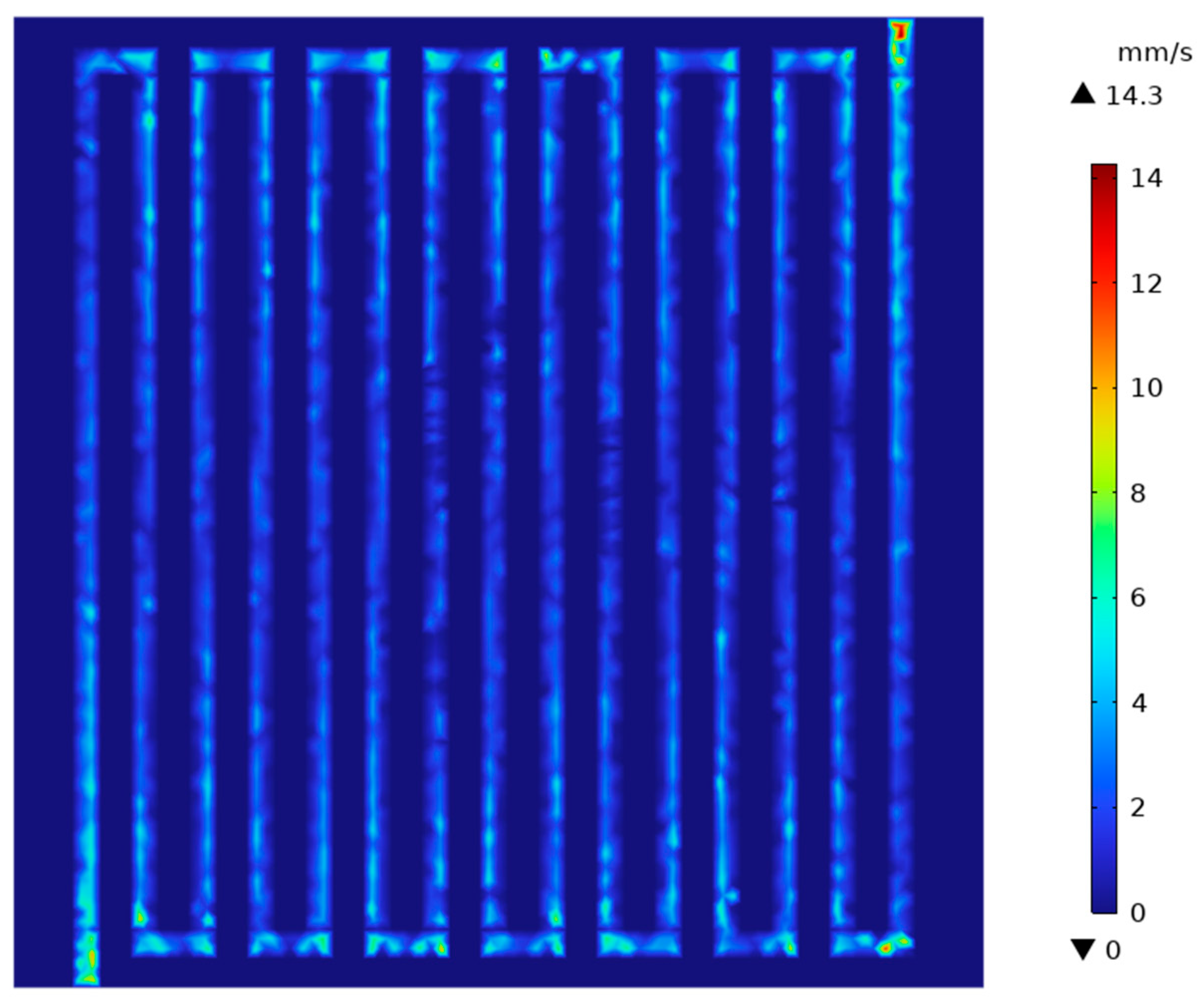
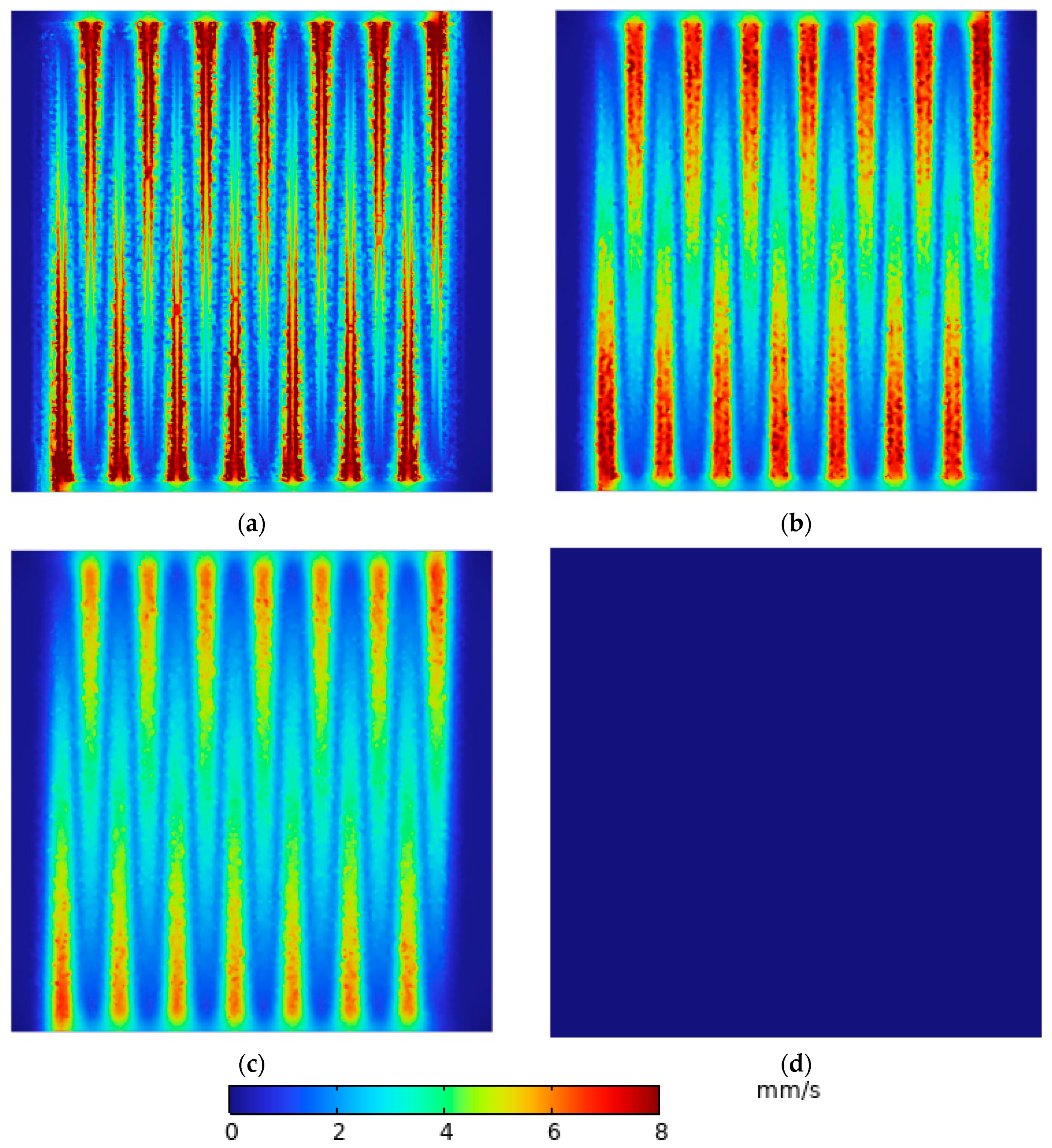
To quantify the distribution of electrolyte flow velocity within the flow channels and carbon felt, the z-axis coordinates of the serpentine flow channels and cathode carbon felt in the VRFB were obtained, as shown in Figure 3. Figure 4 indicates that at the interface between the carbon felt and flow channel, velocity distribution exists only where the channel and felt overlap, with zero velocity elsewhere. As shown in Figure 5, panels (a) to (d) reveal the velocity distribution of the electrolyte beneath the porous carbon felt at the positive electrode. Additionally, higher flow velocities are observed at the inlet, outlet, and flow channel corners, while lower velocities prevail in other regions. From Figure 5a to Figure 5c, the selected cross-sections progressively approach the interface between the carbon felt and ion-exchange membrane [40,41].
It is evident that the electrolyte flow velocity decreases progressively across the carbon felt cross-section. The distinction in electrolyte flow velocity between regions aligned with the flow channel direction and those not aligned within the carbon felt becomes increasingly blurred. When the cross-section aligns with the contact surface between the carbon felt and the ion-exchange membrane, the velocity becomes zero, as shown in Figure 5d. This occurs because the flow channel is a cavity, allowing fluid to flow freely with minimal resistance. In contrast, the carbon felt is a porous medium with a complex microstructure formed by the random accumulation of countless carbon fibers. As the electrolyte flows through it, it must meander around each fiber, continuously experiencing friction, collisions, bifurcations, and convergences with the fiber surfaces. This process causes the macroscopic kinetic energy of the electrolyte to be continuously dissipated and dispersed, resulting in significant flow resistance [39,40,41,42].
The electrolyte possesses the highest kinetic energy and flow velocity within the channel. When a portion enters the porous region of the carbon felt under pressure, its flow transitions from pipe flow to seepage flow. This seepage process, advancing from the carbon felt-channel interface toward the carbon felt-membrane contact surface, represents a continuous dissipation of kinetic energy.
At the surface layer of the carbon felt, near the flow channel, the fluid has just entered and retains some kinetic energy gained from the channel. Vertical convective permeation is relatively stronger here. Therefore, in the region directly below the flow channel, driven by direct vertical pressure, the flow velocity is significantly higher than in areas blocked by the fin plates, creating the alternating pattern of high and low flow velocities previously observed. In the middle layer of the carbon felt, as the fluid penetrates deeper toward the ion exchange membrane, it must traverse the fiber pathways, with each fiber consuming the fluid’s momentum. The flow velocity decreases significantly. At this point, the fluid vertically infiltrating from the flow channel begins to mix with the fluid diffusing from the area beneath the ribs. The vertical driving pressure is gradually balanced by the resistance of the porous medium, causing the absolute value of the flow velocity to decrease. This leads to a narrowing of the relative velocity difference between the flow channel zone and the rib zone. At the bottom layer of the carbon felt, after traversing the entire thickness of the felt, the macroscopic kinetic energy of the fluid flow is completely dissipated.
The ion exchange membrane itself is a dense solid material with no large pores allowing macroscopic penetration by the electrolyte. Under no-slip boundary conditions, at this physical interface between the electrolyte and the ion exchange membrane, all macroscopic velocity components of the electrolyte must reduce to zero. Regardless of how fast the fluid may have been flowing within the carbon felt, as it approaches this solid wall surface, its velocity must decay smoothly and continuously to zero [43,44,45,46].
In the carbon felt region near the flow channel, mass transfer is dominated by pressure-driven convection. As depth increases, the intensity of convection decreases sharply. When convection weakens to a certain extent, the role of another mass transfer mechanism—molecular diffusion—relatively increases. Diffusion is driven by concentration gradients and does not depend on macroscopic fluid flow. In the reaction zone near the membrane, whether beneath the flow channel or beneath the flow channel ribs, intense electrochemical reactions generate significant ion depletion or accumulation at the electrode surface, forming a large-scale local concentration gradient. Within the extremely thin layer immediately adjacent to the membrane, where macroscopic convection has largely ceased, fluid from both directly beneath the flow channel and directly beneath the fin enters the same diffusion mass transfer zone [44,47]. Both face an identical task: relying on diffusion to traverse this final, minute distance to reach or depart the reaction interface. At this scale, the velocity and concentration differences previously caused by distinct convective supply pathways are homogenized by the local reaction-diffusion process. On velocity contour plots, the originally distinct striped distribution becomes blurred, ultimately resulting in zero velocity across the entire membrane surface [48,49,50].
In the region closest to the membrane where reactions are most intense, the electrolyte flow velocity is lowest, and macroscopic convective supply capacity is weakest. This creates an inherent mass transfer bottleneck. Reactants struggle to be rapidly delivered, and products struggle to be rapidly removed, leading to severe concentration polarization. This is the primary factor limiting the performance of liquid flow batteries at high current densities.

3.2. Effect of Current on Battery Charge/Discharge Cell Voltage

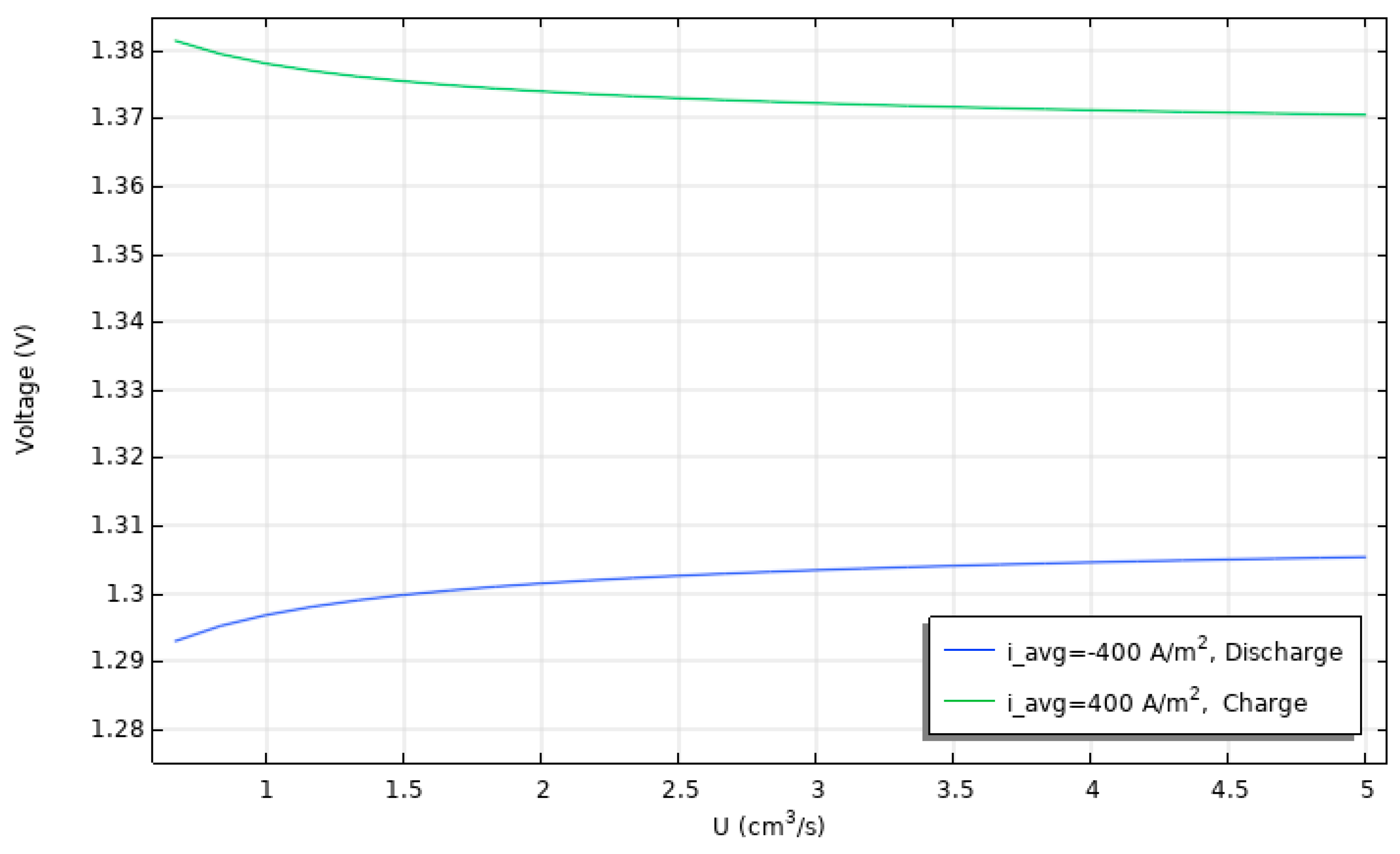
Figure 6 illustrates the relationship between charge/discharge cell voltage and flow rate (The variable “U” represents the electrolyte flow velocity). The graph reveals that as flow rate increases, the charge/discharge cell voltages of the battery exhibit a tendency to converge, though this convergence slows progressively with higher flow rates. This phenomenon arises from the diminishing influence of mass transfer limitations and the increasing prominence of reaction kinetics, ultimately leading the system toward a “limit state” dominated by reaction kinetics and ohmic losses [51]. The rate of cell voltage convergence markedly slows beyond a flow rate of approximately 3 cm3/s (indicated by the arrow in Figure 6). This suggests that further increasing the flow rate beyond this point yields minimal additional benefit for cell voltage stability under these operating conditions, highlighting a key consideration for system efficiency.
At low current densities, concentration polarization dominates, exhibiting pronounced changes as electrolyte transport within porous electrodes proceeds slowly. During discharge, active materials on the electrode surface are rapidly depleted, while high-concentration electrolyte migrates slowly from the bulk phase to the electrode surface, causing a sharp drop in surface concentration. To sustain the current, the output cell voltage must be significantly reduced. During charging, the active material formed on the electrode surface cannot be removed promptly, causing its concentration to rise rapidly and elevating the electrode potential. To continue charging, a higher cell voltage must be applied. Thus, at low current rates, the charge–discharge cell voltage curve “spreads” significantly. This “spread” is primarily caused by severe concentration polarization. When the current rate begins to increase, fresh electrolyte is pumped to the electrode surface more rapidly, and reaction products are flushed away faster. This significantly mitigates the concentration gradient at the electrode surface. During discharge, the electrode surface can maintain a higher concentration, causing the discharge cell voltage to rise. During charging, the surface concentration remains lower, leading to a decrease in charging cell voltage. The charge–discharge cell voltage curves rapidly converge toward the middle. At this stage, each incremental increase in flow rate yields remarkably pronounced improvements in mass transfer and reduction of concentration polarization, resulting in a very rapid “speed” of cell voltage convergence [52].
As the flow rate continues to increase, concentration polarization diminishes in the high-flow-rate range, with other types of polarization becoming dominant. The rate of change slows, and mass transfer intensifies continuously. The concentration at the electrode surface increasingly approaches the bulk concentration at the electrolyte inlet. When the flow rate reaches a sufficiently high level, concentration polarization is reduced to a negligible extent. At this point, the concentration at the electrode surface exhibits virtually no significant change with further increases in flow rate. Cell voltage loss will primarily stem from ohmic and electrochemical polarization. Both of these are essentially independent of flow rate. Ohmic loss depends on the system’s resistance and current. Electrochemical loss depends on the exchange current density of the reaction. Therefore, system performance approaches a “limit value” determined by reaction kinetics and ohmic loss.
Further increases in flow rate yield diminishing marginal benefits for improving mass transfer and enhancing surface concentration. Doubling the flow rate results in only a negligible increase in electrode surface concentration. This is reflected in the cell voltage curve as a minimal change in charge/discharge cell voltage, with the convergence trend becoming extremely slow. The curves approach two parallel lines that no longer shift.

3.3. Effect of Flow Rate on Vanadium Ion Concentration

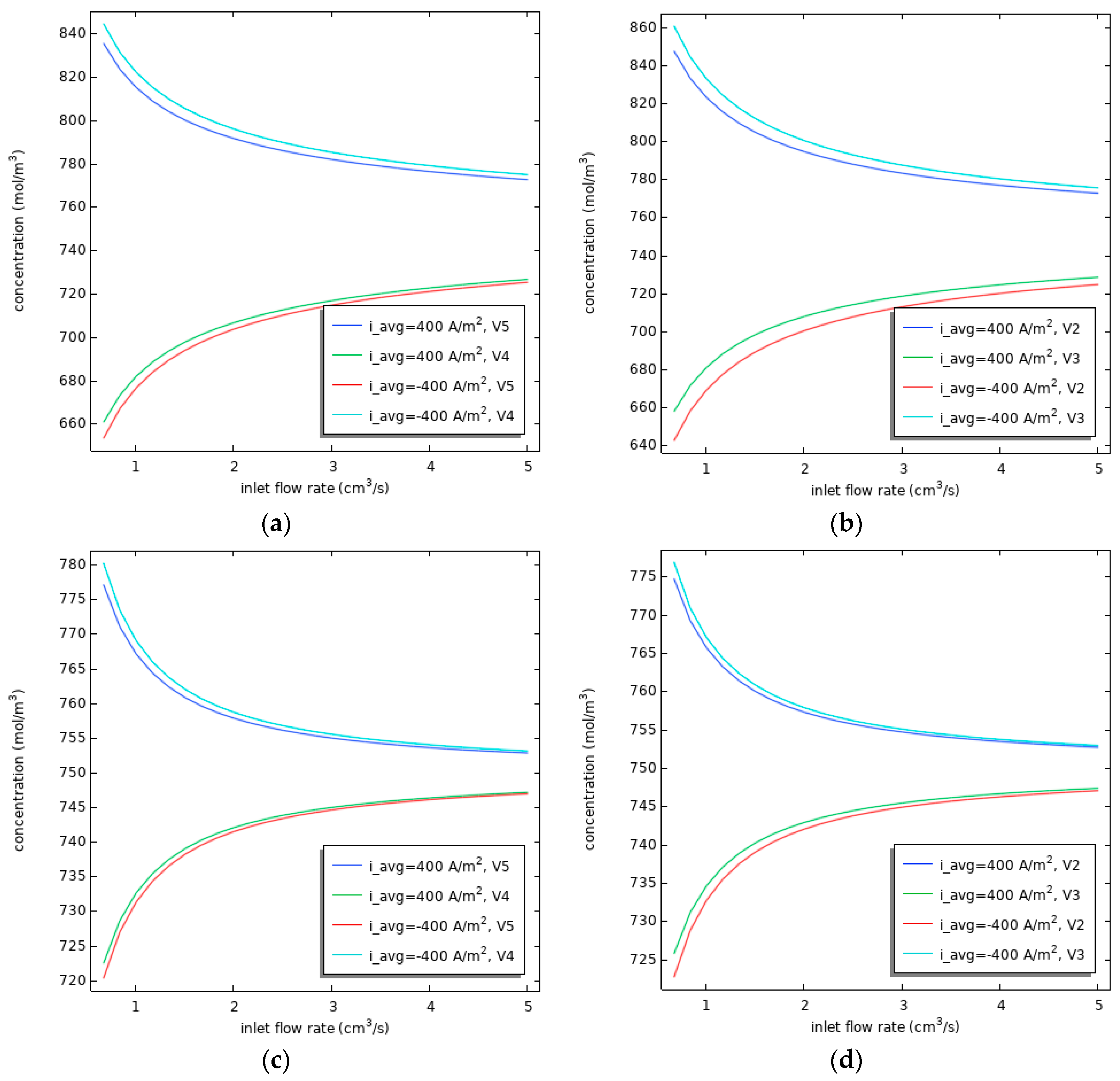
As shown in Figure 7, when the electrolyte inlet flow rate increases, the average concentrations of VO 2 + / VO 2 + and V 2 + / V 3 + on the carbon felt and flow channel approach half of the total vanadium ion concentration in the electrolyte at the anode and cathode, respectively. This occurs because under high-velocity flow, the replenishment of reactants and removal of products are extremely rapid, causing the electrochemical reaction in this local region to approach an “idealized equilibrium state.”
At low flow rates, concentration polarization becomes severe, leading to substantial depletion of reactants at the electrode surface and significant accumulation of products. Simultaneously, the effects of ion migration are amplified. Since ion concentrations at the reaction interface deviate significantly from bulk concentrations, changes in H+ migration rates and ionic strength substantially influence the distribution and potential of various ions. Consequently, at low flow rates, the ratio of V 2 + / V 3 + or VO 2 + / VO 2 + deviates significantly from 1:1, depending on whether the process is charging (where one ion dominates) or discharging (where another ion dominates) [53].
When the inlet flow rate is extremely high, the high-velocity electrolyte instantly transports fresh reactants to the electrode-channel interface and instantly flushes away the generated products. This renders the concentration field at this interface exceptionally uniform and stable, nearly matching the inlet concentration. Concentration polarization is minimized to the utmost extent. At this interface, “smoothed” by the high-speed flow, the electrochemical reaction reaches a steady state. For any given vanadium ion pair (such as VO 2 + / VO 2 + at the cathode), at a given current: The rate at which the reaction consumes VO 2 + is approximately equal to the rate at which the fluid delivers VO 2 + . The rate at which the reaction generates VO 2 + is approximately equal to the rate at which the fluid carries away VO 2 + .

3.4. Relationship Between the Uniformity of Various Valence States of Vanadium Ions in Flow Channels and Carbon Felt and SOC/Flow Velocity

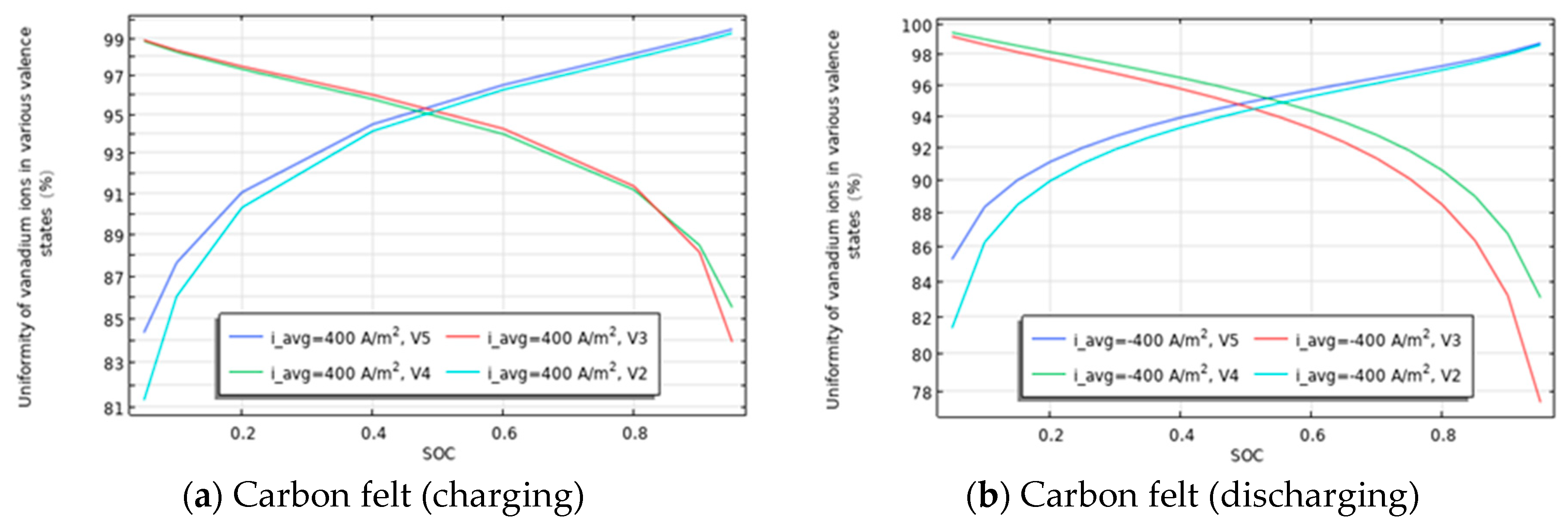
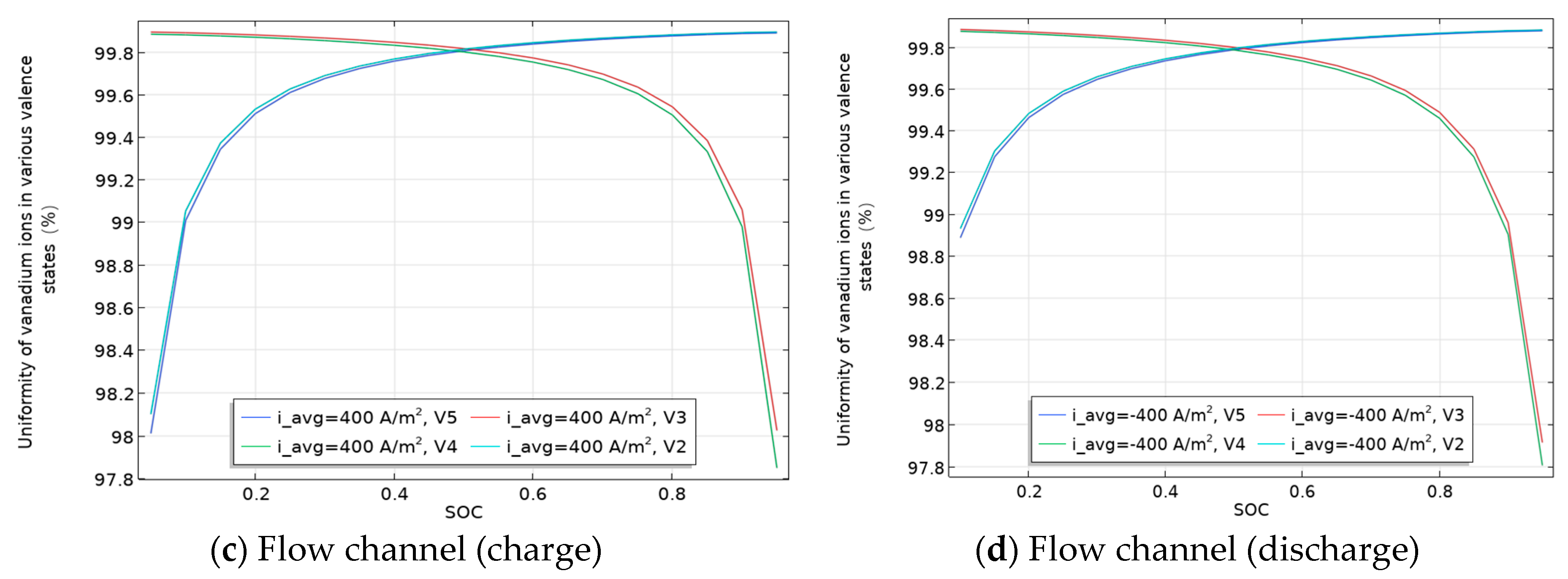
As shown in Figure 8, the ion uniformity of V 2 + / V 3 + or VO 2 + / VO 2 + exhibits approximate symmetry around SOC = 0.5. This stems from the fundamental distinction between vanadium flow batteries and other battery systems: both the positive and negative electrode active materials consist of the same element (vanadium) in different oxidation states. Consequently, their charge and discharge reactions form a perfect “mirror reaction” pair, each involving only single-electron transfer. The efficient charge transfer and stable electrochemical behavior of vanadium species—which are central to the performance of our flow battery—are also exploited in state-of-the-art sensing devices. Specifically, we will mention that the use of vanadium pentoxide (V2O5) nanoparticles as a solid-contact material in potentiometric sensors underscores the versatility of vanadium oxides in creating robust electrochemical interfaces [54]. The cathode reaction oxidizes one ion ( VO 2 + VO 2 + ), while the anode reaction reduces one ion ( V 3 + V 2 + ). The charging and discharging processes are fully reversible [55,56].
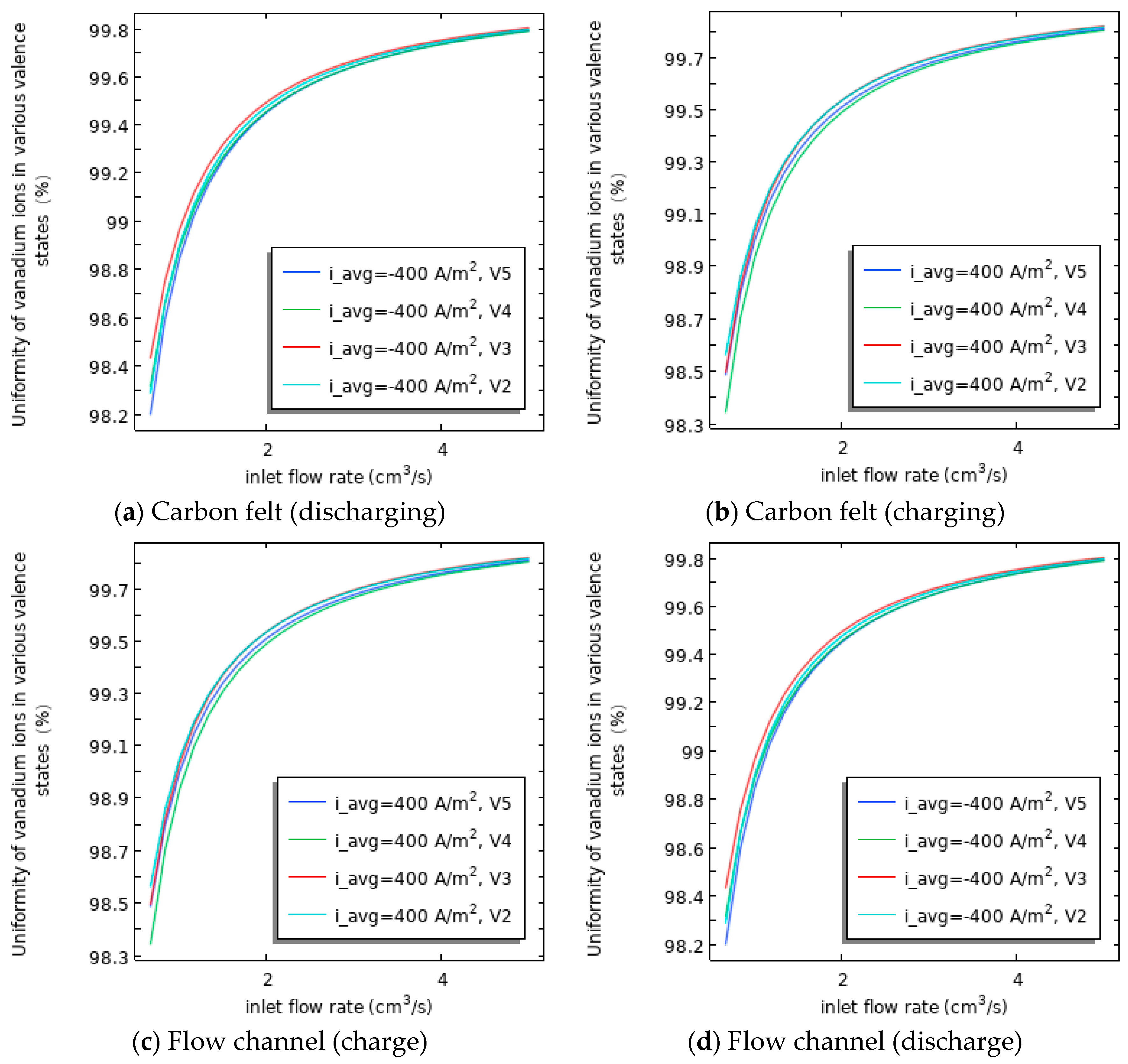
As shown in Figure 9, when SOC = 0.5 and the average current density is 40 mA/cm2, the uniformity of all valence states of vanadium ions increases with increasing inlet flow rate during both charging and discharging, and this increase becomes progressively slower. This occurs because, under conditions of high symmetry (SOC = 0.5 implies identical initial concentrations of reactants and products), increased flow rate effectively reduces concentration polarization, but its beneficial effect exhibits diminishing returns.
Improved uniformity corresponds to reduced concentration polarization. Concentration polarization occurs when the rate of ion consumption/generation in electrochemical reactions exceeds the rate of ion replenishment/removal via fluid transport. Increased flow velocity directly enhances this process by boosting convective transport and reducing diffusion layer thickness. Higher flow rates translate to faster fluid scouring capabilities. It more rapidly transports fresh electrolyte from the flow channel into the depths of the porous electrode while simultaneously removing reaction-spent electrolyte (rich in products) from within the electrode. A relatively stationary diffusion boundary layer exists at the electrode/electrolyte interface [13,47]. Higher flow velocity thins this boundary layer, significantly reducing the resistance to ion diffusion across it. Therefore, as the inlet flow rate increases, mass transfer is continuously enhanced. Concentrations at various points within the electrode increasingly approach those in the flow channel, thereby improving the uniformity of distribution for all valence ions.
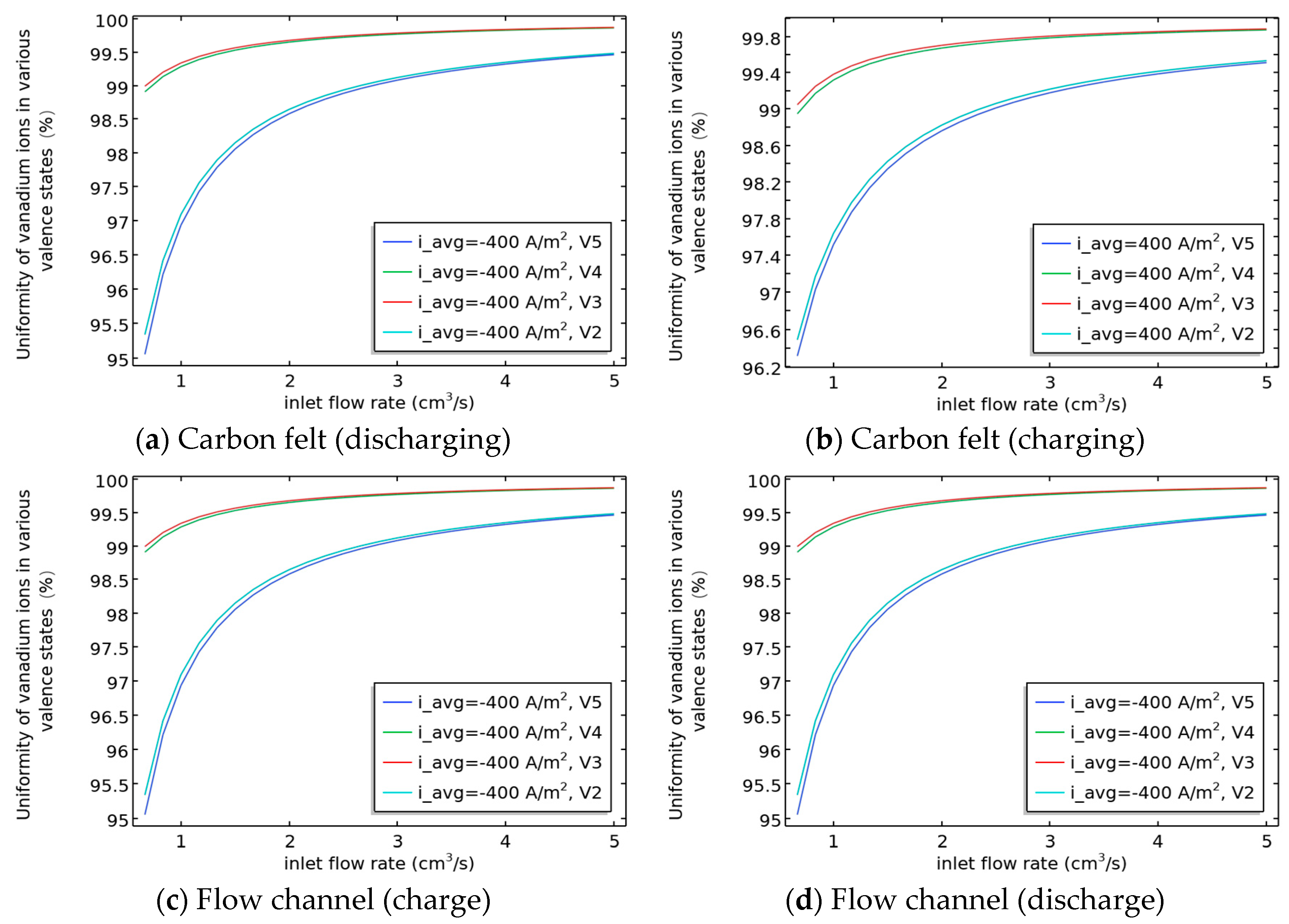
Figure 10 presents the spatial uniformity characteristics of vanadium ions (V2+/V3+ in the negative electrolyte and VO2+/VO2+ in the positive electrolyte) simulated under three typical SOC levels, with a fixed flow rate of 50 mL·min−1. The uniformity is quantified by the concentration uniformity index (ranging from 0 to 1, where 1 indicates complete uniformity).
Symmetric variation of uniformity with SOC deviation: The uniformity index reaches the maximum (0.87) at SOC = 0.5, attributed to the balanced concentration ratio of oxidized and reduced vanadium species, which minimizes internal concentration gradients. When SOC deviates to 0.2 or 0.8, the uniformity index decreases to 0.72 and 0.71, respectively, showing a high degree of symmetry. This symmetry originates from the reciprocal concentration changes of vanadium redox pairs in the positive and negative electrodes—e.g., the low SOC (0.2) is dominated by V3+ (negative) and VO2+ (positive), while the high SOC (0.8) is dominated by V2+ (negative) and VO2+ (positive), and the diffusion coefficient differences between these pairs exhibit symmetric characteristics.
Mechanism of uniformity degradation: At SOC = 0.2, the low concentration of high-reactivity V2+ and VO2+ leads to insufficient supplement for electrode surface reactions, causing local concentration depletion and reduced uniformity. At SOC = 0.8, the accumulation of high-valence vanadium ions (V2+ and VO2+) slightly increases electrolyte viscosity, inhibiting convective mass transfer and resulting in local concentration aggregation.
Correlation with ion migration: The symmetric uniformity degradation at SOC = 0.2 and 0.8 is consistent with the symmetric net migration direction of vanadium ions driven by concentration differences. This indicates that the uniformity variation is inherently linked to the directional migration of vanadium ions across the membrane during SOC deviation.
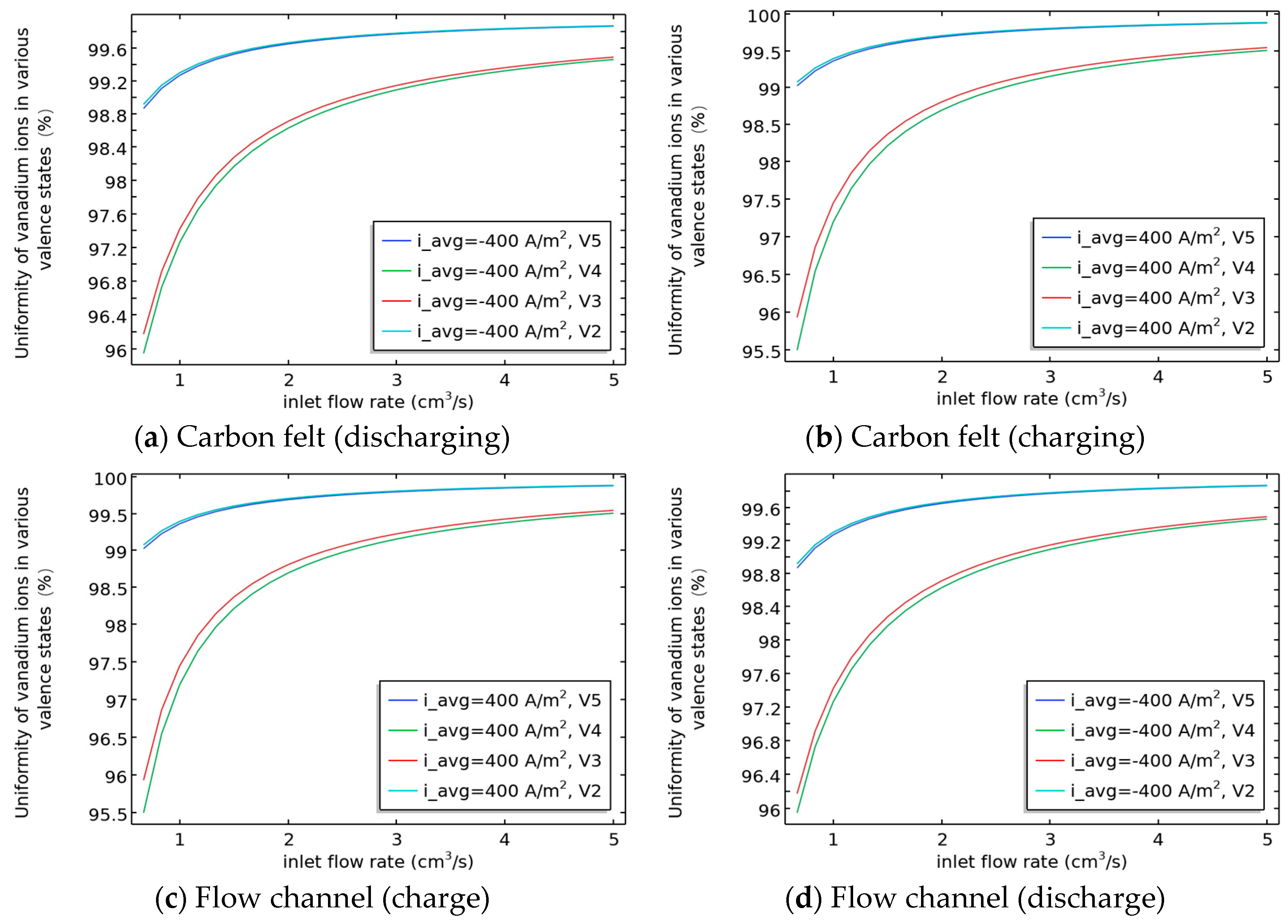
Figure 11 illustrates the variation of vanadium ion uniformity index with electrolyte flow rate (30–80 mL·min−1) under SOC = 0.2, 0.5, and 0.8 conditions, revealing the regulatory role of flow rate in mitigating uniformity loss caused by SOC deviation.
Differential sensitivity of uniformity to flow rate: For SOC = 0.2 and 0.8, the uniformity index increases significantly with rising flow rate—when the flow rate increases from 30 to 60 mL·min−1, the uniformity index rises by 23.6% and 22.5%, respectively. This is because higher flow rates enhance convective mass transfer, alleviate local concentration polarization, and compensate for the mass transfer limitation caused by SOC-induced concentration gradients. In contrast, at SOC = 0.5, the uniformity index remains above 0.85 even at a low flow rate (30 mL·min−1), showing weak dependence on flow rate due to the balanced internal concentration distribution.
Critical flow rate threshold: For SOC = 0.2 and 0.8, the improvement of uniformity slows down significantly when the flow rate exceeds 60 mL·min−1 (the increment is less than 3%). This is because the mass transfer process shifts from convection limitation to reaction kinetics limitation, and further increasing the flow rate only leads to excessive pumping power loss without obvious uniformity gain.
Optimal flow rate window: Considering both uniformity and system efficiency, the optimal flow rate range is determined as 50–60 mL·min−1 for SOC = 0.2 and 0.8 (balancing uniformity improvement and pump loss), while 40–50 mL·min−1 is sufficient for SOC = 0.5. This provides direct operational guidance for actual battery systems to maintain high uniformity across the entire SOC range.
The uniformity characteristics and flow rate regulation revealed by Figure 10 and Figure 11 have direct implications for battery cyclic stability:
Poor vanadium ion uniformity at SOC = 0.2 and 0.8 (without flow rate optimization) leads to local overcharge/discharge, accelerating vanadium ion crossover through the membrane and electrolyte imbalance. This results in increased concentration polarization and reduced coulombic efficiency.
The symmetric uniformity at SOC = 0.2 and 0.8 supports the design of symmetric flow rate control strategies (e.g., increasing flow rate during low-SOC charging and high-SOC discharging), which can mitigate electrolyte imbalance by enhancing mass transfer symmetry [57,58,59].

4. Outlook and Future Work

The current model employs necessary simplifications to focus on the core interplay between flow field design and mass transfer. These choices naturally lead to several promising directions for future research to enhance the model’s comprehensiveness and practical relevance.
The isothermal assumption could be relaxed by integrating energy balance equations. This would allow the model to evaluate flow field performance under realistic operating conditions with active heat generation and dissipation, providing insights for thermal management.
Including vanadium ion and solvent crossover across the membrane would extend the model’s capability from predicting instantaneous performance to simulating long-term capacity fade and electrolyte balance, which is crucial for lifetime assessment.
Extending the steady-state model to simulate transient behaviors, would bridge the gap towards optimizing real-time system control strategies.
Future work could incorporate concentration- and temperature-dependent electrolyte properties (viscosity, conductivity). This would improve the model’s accuracy across a wider range of operating states and electrolyte formulations.
In summary, addressing these aspects would evolve the present model into a more robust tool for the integrated design and operational analysis of flow battery systems.

5. Conclusions

Through observing a series of phenomena in flow battery simulations, such as the convergence of charge/discharge cell voltages with increasing electrolyte inlet flow rate and the approximate symmetry of ion uniformity between VO 2 + / VO 2 + or V 2 + / V 3 + near SOC = 0.5, This study reveals the intrinsic connection between internal mass transfer processes, electrochemical reactions, and system symmetry within vanadium redox flow batteries. As flow rates increase, the convergence rate of charge/discharge cell voltages gradually slows, indicating a transition in system performance from a mass transfer-dominated state to one governed by kinetics and ohmic processes. At low flow rates, concentration polarization is the primary cause of cell voltage loss. Increasing flow rate significantly improves mass transfer with pronounced effects. At high flow rates, concentration polarization is greatly suppressed, and performance approaches the limit determined by intrinsic reaction kinetics and ohmic internal resistance. Further increases in flow rate yield diminishing marginal benefits, exhibiting a decreasing effect. At high flow rates, the concentration ratios of V 2 + / V 3 + and VO 2 + / VO 2 + at the electrode-channel interface tend toward 1:1. This confirms that under ideal conditions where mass transfer limitations are eliminated, the system is governed by charge conservation and electroneutrality principles, naturally tending toward an equilibrium state where reactant and product concentrations are equal. At SOC = 0.5, regardless of charging or discharging, the uniformity of all valence ions increases with flow rate while the rate of increase slows. This demonstrates that flow rate is an effective means to overcome concentration polarization, though its effectiveness has limitations. While the present model effectively captures the core interplay between convective mass transfer and electrochemical kinetics under the studied conditions, several simplifying assumptions define its scope. The model operates under isothermal conditions and does not dynamically account for the effects of temperature variation on reaction rates and transport properties. It focuses on the primary redox reactions, while the explicit influence of electrolyte decomposition is not resolved; their potential collective impact is implicitly reflected in the fitted kinetic parameters. Consequently, the model’s predictions are most reliable within the validated operating envelope (Flow rates of 60 to 300 mL/min, room temperature operation, and the specific electrolyte chemistry used herein). Extrapolation beyond these ranges or to systems where thermal effects or specific side reactions are dominant should be undertaken with caution.

Author Contributions

Conceptualization, T.S.; Methodology, T.S.; Software, T.S.; Validation, T.S. and S.W.; Investigation, T.S.; Writing—original draft, T.S. and S.W.; Writing—review & editing, T.S., C.X. and X.X.; Visualization, T.S.; Supervision, X.X.; Project administration, X.X., C.X. and S.W.; Funding acquisition, X.X., C.X. and S.W. All authors have read and agreed to the published version of the manuscript.

Funding

This work was supported by the National Key Research and Development Program of China No. 2022YFB4200704 and Hubei Provincial Key R&D Program Projects, No.: 2023DJC187; Hubei Provincial Natural Science Foundation Project, No. 2024AFD003; Hubei Provincial Department of Education, No. T2024027; Fundamental Research Projects of Science & Technology Innovation and Development Plan in Yantai City (No. 2022JCYJ043), and the Natural Science Foundation of Shandong Province (Grant No. ZR2022QB068).

Data Availability Statement

The original contributions presented in this study are included in the article. Further inquiries can be directed to the corresponding authors.

Conflicts of Interest

The authors declare no conflicts of interest. The funders had no role in the design of the study; in the collection, analyses, or interpretation of data; in the writing of the manuscript; or in the decision to publish the results.

References

  1. Esan, O.C.; Shi, X.; Pan, Z.; Huo, X.; An, L.; Zhao, T.S. Modeling and Simulation of Flow Batteries. Adv. Energy Mater. 2020, 10, 2000758. [Google Scholar] [CrossRef]
  2. Agyekum, E.B.; Abdullah, M.; Odoi-Yorke, F.; Ameen, A.; Chowdhury, P.; Raza, M.A.; Rashid, F.L.; Hussein, A.K. A state-of-the-art review of electrolyte systems for vanadium redox flow battery ? status of the technology, and future research directions. Energy Convers. Manag. X 2025, 27, 101180. [Google Scholar] [CrossRef]
  3. Zhang, H. Progress and perspectives of flow battery technologies. Curr. Opin. Electrochem. 2019, 18, 123–125. [Google Scholar] [CrossRef]
  4. Shu, B.; Weber, L.S.; Skyllas-Kazacos, M.; Bao, J.; Meng, K. Thermal Modelling and Simulation Studies of Containerised Vanadium Flow Battery Systems. Batteries 2023, 9, 196. [Google Scholar] [CrossRef]
  5. Shah, A.A.; Al-Fetlawi, H.; Walsh, F.C. Dynamic modelling of hydrogen evolution effects in the all-vanadium redox flow battery. Electrochim. Acta 2010, 55, 1125–1139. [Google Scholar] [CrossRef]
  6. Shah, A.A.; Watt-Smith, M.J.; Walsh, F.C. A dynamic performance model for redox-flow batteries involving soluble species. Electrochim. Acta 2008, 53, 8087–8100. [Google Scholar] [CrossRef]
  7. You, D.; Zhang, H.; Chen, J. A simple model for the vanadium redox battery. Electrochim. Acta 2009, 54, 6827–6836. [Google Scholar] [CrossRef]
  8. Xiong, B.; Ding, Y.; Zhang, Q.; Shi, S.; Zhang, H.; Su, Y. Finite element-based analysis of composite serpentine flow channel 3D modeling of vanadium redox flow battery. Int. J. Green Energy 2022, 22, 831–838. [Google Scholar] [CrossRef]
  9. Di Noto, V.; Vezzù, K.; Crivellaro, G.; Pagot, G.; Sun, C.; Meda, L.; Rutkowska, I.; Kulesza, P.; Zawodzinski, T. A general electrochemical formalism for vanadium redox flow batteries. Electrochim. Acta 2022, 408, 139937. [Google Scholar] [CrossRef]
  10. Du, J.; Lin, H.; Zhang, L.; Liu, S.; Wang, L. Novel electrolyte design for high-efficiency vanadium redox flow batteries with enhanced 3.0 M V3+stability at low temperatures. Chem. Eng. J. 2025, 516, 164293. [Google Scholar] [CrossRef]
  11. Guo, Y.; Huang, J.; Feng, J. Research progress in preparation of electrolyte for all-vanadium redox flow battery. J. Ind. Eng. Chem. 2023, 118, 33–43. [Google Scholar] [CrossRef]
  12. Lu, M.; Deng, Y.; Yang, W.; Ye, M.; Jiao, Y.; Xu, Q. A novel rotary serpentine flow field with improved electrolyte penetration and species distribution for vanadium redox flow battery. Electrochim. Acta 2020, 361, 137089. [Google Scholar] [CrossRef]
  13. Krowne, C. Fluid Physics Impacting Vanadium and Other Redox Flow Batteries. J. Electrochem. Soc. 2024, 171, 060517. [Google Scholar] [CrossRef]
  14. Lu, M.; Jiao, Y.; Tang, X.; Yang, W.; Ye, M.; Xu, Q. Blocked serpentine flow field with enhanced species transport and improved flow distribution for vanadium redox flow battery. J. Energy Storage 2021, 35, 102284. [Google Scholar] [CrossRef]
  15. Ashraf Gandomi, Y.; Aaron, D.S.; Mench, M.M. Coupled Membrane Transport Parameters for Ionic Species in All-Vanadium Redox Flow Batteries. Electrochim. Acta 2016, 218, 174–190. [Google Scholar] [CrossRef]
  16. Messaggi, M.; Gambaro, C.; Casalegno, A.; Zago, M. Development of innovative flow fields in a vanadium redox flow battery: Design of channel obstructions with the aid of 3D computational fluid dynamic model and experimental validation through locally-resolved polarization curves. J. Power Sources 2022, 526, 231155. [Google Scholar] [CrossRef]
  17. Li, M.; Hikihara, T. A coupled dynamical model of redox flow battery based on chemical reaction, fluid flow, and electrical circuit. IEICE Trans. Fundam. Electron. Commun. Comput. Sci. 2008, E91-A, 1741–1747. [Google Scholar] [CrossRef]
  18. Milshtein, J.D.; Tenny, K.M.; Barton, J.L.; Drake, J.; Darling, R.M.; Brushett, F.R. Quantifying Mass Transfer Rates in Redox Flow Batteries. J. Electrochem. Soc. 2017, 164, E3265–E3275. [Google Scholar] [CrossRef]
  19. Li, J.; Long, J.; Huang, W.; Xu, W.; Liu, J.; Luo, H.; Zhang, Y. Novel branched sulfonated polyimide membrane with remarkable vanadium permeability resistance and proton selectivity for vanadium redox flow battery application. Int. J. Hydrogen Energy 2022, 47, 8883–8891. [Google Scholar] [CrossRef]
  20. Balaji, J.; Sethuraman, M.; Roh, S.; Jung, H. Recent developments in sol-gel based polymer electrolyte membranes for vanadium redox flow batteries—A review. Polym. Test. 2020, 89, 106567. [Google Scholar] [CrossRef]
  21. Ali, E.; Kwon, H.; Choi, J.; Lee, J.; Kim, J.; Park, H. A numerical study of electrode thickness and porosity effects in all vanadium redox flow batteries. J. Energy Storage 2020, 28, 101208. [Google Scholar] [CrossRef]
  22. Zhou, X.L.; Zhao, T.S.; An, L.; Zeng, Y.K.; Yan, X.H. A vanadium redox flow battery model incorporating the effect of ion concentrations on ion mobility. Appl. Energy 2015, 158, 157–166. [Google Scholar] [CrossRef]
  23. Krowne, C.M. Nernst Equations and Concentration Chemical Reaction Overpotentials for VRFB Operation. J. Electrochem. Soc. 2023, 170, 100534. [Google Scholar] [CrossRef]
  24. Xu, Q.; Zhao, T.S.; Zhang, C. Effects of SOC-dependent electrolyte viscosity on performance of vanadium redox flow batteries. Appl. Energy 2014, 130, 139–147. [Google Scholar] [CrossRef]
  25. Pugach, M.; Parsegov, S.; Gryazina, E.; Bischi, A. Output feedback control of electrolyte flow rate for Vanadium Redox Flow Batteries. J. Power Sources 2020, 455, 227916. [Google Scholar] [CrossRef]
  26. Sauermoser, M.; Kizilova, N.; Pollet, B.G.; Kjelstrup, S. Flow Field Patterns for Proton Exchange Membrane Fuel Cells. Front. Energy Res. 2020, 8, 13. [Google Scholar] [CrossRef]
  27. Kumar, S.; Jayanti, S. Effect of flow field on the performance of an all-vanadium redox flow battery. J. Power Sources 2016, 307, 782–787. [Google Scholar] [CrossRef]
  28. Lou, X.; Yuan, D.; Yu, Y.; Lei, Y.; Ding, M.; Sun, Q.; Jia, C. A Cost-effective Nafion Composite Membrane as an Effective Vanadium-Ion Barrier for Vanadium Redox Flow Batteries. Chem.-Asian J. 2020, 15, 2357–2363. [Google Scholar] [CrossRef]
  29. Xiao, G.; Yang, G.; Zhao, S.; Xia, L.; Chu, F.; Tan, Z.a. Battery performance optimization and multi-component transport enhancement of organic flow battery based on channel section reconstruction. Energy 2022, 258, 124757. [Google Scholar] [CrossRef]
  30. Vivona, D.; Messaggi, M.; Baricci, A.; Casalegno, A.; Zago, M. Unravelling the Contribution of Kinetics and Mass Transport Phenomena to Impedance Spectra in Vanadium Redox Flow Batteries: Development and Validation of a 1D Physics-Based Analytical Model. J. Electrochem. Soc. 2020, 167, 110534. [Google Scholar] [CrossRef]
  31. Tsushima, S.; Suzuki, T. Modeling and Simulation of Vanadium Redox Flow Battery with Interdigitated Flow Field for Optimizing Electrode Architecture. J. Electrochem. Soc. 2020, 167, 020553. [Google Scholar] [CrossRef]
  32. Bogdanov, S.; Pugach, M.; Parsegov, S.; Vlasov, V.; Ibanez, F.M.; Stevenson, K.J.; Vorobev, P. Dynamic modeling of vanadium redox flow batteries: Practical approaches, their applications and limitations. J. Energy Storage 2023, 57, 106191. [Google Scholar] [CrossRef]
  33. Chen, W.; Kang, J.; Shu, Q.; Zhang, Y. Analysis of storage capacity and energy conversion on the performance of gradient and double-layered porous electrode in all-vanadium redox flow batteries. Energy 2019, 180, 341–355. [Google Scholar] [CrossRef]
  34. COMSOL Multiphysics®, version 6.3; COMSOL AB: Stockholm, Sweden, 2024.
  35. Gurieff, N.; Cheung, C.Y.; Timchenko, V.; Menictas, C. Performance enhancing stack geometry concepts for redox flow battery systems with flow through electrodes. J. Energy Storage 2019, 22, 219–227. [Google Scholar] [CrossRef]
  36. Kumar, S.; Agarwal, V.; Barnwal, V.K.; Sahu, S.; Singh, A. Optimization of channel and rib dimension in serpentine flow field for vanadium redox flow battery. Energy Storage 2022, 5, e349. [Google Scholar] [CrossRef]
  37. Sun, J.; Liu, B.; Zheng, M.; Luo, Y.; Yu, Z. Serpentine flow field with changing rib width for enhancing electrolyte penetration uniformity in redox flow batteries. J. Energy Storage 2022, 49, 104135. [Google Scholar] [CrossRef]
  38. Xu, Q.; Zhao, T.S.; Leung, P.K. Numerical investigations of flow field designs for vanadium redox flow batteries. Appl. Energy 2013, 105, 47–56. [Google Scholar] [CrossRef]
  39. Zarei-Jelyani, M.; Loghavi, M.M.; Babaiee, M.; Eqra, R. The significance of charge and discharge current densities in the performance of vanadium redox flow battery. Electrochim. Acta 2023, 443, 141922. [Google Scholar] [CrossRef]
  40. Xiao, W.; Tan, L. Control strategy optimization of electrolyte flow rate for all vanadium redox flow battery with consideration of pump. Renew. Energy 2019, 133, 1445–1454. [Google Scholar] [CrossRef]
  41. Xie, X.; Liu, Y.; Huang, Z.; He, Z.; Liu, Y.; Huang, Q.; Guo, Z.; Zhang, B. Numerical analysis of the design optimization obstruction to guide electrolyte flow in vanadium flow batteries. J. Energy Storage 2024, 101, 113802. [Google Scholar] [CrossRef]
  42. Yu, V.; Chen, D. Dynamic Model of a Vanadium Redox Flow Battery for System Performance Control. J. Sol. Energy Eng.-Trans. Asme 2014, 136, 021005. [Google Scholar] [CrossRef]
  43. Kim, J.; Park, H. Electrokinetic parameters of a vanadium redox flow battery with varying temperature and electrolyte flow rate. Renew. Energy 2019, 138, 284–291. [Google Scholar] [CrossRef]
  44. Krowne, C.M. Analytical current-voltage formulas in electrodes and concentration differences for VRFB. Electrochim. Acta 2024, 476, 143709. [Google Scholar] [CrossRef]
  45. Lei, Y.; Zhang, B.W.; Bai, B.F.; Zhao, T.S. A transient electrochemical model incorporating the Donnan effect for all-vanadium redox flow batteries. J. Power Sources 2015, 299, 202–211. [Google Scholar] [CrossRef]
  46. Loktionov, P.; Pichugov, R.; Konev, D.; Antipov, A. Reduction of VO2+ in electrolysis cell combined with chemical regeneration of oxidized VO2+ electrolyte for operando capacity recovery of vanadium redox flow battery. Electrochim. Acta 2022, 436, 141451. [Google Scholar] [CrossRef]
  47. Krowne, C.M. Spatial Distribution of Pressure Using Fluid Physics for the Vanadium Redox Flow Battery and Minimizing Fluid Crossover Between the Battery Electrodes. J. Electrochem. Soc. 2024, 171, 020537. [Google Scholar] [CrossRef]
  48. Al-Yasiri, M.A.A. Numerical and Experimental Study of New Designs of All-Vanadium Redox Flow Batteries for Performance Improvement. Doctoral Dissertation, Missouri University of Science and Technology, Rolla, MO, USA, 2017. [Google Scholar]
  49. Cheng, Q.; Li, M.-J.; Wang, R.-L.; Du, S.; Hung, T.-C. Design and optimization of guide flow channel for vanadium redox flow battery based on the multi-field synergy. J. Power Sources 2025, 650, 237526. [Google Scholar] [CrossRef]
  50. Chou, H.-W.; Chang, F.-Z.; Wei, H.-J.; Singh, B.; Arpornwichanop, A.; Jienkulsawad, P.; Chou, Y.-S.; Chen, Y.-S. Locating Shunt Currents in a Multistack System of All-Vanadium Redox Flow Batteries. Acs Sustain. Chem. Eng. 2021, 9, 4648–4659. [Google Scholar] [CrossRef]
  51. Meng, X.; Liu, M.; Mei, J.; Li, X.; Grigoriev, S.; Hasanien, H.M.; Tang, X.; Li, R.; Sun, C. Polarization loss decomposition-based online health state estimation for proton exchange membrane fuel cells. Int. J. Hydrogen Energy 2025, 157, 150162. [Google Scholar] [CrossRef]
  52. Wang, Z.; Sun, J.; Shen, J.; Guo, Z.; Xu, X.; Li, J.; Ren, J.; Li, Y.; Wang, T.; Fan, X.; et al. Operando quantitatively analyses of polarizations in all-vanadium flow batteries. J. Energy Chem. 2025, 105, 178–184. [Google Scholar] [CrossRef]
  53. Xu, Q.; Zhao, T.S. Determination of the mass-transport properties of vanadium ions through the porous electrodes of vanadium redox flow batteries. Phys. Chem. Chem. Phys. 2013, 15, 10841–10848. [Google Scholar] [CrossRef]
  54. Hassan, S.S.M.; Fathy, M.A. Novel paper-based potentiometric combined sensors using coumarin derivatives modified with vanadium pentoxide nanoparticles for the selective determination of trace levels of lead ions. Microchim. Acta 2024, 191, 427. [Google Scholar] [CrossRef] [PubMed]
  55. Sun, J.; Jiang, H.R.; Zhang, B.W.; Chao, C.Y.H.; Zhao, T.S. Towards uniform distributions of reactants via the aligned electrode design for vanadium redox flow batteries. Appl. Energy 2020, 259, 114198. [Google Scholar] [CrossRef]
  56. Yuan, C.; Xing, F.; Zheng, Q.; Zhang, H.; Li, X.; Ma, X. Factor analysis of the uniformity of the transfer current density in vanadium flow battery by an improved three-dimensional transient model. Energy 2020, 194, 116839. [Google Scholar] [CrossRef]
  57. Roznyatovskaya, N.; Herr, T.; Kuettinger, M.; Fuehl, M.; Noack, J.; Pinkwart, K.; Tuebke, J. Detection of capacity imbalance in vanadium electrolyte and its electrochemical regeneration for all-vanadium redox-flow batteries. J. Power Sources 2016, 302, 79–83. [Google Scholar] [CrossRef]
  58. Sharma, A.K.; Ling, C.Y.; Birgersson, E.; Vynnycky, M.; Han, M. Verified reduction of dimensionality for an all-vanadium redox flow battery model. J. Power Sources 2015, 279, 345–350. [Google Scholar] [CrossRef]
  59. Tai, Z.; Hanawa, K.; Ju, D.; Luo, W.; Lyu, R.; Ishikawa, K.; Sato, S. Effects of Carbon Fiber Compression Ratio and Electrolyte Flow Rate on the Electrochemical Performance of Vanadium Redox Batteries. J. Chem. 2021, 2021, 6646256. [Google Scholar] [CrossRef]
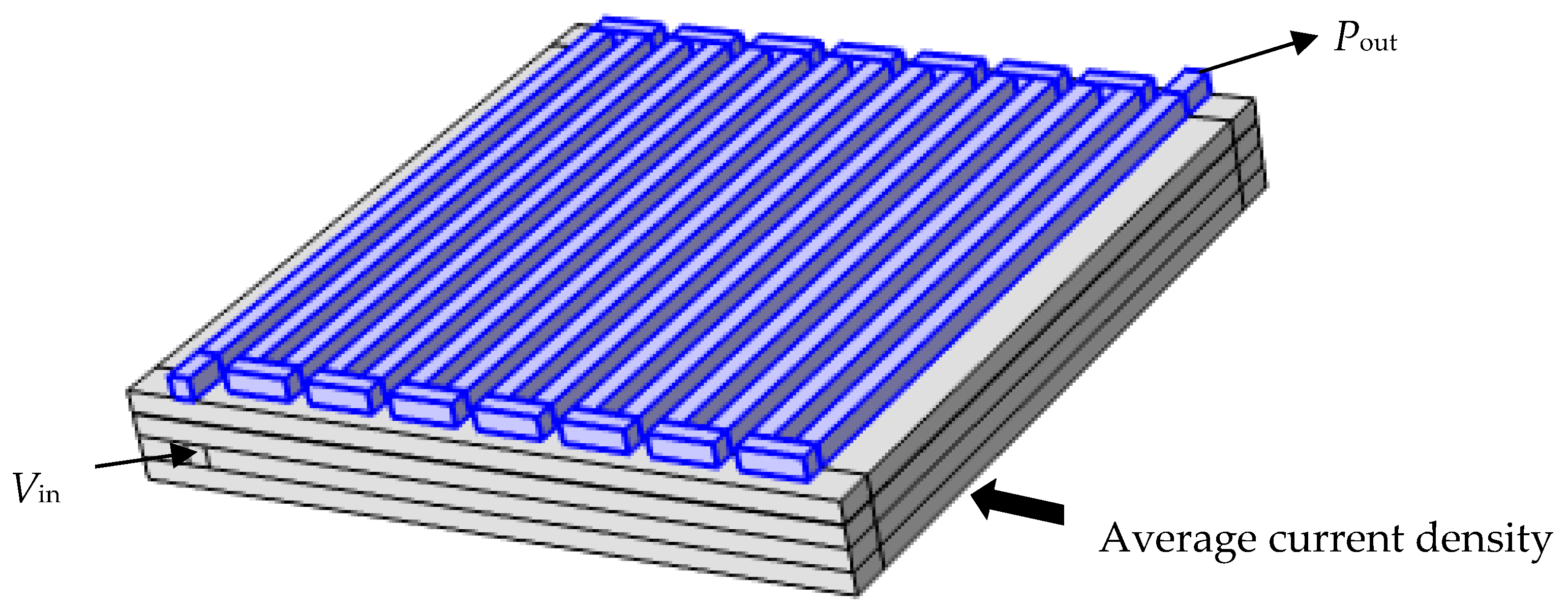
Figure 1. Schematic diagram of the computational domain and boundary conditions.
Symmetry 18 00024 g001
Figure 2. Charge–Discharge Cell voltage vs. State of Charge Diagram, where black squares indicate an applied current density of 50 mA/cm2, red circles indicate an applied current density of 40 mA/cm2, and blue triangles indicate an applied current density of 30 mA/cm2.
Symmetry 18 00024 g002
Figure 3. Snake-shaped flow channel VRFB positive electrode carbon felt and flow channel coordinates along the z-axis (carbon felt thickness: 3 mm; XZ plane views of other flow channel VRFB types are identical).
Symmetry 18 00024 g003
Figure 4. Velocity Distribution Map of the Serpentine Flow Channel VRFB at the Contact Surface Between the Positive Carbon Felt and the Flow Channel.
Symmetry 18 00024 g004
Figure 5. Velocity distribution map of the serpentine flow channel VRFB in the positive electrode carbon felt (inlet at upper right corner): (a) z = 0.5 mm; (b) z = 1 mm; (c) z = 1.5 mm; (d) z = 3 mm.
Symmetry 18 00024 g005
Figure 6. Relationship between Charging/Discharging Cell voltage and Flow Rate.
Symmetry 18 00024 g006
Figure 7. Relationship between average concentrations of vanadium ions at different oxidation states on carbon felt and in flow channels versus flow velocity. (a,b) show average concentrations on carbon felt, while (c,d) show average concentrations in flow channels (SOC = 0.5).
Symmetry 18 00024 g007
Figure 8. Relationship between SOC and the uniformity of various valence states of vanadium ions in carbon felt and flow channels.
Symmetry 18 00024 g008aSymmetry 18 00024 g008b
Figure 9. Relationship between the uniformity of various valence states of vanadium ions in carbon felt and flow channels and flow velocity (SOC = 0.5).
Symmetry 18 00024 g009
Figure 10. Relationship between the uniformity of various valence states of vanadium ions in carbon felt and flow channels and flow velocity (SOC = 0.2) (inlet flow rate: 40~300 mL/min).
Symmetry 18 00024 g010
Figure 11. Relationship between the uniformity of various valence states of vanadium ions in carbon felt and flow channels and flow velocity (SOC = 0.8) (inlet flow rate: 40~300 mL/min).
Symmetry 18 00024 g011
Table 1. Physical Field Parameters of Three-Dimensional Vanadium Redox Flow Batteries.
ParametersNumerical ValueUnits of Parameters
Diffusion coefficient of V2+2.4 × 10⁻¹⁰m2/s
Diffusion coefficient of V3+2.4 × 10⁻¹⁰m2/s
Diffusion coefficient of VO2+3.9 × 10⁻¹⁰m2/s
Diffusion coefficient of H+9.3 × 10⁻⁹m2/s
Diffusion coefficient of SO42−1.3 × 10⁻⁹m2/s
Diffusion coefficient of HSO41.1 × 10−9m2/s
Degree of dissociation of HSO40.251
Dissociation rate parameter for HSO410,000mol/(m3 × s)
Membrane proton concentration1.99mol/L
Initial negative concentration of H+4447.5mol/m3
Initial positive concentration of H+5097.5mol/m3
Initial negative concentration of HSO42668.5mol/m3
Initial positive concentration of HSO43058.5mol/m3
Electrode porosity0.61
Pump efficiency0.91
Permeability1.0 × 10−10m2
c_total (Total vanadium concentration in the positive and negative electrode electrolytes)1500mol/m3
Initial concentration of V2+SOC × c_totalmol/m3
Initial concentration of V3+(1 – SOC) × c_totalmol/m3
Initial concentration of VO2+(1 − SOC) × c_totalmol/m3
Initial concentration of VO2+SOC × c_totalmol/m3
SOC (State of Charge)0~11
Anode reaction rate constant1.7 × 10−7m/s
Cathode reaction rate constant6.8 × 10−7m/s
Electrode conductivity1000S/m
Electrode specific surface area2.0 × 105m2/m3
Table 2. Geometric Parameters of Three-Dimensional Vanadium Flow Batteries.
ParametersNumerical ValueUnits of Parameters
Channel width3mm
Channel depth3mm
Rib electrode section width3mm
Electrode thickness6mm
Ion exchange membrane thickness0.18mm
Electrode edge length100mm
Disclaimer/Publisher’s Note: The statements, opinions and data contained in all publications are solely those of the individual author(s) and contributor(s) and not of MDPI and/or the editor(s). MDPI and/or the editor(s) disclaim responsibility for any injury to people or property resulting from any ideas, methods, instructions or products referred to in the content.