1. Introduction: The Laws of the Game and How the Principles of Nature Govern Chance
In 1975, the original German edition of
Laws of the Game: How the Principles of Nature Govern Chance by M.Eigen and R.Winkler [
1] was published. One of the aims of the book was to highlight how the fundamental principles governing the organization and regulation of biological processes transcend molecular details. In this respect, the text anticipated many ideas that are now central to complexity science, offering a unifying view of nature in which physical, chemical, and biological dynamics can be interpreted as different manifestations of the same balance between order and randomness.
The central idea is to describe natural phenomena through the metaphor of a game: nature evolves as a system that follows fixed rules, within which chance introduces variability and innovation. The “rules of the game” represent the fundamental physicochemical laws that define the space of possibilities, while random fluctuations determine which configurations are explored. In this framework, biological evolution is not understood as an exclusively genetic process, but rather as a general consequence of the tendency of complex systems to select, among many possible alternatives, those that are energetically more stable or functionally more efficient, or, sometimes, just a random one.
To illustrate this perspective, Eigen and Winkler employ a language inspired by game theory, drawing on examples from real games such as chess or backgammon, in which the outcome of a match depends both on the rules and on the contingent moves of the players. Similarly, nature does not act in a strictly deterministic manner but instead combines necessity and probability. In chemical and biological contexts, this translates into the fact that the formation of ordered structures—such as complex molecules or networks of autocatalytic reactions—arises from a dynamic balance between constraints and fluctuations. The concept of a “game” thus becomes a conceptual model for representing processes of selection and adaptation that operate even at molecular scale.
An innovative aspect of the book lies in the extension of these ideas to prebiotic processes. Eigen and Winkler hypothesize that environmental fluctuations—such as the cycles of humidity and temperature characteristic of the early Earth—may have acted as “players” capable of favoring certain molecular configurations over others. In this scenario, chemical selection would have operated as a filtering mechanism, stabilizing molecules or aggregates capable of self-replication or of catalyzing the formation of similar structures. This approach anticipates concepts that are now central to the chemistry of the origin of life, such as self-organization, molecular cooperation and spontaneous symmetry breaking.
It is worth remembering what is meant by spontaneous symmetry breaking: the term describes those situations where a mathematical description of a phenomenon is symmetric with respect to the values of a certain variable, but that predicts, for each realization of the phenomenon, a final value of this variable far from the symmetry point. An often-used mechanical analogy is that of a potential well with two symmetrically arranged minima, a central maximum and a ball that starts from the unstable point in the center. The equations of mechanics do not predict any asymmetry but inevitably a specific ball will fall into only one of the two minima, breaking the symmetry. The concept has been used very effectively in elementary particle physics and condensed matter physics [
2], and more recently it has found application in explaining the irreversible choices made by molecular systems in the context of chemical evolution [
3,
4]. The most important example is that of the breaking of chiral symmetry: at a given moment in prebiotic evolution or later in life, biochemistry must have opted for the almost exclusive use of L-amino acids and D-sugars [
5,
6,
7,
8]. Naturally, the most advanced form of symmetry breaking relevant to the life sciences is the spontaneous organization of otherwise uniformly distributed matter [
9,
10,
11].
From a conceptual standpoint, Eigen’s and Winkler’s contribution consists of proposing a bridge between the thermodynamics of open systems and evolutionary biology. They emphasize that vital processes cannot be understood except under nonequilibrium conditions, in which available energy drives fluxes and reactions that maintain the internal order of the system. Life, in this interpretation, represents a natural strategy for delaying the achievement of thermodynamic equilibrium, using information and selection to organize matter into highly complex structures. The rules of the game thus correspond to the laws of thermodynamics and chemical kinetics, while the “game” itself is played through the interaction of fluctuations, feedback, and adaptation.
The analogy proposed by Eigen and Winkler also has a methodological meaning. It makes it possible to model complex phenomena in terms of strategies and outcomes, thereby making the study of competition among different reactive mechanisms or molecular configurations more accessible. This framework can be linked to modern models of self-organization, in which the collective dynamics of many simple entities lead to the emergence of globally ordered structures.
Modern tools allow the re-examination of the original games, shedding light on the role played by stochastic factors—particularly large fluctuations that, in certain cases, determine a form of selection interpretable as the victory of one player over two or more competitors.
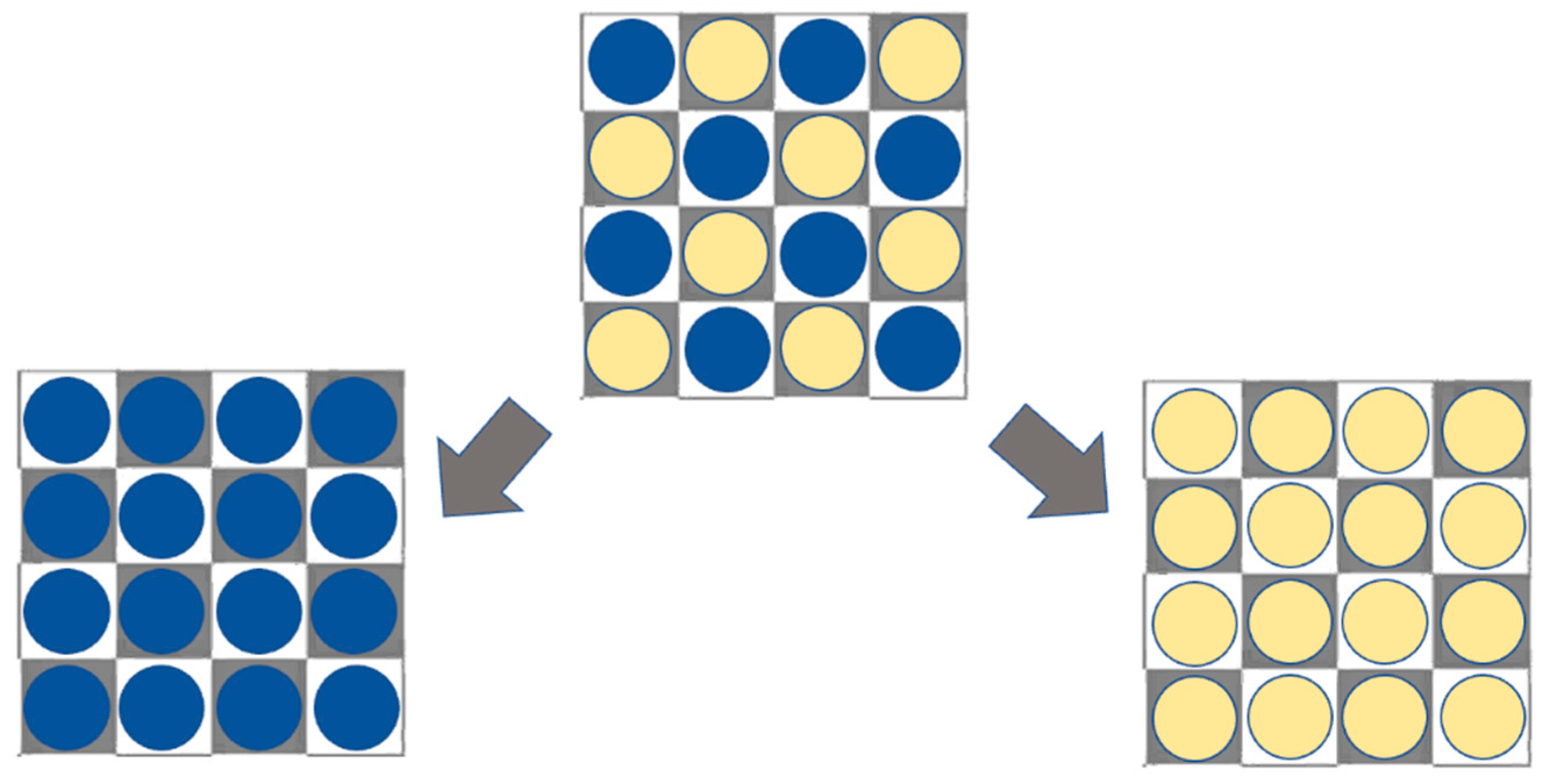
Fifty years on, the board games proposed in the book can still provide a foundation for modeling phase transitions and symmetry-breaking phenomena associated with prebiotic chemistry. This is illustrated by
Figure 1, inspired by the graphics in Eigen and Winkler’s book. The simulations of this paper are based on standard 8 × 8 boards.
Within this perspective, the rule of nature’s game is not rigidity, but capacity to evolve: a dynamic balance between stability and variation that constitutes the very condition for the existence of chemical and biological organization. The pieces become representations of proteins or biomolecules capable of autocatalytic reproduction, while the board represents a chemisorption substrate or a vesicular lipid bilayer membrane.
In this modern context, the original two-dimensional structure is not necessarily preserved, thereby allowing—without entering molecular details, in the spirit of the original text—the study of effects related to the primary and secondary structure of proteins, their interactions from a coarse-grained perspective and the spatial organization of amphiphilic and peptidic rafts.
The nonequilibrium day/night and dry/wet fluctuations that characterize some of these systems thus become the selective driving force and may contribute to an understanding of the origin of peptides, sugars and their biological homochirality within an abiogenetic evolutionary scenario.
“Freedom needs order just as much as it needs room for innovation. Since there is no mathematical formula for calculating justice in advance, justice can be realized only through an evolutionary process. In every phase of this evolution, the new must prove itself against the old. This is how life originated. This is how Homo sapiens developed. Only in this way can we achieve a life of freedom and put an end to degrading dependencies and exploitation.”
2. Monte Carlo Models of Selected Games
Although the text refers to games being played, it does not present in detail the outcomes of such games. Therefore, the Monte Carlo method was employed to produce well-defined statistical results.
A Monte Carlo simulation is a numerical procedure that uses random numbers to sample the configuration space of a system according to a given probability distribution. The algorithm generates a sequence of configurations, updated through stochastic rules. This approach makes it possible to estimate average quantities and correlations even in models with many degrees of freedom, for which an exact analytical treatment is not achievable [
12].
Accordingly, in our Monte Carlo simulations many games are played simultaneously on an equal number of boards, using random numbers. The statistical results are represented graphically as functions of the number of moves, yielding histograms.
In addition, we propose a theoretical basis for the statistical behavior of the games, which will be addressed in the following section.
Four games are analyzed:
Random Walk,
Equilibrium,
Once and for All and
Selection. Their potential chemical and biochemical interpretations will be discussed in a subsequent section, whereas here they are examined for their nominal value (
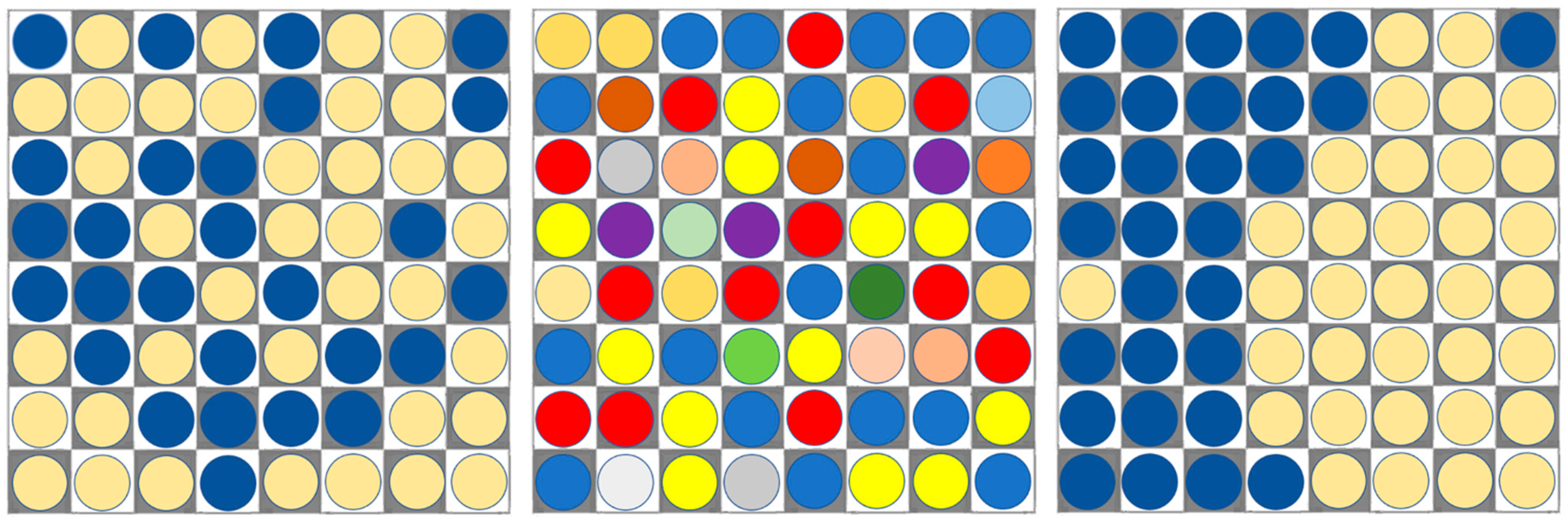
Figure 2).
The Random Walk game is based on the following rules. A square board with 64 squares and two sets of pieces, one yellow and one blue, is used. Each player owns 64 pieces, placing 32 on their respective half of the board and keeping the remaining ones in reserve. Initially, half of the board is occupied by yellow pieces and the other half by blue pieces. At each turn, a coin is tossed: if heads show, yellow removes a blue piece and replaces it with a yellow one; if tails show, blue replaces a yellow piece with a blue one. To obtain reliable results, the game must be allowed to proceed for a very long time, since premature interruption may lead to biased conclusions.
As a preliminary observation, in this game the board has only a formal role, and the only relevant quantity is the number of pieces belonging to each player. It could therefore be regarded as a game of pieces in a sack or urn rather than a board game. Nevertheless, we formally introduce the board since this step is also required for subsequent simulations and for consistency with the exposition adopted by the authors of the original text. Accordingly, the board is represented by an abstract matrix with 8 rows and 8 columns, whose elements take values zero or one to represent pieces of the two colors. If one of the players gains a piece, the program randomly searches—possibly through several attempts—for a square containing an opponent’s piece and replaces it with the value corresponding to the color of the player who won the turn. This entire procedure is repeated automatically many times, on the order of , so that, for a predefined number of moves, the state of the game can be stored and, at the end of the parallel games, a statistical histogram can be obtained. The program records the value of the number of pieces of one player, denoted , at three predetermined time steps. The entire procedure is implemented in a program written in Fortran90, which ensures high execution speed, while the graphical aspects are handled using Python 3 scripts.
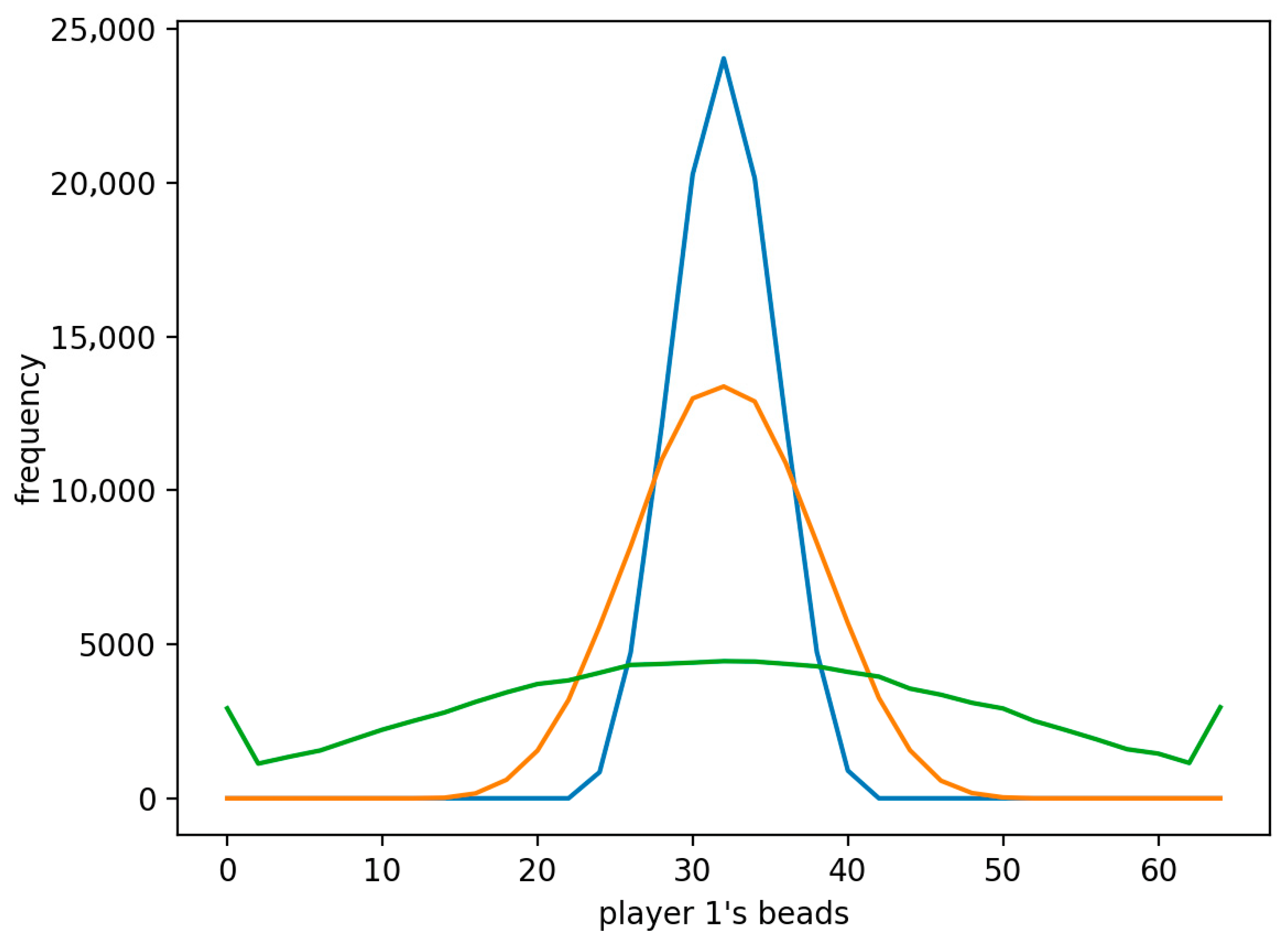
Results, shown in
Figure 3, display the diffusion of board situations starting from the initial one. The steady-state outcome is represented by a flat distribution: this is obtained by running the simulation for much larger times, but also evident from the rules and compatible with stochastic analysis described later in this paper.
In the Equilibrium game, the two players alternately place their pieces randomly on the board until all squares are occupied. Octahedral dice are then rolled to obtain two digits from 1 to 8, which identify a square on the board. The piece on the square indicated by the roll is replaced with a piece taken from the opponent’s reserves. The game ends at any time. Rules are defined to rate the players by a score, but they are not relevant here.
In this variant, the game is modeled as a direct replacement process between two types of pieces, initially distributed uniformly over the two halves of the board. The configuration is represented by an abstract 8 × 8 matrix with entries equal to 0 or 1 depending on the color occupying each square. At each move, a square is chosen at random: if it contains a piece of the first color, it is replaced with the second color and vice versa. This mechanism produces a very simple evolution, in which the total number of pieces of one color, denoted
, increases or decreases by one unit at each step. The evolution is halted either when one of the two colors occupies the entire board or when a maximum number of moves is reached. As in the previous model, the program records the value of
at three predetermined time steps, repeating the simulation for
independent games and constructing statistical histograms for the state of the system at different times. Results are shown in
Figure 4: starting from a concentrated ensemble corresponding to the initial state, the distribution spreads but only until it reaches an equilibrium distribution that remains centered around the midpoint, markedly different from the outcome of the previous game.
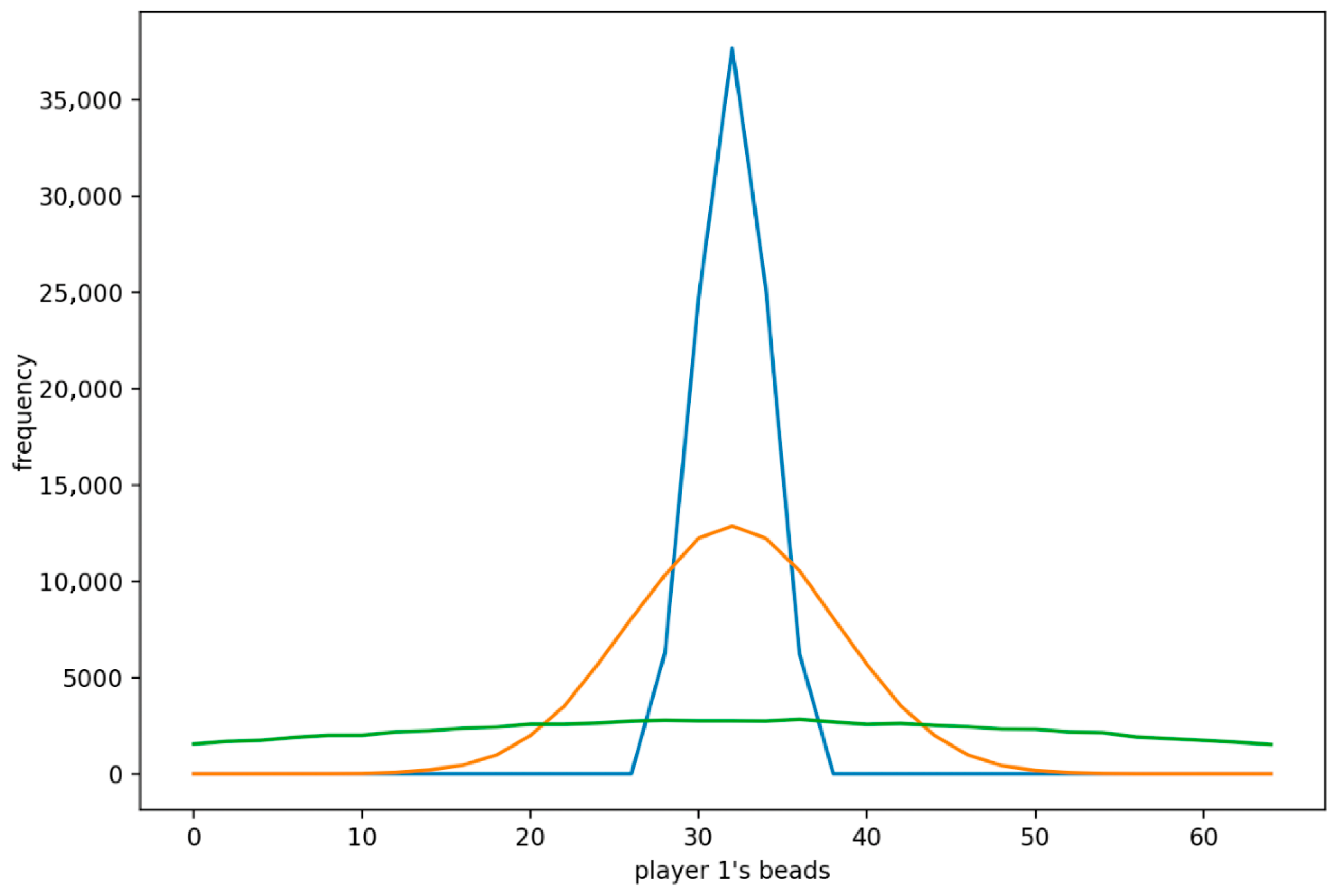
In the Once and for All game, as in the previous ones, a board with 64 squares and two octahedral dice is used. The only different rule concerns the exchange of pieces. Here the rule is inverted: instead of replacing the piece indicated by the dice with a piece of the opposite color, the selected piece is doubled at the expense of the other color. For example, if the dice indicates a square containing a yellow piece, yellow may remove any blue piece from the board and replace it with a yellow piece taken from its reserves. Numerous cooperative variants are possible, in which the formation of compact clusters of pieces on the board is favored; this is the subject of a following section.
In this variant of the program, the board is again represented by an abstract 8 × 8 matrix, initialized with 32 pieces of each color distributed over two distinct halves of the grid. At each turn, a square is chosen at random; if it contains a piece of a given color, the program randomly selects a square occupied by the opposite color and inserts there a piece of the color of the player who won the move. This mechanism implements a competitive replacement process that continues until the number of remaining pieces of one color reaches zero or sixty-four, or until a maximum number of moves is exceeded. During the evolution, the values of
, namely the number of remaining pieces of one of the two colors, are recorded at three predetermined times, updating the frequencies in a final statistical histogram obtained after
independent games. Results are shown in
Figure 5, showing the process of symmetry breaking involved (green curve) and which will be interpreted in more detail in the next section.
The Selection game also takes place on a square 8 × 8 board with two octahedral dice. The principle of the game emerges more clearly when multiple colors of pieces are used, up to 64 distinct ones. At the beginning of the game, all pieces of all colors are placed on the board in equal quantities. They are distributed randomly and fill all squares. In reserve, there are enough pieces for any single color to fill the entire board on its own.
The dice are rolled twice, and the following rules are applied. The piece selected by the first roll is removed from the board and placed in the reserve. The piece selected by the second roll is doubled, i.e., a piece of the same color is taken from the reserve and placed on the square freed by the previous roll.
The game ends when a single color has filled the entire board. Different values can be assigned to the colors (for example, red = 6, blue = 4, green = 2, yellow = 1) to determine a winner if the game is interrupted prematurely. In other versions, these values reflect selective advantages.
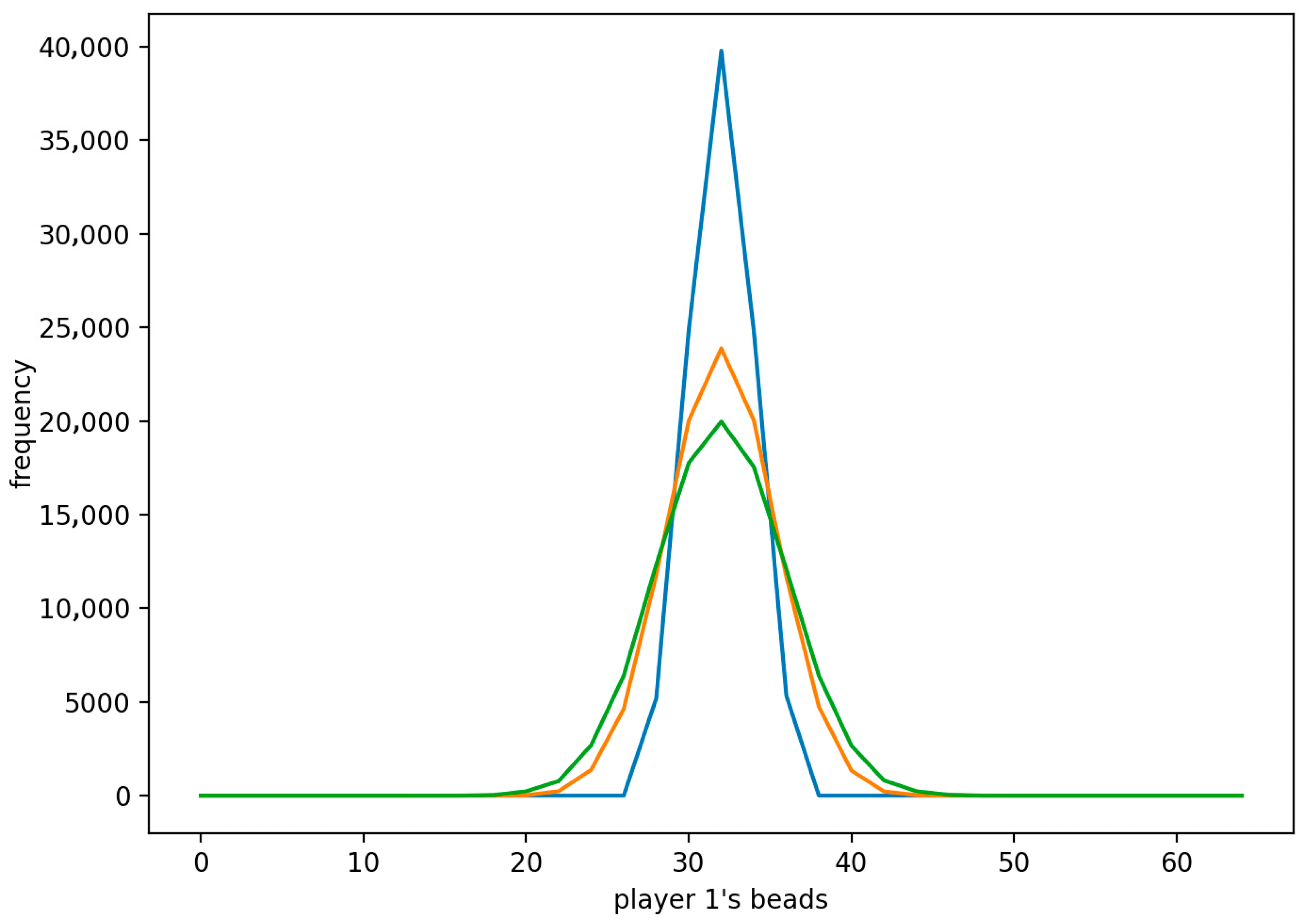
The computer model of the game represents a population initially composed of 64 distinct individuals, each identified by a unique number assigned to the 64 squares of an 8 × 8 matrix. At each step of the game, two squares are selected at random: if they correspond to different individuals, the individual selected first “replicates” and replaces the one selected second, which is thereby eliminated from the population. After each replacement, the code reconstructs the number of individuals still present, also computing how many distinct labels appear on the board. The evolution proceeds until only a single species remains or until a predefined maximum number of moves is reached. As in the previous cases, the simulation is repeated
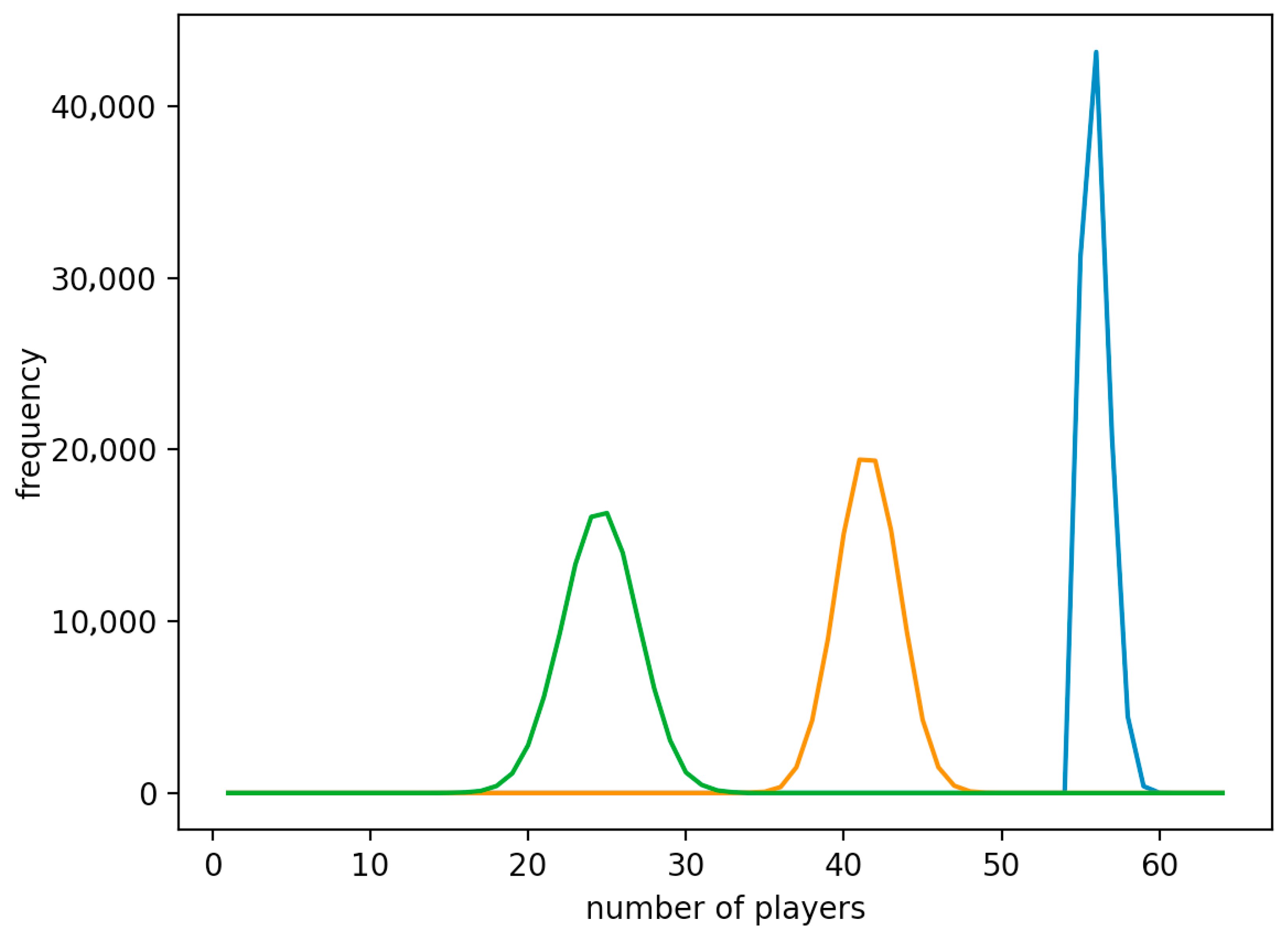
times and, at three specific time points, the number of distinct species still present is recorded to construct statistical histograms of the possible trajectories of the process. This allows us to highlight the reduction in species diversity over time, which is generated by such a dynamic. The results shown in
Figure 6 display relative narrow distributions drifting in time towards lower mean values, a process whose consequences will be discussed in the next section. The figure shows that the expected number of active species decreases over time with a rather low variance, so that at three stages of the game relatively narrow distributions and a general tendency towards a single active species are observed. Selective extinction, therefore, despite being significantly affected by fluctuations, is a process hardly effectively thwarted by other factors.
3. Board Games as Models of Chemical and Biological Processes
In this section, the book’s considerations regarding the value of each specific game as a metaphor, or model, for chemical or biological processes are extended and updated.
If we interpret the chessboard as a surface or medium in which reactions or biochemical changes are occurring, and the pieces as molecules, from a chemical kinetics perspective, it is easier to find an interpretation for those games in which board squares are primarily randomly selected. This is because, in this way, the species present in greater quantities are activated more often, and this is more plausible from a chemical kinetics perspective.
Equilibrium has a simple chemical interpretation: it is an isomerization reaction in which a molecular species exists in two forms that can be converted into one another, and a state of equilibrium is reached. The game highlights the fluctuations around this equilibrium state, which are described by a binomial distribution and, for large checkerboards, a Poisson distribution, which approximates a Gaussian distribution in the continuous case.
A strictly chemical interpretation of Random Walk is more difficult to obtain because it does not satisfy the chemical kinetics requirement of activating species present in higher concentrations more frequently. In this game, in fact, one species is necessarily converted into its opposite with a frequency independent of concentration. From the chemical kinetics perspective, this is a game-like description of a zero-order reaction. It is possible to imagine an enzymatic mechanism in which the active enzyme selects a monomer of one type to transform it into one of another: this is a somewhat artificial interpretation, and we can simply consider the first game as an introductory game. Moreover, in this case, the board visualization is here accessory, or auxiliary, because it involves a forward or backward random walk process.
As far as
Once and for all concerns, this game describes a different chemical reaction from the one previously considered: it is no longer an isomerization reaction but an autocatalytic reaction. It is, therefore, a scenario that has been frequently invoked in the description of symmetry breaking in biological systems and in the process, widely studied in the literature, of chiral symmetry breaking in the first macromolecules [
7,
13,
14,
15,
16,
17].
There are specific reactions that have been studied in the laboratory that realize this type of scenario in the field of prebiotic chemistry: the most important is the Soai reaction [
18]. It must be said, however, that this much studied reaction uses reagents that are not very plausible for the chemical environment of the primordial Earth. When studying such a scenario, it is probably more important to determine the kinetic and statistical behavior of the overall scenario rather than trying to identify the specific reactions at the time.
The
Selection game is very interesting from a biochemical perspective and beyond. In this game, we see a medium in which many species interact, initially present in equal concentrations. The game illustrates the fact that, even in a relatively short time, only one of these species will completely occupy the medium, while all variants will become extinct. This game illustrates a plausible mechanism for the prebiotic molecular evolution that led to the first life form capable of independent reproduction and nutrition, LUCA, the Last Universal Common Ancestor [
19]. In a certain sense, this explains the fact that all life forms currently present on the planet, from the most elementary to the most evolved, invariably use the same chemical mechanisms, in the form of nano-machines, namely proteins, and are very similar in many other respects, such as the transport of electrons and energy.
This game makes a good argument that primitive evolution has a tautological aspect: the very first molecular selection, as the game demonstrates, was largely determined by chance and not necessarily by greater functionality, in opposition to the paradigm of life that later established itself on this planet.
If this argument is accepted, it leads to the hypothesis that extraterrestrial biochemistry could be radically different from our own, even in a similar chemical environment. In recent years, the rules of this game have been used in simulations of pre-LUCA sequence evolution, reaching the book’s conclusions, thus supporting them, and confirming their importance.
Beyond the chemical interpretation, this game also serves as a transversal starting point for a sociological analysis: it illustrates that promoting any variety of a pool, by a totally impartial attitude, in a closed environment does not lead to greater diversity, but rather to the extinction of all but a few, or even just one, varieties.
4. Board Games as Diffusion Processes
In this section, we consider an aspect that is largely neglected in the book, namely the formal analysis of the proposed games from a theoretical perspective, viewing them as stochastic processes. Not only is this approach more consistent with modern methodologies, but, as we shall see, the theoretical analysis provides valuable intuition about the games themselves.
The games analyzed, independently of their possible material realization—which is often encouraged in the original text—are in fact theoretical constructions. Precisely for this reason, they can be fully virtualized, as has been performed in our numerical analysis. The abstract nature of these models also allows for a direct mathematical treatment: through analytical tools it is possible to obtain well-defined quantitative results, capable both of justifying the behaviors observed in the simulations and of providing additional elements of interpretation. At the same time, the choice of the most appropriate mathematical model for a given game plays an important role as a conceptual guide, since it highlights the essential structure of the selection process that these games are intended to illustrate.
In what follows, we adopt an approach that has been highly successful in many problems of chemical kinetics [
20]: it consists of replacing a discrete variable—in this case, the number of pieces—with a continuous variable having the same bounds. In this way, time-dependent probability problems can be solved as diffusion problems using partial differential equations.
An important concept, here as in the subsequent analyses, concerns the nature of the boundary conditions. The two endpoints of the interval (0 and 64) can be regarded as walls that constrain the evolution of the stochastic process. These walls can be of two types: either reflecting or absorbing. A reflecting boundary corresponds to the choice that the game does not terminate even when all pieces are of a single color; the process continues and, at least initially, is forced to move away from the reached boundary. By contrast, an absorbing boundary represents the situation in which a monochromatic configuration on the board is final and the game ends as soon as one of the two colors occupies the entire board.
These two choices lead to different mathematical descriptions of the underlying diffusion process since they modify the structure of the possible trajectories and the statistical properties of absorption or return toward the interior of the interval.
The
Random Walk game admits a particularly simple interpretation: its dynamics can indeed be viewed as a random walk [
21,
22]. At each move, the system takes a step forward toward the color of one player or a step backward toward the color of the other, independently of the instantaneous distribution of pieces on the board. From this perspective, the number of pieces belonging to a given player can be interpreted as the position of a particle moving along a one-dimensional axis x, with coordinates ranging from 0 to 64.
In this first game, if it does not terminate when all pieces are of the same color, the mathematical analysis is based on a diffusion equation, namely a second-order partial differential equation with Neumann boundary conditions, that is, with the derivative of the probability density vanishing at the boundaries.
where the diffusion coefficient is ½, based on the usual formula from diffusion theory [
23], which allows obtaining the diffusion coefficient for the continuum equation from a description of discrete events on a small scale:
where δx is the displacement in a time δt. In these games
since the number of player 1’s pawns changes by 1 in each move and
is the time corresponding to a move which can conventionally be taken as time unit.
In this and in the following cases, the initial condition is given by:
where δ is here a Dirac’s distribution which expresses the equal number of pieces of the two players at the beginning of the game. At long times, the solution to this problem is a function that takes a constant value between the two endpoints, which is precisely what is observed in the Monte Carlo analysis of the game. Indeed, to obtain a vanishing second derivative and a vanishing first derivative at the boundaries, a constant function provides a solution. At this point, by the uniqueness theorem, all solutions are constant, with the constant fixed by the normalization condition of the probability distribution. As long as the boundary conditions do not significantly affect the solution—whose value remains negligible in the vicinity of the boundaries—and thus for short times, the time-dependent solution is given by the analytical solution of the above problem:
We may ask, however, what would happen if a rule is changed, explicitly assuming that the game terminates as soon as a one-color configuration is reached. The observed outcome can be rationalized by considering the mathematics of a diffusion process with absorbing boundary conditions in Dirichlet’s form:
Consequently, a Gaussian distribution with increasing width is observed as long as the loss of probability at the boundaries remains negligible. At this point, the mathematical reasoning can be extended by invoking the concept of Fourier modes of the diffusion equation, namely the eigenfunctions of the Laplace operator, which in the present case are trigonometric functions that decay exponentially with different time constants. Their superposition reconstructs the desired probability distribution [
24]. At long times, an asymptotic argument can be applied: only the mode with the slowest decay, that is, the one with the largest wavelength survives. The distribution function describing the system at long times will therefore be a cosine function centered at the origin, with parameters chosen to satisfy the mentioned boundary conditions, namely such that the argument of the cosine is equal to π/2 for x = 64 and −π/2 for x = 0:
The decay constant
is obtained by substituting
in the diffusion equation:
The
Equilibrium game cannot be interpreted simply as a free diffusion process, since in this case the squares, rather than the pieces, are chosen at random. As a result, there is an inherent tendency for the configuration of the board to return toward an equilibrium state with an equal number of squares occupied by the two colors. In terms of stochastic processes, this situation can be formalized by means of a drift–diffusion equation, that is, a Fokker–Planck equation, which, in comparison with the simple free diffusion equation, includes an additional drift term describing the tendency of the systems to shift leftwards with a speed a(x):
In our case, a(x) must lead towards the equilibrium situation x = 32, therefore a change of sign at x = 32 is necessary. Moreover, it must be proportional to x − 32, because the probability that a color is chosen preferably increases as the advantage of the corresponding player increases. Furthermore, if the chessboard contains pieces of a single color necessarily in the next move the change is unitary and this allows us to fix the expression of the drift term.
The analytical problem can therefore be written in the following form:
And its solution is a stationary Gaussian distribution with a maximum at x = 32.
The
Once and for All game is like
Equilibrium in what the pawn selection is trough squares. This means that the player in the lead is the one who actually makes their move more often. But the move is in the opposite direction, and an increase in pawns of the same color is induced. The corresponding problem can be written in the following form:
where the drift term has been inverted in sign with respect to the model for
Equilibrium, producing an unstable behavior which at the end selects a single color on the board. This is coherent with
Figure 5 and is consistent with the original authors’ intention to use this game as a description of a symmetry-breaking process, a point to which we shall return in the following section.
One aspect highlighted by this mathematical analysis is consistent with the study of stochastic processes of chemical evolution by Ilya Prigogine, mentioned in the book itself. Prigogine noted that, in general chemical kinetics, the probability distribution of the number of molecules of a given chemical species, or of individuals of a biological species, does not remain close to the mean, following the trend described by the Poisson distribution, but exhibits very large variations, which require corrections to macroscopic chemical kinetics and enable selection processes that would otherwise be impossible due to the magnitude of Avogadro’s number [
9,
25].
This aspect, which Prigogine called a breakdown of the law of large numbers, is highlighted by our simulations: we observe probability distributions that under certain conditions easily reach the boundary conditions, while the case that Prigogine would have defined as “normal” corresponds to the stationary solution of the equilibrium game. The first case has a distribution with very fat tails and not an exponential decay like the Poisson distribution. The game shows that these tails of the distribution functions allow us to plausibly arrive at the complete selection of one of the two possible solutions, whereas in the case of an equilibrium distribution, the time needed to reach a selection would be immensely long.
The continuum model of the Selection game involves a drift-diffusion problem defined inside a P-1 dimensional polytope where P is the number of players. Boundary conditions are Dirichlet ones.
5. Emergent Space Structures
Eigen and Winkler repeatedly refer to the possibility of accounting for what they call cooperative effects, which ultimately result from the arrangement of the pieces on the board in games. As discussed in the text and as has been consistently demonstrated thus far, in this discussion the board does not actually have a spatial role, but simply that of a shelf serving to hold the pieces, which, however, exert an effect simply through their number. Accounting for what the authors call cooperative effects ultimately means modifying the rules of the game so that the actual arrangement of the pieces on the board influences the outcome. In technical terms, this means introducing spatial correlations. Obviously, this extends the scope of the simulated dynamics beyond those considered in the original presentation, but it is certainly promising, because spatial differentiation and the formation of compartments are consistent with most scenarios used to describe the origin of life.
One might think, for example, of the formation of the first cells starting from membranes that distinguish an interior from an exterior, or more simply of the fact that a compact group of individuals allows only those on the surface to be exposed to the hostile external environment [
26].
Several games considered in the central chapters of the book are dedicated to the spontaneous formation of complex structures in strongly correlated systems determined by proximity rules such as Conway’s Game of Life or other two-dimensional automata. These games require extremely advanced analysis from the perspective of the stochastic processes considered in this article, and we leave this as a future research perspective.
Consequently, we have added to this discussion a scenario in which, taking a liberty with the rules of Eigen and Winkler games followed to the letter until now, we have introduced rules that value the spatial proximity of the same player’s pawns. Dynamics of this type have been used in the literature to describe primordial homochiral selection scenarios based on random chessboard games [
13,
27,
28].
The minimal spatially correlated game formulated for this study is a version of Equilibrium in which the token chosen by initial selection of a square reproduces with its own color, possibly at the expense of another player’s token, but in its immediate vicinity, that is, necessarily in one of the eight surrounding positions. In addition, we assumed periodic conditions: these conditions imply that a square on the board that is on the edge is in fact in contact with the corresponding squares on the opposite edge.
This way the technical problem of the board edge is avoided and the eight surrounding positions can still be freely selected for any square.
Figure 2 shows the result obtained from a Monte Carlo simulation based on these rules. Ostensibly, and considering the periodic boundary conditions, here the two species have formed two compact and separated clusters, while the arrangement of the pieces in the canonical game is completely random.
Figure 2 also shows that the introduction of contiguity rules makes the breaking of symmetry partly a local concept, even in the absence of a victory by one of the two players: a restricted region of the chessboard can remain for long periods completely occupied by pieces exclusively of one or the other color.
This type of game finds correspondence in molecular simulations for the formation of transmembrane protein rafts: similar proteins interact well side-by-side due to intermolecular forces, while non-similar proteins have less tendency to attract each other. This type of scenario also shows that the kinetics of life and death do not necessarily have to be associated with actual chemical kinetics: species can be present in solution and be absorbed or desorbed by the membrane, thus appearing, or disappearing on the chessboard.
This first example shows the possibility of highlighting effects due to the spatial distribution of the agents on the substrate, opening a wide range of studies.
6. Impact on the Present Research on Biological Homochirality
Many works have proposed stochastic and autocatalytic induced symmetry breaking as the cause of selection of biological molecular features, particularly homochirality [
4,
7,
13,
15,
17,
27,
28]. After 50 years, some of the games proposed in Eigen and Winkler’s book still can bring out a conceptual framework that shows the essence of the mechanisms common to many, if not all, these models. This ability stems primarily from the book’s ambition, which is to show that the logic underlying complex biological or prebiotic interactions transcends molecular details. This message, echoing ideas just arising then in the context of complex systems science [
29] is quite general and extends to the entire range of games presented in the text, far beyond those that lead to a symmetry breaking, which the present authors have focused on in this work. With this focus, the logical mechanism can be made explicit, using the analogy between games and stochastic processes and the technique of mapping a discrete space of states into a continuous one, much within the grasp of mathematical analysis. This is an approach rich in potential and this work should be considered only as a start in this direction. In this view, the essential role is often played by boundary conditions and for this to be the case, the diffusion process must reach frequently the boundaries on which these conditions are formulated. These two simple considerations highlight two unifying aspects that can be applied to the literature mentioned above. That is, first, the game must terminate to make symmetry breaking irreversible: this corresponds to appropriate Dirichlet boundary conditions for the diffusion problem and specific rules for a game, which imply equally specific prescriptions for chemical kinetics. Autocatalysis as a chemical or biological mechanism is compatible with these requirements because a chemical or biological variant does not reappear once it has become extinct, unless hypotheses of isomerization or mutation, respectively, are introduced. The
Equilibrium game shows us that with entirely plausible chemical-kinetic hypotheses compatible, for example, with an isomerization process, the diffusion process may not reach the boundaries and consequently avoid a selection or symmetry breaking process even if these boundaries are terminating. This is another way of formulating Ilya Prigogine’s intuition regarding the importance of the large fluctuations that can emerge from chemical kinetics: these are essential for the boundary conditions to be decisive. In this work, we have shown that one way to express this difference is to check that the chemical kinetic game is described by a pure diffusion equation rather than a Fokker-Planck equation with a drift towards a point away from the boundary. Autocatalysis, however, is not the only mechanism with diffusive behavior: the
Random Walk game, although based on a molecular selection process that is more cumbersome to interpret from a prebiotic perspective, produces a pure diffusion equation. The two games differ in their boundary conditions, which can, however, be modified: the
Random Walk game will essentially behave like
Once and For All if we assume that the game ends when one player loses. This means that radically different physical-chemical hypotheses may produce similar trends: then it becomes difficult to distinguish them within the context of the planet’s chemical history, especially given that we would hardly, if ever, have fossil traces from such a remote era.
7. Conclusions
Eigen and Winkler’s book, now celebrating its 50th anniversary, is a transversal manifesto of ideas that have found their way into complexity theory over the past decades. From this perspective, every complex system unfolds its dynamics in a configuration space made accessible by projecting the underlying laws onto its natural scale. These laws, however, could produce similar projections even if they were substantially different. In recent years, it has become increasingly clear that this logical independence of different scales allows for a natural approach to understanding and modeling systems. It has long been recognized that, although the laws of fundamental physics at the scale of elementary particles are essential to understanding the world, they are more likely to perform this function through the creation of concepts, metaphors and methodologies, rather than through the literal description of the world at the microscale. Among these concepts is, of course, that of spontaneous symmetry breaking. We have considered here only a small portion of the book’s themes, in its very first chapters. This allowed us to demonstrate the productive potential of the ideas presented. In conclusion, it is truly remarkable that the metaphors of a book now 50 years old can so directly raise questions that current literature is at the same time reconsidering and tending to sidestep.