1. Introduction
Separation axioms in the theory of topology are mostly formulated to recognize non-homeomorphic topologies. If there are two topological spaces such that one satisfies a separation axiom but not the other, these two topologies are not homeomorphic. These axioms have received great interest from topologists for a long time. A topological space that satisfies is called a -space for short.
Recently, in [
1], the author offered a special kind of structure called generalized primal topological spaces. This structure possesses all the properties of a generalized topology in the sense of a new topological structure called “primal collection.” Then, Al-Saadi and Al-Malki [
2] studied some types of weak open sets based on an operator employing primal, which satisfied Kuraski’s closure axioms. The concept of “continuity” has gained a lot of attention for its importance in topology. Several types of generalized primal continuous functions are described in [
3].
In this study, we continue our work to clarify the notion of “separation axioms” in this new structure. This paper contains five sections, presented as follows.
Section 1 contains two sub-sections. The first deals with previous studies on which this scientific paper was based. The second includes a recall of the basic concepts and results.
Section 2 presents several types of separation axioms, which are based on the concept of
-set. Next, we study the relationship between them and the
axioms for
We also introduce
for the
axioms, which are based on the concept of closure. In
Section 3, we present the definition of
-
-set and
-
-set, which leads us to new and multiple types of axioms. In
Section 4, we present the fundamental theorem and propositions that are connected between the
-continuous function and the
-homeomorphism function and the separation axioms. Finally, we discuss the conclusions of this research.
1.1. Literature Review
Over the years, various classical mathematical structures have appeared. The mathematical construction “grill” [
4] was introduced as a useful tool for investigating topological concepts with significant applications in the field of topology. Building on this, Acharjee [
5] introduced the dual structure, called a “primal”, in 2022. A collection
of
is named a primal over
X when the following requirements hold for all
: (i)
X never belongs to
; (ii) if
and
, then
; (iii) if
, then either
A or
B belongs to
. A primal topological space (
space) is defined as the triple
.
In 1997, Császár [
6] established the notion of generalized topological spaces, (
spaces), where a family
of subsets of
X satisfies the following: (i) ∅ (the empty set) always belongs to
; (ii) any union of members of
is also a member of
.
is considered a generalized topological space. According to [
7], each element in
X is called a
-open set, and
-closed refers to its complement. Respectively,
and
denote the closure and interior of
A.
Various studies have investigated the topological properties of generalized spaces. In particular, separation axioms have been explored extensively. For example, ref. [
8] introduced early forms of generalized separation axioms, ref. [
9] examined their extensions in different contexts, ref. [
10] focused on applications of these axioms in specific topological structures, and ref. [
11] analyzed neighborhood structures under these axioms. Separation axioms have also been extended by substituting the concept of open sets with more generalized expressions [
12,
13]. Several forms of generalized continuity have been studied: contra generalized continuity [
14], almost generalized continuity [
15], and strong generalized continuity [
16].
Although both
and
have been studied extensively, their integration has not been systematically explored. Generalized primal topological spaces (
spaces), introduced by [
1], combine the structural constraints of
with the flexibility of
, resulting in a unified framework where classical concepts such as separation axioms and continuity can be independently developed and analyzed. This integration allows us to investigate how primal collections influence generalized notions, filling a gap in the literature. In particular, three previous studies [
1,
2,
3] addressed foundational aspects of
spaces: ref. [
2] studied a collection of new generalized structures, and ref. [
3] focused on continuous functions and their generalizations in
spaces.
While these studies have significantly advanced the understanding of classical and generalized structures, they do not fully integrate the effects of primal collections. Therefore, spaces offer a novel framework where separation axioms can be independently developed and analyzed. This work aims to fill this gap and highlight the influence of primal collections on classical topological notions.
1.2. Preliminaries
First, let us recall some basics about spaces.
Definition 1 ([
1]).
A generalized primal topological space, or ( space), is a generalized topology and a primal defined on The indication symbolizes the space. Definition 2 ([
1]).
Let be a space with and we have the following:- (i)
This structure’s members are called -open sets. The complement of -open sets is called -closed sets.
- (ii)
symbolize the family of -closed sets.
- (iii)
symbolize the closure of Hence, is given as the intersection of all -closed sets which contain A.
- (iv)
A space is named strong if where
- (v)
An operator is called a generalized primal neighborhood of x, if for each
- (vi)
An operator is defined by
Definition 3 ([
3]).
Let X and be spaces. A function is known as -continuous if for each -open set is -open. Also, when
f is
-continuous, we get
Moreover,
-continuity of
f leads to
then
Definition 4 ([
3]).
A function is known as -closed if for each -closed set U in the image is -closed in It follows from the above definition that
f is
-closed iff
for all
2. Separation Axioms
Sarsak [
17] studied the separation axioms:
-
,
-
,
-
,
-
,
-
,
-
,
-
, and
-
in generalized topological spaces. In this section, we study the alternative definitions of these kinds of separation axioms in a generalized primal topological space. Also, we investigate the main features of them.
Definition 5. Let be a space with A is known as a -set when we have -open sets U and V satisfies with .
Note that every -open set is -open. Moreover, a space X is known as - if for each with there exists a -set U of X that satisfies or vice versa. However, since a -set is always contained in a space in which contains more than one point trivially does not have the property -.
Example 1. ConsiderWe have that is a space. Then, the family of -open sets coincides with , and henceConsequently,which is an infinite set. Since every -set is of the form , where U is a -open set with , it follows that every -set is contained in . Hence, no -set can separate any two distinct points of . Therefore, the space does not satisfy the - property.
Hence, we present the notion of - for as follows:
Definition 6. Let be a space; X is known as
- (i)
- if for each there exist -sets U and V satisfying and
- (ii)
- if for each there exist disjoint -sets satisfying and
Definition 7. Let be a space. Then, X is known as
- (i)
- if for each there exists -open set containing precisely one element of x and y;
- (ii)
- if each there are -open sets U and V satisfying and and and ;
- (iii)
- if each there are disjoint -open sets U and V satisfying and ;
- (iv)
-regular if for each -closed set F and there are disjoint -open sets U and V satisfying and ;
- (v)
-normal if for all -closed sets A and B satisfying there are disjoint -open sets U and V satisfying and
Remark 1. Let be a space. When
- (i)
X is - it is -;
- (ii)
X is - it is -;
- (iii)
X is - it is -
Theorem 1. Let be a space.
- (i)
X is - iff X has the - property;
- (ii)
X is - iff X has the - property.
Proof. (i) Consider X as - and Thus, there is a -set G satisfying Thus, there are -open sets and satisfying Thus, and If then is the required set. If , then and satisfies the matter.
The opposite direction follows from Remark 1.
(ii) Consider X as - and with . Then, there exist -sets and satisfies and Consider
where
and
are
-sets. Now,
implies
or
and
Now, if
, from
we get the next two cases:
- (1)
From
we get
From
we get
Also,
- (2)
and
We get
and
and
Moreover, if
and
, we get
and
and
The opposite direction follows from Remark 1. □
Corollary 1. Let be a space. When is - then it is -
Theorem 2. Let be a space. Then, X is - iff for every with we have Proof. Let
space be
-
Hence, for every
with
-open set
U satisfies
Thus,
is
-closed, with
, which implies
Hence,
Note that
Therefore,
□
Theorem 3. Let be a space. X is - iff for every is a -closed set.
Proof. Consider as -closed. Also, for each consider Thus, the complements of and are -open sets with and Therefore, the space is - □
Definition 8. Let be a space. A point is called -neat point if leads to
Remark 2. Let be a space. If X is - and has -neat point, then it is unique.
Theorem 4. Let be a space. If X is - and has no -neat point, then it is -
In
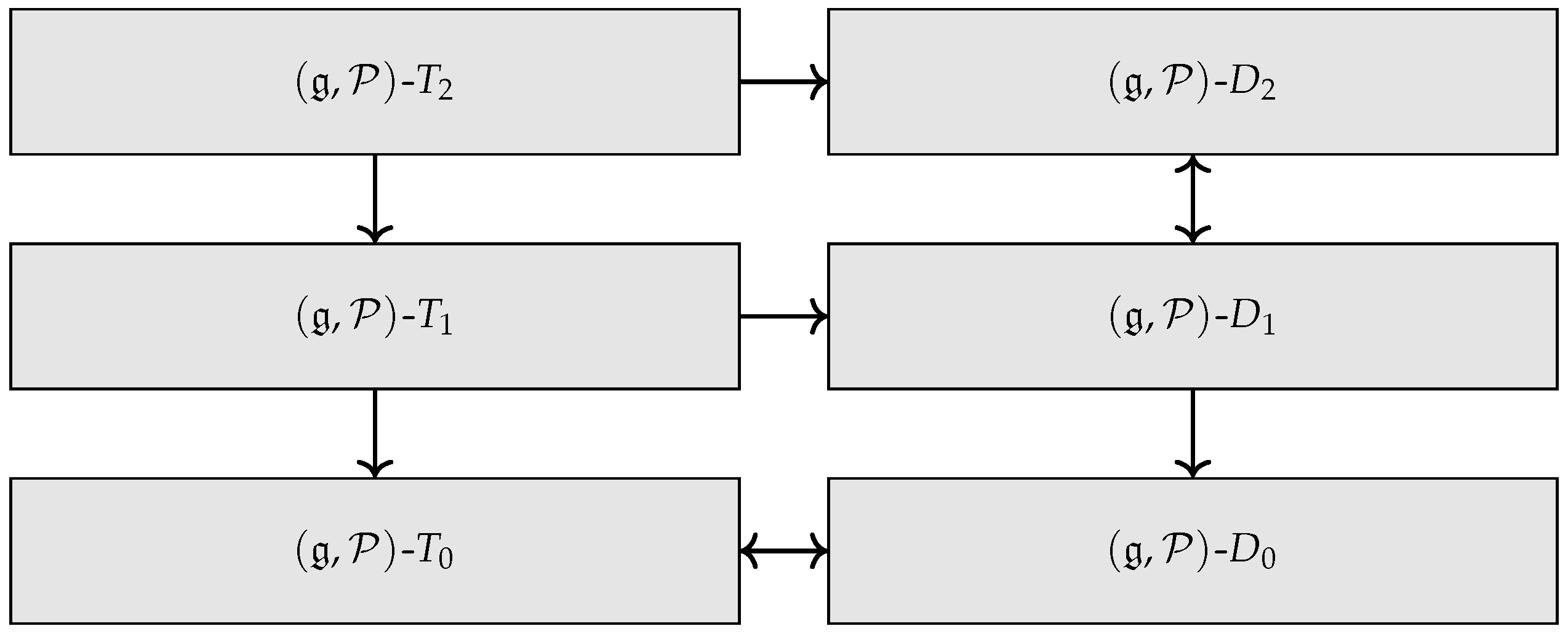
Figure 1, we present the relationship among the above notions in a simple way.
Example 2. Consider the infinite space defined as follows: - (i)
We show that for each pair of distinct elements in , there exists a -open set that contains exactly one of them. This proves that the space satisfies the - separation axiom.
Consider any two distinct points .
Case 1: One of the points is 1. Assume without loss of generality that and . Since any subset of containing 1 is -open and satisfies Thus, 1 is distinguished from any other point in X.
Case 2: Both points are greater than 1. Suppose and with . The set is -open because it contains the element 1. Moreover, Hence, n is distinguished from m by a -open set.
Since in both cases we can find a -open set containing exactly one of x and y, the space satisfies the - property.
- (ii)
The space is not -. Since every nonempty -open set must contain the element 1, no -open set can isolate any from 1. Thus, the - requirement fails for pairs . Consequently, the space cannot satisfy the stronger - property.
- (iii)
Since the space represents -, it also represents the --property, Theorem 1.
However, no pair of disjoint -open sets can separate all distinct elements of the space. Therefore, the space does not satisfy the - property, and consequently, it also does not satisfy the - property.
Definition 9. Let be a space. Then, X is known as
- (i)
- when implies - (ii)
- when for every satisfies there exist disjoint -open sets U and V satisfying
In a space that is not strong, it is impossible for the closure of any set to be contained in -open set, as is required in definitions of - and - Then, a that is not strong is not a - unless = ∅. Similarly, it is not a -
Theorem 5. Let be a space. Then,
- (i)
X is - iff it is - and -;
- (ii)
When X is - then it is -
Proof. The result is obtained as a direct consequence of Definition 7 together with Theorems 2 and 3. □
Definition 10. Let be a space. Then, X is called -symmetric if for each satisfying we get
Theorem 6. Let be a space. Then, X is - iff it is -symmetric.
Theorem 7. Let be a space. Then, X is - iff for every with there exist disjoint -open sets satisfying
Corollary 2. Let be a space. Then, X is - iff for every satisfying there exist disjoint -open sets U and V satisfyingand Corollary 3. In a - space X, the following are identical:
- (i)
X is -.
- (ii)
X is -.
- (iii)
X is -.
Corollary 4. In a space X, the following are identical:
- (i)
X is -.
- (ii)
X is - and -
- (iii)
X is - and -
Corollary 5. In a - space X, the following are identical:
- (i)
X is -.
- (ii)
X is -.
- (iii)
X is -.
Definition 11. Let be a space with The -kernel of denoted by - is given by Lemma 1. Let be a space with Thus, Lemma 2. Let be a space with Thus, Lemma 3. Let be a space with Then, Corollary 6. Let be a space. Then, X is - iff for every satisfyingthere are disjoint -open sets satisfying Theorem 8. Let be a space. Then, X is - iff every satisfyingleads to The following counterexamples demonstrate -spaces where the - and - properties fail, highlighting the role of the -kernel in understanding closure and separability.
Example 3. Consider the infinite -space defined by The closures of singletons are The -kernels areTherefore, this space does not represent the - property. this space does not represent the - property. Theorem 9. Let be a space. Then, X is - iff for each we getleads to Theorem 10. In a space X, the following are identical:
- (i)
X is -
- (ii)
For every satisfying there is a -closed set F satisfying - (iii)
Every has the property - (iv)
Every -closed set F has the property - (v)
Every has the property
Theorem 11. In a space, the following are identical:
- (i)
X is -;
- (ii)
When F is -closed, we get -
- (iii)
When thus -
Theorem 12. Let be a space. Then, X is - iff for each we get 3. More Types of Separation Axioms
Following the same approach, some researchers present different types of separation axioms in generalized topology, for example,
, weakly regular,
and
in [
18,
19]. Here, we will study them on
spaces.
Definition 12. Let be a space. A subset is known as a --set when A represents a countable intersection of -open sets. Moreover, its complement is known as a - set.
Definition 13. Let be a space. A subset is known as a regular --set ifwhere each in the sequence is a -closed set.Moreover, its complement known as a regular --set, which means that A is a regular --set ifwhere each is -open. Definition 14. Let be a space. A subset is called a --open set ifwhere each is a regular - set. Moreover, its complement is called --closed, which means that A is --closed when
where is a regular --set. Definition 15. Let be a space. A subset A is known as -d-closed if Lemma 4. Let be a space with The following are true:
- (i)
When A is a regular --set, thus , consider as --closed;
- (ii)
Each regular --set consider as a --set;
- (iii)
When A is a regular --set, thus , consider as -closed;
- (iv)
Each -closed set F satisfying , consider as a --set;
- (v)
Each -d-closed set consider as -closed;
- (vi)
Each --closed set consider as -d-closed.
Proof. The proof comes immediately from the definitions. □
Definition 16. For a space X with
- (i)
A collection contained in is called a -open complementary system if for every there exists a sequence in satisfying - (ii)
A subset A is known as strongly open --set when we have a countable -open complementary system satisfying . Moreover, its complement is known as a strongly closed --set.
- (iii)
Any intersection of a strongly closed --set is a --closed set. Then, each strongly closed --set is considered as --closed.
- (iv)
Each --closed set is considered as -d-closed.
The following examples illustrate infinite -spaces where certain new separation axioms hold, highlighting the role of -closed sets, - sets, and -kernels.
Definition 17. A space is called weakly - if Theorem 13. A space X is weakly - iff X has no -neat points.
Proof. Consider X as a space that is weakly - and X has a -neat point Thus, for every is a contradiction.
Conversely, let the space have no -neat points and not be weakly - Then, there exists a
Then, any
-open set containing
y must be
Thus,
y is
-neat point of
is a contradiction. □
Theorem 14. When a space X is - and weakly - then it is -
Theorem 15. A space is weakly - iff for each Proof. Consider
X as weakly
-
. Consider
as satisfying
According to Lemma 2,
is a contradiction.
Conversely, let for every x that belongs to If X is not weakly -, then according to Theorem 13, it has a -neat point Therefore,
Definition 18. A space is called
- (i)
- if for every -open set there exists -closed set F satisfying - (ii)
-weakly regular if it has a base is regular --set
- (iii)
- if for every -open V and for every there exists a regular --set F satisfying - (iv)
- if for all -open V and for all there exists a --closed set F satisfying - (v)
- if for all there exists a -closed set F satisfying is a --set with - (vi)
- if for all there exists a -d-closed set F satisfying - (vii)
- if for all -open set V and for all there exists a strongly closed --set F satisfying - (viii)
- if for all -open set V and for all there exists a --closed set F satisfying
Theorem 16. When a space X is - then it is -
Proof. Consider that
satisfies
Thus,
As the space is
-
thus
-
-closed set
satisfies
Thus,
and
for some
Now
where
is a sequence of
-closed sets. Then, there exists
such that
and
Then,
and
are required
-open sets. □
Example 4. Consider the space defined asFor each , define a descending sequence of -open sets:The corresponding -closures:Define the --closed set associated with x: So, for any -open set U with , there exists --closed satisfyingHence, this space represents - and, by Theorem 16, is also -. Theorem 17. A -weakly regular space is -
Proof. Consider
and
Thus,
Hence, there exists a regular
-
-set
F satisfying
Let
where
and
for some
Then,
Hence,
Therefore,
□
Theorem 18. When a space X is -regular, hence it is -
Proof. Consider
X is as
-regular with
Hence,
-open set
satisfies
Again
-regularity yields a
-open set
with
By induction we get a sequence of
-open sets
satisfying
Then, the set
is a regular
-
-set satisfying
□
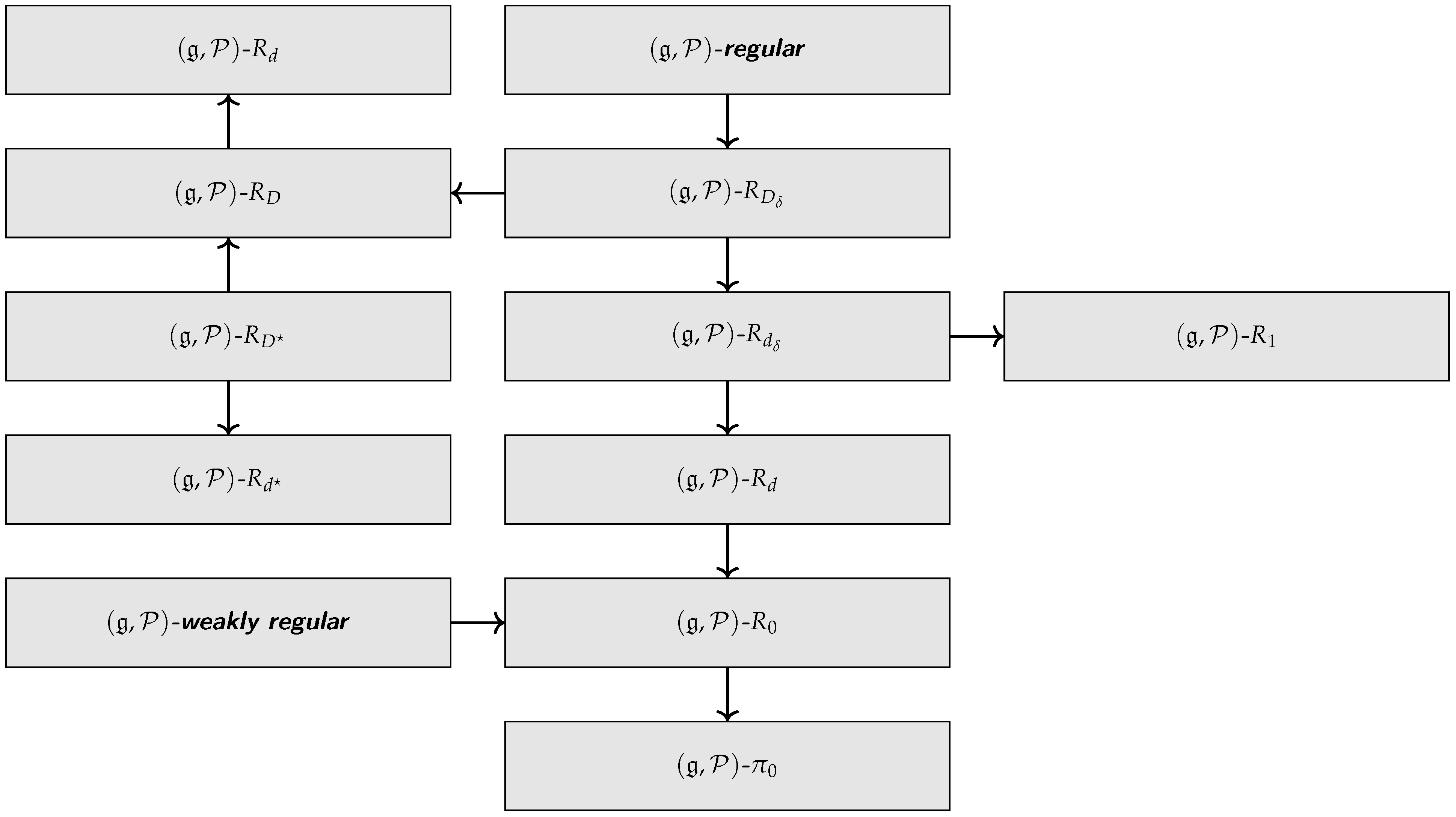
We can summarize the previous results in the following diagram (
Figure 2).
Example 5. - (i)
Let the base of -weakly regular sets be Each F is a regular --set (countable union of -closed sets). Every -open set U contains a set from the base . Thus, this space represents -weakly regular and, by Theorem 17, is also -, hence -
- (ii)
Define the closures of singletons as The corresponding -kernels are - does not hold for , since no - closed set satisfies for arbitrary U containing n, showing that -weakly regular ⇏- in this space.
- (iii)
Similarly, - fails for , showing that -weakly regular ⇏ in this space.
It is worth mentioning that focusing the study on special classes of sets whose definitions rely on the primal collection often leads to results that are particularly interesting. This is exactly the approach we shall adopt next. To begin, we first define the notion of a -open set within a GPT-space.
5. Discussion
In this section, we provide a brief discussion highlighting that certain classical axioms in spaces may differ when restricted to a primal collection. Based on this observation, we introduce relevant definitions and preliminary concepts to clarify the structural differences. This framework will allow us to systematically analyze the consequences of these restrictions.
Definition 20. In a space X, a subset is called -open if
Definition 21. A space X is said to be -Hausdorff if for any two distinct points , there exist two disjoint -open sets U and V such that and .
It is important to note that the relationships between separation axioms may differ when we restrict attention to -open sets. In particular, one property does not necessarily imply the other without specific assumptions on the primal collection.
Remark 3. A -Hausdorff space does not necessarily imply that it is -Hausdorff, and vice versa.
To illustrate, consider a subset
. If
, then
(see Theorem 3.1 [
1]), meaning that no set other than the empty set is
-open. Consequently, it is impossible to find two disjoint
-open sets containing two distinct points.
Furthermore, consider with and primal collection . This example demonstrates that a -Hausdorff space may fail to be -Hausdorff.
Within the framework developed in this paper, however, every -Hausdorff space is indeed a -Hausdorff space, while the converse does not always hold. To avoid ambiguity, we shall adopt the term -Hausdorff to refer to the new notion.
Definition 22. A space X is called -Hausdorff if for each pair of distinct points , there exist two -open sets and such that , , and .
From Definition 22, it follows that every -Hausdorff space is -Hausdorff, regardless of the specific primal collection.
Consider the infinite
space
Observe that without considering the primal collection, the space fails to be Hausdorff because it is impossible to find disjoint -open sets separating points . However, with the primal collection included, we can define -open sets that separate each point of X, ensuring that the space is -Hausdorff. This example clearly shows that the primal collection has a direct effect on separation properties, even in infinite spaces.