Article

Artificial Neural Network-Based Optimization of an Inlet Perforated Distributor Plate for Uniform Coolant Entry in 10 kWh 24S24P Cylindrical Battery Module


1
Department of Mechanical Engineering, Dong-A University, 37 Nakdong-Daero 550, Busan 49315, Republic of Korea
2
Faculty of Mechanical Engineering, Nha Trang University, 02 Nguyen Dinh Chieu Street, Bac Nha Trang Ward 650000, Khanh Hoa Province, Vietnam
*
Author to whom correspondence should be addressed.
These authors contributed equally to this work.
Symmetry 2026, 18(1), 14; https://doi.org/10.3390/sym18010014 (registering DOI)
Submission received: 28 November 2025 / Revised: 16 December 2025 / Accepted: 17 December 2025 / Published: 21 December 2025

Abstract

In this study, a multi-objective optimization framework based on an artificial neural network (ANN) was developed for an inlet perforated distributor plate in a 24S24P 10 kWh cylindrical lithium-ion battery module using immersion cooling. A combined Newman, Tiedeman, Gu and Kim with Computational Fluid Dynamics (NTGK-CFD) model was used to generate a symmetrically designed space by varying the input variables, including hole size A (mm), hole spacing ΔH (mm), and coolant mass flow rate Vin (kg/s). A three-level full factorial design was used to generate 27 cases, then CFD simulations were performed to provide a training data for the ANN model to predict the output variables, including maximum temperature Tmax, maximum temperature difference ΔTmax, and pressure drop ΔP. The results show that the ANN model provides a reliable predictive model, capable of reproducing the thermal-hydraulic behavior of the immersion-cooled battery module with high fidelity via correlation coefficients R of 0.997 for all three output variables. In addition, Pareto-based optimization shows designs that balance cooling efficiency and pumping power. The selected optimal solution maintains Tmax within the optimal range at 37.97 °C while reducing ΔP by up to 44%, providing a practical solution for large-scale battery module thermal management in EVs.

1. Introduction

Reducing carbon emissions in the transportation industry is a key issue for achieving environmental protection goals and mitigating global climate change [1]. In particular, the rapid electrification of road vehicles is a core lever alongside measures to use clean energy and reduce the need for fossil fuels. Therefore, with the outstanding advantages of zero emissions and high efficiency, electric vehicles (EVs) are considered a potential solution to replace vehicles using traditional internal combustion engines [2,3]. The global EV market is showing a strong acceleration with about 14 million EVs sold in 2023, accounting for 18% of the market share. According to the related report, sales are expected to reach about 17 million EVs in 2024 and will continue to increase in the coming years [4].
Lithium-ion batteries (LIBs) dominate EVs due to their high energy density, stable cycling performance, and long cycle life [5,6,7]. However, the performance, lifetime and safety of LIBs are closely dependent on their operating temperature. Reviews recommend controlling the battery’s operating temperature within the optimal ranges of 25 °C to 40 °C [8,9,10]. In addition, the maximum temperature difference (ΔTmax) within the battery module should also be maintained within the allowable range with ΔTmax not exceeding 5 °C [11,12,13]. Excessively high ΔTmax within the battery module can lead to reduced capacity, performance and lifetime of LIBs. Furthermore, to compete with conventional internal combustion engine vehicles, EVs must increase the capacity of their battery packs to augment their driving range and adopt fast charging strategies to shorten the charging time. However, during rapid charging or discharging, LIBs generate substantial heat. If this heat is not effectively dissipated, it can accumulate within the battery module, leading to localised overheating and accelerated performance degradation of the LIB system [14,15]. In addition, LIBs under overheating conditions can also lead to thermal runaway with temperatures reaching over 1000 °C, causing fire and explosion and destroying the battery pack [16,17]. Therefore, the development of effective battery thermal management systems (BTMS) plays an important role in ensuring the performance, extending the life and improving the safety of LIBs applications on EVs [18,19,20].
Common BTMSs include air cooling, PCM cooling, heat pipe cooling and liquid cooling [21,22]. Air cooling is divided into two types of natural convection air cooling and forced air cooling. With its simple structure, low investment requirements, and low operational and maintenance costs, air cooling has been widely adopted in BTMS for EVs [23,24]. However, air has a low heat transfer coefficient, resulting in poor cooling efficiency when the battery pack operates at high charge/discharge rates with rapid and continuous heat dissipation requirements. In addition, noise and uneven distribution of cooling air flow in the battery pack are concerns about this cooling system [25,26]. PCM cooling is a potential cooling method to effectively achieve thermal dissipation for LIBs through heat absorption and phase transition mechanisms. With the advantage of large latent heat, PCM can control and significantly improve the temperature uniformity in the battery pack [27,28]. However, the major drawback of PCM is its low thermal conductivity and heat storage instead of heat dissipation, resulting in a short cooling time or even ineffective cooling when the PCM mass has completely melted. To enhance the thermal conductivity and cooling efficiency of PCM, metal nanoparticles have been incorporated into PCM compositions. Additionally, hybrid cooling strategies that integrate PCM with active cooling systems have also been explored. However, these enhancements also lead to increased mass, volume and complexity of the cooling system [29,30]. Heat pipe cooling has the advantage of high thermal conductivity and no energy consumption through a passive heat dissipation mechanism. However, this benefit is reduced when integrated into battery systems at the pack level with larger heat dissipation capacity requirements, requiring integration with other active cooling systems and thus creating greater complexity and investment and maintenance costs for the cooling system [31,32].
Liquid cooling is the most common cooling method in current BTMSs for EVs. Liquid cooling is divided into two types are indirect liquid cooling and direct liquid cooling [33]. Indirect liquid cooling has a high heat transfer coefficient by using coolants with high thermal conductivity, such as water, water/glycol mixture, nanofluid, etc. Indirect liquid cooling cools the battery through cooling plates, cooling channels or cooling jacket structures. Due to its high heat transfer coefficient, indirect liquid cooling provides superior cooling efficiency compared to air cooling [34,35]. However, indirect liquid cooling systems have large thermal resistance because of the indirect cooling through cooling plate or cooling channel structure, which results in poor efficiency for battery packs with higher capacity or operating under harsh conditions. Additionally, the complexity in the design and layout of the cooling channel, the risk of fluid leakage and the trade-off of increased pump power are major barriers to the adoption of this cooling system [36,37].
Direct liquid cooling also known as immersion cooling is gaining a lot of attention as a superior cooling system for high-power battery packs in EVs [38]. Immersion cooling uses non-conductive and high heat transfer dielectric fluids to effectively dissipate the heat from the battery module. Immersion cooling enhances the heat transfer by allowing the dielectric fluids to come into direct contact with the surface of the battery cells, which completely eliminates thermal resistance and permits superior heat dissipation and maintains temperature uniformity across the battery modules. Compared to traditional air cooling systems, immersion cooling offers a higher heat transfer ratio up to 10,000 times, allowing for efficient heat dissipation and a great potential to prevent thermal runaway of LIBs under abusive conditions [39,40].
Zhao et al., experimentally evaluated the cooling performance of immersion cooling for a battery module consisting of three 18650-type cells. The research results showed that, compared with natural air, the immersion cooling method reduced the average temperature by about 26.3% at a discharge rate of 2C. In addition, the immersion cooling method with the optimized configuration effectively maintained maximum temperature (Tmax) and ΔTmax within the optimal range at 31.0 °C and 2.0 °C, respectively [41]. Li et al. evaluated the immersion cooling effect of cylindrical LIBs during fast charging. The results showed that immersion cooling effectively maintained the battery temperature within 33 °C under fast charging up to 3C [42]. Gao et al. numerically evaluated an immersion cooling system based on a stepped baffle structure for a cylindrical LIB module with an 8S3P configuration. The results showed that, at a discharge rate of 3C, the stepped baffle-based immersion cooling maintained Tmax at 36.42 °C and ΔTmax at 4.74 °C, providing up to 7.5% and 22.5% reductions compared to the cooling without baffles, respectively [43]. Wahab et al. evaluated the thermal performance of a cylindrical LIB battery with 16S1P configuration under different immersion cooling strategies. At a high discharge rate of 4C, Tmax was recorded as 45.7 °C for natural convection, 36.54 °C for forced air cooling, 40.38 °C for static immersion cooling, and 25.85 °C for forced immersion cooling. Moreover, at high discharge rates up to 8C, the observed Tmax results for the above cooling configurations were 57.56 °C, 48.51 °C, 51.06 °C, and 35.43 °C, respectively. Furthermore, increasing the coolant mass flow rate (Vin) from 0.5 LPM to 2 LPM optimally controlled the ΔTmax of the battery module at 4.13 °C with forced immersion cooling. Overall, forced immersion cooling provided the lowest Tmax increase and greatest temperature uniformity compared to the remaining cooling strategies [44]. Song et al. optimized the immersion cooling configuration for a cylindrical battery module consisting of 25 cells using ethylene glycol and evaluated the Vin and coolant inlet layout configurations. The results showed that increasing Vin from 0.005 L/s to 0.015 L/s reduced Tmax from 27.3 °C to 26.5 °C at a 1C discharge rate, from 31.0 °C to 29.0 °C at a 2C discharge rate, and from 35.9 °C to 32.6 °C at a 3C discharge rate. In addition, increasing Vin in the immersion cooling system also had a positive effect on the temperature uniformity in the battery module. Specifically, when increasing Vin from 0.005 L/s to 0.055 L/s, ΔTmax in the battery module decreased from 2.25 °C to 0.96 °C at 1C discharge rate, from 5.42 °C to 2.82 °C at 2C discharge rate, and from 9.82 °C to 5.34 °C at 3C discharge rate. Furthermore, the results of the coolant inlet arrangement also showed that the single inlet outperformed the dual inlet at 3C discharge rate with Tmax 32.8 °C and absorbed the highest heat compared to the remaining configurations with 81.5 kJ [45]. Mo et al. experimentally studied the forced-immersion cooling process for 4S4P battery modules under high ambient temperatures of 35 °C. The research results showed that, under high discharge rates of 2C and 3C, the static immersion cooling configuration controlled Tmax at 48.2 °C and 60.6 °C, respectively. Meanwhile, the forced-immersion cooling configuration provided further improvement with Tmax reduced to 34.2 °C and 40.2 °C at discharge rates of 2C and 3C, respectively. Furthermore, the forced-immersion cooling configuration with optimal coolant inlet arrangement also provides optimum temperature uniformity of the battery module at 4.7 °C under high discharge rates up to 3C. Overall, the forced-immersion cooling configuration provided optimal temperature uniformity and controlled the Tmax of the battery module within the allowable range, even under high discharge rates and harsh ambient temperatures [46].
Artificial neural networks (ANNs) offer fast and differentiable surrogate models that map geometric and operational parameters to thermal-hydraulic responses. This enables efficient multi-objective optimization, such as minimising Tmax, ΔTmax, and pressure drop (ΔP) with high computational efficiency and accuracy. In immersion cooling modules, ANN-driven frameworks have been used to tune geometric/flow parameters and balance thermal performances with energy usage. Recent BTMS studies combine Computational Fluid Dynamics (CFD) or experiments with ANN to optimize cooling structures and operating conditions. Tang et al. applied the ANN technique to optimize a BTMS with an immersion cooling strategy with parallel flow and horizontal flow guides for a battery module consisting of 40 cylindrical cells. The results showed that the ANN-based optimization model proposed optimal designs and predicted Tmax of 31.95 °C and ΔTmax of 3.74 °C for a single cell under a discharge rate of 2C. The predictions were highly reliable with less than 3% deviation. Compared to the previous battery modules with parallel and series arrangements, the optimized immersion-cooled battery module yielded a lower Tmax of 31.60 °C, ΔTmax of 2.57 °C, and a modest ΔP of 13.80 Pa [47]. Donmez et al. optimized an immersion cooling system for a 16S1P cylindrical battery module using an ANN under high discharge rate at 4C. The optimized immersion cooling configuration reduced ΔP by 88.6% compared to the baseline design at Vin of 0.008 kg/s, from approximately 40 Pa to 4.57 Pa, while keeping the Tmax of the battery module within the optimal range at 34.43 °C. At a higher Vin of 0.02 kg/s, the optimized configuration further improved Tmax at 31.21 °C, while the ΔP also showed a reduction of up to 68.4% compared to the baseline design at 0.008 kg/s [48]. Garud et al. presented an ANN model capable of predicting Tmax, ΔTmax, and voltage with high accuracy in the immersion cooling system for cylindrical battery modules with a 4S4P configuration. The results showed that the ANN-based prediction model achieved errors of less than 1% for Tmax and ΔTmax and about 0.9% for voltage. Moreover, under immersion cooling conditions with a coolant inlet temperature at 30 °C, Vin of 1 L/min, and a battery module operating under 4C discharge rate, the ANN model reproduced the full discharge curves with a Correlation Coefficient (R) of 0.999. Therefore, the study concluded that, due to the near-instantaneous inference process, ANN enables dense design scans and is well-suited for optimization coupling for rapid selection of operating points in immersion cooling systems [49]. Donmez et al. coupled CFD with ANN-based optimization to accelerate immersion BTMS design decisions for a battery module with a 16S1P configuration using dielectric coolant. In this model, the ANN was trained with input parameters such as coolant type, C-discharge rates, Vin, and predicted average temperature of the battery module. The results show that the ANN enables dense scanning to reveal operating rules, for example, increasing Vin from 0.001 kg/s to 0.01 kg/s at a 4C discharge rate reduces the average peak battery temperature from approximately 320.23 K to approximately 307.28 K and tightens the temperature difference between cells to less than 6 K. In addition, spatial field trends from CFD are preserved during the ANN-guided exploration, such as colder inlet battery rows near 304 K and warmer outlet battery rows, highlighting the need for routing refinement. The results also show that the ANN acts as a high-fidelity feedback surface that can be coupled with optimizers to target low peak temperatures and low temperature differences under flow and coolant constraints. Overall, the ANN reduces the evaluation cost exponentially with maintaining the accuracy below 1 K and provides a practical tool for optimizing BTMSs using the immersion cooling strategy [50].
Previous studies on immersion cooling have predominantly focused on single cells or small-scale battery assemblies. Systematic investigations of the thermal-hydraulic characteristics of large-capacity cylindrical battery modules remain limited and have not been comprehensively evaluated. Additionally, in high-energy and densely packed modules, the uneven distribution of coolant reduces heat transfer efficiency, thereby exacerbating temperature rises and temperature differences between cells within the battery module. However, the uneven distribution of coolant in high-energy modules has not yet been thoroughly investigated. To address these research gaps, the present study conducts a comprehensive thermal-hydraulic evaluation of a 10 kWh large-scale battery module comprising 576 21700-type LIB cylindrical cells under immersion cooling conditions. The thermohydraulic performance characteristics of battery modules with immersion cooling were comprehensively evaluated, including maximum temperature (Tmax), maximum temperature difference (ΔTmax), and pressure drop (ΔP). In addition, to thoroughly address the hot spots that form in large-scale battery modules, the current research has proposed a specialized inlet perforated distributor plate (IPDP) design to improve the uniform distribution of coolant inside the battery module and provide optimal cooling efficiency. Furthermore, an ANN-based surrogate model trained on CFD-generated data is employed in conjunction with Pareto-based multi-objective optimization to identify optimal design configurations that balance cooling effectiveness against hydraulic penalty, thereby allowing for superior thermal management while minimizing energy consumption. The current study provides essential guidelines and a practical solution for large-scale battery module thermal management in EVs with an advanced immersion cooling strategy.

2. Numerical Method

2.1. Computational Geometry

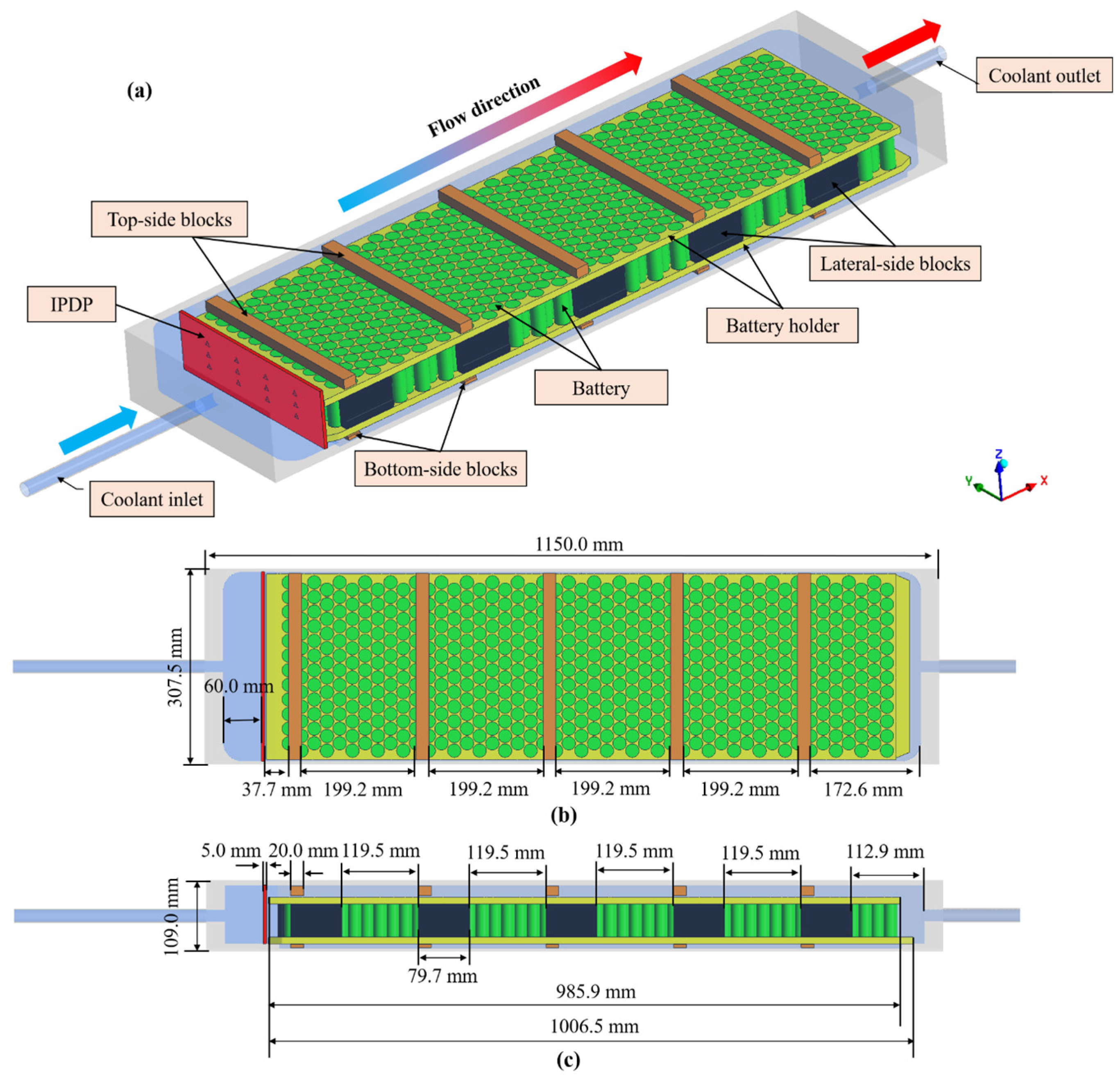
Figure 1 illustrates the three-dimensional numerical model of the 24S24P cylindrical battery module featuring the immersion cooling strategy employed in the current study. The 24S24P battery module consists of 576 21700-type battery cells arranged in a 24-series and 24-parallel configuration. The specifications of the 21700-type battery cell and 24S24P battery module are presented in Table 1. Each cylindrical battery cell is modeled with a diameter and height of 21 mm and 70 mm, respectively. The spacing between adjacent cells is set to 2 mm to ensure uniform coolant flow distribution and effective thermal management within the battery module [8]. The battery cells are arranged symmetrically in the battery module in a cross-arrangement configuration to increase the energy density of the battery module and enhance the uniform flow distribution of the coolant. In addition, the modeling of the battery module includes a structure of top-side, bottom-side and lateral-side blocks arranged symmetrically to prevent skew and poor efficiency flow, thereby enhancing the contact of the coolant with the surface of the battery cells and improving the cooling performance. The holder structures have been arranged symmetrically at the top and bottom to hold and accurately position the cells in the battery module. The simulation model also reflects the actual outer dimensions and thickness of the battery module case, enabling it to simultaneously consider the effects of the internal flow passages and the local volumes formed by the case on the cooling performance.
In the current study, the immersion cooling system utilized a dielectric fluid with high electrical resistivity, enabling safe direct contact between the coolant and the battery cells, as well as associated electrical components. Owing to the electrically insulating nature of the coolant, no additional insulation layers are required to isolate the cooling liquid from current-carrying elements. This approach is consistent with established immersion cooling strategies reported in the literature and enables efficient heat removal through direct contact cooling while maintaining electrical safety. The coolant flow coordinate system is defined such that the battery module length direction is the x-axis, the width direction is the y-axis, and the height direction is the z-axis. The coolant is specified to enter through the inlet, conduct heat exchange with the cells in the battery module in the positive x-direction, and then be discharged through the outlet.
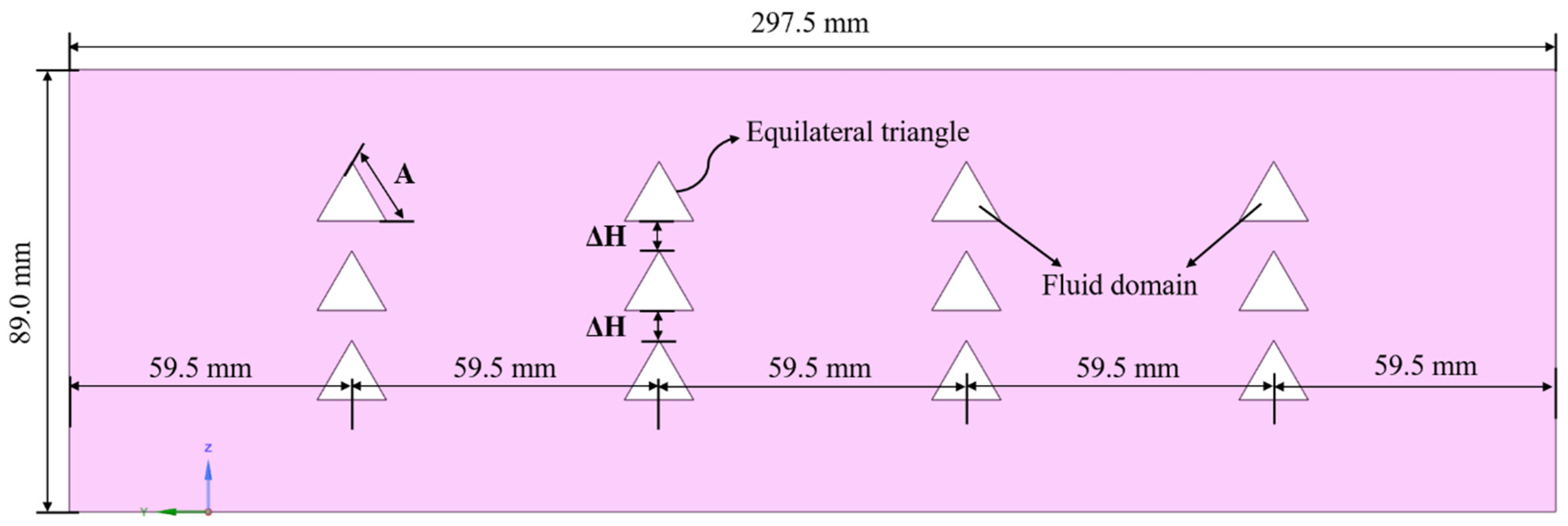
In the present study, to improve the coolant distribution at the inlet for the 24S24P large-capacity battery module, an IPDP was proposed. The modeling of the IPDP is shown in Figure 2. The IPDP located at the inlet side of the battery module acts as a flow distributor through a structure of multiple holes. The IPDP has a width and height of 297.5 mm and 89.0 mm, respectively. As shown in Figure 2, the holes designed on the IPDP have an equilateral triangle cross-section with edges of size set as A (mm). The equilateral triangle holes on the IPDP are arranged symmetrically and evenly spaced with 3 columns and 4 rows, with a total of 12 holes to ensure uniform distribution of coolant to the battery module. In addition, the spacing between the holes ΔH (mm) also has a significant impact on the coolant distribution at the battery module inlet. Therefore, in the present study, the vital design variables of IPDP, including A (mm) and ΔH (mm), were investigated with different sizes and optimized to achieve the most uniform coolant distribution and the highest battery cooling efficiency. Specifically, A was evaluated with different sizes, including 8.66 mm, 13.86 mm, and 17.32 mm. Meanwhile, ΔH was studied with sizes including 6.0 mm, 10.0 mm, and 14.0 mm. When varying the hole size A, the total open area of the IPDP was not constrained and increased proportionally with A. In contrast, when varying the spacing parameter ΔH, the hole size and number of perforations were kept constant for a given A level. Therefore, the total open area remained unchanged, and only the spatial distribution of the perforations was modified. For each combination, the hydraulic diameter and ΔP of the IPDP showed variations, allowing a comprehensive evaluation of the influence of hole size A and spacing between holes ΔH on the inlet ΔP and flow distribution inside the battery module during the cooling process with the immersion cooling system.

2.2. Battery Heat Generation and Coolant Modeling

This study employs an MSMD methodology alongside the NTGK electrochemical sub-model to examine the thermal characteristics of the 21700-type LIB cell. The NTGK is a coupled semi-empirical model, indicating that the numerical model obtains input from parameters evaluated through experimentation. The NTGK model is presently the accepted approach for coupled electrochemical thermal modeling, demonstrating computational efficiency [51,52]. The system produces ongoing data on temperature and depth of discharge ( D O D ) by employing polynomial curve fits of observed voltage and impedance data, reaching up to the sixth order. The generation of heat plays a critical role in the thermal analysis of a battery pack. The governing equations in the subscale NTGK model encompass an empirical relationship that links voltage to current density, along with an energy equation that takes into account the heat generation processes within the battery.
The computational domain employs the subsequent equations to delineate the electrical and thermal field characteristics of the battery at the cell scale [52]:
ρ c p T t . k c T = σ p o s p o s 2 + σ n e g n e g 2 + q ˙ E c h + q ˙ s h o r t
. σ p o s p o s = j E c h j s h o r t
. σ n e g n e g = j E c h j s h o r t
In this context, denotes phase potential, σ indicates effective electric conductivity at the electrodes, q ˙ E c h refers to the heat generated by electrochemical reactions, and j E c h signifies the rate of volumetric current transfer, respectively. q ˙ s h o r t and j s h o r t represent the rates of heat generation resulting from internal battery short-circuits and the current transfer rate, respectively. The suffixes p o s and n e g refer to the positive and negative electrodes, respectively. The source terms j E c h and q ˙ E c h are calculated utilizing the electrochemical sub-model NTGK in this case. A clear semi-empirical electrochemical model is NTGK [52].
The relationship between the potential field and the volumetric current transfer rate is established by [52]:
j = C N C r e f V o l Y U p o s n e g
The volume of the active zone is denoted as V o l , while C r e f represents the battery capacity used to derive the U and Y parameter functions.
The volumetric current density and cell volume are two factors that influence the D O D , a measurable parameter. The D O D presents the remaining capacity of the battery measured in Ampere hours (Ah) at a designated discharge time ( t ). The determination of D O D is as follows [51]:
D O D = V o l 3600 Q n o m i n a l 0 t j d t
The assessment of the U and Y parameter functions is contingent upon the D O D [52]:
U = n = 0 5 a n D O D n C 2 T T r e f
Y = n = 0 5 b n D O D n e x p C 1 1 T 1 T r e f
where T r e f denotes the reference temperature, while C 1 and C 2 represent constants that are particular to a specific battery type.
The thermal energy produced by electrochemical reactions is expressed as [52]:
q E c h = j U p o s n e g T d U d T
The first term represents the overpotential heat, whereas the second term corresponds to the entropic component. Table 2 present the U and Y parameters utilized in the NTGK model. The coefficients listed in Table 2 were identified using the NTGK battery model implemented in ANSYS Fluent 2024 R2. The parameter identification procedure was based on experimentally measured single-cell discharge data obtained at multiple C-rates, including 0.5C, 1.0C, 1.5C, 2.0C, and 2.5C under controlled ambient conditions at 25 °C. Specifically, the experimentally recorded voltage-time profiles were used as input datasets for calibrating the NTGK model. Within the ANSYS Fluent NTGK framework, the polynomial coefficients appearing in Equations (6) and (7) were determined through curve fitting to the measured discharge characteristics. The resulting set of fitted coefficients characterizes the electrochemical heat generation behavior of the battery cells during charge/discharge conditions.
The equations governing the conservation of mass, momentum, and energy that dictate the flow of the coolant are [52]:
. V c = 0
ρ c . V c t + . ρ c V c V c = p + μ 2 V c
ρ c c p , c T c t + ρ c c p , c V c T c = k c 2 T c
where V c represents the velocity of the coolant, ρ c denotes the density of the battery, P indicates the static pressure of the coolant, μ refers to the dynamic viscosity of the coolant, c p , c is the specific heat capacity, T c signifies the temperature, and k c stands for thermal conductivity.

2.3. Boundary Conditions

In the present study, the thermal and hydraulic performance characteristics of the 24S24P battery module consisting of 576 21700-type cylindrical cells were evaluated utilizing an immersion cooling system. The NTGK model is used to obtain a calibrated set of polynomial coefficients representing the average volumetric heat generation rate, which is then applied as a source term in the CFD simulations of the full battery module. Although time-dependent heat generation models can capture transient thermal behavior more explicitly, the use of an average volumetric heat generation source has been widely adopted in battery pack-scale thermal analyses when the objective is to evaluate steady-state or quasi-steady-state performance trends across multiple design configurations. Recent work has demonstrated that volumetric heat generation inputs derived from equivalent circuit models can yield robust predictions comparable to those obtained from fully time-dependent heat generation profiles under similar discharge conditions [53]. This approach facilitates efficient surrogate-assisted optimization while maintaining physical fidelity in the predicted temperature fields. Therefore, the heat generation of the battery cells in the current study was modeled as a constant volumetric heat source. Specifically, the simulations were conducted under a 1C discharge rate condition, with a volumetric heat source of 29,264.53 W/m3 applied for each cell in the battery module. The solid regions in the current modelling consist of the aluminum case, battery cells, and plastic components, including holder, IPDP, top-side, bottom-side, and lateral-side blocks. The coolant used in the study is Pitherm 150B. The thermophysical properties of the battery, coolant and materials of the subcomponents in the battery module are listed in Table 3. In addition, both flow and thermal boundary conditions were applied to the solid and fluid regions to account for conjugate heat transfer between the battery module and the coolant. The initial temperature of the battery cells and coolant is set at 25 °C. The outlet was specified as a pressure outlet with a gauge pressure of 0 Pa. The flow field was solved using Menter’s k-ω SST turbulence model, and all cases were computed under steady-state conditions until convergence.
In this study, the thermal and hydraulic performances of the battery module with immersion cooling were optimized through vital parameters, including the design parameters of IPDP and different inlet coolant mass flow rates (Vin) of Pitherm 150B coolant (Company: Pitherm Chemical Co., Ltd., Suwon-si, Republic of Korea). Specifically, for IPDP, the varied design parameters of A included 8.66 mm, 13.86 mm, and 17.32 mm, and ΔH included 6.0 mm, 10.0 mm, and 14.0 mm. Meanwhile, at the inlet, Vin was varied with three different values of 0.0131 kg/s, 0.0262 kg/s, and 0.0393 kg/s.

2.4. Mesh Independence Verification

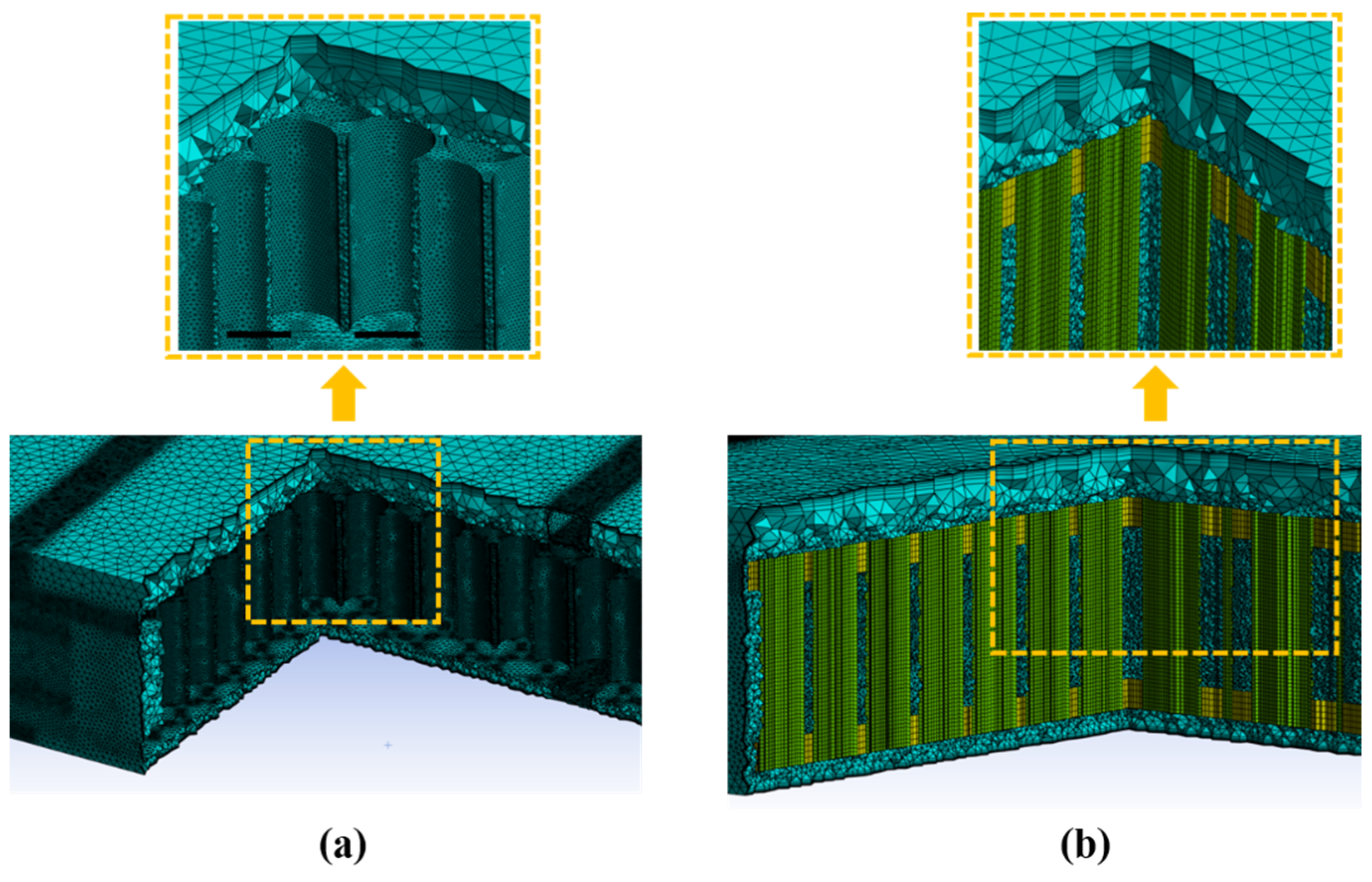
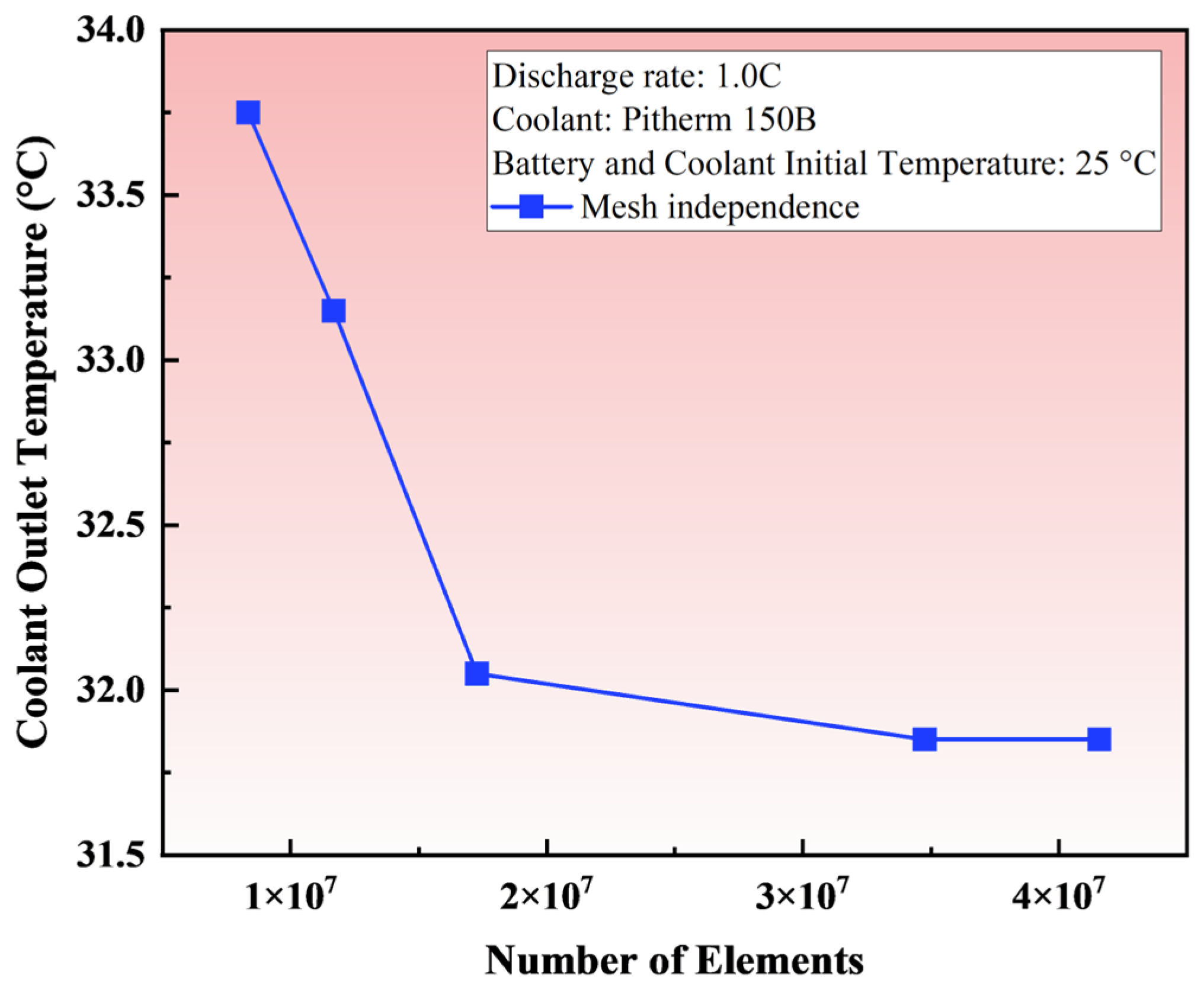
A mesh independence analysis was carried out to ensure the reliability of the numerical results. Although the battery cells and flow distribution holes exhibit geometric symmetry, the full computational domain of the battery module was simulated in this study. This approach was adopted to accurately capture three-dimensional flow development and potential local non-uniformities in coolant distribution, thereby providing a conservative and comprehensive evaluation of the thermal-hydraulic performance of the large-scale battery module with immersion cooling strategy. The entire computational domain consists of solid and fluid regions. The mesh for the solid region was kept identically for all cases and the mesh independence was evaluated by varying the number of elements in the fluid regions. For the solid region, the mesh consists of 977,885 elements for the casing, 18,085 elements for the IPDP, 88,000 elements for the bottom-side blocks, 156,176 elements for the lateral-side blocks, 49,050 elements for the top-side blocks, 881,845 elements for the holder, and 12,753,756 elements for the battery cells. Therefore, the total number of elements in the solid region is 14,924,797. In this study, the mesh resolution for the battery cells was chosen to resolve the internal temperature gradient while balancing computational cost. The fluid region was treated as a single continuous fluid zone extending from the inlet to the downstream region of the battery module. The different number of elements in the fluid region was tested, including 8,341,166, 11,687,076, 17,276,804, 34,754,548 and 41,583,800. Figure 3 shows the convergence trend of the coolant outlet temperature with increasing mesh size. As the number of mesh elements increased, the coolant outlet temperature gradually decreased. In particular, the coolant outlet temperature converged at 31.85 °C with 34,754,548 elements and remained almost unchanged at 41,583,800 elements. Therefore, considering the trade-off between accuracy improvement and computational cost, a fluid region mesh with 34,754,548 elements was selected for subsequent simulations. The mesh configurations of the computational model for the fluid and solid regions in the present study are presented in Figure 4.

2.5. Validation

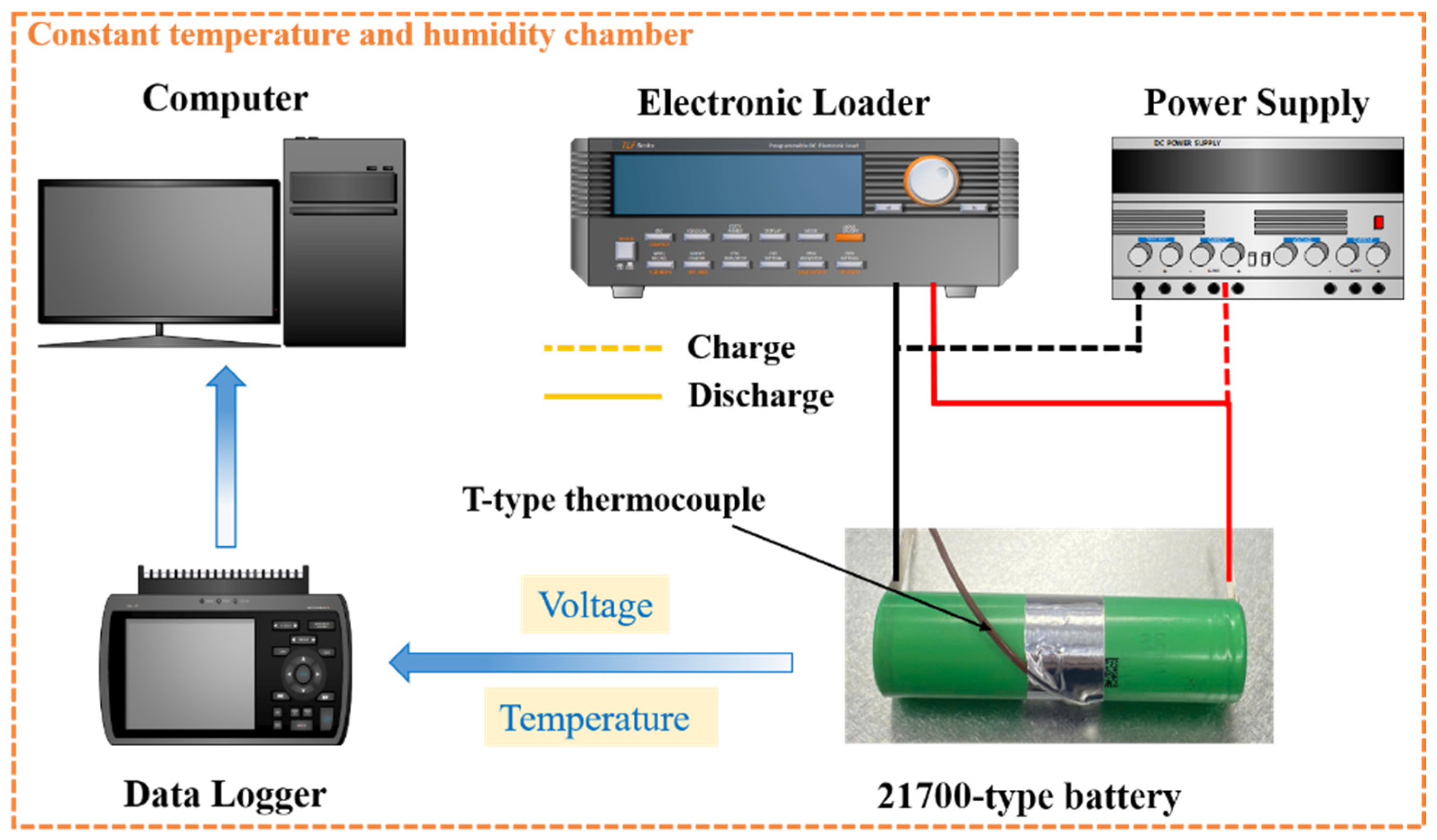
Battery discharge experiments were conducted to obtain the voltage and temperature parameters of the battery and compared to the simulated values to validate the reliability of the numerical model. The experimental setup is shown in Figure 5. A 21700-type lithium-ion battery was used in the present experiments. The Data Logger GL840 (GRAPHTEC, Yokohama, Japan, precision of ±0.1%) was used to record the voltage and temperature data of the battery during the experiment. Two TS3010A-1 DC power supplies and a TLF1200 DC electronic loader (Aichi, Japan) with capacities of 300 W and 1200 W, respectively, were used to charge and discharge the battery during the experiment. The maximum voltage during charging and the cut-off voltage during discharging of the battery are controlled at 4.2 V and 2.5 V, respectively. All experiments were conducted in a chamber with constant humidity and temperature at 25 °C. According to previous studies, the temperature distribution on the surface of the cylindrical battery is almost uniform and there is no significant difference between the positions on the battery surface. In general, the temperature at the middle position of the battery surface can be representative of the entire battery surface temperature [54,55,56]. Therefore, in the present experiment, a T-type thermocouple (precision of ±0.4%) was attached to the middle position of the battery surface to measure the battery temperature during the discharge processes.
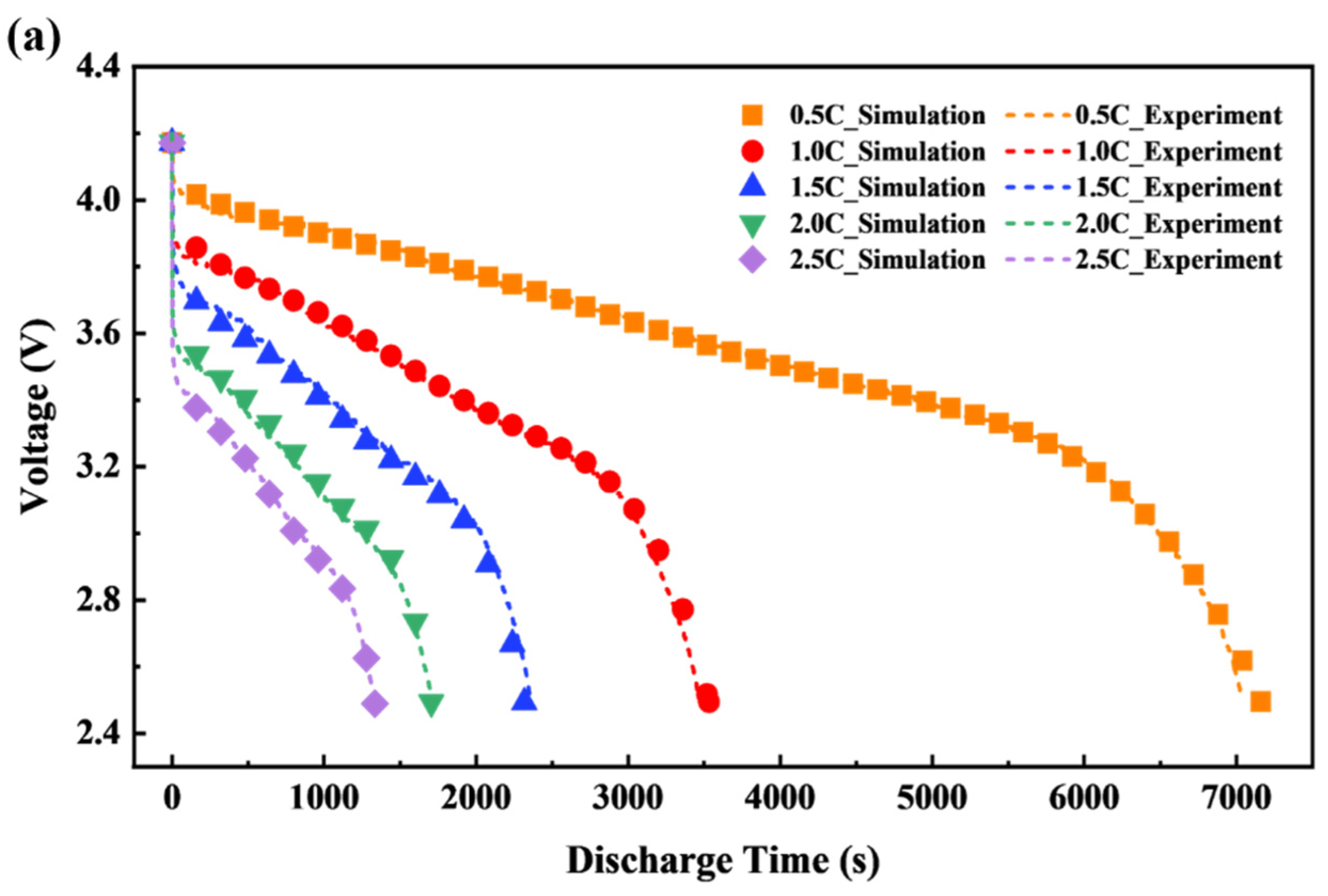
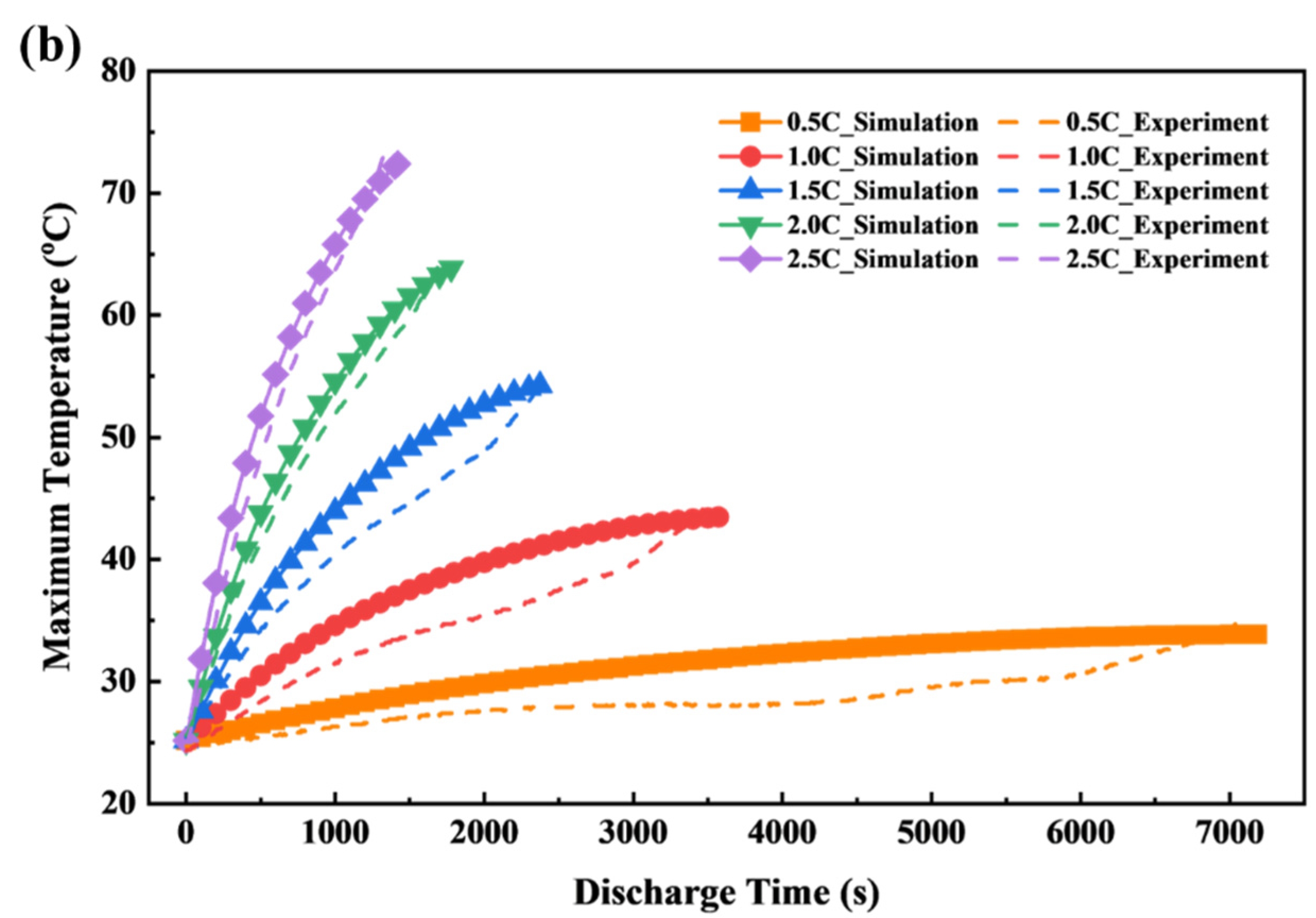
The numerical simulation and experimental data of the battery discharge process at different rates are presented in Figure 6. The single cell simulation was performed under natural convection conditions with a heat transfer coefficient of 7.5 W/m2K. The initial temperature of the battery and the environment was both 25 °C. Figure 6a shows that the voltage variation trend with discharge rates between simulation and experiment is relatively consistent. The percentage errors between the simulated and experimental voltages at rates of 0.5C, 1.0C, 1.5C, 2.0C and 2.5C show 0.06%, 0.55%, 0.92%, 0.92% and 0.18%, respectively. Figure 6b shows that the temperature difference is small at 2.0C and 2.5C, but slightly larger at 0.5C, 1.0C and 1.5C. The corresponding errors are 8.1%, 8.01%, 6.58%, 4.05% and 4.5% for 0.5C, 1.0C, 1.5C, 2.0C and 2.5C discharge rates, respectively. Overall, the developed simulations show good agreement with the experimental data within 3.3%. Therefore, the proposed numerical model is accepted to perform simulations of the battery module with immersion cooling in the current study.

3. Results and Discussion

In this section, a comprehensive analysis of the thermal-hydraulic behavior of the battery module under different geometric and operating conditions is presented. First, the influence of individual design variables including hole size A, hole spacing ΔH, and coolant mass flow rate Vin on maximum temperature Tmax, maximum temperature difference ΔTmax, and pressure drop ΔP is examined using detailed CFD-derived temperature and velocity fields. These parametric studies provide physical insight into how the hole geometry governs coolant jet formation, flow distribution, and heat removal. Subsequently, the performance of the ANN model and the results of multi-objective optimization are discussed, highlighting the trade-off between cooling efficiency and hydraulic losses. These analyses establish the basis for determining the optimal IPDP configuration for a 24S24P high-capacity battery module with immersion cooling.

3.1. Effect of the Hole Size A

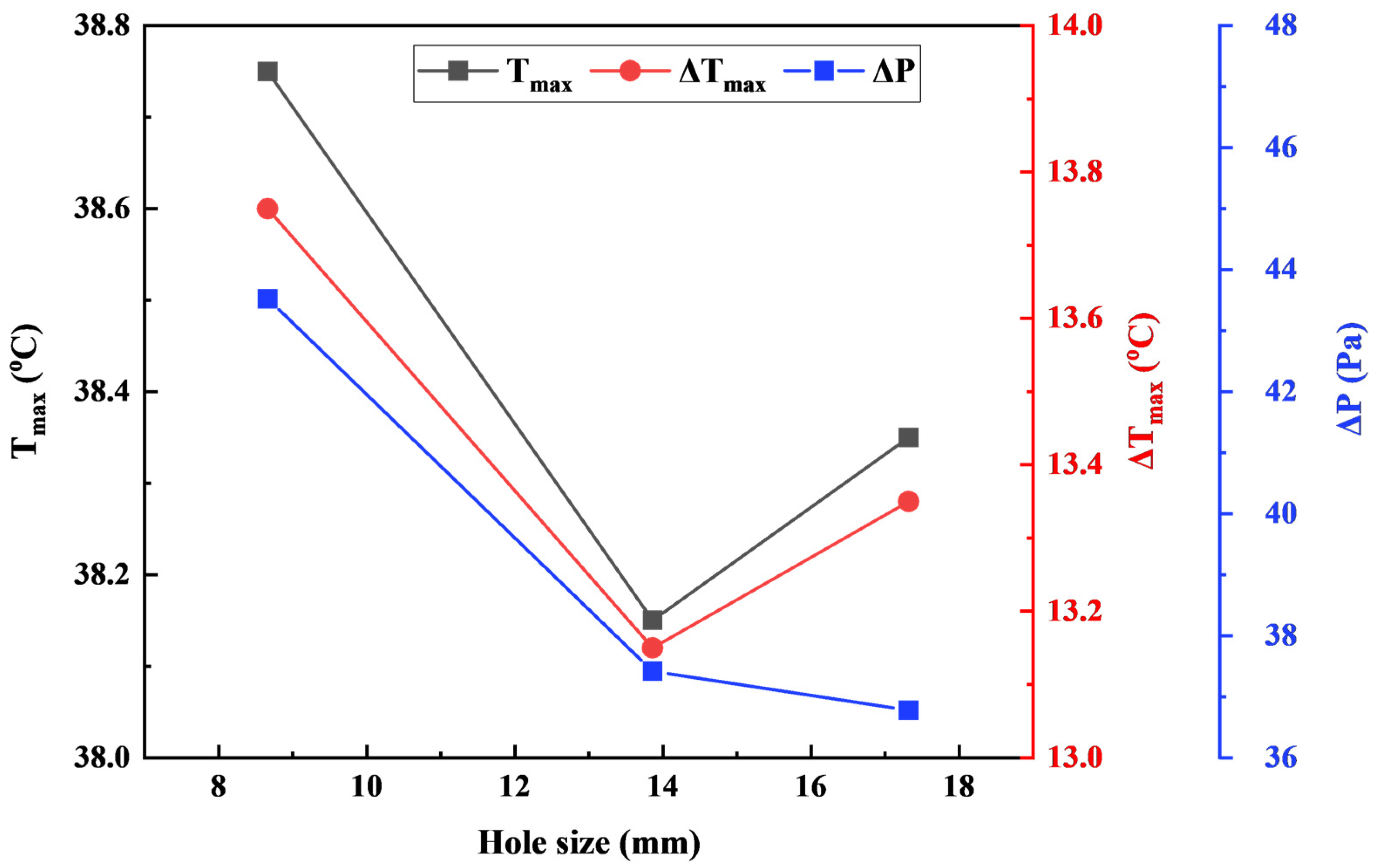
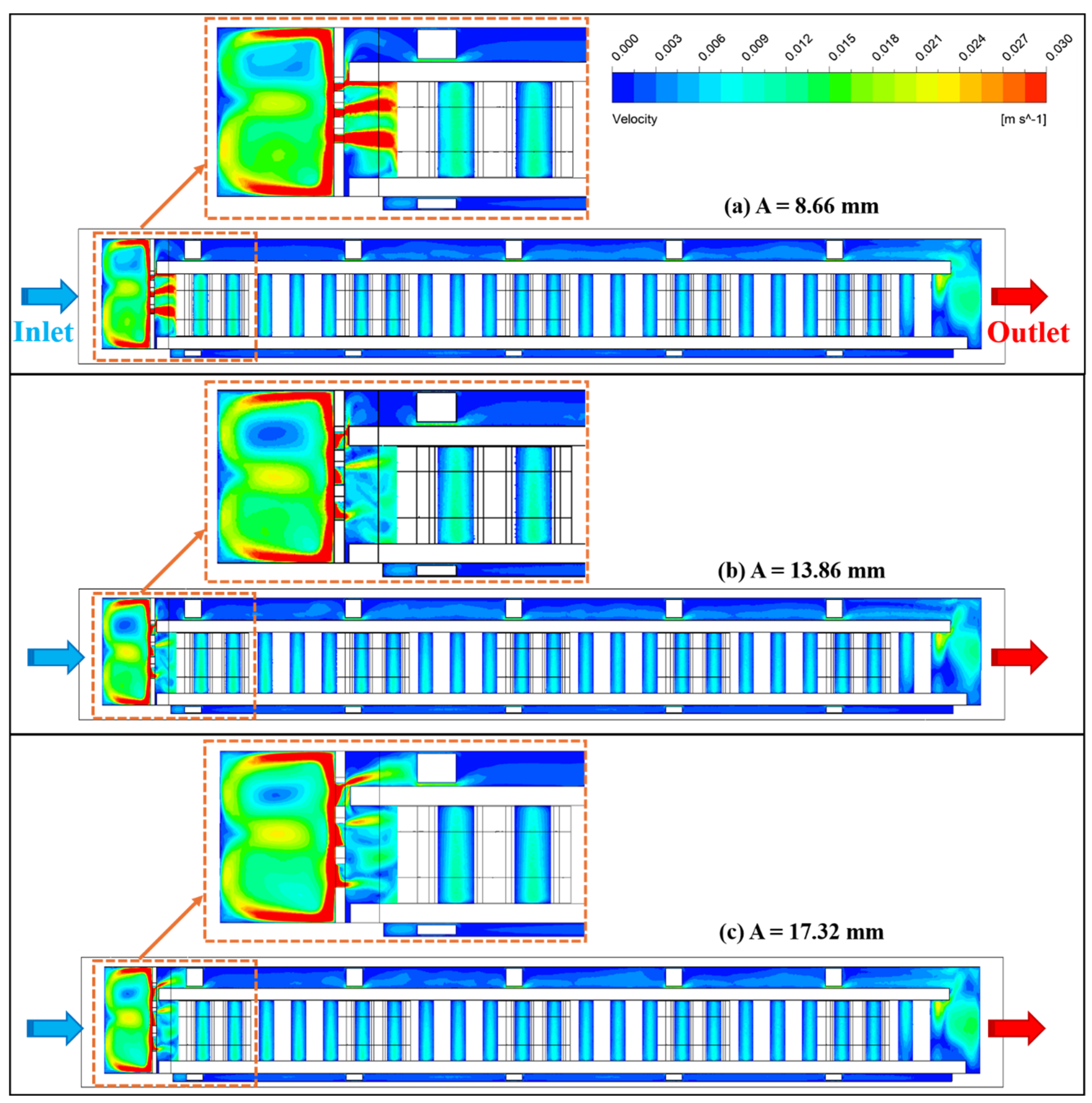
The variations in hole size A have a significant influence on the flow rate as well as the uniform distribution of coolant in the battery module. Therefore, in this section, the variation in thermal and hydraulic performance characteristics of the battery module operating under a discharge rate of 1C was evaluated with different hole size A. The initial temperature of the battery cells and coolant was set at 25 °C. Pitherm 150B was used as the coolant with a fixed Vin of 0.0262 kg/s. The ΔH was fixed at 6.0 mm. The variation in Tmax, ΔTmax and ΔP with different hole size A is shown in Figure 7. The results showed that changing the hole size A produced small changes in the thermal performance of the battery module but significantly reduced the hydraulic resistance. Specifically, increasing the hole diameter from 8.66 mm to 13.86 mm slightly decreased Tmax from 38.75 °C to 38.15 °C and decreased ΔTmax from 13.75 °C to 13.15 °C, indicating a slightly improved coolant distribution. This behavior is consistent with previous studies on perforated plates, which reported that increasing the hole diameter reduces the inlet flow resistance and enhances the jet penetration and mixing, thus improving and maintaining the temperature characteristics within the optimum range [57]. However, enlarging the hole size A further to 17.32 mm resulted in a slight increase in Tmax and ΔTmax in the battery module, with values of 38.35 °C and 13.35 °C, respectively. As hole size A increases, the hydraulic resistance of the IPDP decreases, leading to the discharge through each hole becoming less jet-dominated. For the same inlet mass flow rate condition, the enlarged hole size reduces the local exit velocity from the IPDP, thereby decreasing jet momentum and penetration into the inter-cell flow passages. This reduction in momentum weakens local mixing and convective heat transfer in the regions where hotspots form, which explains the slight rise in Tmax and ΔTmax observed at the maximum hole size. The velocity contours in Figure 8 support this interpretation by showing reduced high-velocity cores and a more diffuse flow field at the largest hole size A, indicating diminished local impingement intensity and an increased propensity for preferential low-velocity flow paths.
In contrast, ΔP showed a steady decreasing trend with the hole enlargement. Specifically, when increasing the hole size A from 8.66 mm to 13.86 mm, ΔP decreased sharply from 43.52 Pa to 37.41 Pa. As the hole size A increased to the maximum value of 17.32 mm, ΔP continued to decrease and reached the lowest value at 36.77 Pa. The above research results show that larger holes reduce flow constriction and reduce resistance compared to smaller hole configurations.
Figure 8 shows the vertical section velocity with different hole size A. The velocity contour results demonstrated that the A directly affects the jet intensity, coolant distribution, and heat exchange efficiency inside the battery module. Specifically, the smallest hole size A at 8.66 mm produced narrow jets with high velocity and a strong initial momentum of the coolant. However, the limited flow area increased ΔP and limited the penetration and uniform distribution of the coolant downstream, resulting in a decrease in cooling efficiency and the highest Tmax and ΔTmax recorded among the hole size A configurations. When the hole diameter was increased to 13.86 mm, this configuration increased the jet spread and reduced the flow resistance, creating a more uniform velocity field that improved the coolant coverage, resulting in the lowest Tmax and ΔTmax among the three configurations. Meanwhile, further hole enlargement at 17.32 mm reduced ΔP. However, larger hole size A weakened the jet coherence, reduced the momentum and coolant uniformity in the battery module, causing a slight increase in Tmax and ΔTmax. Overall, the results showed that moderate hole enlargement improved both hydraulic and thermal performance, while excessively large holes reduced the momentum and coolant uniformity, resulting in a decrease in the heat dissipation capacity for the cells in the battery module.
The above research results show that hole size A optimization is essential because it directly affects the balance between thermal and hydraulic performance in perforated distributor plates. Smaller holes increase water jet penetration and local mixing but create greater flow resistance, increasing ΔP and requiring more pumping power. Conversely, larger holes reduce ΔP but may reduce flow uniformity, limiting the improvement in Tmax and ΔTmax. Therefore, it is necessary to apply optimization strategies to determine the optimum hole size A that provides sufficient coolant distribution while maintaining acceptable ΔP, ensuring both cooling performance and energy efficiency in the immersion cooling system. Previous studies have demonstrated that the hole size in perforated distributor plates significantly affects flow uniformity, mixing characteristics, and pressure drop. There is an optimum hole size range that enhances flow uniformity, exceeding this range further degrades performance, thus highlighting the importance of hole size optimization [58].

3.2. Effect of the Hole Spacing ΔH

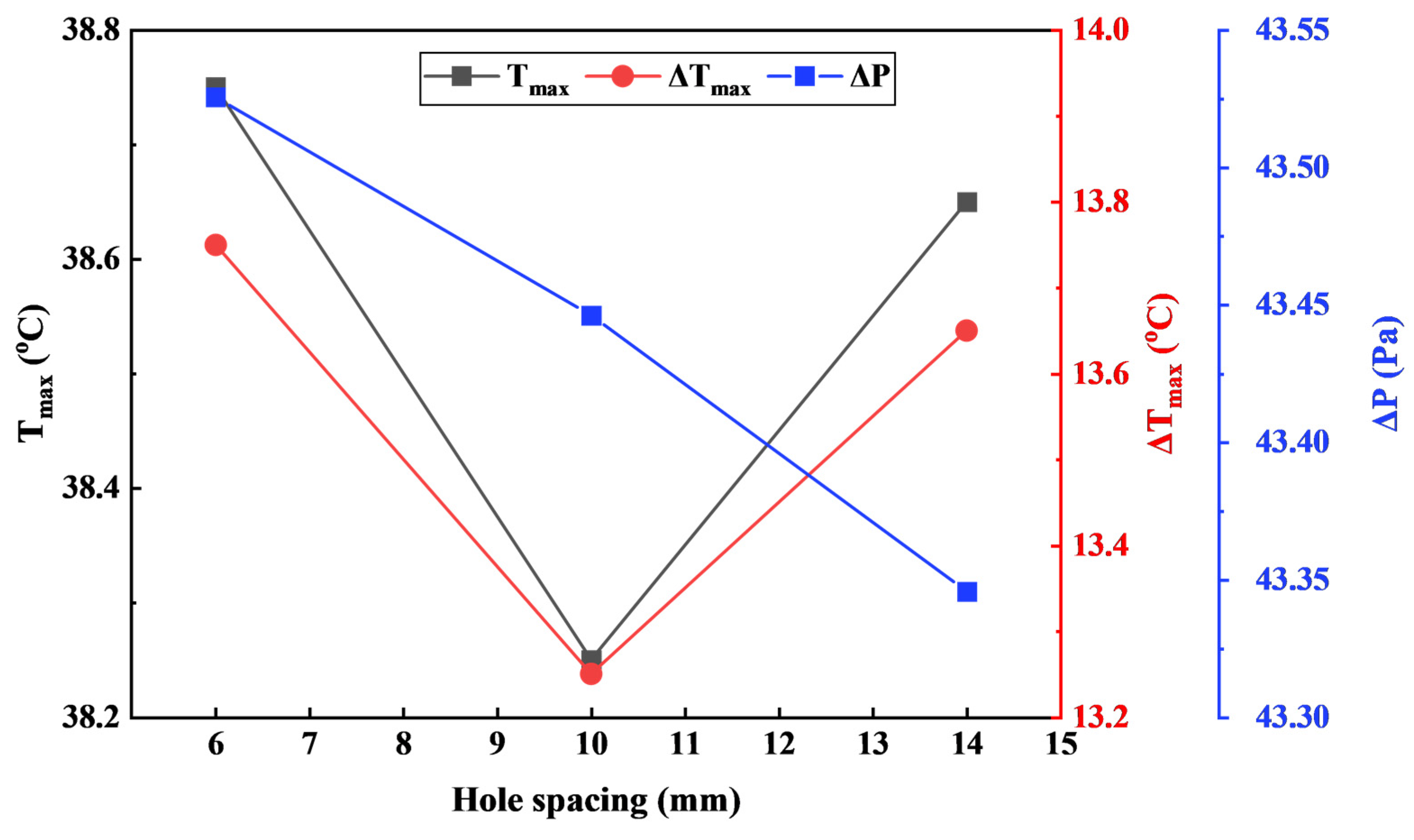
The variation in the spacing between the holes ΔH on the IPDP has a significant impact on the uniform distribution of the coolant in the battery module. Therefore, in this Section, the influence of ΔH was evaluated on the thermal and hydraulic performance for the battery module operating under a discharge rate of 1C. Pitherm 150B was used as the coolant with a fixed Vin of 0.0262 kg/s. The A was fixed at 8.66 mm. The variations in Tmax, ΔTmax and ΔP with different ΔH are shown in Figure 9. The research results indicate that increasing ΔH has caused changes in the thermal and hydraulic performance of the battery module under fixed operating conditions. Specifically, the ΔH of 6.0 mm experienced the highest Tmax and ΔTmax at 38.75 °C and 13.75 °C, respectively. Enlarging the ΔH to 10.0 mm showed an improvement in ΔTmax with 13.25 °C and a decrease in Tmax to 38.25 °C, indicating that moderate separation helps to distribute the coolant more evenly without disrupting the flow momentum. However, when increasing the ΔH to the highest value of 14.0 mm, both Tmax and ΔTmax experienced a rebound with 38.65 °C and 13.65 °C, respectively, indicating a decrease in the momentum of the coolant jets and weaker mixing throughout the perforated distributor plate. In contrast, ΔP showed a continuous decreasing trend with increasing the ΔH on the IPDP. Specifically, when increasing the ΔH from 6.0 mm to 10.0 mm, ΔP decreased from 43.52 Pa to 43.44 Pa and reached the lowest value at 43.34 Pa at the largest ΔH of 14.0 mm.
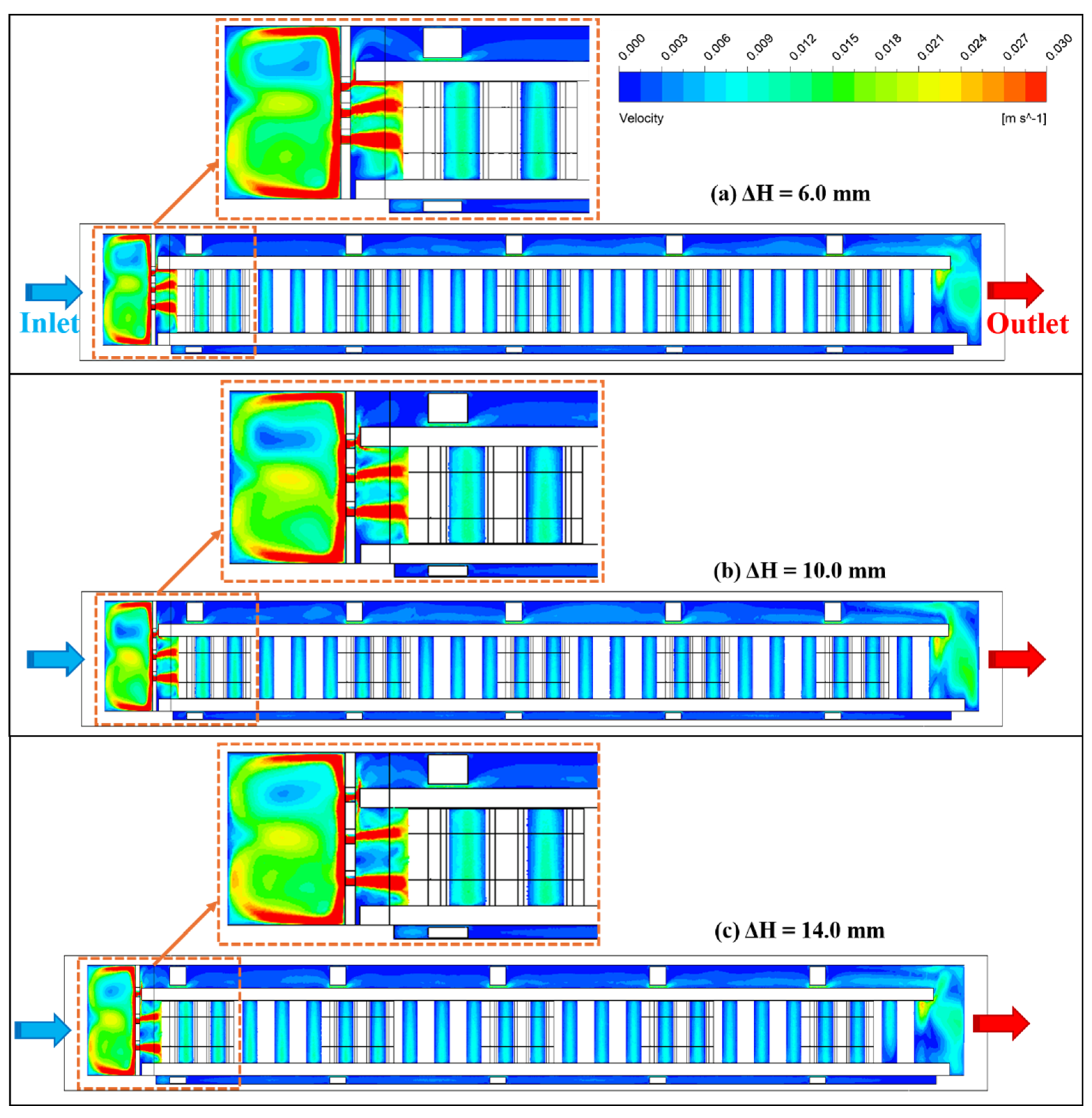
Figure 10 shows the velocity contours in vertical sections for three different ΔH configurations. The results illustrate that varying the ΔH dominated the jet formation and flow evolution downstream, thus significantly affecting the thermal performance in the battery module. Specifically, at a ΔH of 6.0 mm, the closely spaced holes generated strong local jets with large velocity gradients. However, the large turbulence of the coolant near the inlet limited axial penetration, resulting in a slight reduction in heat transfer efficiency and providing slightly higher Tmax and ΔTmax values than the remaining ΔH configurations. Increasing the ΔH to 10.0 mm showed that the configuration generated fewer jets and allowed for reduced coolant turbulence at the inlet. This improvement resulted in a more uniform distribution of the coolant and further downstream propagation. The heat exchange between the coolant and the cells in the battery module is enhanced and provides the lowest Tmax and ΔTmax characteristics, with negligible change in ΔP. However, at the largest ΔH of 14.0 mm, the configuration shows weaker jet formation and widens the downstream low velocity regions, resulting in a slight increase in Tmax and ΔTmax, with the decrease in ΔP being insignificant compared to the other two configurations. These contour plots confirm that the moderate ΔH enhances coolant distribution by maintaining a higher velocity gradient and minimizing stagnant regions in the battery module.
The above research results demonstrate that optimizing the ΔH is important because it determines how evenly the coolant enters the module and also affects the flow resistance on the IPDP. When the holes are too close together, the coolant jets may merge prematurely, creating local recirculation zones, limiting further increases in Tmax and ΔTmax while still causing a similar ΔP. Conversely, too large ΔH reduces the jet coverage, impairing thermal uniformity and increasing Tmax despite only providing a negligible hydraulic benefit. Therefore, determining the optimal ΔH through optimization strategies allows the design to balance the quality of coolant distribution with minimum ΔP, ensuring both effective heat dissipation and efficient pump performance within the operating constraints.

3.3. Effect of the Coolant Mass Flow Rates Vin

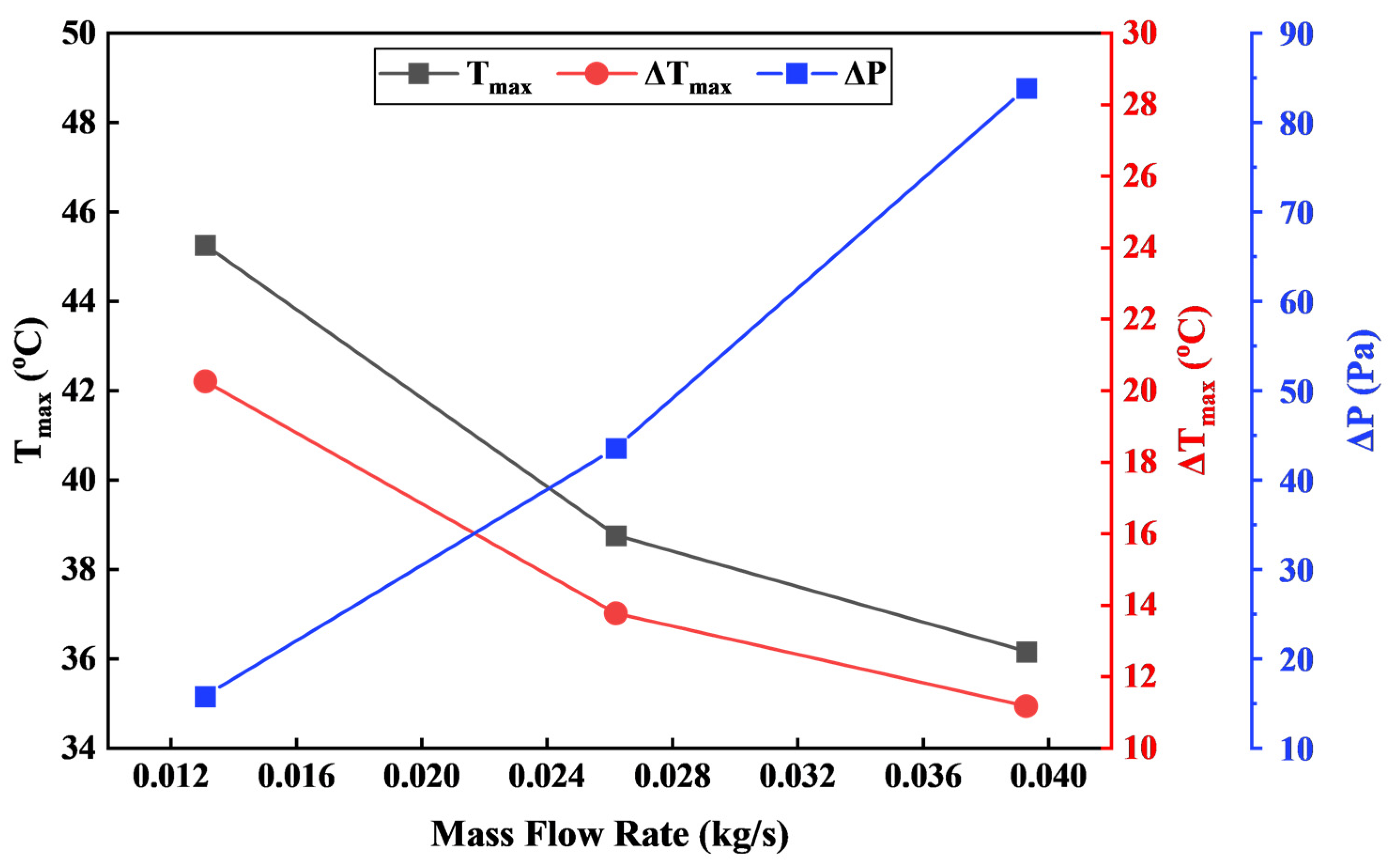
The coolant mass flow rate Vin has a significant influence on the uniform distribution of coolant and the heat dissipation performance for the cells in the battery module. In this section, different Vin were evaluated for the thermal and hydraulic performance of the battery module operating under a 1C discharge rate. Pitherm 150B was used as the coolant under different Vin of 0.0131 kg/s, 0.0262 kg/s and 0.0393 kg/s, respectively. The A and ΔH were fixed at 8.66 mm and 6.0 mm, respectively. The variations in Tmax, ΔTmax, and ΔP under different Vin conditions are shown in Figure 11.
The results clearly show that increasing Vin produces a strong cooling benefit in terms of thermal performance characteristics for the battery module, but at the cost of higher hydraulic resistance. Specifically, at Vin of 0.0131 kg/s, it was found that the limited convection and heat dissipation between the coolant and the battery cells resulted in the highest Tmax at 45.25 °C and the largest ΔTmax at 20.25 °C. However, increasing Vin to 0.0262 kg/s resulted in a significant improvement in the thermal performance of the battery module with a sharp decrease in Tmax to 38.75 °C and a narrowing of ΔTmax to 13.75 °C. Furthermore, further increasing Vin to the highest level of 0.0393 kg/s further resulted in additional thermal performance benefits for the battery module with the lowest Tmax at 36.15 °C and the most uniform temperature distribution at 11.15 °C. The above research results further strengthened the positive relationship between Vin and the thermal performance characteristics in the battery module. Specifically, increasing Vin enhanced the thermal performance of the battery module, whereas a decrease in Vin led to reduced cooling effectiveness. Since the coolant momentum was stronger when Vin was increased, leading to stronger mixing and contact between the coolant and the battery surface, the heat exchange efficiency was stronger and the thermal performance in the battery module was significantly improved [59,60,61].
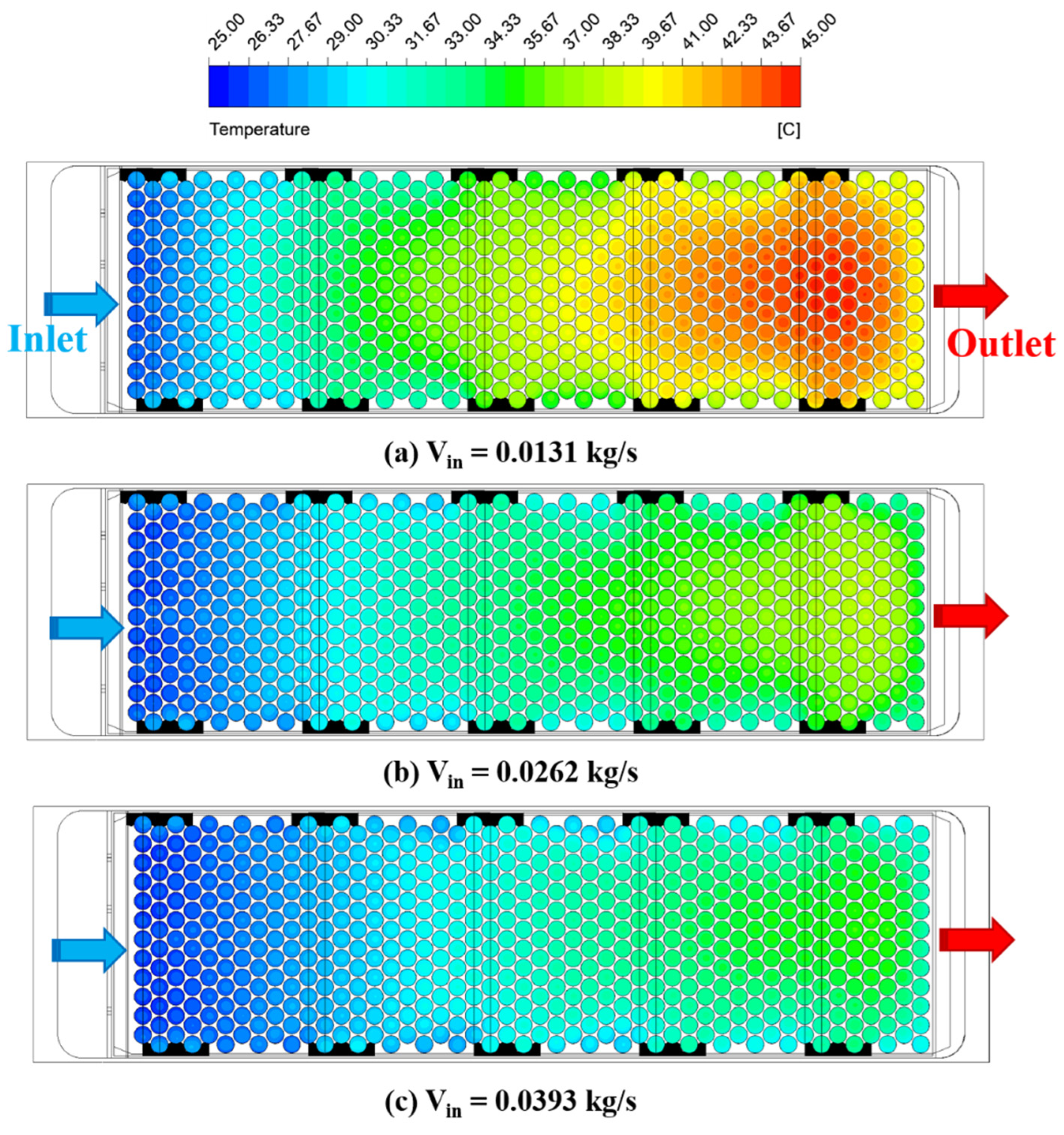
The temperature distribution contours in the battery module with different Vin are shown in Figure 12. It is clearly seen that the temperature contours illustrate the gradual improvement in thermal management as Vin increases. Specifically, at the lowest Vin of 0.0131 kg/s, a distinct temperature gradient forms along the length of the battery module, with high temperatures concentrated near the outlet region due to insufficient convection to remove the heat generated from the battery. Increasing the coolant supply reduces these gradients, resulting in a more uniform distribution and a significant reduction in hot spot intensity within the battery module. At the highest Vin of 0.0393 kg/s, the temperature field becomes noticeably more uniform, with colder regions extending deeper into the battery module and minimal heat accumulation observed near the outlet. These results visually illustrate the strong dependence of heat dissipation efficiency on Vin and reinforce the quantitative trends reported in the previous analysis. In addition, although increasing Vin improves thermal uniformity, ΔTmax in the present Vin range remains above the commonly recommended 5 °C guideline for safe operation. This indicates that further reduction in ΔTmax would require an extended operating/design space and additional measures, while accounting for the associated hydraulic penalty (ΔP).
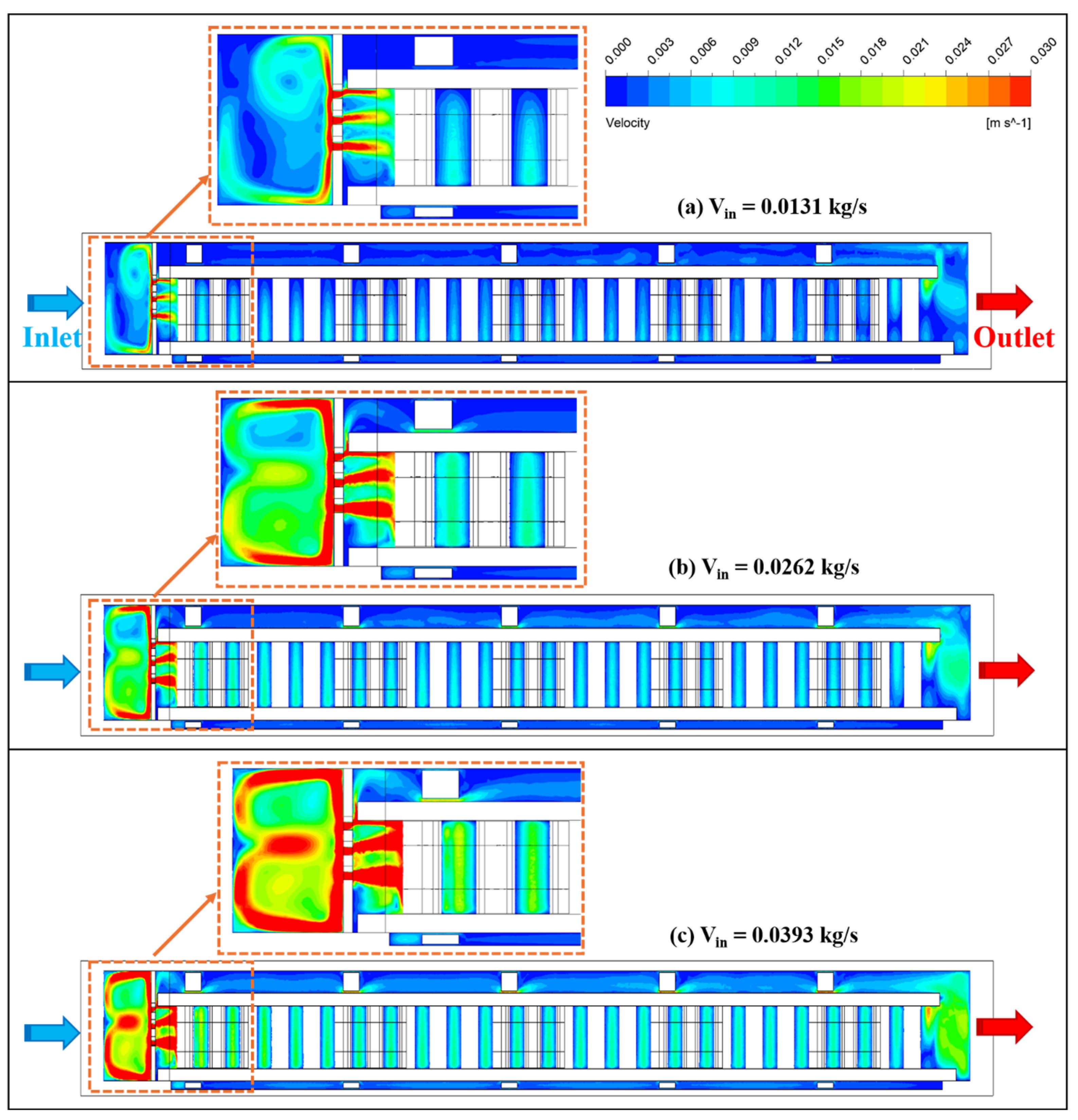
Figure 13 presents vertical cross-sectional velocity contours for three Vin configurations. These results highlight that the coolant inlet momentum governs the penetration and flow distribution within the battery module. Specifically, at the lowest Vin of 0.0131 kg/s, the inlet jet exhibits a limited range, with rapid velocity decay and weak mixing through adjacent channels, resulting in predominantly low-velocity regions downstream. Increasing Vin enhances jet collisions through the IPDP, creating more pronounced high-velocity cores and improving lateral diffusion, which enhances coolant renewal along the cell rows. At the highest Vin of 0.0393 kg/s, the velocity field becomes significantly more dynamic, with high-velocity regions extending deeper into the battery module and improving flow uniformity near the outlet. These contour plots demonstrate that higher coolant supply not only enhances convective heat transfer but also reshapes the flow structures to reduce stagnant regions within the battery module.
However, the improvement in the thermal performance characteristics of the battery module when Vin was increased was also accompanied by a sharp increase in ΔP in the cooling system, as shown in Figure 11. Specifically, when Vin was increased from 0.0131 kg/s to 0.0262 kg/s, ΔP increased significantly from 15.77 Pa to 43.52 Pa, respectively. When Vin was further increased to 0.0393 kg/s, the ΔP in the system increased sharply by twice and reached the highest value at 83.78 Pa.
The above research results show that the cooling performance is significantly enhanced when Vin is increased, but it is also accompanied by a significant increase in the pumping demand. Therefore, the optimization of Vin is very important because it determines the balance between thermal efficiency and hydraulic cost in the cooling system. Higher Vin will enhance convective heat transfer, improve heat dissipation efficiency and optimally control Tmax and ΔTmax. However, a larger Vin also significantly increases ΔP, increasing the pumping power and reducing the system efficiency. Conversely, insufficient Vin will impair the heat exchange process, leading to heat accumulation and the formation of thermal hotspots, which significantly affect the performance, reliability and lifespan of the battery cells in the battery module. Determining the optimum Vin through optimization strategies allows the system to effectively control the temperature characteristics while avoiding excessive hydraulic losses, ensuring a thermally stable and energy-efficient cooling strategy.

3.4. Multi-Objective Optimization

The above analytical results show a clear interaction between the evaluated variables with a decrease in Tmax and ΔTmax generally accompanied by an increase in ΔP. This interdependence emphasizes the need for parameter optimization to determine settings that maximize cooling performance while minimizing hydraulic losses. The objective of the present study was to enhance coolant distribution through the IPDP, thereby improving overall cooling efficiency and reducing energy demand in the immersion cooling system for a high-capacity battery module. Three design variables, including A (mm), ΔH (mm), and Vin (kg/s) were selected for optimization with their respective ranges summarized in Table 4. A three-level full factorial design 3k with k representing the number of factors was employed to evaluate all possible factor combinations, enabling an accurate and comprehensive assessment of main effects, interactions, and non-linear responses that cannot be captured by a two-level design. Given the computational constraints, 27 simulation cases were generated and CFD analyses were performed to obtain Tmax, ΔTmax and ΔP for each condition. The results of the CFD simulation are reported in Table 5.

3.4.1. ANN Structure

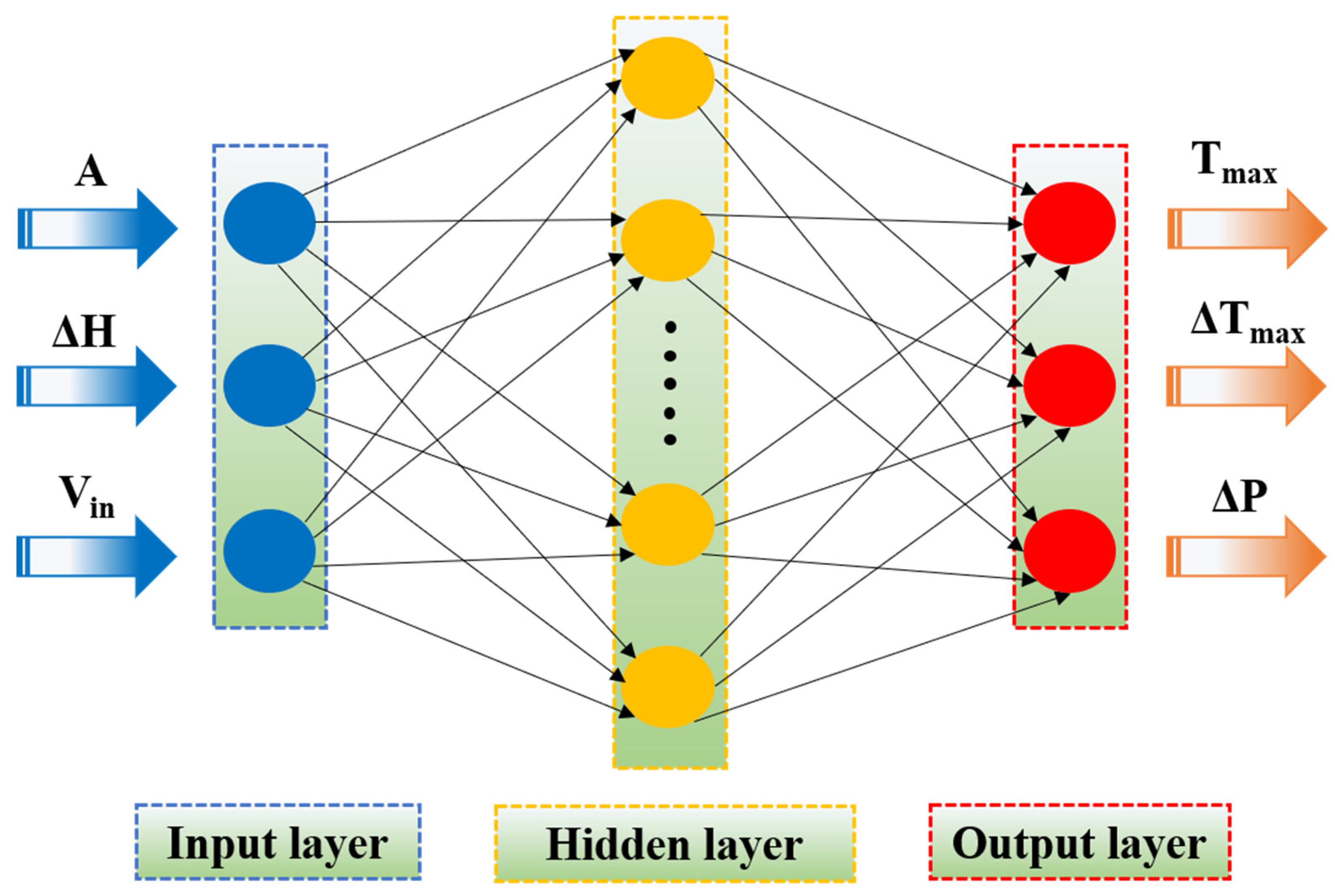
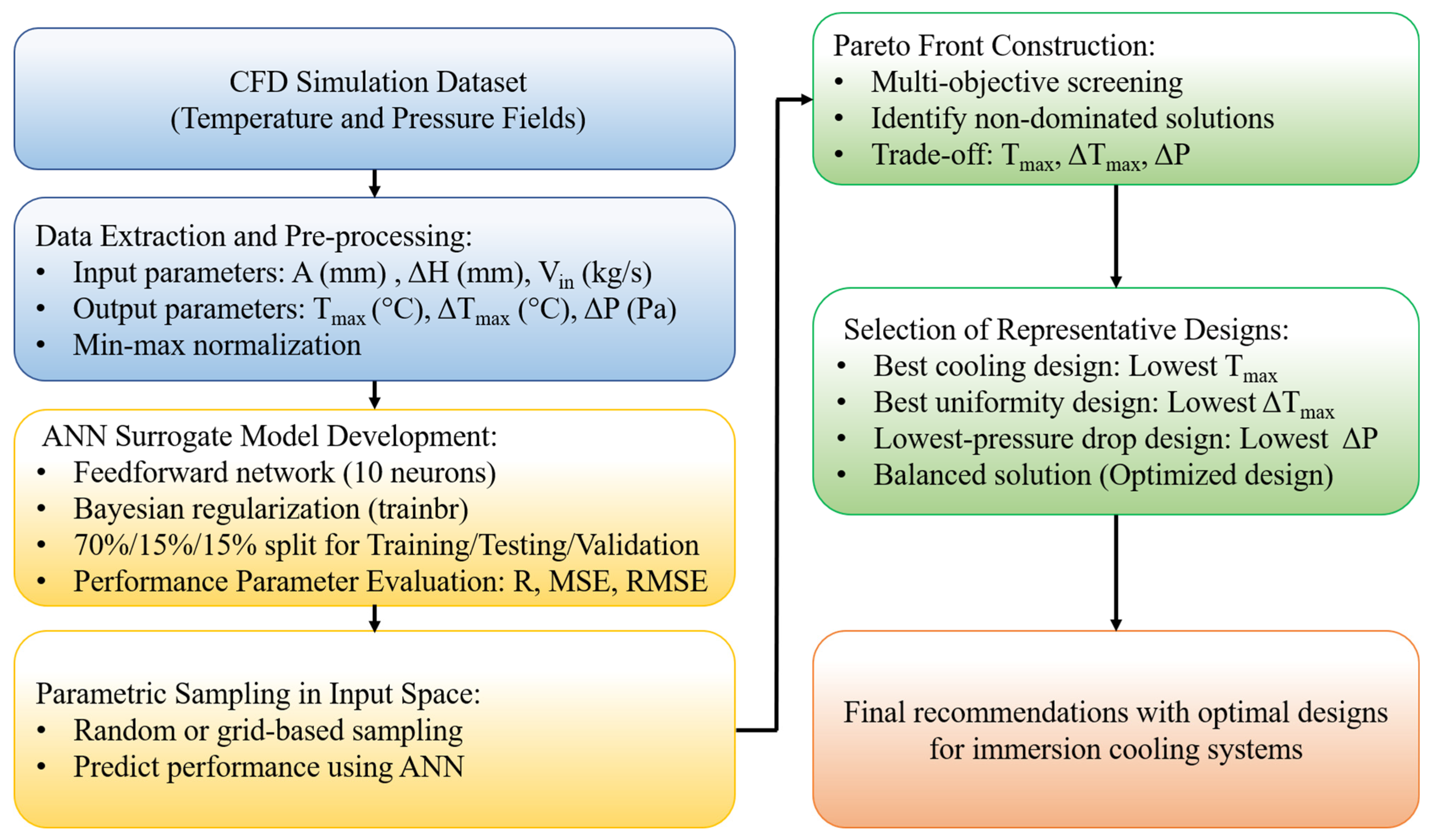
An ANN-based optimization model was developed using three input variables (A, ΔH, and Vin) and three outputs (Tmax, ΔTmax, and ΔP). Figure 14 illustrates a standard ANN model that utilizes the feedforward neural network approach. This model comprises an input layer, a hidden layer, and an output layer. Figure 15 illustrates the detailed flow chart pertaining to multi-objective optimization. Although the dataset consisted of only 27 samples derived from a three-level full factorial design, measures were taken to ensure the generalization capability of the ANN model. A feedforward network with ten hidden neurons and Bayesian regularization was selected after sensitivity testing. The Bayesian regularization algorithm (trainbr) was applied to prevent overfitting, which is particularly effective for small CFD-derived datasets. All data were min-max normalized and split in a 70%/15%/15% ratio for training, validation, and testing [47]. The predictive performance was evaluated on the testing subset using correlation coefficients (R) and root mean square error (RMSE). Backward normalization was applied to restore physical units for evaluation. Although explicit k-fold cross-validation was not performed due to the limited number of samples, additional validation was conducted by comparing ANN predictions with independent CFD simulations at Pareto-optimal design points. Nevertheless, it is acknowledged that the small dataset size may limit extrapolation beyond the sampled design space. Therefore, the ANN surrogate is intended for interpolation-based optimization within the defined parameter ranges in the current study.

3.4.2. Machine Learning Training and Prediction

The predictive accuracy of the ANN model is evaluated using the correlation coefficient (R), mean square error (MSE), and root mean square error (RMSE). The R value quantifies the linear fit between the ANN predictions and the CFD targets, with values close to 1 indicating near-perfect correlation. The MSE measures the mean square deviation between the predicted and actual outputs, providing a sensitive indicator of the overall fit of the model. Meanwhile, the RMSE expresses this error on the original physical scale of the outputs, facilitating a direct interpretation of the prediction quality. Together, these metrics provide a comprehensive assessment of the fidelity of the surrogate: high R values combined with low MSE/RMSE confirm that the ANN reliably captures the non-linear relationships governing the thermo-hydraulic behavior of the battery module. The precise calculation formulas for each are as follows [47]:
R = 1 i = 1 n x i y i 2 i = 1 n x i x 2
R M S E = M S E = 1 n n 1 x i y i 2
where n represents the total number of the dataset, x i and y i denote the predicted and actual values, respectively, and x signifies the mean of the actual values.

3.4.3. Optimized Results and Validation

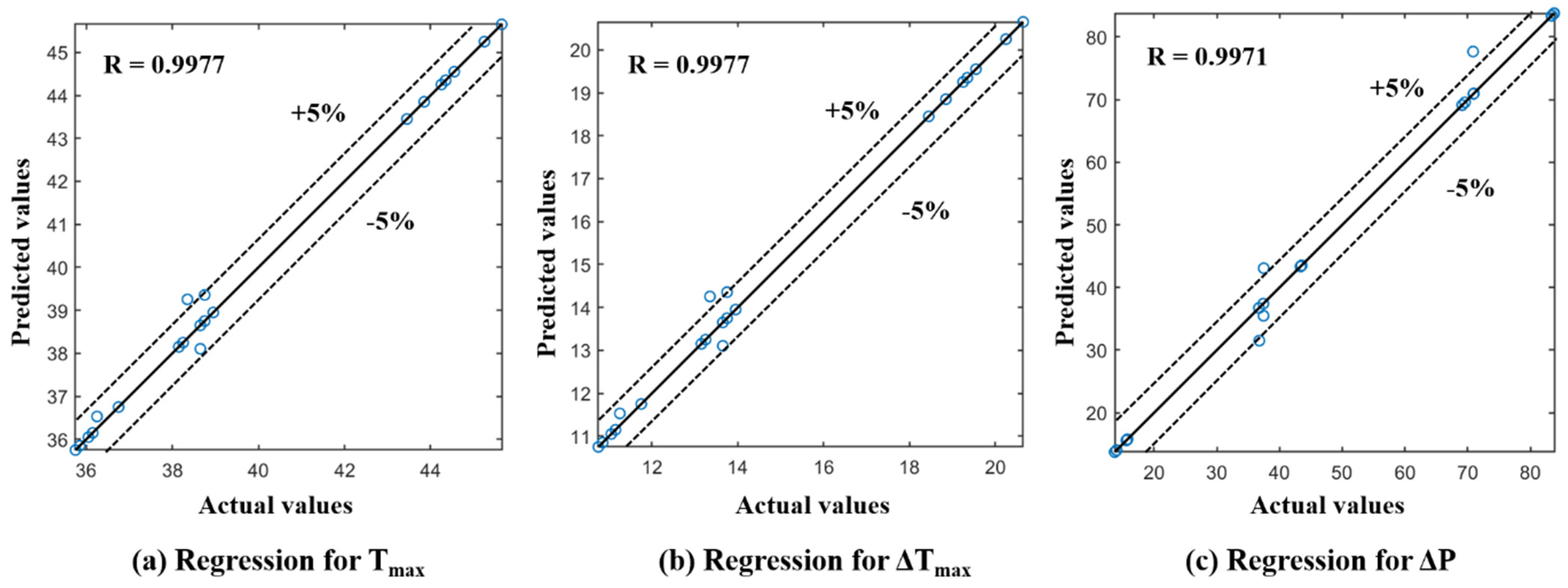
The trained ANN showed excellent agreement with CFD data for all output variables. Tmax and ΔTmax predictions achieved correlation coefficients of R at 0.9977, with RMSE values of 0.24 °C for both outputs. ΔP prediction also demonstrated strong accuracy with an R of 0.9971 and an RMSE of 2.01 Pa. Error histograms shown in Figure 16 confirmed that prediction errors were narrowly distributed around ±5%, indicating stable and accurate performance. Overall, the ANN provided a reliable surrogate model capable of reproducing the thermal-hydraulic behaviour of the immersion-cooled battery module with high fidelity.
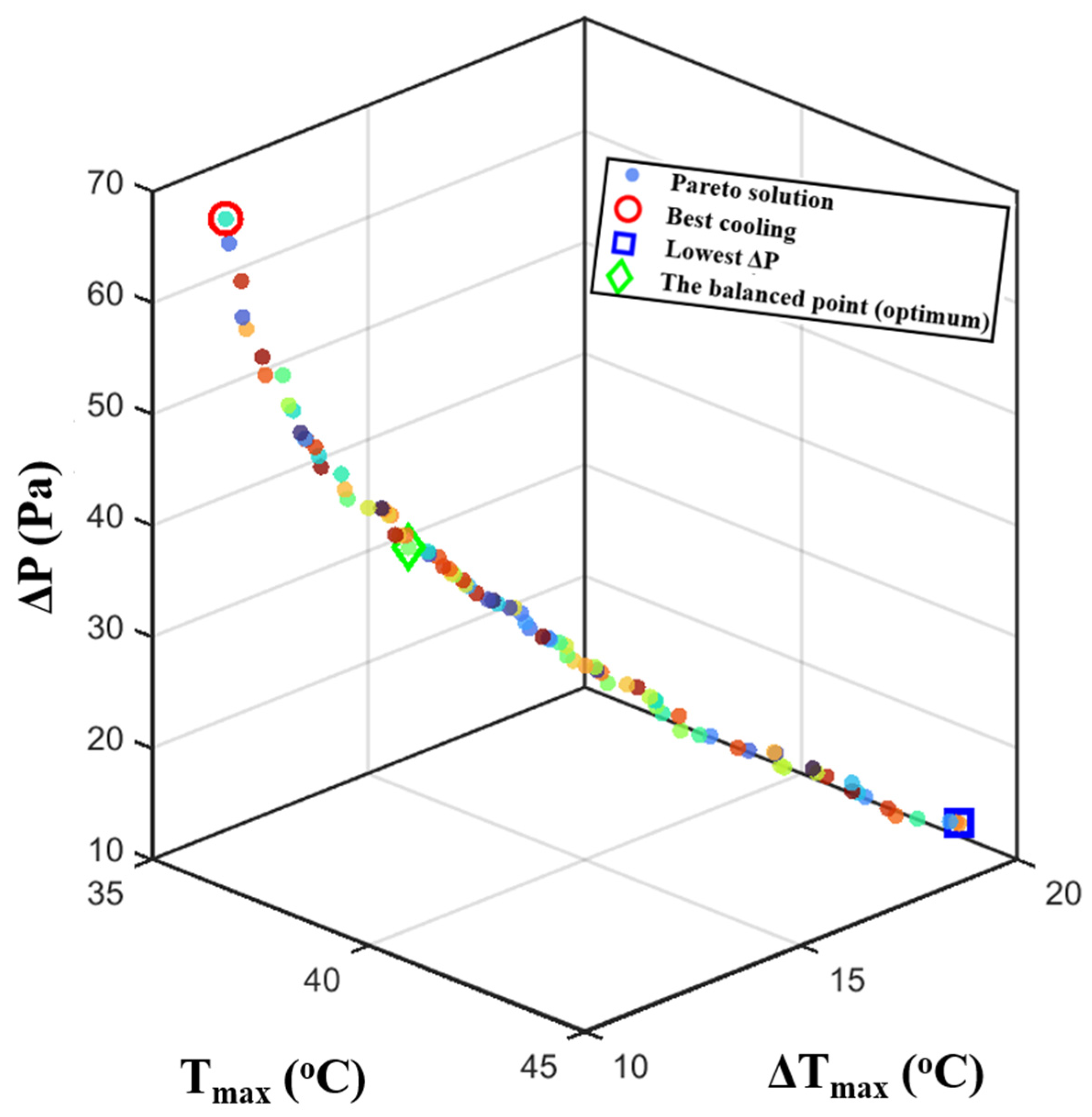
After training with the ANN model, the Pareto solution-based optimization method was applied to optimize the input parameters to provide a balance between thermal and hydraulic performance in the battery module with the immersion cooling system. The results indicated that multi-objective optimization using the ANN surrogate produced a well-defined Pareto front describing the trade-off between cooling performance and hydraulic cost. Figure 17 presents the ANN-based Pareto front obtained from multi-objective optimization of IPDP parameters and Vin. The front illustrates the trade-off between Tmax, ΔTmax, and ΔP. Solutions with lower Tmax and ΔTmax require a significant increase in ΔP, while lower ΔP configurations lead to reduced cooling performance and a rise in Tmax and ΔTmax. Four representative points are highlighted, including the best cooling design (lowest Tmax), the best uniformity design (lowest ΔTmax), the lowest-pressure drop design (lowest ΔP), and the balanced solution (optimized design), which provides a favorable compromise between cooling performance and energy consumption.
Typical Pareto-optimal design parameters obtained from an ANN-based multi-objective optimization are presented in Table 6. The best cooling and uniformity configuration designs with A, ΔH, and Vin are 17.01 mm, 13.70 mm, and 0.03844 kg/s, respectively, achieved the lowest Tmax of 35.85 °C and ΔTmax of 10.85 °C, but at the cost of high ΔP at 67.52 Pa. Conversely, the lowest ΔP design with the lowest ΔP of 13.24 Pa resulted in a poorer cooling performance and a significant increase in Tmax and ΔTmax with 44.32 °C and 19.32 °C, respectively. A balanced solution as an optimized design with hole size A at 16.56 mm, ΔH at 13.80 mm, and Vin at 0.02723 kg/s provided a favorable compromise, reducing ΔP by approximately 44% relative to the best cooling design while maintaining Tmax in the optimal range of 37.97 °C and ΔTmax in the acceptable range of 12.97 °C. These results highlight the effectiveness of ANN-assisted optimization for immersion-cooled high-capacity battery systems.
To verify the predictive reliability of the Pareto-based ANN multi-objective optimization, the optimal design was simulated using high-fidelity CFD, and the ANN predictions were compared with the corresponding numerical results. As shown in Table 7, the ANN showed excellent agreement with the CFD numerical simulation values on all three performance metrics. The Tmax prediction differed from the numerical simulation results by only 1.52%, while ΔTmax showed a modest deviation of 4.47%. The predicted ΔP also closely matched the calculation with an error of only 2.55%. These relatively low deviations confirm that the ANN multi-objective optimization model provides highly accurate estimates in the optimal region of the design space, demonstrating strong generalization capabilities and confirming its suitability for Pareto-based multi-objective optimization.

4. Conclusions

This study developed and validated an ANN-based optimization framework to improve coolant distribution in a 10 kWh 24S24P cylindrical immersion-cooled battery module through the design of the IPDP. A combined NTGK-CFD modeling approach was used to quantify the thermal and hydraulic responses associated with variations in hole size A, hole spacing ΔH, and coolant mass flow rate Vin. The primary findings of the present investigation are detailed below:
(a)
The results of the study show that the generated dataset allows training a highly accurate ANN model, capable of predicting Tmax, ΔTmax, and ΔP with strong correlations with CFD simulation results. Specifically, a correlation coefficient R of 0.9977 with an RMSE value of 0.24 °C was achieved for the Tmax and ΔTmax variables. Additionally, the ΔP prediction also showed high accuracy with an R of 0.9971 and a RMSE of 2.01 Pa.
(b)
Parametric analyses revealed a clear interaction between geometric parameters and flow characteristics, highlighting the trade-off between cooling efficiency and hydraulic losses. Multi-objective optimization identified Pareto-optimal configurations that simultaneously minimized hot spot formation and ΔP, demonstrating that tailoring the hole geometry and coolant mass flow rate Vin can significantly improve cooling efficiency without causing excessive pumping power.
(c)
The optimized design achieved significant improvements in thermal performance in the battery module with Tmax maintained within the optimal range at 37.97 °C and a significant reduction in ΔP of up to 44%, illustrating the potential of data-driven optimization for next-generation battery thermal management systems.
The methodology established in this study provides a scalable framework for complex cooling system optimization design and can be extended to other battery configurations and cooling strategies. Future research will conduct experimental validation using a full battery module prototype to provide practical insights into manufacturability, coolant flow stability, and real-world thermal performance, supporting the translation of the proposed optimization configuration into commercial battery thermal management systems.

Author Contributions

Conceptualization, T.D.L. and M.-Y.L.; methodology, T.D.L. and M.-Y.L.; software, T.D.L. and Y.-M.B.; formal analysis, T.D.L. and Y.-M.B.; investigation, T.D.L., Y.-M.B. and N.-H.N.; resources, T.D.L. and M.-Y.L.; data curation, T.D.L. and N.-H.N.; writing—original draft preparation, T.D.L. and Y.-M.B.; writing—review and editing, T.D.L. and M.-Y.L.; visualization, T.D.L., Y.-M.B. and N.-H.N.; supervision, M.-Y.L.; project administration, M.-Y.L.; funding acquisition, M.-Y.L. All authors have read and agreed to the published version of the manuscript.

Funding

This work was supported by the Korea Industrial Complex Corporation (KICOX) (No. VCDM2502), the Korea Evaluation Institute of Industrial Technology (KEIT) (No. 20024894), both grants funded by the Korean government (MOTIE), and the Regional Innovation System and Education (RISE) program through the Institute for Regional Innovation System and Education in Busan Metropolitan City, funded by the Ministry of Education (MOE) and the Busan Metropolitan City, Republic of Korea (2025-RISE-02-003).

Data Availability Statement

The data presented in this study are available upon request to the corresponding author. The data are not publicly available due to privacy.

Conflicts of Interest

The authors declare that this study was funded by the Korea Industrial Complex Corporation (KICOX) (No.VCDM2502). The funder was not involved in the study design, collection, analysis, interpretation of data, the writing of this article or the decision to submit it for publication.

References

  1. You, N.; Chinnasamy, V.; Lee, M.; Cho, H. Correlation analysis between design parameters and cooling performance in 21700 battery module using immersion cooling. Therm. Sci. Eng. Prog. 2025, 68, 104368. [Google Scholar] [CrossRef]
  2. Liu, J.; Tao, L.; Yang, Q.; Wang, J. Recent advances in immersion cooling for thermal management of lithium-ion batteries. Renew. Sustain. Energy Rev. 2025, 226, 116492. [Google Scholar] [CrossRef]
  3. Jedari Salehzadeh, F.; Heyhat, M.M. Direct and indirect cooling of Lithium-ion batteries with new manifold designs. Therm. Sci. Eng. Prog. 2025, 68, 104325. [Google Scholar] [CrossRef]
  4. Qin, S.; Wang, W.; Chen, S.; Li, X. Preference for electric vehicles among young adults: A discrete choice analysis in China. Transp. Policy 2025, 175, 103872. [Google Scholar] [CrossRef]
  5. Tai, L.D.; Garud, K.S.; Hwang, S.; Lee, M. A Review on Advanced Battery Thermal Management Systems for Fast Charging in Electric Vehicles. Batteries 2024, 10, 372. [Google Scholar] [CrossRef]
  6. Chen, H.; Yang, Q.; Hou, Z.; Liu, J. Cooling effectiveness of the immersion cooling on the overcharging lithium-ion batteries. Therm. Sci. Eng. Prog. 2025, 68, 104342. [Google Scholar] [CrossRef]
  7. Wang, D.; Kong, D.; Ping, P.; Zhao, X.; Dai, X.; Ren, J.; Ren, X.; Guo, J. Synthetic ester immersion cooling for lithium-ion batteries: A comparison of electro-thermal balancing under static and dynamic conditions and heat transfer analysis. J. Energy Storage 2025, 141, 119072. [Google Scholar] [CrossRef]
  8. Tai, L.D.; Garud, K.S.; Lee, M. Experimental Study on Thermal Management of 5S7P Battery Module with Immersion Cooling Under High Charging/Discharging C-Rates. Batteries 2025, 11, 59. [Google Scholar] [CrossRef]
  9. Kim, S.-H.; Park, S.-Y. Computational Analysis for Efficient Battery Cooling for Electric Vehicles Using Various Cooling Methods. J. Korea Acad. Ind. Coop. Soc. 2025, 26, 9–20. [Google Scholar]
  10. Fang, H.; Chen, Y.; Cai, L.; Yao, J.; Zhang, Z. Performance of lithium-ion battery cooling plates based on topology optimization and bionic design. Appl. Therm. Eng. 2026, 284, 129168. [Google Scholar] [CrossRef]
  11. Tai, L.D.; Lee, M. Advances in the Battery Thermal Management Systems of Electric Vehicles for Thermal Runaway Prevention and Suppression. Batteries 2025, 11, 216. [Google Scholar] [CrossRef]
  12. Wang, Y.; Wang, C.; Li, D.; Xi, H. Numerical investigation for a coupled fin-PCM-liquid cooling system under multi-scenario of thermal management and thermal runaway mitigation in lithium-ion battery modules. J. Energy Storage 2025, 140, 119078. [Google Scholar] [CrossRef]
  13. Baek, S.-H.; Ma, B.-C. Optimization of thermal management for immersion cooled lithium-ion batteries based on experimental design methods. J. Korea Acad. Ind. Coop. Soc. 2025, 26, 21–28. [Google Scholar]
  14. Dai, Y.; Ting, Y.; Chang, C.M.; Huang, C. Thermal management analysis of fast-charging lithium-ion battery packs: Effects of cooling strategies. Next Energy 2025, 9, 100465. [Google Scholar] [CrossRef]
  15. Madaoui, S.; Sabatier, J.; Vinassa, J.; Guillemard, F. Research and implementation of a fast-charging methodology for lithium-ion batteries under bottom and dual cooling configurations. J. Energy Storage 2025, 130, 117285. [Google Scholar] [CrossRef]
  16. Hu, Y.; Zhu, H.; Zhu, Y.; Tang, R.; Wu, X.; Qiu, H.; Wu, T. Numerical simulation study on optimizing the temperature characteristics of jet fires in forced air-cooled 18650 battery modules during thermal runaway. Case Stud. Therm. Eng. 2025, 76, 107369. [Google Scholar] [CrossRef]
  17. Li, L.; Lyu, P.; Han, X.; Li, M.; Rao, Z. Multi-directional synergistic effects of air-cooling and liquid-cooling on the thermal runaway propagation of lithium-ion batteries. Appl. Therm. Eng. 2025, 281, 128629. [Google Scholar] [CrossRef]
  18. Garud, K.S.; Tai, L.D.; Hwang, S.; Nguyen, N.; Lee, M. A Review of Advanced Cooling Strategies for Battery Thermal Management Systems in Electric Vehicles. Symmetry 2023, 15, 1322. [Google Scholar] [CrossRef]
  19. Zhang, H.; Cao, S.; Zhang, H.; Ren, C.; Hu, R.; Chen, Z. Synergy of high-efficiency passive protective nanocomposite materials and active liquid cooling for suppressing thermal diffusion in lithium-ion power batteries. Appl. Energy Combust. Sci. 2025, 24, 100433. [Google Scholar] [CrossRef]
  20. Yaqteen, M.A.; Moon, S.; Kim, J.S. A novel spray-based immersion cooling for Li-ion batteries: An experimental comparison with flow immersion. Appl. Therm. Eng. 2025, 282, 128873. [Google Scholar] [CrossRef]
  21. Elsayed Elfeky, K.; Hosny, M.; Mohammed, A.G.; Wang, Q.; Ge, K. Performance assessment of a novel hybrid cooling design for battery thermal management systems. Case Stud. Therm. Eng. 2025, 76, 107393. [Google Scholar] [CrossRef]
  22. Wang, C.; Wang, Y.; Zheng, Y.; Shen, K.; Lai, X.; Xu, C.; Ben-Marzouk, M.; Meng, X. Multi-condition simulation and thermal management enhancement of a rectangular-case lithium-ion battery module single-phase immersion cooling system. Int. J. Therm. Sci. 2026, 221, 110467. [Google Scholar] [CrossRef]
  23. Moon, J.-H. Air-Cooled Battery Cooling Simulation Techniques Using Simulink and Simscape. J. Korea Acad. Ind. Coop. Soc. 2025, 26, 35–40. [Google Scholar] [CrossRef]
  24. Suo, Y.; Tang, C.; Zhang, H. Cooling performance optimization of a novel L1−i−j-type structure for the forced air-cooled battery thermal management system. Int. J. Heat Fluid Flow 2025, 117, 110085. [Google Scholar] [CrossRef]
  25. Abd, H.M.; Abdulwahab, M.R.; Almohammed, O.A.M.; Abed, A.M.; Al-attab, K.A.; Abdullah, M.Z.; Enagi, I.I. Effectiveness of indirect evaporative cooling in battery thermal management systems based on a novel heat pipe structure: An experimental study. Appl. Therm. Eng. 2025, 281, 128799. [Google Scholar] [CrossRef]
  26. Yardımcı, U.; Tuğan, V. Computational fluid dynamics analysis of battery pack with cooling channel integrated with innovative thermoelectric cooling stations. Int. J. Therm. Sci. 2026, 220, 110380. [Google Scholar] [CrossRef]
  27. Choi, D.-H.; Kim, T.-W.; Kim, M.-J.; Yu, J.-S.; Hong, D.-S. Experimental Study on the Thermal Characteristics and Melting Behavior of Phase Change Materials Applied to the Cooling System of Electric Vehicle Chargers. J. Korea Acad. Ind. Coop. Soc. 2024, 25, 349–356. [Google Scholar]
  28. Fan, Y.; Wang, Z.; Yang, H.; Yang, W.; He, P.; Zhang, X. Performance analysis and optimized design of hybrid battery thermal management system integrating leak-free PCM with liquid cooling under extreme temperature conditions. Energy 2025, 341, 139404. [Google Scholar] [CrossRef]
  29. Lai, Y.; Ding, J.; Liu, L. Numerical investigation on the cooling performance of lithium-ion battery using liquid cooled-plate with integrated grooves and secondary microchannel structures. Int. J. Therm. Sci. 2025, 217, 110094. [Google Scholar] [CrossRef]
  30. Zhang, B.; Yuan, N.; Kong, B.; Zou, Y.; Shi, H. Simulation of hybrid air-cooled and liquid-cooled systems for optimal lithium-ion battery performance and condensation prevention in high-humidity environments. Appl. Therm. Eng. 2024, 257, 124455. [Google Scholar] [CrossRef]
  31. Ren, J.; Qiu, X.; Wang, S. A liquid cooling plate based on topology optimization and bionics simplified design for battery cooling. J. Energy Storage 2024, 102, 114171. [Google Scholar] [CrossRef]
  32. Tang, A.; Yang, J.; Yang, P.; Zhang, H.; Cai, T. Optimization and working performance analysis of liquid cooling plates in refrigerant direct cooling power battery systems. Int. J. Heat Mass Transf. 2024, 231, 125899. [Google Scholar] [CrossRef]
  33. Wu, N.; Qin, Y.; Liu, W.; Chen, H.; Zhou, X. Performance optimization of two-phase immersion cooling systems for large-format lithium-ion battery packs. Appl. Therm. Eng. 2025, 281, 128752. [Google Scholar] [CrossRef]
  34. Guo, C.Y.; Muhieldeen, M.W.; Teng, K.H.; Ang, C.K.; Lim, W.H. A novel thermal management system for lithium-ion battery modules combining indirect liquid-cooling with forced air-cooling: Deep learning approach. J. Energy Storage 2024, 94, 112434. [Google Scholar] [CrossRef]
  35. Chen, Z.; Hong, X.; Huo, Z.; Ruan, D. Enhancing lithium-ion battery cooling efficiency through leaf vein-inspired double-layer liquid cooling plate design. J. Energy Storage 2024, 88, 111584. [Google Scholar] [CrossRef]
  36. Hu, H.; Xu, J.; Li, J.; Xi, H. Immersion coupled direct cooling with non-uniform cooling pipes for efficient lithium-ion battery thermal management. J. Energy Storage 2025, 116, 116010. [Google Scholar] [CrossRef]
  37. Song, C.; Kong, B.; Zeng, Z.; Yuan, N.; Shi, H. Innovative coupled cooling strategy for enhanced battery thermal management: Synergistic optimization of jet impingement and immersion cooling. Int. J. Heat Mass Transf. 2024, 232, 125963. [Google Scholar] [CrossRef]
  38. Liu, X.; Zhou, Z.; Wu, W.; Wei, L.; Hu, C.; Li, Y.; Huang, H.; Li, Y.; Song, Y. Numerical simulation for comparison of cold plate cooling and HFE-7000 immersion cooling in lithium-ion battery thermal management. J. Energy Storage 2024, 101, 113938. [Google Scholar] [CrossRef]
  39. Adeniran, A.; Bak, J.; Bhatia, B.; Park, S. Optimizing single-phase immersion cooling system for lithium-ion battery modules in electric vehicles: A multi-objective design approach. Int. J. Therm. Sci. 2025, 210, 109636. [Google Scholar] [CrossRef]
  40. Zou, Z.; Xie, J.; Luo, Y.; Zhang, G.; Yang, X. Numerical study on a novel thermal management system coupling immersion cooling with cooling tubes for power battery modules. J. Energy Storage 2024, 83, 110634. [Google Scholar] [CrossRef]
  41. Zhao, L.; Tong, J.; Zheng, M.; Chen, M.; Li, W. Experimental study on the thermal management performance of immersion cooling for 18650 lithium-ion battery module. Process Saf. Environ. Prot. 2024, 192, 634–642. [Google Scholar] [CrossRef]
  42. Li, Y.; Bai, M.; Zhou, Z.; Lv, J.; Hu, C.; Gao, L.; Peng, C.; Li, Y.; Li, Y.; Song, Y. Experimental study of liquid immersion cooling for different cylindrical lithium-ion batteries under rapid charging conditions. Therm. Sci. Eng. Prog. 2022, 37, 101569. [Google Scholar] [CrossRef]
  43. Gao, Q.; Zhang, Z.; Liu, D. A novel immersion cooling strategy for improving the thermal performance of lithium-ion battery packs. J. Energy Storage 2025, 141, 119121. [Google Scholar] [CrossRef]
  44. Wahab, A.; Cifterler, N.; Amjady, N.; Date, A.; Kemper, H.; Khayyam, H. Enhancing energy and thermal efficiency of single-phase liquid immersion cooling systems for lithium-ion batteries in electric vehicles. J. Energy Storage 2025, 131, 117365. [Google Scholar] [CrossRef]
  45. Song, Y.; Wang, Z.; Jia, D.; Yuan, D.; Chang, Y.; Zheng, X.; Zhang, S. Effect of immersion cooling design optimization on thermal management for lithium battery module. Appl. Therm. Eng. 2025, 272, 126401. [Google Scholar] [CrossRef]
  46. Mo, C.; Yuen, A.C.Y.; Wu, Y.; Fei, B.; Wang, J. Investigation on electro-thermal characteristics and heat transfer of immersion cooling for lithium-ion battery module at high-ambient temperature. J. Power Sources 2025, 645, 237238. [Google Scholar] [CrossRef]
  47. Tang, Z.; Li, X.; Li, Y.; Cheng, J. Multi-objective optimization of parallel flow immersion cooling battery thermal management system with flow guide plates based on artificial neural network. Appl. Therm. Eng. 2025, 274, 126833. [Google Scholar] [CrossRef]
  48. Donmez, M.; Karamangil, M.I. Artificial neural networks-based multi-objective optimization of immersion cooling battery thermal management system using Hammersley sampling method. Case Stud. Therm. Eng. 2024, 64, 105509. [Google Scholar] [CrossRef]
  49. Garud, K.S.; Han, J.; Hwang, S.; Lee, M. Artificial Neural Network Modeling to Predict Thermal and Electrical Performances of Batteries with Direct Oil Cooling. Batteries 2023, 9, 559. [Google Scholar] [CrossRef]
  50. Donmez, M.; Tekin, M.; Karamangil, M.I. Artificial neural network predictions for temperature: Utilizing numerical analysis in immersion cooling systems using mineral oil and an engineered fluid for 32700 LiFePO4. Int. J. Therm. Sci. 2025, 211, 109742. [Google Scholar] [CrossRef]
  51. Suresh Patil, M.; Seo, J.; Lee, M. A novel dielectric fluid immersion cooling technology for Li-ion battery thermal management. Energy Convers. Manag. 2021, 229, 113715. [Google Scholar] [CrossRef]
  52. Kumar, K.; Sarkar, J.; Mondal, S.S. Analysis of ternary hybrid nanofluid in microchannel-cooled cylindrical Li-ion battery pack using multi-scale multi-domain framework. Appl. Energy 2024, 355, 122241. [Google Scholar] [CrossRef]
  53. Dambros Telli, G.; Gungor, S.; Lorente, S. Counterflow canopy-to-canopy and U-turn liquid cooling solutions for battery modules in stationary Battery Energy Storage Systems. Appl. Therm. Eng. 2024, 238, 121997. [Google Scholar] [CrossRef]
  54. Li, Y.; Zhou, Z.; Hu, L.; Bai, M.; Gao, L.; Li, Y.; Liu, X.; Li, Y.; Song, Y. Experimental studies of liquid immersion cooling for 18650 lithium-ion battery under different discharging conditions. Case Stud. Therm. Eng. 2022, 34, 102034. [Google Scholar] [CrossRef]
  55. Kong, D.; Peng, R.; Ping, P.; Du, J.; Chen, G.; Wen, J. A novel battery thermal management system coupling with PCM and optimized controllable liquid cooling for different ambient temperatures. Energy Convers. Manag. 2020, 204, 112280. [Google Scholar] [CrossRef]
  56. Han, J.; Garud, K.S.; Hwang, S.; Lee, M. Experimental Study on Dielectric Fluid Immersion Cooling for Thermal Management of Lithium-Ion Battery. Symmetry 2022, 14, 2126. [Google Scholar] [CrossRef]
  57. Jambunathan, K.; Lai, E.; Moss, M.; Button, B. A review of heat transfer data for single circular jet impingement. Int. J. Heat Fluid Flow 1992, 13, 106–115. [Google Scholar] [CrossRef]
  58. Chen, F.; Liu, Y.; Cui, Z.; Shao, W. An optimization method for uniform flow distribution in the manifold of server cabinet. Energy Sci. Eng. 2021, 9, 390–401. [Google Scholar] [CrossRef]
  59. Han, J.; Garud, K.S.; Kang, E.; Lee, M. Numerical Study on Heat Transfer Characteristics of Dielectric Fluid Immersion Cooling with Fin Structures for Lithium-Ion Batteries. Symmetry 2022, 15, 92. [Google Scholar] [CrossRef]
  60. Kang, E.; Garud, K.S.; Park, S.C.; Lee, M. Heat Transfer Characteristics of an Electric Motor with Oil-Dripping Cooling under Overload Conditions. Symmetry 2024, 16, 289. [Google Scholar] [CrossRef]
  61. Hwang, S.; Lee, M.; Ko, B. Numerical Analysis on Cooling Performances for Connectors Using Immersion Cooling in Ultra-Fast Chargers for Electric Vehicles. Symmetry 2025, 17, 624. [Google Scholar] [CrossRef]
Figure 1. Modeling of 24S24P battery module with immersion cooling: (a) Overall model of 24S24P battery module with immersion cooling equipped with IPDP, (b) Plan view and (c) Side view of the modeling.
Symmetry 18 00014 g001
Figure 2. Modeling of the IPDP integrated in the 24S24P battery module with immersion cooling.
Symmetry 18 00014 g002
Figure 3. Mesh Independence test.
Symmetry 18 00014 g003
Figure 4. Mesh configuration of the computational model: (a) Fluid region and (b) Fluid and solid region mesh configurations.
Symmetry 18 00014 g004
Figure 5. Experimental setup diagram.
Symmetry 18 00014 g005
Figure 6. Comparison of numerical simulation results with experimental data: (a) Voltage and (b) Maximum temperature.
Symmetry 18 00014 g006aSymmetry 18 00014 g006b
Figure 7. The variation in Tmax, ΔTmax and ΔP with different hole sizes.
Symmetry 18 00014 g007
Figure 8. Vertical section velocity with different hole sizes.
Symmetry 18 00014 g008
Figure 9. The variation in Tmax, ΔTmax and ΔP with different hole spacing ΔH.
Symmetry 18 00014 g009
Figure 10. Vertical section velocity with different hole spacing ΔH.
Symmetry 18 00014 g010
Figure 11. The variation in Tmax, ΔTmax and ΔP with different coolant mass flow rates Vin.
Symmetry 18 00014 g011
Figure 12. Temperature distribution contours in the battery module with different coolant mass flow rates Vin.
Symmetry 18 00014 g012
Figure 13. Vertical section velocity with different coolant mass flow rates Vin.
Symmetry 18 00014 g013
Figure 14. Illustrations of a typical ANN architecture.
Symmetry 18 00014 g014
Figure 15. ANN-Pareto multi-objective optimization workflow.
Symmetry 18 00014 g015
Figure 16. Comparison of (a) Tmax, (b) ΔTmax and (c) ΔP actual and predicted values.
Symmetry 18 00014 g016
Figure 17. ANN optimization strategy based on Pareto solution.
Symmetry 18 00014 g017
Table 1. Specifications for the battery cells and battery module in the current study.
ParametersValueUnit
Battery
Type21,700-
Nominal capacity4.80Ah
Nominal voltage3.64V
Maximum charge voltage4.20V
Discharge cut-off voltage2.50V
Diameter 21.15   ± 0.2mm
Height 70.65   ± 0.15mm
Weight 68.0   ± 1.5g
Battery module
Number of cells/module576-
Nominal battery module voltage87.36V
Maximum battery module voltage100.80V
Nominal battery module capacity10.06kWh
Maximum battery module capacity11.61kWh
Table 2. Correction coefficients utilized in the NTGK model.
CoefficientValueCoefficientValue
a04.171265b019.69492
a1−1.373891b1−41.07015
a24.679367b2275.0927
a3−17.74574b3−674.2017
a426.87833b4703.2603
a5−14.05492b5−259.2665
C10C20
Table 3. Thermophysical properties of materials used in the current study.
PropertiesAluminumBatteryPitherm 150BPlastic
Density (kg/m3)27022739.62785.991070
Specific heat (J/kg·K)90316052188.31200
Thermal conductivity (W/m·K)2370.870.13630.17
Dynamic viscosity (kg/m·s)0.0012
Table 4. Design variables and their respective ranges.
ParameterRangeUnits
Hole size (A)8.66, 13.86, 17.32mm
Hole spacing (ΔH)6.0, 10.0, 14.0mm
Coolant mass flow rate (Vin)0.0131, 0.0262, 0.0393kg/s
Table 5. Conditions for sampling and results obtained through CFD calculations.
CaseA (mm)ΔH (mm)Vin (kg/s)Tmax (°C)ΔTmax (°C)ΔP (Pa)
18.666.00.013145.2520.2515.77
28.666.00.026238.7513.7543.52
38.666.00.039336.1511.1583.78
48.6610.00.013144.3519.3515.68
58.6610.00.026238.2513.2543.44
68.6610.00.039336.1511.1583.72
78.6614.00.013143.4518.4515.59
88.6614.00.026238.6513.6543.34
98.6614.00.039335.8510.8583.36
1013.866.00.013144.5519.5514.01
1113.866.00.026238.1513.1537.41
1213.866.00.039336.7511.7570.97
1313.8610.00.013144.3519.3514.02
1413.8610.00.026238.6513.6537.48
1513.8610.00.039336.2511.2570.85
1613.8614.00.013145.6520.6514.03
1713.8614.00.026238.7513.7537.44
1813.8614.00.039336.0511.0570.89
1917.326.00.013143.8518.8513.73
2017.326.00.026238.3513.3536.77
2117.326.00.039336.1511.1569.55
2217.3210.00.013144.2519.2515.65
2317.3210.00.026238.9513.9543.40
2417.3210.00.039336.0511.0583.40
2517.3214.00.013143.4518.4513.73
2617.3214.00.026238.2513.2536.72
2717.3214.00.039335.7510.7569.12
Table 6. Representative Pareto-optimal designs obtained from ANN-based multi-objective optimization.
Design TypeA (mm)ΔH (mm)Vin (kg/s)Tmax (°C)ΔTmax (°C)ΔP (Pa)
Best cooling17.0113.700.0384435.8510.8567.52
Best uniformity17.0113.700.0384435.8510.8567.52
Lowest-pressure drop13.9511.550.0131744.3219.3213.24
Balanced Solution
(Optimized design)
16.5613.800.0272337.9712.9738.00
Table 7. Analysis of errors in the optimization results.
Performance MetricsPrediction ValueCalculation ValueRelative Deviation (%)
Tmax (°C)37.9738.551.52
ΔTmax (°C)12.9713.554.47
ΔP (Pa)38.0038.972.55
Disclaimer/Publisher’s Note: The statements, opinions and data contained in all publications are solely those of the individual author(s) and contributor(s) and not of MDPI and/or the editor(s). MDPI and/or the editor(s) disclaim responsibility for any injury to people or property resulting from any ideas, methods, instructions or products referred to in the content.