


Abstract
This article delves into the fuzzy finite-time adaptive control problem for uncertain nonlinear systems where state measurements are unavailable, nonlinear functions are unknown, and communication is limited. To emulate the unknown nonlinear relationships within the control methodology, we exploit fuzzy logic systems, while also proposing a state observer to address the challenge of unobservable states. To avoid the “complexity explosion” problem intrinsic to conventional backstepping techniques, the controller is developed based on the dynamic surface control methodology, which incorporates first-order filters to successfully alleviate this issue. An event-triggered approach is introduced to alleviate the computational and communication overhead. By leveraging the finite-time control approach, an adaptive finite-time fuzzy control algorithm is constructed using the adaptive backstepping technique. An event-triggered mechanism is designed to reduce communication frequency, while rigorously maintaining closed-loop stability and ensuring a positive minimum inter-event time to avoid Zeno behavior. The proposed finite-time controller achieves finite-time stability of the controlled systems, thereby guaranteeing that all system signals remain bounded within a finite time, despite the presence of unmeasurable states, unknown nonlinear functions, and limited communication constraints. This paper differentiates itself from recent related studies by proposing a co-designed observer–controller framework that rigorously guarantees finite-time stability under an event-triggered communication mechanism, thereby effectively addressing the multiple concurrent challenges of state estimation, rapid convergence, and limited network resources. Simulation examples are conducted to illustrate the effectiveness and feasibility of the derived control algorithm.
1. Introduction
Since its introduction by Kanellakopoulos in 1991, the backstepping method has emerged as a popular approach to tackle a variety of systems, particularly in addressing complex control problems involving nonlinear forms [1,2,3,4]. The backstepping method has made substantial contributions to the development of control systems, encompassing both single-input and single-output and multi-input and multi-output configurations [5,6,7,8]. The backstepping method is hindered by its limited capability in addressing nonlinear systems with partial knowledge. To cope with this challenge, researchers have turned to neural networks (NNs) and fuzzy logic systems (FLSs), capitalizing on their exceptional ability to approximate complex systems and tackle model uncertainties [9,10,11,12]. The combination of adaptive neural networks or fuzzy logic systems and backstepping methods has led to a surge in research, yielding a methodical and organized framework for control algorithm development. However, the conventional backstepping approach can give rise to the “explosion of complexity” issue, resulting in increased online computation load or diminished control efficacy. Dynamic surface control technology provides a solution to this challenge. Researchers have recently proposed adaptive control algorithms that leverage dynamic surface control technology to tackle nonlinear uncertainty in systems [13,14].
The majority of the previous results rely on the assumption that full state information is accessible to the control strategies. In reality, many engineering applications, including axisymmetric systems like missiles and spacecraft, deviate from this assumption, as only their output signals are accessible due to cost constraints, sensor failures, or load limitations. A particularly effective solution to this problem is to design an output feedback control algorithm. A feedback control strategy based on output measurements was developed for heterogeneous multi-agent systems, leveraging the internal model principle, as presented by Zuo et al. [15]. The issue of designing fuzzy adaptive output feedback controllers for optimal fault tolerance in single-input single-output nonlinear systems with strict feedback structures was investigated by Li et al. [16]. Specifically, the fuzzy observer leverages FLSs to provide effective estimation of unknown terms, thereby reducing the dependence of controller design on unknown system states and ensuring strong adaptability [17]. On the other hand, the limited communication bandwidth between control system components imposes a constraint on the continuous transmission of control data. In response, event-triggered control has emerged as a viable solution, as demonstrated in some existing works [18,19,20,21], which selectively transmits data only when a predetermined trigger condition is fulfilled, thereby optimizing resource utilization. As a result, event-triggered control has become a focal point of research in diverse engineering domains, with a substantial body of advanced research achievements having been reported. Notably, the above results are limited to addressing the asymptotic stability of resulting systems or the boundedness of signals within these systems.
Rapid tracking convergence is essential for nonlinear systems to achieve optimal performance. Unlike asymptotic control methods that only guarantee desired performance in the infinite time limit, finite-time control approaches provide exceptional disturbance suppression, refined tracking accuracy, and accelerated convergence performance [22,23,24,25]. Additionally, they ensure the fulfillment of control goals within a finite time frame, emphasizing their relevance. Consequently, considerable efforts have been invested in exploring the application of finite-time control methodologies in demanding industrial settings, including performance vehicles, aviation systems, and nuclear power plants [7,26,27,28]. Although a growing body of research has been dedicated to finite-time control for nonlinear systems, most of the above-mentioned articles have overlooked the challenges posed by limited communication and unmeasurable states, thereby limiting the applicability of these controllers in real-world scenarios. Moreover, to solve the inherent “complexity explosion” problem, the dynamic surface control technique is utilized, which makes the control algorithm development more complex. The fuzzy finite-time adaptive control problem poses a formidable challenge for uncertain nonlinear systems, particularly when compounded by limited communication and unmeasurable states. This gap between existing research and practical demands provides the primary motivation for our work.
Building on these insights, a novel adaptive finite-time fuzzy control strategy is derived in this work for nonlinear systems with uncertainties, specifically designed to handle practical constraints including limited communication and unmeasurable states: (1) Departing from conventional asymptotically stable control designs, this work presents a novel methodology for the synthesis of adaptive fuzzy controllers with finite-time convergence, offering a unified solution to the intertwined issues of uncertain dynamics, unmeasurable states, and communication limitations. (2) Given the unavailability of direct state measurements, an observer-based control scheme is developed. This scheme guarantees that the closed-loop system achieves finite-time stability while ensuring bounded observer errors within the same time frame. Furthermore, the proposed method integrates the dynamic surface control technique with finite-time control design, where the inclusion of first-order filters effectively prevents the “explosion of complexity” inherent in conventional backstepping approaches.
The discussion proceeds as outlined below. Section 2 proceeds with an examination of the problem definition and its underlying prerequisites. Next, this paper unfolds with Section 3, which presents the core results, featuring the design of the state observer and finite-time control algorithm. The validity of the main results is further corroborated by numerical examples in Section 4, followed by a summary of the key findings in the concluding Section 5.
2. Problem Statement and Preliminaries
This article explores nonlinear systems that can be characterized by
where . represents the system state vector and denotes system output. denotes the unknown nonlinear function. It is assumed in this article that only the output variable y is accessible for measurement.
Then, the system (1) is reformulated as
where , , , is the estimated value of , satisfies , and is a positive constant.
Lemma 1
([29]). For , , and , we have
Lemma 2
([30]). Given and , we obtain
where , , , and .
Assumption 1.
It is assumed that the reference signal and its derivatives through the n-th order are bounded.
Lemma 3
([31]). Considering , suppose the existence of a smooth Lyapunov function , which satisfies
where , , and . It can be concluded that the system is semi-globally practically finite-time stable (SGPFS).
Lemma 4
([32]). Fuzzy logic systems (FLSs) can be designed to approximate the continuous function over a compact set .
where is an arbitrarily small positive constant.
Control Objective: Finite-time stability and signal boundedness are achieved for nonlinear systems (1) with unmeasurable states and limited communication via a novel observer-based adaptive control strategy proposed in this article.
3. Main Results
This section develops an adaptive finite-time fuzzy control scheme, utilizing an observer, for nonlinear systems subject to unmeasurable states and communication constraints, which leverages the dynamic surface approach, incorporating first-order filters and the backstepping approach, to develop the finite-time controller.
3.1. Design State Observer
Estimation of the unavailable states is achieved through a designed state observer, compensating for the lack of direct measurements. Since the nonlinear term is unknown, FLSs are employed to approximate it. As stated in Lemma 4, it can be inferred that
where refers to the estimation of . satisfies with .
A state observer is designed as
where is the designed parameter.
The observer error is given by
By selecting the vector K to render A strictly Hurwitz, it follows that for any given symmetric positive-definite matrix , there exists a corresponding matrix satisfying the Lyapunov equation
where .
The Lyapunov function is constructed as
Furthermore, we have
where
According to (13) and (14), we have
where ; denotes the minimum singular value of the corresponding matrix.
Remark 1.
It is worth noting that this article develops state observers to acquire state information. As revealed by Equations (12) and (15), the estimate errors are bounded, implying that a positive constant can be found for which . Consequently, it is noted that the error e conforms to . Moreover, finite-time stability of the estimation errors is clearly evident, to be rigorously proven through subsequent stability analysis.
3.2. Fuzzy Finite-Time Adaptive Control Law
As a precursor to controller development, we present a sequence of function transformations that lay the foundation for the forthcoming control design.
where is accessible for measurement, is the desired signal, and represents the output signal generated by the subsequent first-order filters, as specified by
where denotes the virtual controller and is a constant.
Remark 2.
The backstepping technique is notorious for giving rise to the “explosion of complexity” issue, which stems from the repeated differentiation of the virtual control signal . The dynamic surface control approach with first-order filters (17) is utilized in this work to circumvent the aforementioned problem. This approach successfully mitigates the risk of repetitive differentiation. By integrating the first-order filters with the backstepping methodology, a function transformation, denoted by , is introduced to facilitate the design of a finite-time control algorithm.
Choose the Lyapunov function candidate as
where and , with representing the estimates of and representing the estimates of . and are parameters. The definitions of and will provided subsequently. According to (19), one obtains
The term of (20) is described by
By using (16) and (21), (20) becomes
According to Lemma 2, we obtain
Based on Lemma 4, the FLSs are employed to identify the uncertain nonlinear function , and we have
Because is bounded, it can be found that a constant exists, satisfying
Based on the preceding analysis, the virtual control law can be designed as
and the adaptive laws of and are designed as
where , , , , , is a positive constant, and is a design parameter.
Note that
are applied, where .
Since , where and , is a consistent function [33]. Based on Lemma 2, one has
where ℓ is a nonzero constant. Additionally, one can derive that
where and ℓ are positive constants that satisfy .
Thus, (30) can be rewritten as
Step : Based on the definition of variable , we have
where .
It is important to observe that ; it can be seen that
By applying Lemma 2, one has
The FLSs are employed to approximate as follows:
Because is bounded, it can be found that a constant exists, satisfying
Define the Lyapunov function
where , , where is the estimate of and is the estimate of . and are design parameters. We will define and later in this paper.
Then, the virtual controller is constructed as
where , , , , , and is a constant.
Note that
are applied, where .
According to , where , , we establish that is a continuous function. We have
Moreover, we have
where and are constants that satisfy .
Therefore, (46) becomes
Step : We have, from the definition of ,
where .
The FLSs are employed to approximate as follows:
Because is bounded, it can be found that a constant exists, satisfying
The following Lyapunov function candidate is proposed:
where and , with and corresponding to the estimates of and . and are design parameters.
The virtual control law can be designed as
where , , , , , and is a positive constant.
To save communication resources, inspired by [34,35], an event-triggered mechanism is developed. Thus, the actual control algorithm can be derived as follows:
where , , and are design parameters.
The event-triggered mechanism is defined as
where denotes the measurement error, and are constants, , and is the controller update time. In this case, we can always find a function with , so one has
Bases on [34,35], we have
where and .
Note the fact that
are used, where .
Remark 3.
Considering and , and . Therefore are compact in and , respectively. Therefore, is compact in . Furthermore, it follows that has a non-negative upper bound of .
3.3. Stability Analysis
We summarize the key outcomes of this study below.
Theorem 1.
Under Assumption 1 for the nonlinear system (1), the integrated framework comprising the actual controller (59) with its event-triggered mechanism (60), the fuzzy state observer (8), virtual controllers (27), (43), and (56), and parameter adaptation laws (28), (29), (44), (45), (57), and (58) collectively ensures the achievement of SGPFS for the controlled system. All closed-loop signals remain bounded, with the tracking error exhibiting finite-time boundedness, and Zeno behavior is precluded.
Proof.
The Lyapunov function is defined as follows:
Because , , we obtain
According to Lemma 1, we have
Furthermore, we have
where . In accordance with Lemma 3 and (76), the controlled systems are SGPFS. For , it holds that , and the settling time
where . Based on (76), we can obtain that the signals , , , , and are bounded within finite time. The virtual controller depends on , , , and , establishing that is both continuous and bounded. Additionally, we have that is bounded. Therefore, the boundedness of all closed-loop signals within finite time is guaranteed.
To preclude Zeno behavior, we establish the existence of a constant , which serves as a uniform lower bound for the intersampling intervals, specifically . One has , , and thus for all . Equation (76) implies that the nonlinear system exhibits SGPFS, thus ensuring the boundedness of all closed-loop signals. Moreover, it is evident that is bounded, implying the existence of a constant such that
The formulated adaptive finite-time tracking controller’s algorithm is given as Algorithm 1.
| Algorithm 1 Adaptive Observer-based Finite-time Tracking Controller Design |
| Input: The parameter in fuzzy state observer (8); the parameters and in virtual control strategies (27), (43) and (56); theparameters , , , and in adaptation laws (28), (29), (44), (45), (57), and (58); the functions of FLSs in (7), (24), (39), and (53). |
| Output: The finite-time controller (59). |
| Begin: |
| 1: Step 1: Formulate the fuzzy state observer (8). |
| 2: Step 2: Chose appropriately parameters and construct adaptation laws (28), (29), (44), (45), (57), and (58) and first-order filter (17), and intermediate function transformations (16). |
| 3: Step 3: Design the event-triggered mechanism (60). |
| 4: Step 4: Chose appropriately parameters and formulate actual controller (59). |
| 5: Step 5: An analysis of the convergence time was conducted for the closed-loop |
| system under the proposed finite-time tracking controller. |
| end |
Remark 4.
In the design of our controller, finite-time convergence is rigorously guaranteed through systematic Lyapunov analysis. Specifically, based on the finite-time stability criterion given in Lemma 3, a suitable Lyapunov function is constructed. Through stepwise backstepping design, this criterion is embedded into each virtual control law. To achieve finite-time convergence, necessary fractional-order state feedback terms are introduced into the controller. Furthermore, to ensure compatibility between the adaptation law and the finite-time control framework, the parameter update laws are designed as Equations (28), (29), (44), (45), (57), and (58), and with the aid of Lemma 1, they are also made to satisfy the finite-time stability criterion (Lemma 3). The coordinated action of the above control laws and adaptation laws ensures that the closed-loop system converges to and remains at the equilibrium point within a finite time.
Remark 5.
This research endeavors to resolve a novel and complex problem, namely, the development of fuzzy finite-time adaptive control strategies for nonlinear systems characterized by uncertain nonlinear functions, unmeasurable states, and limited communication, reflecting real-world applications and presenting novel difficulties in deriving control strategies. According to Lemma 4, the FLSs possess excellent function approximation capabilities, a trait frequently leveraged to tackle uncertainties terms. Specifically, we employ the FLSs to approximate the unknown nonlinear terms. To deal with the unmeasurable states and limited communication, the fuzzy observer and event-triggered mechanism are designed. As a result, this paper puts forth an observer-based finite-time fuzzy control strategy, accompanied by adaptive laws, which guarantees that the controlled system exhibits SGPFS and all closed-loop signals remain bounded.
4. Illustrative Examples
The simulation is based on a second-order nonlinear damped car system with external disturbances (Equation (80)), which can represent practical applications such as vehicle suspension and servo mechanisms. This system presents typical challenges, including partially measurable states (only the positional output is measurable, necessitating the design of a state observer), unknown nonlinear dynamics, and limited communication resources. Therefore, this section presents a simulation example with two case studies to validate the effectiveness of the proposed control algorithm. A damped car system is modeled by
where denotes the external disturbances, denotes the car’s displacement from its reference point, and denotes the car’s speed. kg denotes the car’s mass, Ns/m stands for the damping factor, and denotes the stiffness of the spring, , N/m.
According to Theorem 1, the fuzzy finite-time control approach is formulated via an event-triggered mechanism, as expressed in (60), for this particular case:
where the virtual controller is designed as
where the update laws are formulated as
where the virtual controller is designed as
where the update laws are formulated as
Case 1: The parameters are selected to be , , desired signal , , , , , , , , , , , , , and .
Case 2: The parameters are selected to be , , desired signal , , , , , , , , , , , , , and .
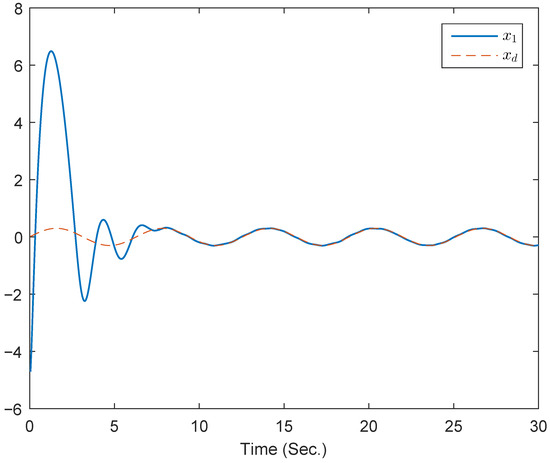
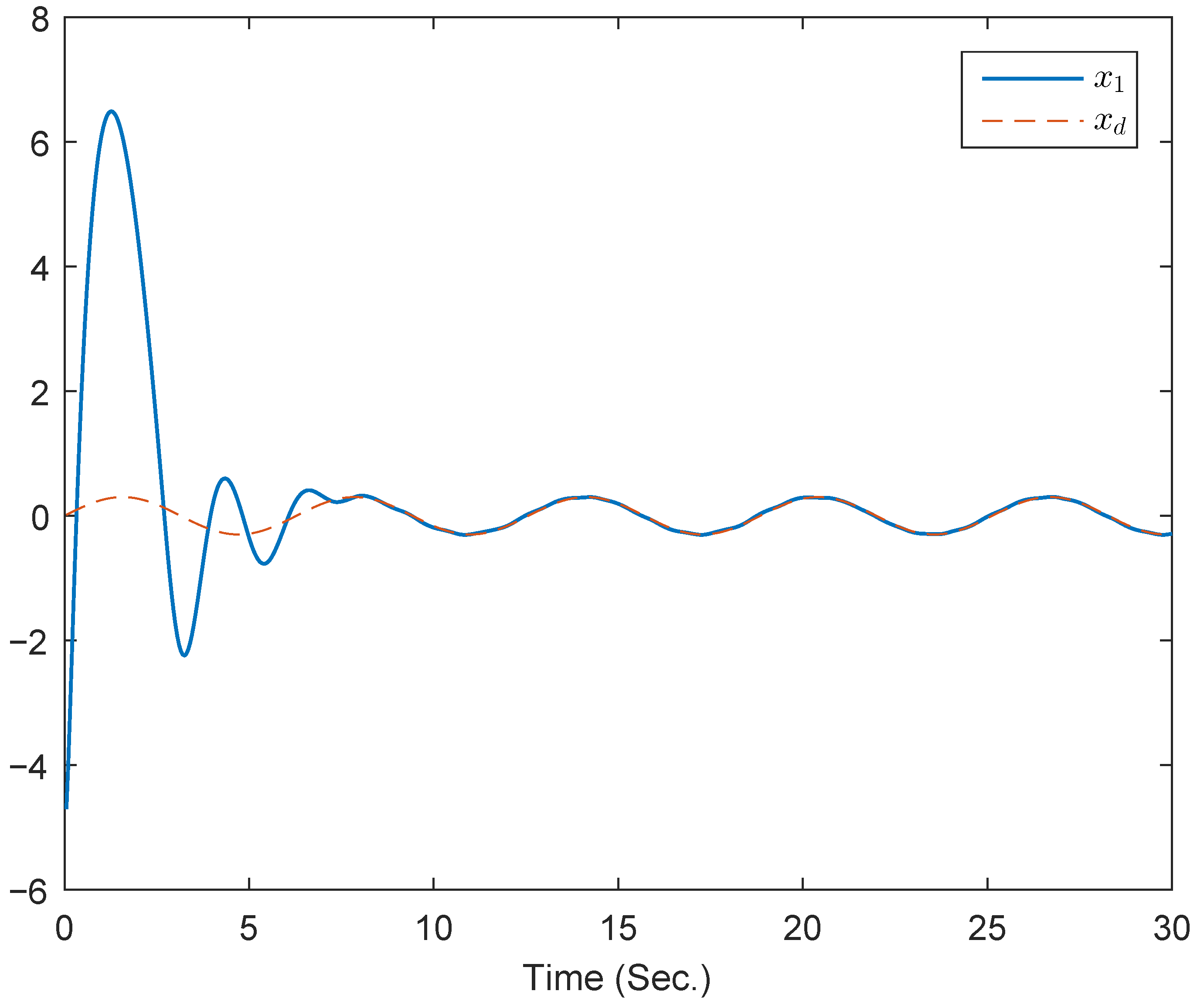
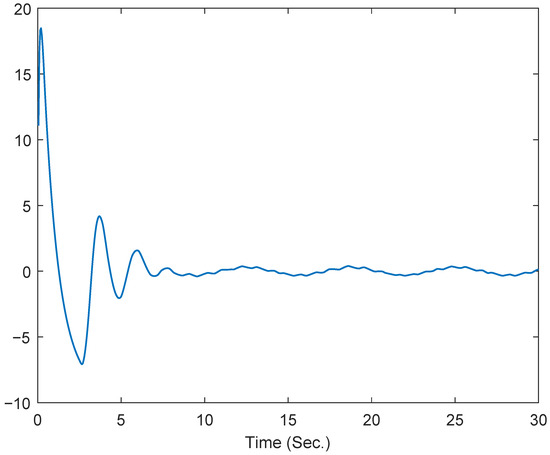
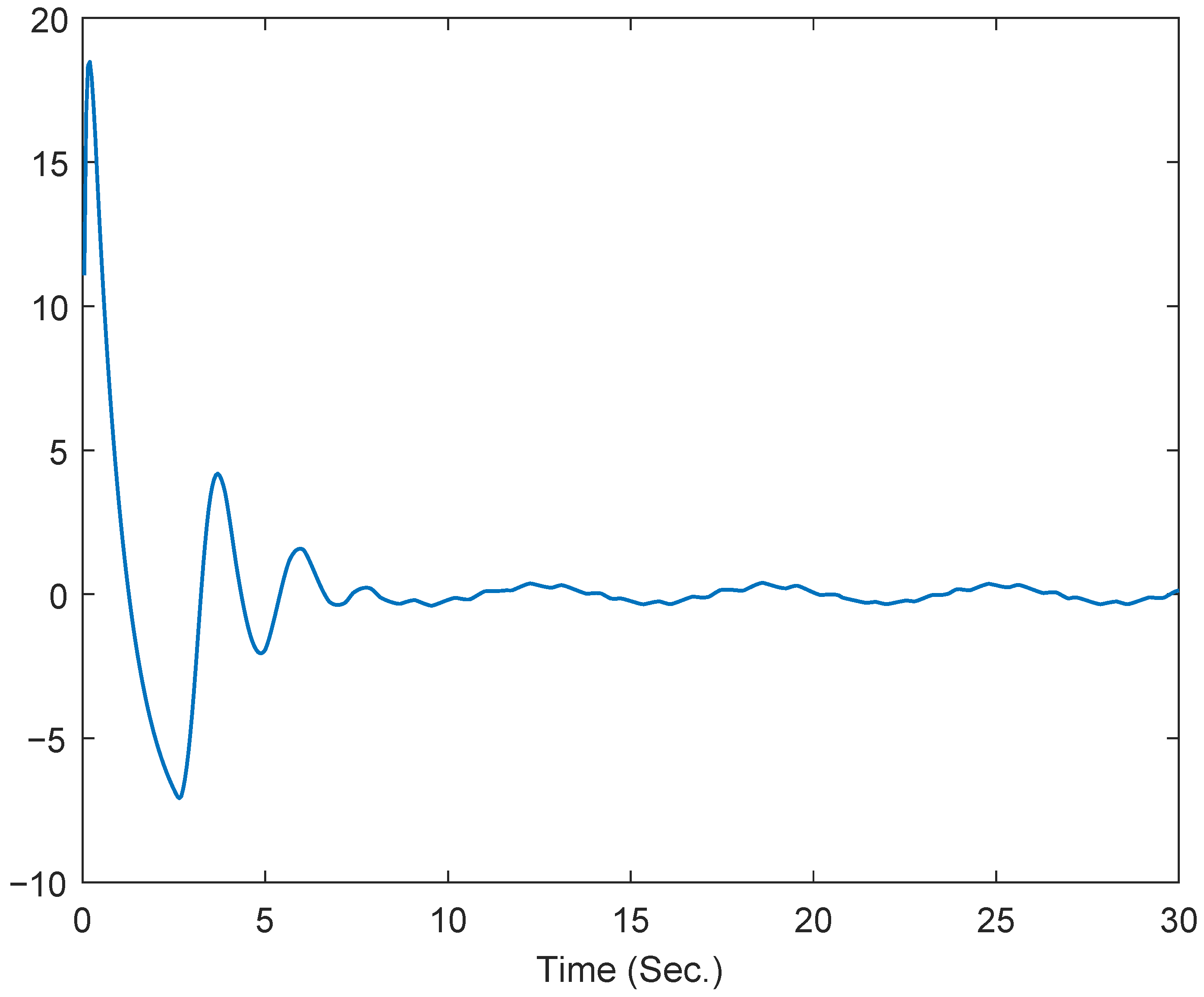
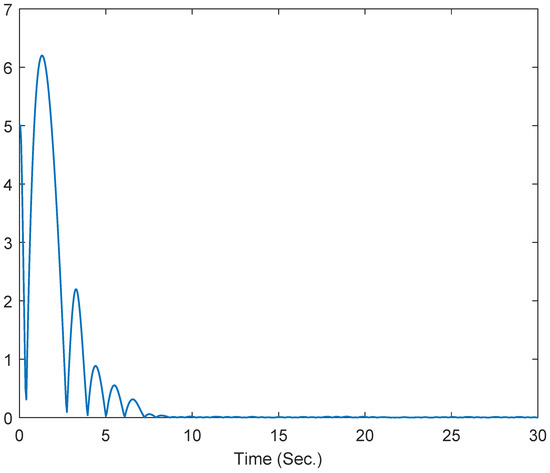
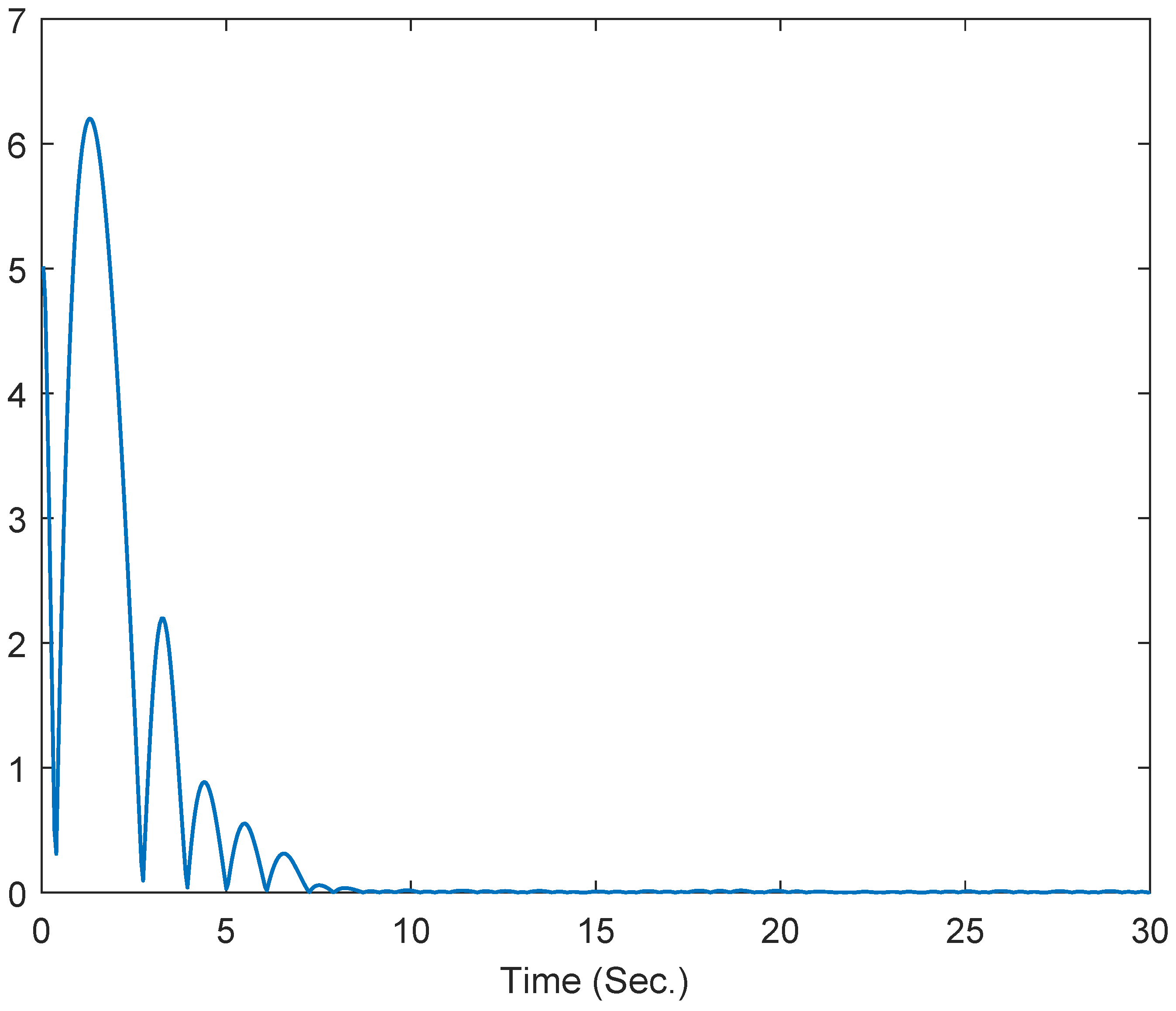
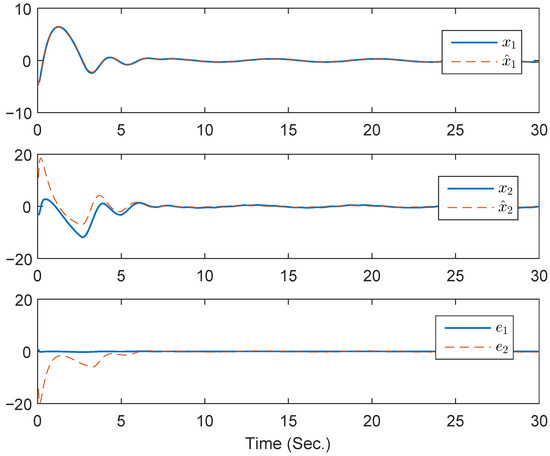
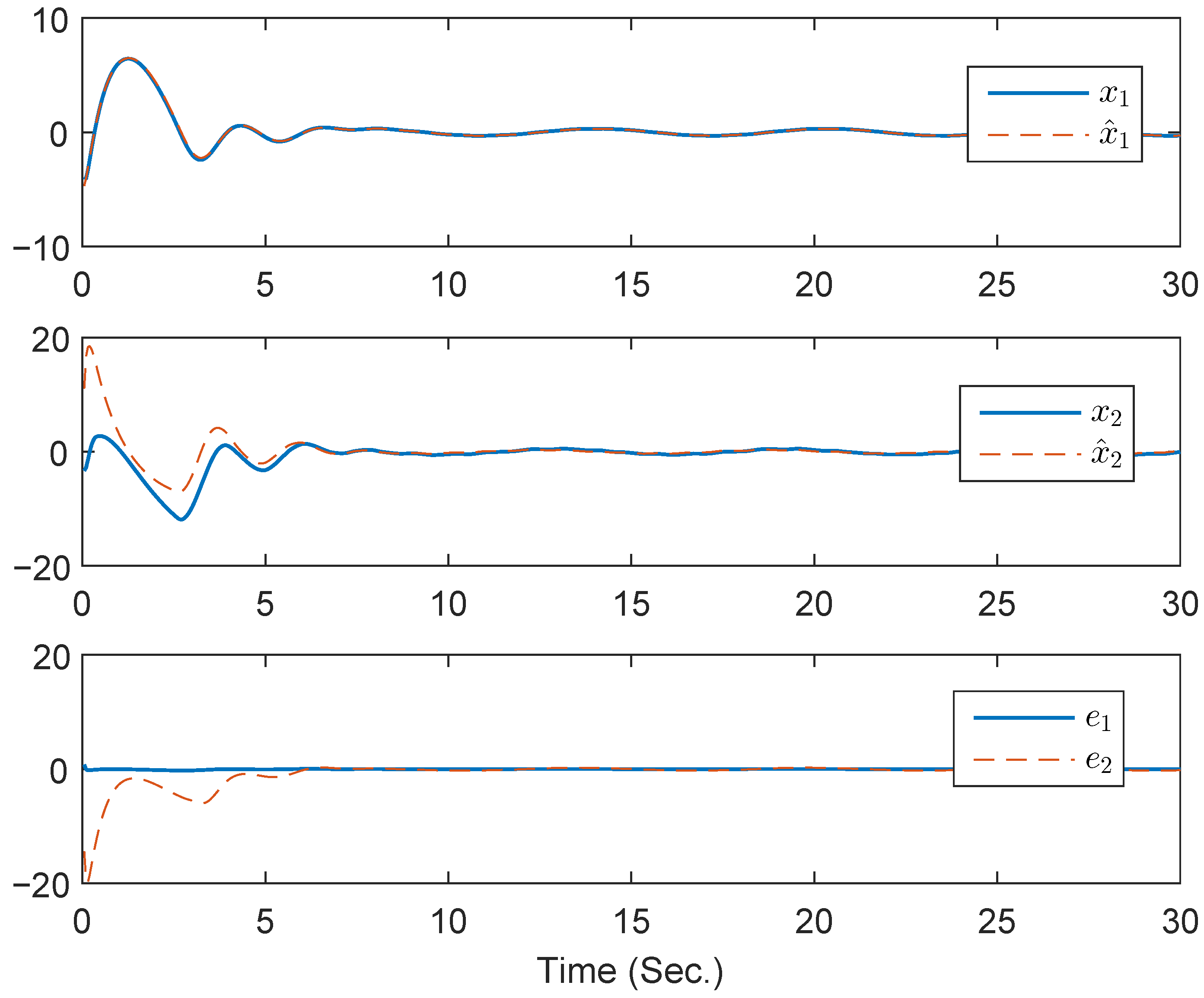
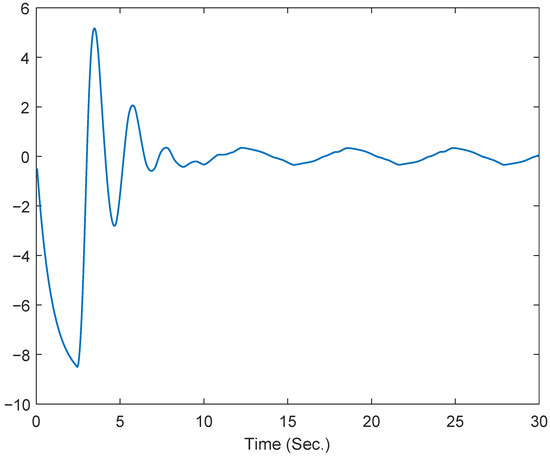
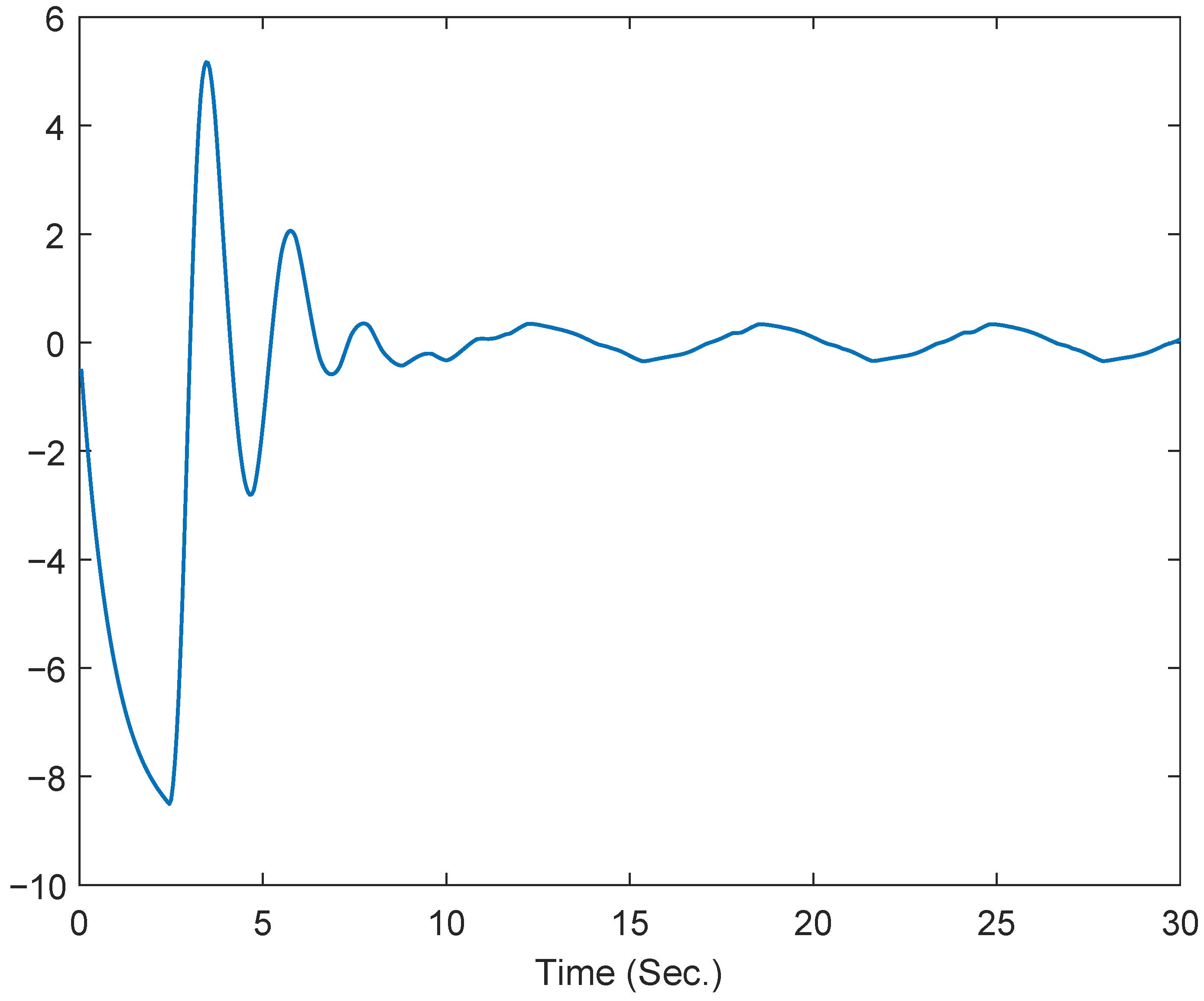
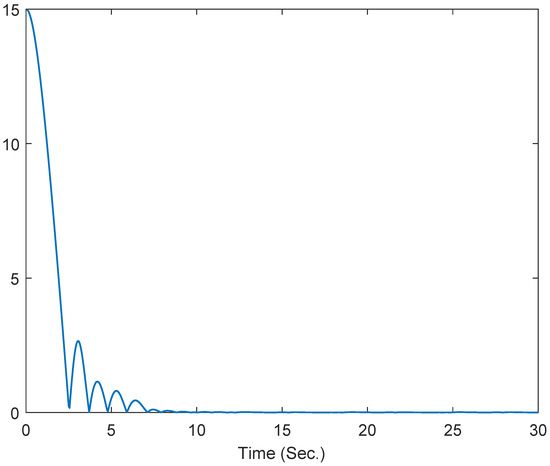
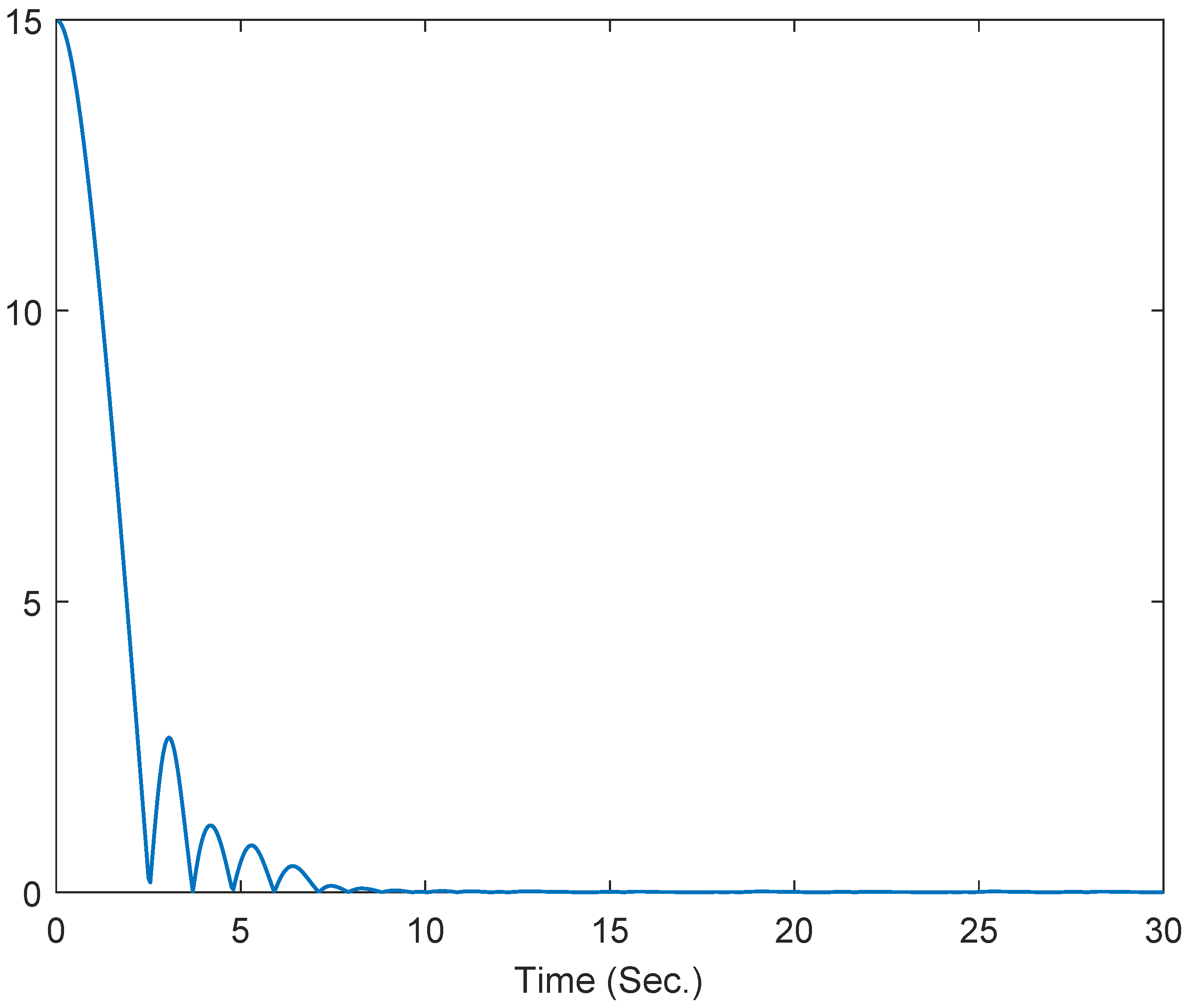
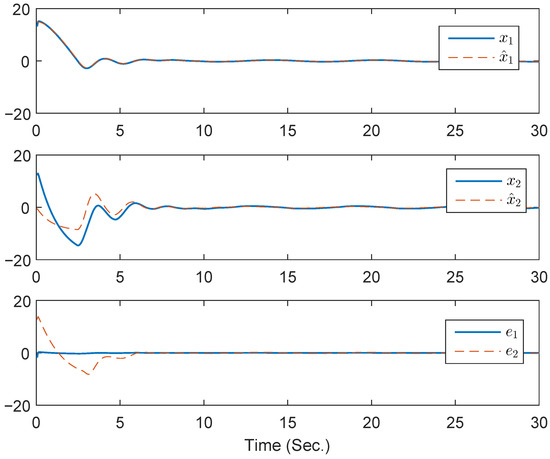
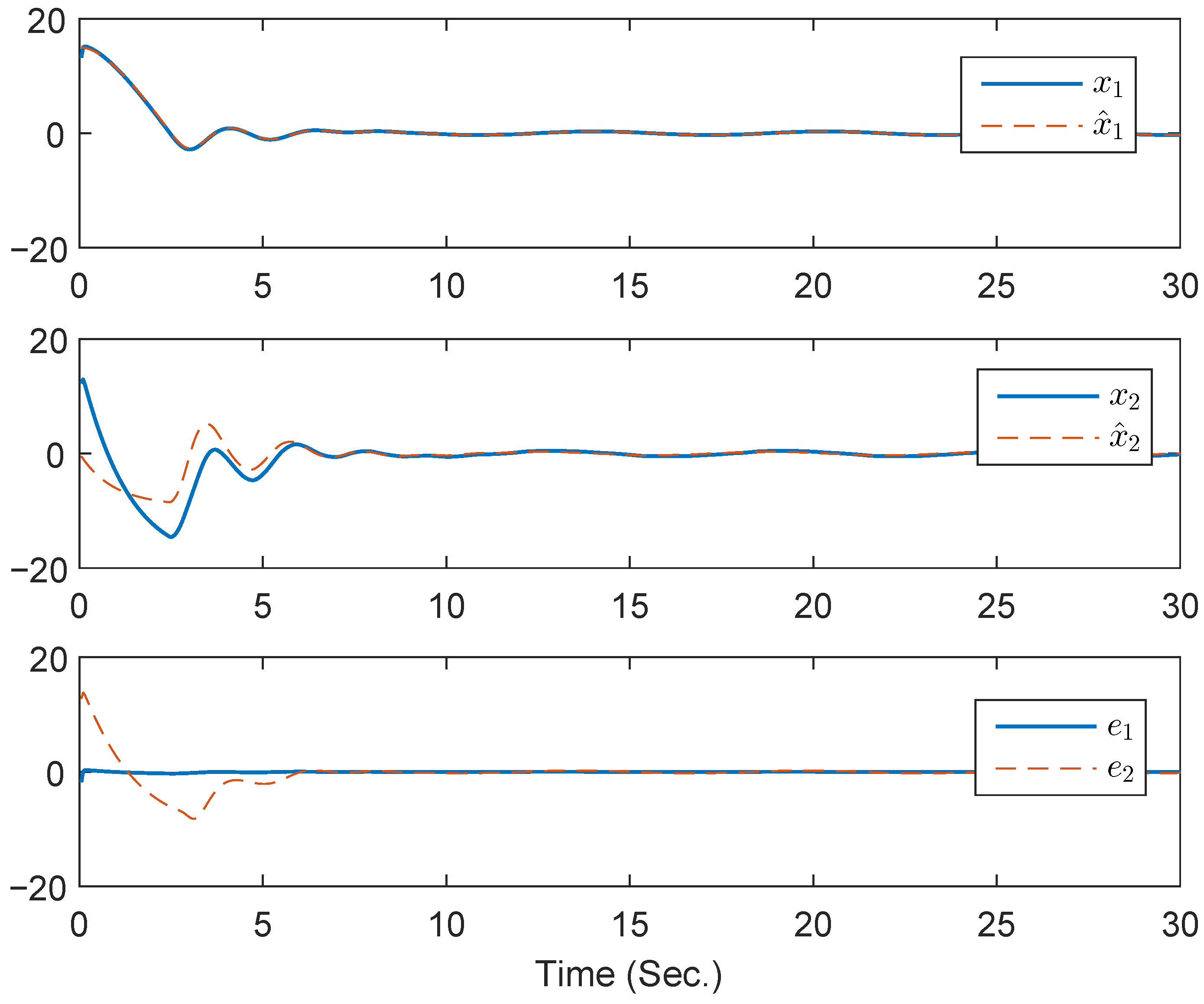
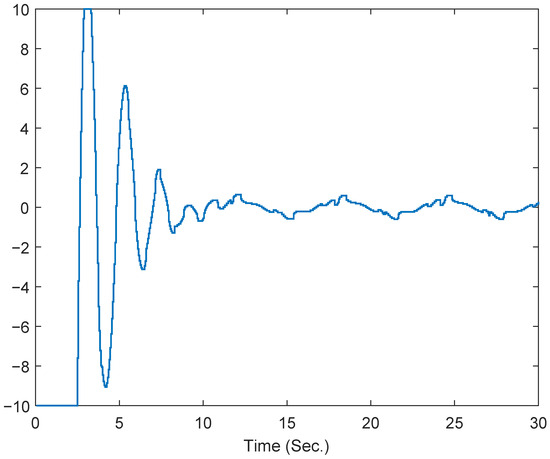
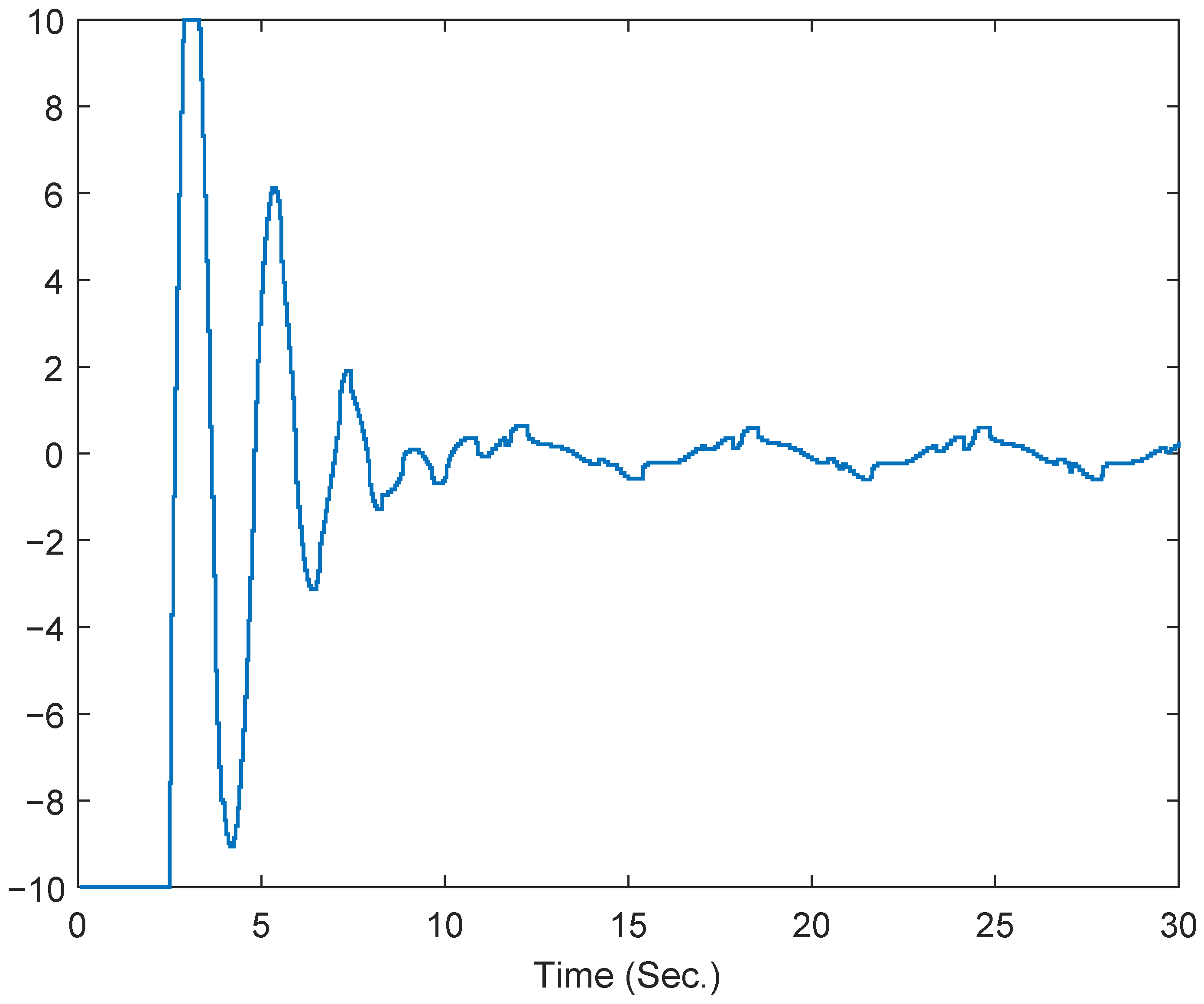
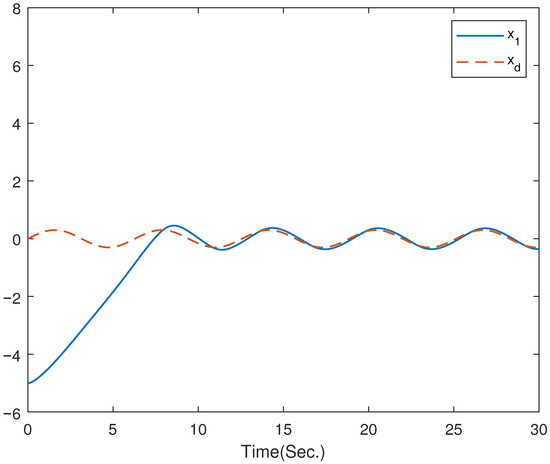
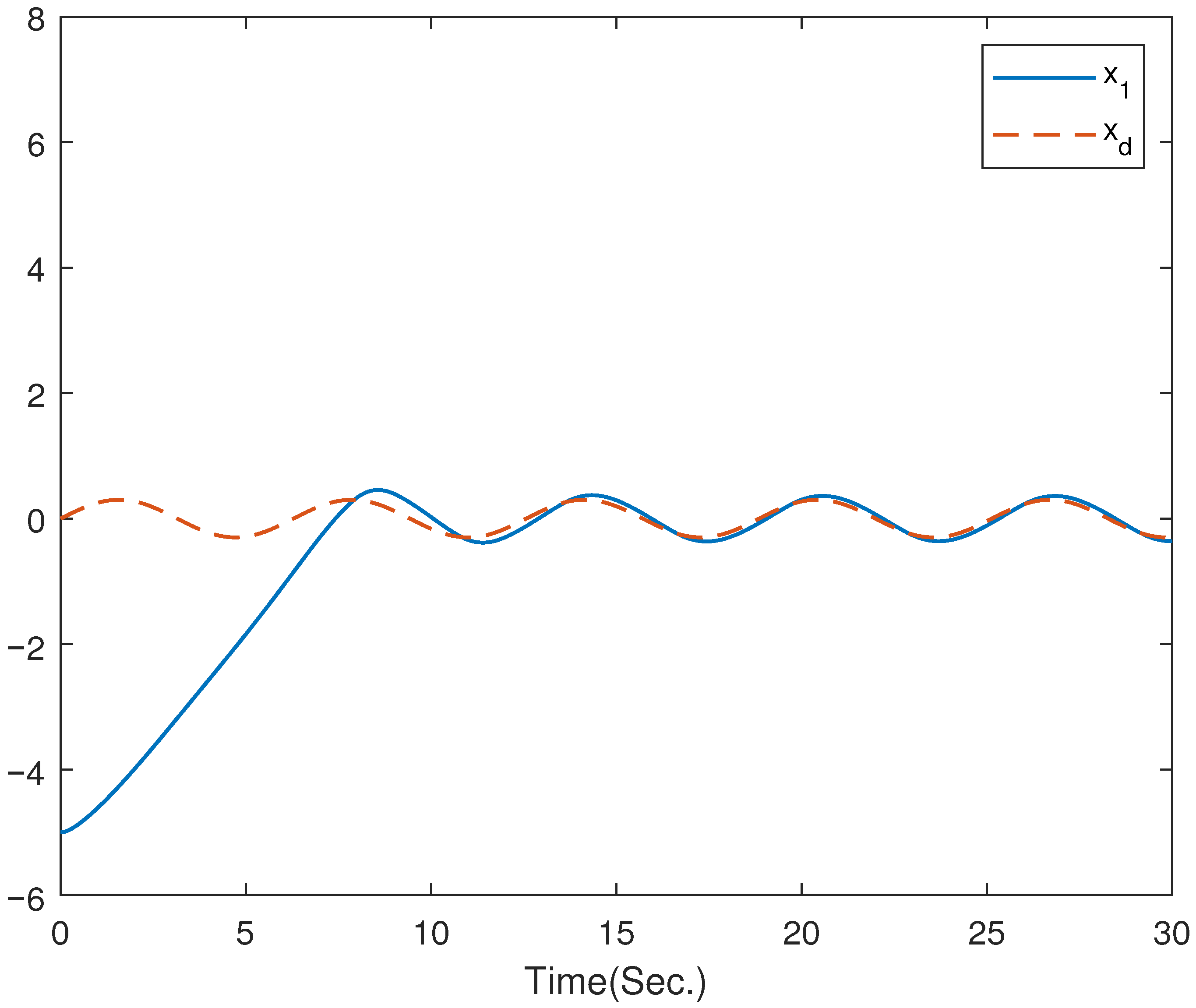
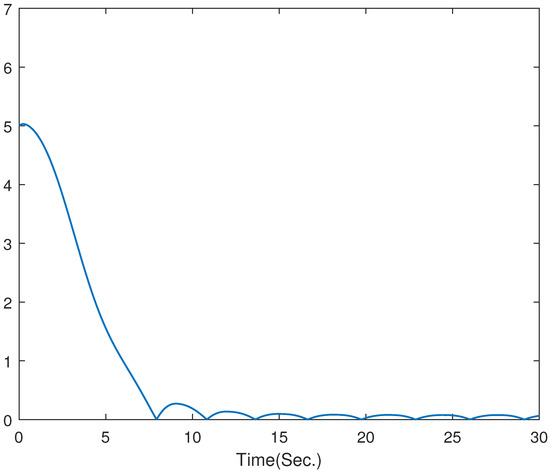
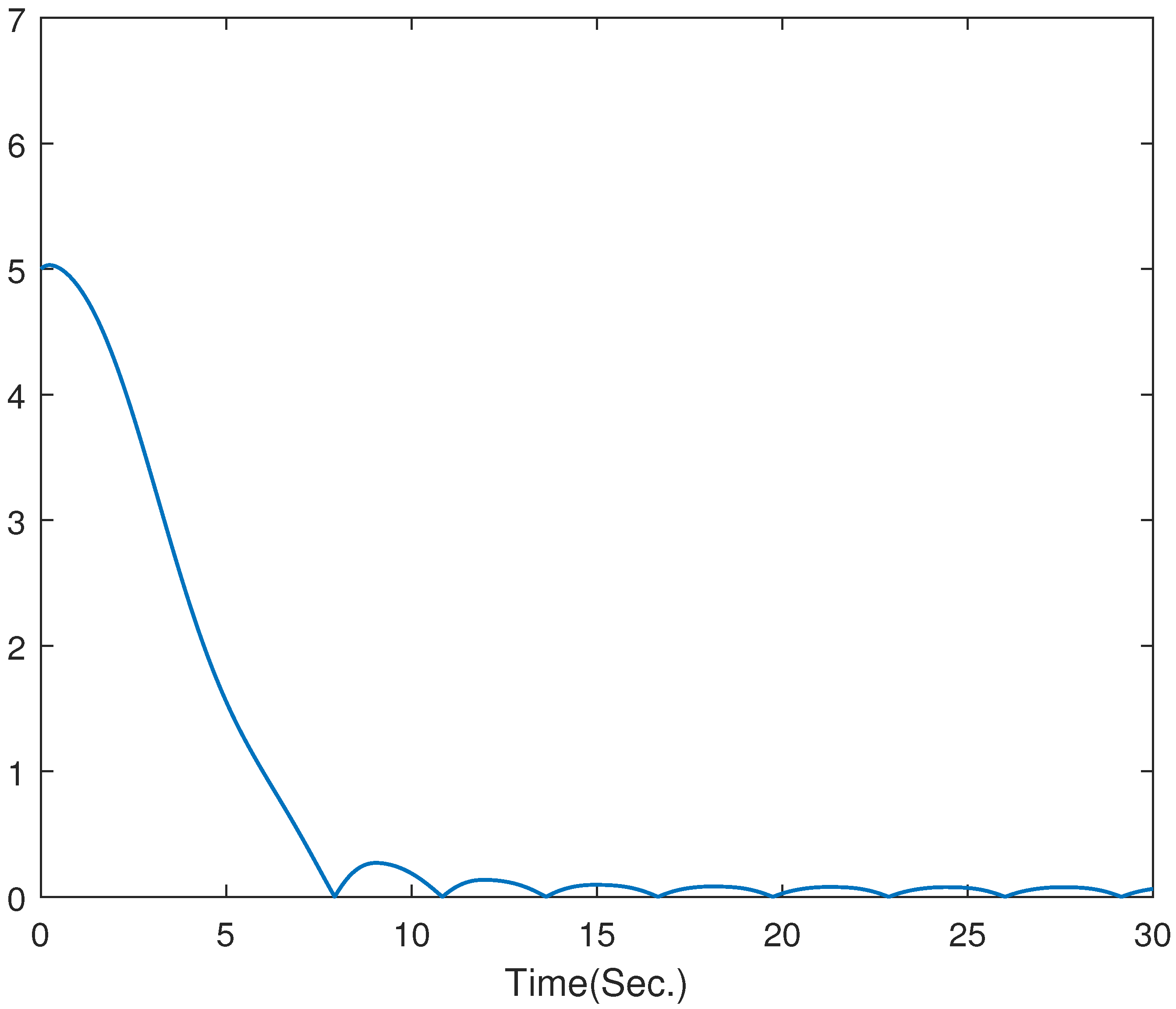
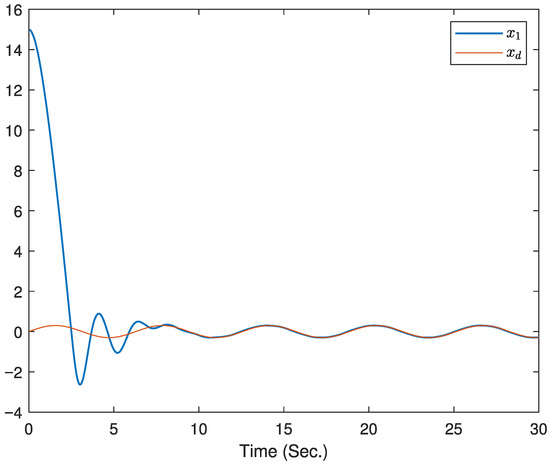
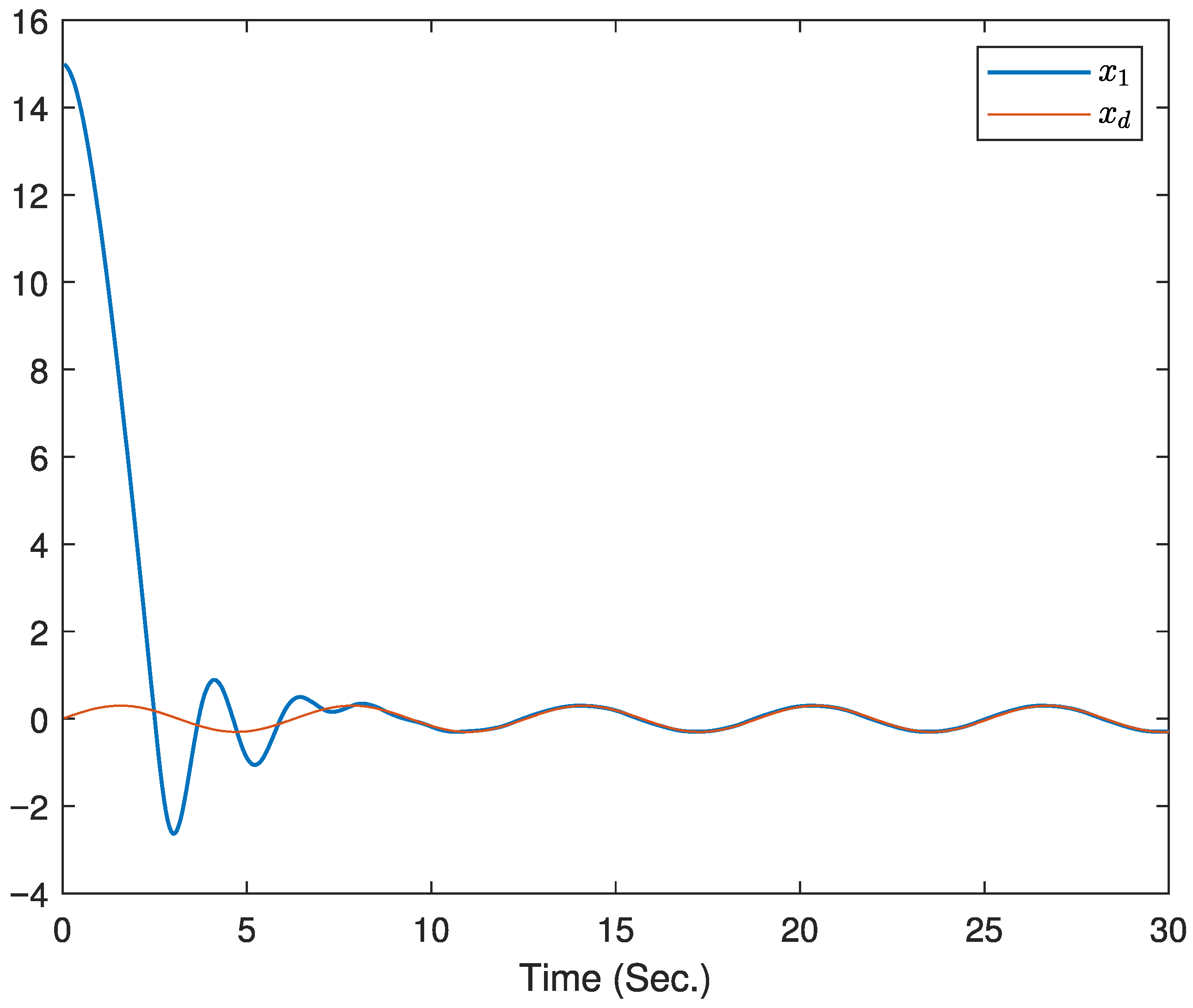
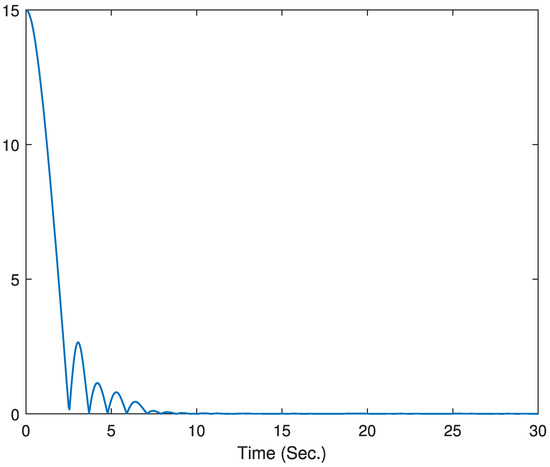
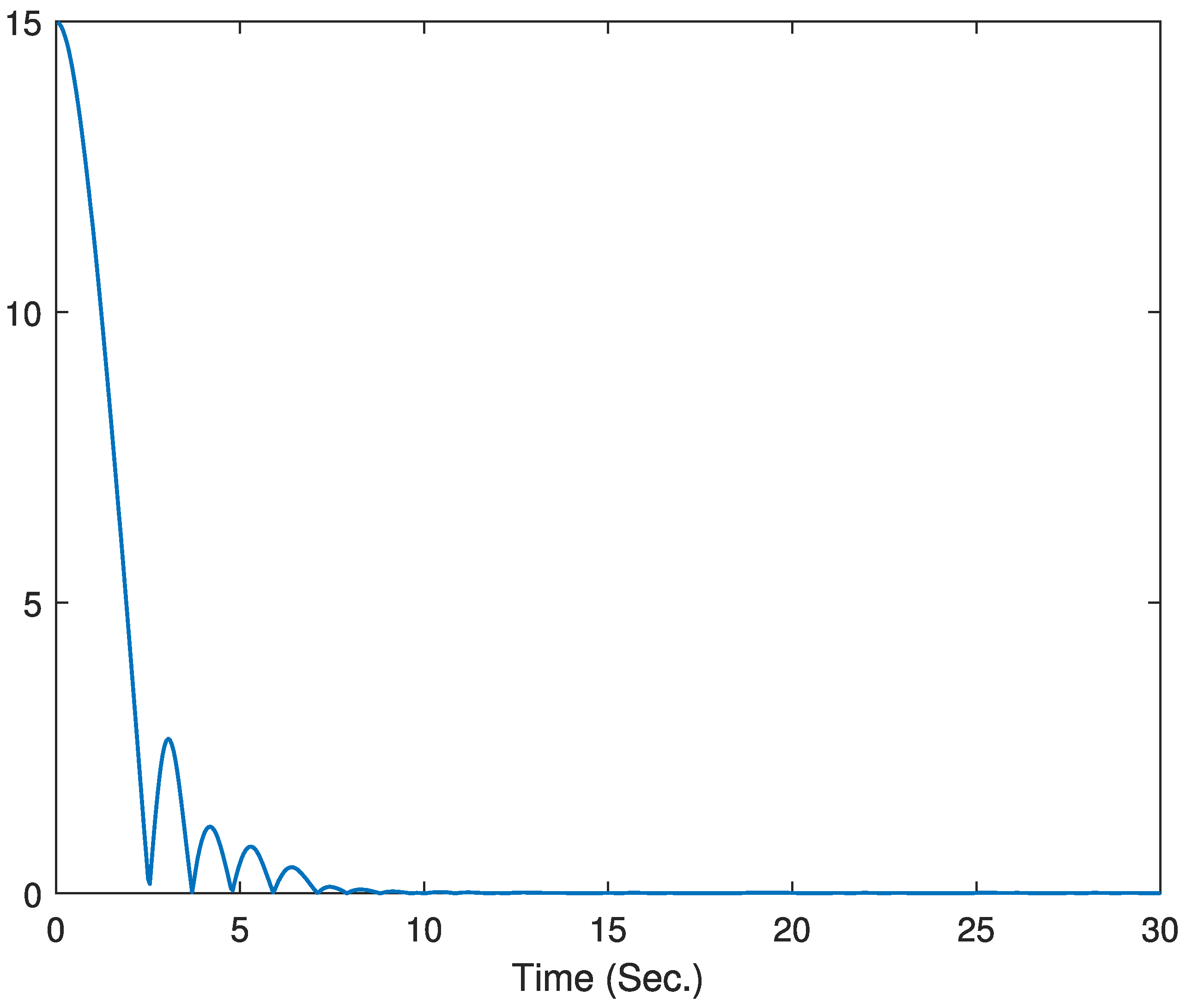
Simulation results from both cases (Figure 1, Figure 2, Figure 3, Figure 4, Figure 5, Figure 6, Figure 7, Figure 8, Figure 9 and Figure 10) corroborate the efficacy of the proposed finite-time control scheme. In Case 1, the system output y successfully tracks the reference signal , as shown by the state trajectories in Figure 1 and Figure 2 and the tracking error in Figure 3. Figure 4 and Figure 5 present the state estimates and control input, respectively. Case 2 further affirms the algorithm’s capability, with Figure 6 and Figure 7 showing state responses that achieve finite-time convergence, Figure 8 the tracking error, Figure 9 the state observer performance, and Figure 10 the control signal. As can be seen from the tracking error curves in Figure 3 and Figure 8, the tracking error converges to the vicinity of zero within 10 s. It is evident from Figure 4 and Figure 9 that the observer designed in this paper effectively estimates the unknown states. These findings collectively affirm the algorithm’s ability to resolve state estimation and communication limitations with satisfactory finite-time tracking.
Figure 1.
The trajectories of the states and in Case 1.
Figure 2.
The trajectory of the state in Case 1.
Figure 3.
The trajectory of the tracking error in Case 1.
Figure 4.
The trajectories of observer states and observer errors in Case 1.
Figure 5.
The trajectory of the control signal in Case 1.
Figure 6.
The trajectories of the states and in Case 2.
Figure 7.
The trajectory of the state in Case 2.
Figure 8.
The trajectories of the tracking error in Case 2.
Figure 9.
The trajectories of observer states and observer errors in Case 2.
Figure 10.
The trajectory of the control signal in Case 2.
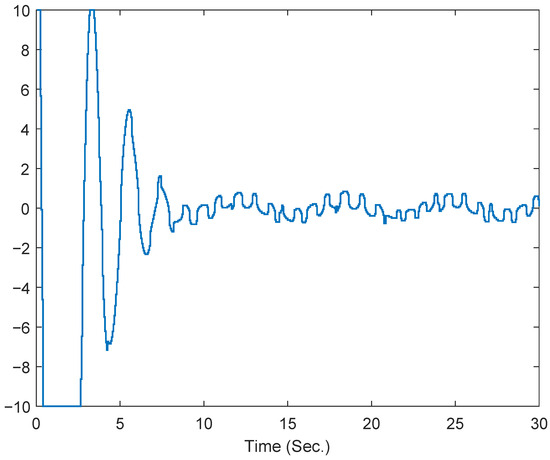
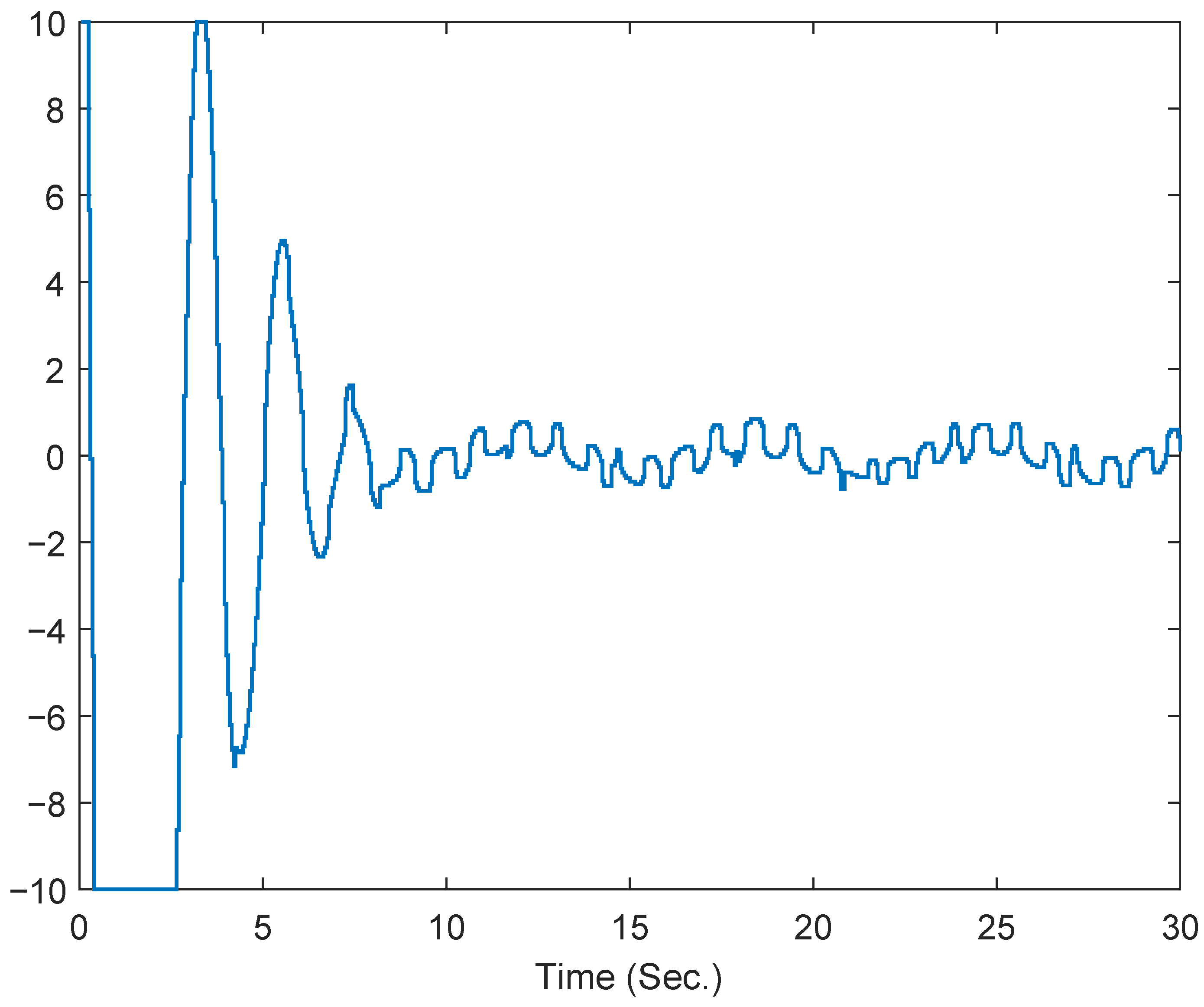
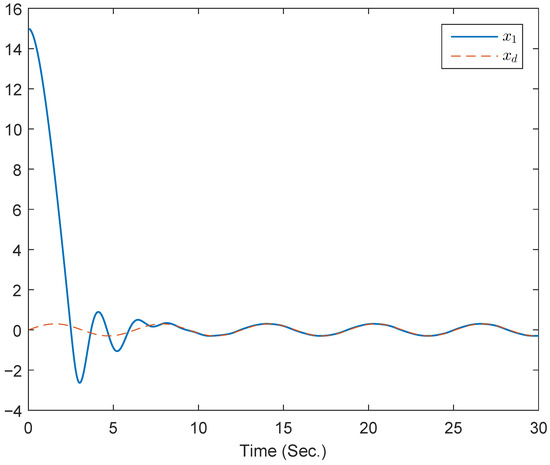
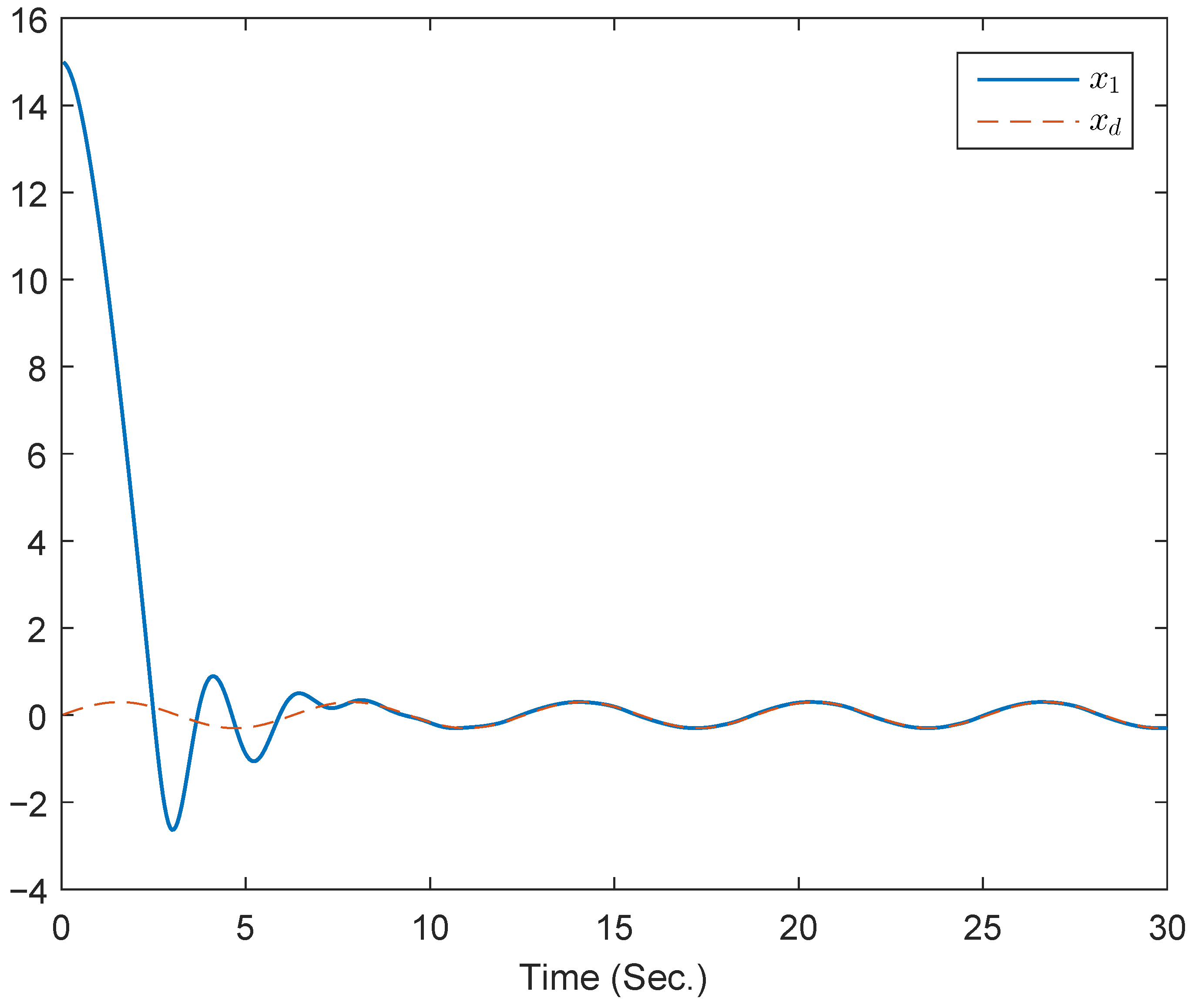
To fully validate the performance advantages of the controller designed in this paper, we conducted a comparative simulation analysis between our method and the finite-time control algorithm proposed in reference [36]. Specifically, for Case 1, the algorithm from reference [36] was applied for simulation validation, and the results are shown in Figure 11 and Figure 12.
Figure 11.
The trajectories of the states and for Ref. [36].
Figure 12.
The trajectory of the tracking error for Ref. [36].
By comparing these with the results of our proposed method (Figure 1 and Figure 3), it can be observed that the controller designed in this paper demonstrates a clear improvement in both convergence speed and control accuracy.
To further validate the effectiveness of the event-triggered control algorithm proposed in this paper in reducing communication load, the following simulation comparison was conducted.
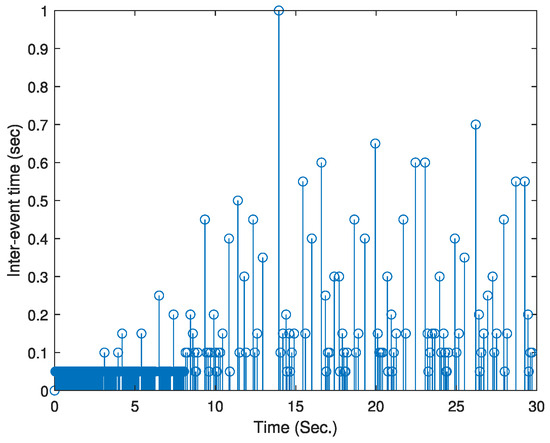
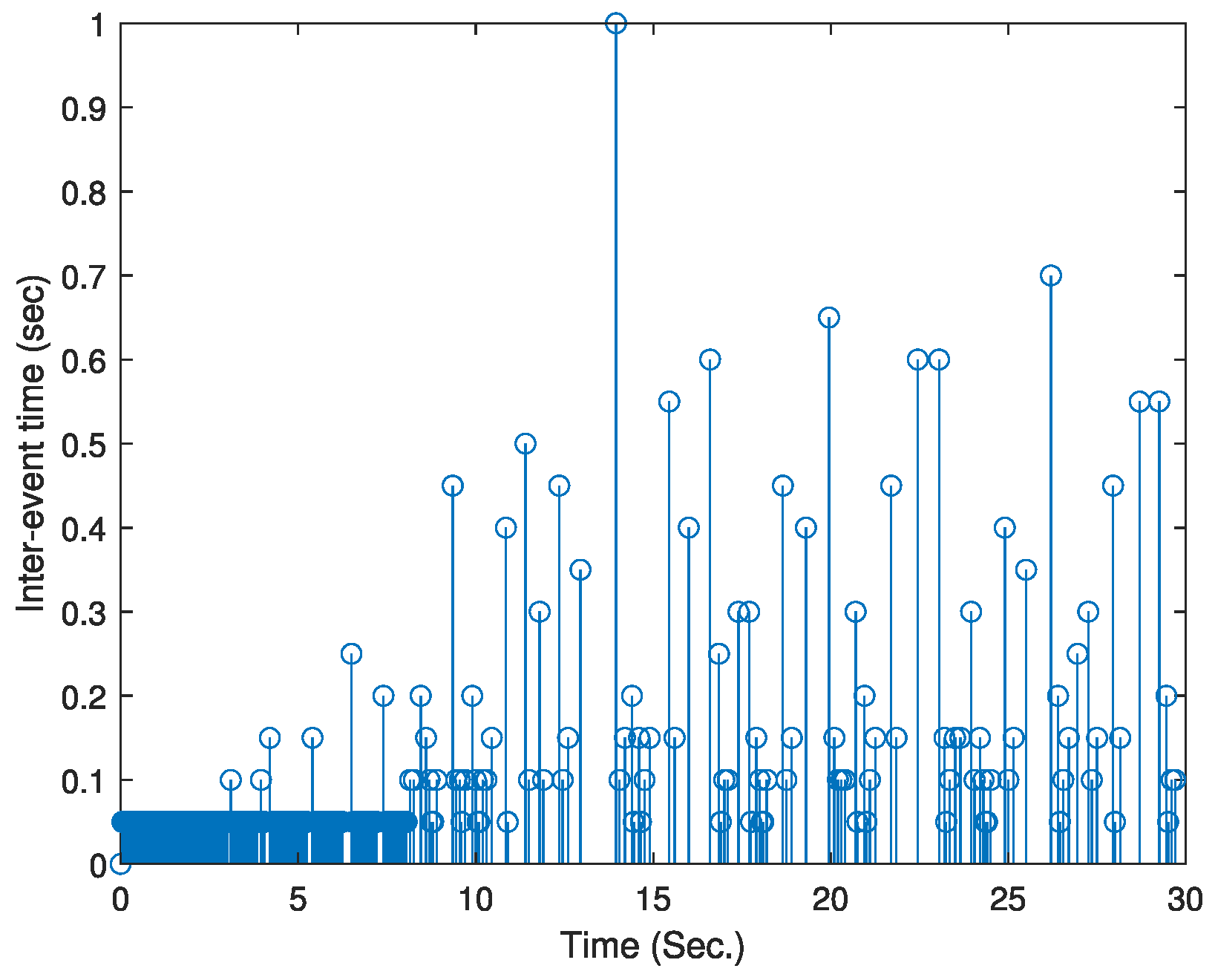
For Case 2, Figure 13 and Figure 14 present the simulation results without the event-triggered mechanism, while Figure 15 shows the curve of event-triggering instants and inter-trigger intervals, clearly indicating the specific timing and distribution of each triggering event. The curve visually demonstrates that control updates are executed only when the triggering conditions are satisfied, fully reflecting the on-demand nature of communication. In this study, the sampling period is set to 0.05 s, and the total simulation duration is 30 s. Under the conventional periodic sampling scheme, a total of 600 sampling and transmission instances are required. In contrast, with the event-triggered mechanism (see Figure 15), the number of sampling/transmission instances is reduced to 257, corresponding to a reduction in communication transmission load of approximately 57%.
Figure 13.
The trajectories of the states and without the event-triggered mechanism.
Figure 14.
The trajectory of the tracking error without the event-triggered mechanism.
Figure 15.
The trajectory of inter-event time.
These quantitative data and visualization results jointly demonstrate that after the introduction of the event-triggered mechanism, the system maintains control tracking accuracy while significantly lowering the communication load. This further confirms the effectiveness of the proposed method, indicating that the event-triggered mechanism can effectively save communication resources without compromising control performance.
5. Conclusions
This paper tackles the issue of adaptive fuzzy finite-time control for nonlinear systems with unmeasurable states as well as limited communication. The issue of unmeasurable states has been overcome through the development of state observers. The controller design process leverages FLSs and the dynamic surface control technique to identify unknown terms and mitigate the complexity explosion issue. Through the incorporation of first-order filters into the integrated dynamic surface and backstepping control framework, we have developed an adaptive finite-time fuzzy control strategy for uncertain nonlinear systems. This designed control approach guarantees that the system achieves semi-global practical finite-time stability (SGPFS) and the tracking error remains bounded within a finite time. The effectiveness of the proposed control method is validated through simulation examples. The simulation results further verify that the system tracking error can converge to the vicinity of zero within a finite time. Moreover, the integrated event-triggered mechanism effectively reduces the frequency of control signal transmissions, achieving approximately 57% communication savings in the simulation Case 2. Correspondingly, the curves of event-triggered instants and inter-trigger intervals visually demonstrates the “on-demand” nature of the communication. These simulation results not only provide empirical support for the validity of the theoretical analysis but also highlight the practical advantages of the proposed method in saving communication resources and improving system operational efficiency. Future research will focus on developing more robust predefined-time control algorithms and, on that basis, designing prescribed performance control schemes for systems with actuator faults.
Author Contributions
Z.W.: Methodology, Writing, Software, Conceptualization, and Investigation. L.X.: Conceptualization, Writing, Methodology, and Investigation. All authors have read and agreed to the published version of the manuscript.
Funding
This research received no external funding.
Data Availability Statement
The original contributions presented in this study are included in the article. Further inquiries can be directed to the corresponding author.
Conflicts of Interest
The authors declare no conflicts of interest.
References
- Luo, R.; Zhang, L.; Li, Y. Adaptive Fuzzy Fixed-Time Control for Uncertain Nonlinear Systems with Mismatched Disturbances. Symmetry 2024, 16, 560. [Google Scholar] [CrossRef] [Scilit]
- Witkowska, A.; Tomera, M.; Śmierzchalski, R. A backstepping approach to ship course control. Int. J. Appl. Math. Comput. Sci. 2007, 17, 73–85. [Google Scholar] [CrossRef] [Scilit]
- Li, G.; Wang, X.; Li, S. Consensus control of higher-order Lipschitz non-linear multi-agent systems based on backstepping method. IET Control Theory Appl. 2019, 14, 490–498. [Google Scholar] [CrossRef] [Scilit]
- Kartal, Y.; Subbarao, K.; Gans, N.R.; Dogan, A.; Lewis, F. Distributed backstepping based control of multiple UAV formation flight subject to time delays. IET Control Theory Appl. 2020, 14, 1628–1638. [Google Scholar] [CrossRef] [Scilit]
- Zhuang, H.; Sun, Q.; Chen, Z.; Zeng, X. Robust adaptive sliding mode attitude control for aircraft systems based on back-stepping method. Aerosp. Sci. Technol. 2021, 118, 107069. [Google Scholar] [CrossRef] [Scilit]
- Capone, A.; Hirche, S. Backstepping for partially unknown nonlinear systems using Gaussian processes. IEEE Control Syst. Lett. 2019, 3, 416–421. [Google Scholar] [CrossRef] [Scilit]
- Yu, J.; Shi, P.; Zhao, L. Finite-time command filtered backstepping control for a class of nonlinear systems. Automatica 2018, 92, 173–180. [Google Scholar] [CrossRef] [Scilit]
- Zhang, L.; Ding, H.; Shi, J.; Huang, Y.; Chen, H.; Guo, K.; Li, Q. An adaptive backstepping sliding mode controller to improve vehicle maneuverability and stability via torque vectoring control. IEEE Trans. Veh. Technol. 2020, 69, 2598–2612. [Google Scholar] [CrossRef] [Scilit]
- Wang, Y.; Ahn, C.K.; Yan, H.; Xie, S. Fuzzy control and filtering for nonlinear singularly perturbed Markov jump systems. IEEE Trans. Cybern. 2020, 51, 297–308. [Google Scholar] [CrossRef] [Scilit]
- Yang, T.; Sun, N.; Fang, Y. Adaptive fuzzy control for a class of MIMO underactuated systems with plant uncertainties and actuator deadzones: Design and experiments. IEEE Trans. Cybern. 2022, 53, 8213–8226. [Google Scholar] [CrossRef]
- Sun, W.; Su, S.-F.; Wu, Y.; Xia, J. Novel adaptive fuzzy control for output constrained stochastic nonstrict feedback nonlinear systems. IEEE Trans. Fuzzy Syst. 2020, 29, 1188–1197. [Google Scholar] [CrossRef] [Scilit]
- Liang, B.; Zheng, S.; Ahn, C.K.; Liu, F. Adaptive fuzzy control for fractional-order interconnected systems with unknown control directions. IEEE Trans. Fuzzy Syst. 2020, 30, 75–87. [Google Scholar] [CrossRef] [Scilit]
- Ma, H.; Liang, H.; Zhou, Q.; Ahn, C.K. Adaptive dynamic surface control design for uncertain nonlinear strict-feedback systems with unknown control direction and disturbances. IEEE Trans. Syst. Man Cybern. Syst. 2018, 49, 506–515. [Google Scholar] [CrossRef] [Scilit]
- Hua, Y.; Zhang, T. Adaptive control of pure-feedback nonlinear systems with full-state time-varying constraints and unmodeled dynamics. Int. J. Adapt. Control Signal Process. 2020, 34, 183–198. [Google Scholar] [CrossRef] [Scilit]
- Zuo, S.; Song, Y.; Lewis, F.L.; Davoudi, A. Output containment control of linear heterogeneous multi-agent systems using internal model principle. IEEE Trans. Cybern. 2017, 47, 2099–2109. [Google Scholar] [CrossRef] [Scilit] [PubMed]
- Li, Y.; Sun, K.; Tong, S. Observer-based adaptive fuzzy fault-tolerant optimal control for SISO nonlinear systems. IEEE Trans. Cybern. 2018, 49, 649–661. [Google Scholar] [CrossRef] [Scilit]
- Li, D.; Han, H.; Qiao, J. Observer-based adaptive fuzzy control for nonlinear state-constrained systems without involving feasibility conditions. IEEE Trans. Cybern. 2021, 52, 11724–11733. [Google Scholar] [CrossRef] [Scilit] [PubMed]
- Girard, A. Dynamic triggering mechanisms for event-triggered control. IEEE Trans. Autom. Control 2014, 60, 1992–1997. [Google Scholar] [CrossRef] [Scilit]
- Huo, X.; Karimi, H.R.; Zhao, X.; Wang, B.; Zong, G. Adaptive-critic design for decentralized event-triggered control of constrained nonlinear interconnected systems within an identifier-critic framework. IEEE Trans. Cybern. 2021, 52, 7478–7491. [Google Scholar] [CrossRef] [Scilit]
- Heemels, W.; Donkers, M. Model-based periodic event-triggered control for linear systems. Automatica 2013, 49, 698–711. [Google Scholar] [CrossRef] [Scilit]
- Su, X.; Wang, C.; Chang, H.; Yang, Y.; Assawinchaichote, W. Event-triggered sliding mode control of networked control systems with Markovian jump parameters. Automatica 2021, 125, 109405. [Google Scholar] [CrossRef] [Scilit]
- Xue, L.; Liu, Z.; Zhang, W. A new finite time control method to nonlinear systems with uncertain dynamics and time-varying powers. Int. J. Robust Nonlinear Control 2023, 33, 8087–8102. [Google Scholar] [CrossRef] [Scilit]
- Li, P.; Yang, H.; Zuo, Z.; Cheng, F. Dual closed-loop finite-time control for lateral trajectory tracking of unmanned ground vehicles under velocity-varying motion. IEEE Trans. Intell. Veh. 2024, 9, 6137–6147. [Google Scholar] [CrossRef] [Scilit]
- Li, X.; Wang, J.; Zhang, H.; Zhang, K.; Lu, G. Adaptive composite observer-based global finite time control with prescribed performance for robots. IEEE Trans. Ind. Electron. 2024, 71, 9351–9363. [Google Scholar] [CrossRef] [Scilit]
- Yin, C.; Xie, Y.; Shi, D.; Wang, S.; Zhang, K.; Li, M. Sliding mode coordinated control of hybrid electric vehicle via finite-time control technique. ISA Trans. 2024, 146, 541–554. [Google Scholar] [CrossRef] [Scilit] [PubMed]
- Li, S.; Ahn, C.K.; Xiang, Z. Command-filter-based adaptive fuzzy finite-time control for switched nonlinear systems using state-dependent switching method. IEEE Trans. Fuzzy Syst. 2020, 29, 833–845. [Google Scholar] [CrossRef] [Scilit]
- Sun, W.; Wu, Y.; Sun, Z. Command filter-based finite-time adaptive fuzzy control for uncertain nonlinear systems with prescribed performance. IEEE Trans. Fuzzy Syst. 2020, 28, 3161–3170. [Google Scholar] [CrossRef] [Scilit]
- Lv, W. Finite time adaptive fault-tolerant control for nonlinear MIMO systems with actuator faults. Int. J. Control Autom. Syst. 2022, 20, 99–108. [Google Scholar] [CrossRef] [Scilit]
- Hardy, H.; Littlewood, E.; Polya, J. Inequalities; Cambridge University Press: Cambridge, UK, 1995. [Google Scholar]
- Deng, H.; Krstic, M. Output-feedback stochastic nonlinear stabilization. IEEE Trans. Autom. Control 1999, 44, 328–333. [Google Scholar] [CrossRef] [Scilit]
- Wang, F.; Chen, B.; Liu, X.; Lin, C. Finite-time adaptive fuzzy tracking control design for nonlinear systems. IEEE Trans. Fuzzy Syst. 2017, 26, 1207–1216. [Google Scholar] [CrossRef] [Scilit]
- Yang, C.D.G. Distributed adaptive fuzzy control for nonlinear multiagent systems under directed graphs. IEEE Trans. Fuzzy Syst. 2017, 26, 1356–1366. [Google Scholar]
- Kong, L.; Yu, X.; Zhang, S. Neuro-learning-based adaptive control for state-constrained strict-feedback systems with unknown control direction. ISA Trans. 2021, 112, 12–22. [Google Scholar] [CrossRef] [Scilit]
- Wang, A.; Liu, L.; Qiu, J.; Feng, G. Event-triggered robust adaptive fuzzy control for a class of nonlinear systems. IEEE Trans. Fuzzy Syst. 2018, 27, 1648–1658. [Google Scholar] [CrossRef] [Scilit]
- Ma, H.; Li, H.; Liang, H.; Dong, G. Adaptive fuzzy event-triggered control for stochastic nonlinear systems with full state constraints and actuator faults. IEEE Trans. Fuzzy Syst. 2019, 27, 2242–2254. [Google Scholar] [CrossRef] [Scilit]
- Hu, Q.; Zhang, J. Relative position finite-time coordinated tracking control of spacecraft formation without velocity measurements. ISA Trans. 2015, 54, 60–74. [Google Scholar] [CrossRef] [Scilit] [PubMed]
Disclaimer/Publisher’s Note: The statements, opinions and data contained in all publications are solely those of the individual author(s) and contributor(s) and not of MDPI and/or the editor(s). MDPI and/or the editor(s) disclaim responsibility for any injury to people or property resulting from any ideas, methods, instructions or products referred to in the content. |
© 2025 by the authors. Licensee MDPI, Basel, Switzerland. This article is an open access article distributed under the terms and conditions of the Creative Commons Attribution (CC BY) license.