Article

Improved Chimpanzee Optimization Algorithm Based on Multi-Strategy Fusion and Its Application in Multiphysics Parameter Optimization


1
School of Electronics and Electrical Engineering, Zhengzhou University of Science and Technology, Zhengzhou 450064, China
2
Semiconductor Manufacturing International Corporation (Beijing) Co., Ltd., Beijing 102600, China
3
College of Software Engineering, Zhengzhou University of Light Industry, Zhengzhou 450001, China
*
Author to whom correspondence should be addressed.
Symmetry 2026, 18(1), 108; https://doi.org/10.3390/sym18010108
Submission received: 3 December 2025 / Revised: 29 December 2025 / Accepted: 1 January 2026 / Published: 7 January 2026
(This article belongs to the Section Engineering and Materials)

Abstract

To address the challenges of high computational costs, susceptibility to local optima, and heavy reliance on manual intervention in multi-physics parameter optimization for symmetric acoustic metamaterials, an enhanced Chimp Optimization Algorithm (DADCOA) is proposed in this paper. This algorithm integrates the double chaotic initialization strategy (DCS), adaptive multimodal convergence mechanism (AMC), and dual-weight pinhole imaging update operator (DWPI). It employs a Logistic–Tent composite chaotic mapping strategy for population initialization, significantly enhancing distribution uniformity within high-dimensional parameter spaces. An AMC factor is then introduced to dynamically balance global exploration and local exploitation based on the real-time evolutionary state of the population. A dual-weight population update mechanism, incorporating distance and historical contributions, is integrated with a pinhole imaging opposition-based learning strategy to improve population diversity. Additionally, a composite single objective error feedback local differential mutation operation is introduced to improve optimization accuracy for coupled multi-physics objectives. Experimental validation based on the CEC 2022 test function suite and an acoustic metamaterial parameter optimization model demonstrates that compared to the standard COA algorithm and existing improved algorithms, the DADCOA algorithm reduces simulation time by 28.46% to 60.76% while maintaining high accuracy. This approach effectively addresses the challenges of high computational cost, stringent accuracy requirements, and composite single objective coupling in COMSOL physical parameter optimization, providing an effective solution for the design of acoustic metamaterials based on symmetric structures.

1. Introduction

Acoustic metasurfaces are engineered periodic structures with subwavelength thickness that have emerged as a research hotspot in the field of acoustic engineering due to their ability to precisely manipulate wave phase, amplitude, and propagation direction. Their functionality is fundamentally rooted in symmetry, both the geometric symmetry of the unit cell and the translational symmetry of the periodic array. These symmetries directly govern the dispersion relations, bandgap formation, and the resultant effective medium properties, enabling precise wavefront control. They demonstrate irreplaceable functionalities in critical applications such as directional sound transmission [1,2,3], super-resolution imaging [4,5,6], and noise control [7,8,9]. Unlike traditional acoustic materials that rely on intrinsic material properties for sound wave manipulation, acoustic metasurfaces enable customized regulation of effective medium parameters like effective sound speed and density through the precise design of unit geometry and spatial arrangement [10,11]. This enables capabilities beyond those of natural materials, including angle-independent unidirectional transmission and subwavelength focusing. For instance, Han [12] demonstrated an asymmetric bilayer Moiré metasurface that achieves angle-independent unidirectional transmission across a 0.5–5 kHz band, offering a practical route to high-precision acoustic isolation; Zheng [13] developed a fully optimized acoustic superlens that attains lateral super-resolution of 80 μm at the fundamental frequency, with resolution further enhanced to 44 μm at harmonic modes, successfully overcoming the diffraction limit and promoting technological advances in ultrasonic medical imaging. These studies confirm that the performance of acoustic metasurfaces is highly dependent on the precise matching of core parameters. Therefore, the parameter optimization problem for such structures is intrinsically linked to exploring and satisfying symmetrical constraints within the design space. The optimal combination of geometric parameters directly determines whether the designed acoustic response can be achieved and maintained. Consequently, developing efficient and robust parameter-optimization methods to accurately determine these critical geometric parameters is a prerequisite for the engineering deployment of acoustic metasurfaces.
With the advancement of multi-physics simulation technology, COMSOL Multiphysics (COMSOL Inc., Stockholm, Sweden) has become a pivotal tool for the parameter optimization of acoustic metasurfaces. It integrates geometry modeling, multiphysics coupling, and post-processing analysis into a unified workflow, providing high-precision numerical simulation support for acoustics-structure interaction problems. By building an acoustic metasurface unit model in COMSOL and defining the acoustic incident boundary conditions, frequency-domain simulations can be performed to obtain dispersion curves and acoustic field distributions. These results are then used to fit the effective sound velocity and derive the effective density, thereby supplying a quantitative basis for parameter optimization [14,15,16]. Nonetheless, existing optimization workflows face multiple bottlenecks and limitations. Many parameter optimization methods still rely on manual trial and error or simple parameter sweeping. Although some studies have incorporated intelligent methods such as genetic algorithms and deep learning, these approaches often struggle to balance sampling uniformity in high-dimensional parameter spaces, computational cost, and solution efficiency. The subspace-exploration strategy based on genetic algorithms by Deng [17] achieved improvements for LRAM low-frequency bandgaps but did not resolve uniform coverage of high-dimensional spaces and incurred high computational expense. Furthermore, swarm intelligence algorithms like the Multi-Objective Grey Wolf Optimizer (MOGWO) [18] and the COA [19] have been applied to multi-physics parameter optimization. However, the MOGWO often suffers from an imbalance between exploration and exploitation due to its linear convergence factor, while COA is prone to falling into local optima because of initial population randomness, making it difficult to balance optimization accuracy and efficiency [18,19]. These limitations underscore the necessity for an optimized framework that achieves a more intricate balance between exploring diversity and focusing on convergence, much like the symmetrical equilibrium found in the physical systems they design. In addition, the COMSOL simulation workflow still heavily depends on manual intervention. Parameter adjustments require manual modification and re-modeling, and steps such as dispersion-curve and effective-parameter extraction often depend on manual intervention. This not only prolongs single-run turnaround times but also degrades reproducibility and impedes coverage of potential optima in high-dimensional spaces. Therefore, there is an urgent need for an automated, robust, and computationally efficient optimization framework tailored to the multi-physics field simulation characteristics of COMSOL Multiphysics simulations. This framework can controllably reduce simulation costs while providing accurate solutions for high-dimensional, multi-objective, and coupled problems, thereby accelerating the engineering deployment of acoustic metasurfaces.
Initializing populations with chaotic sequences can effectively mitigate initial-solution clustering [20], but single chaotic maps often provide suboptimal coverage in high-dimensional parameter spaces. Although strategies such as opposition-based learning [21] and dynamic weighting [22] have been incorporated into the COA to enhance the quality of the initial population, the lack of integration with the physical constraints of acoustic metasurfaces often leads to the generation of numerous combinations of invalid parameters, resulting in wasted computational resources during simulation. Regarding the convergence mechanism, an improved Gray Wolf Optimizer replaced the linear convergence factor with a cosine-based variation [23], which to some extent balances global exploration and local exploitation. However, it fails to dynamically adjust the convergence pace based on real-time multi-objective error feedback during the optimization process, limiting its adaptability to specific problems. The standard COA, employing a fixed convergence factor, often leads to insufficient global exploration in the early stages and slow convergence in the later phases, making it unsuitable for the multi-stage, multi-objective optimization requirements inherent in COMSOL simulations. Furthermore, the integration between existing algorithms and the COMSOL simulation platform remains generally low. A fully automated closed-loop process encompassing “parameter iteration-simulation execution-fitness feedback” has not yet been achieved. The continued reliance on manual intervention for data transfer and result interpretation means that the fundamental issue of human dependency remains unresolved.
To address the challenges mentioned above, this paper proposes an improved COA that integrates double chaotic initialization, an Adaptive Multi-modal Convergence mechanism, and a dual-weighted pinhole imaging update strategy (DADCOA). The design philosophy of DADCOA is inspired by the symmetrical principles underlying acoustic metamaterials. It constructs an optimization process with inherent balance and complementary mechanisms. The algorithm first employs a Logistic-Tent compound chaotic mapping to enhance the distribution diversity of the initial population in high-dimensional space. It further designs an adaptive multi-modal convergence factor based on population state feedback to dynamically balance global exploration and local exploitation. Simultaneously, a dual-weight evaluation system is constructed integrating both distance-based and historical-contribution-based weights, combined with opposition-based learning from pinhole imaging to enhance population diversity. Additionally, an error feedback-driven local differential mutation operation is introduced to improve the cooperative optimization accuracy for multi-physics objectives. Most critically, the algorithm incorporates a physical-constraint pre-screening mechanism that automatically filters out invalid combinations before parameters are passed to COMSOL, significantly reducing computational resource consumption.

2. Simulation Design for Metasurfaces

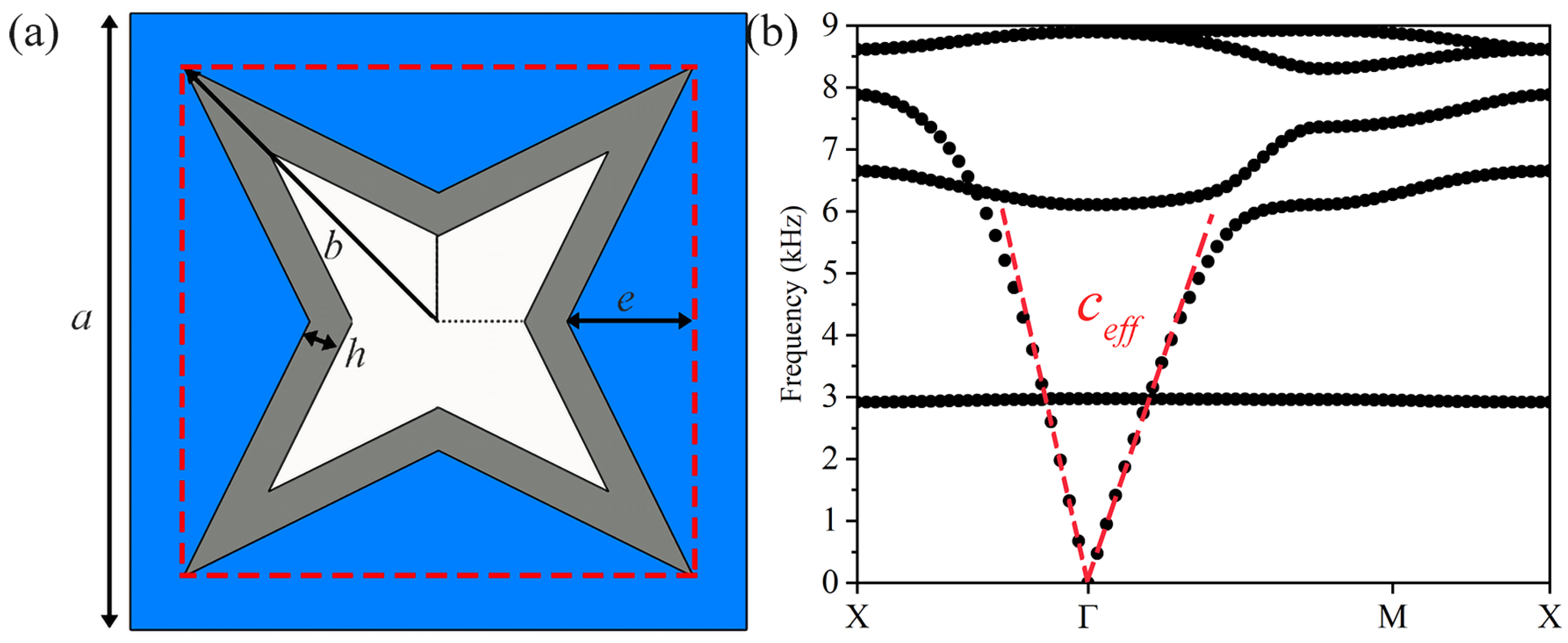
Acoustic metasurfaces achieve efficient control of the transmission phase, polarization mode, propagation mode, and other characteristics of acoustic waves by combining different metamaterial structural units in a specific way to produce abnormal phase transitions within subwavelength structures. The unit shown in Figure 1a comprises a blue water domain, a gray lead frame (mass density ρ = 11,340 kg/m3, Young’s modulus E = 40 GPa , Poisson’s ratio v = 0.35 ), and white air regions. This structure exhibits geometrical symmetry, a key feature that influences its acoustic band structure and effective parameters. Its key tunable geometry parameters are the unit cell size a , frame characteristic size b (vertex-to-center distance), frame thickness h , and shrinkage factor e (the ratio of the shrinkage at the framework midpoint to its original length before shrinkage). The equivalent mass density ( ρ eff ) of the unit cell is approximately equal to the average bulk density at the long-wave limit, and its equivalent phase velocity ( c eff ) can be obtained by calculating the slope of the energy band curve of a periodic unit cell in the low frequency range [24,25]. Therefore, this paper employs the multiphysics finite element software COMSOL Multiphysics to establish a unit cell geometric model. The solid framework is modeled with the Solid Mechanics physics, while the water and air regions are modeled with the Pressure Acoustics physics, and acoustic–solid coupling boundaries are applied at their interfaces. This model employs physically controlled meshing, utilizing free tetrahedral elements for the fluid domain and swept meshes for the solid domain. Applying Floquet periodic boundary conditions to the unit cell and performing parametric scans along the boundary of the irreducible Brillouin zone (XΓMX) result in the six band dispersion curves shown in Figure 1b. The two frequency bands emanating from the Brillouin-zone center Γ (the red dashed lines in Figure 1b) display linear dispersion and their slopes correspond to the unit cell’s effective longitudinal acoustic wave speed.
In the design of directional acoustic wave transmission using acoustic metasurfaces, the primary objective is to precisely adjust unit-cell geometry to achieve the specified effective acoustic velocity and effective density, thereby enabling wavefront control. However, the traditional design iteration process heavily relies on researchers’ experience and manual intervention, which has become a major bottleneck in improving design efficiency and optimization. This limitation manifests in three respects. First, there is a highly complex and strongly nonlinear mapping between key geometric parameters and the effective parameters. Manual parameter tuning lacks a systematic global optimization strategy and is prone to getting stuck in local optima. Second, after completing each multiphysics simulation in COMSOL, frequency response curves must be manually extracted and equivalent parameters calculated through inversion or effective medium theory. The computed results are then compared against target values for evaluation. This process is cumbersome and makes precise multi-objective co-optimization difficult to achieve. Third, the entire process requires manual intervention for parameter modification, simulation restart, and result analysis, which frequently interrupts the optimization workflow. Given that a single multiphysics simulation typically takes several minutes to hours, comprehensively exploring high-dimensional parameter spaces becomes prohibitively costly, severely limiting the discovery and validation of innovative designs.

3. Algorithm Design

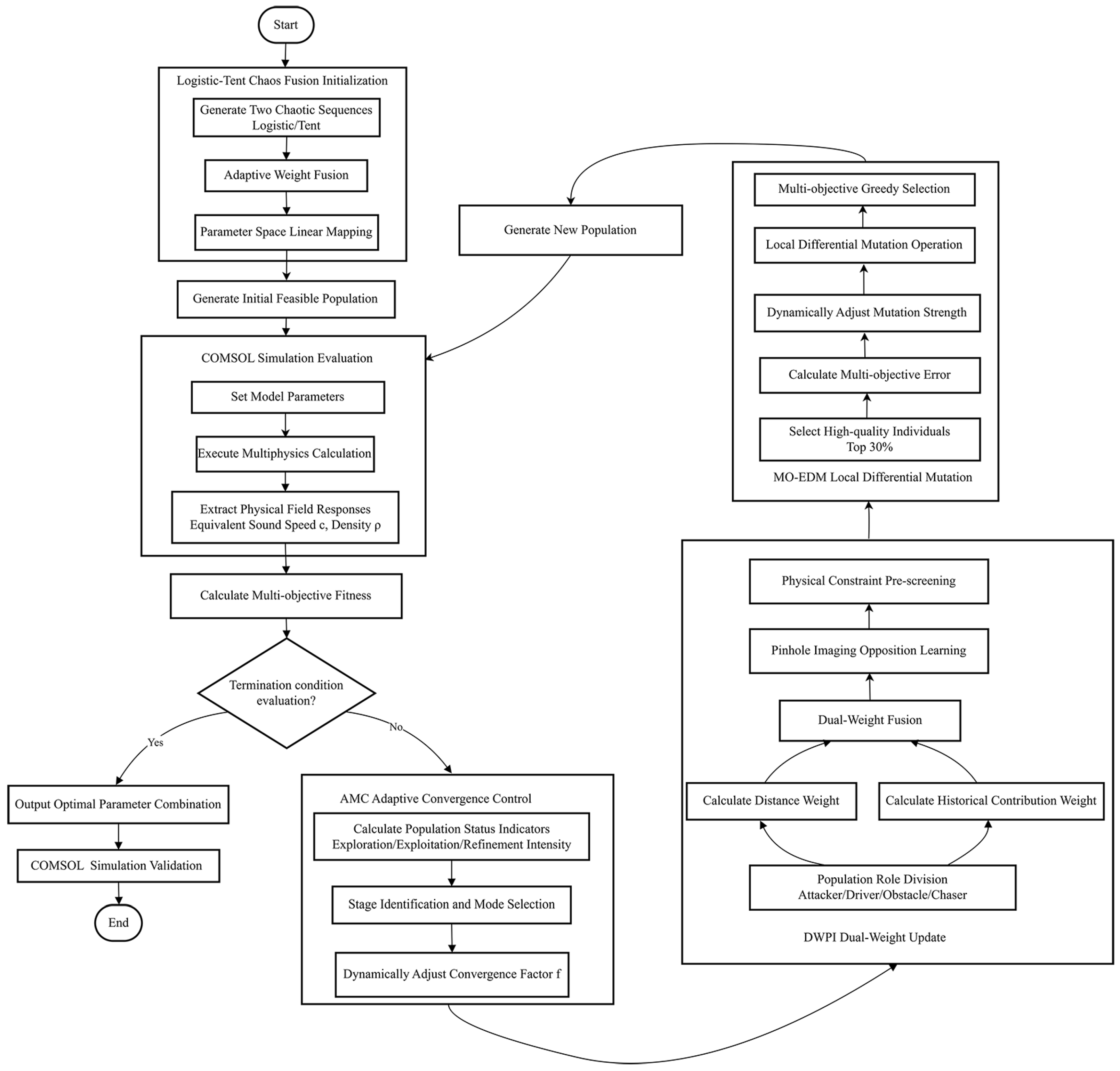
To address the issues of high manual dependency and low efficiency in traditional acoustic metamaterial optimization workflows, this paper proposes an enhanced chimpanzee optimization algorithm (DADCOA). It integrates double chaotic initialization, an adaptive multimodal convergence mechanism, a dual-weight pinhole imaging update strategy, and a composite single objective error feedback local differential mutation method. This approach achieves automated and intelligent parameter optimization for acoustic metamaterials within the COMSOL environment. The algorithm aims to construct a sequence that can autonomously execute parameter setting—simulation submission—result analysis—and decision update. Specifically, the double chaotic initialization enhances population diversity and global search capabilities, avoiding initial blind trial-and-error. An adaptive multi-modal convergence factor dynamically balances global exploration and local exploitation, replacing traditional experience-dependent stage judgments. A dual-weight pinhole imaging update mechanism simulates expert decision-making to guide evolutionary direction while preserving diversity. composite single objective error feedback drives local differential mutation, enabling simultaneous convergence toward multiple physical field objectives and automating the cumbersome result comparison and parameter tuning inherent in conventional workflows. The detailed process is illustrated in Figure 2.

3.1. Logistic-Tent Chaos Fusion Initialization

Population initial diversity serves as a critical foundation for effective global exploration in optimization algorithms. Greater initial diversity increases the probability of locating the region containing the global optimum during the early search stages. The traditional COA typically employs random population initialization, which often leads to an uneven distribution in high-dimensional parameter spaces and consequently compromises global exploration. To address this issue, we propose a method based on Logistic-Tent chaotic fusion initialization. This approach leverages the complementary properties of the Logistic map (strong ergodicity) and the Tent map (uniformity) to generate an initial population with improved dispersion and decision space coverage. It provides a high-quality initial population with excellent diversity and broad coverage for subsequent hybrid optimization algorithms.
The implementation of chaotic fusion initialization comprises three steps: generating two chaotic sequences, performing adaptive weighted fusion, and executing parameter mapping. For the j -th parameter of any individual i in the population, two independent chaotic sequences are first generated. The Logistic reveals its extreme sensitivity to initial conditions and fine ergodicity to thoroughly explore each sub-interval in the domain.
x logistic ( i , j ) = r · x logistic ( i , j ) · 1 x logistic ( i , j )
The Tent map,
x tent ( i , j ) = r · x tent ( i , j ) , x tent ( i , j ) < 0.5 r · 1 x tent ( i , j ) , x tent ( i , j ) 0.5
Its piecewise linear structure and uniform distribution characteristics enable rapid diffusion and uniform coverage within the search space. This addresses the limitation of the Logistic mapping, which converges more slowly in specific regions. Subsequently, an adaptive weighting mechanism is employed to combine the two sequences, as expressed by the fusion formula x i j = w 1 · logistic ( i , j ) + w 2 · x tent ( i , j ) . The weight coefficient is dynamically adjusted for individual i , expressed as w 1 ( i ) = N i + 1 N , w 2 ( i ) = 1 w 1 ( i ) (where N is the population size). This arrangement causes higher-ranked individuals to inherit more of the Logistic map’s fine-exploration capability, while lower-ranked individuals more fully exploit the Tent map’s rapid-expansion characteristic, thereby forming a smooth intra-population transition from fine probing to broad coverage. Finally, the fused chaotic sequence is mapped into the actual parameter optimization space via the linear transformation X ( i , j ) = lb ( j ) + x ( i , j ) · ub ( j ) lb ( j ) , where ub ( j ) and lb ( j ) denote the upper and lower bounds of the j -th parameter, respectively. By complementing their advantages, this chaotic-fusion initialization strategy not only injects strong global-exploration potential at the algorithm’s initial stage, effectively preventing premature convergence caused by clustered initial populations, but also provides a high-quality, high-diversity initial search foundation for subsequent optimization.

3.2. Adaptive Multimodal Convergence Factor

The convergence factor plays a critical role in balancing global exploration and local exploitation in the COA. The standard COA employs a linearly decreasing convergence factor, which fails to adapt to the dynamically changing search requirements in complex optimization problems, often resulting in insufficient depth in global exploration or premature convergence to local optima during the exploitation phase. Therefore, this paper designs an adaptive multimodal convergence factor based on population state feedback. This mechanism can perceive the dynamic characteristics of the optimization process in real time and intelligently switches among four distinct search modes.
The mechanism first establishes a set of phase identification metrics that quantify the current optimization state through three core indicators. The exploration strength indicator S explore = D · 1 t T reflects the combined influence of population diversity and the remaining iteration time, with larger values occurring when the population is dispersed and in the early optimization stage. The exploitation strength indicator S exploit = ( 1 D ) · t T 0.5 becomes dominant when the population tends to converge, and the optimization process passes the halfway point. The refinement strength indicator S refine = ( 1 D ) · t T 2 increases significantly during the late optimization stage when the population is highly concentrated. Based on these real-time computed metrics, the multimodal convergence factor f ( t ) is designed as follows, where t denotes the current iteration count and T denotes the maximum iteration count.
f ( t ) = 2.5 · 1 0.3 · t T , S explore > 0.6 1.5 · exp 3 · t T , S exploit > 0.7 0.8 + 0.4 · cos 5 π · t T · 1 t T , S refine > 0.5 2.0 1.5 · t T 0.5 + 0.5 D , others
When the exploration strength indicator S explore > 0.6, the algorithm switches to the strong exploration mode. In this phase, a slow linear decay of the convergence factor is employed to maintain a relatively large search amplitude, ensuring sufficient coverage of the global parameter space. When the exploitation intensity indicator exceeds S exploit > 0.7, the algorithm transitions into the strong exploitation mode, where the convergence factor follows an exponentially decaying pattern, rapidly contracting the search radius and accelerating convergence toward promising regions. When the refinement intensity indicator satisfies S refine > 0.5, the algorithm activates the fine-refinement mode, adopting a cosine-oscillated decay strategy. This enables fine-grained oscillatory searches around candidate optimal solutions, improving local accuracy while reducing the risk of premature convergence. In all remaining transitional or balanced states, the algorithm operates in the adaptive balanced mode. In this mode, the decay behavior of the convergence factor is dynamically modulated by the population diversity D , a higher diversity slows down the decay to sustain exploratory behavior, whereas a lower diversity accelerates the decay to strengthen exploitation. This multimodal design transforms the algorithm from a rigid, predefined process into an adaptive system capable of sensing the environment, interpreting states, and making intelligent decisions. This design substantially enhances robustness and convergence efficiency when addressing complex, highly nonlinear, and sensitivity-nonuniform optimization problems such as COMSOL Multiphysics parameter tuning.

3.3. Distance-History Contribution Dual-Weight Pinhole Imaging Update

In the population update phase of the standard COA, equal weights are assigned to the four roles (attacker, barrier, chaser, and driver). Such a uniform weighting scheme overlooks the inherent differences in the contributions of various roles throughout the search process and fails to exploit the spatial relationships between individuals and high-quality solutions. Consequently, the guidance of the search direction becomes insufficient, limiting the algorithm’s capability to meet the stringent accuracy requirements of COMSOL Multiphysics parameter optimization. Therefore, we proposes a Distance-History contribution dual-weight pinhole-imaging update mechanism. This structure exhibits geometrical symmetry, a key feature that influences its acoustic band structure and effective parameters.
This mechanism provides dual heuristic information for population renewal by introducing distance weighting (to quantify spatial associations between individuals and high-quality roles, thereby guiding the population toward advantageous regions) and historical contribution weighting (to quantify actual contribution differences among roles, precisely characterizing their influence). Moreover, a pinhole-imaging-based opposite learning strategy is incorporated to adaptively adjust perturbation intensity according to the population’s distribution characteristics, facilitating exploration of unseen regions and maintaining sufficient diversity. Through this integrated design, the DWPI mechanism achieves a dynamic balance between convergence accuracy and population diversity, significantly enhancing robustness and global search capability in complex nonlinear COMSOL multiphysics parameter optimization.
The assignment of population roles is determined by the distribution of individual fitness levels. First, all individuals in the population are sorted in ascending order according to their fitness value fit ( i ), defined as fit ( i ) = m = 1 n w m · y m ( i ) y m target , where y m ( i ) denotes the m -th multiphysics response of the i -th individual, y m target is the corresponding target value, and y m is the weighting coefficient. Based on this sorted list, individuals are partitioned into four functional roles. The individual with the best fitness is designated as the Attacker ( X Attacker ), responsible for guiding the primary search direction. The Barrier ( X Barrier ), possessing the second-best fitness, assists in broadening the global search scope, while the Chaser ( X Chaser ), ranked third in fitness, functions to constrain search boundaries and prevent premature clustering. The average position of all remaining individuals is collectively defined as the Driver ( X Driverr ), which helps maintain broad exploration across the parameter space. This fitness-driven, structured role division enables the update operator to exploit both spatial relationships to elite solutions and differential historical contributions, yielding finer-grained control over population evolution and improved robustness and convergence in complex COMSOL multiphysics parameter optimization.
Based on the assignment of the four roles, a dual-weight evaluation system integrating both spatial distance and historical contribution is established. The distance weight is defined by calculating the Euclidean distance between each individual in the population and the representative of each role, aiming to quantify the spatial correlation during the search process. Specifically, for each i , the Euclidean distances to the Attacker, Barrier, Chaser, and Driver are calculated (denoted as d attacker , d barrier , d chaser , d driverr ), forming the basis for spatial heuristic information.
d i , attacker = X i X Attacker 2 d i , barrier = X i X barrier 2 d i , chaser = X i X chaser 2 d i , driver = X i X driver 2
where X i denotes the position vector of the i -th individual. Then, the distance weight w d , k ( i ) = 1 / d i , k j = 1 4 1 / d i , j between individual i and role k ( k = 1, 2, 3, 4 corresponding to Attacker, Barrier, Chaser, and Driver, respectively) is calculated. The distance weight reflects the spatial proximity between individual i and each role.
The historical contribution weight is assessed by counting the number of successful guidance instances for each role in recent iterations, reflecting the reliability of each role’s sustained performance. By tracking the number of times each role successfully guided individuals to achieve fitness improvement in the last L generations of iterations, the historical contribution weight is calculated:
w c , k = success k + ε j = 1 4 success j + ε
where success k represents the number of successful guidance instances for the k -th role type within the most recent L generations, and ε is a small constant to prevent zero division. Subsequently, the two weights are fused using the dynamic equilibrium coefficient to form the final dual weight w k ,
λ = 0.6 0.3 · t T max
w k = λ · w d , k + ( 1 λ ) · w e , k
Here, t represents the current iteration count, and T max denotes the maximum iteration limit. This design encourages high-quality individuals to rely more on historical experience, while ordinary individuals focus more on spatial proximity, thereby forming personalized search guidance strategies. To further enhance population diversity and avoid premature convergence, a small-hole imaging adversarial learning mechanism is introduced. This mechanism generates high-quality adversarial solutions by mirroring the current optimal solution relative to the center point of the parameter space.
X opposite ( i , j ) = lb ( j ) + ub ( j ) 2 + lb ( j ) + ub ( j ) 2 δ X ncw ( i , j ) 2 δ
The dynamic perturbation coefficient δ = 2 + t T max ensures diversity through strong perturbations in the initial phase and avoids deviation from high-quality regions through weak perturbations in the later phase. lb( k ) and ub( k ) represent the lower and upper bounds of the k -th dimensional parameter, respectively.
Subsequently, physical constraints are applied to pre-screen individuals lb ( k ) X candidate ( i , k ) ub ( k ) (where X candidate represents a new individual or an alternative solution), eliminating invalid individuals to reduce redundant simulations; Finally, a greedy selection strategy replaces the worst individual f ( X opposite ) < f ( X worst ) then X worst = X opposite in the current population with the best alternative solution. This mechanism not only enhances the algorithm’s global exploration capability through mirror mapping but also significantly improves optimization efficiency via physical constraint prescreening, achieving an effective balance between exploration and exploitation.

3.4. Composite Single Objective Error Feedback Local Differential Mutation (MO-EDM)

In COMSOL Multiphysics parameter optimization, the objectives typically involve multiple coupled physical quantities, making conventional single-objective fitness functions inadequate for capturing the comprehensive requirements of such complex systems. To address this, a composite single-objective error feedback mechanism is proposed, which constructs a unified error evaluation metric by computing the relative errors of individual sub-objectives and integrating them with weights reflecting their physical importance. This quantifies the overall discrepancy between the current solution and the ideal targets. Specifically, the relative error of the i -th individual for the m -th physical objective is defined as:
e m ( i ) = y m ( i ) y m target
where e m ( i ) denotes the relative error of individual i for objective m , y m ( i ) represents the value of physical field m obtained by individual i through COMSOL simulation, y m target corresponds to the target value, where m = 1, 2, …, M obj ( M obj denotes the number of composite single objective, set to 2 in this paper). The composite single objective composite error fitness of an individual is the weighted sum of errors across all objectives:
f i t MO ( i ) = m = 1 M obj w m · c m ( i )
where w m is the weight coefficient for the m -th objective satisfying m = 1 M obj w m = 1 , and f i t MO ( i ) is the composite single objective composite fitness.
Leveraging composite single objective error feedback, this paper introduces an adaptive mutation strength adjustment strategy. By quantifying the overall error level of the current solution set, the strategy dynamically modulates the perturbation magnitude of mutation operations, thereby achieving adaptive refinement of search granularity. Specifically, when a high error level is detected, the mutation strength is intensified to broaden exploration. Otherwise, it is reduced to facilitate localized refinement. To implement this adaptive mechanism, the average error of the population across each objective is first computed to establish a global error benchmark.
e ¯ m = 1 N i = 1 N c m ( i )
where e ¯ m represents the average relative error of the population for the m -th objective, and N denotes the population size. Based on the ratio of an individual’s objective error to the population’s average error, the objective error feedback coefficient is defined as:
γ m ( i ) = c m ( i ) c ¯ m + ε
Among these, γ m ( i ) represents the error feedback coefficient for individual i in the m -th objective. ε denotes the minimum value, preventing the denominator from becoming zero. The dynamic mutation intensity factor was constructed by integrating composite single objective weights.
F ( i ) = F 0 · m = 1 M obj w m · γ m ( i )
Here, F ( i ) denotes the dynamic mutation intensity for individual i , with a baseline F 0 = 0.3.
The implementation of the local differential mutation focuses on constructing an efficient neighborhood-search mechanism around high-quality individuals, enabling the generation of directionally meaningful mutation vectors while satisfying composite single objective constraints. Specifically, the top 30% of individuals in terms of fitness are selected to form the local neighborhood set S , ensuring that differential operations are conducted within a region of high-quality solutions. Three distinct individuals x a , x b , x c are then randomly sampled from S to serve as differential base vectors, capturing the structural variation trends within the neighborhood. Incorporating the dynamic mutation intensity F ( i ) of individual i , a local differential mutation vector is subsequently constructed, allowing the perturbation magnitude to be adaptively regulated according tocomposite single objective error feedback. This design enhances the specificity, effectiveness, and composite single objective consistency of the mutation process.
v ( i , k ) = x i ( k ) + F ( i ) · x a ( k ) x b ( k ) + w m · rand ( 0 , 1 ) · x e ( k ) x i ( k )
Here, v ( i , k ) and x i ( k ) denotes the variation vector and original parameter value of the k-th parameter dimension for individual i, respectively. x a ( k ) , x b ( k ) , x c ( k ) represent the k-th parameter values of the three individuals within the neighborhood set S.
After generating the mutated solution, a composite single objective greedy selection strategy is employed to determine the individual entering the next generation. Specifically, the multi-objective aggregated fitness values of the mutated individual v ( i ) and the original individual x i are computed as f i t MO ( v ( i ) ) and f i t MO ( x ( i ) ) , respectively. If f i t MO ( v ( i ) ) < f i t MO ( x ( i ) ) , the mutated individual replaces x i in the next-generation population; otherwise, the original individual is retained.

4. Algorithm Workflow and COMSOL Integration Implementation

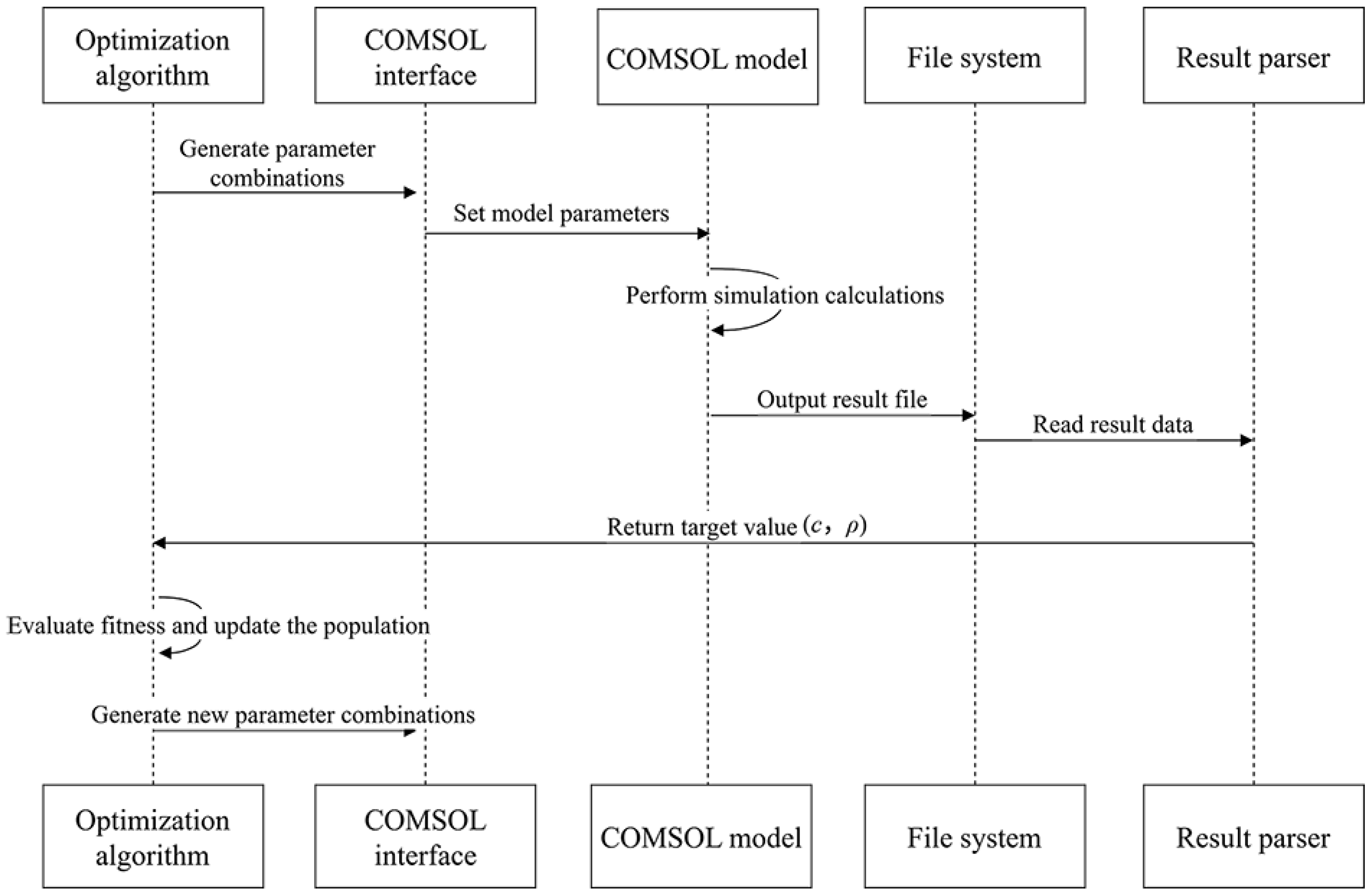
The integrated intelligent optimization algorithm proposed in this paper establishes a closed-loop solution framework for multiphysics parameter optimization by achieving deep coordination among the algorithm logic, COMSOL physical models, and data interaction. The core objective of this framework is to achieve coherent coupling between the algorithm’s search behavior and the physical constraints of the model, while mechanisms such as parameter pre-screening and composite single objective error feedback effectively reduce redundant COMSOL simulations. Consequently, the framework achieves a balanced improvement in both optimization efficiency and solution accuracy. The overall interaction process is illustrated in Figure 3.
The interactive process begins with the initial parameter generation and a single simulation cycle. The optimization algorithm first employs the chaotic fusion initialization strategy to generate physically feasible parameter sets. These parameters are then transferred to the COMSOL model via the COMSOL interface, enabling automatic batch assignment of model parameters and triggering the multiphysics simulation (e.g., computing the effective sound speed c and effective density ρ of acoustic metamaterials). Upon completion, the simulation results are stored in the file system and subsequently extracted by the result parser, which retrieves the target physical quantities (c, ρ ) and returns them to the optimizer. The algorithm evaluates the individual’s fitness using the composite single objectivee evaluation function f i t MO ( i ) = m = 1 2 y m ( i ) y m target y 1 target = c , y 2 target = ρ as the target physical quantities , thereby completing one closed-loop interaction between the algorithm and COMSOL.
The iterative logic shown in the flowchart corresponds to the repeated optimization process. After fitness evaluation, population updating is performed using the AMC and DWPI modules. The AMC module adaptively adjusts the convergence factor based on the standard deviation of population fitness, enabling dynamic switching between exploration and exploitation. The DWPI module fuses distance-based and historical-contribution weights to generate new parameter candidates while introducing pinhole-imaging opposition learning to maintain population diversity. The updated parameters are then transferred back to the simulation model through the COMSOL interface, repeating the simulation–feedback loop. The optimization terminates when the iteration count reaches T m a x or when the improvement in the best fitness remains below a predefined threshold for five consecutive generations. The final optimal parameters are passed to the COMSOL model for high-accuracy verification, and the result parser outputs the validated values of c and ρ , along with convergence curves, thus completing the overall “optimization–verification” closed-loop workflow.

5. Experimental Validation and Analysis

To comprehensively evaluate the algorithm’s performance, three categories of experiments were conducted. First, the effectiveness of the chaotic initialization strategy was verified through visualization techniques. Second, the overall performance of the proposed algorithm was compared with mainstream algorithms on standard high-dimensional benchmark functions. Finally, its practical application was validated through parameter optimization of acoustic metamaterials in COMSOL Multiphysics 6.3.

5.1. Verification of Initial Population Distribution in Chaotic Mapping

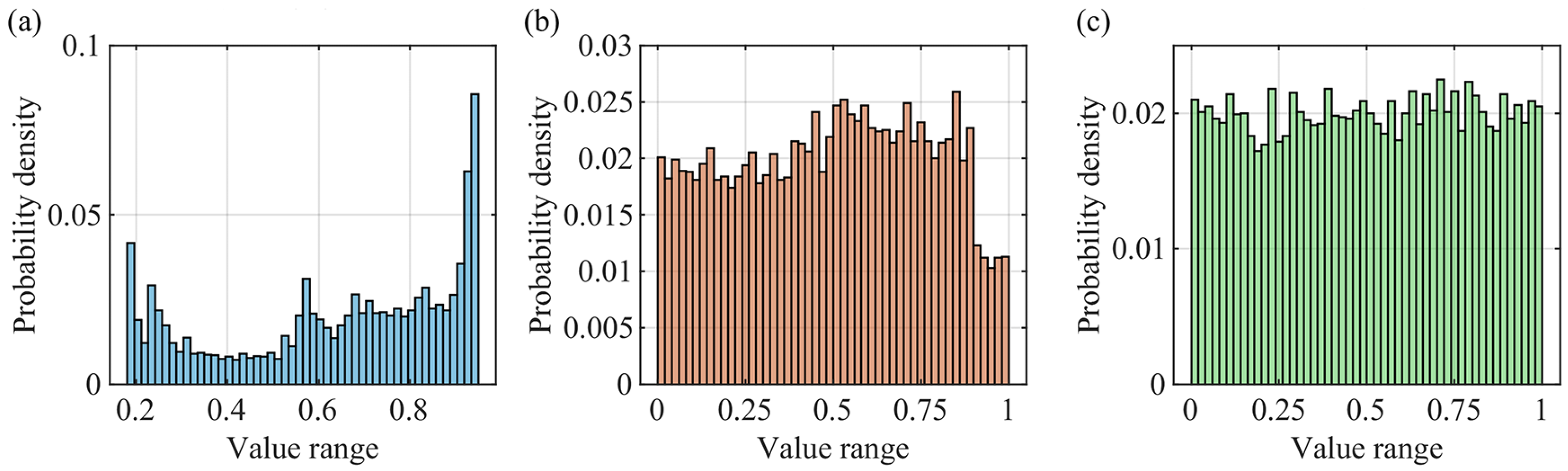
To evaluate the superiority of the proposed chaotic-fusion initialization strategy, a comparative analysis was conducted from two perspectives: probability distribution characteristics and spatial distribution characteristics. Figure 4 illustrates the probability histograms of the sequences generated by the three chaotic maps. The Logistic map (Figure 4a) exhibits pronounced non-uniformity across its domain, while the Tent map (Figure 4b) shows improved uniformity but still suffers from noticeable fluctuations. In contrast, the proposed Logistic–Tent fusion map (Figure 4c) demonstrates an approximately uniform probability distribution over the entire domain, indicating its enhanced ergodicity and distribution uniformity.
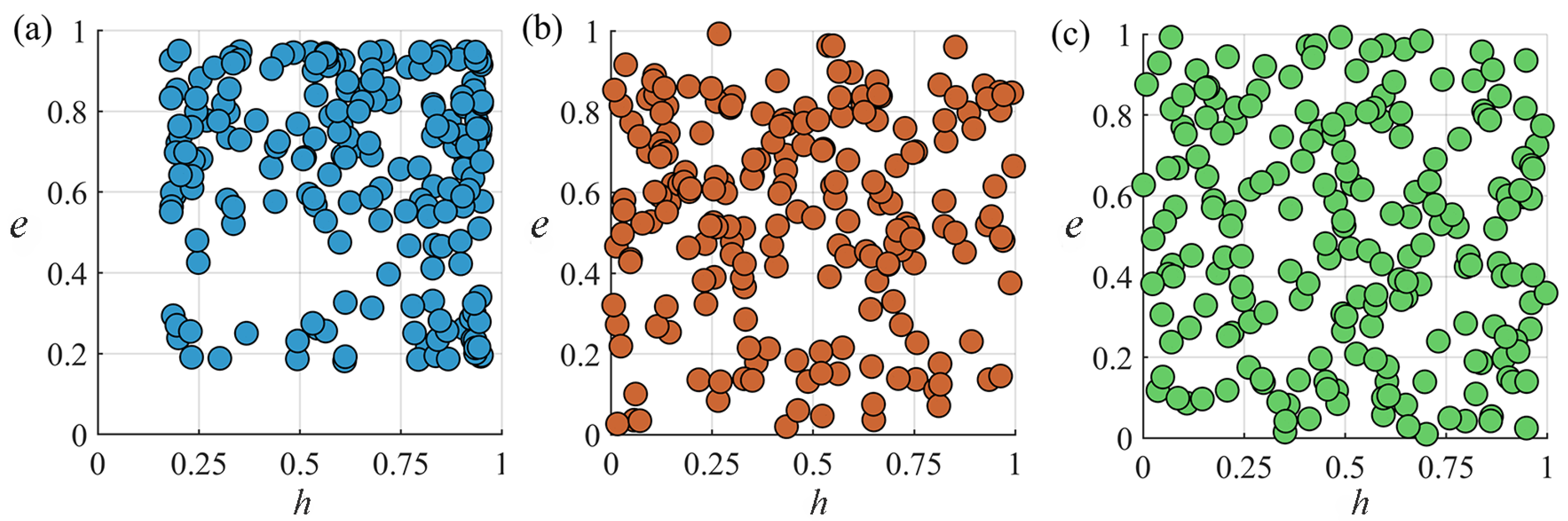
To further relate these statistical properties to the practical initialization behavior of the optimization algorithm, an initial population of size 200 was generated in a two-dimensional parameter space, with the resulting distributions shown in Figure 5. The population initialized by the Logistic map (Figure 5a) exhibits clear clustering and sparsity regions, resulting in insufficient spatial coverage. The Tent-based initialization (Figure 5b) improves coverage to some extent but still yields low-density regions near the boundaries. In comparison, the population generated using the proposed fusion strategy (Figure 5c) achieves a highly uniform spread across the entire space without noticeable voids or excessive clustering.
Overall, the chaotic-fusion initialization effectively mitigates the diversity limitations of traditional chaotic maps, reduces the bias of the initial population toward local subregions, and provides a more representative and uniformly distributed starting point for the optimization process. This substantially enhances the global exploration capability of the algorithm.

5.2. Effectiveness Analysis of Improvement Strategy

To validate the effectiveness of the DADCOA improvement strategy, simulation comparison experiments were conducted on CEC2022 test functions (unimodal functions (F1), multimodal functions (F2–F5), hybrid functions (F6–F8), and composite functions (F9–F12)). The simulation environment was configured as follows: 64-bit Windows 10 OS, Intel® Core™ i7-8700 CPU (3.0 GHz), 32 GB RAM, and MATLAB 2024a as the development and simulation platform. Four comparative algorithm variants were constructed, each integrating only one of the proposed improvements upon the standard Chimp Optimization Algorithm (COA): COA1: Incorporates the Logistic-Tent-Sinusoidal composite chaotic mapping strategy; COA2: Incorporates the adaptive multi-modal convergence factor; COA3: Incorporates the distance and historical contribution dual-weight population update mechanism. COA4: Incorporates the composite single-objective error-feedback local differential mutation operation. To ensure the fairness of the experiment and the accuracy of the results, all algorithms have consistent parameters, a population size of 30, and a maximum iteration count of 500. To reduce the impact of algorithm randomness on the experimental results, each experiment was independently run 30 times and the best value (Best), mean (Mean), standard deviation (Std), and Friedman average ranking were used as evaluation indicators for algorithm performance. DADCOA was tested against COA, COA1, COA2, COA3, and COA4, with results shown in Table 1.
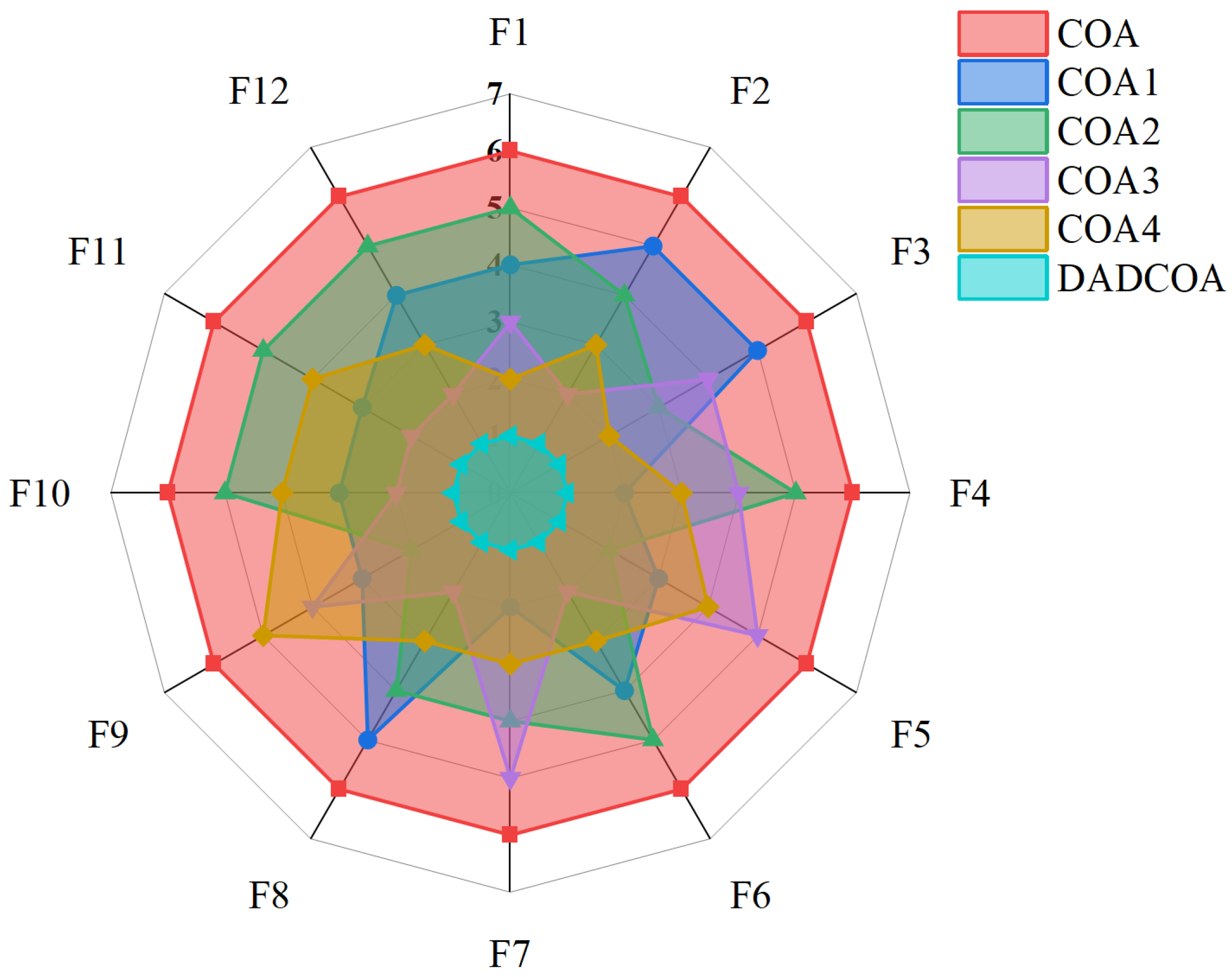
It can be seen that the DADCOA algorithm demonstrates excellent performance in terms of best value, mean, and standard deviation, validating that the introduction of multiple enhancement strategies significantly enhances its global search capability. To conduct an in-depth analysis and comparative evaluation of the effectiveness of various algorithms on the test functions, this study constructed a radar chart based on the mean value rankings from Table 1, as shown in Figure 6. The radar chart visually reflects algorithm performance through the size of their coverage areas, where smaller areas indicate superior performance. As shown in Figure 6, the DADCOA radar map occupies the smallest area, while the COA radar map occupies the largest area, indicating that the addition of all strategies has improved the optimization ability of COA. DADCOA provides the best solution in all testing functions and has better optimization performance.

5.3. Parameter Sensitivity Analysis

To evaluate the rationality of parameter selection in the DADCOA algorithm strategy, we conducted a parameter sensitivity analysis. Using the control variable method (fixing other parameters while varying only the target parameter), we systematically analyzed the impact of four key hyperparameters, population size N, chaos mapping parameters r, local differential mutation benchmark intensity F0, and fitness function weight wm. All experiments were simulated and compared across 12 CEC2022 test functions: unimodal functions (F1), multimodal functions (F2–F5), hybrid functions (F6–F8), and composite functions (F9–F12). Each parameter combination was independently run 30 times to mitigate random errors. Algorithm performance was evaluated using the following metrics: Best result, Mean, Standard Deviation (Std), and Friedman average ranking.

5.3.1. Analysis of Population Size N

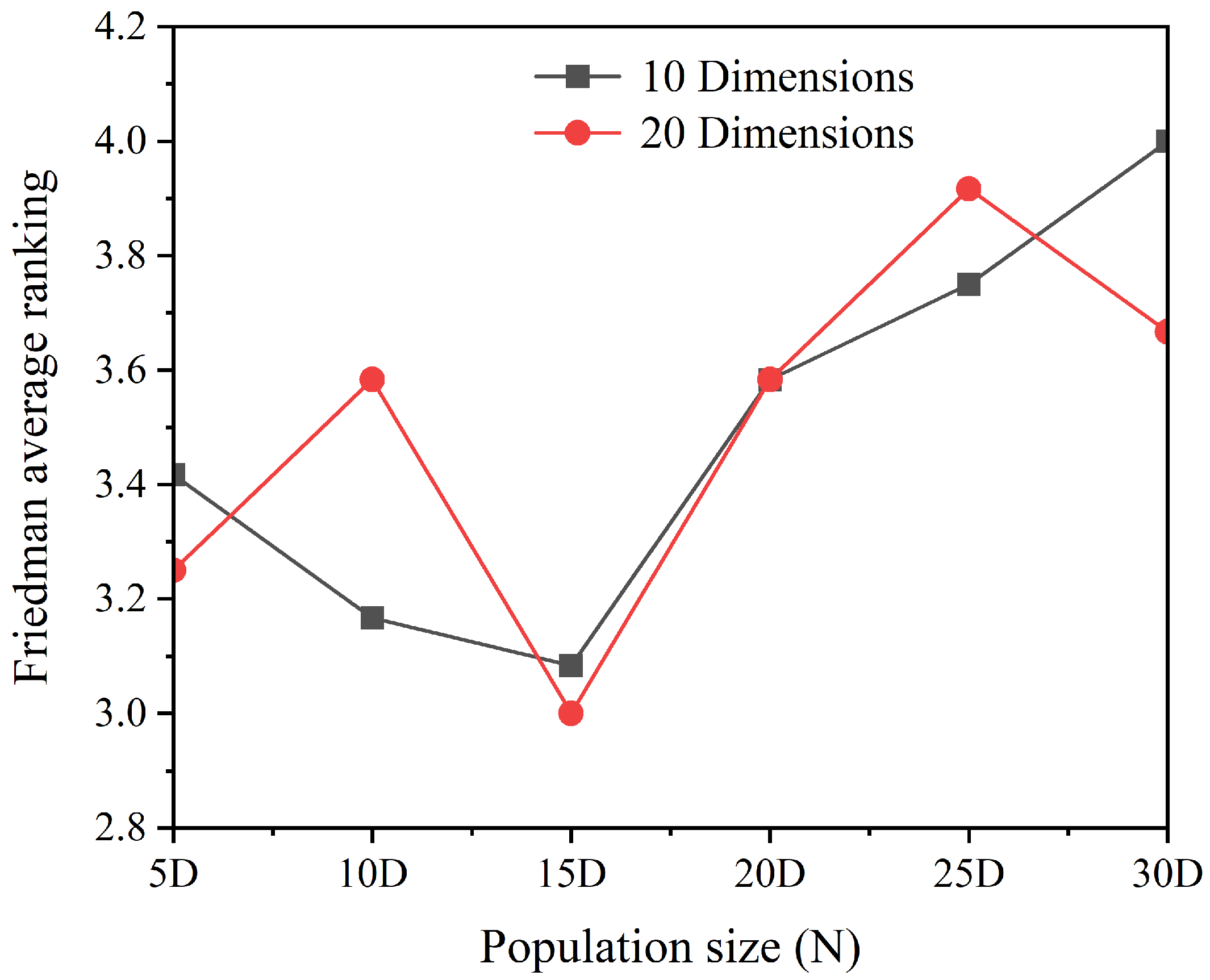
Population size (N) is a critical parameter that governs both the search behavior and computational efficiency of the algorithm. A larger N enhances the exploration breadth per iteration but reduces the total number of iterations, potentially leading to insufficient exploitation depth. Conversely, a smaller N may facilitate more focused exploitation but could compromise population diversity and global exploration capability. Hence, identifying an optimal population size that balances global exploration and local exploitation is essential for achieving efficient search within limited computational resources. To this end, this experiment systematically examines the performance of N across a range from 10D to 30D (in steps of 5D) on problems within the 10D and 20D dimensionality ranges. The comprehensive results of the CEC-2022 tests are listed in Table A1 and Table A2 of Appendix A, while Figure 7 depicts the corresponding Friedman average rankings, revealing the impact of population size scaling on algorithmic efficiency. As shown in Figure 7, N = 15D achieved the lowest (best) average rankings of 3.0833 (10D) and 3 (20D), indicating this configuration delivers the most stable and outstanding overall performance across all test functions. Consequently, subsequent experiments uniformly adopt a population size of 15D to fully demonstrate the performance of the DADCOA algorithm.

5.3.2. Analysis of the Chaos Mapping Parameter r

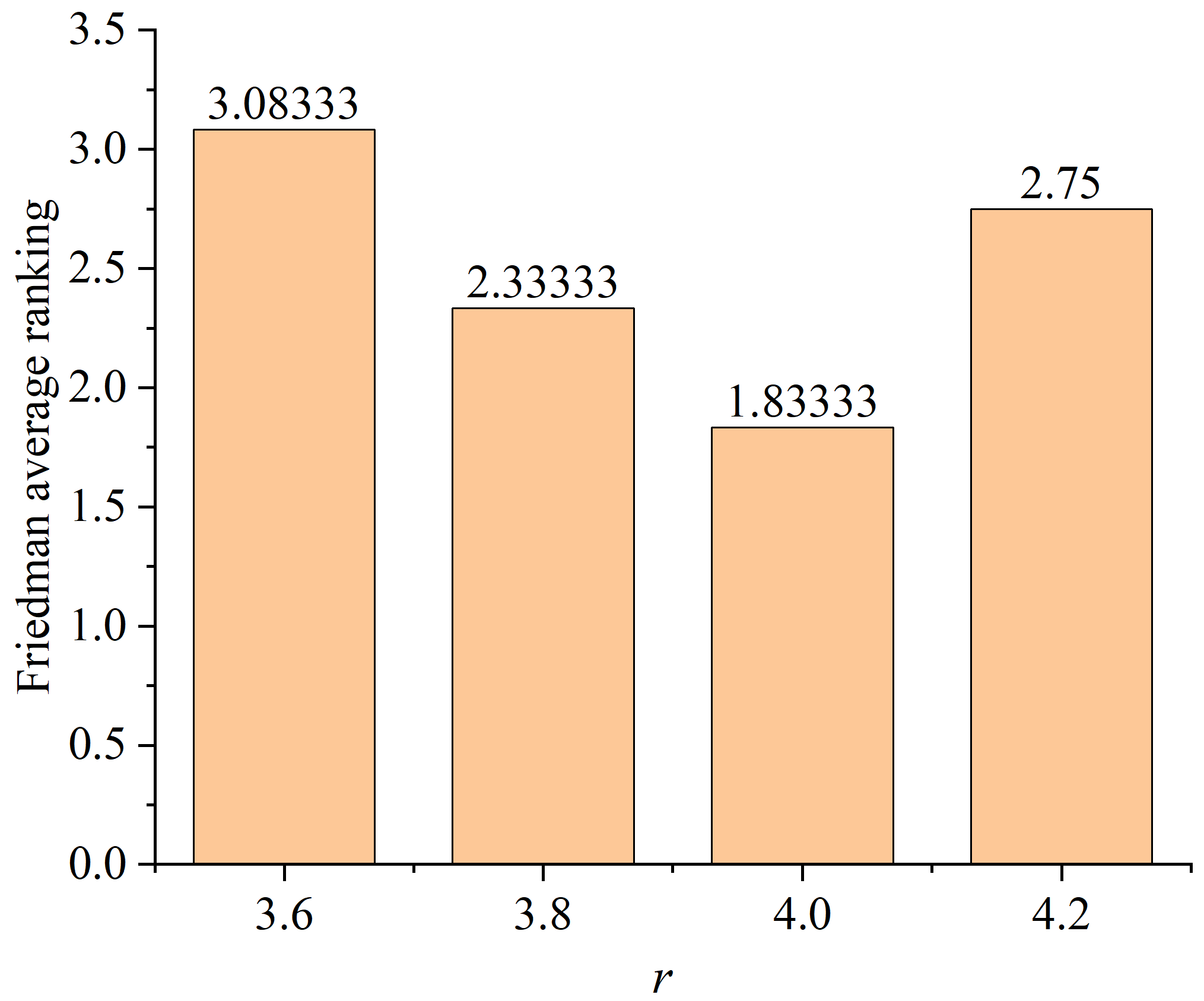
The chaos initialization strategy aims to generate sequences with excellent traversal properties through deterministic equations, in order to overcome the shortcomings of standard random initialization, such as uneven distribution in high-dimensional space and premature convergence of algorithms. In the Logistic-Tent composite mapping, the control parameter r is central to determining its traversal properties. Across all 12 functions in the CEC-2022 test set, we compared four configurations of r = 3.6, 3.8, 4.0, 4.2. The comprehensive results are listed in Table A3 of Appendix A, while Figure 8 depicts the corresponding average rankings. It can be seen that r = 4.0 significantly outperforms other values in terms of overall convergence performance (with the lowest average ranking of 1.8333), which directly confirms the high-quality initial population it generates and lays the best foundation for global and local search. The average ranking of r = 3.6 is the highest (3.0833), indicating that its initialization strategy is ineffective on most functions, severely limiting the convergence potential of the algorithm. The ranking of r = 4.2 (2.75) demonstrates that excessively large r values have already begun to negatively impact performance. Therefore, r = 4.0 ensures that the DADCOA algorithm achieves the strongest convergence performance across a wide range of optimization problems.

5.3.3. Analysis of the Local Differential Mutation Benchmark Intensity F0

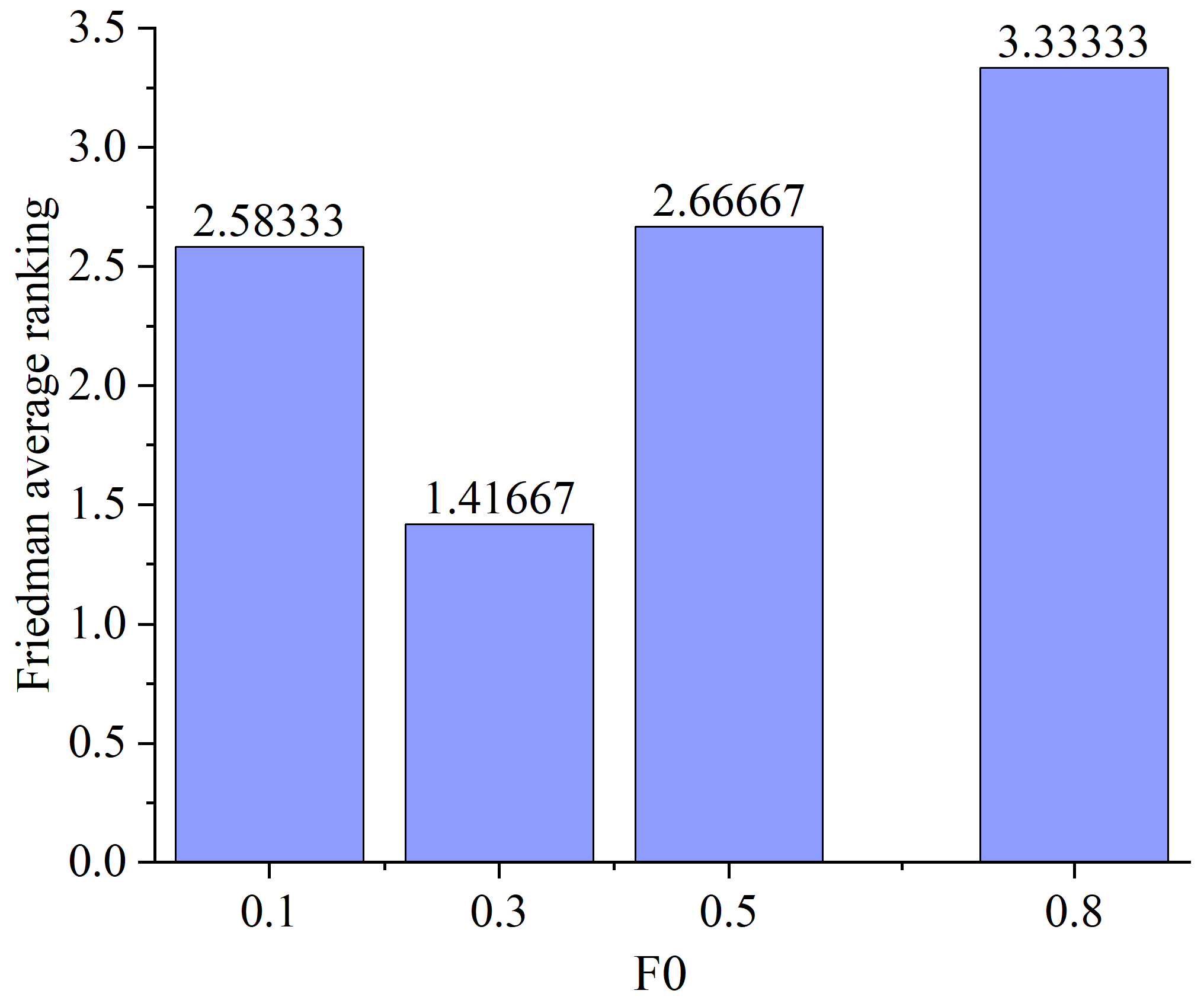
In composite single-objective error-feedback local differential mutation operations, dynamic mutation intensity serves as the key factor guiding the algorithm toward localized refinement. The baseline intensity F0, functioning as a scaling factor, directly determines the baseline magnitude of mutation strides. An excessively low F0 may result in insufficient search strides, causing the algorithm to become trapped in local search stagnation. Conversely, an excessively high F0 may induce search oscillations, undermining convergence stability. Four representative F0 values were selected for comparative experiments F 0 = { 0.1 , 0.3 , 0.5 , 0.8 } . The final composite fitness f i t MO ( i ) obtained from 20 independent runs served as the raw data. Friedman tests were employed to assess the average rankings of these four correlated samples. The comprehensive test results are listed in Table A4 of Appendix A, while Figure 9 illustrates the corresponding Friedman average rankings. F0 = 0.3 ranked first with the lowest average rank (1.4167), indicating superior performance in the vast majority of independent runs and significantly outperforming other configurations in overall capability.

5.3.4. Analysis of the Fitness Function Weight w m

In the multiphysics optimization of acoustic metamaterials, the core challenge lies in simultaneously satisfying multiple mutually coupled physical objectives (such as equivalent sound velocity c eff and equivalent density ρ eff ). To efficiently address this composite single-objective problem, this study employs a weighted summation approach. By introducing weighting coefficients w m to construct a scalarized fitness function, the composite single-objective optimization is transformed into a single-objective search process. The weight w m essentially defines the relative importance of each physical objective, thereby guiding the algorithm’s search direction. Based on the COMSOL acoustic metamaterial element model in Section 2, the target values are set as c target = 750 m / s , ρ target = 2000 kg / m 3 . To comprehensively investigate the influence of weights, five representative weight vectors were selected for experimental evaluation: w 1 = (0.5, 0.5), w 2 = (0.7, 0.3), w 3 = (0.3, 0.7), w 4 = (0.1, 0.9), and w 5 = (0.9, 0.1). In addition to the final composite fitness f i t MO ( i ) , we simultaneously observed the absolute errors of c eff and ρ eff relative to their target values. The results are shown in Table 2. When the weights are set to w 1 = (0.5, 0.5), the fitness f i t MO ( i ) and the absolute errors of each objective all reach their minimum values. This indicates that in this case, balancing the two objectives of sound velocity and density can most effectively achieve the synergistic optimization of multiple physical properties. Other weight configurations, such as w 2 = (0.7, 0.3) and w 4 = (0.9, 0.1), placed greater emphasis on the sound velocity objective. While the error in c eff was relatively small in these results, the error in ρ eff increased significantly. Similarly, settings like w 3 = (0.3, 0.7) favored density optimization, leading to increased sound velocity errors. This phenomenon clearly demonstrates that minor adjustments to the weight vector significantly alter the focus of optimization results, highlighting the high sensitivity of weight allocation in composite single-objective optimization. Therefore, this paper sets the weights as w 1 = (0.5, 0.5).

5.4. Algorithm Optimization Performance Testing

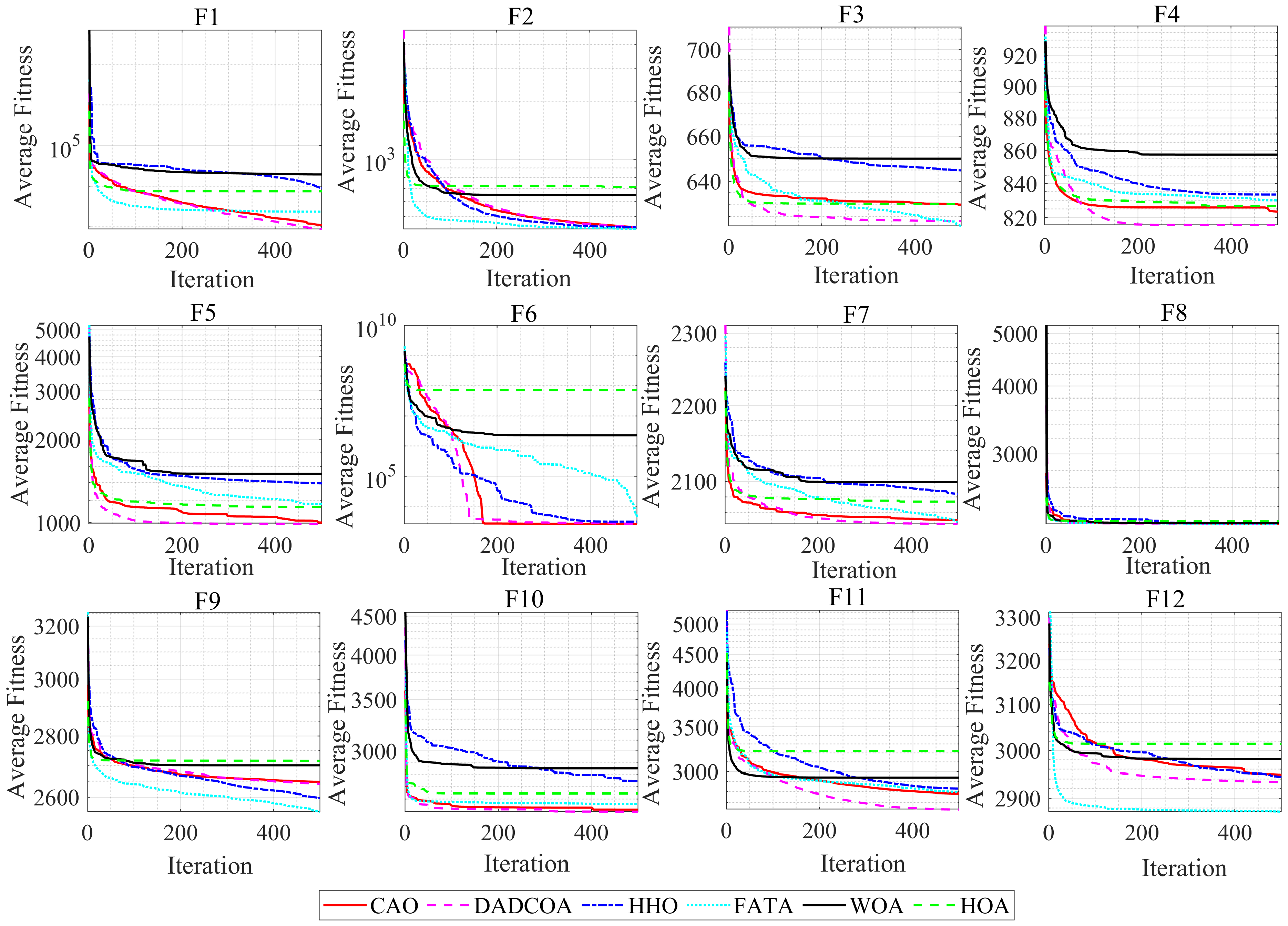
To systematically evaluate the performance of the proposed algorithm, comparative studies were conducted using the CEC2022 test function set. This collection comprises 12 single-objective test functions with boundary constraints, categorized into four types: unimodal functions (F1), basic functions (multimodal, F2–F5), hybrid functions (F6–F8), and composite functions (F9–F12). Unimodal functions, each possessing a single global optimum, are used to evaluate the convergence speed and accuracy of the algorithm on well-defined single-solution problems. In contrast, multimodal functions, which contain multiple local optima, are employed to test the algorithm’s ability to handle complex landscapes and avoid premature convergence. The proposed improved algorithm is compared in performance with the traditional COA, Whale Optimization Algorithm (WOA), Harris Hawks Optimization (HHO), Mirage Optimization Algorithm (FATA), and Hiking Optimization Algorithm (HOA).
In order to ensure the fairness of the experiment, all algorithms were configured with a population size of 30, 10-dimensional input, and a maximum iteration limit of 500. Each algorithm was independently run 30 times, with the best value (Best), mean (Mean), standard deviation (Std), and Friedman average rank serving as evaluation metrics. Table 3 summarizes the experimental results of the DADCOA algorithm on the CEC 2022 test functions, with bolded data indicating the optimal optimization performance. Table 3 reveals that DADCOA demonstrates superior performance advantages on most test functions. DADCOA demonstrates superior optimization capabilities compared to other benchmark algorithms on the unimodal function F1, indicating its robust development potential and stability. In tests on multimodal functions F2–F5, DADCOA continues to exhibit outstanding optimization performance. Except for function F3 where its performance slightly trails the FATA algorithm, DADCOA achieves the optimal convergence value across all other functions. In the mixed function tests F6–F8, DADCOA consistently ranked first in average convergence, demonstrating strong convergence capability. For the composite functions F9–F12, while DADCOA’s convergence accuracy and stability were not optimal, its overall performance across the entire CEC2022 test set remained outstanding. To visually assess convergence across different test functions, Figure 10 displays the average convergence curves of DADCOA and comparison algorithms on CEC2022 test functions. Compared to other algorithms, DADCOA achieved superior average optimization accuracy across all functions except F3, F9 and F12, where results were suboptimal. The Friedman test evaluates whether significant differences exist among multiple samples using the rank mean. The DADCOA algorithm secured the top position with a rank mean of 1.75, followed by FATA with a rank mean of 2.33. These statistical results effectively demonstrate that the DADCOA algorithm significantly outperforms other improved algorithms under comparison.

5.5. Verification of Parametric Optimization for Acoustic Metamaterials in COMSOL

To further assess the performance of the proposed algorithm in physics-based simulation optimization, it was applied to the parameter optimization of an acoustic metamaterial unit modeled in COMSOL. The test structure corresponds to the acoustic metamaterial unit shown in Figure 1, with a fixed unit cell size of a = 20 mm, and three key design parameters (frame characteristic size b, thickness h, and shrinkage factor e) are selected as the optimization variables. The optimization objective is to adjust these parameters such that the equivalent sound speed c and equivalent density ρ of the unit at a specified frequency closely match the target values c = 750 m / s , ρ = 2000 kg / m 3 . To comprehensively assess the effectiveness of the proposed method, the integrated DADCOA algorithm is compared against six existing algorithms: the standard COA, an Improved Chimp Optimization Algorithm (ICOA), a Multi-strategy Chimp Optimization Algorithm (MCOA), a Hybrid Chaotic Chimp Optimization Algorithm (HCOA), Cuckoo Search Algorithm (CSA), and Whale Optimization Algorithm (WOA). Both simulation and verification were conducted under identical conditions.
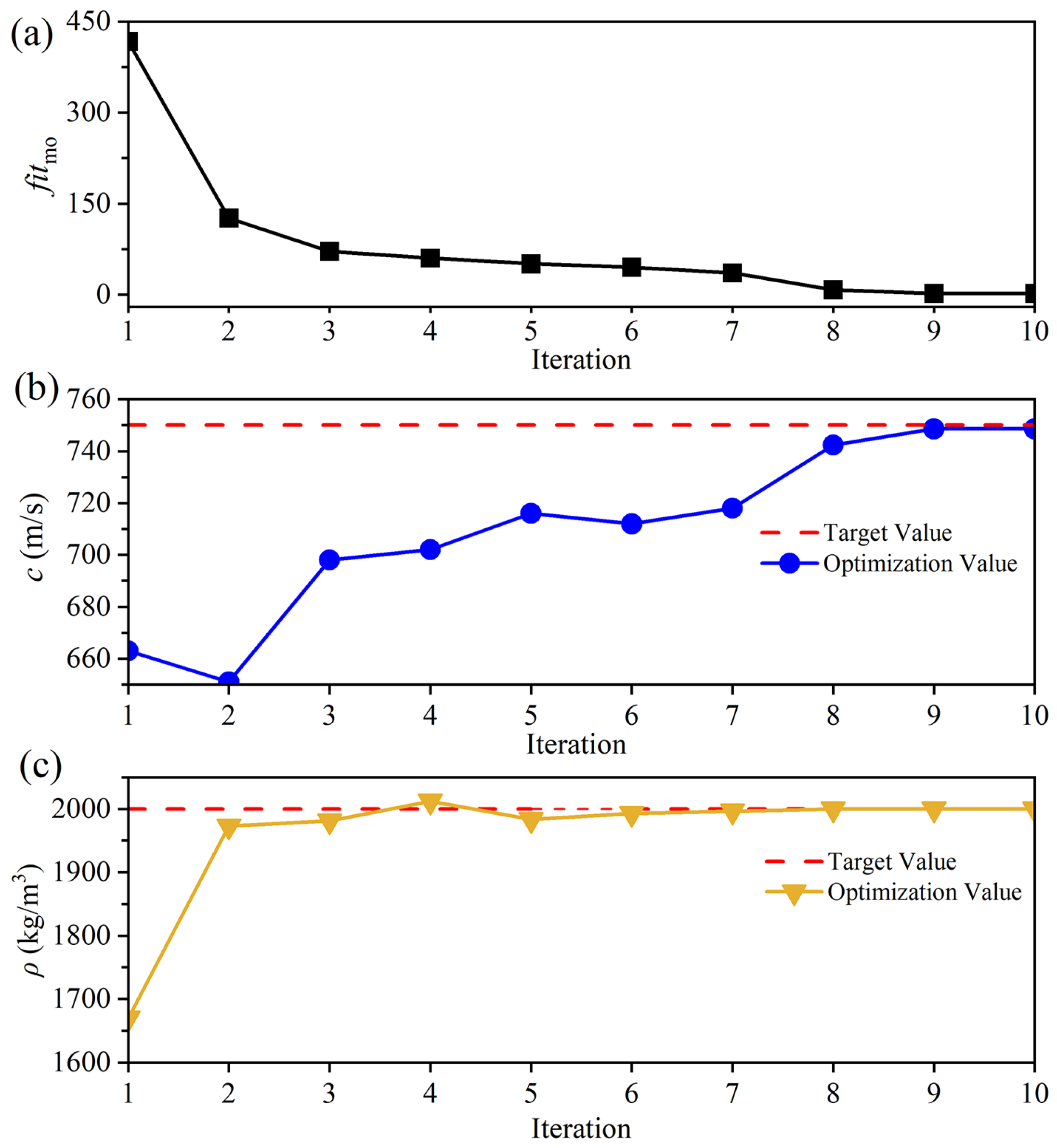
In terms of target-performance approximation, the proposed DADCOA algorithm achieves the highest optimization accuracy among all compared methods, as shown in Table 4. The standard COA exhibits substantial deviations, with an equivalent sound speed error of 59.68 m/s (achieving only 690.32 m/s) and a density error of 156.57 kg/m3 (1843.43 kg/m3), representing the largest discrepancy from the design targets. Although ICOA, MCOA, and HCOA progressively reduce these errors, they still present sound speed deviations of 10.88–117.19 m/s and density deviations of 2.68–144.19 kg/m3. In contrast, the DADCOA algorithm reduces the equivalent sound velocity deviation to only 1.42 m/s (resulting in 748.58 m/s) and the equivalent density deviation to 0.27 kg/m3 (yielding 1999.73 kg/m3), achieving the closest alignment with the design objectives among all compared algorithms. Figure 11 illustrates the convergence and target-approaching behavior of the DADCOA in COMSOL Multiphysics parameter optimization. Figure 11a shows that the fitness convergence curve exhibits a distinct monotonically decreasing trend. During the early stages of optimization, the curve declines rapidly, reflecting the algorithm’s strong search directionality and fast convergence speed. As iterations progress, the curve gradually stabilizes, indicating consistent convergence performance. Further examining the evolution of physical parameters, Figure 11b,c illustrate the optimization trajectories of the equivalent sound velocity c and equivalent density ρ . Both parameters gradually and steadily converge from their initial values toward the preset target values (750 m/s and 2000 kg/m3). Ultimately, both curves fluctuate slightly near their target values before stabilizing, with a narrow fluctuation range. This further validates the effectiveness and reliability of this optimization algorithm in matching target physical properties. Furthermore, the algorithm can be applied to other metamaterial structure optimizations (see Appendix B for details), exhibiting a degree of universality.
Regarding computational efficiency, the DADCOA algorithm significantly reduces the cost of COMSOL simulation. DADCOA converged to a high-precision solution in just 150 simulations, whereas other algorithms required between 231 and 467 simulations. This directly demonstrates DADCOA’s superiority in search directionality and convergence speed. In addition, the standard COA algorithm takes up to 237 min due to inefficient search steps and redundant iterations. The improved ICOA, MCOA, and HCOA reduce the total runtime between 130 and 237 min through enhanced initialization and convergence strategies. In comparison, the DADCOA algorithm completes optimization in just 93 min, reducing time costs by 60.76% compared to traditional COA and by 28.46% compared to the HCOA. This represents efficiency improvements of approximately 74.19% and 59.14% compared to CSA’s 162 min and WOA’s 148 min, respectively. These improvements stem from the high-quality diversity generated by the two-chaotic initialization, the directionally informed updates produced by the dual-weight mechanism, and the physics-based pre-screening that filters invalid parameter sets in advance. Collectively, these features enable the algorithm to simultaneously achieve high accuracy and low computational cost, demonstrating strong potential for real-world engineering optimization applications.
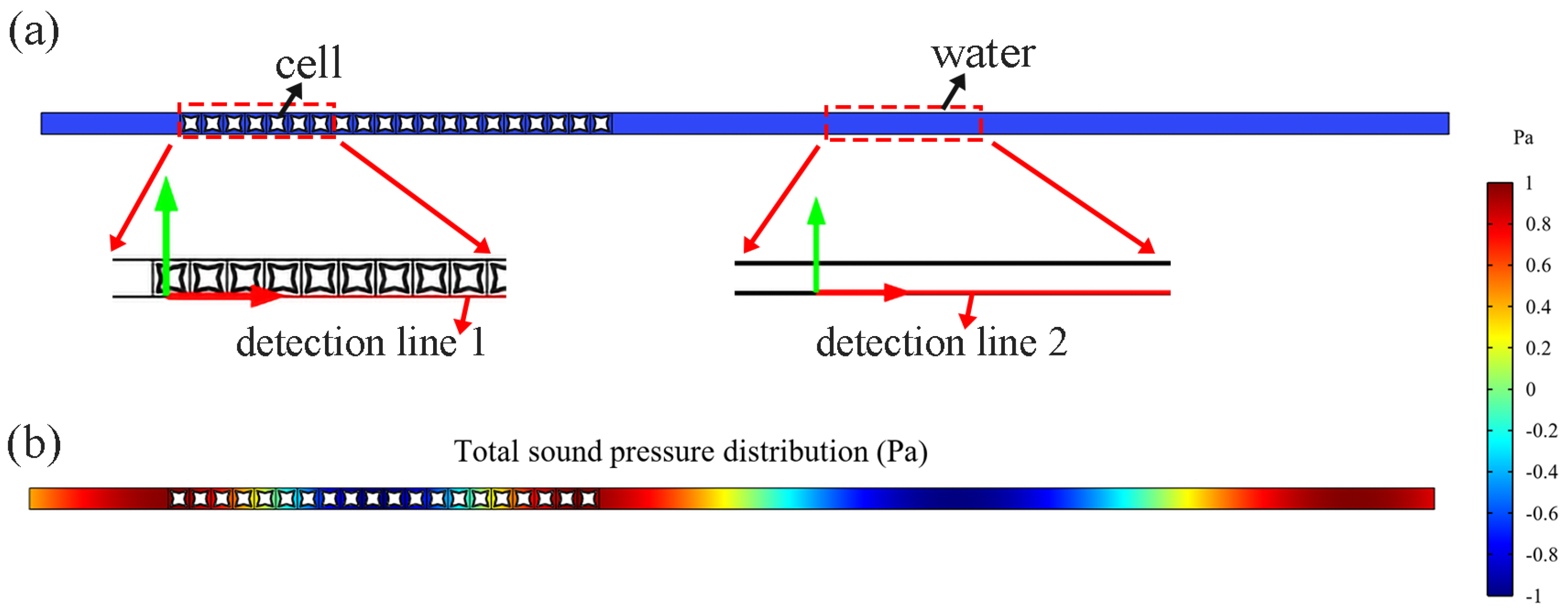
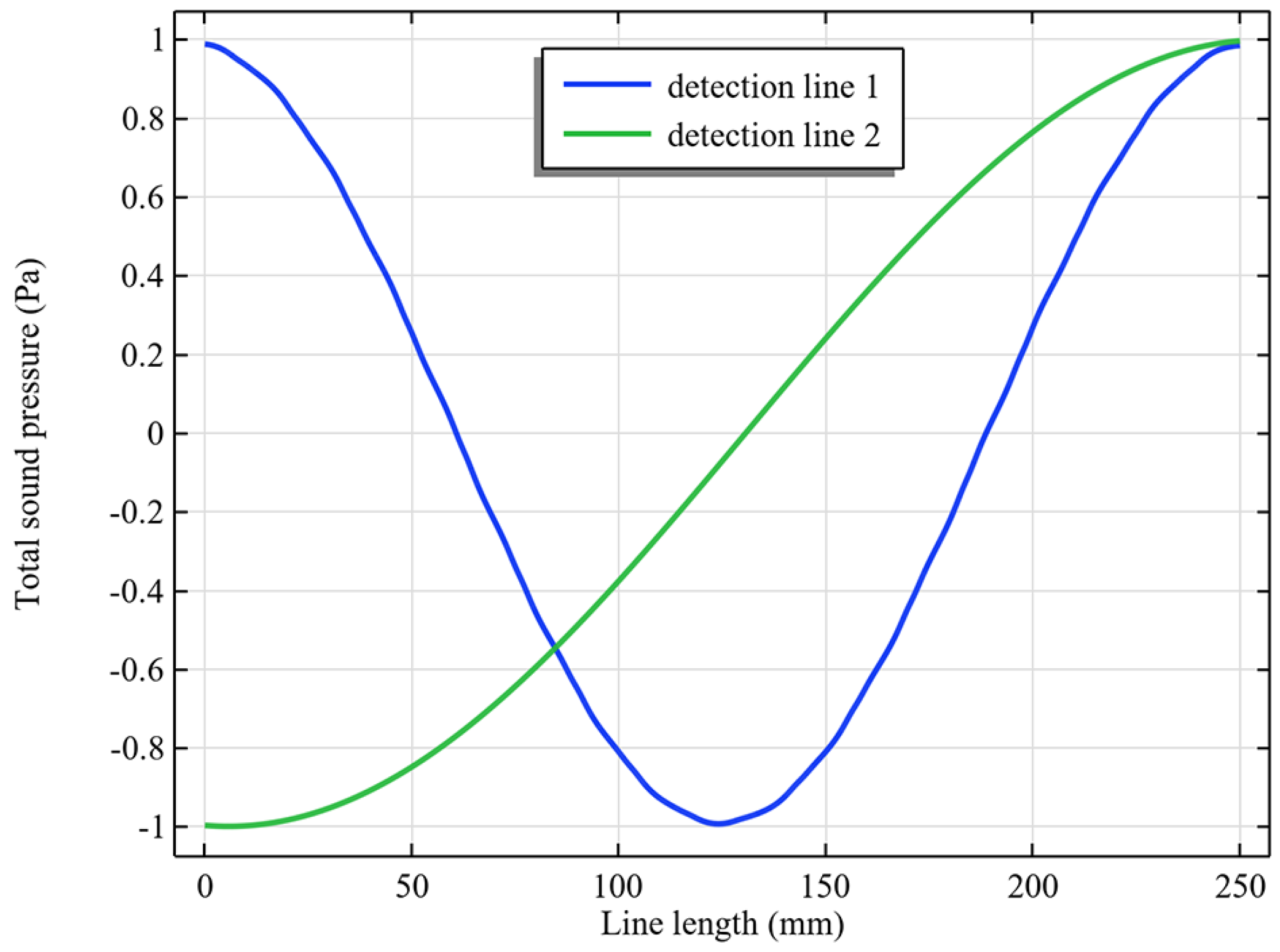
To demonstrate the optimization effect more clearly, a periodic acoustic waveguide model consisting of 20 optimized unit cells was established (see Figure 12a, with a waveguide width of 20 mm for each unit cell and a total length of 1000 mm). A plane wave with an amplitude of 1 was incident at the left end. Plane wave radiation boundary conditions were applied at both ends of the waveguide to eliminate reflections, while periodic boundary conditions were imposed at the top and bottom boundaries. Additionally, two observation lines of equal length were added to the model, with line 1 within the unit cell array region and line 2 in the water domain.
The total sound pressure distribution of the entire waveguide at 3000 Hz is shown in Figure 12b, which visually demonstrates the distinct distribution characteristics of the acoustic field within the unit cell array compared to the free water domain. The sound pressure distribution across the entire waveguide at 3000 Hz reveals a distinct difference between the pressure distribution within the array and that within the water domain. This provides direct evidence for the transformation from parameter-level convergence to physical response. To quantify this physical phenomenon, the sound pressure distribution was extracted along the observation lines (Figure 13). The results indicate that observation line 2 corresponds to approximately half a wavelength in the free water domain, while observation line 1 corresponds to approximately one full wavelength within the single cell. This implies that the propagation wavelength within the unit cell is approximately half that in the water domain, with a corresponding equivalent sound velocity of about half the water domain’s sound velocity (0.5 × c water = 750 m/s). This value matches the target equivalent sound speed set in the optimization objectives.

6. Conclusions

This paper addresses the challenges of high computational cost, susceptibility to local optima, and strong reliance on manual intervention in multi-physics parameter optimization for acoustic metamaterials. It proposes a modified chimpanzee optimization algorithm (DADCOA) that integrates multiple strategies. By systematically enhancing the standard COA algorithm in initialization, population update, and local search, the algorithm has successfully constructed an automated and efficient optimization framework suitable for COMSOL simulation. The main contributions and conclusions of this work can be summarized as follows:
(1)
A multi-strategy fusion optimization algorithm is proposed. DADCOA integrates the Dual Chaotic Initialization Strategy, Adaptive Multi-modal Convergence Mechanism, Dual-weight Pinhole Imaging Update Operator, and Composite single-objective Error Feedback Local Differential Mutation. These strategies work synergistically to address critical challenges in high-dimensional spaces, including initial population distribution imbalance, dynamic equilibrium between exploration and exploitation phases, precise search direction guidance, and collaborative optimization of multi-physics coupled objectives, thereby providing a solution for complex simulation optimization.
(2)
The algorithm’s superior performance was validated on standard test functions. Through testing on a series of high-dimensional unimodal and multimodal benchmark functions, DADCOA demonstrated significantly better convergence accuracy and stability compared to standard COA and other mainstream meta-heuristic algorithms (such as WOA, HOA, etc.), confirming the effectiveness and robustness of its improved strategy.
(3)
Significant application results have been achieved in COMSOL acoustic metamaterial optimization. DADCOA was applied to parameter optimization of acoustic metamaterial units, with the composite single-objective of precisely matching the target equivalent sound velocity (750 m/s) and equivalent density (2000 kg/m3). Experimental results demonstrate that compared to existing improved COA algorithms, DADCOA achieves the design objectives with the highest accuracy (adaptive fitness value of only 1.69, with deviations of 1.5 m/s and 0.3 kg/m3 for sound velocity and density, respectively) and the highest efficiency (total optimization time of 93 min). This fully satisfies the dual requirements of precision and cost efficiency demanded by engineering applications.
(4)
An efficient automated simulation-optimization closed-loop system has been established. This research integrates algorithms with COMSOL multiphysics simulation, achieving an automated workflow from parameter iteration to simulation computation, result analysis and decision update. Combined with a physical constraint pre-screening mechanism, it effectively reduces redundant simulations, providing an efficient solution for simulation-based complex system design. In summary, the proposed DADCOA algorithm and its automated optimization framework provide a powerful simulation-driven intelligent design tool for acoustic metamaterials. Future research can extend this framework to three-dimensional metamaterials and broadband/nonlinear response design while exploring integration with deep learning surrogate models to further overcome computational bottlenecks, representing a highly promising research direction.

Author Contributions

Conceptualization, B.Z. and Y.C.; methodology, Y.C.; software, B.Z.; validation, B.Z., C.S. and N.Y.; data curation, N.Y.; writing—original draft preparation, B.Z.; writing—review and editing, B.Z., C.S. and Y.C.; supervision, Y.C. All authors have read and agreed to the published version of the manuscript.

Funding

This work was partially supported by the Project supported by the Science and Technology Research Project of Henan Province (No. 242102211110, No. 252102211001).

Data Availability Statement

The original contributions presented in this study are included in the article. Further inquiries can be directed to the corresponding author.

Conflicts of Interest

Author Chaoyun Shi was employed by the company Semiconductor Manufacturing International Corporation (Beijing) Co., Ltd. The remaining authors declare that the research was conducted in the absence of any commercial or financial relationships that could be construed as a potential conflict of interest.

Appendix A

Table A1. Experiments comparing DADCOA with different population sizes (10D).
FunctionIndicatorN = 5DN = 10DN = 15DN = 20DN = 25DN = 30D
F1Best 3.5798 × 10 2 3.0956 × 10 2 3.3643 × 10 2 3.3664 × 10 2 3.6713 × 10 2 3.2017 × 10 2
Avg 1.7219 × 10 3 1.5992 × 10 3 6.7373 × 10 2 1.4691 × 10 3 1.6271 × 10 3 1.8411 × 10 3
Std 2.8868 × 10 3 2.6715 × 10 3 3.4636 × 10 2 2.4096 × 10 3 2.4968 × 10 3 2.8723 × 10 3
Rank531246
F2Best 5.4224 × 10 2 5.2207 × 10 2 4.0001 × 10 2 5.4224 × 10 2 5.5549 × 10 2 5.5771 × 10 2
Avg 7.1410 × 10 2 7.4139 × 10 2 4.1069 × 10 2 7.0487 × 10 2 7.2194 × 10 2 7.4053 × 10 2
Std 3.0991 × 10 2 3.3039 × 10 2 2.4284 × 10 1 3.2843 × 10 2 2.9103 × 10 2 3.1251 × 10 2
Rank361245
F3Best 3.2286 × 10 2 3.2139 × 10 2 6.1416 × 10 2 5.2249 × 10 2 4.2110 × 10 2 4.1865 × 10 2
Avg 5.4438 × 10 2 5.4221 × 10 2 6.2106 × 10 2 5.4441 × 10 2 5.4311 × 10 2 5.4137 × 10 2
Std 1.2514 × 10 1 1.0965 × 10 1 6.0649 × 10 0 1.3084 × 10 1 1.1802 × 10 1 1.1396 × 10 1
Rank426531
F4Best 8.1852 × 10 2 8.1719 × 10 2 8.0697 × 10 2 7.8857 × 10 2 8.1570 × 10 2 8.1544 × 10 2
Avg 8.6313 × 10 2 8.6388 × 10 2 8.1662 × 10 2 8.0107 × 10 2 8.7067 × 10 2 8.6794 × 10 2
Std 2.6854 × 10 1 2.5852 × 10 1 6.0985 × 10 0 2.7663 × 10 1 2.6853 × 10 1 3.0163 × 10 1
Rank342165
F5Best 9.2491 × 10 2 9.1808 × 10 2 9.2180 × 10 2 9.1063 × 10 2 9.2779 × 10 2 9.1476 × 10 2
Avg 9.5036 × 10 2 9.4829 × 10 2 9.8816 × 10 2 9.5787 × 10 2 9.5472 × 10 2 9.4134 × 10 2
Std 3.6591 × 10 1 3.2988 × 10 1 4.5308 × 10 1 3.4258 × 10 1 3.5181 × 10 1 3.0645 × 10 1
Rank326541
F6Best 1.6016 × 10 3 1.8729 × 10 3 1.9979 × 10 3 1.8147 × 10 3 1.6631 × 10 3 1.5939 × 10 3
Avg 3.4612 × 10 3 3.5113 × 10 3 3.6478 × 10 3 3.4608 × 10 3 3.5121 × 10 3 3.6902 × 10 3
Std 1.3418 × 10 3 4.4615 × 10 3 1.1139 × 10 3 1.1478 × 10 3 4.9015 × 10 3 1.3719 × 10 3
Rank135246
F7Best 2.0468 × 10 3 2.0510 × 10 3 2.0508 × 10 3 2.0490 × 10 3 2.0489 × 10 3 2.0459 × 10 3
Avg 2.0987 × 10 3 2.1076 × 10 3 2.0995 × 10 3 2.1055 × 10 3 2.1114 × 10 3 2.1077 × 10 3
Std 3.5358 × 10 1 2.9490 × 10 1 2.9664 × 10 1 4.0567 × 10 1 3.5873 × 10 1 3.6433 × 10 1
Rank142365
F8Best 2.2292 × 10 3 2.1294 × 10 3 2.2211 × 10 3 2.2323 × 10 3 2.0278 × 10 3 2.2285 × 10 3
Avg 2.2774 × 10 3 2.1667 × 10 3 2.2230 × 10 3 2.2729 × 10 3 2.0614 × 10 3 2.2690 × 10 3
Std 2.9649 × 10 1 2.1534 × 10 1 3.8515 × 10 0 2.0496 × 10 1 1.4907 × 10 1 2.1462 × 10 1
Rank623514
F9Best 2.6605 × 10 3 2.6733 × 10 3 2.5906 × 10 3 2.6668 × 10 3 2.2558 × 10 3 2.3616 × 10 3
Avg 2.7205 × 10 3 2.7246 × 10 3 2.6292 × 10 3 2.7318 × 10 3 2.3909 × 10 3 2.4106 × 10 3
Std 2.9285 × 10 1 2.1541 × 10 1 1.4735 × 10 1 2.7336 × 10 1 1.9482 × 10 1 2.4795 × 10 1
Rank354612
F10Best 2.5029 × 10 3 2.5074 × 10 3 2.5011 × 10 3 2.5023 × 10 3 2.5149 × 10 3 2.4172 × 10 3
Avg 2.5722 × 10 3 2.5642 × 10 3 2.5018 × 10 3 2.5647 × 10 3 2.5805 × 10 3 2.4421 × 10 3
Std 3.3917 × 10 1 2.1738 × 10 1 7.1339 × 10 1 3.5113 × 10 1 3.6841 × 10 1 1.3486 × 10 1
Rank532461
F11Best 2.2671 × 10 3 2.1430 × 10 3 2.6005 × 10 3 2.7812 × 10 3 2.7789 × 10 3 2.8053 × 10 3
Avg 2.6755 × 10 3 2.7974 × 10 3 2.6620 × 10 3 2.8401 × 10 3 2.7978 × 10 3 2.8758 × 10 3
Std 1.6387 × 10 3 1.5458 × 10 3 1.4523 × 10 2 1.7766 × 10 3 1.6661 × 10 3 1.4682 × 10 3
Rank231546
F12Best 2.9464 × 10 3 2.1497 × 10 3 2.8934 × 10 3 1.9554 × 10 3 2.0540 × 10 3 2.9517 × 10 3
Avg 3.4818 × 10 3 2.4097 × 10 3 2.9306 × 10 3 2.7538 × 10 3 2.5449 × 10 3 3.4884 × 10 3
Std 3.2505 × 10 2 3.1610 × 10 2 2.5372 × 10 1 3.1604 × 10 2 2.9698 × 10 2 2.9097 × 10 2
Rank514326
Friedman average ranking3.253.5833333.583333.916673.66667
Table A2. Experiments comparing DADCOA with different population sizes (20D).
FunctionIndicatorN = 5DN = 10DN = 15DN = 20DN = 25DN = 30D
F1Best 3.3664 × 10 3 3.5798 × 10 3 3.3643 × 10 2 3.0956 × 10 3 3.2017 × 10 3 3.6713 × 10 3
Avg 1.4691 × 10 4 1.7219 × 10 4 6.7373 × 10 2 1.5992 × 10 4 1.8411 × 10 4 1.6271 × 10 4
Std 2.4096 × 10 4 2.8868 × 10 4 3.4636 × 10 2 2.6715 × 10 4 2.8723 × 10 4 2.4968 × 10 4
Rank251364
F2Best 5.4224 × 10 2 5.4224 × 10 2 4.9645 × 10 2 5.2207 × 10 2 5.5771 × 10 2 5.5549 × 10 2
Avg 7.0487 × 10 2 7.1410 × 10 2 6.9029 × 10 2 7.4139 × 10 2 7.4053 × 10 2 7.2194 × 10 2
Std 3.2843 × 10 2 3.0991 × 10 2 3.4556 × 10 2 3.3039 × 10 2 3.1251 × 10 2 2.9103 × 10 2
Rank231654
F3Best 6.2249 × 10 2 6.2286 × 10 2 6.2588 × 10 2 6.2139 × 10 2 6.1865 × 10 2 6.2110 × 10 2
Avg 6.4441 × 10 2 6.4438 × 10 2 6.4605 × 10 2 6.4221 × 10 2 6.4137 × 10 2 6.4311 × 10 2
Std 1.3084 × 10 1 1.2514 × 10 1 1.3411 × 10 1 1.0965 × 10 1 1.1396 × 10 1 1.1802 × 10 1
Rank546213
F4Best 8.1857 × 10 2 8.1852 × 10 2 8.1970 × 10 2 8.1719 × 10 2 8.1544 × 10 2 8.1570 × 10 2
Avg 8.6107 × 10 2 8.6313 × 10 2 8.6156 × 10 2 8.6388 × 10 2 8.6794 × 10 2 8.7067 × 10 2
Std 2.7663 × 10 1 2.6854 × 10 1 2.5036 × 10 1 2.5852 × 10 1 3.0163 × 10 1 2.6853 × 10 1
Rank132456
F5Best 9.8063 × 10 2 9.6491 × 10 2 9.8155 × 10 2 9.5808 × 10 2 9.4476 × 10 2 9.5779 × 10 2
Avg 1.5787 × 10 3 1.5036 × 10 3 1.5917 × 10 3 1.4829 × 10 3 1.4134 × 10 3 1.5472 × 10 3
Std 3.4258 × 10 2 3.6591 × 10 2 3.7723 × 10 2 3.2988 × 10 2 3.0645 × 10 2 3.5181 × 10 2
Rank536214
F6Best 2.8147 × 10 3 2.8729 × 10 3 1.5939 × 10 4 2.5022 × 10 3 2.6016 × 10 3 2.6631 × 10 3
Avg 3.6208 × 10 5 1.2923 × 10 6 5.6902 × 10 6 4.4364 × 10 6 4.4612 × 10 3 1.5121 × 10 6
Std 1.1478 × 10 6 4.4615 × 10 6 1.3719 × 10 7 1.3192 × 10 7 1.3418 × 10 3 4.9015 × 10 6
Rank236514
F7Best 2.0490 × 10 3 2.0468 × 10 3 2.0508 × 10 3 2.0510 × 10 3 2.0459 × 10 3 2.0489 × 10 3
Avg 2.1055 × 10 3 2.0987 × 10 3 2.0995 × 10 3 2.1076 × 10 3 2.1077 × 10 3 2.1114 × 10 3
Std 4.0567 × 10 1 3.5358 × 10 1 2.9664 × 10 1 2.9490 × 10 1 3.6433 × 10 1 3.5873 × 10 1
Rank312456
F8Best 2.2323 × 10 3 2.2292 × 10 3 2.2303 × 10 3 2.2294 × 10 3 2.2285 × 10 3 2.2278 × 10 3
Avg 2.2729 × 10 3 2.2774 × 10 3 2.2679 × 10 3 2.2667 × 10 3 2.2690 × 10 3 2.2614 × 10 3
Std 2.0496 × 10 1 2.9649 × 10 1 2.2603 × 10 1 2.1534 × 10 1 2.1462 × 10 1 1.4907 × 10 1
Rank563241
F9Best 2.6616 × 10 3 2.6605 × 10 3 2.6558 × 10 3 2.6733 × 10 3 2.6668 × 10 3 2.6661 × 10 3
Avg 2.7106 × 10 3 2.7205 × 10 3 2.6909 × 10 3 2.7246 × 10 3 2.7318 × 10 3 2.7224 × 10 3
Std 2.4795 × 10 1 2.9285 × 10 1 1.9482 × 10 1 2.1541 × 10 1 2.7336 × 10 1 2.7198 × 10 1
Rank231564
F10Best 2.5023 × 10 3 2.5029 × 10 3 2.5149 × 10 3 2.5074 × 10 3 2.5172 × 10 3 2.5116 × 10 3
Avg 2.5647 × 10 3 2.5722 × 10 3 2.5805 × 10 3 2.5642 × 10 3 2.5421 × 10 3 2.5504 × 10 3
Std 3.5113 × 10 1 3.3917 × 10 1 3.6841 × 10 1 2.1738 × 10 1 1.3486 × 10 1 2.1584 × 10 1
Rank456312
F11Best 2.7812 × 10 3 2.7671 × 10 3 2.7213 × 10 3 2.8430 × 10 3 2.8053 × 10 3 2.7789 × 10 3
Avg 4.8401 × 10 3 4.6755 × 10 3 4.6458 × 10 3 4.7974 × 10 3 4.8758 × 10 3 4.7978 × 10 3
Std 1.7766 × 10 3 1.6387 × 10 3 1.7676 × 10 3 1.5458 × 10 3 1.4682 × 10 3 1.6661 × 10 3
Rank521364
F12Best 2.9554 × 10 3 2.9464 × 10 3 2.9497 × 10 3 2.9545 × 10 3 2.9517 × 10 3 2.9540 × 10 3
Avg 3.4538 × 10 3 3.4818 × 10 3 3.4097 × 10 3 3.4545 × 10 3 3.4884 × 10 3 3.4449 × 10 3
Std 3.1604 × 10 2 3.2505 × 10 2 3.1610 × 10 2 2.8804 × 10 2 2.9097 × 10 2 2.9698 × 10 2
Rank351462
Friedman average ranking3.253.5833333.583333.916673.66667
Table A3. Comparative DADCOA experiments with different parameter r.
FunctionIndicatorr=3.6r=3.8r=4.0r=4.2
F1Best 2.6108 × 10 2 6.2766 × 10 2 3.3643 × 10 2 2.9001 × 10 2
Avg 3.2158 × 10 3 4.0261 × 10 3 6.7373 × 10 2 4.4968 × 10 3
Std 1.2678 × 10 3 1.2955 × 10 3 3.4636 × 10 2 2.2148 × 10 3
Rank2314
F2Best 1.8951 × 10 2 1.4884 × 10 2 4.0001 × 10 2 2.6351 × 10 2
Avg 3.2568 × 10 2 3.4051 × 10 2 4.1069 × 10 2 4.6455 × 10 2
Std 6.5248 × 10 1 7.6764 × 10 1 2.4284 × 10 1 4.7849 × 10 1
Rank1234
F3Best 6.7772 × 10 2 6.8626 × 10 2 6.1416 × 10 2 6.8598 × 10 2
Avg 7.0215 × 10 2 7.0160 × 10 2 6.2106 × 10 2 7.0067 × 10 2
Std 7.3406 × 10 0 7.1865 × 10 0 6.0649 × 10 0 5.9626 × 10 0
Rank4312
F4Best 9.7041 × 10 2 9.6475 × 10 2 8.0697 × 10 2 9.6981 × 10 2
Avg 1.0039 × 10 3 9.9815 × 10 2 8.1662 × 10 2 9.9959 × 10 2
Std 1.1654 × 10 1 1.4145 × 10 1 6.0985 × 10 0 1.4324 × 10 1
Rank4132
F5Best 7.4415 × 10 2 3.7412 × 10 3 9.2180 × 10 2 3.7857 × 10 3
Avg 9.5647 × 10 2 4.7071 × 10 3 9.8816 × 10 2 4.6187 × 10 3
Std 4.3247 × 10 1 4.3009 × 10 2 4.5308 × 10 1 4.3735 × 10 2
Rank1423
F6Best 3.1878 × 10 3 2.1984 × 10 3 1.9979 × 10 3 2.4084 × 10 3
Avg 4.3174 × 10 3 4.1678 × 10 3 3.6478 × 10 3 4.2731 × 10 3
Std 7.6373 × 10 3 3.9669 × 10 3 1.1139 × 10 3 2.0463 × 10 3
Rank4213
F7Best 2.2994 × 10 3 2.2437 × 10 3 2.0191 × 10 3 1.9550 × 10 3
Avg 2.4240 × 10 3 2.4132 × 10 3 2.0456 × 10 3 2.0384 × 10 3
Std 2.4600 × 10 1 2.6404 × 10 1 1.2817 × 10 1 1.9759 × 10 1
Rank4321
F8Best 2.1602 × 10 3 2.0907 × 10 3 2.2211 × 10 3 2.5578 × 10 3
Avg 2.2134 × 10 3 2.1318 × 10 3 2.2230 × 10 3 3.9454 × 10 3
Std 1.0625 × 10 1 2.9444 × 10 0 3.8515 × 10 0 6.2072 × 10 0
Rank2134
F9Best 3.1084 × 10 3 3.3672 × 10 3 2.5906 × 10 3 3.3911 × 10 3
Avg 4.0336 × 10 3 4.0271 × 10 3 2.6292 × 10 3 3.8725 × 10 3
Std 2.7331 × 10 2 2.3949 × 10 2 1.4735 × 10 1 2.6760 × 10 2
Rank4312
F10Best 4.5062 × 10 3 5.2671 × 10 3 2.5011 × 10 3 6.6108 × 10 3
Avg 7.5253 × 10 3 7.4021 × 10 3 2.5018 × 10 3 7.7624 × 10 3
Std 7.1664 × 10 2 6.6921 × 10 2 7.1339 × 10 1 4.8053 × 10 2
Rank3214
F11Best 3.1263 × 10 3 2.0833 × 10 3 2.6005 × 10 3 2.0418 × 10 3
Avg 3.1413 × 10 3 2.1891 × 10 3 2.6620 × 10 3 2.3143 × 10 3
Std 2.6798 × 10 2 1.3062 × 10 2 1.4523 × 10 2 1.1385 × 10 2
Rank4132
F12Best 4.4613 × 10 3 4.6168 × 10 3 2.8934 × 10 3 4.4408 × 10 3
Avg 5.2213 × 10 3 5.1652 × 10 3 2.9306 × 10 3 4.9757 × 10 3
Std 3.5993 × 10 2 2.7314 × 10 2 2.5372 × 10 1 3.0338 × 10 2
Rank4312
Friedman average ranking3.08332.33331.83332.7500
Final ranking4213
Table A4. Comparative DADCOA experiments with different parameter F0.
FunctionIndicatorF0 = 0.1F0 = 0.3F0 = 0.5F0 = 0.8
F1Best 4.4826 × 10 2 3.3643 × 10 2 5.0252 × 10 2 5.4263 × 10 2
Avg 7.0796 × 10 2 6.7373 × 10 2 7.2422 × 10 2 7.4235 × 10 2
Std 3.5186 × 10 2 3.4636 × 10 2 4.0973 × 10 2 4.8578 × 10 2
Rank2134
F2Best 4.2035 × 10 2 4.0001 × 10 2 4.2225 × 10 2 4.2322 × 10 2
Avg 4.3170 × 10 2 4.1069 × 10 2 4.3318 × 10 2 4.6295 × 10 2
Std 3.1752 × 10 2 2.4284 × 10 1 4.5218 × 10 2 4.9959 × 10 2
Rank2134
F3Best 6.8675 × 10 2 6.1416 × 10 2 6.7616 × 10 2 6.8072 × 10 2
Avg 7.0299 × 10 2 6.2106 × 10 2 6.9925 × 10 2 6.9958 × 10 2
Std 6.1743 × 10 0 6.0649 × 10 0 8.1138 × 10 0 7.4601 × 10 0
Rank4123
F4Best 9.7769 × 10 2 8.0697 × 10 2 9.5311 × 10 2 9.7799 × 10 2
Avg 1.0014 × 10 3 8.1662 × 10 2 1.0031 × 10 3 1.0034 × 10 3
Std 1.1740 × 10 1 6.0985 × 10 0 1.3327 × 10 1 1.1543 × 10 1
Rank2134
F5Best 4.0595 × 10 3 9.2180 × 10 2 3.5375 × 10 3 3.7717 × 10 3
Avg 4.7601 × 10 3 9.8816 × 10 2 4.6953 × 10 3 4.6108 × 10 3
Std 2.9862 × 10 2 4.5308 × 10 1 4.0615 × 10 2 3.9028 × 10 2
Rank4132
F6Best 2.1579 × 10 3 1.9979 × 10 3 2.5080 × 10 3 3.1680 × 10 3
Avg 3.7636 × 10 3 3.6478 × 10 3 4.2515 × 10 3 4.2828 × 10 3
Std 1.7729 × 10 3 1.1139 × 10 3 1.9645 × 10 3 2.2798 × 10 3
Rank2134
F7Best 4.1223 × 10 5 2.0191 × 10 3 1.0241 × 10 3 1.2065 × 10 3
Avg 1.3665 × 10 3 2.0456 × 10 3 1.4182 × 10 3 1.3916 × 10 3
Std 1.2289 × 10 1 1.2817 × 10 1 1.5801 × 10 1 1.7898 × 10 1
Rank1432
F8Best 1.3271 × 10 3 2.2211 × 10 3 1.4773 × 10 3 1.6404 × 10 3
Avg 2.0190 × 10 3 2.2230 × 10 3 2.1678 × 10 3 2.5920 × 10 3
Std 4.3067 × 10 0 3.8515 × 10 0 4.3681 × 10 0 1.1253 × 10 0
Rank1324
F9Best 3.1520 × 10 3 2.5906 × 10 3 3.3235 × 10 3 3.1248 × 10 3
Avg 3.8208 × 10 3 2.6292 × 10 3 3.8959 × 10 3 4.0277 × 10 3
Std 3.3521 × 10 2 1.4735 × 10 1 3.2098 × 10 2 3.8699 × 10 2
Rank2134
F10Best 2.5147 × 10 3 2.5011 × 10 3 2.3795 × 10 3 2.6009 × 10 3
Avg 2.6767 × 10 3 2.5018 × 10 3 2.4702 × 10 3 2.6415 × 10 3
Std 6.6315 × 10 0 7.1339 × 10 1 9.8818 × 10 0 6.2310 × 10 0
Rank4123
F11Best 8.2048 × 10 3 8.0694 × 10 3 7.6661 × 10 3 7.9540 × 10 3
Avg 9.0200 × 10 3 8.8876 × 10 3 8.9449 × 10 3 8.9261 × 10 3
Std 3.7867 × 10 2 3.3730 × 10 2 4.1859 × 10 2 4.4855 × 10 2
Rank4132
F12Best 4.5653 × 10 3 2.8934 × 10 3 4.3110 × 10 3 4.4748 × 10 3
Avg 5.1417 × 10 3 2.9306 × 10 3 5.1015 × 10 3 5.2303 × 10 3
Std 2.5417 × 10 1 2.5372 × 10 1 3.4203 × 10 1 3.8499 × 10 1
Rank3124
Friedman average ranking2.58331.41672.66673.3333
Final ranking2134

Appendix B

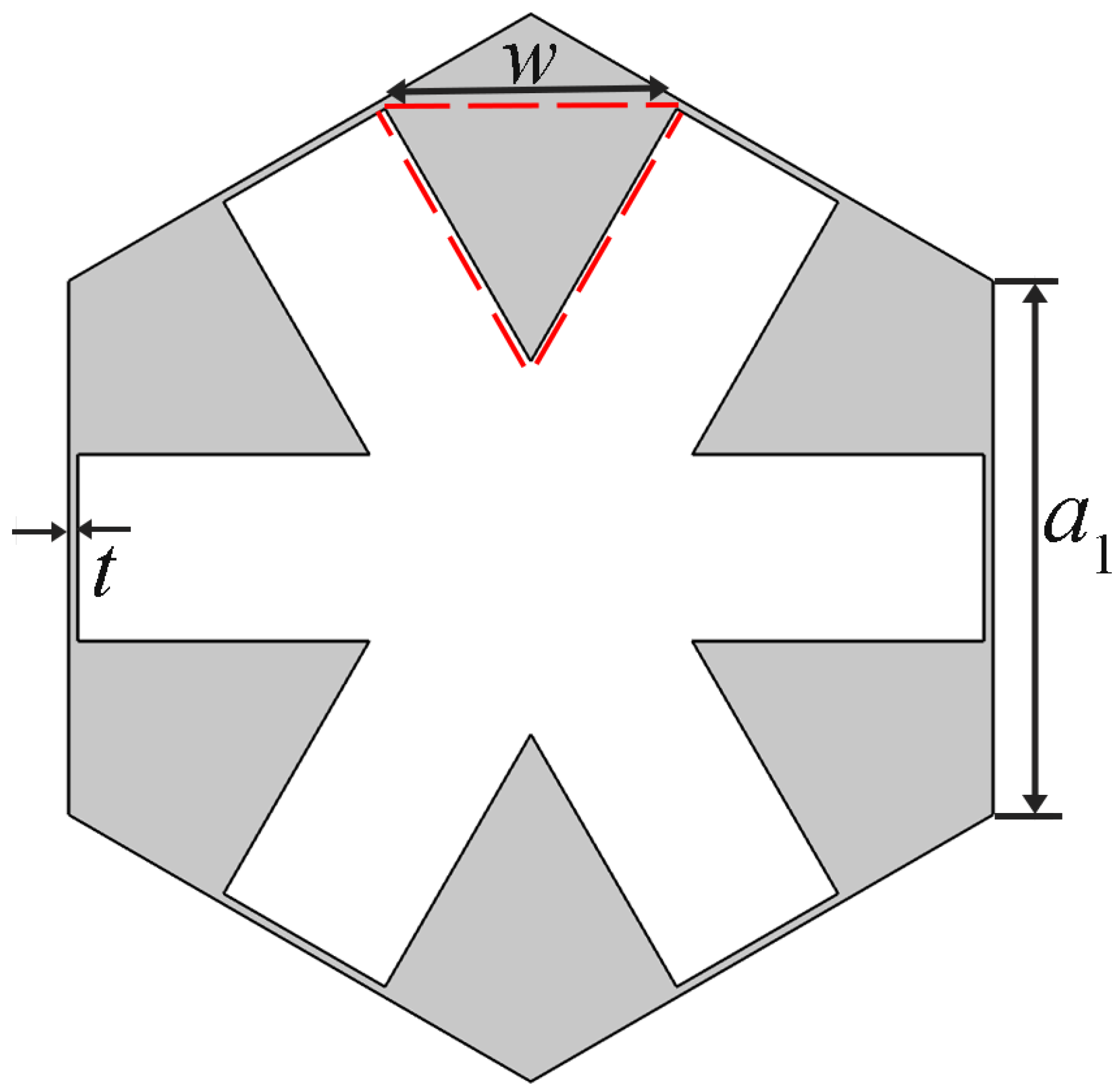
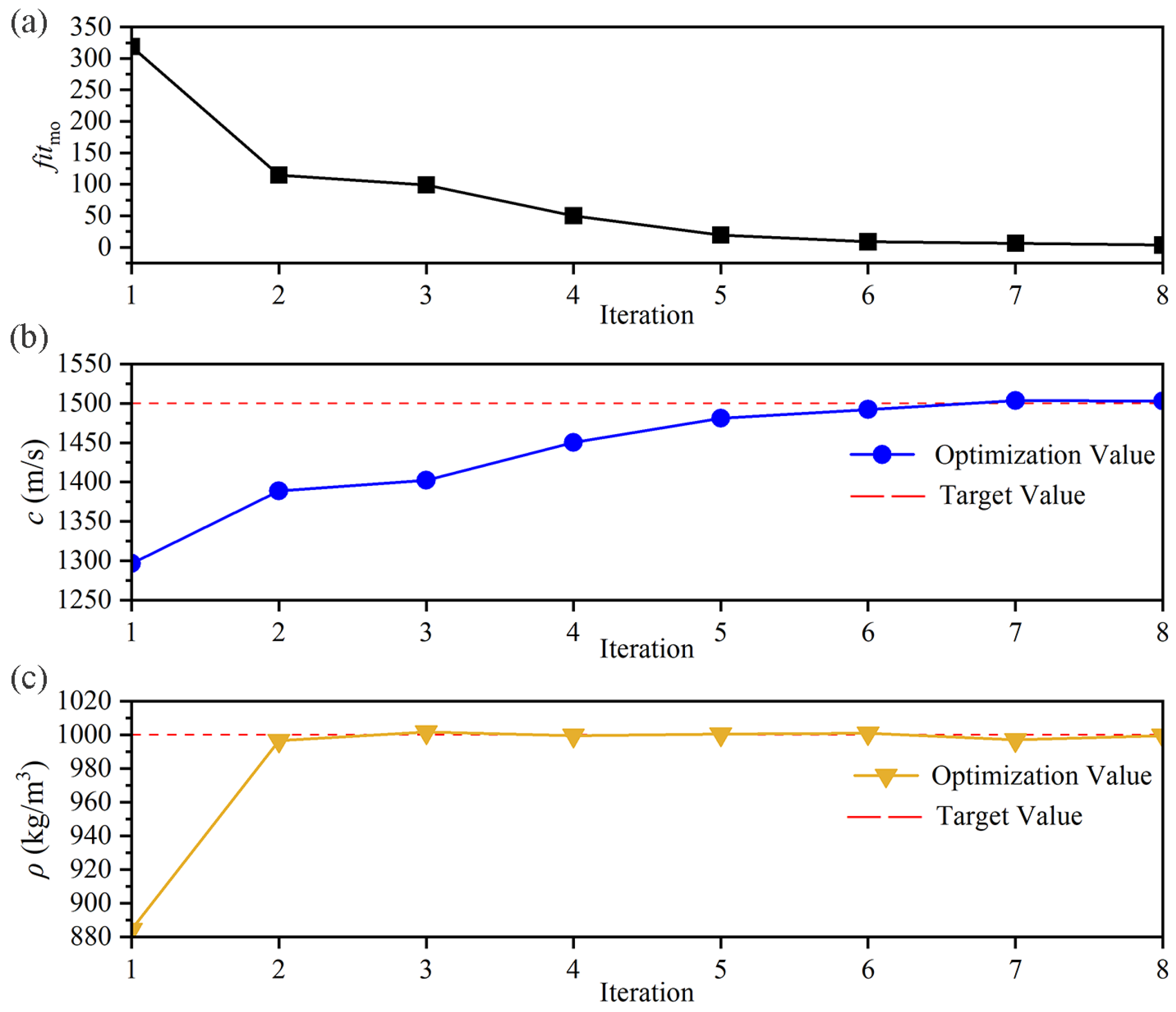
To validate the algorithm’s engineering applicability, this study optimizes the two-dimensional five-mode metamaterial unit shown in Figure A1. This unit features a hexagonal honeycomb periodic arrangement, where each unit cell consists of an aluminum arm with side length a 1 = 6 mm and thickness t, forming a regular hexagonal lattice. Equilateral triangular counterweights with side length w are connected at the vertices (as shown by the dashed lines in the figure). The lattice constant a s = 3 a 1 . The gray region in Figure A1 represents metallic aluminum (density ρ Al = 2700 kg / m 3 , Young’s modulus E Al = 70 GPa , Poisson’s ratio c Al = 0.33 ), while the internal white hollow sections are filled with air. The density and sound velocity of the background water are ρ watert = 1000 kg / m 3 and c water = 1500 m / s , respectively. The solid mechanics module in COMSOL Multiphysics was used to calculate the band structure of this structure. This optimization aims to adjust the key geometric parameters of the structure, arm width t and counterweight edge length w, to make the equivalent sound velocity and equivalent density of the metamaterial approach the preset target values c target = 1500 m / s , ρ target = 1000 kg / m 3 , respectively.
Figure A1. Schematic diagram of the acoustic metamaterial structure.
Symmetry 18 00108 g0a1
Figure A2 illustrates the convergence process of the DADCOA algorithm in COMSOL multiphysics parameter optimization. The fitness convergence curve exhibits a downward trend throughout the optimization process, with a rapid decline in the early stages indicating that the algorithm is searching in the correct direction and converging quickly. In the later stages, the curve stabilizes, indicating that the algorithm has approached the optimal region. As shown in Figure A2b,c, the optimization curves for the equivalent sound velocity and equivalent density clearly demonstrate how these two physical quantities gradually and steadily approach their target values (1500 m/s and 1000 kg/m3) from their initial values. Both curves ultimately stabilize near their target values with minimal fluctuations, fully validating the effectiveness and reliability of the optimization results. This also reflects the universality of the DADCOA algorithm across different structures.
Figure A2. Convergence curves for (a) fitness, (b) velocity, and (c) density objective values, along with the optimization process curve.
Symmetry 18 00108 g0a2

References

  1. Xin, Y.-J.; Huang, R.-N.; Li, P.; Yan, H.; Dong, X.-J.; Yan, Q.; Sun, Y.-T.; Cheng, S.-L.; Zhao, Q.-X. Labyrinth acoustic metamaterials with fractal structure based on hilbert curve. Phys. B Condens. Matter 2023, 667, 415150. [Google Scholar] [CrossRef]
  2. Chu, Y.; Hu, Y.; Wang, G.; Wang, Z. Dual-functional pentamode metamaterial with water-like and topological transmission properties. J. Phys. Condens. Matter 2024, 36, 325701. [Google Scholar] [CrossRef] [PubMed]
  3. Chu, Y.; Wang, Z.; Xu, Z. Broadband high-efficiency controllable asymmetric propagation by pentamode acoustic metasurface. Phys. Lett. A 2020, 384, 126230. [Google Scholar] [CrossRef]
  4. Song, G.Y.; Huang, B.; Dong, H.Y.; Cheng, Q.; Cui, T.J. Broadband focusing acoustic lens based on fractal metamaterials. Sci. Rep. 2016, 6, 35929. [Google Scholar] [CrossRef]
  5. Ma, F.; Huang, Z.; Liu, C.; Wu, J.H. Acoustic focusing and imaging via phononic crystal and acoustic metamaterials. J. Appl. Phys. 2022, 131, 011103. [Google Scholar] [CrossRef]
  6. Xie, S.; Ding, H.; Zhou, Z.; Li, Y.; Hao, T. Wideband subwavelength acoustic edge detection via trapped modes with breaking structural periodicity. Appl. Phys. Express 2022, 15, 084002. [Google Scholar] [CrossRef]
  7. Lu, J.-H.; Ding, S.; Zhou, K.; Ni, Y.-Q. Kolmogorov-arnold networks-optimized honeycomb acoustic metamaterials for railway noise control. Int. J. Mech. Sci. 2025, 303, 110672. [Google Scholar] [CrossRef]
  8. Ang, L.; Cui, F.; Lim, K.; Lee, H. A systematic review of emerging ventilated acoustic metamaterials for noise control. Sustainability 2023, 15, 4113. [Google Scholar] [CrossRef]
  9. Cui, H.; Liu, C.; Hu, H. Research on low-frequency noise control based on fractal coiled acoustic metamaterials. Shock Vib. 2022, 2022, 2083563. [Google Scholar] [CrossRef]
  10. Yin, J.-H.; Wang, H.; Song, Y.-B.; Jiang, L.; Yang, S.; Zhou, X.-L. Design and characterization of near-zero refractive index labyrinth-type acoustic metamaterials. Eur. J. Mech.-A/Solids 2025, 105882. [Google Scholar] [CrossRef]
  11. Wang, Z.; Zhu, S.; Hu, Y.; Chu, Y.; Luo, Y. Acoustic insulation and directional refraction of dual-functional pentamode metasurface. Appl. Phys. A 2024, 130, 529. [Google Scholar] [CrossRef]
  12. Han, C.; Fan, S.; Zhou, H.-T.; He, K.; Jia, Y.; Li, C.; Li, H.; Yang, X.-D.; Chen, L.-Q.; Yang, T.; et al. All-angle unidirectional flat-band acoustic metasurfaces. Nat. Commun. 2025, 16, 634. [Google Scholar] [CrossRef]
  13. Li, Z.-L.; Huang, L.-X.; Sun, Q.-L.; Zhao, Y.-J.; Li, P.-Q.; Peng, Y.-G.; Zeng, L.-S.; Zhou, J.; Xiao, Y.; Zhu, X.-F.; et al. 3d acoustic imaging hitting the diffraction limit via fully parameter-optimized meta-lens and frequency-domain reconstruction. Adv. Mater. 2025, 37, e71110. [Google Scholar] [CrossRef]
  14. Nakagawa, T.; Nagayama, T.; Fukushima, S.; Watanabe, T. Constitution method for broadband acoustic metamaterials based on the design theory of a one-dimensional distributed transmission-line model. Crystals 2022, 12, 1528. [Google Scholar] [CrossRef]
  15. Voss, J.; Rizzi, G.; Demetriou, P.; Neff, P.; Madeo, A. Remarks on wave propagation in an acoustic metamaterial modeled as a relaxed micromorphic continuum. PAMM 2023, 23, e202200182. [Google Scholar] [CrossRef]
  16. Chu, Y.; Sun, T.; Wang, Z.; Zhang, Z.; Chen, M. Low-frequency broadband acoustic modulation mechanism of composite pentamode metamaterials. Phys. Lett. A 2023, 491, 129212. [Google Scholar] [CrossRef]
  17. Deng, J.; Qin, Y.; Chen, X.; He, Y.; Song, Y.; Zhang, X.; Ma, W.; Li, S.; Wu, Y. Multi-objective optimization design of low-frequency band gap for local resonance acoustic metamaterials based on genetic algorithm. Machines 2025, 13, 610. [Google Scholar] [CrossRef]
  18. Gong, Y.; Adjei, R.A.; Tao, G.; Zeng, Y.; Fan, C. An improved multi-objective grey wolf optimizer for aerodynamic optimization of axial cooling fans. Appl. Sci. 2025, 15, 5197. [Google Scholar] [CrossRef]
  19. Suo, L.; Peng, T.; Song, S.; Zhang, C.; Wang, Y.; Fu, Y.; Nazir, M.S. Wind speed prediction by a swarm intelligence based deep learning model via signal decomposition and parameter optimization using improved chimp optimization algorithm. Energy 2023, 276, 127526. [Google Scholar] [CrossRef]
  20. Koupaei, J.A.; Ebadi, M.J. A chaotic decomposition-based approach for enhanced multi-objective optimization. Mathematics 2025, 13, 817. [Google Scholar]
  21. Zhang, L.; Chen, X. Social coevolution and sine chaotic opposition learning chimp optimization algorithm for feature selection. Sci. Rep. 2024, 14, 15413. [Google Scholar] [CrossRef]
  22. Pu, R.; Li, S.; Zhou, P.; Yang, G. Improved chimp optimization algorithm for matching combinations of machine tool supply and demand in cloud manufacturing. Appl. Sci. 2023, 13, 12106. [Google Scholar] [CrossRef]
  23. Liu, J.; Liu, Z.; Wu, Y.; Li, K. Mbb-mogwo: Modified boltzmann-based multi-objective grey wolf optimizer. Sensors 2024, 24, 1502. [Google Scholar] [CrossRef] [PubMed]
  24. Wu, X.; Xia, X.; Tian, J.; Liu, Z.; Wen, W. Broadband reflective metasurface for focusing underwater ultrasonic waves with linearly tunable focal length. Appl. Phys. Lett. 2016, 108, 163502. [Google Scholar] [CrossRef]
  25. Cai, X.; Wang, L.; Zhao, Z.; Zhao, A.; Zhang, X.; Wu, T.; Chen, H. The mechanical and acoustic properties of two-dimensional pentamode metamaterials with different structural parameters. Appl. Phys. Lett. 2016, 109, 131904. [Google Scholar] [CrossRef]
Figure 1. (a) Schematic diagram of the acoustic metamaterial structure and (b) its band structure curve.
Symmetry 18 00108 g001
Figure 2. Flowchart of the optimization process.
Symmetry 18 00108 g002
Figure 3. Schematic diagram of the automated interaction process between the optimization algorithm and COMSOL simulation.
Symmetry 18 00108 g003
Figure 4. Distribution comparison of (a) the logistic map, (b) the Tent map, and (c) the fusion map.
Symmetry 18 00108 g004
Figure 5. Comparison of initial population distributions for (a) the logistic map, (b) the tent map, and (c) the fusion map.
Symmetry 18 00108 g005
Figure 6. Mean ranking radar map.
Symmetry 18 00108 g006
Figure 7. Friedman average rankings of the DADCOA with different population sizes.
Symmetry 18 00108 g007
Figure 8. Friedman average ranking at different parameters r.
Symmetry 18 00108 g008
Figure 9. Friedman average ranking at different parameters F0.
Symmetry 18 00108 g009
Figure 10. Convergence curves of DADCO and other competing algorithms.
Symmetry 18 00108 g010
Figure 11. Fitness convergence curve and optimization process curves for (a) fitness, (b) velocity and (c) density target values.
Symmetry 18 00108 g011
Figure 12. The acoustic waveguide and sound pressure. (a) The sound wave enters from the left side of the waveguide, propagates through the 20 element array, and exits from the right side, along with a locally enlarged view of the observation line position. (b) Total sound pressure distribution in the acoustic waveguide at 3000 Hz.
Symmetry 18 00108 g012
Figure 13. The sound pressure distribution on two observation lines.
Symmetry 18 00108 g013
Table 1. Comparison results of different improvement strategies.
FunctionIndicatorCOACOA1COA2COA3COA4DADCOA
F1Best 6.7398 × 10 2 4.3017 × 10 2 4.8514 × 10 2 4.5152 × 10 2 4.5152 × 10 2 3.3643 × 10 2
Avg 1.3319 × 10 3 7.4026 × 10 2 7.5614 × 10 2 7.3124 × 10 2 7.2216 × 10 2 6.7373 × 10 2
Std 6.3484 × 10 2 2.0790 × 10 2 2.5110 × 10 2 2.0108 × 10 2 1.9077 × 10 2 3.4636 × 10 2
Rank645321
F2Best 4.0056 × 10 2 4.0000 × 10 2 4.0001 × 10 2 4.0001 × 10 2 4.0001 × 10 2 4.0001 × 10 2
Avg 4.3823 × 10 2 4.3313 × 10 2 4.2734 × 10 2 4.1114 × 10 2 4.2711 × 10 2 4.1069 × 10 2
Std 4.7679 × 10 1 3.1630 × 10 1 4.6883 × 10 1 2.2155 × 10 1 2.8317 × 10 1 2.4284 × 10 1
Rank654231
F3Best 6.2906 × 10 2 6.1002 × 10 2 6.1328 × 10 2 6.1218 × 10 2 6.1022 × 10 2 6.1416 × 10 2
Avg 7.6049 × 10 2 6.2737 × 10 2 6.2643 × 10 2 6.2703 × 10 2 6.2544 × 10 2 6.2106 × 10 2
Std 6.9870 × 10 0 8.0053 × 10 0 7.6195 × 10 0 4.5333 × 10 0 6.2153 × 10 0 6.0649 × 10 0
Rank653421
F4Best 8.0796 × 10 2 8.1493 × 10 2 8.0796 × 10 2 8.1896 × 10 2 8.1633 × 10 2 8.0697 × 10 2
Avg 8.2861 × 10 2 8.2119 × 10 2 8.2209 × 10 2 8.2199 × 10 2 8.1294 × 10 2 8.1662 × 10 2
Std 9.8808 × 10 0 7.3868 × 10 0 7.2971 × 10 0 9.3034 × 10 0 8.6302 × 10 0 6.0985 × 10 0
Rank625431
F5Best 9.3986 × 10 2 9.1827 × 10 2 9.1914 × 10 2 9.1116 × 10 2 9.1741 × 10 2 9.2180 × 10 2
Avg 1.0002 × 10 3 9.7220 × 10 2 9.7105 × 10 2 9.8846 × 10 2 9.7824 × 10 2 9.8816 × 10 2
Std 3.7367 × 10 1 5.4467 × 10 1 4.4941 × 10 1 2.6484 × 10 1 3.6645 × 10 1 4.5308 × 10 1
Rank632541
F6Best 1.9977 × 10 3 1.9519 × 10 3 1.9233 × 10 3 1.9101 × 10 3 1.9302 × 10 3 1.9979 × 10 3
Avg 3.3298 × 10 3 2.9897 × 10 3 3.0934 × 10 3 2.4853 × 10 3 2.7463 × 10 3 3.6478 × 10 3
Std 1.1189 × 10 3 1.2869 × 10 3 1.5959 × 10 3 4.3731 × 10 2 3.3263 × 10 2 1.1139 × 10 3
Rank645231
F7Best 2.0269 × 10 3 2.0374 × 10 3 2.0399 × 10 3 2.0329 × 10 3 2.0329 × 10 3 2.0191 × 10 3
Avg 2.0524 × 10 3 2.0456 × 10 3 2.0478 × 10 3 2.0502 × 10 3 2.0463 × 10 3 2.0456 × 10 3
Std 1.7313 × 10 1 1.0397 × 10 1 7.0554 × 10 0 1.1996 × 10 1 1.3300 × 10 1 1.2817 × 10 1
Rank624531
F8Best 2.2226 × 10 3 2.2246 × 10 3 2.2250 × 10 3 2.2245 × 10 3 2.2244 × 10 3 2.2211 × 10 3
Avg 2.2319 × 10 3 2.2305 × 10 3 2.2285 × 10 3 2.2278 × 10 3 2.2280 × 10 3 2.2230 × 10 3
Std 6.9666 × 10 0 6.2520 × 10 0 2.2962 × 10 0 3.1483 × 10 0 3.1483 × 10 0 3.8515 × 10 0
Rank654231
F9Best 2.6210 × 10 3 2.6169 × 10 3 2.6264 × 10 3 2.5830 × 10 3 2.6024 × 10 3 2.5906 × 10 3
Avg 2.6505 × 10 3 2.6408 × 10 3 2.6392 × 10 3 2.6411 × 10 3 2.6432 × 10 3 2.6292 × 10 3
Std 2.8242 × 10 1 1.5427 × 10 1 8.5808 × 10 0 3.0085 × 10 1 4.2309 × 10 1 1.4735 × 10 1
Rank632451
F10Best 2.5011 × 10 3 2.5014 × 10 3 2.5013 × 10 3 2.5018 × 10 3 2.5017 × 10 3 2.5011 × 10 3
Avg 2.5145 × 10 3 2.5026 × 10 3 2.5044 × 10 3 2.5023 × 10 3 2.5034 × 10 3 2.5018 × 10 3
Std 4.6297 × 10 0 1.3845 × 10 2 3.8442 × 10 1 4.5797 × 10 1 1.3466 × 10 0 7.1339 × 10 1
Rank635241
F11Best 2.6012 × 10 3 2.6005 × 10 3 2.6006 × 10 3 2.6005 × 10 3 2.6005 × 10 3 2.6005 × 10 3
Avg 2.7362 × 10 3 2.6766 × 10 3 2.7306 × 10 3 2.7218 × 10 3 2.7218 × 10 3 2.6620 × 10 3
Std 1.4678 × 10 2 1.6446 × 10 2 1.4974 × 10 2 1.5426 × 10 2 1.5426 × 10 2 1.4523 × 10 2
Rank635241
F12Best 2.8934 × 10 3 2.8857 × 10 3 2.9148 × 10 3 2.9056 × 10 3 2.9104 × 10 3 2.8934 × 10 3
Avg 2.9544 × 10 3 2.9416 × 10 3 2.9423 × 10 3 2.9362 × 10 3 2.9410 × 10 3 2.9306 × 10 3
Std 2.5372 × 10 1 2.9262 × 10 1 2.1079 × 10 1 2.0395 × 10 1 2.0395 × 10 1 2.5372 × 10 1
Rank645231
Table 2. Comparison results of different fitness function weights w m .
Weight ConfigurationFitness Function ( fit MO ( i ) )Sound Velocity
( c eff )
Absolute Error
in Sound Velocity
Density ( ρ eff )Absolute Error
in Density
| c eff c target || ρ eff ρ target |
(0.5, 0.5)1.69748.581.421999.730.27
(0.7, 0.3)147.7917243.561593.56150091197.9781202.0218855
(0.3, 0.7)257.4025632.651482.6510439367.846132.15390309
(0.9, 0.1)146.1956242.975992.97589847200.5846199.4153903
(0.1, 0.9)237.5878530.3841380.3840978305.208594.79151263
Table 3. CEC2022 test function optimization results.
FunctionIndicatorDADCOACOAHHOFATAWOAHOA
F1Best 3.3643 × 10 2 6.7398 × 10 2 9.3165 × 10 2 4.1947 × 10 2 7.6704 × 10 3 3.3859 × 10 3
Avg 6.7373 × 10 2 1.3319 × 10 3 1.0917 × 10 4 1.7699 × 10 3 2.0588 × 10 4 7.2070 × 10 3
Std 3.4636 × 10 2 6.3484 × 10 2 9.2003 × 10 3 1.5568 × 10 3 1.2115 × 10 4 2.6735 × 10 3
F2Best 4.0001 × 10 2 4.0056 × 10 2 4.0162 × 10 2 4.0023 × 10 2 4.2878 × 10 2 5.9616 × 10 2
Avg 4.1069 × 10 2 4.3823 × 10 2 4.5544 × 10 2 4.1900 × 10 2 7.1578 × 10 2 8.9784 × 10 2
Std 2.4284 × 10 1 4.7679 × 10 1 3.8092 × 10 1 2.0077 × 10 1 3.1313 × 10 2 2.4360 × 10 2
F3Best 6.1416 × 10 2 6.2906 × 10 2 6.3309 × 10 2 6.0316 × 10 2 6.2828 × 10 2 6.1616 × 10 2
Avg 6.2106 × 10 2 7.6049 × 10 2 6.5944 × 10 2 6.2028 × 10 2 6.4039 × 10 2 6.2803 × 10 2
Std 6.0649 × 10 0 6.9870 × 10 0 1.2571 × 10 1 9.7403 × 10 0 9.0199 × 10 0 7.8801 × 10 0
F4Best 8.0697 × 10 2 8.0796 × 10 2 8.1194 × 10 2 8.1468 × 10 2 8.3112 × 10 2 8.2542 × 10 2
Avg 8.1662 × 10 2 8.2861 × 10 2 8.2776 × 10 2 8.2865 × 10 2 8.5162 × 10 2 8.3685 × 10 2
Std 6.0985 × 10 0 9.8808 × 10 0 1.2181 × 10 1 7.3431 × 10 0 1.4302 × 10 1 1.0198 × 10 1
F5Best 9.2180 × 10 2 9.3986 × 10 2 1.1192 × 10 3 9.3207 × 10 2 1.1755 × 10 3 9.9866 × 10 2
Avg 9.8816 × 10 2 1.0002 × 10 3 1.3897 × 10 3 1.1659 × 10 3 1.5069 × 10 3 1.1400 × 10 3
Std 4.5308 × 10 1 3.7367 × 10 1 2.1475 × 10 2 1.7432 × 10 2 2.5399 × 10 2 1.1178 × 10 2
F6Best 1.9979 × 10 3 1.9977 × 10 3 1.9274 × 10 3 2.1289 × 10 3 3.0451 × 10 3 3.6419 × 10 3
Avg 3.6478 × 10 3 3.3298 × 10 3 3.6053 × 10 3 4.9313 × 10 3 1.8476 × 10 4 1.5116 × 10 8
Std 1.1139 × 10 3 1.1189 × 10 3 1.1910 × 10 3 3.1069 × 10 3 1.9088 × 10 4 2.2826 × 10 8
F7Best 2.0191 × 10 3 2.0269 × 10 3 2.0304 × 10 3 2.0345 × 10 3 2.0511 × 10 3 2.0386 × 10 3
Avg 2.0456 × 10 3 2.0524 × 10 3 2.0841 × 10 3 2.0482 × 10 3 2.0992 × 10 3 2.0740 × 10 3
Std 1.2817 × 10 1 1.7313 × 10 1 3.0756 × 10 1 1.0950 × 10 1 4.2378 × 10 1 2.0308 × 10 1
F8Best 2.2211 × 10 3 2.2226 × 10 3 2.2240 × 10 3 2.2226 × 10 3 2.2254 × 10 3 2.2230 × 10 3
Avg 2.2230 × 10 3 2.2319 × 10 3 2.2345 × 10 3 2.2271 × 10 3 2.2364 × 10 3 2.2547 × 10 3
Std 3.8515 × 10 0 6.9666 × 10 0 1.5547 × 10 1 7.3577 × 10 0 1.5719 × 10 1 4.8564 × 10 1
F9Best 2.5906 × 10 3 2.6210 × 10 3 2.5380 × 10 3 2.5295 × 10 3 2.6224 × 10 3 2.6369 × 10 3
Avg 2.6292 × 10 3 2.6505 × 10 3 2.5783 × 10 3 2.5437 × 10 3 2.7021 × 10 3 2.6888 × 10 3
Std 1.4735 × 10 1 2.8242 × 10 1 3.6211 × 10 1 1.5922 × 10 1 5.1133 × 10 1 3.0969 × 10 1
F10Best 2.5011 × 10 3 2.5011 × 10 3 2.5009 × 10 3 2.5013 × 10 3 2.5040 × 10 3 2.5011 × 10 3
Avg 2.5018 × 10 3 2.5145 × 10 3 2.6395 × 10 3 2.5570 × 10 3 2.7371 × 10 3 2.5639 × 10 3
Std 7.1339 × 10 1 4.6297 × 10 0 1.6761 × 10 2 7.0737 × 10 1 5.1693 × 10 2 6.2117 × 10 1
F11Best 2.6005 × 10 3 2.6012 × 10 3 2.6008 × 10 3 2.6052 × 10 3 2.7866 × 10 3 2.7809 × 10 3
Avg 2.6620 × 10 3 2.7362 × 10 3 2.7489 × 10 3 2.7390 × 10 3 3.3509 × 10 3 3.1626 × 10 3
Std 1.4523 × 10 2 1.4678 × 10 2 1.3366 × 10 2 1.5936 × 10 2 6.2295 × 10 2 3.9615 × 10 2
F12Best 2.8934 × 10 3 2.9018 × 10 3 2.8684 × 10 3 2.8651 × 10 3 2.8725 × 10 3 2.9138 × 10 3
Avg 2.9306 × 10 3 2.9544 × 10 3 3.2222 × 10 3 2.8934 × 10 3 2.9618 × 10 3 2.9979 × 10 3
Std 2.5372 × 10 1 1.8787 × 10 1 6.6426 × 10 2 2.2301 × 10 1 1.7150 × 10 2 7.0773 × 10 1
Friedman average ranking1.752.424.252.335.54.75
Final ranking134265
Table 4. Comparison of optimization results for each algorithm.
AlgorithmOptimal ParametersSound SpeedDensityFitness ValueNumber of SimulationsTotal Time
( b , h , e ) c (m/s) ρ (kg/m3) fit MO (min)
COA8.401, 0.892, 0.248690.321843.43216.25467237
ICOA9.176, 1.117, 0.176760.882144.19155.07397205
MCOA9.130, 0.973, 0.240632.811997.32119.87358187
HCOA9.120, 1.010, 0.100702.161979.4268.42234130
CSA9.41, 0.985, 0.113628.171977.60144.23318162
WOA8.305, 1.020, 0.125806.751930.40126.35286148
DADCOA8.990, 1.036, 0.100748.581999.731.6915093
Disclaimer/Publisher’s Note: The statements, opinions and data contained in all publications are solely those of the individual author(s) and contributor(s) and not of MDPI and/or the editor(s). MDPI and/or the editor(s) disclaim responsibility for any injury to people or property resulting from any ideas, methods, instructions or products referred to in the content.