1. Introduction
The Hjorth distribution, proposed by Hjorth [
1], is known for accommodating increasing, decreasing, and bathtub-shaped hazard rates, making it more flexible than traditional models such as the Weibull and Gamma distributions. This flexibility enables improved statistical fitting in survival analysis, reliability engineering, and risk assessment.
Furthermore, Hjorth [
1] demonstrated that a bathtub-shaped model allows for more effective analysis of failure data from hydromechanical systems driving electric generators in airplanes operating at constant revolutions per unit time. Consequently, this model is widely applied in biostatistics, actuarial science, and mechanical failure analysis, offering improved predictive accuracy for real-world failure data. Following Haj Ahmad and Elshahhat [
2], let
Y be a nonnegative random variable that follows the three-parameter Hjorth (
) distribution, where
.
Then, the associated cumulative distribution function (CDF) and probability density function (PDF) (for
) of the IH model are given, respectively, by
and
where
and
are the positive shape and scale parameters, respectively. Several authors in the literature have studied this model in different statistical scenarios; for example, see Nadarajah [
3], Rastogi et al. [
4], Jiang [
5], Pushkarna et al. [
6], Elshahhat and Nassar [
7], Demirci Bicer [
8], among others.
An inverted distribution is developed by applying a reciprocal transformation to a random variable. This type of distribution offers enhanced modeling flexibility by introducing distinct hazard rate shapes, such as inverted-bathtub forms, which are suitable for systems with early high risk followed by stabilization. They often provide better fits for real-world data, especially in sciences where large survival times or low failure rates are common; see Lehmann and Shaffer [
9], Sharma et al. [
10], Nguyen et al. [
11], Tomer and Panwar [
12], Choudhary et al. [
13], Nayal [
14], Alqasem et al. [
15], Singh et al. [
16], among others.
The Hjorth distribution is well-known for its ability to model bathtub-shaped hazard rates, which are important in many reliability settings. However, in real-world applications, especially in biomedical and environmental contexts, data often exhibit inverted bathtub-shaped hazard rates, characterized by early failure risk, a stable middle period, and a declining risk later on. Such behavior is not captured adequately by the original Hjorth model.
The proposed inverted Hjorth (IH) model originates from a non-trivial transformation of the classical Hjorth distribution, capturing inverse behavior in lifetime dynamics, which is rarely addressed in conventional reliability models. The IH model supports an inverted bathtub-shaped hazard rate, which is critical for systems prone to initial high risk, followed by a plateau, and then gradual wear-out—an area underrepresented in traditional survival analysis. The IH model introduces additional flexibility in modeling right-skewed, heavy-tailed data and offers superior capability for capturing extreme values or outliers, especially in biomedical and environmental reliability contexts. Additionally, its hazard function supports more complex reliability structures, which are not well captured by other inverted lifetime models, such as the inverted Weibull or inverted Gompertz lifespan models. Analyzing two real-world datasets from different sectors, as shown later, revealed that the IH distribution outperforms eight existing and recently proposed models, namely inverted Dagum, generalized inverse Gompertz, inverted log-logistic, inverted Lomax, inverted Gompertz, inverted Nadarajah-Haghighi, inverted exponentiated Pareto, and exponentiated inverted exponential. In light of the primary purpose of introducing the IH distribution, the main objectives of the present study are as follows:
Developing an inverted life distribution, called the IH distribution, which provides a useful framework for modeling data showing inverted bathtub failure rates, demonstrating its superior performance compared to many existing distributions developed in the literature.
Developing different statistical and reliability characteristics of the IH model, including quantiles, moments, reliability measures, and order statistics.
Developing different estimators using likelihood- and Bayesian-based approaches to examine the behavior of IH model parameters in estimation scenarios, particularly using Type-II censoring (TIIC).
Creating two types of asymptotic interval estimators and two types of credible interval estimators.
Conducting a simulation study to evaluate the accuracy of various estimation methods using rigorous statistical performance metrics.
Analyzing two real-world datasets to demonstrate the IH distribution’s superiority over existing lifespan distributions in modeling environmental and pharmacological problems, owing to the flexibility and simplicity of its PDF and CDF.
We now classify the rest of this work as follows:
Section 2 introduces the IH distribution.
Section 3 derives certain model features.
Section 4 investigated several parameter estimation issues. Simulation design and real-world data applications are examined in
Section 5 and
Section 6, respectively.
Section 7 and
Section 8 outline the study limitations and conclusions, respectively.
2. The Inverted Hjorth Model
This section introduces the key mathematical properties of the IH distribution, including its main functions such as probability density, cumulative distribution, reliability, failure rate, and others.
2.1. Distribution Functions
Now, let
Y be a random variable that follows the Hjorth distribution with the CDF
, in (
1), and with the PDF
, in (
2). Taking
, the random variable
X will follow the IH model, symbolized as
, with the following CDF (say,
) and PDF (say,
):
and
respectively, where
denotes the shape parameters and
denotes the scale parameter. Briefly, to ensure the mathematical validity of the proposed distribution, we now demonstrate that the CDF in (
3) satisfies the fundamental properties required of any distribution function.
Proof. Specifically, we show the CDF (
3) is right-continuous and non-decreasing and that its limiting values at the boundaries of its support conform to standard behavior; that is, the CDF approaches 0 as
and approaches 1 as
.
- (i)
Right-Continuity: The function
is composed of rational and exponential components, each continuous for
. Hence, the function is right-continuous, such as:
- (ii)
Limits at the Endpoints:
As , we get:
As , we get:
- (iii)
Monotonicity (Non-decreasing): Check the PDF by differentiating the CDF with respect to
x:
which is matches to Equation (
4), that is
Since all terms in (
5) are strictly positive for
and
, it follows that
, and thus
is strictly increasing (non-decreasing) on its support.
□
2.2. Reliability and Failure Rate
The survival (or reliability) and hazard rate (or failure rate function (FRF)) functions of the IH distribution are
and
By varying the parameters
,
, and
,
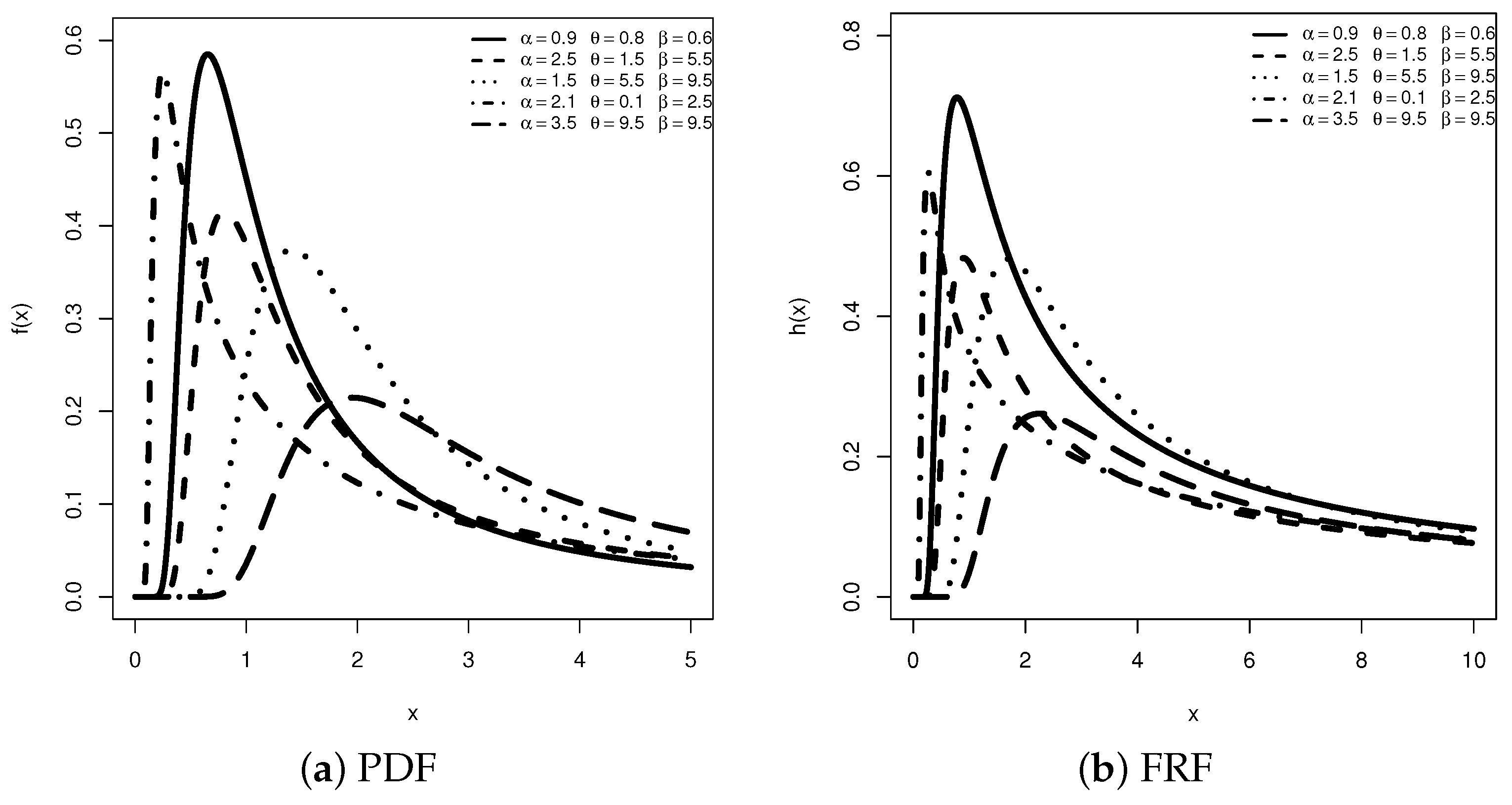
Figure 1 illustrates different shapes of the density and hazard rate functions of the IH model.
Figure 1a shows that the IH density can be unimodal and positively (right) skewed, exhibiting substantial tail heaviness.
Figure 1b illustrates that the IH hazard rate exhibits an inverted (upside-down) bathtub shape. This type of failure rate is relevant for modeling early-life failures, stable operational phases, and wear-out failures, making it highly suitable for real-world reliability analysis. It is useful for optimizing maintenance schedules, designing cost-effective warranty policies, and improving resource allocation by emphasizing early defect detection and late-stage preventive actions. Consequently,
Figure 1 shows that:
When is small and is moderate, the PDF exhibits pronounced right skewness and heavy tails;
When is small, the FRF assumes a monotonically decreasing shape;
As increases, the FRF adopts an inverted bathtub shape, rising initially, peaking early, and then gradually declining;
Increasing compresses the PDF toward the origin, producing a sharper peak and accentuating the early-failure phase in the FRF.
2.3. Density Expansion
The series expansion of the IH density provides deeper insight into the distribution’s structure, particularly when analyzing its behavior near the origin or in the tails. Although the PDF (
4) is expressed in closed form and is algebraically tractable, representing it via a Maclaurin series expansion enhances its analytical utility. Accordingly, this part derives a power series representation of the IH density to facilitate further theoretical exploration. Suppose
and
are real numbers; we now employ the following general binomial expansion series:
where
.
Applying the expansion (
8) to the case where the numerator coefficient is negative, we obtain:
expanding the PDF (
4) by (
9), we get
where
.
Setting
and
, one can rewrite (
10) as:
where
,
,
,
, and
.
In similar setup, from (
9), we expanding the following term:
thus, we can easily expanding the CDF (
3) as follows:
where
Notably, the infinite series expansions of the PDF and CDF given in (
11) and (
13), respectively, are numerically approximated by truncating both series to a finite number of terms, denoted
and
. From a simulated IH dataset, without loss of generality, truncating at
and
yields an accurate approximation with a negligible error (less than 10
−6) across the entire range of practical parameter values.
2.4. Quantile and Quartiles
The quantile function, given by
for
, can be derived from (
3) as
solve for
x in terms of
u, we get:
Taking the natural logarithm for both sides as
After raising both sides in (
15) to the power, we put
as follows
As a result, the quantile function of the IH model is expressed in a nonlinear form and requires numerical methods to solve for
x. Now, let
U follow the uniform distribution on (0, 1). Then, a random sample of size
n from the IH distribution can be generated as follows:
For this purpose, we recommend using the ’
’ package (version 2.1-3), as suggested by Pavia and Pavia [
17], to simulate IH random variates. In particular, from (
16), the first, second (median), and third quartiles of the IH distribution can be acquired directly by setting
, respectively.
3. Statistical Properties
This section presents several properties of the IH distribution, including moments, mean residual life, stress–strength reliability, and order statistics, among others.
3.1. Mean Deviation
The mean deviation about the mean (or median) offers a simple and intuitive measure of dispersion, as it captures the average absolute deviation of data points from the central value, making it useful for understanding variability within a population. Let
and
M denote the mean and median of the IH distribution, respectively. Following Elshahhat et al. [
18], the mean deviation about the mean
(say,
) can be derived as
where
From (
11), one can get
as
Now, from (
3) and (
18), one can re-express (
17) as
On the other hand, the mean deviation about the median
M of the IH distribution is given by
By replacing
with
M in (
18), the mean deviation about the median, denoted
, can be derived in a manner similar to that used for obtaining the mean deviation about the mean
of the IH distribution.
3.2. Moments and Moment Generating Function
Moments play a vital role in statistical analysis, as they characterize important features of probability distributions
Theorem 1. If X follows the IH distribution, then the rth moment (moment about zero), denoted , is given bywhere
and
By setting
in (
21), the mean of the IH distribution is
where
and
Following the same approach used to obtain the mean of the IH model, its variance can be derived as , by directly setting in .
Using Theorem 1, the central moments of the IH distribution can be obtained in the following form:
Using
for
, the skewness, denoted by
, and the kurtosis, denoted by
, of the IH distribution can be obtained, respectively, as follows:
Table 1 presents key summary statistics of the IH distribution, namely the mean, variance, skewness, and kurtosis. The results indicate that:
When increases (for fixed and ), the mean and variance decrease, whereas the skewness and kurtosis increase. A similar pattern is observed when increases (for fixed and );
When increases (for fixed and ), the mean and variance increase, while the skewness and kurtosis decrease.
The moment generating function (say,
) is defined as
Then, from (
4) and (
21), we have
where
3.3. Mean Residual Life
The mean residual life (MRL) function quantifies the expected remaining lifetime of a system or component, given that it has survived up to a specified time. This measure is particularly useful in reliability analysis and maintenance planning. The MRL function, denoted by
, is defined as
where
and
are defined in (
6) and (
22), respectively.
Substituting (
11) into (
25), the MRL function of the IH model, for
, is obtained as:
3.4. Mean Inactivity Time
The mean inactivity time (MIT) function quantifies the expected time a system or component has been inactive prior to a given time and is useful in reliability and maintenance analysis. Consider the quantity
, where
X is a lifetime random variable. This represents the elapsed time since the component failed, given that its lifetime is less than or equal to
x. The MIT function of
X is formally defined as
If
, from (
13), we have
By substituting (
13) and (
28) into (
27), the MIT function (for
) of the IH distribution can be obtained.
3.5. Strong Mean Inactivity Time
The strong-MIT (SMIT) function is used in reliability analysis, maintenance scheduling, and risk assessment to evaluate system downtime, predict failure patterns, and optimize resource allocation for improved operational efficiency.
The SMIT of a lifetime
X is defined as
If
, from (
13), we have
Subsequently, the SMIT of the IH distribution can be simply offered by substituting (
13) (at
) and (
30) into (
29).
3.6. Stress-Strength
In the stress–strength model, the lifetime of a component with random strength, denoted
, under random stress, denoted
, is considered. The component fails when the applied stress exceeds its strength, i.e., when
, and remains functional otherwise. Suppose
and
are independent IH random variables such that
Then, the stress–strength parameter (SSP), denoted
is given by
From (
3) and (
4), the CDF and PDF of
and
can be formulated as follows:
and
respectively, where
and
(for
) denote the shape parameters and
denotes the scale parameter. Before deriving the SSP, we first determine three key quantities from the expansion series, namely:
and
Substituting Equations (
32)–(
36) into (
31), the SSP
of the IH model becomes
where
,
,
, and
3.7. Order Statistics
Order statistics provide valuable insights into the distribution of data, facilitating the estimation of percentiles, extremes, and reliability measures in statistical analysis. Suppose
denote the order statistics of a random sample of size
n drawn from the IH population. The PDF and CDF of
, for
(denoted by
and
, respectively), where
is the beta function, are given by
and
respectively, where
.
Hence, from (
3) and (
4), the PDF and CDF of
are acquired, respectively, as
and
Consequently, the PDFs of the smallest and largest order statistics,
and
, respectively, are given by
and
respectively.
4. Parameter Estimation
This section deals with the likelihood and Bayesian estimation approaches under a TIIC strategy for developing point and interval estimates of the IH parameters.
4.1. Likelihood Inference
Suppose
, where
is the specified number of failures, represents a TIIC sample of size
d obtained from a life test of
n independent units, all placed on test at time zero. The joint likelihood function of
, denoted
, is defined as
where
.
From (
3), (
4), and (
42), the likelihood function (LF) and its corresponding log-likelihood (log-LF) can be expressed, up to a proportionality constant, as
and
respectively, where
and
for simplicity.
By differentiating (
44) partially with respect to
,
, and
, three nonlinear likelihood equations are obtained, which must be solved simultaneously to obtain their maximum likelihood estimates (MLEs), denoted by
,
, and
, as
and
respectively.
From (
45)–(
47), the MLEs
,
, and
of
,
, and
, respectively, are expressed as three nonlinear equations, as motivated earlier. To ensure reliable and interpretable statistical inference, we examine the existence and uniqueness of the MLEs
,
, and
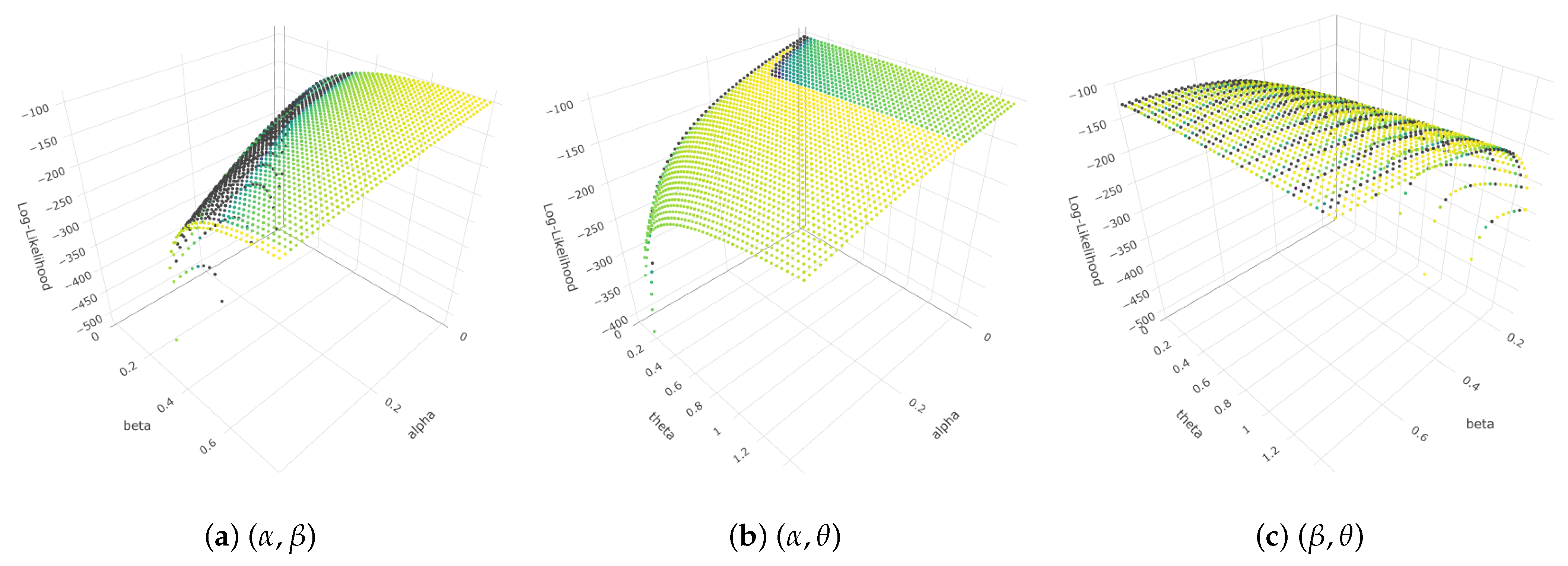
to verify that they yield an optimal fit to the data. The log-likelihood surface serves as a key tool for this purpose, enabling visualization of the peaks and curvature associated with the MLEs. Using a TIIC dataset with
drawn from the
distribution,
Figure 2 presents three 3D log-likelihood surfaces, illustrating the behavior of the likelihood function under varying parameter values. The plots in
Figure 2 reveal that each surface exhibits a single global maximum, confirming the existence and uniqueness of the MLEs
,
, and
.
We now consider the asymptotic normality (AN) of each MLE to construct its corresponding asymptotic confidence interval (ACI), denoted ACI-AN. Accordingly, based on (
45)–(
47), the
ACI-AN estimators for
,
, and
, respectively, are given as follows:
where
is an upper limit
of the standard Gaussian distribution.
A log-transformed MLE helps ensure that parameters constrained to be positive are not estimated with invalid negative values. By applying a logarithmic transformation, the resulting sampling distribution becomes more stable and approximately symmetric, particularly for small sample sizes. When the ACI is back-transformed, it remains within the valid positive range, thus improving its efficiency; see Meeker and Escobar [
19] and Nassar and Elshahhat [
20] for additional details. Hence, the NA of the log-MLE is used to construct its corresponding ACI, abbreviated ACI-NL. Accordingly, from (
45)–(
47), the
ACI-NL estimators for
,
, and
are given as follows:
respectively.
To get the estimated variances
(provided in (
48) and (
49)), we first obtain six quantities from (
44), namely
, as: 0pt
and
where
Using the invariance property of the MLEs
,
, and
, the approximate variance–covariance (AVC) matrix, denoted
, is obtained, from which the MLEs of
, for
, are derived as follows:
To obtain the MLEs, we recommend using the Newton–Raphson (NR) algorithm to solve the likelihood equations. To implement this, after installing the maxLik package in R (version 4.2.2), the MLEs, along with their ACIs, for , , and can be computed.
4.2. Bayesian Inference
This subsection explores the Bayesian estimators and the associated
Bayesian credible intervals (BCIs), including highest posterior density (HPD) intervals, based on three independent gamma conjugate priors for
,
, and
. The gamma distribution is adopted as the prior density because it exhibits flexible shapes depending on the chosen hyperparameters, making it a more suitable prior for model parameters compared to more complex alternatives; see Dey et al. [
21] for further discussion. Therefore, gamma priors are employed to ensure proper support for the IH parameters. Hence, the joint prior PDF, denoted
, for
, up to a proportionality constant, is given by
where
and
for
are the shape and scale hyper-parameters, respectively, of
,
, and
.
Combining (
51) with (
42), the joint posterior distribution (say,
) of
,
, and
becomes
and
is the normalizing term.
The Bayes estimators of
,
, and
, denoted
,
, and
, respectively, for a generic function
under the squared error loss (SEL) function, are directly given by the posterior mean of
, as follows:
Due to the nonlinear nature of the posterior mean in (
53), the marginal posterior PDFs of
,
, and
cannot be obtained in closed form. Therefore, Markov chain Monte Carlo (MCMC) methods are recommended to generate posterior samples from (
52), evaluate the Bayes estimators of
,
, and
, and construct their BCI and HPD interval estimates. To implement this, the full conditional distributions of
,
, and
derived from (
52) are given by:
and
respectively.
From (
54) and (
56), the conditional posterior PDFs of
,
, and
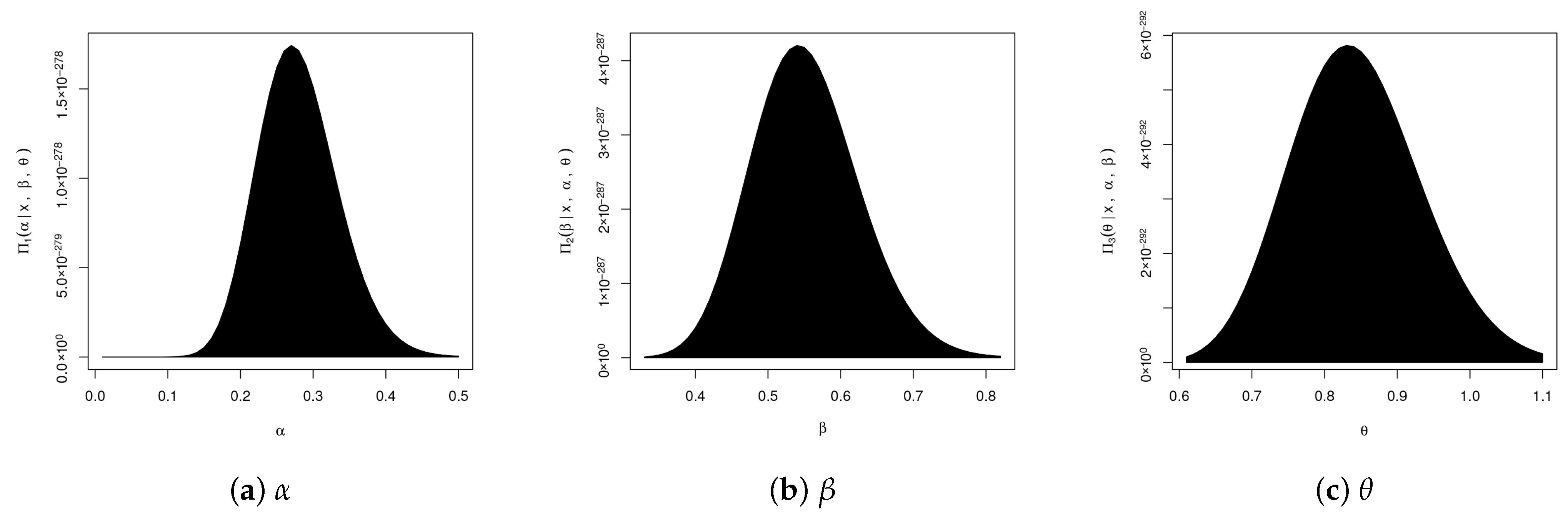
do not belong to any standard family of distributions. Using the same TIIC dataset employed in
Figure 2, the posterior distributions
(
) of
,
, and
are displayed in
Figure 3. It reveals that all posterior PDFs of
,
, and
exhibit approximately normal behavior. Consequently, the Metropolis–Hastings (M–H) algorithm with a normal proposal distribution is recommended for generating MCMC samples to obtain the Bayes point estimates and their corresponding
credible intervals for each unknown parameter.
To perform the M-H algorithm, do the following steps:
- Step 1.
Put .
- Step 2.
Set .
- Step 3.
Obtain from normal proposal distribution .
- Step 4.
Obtain .
- Step 5.
Generate from uniform distribution.
- Step 6.
If , set else set .
- Step 7.
Set .
- Step 8.
Redo Steps 2-7 times, burning in , to get .
- Step 9.
Find the MCMC point estimate of
through the SEL as:
where
.
- Step 10.
Find the BCI bounds of as:
- (a)
Sort
for
as:
- (b)
The BCI bounds of
take:
- Step 11.
The HPD interval of is computed as follows:
- Step 12.
Redo Steps 2–11 for and .
5. Monte Carlo Simulations
To examine the performance of the offered estimators of the proposed IH estimators mentioned in earlier sections, in this part, we conduct several Monte Carlo comparisons. To achieve this, we create several TIIC samples using specified configurations of IH parameters by following the next steps:
- Step 1:
Set two sets of IH parameters, namely:
Set 1: ;
Set 2: .
- Step 2:
Fix levels of sample sizes .
- Step 3:
Generate independently for .
- Step 4:
Set .
- Step 5:
Fix levels of failure percentages (FPs) of each n, where , such as FP .
- Step 6:
Perform 5000 replications for each setting.
To get the Bayes estimates and associated 95% BCI/HPD intervals of , , or , beyond assigning = 2000 and = 12,000, we use two informative prior sets for each parameter group, namely:
For Set 1:
- –
Prior-1 (P1): and ;
- –
Prior-2 (P2): and .
For Set 2:
- –
Prior-1 (P1): and ;
- –
Prior-2 (P2): and .
Comparison of the point estimates of
(as an example) is done using their mean squared errors (MSEs) and mean absolute biases (MABs) as:
and
respectively. Also, the comparison of the interval estimates of
(as an example) is done using their average interval lengths (AILs) and coverage percentages (CP) as follows:
and
where
is the indicator function,
and
denote the lower and upper bounds, respectively, of each offered interval estimator.
By installing two
programming packages, namely ’
’ and ’
,’ suggested by Henningsen and Toomet [
22] and Plummer et al. [
23], respectively, the classical and Bayesian calculations, in addition to their interval estimations, are obtained. All software scripts used for these calculations are available upon request.
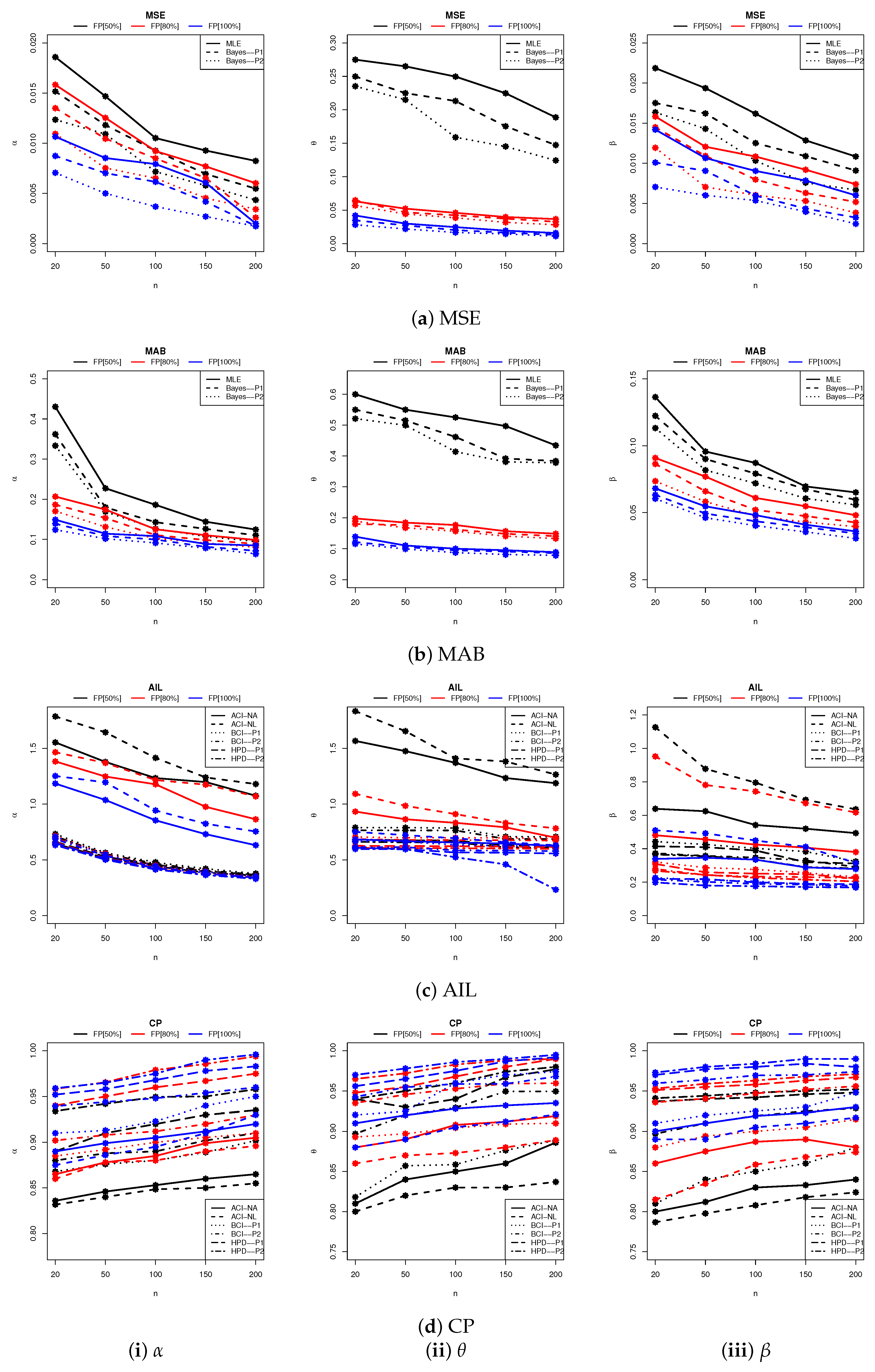
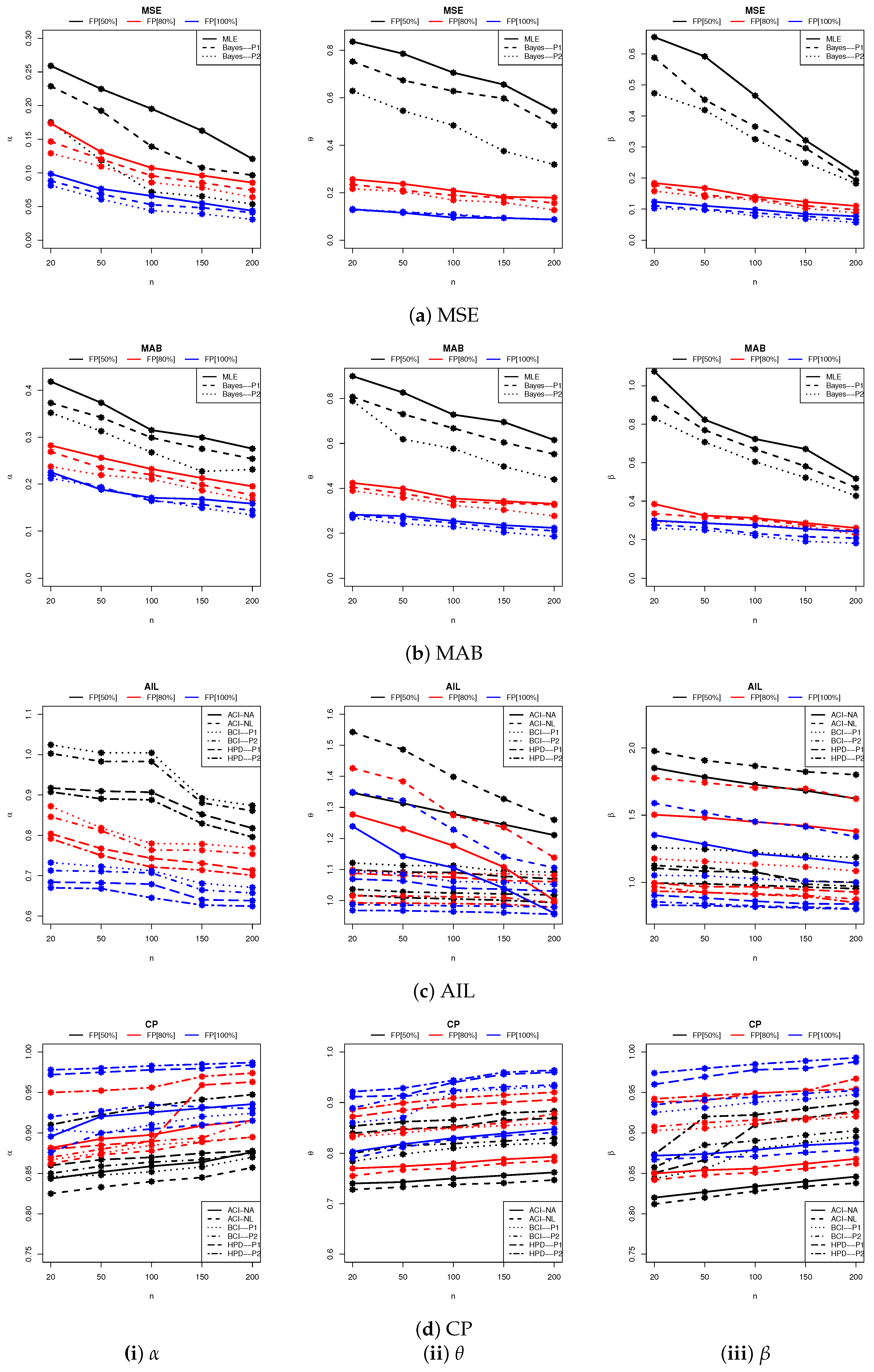
Table 2,
Table 3,
Table 4,
Table 5,
Table 6 and
Table 7 present the simulated MSE, MAB, AIL, and CP values for the parameters
,
, and
. The results indicate the following trends:
As the sample size n increases, the precision of all parameter estimates improves. A similar improvement is observed as the fraction of failures (FP%) increases.
As FP% approaches 100%, all point and interval estimation results become satisfactory, consistent with the asymptotic properties of the estimators.
In terms of minimum MSE and MAB, Bayesian estimates using informative priors outperform likelihood-based estimates due to the incorporation of prior information.
Credible intervals (e.g., 95% BCI/HPD) are more reliable than asymptotic intervals (95% ACI-NA/ACI-NL), providing lower AIL values and higher CP values.
Among the asymptotic intervals, the ACI-NA method performs better than the ACI-NL method, yielding lower AIL and higher CP values.
Among the credible intervals, HPD intervals outperform BCIs, achieving lower AIL and higher CP values.
Within the Bayesian approaches, Prior-2 (P2) consistently outperforms Prior-1 (P1) due to its lower prior variance.
Both prior choices produce consistent parameter estimates; however, Prior-2, being more informative, results in slightly better precision (lower MSE and shorter AILs). The sensitivity to prior specification remains moderate and within acceptable limits, confirming the robustness of the Bayesian estimates.
As , , and increase, the simulated MSE, MAB, and AIL values increase, while the associated CP values decrease.
Overall, Bayesian estimation with a normal proposal in the Metropolis–Hastings algorithm is recommended for IH parameter estimation.
6. Data Analysis
This section analyzes two real-world datasets from the environmental and pharmacological domains to demonstrate the efficiency and superiority of the IH model and to illustrate the practical relevance of the proposed estimators in real-world scenarios:
- Data A:
Maintaining monthly river flows is crucial for preserving aquatic ecosystems, supporting biodiversity, and sustaining water quality for downstream users. It also ensures a reliable water supply for agriculture, industry, and urban consumption, particularly during dry seasons. This dataset represents the minimum monthly water flows (m
3/s) of the Piracicaba River, located in São Paulo state, Brazil; see Arshad et al. [
24]. The data were obtained from the Department of Water Resources and the Power Agency for Water Resources Management of São Paulo State, covering the period 1960–2014. For computational convenience, all flow measurements (
) reported in
Table 8 have been divided by ten.
- Data B:
Plasma concentrations of indomethacin are used to assess the drug’s therapeutic effectiveness and guide dosing to safely manage pain and inflammation. Monitoring these levels also helps minimize the risk of adverse effects, such as gastrointestinal or renal complications, by avoiding toxic concentrations.
Table 8 presents a dataset (
) of plasma indomethacin concentrations (µg/mL); see Arshad et al. [
24].
To demonstrate the adaptability of the proposed model, the IH lifetime distribution is compared with eight competing models from the literature:
- (1)
Inverted Dagum (ID(
)) by Osi et al. [
25];
- (2)
Generalized inverse Gompertz (GIG(
)) by Elshahhat et al. [
26];
- (3)
Inverted log-logistic (ILL(
)) by Leemis [
27];
- (4)
Inverted Lomax (ILo(
)) by Kleiber and Kotz [
28];
- (5)
Inverted Gompertz (IGo(
)) by Eliwa et al. [
29];
- (6)
Inverted Nadarajah–Haghighi (INH(
)) by Tahir et al. [
30];
- (7)
Inverted exponentiated Pareto (IEP(
)) by Abouammoh and Alshingiti [
31];
- (8)
Exponentiated inverted exponential (EIE(
)) by Fatima and Ahmad [
32].
To evaluate the goodness-of-fit of the IH model and its competitors, we use several criteria: (i) negative log-likelihood (N-LL), (ii) Akaike information (AI), (iii) consistent Akaike information (CAI), (iv) Bayesian information (BI), (v) Hannan–Quinn information (HQI), and (vi) the Kolmogorov–Smirnov (KS) statistic with its corresponding
p-value (see
Table 9).
For all measures (i)–(vi), the MLEs along with their standard errors (Std. Errs) for
,
, and
are computed. In
Table 9, the MLEs for
,
, and
are reported in the first row, while their corresponding Std. Errs are provided in the second row.
Table 9 shows that the IH model outperforms all competing models by achieving the lowest values for all fit metrics and the highest
p-value in the KS test.
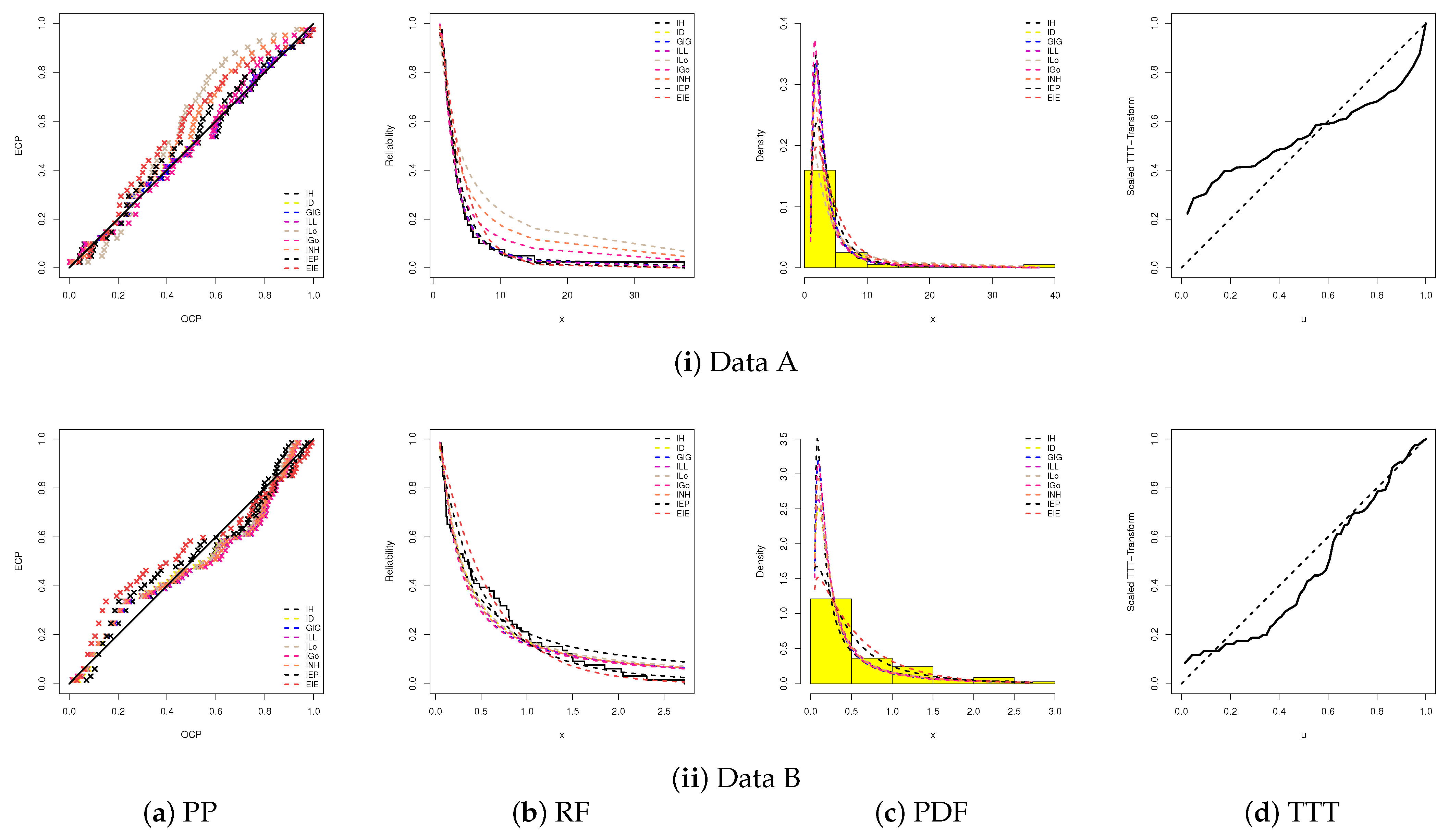
Figure 6 visualizes the model fits for the IH distribution and its competitors using real datasets A and B, evaluated through four graphical diagnostics: (i) probability–probability (PP) plots, (ii) fitted reliability function (RF) curves, (iii) fitted PDF curves overlaid with histogram-normalized counts (HNC), and (iv) scaled total time on test (TTT) transforms.
Figure 6a,b for datasets A and B show that the fitted IH distribution closely follows the empirical data points.
Figure 6c demonstrate that the fitted IH density curve captures most of the observed histogram for both datasets.
Figure 6d (where the theoretical and empirical TTT lines are represented by dashed and solid lines, respectively) confirms that datasets A and B exhibit inverted-bathtub hazard shapes, consistent with the IH failure rate shown in
Figure 1. Thus, all visual diagnostics in
Figure 6 confirm that the IH lifetime model provides the best fit among the considered alternatives.
Using the complete datasets A and B, in addition to complete sample, two TIIC samples are also considered with sizes
and
for Data A, and
and
for Data B. Maximum likelihood and Bayesian methods are employed to obtain point estimates and interval estimates for the parameters
,
, and
from all censored samples. The MLEs and Bayesian estimates (along with their Std. Errs) as well as the interval widths (IWs) derived from 95% ACI-NA/ACI-NL and 95% BCI/HPD approaches for
,
, and
are summarized in
Table 10 and
Table 11. For all Bayesian computations, due to the lack of prior knowledge about
, the hyperparameters
and
(
) are set to
, making the gamma priors nearly non-informative. The M–H algorithm is employed with a burn-in period
and a total of
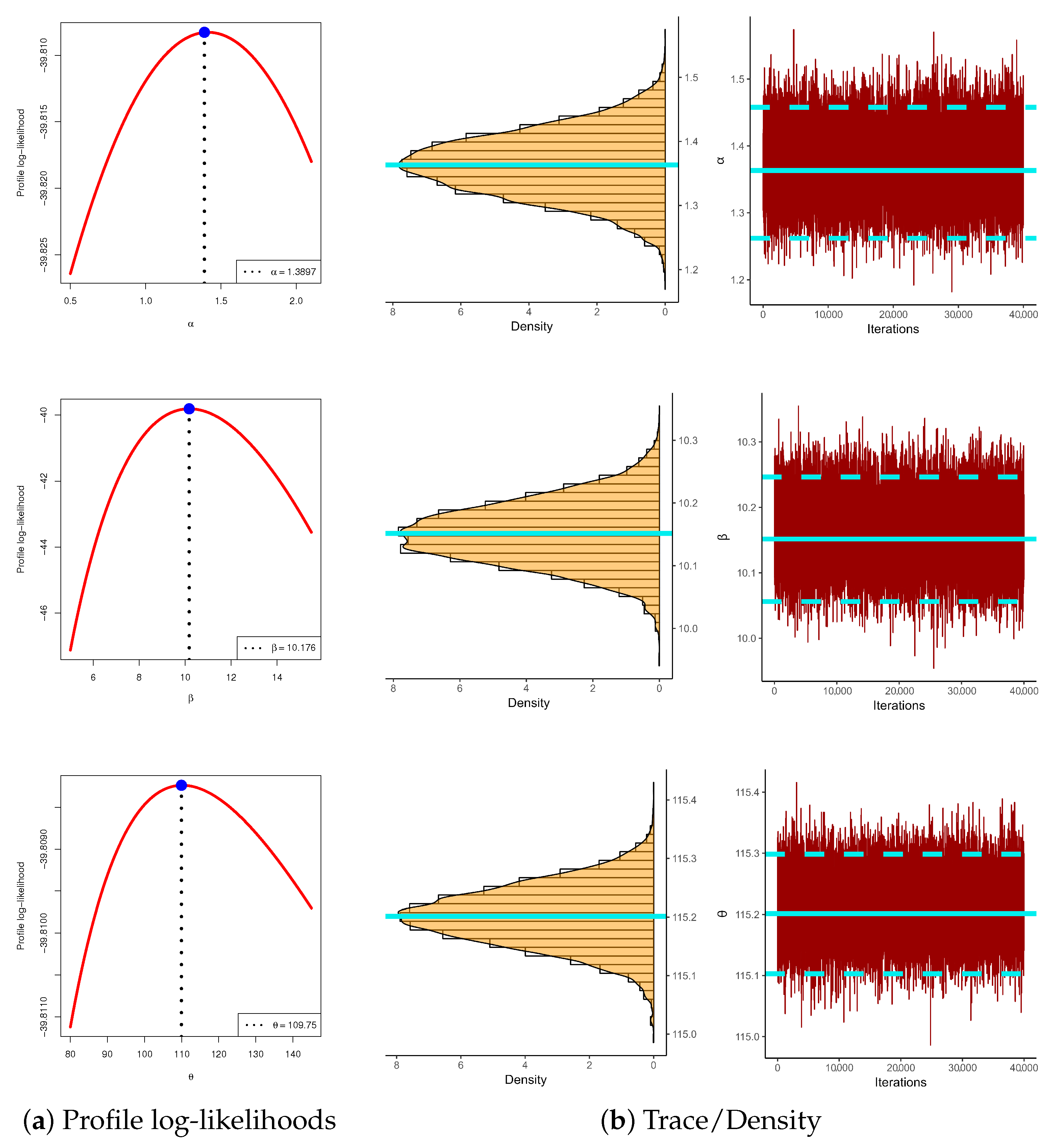
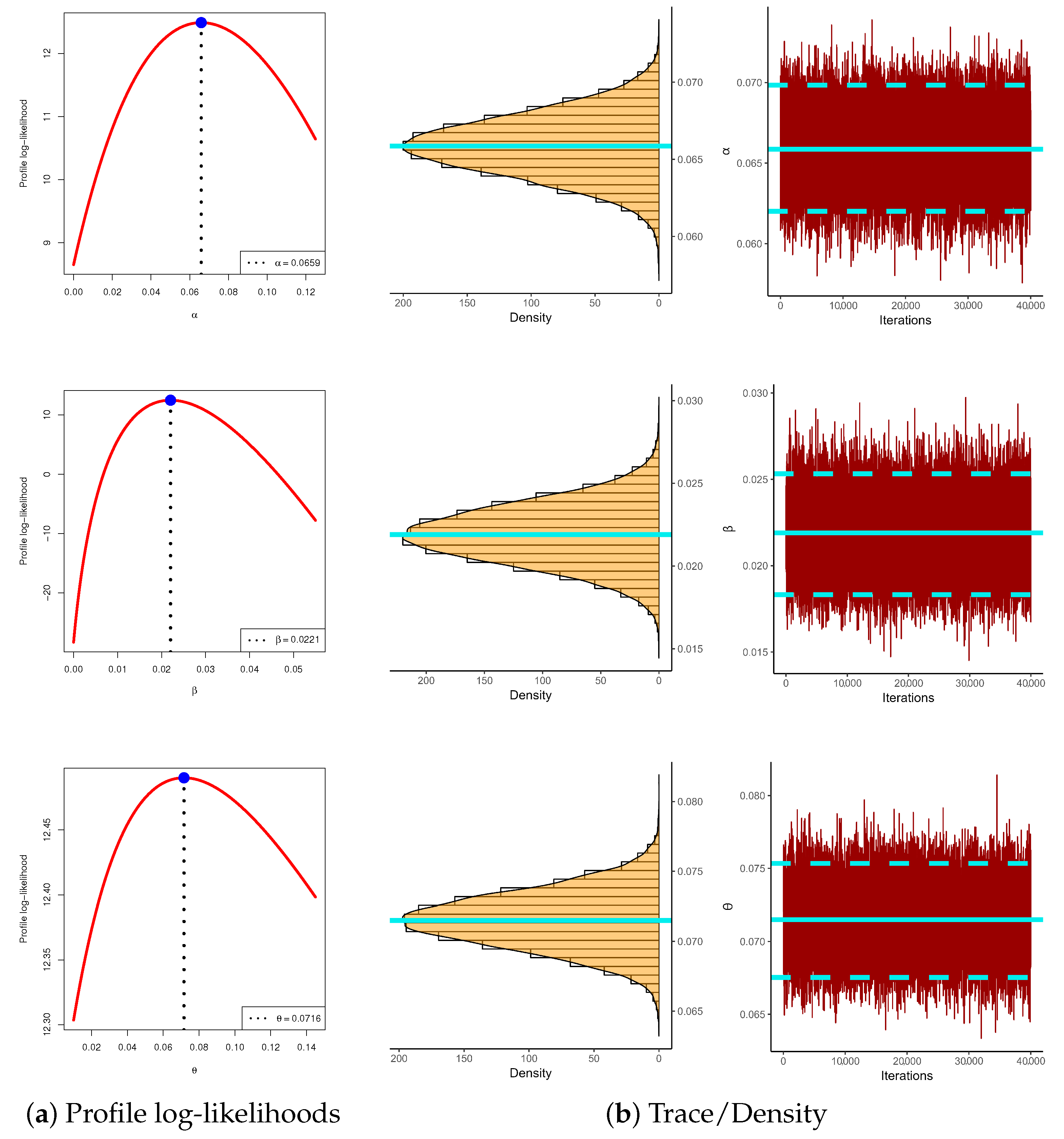
iterations. To assess the existence and uniqueness of the MLEs for
,
, and
, the corresponding profile log-likelihood functions are plotted in
Figure 7 and
Figure 8. These plots display clear and well-defined maxima, confirming that the frequentist estimates of
,
, and
derived from all samples based on datasets A and B exist and are unique. These graphical findings align with the numerical estimates reported in
Table 10 and
Table 11, and thus these estimates are used as initial values for subsequent Bayesian computations. Additionally,
Figure 7 and
Figure 8 present the kernel density estimates (using a Gaussian kernel) alongside trace plots for the 40,000 retained MCMC samples of
,
, and
obtained from a representative TIIC sample (
) for both datasets A and B. The trace plots for each parameter indicate good mixing and suggest convergence of the chains. Moreover, the marginal posterior estimates of
,
, and
appear approximately symmetric. These observations further confirm that the chosen burn-in period is sufficient to mitigate the influence of initial values and allow the chains to adequately explore the target posterior distributions.
Overall, the results from the environmental and pharmacological case studies demonstrate the flexibility and efficiency of the proposed IH lifetime model in capturing diverse failure behaviors across different scenarios. Compared to eight widely used lifetime models with varying hazard rate structures, the IH model consistently provides the best fit, establishing it as an effective and practical tool for real-world applications. For reproducibility,
Appendix B provides the R scripts implementing the main IH functions used in the real-data analyses.
7. Limitations
Despite the promising results and practical importance of the IH model, which shows great flexibility and robust performance in modeling lifetime data, this section provides some limitations to the current study, such as:
First, the current formulation focuses on univariate lifetime distributions and does not yet account for multivariate extensions or covariate-dependent reliability frameworks, which are often relevant in complex engineering and biomedical applications.
Second, while Bayesian estimation was successfully implemented, the choice of prior distributions remains a critical factor; although nearly non-informative priors were adopted in this study, further investigation into the sensitivity of the model to alternative informative priors is warranted.
Third, the simulation experiments and real-data analyses were conducted for selected sample sizes and censoring schemes, and thus the findings may not fully generalize to all experimental designs, particularly under extreme censoring.
Finally, the comparative study was limited to eight well-known lifetime models; additional benchmarking against more recent flexible distributions could provide a deeper assessment of the IH model’s relative performance.
8. Conclusions
This study introduced the inverted Hjorth (IH) distribution as a flexible alternative to model lifetime data with upside-down bathtub-shaped hazard rates, which are particularly relevant for reliability prediction and maintenance planning. Several analytical properties, including the moment-generating function, quantiles, mean residual life, and order statistics, were derived. Parameter estimation was addressed using both maximum likelihood and Bayesian approaches under Type-II censoring, and two forms of asymptotic confidence intervals and Bayesian credible intervals (BCI and HPD) were proposed. Through extensive Monte Carlo simulations, we observed that MLEs perform reliably for large and complete samples but lose accuracy under heavy censoring or small sample sizes. In contrast, Bayesian estimators, especially with informative priors, demonstrated improved robustness, lower error measures, and more reliable coverage. Bayesian credible intervals were generally shorter and provided better coverage than traditional asymptotic intervals. The practical relevance of the IH model was validated through two real-world datasets: minimum monthly water flows of the Piracicaba River in São Paulo State and plasma concentrations of indomethacin. In both cases, the IH model outperformed eight well-known competing lifetime models, highlighting its superior flexibility and effectiveness. Overall, the IH distribution serves as a valuable tool for modeling complex lifetime behaviors under censoring and limited data conditions. Future work may extend this model to multivariate settings, regression-based lifetime analyses, and more complex real-world reliability problems.