Review

Machine Learning-Enabled Quantification and Interpretation of Structural Symmetry Collapse in Cementitious Materials

Department of Civil Engineering, Seoul National University of Science and Technology, 232 Gongneung-ro, Nowon-gu, Seoul 01811, Republic of Korea
*
Author to whom correspondence should be addressed.
Symmetry 2025, 17(12), 2185; https://doi.org/10.3390/sym17122185
Submission received: 18 November 2025 / Revised: 9 December 2025 / Accepted: 15 December 2025 / Published: 18 December 2025

Abstract

The mechanical and durability performance of cementitious materials is fundamentally governed by the symmetry, anisotropy, and hierarchical organization of their microstructures. Conventional experimental characterization—based on imaging, spectroscopy, and physical testing—often struggles to capture these multiscale spatial patterns and their nonlinear correlations with macroscopic performance. Recent advances in machine learning (ML) provide unprecedented opportunities to interpret structural symmetry and anisotropy through data-driven analytics, computer vision, and physics-informed models. Furthermore, we summarize cases where symmetry-informed descriptors improve performance prediction accuracy in fiber- and nano-modified composites, demonstrating that ML-based symmetry analysis can substantially complement the limitations of conventional experimental-based characterization. We confirm that image-based models such as CNN and U-Net quantify the directionality and connectivity of pores and cracks, and that physically informative neural networks (PINNs) and heterogeneous data-based models enhance physical consistency and computational efficiency compared to conventional FEM and CFD. Finally, we present the conceptual and methodological foundation for developing AI-based microstructural symmetry analysis, aiming to go beyond simple prediction and establish a conceptual foundation for AI-driven cement design based on microstructure–performance causality.

1. Introduction

Cementitious materials—including ordinary Portland cement (OPC), blended binders, geopolymers, and polymer-modified or fiber-reinforced composites—are among the most widely used construction materials on earth [1]. Their versatility, cost-effectiveness, and compatibility with steel reinforcement have enabled the development of the infrastructure that underpins modern society. Nevertheless, despite decades of research and technological progress, the intrinsic heterogeneity and complex hierarchical structure of these materials continue to pose significant challenges in predicting and optimizing their performance [1,2,3,4]. At the core of these challenges lie issues of structural symmetry and anisotropy—specifically, understanding how the internal architecture of cementitious materials deviates from ideal geometric or statistical uniformity, and how such deviations influence mechanical strength, fracture behavior, and durability [5,6,7,8].
In ideal solids, symmetry provides a concise description of structural order and governs many physical properties through invariance under rotation, reflection, and translation. In cementitious systems, however, perfect symmetry is seldom observed. Instead, these materials exhibit a form of statistical symmetry governed by the probabilistic distribution of phases such as calcium silicate hydrate (C–S–H), portlandite, unhydrated clinker, and porosity [1,6,9]. During hydration, segregation, and curing, various factors—including water-to-binder ratio, temperature gradients, polymer dispersion, and fiber orientation—induce heterogeneities that break local symmetry and generate anisotropy across multiple length scales [3,4,10,11,12,13,14,15]. As a result, the resulting microstructure is neither completely random nor fully ordered. Quantifying these characteristics has long been a major objective in experimental and computational materials science. Techniques such as scanning electron microscopy (SEM), X-ray microcomputed tomography (µCT), and digital image correlation (DIC) have revealed unprecedented details of cementitious microstructures, capturing pore morphology, aggregate interfaces, and crack evolution in three dimensions [16,17,18]. Complementary numerical methods—including finite-element analysis, image-based homogenization, and statistical texture analysis—have been used to estimate effective elastic tensors and transport coefficients [2,19,20,21,22]. However, despite the abundance of available data, notable limitations persist. Conventional image processing and statistical approaches often fail to capture the nonlinear, multiscale relationships between microstructural symmetry and macroscopic properties. Moreover, manual feature extraction and operator-dependent segmentation introduce subjective bias, hindering reproducibility and limiting scalability [21,23,24]. As a result, substantial portions of valuable experimental information remain underutilized.
In recent years, machine learning (ML) has emerged as a powerful framework for addressing the inherent complexity of such data. In materials science, ML forms the foundation of the broader field of materials informatics, which aims to accelerate discovery and design by leveraging data from experiments, simulations, and theory. In cement and concrete research, ML has been successfully applied to predict compressive strength, optimize mix design, estimate carbonation depth, and forecast durability indicators such as chloride diffusion or freeze–thaw resistance [25,26,27]. These achievements demonstrate ML’s ability to capture complex nonlinear behaviors that conventional empirical models cannot. However, most existing studies have primarily used ML for performance prediction, lacking an analytical understanding of how symmetry disruption occurring at the microstructural level is projected into macroscopic properties. Recently, ML has been extended to include high-resolution image-based CNN analysis, microstructural pattern classification using unsupervised learning, phase connectivity representation using graph neural networks (GNNs), and integration of physical constraints through physically informative neural networks (PINNs), evolving into a tool for quantifying symmetry and anisotropy [27,28,29,30,31,32,33,34]. This opens up the possibility of elucidating the structural mechanisms by which local geometric asymmetry leads to global performance degradation or enhancement [27,30,31,32].
Nevertheless, recent reviews tend to focus on prediction-oriented ML approaches or introduce single techniques, leaving a lack of a comprehensive framework for discussing multiscale symmetry and anisotropy in cement composites in conjunction with ML. This review presents the following clear research contributions: we present the principles of symmetry and anisotropy formation in cement composites from a theoretical and multi-scale perspective, compare the latest imaging and analysis techniques for quantifying symmetry from experimental microstructural data, and structure a ML-based symmetry analysis framework. We also propose a new research paradigm that utilizes machine learning to enable interpretation based on symmetry information, going beyond the existing performance prediction-centered approach.

2. Anisotropic Assumption and Actual Structural Asymmetry of Cementitious Materials

2.1. Anisotropic Formation Mechanism and Microstructure Evolution of Cementitious Materials

The behavior of cement-based materials has long been interpreted using a simplified model on the premise of isotropy and symmetry. This is an interpretation that assumes an ideal material with the same stress–strain relationship in all directions as a basic premise for structural analysis. This simplification has enabled efficiency of computation and standardization of design but cannot reflect the physical and chemical complexity of actual cement composites [2]. The composite material is a multi-phase composite structure in which cement paste, aggregate, mixture, voids, moisture, etc. are intertwined, and each phase has different chemical reactivity, particle size, density, and surface energy. Thus, fine inequality and local asymmetry are inherent inside the material from the formation stage, which is the root cause of the macroscopic isotropic assumption’s inability to fully explain the actual material behavior [5,33]. The anisotropy of cement is not a simple heterogeneity but a result of the non-equilibrium structural evolution that accumulates throughout the formation process [1,34]. Its mechanisms of occurrence are chemical, non-forming thermodynamic, and they involve the structural heterogeneity of microstructures, the mechanical confinement and imbalance of stress fields, and gradients in the curing environment.
First, the hydration reaction is a non-equilibrium process in which the composite does not have a consistent reaction rate, but the reaction rate and direction vary depending on the local environment [3]. If the diffusion rate of moisture, the heat transfer path, and the ion concentration gradient are unevenly distributed, the reaction progress rate and the product growth rate at each point in the initial hydration stage appear differently [3,10,11]. This difference in local reaction rate induces asymmetry in crystal growth at the microstructural level. C–S–H consequently grows in an asymmetric fibrous or layered form, while portlandite or ringite phases are preferentially arranged according to variations in binding stress or interfacial energy. This restriction of the growth direction reinforces the anisotropy of the microstructure by forming the preferred orientation of the hydration product [6,7,8,9,12]. In actual TEM and XRD analysis, it is reported that the C–S–H gel grows in one direction along the water diffusion path and the layered spacing is clearly different [4,6,13,14]. In addition, in large numbers, the temperature gradient generated by the heat of hydration further intensifies this microscopic anisotropy. A vertical difference is formed in the density and porosity of the C–S–H gel according to the difference in the hydration reaction rate by the location of the members [15]. As a result, the microstructure of cement is not only chemically heterogeneous but also has a limited anisotropy in the growth direction. This acts as a decisive factor in destroying microscopic symmetry from the initial curing stage.
The microstructure formed by the non-equilibrium reaction is not a complete continuum but has the form of a heterogeneous polyphase composite. The hydration product grows into a structure in which an amorphous gel and a crystalline phase are mixed, and since the expansion coefficient and strain of each phase are different, a fine stress concentration occurs at the interface [35,36]. In particular, the interfacial transition zone (ITZ) around the aggregate show high porosity and low density and has weaker mechanical continuity than the surroundings [19,20,37,38]. Inside the ITZ, the growth of hydration products and micropore connectivity are complex, which can induce orientation-dependence in the load, moisture, chloride, and heat transfer paths [38,39]. These microstructures repeat the rearrangement of the ITZ, the density of the C–S–H gel, and the growth and recovery of microcracks over time, and the initial microscopic asymmetry gradually expands [1,34].
On the other hand, mechanical restraint and stress field continue to act in the process of forming the cement structure, further weakening the symmetry. During the construction of pouring, compression, vibration, etc., the binding force of its own weight and the formwork act in different directions, causing bleeding that separates particulates and moisture in the vertical direction, which intensifies the layered structure [40,41,42]. Temperature rising and volume expansion that occur during curing are also unevenly limited by external constraint conditions, and thermal and residual stresses are concentrated in specific directions. Therefore, mechanical restraint is not a simple external force condition but acts as an internal factor that continuously collapses the symmetry inside the material.
Finally, the gradient of the curing environment further strengthens the directionality of the cement structure. On the surface, moisture evaporation and drying shrinkage due to temperature drop, and continuous hydrothermal accumulation occurs inside at the same time. This heat and moisture gradient widens the deviation of the reaction rate and forms different distributions and stress states of hydrate products in each local region [43]. At the top close to the drying surface, microcracks are concentrated in the horizontal direction, and residual moisture movement continues inside, increasing the connectivity of pores in the vertical direction. As a result, the water permeability and expansion coefficient are distributed differently in the vertical direction, cracks due to thermal stress in the surface layer, and relaxation due to wet expansion occurs in the inner core [43,44]. Due to the influence of this curing environment, the anisotropy of the entire structure becomes more pronounced.

2.2. Characteristics of Macroscopic Anisotropic Behavior According to Symmetry Collapse

If the internal structure of the cement-based material is not in a symmetrical state, the behavior of the internal structure inevitably has directional dependence. As the distribution of stress and strain becomes spatially uneven and the load transfer path is locally concentrated, a macroscopic level of anisotropy is expressed [40]. The anisotropy of the internal structure affects not only mechanical strength such as compressive strength and tensile strength, but also thermal and chemical properties, which are factors that affect durability [16,45]. In other words, the collapse of symmetry is a structural medium that governs the behavioral style of cement composites and appears through the process of projecting the direction of microstructure into macroscopic performance.
First, it causes an imbalance between stress transfer and deformation. The growth of C–S–H or the arrangement of pores influences the microcracks that occur along the stress path, which is due to the non-uniform development of the ITZ, which forms a strength gradient within the material with a high porosity compared to the bulk matrix [17]. In particular, the phenomenon of the weakest vector being repeatedly aligned in a specific direction has been reported to cause an imbalance in stress transfer and deformation dominating in a direction different from the main load path. The overlapping of this microstructural orientation, the non-uniform connectivity of pores, and the weakened ITZ results in a breakdown of symmetry and a marked anisotropic behavior at the macroscopic level [17,46].
In addition, anisotropy results in asymmetry of viscoelastic behavior under long-term load conditions. The directional arrangement of the microstructure induces the directional dependence of creep strain when the load is sustained, and the deformation is relaxed in the fibrous C–S–H structure consistent with the load direction, but the deformation is accumulated in the transverse direction [6,47]. This difference deepens the imbalance of irreversible deformation as the loading time increases, causing the residual stress to be deflected in a specific direction during the long-term creep and deformation recovery process [48,49]. As a result, the load-deformation response of the material evolves nonlinearly, and cracks on the same plane are continuously reactivated when repeated stress is applied [50].
Anisotropy makes the behavior of the material locally non-uniform, amplifying microstructure heterogeneity due to material separation and deepening the spatial imbalance of stress [51]. As a result, fine particles and moisture are concentrated at the top and coarse aggregate and high-density tissue are formed at the bottom, resulting in a physical gradient in the vertical direction. This heterogeneity distorts the load redistribution, resulting in tensile stress vulnerability at the top and compression/shearing sensitivity at the bottom, and the stress field becomes asymmetric in the vertical direction. In addition, the transport process of heat, moisture, and ions is also influenced by this structural anisotropy and proceeds predominantly in a specific direction, which accelerates the local stress and crack concentration and acts as a factor that lowers structural stability [51,52,53,54].
Anisotropy changes the resistance properties of materials in a direction-dependent manner through non-uniformity of the internal bonding state, and this difference in properties forms an asymmetric stress field when heat and humidity conditions are changed [55,56]. The porosity and density gradient inside cement change the thermal conductivity and the permeability coefficient according to direction, so that heat is transferred quickly in some areas, but moisture diffusion is limited, and heat transfer resistance is large in other areas, but evaporation is active [55]. This non-homogeneous distribution simultaneously induces the accumulation of internal hydration heat and the surface drying shrinkage when the temperature rises, and in the cooling stage, the tensile stress is locally concentrated, and cracks occur [56].
The anisotropic void network deflects the internal moisture movement and locally accelerates self-desiccation. When moisture moves predominantly in one direction, the contraction stress is concentrated in the dry area and the wet expansion remains on the other side. This imbalance induces micro-shrinkage cracks in a specific direction, and the gradient becomes more pronounced, and the width of the crack opening in the surface layer gradually increases over time [45,56].
Chemical degradation is also strongly affected by anisotropy. Asymmetrical pore alignment or ITZ development accelerates the diffusion rates of chloride, sulfate, and carbon dioxide along the ITZ and pore alignment directions. For this reason, even under the same environmental conditions, carbonation or salt damage begins on one side first, and the progress of deterioration appears uneven. When ITZ develops anisotropically, a potential difference is formed in the direction of chloride concentration, and corrosion reactions occur locally, resulting in the generation of chloride products and an accelerated chloride diffusion rate [57,58,59]
After all, the anisotropy of cement-based materials is not a simple by-product of heterogeneity, but a result of acting as a complex mechanism in which the orientation of microstructures dominates stress, heat, moisture, chemical reaction, and damage evolution after symmetrical collapse. This anisotropy is a key factor in determining structural stability and durability and accumulates and evolves in the long term from the material formation stage.

3. Anisotropic Expression and Structural Characteristics of Cementitious Materials

3.1. Anisotropic Expression and Structural Characteristics of General Concrete

Concrete has been regarded as a homogeneous material with isotropy for a long time, but it contains various levels of anisotropy due to the unevenness and structural constraints of the microstructure. Concrete, which is a multiphase composite composed of cement paste, aggregates, voids, and ITZ, shows a direction-dependent response to external forces such as load, heat, moisture, and chemical penetration or environmental changes because the chemical composition, physical structure, and mechanical properties of each phase are different [5,33]. In other words, concrete behaves not as an ideal isotropic material, but as an anisotropic material whose symmetry has collapsed from the formation stage [34].
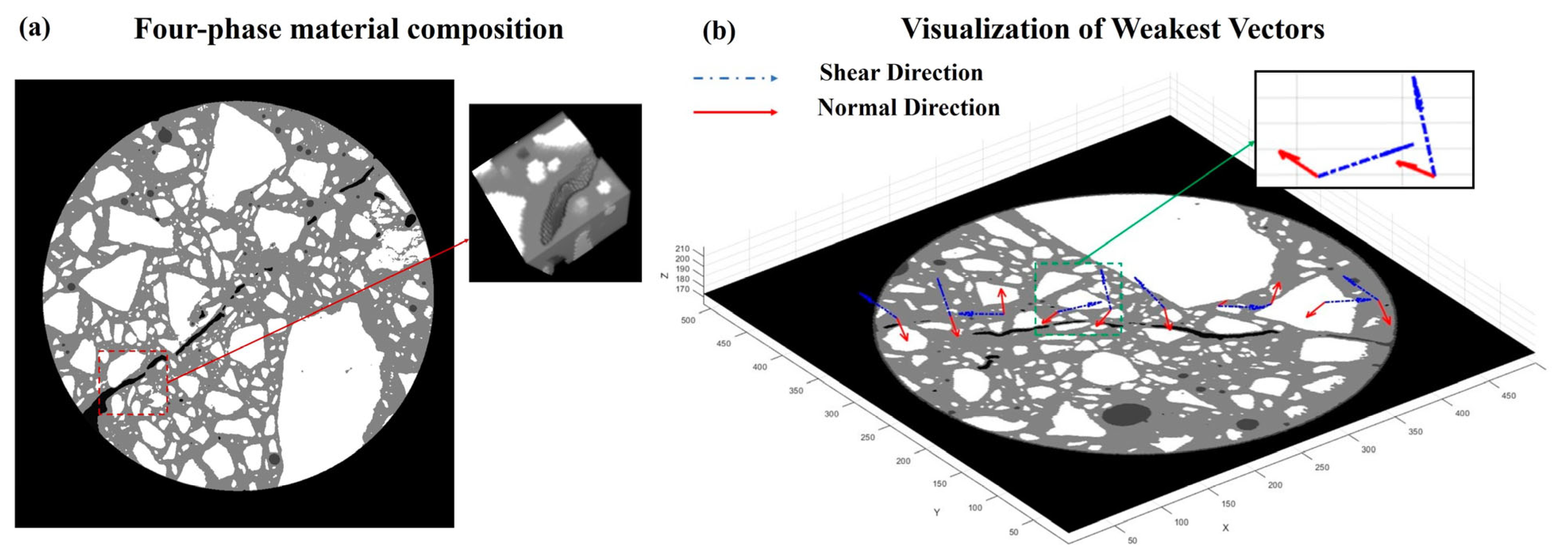
This anisotropy is formed from the manufacturing and pouring stages of concrete. Concrete, which is a complex mixture of various phases, is not distributed uniformly due to gravity, viscosity, and moisture movement during the pouring process, and non-uniformity in density difference and bonding strength occurs at a fine level [60]. Figure 1a visually shows the structural asymmetry inside these composite materials. Even if materials with different densities are uniformly mixed, anisotropy is not symmetrical depending on the characteristics of each material.
Additionally, when constituent materials with different densities and stiffnesses are combined, direction-dependent stress transfer paths are formed within the concrete, and, in this process, anisotropy occurs, where the macroscopic symmetry is broken [17]. The eigenvector analysis results in Figure 1b quantitatively supports this phenomenon. Each vector component shows a different direction depending on the position, and the vector corresponding to the minimum resistance direction in the vertical stress is indicated by the red arrow in the solid line, and the minimum resistance direction in the shear stress is indicated by the blue arrow in the dotted line. This means that, even if the load is applied equally, the stress is transmitted in different weak directions in each local area, and the actual deformation also occurs along these weak directions. In other words, the asymmetric arrangement of microstructures gives directivity to the stress field, which directly affects the macroscopic deformation behavior [17].
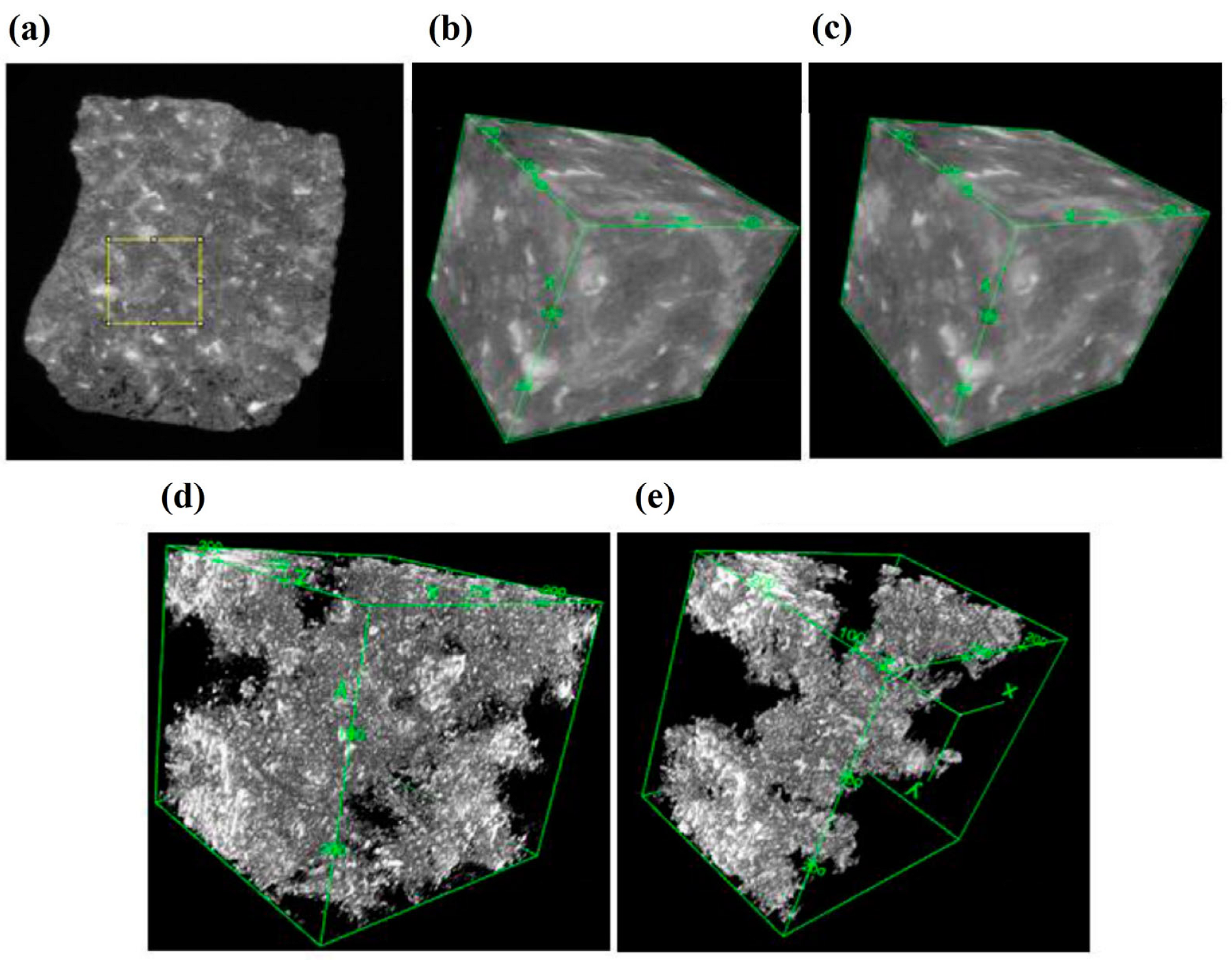
This microstructural anisotropy is also evident in the distribution of pores. The degraded cement paste CT image in Figure 2 is a 3D visualized image of the pore space, showing an asymmetric porosity and the connection structure of the pores. The size and shape of the pore, and the degree of connection between the pores depend on the position of the structure, which leads to deflection of the moisture and ion movement path. This trend shows that the already inherent direction is extended to an asymmetric pore network due to the anisotropy created by the mixing of various composite materials [16].
Consequently, ordinary concrete appears to be a uniform material, but, internally, it is a typical anisotropic structure with a combination of uneven distribution of composition, orientation of pore networks, and asymmetry of local stress fields. This structural anisotropy leads to an imbalance between stress concentration and deformation and plays a crucial role in long-term degradation and crack progression [17,61].

3.2. Anisotropic Expression and Behavioral Characteristics of Lightweight and Porous Concrete

Lightweight and porous concrete has a higher porosity and heterogeneous density distribution than general concrete, resulting in clear anisotropy from the inside of the material. The low density and high absorption rate of lightweight aggregates asymmetrically change the hydration behavior and internal moisture movement, imparting directionality to the heat transfer and stress transfer paths [61]. This structural heterogeneity causes material separation according to the difference in gravity and viscosity during pouring, resulting in the concentration of lightweight aggregates at the top and the accumulation of cement paste at the bottom to form a vertical density gradient. This anisotropic density distribution distorts the load redistribution, resulting in anisotropic behavior with different strength and elastic properties by location [61].
The anisotropic structure affects not only mechanical behavior but also thermal and hydraulic properties in the same way. If the alignment and shape of the internal voids are non-homogeneous, the stress field is concentrated in a specific direction and the crack begins to dominate on one side, and, at the same time, the thermal conductivity and moisture diffusion coefficient also change to dominate in that direction. As a result of X-ray CT analysis, the thermal conductivity of the specimen whose voids were aligned in the horizontal direction decreased by about 20%, but the decrease in compressive strength was limited to within 5% [51]. This shows that the directionality of the voids affects both thermal and mechanical behavior, and this structural anisotropy acts as a design variable that can control material performance, not a simple heterogeneous by-product [51,61].
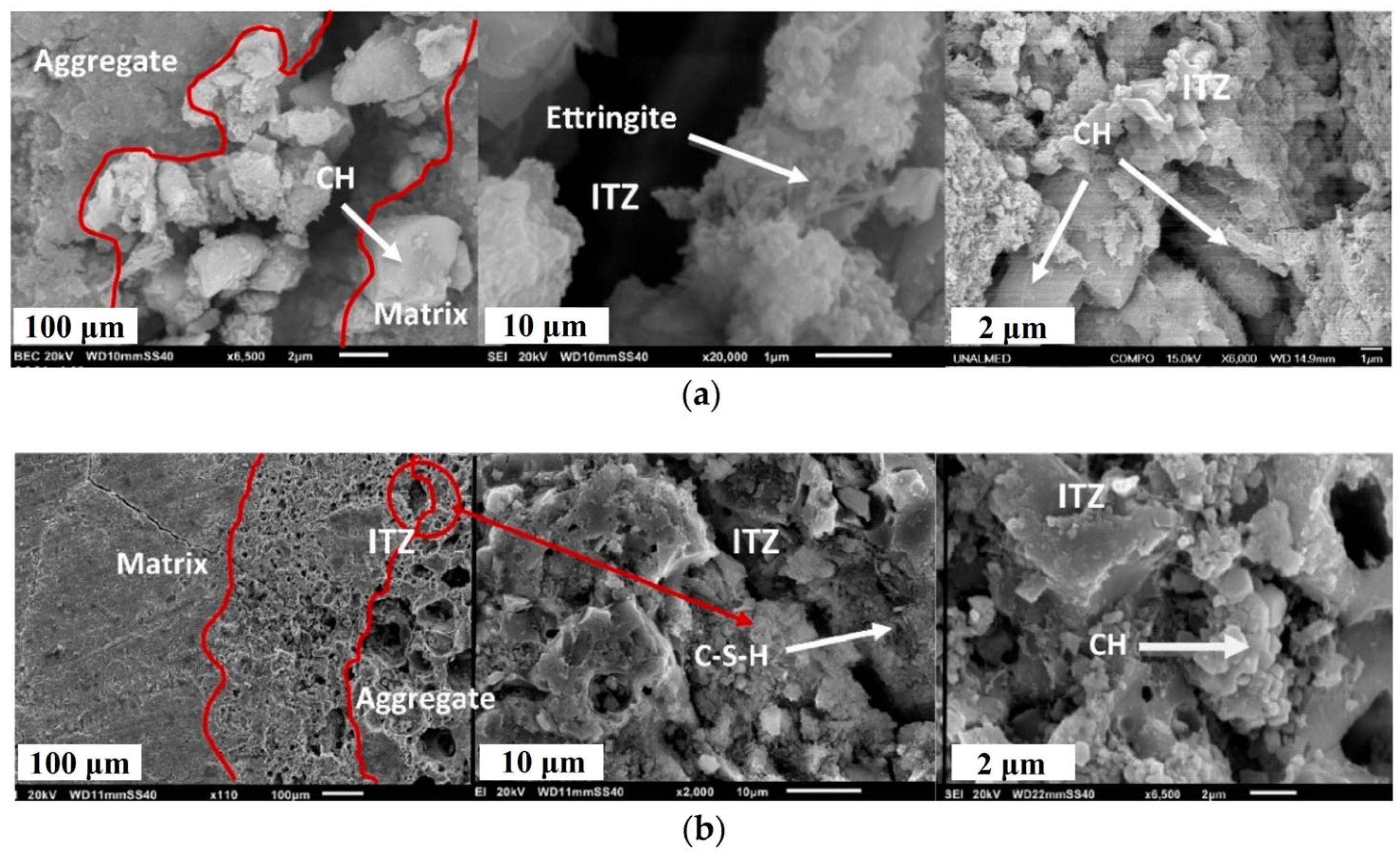
Anisotropy is particularly evident in the development of the ITZ. Unlike general concrete, the ITZ of lightweight aggregate concrete is affected by the surface of lightweight aggregate with many voids and active moisture exchange and exhibits an asymmetric hydration product arrangement. Figure 3a shows the microstructure of the general aggregate–cement interface, and Figure 3b shows the microstructure of the lightweight aggregate–cement interface, which shows that the C–S–H gel and Ca(OH)2 crystals grow at an abnormal level by combining the wall-effect and hydration crystal orientation in the lightweight aggregate [38]. In Figure 3b, the ITZ of lightweight aggregate concrete has a lower Ca/Si ratio than that of conventional concrete, and the porosity and chemical reactivity of the lightweight aggregate surface increase the density of the hydration products. Consequently, the ITZ develops into a denser microstructure [38]. In other words, each aggregate influences the development of the ITZ, and each differently developed ITZ exhibits its own anisotropy.
After all, the anisotropy of lightweight and porous concrete is the result of a combination of three factors: density gradient [61] due to material separation, asymmetric development of ITZ [38], and directional arrangement of internal voids [51].

3.3. Anisotropic Expression and Structural Effects of 3D-Printed Concrete

3D printed concrete (3DPC) shows clear anisotropy, in which stress transfer and microstructure formation inside materials depend on a specific direction due to the nature of the process manufactured based on lamination. This anisotropy is formed in combination by various factors such as structural discontinuity of the interlayer joint, lamination time interval, material rheological properties, and difference in curing speed. Therefore, 3DPC cannot prevent the difference in physical and mechanical properties between the printing path (x-y) and the lamination direction (z), and this structural asymmetry directly affects the mechanical performance and durability of the entire member [62,63,64].
The lamination time interval acts as a major determinant of interlayer adhesive strength and mechanical anisotropy. As the interlamination time increases, the hydration of the lower surface proceeds and moisture disappears, weakening the chemical bond with the upper layer. As a result, it was reported that the shear and bending strength at the interlaminar interface rapidly decreased, and the strength in the vertical (z) direction decreased by 25% compared to the horizontal (x-y) direction even though the material was the same [62]. This decrease in interlaminar bonding strength is greatly affected by the interlaminar time interval, and the flexural strength is the most anisotropic [62].
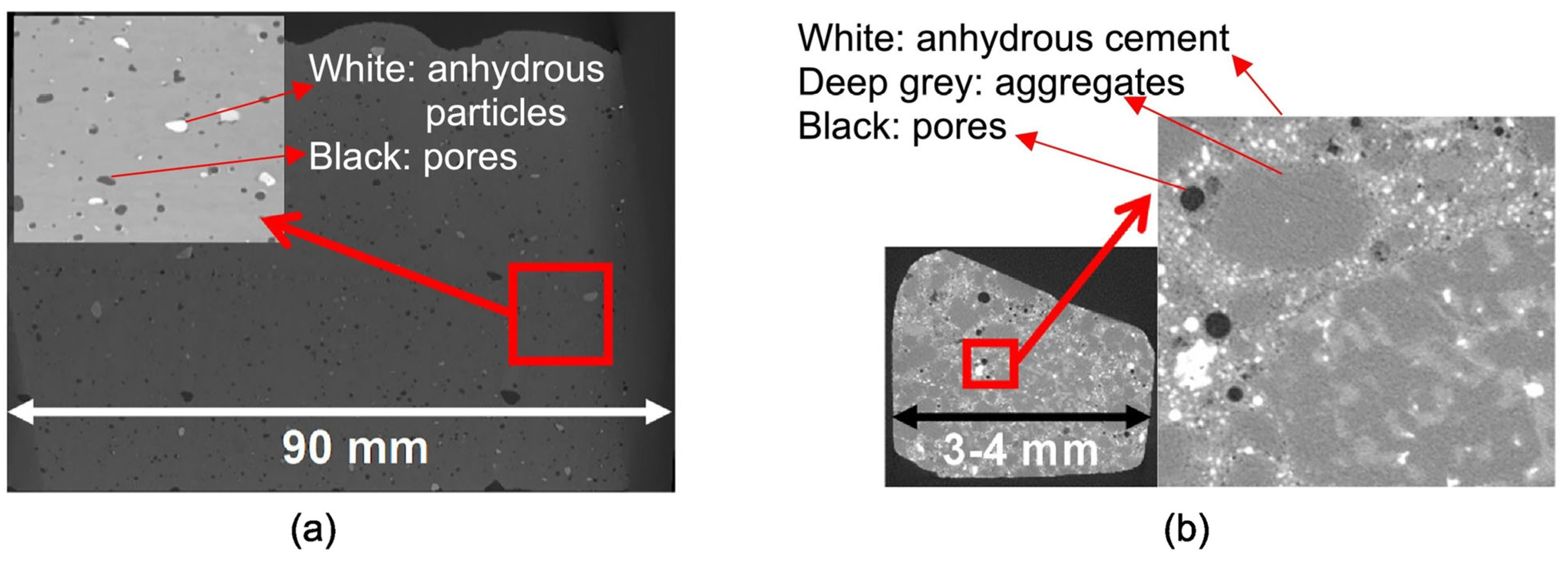
As a result of the microstructure analysis of 3D-printed concrete, the core and the surrounding Filament Interfacial Zone (FIZ) were cross-distributed inside the laminated filament, and the density and composition heterogeneity between the two areas were confirmed [63]. This non-uniformity can be confirmed through Figure 4, which captures the microstructure of 3DPC. Figure 4a is a macro image of a large sample obtained by x-ray CT scanning of 3DPC, and it is asymmetrically distributed that there are different phases of voids, aggregates, and anhydrous cement according to the difference in density. Figure 4b is also a micro image of a small sample, and it can be visually confirmed that the anisotropy is strengthened due to the difference in density of the three phases. Following these visually confirmed inhomogeneities, the anisotropy of the pore distribution within the FIZ can be confirmed [63].
This heterogeneity is formed by a combination of factors such as shear flow, nozzle pressure gradient, initial moisture loss, and air capture during the extrusion process [63,65]. While each filament is individually laminated, moisture on the surface evaporates and the lower layer absorbs moisture from the upper layer by an osmotic pressure gradient, causing the hydration reaction of the interface to proceed unevenly [66]. In this process, a porous weak plane is formed, so that stress is concentrated near the interface, and load transfer is cut off, resulting in a weak mechanical anisotropy in the stacking direction (z-axis).
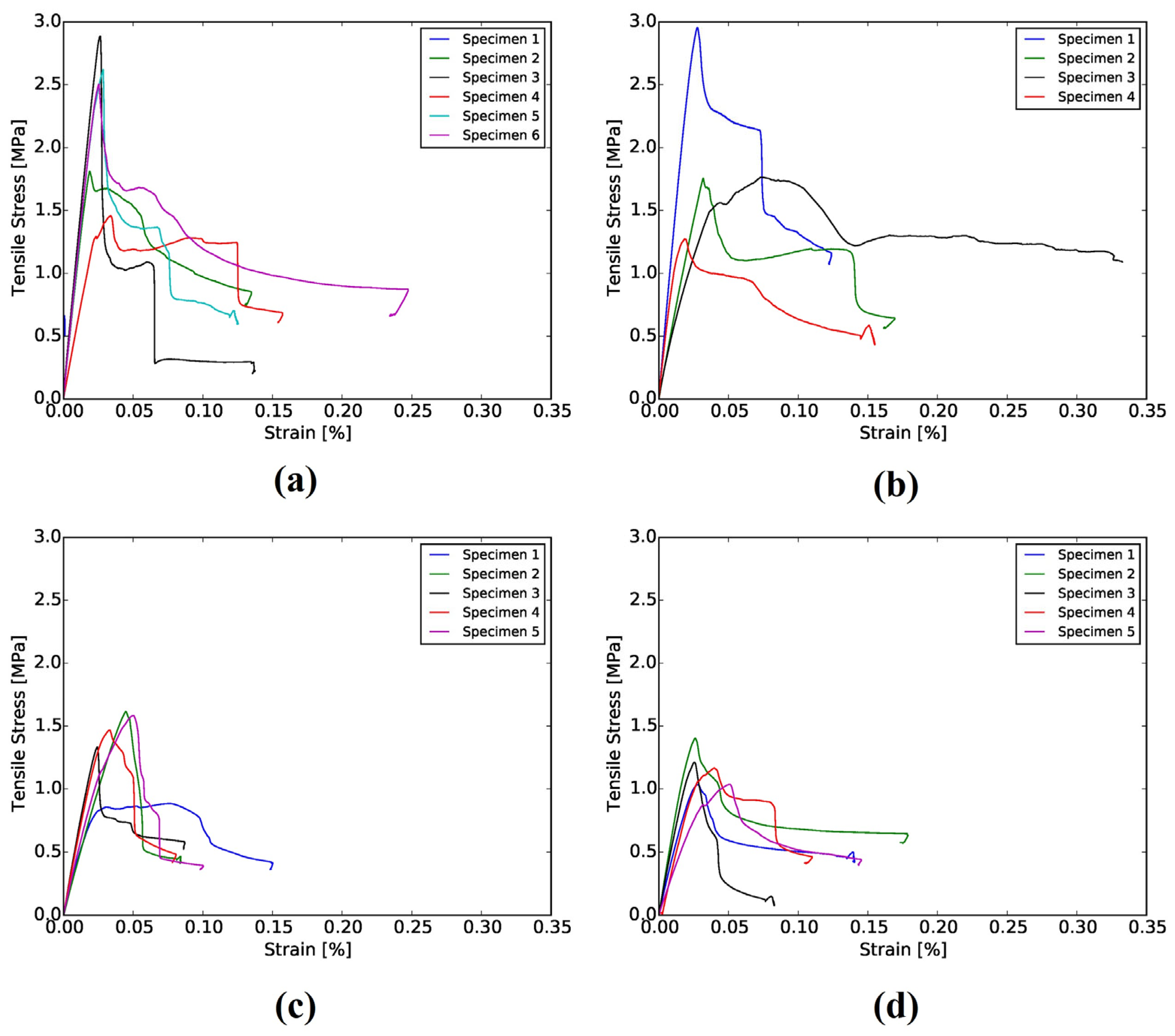
The stress–strain curves of isotropic materials should appear identical regardless of the interface or orientation, but this is not the case for 3D-printed concrete. As observed in Figure 5, the results of the layer interface tensile bond test, where a load is applied in the direction separating the two laminated layers, exhibit a brittle failure pattern, with a rapid stress drop occurring immediately after reaching the maximum stress under all conditions. This is because the interface does not provide a continuous stress transfer path, causing the crack to propagate instantaneously along the interface as a single failure plane, demonstrating that the interface acts as a weak surface for mechanical behavior [67].
Furthermore, the deformation capacity in this direction is very limited, and ductile behaviors such as strain hardening are not observed. This is mainly due to the deterioration of the interfacial quality caused by hydration deviation and unconnected voids during the lamination process, as well as the lack of fiber bridges or material continuity [67]. This differential stress–strain behavior also indicates that 3DPC is a distinctly anisotropic material, not an isotropic one, as evidenced by the stress–strain curve.
On the other hand, because of analyzing the distribution of internal voids and heat transfer characteristics of 3D printed concrete through X-ray CT and numerical analysis, it was confirmed that the interlayer voids were generally aligned parallel to the printing path [64]. The orientation of these voids gave a clear direction to the heat and moisture movement paths, and the transfer efficiency was significantly higher in the horizontal (xy) direction than in the vertical (z) direction. The heat flow in the vertical (z) direction was significantly reduced by the discontinuity of the interlayer voids, and accordingly, the specimen showed clear thermal anisotropy. This thermal anisotropy made the internal stress field asymmetric under a temperature gradient, and cracks near the interface were repeatedly reactivated during the cooling process [64].
As a result, the anisotropy of 3D-printed concrete can be seen as a complex result resulting from the discontinuity of the lamination process and the asynchronous of the hydration reaction. The decrease in bonding force over the lamination time interval, the non-uniformity in density and pore distribution between filaments, and the difference in thermal and hydraulic paths due to the interlayer alignment structure interact and form a macroscopic anisotropy. This structural anisotropy is not just a homogeneity of microstructure but acts as a key factor affecting the overall long-term performance of concrete, such as load redistribution, heat transfer, and crack progression [62,63,64].

3.4. Anisotropic Expression and Structural Effects of Fiber-Reinforced Cementitious Composites

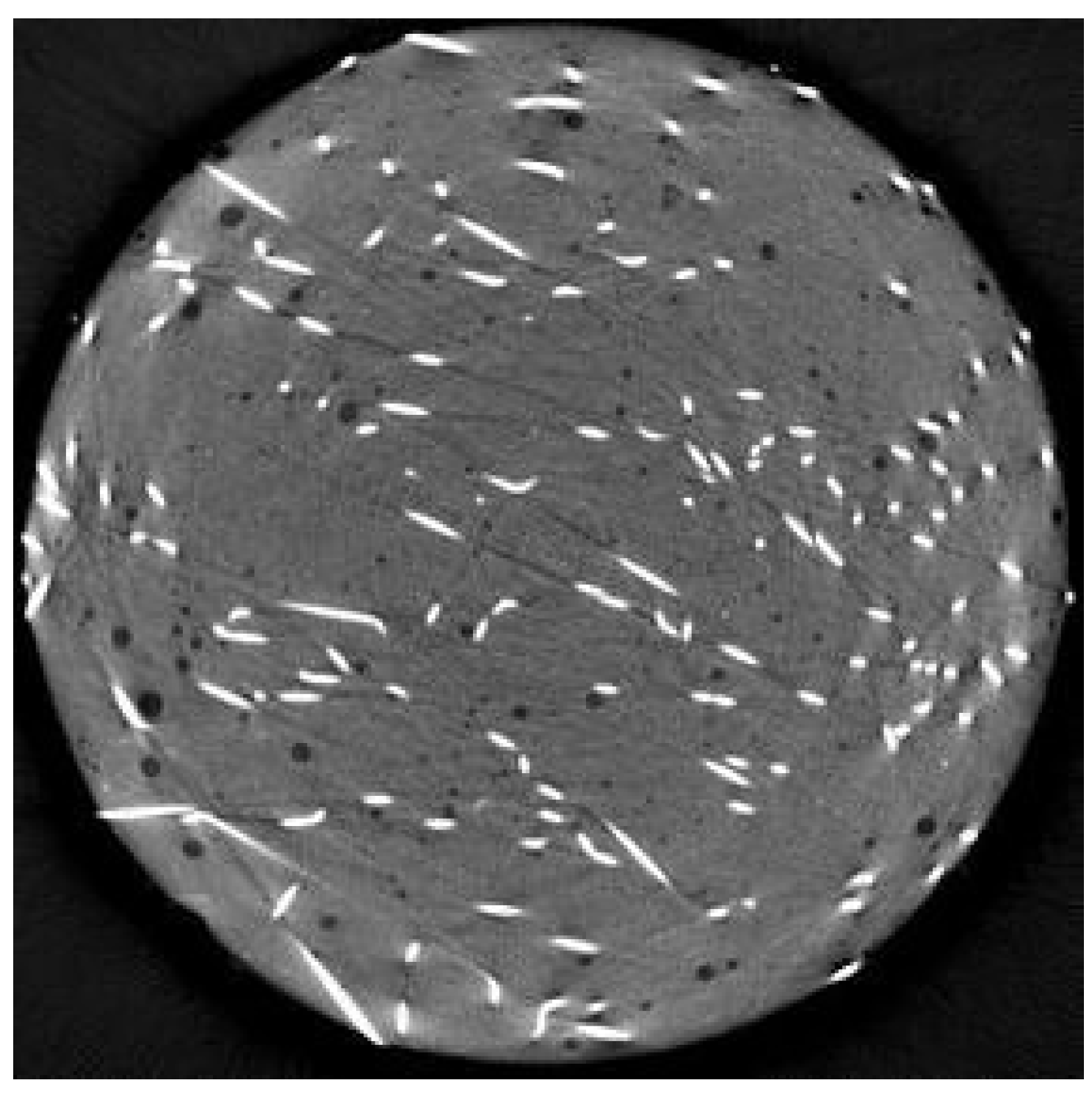
In fiber-reinforced cementitious composites (FRCCs), the orientation and distribution of fibers directly affect the behavioral properties, which leads to anisotropy of the material. In the actual pouring process, fibers tend to be asymmetrically arranged without being uniformly mixed due to the influence of gravity, viscosity, and filling property. As shown in Figure 6, the fibers in the cement matrix are mixed in an uneven direction. These fiber nets cause differences in tensile stress transfer efficiency when cracking proceeds, and even in the same material, direction-dependent behavior in which strength and failure mode vary depending on the load direction appears [68].
This asymmetric orientation leads to a problem in which the number of fibers across the crack plane decreases or the stress transfer path is discontinuously formed due to differences in fiber distribution and orientation. As a result of testing by cutting the core in various directions in the SFRC slab, it was reported that when there were many fibers matching the tensile direction, the residual tensile strength increased by up to 30% or more, but on the contrary, if the fibers were arranged perpendicular to the load direction, the tensile strength decreased by more than 20% after destruction [69]. In addition, depending on the core position, the residual stress was 30% higher on average in the lower specimen than in the upper part, confirming that fiber sedimentation and separation during the pouring process were the main factors of strength unevenness.
It was determined that fiber-matrix debonding induces local stress concentration in short fiber reinforcing materials into which complex fiber orientation is introduced, resulting in anisotropic damage progress in the overall material. In the study, it was suggested that the more uneven the fiber orientation, the more the ductility damage of the matrix is concentrated in a specific direction, and the unevenness of the interfacial shear stress causes the overall stiffness to decrease [70]. This phenomenon is applied equally in actual concrete, resulting in locally concentrated destruction along the fiber direction when the fibers are irregularly oriented.
Finally, the anisotropy of fiber-reinforced cement composites stems from the asymmetric distribution of fibers formed during pouring, local damage to the fiber-matrix interface, and inconsistency between the crack surface and the fiber direction. This structural anisotropy governs the direction of crack initiation and progress and deepens the nonlinearity of load redistribution and residual tensile behavior by position. Therefore, if the alignment of the fibers is not controlled, the strength prediction according to the material’s position may become uncertain, and the ductility and destructive safety of the structure may deteriorate [68,69,70].

4. Current Status and Limitations of Anisotropic Quantification and Interpretation of Cementitious Materials

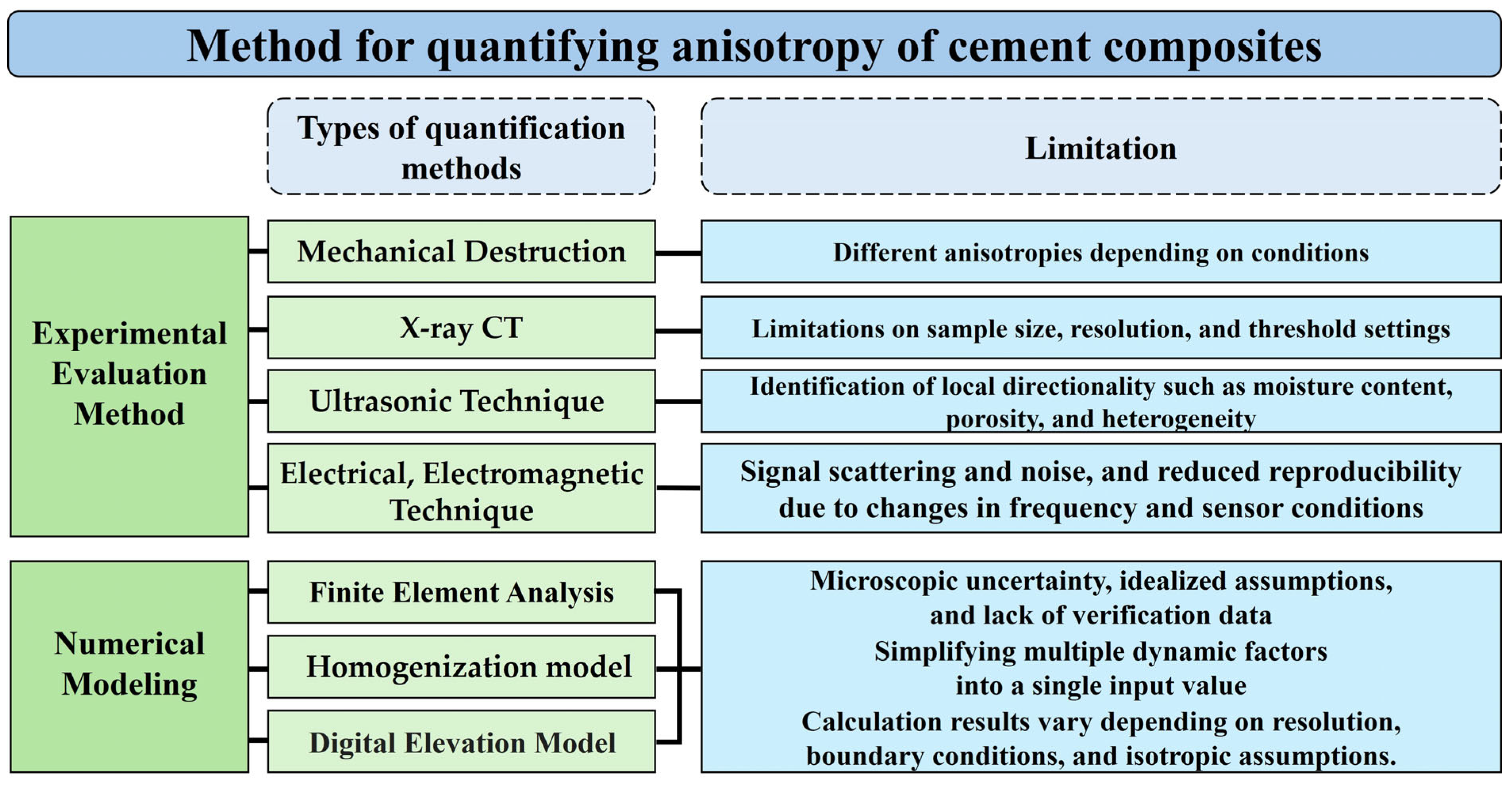
Quantification of the anisotropy of cement-based materials is necessary to model the behavior of the material as a consistent property value. Figure 7 largely divides the method of quantifying and applying the anisotropy of cement-based materials into a quantification method using an experimental approach and a quantification method through numerical modeling; it shows the current method of quantifying the anisotropy and its limitations in a mimetic diagram. Among the methods of quantifying anisotropy, the method of quantifying through the experimental approach has mainly indirectly estimated the internal structural asymmetry using the difference in physical properties by direction [5,17].
Mechanical anisotropy evaluation is one of the oldest approaches and measures the asymmetry of the stress–strain relationship through load experiments by direction. In mechanical testing, anisotropy is mainly quantified by the elastic modulus anisotropy ratio (AE = E/E), and the difference in elastic modulus or tensile strength of specimens loaded in the horizontal and vertical directions is an indicator reflecting the directionality of the internal microstructure [71,72]. However, even a small change in the conditions depends on the volume fraction of the components, the phase shape, the measurement position within the structure, etc., and the result varies significantly. In other words, it is difficult to clearly distinguish whether the measured anisotropy value reflects the intrinsic structure of the actual material or whether it is the result of simple test conditions [73,74,75]. Moreover, since the heterogeneity inside the material is not spatially continuous, there is also the fundamental limitation that it is difficult to represent the directionality of the entire material with a single specimen [21]. For this reason, mechanical testing provides an average orientation of the entire material but fails to elucidate the origins of microstructural features (pores, ITZs). Therefore, to consistently connect multiphysics information with global and local orientations, mechanical testing results need to be combined with other data-driven tools.
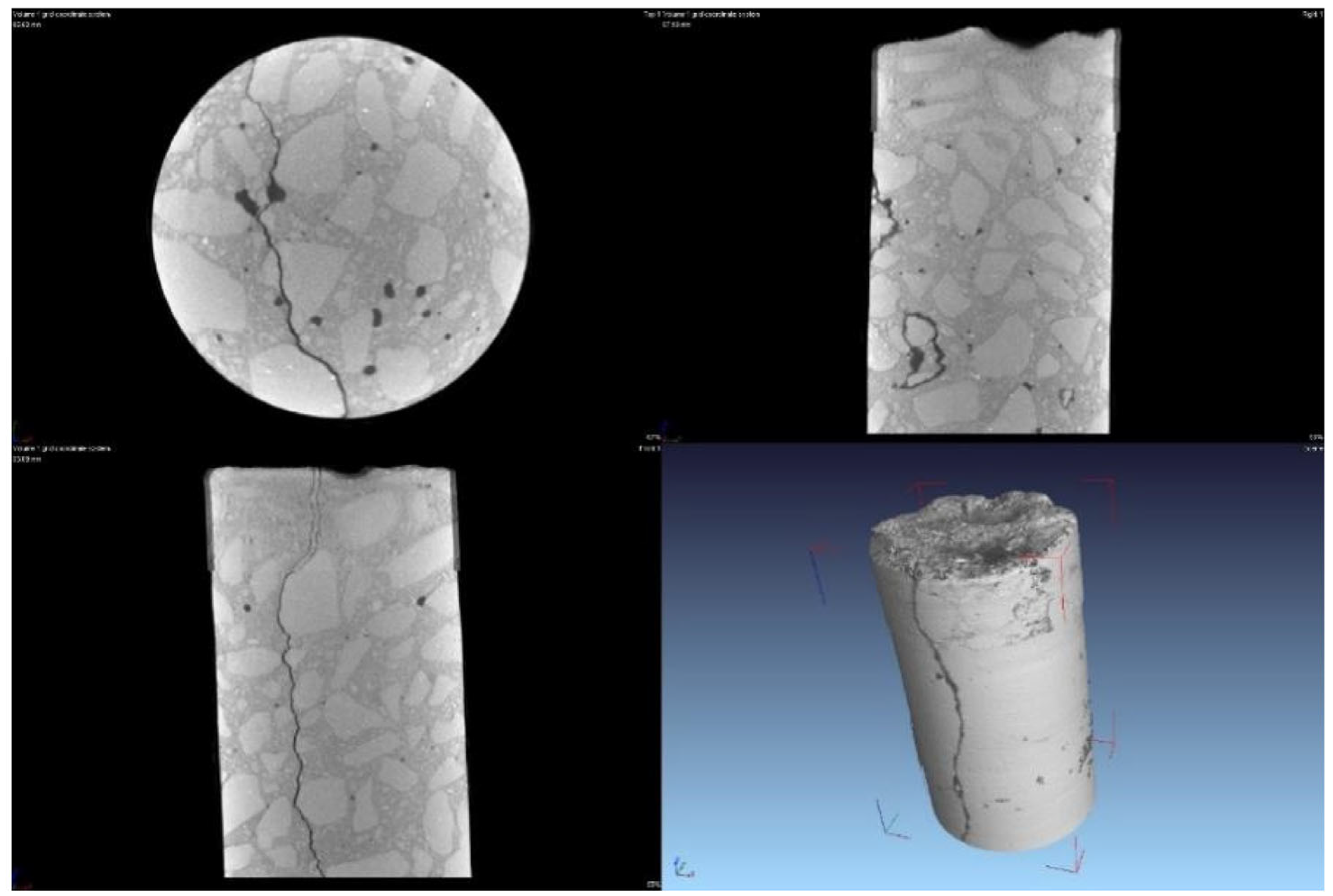
X-ray CT is a key technique that quantifies the distribution and orientation of fibers by non-destructively analyzing the internal structure of cement-based composites. The CT-based orientation is expressed as an orientation tensor (aij = ⟨ninj⟩); by accumulating and calculating the area ratio of fibers in the CT cross-section, the volume fraction and direction-specific dispersion can be obtained, and the structural anisotropy can be evaluated through this. Figure 8 is an image of cracked concrete with X-ray CT. The location of thick aggregates and cement pastes in concrete can be confirmed through the image, and it can be confirmed that the heterogeneous anisotropy of concrete affects the crack [18].
However, this method is limited to a small specimen to obtain a high-resolution image, and the calculation error varies significantly depending on the resolution and threshold setting. In addition, in thick specimens, the volume fraction is overestimated due to overlapping projections and it takes a long time to scan and undertake post-processing, making it difficult to apply in the field. Therefore, X-ray CT is effective for precise analysis at the microstructure level, but there is a limit to representing the direction or temporal change of the material as a whole [21,23,24]. In other words, while CT provides a precise local microstructure, it lacks the global directionality of mechanical testing, and it is not directly linked to signal-level information from ultrasound or electromagnetic sources. This scale mismatch complicates the integrated interpretation of multiple causes of anisotropy and highlights the need for ML-based fusion analysis that integrates different resolutions and physical quantities.
Quantifying the anisotropy of cement composites using ultrasonic techniques is a non-destructive method that indirectly evaluates the unevenness and fiber orientation of the internal structure by analyzing the difference in the direction of the wave propagation speed in the material. Ultrasonic-based anisotropy is expressed by the longitudinal wave velocity ratio (AV = V/V), and the ultrasonic pulse velocity method (UPV) calculates the velocity by measuring the propagation time between the transmitter and receiver and estimates the directional difference in elastic modulus or stiffness [25,26]. This method has the advantage of being able to evaluate the homogeneity and orientation inside the material without damaging the specimen and being easy to apply in the field. However, it is highly sensitive to factors such as the complex unevenness of concrete, moisture state, and porosity, so there is a limit in that the wave velocity change does not necessarily reflect the anisotropy alone [25,26,76]. In addition, since the measured velocity corresponds to the average value of the entire sample, there is a limit to the identification of local fiber alignment or fine orientation, and it is difficult to compare between tests due to the absence of a standardized analysis procedure [77,78,79]. Recently, high-resolution phase arrangement and ultrasonic tomography techniques have been developed to improve spatial resolution, but, due to expensive equipment and complex post-processing, field utilization is still limited [21,25,26,80].
The anisotropic quantification of cement composites using electrical and electromagnetic techniques is a non-destructive method that evaluates the heterogeneity of fiber orientation or conductive paths by measuring the distribution of eddy currents and electromagnetic response characteristics generated inside the material [22,81,82,83]. Currently, anisotropy is mainly quantified using the electrical conductivity ratio (σ/σ) or the impedance direction ratio. In particular, the use of multiple frequencies or multiple-harmonization signals has the advantage of being able to measure reactions at different depths simultaneously, allowing for the precise classification of the three-dimensional anisotropic distribution inside the composite material [22,82,83]. However, since cement composites are a multi-phase structure that is a mixture of non-conductive aggregates, pores, hydration products, etc., the scattering and noise of electromagnetic signals are severe, so the sensitivity and reproducibility are low [81,82,83]. In addition, high-frequency signals have a shallow penetration depth, low-frequency signals have poor spatial resolution, and the lift-off effect due to the change in the gap between the sensor and the surface is the main cause of signal distortion. In addition, it is difficult to compare between experiments in that there is no standardized correction procedure because the results vary depending on sensor arrangement, frequency setting, magnetic flux density, etc. [82,83,84]. For this reason, electrical and electromagnetic techniques are promising tools for directional evaluation of cement composites, but their reliability is further improved when applied in parallel with other non-destructive methods such as ultrasound or X-ray CT.
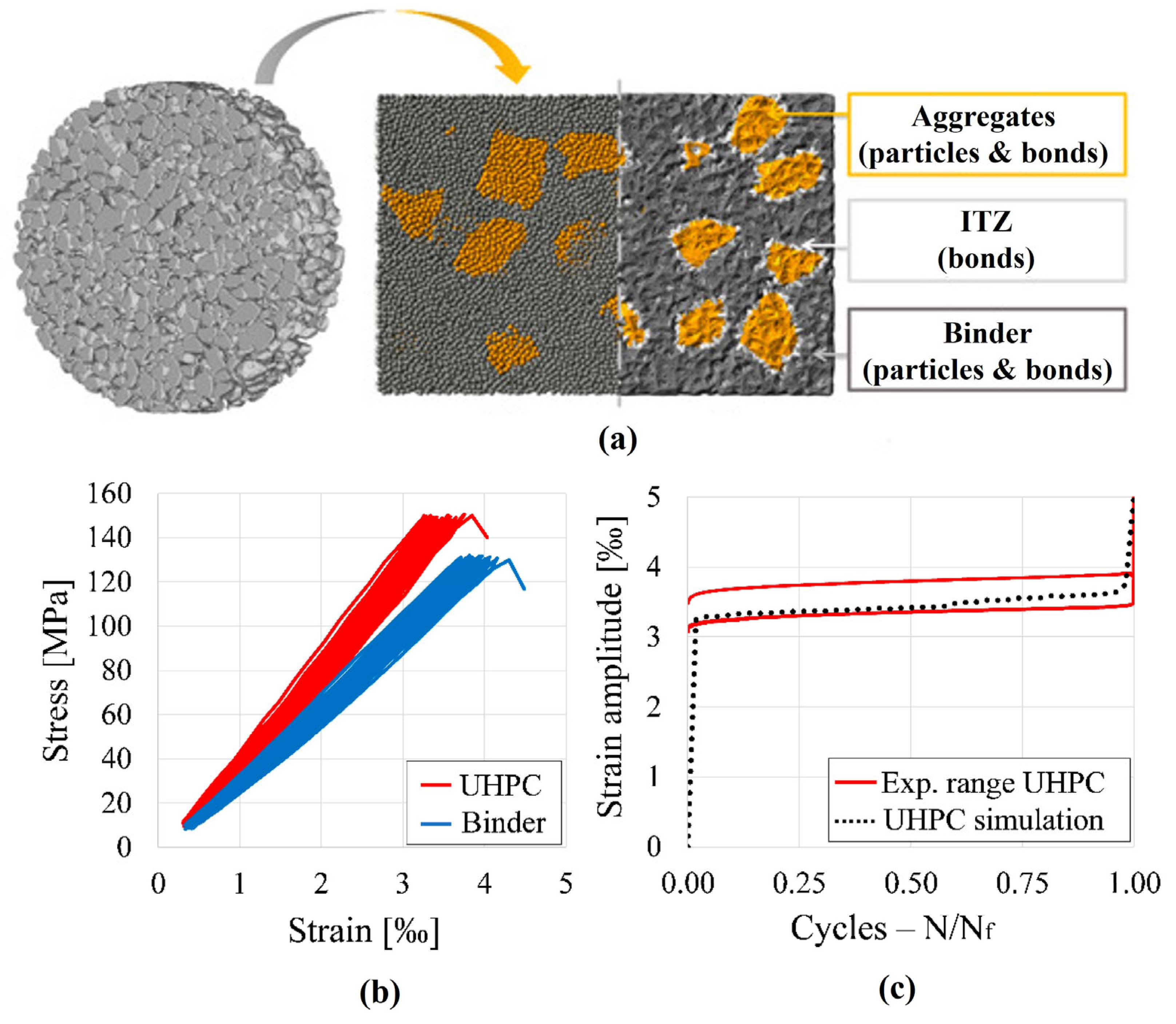
Numerical modeling and analysis to quantify the anisotropy of cement-based materials have been developed to compensate for the limitations of the experimental approach. Concrete, a multiphase composite material, has a heterogeneous distribution of aggregates, cement paste, pores, and hydration products, and this complex microstructure induces directional dependence of macroscopic properties such as elastic modulus anisotropy (AE), hydraulic conductivity ratio (Ak), and thermal conductivity ratio (Aλ) [85,86,87]. Finite element analysis (FEA), the digital elevation model (DEM), and the homogenization model are used to analyze this, and complex stress–deformation–transfer characteristics can be predicted without experiments.
Figure 9a is a cross-section of a three-phase model and is a 3D model reconstructed from µCT. As can be seen in this model, the anisotropy of concrete should be considered, and the macroscopic fatigue simulation results in Figure 9b and the hysteresis loop obtained in the fatigue simulation in Figure 9c reflect the simulation after parameter correction for the components of each three-phase structure such as the binder, ITZ, and aggregate [88].
However, these models still have structural limitations of microscopic uncertainty, idealized assumptions, and lack of verification [22,81,88,89,90]. The actual microstructure of concrete changes continuously over time due to hydration, moisture content, crack progress, hybridization reaction, etc. [9,91]. When these dynamic factors are simplified to a single input parameter, the anisotropy reflected by the model is not representative of the actual variability of the material [92]. In addition, due to the limitations of the resolution and calculation cost of numerical analysis, it is difficult to accurately reproduce local heterogeneity such as ITZ or void linkage, which leads to distortion in the predicted directionality results. Many models are inconsistent with the nonlinear damage mechanism of concrete based on idealized premises such as isotropic elastic constant, uniform boundary condition, linear behavior, etc. As a result, the directional indicators produced in the simulation are difficult to obtain consistency with the experimental anisotropy coefficient [21,88,93,94,95,96,97]. After all, numerical modeling is an essential tool for understanding the anisotropy of concrete and interpreting trends, but due to the representativeness of input data and the assumption of idealization of modeling, there are fundamental limitations to quantitative reliability. Therefore, it is difficult for numerical models to comprehensively reproduce multi-scale and multi-physical anisotropy on their own, and ML-based analysis is required to learn by linking experimental, image, signal, and model data with these anisotropy indices (AE, Ak, Aλ, aij).

5. Machine-Learning-Based Anisotropy Quantification and Prediction

The anisotropy of cement-based materials occurs nonlinearly in the interaction of complex microstructures, heat and moisture shifts, and chemical reactions [68,69,70]. However, as discussed earlier, existing experimental and numerical approaches are at the level of observing or assuming anisotropy. Image-based quantification methods present visual forms, not actually quantifying them. In addition, numerical models do not reflect actual structural heterogeneity on the premise of isotropic or averaged parameters [92]. This limitation allows a central data-driven approach to machine learning (ML) to quantitatively reconstruct complex symmetry collapses of cement-based materials [27]. The key to machine learning is to learn nonlinear correlations through the intrinsic patterns of the data itself, rather than through predefined physical equations. It can extract directional factors and symmetry decay patterns that the existing models have not captured by integrating learning microstructure images and mechanical properties [27,28].

5.1. Machine Learning Complementation of Image-Based Anisotropic Quantification

The anisotropy of cement-based materials has been observed using various experimental techniques such as scanning electron microscopy (SEM), X-ray tomography (XCT), digital image correlation analysis (DIC), and nanoindentation. However, these techniques have fundamental limitations in that they depend on the subjectivity of the observer or that image interpretation remains at a qualitative level [29,98,99]. Since the direction of the cement structure, the void connectivity, and the orientation of microcracks exist as pixel-level correlations in the image, it is difficult to quantitatively identify their statistical characteristics with visual reading. Machine-learning-based image analysis has recently spread rapidly to compensate for the limitations of this qualitative analysis [27,28,30].
Machine learning can quantify the structural features of symmetrical breakdowns by converting experimental image data into mathematical vector form and automatically learning the spatial patterns inside them. Convolutional neural networks (CNNs) excel at extracting directional patterns from microtissue images [31,32]. Having learned the pixel distribution of SEM images, CNN automatically recognizes the linear arrangement of hydration products, alignment of voids, continuity of cracks, etc., as filter coefficients and automatically detects the spatial intensity of microscopic symmetry collapse by converting it into numerical values [28]. Meanwhile, by extending these machine-learning-based quantitative analyses recently, generative models can reconstruct microtissues similarly to reality based on statistical rules learned beyond just classifying a given image or extracting features and predicting the direction of formation of cracks or voids within them [27].
By integrating the U-Net-based generative model and the Denoising Diffusion Probabilistic Model (DDPM), approximately 15,000 BSE-SEM images are learned, which statistically reproduces the microstructure of the actual cement paste. The resulting microstructure shows the scale distribution, phase composition, and connectivity almost identical to the actual image, demonstrating that the model has learned the topological and geometric rules inside the material, not just image generation. At this time, while simple CNN-based models are suitable for extracting features from individual images and predicting properties, generative models such as DDPM/U-Net have an advantage in anisotropic representation power in that they can reproduce the statistical distribution and topological structure of an entire group of images, not just a single image [27].
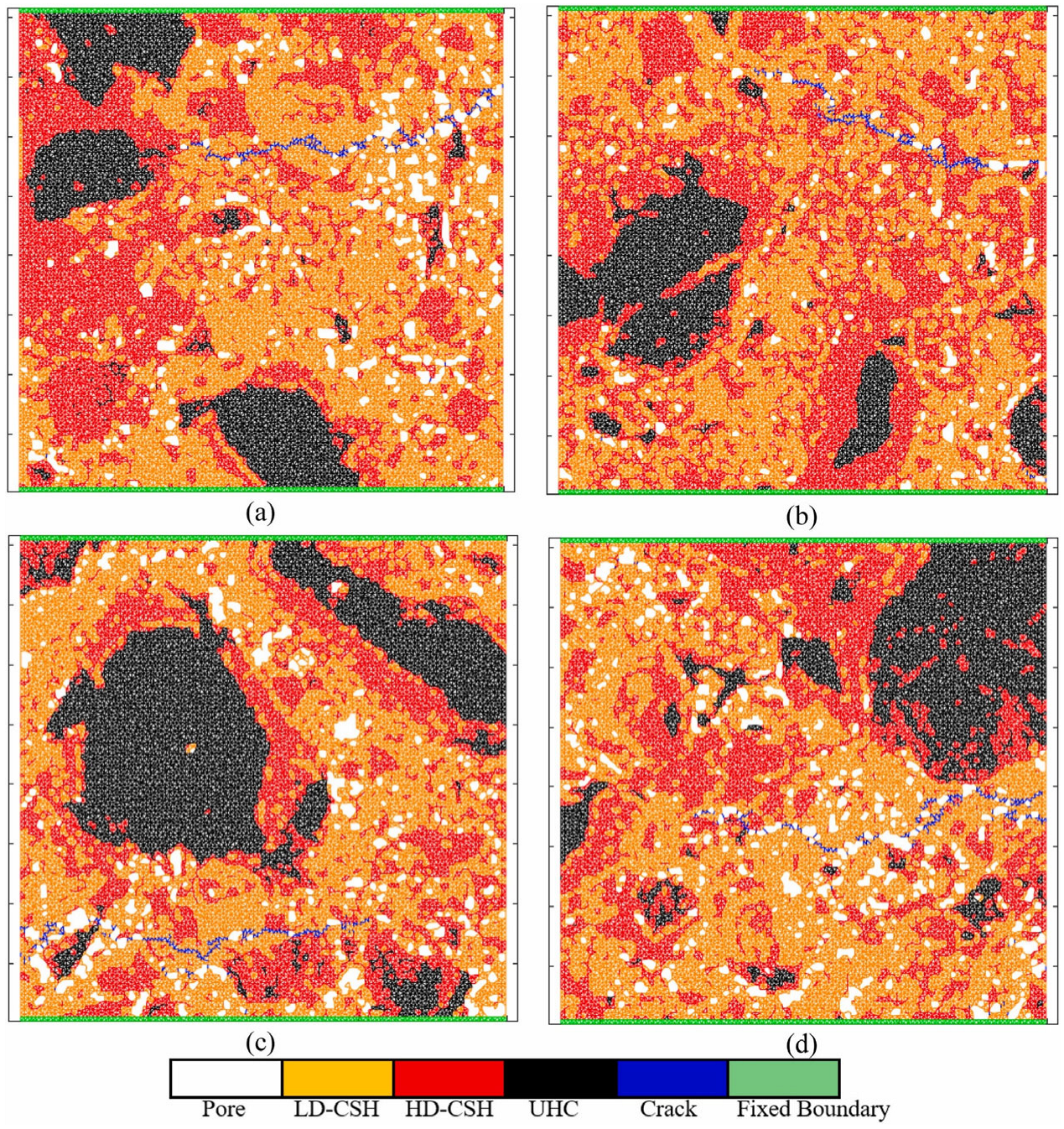
Figure 10 shows the microstructure in which the crack pattern is visible, Figure 10a,b is the created microstructure, and Figure 10c,d is the original microstructure [27]. The fact that the crack propagates mainly along the LD-CSH area in the image generated by the model is consistent with the actual cement structure’s crack diffusion trend. These results imply that the model has inherently learned the orientation of the hydration product, the continuity of the pores, and the direction of crack progression, not just by learning pixel-level visual information, but by capturing the directional behavior of the symmetry collapse occurring in the cement-based composite with statistical rules and quantifying it in the form of a filter coefficient, enabling quantitative comparison and prediction of physical properties such as stress–strain curve, elastic modulus, and short axis tensile strength [27]. However, generative models have a larger number of parameters and training time than CNNs, and require more image data and labels to reliably reproduce the statistical distribution of microstructures, which presents a burden in terms of computational cost and data requirements [28].

5.2. Machine Learning Complementation of Ultrasound-Based Anisotropic Quantification

Ultrasound tests have been used as a key means of non-destructively evaluating microstructure changes and anisotropic behavior inside cement-based materials. The speed, attenuation, and diffusion characteristics of the wave reflect the connectivity of the pores, the inter-particle contact characteristics, and the heterogeneity of the interfacial potential (ITZ) and thus are used as quantitative indicators of anisotropy [100]. However, conventional ultrasonic techniques do not fully explain the complex interaction between wave-materials based solely on the amplitude and velocity changes in the signal. The heterogeneity due to the polyphase structure that occurs during the hydration process of cement composites absorbs and scatters frequencies, making it difficult to interpret and the precision decreases [100].
To overcome this limitation, an ultrasonic-diffusion-based approach has been proposed. This method can individually evaluate the structural effect due to scattering and the loss due to viscoelastic absorption by separating and analyzing the decay signal into a diffusion coefficient (D) and a dissipation coefficient (σ). Using this method, the multi-scale microstructure of the hydrated cement pastes and concrete was monitored [100]. The diffusion coefficient (D) increases or decreases according to the changes in the spacing and pore structure between particles, and the dissipation coefficient (σ) was affected by the viscoelastic behavior of the base material. It was found that the presence, thickness, and porosity of the ITZ directly affect the diffusion behavior. However, it has also been reported that this method has large signal variability depending on the crack shape or environmental factor, so that the consistency of the results is poor even within the same material.
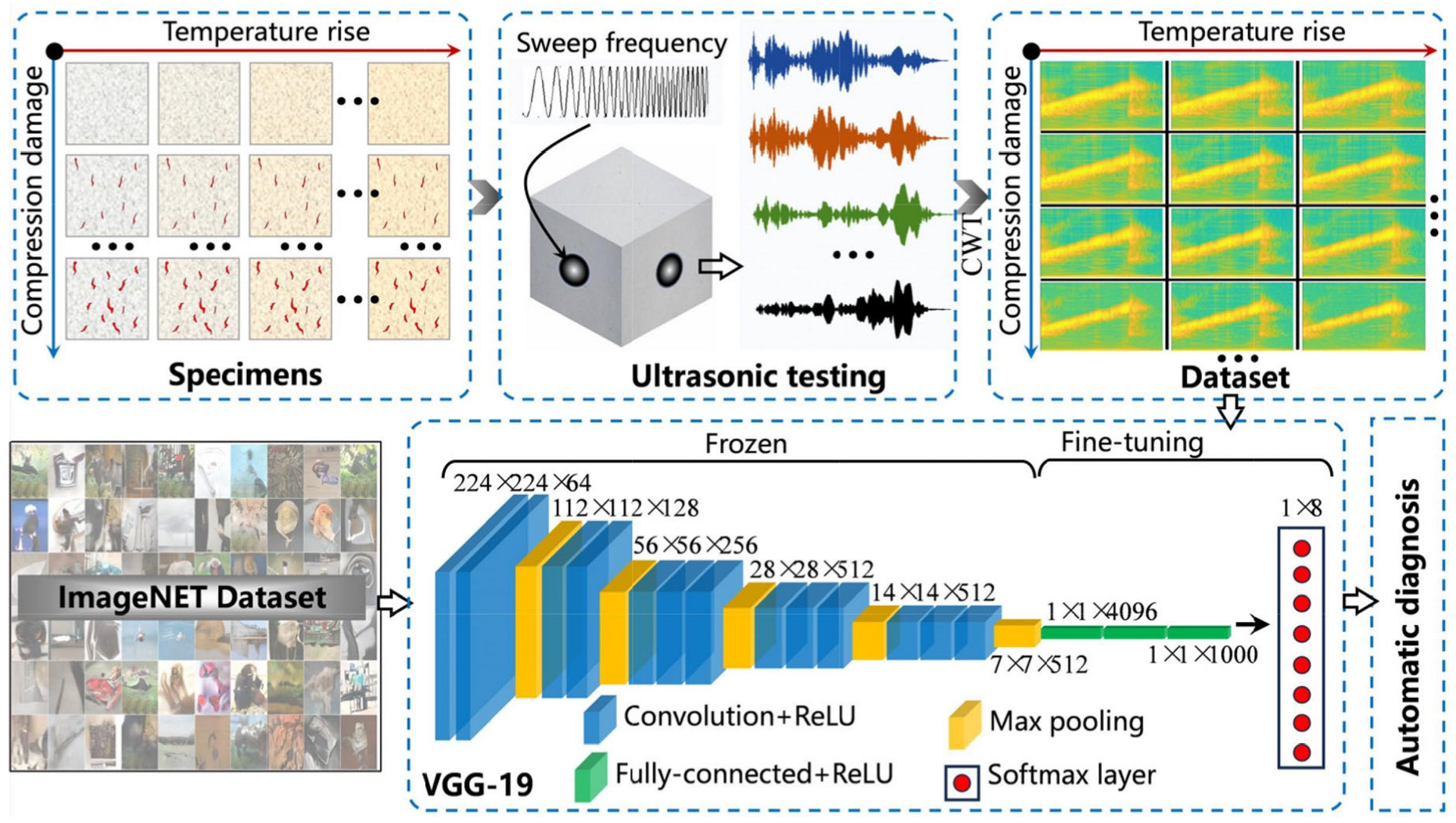
To alleviate the experimental constraints, ultrasonic signal analysis using machine learning is being actively attempted. The ultrasonic time series data were converted into the frequency-time domain through continuous wavelet conversion (CWT) and the degree of compression damage of concrete under temperature change conditions was automatically predicted by using a transfer learning-based deep convolutional neural network (DCNN) [101]. This study showed higher prediction accuracy than the existing temperature correction technique and reduced environmental dependence by learning nonlinear changes in damping patterns based on data [101]. It is a diagram of the flow of accurately determining the damage state by learning damage from the obtained ultrasonic signal in Figure 11. It is confirmed that the accuracy is up to 98.2% by applying it to ultrasonic diagnosis through DCNN [101]. While diffusion coefficient-based analysis offers the advantage of high interpretability due to its direct connection to signal physical quantities, it is sensitive to changes in environmental conditions and has limited data-based correction capabilities. Conversely, DCNN-based ultrasound analysis offers the advantage of extracting ultrasonic signal characteristics based on temperature changes, enabling highly accurate diagnosis even with limited data [28,101].
As a result, machine-learning-based ultrasonic analysis extends beyond simple signal processing assistance technology to a physical-data fusion model that inherently learns the nonlinearity of wave-microstructure interactions. This approach complements the limitations of existing diffusion coefficient-centered analysis and shows the possibility of precisely explaining the symmetry collapse of cement-based materials by restoring anisotropic factors such as microstructure orientation, void connectivity, and crack growth direction to high resolution and presenting a quantitative calibration model that reflects external environmental conditions [76,100,101,102,103].

5.3. Machine Learning—Simulation Convergence with Limitations of Numerical Model-Based Interpretation

Existing numerical analysis approaches such as FEM, CFD, and FVM do not sufficiently reflect the complex anisotropic behavior of cement-based materials. In general, these models presuppose isotropic or averaged physical properties and simplify local asymmetric properties such as the heterogeneity of the microstructure, grain orientation, and continuity of pores [2,28,92]. In particular, the directionality of the microstructure or the time-dependent damage behavior is difficult to completely describe by physical formula and is calculated by approximating boundary conditions or parameters within a numerical model. As a result, it has a limitation in that it cannot accurately reproduce the crack propagation trend, anisotropic stress distribution, and nonlinear viscosity changes observed in actual experiments [104].
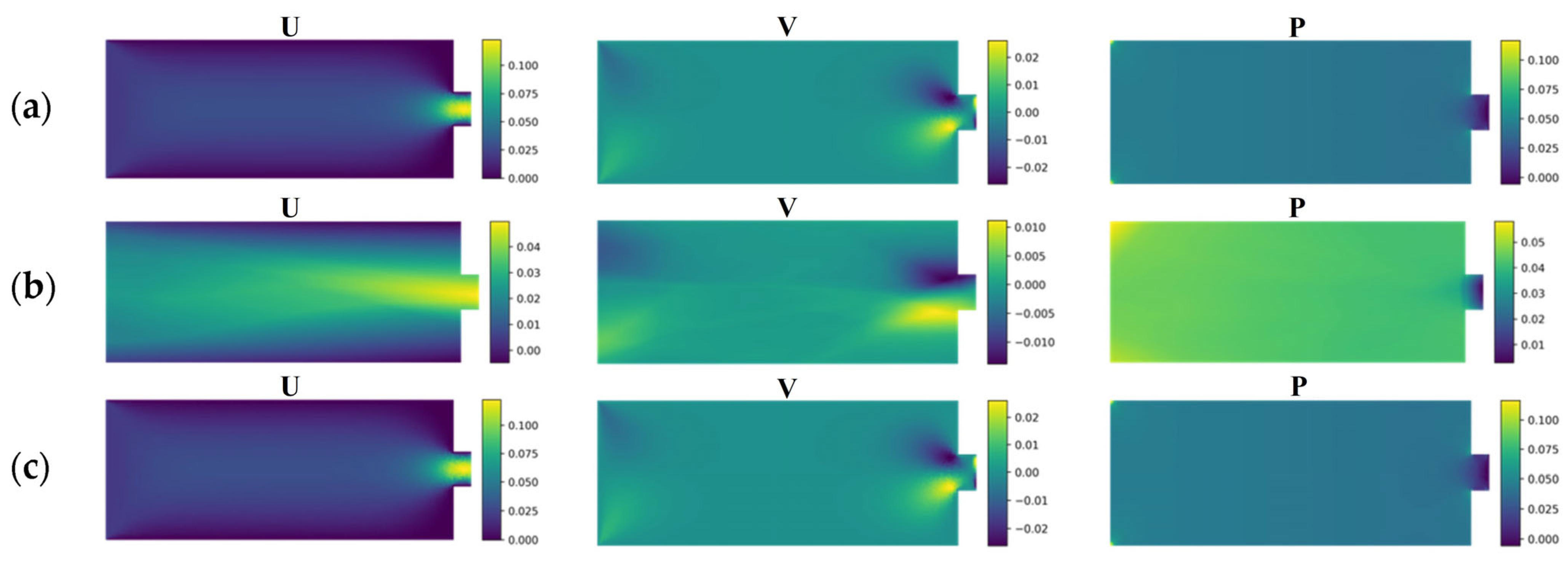
To overcome these limitations, attempts have recently been expanded to correct the spatial variability and nonlinear behavior of anisotropic properties based on data by fusing machine learning (ML) with numerical models. To consider the anisotropic viscosity and flow direction of fluid cement paste, a physics-informed neural network (PINN) with physical constraints was applied to the Navier–Stokes equation. As a result, it reproduces the anisotropic flow pattern in the laminar flow-shear section that the existing CFD model could not explain, reduces the error in the experimental data, and reports that the inference time of the NSINN model is 0.039 s, which is 10 times faster than the CFD’s inference time of 3.37 s [104] compared to other learning methods, ANN and previous studies, it can also be confirmed through Figure 12 that the flow pattern in areas with complex flow such as near the wall or nozzle outlet is well reproduced.
To interpret the anisotropic deformation and damage behavior of short fiber composites, a thermodynamically consistent material model combining physical-based deep learning (PLDL) was proposed. The model implemented data-driven prediction under physical constraints by including the residuals of physical equations directly as learning losses while suppressing the numerical instabilities that often occur in FEM [105]. In addition, we derive accurate results by supplementing the local directivity simplified by FEM with the ML-based property prediction model for the anisotropic behavior [28,105].
These studies show that machine learning is not just an auxiliary tool but also complements the physical limitations of numerical models based on data and expands the interpretation space of the simulation. ML–Simulation fusion presents the potential to significantly increase computational efficiency by predicting microstructure-based anisotropy analysis in real time or building an alternative model learned from FEM and CFD results.

6. Limitations and Future Studies

To quantitatively analyze the anisotropy of cement-based materials, existing experiments, in numerical interpretations of symmetry premises, machine-learning-based approaches have quantified and quantified the anisotropy and converted it into data [27,28,30]. However, challenges remain to be solved.
First, the lack of quality and standardization of data is a key constraint. The microstructure of cement-based materials continuously changes according to hydration reaction, hybridization reaction, curing conditions, and environmental exposure, and the specimen size, resolution, equipment, and image processing method are different for each study [106]. This inconsistency reduces learning stability and reproducibility and makes it difficult to compare results between different studies. In the future, it is necessary to establish a multimodal database that integrates image, spectroscopy, and epidemiological data, and a system that can label symmetry and anisotropy related variables in a standardized format should be prepared [107,108]. In addition, the lack of standardization of analysis indicators and result interpretation makes comparison between studies difficult. Even for the same anisotropy index, quantitative compatibility is low because the definition method and calculation procedure are different for each researcher [106,109,110]. Therefore, quantification indicators of the same anisotropy are required, and standardization is required.
There are also limitations to the anisotropy measurement method to which machine learning is applied. This is because the physical interpretability of machine learning models has not been sufficiently secured. Even if the predictive performance is high, it is difficult to explain which structural factors influenced the change in physical properties inside the model [111,112]. In multiphase amorphous materials such as cement composites, causal behavior cannot be reproduced only by simple correlation learning. Therefore, it is necessary to develop physical-based deep learning that internalizes physical principles such as symmetrical constraints, energy conservation, and stress equilibrium in the learning process [28,105,113]. Through this, the model should be able to present actual structural behavior in an interpretable form beyond simple data fit.
The reliability problem of machine learning cannot be overlooked. Distorted correlations can be strengthened if the data that have not been noise-removed are trained; if the prediction uncertainty is not specified, it can lead to safety issues in the actual design stage [114]. Future studies require a systematic verification procedure that quantitatively evaluates the uncertainty of the model and gives a confidence interval to the prediction results.
Ultimately, machine-learning-based anisotropy analysis represents a new analysis framework that could quantitatively describe the direction of symmetry collapse and its physical consequences beyond the existing point of view of recognizing cement-based materials as simple heterogeneous. In the future, when data quality improvement, physical embedded model establishment, index standardization, and reliability verification are systematically performed in parallel, cement composite research will evolve away from an empirical approach and into physically consistent data-driven design science.

7. Conclusions

This study systematically analyzed the structural symmetry and anisotropy of cement-based materials and presented an integrated framework to expand them to a machine learning-based approach. First, the intrinsic symmetry of cementitious composites is collapsed from the formation stage due to chemical and thermodynamic inequality, microstructure heterogeneity, mechanical restraint, and gradients in the curing environment, and as a result, the microscopic level of asymmetry is projected into macroscopic behaviors such as stress transfer, heat and moisture transfer, and chemical reactions. This structural anisotropy is expressed in various forms in all types of cementitious materials such as general concrete, lightweight and porous concrete, 3D-printed concrete, and fiber-reinforced composites, and mechanical, thermal, and mathematical anisotropy is strengthened according to the difference in composition, orientation, and pore connection of each phase.
Existing experimental quantification methods (X-ray CT, ultrasound, electric/electromagnetic measurements, etc.) partially investigated the directional dependence inside the material, but it was difficult to secure reproducibility and reliability due to resolution limits, specimen size constraints, analyst dependence, and non-standardized procedures. Numerical models (FEM, DEM, homogenization models, etc.) did not sufficiently reflect actual structural variability by simplifying complex microtissues into isotropic or average parameters.
Machine-learning-based approaches have emerged to overcome these limitations. Image-based deep learning such as CNN, U-Net, and DDPM has shown that it is possible to quantify the collapse of microstructural symmetry such as orientation, void connectivity, and crack progression direction of hydration products by learning SEM, XCT, and DIC images. In ultrasonic signal analysis, the transfer-learning-based DCNN learned nonlinear patterns in the frequency-time domain and predicted damage and directionality with higher accuracy than the existing diffusion coefficient analysis. Furthermore, PINN and PLDL approaches, including physical equation constraints, supplemented the limitations of the FEM and CFD models and enabled real-time prediction of anisotropic behavior and improved computational efficiency. Future research will require the construction of a multimodal data set that links image, spectral, and dynamic data, as well as ensuring consistency in the definition, measurement, and interpretation of anisotropy indices. Furthermore, improvements in the predictive reliability and interpretability of neural network structures that incorporate physical constraints, as well as the establishment of a quantitative uncertainty verification system, are essential. With this foundation in place, machine-learning-based analysis is expected to provide a more precise description of the anisotropic behavior of cement composites and enable comparison of results across various materials and conditions, thereby enhancing the reproducibility and scalability of related research.

Author Contributions

Conceptualization, M.O.K.; methodology, M.O.K.; software, T.L.; validation, T.L.; formal analysis, T.L.; investigation, T.L.; resources, T.L.; data curation, T.L.; writing—original draft preparation, T.L.; writing—review and editing, M.O.K.; visualization, T.L.; supervision, M.O.K.; project administration, M.O.K.; funding acquisition, M.O.K. All authors have read and agreed to the published version of the manuscript.

Funding

This research was supported by the “Regional Innovation System & Education (RISE)” through the Seoul RISE Center, funded by the Ministry of Education (MOE) and the Seoul Metropolitan Government. (2025-RISE-01-014-04).

Data Availability Statement

The original contributions presented in the study are included in the article; further inquiries can be directed to the corresponding authors.

Acknowledgments

The authors express their sincere gratitude to the Ministry of Education (MOE) and the Seoul Metropolitan Government for their financial support.

Conflicts of Interest

The authors declare no conflicts of interest.

References

  1. John, E.; Lothenbach, B. Cement hydration mechanisms through time–a review. J. Mater. Sci. 2023, 58, 9805–9833. [Google Scholar] [CrossRef]
  2. Huang, J.; Krabbenhoft, K.; Lyamin, A.V. Statistical homogenization of elastic properties of cement paste based on X-ray microtomography images. Int. J. Solids Struct. 2013, 50, 699–709. [Google Scholar] [CrossRef]
  3. Scherer, G.W.; Zhang, J.; Thomas, J.J. Nucleation and growth models for hydration of cement. Cem. Concr. Res. 2012, 42, 982–993. [Google Scholar] [CrossRef]
  4. Gallucci, E.; Mathur, P.; Scrivener, K. Microstructural development of early age hydration shells around cement grains. Cem. Concr. Res. 2010, 40, 4–13. [Google Scholar] [CrossRef]
  5. He, S.; Li, Z.; Yang, E.H. Quantitative characterization of anisotropic properties of the interfacial transition zone (ITZ) between microfiber and cement paste. Cem. Concr. Res. 2019, 122, 136–146. [Google Scholar] [CrossRef]
  6. Li, J.; Zhang, W. Preferred orientation of calcium silicate hydrate and its implication to concrete creep. Compos. Part B Eng. 2022, 247, 110297. [Google Scholar] [CrossRef]
  7. Vandamme, M.; Ulm, F.J. Nanogranular origin of concrete creep. Proc. Natl. Acad. Sci. USA 2009, 106, 10552–10557. [Google Scholar] [CrossRef]
  8. Wenk, H.R.; Monteiro, P.J.; Kunz, M.; Chen, K.; Tamura, N.; Lutterotti, L.; Del Arroz, J. Preferred orientation of ettringite in concrete fractures. Appl. Crystallogr. 2009, 42, 429–432. [Google Scholar] [CrossRef]
  9. Zheng, Q.; Jiang, J.; Xu, G.; Yu, J.; Tang, L.; Li, S. New insights into the role of Portlandite in the cement system: Elastic anisotropy, thermal stability, and structural compatibility with CSH. Cryst. Growth Des. 2020, 20, 2477–2488. [Google Scholar] [CrossRef]
  10. Tzschichholz, F.; Herrmann, H.J.; Zanni, H. Reaction-diffusion model for the hydration and setting of cement. Phys. Rev. E 1996, 53, 2629. [Google Scholar] [CrossRef][Green Version]
  11. Wang, Y.; Xi, Y. The Effect of Temperature on Moisture Transport in Concrete. Materials 2017, 10, 926. [Google Scholar] [CrossRef]
  12. Li, J.; Zhang, W.; Xu, K.; Monteiro, P.J. Fibrillar calcium silicate hydrate seeds from hydrated tricalcium silicate lower cement demand. Cem. Concr. Res. 2020, 137, 106195. [Google Scholar] [CrossRef]
  13. Maddalena, R.; Li, K.; Chater, P.A.; Michalik, S.; Hamilton, A. Direct synthesis of a solid calcium-silicate-hydrate (CSH). Constr. Build. Mater. 2019, 223, 554–565. [Google Scholar] [CrossRef]
  14. Yan, Y.; Geng, G. Evolution of CSH morphology at early age: New insights from direct TEM observation. J. Build. Eng. 2023, 73, 106764. [Google Scholar] [CrossRef]
  15. He, S.; Cao, J.; Chai, J.; Yang, Y.; Li, M.; Qin, Y.; Xu, Z. Effect of temperature gradients on the microstructural characteristics and mechanical properties of concrete. Cem. Concr. Res. 2024, 184, 107608. [Google Scholar] [CrossRef]
  16. Promentilla, M.A.B.; Cortez, S.M.; Papel, R.A.D.; Tablada, B.M.; Sugiyama, T. Evaluation of Microstructure and Transport Properties of Deteriorated Cementitious Materials from Their X-ray Computed Tomography (CT) Images. Materials 2016, 9, 388. [Google Scholar] [CrossRef]
  17. Zhang, G.; Lu, Y. Quantifying Anisotropic Properties of Old–New Concrete Interfaces Using X-Ray Computed Tomography and Homogenization. Infrastructures 2025, 10, 20. [Google Scholar] [CrossRef]
  18. Wang, R.; Wu, H.; Zhao, M.; Liu, Y.; Chen, C. The classification and mechanism of microcrack homogenization research in cement concrete based on X-ray CT. Buildings 2022, 12, 1011. [Google Scholar] [CrossRef]
  19. Chen, Q.; Zhang, J.; Wang, Z.; Zhao, T.; Wang, Z. A review of the interfacial transition zones in concrete: Identification, physical characteristics, and mechanical properties. Eng. Fract. Mech. 2024, 300, 109979. [Google Scholar] [CrossRef]
  20. Alanazi, H. Study of the interfacial transition zone characteristics of geopolymer and conventional concretes. Gels 2022, 8, 105. [Google Scholar] [CrossRef]
  21. Alabi, D.J.; Skarlatos, A.; Riding, K.A.; Reboud, C.; Harley, J.B. Magnetic anisotropy quantification in steel fiber reinforced materials. NDT E Int. 2024, 141, 102995. [Google Scholar] [CrossRef]
  22. Zhang, J.; Ma, R.; Pan, Z.; Zhou, H. Review of Mesoscale geometric models of concrete materials. Buildings 2023, 13, 2428. [Google Scholar] [CrossRef]
  23. Kumar, L.M.; Zeng, C.; Foster, S.J. A stereological approach to estimation of fibre distribution in concrete. Constr. Build. Mater. 2022, 324, 126547. [Google Scholar] [CrossRef]
  24. Ruan, T.; Poursaee, A. Fiber-distribution assessment in steel fiber–reinforced UHPC using conventional imaging, X-ray CT scan, and concrete electrical conductivity. J. Mater. Civ. Eng. 2019, 31, 04019133. [Google Scholar] [CrossRef]
  25. Karaiskos, G.; Deraemaeker, A.; Aggelis, D.G.; Van Hemelrijck, D. Monitoring of concrete structures using the ultrasonic pulse velocity method. Smart Mater. Struct. 2015, 24, 113001. [Google Scholar] [CrossRef]
  26. Fedoroff, A.; Calonius, K.; Sklodowska, A. Measuring damage anisotropy in concrete from ultrasound velocity data. Int. J. Damage Mech. 2025, 1–31. [Google Scholar] [CrossRef]
  27. Liang, M.; Feng, K.; He, S.; Gan, Y.; Zhang, Y.; Schlangen, E.; Šavija, B. Generation of cement paste microstructure using machine learning models. Dev. Built Environ. 2025, 21, 100624. [Google Scholar] [CrossRef]
  28. Sahimi, M.; Tahmasebi, P. Reconstruction, optimization, and design of heterogeneous materials and media: Basic principles, computational algorithms, and applications. Phys. Rep. 2021, 939, 1–82. [Google Scholar] [CrossRef]
  29. Bangaru, S.S.; Wang, C.; Zhou, X.; Hassan, M. Scanning electron microscopy (SEM) image segmentation for microstructure analysis of concrete using U-net convolutional neural network. Autom. Constr. 2022, 144, 104602. [Google Scholar] [CrossRef]
  30. Wijaya, A.; Wagner, J.; Sartory, B.; Brunner, R. Analyzing microstructure relationships in porous copper using a multi-method machine learning-based approach. Commun. Mater. 2024, 5, 59. [Google Scholar] [CrossRef]
  31. Choudhary, K.; DeCost, B.; Chen, C.; Jain, A.; Tavazza, F.; Cohn, R.; Park, C.W.; Choudhary, A.M.; Agrawal, A.; Billinge, S.J.L.; et al. Recent advances and applications of deep learning methods in materials science. npj Comput. Mater. 2022, 8, 59. [Google Scholar] [CrossRef]
  32. Iwata, H.; Hayashi, Y.; Hasegawa, A.; Terayama, K.; Okuno, Y. Classification of scanning electron microscope images of pharmaceutical excipients using deep convolutional neural networks with transfer learning. Int. J. Pharm. X 2022, 4, 100135. [Google Scholar] [CrossRef]
  33. Du, Y.; Ge, Y. Multiphase Model for Predicting the Thermal Conductivity of Cement Paste and Its Applications. Materials 2021, 14, 4525. [Google Scholar] [CrossRef]
  34. Sherzer, G.; Gao, P.; Schlangen, E.; Ye, G.; Gal, E. Upscaling Cement Paste Microstructure to Obtain the Fracture, Shear, and Elastic Concrete Mechanical LDPM Parameters. Materials 2017, 10, 242. [Google Scholar] [CrossRef]
  35. Schulson, E.M.; Swainson, I.P.; Holden, T.M. Internal stress within hardened cement paste induced through thermal mismatch: Calcium hydroxide versus calcium silicate hydrate. Cem. Concr. Res. 2001, 31, 1785–1791. [Google Scholar] [CrossRef]
  36. Ren, Q.; Pacheco, J.; de Brito, J. Mesoscale modeling of recycled aggregate concrete: A parametric analysis of the quality and shape of aggregate. Struct. Concr. 2025, 26, 1636–1653. [Google Scholar] [CrossRef]
  37. Lei, J.J.; Wu, Z.X.; Wen, Z.J.; Cheng, Z.S.; Zhu, R. Mesoscale analysis of the effect of interfacial transition zone on the compressive damage of concrete based on discrete element method. Materials 2022, 15, 8840. [Google Scholar] [CrossRef]
  38. Zhou, J.; Dong, Y.; Qiu, T.; Lv, J.; Guo, P.; Liu, X. The Microstructure and Modification of the Interfacial Transition Zone in Lightweight Aggregate Concrete: A Review. Buildings 2025, 15, 2784. [Google Scholar] [CrossRef]
  39. Zhang, Q.; Zhao, M.; Song, L.; Yang, Y.; He, J. The Evolution of Concrete Microstructure and Chloride-Ion Diffusion Coefficient Under Cyclic Axial Compression. Int. J. Concr. Struct. Mater. 2025, 19, 56. [Google Scholar] [CrossRef]
  40. Qu, Z.; Zhang, Y.; Liu, Z.; Si, R.; Wu, J. A review on early-age cracking of concrete: Causes and control. Case Stud. Constr. Mater. 2024, 21, e03848. [Google Scholar] [CrossRef]
  41. Kolawole, J.T.; Combrinck, R.; Boshoff, W.P. Plastic cracking behaviour of concrete and its interdependence on rheo-physical properties. Compos. Part B Eng. 2022, 230, 109527. [Google Scholar] [CrossRef]
  42. Muslim, F.; Wong, H.S.; Cheng, G.; Alexandrou, C.; Liu, B.; Buenfeld, N.R. Combined effects of vertical spacers and segregation on mass transport properties of reinforced concrete. Mater. Struct. 2020, 53, 151. [Google Scholar] [CrossRef]
  43. Shen, D.; Liu, K.; Ji, Y.; Shi, H.; Zhang, J. Early-age residual stress and stress relaxation of high-performance concrete containing fly ash. Mag. Concr. Res. 2018, 70, 726–738. [Google Scholar] [CrossRef]
  44. de Sa, C.; Benboudjema, F.; Thiery, M.; Sicard, J. Analysis of microcracking induced by differential drying shrinkage. Cem. Concr. Compos. 2008, 30, 947–956. [Google Scholar] [CrossRef]
  45. de Siqueira Neto, L.A.; Isgor, O.B.; Weiss, W.J. Modeling fluid absorption in layered anisotropic cement-based materials. Mater. Struct. 2025, 58, 213. [Google Scholar] [CrossRef]
  46. Bui, D.C.; Nakarai, K.; Nishikawa, H. Effects of early-age thermal microcracking on material properties and structural performance of limestone aggregate concrete. Cem. Concr. Compos. 2021, 124, 104267. [Google Scholar] [CrossRef]
  47. Li, J.; Zhang, W.; Monteiro, P.J. Preferred orientation of calcium aluminosilicate hydrate compacts: Implications for creep and indentation. Cem. Concr. Res. 2021, 143, 106371. [Google Scholar] [CrossRef]
  48. Zhang, Y.; Sun, T.; Qin, M.; Zhang, D.; Qin, N.; Wang, Y. Effect of Time and Stress on Creep Damage Characteristics of Cement-Based Materials. Buildings 2024, 14, 3745. [Google Scholar] [CrossRef]
  49. Rossi, P.; Tailhan, J.L.; Le Maou, F. Creep strain versus residual strain of a concrete loaded under various levels of compressive stress. Cem. Concr. Res. 2013, 51, 32–37. [Google Scholar] [CrossRef]
  50. Alrayes, O.; Könke, C.; Ooi, E.T.; Hamdia, K.M. Modeling Cyclic Crack Propagation in Concrete Using the Scaled Boundary Finite Element Method Coupled with the Cumulative Damage-Plasticity Constitutive Law. Materials 2023, 16, 863. [Google Scholar] [CrossRef]
  51. Tenza-Abril, A.J.; Benavente, D.; Pla, C.; Baeza-Brotons, F.; Valdes-Abellan, J.; Solak, A.M. Statistical and experimental study for determining the influence of the segregation phenomenon on physical and mechanical properties of lightweight concrete. Constr. Build. Mater. 2020, 238, 117642. [Google Scholar] [CrossRef]
  52. Ren, Q.; Pacheco, J.; de Brito, J.; Wang, Y.; Hu, J. A novel approach to refining mesoscale geometric modeling for segregation in concrete. Low-Carbon Mater. Green Constr. 2024, 2, 27. [Google Scholar] [CrossRef]
  53. Solak, A.M.; Tenza-Abril, A.J.; García-Vera, V.E. Influence of the segregation phenomenon on structural efficiency of lightweight aggregate concretes. Materials 2020, 13, 5754. [Google Scholar] [CrossRef] [PubMed]
  54. Majerek, D.; Sędzielewska, E.; Paśnikowska-Łukaszuk, M.; Łazuka, E.; Suchorab, Z.; Łagód, G. Automatic Image Analysis Method as a Tool to Evaluate the Anisotropy of Autoclaved Aerated Concrete for Moisture and Heat Transport. Materials 2024, 17, 4903. [Google Scholar] [CrossRef]
  55. Shen, L.; Ren, Q.; Zhang, L.; Han, Y.; Cusatis, G. Experimental and numerical study of effective thermal conductivity of cracked concrete. Constr. Build. Mater. 2017, 153, 55–68. [Google Scholar] [CrossRef]
  56. Burlion, N.; Skoczylas, F.; Dubois, T. Induced anisotropic permeability due to drying of concrete. Cem. Concr. Res. 2003, 33, 679–687. [Google Scholar] [CrossRef]
  57. Min, K.S.; Park, K.M.; Lee, B.C.; Roh, Y.S. Chloride diffusion by build orientation of cementitious material-based binder jetting 3D printing mortar. Materials 2021, 14, 7452. [Google Scholar] [CrossRef]
  58. Zheng, J.J.; Wong, H.S.; Buenfeld, N.R. Assessing the influence of ITZ on the steady-state chloride diffusivity of concrete using a numerical model. Cem. Concr. Res. 2009, 39, 805–813. [Google Scholar] [CrossRef]
  59. Tian, Z.; Ji, H.; Tian, Y.; Ye, H. Quantifying anisotropic chloride diffusion coefficients of interfacial transition zone in concrete. Cem. Concr. Compos. 2025, 163, 106199. [Google Scholar] [CrossRef]
  60. Denu, M.; Spörel, F.; Alós Shepherd, D.; Ahmed, H.; Punkki, J.; Dehn, F. Segregation Sensitivity of Concrete—Quantification by Concrete Density. Constr. Mater. 2025, 5, 22. [Google Scholar] [CrossRef]
  61. Chung, S.Y.; Abd Elrahman, M.; Stephan, D. Investigation of the effects of anisotropic pores on material properties of insulating concrete using computed tomography and probabilistic methods. Energy Build. 2016, 125, 122–129. [Google Scholar] [CrossRef]
  62. Maroszek, M.; Hager, I.; Mróz, K.; Sitarz, M.; Hebda, M. Anisotropy of Mechanical Properties of 3D-Printed Materials—Influence of Application Time of Subsequent Layers. Materials 2025, 18, 3845. [Google Scholar] [CrossRef] [PubMed]
  63. Kolawole, J.T.; Buswell, R.; Mahmood, S.; Isa, M.N.; Cavalaro, S.; Austin, S.; Engelberg, D.; Dobrzanski, J.; Xu, J.; Withers, P.J. On the origins of anisotropy of extrusion-based 3D printed concrete: The roles of filament skin and agglomeration. Cem. Concr. Res. 2025, 192, 107817. [Google Scholar] [CrossRef]
  64. Xing, W.; Li, Z. Quantifying the heterogeneous anisotropic thermal performance of extrusion-based 3D printed structures: A multiscale computational approach. Constr. Build. Mater. 2025, 494, 143501. [Google Scholar] [CrossRef]
  65. Le, T.T.; Austin, S.A.; Lim, S.; Buswell, R.A.; Law, R.; Gibb, A.G.; Thorpe, T. Hardened properties of high-performance printing concrete. Cem. Concr. Res. 2012, 42, 558–566. [Google Scholar] [CrossRef]
  66. Van Der Putten, J.; Deprez, M.; Cnudde, V.; De Schutter, G.; Van Tittelboom, K. Microstructural characterization of 3D printed cementitious materials. Materials 2019, 12, 2993. [Google Scholar] [CrossRef] [PubMed]
  67. Chaves Figueiredo, S.; Romero Rodríguez, C.; YAhmed, Z.; Bos, D.H.; Xu, Y.; Salet, T.M.; Çopuroğlu, O.; Schlangen, E.; Bos, F.P. Mechanical behavior of printed strain hardening cementitious composites. Materials 2020, 13, 2253. [Google Scholar] [CrossRef]
  68. Oesch, T.; Landis, E.; Kuchma, D. A methodology for quantifying the impact of casting procedure on anisotropy in fiber-reinforced concrete using X-ray CT. Mater. Struct. 2018, 51, 73. [Google Scholar]
  69. Pujadas, P.; de la Fuente, A.; di Prisco, S. Characterization tests for predicting the mechanical performance of SFRC floors: Identification of fibre distribution and orientation effects. Mater. Struct. 2021, 54, 3. [Google Scholar] [CrossRef]
  70. Notta-Cuvier, D.; Lauro, F.; Bennani, B.; Balieu, R. Damage of short-fibre reinforced materials with anisotropy induced by complex fibres orientations. Mech. Mater. 2014, 68, 193–206. [Google Scholar] [CrossRef]
  71. Surehali, S.; Tripathi, A.; Neithalath, N. Anisotropy in additively manufactured concrete specimens under compressive loading—Quantification of the effects of layer height and fiber reinforcement. Materials 2023, 16, 5488. [Google Scholar] [CrossRef] [PubMed]
  72. Yang, Y.; Wu, C.; Liu, Z.; Wang, H.; Ren, Q. Mechanical anisotropy of ultra-high performance fibre-reinforced concrete for 3D printing. Cem. Concr. Compos. 2022, 125, 104310. [Google Scholar] [CrossRef]
  73. Maryamh, K.; Hauch, K.; Redenbach, C.; Schnell, J. Influence of specimen size on the fibre geometry and tensile strength of ultra-high-performance fibre-reinforced concrete. Struct. Concr. 2022, 23, 1239–1252. [Google Scholar] [CrossRef]
  74. González, D.C.; Mena-Alonso, Á.; Mínguez, J.; Martínez, J.A.; Vicente, M.A. Effect of fiber orientation on the fatigue behavior of steel fiber-reinforced concrete specimens by performing wedge splitting tests and computed tomography scanning. Int. J. Concr. Struct. Mater. 2024, 18, 4. [Google Scholar] [CrossRef]
  75. Nagaraja, A.M. Elastic anisotropy in heterogeneous materials. arXiv 2022, arXiv:2212.13503. [Google Scholar]
  76. Solodov, I.; Bernhardt, Y.; Littner, L.; Kreutzbruck, M. Ultrasonic anisotropy in composites: Effects and applications. J. Compos. Sci. 2022, 6, 93. [Google Scholar] [CrossRef]
  77. Kewalramani, M.A.; Gupta, R. Concrete compressive strength prediction using ultrasonic pulse velocity through artificial neural networks. Autom. Constr. 2006, 15, 374–379. [Google Scholar] [CrossRef]
  78. Hoła, J.; Schabowicz, K. State-of-the-art non-destructive methods for diagnostic testing of building structures—Anticipated development trends. Arch. Civ. Mech. Eng. 2010, 10, 5–18. [Google Scholar] [CrossRef]
  79. Hu, H.; Zhu, X.; Wang, C.; Zhang, L.; Li, X.; Lee, S.; Huang, Z.; Chen, R.; Chen, Z.; Wang, C.; et al. Stretchable ultrasonic transducer arrays for three-dimensional imaging on complex surfaces. Sci. Adv. 2018, 4, eaar3979. [Google Scholar] [CrossRef]
  80. McNab, A.; Campbell, M.J. Ultrasonic phased arrays for nondestructive testing. NDT Int. 1987, 20, 333–337. [Google Scholar] [CrossRef]
  81. Mašek, J.; Miarka, P. Mesoscale FEM Model of Concrete: Statistical Assessment of Inherent Stress Concentrations in Dependence on Phase Heterogeneity. arXiv 2025, arXiv:2506.16242. [Google Scholar] [CrossRef]
  82. Künzel, K.; Papež, V.; Carrera, K.; Konrád, P.; Mára, M.; Kheml, P.; Sovják, R. Electromagnetic properties of steel fibres for use in cementitious composites, fibre detection and non-destructive testing. Materials 2021, 14, 2131. [Google Scholar] [CrossRef] [PubMed]
  83. Frankowski, P.K.; Majzner, P.; Mąka, M.; Stawicki, T. Non-Destructive Evaluation of Reinforced Concrete Structures with Magnetic Flux Leakage and Eddy Current Methods—Comparative Analysis. Appl. Sci. (2076–3417) 2024, 14, 11965. [Google Scholar] [CrossRef]
  84. Chen, G.; Cao, Z.; Zhang, S.; Wei, J.; Gao, W.; Jin, W. Lift-off effect of Koch and circular differential pickup eddy current probes. Chin. J. Mech. Eng. 2024, 37, 39. [Google Scholar] [CrossRef]
  85. Wriggers, P.; Moftah, S.O. Mesoscale models for concrete: Homogenisation and damage behaviour. Finite Elem. Anal. Des. 2006, 42, 623–636. [Google Scholar] [CrossRef]
  86. Stefanou, G.; Savvas, D.; Metsis, P. Random material property fields of 3D concrete microstructures based on CT image reconstruction. Materials 2021, 14, 1423. [Google Scholar] [CrossRef]
  87. Contrafatto, L.; Cuomo, M.; Gazzo, S. A concrete homogenisation technique at meso-scale level accounting for damaging behaviour of cement paste and aggregates. Comput. Struct. 2016, 173, 1–18. [Google Scholar] [CrossRef]
  88. Rybczynski, S.; Schaan, G.; Dosta, M.; Ritter, M.; Schmidt-Döhl, F. Discrete element modeling and electron microscopy investigation of fatigue-induced microstructural changes in ultra-high-performance concrete. Materials 2021, 14, 6337. [Google Scholar] [CrossRef]
  89. Yu, Y.; Wu, B. Discrete element mesoscale modeling of recycled lump concrete under axial compression. Materials 2019, 12, 3140. [Google Scholar] [CrossRef]
  90. Kim, J.J.; Fan, T.; Reda Taha, M.M. A homogenization approach for uncertainty quantification of deflection in reinforced concrete beams considering microstructural variability. Struct. Eng. Mech. 2011, 38, 503. [Google Scholar] [CrossRef]
  91. Huang, Y.; Chen, G.; Yang, R.; Yu, R.; Xiao, R.; Wang, Z.; Xie, J.; Cheng, J. Hydration kinetics and microstructure development of Ultra-High Performance Concrete (UHPC) by high volume of phosphorus slag powder. Cem. Concr. Compos. 2023, 138, 104978. [Google Scholar] [CrossRef]
  92. Baktheer, A.; Classen, M. A review of recent trends and challenges in numerical modeling of the anisotropic behavior of hardened 3D printed concrete. Addit. Manuf. 2024, 89, 104309. [Google Scholar] [CrossRef]
  93. Daungwilailuk, T.; Pheinsusom, P.; Pansuk, W. Uniaxial load testing of large-scale 3D-printed concrete wall and finite-element model analysis. Constr. Build. Mater. 2021, 275, 122039. [Google Scholar] [CrossRef]
  94. Park, M.J.; Bae, J.; Ju, Y.K. Structural behavior of a composite curtain wall fabricated by the fused deposition modeling 3D printing method. Polymers 2022, 14, 1431. [Google Scholar] [CrossRef] [PubMed]
  95. Park, K.; Memari, A.; Hojati, M.; Zahabi, M.; Nazarian, S.; Duarte, J.P. Experimental testing and finite element modeling of 3D-printed reinforced concrete beams. In Proceedings of the 5th Residential Building Design & Construction, State College, PA, USA, 4–5 March 2020. [Google Scholar]
  96. Chandra, J.; Wibowo, H.; Wijaya, D.; Purnomo, F.O.; Pudjisuryadi, P.; Antoni, A. Modeling and analysis of 3D-printed reinforced and prestressed concrete beams. In IOP Conference Series: Earth and Environmental Science; IOP Publishing: Bristol, UK, 2021; Volume 907, p. 012009. [Google Scholar]
  97. An, D.; Zhang, Y.X.; Yang, R.C. Numerical modelling of 3D concrete printing: Material models, boundary conditions and failure identification. Eng. Struct. 2024, 299, 117104. [Google Scholar] [CrossRef]
  98. Gencturk, B.; Hossain, K.; Kapadia, A.; Labib, E.; Mo, Y.L. Use of digital image correlation technique in full-scale testing of prestressed concrete structures. Measurement 2014, 47, 505–515. [Google Scholar] [CrossRef]
  99. He, S.; Yang, E. Anisotropic Properties of Fiber/Matrix Interface Transition Zone. In Proceedings of the 10th International Conference on Fracture Mechanics of Concrete and Concrete Structures, Bayonne, France, 23–26 June 2019. [Google Scholar]
  100. Ekin, N. Concrete anisotropy estimated from ultrasonic signal amplitudes. Mater. Test. 2021, 63, 1164–1173. [Google Scholar] [CrossRef]
  101. Wang, L.; Yi, S.; Yu, Y.; Gao, C.; Samali, B. Automated ultrasonic-based diagnosis of concrete compressive damage amidst temperature variations utilizing deep learning. Mech. Syst. Signal Process. 2024, 221, 111719. [Google Scholar] [CrossRef]
  102. Basu, S.; Sasmal, S. Ultrasonic wave diffusion-based investigations on microstructural development in multi-scale cementitious materials. Constr. Build. Mater. 2024, 442, 137626. [Google Scholar] [CrossRef]
  103. Raissi, M.; Perdikaris, P.; Karniadakis, G.E. Physics-informed neural networks: A deep learning framework for solving forward and inverse problems involving nonlinear partial differential equations. J. Comput. Phys. 2019, 378, 686–707. [Google Scholar] [CrossRef]
  104. Zhang, T.; Wang, D.; Lu, Y. A Navier–Stokes-Informed Neural Network for Simulating the Flow Behavior of Flowable Cement Paste in 3D Concrete Printing. Buildings 2025, 15, 275. [Google Scholar] [CrossRef]
  105. Bahtiri, B.; Arash, B.; Scheffler, S.; Jux, M.; Rolfes, R. A thermodynamically consistent physics-informed deep learning material model for short fiber/polymer nanocomposites. Comput. Methods Appl. Mech. Eng. 2024, 427, 117038. [Google Scholar] [CrossRef]
  106. Pan, T.; Guo, R.; Yan, Y.; Fu, C.; Lin, R. Texture Feature Analysis of the Microstructure of Cement-Based Materials During Hydration. Fractal Fract. 2025, 9, 543. [Google Scholar] [CrossRef]
  107. Zhang, Y.; Wu, X.; You, J. A benchmark dataset and baseline methods for rock microstructure interpretation in SEM images. Sci. Data 2025, 12, 1671. [Google Scholar] [CrossRef]
  108. Wang, Z.; Sun, Z.; Yin, H.; Liu, X.; Wang, J.; Zhao, H.; Pang, C.H.; Wu, T.; Yin, Z.; Yu, X.F. Data-driven materials innovation and applications. Adv. Mater. 2022, 34, 2104113. [Google Scholar] [CrossRef]
  109. Zhao, J.M.; Song, X.X.; Liu, B. Standardized compliance matrices for general anisotropic materials and a simple measure of anisotropy degree based on shear-extension coupling coefficient. Int. J. Appl. Mech. 2016, 8, 1650076. [Google Scholar] [CrossRef]
  110. Lee, K.L.K.; Gonzales, C.; Nassar, M.; Spellings, M.; Galkin, M.; Miret, S. Matsciml: A broad, multi-task benchmark for solid-state materials modeling. arXiv 2023, arXiv:2309.05934. [Google Scholar]
  111. Zhong, X.; Gallagher, B.; Liu, S.; Kailkhura, B.; Hiszpanski, A.; Han, T.Y.J. Explainable machine learning in materials science. npj Comput. Mater. 2022, 8, 204. [Google Scholar] [CrossRef]
  112. Allen, A.E.; Tkatchenko, A. Machine learning of material properties: Predictive and interpretable multilinear models. Sci. Adv. 2022, 8, eabm7185. [Google Scholar] [CrossRef]
  113. Peng, L.; Miao, X.; Zhu, J.X.; Zhang, M.Q.; Zheng, X.Q.; Li, H.Y.; Wang, Y.; Jiang, Z.; Huang, B.T. Hybrid machine learning and multi-objective optimization for intelligent design of green and low-carbon concrete. Sustain. Mater. Technol. 2025, 45, e01605. [Google Scholar] [CrossRef]
  114. Kumagai, M.; Ando, Y.; Tanaka, A.; Tsuda, K.; Katsura, Y.; Kurosaki, K. Effects of data bias on machine-learning–based material discovery using experimental property data. Sci. Technol. Adv. Mater. Methods 2022, 2, 302–309. [Google Scholar] [CrossRef]
Figure 1. Anisotropic behavior of ordinary concrete. (a) Four-phase material composition. (b) Visualization of weakest vectors [17].
Symmetry 17 02185 g001
Figure 2. Image of pore distribution in ordinary concrete. (a) An 8-bit representative slice. (b) Volume of Interest (VOI) selection. (c) 3D reconstruction after denoising. (d) 3D visualization of total porosity. (e) 3D visualization of effective porosity [16].
Symmetry 17 02185 g002
Figure 3. Microstructure between lightweight aggregate and ITZ. (a) ITZ between Natural Aggregate (NA) and cement. (b) ITZ between Lightweight Aggregate (LWA) and cement [38].
Symmetry 17 02185 g003
Figure 4. Microstructural X-ray CT images of 3D printed concrete. (a) Image of large specimen. (b) Image of the small specimen [63].
Symmetry 17 02185 g004
Figure 5. Interfacial tensile bond strength of laminates over time: (a) XVA3 PVA20 (Second layer deposition after 3 min); (b) XVA3 PVA20 (Second layer deposition after 36 min); (c) YVA3 PVA20 (Second layer deposition after 3 min); (d) YVA3 PVA20 (Second layer deposition after 36 min) [67].
Symmetry 17 02185 g005
Figure 6. Cross-section of fiber inclusion status of fiber-reinforced concrete [68].
Symmetry 17 02185 g006
Figure 7. Quantifying the anisotropy of cementitious materials and its limitations.
Symmetry 17 02185 g007
Figure 8. X-ray CT image of the effect of concrete anisotropy on cracking [18].
Symmetry 17 02185 g008
Figure 9. Numerical analysis program reflects the components of each material. (a) A schematic diagram of concrete with a multiphase structure. (b) Stress and strain values when UHPC is numerically analyzed. (c) Comparison of cycle counts according to a numerical analysis of UHPC [88].
Symmetry 17 02185 g009
Figure 10. Quantifying anisotropy through microstructural analysis of generated and original images. (a,b) Generated microstructures. (c,d) Original microstructures [27].
Symmetry 17 02185 g010
Figure 11. A schematic diagram of ultrasound diagnosis using DCNN enhanced with transfer learning [101].
Symmetry 17 02185 g011
Figure 12. Velocity and pressure models compared with ANN, NSINN, and Reference. (a) Reference. (b) ANN. (c) NSINN [104].
Symmetry 17 02185 g012
Disclaimer/Publisher’s Note: The statements, opinions and data contained in all publications are solely those of the individual author(s) and contributor(s) and not of MDPI and/or the editor(s). MDPI and/or the editor(s) disclaim responsibility for any injury to people or property resulting from any ideas, methods, instructions or products referred to in the content.