1. Introduction
Maintaining public safety and mitigating the substantial economic impact of infrastructure decay heavily rely on the prompt and accurate assessment of road surface conditions [
1]. In this domain, deep learning has triggered a significant methodological shift. Architectures based on Convolutional Neural Networks (CNNs), with the You Only Look Once (YOLO) series being a prominent example [
2,
3,
4], have emerged as the dominant standard, due to their effective trade-off between inference speed and precision. These models are pivotal for automating the traditionally strenuous and time-consuming manual inspection, particularly on mobile data-gathering platforms [
5].
Despite these advancements, the conventional object detection framework faces considerable challenges when applied to pavement analysis. A primary issue arises from a methodological limitation: treating defect detection as isolated, discrete prediction tasks. This approach overlooks a fundamental reality: road defects rarely exist as singular issues. Instead, they typically form patterns that are spatially interconnected and structurally complex. For instance, alligator cracking is characterized by a network of fissures, while potholes often occur alongside nearby longitudinal cracks. Existing detectors, optimized for localized, self-contained feature recognition, are thus unable to capture these essential relational dynamics. This data-centric approach, lacking structural context, increases the chance of misinterpreting complex patterns, resulting in false and isolated detections.
Additionally, a significant portion of practical road surveying involves processing video streams captured from moving vehicles. Conventional detectors often produce outputs that lack temporal coherence when applied frame by frame. A defect that is clearly identified in one frame may vanish in the next due to minor changes in lighting, motion blur, or perspective. This instability, known as “flickering,” seriously undermines the reliability of automated systems designed for continuous pavement monitoring and health assessment. Consequently, there is an urgent need for a robust mechanism that can enforce temporal consistency, making vision models more suitable for dynamic, video-based inspection tasks.
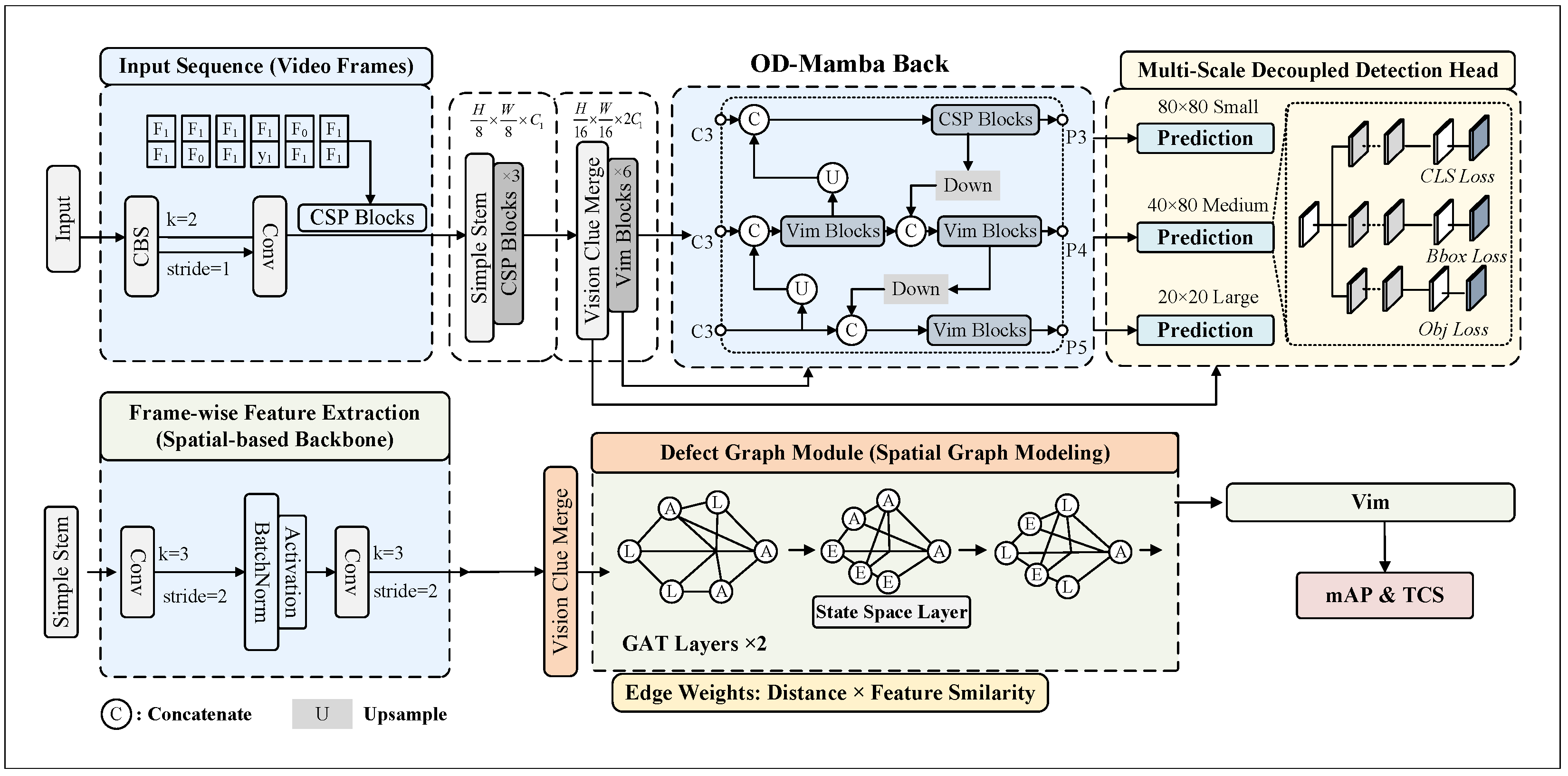
To address these challenges, we redefine the problem of road defect detection by shifting from isolated object recognition to a model of hierarchical, context-aware reasoning. We introduce the Spatio-Temporal Graph Mamba YOLO (STG-Mamba-YOLO), a novel framework engineered to explicitly model and fuse contextual information at three distinct, complementary levels: pixel, object, and sequence. This is accomplished by enhancing feature representations with long-range pixel dependencies, performing reasoning over a spatial graph of co-located objects, and modeling the temporal dynamics of these object graphs across frames.
The feature extractor must have a global receptive field to properly model pixel-level context, particularly for defects with high aspect ratios like elongated cracks. For this purpose, we employ the Mamba state-space model [
6], a recent architecture noted for its ability to model long sequences with linear complexity. By strategically incorporating Mamba blocks into the YOLO backbone, we augment its ability to model long-range spatial dependencies within the feature maps. For object-level context, we introduce structural priors concerning the relationships between defect instances. This is achieved by building an intra-frame graph where defect proposals function as nodes. A Graph Attention Network (GAT) [
7] is then used to update node representations by aggregating information from spatially and semantically proximate instances. To impose sequence-level context, our goal is temporal smoothness, based on the physical reality that road conditions change gradually, not erratically. We introduce a novel Temporal Graph Mamba module that operates on sequences of these defect graphs from adjacent frames. This module learns to predict a temporally consistent state, which is used to refine the final detections.
We performed extensive experimentation on several public benchmarks, such as RDD2022, to validate our approach. The empirical results show that our method consistently outperforms established baselines and current state-of-the-art detectors. Moreover, detailed ablation studies confirm each hierarchical level’s distinct and synergistic contributions, thereby validating our overall design philosophy. In summary, our contributions are fourfold:
We formally identify and provide a systematic solution for the critical limitations of context blindness and temporal inconsistency in existing road defect detection methods.
We introduce STG-Mamba-YOLO, a new hierarchical framework that effectively unifies three components: a Mamba-enhanced backbone, an intra-frame defect graph network, and a temporal graph Mamba module. This architecture fuses context at the pixel, object, and sequence levels.
We develop a novel methodology for modeling the spatial topology of co-occurring defects using graph-based reasoning. This scheme is extended to enforce temporal stability in video by applying a state-space model to sequences of these graphs.
We present comprehensive experimental results on challenging benchmarks, including in-depth ablation studies and qualitative visualizations, which collectively demonstrate the clear superiority of our proposed framework compared to SOTA alternatives.
4. Experiments
In this section, we present a series of comprehensive experiments designed to rigorously validate the efficacy and performance of our proposed STG-Mamba-YOLO framework. We commence by detailing the datasets, evaluation metrics, and implementation specifics. This is followed by quantitative comparisons against state-of-the-art methods and in-depth ablation studies to dissect the contribution of each proposed component. Finally, qualitative visualizations are provided to offer intuitive insights into the operational advantages of our approach.
4.1. Datasets and Evaluation Metrics
Datasets. To facilitate a comprehensive and impartial evaluation, our experimental validation is conducted on three diverse and challenging public datasets for road damage detection. These datasets exhibit significant variability in terms of geographical origin, imaging conditions, resolution, and class distribution, thereby providing a robust testbed for evaluating the generalization capabilities of our model. As noted in recent benchmarks [
30], leveraging multiple datasets is crucial for robust validation.
Road Damage Detection 2022 (RDD2022) [
31] is a large-scale, geographically diverse dataset, containing over 47,000 images collected from Japan, India, and the Czech Republic. It encompasses a wide spectrum of road types and weather conditions, with annotations for common damage types such as longitudinal cracks (D00), transverse cracks (D10), alligator cracks (D20), and potholes (D40). We adhere strictly to the official training, validation, and testing splits to ensure fair and reproducible comparisons.
GAPs384 [
32] is a German asphalt pavement distress dataset distinguished by its high-resolution images (
pixels) and fine-grained crack annotations. While the original dataset provides pixel-level masks, we utilize the corresponding bounding box annotations for the object detection task. Its high-resolution nature poses a distinct challenge for the efficient processing of long-range dependencies, making it an ideal benchmark for assessing the efficacy of our Mamba-enhanced backbone.
Crack500 [
33] comprises 500 high-resolution images of pavement cracks characterized by their thin and topologically complex structures. Although primarily curated for semantic segmentation, it is widely adopted for detection by converting segmentation masks to bounding boxes. It serves as a focused benchmark to rigorously test our model’s capacity for handling elongated and structurally intricate damage classes.
Video Sequence Benchmark. A significant impediment to evaluating temporal performance in this domain is the absence of a standardized, large-scale video dataset for road damage detection. To surmount this limitation, we construct a semi-synthetic video benchmark for the explicit evaluation of temporal consistency. We curate sequences of visually contiguous images from the RDD2022 test set that exhibit characteristics of sequential capture. To simulate smooth vehicle motion and establish a controlled evaluation environment, we apply minor geometric transformations (slight translations and scaling) between consecutive frames. This benchmark, which we intend to release publicly, enables the quantitative measurement of temporal stability in detection results.
Evaluation Metrics. Our evaluation protocol is founded on a suite of standard metrics assessing accuracy, temporal stability, and computational efficiency.
Detection Accuracy. We employ the standard COCO evaluation protocol. The primary metric is mAP@[0.5:0.95], which represents the mean Average Precision (mAP) averaged over Intersection over Union (IoU) thresholds from 0.5 to 0.95. We also report mAP@0.5, the mAP at a single IoU threshold of 0.5, to maintain compatibility with prior works that report this metric exclusively.
Temporal Stability. To quantify the “flickering” artifact prevalent in video-stream detection, we propose the Temporal Consistency Score (TCS). For a damage tracked over a trajectory of
N frames with a detection confidence sequence
, the TCS is defined as the inverse of the coefficient of variation:
where
and
denote the mean and standard deviation of the confidence scores, respectively. A higher TCS signifies lower relative variance and thus more stable detection. We report the average TCS across all tracked trajectories.
Model Efficiency. To assess the practical deployability of our model, we report the total number of learnable Parameters (M), the computational complexity in Giga Floating Point Operations (GFLOPs), and the inference throughput in Frames Per Second (FPS) achieved on an NVIDIA A100 GPU.
4.2. Dataset Statistical Analysis
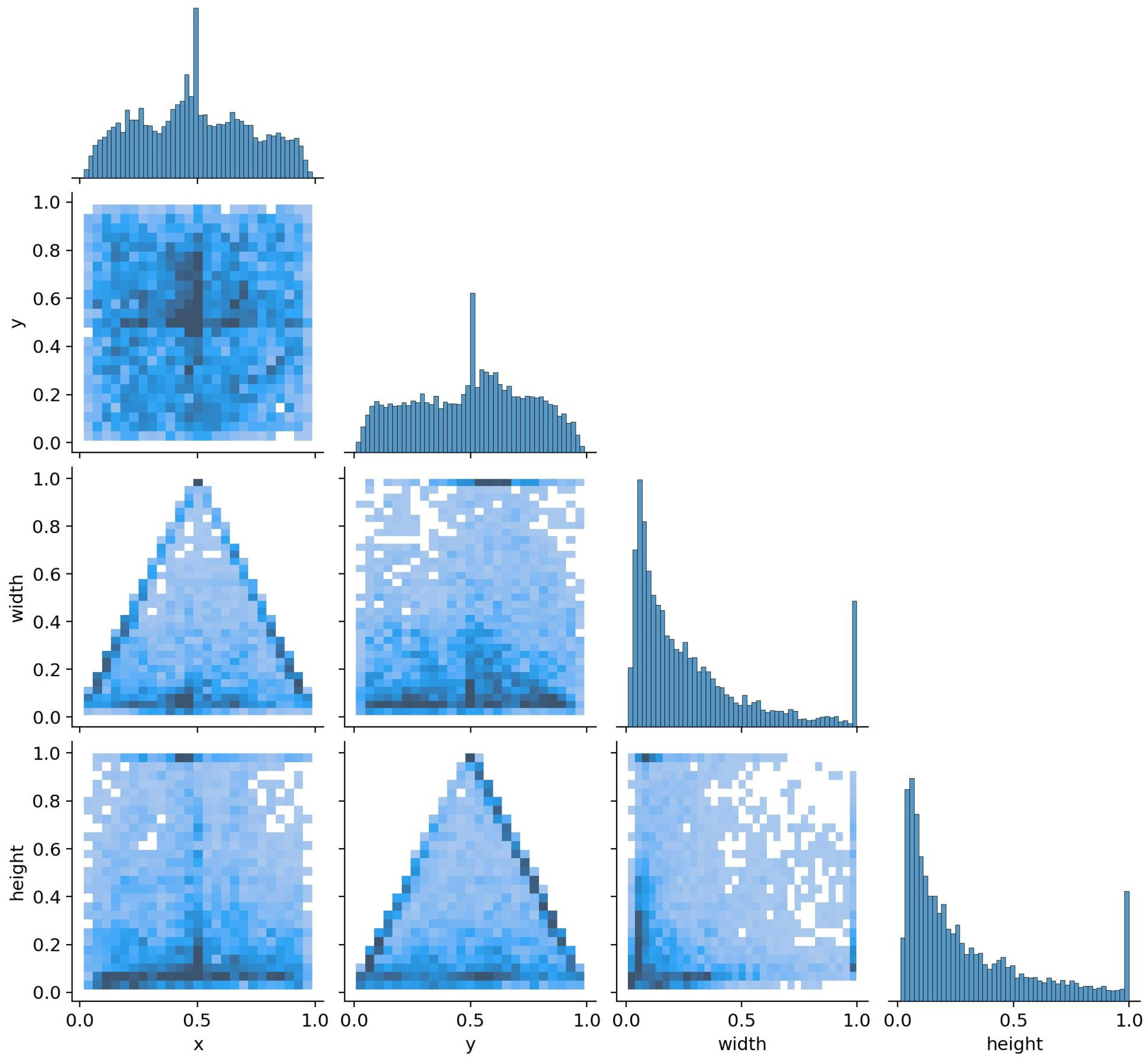
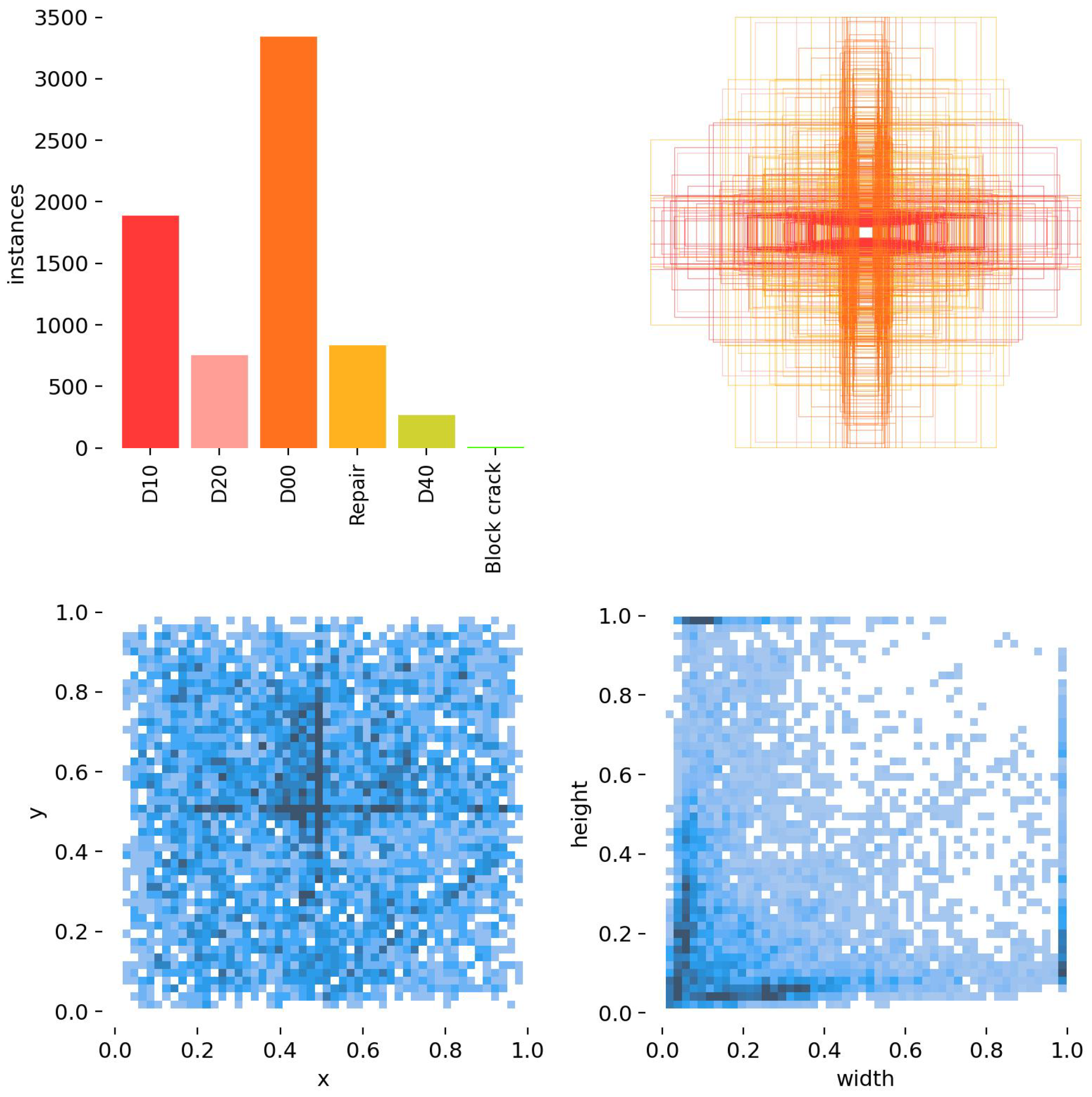
To elucidate the intrinsic challenges of the road damage detection task, we conducted a thorough statistical analysis of the RDD2022 annotations, visualized in
Figure 2 and
Figure 3. This analysis uncovers several key data characteristics that directly motivate our hierarchical model design. The class distribution bar chart (top-left) reveals a severe class imbalance, where the longitudinal crack class (D00) overwhelmingly dominates the dataset, while other critical classes like potholes (D40) are significantly underrepresented. This imbalance poses a formidable challenge to training models that generalize effectively to minority classes. Concurrently, the heatmaps of bounding box centers (bottom-left) and the spatial overlay (top-right) both indicate a strong spatial bias, with a high concentration of damages in the image center—a typical artifact of vehicle-mounted data capture that demands model robustness.
Most critically for our work, the width-height distribution histogram (bottom-right) highlights an extreme diversity in object aspect ratios. The plot reveals not only a dense cluster of compact objects but also two distinct arms extending vertically and horizontally. These arms correspond to the numerous elongated objects: tall, thin longitudinal cracks and wide, thin transverse cracks. This pronounced feature distribution starkly underscores the inherent limitations of conventional CNNs with their constrained, local receptive fields. It concurrently validates the architectural necessity of our Mamba-enhanced backbone, which is expressly designed to capture such long-range dependencies with high efficiency.
4.3. Implementation Details
Model Configuration. The architectural foundation of our proposed STG-Mamba-YOLO is the YOLOv9-C model [
10]. We integrated Visual Mamba (Vim) blocks into the backbone at the P4 and P5 stages to capture global context. The dimension of the extracted proposal features
is set to
. For the graph module, we utilized a 3-layer Graph Attention Network (GAT) with 8 attention heads per layer. The edge construction threshold
(Equation (
2)) was empirically set to 0.7. The temporal module processes a sequence length of
consecutive frames.
Training Protocol. All models were trained from scratch using the PyTorch 2.x framework on a cluster of four NVIDIA A100 (80GB) GPUs. We employed the AdamW optimizer [
34] with an initial learning rate of
and a weight decay of
. A cosine annealing scheduler was used, preceded by a linear warmup phase of 3 epochs. The total training duration was 100 epochs with a global batch size of 32 (8 images per GPU). The loss balancing hyperparameters were set to
and
based on grid search. The input resolution was standardized to
pixels.
Data Augmentation and Reproducibility. To ensure robustness, we adopted the standard YOLOv9 augmentation suite, including Mosaic, MixUp, random affine transformations (rotation, scaling, translation, shear), and HSV color space adjustments. To guarantee reproducibility, all experiments were conducted with a fixed random seed of 42. For the semi-synthetic video benchmark construction, we applied controlled affine transformations between frames: translation sampled from pixels, rotation from , and scaling from , simulating smooth vehicle motion.
4.4. Comparison with State-of-the-Art Methods
To establish a comprehensive performance benchmark, our proposed STG-Mamba-YOLO is evaluated against a diverse array of state-of-the-art (SOTA) object detectors. This selection of baselines intentionally spans multiple architectural families, including two-stage detectors (e.g., Faster R-CNN), one-stage anchor-based detectors (e.g., YOLOv5, YOLOv7), one-stage anchor-free detectors (e.g., YOLOX), and modern Transformer-based models (e.g., RT-DETR). Among these, we designate YOLOv9-C [
10] as our primary baseline, owing to its exceptional balance of performance and computational efficiency. To ensure a fair and direct comparison, all competing models were trained and evaluated under the unified experimental protocol detailed in
Section 4.2.
Performance on Static Image Datasets. The main quantitative results of our comparison on the RDD2022, GAPs384, and Crack500 test sets are presented in
Table 1. The findings unequivocally demonstrate the consistent superiority of our approach across all three challenging benchmarks.
Table 1.
Quantitative comparison with state-of-the-art methods on the RDD2022, GAPs384, and Crack500 test sets. The best performance is highlighted in bold, and the second best is underlined. Our STG-Mamba-YOLO is presented separately at the bottom for clarity.
Table 1.
Quantitative comparison with state-of-the-art methods on the RDD2022, GAPs384, and Crack500 test sets. The best performance is highlighted in bold, and the second best is underlined. Our STG-Mamba-YOLO is presented separately at the bottom for clarity.
| Method | Backbone | Params (M) | GFLOPs | RDD2022 | GAPs384 | Crack500 |
| mAP@0.5:0.95 | mAP@0.5 | mAP@0.5:0.95 | mAP@0.5 | mAP@0.5:0.95 | mAP@0.5 |
| Two-Stage Detectors |
| Faster R-CNN [8] | ResNet-50 | 41.3 | 246 | 55.4 | 76.1 | 51.2 | 71.8 | 45.3 | 65.1 |
| Faster R-CNN [8] | ResNet-101 | 60.2 | 336 | 56.9 | 77.3 | 52.8 | 72.9 | 46.8 | 66.2 |
| One-Stage Detectors |
| SSD300 [9] | VGG-16 | 35.3 | 78 | 51.5 | 72.8 | 48.9 | 69.1 | 42.1 | 61.3 |
| YOLOv3 [35] | DarkNet-53 | 61.5 | 155 | 59.8 | 80.2 | 54.1 | 74.3 | 48.5 | 68.2 |
| YOLOv4 [3] | CSPDarkNet-53 | 64.1 | 129 | 62.5 | 82.9 | 56.8 | 76.6 | 51.2 | 71.0 |
| YOLOv5-L [36] | CSP-Backbone | 46.1 | 108 | 63.8 | 83.5 | 58.1 | 77.9 | 52.9 | 72.5 |
| YOLOv7 [37] | ELAN-Net | 36.9 | 104 | 64.9 | 84.1 | 59.5 | 78.8 | 53.8 | 73.1 |
| YOLOX-L [4] | CSP-Backbone | 54.2 | 156 | 64.2 | 83.8 | 58.7 | 78.1 | 53.1 | 72.8 |
| YOLOv8-L [34] | CSP-Backbone | 43.6 | 165 | 65.2 | 84.4 | 59.8 | 79.2 | 54.3 | 73.6 |
| YOLOv9-C [10] | GELAN-C | 25.5 | 102 | 65.7 | 84.8 | 60.3 | 79.7 | 54.8 | 74.1 |
| Transformer-based Detectors |
| DETR [11] | ResNet-50 | 41.5 | 86 | 60.3 | 81.1 | 55.2 | 75.0 | 49.6 | 69.3 |
| RT-DETR-L [38] | HGNetV2-L | 33.1 | 110 | 65.4 | 84.5 | 60.1 | 79.5 | 54.5 | 73.8 |
| Domain-Specific SOTA |
| CD-YOLO [39] | Custom-CSP | 48.2 | 121 | 64.5 | 83.9 | 59.1 | 78.4 | 53.6 | 73.0 |
| Improved-YOLOv8 [34] | YOLOv8-CSP | 44.1 | 168 | 65.3 | 84.6 | 59.9 | 79.3 | 54.4 | 73.7 |
| Our Proposed Method |
| STG-Mamba-YOLO | Mamba-GELAN | 28.9 | 115 | 68.2 | 86.1 | 63.2 | 81.5 | 57.9 | 76.2 |
The YOLOv9-C model establishes a formidable performance baseline, surpassing the majority of other methods in our comparison. Nevertheless, our STG-Mamba-YOLO consistently outperforms this formidable baseline and all other competing models, with the performance delta being particularly pronounced on the more stringent mAP@[0.5:0.95] metric. Specifically, on the RDD2022 dataset, our model achieves an mAP@[0.5:0.95] of 68.2%, representing a significant improvement of 2.5 percentage points over YOLOv9-C. These performance gains are even more substantial on benchmarks characterized by fine-grained and topologically complex cracks. On GAPs384 and Crack500, our model surpasses the second-best method by 2.9 and 3.1 percentage points in mAP@[0.5:0.95], respectively.
This consistent outperformance underscores the pivotal role of our hierarchical context modeling. The Mamba-enhanced backbone excels at capturing the global extent of elongated cracks, while the intra-frame damage graph module effectively reasons about the topological relationships between constituent crack segments. This synergy leads to more precise localization and robust classification, which is essential for satisfying the higher IoU thresholds inherent in the primary mAP metric.
Performance on Video Sequences. To validate the efficacy of our temporal modeling, we conducted evaluations on our semi-synthetic video benchmark. As presented in
Table 2, our full STG-Mamba-YOLO model is compared against strong baselines operating in a standard frame-by-frame detection mode. Although our model also attains the highest mAP, the most compelling result lies in the Temporal Consistency Score (TCS). Our method achieves a TCS of 9.71—a value nearly triple that of the formidable YOLOv9-C baseline.
Table 2.
Performance comparison on our semi-synthetic video sequence benchmark. Our model not only achieves the highest detection accuracy but also demonstrates a dramatic improvement in temporal stability, validated by the significantly higher Temporal Consistency Score (TCS).
Table 2.
Performance comparison on our semi-synthetic video sequence benchmark. Our model not only achieves the highest detection accuracy but also demonstrates a dramatic improvement in temporal stability, validated by the significantly higher Temporal Consistency Score (TCS).
| Method | mAP@0.5:0.95 | TCS ↑ |
| YOLOv8-L | 59.3 | 2.87 |
| RT-DETR-L | 60.1 | 3.12 |
| YOLOv9-C | 60.5 | 3.25 |
| STG-Mamba-YOLO (Ours) | 62.8 | 9.71 |
This result provides strong quantitative evidence that our temporal graph Mamba module effectively mitigates the flickering phenomenon inherent in frame-by-frame processing. By explicitly modeling the evolution of the damage graph across time, our framework produces temporally coherent and reliable detections—a critical prerequisite for practical deployment in continuous road monitoring systems.
4.5. Ablation Studies
To deconstruct our STG-Mamba-YOLO framework and rigorously quantify the contribution of its principal components, we conducted a series of comprehensive ablation studies. These studies are designed to first isolate the effectiveness of our three core hierarchical modules, and second, to analyze the impact of specific design choices, such as the graph construction methodology and temporal sequence length. Unless otherwise specified, all ablation experiments were conducted on the RDD2022 dataset to ensure a consistent basis for comparison.
Effectiveness of Core Components. Our first ablation study evaluates the incremental performance gains accrued by progressively integrating each of our proposed modules onto the YOLOv9-C baseline. The results, summarized in
Table 3, reveal a clear and statistically significant performance improvement at each stage of our hierarchical design.
Table 3.
Ablation study on the effectiveness of the core components of STG-Mamba-YOLO. M-BB refers to the Mamba-enhanced Backbone, GNN to the Intra-frame Graph Network, and Temp. to the Temporal module. Static metrics are on the RDD2022 test set, while Video metrics are on our video benchmark.
Table 3.
Ablation study on the effectiveness of the core components of STG-Mamba-YOLO. M-BB refers to the Mamba-enhanced Backbone, GNN to the Intra-frame Graph Network, and Temp. to the Temporal module. Static metrics are on the RDD2022 test set, while Video metrics are on our video benchmark.
| ID | M-BB | GNN | Temp. | Static Perf. | Video Perf. |
| mAP@0.5:0.95 | mAP@0.5 | mAP@0.5:0.95 | TCS |
| A | | | | 65.7 | 84.8 | 60.5 | 3.25 |
| B | ✓ | | | 66.8 | 85.4 | 61.5 | 3.30 |
| C | ✓ | ✓ | - | 68.2 | - | - | |
| D | ✓ | ✓ | ✓ | - | - | 62.8 | 9.71 |
Beginning with the baseline model (A), the integration of our Mamba-enhanced Backbone (Model B) yields a notable improvement of 1.1 percentage points in mAP@[0.5:0.95]. This result substantiates our hypothesis that the capacity of Mamba blocks to model long-range dependencies is highly effective for capturing the global structure of elongated Damages, thereby producing more robust feature representations.
Subsequently, the addition of the intra-frame GNN refinement module (Model C) boosts the mAP@[0.5:0.95] to 68.2%, a further gain of 1.4 percentage points over Model B. This substantial improvement validates the critical role of explicit relational reasoning. The GNN effectively leverages the spatial and semantic context among damage candidates to rectify initial misclassifications and enhance localization precision.
Finally, the incorporation of the temporal graph Mamba module (Model D) completes our full framework. Evaluated on our video benchmark, its superiority becomes evident. While its frame-level accuracy (mAP) increases to a solid 62.8%, the most profound impact is observed in the Temporal Consistency Score (TCS), which surges from 3.32 to 9.71. This nearly threefold increase furnishes definitive evidence that our temporal module effectively suppresses detection flickering and produces highly stable, temporally coherent results.
Analysis of Graph Construction. To validate our design choices for the graph’s edge definition, we ablate our composite weighting scheme (Spatial + Feature), comparing it against using each component in isolation. This experiment was conducted using Model C on the GAPs384 dataset, a benchmark selected for its complex, overlapping crack patterns where relational reasoning is especially critical. As shown in
Table 4, while both spatial proximity and feature similarity individually contribute positively to performance, their synergistic combination yields the optimal results. This finding demonstrates that the GNN’s reasoning is most effective when it can jointly consider both where damages are located relative to each other and what their visual features represent.
Table 4.
Ablation study on the edge definition strategy in the intra-frame graph network, evaluated on the GAPs384 dataset.
Table 4.
Ablation study on the edge definition strategy in the intra-frame graph network, evaluated on the GAPs384 dataset.
| Edge Definition Strategy | mAP |
| No GNN (Model B baseline) | 61.5 |
| Spatial Proximity Only | 62.5 |
| Feature Similarity Only | 62.7 |
| Spatial + Feature (Ours) | 63.2 |
Impact of Temporal Sequence Length. We also analyze the sensitivity of our temporal module to the sequence length (
) used for context aggregation. We evaluate our full model (D) on the video benchmark with varying sequence lengths.
Table 5 shows that performance, in terms of both mAP and TCS, generally improves as more frames are considered. The most significant gains occur when moving from a single frame (no temporal context) to a sequence of 3. The performance begins to saturate at a length of 5, with only marginal gains or even slight degradation beyond that point, while computational costs continue to increase. Therefore, we select a sequence length of 5 as it provides an optimal trade-off between performance and efficiency.
Table 5.
Ablation study on the temporal sequence length () on our video benchmark. A length of 1 is equivalent to the model without the temporal module.
Table 5.
Ablation study on the temporal sequence length () on our video benchmark. A length of 1 is equivalent to the model without the temporal module.
| Sequence Length | mAP | TCS |
| 1 (No Temporal Module) | 61.6 | 3.32 |
| 3 | 62.5 | 8.49 |
| 5 (Our Choice) | 62.8 | 9.71 |
| 7 | 62.7 | 9.65 |
Analysis of Ablation Studies.
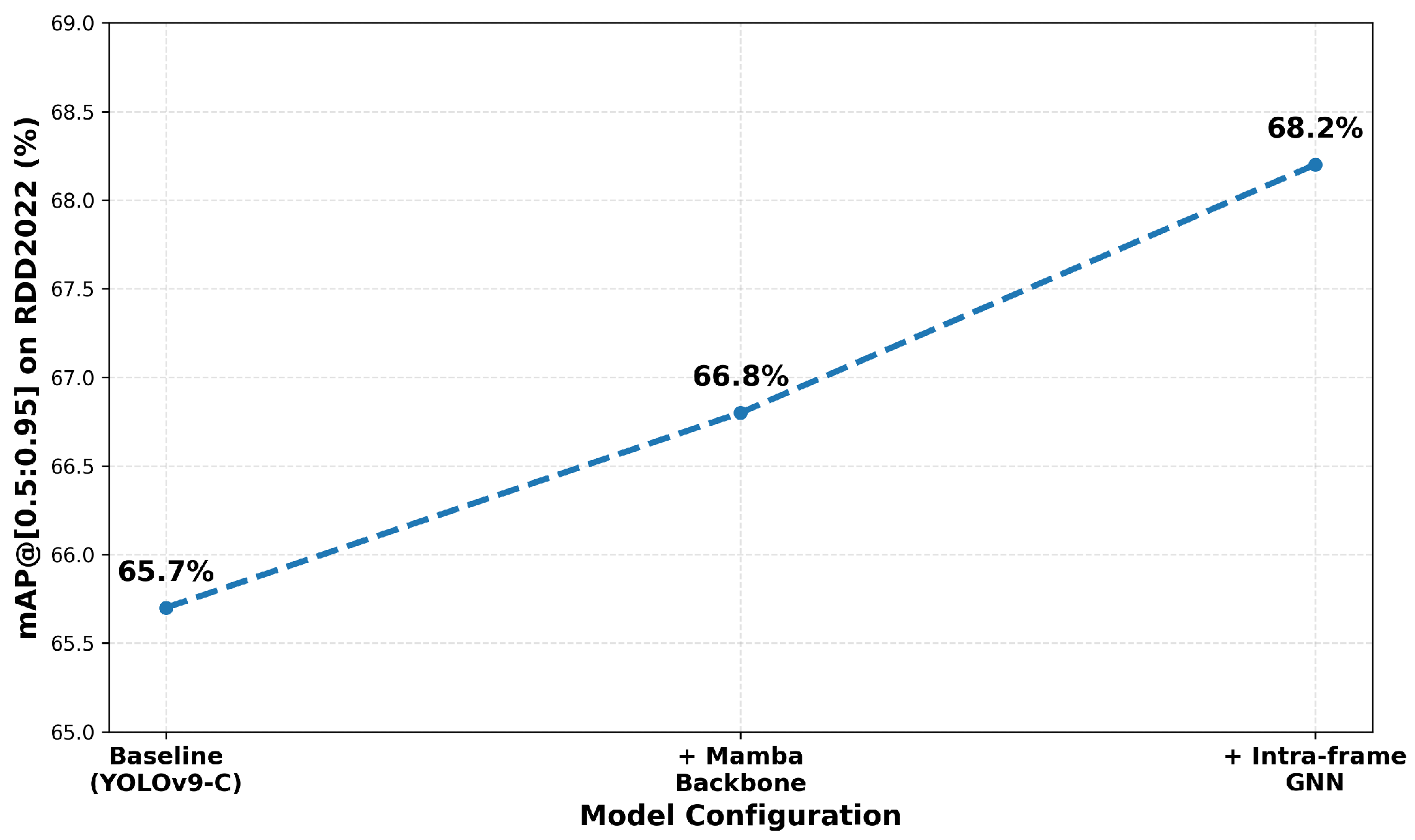
Figure 4 graphically illustrates the stepwise performance contribution of our core components. The performance curve exhibits a monotonic and significant ascent as the Mamba backbone and the GNN module are sequentially integrated. This visual evidence corroborates the quantitative findings in
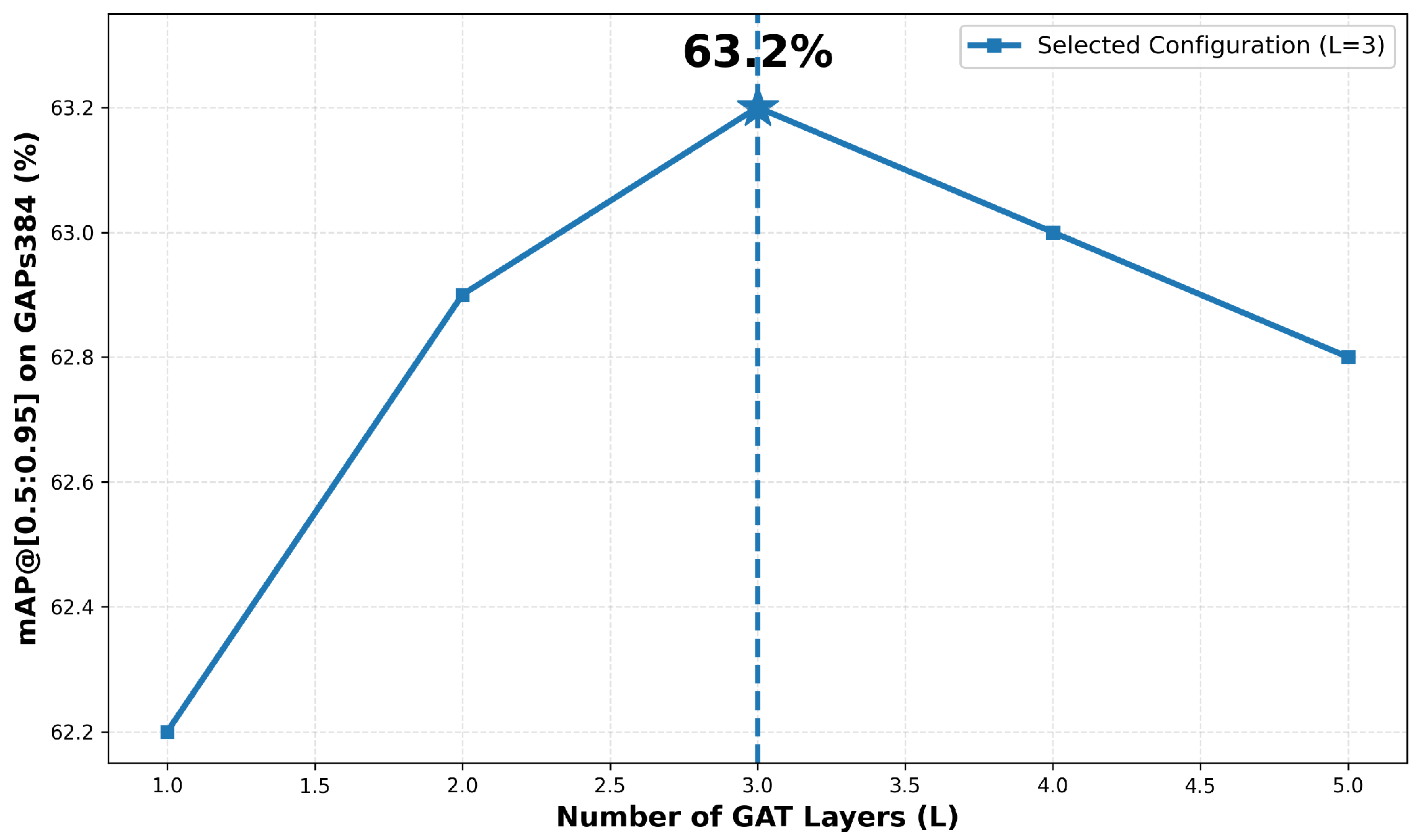
Table 3, confirming the efficacy of our hierarchical design. The impact of the GAT’s depth on model performance is analyzed in
Figure 5. The performance curve clearly peaks at a depth of three layers. This suggests that shallower configurations are insufficient for effective information propagation across the damage graph, while deeper architectures begin to suffer from performance degradation, a phenomenon likely attributable to the well-documented issue of over-smoothing in deep GNNs. This empirical result provides a strong validation for our selection of
as the optimal depth for our GNN module.
Analysis of Temporal and Efficiency Trade-offs.
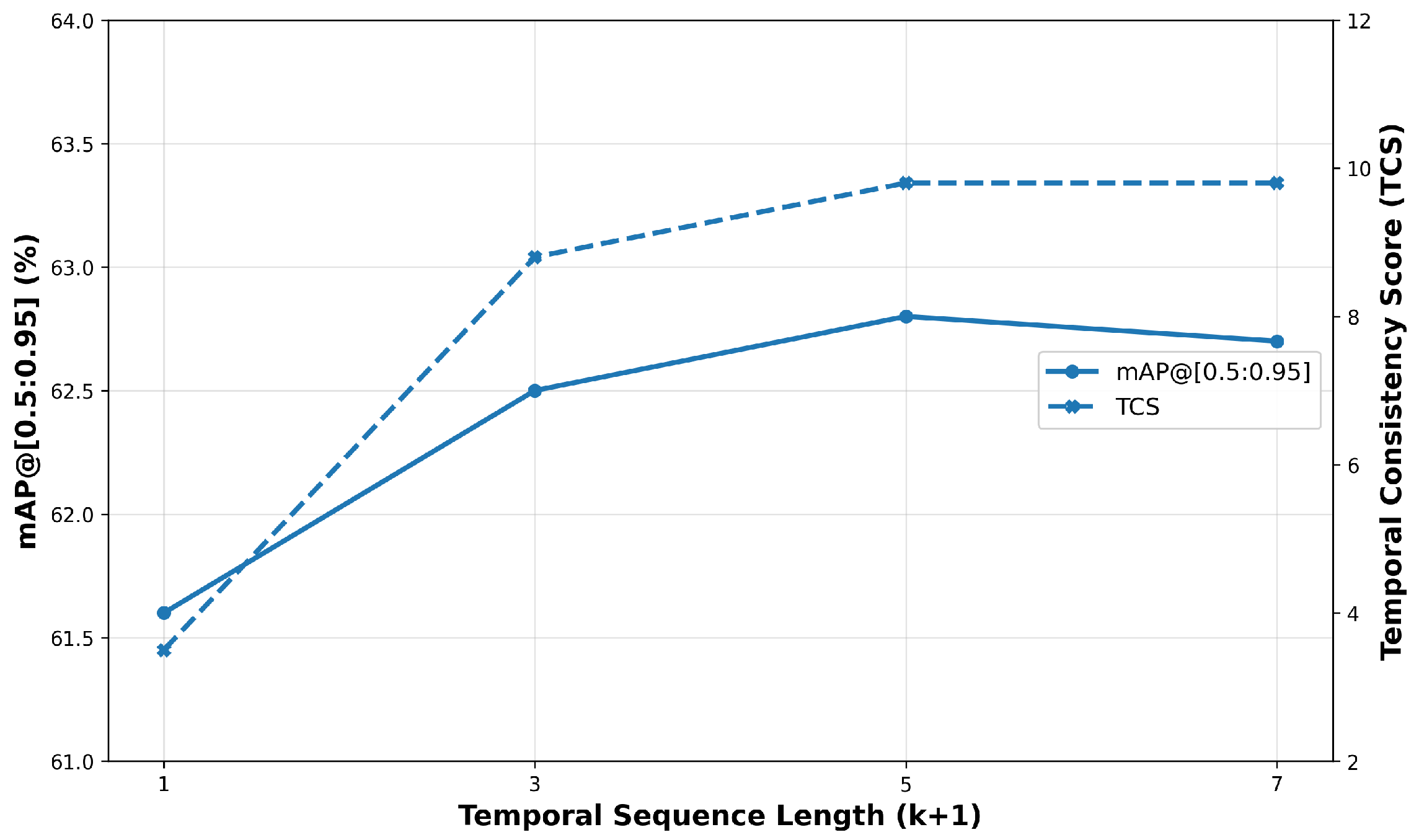
Figure 6 visualizes the critical trade-off between detection accuracy and temporal stability as a function of sequence length. The dual-axis plot reveals that while mAP (blue line) begins to plateau around a sequence length of five frames, the Temporal Consistency Score (TCS, red line) exhibits a dramatic and sustained increase up to this point. This visualization powerfully underscores the value proposition of our temporal module, justifying our selection of a five-frame sequence. This configuration strikes an optimal balance, achieving near-maximal temporal stability for only marginal gains in mAP, without incurring undue computational latency.
Figure 4.
Cumulative performance gain from core components on the RDD2022 dataset.
Figure 4.
Cumulative performance gain from core components on the RDD2022 dataset.
Figure 5.
Impact of GAT layer depth on performance, evaluated on the GAPs384 dataset. Performance peaks at L = 3.
Figure 5.
Impact of GAT layer depth on performance, evaluated on the GAPs384 dataset. Performance peaks at L = 3.
Figure 6.
Dual-axis analysis of the impact of temporal sequence length () on model performance. The left axis (solid blue line with circle markers) represents the Detection Accuracy (mAP), while the right axis (dashed orange line with cross markers) indicates the Temporal Consistency Score (TCS). The trend reveals that while accuracy (mAP) begins to plateau after 3 frames, the stability (TCS) continues to improve significantly until 5 frames, justifying our selection of as the optimal trade-off point.
Figure 6.
Dual-axis analysis of the impact of temporal sequence length () on model performance. The left axis (solid blue line with circle markers) represents the Detection Accuracy (mAP), while the right axis (dashed orange line with cross markers) indicates the Temporal Consistency Score (TCS). The trend reveals that while accuracy (mAP) begins to plateau after 3 frames, the stability (TCS) continues to improve significantly until 5 frames, justifying our selection of as the optimal trade-off point.
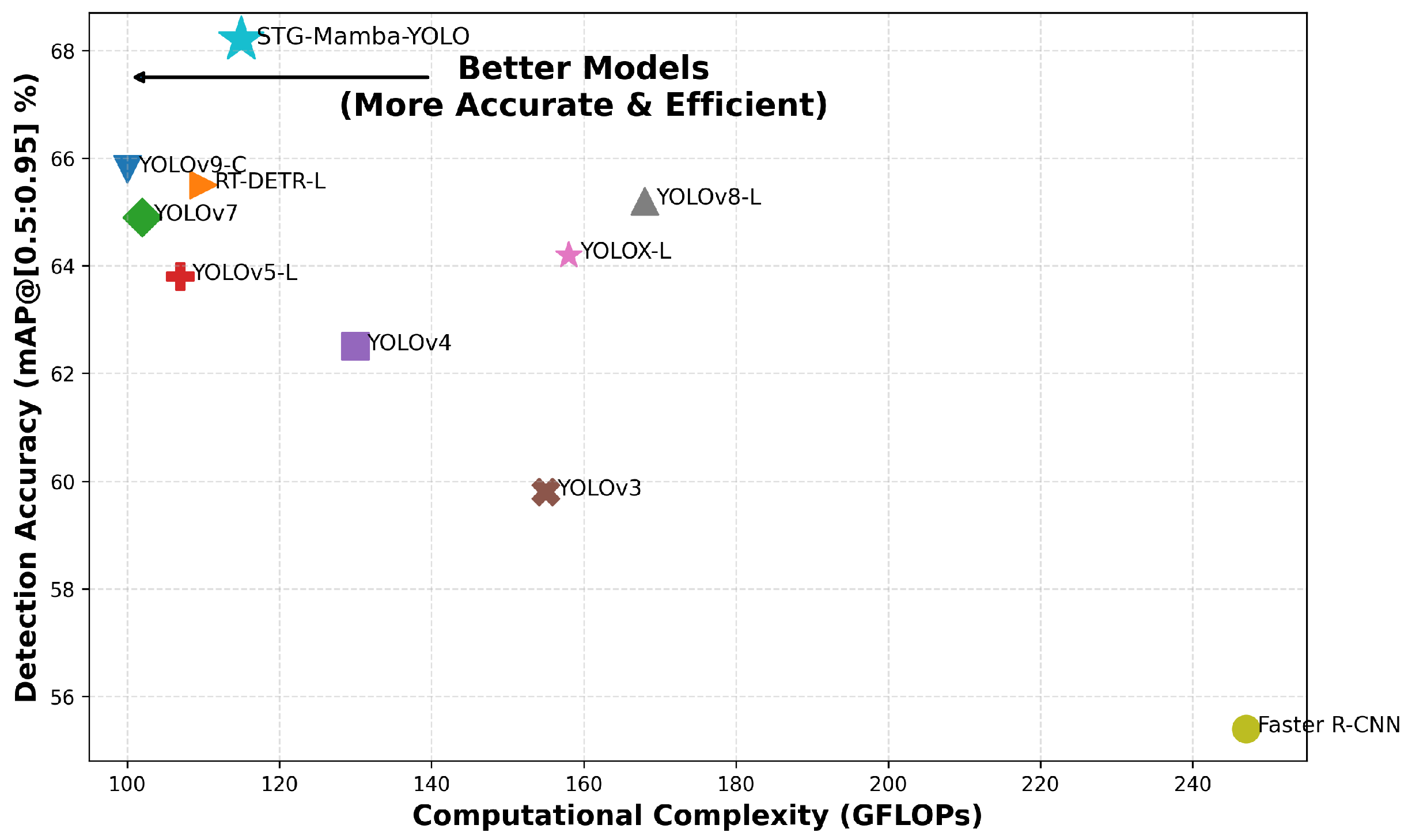
Finally,
Figure 7 situates our model within the broader landscape of SOTA detectors by plotting detection accuracy against computational complexity. In this plot, where each point represents a unique model, the top-left corner signifies the ideal trade-off (high accuracy, low complexity). Our STG-Mamba-YOLO is clearly positioned in this desirable Pareto-optimal region. It achieves the highest accuracy among all compared methods while maintaining a computational cost comparable to the highly efficient YOLOv9-C baseline. This result demonstrates that our framework establishes a new, superior Pareto front for the task of road damage detection.
4.6. Evaluation on Real-World Video Sequences
To rigorously address the limitations of semi-synthetic benchmarks and validate the proposed model under authentic driving conditions, we conducted additional evaluations on real-world video footage. We utilized a challenging sequence from the Mendeley Pothole Video Dataset, captured using a vehicle-mounted camera traversing an uneven road surface. This specific sequence is characterized by significant vertical camera vibration and motion blur, presenting a “stress test” scenario for detection stability.
We annotated a contiguous clip of 50 frames containing complex, interconnected road damage. As quantitatively presented in
Table 6, standard frame-by-frame detectors exhibit marked instability. For instance, the baseline YOLOv9-C suffers from “flickering,” where detection boxes transiently disappear or shift drastically due to frame-to-frame visual fluctuations caused by vibration. In stark contrast, STG-Mamba-YOLO significantly mitigates this issue. By leveraging the Temporal Graph Mamba module to propagate structural context across time, our method maintains a coherent tracking of defects.
Quantitatively, our method achieves a Temporal Consistency Score (TCS) of 8.95, which is nearly 2.8 times higher than the baseline’s 3.15. Furthermore, the detection accuracy (mAP) is boosted by 4.2% compared to the baseline, proving that temporal stability also contributes to more robust recognition of blurred damage features. This empirical evidence confirms that our hierarchical design generalizes effectively to the dynamic complexities of real-world infrastructure inspection.
4.7. Scalability Analysis on High-Resolution Inputs
We further investigated the scalability of our architecture by increasing the input resolution to . This experiment was conducted on the GAPs384 dataset, where high resolution is critical for detecting fine-grained cracks.
Table 7 illustrates the trade-off between performance and computational cost. While Transformer-based models (e.g., RT-DETR) suffer from quadratic complexity growth due to the self-attention mechanism, our Mamba-enhanced backbone maintains linear complexity. At
resolution, STG-Mamba-YOLO achieves a robust accuracy of 68.9%, outperforming the
baseline by 2.8%, with only a moderate and linear increase in GFLOPs (from 115 to 298). In contrast, the computational cost of RT-DETR explodes to over 450 GFLOPs, rendering it unsuitable for real-time applications. This demonstrates the efficiency of our hierarchical design for high-resolution pavement inspection.
4.8. Qualitative Results
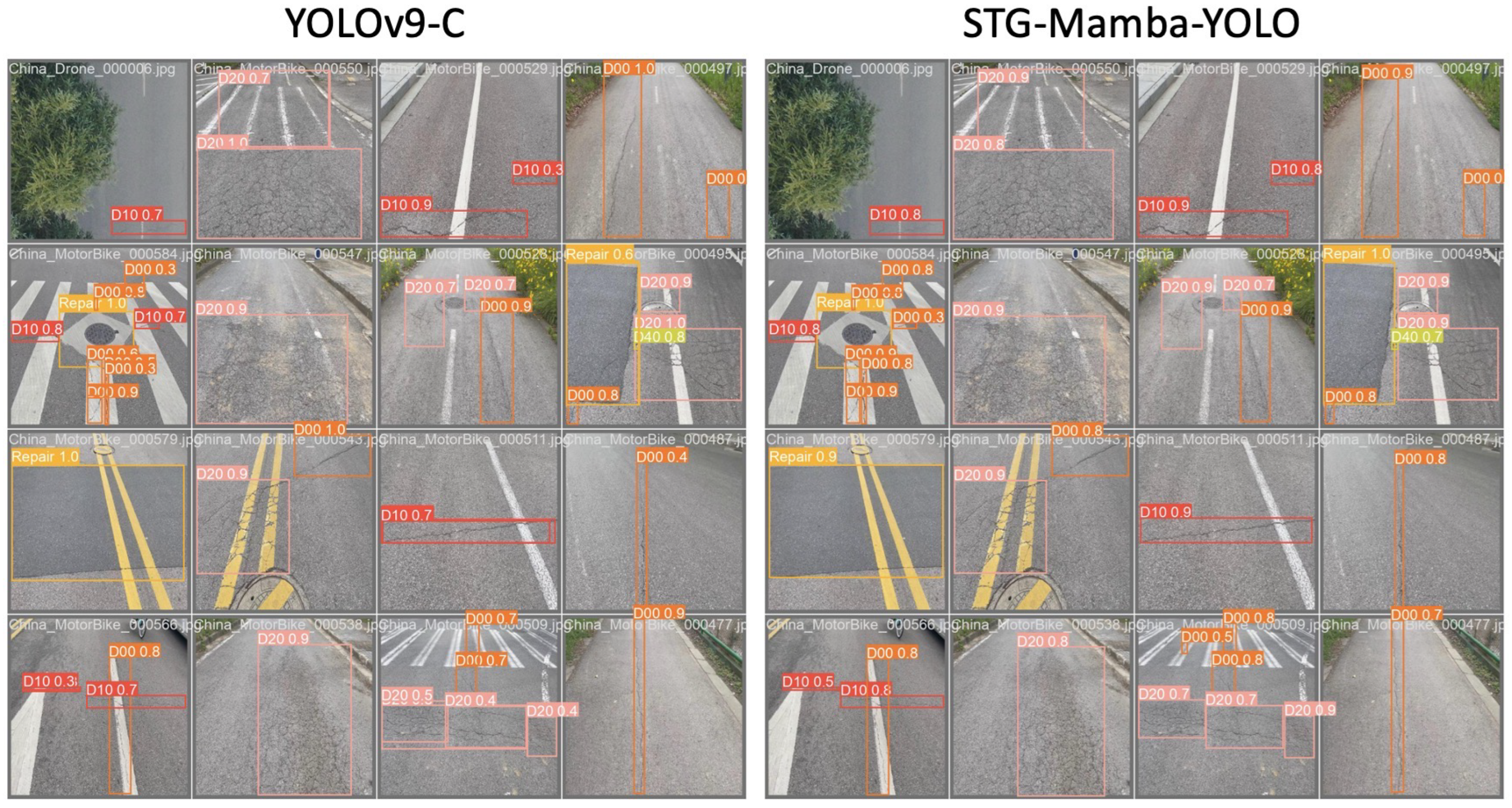
To provide an intuitive validation of our quantitative findings,
Figure 8 presents a side-by-side qualitative comparison between our STG-Mamba-YOLO and the YOLOv9-C baseline. The selected examples span a variety of challenging, real-world scenarios and compellingly highlight the superiority of our method in terms of accuracy, robustness, and contextual scene understanding.
A primary advantage demonstrated by our model is its markedly improved robustness in complex scenes laden with visual distractors. As depicted in the second row of the figure, the baseline model is easily confounded by road markings and varied pavement textures, resulting in a cluttered output with numerous false positives. In stark contrast, our STG-Mamba-YOLO, empowered by its graph-based reasoning module, correctly identifies the true ‘Repair’ and ‘D10’ damages while effectively suppressing the misleading visual cues from painted lines. This capability results in a substantially cleaner and more reliable detection output.
Furthermore, the qualitative results underscore our model’s enhanced capability in detecting subtle and continuous damages. In the first and third rows, our model delivers consistently more confident predictions (higher scores) and more precise bounding boxes for faint or elongated cracks, which the baseline either fails to detect or localizes inaccurately. This superior performance is directly attributable to our Mamba-enhanced backbone, which leverages its global receptive field to more effectively capture the long-range signatures of such objects.
Overall, these qualitative examples provide compelling corroboration for our quantitative findings. They demonstrate that by hierarchically modeling context from the pixel to the object level, our STG-Mamba-YOLO not only elevates detection accuracy but also fundamentally deepens the model’s contextual understanding of the scene. This makes it a significantly more robust and reliable solution for real-world road inspection.
Robustness in Adverse Conditions. Beyond controlled benchmarks, the true litmus test for a detection model is its robustness in unconstrained, real-world environments.
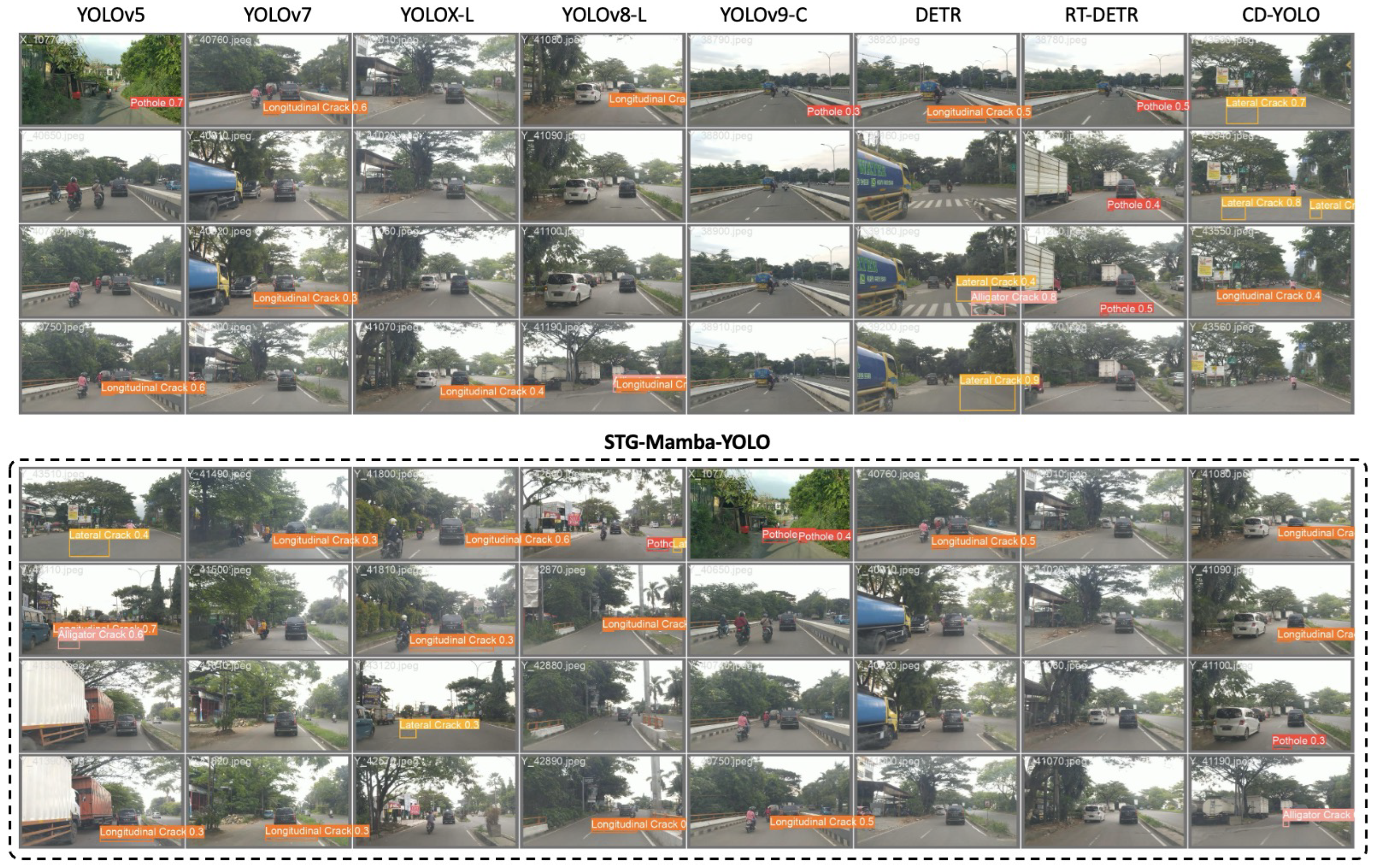
Figure 9 presents the results of a rigorous stress test, where we evaluate our model alongside multiple SOTA detectors under adverse conditions characterized by heavy foliage, dappled lighting, strong shadows, and complex backgrounds.
The results depicted in the top panel are revealing: the vast majority of state-of-the-art detectors, spanning both the YOLO series and Transformer-based architectures, fail catastrophically under these challenging conditions. These models yield either extremely sparse, low-confidence detections or, in many cases, fail to detect any damages whatsoever. This outcome suggests that while these models excel on curated benchmarks, their performance is brittle, and they fail to generalize when confronted with the significant visual clutter and occlusions typical of real-world scenarios.
In stark contrast, the bottom panel demonstrates that our STG-Mamba-YOLO maintains a remarkably high level of performance. It successfully and confidently identifies a diverse array of damages—including longitudinal, lateral, and alligator cracks, as well as potholes—even when partially obscured by deep shadows or embedded within complex scenery. This remarkable robustness is a direct consequence of our model’s hierarchical architecture. The Mamba backbone’s global receptive field enables it to perceive the underlying continuity of a crack despite local interruptions from shadows. Concurrently, the GNN module reinforces these perceptions by leveraging the broader context of the surrounding road area, which aids in distinguishing true damages from visual noise.
This stark comparison provides compelling evidence that our method is not merely more accurate, but is fundamentally more generalizable and thus better suited for deployment in the unpredictable, dynamic environments of real-world inspection.
4.9. Efficiency Analysis
While detection accuracy is a paramount objective, the practical deployability of a road inspection model is equally contingent upon its computational efficiency and inference speed. This section provides a detailed analysis of our model’s efficiency, carefully contextualizing its computational overhead against the substantial performance gains it delivers.
Table 8 presents a focused comparison of key efficiency metrics—namely model parameters, GFLOPs, and inference speed (FPS)—between our model and representative SOTA detectors. Inference speed was benchmarked on an NVIDIA A100 GPU using a batch size of one to accurately measure latency-oriented throughput. As STG-Mamba-YOLO is architecturally based on the lightweight YOLOv9-C, the addition of our hierarchical context modules introduces a modest and anticipated computational overhead. Specifically, the model size increases by approximately 3.4M parameters, and the GFLOPs rise by 13 (from 102 to 115). This corresponds to a decrease in inference speed from 95 to 81 FPS.
However, we argue that this moderate increase in computational cost is overwhelmingly justified by the substantial performance improvements. The ≈12.7% increase in GFLOPs delivers a 2.5 percentage point gain in mAP for static images and, more critically, a nearly 200% improvement in the Temporal Consistency Score (TCS) for video analysis (
Table 2). This trade-off is exceptionally favorable, particularly for real-world deployment scenarios where reliability and accuracy in complex scenes are prioritized over maximal throughput. It is worth noting that while the increased GFLOPs are negligible on server-grade GPUs, they may impact latency on resource-constrained embedded devices (e.g., NVIDIA Jetson). However, we consider this trade-off acceptable given the substantial gains in detection stability.
Furthermore, when situated within the broader performance–complexity landscape (visualized in
Figure 7), our model’s efficiency profile is excellent. It remains substantially faster than two-stage methods like Faster R-CNN while being more accurate than other real-time models such as RT-DETR. With an inference speed of 81 FPS, STG-Mamba-YOLO comfortably exceeds the typical threshold for real-time video processing (>30 FPS). This positions our framework as a highly practical and powerful solution, well-suited for deployment in vehicle-mounted road inspection systems.
5. Discussion
The empirical results presented in this study demonstrate that STG-Mamba-YOLO achieves a superior trade-off between accuracy and stability. The model’s strong performance directly results from its innovative hierarchical architecture, which integrates context at three complementary levels. Our ablation studies (
Section 4.5) provided conclusive evidence for the individual contribution of each stage. Specifically, the Mamba blocks were shown to be critical for modeling elongated defects, a persistent weakness of standard CNNs. Furthermore, the intra-frame GNN module marks a conceptual shift from simple feature detection to active relational reasoning. With this, the model interprets complex defect formations (like alligator cracking) as a single, interconnected structure, not as a set of discrete fissures. Lastly, the significant jump in the Temporal Consistency Score (TCS) highlights the fundamental importance of sequence-level modeling. This component effectively transforms the detector from a static image processor into a reliable tool for dynamic assessment, a crucial requirement for real-world applications.
The paradigm of hierarchical context fusion presented here is not restricted to the road inspection domain. This architectural template—which synergistically combines long-range spatial extractors (Mamba) and high-level relational engines (GNNs)—is highly promising for numerous other computer vision tasks where context is decisive. Examples include agricultural disease identification, industrial defect analysis, or medical lesion segmentation. A robust and temporally stable detector like STG-Mamba-YOLO can improve automated pavement management systems. Reliable defect tracking facilitates more accurate Pavement Condition Index (PCI) evaluations and provides the foundation for creating longitudinal records of damage development. Such data is invaluable for optimizing maintenance schedules and resource allocation.
While the performance is compelling, our study is subject to several limitations. First, the addition of the GNN and temporal modules, though effective, increases the model’s computational footprint. Future research could explore model compression techniques like knowledge distillation or graph pruning to create lightweight versions for on-device deployment. Second, the GNNs’ learned relational patterns are data-dependent and might not generalize perfectly to novel defect topologies absent from the training set. Investigating few-shot or zero-shot learning for this component could be a way to improve its adaptability. Third, the lack of a large-scale, public video dataset for road damage necessitated using a semi-synthetic benchmark for temporal evaluation. Assembling and releasing such a benchmark would be a valuable contribution to the research community.
6. Conclusions
This paper presented STG-Mamba-YOLO, a new framework that re-envisions road defect detection. It shifts the task from isolated object identification to a hierarchical, context-based reasoning process. As demonstrated by our comprehensive quantitative and qualitative experiments, this new paradigm offers substantial gains in accuracy, robustness, and temporal stability compared to a wide array of state-of-the-art methods.
Looking ahead, we envision two particularly promising research paths. The first is a multi-modal framework, which would integrate GPS data for defect geolocation and fuse inputs from other sensors (e.g., 3D lidar or thermal cameras) to evaluate damage severity (like pothole depth), not just its presence. The second is to expand the temporal modeling capabilities beyond ensuring consistency to achieve true predictive maintenance. Analyzing the long-term evolution of defect graphs, future models could be trained to forecast crack propagation paths or the expansion rate of potholes, enabling a shift from reactive to genuinely predictive infrastructure management.




 ,
,