Article

Platform-Targeted Technology Investment and Sales Mode Selection Considering Asymmetry of Power Structures


by
Hua Zhang
School of Management Science and Engineering, Anhui University of Technology, Ma’anshan 243032, China
Symmetry 2025, 17(12), 2168; https://doi.org/10.3390/sym17122168
Submission received: 19 November 2025 / Revised: 13 December 2025 / Accepted: 15 December 2025 / Published: 16 December 2025
(This article belongs to the Section Mathematics)

Abstract

In the current digital competition environment, e-commerce platforms have increased their investment in targeted advertising, improving advertising efficiency while also influencing the choice of product sales modes. This study aims to deeply explore the investment made by platforms in targeted technology and the impact of the choice of sales modes under the asymmetry of power structures. Based on game theory and optimization theory, we develop a decision-making model for targeted technology investments and sales mode selection. Through equilibrium analysis and numerical simulation, the results show that (1) targeted advertising leads to price increases, a reduction in advertising investment, and a decline in demand. Additionally, targeted advertising boosts the seller’s profit while negatively affecting the profit of the other party. (2) When in platform-led sales mode, if the unit advertising cost is low, the platform favors the resale mode; otherwise, it opts for the agency mode. When in manufacturer-led sales mode, regardless of the advertising mode, if the unit advertising cost is low, the manufacturer prefers the agency mode; otherwise, it selects the resale mode. (3) Under different power structures, the conditions and scope for platform-targeted technology investments were provided, and for different advertising models, suggestions were provided for the sales mode selection of the platform and the manufacturer.

1. Introduction

In recent years, the rapid development of online retailing has had a profound impact on the global business landscape. According to the latest forecast data released by eMarketer (https://www.emarketer.com/forecasts/ (14 December 2025)), global e-commerce sales are expected to reach USD 6.4 trillion in 2025, marking a 6.8% increase from the previous year. Despite a decline in the growth rate, e-commerce’s share of total retail sales continues to increase steadily. By 2025, it is projected that e-commerce will account for 20.5% of global retail sales. This growth trend is primarily driven by the flexibility of the e-commerce platform sales mode and continuous advancements in data technology. As pioneering technologies such as cloud computing, machine learning, and artificial intelligence undergo continuous development and advancement, electronic commerce platforms find themselves in a position to invest in highly precise targeted technology, construct user profiles, analyze behavior, and utilize data-driven intelligent algorithms for the purpose of achieving highly accurate ad targeting. For instance, commercial platforms such as JD.com, Amazon, and Taobao employ sophisticated data analysis techniques to ascertain consumer preferences and implement targeted advertising strategies, thereby achieving precision marketing. The implementation of targeted advertising initiatives has been demonstrated to engender a substantial reduction in the squandering of advertising resources. This phenomenon occurs as a consequence of the deployment of targeted technological investments, which facilitate the acquisition of accurate consumer information. Consequently, this results in a diminution of marketing expenditures and an enhancement in sales efficiency [1,2].
In platform supply chain systems, the selection of an appropriate commodity sales mode is a critical strategic decision that significantly influences the performance and profitability of both the platforms and merchants. Within the platform economy, sales modes are broadly classified into two distinct forms: the resale mode and the agency mode. Under the resale mode, the platform acquires products from manufacturers through wholesale procurement before selling directly to end consumers via its self-operated retail channels. A representative example is JD.com, where brands such as Huawei, Xiaomi, and Givenchy distribute their products through the platform’s self-operated stores, positioning the platform as the direct seller in the transaction. In contrast, under the agency mode, the platform functions as a facilitator by granting manufacturers access to its consumer base and charging a commission on each sale, while the manufacturer retains control over pricing, inventory, and direct consumer sales. This mode is exemplified by brands like Muji and ONLY, which operate official flagship stores on platforms to sell directly to consumers. The divergence between these two modes extends beyond operational structure—key strategic decisions such as pricing authority and responsibility for marketing and advertising are allocated differently, leading to distinct incentive structures and potential conflicts of interest among stakeholders. Given these implications, this paper systematically investigates the interplay between targeted advertising strategies and the choice of sales mode, particularly in the context of platform investments in advanced consumer-targeted technology.
In the retail market, the choice of sales mode is usually affected by the power structure between the platform and the manufacturer. This asymmetry of the power structure determines who has a greater say in the choice of sales mode. For example, as one of the world’s largest e-commerce platforms, Amazon has considerable influence over the choice of sales mode. Depending on its strategy and market positioning, Amazon can proactively decide whether to adopt a resale mode, whereby it buys goods directly from manufacturers and sells them to consumers, or an agency mode, whereby it acts as an intermediary between manufacturers and consumers and earns a commission. Conversely, high-end brand manufacturers such as Apple and Huawei usually have the dominant right to choose the sales mode on the platform. Due to their strong market influence and brand value, emerging e-commerce platforms often need to make concessions to attract these big brands and avoid them withdrawing from the platform. This allows these influential manufacturers to control the sales mode of goods. This asymmetrical power structure between platforms and manufacturers directly affects the choice of sales mode and also affects whether platforms are willing to invest in targeted technology, i.e., the ability to optimize for specific markets or consumer groups. Therefore, this paper considers the power the asymmetry between platforms and manufacturers, exploring its impact on platform-targeted technology investments and sales mode choice.
In summary, this research combines the research on targeted technology investments with the choice strategy of platform sales mode, considering the power structure difference between the platform and the manufacturer. The aim is to explore the following research questions:
  • How does targeted advertising affect the pricing of goods, advertising strategies, and commodity demand, and further affect the profit distribution of all parties?
  • Under different power structures, how should platforms and manufacturers choose the sales mode?
  • Under what conditions should the platform make targeted technology investments to optimize its operational efficiency and market performance?
To address the aforementioned issues, this study constructs a decision-making model for targeted technology investment and sales mode selection, involving e-commerce platforms and manufacturers. Within this framework, we examine two market scenarios: platform-led sales modes versus manufacturer-led sales modes and conduct an in-depth analysis of e-commerce platforms’ targeted technology investment decisions and product sales mode selections. Without targeted technology investments, products will be marketed through uniform advertising. Conversely, when platforms invest in targeted technology, they can use targeted advertising to precisely deliver product information to target consumers. Based on different advertising strategies and sales modes, this research identifies four subgame equilibrium scenarios: (1) agency mode combined with uniform advertising (AU); (2) agency mode combined with targeted advertising (AT); (3) resale mode combined with uniform advertising (RU); and (4) resale mode combined with targeted advertising (RT). By comparing these subgame equilibrium results, the study further analyzes product sales mode selection decisions and targeted technology investment decisions. The aim is to explore how targeted advertising influences product sales mode selection strategies under different market power structures, as well as the effects of targeted advertising strategies on equilibrium prices, demand volumes, and profits across stakeholders.
We made some intriguing observations. Firstly, both the agency and resale modes demonstrate that targeted advertising increases retail prices, while reducing advertising expenditure, thereby decreasing product demand. Under the agency mode, targeted advertising increases manufacturers’ profits but reduces platform profits. In contrast, under the resale mode, targeted advertising elevates platform profits at the expense of the manufacturers’. In essence, when platforms offer targeted advertising services, they boost the profits of direct sellers on their platforms while undermining the interests of the other party.
Secondly, when adopting a platform-led sales mode, platforms tend to favor resale modes when the advertising cost per unit is relatively low. In this case, platforms retain pricing authority and ad placement decision-making power, enabling more effective cost control and profit maximization. Conversely, when advertising costs per unit are higher, platforms prefer agency modes. Under this case, platforms avoid high advertising expenses by distributing products through agents, thereby mitigating exposure to high-cost risks and making agency modes more advantageous. In the manufacturer-led sales mode, manufacturers opt for agency modes regardless of advertising models when advertising costs per unit are lower, in order to gain pricing and ad placement control. Conversely, they choose resale modes when advertising costs per unit are higher.
Finally, we outline the conditional parameters for platform investment decisions in targeted technology under different power structures. In platform-led sales mode, platforms prefer to invest in targeted technology to support product sales through resale channels. However, they are reluctant to use this technology for the agency mode due to the potential for profit erosion. Conversely, in manufacturer-led sales mode, platforms instead invest in targeted technology for agency modes. This is because, when advertising costs remain moderate, manufacturers opt for resale mode (RU) if platforms do not invest in targeted technology. However, when platforms invest in targeted technology, manufacturers increasingly favor agency mode (AU), resulting in higher platform profits. This demonstrates that platform investment strategies vary based on advertising cost–profit trade-offs across sales modes. Additionally, even with higher advertising costs (not exceeding platform revenue), manufacturers may invest in targeted technology under manufacturer-led sales modes. This is because manufacturers prefer resale channels to high-cost advertising, enabling platforms to increase profits from resale mode through investments in targeted technology.
The remainder of this paper is structured as follows: Section 2 provides a review of the relevant literature. Section 3 establishes the model and solves for the equilibrium. Section 4 provides equilibrium analysis. Section 5 summarizes the paper.

2. Literature Review

The research related to this paper mainly includes targeted advertising research and platform sales mode research.

2.1. Targeted Advertising

The novel way of targeted advertising and the high efficiency of advertising have attracted more and more attention from academic circles.
Some scholars have investigated the role of targeted advertising in the decision-making of monopolistic businesses. Despotakis and Yu [3] examined multi-dimensional targeted advertising strategies for monopolistic firms, revealing that such approaches may yield lower profits compared to single-dimensional targeting. Li et al. [4] and Kim and Balachander [5] studied targeted advertising in auction markets. Ning et al. [6] analyzed how targeted advertising strategies influence consumers data privacy preferences.
Some scholars have studied targeted advertising decisions in oligopolistic competition. Iyer et al. [1] investigated price and targeted advertising competition between two symmetric firms, finding that targeted advertising eliminated wasted advertising on consumers with a clear preference for competing products, thereby reducing inter-firm competition. Building on Iyer et al. [1], Zhang and He [2] extended the model to asymmetric firm competition, discovering that targeted advertising indirectly narrowed the cost gap between firms, potentially benefiting high-cost firms while disadvantaging low-cost ones. Zhang et al. [7] examined targeted advertising and price discrimination strategies between suppliers and retailers, demonstrating that manufacturers’ targeted advertising reduces retailer profits, while retailers can mitigate losses through price discrimination. Moorthy and Tehrani [8] analyzed hotels’ targeted advertising expenditures and pricing strategies, revealing that such spending becomes optimal only when products are highly differentiated. Esteves and Resende [9] studied the effects of targeted advertising and price discrimination in symmetric duopoly firms, finding that advertising intensity is higher in disadvantaged markets than in dominant ones. Targeted advertising reduces competition and increases industry profits. Zhou and Chen [10] investigated the impact of targeted advertising on supply chain decisions, showing that suppliers using targeted advertising reduce retailer profits, while retailers can employ price discrimination as a defensive strategy. Shen et al. [11] explored the advertising strategies of merchants while considering consumer privacy concerns. Additionally, some scholars have investigated targeted advertising in e-commerce platforms. Hao and Yang [12] examined targeted promotions within supply chains involving both sellers and platforms, finding that such targeted promotions can enhance profits for both parties. Pepall and Ricahrds [13] developed a model of horizontal differentiation to study the impact of targeted advertising on consumer welfare. The research suggests that if all consumers receive targeted advertising, the product market will become more concentrated and consumer welfare will significantly improve. Zhang [14] researched platform-targeted technology investments and seller price and advertising strategies.
Current research on targeted advertising predominantly focuses on monopolistic and oligopolistic competitive markets, with only a limited number of studies analyzing the impact of targeted advertising on platform marketing under single-channel models. This paper examines the price and advertising strategies between platforms and manufacturers under platform-targeted technology investments across different sales modes.

2.2. Platform Sales Mode

In the study of platform sales modes, some scholars study the selection of platform sales modes under the competition of offline channels. Abhishek et al. [15] found that when online sales negatively impact offline channel demand, platforms should adopt agency channel models. Conversely, e-retailers tend to switch to resale channel models when online sales stimulate demand growth in offline channels. Tian et al. [16] analyzed the influence of order fulfillment costs on platform sales mode choices. Zhang and Zhang [17] investigated platform sales mode selection and demand information sharing under supplier offline channel invasion. Their research indicates that when suppliers’ offline entry costs are extremely low or very high, e-commerce platforms share information in agency sales mode, while maintaining information confidentiality in resale modes. When entry costs fall into the middle range with higher channel substitution rates and lower information uncertainty, e-commerce platforms withhold demand information in agency sales mode but share it in resale mode to deter supplier entry into offline channels. Chen et al. [18] studied a specific multi-stage decision model to determine whether enterprises should adopt self-operated sales mode, platform sales mode, or offline store models.
Some scholars explore the choice of platform mode for online channel competition. Song et al. [19] studied the open platform strategy of online retailers and the reasons that third-party sellers join the platform. He et al. [20] showed that when platforms make decisions on self-selling models, they should consider whether the competition between sellers is exclusive and the potential reactions of third-party sellers. Jiang et al. [21] studied that platforms can identify product demand characteristics (such as high, low demand, and long tail) based on historical sales volume, and then make sales mode decisions based on the uncertain market demand faced by platforms in advance. We find that identifying product demand characteristics is not always beneficial for the platform, because retailers selling high-demand products can mask product characteristics by reducing sales volume. Lu et al. [22] believed that no matter whether the platform introduced its own brand or not, the resale mode could significantly improve the profits of both the brand owner and the platform. Peng et al. [23] examined whether a dominant platform in the market must decide whether to introduce its store brand and what sales mode to provide to national brand manufacturers.
Some scholars also explore the factors that affect the choice of platform sales mode. Hagiu and Wright [24] constructed and analyzed the game model of sales mode selection between platforms and upstream suppliers, and pointed out that the control rights of platforms and suppliers over marketing activities played a decisive role in the choice of sales mode. Qin et al. [25] explored the interaction between logistics services provided by platforms or suppliers and the choice of sales mode on platforms. The study found that logistics service cost is the key influencing factor. Ha et al. [26] introduced platform services and discussed the optimal sales channel selection strategy of platforms or manufacturers under resale, commission, and mixed modes. The research shows that the hybrid sales mode can not only alleviate the double marginal effect of the supply chain under the resale mode but also motivates the platform to provide a higher level of service. Zhang et al. [27] explored how enterprises’ attention to social responsibility affects their choice of agent sales or resale mode, and found that the platform’s attention to consumers can improve its own profits while harming manufacturers’ profits under agent sales. Hao and Yang [28] studied the choice of e-commerce platforms between resale and agency modes based on live streaming channels and consumer returns. Wan et al. [29] studied the impact of the cost-sharing mechanism on the platform model and found that without the cost-sharing mechanism, suppliers benefit from the agency platform model, while online platforms benefit from the resale platform model, thus there is an inability to achieve a win–win situation for both parties. Yao et al. [30] analyzed the impact of consumers’ green awareness and eco-label credibility on the game model of e-commerce platform supply chains under resale and agency sales modes.
Current research on the platform sales mode does not address the selection of such models under targeted technology investments. This paper therefore integrates the analysis of targeted technology investments with channel sales mode selection in platforms that possess consumer data, exploring how these investments influence sales mode strategies. It further examines the effects of targeted advertising strategies on market equilibrium prices, demand dynamics, and profit distribution across stakeholders.

2.3. Summary and Research Gap

Current research on targeted advertising primarily focuses on competition in monopolistic or oligopolistic markets and the impact of targeted advertising on a single sales mode within the platform economy. However, there is a lack of analysis of the interaction between a platform’s sales mode and targeted technology investment. At the same time, existing research fails to consider the interplay between technological investment and sales mode selection. Research on platform sales modes ignores the issue of sales mode selection in the context of targeted technology investment. This paper combines an analysis of targeted technology investment with channel sales mode selection by platforms with consumer data, exploring how these investments affect sales mode strategies.
Therefore, this paper uses game theory to construct a decision-making model for targeted technology investment and sales mode selection on platforms. Through equilibrium analysis, the paper explores the decision-making process for commodity sales modes and targeted technology investment decisions. The aim is to investigate the impact of targeted advertising in different market power structures on the selection strategy for commodity sales modes, as well as the role of targeted advertising strategies in determining market equilibrium prices, demand quantities, and profits for all parties. Table 1 summarizes the most relevant literature and highlights the contributions of this paper.

3. Model

Consider a platform sales system consisting of a manufacturer (M) and a platform (P). There are two common sales modes in this platform: the agency mode (A) and the resale mode (R). Under the agency mode, the manufacturer pays a commission to the platform for each unit of goods sold on the platform, with a commission rate of θ . Under the resale mode, the manufacturer sells the goods to the platform at the wholesale price w, and the platform sets the retail price for resale to consumers. Considering that consumers have different preferences for the product, incomplete matching between consumer preferences and commodities will result in preference mismatch costs. Given that consumer preferences x, over the good are uniformly distributed over the interval [0, 1], let t be the unit mismatch cost; consumers buy at most one unit of the good, and the consumer valuation of the good is assumed to be v > 0. For a consumer located in the interval [0, 1], the consumer utility of purchasing one unit of the product with price p is U x = v p t x . We assume that the unit mismatch cost is large enough, so that a portion of consumers do not purchase this product, ensuring the effectiveness of targeted advertising; at the same time, assuming that all consumers within the interval are potential consumers, that is, when the product price is zero, the utility of all consumers is positive. Therefore, assume that v/2 < t < v.
Suppose that this platform can use technology to identify consumers’ preference locations and deliver targeted advertisements to individual consumers. This technology can be achieved by collecting and analyzing consumer data or through new information technologies. Therefore, the platform can acquire targeted technology by investing in technology or obtaining consumer data. The fixed cost of investing in targeted technology is c. According to the literature on informative advertising, assume that consumers initially are unaware of the existence of the product, and the only way for consumers to learn about the product is through advertisements [1]. Assume that the unit advertising cost is f, where 0 < f < v. Under uniform advertising, the advertisement is placed in the entire consumer market, and the consumer market is one; then, the advertising cost is f. If the advertisement can be targeted at a specific market segment within the market, the advertising cost is considered to be linearly related to the number of informed consumers [2]. For example, if advertisements are only made for consumers in the interval [0, b], the advertising cost is fb.
Depending on the power structure between the platform and the manufacturer, the manufacturer’s choice of sales mode on the platform can be categorized as either platform-led or manufacturer-led.
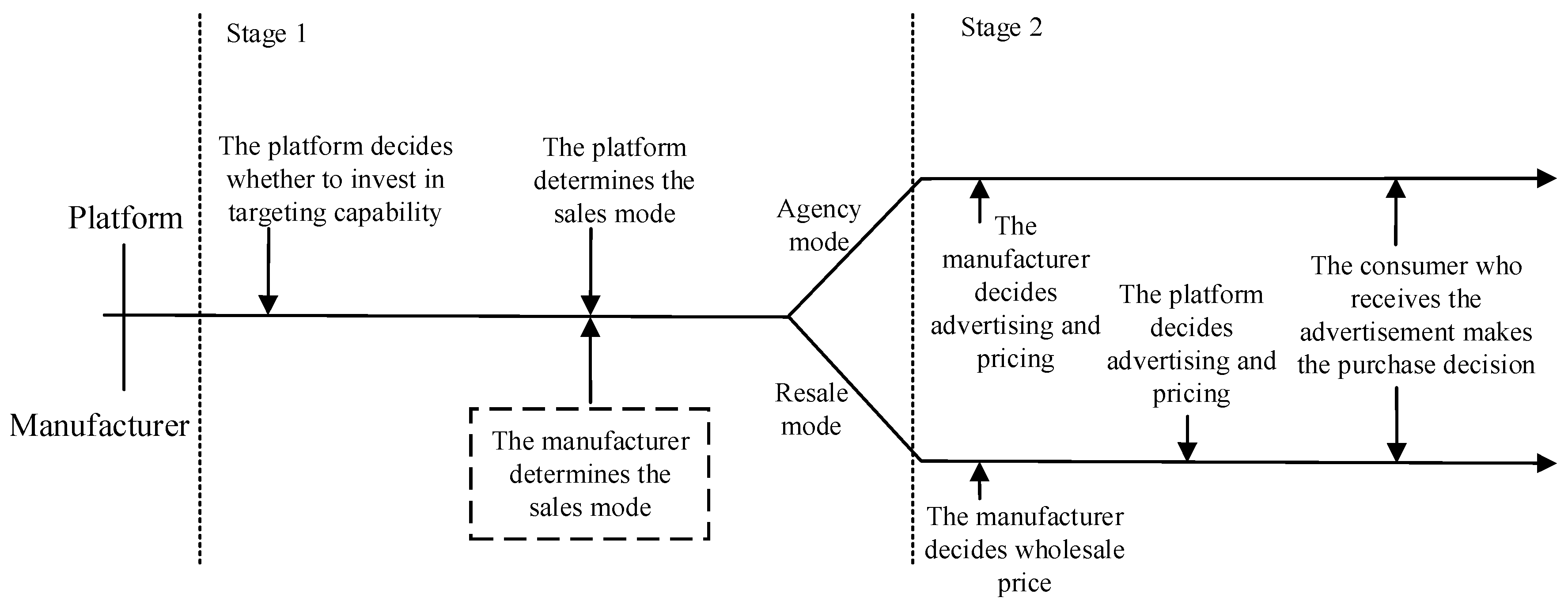
The game timeline (see Figure 1) in this paper is as follows: Stage 1: The platform decides whether to conduct a targeted technology investment; Stage 2: The platform (or manufacturer) determines the sales mode. Under agency mode A, the manufacturer decides on retail prices and advertising placements; under resale mode R, the manufacturer first sets wholesale prices, after which the platform determines retail prices and advertising placements.
For easy reference, the relevant parameters and variables in this paper are shown in Table 2.

3.1. Agency Mode + Uniform Advertising (AU)

If the platform does not invest in targeted technology, the manufacturer uses uniform advertising. The manufacturer disseminates advertisements to the entire market and sets the retail price p. Let x ^ be the marginal consumers among the consumers who receive the advertising information and purchase the goods, and the non-purchasing marginal consumers. Then, the market demand is d = min x ^ , 1 . We assume that the market clears. That is, the price adjusts so that the quantity demanded equals the total quantity produced [31]. To study the effect of targeted advertising in the market, assume that there is a portion of consumers who do not purchase the goods, then v < 2t. Therefore, the market demand is
d = x ^ = v p t .
The manufacturer’s profit function is
Π M = 1 θ p x ^ f .
By backward induction, let Π M p = 1 θ v 2 p t = 0 yield the optimal price p AU * = v 2 . Substituting p AU * into Equation (1) yields d AU * = v 2 t .
The platform’s profit is
Π P = θ p x ^ .
Substitute p AU * = v 2 and d AU * = v 2 t into the profit function of both parties, and we obtain the manufacturer’s profit as Π M AU * = v 2 1 θ 4 t f and the platform’s profit as Π P AU * = v 2 θ 4 t .

3.2. Agency Mode + Targeted Advertising (AT)

If the platform has targeted investment targeted technology, it can provide the manufacturer with targeted technology. If the manufacturer releases targeted advertisements to consumers in a certain area 0 , b , then the market demand is d = min v p t , b . The manufacturer’s profit function is
Π M = 1 θ p min v p t , b f b .
The platform’s profit function is
Π P = θ p min v p t , b c .
By backward induction, firstly, we derive the solution for maximizing manufacturer profit yields p = max v 2 , v b t , by substituting it into the demand function, we have d = min v 2 t , b . Then, the manufacturer’s profit is Π M = 1 θ max v 2 , v b t min v 2 t , b f b . If b < v 2 t , Π M = 1 θ v b t b f b let Π M / b = 0 yield b = v 2 t f 2 t 1 θ . If b v 2 t , Π M = 1 θ v 2 4 t f b let Π M / b = 0 yield b = v 2 t . By comparing the profits under b < v 2 t and b v 2 t , and substituting b = v 2 t f 2 t 1 θ into Π M = 1 θ v b t b f b , we have Π M b = v 2 t f 2 t 1 θ = 1 θ v f 2 4 t 1 θ . Substituting b = v 2 t into Π M = 1 θ v 2 4 t f b , we have Π M b = v 2 t = 1 θ v 2 4 t f v 2 t . By calculation, we obtain Π M b = v 2 t f 2 t 1 θ Π M b = v 2 t = f 2 4 t 1 θ > 0 ; we find that at b < v 2 t , the manufacturer achieves higher profitability. Therefore, the optimal advertising for the manufacturer is b AT * = v 2 t f 2 t 1 θ . Therefore, higher advertising expenditure does not necessarily lead to effectiveness. Reducing ineffective advertising expenditure is beneficial for increasing profits. By substituting b AT * into p , we have the optimal price p AT * = v 2 + f 2 1 θ , then, the demand d AT * = b AT * = v 2 t f 2 t 1 θ , manufacturer’s profit Π M AT * = v 1 θ f 2 4 t 1 θ , and platform’s profit Π P AT * = v 2 1 θ 2 f 2 θ 4 t 1 θ 2 c .

3.3. Resale Mode + Uniform Advertising (RU)

If the platform does not invest in targeted technology, the manufacturer first sets the wholesale price w , then the platform launches advertisements to the whole market and sets a uniform retail price p . If the marginal consumer is set x ^ , the demand is
d = x ^ = v p t .
The manufacturer’s profit function is
Π S = w d .
The platform’s profit function is
Π P = p w d f .
By backward induction, firstly, let Π P p = 0 yield p = v + w 2 , then, when put it into the demand function, we have d = v w 2 t . Next, solve for the optimal wholesale price of the manufacturer to obtain w = v 2 , and substitute it into p = v + w 2 to obtain the optimal retail price p RU * = 3 v 4 . Then, the demand is d RU * = v 4 t , the manufacturer’s profit is Π M RU * = v 2 8 t , and the platform’s profit is Π P RU * = v 2 16 t f .

3.4. Resale Mode + Targeted Advertising (RT)

If the platform invests in targeted advertising technology, the manufacturer first sets wholesale prices w , then the platform conducts targeted advertising campaigns. The platform will send advertisements to the consumers within the specified area 0 , b and set a unified retail price p . Therefore, the demand is d = min v p t , b , and the manufacturer’s profit function is
Π M = w min v p t , b .
The platform’s profit function is
Π P = p w min v p t , b f b c .
By backward induction, when v p t < b , d = v p t , substitute d = v p t into Equation (10) and set Π P p = 0 , yielding p = v + w 2 , then d = v w 2 t . The platform achieves optimal advertising b = d = v w 2 t by reducing ad waste. Next, solving for the manufacturer’s wholesale price involves substituting the platform’s pricing and advertising parameters into the manufacturer’s profit function Π M = w v w 2 t , which yields w = v 2 . Substituting this into the price response and advertising response functions leads to the optimal price p = 3 v 4 , optimal advertising placement b = v 4 t , the manufacturer’s profit Π M = v 2 8 t , and the platform’s profit Π P = v 2 16 t v f 4 t c . When v p t > b , d = b , by substituting it into Equation (10), we have Π P = p w b f b c . Solving Π P p = 0 yields b = v w f 2 t , then the optimal price is p = v + w + f 2 . Subsequently, we solve the manufacturer’s wholesale price decision. By substituting the platform’s price and the advertising response function into the manufacturer’s profit function, we obtain the optimal wholesale price as w RT * = v f 2 . Plugging this into the price response and advertising response functions yields the optimal price p RT * = 3 v + f 4 and optimal advertising placement b RT * = v f 4 t ; the manufacturer’s profit reaches Π M RT * = v f 2 8 t , while the platform’s profit is Π P RT * = v f 2 16 t c . Comparing the platform profits under v p t < b and v p t > b , we can obtain that the platform has higher profitability when v p t < b . Therefore, the platform’s optimal advertising strategy is b RT * = v f 4 t .

4. Equilibrium Analysis

This section compares the equilibrium results under AU, AT, RU, and RT, explores the sales mode selection and orientation technology investment decisions under different power structures, and analyzes the impact of orientation technology on price and advertising strategies, commodity demand, and platform and manufacturer profits.
According to the equilibrium solution in Section 3, the equilibrium results are summarized to obtain Theorem 1.
The equilibrium results under different scenarios (see Table 3).

4.1. The Effect of Targeted Advertising on Equilibrium

First, by comparing the equilibrium under the investment with and without directed capacity, this paper analyzes the influence of the directed capacity on the equilibrium.
Proposition 1.
The influence of targeted advertising on decision variables:
1. 
p AT * > p AU * , p RT * > p RU * ;
2. 
b AT * < b AU * , b RT * < b RU * ;
3. 
w RU * > w RT * .
Proposition 1 indicates that under targeted advertising, both the agency and resale modes lead to rising retail prices while reducing ad spending. This phenomenon occurs because sellers with targeted technology focus their advertising resources on consumers with stronger product preferences. These consumers demonstrate higher demand intensity and are more willing to pay premium prices. Consequently, sellers abandon lower-paying customers, resulting in reduced overall ad spending. Additionally, in the resale mode, the manufacturer’s wholesale price decreases when the platform invests in targeted technology. This happens because the platform reduces ad placements to cut costs, shrinking market demand. To stimulate sales and maximize profits, the manufacturer often decreases the wholesale price under such circumstances.
Corollary 1.
p AT * f > 0 , p RT * f > 0 , b AT * f < 0 , b RT * f < 0 , w RT * f < 0 .
In Corollary 1, it is demonstrated that product prices are directly proportional to unit advertising costs, while the volume of targeted advertising is inversely proportional to unit advertising costs. Similarly to Proposition 1, this phenomenon occurs because sellers tend to allocate ads to consumers with a higher willingness to pay to effectively reduce advertising expenses. Consequently, when unit advertising costs are high, sellers become more cautious in selecting target audiences, thereby reducing ad placements. In such scenarios, consumers with stronger preferences for the product are more willing to pay higher prices. However, under the resale mode, a counter-intuitive conclusion emerges; when unit advertising costs increase, wholesale prices paradoxically decrease. Intuitively, rising unit advertising costs should lead to price increases and, consequently, higher wholesale prices. Contrary to this, our study reveals that increased unit advertising costs enable the manufacturer to lower prices and reduce ad placements, effectively decreasing demand. To mitigate excessive demand reduction, the manufacturer may choose to lower wholesale prices, thereby moderating price increases and maintaining stable market demand. Under the resale mode, the manufacturer balances supply and demand through wholesale price adjustment under high advertising cost conditions and ultimately maximizes profits.
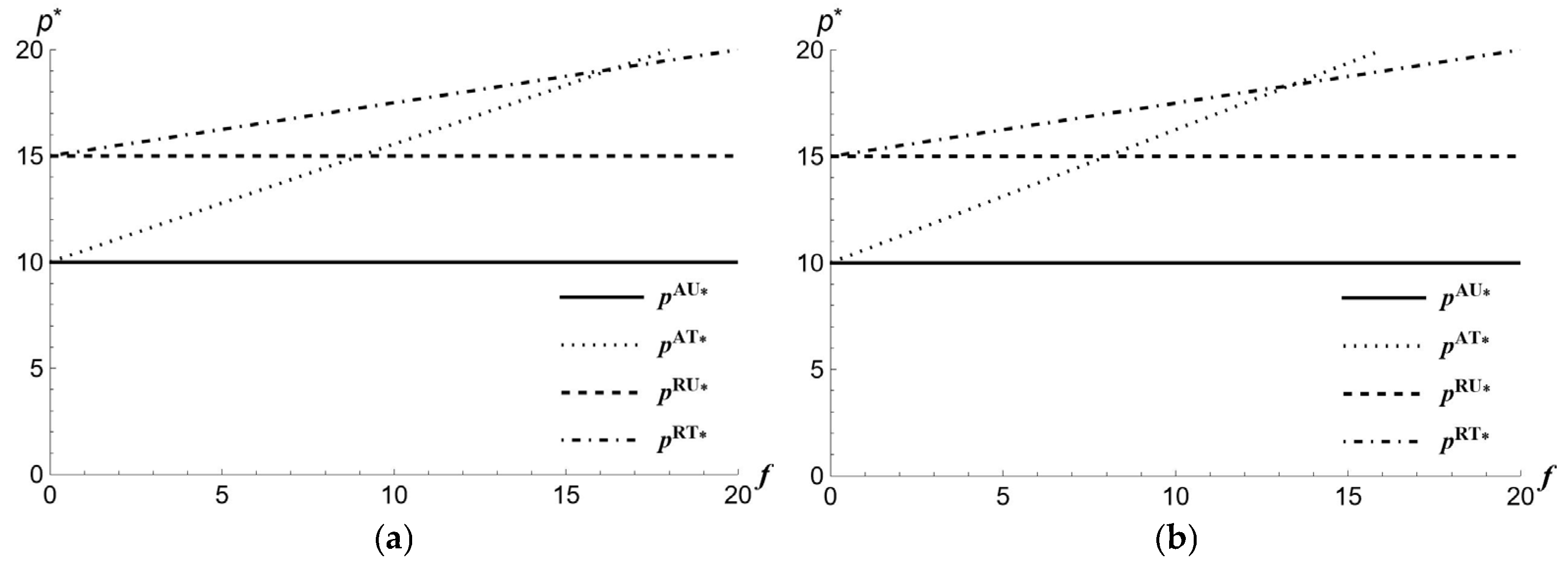
In order to intuitively demonstrate Proposition 1 and Corollary 1, numerical simulation will be carried out first to analyze the changes in price and advertising in the consumer market. Take t = 11 , v = 20 , and θ as 0.05 and 0.2, respectively, and f as from 0 to 20, so as to obtain Figure 2 showing the change in price with unit advertising cost.
As shown in Figure 2, under uniform advertising scenarios, product prices remain stable regardless of whether the agency mode or resale mode is adopted, as they do not fluctuate with unit advertising costs. In such cases, products under the agency mode typically command lower prices than those in the resale mode. However, in targeted advertising contexts, both models experience price increases. When unit advertising costs rise, prices under the agency mode may even surpass those in the resale mode. This explains why, in real-world retail platforms, products from self-operated stores sometimes sell at lower prices than those in brand flagship stores. Therefore, the following conclusion is drawn.
Conclusion 1.
Targeted advertising leads to an increase in commodity prices, and the price increases as the unit advertising cost increases.
Furthermore, under the agency mode, as commission rates increase, product prices in targeted advertising campaigns rise at a faster rate compared to unit advertising costs. This means that when the platform promotes goods through targeted advertising, the price of goods will increase faster if the commission ratio is higher under the agency mode, leading to the possibility that the price of goods under the agency mode may exceed the price of goods under the resale mode in some cases. Such scenarios are likely to occur in real-world retail markets, particularly in highly competitive environments where the platform may adopt more aggressive pricing strategies to attract consumers. This trend reveals that in the context of targeted advertising, platform managers need to be vigilant; when the cost per unit of advertisement increases, the price of goods under the agency mode may exceed that under the resale mode. This provides a basis for the platform to make decisions regarding the allocation of pricing authority—if the platform wishes to maintain price competitiveness, it should prefer to regain pricing authority (to adopt the resale mode) or intervene in the advertising costs of sellers under the agency mode.
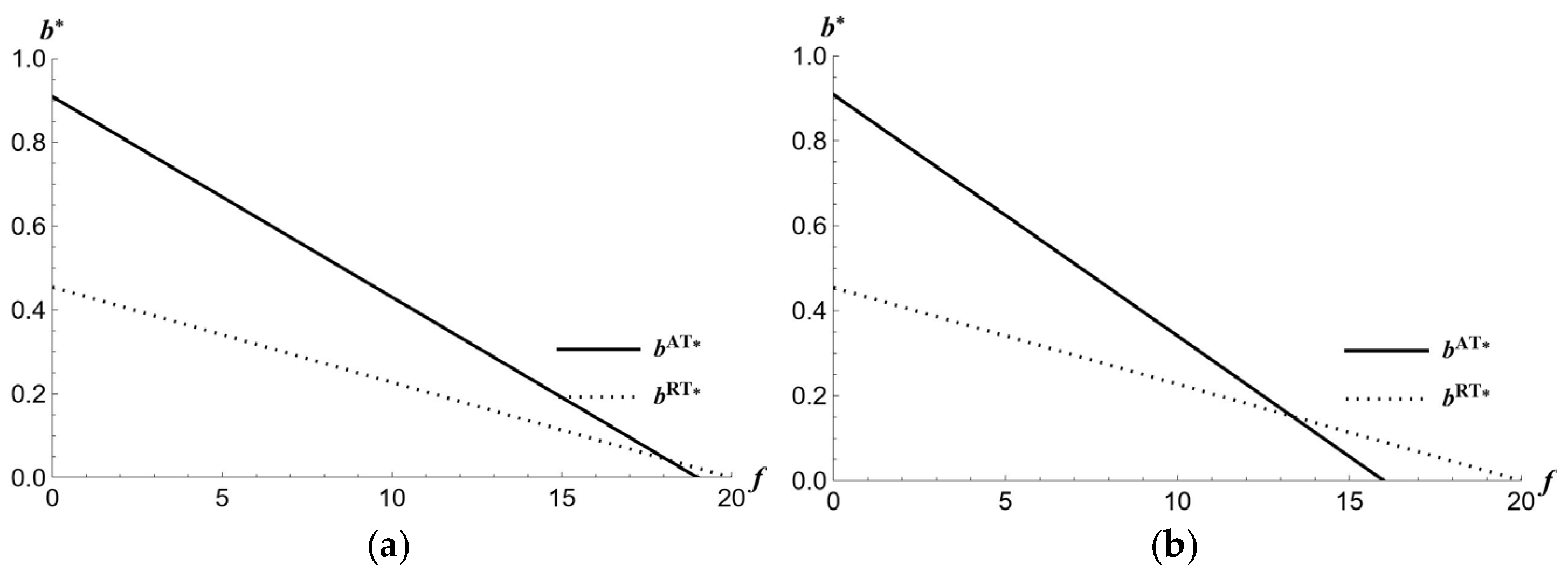
Take t = 11 , v = 20 , and θ as 0.05 and 0.2; f is from 0 to 20, and then the graph of directed advertising with unit advertising cost variation can be obtained, as shown in Figure 3.
Figure 3 illustrates how advertising volume in both agency and resale modes varies with unit advertising costs in the context of targeted advertising. Specifically, when unit advertising costs are relatively low, we observe that the agency mode demonstrates a significantly higher advertising volume compared to the resale mode. This phenomenon can be explained by the findings in Figure 2. At lower cost levels, products under the agency mode command higher prices, which incentivizes the manufacturer to invest more in advertising campaigns to boost product exposure and sales. Therefore, the following conclusion is drawn.
Conclusion 2.
Targeted advertising leads to a decrease in the advertising level, and the advertising level decreases as the unit advertising cost increases.
However, the situation changes when unit advertising costs are higher. In this case, the volume of ad placements in the resale mode actually surpasses that of the agency mode. Similarly, this phenomenon can be explained through product pricing; when unit advertising costs are elevated, products in the resale mode command higher prices. By increasing ad placements, the platform can effectively boost sales revenue to offset the higher advertising expenses.
In Figure 3a,b, we can observe that under the agency mode, higher platform commission rates correspond to a steeper decline in advertising volume as unit costs increase. This occurs because higher platform commissions reduce the manufacturer’s incentive to advertise. When facing increased commission rates, companies become more cautious in evaluating the cost–benefit ratio of ad placements, leading to reduced advertising volume. Consequently, the level of platform commission rates directly impacts the manufacturer’s willingness to engage in advertising under this agency mode. The management insight is that the platform’s commission rate directly influences the manufacturer’s enthusiasm for advertising in the agency mode. If the platform wants to encourage the promotion of new products or increase the exposure of certain types of goods, it can stimulate the manufacturer to increase advertising investment by gradually lowering the commission rate; conversely, if it needs to control the quality of advertising or avoid excessive competition, it can maintain or increase the commission rate.
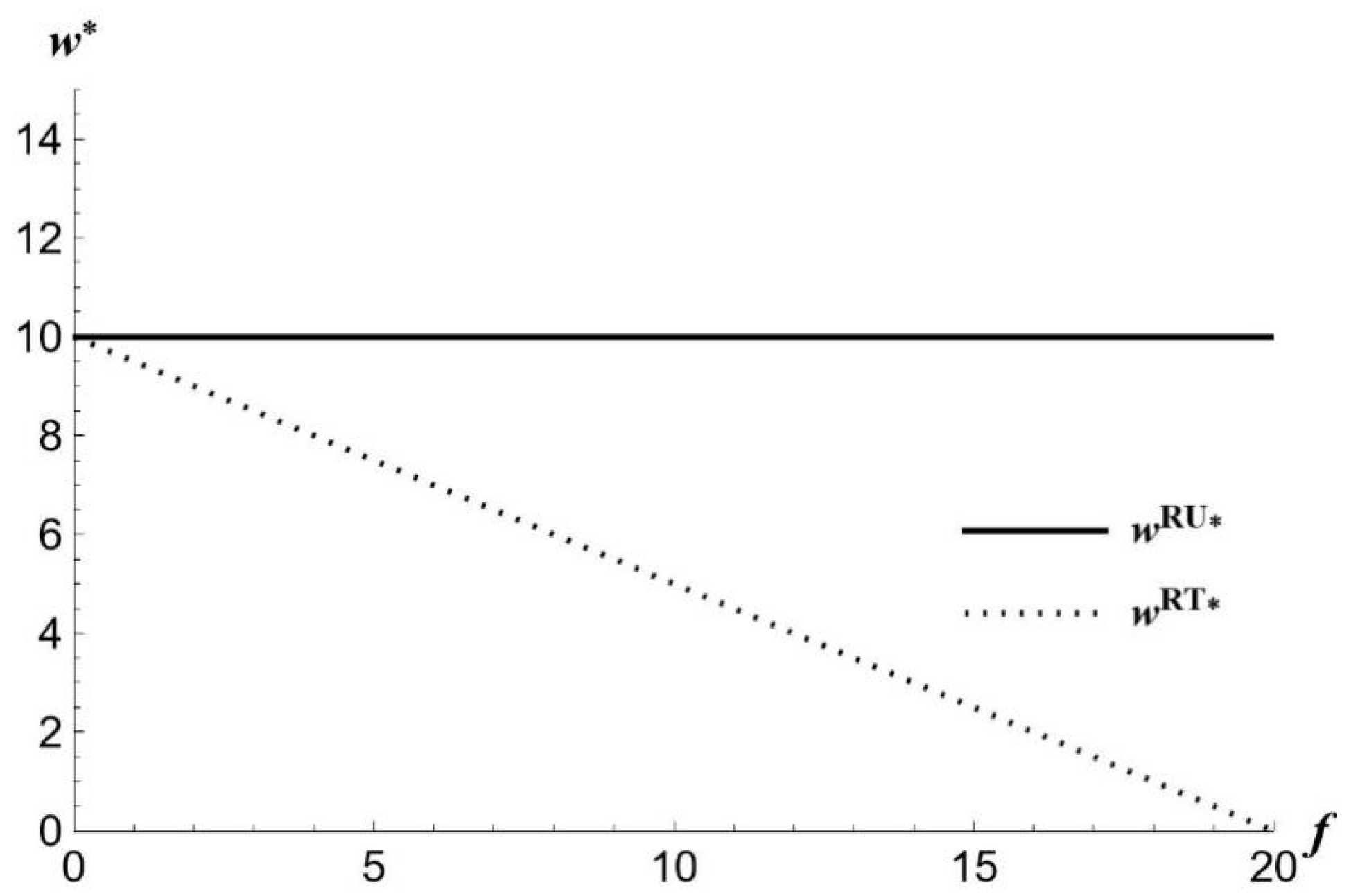
Take t = 11 , v = 20 , and f as from 0 to 20, and obtain the wholesale price change with unit advertising cost, as shown in Figure 4.
As shown in Figure 4, in uniform advertising scenarios where precise targeting is unachievable, the platform must still deploy ads across the entire consumer market even when unit costs rise. In such cases, product prices remain unchanged and demand stays stable, keeping wholesale prices consistent. However, with targeted advertising enabling precise delivery, the platform reduces ad placements proportionally as costs increase, leading to higher product prices. The resulting price hikes inevitably decrease demand. In order to improve the profit, the manufacturer will reduce the wholesale price accordingly. This provides manufacturers with a clear strategy for wholesale negotiations: when the platform starts using targeted advertising and the cost of advertising increases, manufacturers should anticipate that the platform will have the motivation to lower the wholesale price to maintain demand. By taking advantage of this negotiation window, manufacturers can offer to accept a lower wholesale price in exchange for more commitments from the platform in terms of advertising resources or traffic.
Secondly, we compare the size of commodity demand in different situations and analyze the influence of targeted technology on commodity demand.
Proposition 2.
d AT * < d AU * , d RT * < d RU * .
Proposition 2 demonstrates that both agency mode and resale mode exhibit reduced product demand when enterprises implement targeted technology investments. Building on the analysis of Proposition 1, we can conclude that sellers who acquire targeted technology tend to scale back advertising efforts. This naturally decreases the number of consumers accessing a product’s information. Despite this, sellers still opt to raise prices. The underlying logic is that higher pricing attracts consumers with stronger product preferences, thereby increasing marginal profits. Ultimately, this strategy enables sellers to effectively enhance their profit margins.
Then, according to the profit size of the manufacturer and the platform in different situations, this paper analyzes the influence of targeting ability on the profits of the manufacturer and the platform in different situations under the agency mode and resale mode.
Proposition 3.
Under the agency mode, the manufacturer’s profit is Π M AU * < Π M AT * and the platform’s profit is Π P AU * > Π P AT * .
Proof of Proposition 3.
Comparing the manufacturer’s profit, Π M AU * Π M AT * = f 2 v 2 t 1 θ f 4 t 1 θ < 0 , then Π M AU * < Π M AT * . Comparing manufacturer’s profit, Π P AU * Π P AT * = θ f 2 4 t 1 θ 2 + c > 0 , then Π P AU * > Π P AT * . □
Proposition 3 demonstrates how the manufacturer in the agency mode enhances profits through targeted technology. Specifically, when the manufacturer acquires targeted technology, they can more precisely deliver product sales and advertising to consumer groups with a higher preference for their products. This precision-targeted strategy makes these consumers more willing to purchase at premium prices, significantly boosting the manufacturer’s profit margins. However, this approach also brings negative consequences. By selectively targeting advertisements, the manufacturer excludes consumer groups with lower product preferences. While this saves costs for the manufacturer, it simultaneously reduces overall product demand. The decreased demand directly impacts the platform’s profits, as revenue is closely tied to product sales volume. Consequently, although the manufacturer’s profit increases, the platform’s profits suffer adverse effects. This phenomenon reveals the complexity of interest distribution between the manufacturer and the platform under the agency mode, along with the influence of targeted technology on supply chain profit allocation.
Proposition 4.
Under the resale mode, the manufacturer’s profit is Π M RT * < Π M RU * . The platform’s profits: if c < v f 2 16 t v 2 16 t + f , Π P RT * > Π P RU * ; if c > v f 2 16 t v 2 16 t + f , Π P RT * > Π P RU * .
Through an in-depth analysis of Proposition 4, we can further examine how the manufacturer’s profit is influenced by targeted technology under resale modes. Specifically, when the manufacturer adopts resale mode, the platform assumes responsibility for product pricing and advertising decisions. In such scenarios, if advertising investment costs remain relatively low while unit advertising expenses are high, the platform’s profits will increase. This occurs because the platform tends to reduce advertising intensity to cut costs. To maximize revenue, the platform may prioritize targeting consumers with a higher willingness to pay while raising product prices. However, this strategy leads to decreased demand for products, ultimately negatively impacting the manufacturer’s profit.
On the other hand, the implementation of targeted advertising technology can significantly boost a platform’s sales revenue. This is because such technology enables the platform to more accurately identify and attract consumers with high payment willingness, thereby improving ad conversion rates and sales efficiency. However, whether targeted advertising can truly enhance a platform’s net profit requires a comprehensive evaluation of both the investment costs in this technology and the resulting revenue growth. If a platform’s investment in targeted advertising remains below a specific threshold, its net profit will increase. Conversely, if the investment exceeds the range that can be offset by the revenue’s growth, the platform’s net profit will decrease.
In general, under the resale mode, the manufacturer’s profit is affected by the platform’s pricing and advertising strategies. While the platform can boost sales revenue through targeted advertising technology, their impact on net profit depends on the balance between investment costs for this technology and the resulting revenue growth. Substantial profit improvements can only be achieved when investment costs remain within reasonable limits.
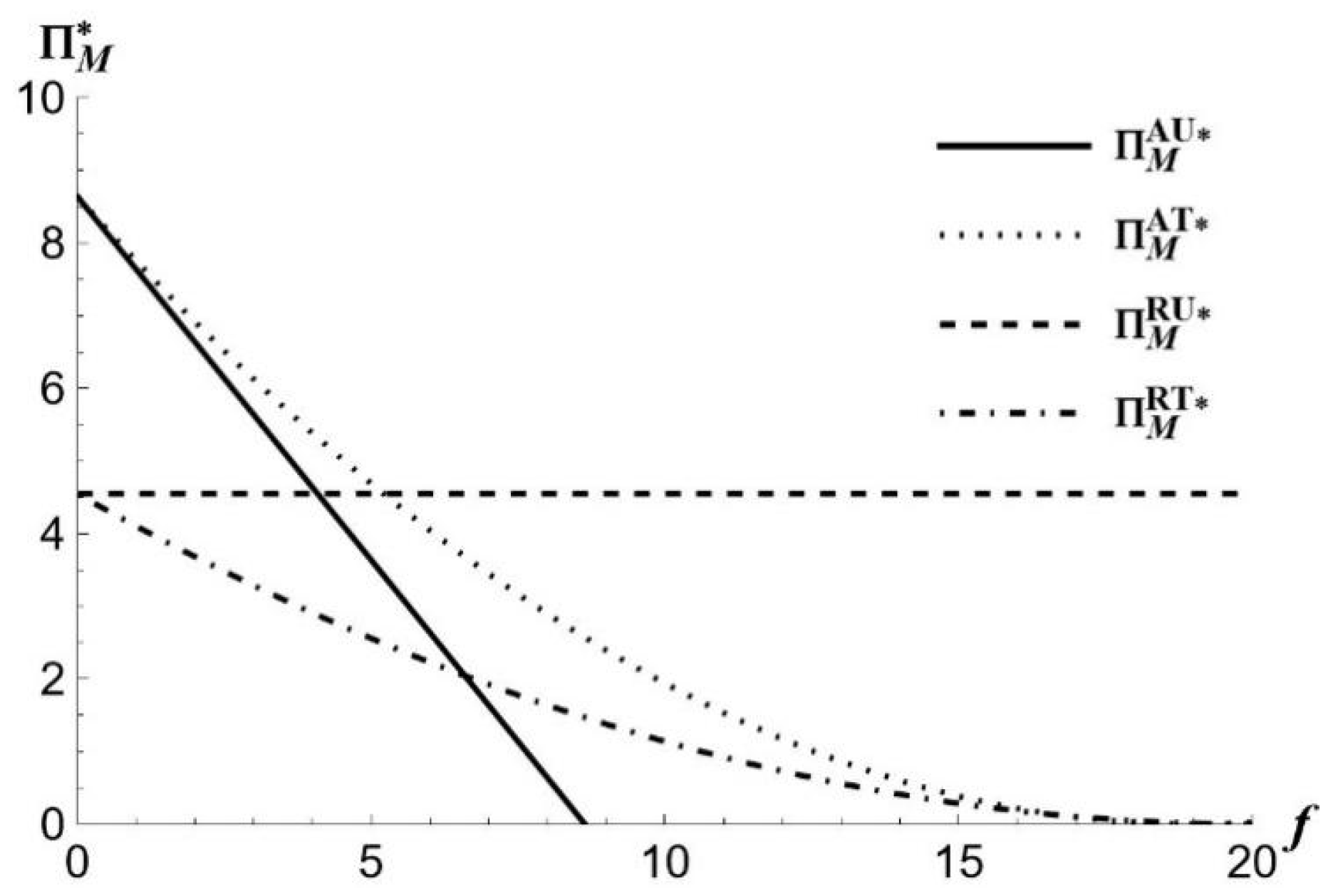
Take t = 11 , v = 20 , θ = 0.05 , and f as from 0 to 20, and obtain the chart of the manufacturer’s profit with unit advertising cost variation, as shown in Figure 5.
Figure 5 illustrates how manufacturer profits vary with unit advertising costs. The data aligns with Propositions 3 and 4. Comparing the values Π M AU * and Π M RU * under uniform advertising, it becomes evident that the manufacturer prefers agency modes when unit costs are low, while they favor resale modes when costs are high. When comparing targeted advertising scenarios, the manufacturer chooses the agency mode when unit costs are low; otherwise, the resale mode prevails. The following conclusion is drawn.
Conclusion 3.
Under the resale mode, targeted advertising harms the manufacturer’s profit. Under the agency mode, targeted advertising increases the manufacturer’s profit.
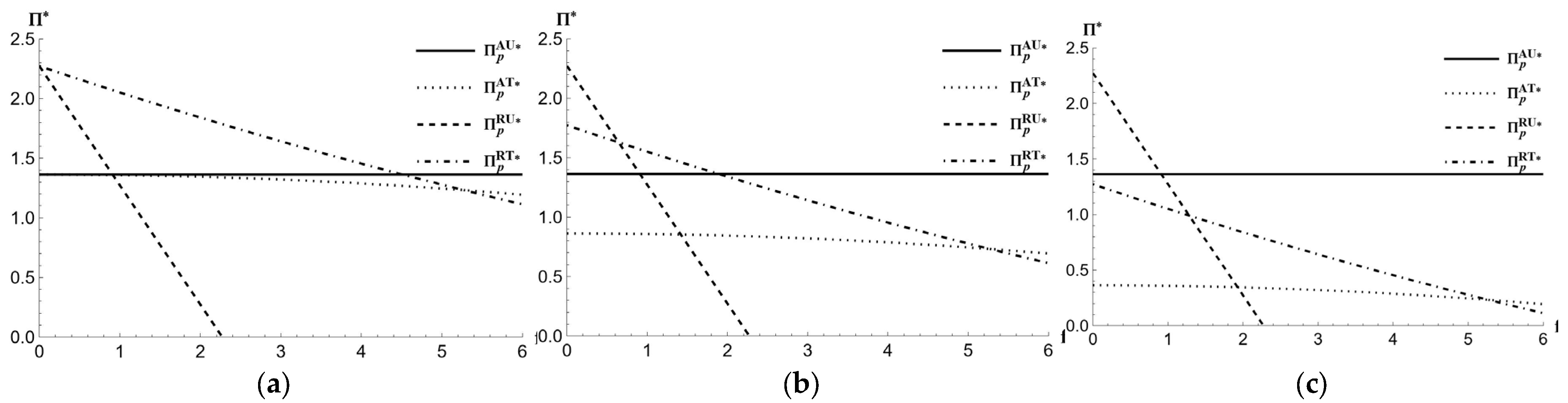
Take v = 20 , θ = 0.15 , t = 11 , and c as 0, 0.5, and 1, respectively, to obtain the graph of the platform’s profit with unit advertising cost.
As shown in Figure 6a, when c = 0 , i.e., investment costs for targeted technology are not considered, the platform achieves maximum profits under targeted advertising and resale mode (RT) when unit advertising costs are low. Conversely, they maximize profits through uniform advertising and agency mode (AU) when unit costs are high. Figure 6b illustrates that when c = 0.5 , i.e., targeted technology has lower investment costs, the platform demonstrates optimal performance in resale mode (RT) with moderate unit costs. However, profits from targeted advertising decline, while resale mode (RU) yields higher returns. The platform chooses agency mode (AU) when unit costs are elevated. As shown in Figure 6c, when c = 1 , namely, when the investment cost of targeted technology is high, the platform’s profit from investing in targeted technology is low; when the unit advertising cost is low, the platform tends to use resell mode (RU) and obtains more profits. When the unit advertising cost is high, the platform prefers the agency mode (AU). Figure 6 further defines the scope for the platform’s investment decisions, clarifying under what combinations of advertising costs and investment costs the targeted investment capabilities can truly lead to an increase in net profits, thereby avoiding blind investment. The following conclusion is drawn.
Conclusion 4.
Under the agency mode, targeted advertising increases the platform’s profit; under the resale mode, targeted advertising increases the platform’s profit when the advertising cost is low and reduces the platform’s profit when the advertising cost is high.

4.2. Sales Mode Selection

This part analyzes the decision of commodity sales mode selection. According to the difference in power structure between the platform and the manufacturer, it analyzes the two situations of a platform-led sales mode and manufacturer-led sales mode, respectively.

4.2.1. Platform-Led Sales Mode

Under the platform-led sales mode, the commodity sales mode is determined by the platform, and the platform selects the sales mode according to the profit size of different sales modes, resulting in the following propositions.
Proposition 5.
In the platform-led sales mode situation:
1. 
First item: under uniform advertising, when f < v 2 16 t v 2 θ 4 t , the platform chooses the resale mode; when f > v 2 16 t v 2 θ 4 t , the platform chooses the agency mode.
2. 
Under targeted advertising, when f < v 1 θ 2 2 v θ 1 θ 2 + θ 1 + θ 2 , the platform chooses the resale mode; when f > v 1 θ 2 2 v θ 1 θ 2 + θ 1 + θ 2 , the platform chooses the agency mode.
Proof of Proposition 5.
Π P AU * Π P RU * = v 2 θ 4 t v 2 16 t + f , when f < v 2 16 t v 2 θ 4 t , Π P AU * < Π P RU * . When f > v 2 16 t v 2 θ 4 t , Π P AU * > Π P RU * . Let Π P AT * Π P RT * = 0 , we have that, when f < v 1 θ 2 2 v θ 1 θ 2 + θ 1 + θ 2 , Π P AT * Π P RT * < 0 ; when f > v 1 θ 2 2 v θ 1 θ 2 + θ 1 + θ 2 , Π P AT * Π P RT * > 0 . □
Based on the analysis of Proposition 5, we can conclude that in a platform-led sales mode, the platform’s decision will be affected by the unit advertising cost, regardless of which advertising model is adopted. Specifically, when unit advertising costs are low, platforms tend to choose the resale mode. In this model, platforms control the pricing power of goods and the decision-making power of advertising, so that they can control costs more effectively and maximize profits. On the contrary, if the unit advertising cost is high, the platform is more inclined to choose the agency mode. In this model, platforms do not need to bear high advertising expenses, but sell goods through agents, thus avoiding the risk of high costs, making the agency mode more advantageous in this case. In short, when facing different advertising costs, the platform will choose the most appropriate sales and advertising model according to the high and low costs to ensure that its benefits are maximized.
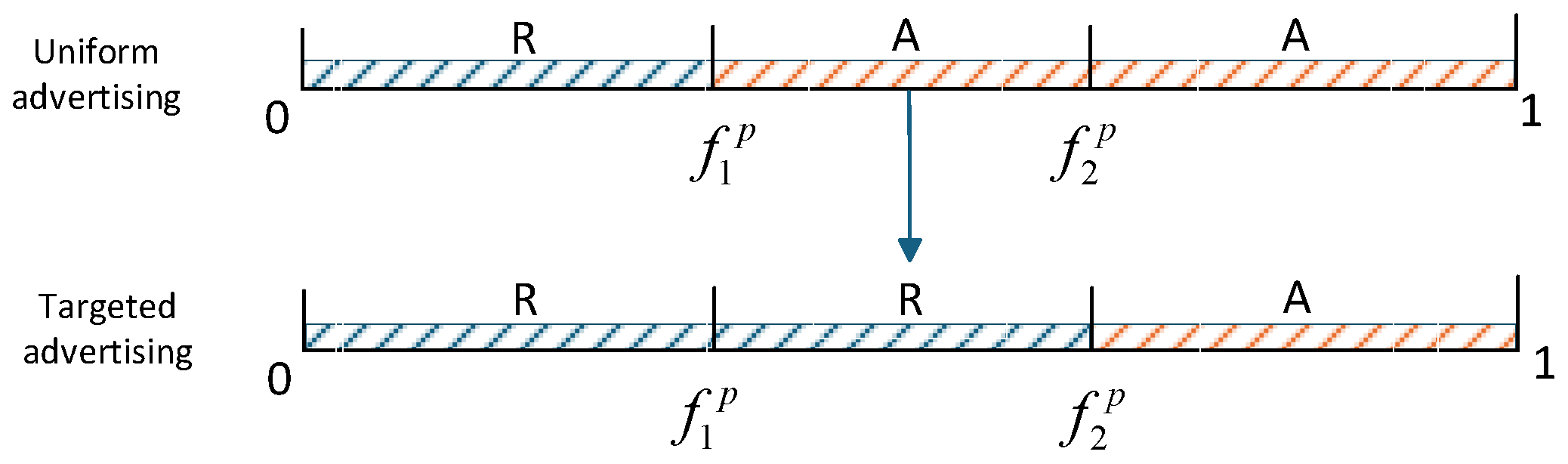
Set f 1 p = v 2 16 t v 2 θ 4 t , f 2 p = v 1 θ 2 2 v θ 1 θ 2 + θ 1 + θ 2 , comparing f 1 p and f 2 p , we have f 1 p < f 2 p . According to Proposition 5, we can draw the platform sales mode selection diagram when the platform dominates the sales mode, as shown in Figure 7.
As shown in Figure 7, when the platform adopts a dominant sales mode, if f < f 1 p , the platform chooses the resale mode with uniform advertising. If f < f 2 p , the platform chooses the resale mode with targeted advertising. As can be seen from Figure 7, the area where the platform selects the resale mode has become larger. Therefore, when the platform dominates the sales mode, targeted advertising promotes the platform to choose the resale mode.

4.2.2. Manufacturer-Led the Sales Mode

Proposition 6.
When in the manufacturer-led the sales mode
1. 
Under uniform advertising, if f < v 2 1 2 θ 8 t , the manufacturer chooses the agency mode, otherwise they choose the resale mode.
2. 
Under targeted advertising, if f < v v θ 1 2 1 θ 1 + θ , the manufacturer chooses the agency mode, otherwise they choose the resale mode.
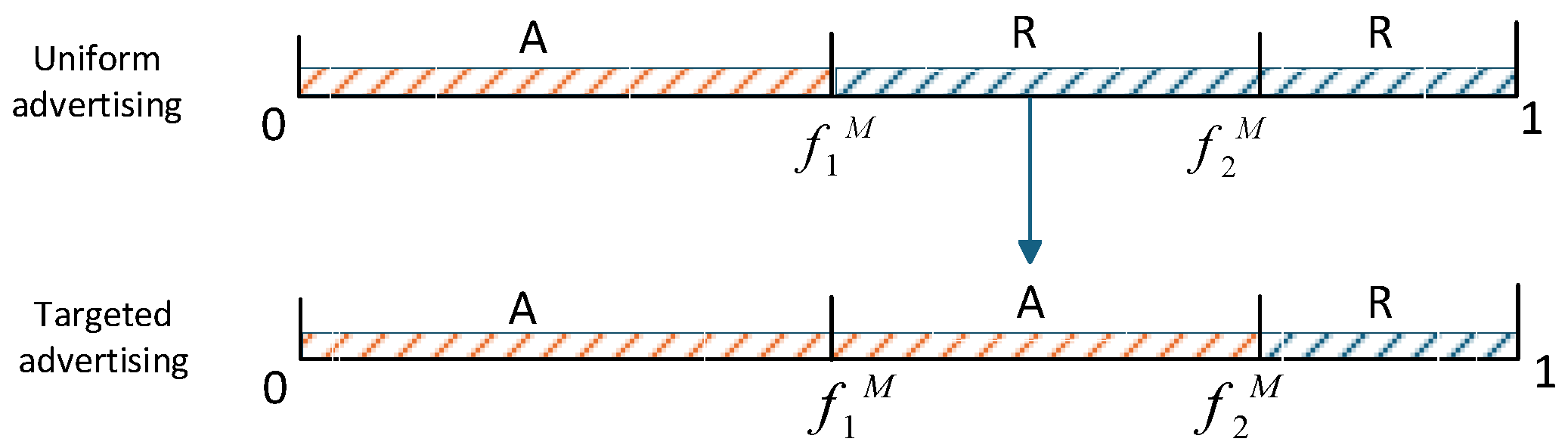
Proposition 6 demonstrates that, when in the manufacturer-led sales mode, regardless of advertising strategies, the manufacturer chooses the agency mode when unit advertising costs are lower, as this grants them greater control over product pricing and ad placement. Conversely, they choose resale mode when unit costs are higher. As previously established, the relationships between these factors can be summarized as follows: Let f 1 M = v 2 1 2 θ 8 t , f 2 M = v v θ 1 2 1 θ 1 + θ , and when comparing f 1 M with f 2 M , we have f 1 M < f 2 M . The diagram illustrating manufacturer-led sales mode choices is presented as shown in Figure 8.
As shown in Figure 8, the manufacturer is more inclined to the agency mode under targeted advertising, and some regions of the manufacturer have changed from the resale mode to the agency mode.
By comparing the sales mode choices under the two power structures, we obtain Corollary 2.
Corollary 2.
Under uniform advertising, if f 1 p < f < f 1 M , the agency mode made both the platform and the manufacturer win; under targeted advertising, if f 2 p < f < f 2 M , the agency mode made both the platform and the manufacturer win.
Corollary 2 reveals the tendency of the platform and the manufacturer to use sales modes under different advertising modes. Only when the unit advertising cost is within a certain range, can both sides achieve mutual benefits and win–win results; otherwise, they will tend to choose the mode that is more beneficial to themselves.

4.3. Targeted Investment Decisions

This part analyzes the investment decision of platform-targeted technology according to the impact of targeted technology on the platform’s profits. The platform’s decision of whether to invest in targeted technology depends on whether targeted technology improves the platform’s profits. According to the difference in the power structure of the platform and the manufacturer, it can be divided into two cases: platform-led sales mode and manufacturer-led sales mode.

4.3.1. Platform-Led Sales Mode

Proposition 7.
When in the platform-led the sales mode
1. 
When c < min v f 2 16 t θ v 2 4 t , v f 2 16 t + f v 2 16 t , the platform invests in targeted technology and chooses the resale mode (RT);
2. 
When c < v f 2 16 t θ v 2 4 t and c > v f 2 16 t + f v 2 16 t , the platform does not invest and chooses the resale mode (RU);
3. 
When c > v f 2 16 t θ v 2 4 t and c < v f 2 16 t + f v 2 16 t , the platform does not invest and chooses the agency mode (AU);
4. 
When c > max v f 2 16 t θ v 2 4 t , v f 2 16 t + f v 2 16 t , the platform does not invest. If f < f 1 p , the platform chooses the resale mode (AU). If f > f 1 M , the platform chooses the agency mode (RU).
Proof of Proposition 7.
By comparing Π P AU * and Π P AT * we obtain Π P AU * Π P AT * = θ f 2 4 t 1 θ 2 + c > 0 , and the platform will not choose AT. Then, by comparing Π P RT * and max Π p AU * , Π p RU * , it can be determined whether the platform has invested in the targeted ability. Additionally, it can be calculated that when c < min v f 2 16 t θ v 2 4 t , v f 2 16 t + f v 2 16 t , Π p RT * > max Π p AU * , Π p RU * . □
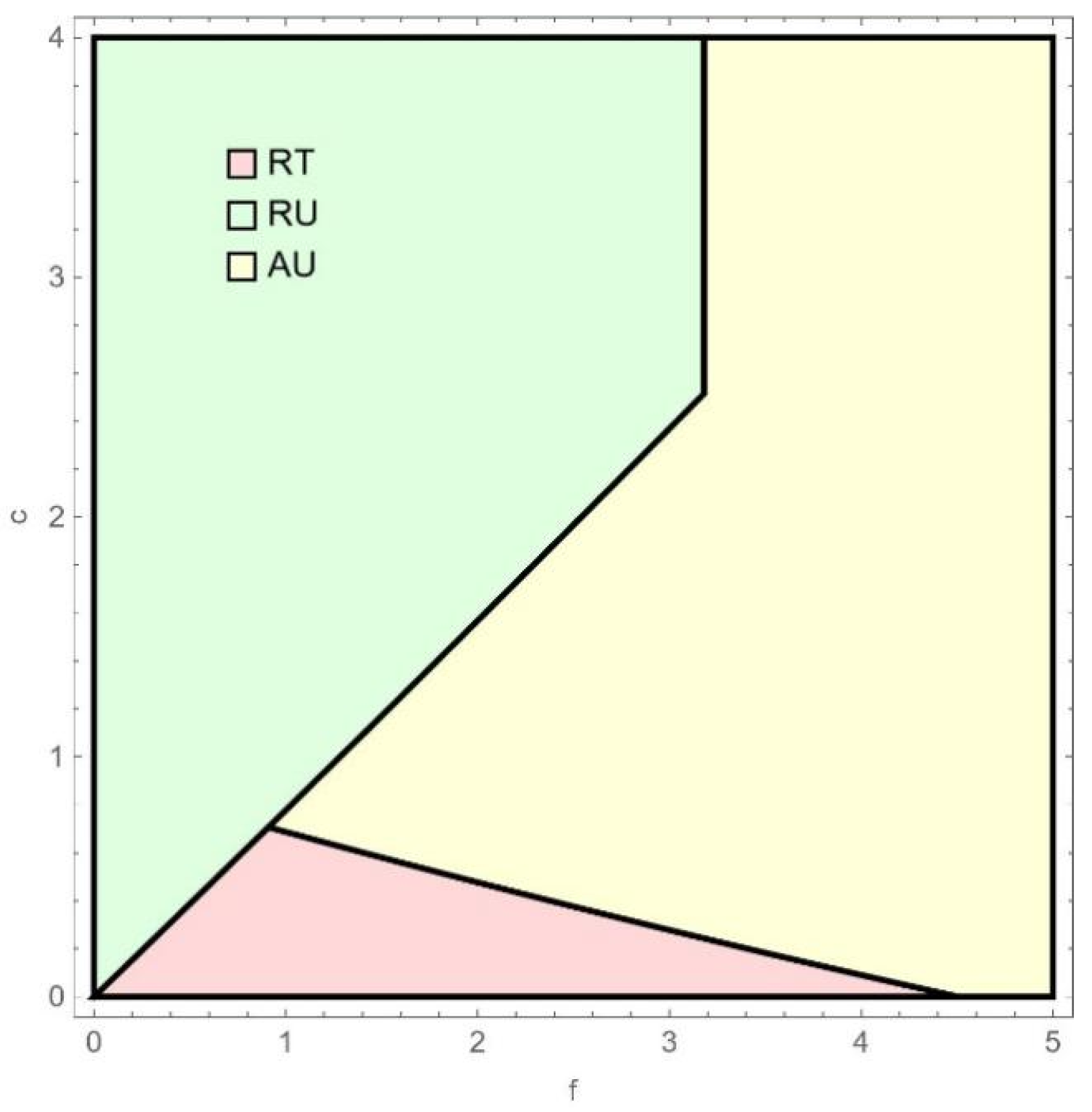
In order to describe Proposition 7 more intuitively, a numerical simulation is used. Take θ = 0.15 , v = 20 , t = 11 , c as from 0 to 4, and f as from 0 to 5, respectively, to obtain the equilibrium’s regional map (see Figure 9).
Proposition 7 describes the platform’s decision-making for targeted technology investment under the platform-led sales mode. From Proposition 7, it is clear that, in the agency mode, the platform will not tend to invest in targeted technology. This is because, in the agency mode, the manufacturer uses targeted technology to advertise to the consumer groups with a high willingness to pay. Consumer groups with a low willingness to pay do not receive the advertising information. This leads to a decline in the demand for goods and thus reduces the platform’s profits. Therefore, the platform’s intrinsic motivation to invest in targeted technology lies in the higher profit returns that can be achieved through the use of targeted advertising in the resale mode. Figure 4 intuitively illustrates the equilibrium region of platform-targeted technology investment and sales mode choice under platform-led sales mode. The prerequisite for the platform to invest in targeted technology is that the investment cost is relatively low and the unit advertising cost is moderate. In the event that the financial outlay required for the acquisition of targeted technology proves excessively onerous, and the platform is unable to secure commensurate returns on the investment, it will abstain from further investment. In instances where the unit advertising cost is minimal, the platform’s investment in targeted technology is unable to achieve a substantial reduction in advertising costs. Consequently, this investment is rendered ineffective, and the platform exhibits a greater propensity to adopt the resale mode, as it is averse to assuming the substantial advertising costs. According to Proposition 3, under the agency mode, Π P AU * > Π P AT * , so the platform will choose not to invest and will prefer the agency mode.

4.3.2. Manufacturer-Led the Sales Mode

Proposition 8.
When in the manufacturer-led the sales mode
1. 
When f < v 2 1 2 θ 8 t , the platform chooses not to invest in targeted technology, and the manufacturer chooses the agency mode (AU);
2. 
When v 2 1 2 θ 8 t < f < v v θ 1 2 1 θ 1 + θ , if c < θ v 2 1 θ 2 f 2 4 t 1 θ 2 v 2 16 t + f , the platform invests in targeted technology and the manufacturer chooses the agency mode (AT); if c > θ v 2 1 θ 2 f 2 4 t 1 θ 2 v 2 16 t + f , the platform does not invest in targeted technology and the manufacturer chooses the resale mode (RU);
3. 
When f > v v θ 1 2 1 θ 1 + θ , if c < v f 2 16 t v 2 16 t + f , the platform invests in targeted technology and the manufacturer chooses the resale mode (RT). If c > v f 2 16 t v 2 16 t + f , the platform does not invest in targeted technology and the manufacturer chooses the resale mode (RU).
Proof of Proposition 8.
According to Proposition 6, when f < v 2 1 2 θ 8 t , the manufacturer chooses the agency mode for both uniform advertising and targeted advertising. According to Π P A U * > Π P A T * , the platform opts not to invest in targeted technology. When f > v v θ 1 2 1 θ 1 + θ , the manufacturer selects the resale mode for both uniform advertising and targeted advertising. When c < v f 2 16 t v 2 16 t + f , Π P RU * < Π P RT * , otherwise Π P RU * > Π P RT * . When v 2 1 2 θ 8 t < f < v v θ 1 2 1 θ 1 + θ , under uniform advertising, the manufacturer chooses the resale mode; under targeted advertising, the manufacturer chooses the agency mode. By comparing Π P RU * and Π P AT * , if c < θ v 2 1 θ 2 f 2 4 t 1 θ 2 v 2 16 t + f , Π P AT * > Π P RU * , otherwise Π P AT * < Π P RU * . Thus, Proposition 8 is established. □
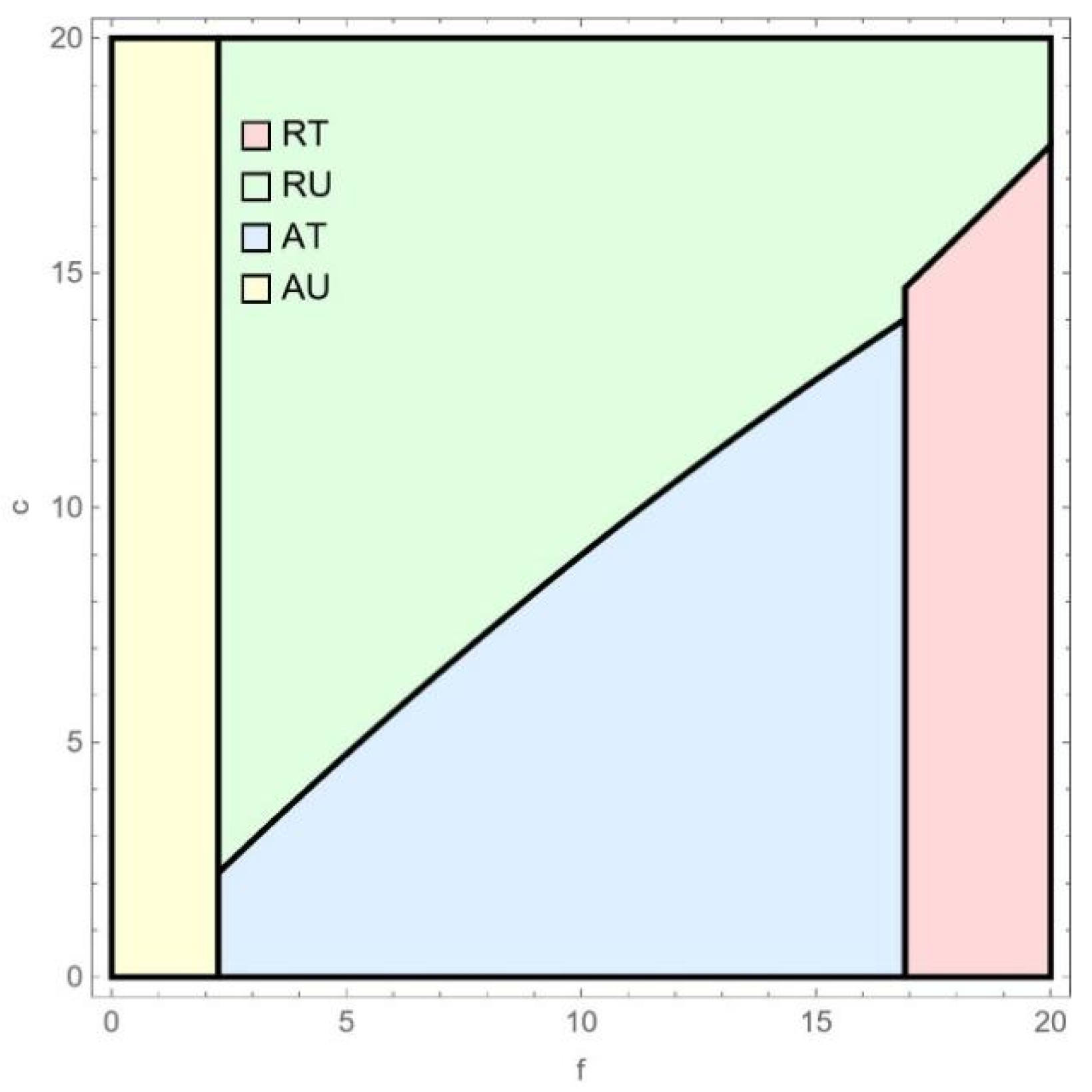
In order to describe Proposition 8 more intuitively, a numerical simulation is used. Take θ = 0.25 , v = 20 , t = 11 , c as from 0 to 20, and f as from 0 to 20, to obtain the equilibrium region’s map.
As demonstrated in Figure 10, the investment decisions pertaining to platform-targeted technology and manufacturer sales mode choices under a manufacturer-led sales mode are illustrated. As shown in the figure, when the unit advertising cost is low, the platform will not invest in targeted technology, because when the unit advertising cost is low, the manufacturer will choose the agency mode regardless of the advertising type when it dominates the sales mode. According to Proposition 3, targeted advertising reduces platform profits under the agency mode. When the unit advertising cost is moderate, the manufacturer will opt for the resale mode with mass advertising and the agency mode with targeted advertising. However, when the unit advertising cost is high, the manufacturer will not choose the agency mode regardless of the advertising form, because it incurs high advertising costs.
When comparing platform-led and manufacturer-led sales modes, we can find that under the platform-led sales mode, the platform is more inclined to invest in targeted technology and hopes that this technology will be used for the sales of goods on the platform under the resale mode. However, the platform resists allocating resources to such technology for the agency mode, as this would erode the platform’s profit margins. Interestingly, under the manufacturer-led sales mode, the platform will invest in targeted technology for the agency mode. In this mode, when unit advertising costs remain moderate, the manufacturer typically chooses the resale mode if the platform does not invest in targeted technology. Conversely, after the platform invests in targeted technology, the manufacturer increasingly favors the agency mode, which yields higher profits for the platform. This demonstrates that the platform’s investment strategies vary according to the balance between advertising costs and profitability. In addition, under the manufacturer-led sales mode, even if the unit advertising cost is high (no more than the platform’s sales revenue), the platform may still invest in targeted technology. This is because at this time, the manufacturer is unwilling to bear high advertising costs and turns to the resale mode, and the platform improves the profit of the resale mode by investing in the targeted technology.

5. Conclusions

5.1. Theoretical Contribution

This research constructs a platform and manufacturer system that integrates research on targeted technology investment with sales mode selection strategies, while considering power structure differences between platforms and manufacturers. It explores strategic interactions between platforms and manufacturers in targeted technology investment and sales mode selection under different power structures. The findings reveal two key insights.
Firstly, whether through agency mode or resale mode, the seller (the manufacturer in agency mode or the platform in resale mode) tends to raise retail prices and reduce advertising investments, thereby decreasing product demand. Consequently, targeted advertising increases the seller’s profit at the expense of the other party.
Secondly, when adopting a platform-led sales mode, platforms prefer resale mode when unit advertising costs are low. Under resale mode, platforms retain pricing authority and advertising decision-making power, enabling more effective cost control and profit maximization. Conversely, when unit advertising costs are high, platforms favor agency modes. In this scenario, platforms avoid high advertising expenses by selling products through agents, reducing cost risks and making agency modes more advantageous. For manufacturer-led sales modes, regardless of the advertising models, manufacturers choose agency modes when unit advertising costs are low to gain pricing and advertising control advantages, while opting for resale modes when unit advertising costs are higher.
Finally, we present a comprehensive analysis of the conditional range of targeted technology investment decisions under different power structures. This analysis is accompanied by strategic recommendations for platforms and manufacturers to select the most effective sales mode for different advertising modes.

5.2. Management Implications

The following section will address the management implications of the aforementioned points.
Firstly, platforms must thoroughly understand the differences in power structures between themselves and manufacturers, and clarify which power dynamics grant them greater bargaining leverage and decision-making authority. Under a platform-led sales mode, such as in areas where Amazon exerts strong control over its platform, platforms should proactively invest in targeted technology and adopt resale modes when unit advertising costs remain moderate or low. This will enable them to secure pricing control and ad placement decisions, thereby maximizing profits. This aligns with Amazon’s strategy of developing its own business (Amazon Basics) and providing powerful advertising tools. Conversely, when unit advertising costs are high, platforms should consider adopting agency modes to avoid substantial advertising expenses. This is why, in categories such as fashion and luxury goods, which require frequent and costly marketing efforts, platforms are more inclined to play the role of ‘shopping mall landlord’ than ‘direct store owner’.
Secondly, platforms must closely monitor market trends and competitors’ strategies, while flexibly adjusting their targeted technology investments and sales mode choices. For instance, under a manufacturer-led sales mode, if competitors have already invested in targeted technology and adopted agency modes, but the platform’s targeted technology investment costs remain relatively low, it should consider investing in targeted technology and adopting agency modes to capture higher market share and profits.
Manufacturers must also clarify the power structure differences between themselves and platforms and select an appropriate sales mode based on unit advertising costs. Under a manufacturer-led sales mode, if the unit advertising costs are low, manufacturers should opt for an agency mode to gain pricing and ad placement authority (such as the official Apple store). Conversely, when unit advertising costs are high, manufacturers should choose a resale mode to avoid bearing substantial advertising expenses.
Furthermore, the introduction of targeted advertising generally raises retail prices, but the distribution of profits depends on the sales mode. In the resale mode, after the platform invests in targeted advertising, its pricing strategy is to raise prices for high-preference consumers. The “dynamic pricing” algorithm used by Amazon for its own products can be regarded as a practical application of this strategy. Under the agency mode, the pricing power of targeted advertising lies in the hands of the manufacturers. The model warns that this will erode the platform’s profits. This discovery directly guides the design of the platform’s governance rules: when the platform provides advanced targeted technology to the manufacturer, it needs corresponding mechanisms to protect its own interests.
In conclusion, this paper not only reveals the strategic interactions between platforms and manufacturers regarding targeted technology investments and sales mode choices under different power structures but also provides practical management insights and strategic recommendations for both parties. In future market competition, platforms and manufacturers need to closely monitor market dynamics and competitors’ strategies and flexibly adjust their targeted technology investment decisions and sales mode selections, thereby achieving sustainable development and profitability.

5.3. Limitations

This study also contains several factors worthy of further exploration in the future. Firstly, the analysis is focused on the market structure between individual platforms and manufacturers, without considering scenarios involving competition among two or more manufacturers. Secondly, in order to ensure model universality and applicability, it was decided that consumer privacy concerns would not be addressed in this research. In future research, the impact of manufacturers’ simultaneous advertising campaigns across multiple external channels (e.g., TikTok Shop and Meta Ads) outside the platform on the platform’s sales mode will be considered.

Funding

This research was supported by the National Social Science Fund of China (Grant Number: 24CGL047).

Data Availability Statement

The original contributions presented in the study are included in the article.

Conflicts of Interest

The author declares no conflicts of interest.

Abbreviations

The following abbreviations are used in this manuscript:
AUThe scenario “agency mode + uniform advertising”
ATThe scenario “agency mode + targeted advertising”
RUThe scenario “resale mode + uniform advertising”
RTThe scenario “resale mode + targeted advertising”

References

  1. Iyer, G.; Soberman, D.; Villas-Boas, J.M. The targeting of advertising. Mark. Sci. 2005, 24, 461–476. [Google Scholar] [CrossRef]
  2. Zhang, J.; He, X. Targeted advertising by asymmetric firms. Omega 2019, 89, 136–150. [Google Scholar] [CrossRef]
  3. Despotakis, S.; Yu, J. Multidimensional targeting and consumer response. Manag. Sci. 2023, 69, 4518–4540. [Google Scholar] [CrossRef]
  4. Li, S.; Sun, H.; Yu, J. Competitive targeted online advertising. Int. J. Ind. Organ. 2023, 87, 102924. [Google Scholar] [CrossRef]
  5. Kim, A.J.; Balachander, S. Coordinating traditional media advertising and online advertising in brand marketing. Prod. Oper. Manag. 2023, 32, 1865–1879. [Google Scholar] [CrossRef]
  6. Ning, Z.; Shin, J.; Yu, J. Targeted advertising as implicit recommendation: Strategic mistargeting and personal data opt-out. Mark. Sci. 2025, 44, 390–410. [Google Scholar] [CrossRef]
  7. Zhang, J.; Liu, Z.; Zhong, W. Attack and defend: The role of targeting in a distribution channel. Mark. Lett. 2016, 27, 375–386. [Google Scholar] [CrossRef]
  8. Moorthy, S.; Shahrokhi Tehrani, S. Targeted advertising spending and price on hoteling line. Mark. Sci. 2023, 42, 1029–1185. [Google Scholar] [CrossRef]
  9. Esteves, R.B.; Resende, J. Competitive targeted advertising with price discrimination. Mark. Sci. 2016, 35, 576–587. [Google Scholar] [CrossRef]
  10. Zhou, J.J.; Chen, Y.J. Targeted information release in social networks. Oper. Res. 2016, 64, 721–735. [Google Scholar] [CrossRef]
  11. Shen, Y.; Zhong, W.J.; Mei, S.E. Advertising strategies of competing firms considering consumer privacy concerns. Manag. Decis. Econ. 2023, 44, 2424–2437. [Google Scholar] [CrossRef]
  12. Hao, C.; Yang, L. Platform advertising and targeted promotion: Paid or free? Electron. Commer. Res. Appl. 2022, 55, 101178. [Google Scholar] [CrossRef]
  13. Pepall, L.; Richards, D. Targeted advertising, concentration, and consumer welfare. Inf. Econ. Policy 2025, 70, 101128. [Google Scholar] [CrossRef]
  14. Zhang, H. Platform targeted capability investment, seller price and advertising strategies. INFOR Inf. Syst. Oper. Res. 2025, 63, 668–695. [Google Scholar] [CrossRef]
  15. Abhishek, V.; Jerath, K.; Zhang, Z.J. Agency selling or reselling? Channel structures in electronic retailing. Manag. Sci. 2016, 62, 2259–2280. [Google Scholar] [CrossRef]
  16. Tian, L.; Vakharia, A.J.; Tan, Y.; Xu, Y. Marketplace, reseller, or hybrid: Strategic analysis of an emerging e-commerce model. Prod. Oper. Manag. 2018, 27, 1595–1610. [Google Scholar] [CrossRef]
  17. Zhang, S.; Zhang, J. Agency selling or reselling: E-tailer information sharing with supplier offline entry. Eur. J. Oper. Res. 2020, 280, 134–151. [Google Scholar] [CrossRef]
  18. Chen, P.; Yan, Y.; Xu, G.; Zhao, R.N. Promotion decisions under asymmetric demand-generation information: Self-operated, online-platform and offline-outlet strategies. IEEE Trans. Fuzzy Syst. 2019, 27, 928–942. [Google Scholar] [CrossRef]
  19. Song, W.; Chen, J.; Li, W. Spillover effect of consumer awareness on third parties’ selling strategies and retailers’ platform openness. Inf. Syst. Res. 2020, 32, 172–193. [Google Scholar] [CrossRef]
  20. He, S.; Peng, J.; Li, J.; Xu, L. Impact of platform owner’s entry on third-party stores. Inf. Syst. Res. 2020, 31, 1467–1484. [Google Scholar] [CrossRef]
  21. Jiang, B.J.; Jerath, K.; Srinivasan, K. Firm strategies in the “mid tail” of platform-based retailing. Mark. Sci. 2011, 30, 757–775. [Google Scholar] [CrossRef]
  22. Lu, Z.; Si, Y.; Han, Z.; Ma, C. Research on private label introduction and sales mode decision-making for e-commerce platforms considering coupon promotion strategies. Systems 2025, 13, 437. [Google Scholar] [CrossRef]
  23. Peng, X.; Xiang, Z.; Ji, T. Platform’s premium store brand introduction and sales mode selection strategies with the cost-advantageous manufacturer. J. Retail. Consum. Serv. 2025, 84, 104190. [Google Scholar] [CrossRef]
  24. Hagiu, A.; Wright, J. Marketplace or reseller? Manag. Sci. 2015, 61, 184–203. [Google Scholar] [CrossRef]
  25. Qin, X.L.; Liu, Z.X.; Tian, L. The optimal combination between selling mode and logistics service strategy in an e-commerce market. Eur. J. Oper. Res. 2021, 289, 639–651. [Google Scholar] [CrossRef]
  26. Ha, A.Y.; Tong, S.L.; Wang, Y.J. Channel structures of online retail platforms. Manuf. Serv. Oper. Manag. 2022, 24, 1547–1561. [Google Scholar] [CrossRef]
  27. Zhang, X.; Zhang, X.; Huang, J. Socially responsible e-commerce supply chains: Sales mode preference and store brand introduction. Transp. Res. Part E Logist. Transp. Rev. 2025, 193, 103829. [Google Scholar] [CrossRef]
  28. Hao, C.; Yang, L. Resale or agency sale? Equilibrium analysis on the role of live streaming selling. Eur. J. Oper. Res. 2023, 307, 1117–1134. [Google Scholar]
  29. Wan, N.; Fan, J.; Wu, X. The cost-sharing mechanism for blockchain technology adoption in the platform-led e-commerce supply Chain. J. Syst. Sci. Syst. Eng. 2025, 34, 156–179. [Google Scholar]
  30. Yao, F.; Li, B.; Lv, Y.; Qin, X. Eco-labels and sales mode selection strategies for e-commerce platform supply chain. Manag. Decis. Econ. 2024, 46, 1278–1296. [Google Scholar] [CrossRef]
  31. Tirole, J. The Theory of Industrial Organization; MIT Press Books: Cambridge, MA, USA, 1988; Volume 1. [Google Scholar] [CrossRef]
Figure 1. The sequence of events and decisions.
Symmetry 17 02168 g001
Figure 2. Price changes with unit advertising cost. (a) θ = 0.05 ; (b) θ = 0.2 .
Symmetry 17 02168 g002
Figure 3. Wholesale Price changes with unit advertising cost. (a) θ = 0.05 ; (b) θ = 0.2 .
Symmetry 17 02168 g003
Figure 4. Wholesale price changes with unit advertising cost.
Symmetry 17 02168 g004
Figure 5. Changes in manufacturer profits with unit advertising cost.
Symmetry 17 02168 g005
Figure 6. Platform profits change with unit advertising costs: (a) c = 0 ; (b) c = 0.5 ; (c) c = 1 .
Symmetry 17 02168 g006
Figure 7. Platform sales mode selection diagram.
Symmetry 17 02168 g007
Figure 8. Manufacture sales mode selection diagram.
Symmetry 17 02168 g008
Figure 9. Equilibrium region diagram under the platform-led sales mode.
Symmetry 17 02168 g009
Figure 10. Equilibrium region diagram under the manufacture-led sales mode.
Symmetry 17 02168 g010
Table 1. Comparison between this paper and the most relevant research.
LiteraturePlatform Sales ModeTargeted AdvertisingPower StructureTargeted Technology Investment
Iyer [1]; Zhang and He [2]; Despotakis and Yu [3]; Ning et al. [6]; Moorthy and Tehrani [8]
Hao and Yang [12]
Zhang [14]
Lu et al. [22]
Wan et al. [29]
Hagiu and Wright [24]
Zhang et al. [27]
This paper
Note: The checkmark (✓) indicates that the corresponding aspect is considered or studied in the research.
Table 2. Summary of the notations.
NotationsDefinitions
U x The utility of goods purchased by consumers located in x
x The consumer preference
t The unit mismatch cost
θ Platform commission rate
v Consumer valuation of goods
w Wholesale price
p The selling price of a commodity
c The fixed cost of investment targeted technology
f Unit advertising cost
b Advertising volume
d Commodity demand
Π M Manufacturer’s profit
Π P Platform’s profit
AUScenario “agency mode + uniform advertising”
ATScenario “agency mode + targeted advertising”
RUScenario “resale mode + uniform advertising”
RTScenario “resale mode + targeted advertising”
Table 3. Equilibrium outcomes.
AUATRURT
p * v 2 v 2 + f 2 1 θ 3 v 4 3 v + f 4
b * 1 v 2 t f 2 t 1 θ 1 v f 4 t
d * v 2 t v 2 t f 2 t 1 θ v 4 t v f 4 t
w * v 2 v f 2
Π M * v 2 1 θ 4 t f v 1 θ f 2 4 t 1 θ v 2 8 t v f 2 8 t
Π P * v 2 θ 4 t θ v 2 1 θ 2 f 2 4 t 1 θ 2 c v 2 16 t f v f 2 16 t c
Disclaimer/Publisher’s Note: The statements, opinions and data contained in all publications are solely those of the individual author(s) and contributor(s) and not of MDPI and/or the editor(s). MDPI and/or the editor(s) disclaim responsibility for any injury to people or property resulting from any ideas, methods, instructions or products referred to in the content.