


Abstract
In this paper, we introduce and investigate a novel family of parameter-dependent operators incorporating multiple shape parameters , whose underlying basis functions include these parameters and exhibit a symmetry property. This parameter-dependent formulation provides a unified and flexible framework for constructing positive linear operators with enhanced approximation and shape-preserving capabilities. We establish fundamental properties of the proposed operators, including nonnegativity, linearity, end-point interpolation, monotonicity preservation and partition of unity; derive their central moments; and determine direct approximation theorems and Voronovskaja-type results. Finally, numerical experiments and graphical illustrations demonstrate the improved performance and adaptability of the proposed scheme compared with existing Bernstein-type variants. The presented framework unifies several classical and generalized operator families while providing additional shape control for practical applications in computer-aided geometric design and function approximation.
Keywords:
divided difference; symmetric basis functions; shape-preserving approximation; convergence analysis; error graphics MSC:
41A36; 46N40; 47N40
1. Introduction
1.1. Context and Motivation
Approximation theory occupies a central place in both pure and applied mathematics, providing the theoretical foundation for representing complex functions by simpler and more tractable forms, typically polynomials or linear operators. These constructions serve as the mathematical backbone of numerous applications, including signal reconstruction, data fitting, computer graphics, and numerical analysis. The pursuit of accuracy, stability, and geometric fidelity in such approximations has motivated researchers to develop increasingly flexible operator families that can adapt to diverse functional behaviors.
Among these, positive linear operators, such as Bernstein-type operators, play a particularly significant role due to their elegant theoretical structure and robust practical performance. They not only ensure convergence to the target function but also preserve fundamental geometric features, properties that are critical in computer-aided geometric design (CAGD), image reconstruction, and engineering modeling. In this context, designing operators that simultaneously provide strong approximation capability and shape-preserving control remains a key research challenge motivating the present study.
1.2. Historical Background (Weierstrass, Bernstein, and Stancu)
The origins of modern approximation theory can be traced back to the nineteenth century, when Karl Weierstrass established his seminal Approximation Theorem [1]. This theorem demonstrated that every continuous real-valued function on a closed and bounded interval can be uniformly approximated by algebraic polynomials. The result not only resolved a long-standing question about the representability of continuous functions but also provided the conceptual foundation for modern constructive approximation theory.
However, while Weierstrass’s theorem proved the existence of such approximations, it did not offer a constructive method for obtaining them. This gap was elegantly filled by Sergei N. Bernstein, who, in 1912, introduced a sequence of explicit polynomial operators now known as the Bernstein polynomials [2]. The Bernstein construction not only supplied a constructive proof of Weierstrass’s theorem but also initiated an entirely new approach to approximation, one based on positive linear operators with well-defined probabilistic and geometric interpretations.
Beyond its theoretical importance, the Bernstein operator established deep connections with probability theory, the basis functions correspond to binomial distributions, and with CAGD, where they form the mathematical foundation of Bézier curves and surfaces. The geometric interpretability of Bernstein polynomials, including their endpoint interpolation and convex-hull properties, led to their widespread use in geometric modeling, animation, and computer graphics.
Building upon Bernstein’s idea, several generalizations were developed to improve flexibility and control over approximation behavior. Among the most notable contributions was that of D.D. Stancu [3] in 1968, who introduced a two-parameter extension, now known as the Stancu operators. This modification endowed the classical Bernstein framework with two adjustable parameters, denoted by and , satisfying , thereby enabling control over the position and scaling of the sample points. Stancu’s innovation paved the way for constructing families of parameter-dependent operators that can be tuned to achieve faster convergence, reduced boundary oscillations, and enhanced shape-preserving properties. We refer to papers [4,5,6,7,8,9,10,11,12,13] (and references therein) for further reading on them.
The introduction of these parameters not only generalized the Bernstein approach but also brought operator theory closer to the needs of practical modeling. For instance, in CAGD and curve fitting, small adjustments in and enable smooth manipulation of curve tension and shape, which is essential for visual continuity and design control. In the context of bivariate approximation, generalized Baskakov–Durrmeyer operators were analyzed in [14], offering flexible tensor-product formulations for surfaces and two-dimensional approximations. Stancu’s framework also provided the conceptual bridge to later developments in q-calculus, -extensions, and statistical convergence methods, all of which seek to capture more refined approximation behaviors through parameterization [15,16].
Subsequent decades witnessed an explosion of variants, such as the Lupaş, Phillips, -Bernstein, and Bézier–Stancu operators, each extending the classical model in pursuit of better convergence rates or improved geometric control. In this progression, the shape parameter made its first appearance in the literature within the Bézier framework through the work of Ye et al. [17], where it was introduced as a shape-adjusting tool for curve and surface modeling; this geometric origin later evolved into an operator-theoretic formulation with the Bernstein operators of Cai et al. [18], marking the pivotal transition of from purely shape control to a formal mechanism for tuning convergence and geometric behavior in approximation theory. This development established the conceptual foundation for later parameter-driven generalizations. These innovations established a comprehensive landscape in which the shape and convergence behavior of approximation operators could be finely regulated through adjustable parameters. In recent years, several generalizations of classical positive linear operators have been proposed to improve flexibility and shape control. Notably, in [19] and Rao et al. [20,21] have introduced fractional, -modified, and multi-parameter Stancu-type operators that extend the classical Bernstein framework toward more adaptable formulations. In particular, the Riemann–Liouville fractional Bernstein–Stancu–Kantorovich operators proposed in [22] provide an important precedent, revealing how fractional integration can be incorporated into the positive linear framework to improve convergence and smoothness. Complementary to these fractional constructs, Hermite-polynomial connections for Szász-type Chlodowsky operators were recently analyzed in [23], revealing new hybrid integral–polynomial relationships in approximation theory.
Within this evolutionary continuum, the current study positions itself as a further advancement, introducing a multi-parameter generalization that unifies and extends several existing operator families. By incorporating multiple shape parameters , the proposed formulation enhances both theoretical expressiveness and practical flexibility, allowing localized control of the approximating curve or surface. Thus, the present work can be viewed as a natural extension of the Bernstein–Stancu lineage, retaining their foundational principles while expanding their capabilities for shape-adaptive approximation and geometric modeling.
1.3. Literature Gap and Objectives
Over the past few decades, various parameter-dependent and generalized Bernstein-type operators have been developed to improve convergence rates and shape adaptability. These include -Bernstein operators, -Bernstein operators, Lupaş-type and Phillips-type modifications, and statistical convergence variants. However, despite these advances, most formulations rely on a single or limited number of shape parameters, restricting their flexibility in simultaneously controlling multiple local features of the approximating function.
Furthermore, while several existing studies focus on theoretical convergence results, fewer works provide a unified framework that jointly addresses approximation accuracy, convergence behavior, and geometric preservation within a single operator family. This gap motivates the present study.
In this manuscript, we establish a new class of parameter-dependent operators equipped with multiple shape parameters , where the underlying basis functions, including these parameters, possess an inherent symmetry that ensures balanced approximation behavior. The proposed formulation combines the adjustability of Stancu-type parameters with the structural versatility of generalized Bernstein bases. We establish their approximation and convergence properties, derive central moments and Voronovskaja-type results, and analyze their shape-preserving behavior, such as monotonicity preservation. Numerical and graphical analyses are provided to illustrate their flexibility and superiority over existing variants.
1.4. Shape-Preserving Properties of Parameter-Dependent Operators
An essential feature that distinguishes advanced approximation schemes from purely analytic constructions is their ability to preserve the shape of the target function. In many practical scenarios, such as CAGD, image reconstruction, data visualization, and engineering simulation, preserving geometric attributes is crucial. These attributes include monotonicity, linearity, end-point interpolation, and nonnegativity, and are often just as important as numerical accuracy. Classical approximation methods, when applied blindly, may distort these qualitative characteristics, leading to undesirable oscillations or artificial inflection points. Consequently, the development of shape-preserving operators has become a central theme in modern approximation theory. We refer to papers [24,25,26,27,28,29,30,31,32] (and references therein) to highlight the methodological advancements and analytical techniques related to shape-preserving approximation operators.
Within this framework, parameter-dependent operators offer an effective means of regulating geometric fidelity. The presence of adjustable parameters provides an additional degree of freedom that can be tuned to maintain or enhance particular shape features of the approximated function. For instance, in the context of Bernstein–Stancu-type constructions, incorporating multiple shape parameters allows local manipulation of curvature and slope without compromising convergence or positivity. By carefully selecting or adapting these parameters, one can control tension, inflection behavior, and edge smoothness, thereby ensuring that the approximating function remains consistent with the intrinsic geometry of the original data.
Moreover, the divided-difference approach offers not only a theoretical framework but also a computationally feasible method for assessing shape fidelity. By analyzing the sign and magnitude of divided differences of the operator images of test functions, typically polynomials or piecewise linear functions, one can obtain explicit parameter ranges that guarantee shape preservation. Such analysis reveals that appropriate tuning of the parameter set enhances convexity retention near boundaries and minimizes curvature distortion in transition zones.
From a broader perspective, the shape-preserving capability of parameter-dependent operators establishes a strong link between approximation theory and geometric modeling. While traditional convergence theorems address asymptotic proximity in analytic norms, shape preservation extends this notion to the geometric domain, ensuring that the approximating process respects the qualitative nature of the original function. The resulting operators thus serve as a unified mathematical bridge between theoretical approximation frameworks and practical geometric design tools.
1.5. Structure of the Paper
This paper is organized as follows: Section 2 presents preliminary definitions and auxiliary results. Section 3 introduces the construction of the proposed parameter-dependent operators and establishes their fundamental properties. Section 4 explores the shape-preserving properties such as monotonicity. Section 5 provides the main approximation and pointwise convergence results, including direct theorems and Voronovskaja-type relations. Section 6 illustrates the numerical experiments and graphical comparisons. Finally, Section 7 offers a detailed discussion, and Section 8 concludes this paper with key findings and future research directions.
2. Auxiliary Results
We begin by recalling the definition of the binomial coefficients
Next, we recall the basic definition of the divided differences, as given by Bustamante [33], which play a fundamental role in interpolation and approximation theory and are used in the subsequent analysis. The nth order divided difference of a real-valued function is represented by the notation
where each for . Divided differences are known to be linear and symmetric, and they satisfy the following fundamental relations:
Remark 1.
Let be fixed. A real-valued function f on interval is said to be n-convex if its order divided differences satisfy
In particular, a 0-convex function f is nonnegative on , while a 1-convex function is nondecreasing.
The Bernstein polynomials given as
where , and
are the Bernstein basis polynomials of degree n. The Bernstein basis functions given by (4) have the following properties [33]:
and
The Stancu polynomials given as
where By constructing the operators in (9), Stancu sought to provide an alternative mechanism for selecting sample points on the interval through the parameters and , thereby offering greater flexibility in evaluating function values. In this framework, the sample points were chosen so that, as , the spacing between successive sample points, as well as the distances from 0 to the first node and from the last node to 1, tends to zero.
The seminal work of Ye et al. [17] pioneered the inclusion of a shape parameter into the Bernstein basis functions in (4), establishing the first generalized framework capable of shape adjustments while retaining the essential properties of the classical Bernstein formulation. Bézier bases are fundamental in fields like computer-aided geometric design [34,35], computer graphics and animation [36,37,38], robotics [39,40], data visualization and signal processing [41,42,43] due to their versatility, mathematical elegance, and practical utility. Derived from Bernstein polynomials in (4), they facilitate intuitive shape control, smooth approximations in both 2D and 3D, and ensure numerical stability through efficient algorithms such as De Casteljau’s [44]. Building upon this pioneering concept, Han et al. [45] established a new class of operators equipped with multiple shape parameters , designed to achieve improved approximation and monotonicity-preserving properties, as follows: Let and with The polynomials with , are defined as
for n arbitrarily chosen real values of , where
Here, note that if generalized Bernstein basis polynomials of degree n in (10) reduce to polynomials of degree n in (4). The multi-parameter generalization of Bézier curves and surfaces proposed by Han et al. [45] offers clear advantages over single-parameter approaches such as the model of Ye et al. [17]. First and foremost, incorporating additional shape parameters provides greater control and flexibility in manipulating curve and surface shapes. The use of a single shape parameter, , constrained to an interval such as , limits the potential variations and transformations achievable within the design space. By contrast, Han et al.’s approach allows for multiple parameters, leading to a richer set of geometrical configurations and more nuanced adjustments to curvature and surface aesthetics. This characteristic is particularly significant in applications such as aerodynamic and automotive design, where the precision of shape directly affects performance outcomes [46]. Notably, recent engineering studies employing generalized Bernstein-type operators for robotic control have demonstrated that multi-parameter structures can yield superior adaptability and stability compared to single-parameter formulations [47,48].
Moreover, multiple shape parameters facilitate a more detailed representation of complex geometries compared to single-parameter formulations, enabling finer local adjustments while preserving the global shape and thereby achieving higher overall shape fidelity [49]. For instance, airfoil design often employs such parameterization approaches to achieve specific aerodynamic characteristics; methods based on Bézier curves with multiple adjustable parameters can yield superior aerodynamic performance when compared to single-parameter models [50]. Similarly, multi-parameter Bernstein generalizations have been shown to improve coordinated robotic motion and robustness under disturbances, further highlighting the practical benefits of richer parameter spaces in real-world applications [51].
Furthermore, the optimization capabilities are significantly enhanced when using generalizations with multiple shape parameters. The ability to independently adjust various aspects of the geometry enables optimization algorithms to converge on better solutions faster and more effectively. In specific engineering contexts, such as wind turbine blade design, multiple parameters have been shown to accommodate varying operational conditions and enhance performance via optimization techniques, leading to airfoils with improved lift-to-drag ratios and greater robustness against perturbations compared to single-parameter [52,53]. Reinforcing this trend, recent robotics research demonstrates that multi-parameter Bernstein-based frameworks, including -analogues, enable improved impedance control and coordinated electromechanical performance, outperforming single-parameter counterparts in stability and responsiveness [54].
Prior research has revealed the remarkable effectiveness and adaptability of these basis functions, underscoring their pivotal role in shaping parametric curves and surfaces (see [45,55,56,57,58,59,60,61]). Subsequently, to transform the classical Bernstein polynomials of degree n to generalized Bernstein polynomials of degree associated with Hu et al. [56] constructed the equations
where are the Bernstein basis functions of degree
In [62], Kadak and Özger introduced a new kind of Bernstein-type operator equipped with multiple shape parameters satisfying (11) by employing the equations in (12), which are denoted as
They analyzed the approximation properties of generalized Bernstein operators constructed with Inspired by the study presented in [62], we consider an extended parameter-dependent variant of the operators given in (13).
The operators given in (9) satisfy the following identities.
Lemma 1.
For real parameters ρ and σ with have the following equalities:
Theorem 1
([56]). The functions of degree n, corresponding to the parameter set introduced in (10), form a linearly independent system.
Theorem 2
([45]). The functions with in (10) have the following properties:
- (i)
- nonnegativity:
- (ii)
- partition of unity:
- (iii)
- symmetry: for
3. Parameter-Dependent Operators
This section is dedicated to the construction of parameter-dependent operators based on given in (11). Let and be two real parameters satisfying Then, we define the parameter-dependent Stancu variant of the operators given in (13) as
where , , and the functions are as in (12).
Lemma 2.
For real parameters ρ and σ with and any natural number have the following results:
where
Proof.
Let and be the arbitrary shape parameters satisfying (11). Due to partition of unity property given in Theorem 2, we have To compute first we assume n to be even number, that is, for By employing (12), we get
and the last equation can be rewritten as
where
Here, we obtain
which yield
Subsequently, Lemma 1 and Equations (15)–(17) produce
that is
The case of the odd number n can be proven in a similar fashion so it is omitted. Next, we will calculate for even number For , we have
We can reformulate the final equation as
where
Then for
and
we obtain
Consequently, Lemma 1 and Equations (15), (18) and (19) yield
Therefore
for The case of the odd number n is similar to even number case. We also omit the proofs of and for the purpose of conciseness, since they are computed by following the same steps for the proofs of the preceding identities. □
Corollary 1.
Let ρ and σ be real parameters with and be any natural number. For n arbitrary real values of shape parameters , the central moments of operators given in (14) are obtained as
where is defined as in Lemma 2.
Theorem 3.
Let ρ and σ be real parameters with and be any natural number. For arbitrary real values of shape parameters satisfying (11) and fixed value of we have
Proof.
Let and assume that shape parameters satisfy property (11). Then by utilizing (15), we obtain
and
Therefore, . Next, consider the limit in (24). It is clear to see that, we have the following inequalities regarding as:
and conversely
Substitution of the inequalities (26)–(29) in (21) yields
and
Hence, we have on the grounds of (30) and (31). The limit in (25) can be proven using the same techniques, so it is omitted. □
4. Shape-Preserving Properties of Parameter-Dependent Operators
This section focuses on shape-preserving properties of , including nonnegativity, linearity, end-point interpolation and the preservation of monotonicity. In the following lemma we give the nonnegativity and linearity properties of operators .
Lemma 3.
Let and let be two real parameters with For shape parameters satisfying (11), the operators have the following properties:
- (i)
- are nonnegative, that is, if thenfor function f defined on
- (ii)
- are linear, that is,for functions and defined on
- (iii)
- satisfy the end-point interpolation property for , that is,andfor function f defined on
Proof.
- (i)
- for that is, when f is convex, it readily follows thatby Theorem 2(i) and Remark 1.
- (ii)
- the linearity property of the divided differences and the summation operator implyfor
- (iii)
□
In the sequel, we present our results on the monotonicity preservation of . We begin by expressing in terms of the bases given in (4) and the divided differences of f in the following lemma.
Lemma 4.
Proof.
First note that, by identity (1). Next, substitution of equations in (12) in Stancu variant of the generalized Bernstein operators in (14) yields
which can also be expressed as
By substituting into the terms of the summation involving and subsequently rearranging the terms in (34), we obtain
where
Now, substituting the expressions given in equations (36) and (37) into Equation (35) and then substituting into the first term of the summation, we arrive at
Finally, using property (6) in the first two terms of the summation in (38), we obtain the desired representation in (33). Hence the proof is complete. □
Theorem 4.
Let , and let be real parameters such that . If a function f is monotone on the interval , then the related parameter-dependent operators preserve this monotonicity on , provided that the shape parameters satisfy condition (11).
Proof.
We commence our work by computing the first derivative of operator Differentiation of Equation (33) by utilization of properties (7) and (5), respectively, yields
By replacing k with in the first, third, and fourth terms of the summation in (39) and subsequently combining like terms, we obtain
Observe that the recurrence relation (6) can be modified for as
Also note that, we can write
Next, applying (41) to the first term of the summation and (42) to the second and third terms in (40), we obtain
Finally, rearranging the similar terms of the summation in (43), we obtain the first derivative of as
Now, assume that f is a monotonically increasing function on . Then, by Remark 1, we have
for all and satisfying Next consider the case From the given condition on in (11), we have
Multiplying the inequality (46) by , yields
and
due to the identity
Subsequently, we obtain
and
Now, consider the case From the given condition on in (11), we have
Multiplying the inequality (49) by yields
and
Consequently, we get
and
Finally, in the light of inequalities (45), (47), (48), (50), and (51), one can conclude that Thus for a monotone increasing function the corresponding operator is also monotone increasing. Similarly for a monotonically decreasing function f on , we have
Then, by inequalities (47), (48), (50)–(52), one can conclude that which implies that the corresponding operator is also monotone decreasing. Hence, the proof is complete. □
5. Quantitative Estimates and Voronovskaja-Type Results
This section focuses on the quantitative analysis of the operator Specifically, we establish Voronovskaja-type results and investigate its pointwise approximation properties. Key findings include local approximation theorems derived using the second-order modulus of smoothness () and the standard modulus of continuity ().
We begin by recalling the notion of Lipschitz continuity, which is instrumental in deriving pointwise convergence results.
A function is said to belong to the Lipschitz (or Hölder) class , , if there exists a constant such that
Theorem 5.
Let . Then uniformly converges to f on .
Proof.
The proof is a direct consequence of Korovkin theorem [63] and Lemma 2. So we omit details. □
Theorem 6.
Let , let , and let satisfy the local Hölder condition with constant on T in the sense that
Then for each and every natural we have
where
Proof.
Fix . By definition of choose (or a sequence in T approaching the infimum) with
and let at the end. Using positivity and linearity of we write
We estimate each term separately.
- (i)
- Estimate of .By the Hölder condition on T,Letting we obtain the contribution .
- (ii)
- Estimate of .Since and the Hölder condition holds on T, we may choose a point (for instance ) and bound the uniform approximation error at by the local modulus on T. More directly, writeNow by Hölder/Cauchy–Schwarz (since ). The second central moment is bounded uniformly by the same algebraic expression appearing in the theorem (indeed the formula in Lemma 2/Corollary 1 expresses for general y, so put ). ThusUsing continuity of in y (it is a polynomial in y and the ), and letting the chosen approach the infimum point we can bound this term byand the can be absorbed by taking the exact infimum over T (or removed by choosing arbitrarily close to the infimum). For clarity of the final estimate we keep the main contribution .
- (iii)
- Estimate of .By linearity and positivity,Each of these is bounded in the same manner as in part (ii) by times a fractional moment; in particular both are up to negligible terms coming from the small shift . Combining the two contributions yields an extra factor not exceeding .
Collecting the three estimates, we obtain
with if we trace constants carefully through the Hölder inequalities used above. Finally, substituting the explicit expansion for from Lemma 2/Corollary 1 (the long algebraic expression appearing in the statement of the theorem) yields exactly the asserted inequality. □
Let and . Then, the Lipschitz-type maximal function of order [64] is defined by
Theorem 7.
Let and Then for every we have
Proof.
The following relations hold:
Using (53) and applying the Hölder inequality to the preceding expression with
we observe that
The desired result follows directly from the preceding inequality in conjunction with the relation in (53). □
To state a local approximation theorem, we recall some fundamental notions concerning modulus of continuity, modulus of smoothness, and Peetre’s K-functional.
The modulus of continuity of is defined by
For any and , the following is satisfied:
Also, and are given by
where and
There exists an absolute constant , independent of and f, such that
for all (see [65]).
Theorem 8.
The operators satisfy the following inequality:
where C is an absolute positive constant, and
such that both terms and converges to zero when .
Proof.
We define the operator , which reproduces constants and linear functions on the interval
Let . Then for any function , Taylor’s expansion formula takes the form
Applying to both sides of (58), we get
So
We get the following relations taking into (57) account:
By (57) and (59), we get
where and . Applying inequality (56) and then taking the infimum over all on the right-hand side, we obtain
□
Theorem 9.
Let . For any , the following inequality holds:
Proof.
For any , using the fundamental theorem of calculus, we can write
Applying the operator to both sides, we obtain
Since for any and , we have
and it follows that
Hence, taking absolute values and applying the operator, we get
Implementing Cauchy-Schwarz inequality to the last term yields
Finally, choosing , we complete the proof. □
Next theorem presents a quantitative Voronovskaja type result for the operator by means of first order Ditzian-Totik modulus of smoothness which is defined as follow: Let and . Then
where
Further, the related K-functional is defined by
where
and denotes the class of absolutely continuous functions on , with being differentiable. Then, there exists a positive constant C independent of y and n such that
Lemma 5.
Let . Then for all and sufficiently large n, we have
where C is an absolute positive constant in (61) and
such that both terms and converges to zero when .
Proof.
Let be given and . Using Taylor’s formula for , we have . Hence
If we apply to both sides of (62), we obtain
Then, the quantity in the right hand side of (63) can be estimated as follows:
where . In view of Corollary 1 for sufficiently large n,
From (63)–(65) and using Cauchy-Schwarz inequality, we arrive at
Upon taking the infimum over all functions on the right-hand side, it follows that
□
Corollary 2.
Let and . Then
Proof.
The proof follows directly from Lemma 5 and is therefore omitted. □
6. Numerical Results
In this section, we present some numerical experiments to illustrate the approximation performance and shape-preserving capability of the proposed parameter-dependent operators. The examples are designed to compare the behavior of our generalized operators with their classical counterparts, highlighting the influence of the multiple shape parameters on convergence. For each test function, we provide graphical representations of the approximations and their corresponding errors. These figures and tables demonstrate the flexibility of the operators in controlling local geometric features and improving accuracy across various parameter settings.
Example 1.
Figure 1.
Comparison of approximations by and the classical Stancu operators (Example 1).
Figure 2.
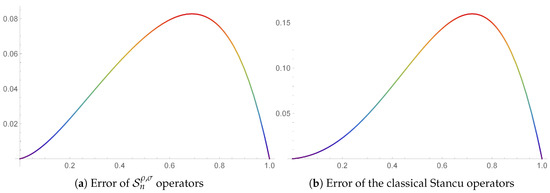
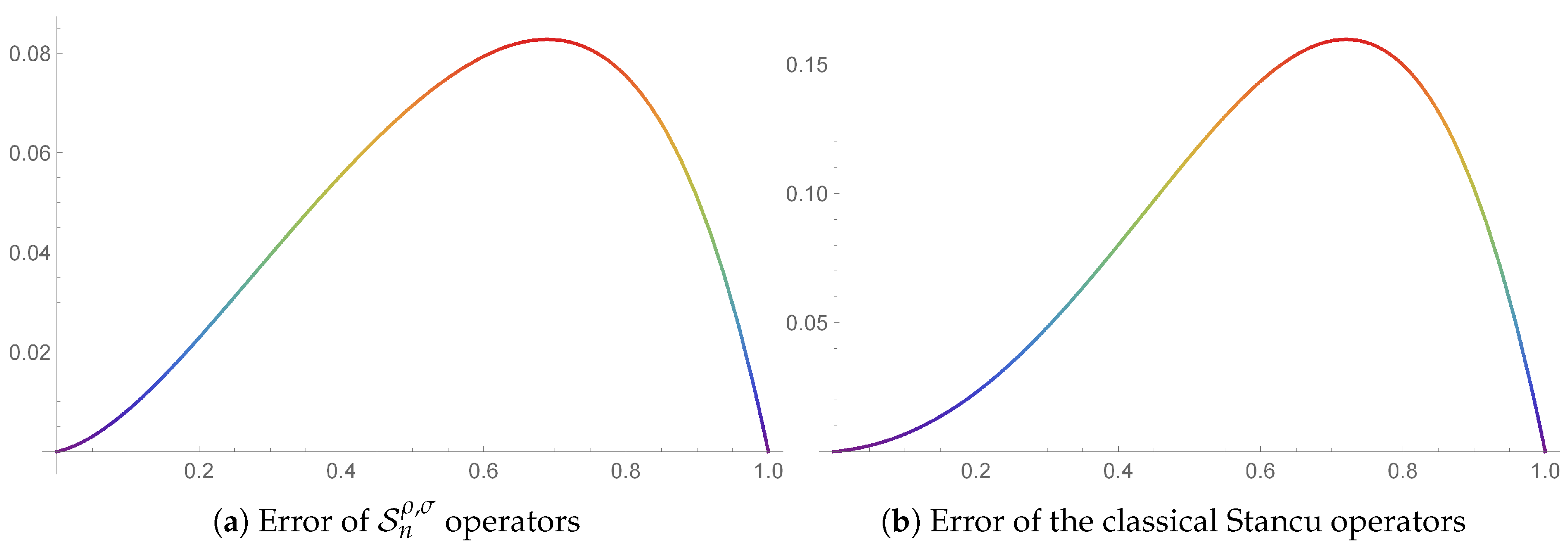
Comparison of approximation errors for and the classical Stancu operators (Example 1).
Figure 1 illustrates the approximation of the test function by the proposed operator and the classical Stancu operator. The curves reveal that the generalized operator with multiple shape parameters follows the target function more closely, especially near the boundary regions where classical schemes typically deviate. This demonstrates that the inclusion of additional parameters enhances local adaptability and provides a smoother, more accurate reproduction of nonlinear profiles.
Figure 2 compares the approximation errors of the proposed and classical operators for Example 1. The error curves clearly show that the generalized operator achieves smaller deviations throughout the interval , confirming its higher precision and better control of boundary oscillations. The reduction in the maximum error amplitude emphasizes the improved numerical stability and superior convergence of the multi-parameter framework.
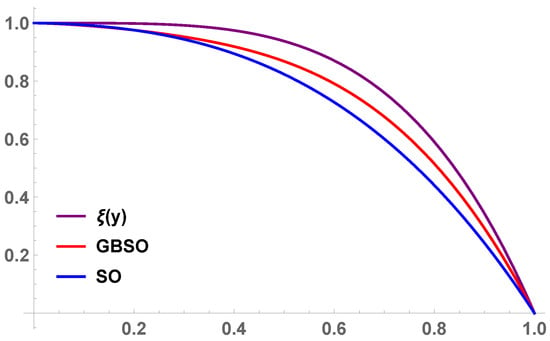
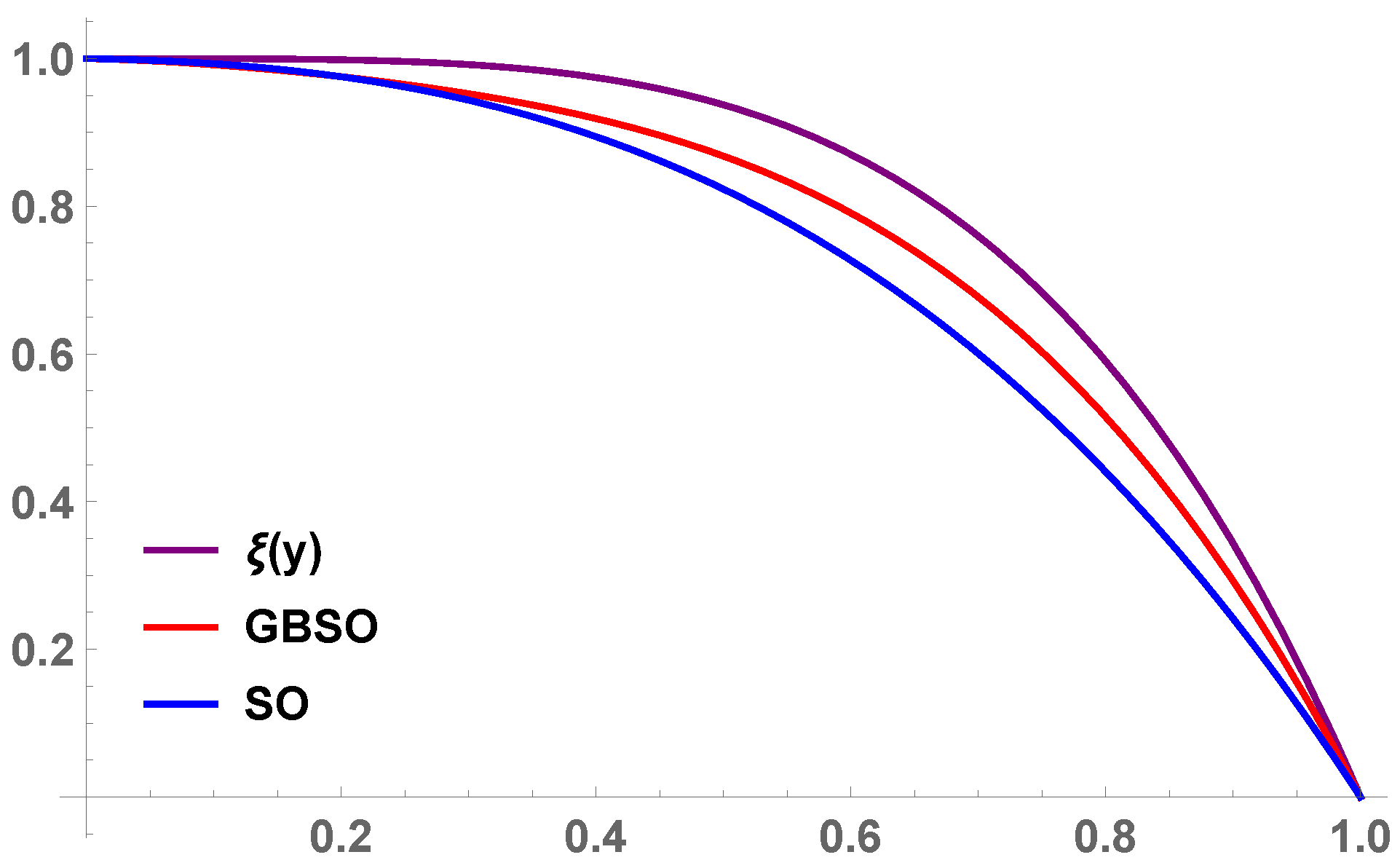
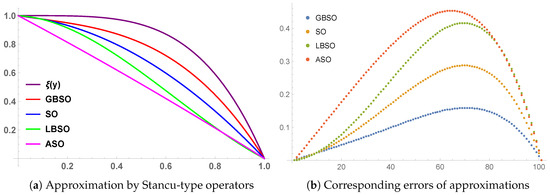
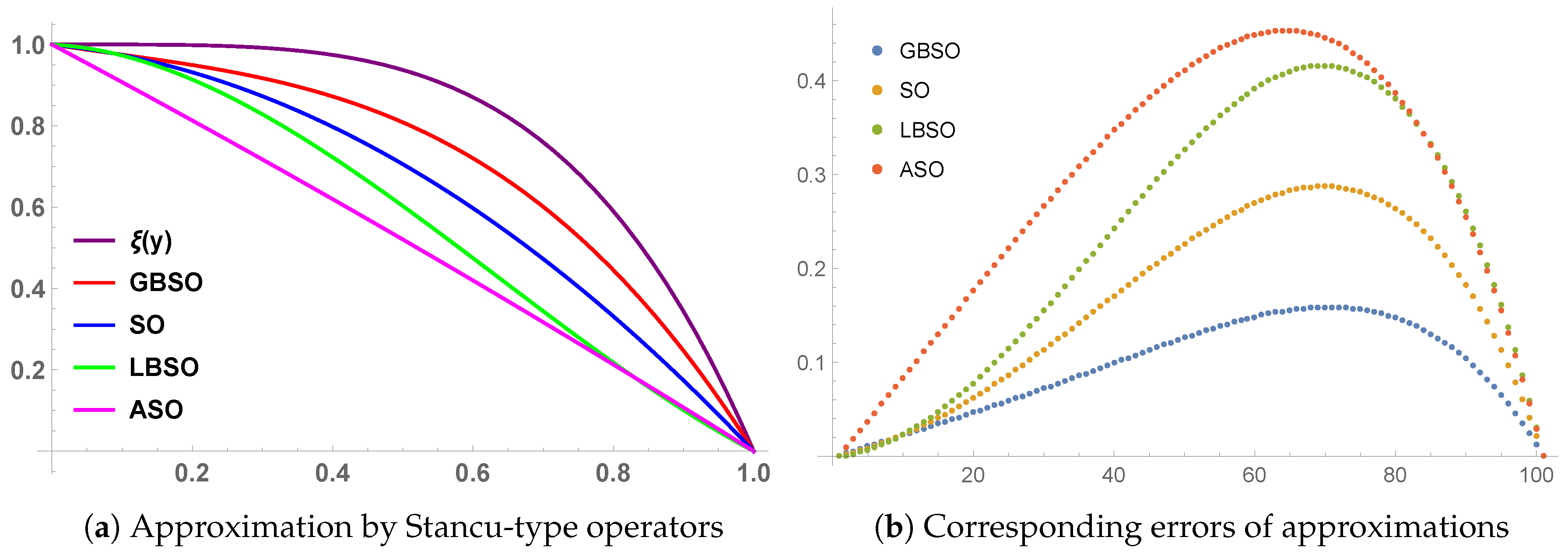
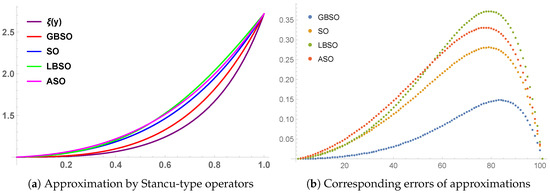
In Figure 3, we choose and the same parameters defined above. Figure 3 presents a comparative analysis of four Stancu-type operators, GBSO, SO, LBSO, and ASO, applied to . Here, GBSO, SO, LBSO and ASO are , the classical Stancu, Bernstein-Stancu, and Bernstein-Stancu operators, respectively. The graphical results demonstrate that GBSO delivers the closest fit and the lowest error levels among all variants. This superior performance verifies that multiple adjustable parameters provide a broader design space, allowing finer shape control and significantly enhanced approximation accuracy.
Figure 3.
Comparison of certain Stancu-type operators (Example 1).
Example 2.
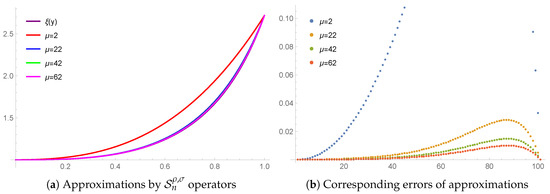
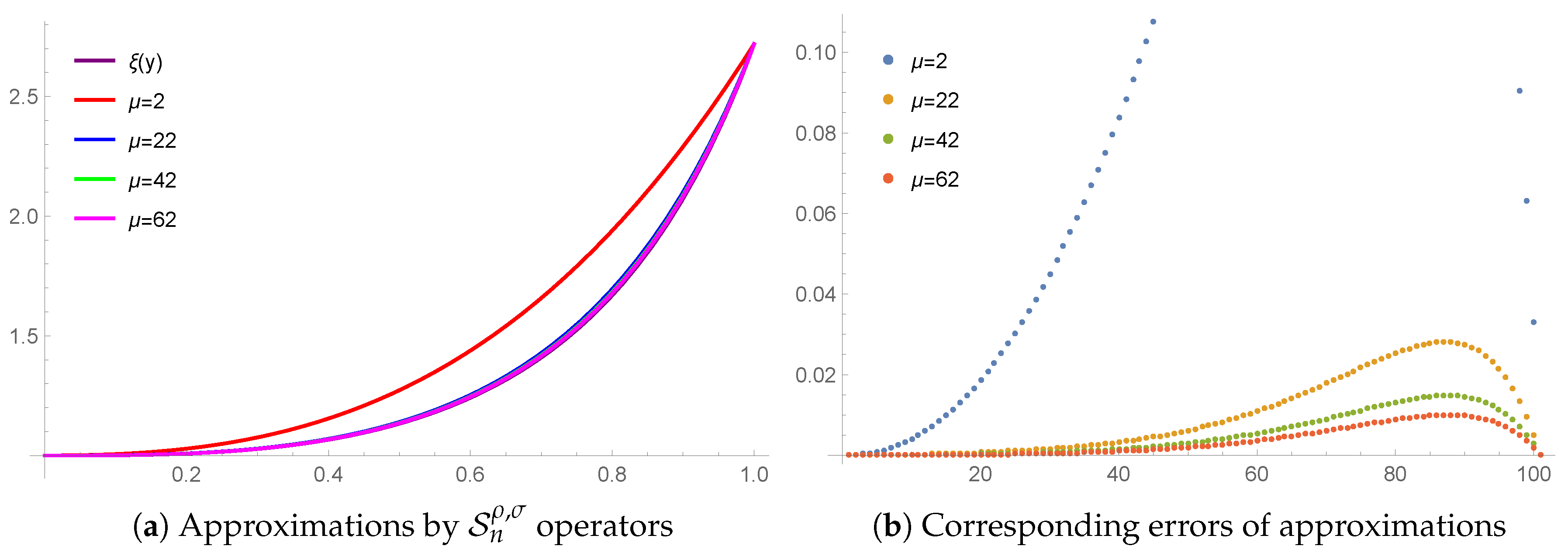
Consider the function In Figure 4, we choose and
Here, GBSO, SO, LBSO and ASO are , the classical Stancu, Bernstein-Stancu, and Bernstein-Stancu operators, respectively. Figure 4 displays the approximations and corresponding errors of the proposed operators for the function under varying degrees n. As n increases, the approximated curve converges smoothly toward the exact function, and the error magnitude diminishes across the domain. These outcomes validate the theoretical convergence properties and highlight the scalability of the operator with respect to the polynomial degree.
Figure 4.
Approximations and errors of approximations of operators with n values (Example 2).
Table 1 summarizes the mean approximation errors of different Stancu-type operators for . Across all tested degrees n, GBSO consistently produces the smallest errors, outperforming SO, LBSO, ASO schemes. This quantitative evidence corroborates the graphical observations, confirming the accuracy and robustness of the proposed formulation.
Table 1.
Comparison: Error of approximation of Stancu-type operators (Example 2).
Figure 5 compares the approximations and error profiles of several Stancu-type operators for the exponential test function. GBSO maintains a nearly perfect alignment with the exact curve and exhibits the smallest pointwise errors across the entire interval. The improvement is particularly evident near the boundary regions, reflecting the operator’s enhanced smoothness, flexibility, and precision in capturing rapidly varying behaviors.
Figure 5.
Comparison of certain Stancu-type operators (Example 2).
Discussion of Numerical Findings. The numerical experiments presented in this section confirm the theoretical assertions established in the preceding parts of the paper. The proposed parameter-dependent operators exhibit superior approximation performance compared to their classical and single-parameter counterparts. The graphical and tabulated results clearly indicate that the inclusion of multiple shape parameters provides additional flexibility in controlling the local behavior of the approximating function, resulting in smoother curves and smaller approximation errors. Moreover, the convergence rate improves as the parameter n increases, validating the analytical convergence results derived earlier. Overall, the proposed family of operators achieves a balanced combination of accuracy, stability, and shape-preserving capability, demonstrating their potential for practical applications in CAGD and numerical analysis.
7. Discussion
The proposed family of parameter-dependent Bernstein–Stancu-type operators introduces a highly adaptable mechanism for balancing approximation precision and shape control. The inclusion of multiple shape parameters enhances the operator’s ability to maintain monotonicity while adjusting local features of the approximating function. Compared with existing generalizations such as the single-parameter Bernstein–Stancu or Bernstein operators, the present formulation yields improved convergence behavior and smoother geometric transitions.
The analytical results confirm that the operators satisfy essential approximation criteria, including pointwise and uniform convergence, central moment bounds, and Voronovskaja-type asymptotic relations. Moreover, the numerical experiments demonstrate that varying the shape parameters allows continuous tuning between sharper and smoother profiles, making the method particularly suitable for applications in curve modeling, computer graphics, and computational data fitting. These findings position the proposed framework as a significant step toward integrating theoretical approximation techniques with practical geometric design methodologies.
8. Conclusions
In this paper, we developed a new class of parameter-dependent Bernstein–Stancu-type operators incorporating multiple shape parameters. We established their fundamental approximation and convergence properties, including direct and weighted approximation results, central moments, and Voronovskaja-type theorems. Moreover, we demonstrated their nonnegativity, linearity, and ability to preserve monotonicity.
The numerical results confirmed that the proposed operators achieve superior approximation performance and enhanced shape control compared with existing variants. Future studies will focus on multidimensional extensions, applications in surface modeling and image processing, and hybrid formulations that integrate statistical convergence with -analogs or fractal-based operator frameworks.
Author Contributions
Conceptualization and methodology, F.Ö., N.T.; software and visualization, F.Ö.; validation, Y.Ç. and R.T.A.; writing—original draft preparation, F.Ö., Y.Ç., N.T. and R.T.A.; writing—review and editing, F.Ö., Y.Ç., N.T. and R.T.A. All authors have read and agreed to the published version of the manuscript.
Funding
This work was supported and funded by the Deanship of Scientific Research at Imam Mohammad Ibn Saud Islamic University (IMSIU) (grant number IMSIU-DDRSP2502).
Data Availability Statement
The original contributions presented in the study are included in the article, further inquiries can be directed to the corresponding author.
Conflicts of Interest
The authors declare no conflicts of interest.
References
- Weierstrass, K. Über die analytische Darstellbarkeit sogenannter willkürlicher Functionen einer reellen Veränderlichen. Sitzungsberichte Königlich Preußischen Akad. Der Wiss. Berl. 1885, 2, 633–639. [Google Scholar]
- Bernstein, S. Dámonstration du tháorème de Weierstrass fondeá sur le calcul des probabilitás. Commun. Soc. Math. Kharkow 1912, 13, 1–2. [Google Scholar]
- Stancu, D.D. Approximation of function by a new class of polynomial operators. Rev. Roum. Math. Pures Appl. 1968, 13, 1173–1194. [Google Scholar]
- Baytunç, E.; Gezer, H.; Aktuğlu, H. Kantorovich Variant of the Blending Type Bernstein Operators. Bull. Iran. Math. Soc. 2024, 50, 82. [Google Scholar] [CrossRef] [Scilit]
- Wang, M.; Yu, D.; Zhou, P. On the approximation by operators of Bernstein–Stancu types. Appl. Math. Comput. 2014, 246, 79–87. [Google Scholar] [CrossRef] [Scilit]
- Nasiruzzaman, M.; Rao, N.; Alotaibi, A.; Mohiuddine, S.A. Pointwise and Uniform Approximation Properties of σ-Stancu-Schurer Operators. Filomat 2022, 36, 5751–5764. [Google Scholar] [CrossRef] [Scilit]
- Su, L.T.; Kanat, K.; Sofyalioğlu Aksoy, M.; Kisakol, M. Approximation by bivariate Bernstein–Kantorovich–Stancu operators that reproduce exponential functions. J. Inequal. Appl. 2024, 2024, 6. [Google Scholar] [CrossRef] [Scilit]
- Turhan, N. Note on the shape-preservation of a new class of Kantorovich-type operators via divided differences. Demonstr. Math. 2025, 58, 20250121. [Google Scholar] [CrossRef] [Scilit]
- Cai, Q.; Aslan, R.; Özger, F.; Srivastava, H.M. Approximation by a new Stancu variant of generalized (λ, μ)-Bernstein operators. Alex. Eng. J. 2024, 107, 205–214. [Google Scholar] [CrossRef] [Scilit]
- Alotaibi, A.; Nasiruzzaman, M.; Mohiuddine, S.A. On the Convergence of Bernstein–Kantorovich–Stancu Shifted Knots Operators Involving Schur Parameter. Complex Anal. Oper. Theory 2024, 18, 4. [Google Scholar] [CrossRef] [Scilit]
- Mohiuddine, S.A.; Özger, F. Approximation of functions by Stancu variant of Bernstein–Kantorovich operators based on shape parameter α. Rev. R. Acad. Cienc. Exactas Fís. Nat. Ser. A Mat. RACSAM 2020, 114, 70. [Google Scholar] [CrossRef] [Scilit]
- Bodur, M.; Manav, N.; Tasdelen, F. Approximation properties of λ-Bernstein–Kantorovich–Stancu operators. Math. Slovaca 2022, 72, 141–152. [Google Scholar] [CrossRef] [Scilit]
- Bărbosu, D. Kantorovich–Stancu type operators. J. Inequal. Pure Appl. Math. 2004, 5, 53. [Google Scholar]
- Rani, M.; Rao, N.; Malik, P. Generalized Bivariate Baskakov–Durrmeyer Operators and Associated GBS Operators. Filomat 2022, 36, 1539–1555. [Google Scholar] [CrossRef] [Scilit]
- Mursaleen, M.; Nasiruzzaman, M.; Nurgali, A. Some approximation results on Bernstein–Schurer operators defined by (p, q)-integers. J. Inequal. Appl. 2015, 2015, 249. [Google Scholar] [CrossRef] [Scilit]
- Kang, S.M.; Acu, A.M.; Rafiq, A.; Kwun, Y.C. Approximation properties of q-Kantorovich–Stancu operator. J. Inequal. Appl. 2015, 2015, 211. [Google Scholar] [CrossRef] [Scilit]
- Ye, Z.; Long, X.; Zeng, X.M. Adjustment Algorithms for Bézier Curve and Surface. In Proceedings of the 5th International Conference on Computer Science and Education, Hefei, China, 24–27 August 2010. [Google Scholar] [CrossRef] [Scilit]
- Cai, Q.B.; Lian, B.Y.; Zhou, G. Approximation properties of λ-Bernstein operators. J. Inequal. Appl. 2018, 2018, 61. [Google Scholar] [CrossRef] [Scilit]
- Özger, F.; Aslan, R.; Ersoy, M. Some Approximation Results on a Class of Szász–Mirakjan–Kantorovich Operators Including Non-Negative Parameter α. Numer. Funct. Anal. Optim. 2025, 46, 461–484. [Google Scholar] [CrossRef] [Scilit]
- Rao, N.; Shahzad, M.; Jha, N.K. Study of Two-Dimensional α–Modified Bernstein Bi-Variate Operators. Filomat 2025, 39, 1509–1522. [Google Scholar] [CrossRef] [Scilit]
- Rao, N.; Farid, M.; Jha, N.K. Approximation Properties of a Fractional Integral-Type Szász–Kantorovich–Stancu–Schurer Operator via Charlier Polynomials. Mathematics 2025, 13, 3039. [Google Scholar] [CrossRef] [Scilit]
- Aslan, R. Some Approximation Properties of Riemann–Liouville Type Fractional Bernstein–Stancu–Kantorovich Operators with Order of. Iran. J. Sci. 2025, 49, 481–494. [Google Scholar] [CrossRef] [Scilit]
- Jha, N.K.; Rao, N. Hermite Polynomial Connecting Szász Integral Chlodowsky Operators and Applications. Iran. J. Sci. 2026, 50, 1–12. [Google Scholar] [CrossRef] [Scilit]
- Rao, N.; Ayman-Mursaleen, M.; Aslan, R. A Note on a General Sequence of λ-Szász Kantorovich Type Operators. Comput. Appl. Math. 2024, 43, 428. [Google Scholar] [CrossRef] [Scilit]
- Bede, B.; Coroianu, L.; Gal, S.G. Approximation and shape preserving properties of the Bernstein operator of max-product kind. Int. J. Math. Math. Sci. 2009, 2009, 590589. [Google Scholar] [CrossRef] [Scilit]
- Wang, Y.; Zhou, Y. Shape preserving properties for q-Bernstein–Stancu operators. J. Math. 2014, 2014, 603694. [Google Scholar] [CrossRef] [Scilit]
- Xu, X.W.; Zeng, X.M.; Goldman, R. Shape preserving properties of univariate Lototsky–Bernstein operators. J. Approx. Theory 2017, 224, 13–42. [Google Scholar] [CrossRef] [Scilit]
- Su, L.T.; Mutlu, G.; Çekim, B. On the shape-preserving properties of λ-Bernstein operators. J. Inequal. Appl. 2022, 2022, 151. [Google Scholar] [CrossRef] [Scilit]
- Acu, A.M.; Mutlu, G.; Çekim, B.; Yazıcı, S. A new representation and shape-preserving properties of perturbed Bernstein operators. Math. Methods Appl. Sci. 2024, 47, 5–14. [Google Scholar] [CrossRef] [Scilit]
- Turhan, N.; Özger, F.; Ödemiş Özger, Z. A comprehensive study on the shape properties of Kantorovich type Schurer operators equipped with shape parameter λ. Expert Syst. Appl. 2025, 270, 126500. [Google Scholar] [CrossRef] [Scilit]
- Turhan, N. Implementation of divided differences to shape preservation. Numer. Algorithms 2026, 101, 1–44. [Google Scholar] [CrossRef] [Scilit]
- Karakılıç, İ.; Karakılıç, S.; Budakçı, G.; Özger, F. Bézier Curves and Surfaces with the Blending (α, λ, s)-Bernstein Basis. Symmetry 2025, 17, 219. [Google Scholar] [CrossRef] [Scilit]
- Bustamante, J. On the Rates of Approximation of Bernstein Type Operators; Birkhäuser: Cham, Switzerland; Springer: Cham, Switzerland, 2017. [Google Scholar] [CrossRef] [Scilit]
- Raseli, S.S.; Faisal, N.A.M.K.; Mahat, N. Construction of cubic Bézier curve. J. Comput. Res. Innov. 2022, 7, 111–120. [Google Scholar] [CrossRef] [Scilit]
- Zain, S.; Misro, Y.; Miura, K.T. Generalized fractional Bézier curve with shape parameters. Mathematics 2021, 9, 2141. [Google Scholar] [CrossRef] [Scilit]
- Hu, S.; Li, Y.; Ju, T.; Zhu, X. Modifying the shape of NURBS surfaces with geometric constraints. Comput.-Aided Des. 2001, 33, 903–912. [Google Scholar] [CrossRef] [Scilit]
- Rababah, A.; Jaradat, M. Approximating offset curves using Bézier curves with high accuracy. Int. J. Electr. Comput. Eng. 2020, 10, 1648–1654. [Google Scholar] [CrossRef] [Scilit]
- Brander, D.; Bærentzen, J.A.; Fisker, A.; Gravesen, J. Bézier curves that are close to elastica. Comput.-Aided Des. 2018, 104, 36–44. [Google Scholar] [CrossRef] [Scilit]
- Zeng, X.; Zhang, H.; Xi, X.; Li, B.; Zhou, J. Numerically denoising thermally tunable and thickness-dependent terahertz signals in ErFeO3 based on Bézier curves and B-splines. Ann. Phys. 2021, 533, 2000464. [Google Scholar] [CrossRef] [Scilit]
- Erişkin, H.; Yücesan, A. Bézier curve with a minimal jerk energy. Math. Sci. Appl. E-Notes 2016, 4, 139–148. [Google Scholar] [CrossRef] [Scilit]
- Erkan, E.; Yüce, S. Some notes on geometry of Bézier curves in Euclidean 4-space. J. Eng. Technol. Appl. Sci. 2020, 5, 93–101. [Google Scholar] [CrossRef] [Scilit]
- Bibi, S.; Misro, Y.; Abbas, M.; Majeed, A.; Nazir, T. G3 shape adjustable GHT-Bézier developable surfaces and their applications. Mathematics 2021, 9, 2350. [Google Scholar] [CrossRef] [Scilit]
- Kılıçoğlu, S.; Şenyurt, S. On the involute of the cubic Bézier curve by using matrix representation in E3. Eur. J. Pure Appl. Math. 2020, 13, 216–226. [Google Scholar] [CrossRef] [Scilit]
- Boehm, W.; Müller, A. On de Casteljau’s algorithm. Comput. Aided Geom. Design 1999, 16, 587–605. [Google Scholar] [CrossRef] [Scilit]
- Han, X.; Ma, Y.C.; Huang, X.L. A novel generalization of Bézier curve and surface. J. Comput. Appl. Math. 2008, 217, 180–193. [Google Scholar] [CrossRef] [Scilit]
- Wei, M.; Li, C.; Liu, Q. Geometric modeling of C-Bézier curve and surface with shape parameters. Mathematics 2021, 9, 2651. [Google Scholar] [CrossRef] [Scilit]
- Zhang, Q.; Mu, M.; Wang, X. A modified robotic manipulator controller based on Bernstein–Kantorovich–Stancu operator. Micromachines 2023, 14, 44. [Google Scholar] [CrossRef] [Scilit] [PubMed]
- Izadbakhsh, A.; Nikdel, N. Robust adaptive controller–observer scheme for robot manipulators: A Bernstein–Stancu approach. Robotica 2022, 40, 1309–1325. [Google Scholar] [CrossRef] [Scilit]
- Maqsood, S.; Abbas, M.; Miura, K.T.; Majeed, A.; Iqbal, A. Geometric modeling and applications of generalized blended trigonometric Bézier curves with shape parameters. Adv. Differ. Equ. 2020, 2020, 550. [Google Scholar] [CrossRef] [Scilit]
- Maqsood, S.; Abbas, M.; Hu, G.; Ramli, A.; Miura, K.T. A novel generalization of trigonometric Bézier curve and surface with shape parameters and its applications. Math. Probl. Eng. 2020, 2020, 4036434. [Google Scholar] [CrossRef] [Scilit]
- Izadbakhsh, A.; Nikdel, N.; Deylami, A. Adaptive control of cooperative robots in the presence of disturbances and uncertainties: A Bernstein–Chlodowsky approach. Math. Methods Appl. Sci. 2023, 46, 14922–14946. [Google Scholar] [CrossRef] [Scilit]
- Ju, Y.; Zhang, C. Multi-point robust design optimization of wind turbine airfoil under geometric uncertainty. Proc. Inst. Mech. Eng. Part A J. Power Energy 2011, 226, 245–261. [Google Scholar] [CrossRef] [Scilit]
- Gardner, B.; Selig, M.S. Airfoil design using a genetic algorithm and an inverse method. In Proceedings of the 41st Aerospace Sciences Meeting and Exhibit, Reno, Nevada, 6–9 January 2003. [Google Scholar] [CrossRef] [Scilit]
- Niknia, H.; Izadbakhsh, A.; Razmavar, V. Robust adaptive impedance control of coordinated electrically driven robots: An engineering application for the (p, q)-analogue of Bernstein–Stancu operators. J. Vib. Control 2024, 31, 4816–4841. [Google Scholar] [CrossRef] [Scilit]
- Turhan, N.; Özger, F.; Mursaleen, M. Kantorovich-Stancu type (α, λ, s)-Bernstein operators and their approximation properties. Math. Comput. Model. Dyn. Syst. 2024, 30, 228–265. [Google Scholar] [CrossRef] [Scilit]
- Hu, G.; Bo, C.; Qin, X. Continuity conditions for q-Bezier curves of degree n. J. Inequal. Appl. 2017, 2017, 115. [Google Scholar] [CrossRef] [Scilit]
- Khan, K.; Lobiyal, D.K. Bézier curves based on Lupaş (p, q)-analogue of Bernstein functions in CAGD. J. Comput. Appl. Math. 2017, 317, 458–477. [Google Scholar] [CrossRef] [Scilit]
- Qin, X.; Hu, G.; Zhang, N.; Shen, X.; Yang, Y. A novel extension to the polynomial basis functions describing Bézier curves and surfaces of degree n with multiple shape parameters. Appl. Math. Comput. 2013, 223, 1–16. [Google Scholar] [CrossRef] [Scilit]
- Khosravian-Arab, H.; Dehghan, M.; Eslahchi, M.R. A new approach to improve the order of approximation of the Bernstein operators: Theory and applications. Numer. Algorithms 2018, 77, 111–150. [Google Scholar] [CrossRef] [Scilit]
- Goldman, R.; Xu, X.; Zeng, X. Applications of the Shorgin Identity to Bernstein Type Operators. Results Math. 2018, 73, 2. [Google Scholar] [CrossRef] [Scilit]
- Tabrizidooz, H.R.; Shabanpanah, K. Bernstein polynomial basis for numerical solution of boundary value problems. Numer. Algorithms 2018, 77, 211–228. [Google Scholar] [CrossRef] [Scilit]
- Kadak, U.; Özger, F. Generalized Bernstein Operators Associated with Multiple Shape Parameters. In Positive Operators and Fixed-Point Theorems with Applications; Springer Nature: Singapore, 2025; pp. 87–114. [Google Scholar]
- Kantorovich, L.V. Sur certains développements suivant les polynômes de la forme de S. Bernstein I, II. C. R. Acad. URSS 1930, 563–568, 595–600. [Google Scholar]
- Lenze, B. On Lipschitz type maximal functions and their smoothness spaces. Nederl. Akad. Indag. 1990, 93, 89–98. [Google Scholar] [CrossRef] [Scilit]
- DeVore, R.A.; Lorentz, G.G. Constructive Approximation; Springer: Berlin/Heidelberg, Germany, 1993. [Google Scholar] [CrossRef] [Scilit]

Disclaimer/Publisher’s Note: The statements, opinions and data contained in all publications are solely those of the individual author(s) and contributor(s) and not of MDPI and/or the editor(s). MDPI and/or the editor(s) disclaim responsibility for any injury to people or property resulting from any ideas, methods, instructions or products referred to in the content. |
© 2025 by the authors. Licensee MDPI, Basel, Switzerland. This article is an open access article distributed under the terms and conditions of the Creative Commons Attribution (CC BY) license (https://creativecommons.org/licenses/by/4.0/).