Article

Systematic Analysis of Double Gamow–Teller Sum Rules
1
College of Physics and Engineering, Qufu Normal University, 57 Jingxuan West Road, Qufu 273165, China
2
School of National Defense Science and Technology, Southwest University of Science and Technology, Mianyang 621010, China
3
Department of Physics, San Diego State University, 5500 Campanile Drive, San Diego, CA 92182, USA
*
Authors to whom correspondence should be addressed.
Symmetry 2025, 17(12), 2134; https://doi.org/10.3390/sym17122134
Submission received: 30 October 2025 / Revised: 3 December 2025 / Accepted: 9 December 2025 / Published: 11 December 2025
(This article belongs to the Special Issue Symmetry in Nuclear Physics and Nuclear Astrophysics)

Abstract

Sum rules are a useful characterization of transition strength functions for atomic nuclei. Unlike the Ikeda sum rule for single Gamow–Teller transitions, as a result of SU(4) breaking, double Gamow–Teller transition sum rules depend upon the detailed many-body wavefunctions. In order to systematically investigate the double Gamow–Teller (DGT) transition sum rules, we approximate the shell-model ground state with nucleon-pair condensates, with angular-momentum projection after variation, and use expectation values to compute the 2 β and 2 β + sum rules. For even–even nuclei in the 1 s 0 d and 1 p 0 f valence spaces, we quantitatively estimate the model-dependent fractions of the DGT sum rules, and analyze the importance of the double isospin analog state to the DGT strength function, relative to SU(4) predictions.

1. Introduction

While the deformation of atomic nuclei has been revealed through electric quadrupole static moments and transitions, the spin–isospin content of nuclei is illuminated by other nuclear properties such as weak-interaction β decays, electromagnetic M 1 decays, and static moments. The single-charge-exchange reaction (SCX), e.g., (p, n) or (3He, t), has been a useful probe of Gamow–Teller transition strengths [1], shedding light on the axial charge quenching problem [2] and providing details on the Gamow–Teller giant resonance [3]. Double-charge-exchange reactions via pions ( π DCX) have led to discoveries of new giant resonances, such as dipole resonance built on the isospin analog state (GDR⊗IAS), and double giant dipole resonance (DGDR) [4]. In recent years, improvements in experimental facilities and techniques open new possibilities of heavy-ion double-charge-exchange experiments (HIDCX) such as (20Ne, 20O) reactions [5,6].
In recent years, neutrinoless double-beta ( 0 ν β β ) decay matrix elements have been experimentally sought and intensely theoretically studied. Calculations have suggested empirical correlations between 0 ν β β matrix elements and double Gamow–Teller (DGT), raising the possibility that measurement of DCX cross sections could help in reducing the uncertainties of 0 ν β β matrix elements [7]. In the shell model, the DGT strengths can be computed state by state [8,9,10], or with the Lanczos strength function technique [7,11,12,13].
Aside from details of the strength distribution, sum rules provide important gross characterizations of strength functions for a given initial state and transition channel. For single Gamow–Teller transitions, i.e., O ^ G T ± = σ τ ± , the Ikeda sum rule [14] gives the difference between GT− total strength and GT+ total strength, solely in terms of the proton and neutron numbers:
S G T S G T + = 3 ( N Z ) .
This sum rule is useful in validating computer codes and in finding “missing strength,” including the quenching of the axial coupling g A , in experiments.
While the single Gamow–Teller Ikeda sum rule is strictly model-independent, i.e., does not depend upon the details of the nuclear wave functions, by way of contrast, the DGT sum rules have both model-independent and model-dependent terms, which we summarize in Section 2. In this work, we systematically investigate both S D G T + and S D G T , in a series of even–even nuclei in 1 s 0 d , 1 p 0 f major shells. We quantitatively assess the relative weight of the model-independent terms in the DGT sum rules as a function of the neutron excess N Z . We also analyze the DGT strength on the double isospin analog final state (DIAS) of those nuclei, in comparison with the SU(4) predictions.
In Section 3 we present the theoretical framework of projection after variation of nucleon-pair condensates (PVPC), and benchmark one-body spin–isospin transition sum rules of PVPC, against shell-model results. Such a study also gauges the robustness of the model-dependent components. In Section 4 we present systematic analysis of DGT sum rules from PVPC and analyze the evolution of S D G T ± as N Z increases. In Section 5 we draw major conclusions and discuss possibilities of improving the accuracy of our predictions in future work.

2. Model-Independent and Model-Dependent Sum Rules

For the double Gamow–Teller transition, i.e., O ^ J μ D G T ± = [ O ^ G T ± O ^ G T ± ] J μ , sum rules have been derived for both the J = 0 [15,16] and the J = 2 [17,18] channels. We confirm that the DGT sum rule formulas in Refs. [17,18] are reproducible, while the DGT sum rule formulas in Refs. [15,16] are three times too large. The DGT sum rules are [17,18
S D G T J = 0 = S D G T J = 0 S D G T + J = 0 = 2 ( N Z ) ( N Z + 1 ) + 4 3 ( N Z ) S G T + 4 3 S σ 4 i 3 ψ g . s . | Σ · ( O ^ G T × O ^ G T + ) | ψ g . s . ,
S D G T J = 2 = S D G T J = 2 S D G T + J = 2 = 10 ( N Z ) ( N Z 2 ) + 20 3 ( N Z ) S G T + + 10 3 S σ + 10 i 3 ψ g . s . | Σ · ( O ^ G T × O ^ G T + ) | ψ g . s . ,
where | ψ g . s . is the ground state of the parent nucleus, and S σ is the sum rule of a spin transition Σ = k σ ( k ) :
S σ = ψ g . s . | Σ · Σ | ψ g . s . .
Note that because the scalar triple product Σ · ( O ^ G T × O ^ G T + ) is anti-Hermitian, the expectation value ψ g . s . | Σ · ( O ^ G T × O ^ G T + ) | ψ g . s . is imaginary, hence the factor i in Equations (2) and (3).
For N Z nuclei, one expects the DGT sum rules to be dominated by the model-independent terms (MITs), determined solely by the proton and neutron numbers Z and N. The remainder depends upon the initial state | ψ g . s . . The terms involving O ^ G T + | ψ g . s . , including S G T + , should be suppressed when N Z , while S σ measures the spin content. Numerical results for even-A Neon isotopes show that when N Z 4 , the model-independent component exhausts more than 80% of the sum rule [17]. Results for semi-magic nuclei, e.g., He, O, Ca isotopes, support this conclusion [18].
Wigner’s SU(4) symmetry is well-known to be broken, but nonetheless provides insights on such transitions. For even–even nuclei with N Z 2 , the initial ground state is expected to be dominated by ( S = 0 , T = ( N Z ) / 2 ) ; in the final ( N 2 , Z + 2 ) nucleus there are two S = 0 final states belonging to the same supermultiplet [15], the double isospin analog state (DIAS) and a DGT state with ( S = 0 , T = ( N Z ) / 2 2 ) . These latter two yield DGT strengths:
B ( D G T , 0 1 + D I A S ) = 2 ( N Z ) 3 N Z 1 ,
B ( D G T , 0 1 + D G T S ( S = 0 ) ) = 2 ( N Z ) ( N Z ) 2 4 N Z 1 .
Summing, we obtain the model-independent term of Equation (2), which also predicts that when N Z = 2 , 4 , 6 , , the DGT strength on the DIAS decreases from a maximum of 12, approaching constant 6.
A model-independent rule can be further derived from Equations (2) and (3), when N Z > 0 ,
S G T + = 5 S D G T J = 0 + 2 S D G T J = 2 20 ( N Z ) 3 2 ( N Z 1 ) ,
or with regard to S G T ,
S G T = S G T + + 3 ( N Z ) = 5 S D G T J = 0 + 2 S D G T J = 2 20 ( N Z ) + 3 2 ( N Z + 1 ) .
This model-independent constraint can be used directly by experimentalists. If the three sum rules S G T , S D G T J = 0 , 2 can be obtained experimentally, the degree of their agreement with this rule may signal the comparison between one-body quenching in S G T and two-body quenching in S D G T J = 0 , 2 .

3. Formalism and Benchmark

We compute the DGT sum rules as expectation values. Our primary model for nuclear wave functions is angular-momentum projected (after variation) nucleon-pair condensate (PVPC) in a shell-model valence space. This is an efficient approximation to the full configuration–interaction shell model.

3.1. Formalism: Configuration–Interaction Shell Model

The underlying conceptual framework for our many-body theory is the spherical shell model. Nucleons can occupy single-particle orbitals with good angular momentum, as well as other relevant quantum numbers. A flexible instantiation of this framework is the configuration–interaction method [12], where one expands a wave function on an orthonormal basis:
| Ψ = α c α | α .
A convenient choice for the many-body basis states are the occupation representation of Slater determinants. In the so-called M-scheme, these basis states have a fixed total z-component of angular momentum, or M, which is easy to enforce. Furthermore, matrix elements of the many-body Hamiltonian, α | H ^ | β , can be computed very efficiently in the M-scheme. Here, the Hamiltonian can be represented in second quantization, with one-body and two-body terms,
H ^ = a ϵ a n ^ a + a b c d 1 + δ a b 1 + δ c d 4 I T V ( a b c d ; I T ) M M T A ^ I M , T M T ( a b ) A ^ I M , T M T ( c d ) ,
where A ^ α β A α β c ^ α c ^ β , and α , β stand for (usually harmonic oscillator) orbitals with quantum numbers e.g., ( n α l α j α m α ) . In the standard configuration–interaction shell model, the coefficients A α β are simply Clebsch–Gordan coefficients, but below, in the nucleon-pair condensate model, they are determined variationally. We use the code BIGSTICK [19] for full configuration–interaction calculations, or otherwise take results from the literature.
For this work, we work in three model spaces, each with its own shell-model effective interaction, stored as single-particle energies and two-body matrix elements. In the 0 p shell, assuming a frozen 4He core, we use the CKII interaction [20]; in the 1 s 0 d shell, on top of a frozen 16O core, we use USDB [21]; and finally, in the 1 p 0 f shell, we use the interaction GX1A [22].
Although the basis states have good M and not individually good total angular momentum J, because the Hamiltonian is rotationally invariant, eigenstates with good J naturally arise. The downside of the M-scheme is that one needs large dimensions to build in the necessary correlations.

3.2. Formalism: Projection After Variation of Nucleon-Pair Condensates

Because of the demands of large basis dimension for full-configuration shell-model calculations, we also use an efficient alternative. For an even–even nucleus with N π valence protons and N ν valence neutrons, a general nucleon-pair condensate (PC) is defined as
| P C 1 ( N π / 2 ) ! ( N ν / 2 ) ! ( A ^ π ) N π / 2 ( A ^ ν ) N ν / 2 | 0 ,
Here, A α β are the “pair structure coefficients”, to be determined variationally. Given the shell-model effective Hamiltonian, Equation (10), the trial wavefunction | P C is optimized by varying the pair structure coefficients A α β π , A α β ν , so that the expectation value of the Hamiltonian is minimized [23,24,25,26,27],
min A α β π , A α β ν P C | H ^ | P C / P C | P C .
For example, in the 1 s 0 d major shell, there are C 2 12 = 66 free parameters for A α β π and A α β ν , respectively. With the formulas derived in Ref. [27] and the multi-variable minimizers in the GNU Scientific Library codes [28], such a variation converges after typically about 200 interactions.
The Hamiltonian in Equation (10) respects angular momenta as good quantum numbers, corresponding to rotational symmetry, but in the variational process, the rotational symmetry is spontaneously broken, and the pair condensate ends up without good angular momenta. Therefore, angular momentum projection is implemented to restore rotational symmetry. Projected bases with angular momentum ( J , M ) can be constructed from the variationally optimized pair condensate (VPC),
P ^ M K J | V P C , K = J , , J ,
using the angular momentum projection operator P ^ M K J = 2 J + 1 8 π D M K J * ( Ω ) R ^ ( Ω ) d Ω [27]. Here, D M K J ( Ω ) is the Wigner D-function and the rotation operator is R ^ ( Ω ) = R ^ ( α , β , γ ) = exp ( i γ J ^ z ) exp ( i β J ^ y ) exp ( i α J ^ z ) . Nuclear states are approximated as linear combinations of such bases, and the mixing among such bases are introduced by solving the so-called Hill–Wheeler equation, a generalized eigenvalue problem,
K H K K J g J K r = ϵ r , J K N K K J g J K r ,
where H K K J P C | H ^ P ^ K K J | P C and N K K J P C | P ^ K K J | P C are the Hamiltonian matrix elements and overlaps of projected bases, respectively, ϵ r , J is the eigen-energy of the r-th state with angular momentum J, with at most ( 2 J + 1 ) states, and g J K r determines the eigen-wavefunctions,
ψ J M r = K g J K r P ^ M K J | P C .
Throughout this work, we are restricted to one major shell, without consideration of cross-shell configurations. The PVPC ground state could be considered as close to an HFB vacuum with conserved particle numbers, see the discussions on the canonical transformation of a pair condensate in [29], without including quasi-particle excitations.

3.3. Formalism: Sum Rules as Expectation Values

An advantage of certain sum rules, such as the non-energy-weighted sum rules investigated here, is that they can be rewritten as expectation values of operators. This is particularly straightforward for sum rules of one-body operators. Given an initial state | J i M i and a one-body transition operator O ^ t τ , the sum rule is summed over J f , M f of the final state | J f M f , and averaged over M i ,
S = 1 2 J i + 1 J f M f τ M i | J f M f | O ^ t τ | J i M i | 2 = J i M i | ( 1 ) t [ t ] ( O ^ t O ^ t ) 00 | J i M i .
In other words, the sum rule is the expectation value of an sum rule operator
O ^ S R ( 1 ) t [ t ] ( O ^ t O ^ t ) 00 .
Such an operator can be written into a Hamiltonian-like form in the occupation space, and fed to structure codes for the fast evaluation of sum rules [30,31],
O ^ S R = a b g a b [ j a ] ( a b ˜ ) 00 + 1 4 a b c d J ζ a b ζ c d W J ( a b c d ) [ J ] ( A ^ J ( a b ) A ˜ J ( c d ) ) 00 ,
where [ j a ] 2 j a + 1 , ζ a b 1 + δ a b , A ^ J ( a b ) ( a ^ b ^ ) J M , a , b index single-j orbits with quantum numbers ( n l j ) . Given the transition operator O ^ t , the values of g a b and W J ( a b c d ) can be computed with the code PandasCommute, which is publicly available [31].
For transitions involving operators of rank higher than one-body, e.g., DGT, the basic idea still holds but the details are more complicated. We address this in Section 4.1.

3.4. Benchmark of S G T + and S σ

The approximate ground state from PVPC has an energy above that of the “exact” shell-model ground state, by typically 0.5 MeV for semi-magic nuclei, and 1∼2 MeV for open-shell nuclei [27]. Shell model sum rules show secular dependence on the excitation energy of the initial state, although different configurations can lead to local fluctuations of the sum rules [30]. As a result, approximate ground states, which can be considered as a linear combination of low-energy shell-model configurations, end up with reasonable sum rules for E2, M1, and Gamow–Teller transitions [32]. Nonetheless, spin–isospin transitions are well-known to be sensitive to details of the many-body wavefunction, compared with electromagnetic transitions, hence we benchmark S G T + and S σ as in Equations (2) and (3), before analyzing S D G T ± .
The expectation value of O ^ S R from Equation (18) for the projected wavefunction in Equation (15) can be written as follows:
ψ J i M i r | O ^ S R | ψ J i M i r = K K g J i K r g J i K r P C | O ^ S R P ^ K K J i | P C ,
where P ^ K M i J i O ^ S R P ^ M i K J i = O ^ S R P ^ K K J i is used, because O ^ S R is a scalar and P ^ K M i J i P ^ M i K J i = P ^ K K J i . Expressions such as P C | O ^ S R P ^ K K J i | P C are in the form of Hamiltonian “kernel” values H K K J in (14), and therefore can be easily computed.
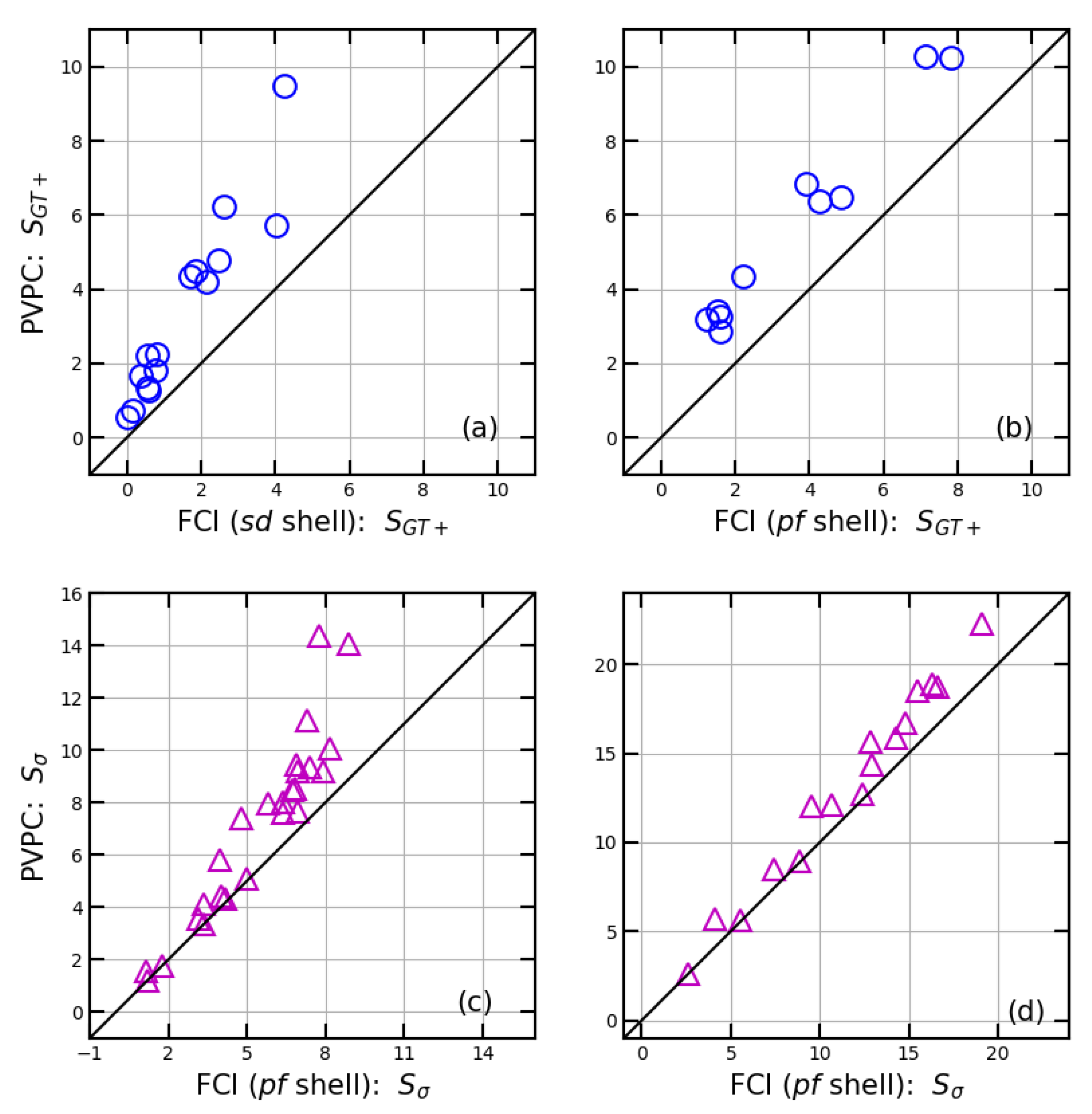
In Figure 1 we show the numerical results of S G T + and S σ for even–even nuclei in the 1 s 0 d and 1 p 0 f major shells. The horizontal values are shell-model sum rules generated with the BIGSTICK code [19], while the vertical values are sum rules generated with the PVPC model. The diagonal solid line means that the approximate sum rules are perfectly in agreement with shell-model results. We see that S G T + is over-estimated by PVPC, as in other approximate methods such as the Projected Hartree–Fock method and the nucleon-pair approximation [33]. In the 1 s 0 d major shell, the PVPC S G T + can be twice that of the shell-model S G T + , while in the 1 p 0 f major shell, the PVPC S G T + is about 1.2∼1.5 times that of the shell model. Previous shell-model investigations [30] show that in the 1 s 0 d shell, the Gamow–Teller sum rule typically increases as the excitation of the initial energy increases. As our approximate ground state may include excited configurations other than the pure shell-model ground state, the overestimation of S G T + agrees with that trend.
However, S σ appears to be less sensitive, as PVPC S σ values are remarkably faithful to shell-model S σ values. We speculate that this is because the transition Σ ^ = k σ ( k ) involves only spin components, not spin–isospin components as in the Gamow–Teller transition.

4. Double Gamow–Teller Sum Rules

4.1. Formalism

While Refs. [15,16,17,18] study the difference between S D G T and S D G T + , in this work we compute S D G T ± directly. Invoking closure condition J f M f | J f M f J f M f | = 1 , S D G T ± is the expectation value of a four-body operator,
S D G T ± = J f M f μ J f M f O ^ J μ D G T ± J i M i 2 = J i M i μ ( O ^ J μ D G T ± ) O ^ J μ D G T ± J i M i ,
where O ^ J μ D G T ± is the double Gamow–Teller transition operator,
O ^ J μ D G T ± = [ O ^ G T ± O ^ G T ± ] J μ ,
O ^ G T ± denotes the Gamow–Teller transition operator, i.e., σ τ ± , “⊗” signals angular momentum coupling, J = 0 , 2 , and μ = J , , J . Note that J = 1 is forbidden because of symmetry consideration [18].
Because of the four-body nature of the operator, computing the DGT sum rule expectation value is more complicated than for single GT sum rules. We are aided, however, by being able to separate out the proton and neutron components of the operators, which makes this calculation tractable. The DGT transition operator can be expanded as
O ^ J μ D G T ± = [ O ^ G T ± × O ^ G T ± ] J μ = α , γ ν / π ; β , δ π / ν C J μ D G T ( α β γ δ ) c ^ α c ^ β c ^ γ c ^ δ ,
where C J μ D G T ( α β γ δ ) is found to be
C J μ D G T ( α β γ δ ) = M 1 ( 1 , M 1 ; 1 , μ M 1 | J μ ) g M 1 G T ( α β ) g μ M 1 G T ( γ δ ) .
Here, g M G T ( α β ) is defined such that O ^ 1 M G T ± = α ν / π , β π / ν g M G T ( α β ) c ^ α c ^ β ,
g M G T ( α β ) ( 1 ) j β m β 2 j α + 1 3 α | | σ | | β ( j α , m α ; j β , m β | 1 M ) ,
and ( j α , m α ; j β , m β | 1 M ) denotes the Clebsch–Gorden coefficients. We denote single-j orbits by Latin letters a , b , , with quantum numbers ( n a l a j a ) , and m-scheme orbits by Greek letters α , β , , with quantum numbers ( n α l α j α m α ) .
In order to cast the DGT transition operator into computation with pair condensates, we write it in terms of pair creators and pair annihilators, e.g., for DGT−,
O ^ J μ D G T = α < β ( P ^ π α β ) ( P ^ ν α β ) ,
i.e., the operator annihilates a pair of neutrons and creates a pair of protons. The pair structure coefficients of ( P ^ π α β ) and P ^ ν α β can be derived:
( p π α β ) γ δ = δ α γ δ β δ δ α δ δ β γ ,
( p ν α β ) γ δ = C J μ D G T ( α γ β δ ) C J μ D G T ( β γ α δ ) C J μ D G T ( α δ β γ ) + C J μ D G T ( β δ α γ ) .
The sum rule operator for DGT− channel can also be written in terms of pair creators and pair annihilators,
O ^ J μ D G T S R = α < β ( P ^ ν α β ) ( P ^ π α β ) γ < δ ( P ^ π γ δ ) ( P ^ ν γ δ ) .
The expectation value of O ^ J μ D G T S R on the wavefunction Equation (15) is similar to Equation (19),
S D G T ( ψ J i M i r ) = K K g J i K r g J i K r P C O ^ J μ D G T S R P ^ K K J i P C = K K g J i K r g J i K r 8 J + 1 8 π D K K J i * ( Ω ) m < n , i < k A ^ π N π / 2 ( P ^ π m n ) ( P ^ π i k ) ( A ^ π ) N π / 2 × A ^ ν N ν / 2 ( P ^ ν m n ) ( P ^ ν i k ) ( A ^ ν ) N ν / 2 d Ω ,
where A ^ π R ^ ( Ω ) A ^ π and A ^ ν R ^ ( Ω ) A ^ ν are the rotated pairs. Terms such as A ^ π N π / 2 ( P ^ π m n ) ( P ^ π i k ) ( A ^ π ) N π / 2 and A ^ ν N ν / 2 ( P ^ ν m n ) ( P ^ ν i k ) ( A ^ ν ) N ν / 2 can be computed with overlap formulas between pair condensates with “impurity” pairs [27].

4.2. Benchmark DGT Sum Rules

We benchmark DGT sum rules from PVPC against those from shell-model results available in the literature. In Ref. [18], shell-model DGT sum rules are presented for a series of semi-magic nuclei. With no valence protons or full valence neutrons in semi-magic nuclei, S D G T + = 0 , and O ^ G T + | ψ g . s . = 0 , and therefore Equation (2) and (3) can be utilized in the shell model to acquire S D G T , surrounding the difficulty of three-body terms [18].
In this work, the PVPC S D G T values are computed with Equation (29), using the four-body sum rule operator directly. In Table 1, we present S D G T for the semi-magic nuclei studied in Ref. [18], from both PVPC and the shell model in comparison. It is shown that S D G T from PVPC is remarkably close to that from the shell model (in the parentheses), which is unsurprising, as it is known that the ground state of a semi-magic nucleus is typically well-approximated with a pair condensate.
For open-shell nuclei, shell-model DGT sum rules have not been computed systematically, as far as we know. Therefore, in the next subsection, we present the PVPC results, and also analyze the error induced by the overestimated S G T + , as mentioned previously.

4.3. Systematic Analysis of S D G T ±

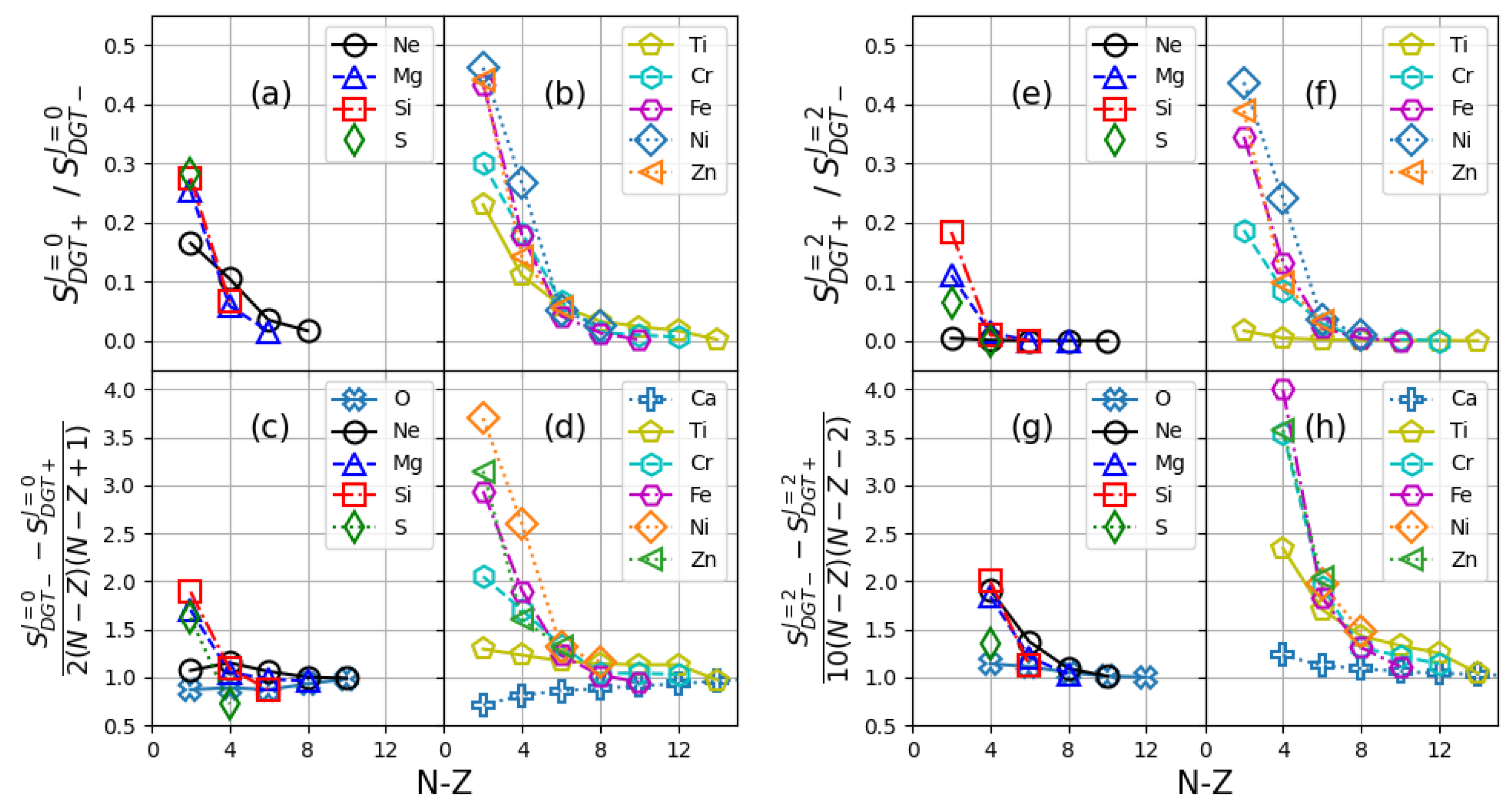
We compute S D G T ± for N Z even–even isotopes of O, Ne, Mg, Si, S, Ca, Ti, Cr, Fe, Ni, Zn in the 1 s 0 d and 1 p 0 f major shells. In Figure 2a,b,e,f we show the ratio between S D G T + and S D G T versus the neutron excess. When N Z = 0 it is trivial, as S D G T + equals S D G T ; therefore, in these two panels, N Z starts from 2. While it is anticipated that S D G T + approaches 0 as N Z increases, we show the speed of this tendency. When N Z = 6 , S D G T + is below 7% of S D G T ; when N Z = 8 , S D G T + is below 4% of S D G T ; in such cases S D G T + is negligible.
In Figure 2c,d,g,h, we show the difference between S D G T and S D G T + , i.e., the “sum rules” in Refs. [15,16,17,18], S D G T = S D G T S D G T + , in comparison with the model-independent terms (MITs) in (2) and (3). Indeed, for Neon isotopes, the MIT is faithful to the sum rule in the J = 0 channel, in accordance with Ref. [17], but for other nuclei the DGT sum rules show more deviations from the MITs.
In the J = 0 channel, when N Z = 2 , 4 , S D G T S D G T + can be 0.7∼4 times the MIT; when N Z = 6 , S D G T S D G T + is about 0.8∼1.5 times the MIT. The good news is that when N Z 8 , the MIT approaches the DGT sum rule.
Because the MIT in S D G T J = 2 , 10 ( N Z ) ( N Z 2 ) equals zero when N Z = 2 , Panel (gh) starts from N Z = 4 . It is noteworthy that in the J = 0 channel, MITs can be larger or smaller than S D G T , while in the J = 2 channel, MITs are smaller than S D G T , and the MIT approaches the sum rule faster in the J = 0 channel. Also, 1 p 0 f -shell nuclei have larger DGTSR, compared with 1 s 0 d -shell nuclei.
In Equations (2) and (3), there are three model-dependent contributions: S G T + , S σ , and a three-body term. In our benchmark results, PVPC S σ agrees well with shell-model S σ values, but PVPC overestimates S G T + by about 2 times in the 1 s 0 d shell and about 1.2∼1.5 times in the 1 p 0 f shell. The contribution from S G T + scales with N Z , i.e., 4 3 ( N Z ) S G T + for S D G T J = 0 and 20 3 ( N Z ) S G T + for S D G T J = 2 . Therefore, the error brought by PVPC S G T + may become significant when N Z increases. We make use of the shell-model S G T + values and introduce corrections,
S D G T J = 0 = S D G T J = 0 , P V P C 4 3 ( N Z ) ( S G T + P V P C S G T + F C I ) ,
S D G T J = 2 = S D G T J = 2 , P V P C 20 3 ( N Z ) ( S G T + P V P C S G T + F C I ) ,
where S D G T P V P C is the computational value from Equation (29), S G T + P V P C is the S G T + value from PVPC, and S G T + F C I is that from the full configuration–interaction shell model. In other words, we replace the PVPC S G T + values with shell-model ones, when available, in the DGTSR, as corrections. Thus, the contributions from both S σ , S G T + are supposed to be reliable, while the contributions from ψ g . s . | Σ · ( O ^ G T × O ^ G T + ) | ψ g . s . are from PVPC. The corrected DGT sum rules are denoted by S D G T instead of S D G T .
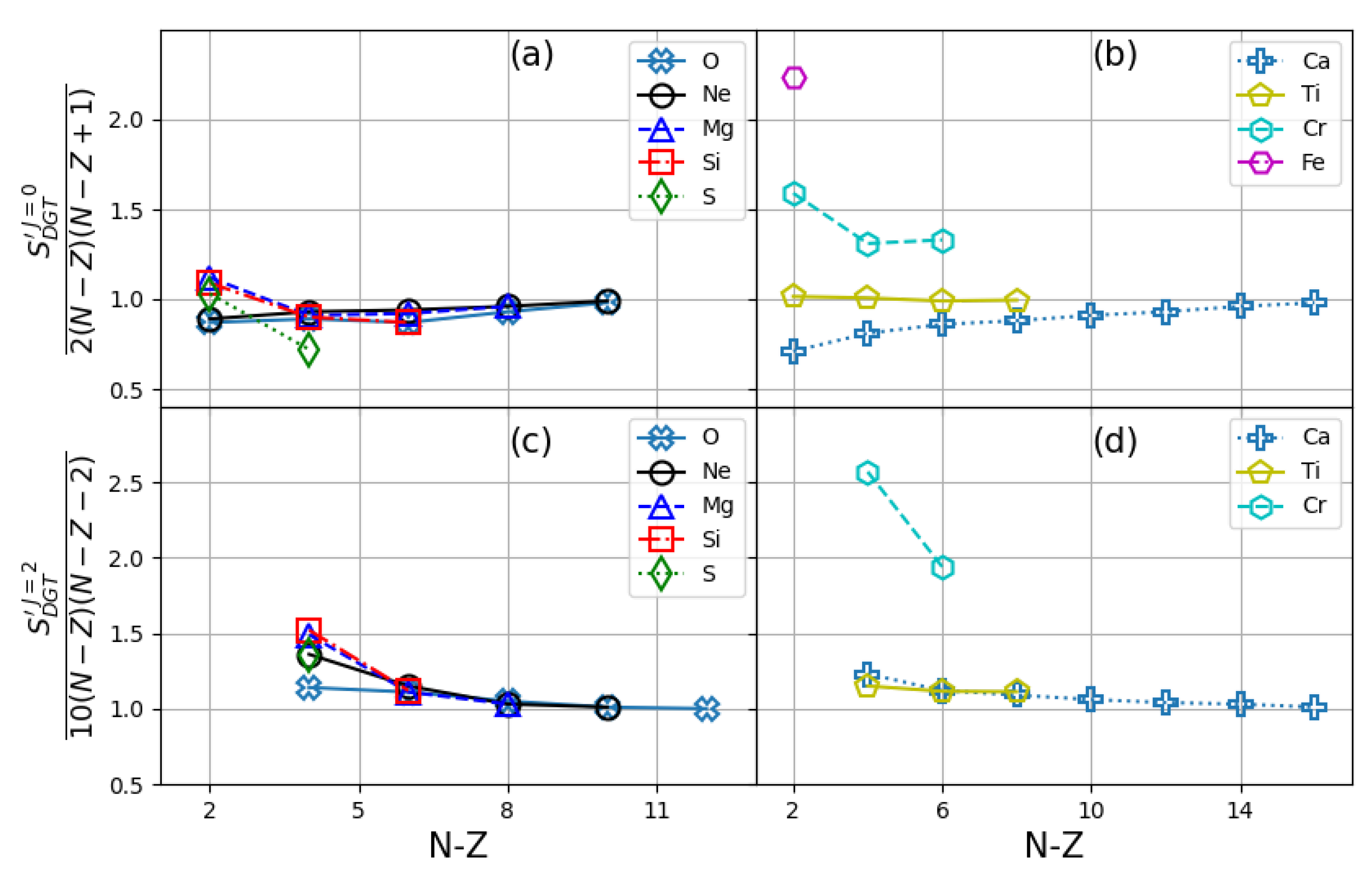
In Figure 3, we present corrected sum rules, versus the MIT, when shell-model S G T + values are available. Compared with Figure 2c,d,g,h, the MIT approaches the DGTSR faster (as N Z increases) after corrections.

4.4. DGT Strength on the DIAS Final State

Among all possible final states, the double isospin analog state (DIAS) of the initial state is special. Assuming the initial state | J i M i has isospin quantum numbers t = N Z 2 , t z = N Z 2 , the DIAS final state is written as
| DIAS = T ^ T ^ | J i M i 2 ( N Z ) ( N Z + 1 ) ,
and the DGT− strength from | J i M i to | DIAS is
D ( D I A S ) = | J i M i | T ^ + T ^ + O ^ D G T J μ | J i M i | 2 2 ( N Z ) ( N Z + 1 ) .
When there are no valence protons or full valence neutrons in the configuration space, T ^ + | J i M i = 0 , by derivations with commutators, it is shown that D ( D I A S ) can be expressed with S σ , S G T ± [18],
D ( D I A S ) = 2 [ S σ S G T S G T + ] 2 3 ( N Z ) ( N Z 1 ) .
In general, for open-shell nuclei, following Equation (33), the strength on the DIAS can be computed in terms of expectation value of the four-body operator T ^ + T ^ + O ^ D G T J μ . Therefore, it can be computed in a similar way as in Equation (28).
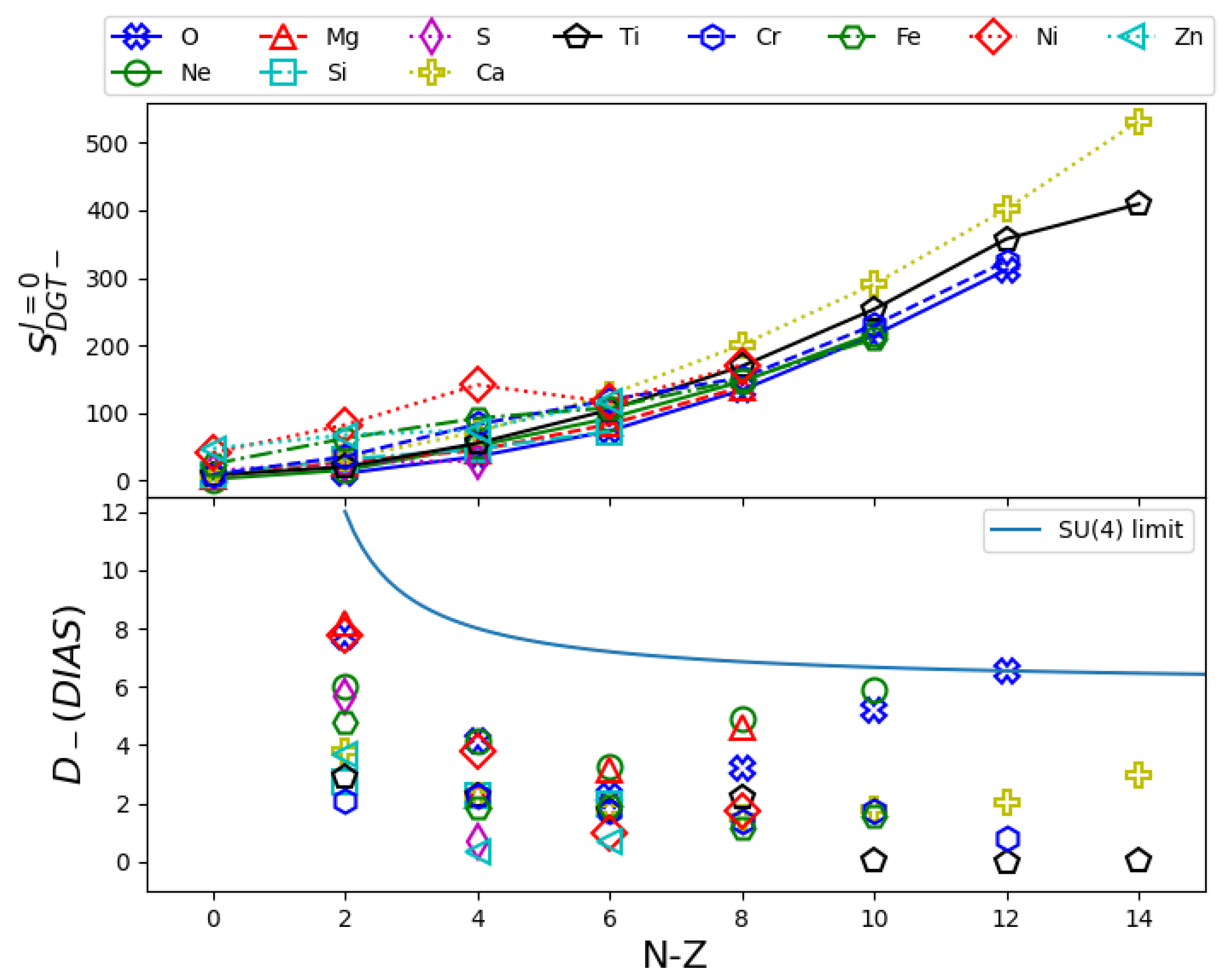
In Figure 4 we present theoretical results of DGT strengths on the DIAS, for even–even N Z isotopes of O, Ne, Mg, Si, S, Ca, Ti, Cr, Fe, Ni, Zn. While S D G T J = 0 increases in a parabolic manner following the model-independent term in Equation (2), D ( D I A S ) appears to be irrelevant to N Z . As a result, the fraction of D ( D I A S ) in the total strength function becomes negligible when N Z 4 . That is predicted by the Wigner SU(4) in Equations (5) and (6), i.e., D ( D I A S ) ( 6 , 12 ] , while S D G T J = 0 increases as 2 ( N Z ) ( N Z + 1 ) .
When N Z = 0 , D ( D I A S ) is blocked, since the initial nucleus has isospin T i = 0 . When N Z = 2 , SU(4) predicts that all S D G T J = 0 = D ( D G T ) = 12 , i.e., all DGT strengths are on the DIAS.
In Table 2, we present the fraction of DIAS contribution in S D G T J = 0 , for N Z = 2 nuclei. Three features can be identified: (i) as the valence particles increase, the DIAS fraction decreases; (ii) in the higher 1 p 0 f shell, the DIAS fraction is less significant compared to the lower 1 s 0 d shell; and (iii) the fraction can be enhanced when approaching closed shells, as in 38Ar, or the 0 f 7 / 2 subshell, as in 58Ni. The dominance of the DIAS contribution in 18O, 22Ne, 26Mg, 42Ca and 46Ti may result in a narrow strong peak in experiments, which is reminiscent of the “low-energy super GT state” [34,35], which was also observed in particle-type N Z = 2 nuclei, but not in hole-type N Z = 2 nuclei. It was argued that T = 0 interactions could pull the GT strengths to a lower excitation energy [34,36], bending the strength function toward the SU(4) predictions. In our context, it is possible that the ground state of particle-type N Z = 2 nuclei tends closer to an SU(4) weight state; as a result, its DIAS (or its mirror state) is a “super DGT state”.

5. Summary and Outlook

In summary, we present a systematic investigation on the double Gamow–Teller sum rules. Based on known DGTSR formulas, we suggest a model-independent rule, Equation (8), among three sum rules S G T , S D G T J = 0 , 2 , which can be used by experimentalists directly. If experimental data of these three sum rules can be obtained in the future, comparison between GT quenching and DGT quenching can be realized.
Then, we computed total strengths of double Gamow–Teller transition, i.e., S D G T ± in the method of projection after variation of pair condensates (PVPC). Benchmarking against shell-model results available in the literature shows that S D G T ± from PVPC are accurate for semi-magic nuclei. For open-shell nuclei without systematic shell-model results in the literature, we present DGTSR data in the 1 s 0 d and 1 p 0 f major shells. The results show that when N Z 8 , S D G T + is below 4% of S D G T , and the model-independent term in Equation (2) and (3) exhausts more than 85 % of S D G T J = 0 , and more than 66 % of S D G T J = 2 respectively.
After elimination of error caused by PVPC’s overestimation of S G T + values, S D G T values approach the MIT faster. In future work, the Generator Coordinate Method, or the variation after projection techniques, can be used to improve the accuracy of PVPC states, and promote the quality of S D G T data.
The strength on the DIAS final state, i.e., D ( D I A S ) , remains on the magnitude 1∼10, irrelevant to N Z , while the total strength S D G T exhibits a parabolic growth as N Z increases. In N Z = 2 nuclei with a few valence particles, 18O, 22Ne, 26Mg, and 42Ca, 46Ti, D ( D I A S ) dominates the strength function, suggesting possible “super DGT states”, similar to “super GT states” [34,35]. These features are qualitatively in alignment with the predictions of SU(4) symmetry.

Supplementary Materials

The following supporting information can be downloaded at: https://www.mdpi.com/article/10.3390/sym17122134/s1, DGTSR.xlsx: Original data in this work, including S σ , S G T + , D ( D I A S ) , S D G T ± ( J = 0 , 2 ) values; SGT+Ssigma-scripts: shell scripts and input files to generate S G T + , S σ with the shell model code BIGSTICK; ReadMe.md: detailed explanations about the data and scripts.

Author Contributions

Conceptualization, Y.L. (Yi Lu) and C.W.J.; methodology, Y.L. (Yi Lu) and Y.L. (Yang Lei); formal analysis, H.-J.X.; investigation, S.-Y.L.; data curation, H.-J.X. and S.-Y.L.; writing—original draft preparation, H.-J.X.; writing—review and editing, Y.L. (Yi Lu) and C.W.J.; project administration, Y.L. (Yi Lu). All authors have read and agreed to the published version of the manuscript.

Funding

Yi Lu acknowledges support by the Natural Science Foundation of Shandong Province, China (ZR2022MA050), and the National Natural Science Foundation of China (11705100, 12175115). Yang Lei is grateful for the financial support of the Sichuan Science and Technology Program (Grant No. 2019JDRC0017) and the Doctoral Program of Southwest University of Science and Technology (Grant No. 18zx7147). This material is also based upon work (Calvin W. Johnson) supported by the U.S. Department of Energy, Office of Science, Office of Nuclear Physics, under Award Number DE-FG02-03ER41272.

Data Availability Statement

The code PandasCommute for one-body transition sum rule operator can be found at https://gitee.com/luyi07/PandasCommute.git (accessed on 3 December 2025). The shell-model code BIGSTICK can be found at https://github.com/cwjsdsu/BigStickPublick.git (accessed on 1 January 2025). The pair condensate code PVPC is not ready to be published yet, but the sum rule data and documented shell scripts for BIGSTICK can be found in the Supplementary Materials.

Conflicts of Interest

The authors declare no conflicts of interest.

Abbreviations

The following abbreviations are used in this manuscript:
DGTDouble Gamow–Teller
DGTSRDouble Gamow–Teller Sum Rule
DIASDouble Isospin Analog States
DCXDouble Charge Exchange

References

  1. Osterfeld, F. Nuclear spin and isospin excitations. Rev. Mod. Phys. 1992, 64, 491–557. [Google Scholar] [CrossRef]
  2. Ichimura, M.; Sakai, H.; Wakasa, T. Spin–isospin responses via (p,n) and (n,p) reactions. Prog. Part. Nucl. Phys. 2006, 56, 446–531. [Google Scholar] [CrossRef]
  3. Fujita, Y.; Rubio, B.; Gelletly, W. Spin-isospin excitations probed by strong, weak and electro-magnetic interactions. Prog. Part. Nucl. Phys. 2011, 66, 549–606. [Google Scholar] [CrossRef]
  4. Mordechai, S.; Fred Moore, C. Double giant resonances in atomic nuclei. Nature 1991, 352, 393–397. [Google Scholar] [CrossRef]
  5. Lenske, H.; Cappuzzello, F.; Cavallaro, M.; Colonna, M. Heavy ion charge exchange reactions as probes for nuclear beta-decay. Prog. Part. Nucl. Phys. 2019, 109, 103716. [Google Scholar] [CrossRef]
  6. Cappuzzello, F.; Lenske, H.; Cavallaro, M.; Agodi, C.; Auerbach, N.; Bellone, J.; Bijker, R.; Burrello, S.; Calabrese, S.; Carbone, D.; et al. Shedding light on nuclear aspects of neutrinoless double beta decay by heavy-ion double charge exchange reactions. Prog. Part. Nucl. Phys. 2023, 128, 103999. [Google Scholar] [CrossRef]
  7. Shimizu, N.; Menéndez, J.; Yako, K. Double Gamow-Teller Transitions and its Relation to Neutrinoless ββ Decay. Phys. Rev. Lett. 2018, 120, 142502. [Google Scholar] [CrossRef]
  8. Auerbach, N.; Zamick, L.; Zheng, D.C. Double Gamow-Teller strength in nuclei. Ann. Phys. 1989, 192, 77–84. [Google Scholar] [CrossRef]
  9. Auerbach, N.; Minh Loc, B. Nuclear structure studies of double-charge-exchange Gamow-Teller strength. Phys. Rev. C 2018, 98, 064301. [Google Scholar] [CrossRef]
  10. Roca-Maza, X.; Sagawa, H.; Colò, G. Double charge-exchange phonon states. Phys. Rev. C 2020, 101, 014320. [Google Scholar] [CrossRef]
  11. Whitehead, R.; Watt, A.; Kelvin, D. Shell-model calculation of strength functions. Phys. Lett. B 1980, 89, 313–315. [Google Scholar] [CrossRef]
  12. Caurier, E.; Martínez-Pinedo, G.; Nowacki, F.; Poves, A.; Zuker, A.P. The shell model as a unified view of nuclear structure. Rev. Mod. Phys. 2005, 77, 427–488. [Google Scholar] [CrossRef]
  13. Nevo Dinur, N.; Barnea, N.; Ji, C.; Bacca, S. Efficient method for evaluating energy-dependent sum rules. Phys. Rev. C 2014, 89, 064317. [Google Scholar] [CrossRef]
  14. Kiyomi, I. Collective Excitation of Unlike Pair States in Heavier Nuclei. Progr. Theoret. Phys. 1964, 31, 434–451. [Google Scholar]
  15. Vogel, P.; Ericson, M.; Vergados, J.D. Sum rules for two-particle operators and double beta decay. Phys. Lett. B 1988, 212, 259–263. [Google Scholar] [CrossRef]
  16. Zheng, D.C.; Zamick, L.; Auerbach, N. Generalization of the sum rule for double Gamow-Teller operators. Phys. Rev. C 1989, 40, 936–939. [Google Scholar] [CrossRef] [PubMed]
  17. Muto, K. Sum rules for double Gamow-Teller excitation. Phys. Lett. B 1992, 277, 13–17. [Google Scholar] [CrossRef]
  18. Sagawa, H.; Uesaka, T. Sum rule study for double Gamow-Teller states. Phys. Rev. C 2016, 94, 064325. [Google Scholar] [CrossRef]
  19. Johnson, C.W.; Ormand, W.; Krastev, P.G. Factorization in large-scale many-body calculations. Comput. Phys. Commun. 2013, 184, 2761–2774. [Google Scholar] [CrossRef]
  20. Cohen, S.; Kurath, D. Effective interactions for the 1p shell. Nucl. Phys. 1965, 73, 1–24. [Google Scholar] [CrossRef]
  21. Brown, B.A.; Richter, W.A. New “USD” Hamiltonians for the sd shell. Phys. Rev. C 2006, 74, 034315. [Google Scholar] [CrossRef]
  22. Honma, M.; Otsuka, T.; Brown, B.A.; Mizusaki, T. Shell-model description of neutron-rich pf-shell nuclei with a new effective interaction GXPF 1. Eur. Phys. J.-Hadron. Nucl. 2005, 25, 499–502. [Google Scholar] [CrossRef]
  23. Otsuka, T.; Honma, M.; Mizusaki, T.; Shimizu, N.; Utsuno, Y. Monte Carlo shell model for atomic nuclei. Prog. Part. Nucl. Phys. 2001, 47, 319–400. [Google Scholar] [CrossRef]
  24. Rowe, D.J.; Song, T.; Chen, H. Unified pair-coupling theory of fermion systems. Phys. Rev. C 1991, 44, R598–R601. [Google Scholar] [CrossRef]
  25. Silvestre-Brac, B.; Piepenbring, R. Multiphonon theory: Generalized Wick’s theorem and recursion formulas. Phys. Rev. C 1982, 26, 2640–2653. [Google Scholar] [CrossRef]
  26. Lei, Y.; Jiang, H.; Pittel, S. Variational approach for pair optimization in the nucleon pair approximation. Phys. Rev. C 2020, 102, 024310. [Google Scholar] [CrossRef]
  27. Lu, Y.; Lei, Y.; Johnson, C.W.; Shen, J.J. Nuclear states projected from a pair condensate. Phys. Rev. C 2022, 105, 034317. [Google Scholar] [CrossRef]
  28. Galassi, M.; Davies, J.; Theiler, J.; Gough, B.; Jungman, G.; Alken, P.; Booth, M.; Rossi, F.; Ulerich, R. GNU Scientific Library; Network Theory Limited: Godalming, UK, 2019. [Google Scholar]
  29. Liang, S.Y.; Lu, Y.; Lei, Y.; Johnson, C.W.; Fu, G.J.; Shen, J.J. Shannon entropy of optimized proton-neutron pair condensates. Phys. Rev. C 2025, 111, 024310. [Google Scholar] [CrossRef]
  30. Johnson, C.W. Systematics of strength function sum rules. Phys. Lett. B 2015, 750, 72–75. [Google Scholar] [CrossRef]
  31. Lu, Y.; Johnson, C.W. Transition sum rules in the shell model. Phys. Rev. C 2018, 97, 034330. [Google Scholar] [CrossRef]
  32. Johnson, C.W.; Luu, K.A.; Lu, Y. Exact sum rules with approximate ground states. J. Phys. Nucl. Part. Phys. 2020, 47, 105107. [Google Scholar] [CrossRef]
  33. Lauber, S.M.; Frye, H.C.; Johnson, C.W. Benchmarking angular-momentum projected Hartree–Fock as an approximation. J. Phys. Nucl. Part. Phys. 2021, 48, 095107. [Google Scholar] [CrossRef]
  34. Fujita, Y.; Fujita, H.; Adachi, T.; Bai, C.L.; Algora, A.; Berg, G.P.A.; von Brentano, P.; Colò, G.; Csatlós, M.; Deaven, J.M.; et al. Observation of Low- and High-Energy Gamow-Teller Phonon Excitations in Nuclei. Phys. Rev. Lett. 2014, 112, 112502. [Google Scholar] [CrossRef]
  35. Fujita, Y.; Fujita, H.; Adachi, T.; Susoy, G.; Algora, A.; Bai, C.L.; Colò, G.; Csatlós, M.; Deaven, J.M.; Estevez-Aguado, E.; et al. High-resolution study of Gamow-Teller excitations in the 42Ca(3He,t)0.28em0ex42Sc reaction and the observation of a “low-energy super-Gamow-Teller state”. Phys. Rev. C 2015, 91, 064316. [Google Scholar] [CrossRef]
  36. Bai, C.; Sagawa, H.; Sasano, M.; Uesaka, T.; Hagino, K.; Zhang, H.; Zhang, X.; Xu, F. Role of T=0 pairing in Gamow–Teller states in N=Z nuclei. Phys. Lett. B 2013, 719, 116–120. [Google Scholar] [CrossRef]
Figure 1. Benchmark of one-body spin–isospin sum rules of ground states generated from PVPC, against that of shell-model ground states by “exact” diagonalization. “PVPC” stands for “projection after variation of a pair condensate”. Panel (a): GT+ sum rules S G T + of even–even nuclei in the 1 s 0 d major shell; Panel (b): S G T + of even–even nuclei in the 1 p 0 f major shell; Panel (c): S σ of even–even nuclei in the 1 s 0 d major shell; Panel (d): S σ of even–even nuclei in the 1 p 0 f major shell.
Symmetry 17 02134 g001
Figure 2. DGT sum rules of even–even nuclei in the 1 s 0 d and 1 p 0 f major shells, from PVPC. Panel (a,b): ratio between S D G T + J = 0 and S D G T J = 0 ; Panel (c,d): ratio between S D G T J = 0 S D G T + J = 0 and the model-independent term 2 ( N Z ) ( N Z + 1 ) in Equation (2); Panel (e,f): ratio between S D G T + J = 2 and S D G T J = 2 ; Panel (g,h): ratio between S D G T J = 2 S D G T + J = 2 and the model-independent term 10 ( N Z ) ( N Z 2 ) in Equation (3).
Symmetry 17 02134 g002
Figure 3. The ratio between the DGT sum rule and the MIT, with corrections introduced via Equations (30) and (31). (a) J = 0 channel for 1 s 0 d -shell nuclei; (b) J = 0 channel for 1 p 0 f -shell nuclei; (c) J = 2 channel for 1 s 0 d -shell nuclei; (d) J = 2 channel for 1 p 0 f -shell nuclei.
Symmetry 17 02134 g003
Figure 4. D ( D I A S ) in comparison with S D G T J = 0 , for even-even nuclei in 1 s 0 d and 1 p 0 f shells. Scattered data points are for D ( D I A S ) , while those linked with lines are for S D G T in the J = 0 channel.
Symmetry 17 02134 g004
Table 1. DGT− sum rules generated with the PVPC method, in comparison with shell-model results in the parentheses. The shell-model results are quoted from Ref. [18].
Initial StateJ = 0J = 2
6He12.00 (12)0.013 (0)
8He39.54 (39.7)81.39 (80.7)
14C7.57 (8.98)10.87 (7.55)
18O10.42 (10.4)3.99 (3.96)
20O33.77 (35.5)91.2 (91.3)
42Ca8.50 (8.5)8.75 (8.75)
44Ca31.68 (32.6)100.8 (98.5)
46Ca70.38 (72.3)274.0 (269.3)
48Ca125.75 (135.5)525.6 (501.2)
Table 2. The fraction of DIAS strength in S D G T J = 0 , for N Z = 2 nuclei.
18O22Ne26Mg30Si34S38Ar
D ( D I A S ) / S D G T J = 0 74.1 % 39.3 % 29.9 % 8.8 % 2.1 % 18.4 %
42Ca46Ti50Cr54Fe58Ni62Zn
D ( D I A S ) / S D G T J = 0 44.7 % 14.5 % 5.9 % 7.7 % 9.4 % 5.4 %
Disclaimer/Publisher’s Note: The statements, opinions and data contained in all publications are solely those of the individual author(s) and contributor(s) and not of MDPI and/or the editor(s). MDPI and/or the editor(s) disclaim responsibility for any injury to people or property resulting from any ideas, methods, instructions or products referred to in the content.