Article

Triaxiality in the Low-Lying Quadrupole Bands of Even–Even Yb Isotopes

by
Polytimos Vasileiou
1,*,
Dennis Bonatsos
2 and
Theo J. Mertzimekis
1
1
Department of Physics, National & Kapodistrian University of Athens, Zografou Campus, GR-15784 Athens, Greece
2
Institute of Nuclear and Particle Physics, National Centre for Scientific Research “Demokritos”, GR-15310 Aghia Paraskevi, Greece
*
Author to whom correspondence should be addressed.
Symmetry 2025, 17(12), 2135; https://doi.org/10.3390/sym17122135
Submission received: 18 November 2025 / Revised: 6 December 2025 / Accepted: 9 December 2025 / Published: 11 December 2025
(This article belongs to the Section Physics)

Abstract

Following a series of successful applications to the neighboring isotopic chains of the rare-earth region, a mean-field-derived IBM-1 Hamiltonian with an intrinsic triaxial deformation derived from fermionic proxy-SU(3) irreducible representations (irreps) is employed for the study of energies and B ( E 2 ) transition strengths in the low-lying quadrupole bands of the even–even 162–182Yb. Proxy-SU(3) next-highest-weight irreps are incorporated in the calculations for the first time, leading to a significantly improved agreement with experimental data, where available, compared to axially symmetric calculations, as well as to triaxial calculations considering only highest-weight irreps.

1. Introduction

Triaxiality [1,2,3] in atomic nuclei has been a long-standing puzzle in nuclear structure. Over the years, numerous experimental as well as theoretical studies have been dedicated to unveiling its nature and origins. Recently, the interest of the community in the subject of triaxiality has been reinvigorated, with an increasing number of findings suggesting its presence over extended regions of the nuclear landscape [4,5,6,7,8].
Among the various theoretical models existing for the study of nuclear structure, the nuclear shell model [9,10,11] holds a prominent place, since it is known to provide detailed microscopic descriptions of atomic nuclei in terms of their constituents, namely protons and neutrons. However, due to the magnitude of the model space involved, shell model calculations can become very computationally demanding and time-consuming, especially for (medium-)heavy nuclei [12].
Several iterations of the nuclear shell model have been developed throughout the years, ranging from its most basic form, dubbed the spherical shell model [9], to the deformed [13], projected (PSM) [14], triaxial projected (TPSM) [15], and, more recently, the state-of-the-art Monte Carlo shell model (MCSM) [4,6]. Of these, only the latter two can readily describe triaxial shapes. More specifically, triaxiality is explicitly accounted for in the TPSM, and, due to its low computational requirements as compared to the full shell model approach, this model has been employed for extensive studies of a series of nuclei [5]. Regarding the state-of-the-art MCSM, it has recently been successfully applied to the study of several heavier, deformed nuclei [6]. However, its improved predictive power comes with a substantially increased demand in terms of computational time and resources.
A different microscopic path toward nuclear deformation was introduced in 1958, in the works of Elliott [16,17,18], who revealed that quadrupole deformation, characterized by SU(3) symmetry, can emerge within the spherical shell model, in the form of an intrinsic state. This allowed for the derivation of simple expressions for the collective deformation variables β and γ [19,20], through a mapping between the invariants of the collective model and those of the rigid rotor, namely the second- and third-order Casimir operators of SU(3) [21,22]. Since the spin–orbit interaction breaks the SU(3) symmetry beyond the sd nuclear shell, several algebraic approximation schemes exist for its restoration in heavier shells [23,24,25,26,27,28,29,30]. Among these is the recently developed proxy-SU(3) [28,29,30].
Within proxy-SU(3), a replacement takes place between intruder orbitals (except the one possessing the highest angular momentum projection, which lies at the top of the shell and thus is empty for most nuclei) and deserting orbitals—with the former acting as “proxies”—for the restoration of the broken SU(3) symmetry beyond the sd shell. Using the λ and μ Elliott label notation [16,17,18,31], each nucleus is characterized by an SU(3) irreducible representation (hereafter called “irrep”) of the form ( λ , μ ) , which is the most streched irrep ( λ p + λ n , μ p + μ n ) , where ( λ p , μ p ) and ( λ n , μ n ) are the highest-weight (hw) proton and neutron irreps, respectively, as dictated by the Pauli principle and the short-range nature of the nucleon interaction [32,33]. In this framework, the ( λ , μ ) irreps are, in general, triaxial, lying between the limiting cases of ( λ , 0 ) and ( 0 , μ ) , which describe axially symmetric prolate and oblate shapes, respectively (see also discussion in [7]). However, in cases where the valence proton and/or neutron hw irreps are completely symmetric ( μ p , n = 0 ), the derived γ deformation values are unusually low compared to their experimental counterparts. This discrepancy is most severe for nuclei possessing both μ p = 0 and μ n = 0 . For these nuclei, the stretched proxy-SU(3) hw irrep is fully symmetric ( μ = 0 ), in analogy with the completely symmetric forms arising in boson models [34,35].
The interacting boson model-1 (IBM-1) [34] is the simplest iteration among a series of phenomenological interacting boson models. It achieves a vast truncation of the shell model space by making use of bosonic degrees of freedom, namely the s  ( L = 0 ) and d ( L = 2 ) valence bosons, corresponding to correlated fermion pairs, counted from the nearest closed shells. Within IBM-1, no distinction is made between bosons coming from correlated proton or neutron pairs. The model possesses an overall U(6) symmetry, encompassing three dynamical symmetries (DSs): U(5) [36], SU(3) [35], and O(6) [37], corresponding to spherical, axially deformed, and γ -unstable (soft toward triaxial deformation) shapes.
It is known [38] that the SU(3) DS limit of the IBM-1 framework cannot readily accommodate triaxial shapes, since in this limit, the ground-state band (gsb) sits alone in the axially symmetric ( 2 N B , 0 ) irrep ( N B : number of valence bosons). To describe triaxial shapes within IBM-1, one has to introduce higher-order (three- and four-body) terms, of the form ( d × d × d ) · ( d ˜ × d ˜ × d ˜ ) [38,39,40], ( Q ^ × Q ^ × Q ^ ) , ( L ^ × Q ^ × L ^ ) , and ( L ^ × Q ^ ) · ( L ^ × Q ^ ) [41,42]. Alternatively, one can turn to IBM-2, by distinguishing proton from neutron valence bosons. Treating one boson species as particles, with irreps ( 2 N 1 , 0 ) , and the other as holes, with irreps ( 0 , 2 N 2 ) , triaxial irreps of the form ( 2 N 1 , 2 N 2 ) are obtained for the whole nucleus [SU*(3) limit of IBM-2] [43,44,45]. However, both of the aforementioned approaches involve the inclusion of additional parameters in the IBM Hamiltonians, making for more computationally cumbersome calculations.
In Refs. [7,46], a significant step was taken toward amending the discrepancies arising from the exclusive use of proxy-SU(3) hw irreps to describe nuclear properties. The next-highest-weight (nhw) irreps of proxy-SU(3) were incorporated in the calculations for the first time, leading to significantly improved predictions for the cases of μ p , n = 0 . The combination of hw and nhw proxy-SU(3) irreps was soon-after employed to review triaxial shapes in even–even nuclei and underpin regions of the nuclear chart wherein triaxiality is favored [8].
In parallel with the advancements in the proxy-SU(3) theoretical framework, a new method was employed for introducing triaxiality into IBM-1 [47,48]. This method utilized proxy-SU(3) hw irreps to microscopically derive a γ deformation value, which was incorporated into the classical limit of IBM-1, as formulated with the use of coherent states [34,49,50]. The IBM-1 Hamiltonian parameters used for the calculation of spectra and transition strengths were subsequently determined via a mapping [51,52,53] of the IBM-1 potential energy curve (PEC) onto a corresponding one obtained from self-consistent mean-field (SCMF) calculations [54]. The method was successfully applied in a series of even–even Hf, W [47], and Er [48] isotopes, producing results in very good agreement with available experimental data, as well as with TPSM [5] and MCSM [6] predictions.
In the present paper, we expand upon this method by incorporating nhw proxy-SU(3) irreps into our triaxial calculations. As a first application, we shall examine even–even nuclei of the Yb isotopic chain, with N = 92–112, containing isotopes traditionally considered to be good examples of axially symmetric (prolate) rotors [55,56,57,58]. Since Yb isotopes are characterized by the fully symmetric proton hw irrep, ( 20 , 0 ) , the impact of the proxy-SU(3) nhw irreps is expected to be substantial across the entire isotopic chain, becoming especially significant for the isotopes additionally possessing fully symmetric neutron hw irreps (i.e., 164,172,182Yb94,102,112). In addition to the ground and γ bands, the inclusion of nhw proxy-SU(3) irreps in the calculations allows us to extend our study to the β bands, and examine triaxiality features through a comparison of energy levels and B ( E 2 ) transition strengths with available experimental data [59,60,61], as well as with recent Monte Carlo shell model predictions [6].

2. Theoretical Method

For the construction of the microscopic PEC for each isotope, the Skyrme–Hartree–Fock + Bardeen–Cooper–Schriefer (HF+BCS) code SKYAX [54] is employed to carry out SCMF calculations on a two-dimensional mesh of the r-z plane, with a constraint being placed on the quadrupole deformation variable, β . The SV-bas [62] Skyrme energy density functional (EDF) is employed, along with a density-dependent δ -force used for the pairing (see [47] for more details).
To obtain the IBM-1 PECs, the consistent-Q formalism (CQF) [63,64] is adopted to write the IBM-1 Hamiltonian in the form [65,66]
H ( ζ , χ ) = c ( 1 ζ ) n ^ d ζ 4 N B Q ^ χ Q ^ χ ,
where N B is the valence boson number, n ^ d = d · d ˜ is the number operator for quadrupole bosons, Q ^ χ = ( s d ˜ + d s ) + χ ( d d ˜ ) ( 2 ) is the quadrupole operator, and c is a scaling factor.
The Hamiltonian of (1) makes use of two structural parameters, namely ζ and χ , to describe the entire IBM symmetry triangle [67,68,69], bordered by the U(5)–O(6)–SU(3) dynamical symmetry limits of the IBM. Finally, by utilizing the coherent-state formalism [34,49,50], we derive the following expression for the energy IBM-1 energy surface, E ( β , γ ) [70]:
E ( β , γ ) = c N B β 2 1 + β 2 ( 1 ζ ) ( χ 2 + 1 ) ζ 4 N B 5 c ζ 4 ( 1 + β 2 ) c ζ ( N B 1 ) 4 ( 1 + β 2 ) 2 × 4 β 2 4 2 7 χ β 3 cos 3 γ + 2 7 χ 2 β 4 .
Equation (2) links the structural parameters ( ζ , χ ) of the ECQF Hamiltonian to the ( β , γ ) classical coordinates connected to the Bohr geometrical variables [34,71]. More specifically, ζ is associated with the the axial quadrupole deformation parameter, β , while χ is related to the triaxiality parameter, γ , which indicates the degree of axial asymmetry in a nucleus.
Regarding the quadrupole deformation parameters, one can approximate β β F [72] and write
β = C β β F ,
with C β being the proportionality coefficient for the β deformation [47,51]. Since β is derived using the valence boson space, which is smaller than the shell model space used for the derivation of β F , C β > 1 .
For the triaxiality parameter γ , the following three cases are examined:
(I)
Axial deformations, i.e.,
γ I = 0 .
(II)
Intrinsic triaxial deformation, derived from the proxy-SU(3) fermionic hw irreps, for each isotope under study. Its value is calculated as [19,20]
γ I I = γ h w = arctan 3 ( μ + 1 ) 2 λ + μ + 3 .
(III)
Since Yb isotopes are characterized by the fully symmetric proton hw irrep ( λ p , μ p ) = ( 20 , 0 ) (see Table II of [29]), the proxy-SU(3)-predicted γ h w are unnaturally low across the entire isotopic chain (see earlier discussion in Section 1). To remedy this behavior, it is necessary to take into account the next-highest-weight (nhw) irreps in the calculation of the intrinsic γ deformation for each of the examined isotopes. A simple first approach is to take the average of the γ deformation values predicted with the use of the hw and nhw irreps (see relevant discussions in [7,46]), i.e.,
γ I I I = 1 2 γ h w + 1 2 γ n h w ,
where γ h w and γ n h w are calculated from Equation (5).
The ( λ , μ ) hw and nhw irreps, along with their associated γ h w and γ n h w , are tabulated for the Yb isotopes under study in Table II of [46].
By imposing conditions (3), (4), (5), and (6) in Equation (2), we obtain the IBM-1 PECs for each of the cases (I)–(III), as functions of the quadrupole deformation, β , with parameters χ , ζ , c, and C β :
E ( β , γ = γ i ) E ( β ) E ( β F ; C β , χ , ζ , c , N B ) , γ = γ i , i = I , I I , I I I .
Mapping the IBM-1 PEC onto the HF+BCS PEC leads to the determination of the set of optimal ( χ , ζ , C β ) parameters, the ones leading to the best reproduction of the overall shape and curvature of the fermionic PEC by the bosonic one, up to a few MeV of the absolute minimum of the former (see [47,48] for a more detailed description of the mapping procedure). The calculated PECs are plotted in Figure 1. Regarding the scale, c, it is chosen so as to reproduce the available experimental E ( 2 1 + ) energies [59,61].
In the last step of this procedure, a rescaling of the β - and γ -band energy levels to their experimental bandheads, where available, is performed. This is related to the difference between the mass coefficients associated with the moments of inertia for the ground, β and γ bands [73,74,75,76,77], and is required in order to obtain quantitative results for the band energies (see also discussions in [47,48]).
The determined IBM-1 Hamiltonian parameters, tabulated in Table 1, are then used as inputs for the calculation of energy spectra and B ( E 2 ) transition strengths for the Yb isotopes under study, with the help of the IBM-1 code IBAR [78].

3. Results and Discussion

3.1. Parameter Systematics

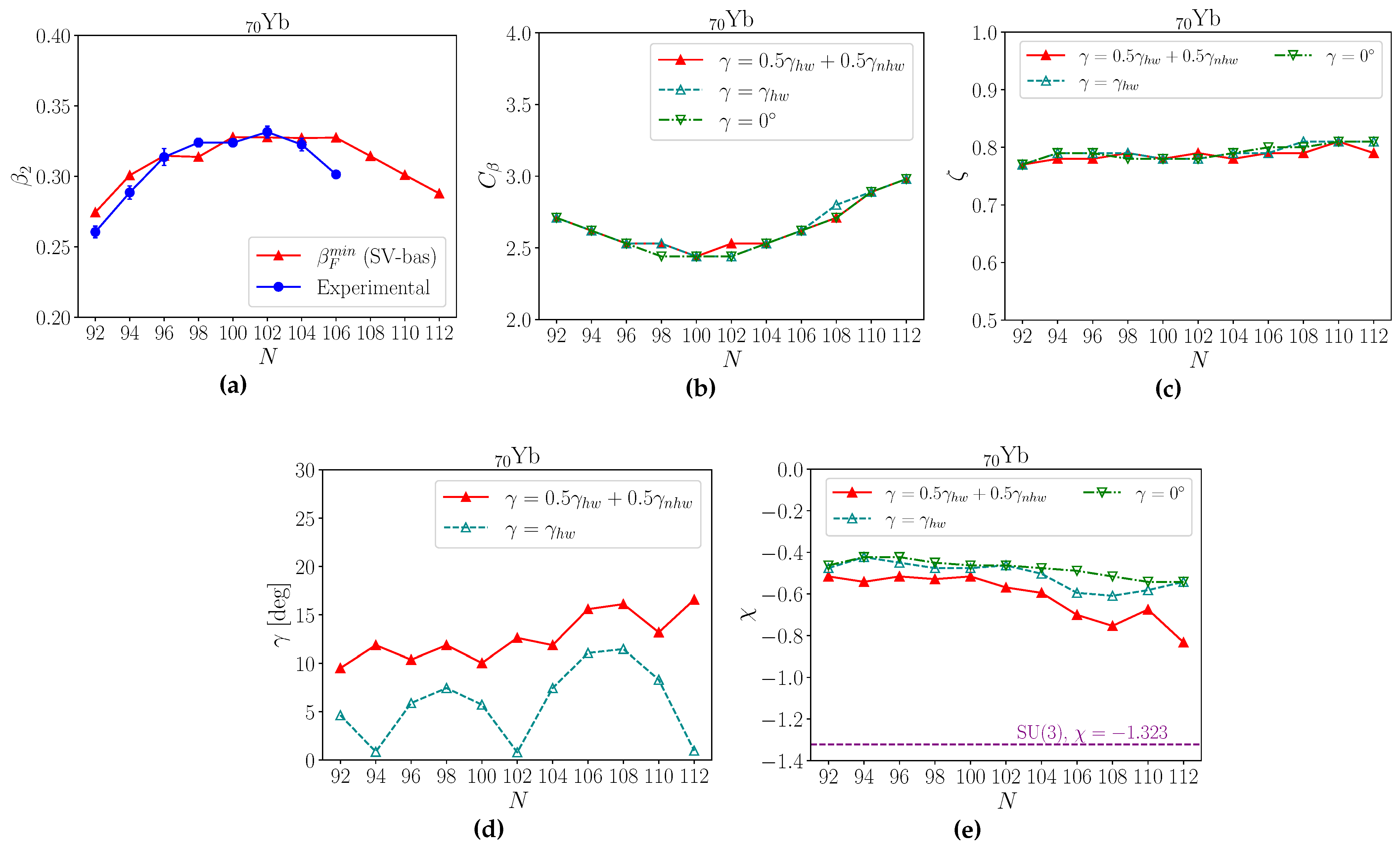
We begin our discussion of the results with an examination of the systematics of the extracted IBM-1 Hamiltonian parameters. These are tabulated in Table 1, and plotted in Figure 2a–e. The same notation is used in all of the panels of Figure 2, i.e., green dashed lines with empty triangles for γ = 0 ° ( γ I ) , cyan dashed lines with empty triangles for γ = γ h w ( γ I I ) , and red solid lines with filled triangles for γ = 1 2 γ h w + 1 2 γ n h w ( γ I I I ) .
In qualitative agreement with earlier works employing PES mapping methods, as well as with our previous studies on Er [48], Hf, and W [47], the C β proportionality coefficients [Figure 2b] follow a trend opposite to the β 2 deformation parameters [Figure 2a], assuming that their minimal values are just below the midshell for which the PECs present the largest deformation. For all of the studied isotopes, the inclusion of proxy-SU(3) irreps has minimal influence on the C β parameters, as well as the ζ parameters [Figure 2c], both related to the axial quadrupole deformation β 2 .
However, this is not the case for the χ parameters, which are related to the triaxiality variables γ . Again, the intrinsic triaxiality values are well translated into the χ parameters of the IBM-1 CQF Hamiltonian (1). The oscillating pattern caused by the fully symmetric neutron hw irreps at N = 94 , 102 , 112 is transferred to the χ values, with the local minima of γ at these neutron numbers being translated into local maxima of χ , in qualitative agreement. It is at this point that the impact of the proxy-SU(3) nhw irreps becomes apparent, with their inclusion in the calculation of γ leading to the elimination of the aforementioned oscillating pattern, along with an additional overall increase in the calculated triaxiality values. This is in turn reflected in the χ values, which are now substantially lowered, lying closer to the SU(3) limit of χ = 7 / 2 1.323 , typical for well-deformed, prolate nuclei.
In [79], the same CQF Hamiltonian (1) is employed for the study of the nuclear structure in the even–even 164–178Yb isotopes. However, the Hamiltonian parameters tabulated in Table 7 of [79] are determined through fits to the experimental energy ratios E ( 4 1 + ) / E ( 2 1 + ) , , E ( 12 1 + ) / E ( 10 1 + ) with the inclusion of E ( 2 2 + ) / E ( 2 1 + ) and E ( 0 2 + ) / E ( 2 1 + ) , where available. Therefore, these fits are weighted toward the ground bands, with χ approaching the SU(3) DS limit, and reaching its maximum value at N = 102 (174Yb), i.e., at the maximum of the quadrupole deformation, β 2 . This is no longer the case in the present work (see Table 1), where the ground and γ bands are included in the calculations on equal footing, through the use of proxy-SU(3) irreps. It should be pointed out that both parameter sets (i.e., that tabulated in Table 7 of [79] and that tabulated in Table 1 of the present manuscript) lead to a very good reproduction of the ground-band levels in all of the examined Yb isotopes [see discussion in the next section, as well as Figure 10 of [79] and Figure 3a–c].

3.2. Energy Levels

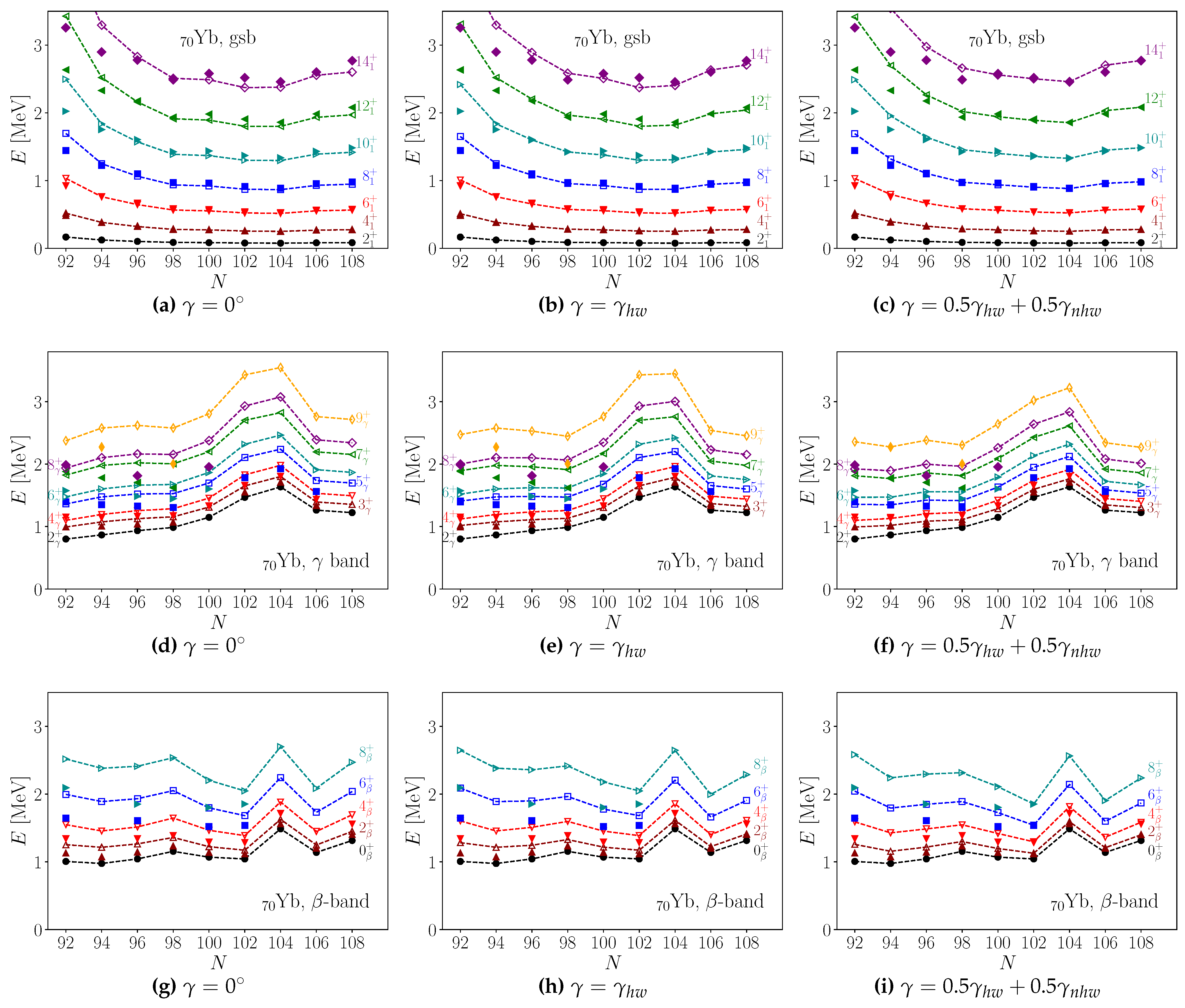
We shall now proceed with a more detailed inspection of the calculated Yb energy spectra. These are plotted for 162–178Yb in Figure 3.

3.2.1. Ground and γ Bands

As in the case of their Er, Hf, and W neighbors, the inclusion of an intrinsic triaxiality through the proxy-SU(3) irreps improves the reproduction of the experimentally observed L ( L + 1 ) rotational splitting of the gsb energy levels in the studied Yb isotopes, without the need for the addition of an ( L ^ · L ^ ) term in the Hamiltonian (1). This is owed to the effect of the second-order Casimir operator of SU(3), C ^ 2 [ SU ( 3 ) ] , defined as [16,17,18,31]
C ^ 2 [ SU ( 3 ) ] = 2 Q ^ · Q ^ + 3 4 L ^ 2 ,
which enters implicitly in the calculations via the ( λ , μ ) irreps used to derive γ I I , I I I through (5) and (6).
The γ bands, formed by the 2 2 + , 3 1 + , 4 2 + , …, 9 1 + states, are even more sensitive to the inclusion of triaxiality, with the calculated energy levels for γ = γ h w being in better agreement with the experiment, compared to the γ = 0 ° case. Still, this improvement is not as substantial for the Yb isotopes as compared to Er, Hf, and W. This is due to the fact that Yb ( Z = 70 ) is characterized by the fully symmetric proton hw irrep ( 20 , 0 ) , resulting in an underestimation of the γ values within the proxy-SU(3) framework. This underestimation is most severe in the cases where the neutron hw irreps are also fully symmetric, i.e., for N = 94 , 102 , 112 , for which the predicted γ values are unrealistically low (< 1 ° ).
The incorporation of the nhw irreps of proxy-SU(3) in the calculation of γ amends the above discrepancies, leading to a significantly improved agreement with the corresponding experimental (empirical) predictions (see also discussion in Section 3.2.3, and Figure 6 of [7]). This improvement is in turn reflected in the calculated energy levels, especially for the γ -band members of the studied Yb isotopes (Figure 3).
To further highlight the aforementioned improvements, we examine the odd–even staggering within the γ bands of these isotopes, expressed with the aid of the staggering parameter, S ( J γ + ) [80,81]:
S ( J γ ) = { E ( J γ + ) E [ ( J 1 ) γ + ] } { E [ ( J 1 ) γ + ] E [ ( J 2 ) γ + ] } E ( 2 1 + ) .
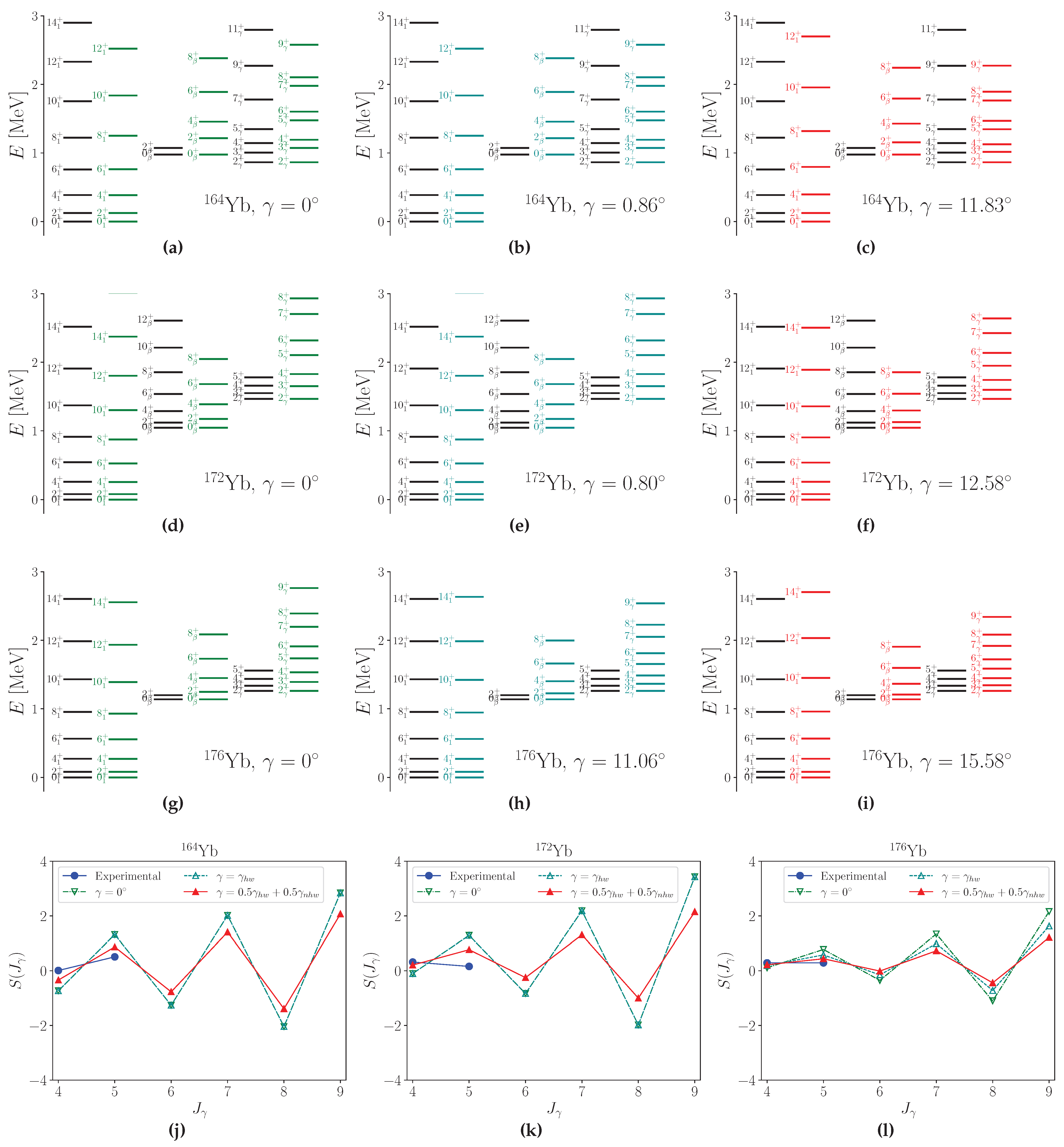
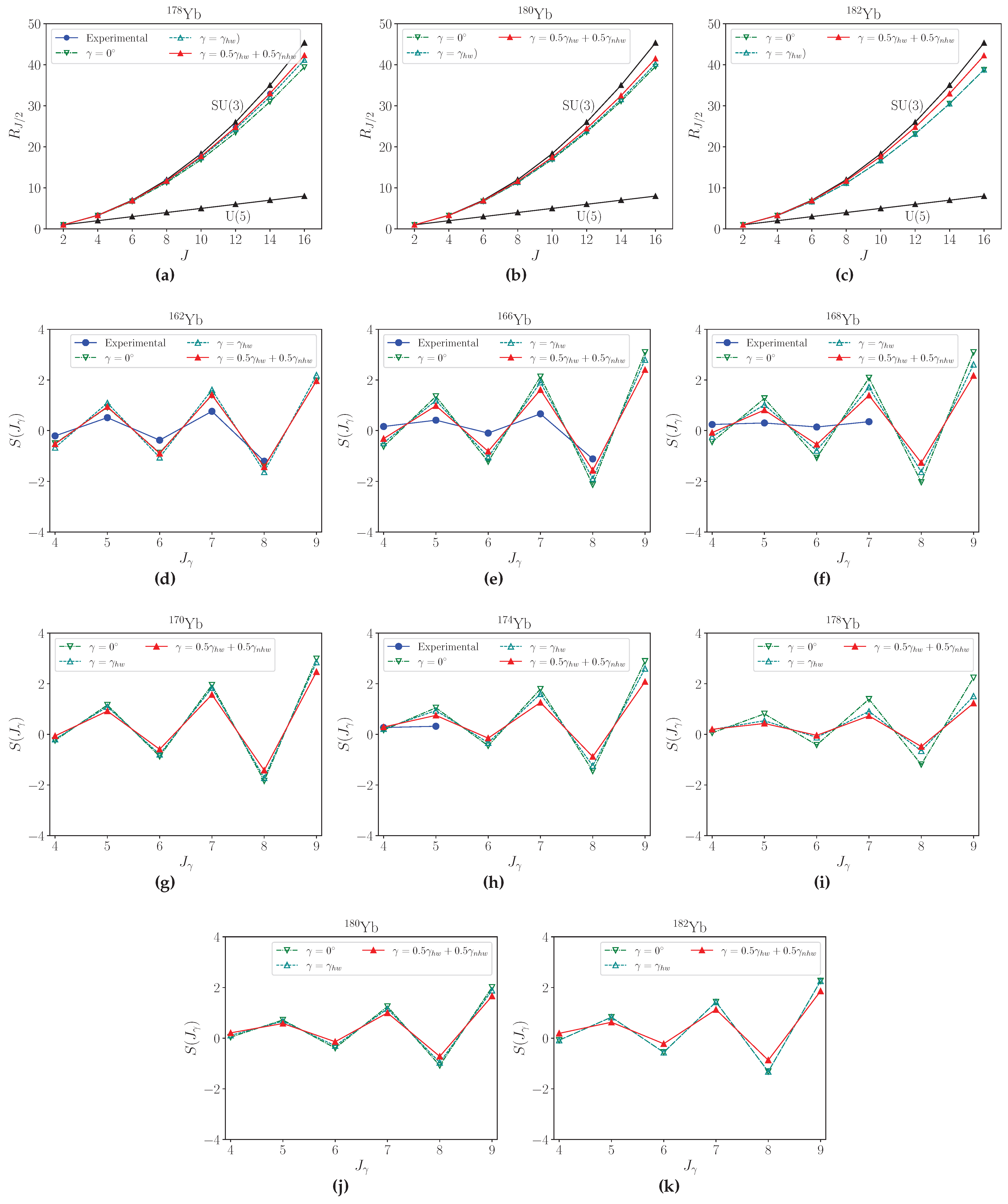
S ( J γ ) measures the displacement of the ( J 1 ) γ + level, relative to the average of J γ + and ( J 2 ) γ + , normalized to the E ( 2 1 + ) energy of the first excited gsb level. Its discrete (derivative) form makes S ( J γ ) particularly sensitive to changes in structure. In the framework of collective models, it has been used as a means to distinguish between rigid and soft triaxial nuclear shapes, with the former being associated with odd-J-down and the latter with even-J-down patterns [5,80,81]. The results for S ( J γ ) are plotted for 162–182Yb in Figure 4j–l and Figure 5d–k.

3.2.2. β Bands

Regarding the K = 0 2 + excited bands, typically associated with the β bands in the rare-earth mass region [82], these are formed by the 0 2 + , 2 3 + , 4 3 + , 6 3 + , and 8 3 + calculated states. As can be seen by the comparison of Figure 3g–i, the inclusion of proxy-SU(3) hw irreps does not significantly alter the characteristics of these bands. This is to be expected, since in both the SU(3) DS limit of IBM-1 and the proxy-SU(3) symmetry scheme, the bands built upon the K = 0 2 + states belong in irreps separate from the gs irrep. More specifically, the relevant irreps are ( 2 N B 4 , 2 ) and the proxy-SU(3) nhw irrep, respectively.
The inclusion of the nhw irreps of proxy-SU(3) in the triaxial calculations is necessary for the description of the β bands, and, as is seen in Figure 3g–i, it leads to a substantially improved description of these bands.

3.2.3. 164,172,182Yb94,102,112

At this point, we shall address in more detail the cases of 164,172,182Yb. For these isotopes, the proxy-SU(3) hw irreps are fully symmetric both for protons and for neutrons. Thus the stretched hw irreps, used in the determination of γ h w , are also fully symmetric [these irreps are (56, 0), (60, 0), and (50, 0) for Yb 94 70 164 , Yb 102 70 172 , and Yb 112 70 182 , respectively].
Consequently, the predicted γ h w values are very close to 0 ° ; therefore, the determined IBM-1 Hamiltonian parameters, and, by extension, the calculated spectra, are indistinguishable between the γ = 0 ° and γ = γ h w cases (see Table 1 and Figure 3 and Figure 4).
To achieve a good description of the low-lying collective quadrupole bands in these nuclei, the inclusion of proxy-SU(3) nhw irreps is most essential. Since these nuclei possess μ = 0 , the corresponding proxy-SU(3) hw irreps cannot accommodate the γ bands (see earlier discussion in Section 1, and Ref. [46]), which are pushed to the next-highest-weight irrep, where the β bands (built upon the K = 0 2 + level) reside. This is closer to the bosonic picture of the SU(3) DS of the IBM-1 framework, for which the gsb sits in the hw irrep, ( 2 N B , 0 ) , while the β and γ bands are contained in the nhw irrep, ( 2 N B 4 , 2 ) .
The incorporation of the nhw irreps of proxy-SU(3) in the calculations is expected to lead to a significantly improved agreement with the experiment for these bands, a fact corroborated by Figure 3, Figure 4 and Figure 5. From these figures, one can see that 164,172,182Yb present the largest simultaneous improvement in their γ and β bands, owing to the fact that these bands are both fully contained in the corresponding nhw proxy-SU(3) irreps, which are included on equal footing in the calculations [see Equation (6)]. This is illustrated in Figure 4, where level schemes and S ( J γ ) staggering parameters are shown for 164,172Yb ( μ = 0 ), together with 176Yb ( μ 0 ), shown for comparison.

3.3. E2 Transitions

For the calculation of the B ( E 2 ) transition strengths, we make use of the T ^ ( E 2 ) electric quadrupole transition operator, defined in the consistent-Q formalism as [78]
T ^ ( E 2 ) = e B Q ^ χ · Q ^ χ ,
where Q ^ χ is the quadrupole boson creation operator of Equation (1), and e B is an effective charge. In conventional IBM-1 calculations, e B is determined through fits to experimental B ( E 2 ) data (see, e.g., [70,79,83,84,85,86]). In our previous work on Er isotopes [48], we eliminated the need for effective charges by directly equating the B ( E 2 ; 0 1 + 2 1 + ) values of the EDF-IBM model to the ones resulting from the mean-field calculations. The latter were determined in the framework of the nuclear collective model as [67,71]
B ( E 2 ; 0 1 + 2 1 + ) = 3 Z e R 0 2 4 π β + 1 8 5 π β 2 2 ,
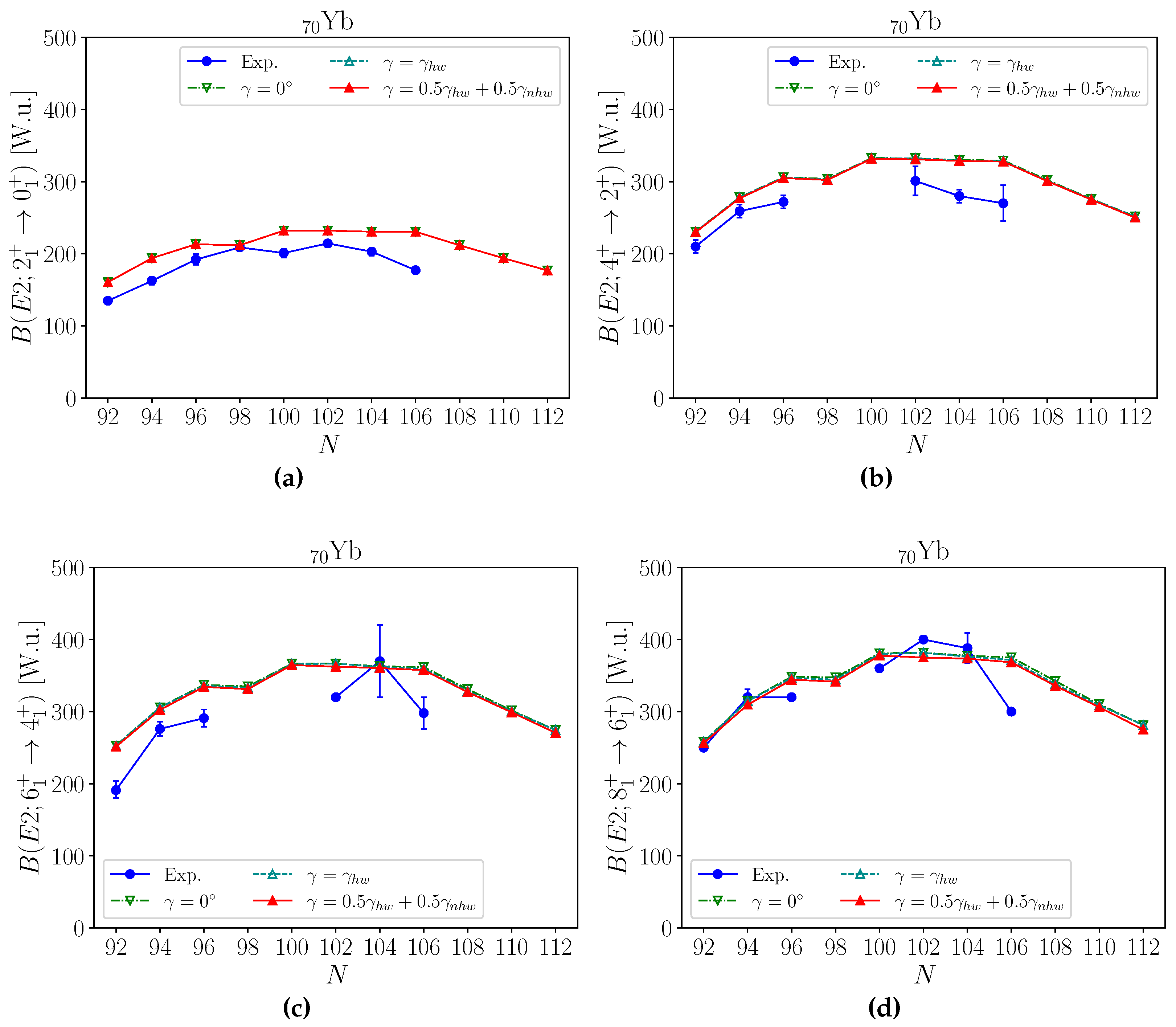
where β = β F m i n , the minimum of the mean-field PEC, Z is the atomic number of the nucleus, and R 0 is the nuclear radius. The same approach was adopted in the present work to calculate the B ( E 2 ) values for some “key” intraband (Figure 6) and interband (Figure 7) transitions in 162–182Yb, to be discussed in more detail in the subsequent sections.

3.3.1. g g

We begin our discussion of the B ( E 2 ) results by examining the B ( E 2 ; J g J g 2 ) gsb transitions ( g g ), plotted in Figure 6a–d, together with available experimental data [59,60,61].
These quantities exhibit similar sensitivity to C β to the inclusion of triaxial deformation, with differences among γ = γ I , I I , I I I starting to become noticeable with increasing spin [Figure 6c,d]. An overall good agreement with experimental data is seen in all of the cases. As in the case of the Hf, W [47], and Er [48] isotopes, the experimentally observed pre-midshell saturation of B ( E 2 ) gsb transition strengths [87,88] in Yb is well reproduced by the calculations, with slight displacements of the theoretically calculated minimum from the experimental one being owed to the particular EDF choice [see also Figure 3a in [47] and Figure 7a in [48], along with the relevant discussions].

3.3.2. γ g

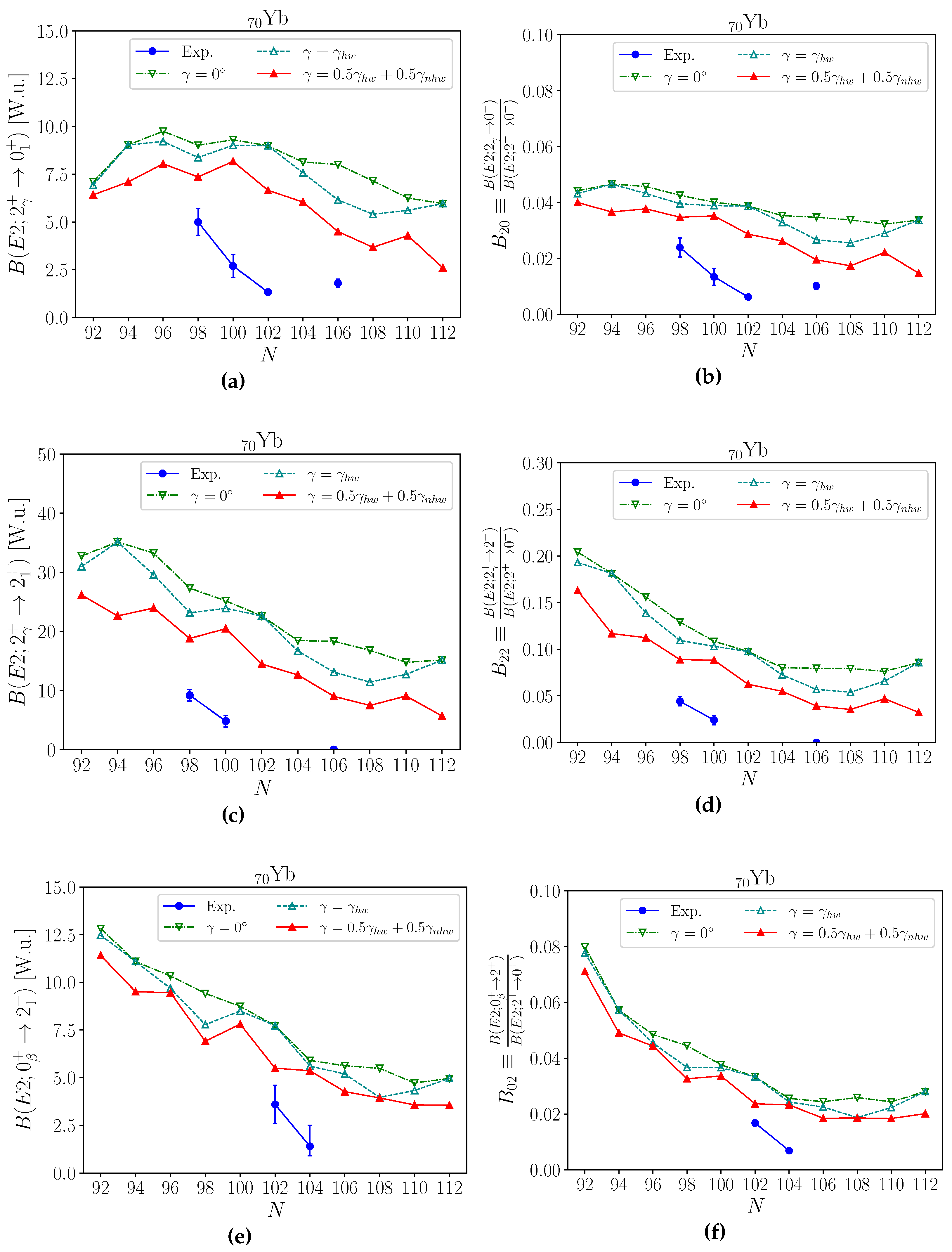
The significance of triaxiality for the reproduction of interband transitions connecting the γ band to the gs band ( γ g ) becomes evident as one examines Figure 7a–d, showing results for the 2 γ + 0 1 + [panels a,b] and 2 γ + 2 1 + [panels c,d] interband transitions, connecting the γ bandhead to the 0 1 + ground state and the 2 1 + first excited state.
Again, the inclusion of γ h w , stemming from the proxy-SU(3) irreps, leads to a lowering of the B ( E 2 ; J γ J g ) values, bringing them closer to the experimental ones. However, since Yb isotopes are characterized by the symmetric proton hw irrep ( 20 , 0 ) , the impact of γ h w on the calculations is not as significant as on their Er neighbors, possessing the proton hw irrep ( 18 , 6 ) . For the μ n = 0 cases ( N = 94 , 102 , 112 ), the γ h w 0 ° calculations are indistinguishable from the axially symmetric ones (see earlier discussion in Section 3.2.3).
With the incorporation of proxy-SU(3) nhw irreps, the theoretical predictions are substantially improved, both on a qualitative and on a quantitative level. The oscillating pattern caused by the fully symmetric proxy-SU(3) hw irreps is now eliminated, while at the same time, the B ( E 2 ) values are lowered, in improved agreement with the available experimental data.

3.3.3. β g

In addition to the γ g transitions, the inclusion of triaxial deformation has a significant impact on the interband transitions connecting the β bandhead to the ground state ( β g ). As seen in Figure 7e,f, the calculations with γ = γ h w lead to an initial lowering of the B ( E 2 ) values, further enhanced with the incorporation of proxy-SU(3) nhw irreps. As in the case of γ g transitions, the oscillating pattern (local maxima at N = 94 , 102 , 112 ) appearing when only hw proxy-SU(3) irreps are considered is eliminated.
The lack of available experimental data on B ( E 2 ; 0 β + 2 1 + ) transition strengths for the even–even Yb isotopes prevents a clear comparison between theoretical and experimental trends for these quantities. This fact highlights the need for current and future experimental endeavors focused on the study of the β bands and the measurement of β g transition strengths in these isotopes. These can in turn provide insight into the mixing of the corresponding proxy-SU(3) irreps, paving the way for more refined future calculations.
In concluding this subsection, it should be noted that interband B(E2) transition strengths are particularly sensitive to the IBM-1 Hamiltonian parameter inputs, with slight variations resulting in large shifts in the predicted values for these quantities. This fact further highlights the good level of agreement achieved between the calculations performed in the present work and available experimental data (see Figure 7), which is on par with the level of agreement with the experiment achieved within the framework of the highly sophisticated, state-of-the-art Monte Carlo shell model, to be further discussed in the following section.

3.4. Comparison with Monte Carlo Shell Model Predictions

The prevalence of triaxial shapes in a series of mid-heavy nuclei was recently showcased in the framework of the state-of-the-art Monte Carlo shell model (MCSM) [4,6]. In the recent work of Otsuka et al. [6], MCSM calculations were carried out, demonstrating the presence of triaxiality in a number of well-deformed rare-earth nuclei—traditionally considered to be axially symmetric rotors—with 164Yb94 and 168Yb98 being among them.
For 168Yb, the MCSM calculations of [6] yield nonzero γ deformation values of 4 . 5 ° and 6 . 0 ° for the ground and γ bands, respectively. These values lie close to each other, a fact indicating similarities in the structure of the bands. This aligns well with the proxy-SU(3) picture, where such similarities are expressed through the fact that the ground and γ bands both belong to the same proxy-SU(3) irrep, possessing a nonzero γ deformation value of 7 . 45 ° . Both the MCSM calculations and the proxy-SU(3) hw irrep predictions underestimate the γ deformation, as can be seen by a comparison with the corresponding experimental (empirical) value, calculated through the well-known relation [1,29,67]
sin ( 3 γ ) = 3 2 2 1 R 1 R + 1 2 ,
where R E ( 2 γ + ) / E ( 2 1 + ) . This underestimation is amended with the incorporation of nhw proxy-SU(3), bringing the predicted γ deformation value into excellent agreement with the corresponding experimental one for 168Yb.
Regarding 164Yb, the MCSM predicts γ deformations of 8 . 7 ° and 14 . 2 ° for its ground and γ bands, respectively. These values are further apart compared to the case of 164Yb, indicating larger differences in the structure of these bands. This is, again, in good agreement with the proxy-SU(3) picture, where, for 164Yb ( N = 94 ), the proxy-SU(3) hw irrep is fully symmetric ( μ = 0 ), and thus the γ band is pushed to the nhw irrep, possessing a different band structure. The inclusion of the nhw proxy-SU(3) irrep in the calculations drastically increases the predicted γ deformation for this nucleus, bringing it into good agreement with experimental observations and MCSM predictions.
Overall, the calculations performed in this work align well with the highly sophisticated and time-demanding MCSM calculations of [6], converging to pictures of 164,168Yb as γ -soft rotors, with slight triaxiality in the range of ∼5°–15°. The experimental γ deformation values, along with the available B ( E 2 ) intra- and interband transitions in 164,168Yb, are tabulated in Table 2 along with the MCSM predictions and the calculations performed in this work (see also discussion in Section 3.3).

4. Summary and Outlook

Keeping up with the latest advances in the proxy-SU(3) framework, a first attempt was made to utilize next-highest-weight proxy-SU(3) irreps for the purpose of incorporating triaxiality within the standard IBM-1 framework, where only one- and two-body terms are included.
Expanding upon the method introduced in [47,48], γ deformation values were derived from the proxy-SU(3) irreps for a series of even–even members of the Yb isotopic chain. The origin of these deformations is microscopic, emerging as a consequence of the Pauli principle and the short-range nature of the nucleon–nucleon interaction. They were incorporated into the IBM-1 potential energy curves, and subsequently fitted to microscopic ones, resulting from self-consistent mean-field calculations employing a Skyrme EDF [54], for the derivation of the IBM-1 Hamiltonian parameters. The IBAR [78] IBM-1 code was then used for the calculation of energy spectra and B ( E 2 ) transition strengths.
As in the case of their Er [48], Hf, and W [47] neighbors, it is shown that the inclusion of a triaxial deformation, stemming from the use of proxy-SU(3) hw irreps, leads to improved agreement between the calculated and experimental energies and transition strengths, as compared with the axially symmetric case. Furthermore, the inclusion of nhw proxy-SU(3) irreps in the calculations results in the amendment of the discrepancies arising when only hw proxy-SU(3) irreps are considered. The oscillating patterns of the γ deformation values, presenting deep minima for the cases of fully symmetric neutron hw irreps, are eliminated, while, at the same time, there is an overall increase in the predicted triaxiality values, bringing them into good agreement with available experimental data [59,60].
In addition, the incorporation of nhw proxy-SU(3) irreps in the calculations allows us to extend our studies to the β bands, and examine the influence of triaxial deformation in their structure. Again, a significantly improved agreement with the experiment was observed for the energies and the B ( E 2 ; 0 β + 2 1 + ) interband transition strengths when nhw proxy-SU(3) irreps were included in the calculations.
The results of this work were also compatible with state-of-the-art Monte Carlo shell model (MCSM) calculations, available for 164Yb94 and 168Yb98, showing good agreement. Given their relative simplicity and lower computational burden, the calculations carried out in this work can provide a reference point for more sophisticated and computationally demanding shell model approaches, as one performs a systematic examination of the nuclear structure evolution across extended isotopic chains.
Along these lines, new theoretical predictions are given for the gsb energy ratios, γ band staggering, and B ( E 2 ) transition strengths in 180,182Yb, for which no experimental data are currently available in [59,60]. Given their proximity to the neutron dripline, these predictions can serve as guides in future experimental efforts in these neutron-rich mass regions.
Overall, the results presented in this work add to an increasing number of theoretical as well as experimental findings pointing toward the preponderance of triaxiality over extended regions of the nuclear landscape. Going forward, calculations involving proxy-SU(3) nhw irreps will be extended to other rare-earth nuclei, in an effort to firmly establish the prevalence of triaxiality in other nuclear chart regimes.

Author Contributions

Conceptualization, P.V., T.J.M. and D.B.; methodology, P.V., T.J.M. and D.B.; software, P.V.; validation, P.V., T.J.M. and D.B.; formal analysis, P.V.; investigation, P.V.; writing—original draft preparation, P.V., T.J.M. and D.B.; writing—review and editing, P.V., T.J.M. and D.B.; visualization, P.V. All authors have read and agreed to the published version of the manuscript.

Funding

This research received no external funding.

Data Availability Statement

This manuscript has associated data in a data repository [authors’ comment: bibliographic data in this work have been retrieved from the National Nuclear Data Center (NNDC) at https://www.nndc.bnl.gov/ (accessed on 5 November 2025)].

Conflicts of Interest

The authors declare no conflicts of interest. The funders had no role in the design of the study; in the collection, analysis, or interpretation of data; in the writing of the manuscript; or in the decision to publish the results.

Abbreviations

The following abbreviations are used in this manuscript:
irrepsirreducible representations
PSMprojected shell model
TPSMtriaxial projected shell model
MCSMMonte Carlo shell model
hwhighest weight
nhwnext highest weight
IBMinteracting boson model
DSdynamical symmetry
SCMFself-consistent mean field
PESpotential energy surface
PECpotential energy curve
HF+BCSHartree–Fock+Bardeen–Cooper–Schrieffer
CQFconsistent-Q formalism

References

  1. Davydov, A.S.; Filippov, G.F. Rotational states in even atomic nuclei. Nucl. Phys. 1958, 8, 237–249. [Google Scholar] [CrossRef]
  2. Davydov, A.S.; Rostovsky, V.S. Relative transition probabilities between rotational levels of non-axial nuclei. Nucl. Phys. 1959, 12, 58–68. [Google Scholar] [CrossRef]
  3. Meyer-ter-Vehn, J. Collective model description of transitional odd-A nuclei: (I). The triaxial-rotor-plus-particle model. Nucl. Phys. A 1975, 249, 111–140. [Google Scholar] [CrossRef]
  4. Tsunoda, Y.; Otsuka, T. Triaxial rigidity of 166Er and its Bohr-model realization. Phys. Rev. C 2021, 103, L021303. [Google Scholar] [CrossRef]
  5. Rouoof, S.; Nazir, N.; Jehangir, S.; Bhat, G.H.; Sheikh, J.A.; Rather, N.; Frauendorf, S. Fingerprints of the triaxial deformation from energies and B(E2) transition probabilities of γ-bands in transitional and deformed nuclei. Eur. Phys. J. A 2024, 60, 40. [Google Scholar] [CrossRef]
  6. Otsuka, T.; Tsunoda, Y.; Shimizu, N.; Utsuno, Y.; Ueno, H. Prevailing triaxial shapes in atomic nuclei and a quantum theory of rotation of composite objects. Eur. Phys. J. A 2025, 61, 126. [Google Scholar] [CrossRef]
  7. Bonatsos, D.; Martinou, A.; Peroulis, S.K.; Petrellis, D.; Vasileiou, P.; Mertzimekis, T.J.; Minkov, N. Preponderance of triaxial shapes in atomic nuclei predicted by the proxy-SU(3) symmetry. J. Phys. G Nucl. Part. Phys. 2025, 52, 015102. [Google Scholar] [CrossRef]
  8. Bonatsos, D.; Martinou, A.; Peroulis, S.K.; Petrellis, D.; Vasileiou, P.; Mertzimekis, T.J.; Minkov, N. Triaxial Shapes in Even-Even Nuclei: A Theoretical Overview. Atoms 2025, 13, 47. [Google Scholar] [CrossRef]
  9. Mayer, M.G.; Jensen, J.H.D. Elementary Theory of Nuclear Shell Structure; Wiley: New York, NY, USA, 1955. [Google Scholar]
  10. Heyde, K.L.G. The Nuclear Shell Model; Springer: Berlin, Germany, 1990. [Google Scholar]
  11. Talmi, I. Simple Models of Complex Nuclei: The Shell Model and the Interacting Boson Model; Harwood: Chur, Switzerland, 1993. [Google Scholar]
  12. Shimizu, N. Recent Progress of Shell-Model Calculations, Monte Carlo Shell Model, and Quasi-Particle Vacua Shell Model. Physics 2022, 4, 1081–1093. [Google Scholar] [CrossRef]
  13. Nilsson, S.G. Binding states of individual nucleons in strongly deformed nuclei. Dan. Mat. Fys. Medd. 1955, 29, 16. [Google Scholar]
  14. Hara, K.; Sun, Y. Projected Shell Model and High-Spin Spectroscopy. Int. J. Mod. Phys. E 1995, 4, 637–785. [Google Scholar] [CrossRef]
  15. Sheikh, J.A.; Hara, K. Triaxial Projected Shell Model Approach. Phys. Rev. Lett. 1999, 82, 3968–3971. [Google Scholar] [CrossRef]
  16. Elliott, J.P. Collective motion in the nuclear shell model. I. Classification schemes for states of mixed configurations. Proc. R. Soc. Lond. Ser. A Math. Phys. Sci. 1958, 245, 128–145. [Google Scholar] [CrossRef]
  17. Elliott, J.P. Collective motion in the nuclear shell model II. The introduction of intrinsic wave-functions. Proc. R. Soc. Lond. Ser. A Math. Phys. Sci. 1958, 245, 562–581. [Google Scholar] [CrossRef]
  18. Elliott, J.P.; Harvey, M. Collective motion in the nuclear shell model III. The calculation of spectra. Proc. R. Soc. Lond. Ser. A Math. Phys. Sci. 1963, 272, 557–577. [Google Scholar] [CrossRef]
  19. Castaños, O.; Draayer, J.P.; Leschber, Y. Shape variables and the shell model. Z. Phys. A 1988, 329, 33. [Google Scholar]
  20. Draayer, J.P.; Park, S.C.; Castaños, O. Shell-Model Interpretation of the Collective-Model Potential-Energy Surface. Phys. Rev. Lett. 1989, 62, 20–23. [Google Scholar] [CrossRef]
  21. Wybourne, B.G. Classical Groups for Physicists; Wiley: New York, NY, USA, 1974. [Google Scholar]
  22. Moshinsky, M.; Smirnov, Y.F. The Harmonic Oscillator in Modern Physics; Harwood: Amsterdam, The Netherlands, 1996. [Google Scholar]
  23. Raju, R.; Draayer, J.; Hecht, K. Search for a coupling scheme in heavy deformed nuclei: The pseudo SU(3) model. Nucl. Phys. A 1973, 202, 433–466. [Google Scholar] [CrossRef]
  24. Draayer, J.P.; Weeks, K.J. Shell-Model Description of the Low-Energy Structure of Strongly Deformed Nuclei. Phys. Rev. Lett. 1983, 51, 1422–1425. [Google Scholar] [CrossRef]
  25. Draayer, J.; Weeks, K. Towards a shell model description of the low-energy structure of deformed nuclei I. Even-even systems. Ann. Phys. 1984, 156, 41–67. [Google Scholar] [CrossRef]
  26. Zuker, A.P.; Poves, A.; Nowacki, F.; Lenzi, S.M. Nilsson-SU3 self-consistency in heavy N=Z nuclei. Phys. Rev. C 2015, 92, 024320. [Google Scholar] [CrossRef]
  27. Zuker, A.P.; Retamosa, J.; Poves, A.; Caurier, E. Spherical shell model description of rotational motion. Phys. Rev. C 1995, 52, R1741–R1745. [Google Scholar] [CrossRef] [PubMed]
  28. Bonatsos, D.; Assimakis, I.E.; Minkov, N.; Martinou, A.; Cakirli, R.B.; Casten, R.F.; Blaum, K. Proxy-SU(3) symmetry in heavy deformed nuclei. Phys. Rev. C 2017, 95, 064325. [Google Scholar] [CrossRef]
  29. Bonatsos, D.; Assimakis, I.E.; Minkov, N.; Martinou, A.; Sarantopoulou, S.; Cakirli, R.B.; Casten, R.F.; Blaum, K. Analytic predictions for nuclear shapes, prolate dominance, and the prolate-oblate shape transition in the proxy-SU(3) model. Phys. Rev. C 2017, 95, 064326. [Google Scholar] [CrossRef]
  30. Bonatsos, D.; Martinou, A.; Peroulis, S.K.; Mertzimekis, T.J.; Minkov, N. The Proxy-SU(3) Symmetry in Atomic Nuclei. Symmetry 2023, 15, 169. [Google Scholar] [CrossRef]
  31. Elliott, J.P.; Wilsdon, C.E. Collective motion in the nuclear shell model IV. Odd-mass nuclei in the sd shell. Proc. R. Soc. Lond. Ser. A Math. Phys. Sci. 1968, 302, 509–528. [Google Scholar] [CrossRef]
  32. Martinou, A.; Bonatsos, D.; Mertzimekis, T.J.; Karakatsanis, K.E.; Assimakis, I.E.; Peroulis, S.K.; Sarantopoulou, S.; Minkov, N. The islands of shape coexistence within the Elliott and the proxy-SU(3) Models. Eur. Phys. J. A 2021, 57, 84. [Google Scholar] [CrossRef]
  33. Martinou, A.; Bonatsos, D.; Karakatsanis, K.E.; Sarantopoulou, S.; Assimakis, I.E.; Peroulis, S.K.; Minkov, N. Why nuclear forces favor the highest weight irreducible representations of the fermionic SU(3) symmetry. Eur. Phys. J. A 2021, 57, 83. [Google Scholar] [CrossRef]
  34. Iachello, F.; Arima, A. The Interacting Boson Model; Cambridge Monographs on Mathematical Physics; Cambridge University Press: Cambridge, UK, 1987. [Google Scholar]
  35. Arima, A.; Iachello, F. Interacting boson model of collective nuclear states II. The rotational limit. Ann. Phys. 1978, 111, 201–238. [Google Scholar] [CrossRef]
  36. Arima, A.; Iachello, F. Interacting boson model of collective states I. The vibrational limit. Ann. Phys. 1976, 99, 253–317. [Google Scholar] [CrossRef]
  37. Arima, A.; Iachello, F. Interacting boson model of collective nuclear states IV. The O(6) limit. Ann. Phys. 1979, 123, 468–492. [Google Scholar] [CrossRef]
  38. Van Isacker, P.; Chen, J.Q. Classical limit of the interacting boson Hamiltonian. Phys. Rev. C 1981, 24, 684–689. [Google Scholar] [CrossRef]
  39. Heyde, K.; Van Isacker, P.; Waroquier, M.; Moreau, J. Triaxial shapes in the interacting boson model. Phys. Rev. C 1984, 29, 1420–1427. [Google Scholar] [CrossRef]
  40. Thiamova, G. The IBM description of triaxial nuclei. Eur. Phys. J. A 2010, 45, 81–90. [Google Scholar] [CrossRef]
  41. Zhang, Y.; Pan, F.; Dai, L.R.; Draayer, J.P. Triaxial rotor in the SU(3) limit of the interacting boson model. Phys. Rev. C 2014, 90, 044310. [Google Scholar] [CrossRef]
  42. Zhang, Y.; He, Y.W.; Karlsson, D.; Qi, C.; Pan, F.; Draayer, J. A theoretical interpretation of the anomalous reduced E2 transition probabilities along the yrast line of neutron-deficient nuclei. Phys. Lett. B 2022, 834, 137443. [Google Scholar] [CrossRef]
  43. Dieperink, A.E.L.; Bijker, R. On triaxial features in the neutron-proton IBA. Phys. Lett. B 1982, 116, 77–81. [Google Scholar] [CrossRef]
  44. Walet, N.R.; Brussaard, P.J. A study of the SU(3)* limit of IBM-2. Nucl. Phys. A 1987, 474, 61–76. [Google Scholar] [CrossRef]
  45. Sevrin, A.; Heyde, K.; Jolie, J. Triaxiality in the proton-neutron interacting boson model: Systematic study of perturbations in the SU/emph> (3) limit. Phys. Rev. C 1987, 36, 2621–2630. [Google Scholar] [CrossRef]
  46. Bonatsos, D.; Martinou, A.; Peroulis, S.K.; Petrellis, D.; Vasileiou, P.; Mertzimekis, T.J.; Minkov, N. Robustness of the Proxy-SU(3) Symmetry in Atomic Nuclei and the Role of the Next-Highest-Weight Irreducible Representation. Symmetry 2024, 16, 1625. [Google Scholar] [CrossRef]
  47. Vasileiou, P.; Bonatsos, D.; Mertzimekis, T.J. Mean-field-derived IBM-1 Hamiltonian with intrinsic triaxial deformation. Phys. Rev. C 2024, 110, 014313. [Google Scholar] [CrossRef]
  48. Vasileiou, P.; Bonatsos, D.; Mertzimekis, T.J. Triaxiality in Er isotopes in the framework of IBM-1. Phys. Scr. 2025, 100, 055306. [Google Scholar] [CrossRef]
  49. Ginocchio, J.N.; Kirson, M.W. Relationship between the Bohr Collective Hamiltonian and the Interacting-Boson Model. Phys. Rev. Lett. 1980, 44, 1744–1747. [Google Scholar] [CrossRef]
  50. Dieperink, A.E.L.; Scholten, O.; Iachello, F. Classical Limit of the Interacting-Boson Model. Phys. Rev. Lett. 1980, 44, 1747–1750. [Google Scholar] [CrossRef]
  51. Nomura, K.; Shimizu, N.; Otsuka, T. Mean-Field Derivation of the Interacting Boson Model Hamiltonian and Exotic Nuclei. Phys. Rev. Lett. 2008, 101, 142501. [Google Scholar] [CrossRef]
  52. Nomura, K.; Shimizu, N.; Otsuka, T. Formulating the interacting boson model by mean-field methods. Phys. Rev. C 2010, 81, 044307. [Google Scholar] [CrossRef]
  53. Nomura, K.; Otsuka, T.; Shimizu, N.; Guo, L. Microscopic formulation of the interacting boson model for rotational nuclei. Phys. Rev. C 2011, 83, 041302(R). [Google Scholar] [CrossRef]
  54. Reinhard, P.G.; Schuetrumpf, B.; Maruhn, J. The Axial Hartree–Fock + BCS Code SkyAx. Comput. Phys. Commun. 2021, 258, 107603. [Google Scholar] [CrossRef]
  55. Goriely, S.; Hilaire, S.; Girod, M.; Péru, S. First Gogny-Hartree-Fock-Bogoliubov Nuclear Mass Model. Phys. Rev. Lett. 2009, 102, 242501. [Google Scholar] [CrossRef] [PubMed]
  56. Hartree–Fock–Bogoliubov Results Based on the Gogny Force. 2006. Available online: https://www-phynu.cea.fr/science_en_ligne/carte_potentiels_microscopiques/carte_potentiel_nucleaire_eng.htm (accessed on 5 November 2025).
  57. HFB+5DCH Results. 2006. Available online: https://www-phynu.cea.fr/science_en_ligne/carte_potentiels_microscopiques/tables/HFB-5DCH-table_eng.htm (accessed on 5 November 2025).
  58. Yang, X.Q.; Wang, L.J.; Xiang, J.; Wu, X.Y.; Li, Z.P. Microscopic analysis of prolate-oblate shape phase transition and shape coexistence in the Er-Pt region. Phys. Rev. C 2021, 103, 054321. [Google Scholar] [CrossRef]
  59. National Nuclear Data Center. Available online: https://www.nndc.bnl.gov/nudat3 (accessed on 5 November 2025).
  60. ENSDF. Available online: https://www.nndc.bnl.gov/ensdf (accessed on 5 November 2025).
  61. Pritychenko, B.; Birch, M.; Singh, B.; Horoi, M. Tables of E2 transition probabilities from the first 2+ states in even–even nuclei. At. Data Nucl. Data Tables 2016, 107, 1–139. [Google Scholar] [CrossRef]
  62. Klüpfel, P.; Reinhard, P.G.; Bürvenich, T.J.; Maruhn, J.A. Variations on a theme by Skyrme: A systematic study of adjustments of model parameters. Phys. Rev. C 2009, 79, 034310. [Google Scholar] [CrossRef]
  63. Warner, D.D.; Casten, R.F. Revised Formulation of the Phenomenological Interacting Boson Approximation. Phys. Rev. Lett. 1982, 48, 1385–1389. [Google Scholar] [CrossRef]
  64. Warner, D.D.; Casten, R.F. Predictions of the interacting boson approximation in a consistent Q framework. Phys. Rev. C 1983, 28, 1798–1806. [Google Scholar] [CrossRef]
  65. Zamfir, N.V.; von Brentano, P.; Casten, R.F.; Jolie, J. Test of two-level crossing at the N=90 spherical-deformed critical point. Phys. Rev. C 2002, 66, 021304(R). [Google Scholar] [CrossRef]
  66. Werner, V.; von Brentano, P.; Casten, R.; Scholl, C.; McCutchan, E.; Krücken, R.; Jolie, J. Alternative interpretation of E0 strengths in transitional regions. Eur. Phys. J. A 2005, 25, 455–456. [Google Scholar] [CrossRef]
  67. Casten, R.F. Nuclear Structure from a Simple Perspective; Oxford University Press: Oxford, UK, 2000. [Google Scholar]
  68. Feng, D.H.; Gilmore, R.; Deans, S.R. Phase transitions and the geometric properties of the interacting boson model. Phys. Rev. C 1981, 23, 1254–1258. [Google Scholar] [CrossRef]
  69. Iachello, F.; Zamfir, N.V.; Casten, R.F. Phase Coexistence in Transitional Nuclei and the Interacting-Boson Model. Phys. Rev. Lett. 1998, 81, 1191–1194. [Google Scholar] [CrossRef]
  70. McCutchan, E.A.; Bonatsos, D.; Zamfir, N.V. Connecting the X(5)-β2, X(5)-β4, and X(3) models to the shape/phase-transition region of the interacting boson model. Phys. Rev. C 2006, 74, 034306. [Google Scholar] [CrossRef]
  71. Bohr, A.; Mottelson, B.R. Nuclear Structure; Vol. II: Nuclear Deformations; World Scientific Publishing: Singapore, 1998. [Google Scholar]
  72. Ginocchio, J.; Kirson, M. An intrinsic state for the interacting boson model and its relationship to the Bohr-Mottelson model. Nucl. Phys. A 1980, 350, 31–60. [Google Scholar] [CrossRef]
  73. Jolos, R.V.; von Brentano, P.; Pietralla, N. Generalized Grodzins relation. Phys. Rev. C 2005, 71, 044305. [Google Scholar] [CrossRef]
  74. Jolos, R.V.; von Brentano, P.; Dewald, A.; Pietralla, N. Spin dependence of intrinsic and transition quadrupole moments. Phys. Rev. C 2005, 72, 024310. [Google Scholar] [CrossRef]
  75. Jolos, R.V.; von Brentano, P. Mass coefficient and Grodzins relation for the ground-state band and γ band. Phys. Rev. C 2006, 74, 064307. [Google Scholar] [CrossRef]
  76. Jolos, R.V.; von Brentano, P. Bohr Hamiltonian with different mass coefficients for the ground- and γ bands from experimental data. Phys. Rev. C 2007, 76, 024309. [Google Scholar] [CrossRef]
  77. Jolos, R.; Kolganova, E. Derivation of the Grodzins relation in collective nuclear model. Phys. Lett. B 2021, 820, 136581. [Google Scholar] [CrossRef]
  78. Casperson, R. IBAR: Interacting boson model calculations for large system sizes. Comput. Phys. Commun. 2012, 183, 1029–1035. [Google Scholar] [CrossRef]
  79. Zyriliou, A.; Mertzimekis, T.J.; Chalil, A.; Vasileiou, P.; Mavrommatis, E.; Bonatsos, D.; Martinou, A.; Peroulis, S.; Minkov, N. A study of some aspects of the nuclear structure in the even–even Yb isotopes. Eur. Phys. J. Plus 2022, 137, 352. [Google Scholar] [CrossRef]
  80. Zamfir, N.V.; Casten, R.F. Signatures of γ softness or triaxiality in low energy nuclear spectra. Phys. Lett. B 1991, 260, 265–270. [Google Scholar] [CrossRef]
  81. McCutchan, E.A.; Bonatsos, D.; Zamfir, N.V.; Casten, R.F. Staggering in γ-band energies and the transition between different structural symmetries in nuclei. Phys. Rev. C 2007, 76, 024306. [Google Scholar] [CrossRef]
  82. Aprahamian, A.; Lee, K.; Lesher, S.; Bijker, R. The nature of 0+ excitations in deformed nuclei. Prog. Part. Nucl. Phys. 2025, 143, 104173. [Google Scholar] [CrossRef]
  83. McCutchan, E.A.; Zamfir, N.V.; Casten, R.F. Mapping the interacting boson approximation symmetry triangle: New trajectories of structural evolution of rare-earth nuclei. Phys. Rev. C 2004, 69, 064306. [Google Scholar] [CrossRef]
  84. McCutchan, E.A.; Zamfir, N.V. Simple description of light W, Os, and Pt nuclei in the interacting boson model. Phys. Rev. C 2005, 71, 054306. [Google Scholar] [CrossRef]
  85. McCutchan, E.A.; Casten, R.F.; Zamfir, N.V. Simple interpretation of shape evolution in Pt isotopes without intruder states. Phys. Rev. C 2005, 71, 061301(R). [Google Scholar] [CrossRef]
  86. Harter, A.; Knafla, L.; Frießner, G.; Häfner, G.; Jolie, J.; Blazhev, A.; Dewald, A.; Dunkel, F.; Esmaylzadeh, A.; Fransen, C.; et al. Lifetime measurements in the tungsten isotopes 176,178,180W. Phys. Rev. C 2022, 106, 024326. [Google Scholar] [CrossRef]
  87. Wiederhold, J.; Werner, V.; Kern, R.; Pietralla, N.; Bucurescu, D.; Carroll, R.; Cooper, N.; Daniel, T.; Filipescu, D.; Florea, N.; et al. Evolution of E2 strength in the rare-earth isotopes 174,176,178,180Hf. Phys. Rev. C 2019, 99, 024316. [Google Scholar] [CrossRef]
  88. Vasileiou, P.; Mertzimekis, T.J.; Mavrommatis, E.; Zyriliou, A. Nuclear Structure Investigations of Even–Even Hf Isotopes. Symmetry 2023, 15, 196. [Google Scholar] [CrossRef]
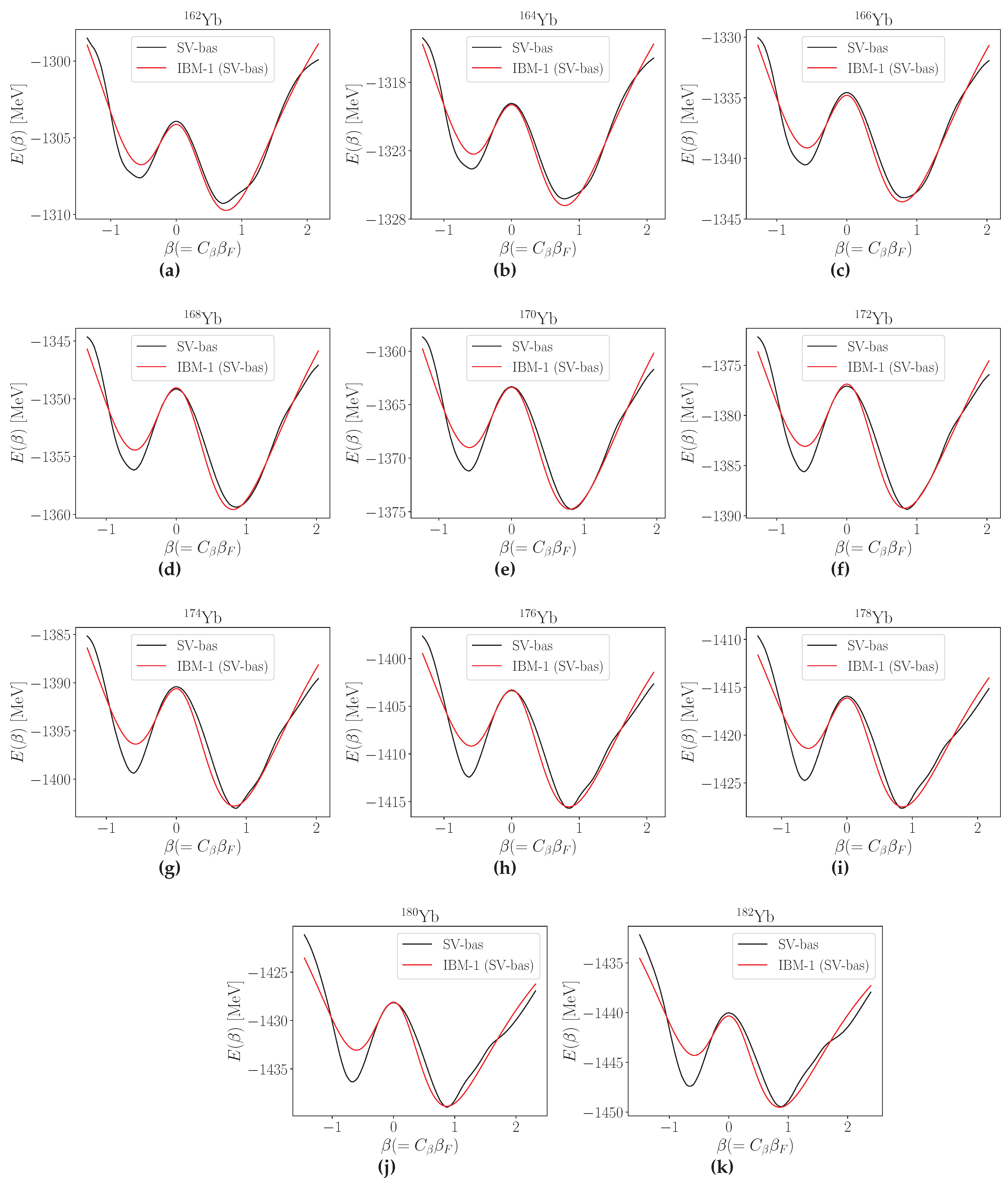
Figure 1. SV-bas EDF potential energy curves (black) vs. the corresponding IBM-1 ones (red) for 162–182Yb. The IBM-1 PECs resulted from the procedure outlined in Section 2, with the inclusion of proxy-SU(3) nhw irreps (see Section 2 for details).
Symmetry 17 02135 g001
Figure 2. IBM-1 Hamiltonian parameter systematics as functions of the neutron number, N. The experimental quadrupole deformation parameters are taken from [61].
Symmetry 17 02135 g002
Figure 3. Experimental (solid symbols) vs. theoretical (empty symbols connected by dashed lines) g.s., γ - and β -band energies for 162–178Yb.
Symmetry 17 02135 g003
Figure 4. (ai) Energy level schemes and (jl) S ( J γ ) γ -band staggering parameters for 164,172,176Yb ( N = 94 , 102 , 106 ) .
Symmetry 17 02135 g004
Figure 5. (ac) R J / 2 gsb energy ratios and (dk) S ( J γ ) γ -band staggering parameters for 162,166–170,178–182Yb.
Symmetry 17 02135 g005
Figure 6. B ( E 2 ; J g J g 2 ) transition strengths for 162–182Yb (see Section 3.3 for details).
Symmetry 17 02135 g006
Figure 7. B ( E 2 ) transition strengths and ratios for the γ g and β g transitions in 162–182Yb (see Section 3.3 for details).
Symmetry 17 02135 g007
Table 1. The parameters of the IBM-1 Hamiltonian of Equation (1), extracted from the mapping procedure outlined in Section 2. Tabulated are also the proportionality coefficients for β deformation, C β , the intrinsic γ deformation parameters, and the experimental (exp.) and calculated (th.) R 4 / 2 energy ratios.
Isotope N B χ ζ c [MeV] C β γ [deg] R 4 / 2 (exp.) R 4 / 2  (th.)
I. Axially symmetric ( γ = 0 ° )
162Yb11−0.4630.7702.2862.710.002.923.11
164Yb12−0.4230.7901.8152.620.003.133.11
166Yb13−0.4230.7901.6802.530.003.233.15
168Yb14−0.4500.7801.5822.440.003.273.19
170Yb15−0.4630.7801.6772.440.003.293.23
172Yb16−0.4630.7801.7002.440.003.313.25
174Yb17−0.4760.7901.8332.530.003.313.27
176Yb16−0.4890.8001.8832.620.003.313.27
178Yb15−0.5160.8001.8082.710.003.313.27
180Yb14−0.5420.8101.0002.890.003.27
182Yb13−0.5420.8101.0002.980.003.25
II. Triaxial, with proxy-SU(3) h.w. ( γ = γ h w )
162Yb11−0.4760.7702.1542.714.642.923.06
164Yb12−0.4230.7901.8152.620.863.133.11
166Yb13−0.4500.7901.7202.535.903.233.17
168Yb14−0.4760.7901.6552.537.453.273.22
170Yb15−0.4760.7801.6932.445.733.293.23
172Yb16−0.4630.7801.7002.440.803.313.25
174Yb17−0.5030.7901.8602.537.453.313.28
176Yb16−0.5950.7901.9432.6211.063.313.30
178Yb15−0.6090.8101.9202.8011.463.313.30
180Yb14−0.5820.8101.0002.898.313.28
182Yb13−0.5420.8101.0002.980.973.25
III. Triaxial, with proxy-SU(3) h.w. + n.h.w. ( γ = 0.5 γ h w + 0.5 γ n h w )
162Yb11−0.5160.7702.2352.719.532.923.11
164Yb12−0.5420.7801.9502.6211.833.133.19
166Yb13−0.5160.7801.7622.5310.393.233.21
168Yb14−0.5290.7901.7132.5311.853.273.25
170Yb15−0.5160.7801.7372.4410.043.293.25
172Yb16−0.5690.7901.8412.5312.583.313.29
174Yb17−0.5950.7801.9032.5311.853.313.30
176Yb16−0.7010.7902.0232.6215.583.313.31
178Yb15−0.7540.7901.9592.7116.133.313.31
180Yb14−0.6750.8101.0002.8913.173.30
182Yb13−0.8330.7901.0002.9816.553.31
Table 2. Comparison of the B ( E 2 ; 2 1 + 0 1 + ) and B ( E 2 ; 2 γ + 0 1 + ) transition strengths resulting from the calculations performed in this work (T.W.) to MCSM predictions (obtained from Figure 16 of [6]), as well as available experimental data [59,61] (see Section 3.3 and Section 3.4 for details). The calculated B ( E 2 ; 2 γ + 2 1 + ) and B ( E 2 ; 0 β + 2 1 + ) transition strengths are also tabulated, for completeness. All B ( E 2 ) values are given in Weisskopf units [W.u.].
ExperimentalMCSMT.W. ( γ I )T.W. ( γ II )T.W. ( γ III )
164Yb
γ 14 . 84 ° 8 . 7 ° , 14 . 2 ° 0 ° 0 . 86 ° 11 . 83 °
B ( E 2 ; 2 1 + 0 1 + ) 162.4 (53)155193.82193.82193.82
B ( E 2 ; 2 γ + 0 1 + ) 5.69.039.037.10
B ( E 2 ; 2 γ + 2 1 + ) 35.1135.1122.61
B ( E 2 ; 0 β + 2 1 + ) 11.1011.109.51
168Yb
γ 11 . 85 ° 4 . 5 ° , 6 . 0 ° 0 ° 7 . 45 ° 11 . 85 °
B ( E 2 ; 2 1 + 0 1 + ) 208.8 (44)186211.75211.75211.75
B ( E 2 ; 2 γ + 0 1 + ) 5.0 (7)1.89.028.377.36
B ( E 2 ; 2 γ + 2 1 + ) 9.2 (10)27.3123.1418.79
B ( E 2 ; 0 β + 2 1 + ) 9.427.786.91
Disclaimer/Publisher’s Note: The statements, opinions and data contained in all publications are solely those of the individual author(s) and contributor(s) and not of MDPI and/or the editor(s). MDPI and/or the editor(s) disclaim responsibility for any injury to people or property resulting from any ideas, methods, instructions or products referred to in the content.