Article

Research on the Follow-Up Braking Control of the Aircraft Engine-Off Taxi Towing System Under Complex Conditions

College of Civil Aviation Safety Engineering, Civil Aviation Flight University of China, Guanghan 618307, China
*
Author to whom correspondence should be addressed.
Symmetry 2025, 17(12), 2131; https://doi.org/10.3390/sym17122131
Submission received: 14 November 2025 / Revised: 2 December 2025 / Accepted: 7 December 2025 / Published: 11 December 2025
(This article belongs to the Section Engineering and Materials)

Abstract

The traditional ground taxiing method of aircraft has the drawbacks of low efficiency and excessive fuel consumption. In this paper, an aircraft engine-off taxi towing system (AEOTTS) is proposed to provide high-speed traction for the aircraft throughout the entire ground movement. This will be a more efficient intelligent taxiing mode for aircraft. However, the new braking control strategy for the AEOTTS under complex conditions is not yet mature. Based on the motion and mechanical symmetry of the AEOTTS and combined with the contact model of the pick-up and holding system (PUHS), a coupling dynamic model of the AEOTTS is established. On this basis, a state estimator of the AEOTTS is established using the unambiguous Kalman filtering (UKF) method. The follow-up braking control system of the AEOTTS is constructed with the goal of minimizing the towing force on the aircraft’s nose landing gear (NLG), combined with the optimization of braking force distribution and the fuzzy PID control method. By comparing the braking performance of three follow-up braking control systems under wet runway conditions and runway unevenness conditions, the results show that compared with the other two control methods, the follow-up braking control system proposed in this paper can effectively reduce the towing force on the aircraft’s NLG and the braking distance of the AEOTTS, ensuring the safety of the taxiing and traction braking process.

1. Introduction

Traditional aircraft ground taxiing methods suffer from issues such as low efficiency, high fuel consumption by the engines, and foreign object ingestion [1]. According to statistics from the Beijing Capital–Shanghai Hongqiao route data, aircraft ground taxiing accounts for 1/3 of the total engine operating time. Consequently, aircraft ground taxiing significantly increases fuel consumption costs for the engines. Some studies suggest that additional green power systems could be installed on aircraft to replace the engines during ground taxiing. However, the extra weight carried would also raise fuel consumption during takeoff, climb, and cruise phases of flight [2]. In response to these challenges, several international research institutions have been dedicated to exploring a novel taxiing model—AEOTTS. According to the 2024 Statistical Bulletin on the Development of the Civil Aviation Industry issued by the Civil Aviation Administration of China in May 2025, it is estimated that the average daily takeoffs of civil aviation flights in China in 2024 were 16,943. Based on an industry-wide average engine ground taxiing time of 13.62 min per takeoff, the total daily fuel consumption is approximately 3178 tons. Calculated at the fuel price of 5600 yuan per ton in June 2024, this amounts to a daily cost of 17.79 million yuan, resulting in annual fuel consumption costs exceeding 6.49 billion yuan. Furthermore, factoring in the annual engine operation costs during taxiing under the old model (approximately 1.51 billion yuan per year) and the annual cost of the AEOTTS (approximately 680 million yuan), adopting the AEOTTS could lead to annual savings of about 7.32 billion yuan. This represents significant economic value. This approach proposes towing the aircraft throughout the entire ground movement process, presenting a more efficient, economical, environmentally friendly, and safe intelligent taxiing mode for aircraft. In towbarless aircraft towing operations, the aircraft is towed by a TLTV from the apron to the take-off point at speeds of approximately 40 km/h. The high-speed nature of these operations increases braking safety risks within the AEOTTS. During pilot-controlled braking of the AEOTTS, if the towbarless towing vehicle (TLTV) does not engage in control, the aircraft’s NLG is subjected to significant pulling forces. Additionally, factors such as airport environment and runway unevenness pose substantial risks to the safety of the nose landing gear during braking operations. Therefore, it is essential to establish a follow-up braking control system for the AEOTTS to ensure braking safety.
Current research on the longitudinal dynamics of traction systems primarily focuses on two aspects: modeling of the PUHS and integrated modeling of the entire traction system. The PUHS in a towbarless aircraft tractor is a specialized mechanism designed to connect with the aircraft’s NLG. Its main functions are to lift and clamp the aircraft’s nose wheel, enabling taxiing operations, while transferring a portion of the aircraft’s load to the TLTV. Zhang et al. [3] optimized the design of the aircraft tractor’s PUHS using the Pro/Engineer simulation platform. Song et al. [4] developed a novel PUHS for a towbarless aircraft tractor and analyzed its kinematic and dynamic characteristics. Wang et al. [5] validated the effectiveness of the PUHS by modeling its clamping and lifting actions and solving for the mechanism’s degrees of freedom and forward kinematic solutions. Wang [6] and Jin et al. [7] conducted kinematic and static strength analyses on new PUHS designs, confirming their feasibility and reliability. Gao et al. [8] established a coupled dynamic model of the PUHS and the aircraft NLG, investigating the system’s vibration characteristics under external disturbances and studying the influence of stiffness and damping on vibration patterns. Current research on PUHS mainly encompasses structural design, strength analysis, and kinematic and dynamic studies, but lacks an in-depth investigation into the load characteristics on the aircraft NLG based on the PUHS contact model. In terms of longitudinal dynamics research for traction systems, existing studies have primarily addressed traditional low-speed push-out operations near parking positions and boarding gates. Shi et al. [9] analyzed the braking performance of aircraft traction systems and found that independent braking of the tractor’s rear wheels yielded better results. Wang et al. [10] investigated the effects of braking force distribution on the tractor and the initial braking speed of the traction system on its overall performance. Sun et al. [11] developed a combined braking model for the aircraft traction system, comparing braking performance and NLG safety between tractor-only braking and combined tractor-aircraft braking modes. The results indicated that combined braking offered superior braking performance and safety. Wang et al. [12] established a multi-body dynamic model for a towbar aircraft traction system and discussed the critical conditions for tow pin fracture during linear and turning braking scenarios. Current research on the braking characteristics of traction systems primarily focuses on traditional tractor braking methods, with limited studies addressing the novel AEOTTS braking modes.
AEOTTS imposes higher demands on ground movement control. As the state variables of the traction system are difficult to measure directly [13], soft measurement techniques can be utilized to estimate the operational states of the system [14]. Among these, the unscented Kalman filter (UKF) is well-suited for handling the nonlinear characteristics of complex systems. Zhou Cong et al. [15] developed an improved UKF algorithm based on virtual noise compensation technology to estimate vehicle driving states, demonstrating that this algorithm offers high estimation accuracy. Wang et al. [16] designed different noise covariance matrices for various road roughness levels and established an adaptive UKF state estimator on this basis. Through multi-condition simulations, the algorithm exhibited good adaptability and stability across different road surfaces. In the realm of longitudinal dynamics control for vehicle systems, Liu et al. [17] designed a novel electro-hydraulic braking system and verified its effectiveness in reducing braking distance. Yu et al. [18] developed a composite anti-lock braking control strategy, which effectively enhances the braking performance of electric vehicles on various complex road surfaces. Jiang et al. [19] proposed a control strategy for energy recovery during braking, improving energy recovery efficiency while ensuring braking safety. Tang et al. [20] designed a braking control algorithm that combines a fuzzy logic controller with a fractional-order sliding mode controller, demonstrating stronger robustness compared to conventional sliding mode controllers. Mousavinejad et al. [21] designed a non-singular fast terminal sliding mode controller, which effectively improves system response speed, eliminates chattering in sliding mode control, and enhances transient smoothness of the system.
In this paper, a longitudinal-vertical coupled 11-DOF model of the AEOTTS is first developed, accounting for AEOTTS symmetry, airport runway unevenness, vertical vibration loads, and the three-point contact characteristics of the PUHS. Based on the UKF, a state estimator for the longitudinal dynamics of the AEOTTS is established. With the objective of minimizing the force on the aircraft’s NLG and incorporating optimized braking force distribution, follow-up braking control for AEOTTS is achieved through fuzzy PID slip rate control. Finally, the effectiveness of the proposed follow-up control strategy is validated under three complex braking conditions.
The main body of this paper consists of Section 2, Section 3 and Section 4. Section 2 primarily focuses on modeling the AEOTTS, including the overall modeling of the AEOTTS, detailed modeling of the key component—the PUHS, and the dynamic modeling of grounded tires. Section 3 is dedicated to modeling the follow-up control system of the AEOTTS, which includes the design of the AEOTTS state estimator based on UKF, the design of the follow-up control system, and the modeling of road roughness. Section 4 mainly involves the simulation verification of the follow-up braking control system of the AEOTTS under complex working conditions, encompassing the AEOTTS braking performance analysis, aircraft NLG towing force analysis, and the AEOTTS braking distance analysis.

2. Symmetry-Based Dynamic Model of AEOTTS

2.1. Symmetry-Based Longitudinal Dynamic Modeling of the AEOTTS

Figure 1 shows an AEOTTS, where the TLTV and the aircraft are connected through a pick up and holding system (PUHS). The TLTV provides the power for taxiing operations. During longitudinal motion, due to the structural symmetry of the AEOTTS along the direction of movement, the motion trajectories and force conditions of the wheels on both sides also exhibit symmetry.
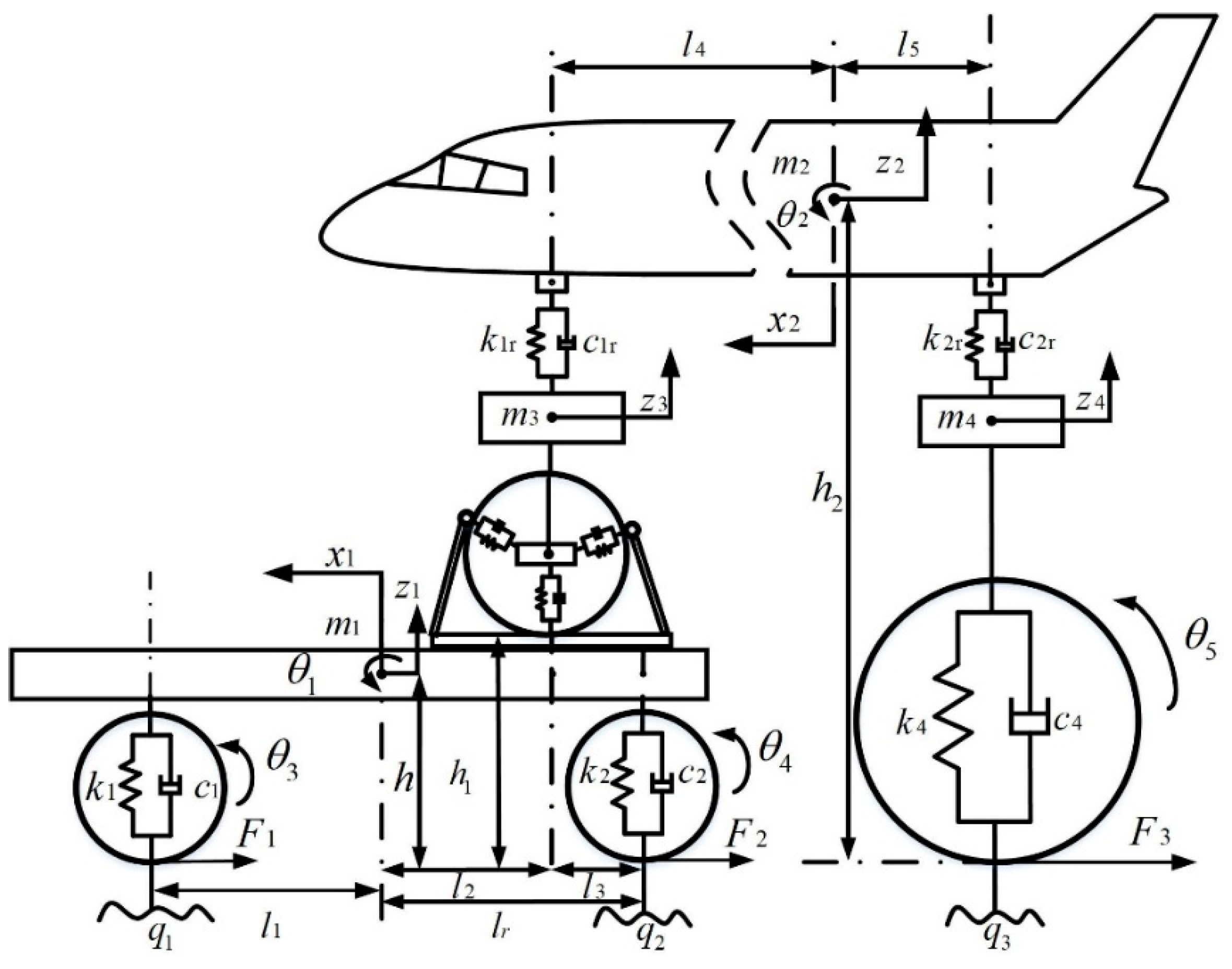
To focus on the longitudinal braking dynamics of the AEOTTS, the influence of small displacements and the system’s steering dynamics is neglected. The AEOTTS is simplified as follows: the TLTV is simplified to a 1/2 vehicle model, including the frame body and the front and rear tires; the aircraft is simplified to a 1/2 aircraft model, including the fuselage, NLG, main landing gear, and the aircraft’s main wheels; except for the landing gear shock struts and tires, all other structures are considered rigid bodies; the PUHS adopts a three-point clamping contact mode; the influence of pitch motion on the longitudinal displacement of the towing system is neglected; road unevenness inputs are applied to the front and rear tires of the tug and the aircraft’s main wheels. Based on the above simplifications, an 11-degree-of-freedom vertical and pitch coupling dynamic model of the aircraft towing system is established, as shown in Figure 2.
z1 and θ1 are the TLTV’s vertical and pitch motions, respectively. z2 and θ2 are the aircraft’s vertical and pitch motions, respectively. z3 and z4 are the vertical motions of the nose and main landing gear, respectively. x1 and x2 are the longitudinal motions of the TLTV and aircraft, respectively. θ3 and θ4 are the rotations of the TLTV front and rear wheels, respectively. θ5 is the aircraft’s main wheel rotation. q1, q2 and q3 are the road unevenness inputs of the TLTV front wheel, TLTV rear wheel, and the aircraft main wheel, respectively.
(1)
The AEOTTS longitudinal dynamic equations
m 1 x ¨ 1 = F t F 1 F 2
m 2 x ¨ 2 = F t F 3
where F t is the longitudinal force on the aircraft NLG, Its value can be calculated using the model of the PUHS formula as shown in Equations (15)–(22) below. described below; F 1 and F 2 are the ground longitudinal frictions on the TLTV front and rear tires, respectively; F 3 is the friction force of the aircraft’s main wheel; m 1 and m 2 are the masses of the TLTV and aircraft, respectively.
(2)
The wheel rotation dynamic equations
J 3 θ ¨ 3 = F 1 R 1 T b 1
J 3 θ ¨ 4 = F 2 R 1 T b 2
J 4 θ ¨ 5 = F 3 R 2 T b 3
where T b 1 and T b 2 are the braking torques applied on the TLTV’s front and rear wheels, respectively; T b 3 is the braking torque applied on the aircraft’s main wheel; J 3 is the TLTV’s wheel moment of inertia and J 4 is the aircraft’s main wheel moment of inertia; R 1 and R 2 are the wheel rolling radius, respectively.
(3)
The total vertical load of each wheel
The wheel’s total vertical load is the sum of the wheel’s static and dynamic load. The dynamic load depends on the load transfer induced by the AEOTTS longitudinal acceleration/deceleration and on system vibration. The total vertical load of each wheel can be expressed as
F N 1 = l r l 1 + l r ( m 1 g + l 5 l 4 + l 5 m 2 g ) + F d 1 + m 1 x ¨ 1 h 1 ( l 4 + l 5 ) + m 2 x ¨ 2 ( h 2 l 3 + h ( l 4 + l 5 ) ) ( l 1 + l r ) ( l 4 + l 5 )
F N 2 = l 1 l 1 + l r ( m 1 g + l 5 l 4 + l 5 m 2 g ) + F d 2 + m 1 x ¨ 1 h 1 ( l 4 + l 5 ) + m 2 x ¨ 2 ( h 2 ( l 2 + l 1 ) h ( l 4 + l 5 ) ) ( l 1 + l r ) ( l 4 + l 5 )
F N 3 = l 4 l 4 + l 5 m 2 g + F d 3 m 2 x ¨ 2 h 2 l 4 + l 5
where FN1, FN2 and FN3 represent the vertical loads on the front wheel of the TLTV, the rear wheel of the TLTV, and the main landing gear wheel of the aircraft, respectively; Fd1, Fd2 and Fd3 denote the dynamic loads generated by vertical vibrations on the front wheel of the TLTV, the rear wheel of the TLTV, and the main landing gear wheel of the aircraft, respectively. These parameters can be determined by solving the vertical vibration model of the AEOTTS; l 1 , l 2 , l 3 , l 4 , l 5 , l r , h , h 1 and h 2 are length-related physical parameters in the AEOTTS. The specific physical meanings of these parameters are provided in Table 1.
(4)
The AEOTTS Vertical Dynamics Equations
m 1 z ¨ 1 = k 1 ( z 1 q 1 l 1 θ 1 ) k 2 ( z 1 q 2 + l r θ 1 ) c 1 ( z ˙ 1 q ˙ 1 l 1 θ ˙ 1 ) c 2 ( z ˙ 1 q ˙ 2 + l r θ ˙ 1 ) F G F
J 1 θ ¨ 1 = k 1 l 1 ( z 1 q 1 l 1 θ 1 ) k 2 l r ( z 1 q 2 + l r θ 1 ) + c 1 l 1 ( z ˙ 1 q ˙ 1 l 1 θ ˙ 1 ) c 2 l r ( z ˙ 1 q ˙ 2 + l r θ ˙ 1 ) F G F l 2
m 2 z ¨ 2 = k 1 r ( z 2 z 3 l 4 θ 2 ) k 2 r ( z 2 z 4 + l 5 θ 2 )   c 1 r ( z ˙ 2 z ˙ 3 l 4 θ ˙ 2 ) c 2 r ( z ˙ 2 z ˙ 4 + l 5 θ ˙ 2 )
J 2 θ ¨ 2 = k 1 r l 4 ( z 2 z 3 l 4 θ 2 )     k 2 r l 5 ( z 2 z 4 + l 5 θ 2 )   +   c 1 r l 4 ( z ˙ 2 z ˙ 3 l 4 θ ˙ 2 ) c 2 r l 5 ( z ˙ 2 z ˙ 4 + l 5 θ ˙ 2 )
m 3 z ¨ 3 = k 1 r ( z 2 z 3 l 4 θ 2 )   +   c 1 r ( z ˙ 2 z ˙ 3 l 4 θ ˙ 2 )   +   F G F
m 4 z ¨ 4 = k 4 ( z 4 q 3 ) + k 2 r ( z 2 z 4 l 5 θ 2 )   c 4 ( z ˙ 4 q ˙ 3 ) + c 2 r ( z ˙ 2 z ˙ 4 l 5 θ ˙ 2 )
TLTV (AM210, Weihai Guangtai, Weihai, China) and Aircraft (B737-800, Boeing, Chicago, IL, USA) model parameters are in Table 1 [22,23].

2.2. PUHS–Aircraft Nose Wheel Contact Model

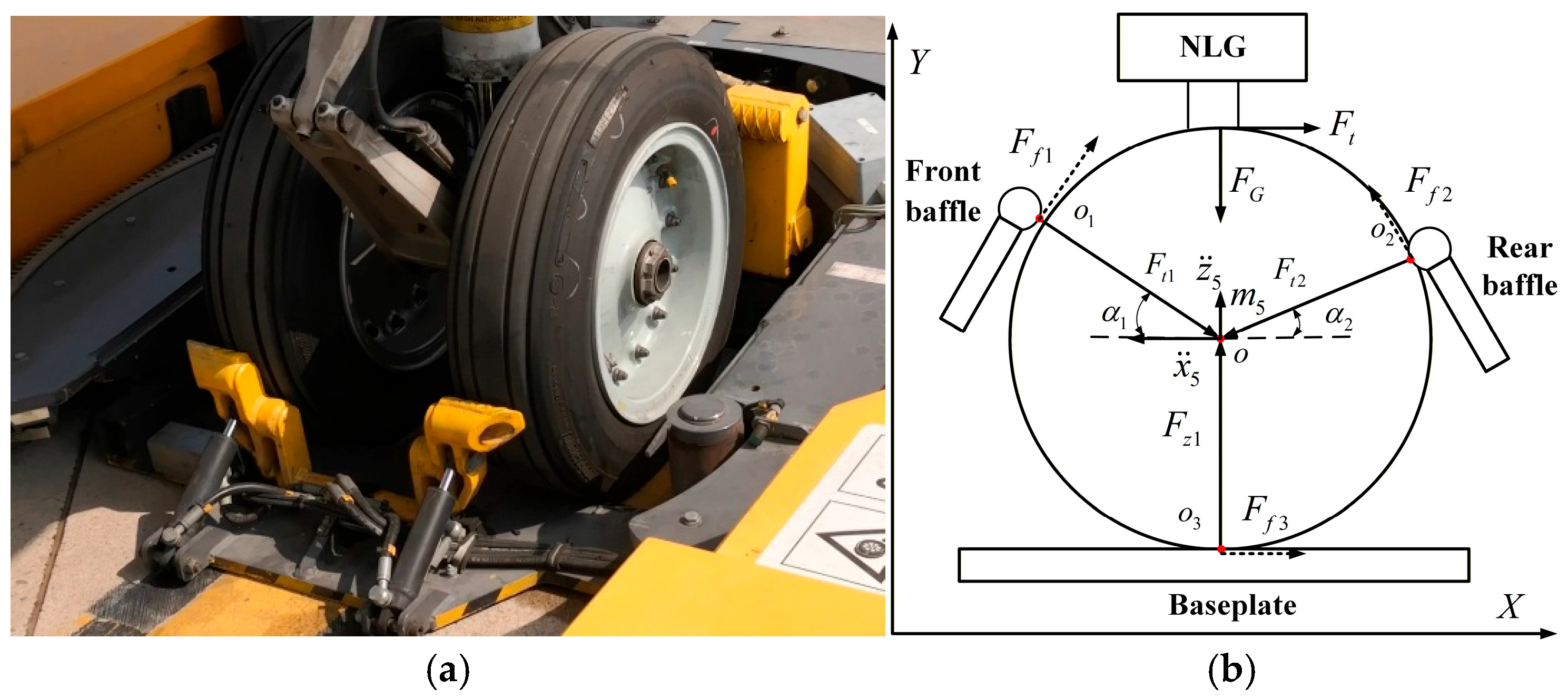
The PUHS of the AEOTTS is a mechanical structure that connects the aircraft and the TLTV, as shown in Figure 3a. This mechanism typically consists of a pair of wheel-holding units installed at the rear of the TLTV, which are used for towing and maneuvering the aircraft on the ground. The refined contact model of the three-point clamping PUHS is illustrated in Figure 3b. The follow-up assumptions are made for the contact model between the PUHS and the aircraft’s nose wheel: during the movement of the AEOTTS, no relative rotation occurs in the aircraft’s nose wheel; the deformation of the clamping arms in the PUHS is neglected, and only the deformation of the aircraft’s nose wheel is considered for contact analysis.
The two-degree-of-freedom model of the aircraft’s nose wheel can be expressed as:
m 5 x ¨ 5 = F t + F t 1 cos α 1 F t 2 cos α 2 F f 1 sin α 1 + F f 2 sin α 2 F f 3
m 5 z ¨ 5 = F G F t 1 sin α 1 F t 2 sin α 2 + F f 1 cos α 1 + F f 2 cos α 2
where m 5 is the mass of the aircraft’s nose wheel; x 5 and z 5 represent the longitudinal and vertical motion of the nose wheel, respectively; F G is the vertical load from the landing gear; Ft1, Ft2 and Fz1 are the contact forces between the nose wheel and the front baffle, rear baffle, and baseplate of the PUHS, respectively; Ff1, Ff2 and Ff3 are the tangential friction forces between the nose wheel and the front baffle, rear baffle, and baseplate of the PUHS, respectively; α 1 and α 2 are the horizontal angles of the contact forces between the nose wheel and the front and rear baffles, respectively.
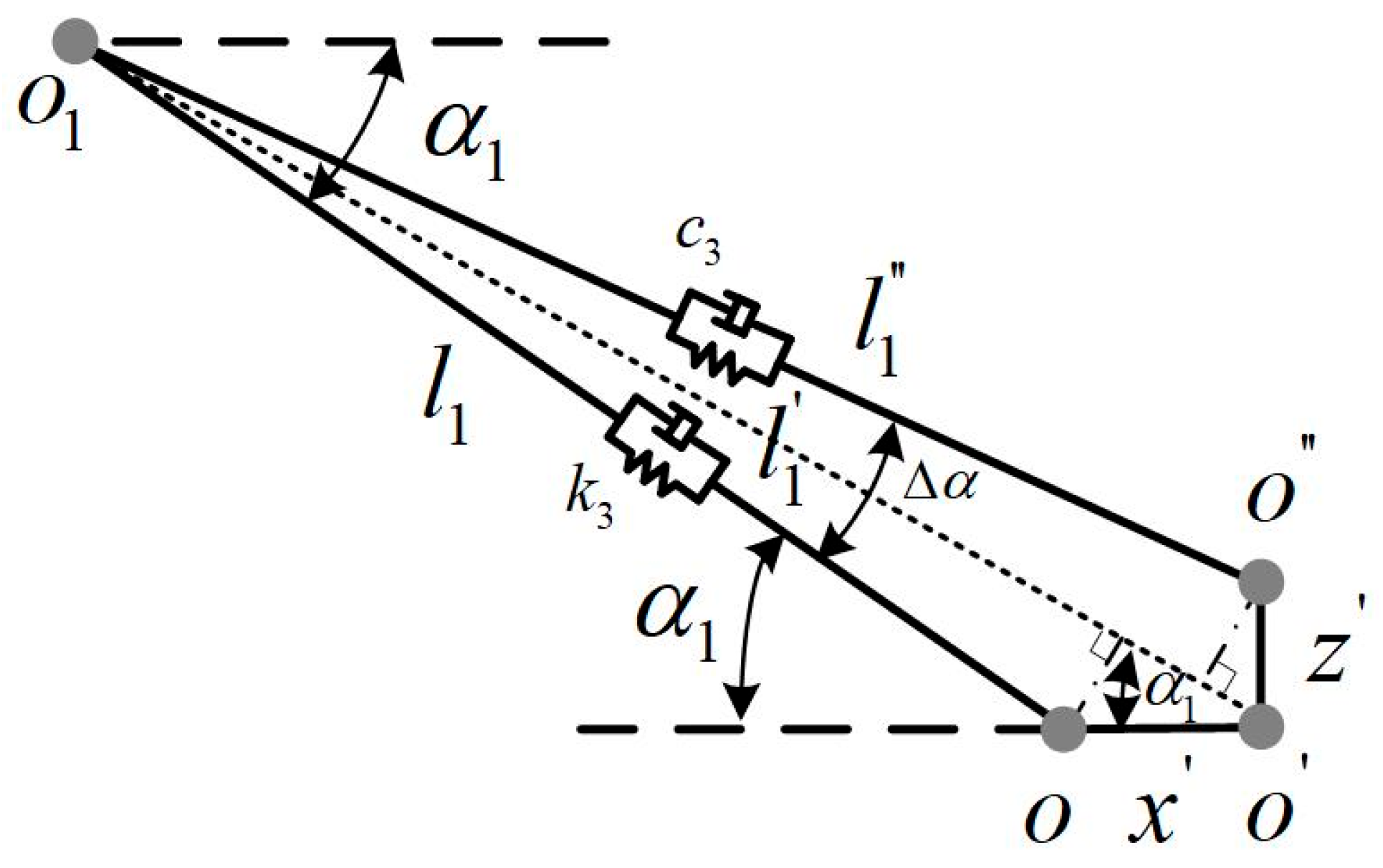
When solving the traction force model of the three-point contact PUHS, there are three unknown contact forces to be determined. The solution of the contact forces is equivalent to modeling them as parallel spring-dampers. Taking the front baffle as an example, the contact deformation between the wheel-holding mechanism and the aircraft’s nose wheel during motion can be simplified to the form shown in Figure 4. Since the change in the horizontal angle of the contact force before and after deformation is minimal, Δ α influence can be neglected.
The wheel deformation at the contact point of the front baffle can be expressed as the superposition of the longitudinal and vertical deformation components:
Δ l 1 = l 1 l 1 = l 1 l 1 + l 1 l 1 = x cos α 1 + z sin α 1
where Δ l 1 represents the tire deformation at the front baffle of the PUHS; l 1 denotes the initial static loaded length between the front baffle and the wheel center; l 1 and l 1 are the longitudinal and vertical lengths between the front baffle and the wheel center after deformation, respectively; x and z represent the relative longitudinal and vertical displacements between the aircraft nose wheel and the PUHS, respectively.
Similarly, the deformations at the rear baffle and the baseplate can be derived as follows:
Δ l 2 = x cos α 2 + z sin α 2
Δ l 3 = z
where Δ l 2 and Δ l 3 represent the wheel deformations at the rear baffle and the baseplate of the wheel-holding mechanism, respectively.
The contact forces at each point between the aircraft nose wheel and the PUHS can be expressed as
F t 1 = k 3 Δ l 1 + c 3 Δ l ˙ 1
F t 2 = k 3 Δ l 2 + c 3 Δ l ˙ 2
F t 3 = k 3 Δ l 3 + c 3 Δ l ˙ 3
where Δ l ˙ 1 , Δ l ˙ 2 and Δ l ˙ 3 represent the rates of change of the wheel deformation at the front baffle, rear baffle, and baseplate of the PUHS, respectively; k 3 and c 3 denote the radial stiffness coefficient and damping coefficient of the aircraft nose wheel, respectively.

2.3. Tire Model

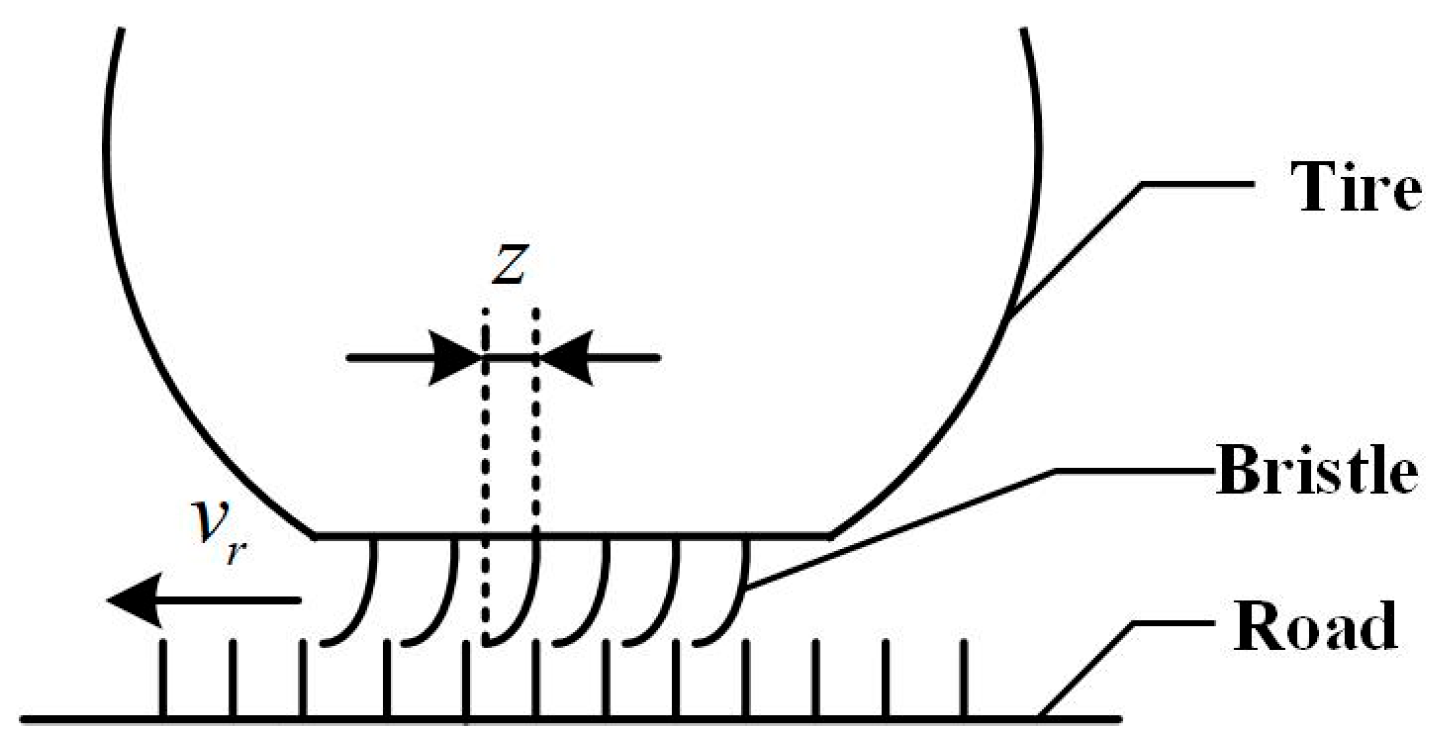
The improved Lugre hydroplaning tire model is selected as the tire model [24], which can accurately reflect the longitudinal friction characteristics of the tire on dry pavement and wet slippery pavement with varying water film thicknesses, as illustrated in Figure 5.
It is primarily expressed as
d δ z d t t , ζ = v r σ 0 v r g ( v r ) δ z
g ( v r ) = μ c + ( μ s μ c ) e ( v r / v s ) ψ
F = F n ( g ( v r ) + σ 2 v r ) A F n 2 g ( v r ) R ( n )
R ( n ) = 1 1 e a ( ρ u + ρ ) ( 1 u 2 n ) ( 1 B u ) d u   = R 0 B R 1 R 2 n + B R 2 n + 1
where R m = 1 1 u m e a ( ρ u + ρ ) d u = i = 0 m ( 1 ) m i m ! i ! ( 1 a ρ ) m + 1 i ( e 2 a ρ ( 1 ) i ) ; z represents the bristle deflection; ζ denotes the tire-road contact patch; v r is the relative velocity between the bristle and the road surface; σ 0 is the bristle stiffness coefficient; g ( v r ) is the Stribeck friction coefficient; F represents the friction force; σ 1 is the bristle damping coefficient; σ 2 is the relative viscous damping coefficient between the tire and the road surface; f n is the pressure distribution function at the tire contact patch; μ c is the Coulomb friction coefficient; μ s is the static friction coefficient; v s is the Stribeck velocity; ψ is the Stribeck factor, typically taken as 0.5; F n is the total vertical load on the tire.
The tire parameters identified through trailer tests are presented in Table 2.

3. Follow-Up Control System of the AEOTTS Symmetric Model

3.1. AEOTTS State Estimation

Integrating the longitudinal-vertical coupled dynamics model of the AEOTTS with the tire model, a braking state estimator for the taxiing traction system is established based on the UKF. Considering the excitation from runway unevenness, the state-space equation and the measurement equation for the braking state of the AEOTTS are given as follows:
x k + 1 = f ( x k , u k ) + w k z k = h ( x k , u k ) + v k
where x k + 1 , z k and u k represent the state variables, observed quantities, and input quantities of the AEOTTS, respectively; w k and v k denote the process noise and observation noise of the taxiing, respectively.
State Estimator x k for the longitudinal dynamics of the AEOTTS is expressed as
x k = [ F t , x ˙ 1 , x ˙ 2 , x 1 , x 2 ]
Input quantities of the AEOTTS is
u k = [ v 0 , F N 1 , F N 2 , F N 3 ]
where v 0 is the initial velocity of the AEOTTS.
Based on the established braking dynamics equations for AEOTTS, the state-space equation is as follows
F t ( k ) = F N 3 ( k 1 ) ( g ( v r ) + σ 2 v r ) / 2 A F N 3 ( k 1 ) 4 g ( v r ) R ( n ) ( i = 1 2 F N i ( k 1 ) ( g ( v r ) + σ 2 v r ) / 2 A F N i ( k 1 ) 4 g ( v r ) R ( n ) ) + ( m 1 m 2 ) i = 1 3 F N i ( k 1 ) ( g ( v r ) + σ 2 v r ) A F N i ( k 1 ) 2 g ( v r ) R ( n ) 2 ( m 1 + m 2 )
x ˙ 1 ( k ) = x ˙ 1 ( k 1 ) + x ¨ 1 ( k 1 ) Δ t
x ˙ 2 ( k ) = x ˙ 2 ( k 1 ) + x ¨ 2 ( k 1 ) Δ t
x 1 ( k ) = x 1 ( k 1 ) + x ˙ 1 ( k 1 ) Δ t
x 2 ( k ) = x 2 ( k 1 ) + x ˙ 2 ( k 1 ) Δ t
where Δ t is the step time.
The observed quantity z k is
z k = [ x ¨ 1 , x ¨ 2 ]
The observation equation is
x ¨ 1 ( k ) = ( F 1 ( k ) + F 2 ( k ) + F t ( k ) ) / m 1 x ¨ 2 ( k ) = ( F 3 ( k ) F t ( k ) ) / m 2
Through the steps outlined above, the modeling of the state estimator for the longitudinal dynamics of the AEOTTS has been completed.

3.2. AEOTTS Follow-Up Control

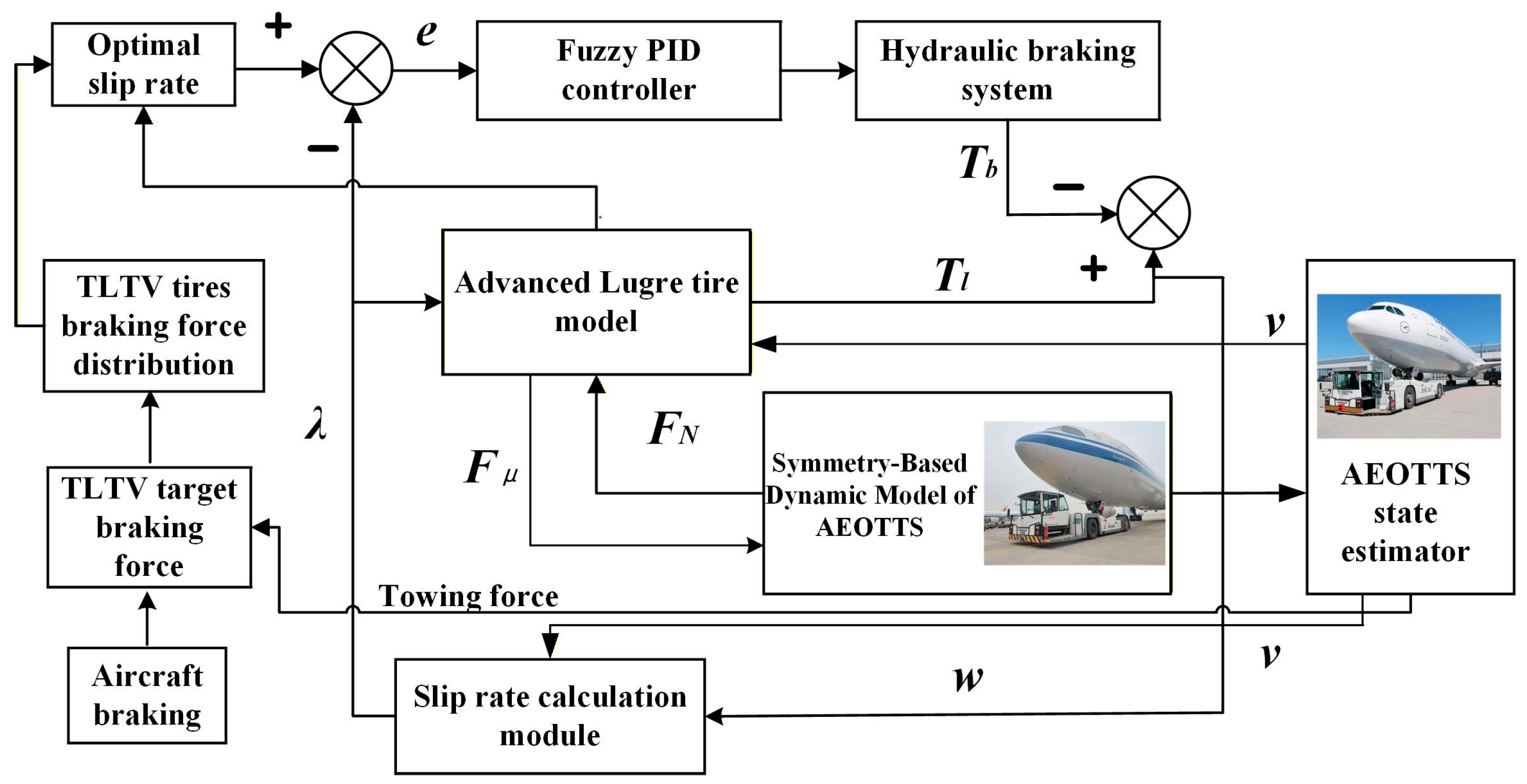
Based on the fuzzy PID control [25] method, the follow-up braking control system for the AEOTTS is established, as shown in Figure 6. The process is as follows: First, under the control of the pilot, the aircraft initiates braking. To minimize the force on the NLG and in combination with the AEOTTS state estimator, the total braking force required for the tow tractor follow-up braking is determined. Next, with braking stability as the constraint condition, the tires braking force is distributed between the front and rear wheels of the TLTV. Using the advanced Lugre tire inverse model, the optimal slip rate for each tire is calculated. Subsequently, a fuzzy PID controller is applied to regulate the hydraulic braking system to output the braking torque. Combining the estimated speed from the AEOTTS state estimator and feeding the speed and tire dynamic load into the advanced Lugre tire model, the friction torque of each tire of is computed. The hydraulic braking torque and tire friction torque are then combined to solve for the actual tire rotational speed and actual slip rate. Finally, the braking force is fed back into the symmetry-based dynamic model of the AEOTTS to estimate state variables such as speed and distance. By continuously adjusting the output braking torque to reduce the deviation between the actual slip rate and the target slip rate of the front and rear wheels of the TLTV, the AEOTTS is brought to a stop, thereby completing the follow-up braking control of the AEOTTS.

Braking Force Computation and Distribution

To control the traction force Ft → 0, it is necessary to ensure that the displacement difference, velocity difference, and acceleration difference between the TLTV and the aircraft all approach zero, i.e., x 1 = x 2 , x ˙ 1 = x ˙ 2 and x ¨ 1 = x ¨ 2 . Substituting these conditions into Equations (1) and (2), the braking deceleration atol is derived as
a t o l = F 3 / m 2
Thus, the total required braking force for the TLTV can be determined as
F t o l = m 1 a t o l
Zs represent the degree of deviation of the braking force distribution point from the equilibrium state. With braking stability as the optimization objective, the braking forces on the front and rear wheels of the TLTV are distributed as follows
Min :   Z s = F 1 F f 2 F 2 F r 2 2 F r 2
By combining Equations (6) and (7),
F 1 + F 2 = z 1 ( F N 1 + F N 2 )
where z 1 is the braking intensity, F f and F r are the ideal braking forces for the front and rear wheels of the TLTV, respectively, F f = z 1 F N 1 and F r = z 1 F N 2 .
By utilizing the improved Lugre tire model, the target slip rate for the front and rear wheels of the TLTV under various follow-up braking control conditions can be obtained.

3.3. Unevenness Runway Input

Runway unevenness is typically characterized by its power spectral density. The time-domain representation of the road profile can be generated using the harmonic superposition method [26].
q x = i = 1 m q i x = i = 1 m 2 G q ( n m i d i ) Δ n sin ( 2 π n m i d i x + θ i )
where x is the longitudinal displacement; n is the spatial frequency, and the spatial frequency domain is divided into m intervals; q i x is the road surface roughness in the i th interval, with a spatial frequency domain width of Δ n , and the center frequency of the i-th interval is n m i d i ; G q ( n m i d i ) is the spatial power spectral density at spatial frequency n m i d i ; θ i is a random number uniformly distributed in the range [0, 2π].
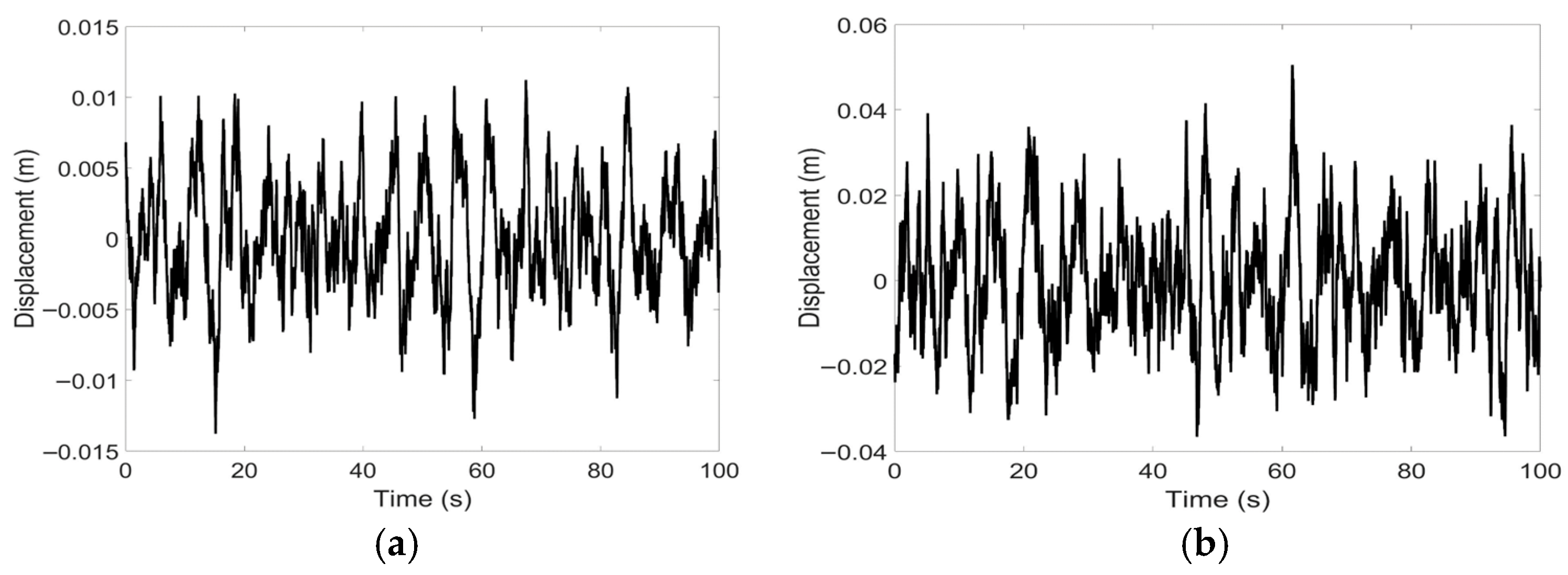
With reference to the road roughness classification specified in GB/T 7031-2005 [27], Class A road surfaces are used to describe the roughness of newly constructed runways, while Class C road surfaces are adopted to represent the roughness of older runways. The road roughness profiles for Class A and Class C, derived based on Equation (38), are shown in Figure 7.

4. Follow-Up Braking Analysis of AEOTTS Under Complex Conditions

The initial speed is set at 40 km/h for all conditions. The standard braking condition is defined as the scenario where the aircraft achieves optimal braking force after 1 s on a dry Class A runway. The wet runway braking condition is defined as the scenario where the aircraft achieves optimal braking force after 1 s on a wet Class A runway. The Class C runway braking condition is defined as the scenario where the aircraft achieves optimal braking force after 1 s on a dry Class C runway.

4.1. Analysis of Follow-Up Braking Characteristics

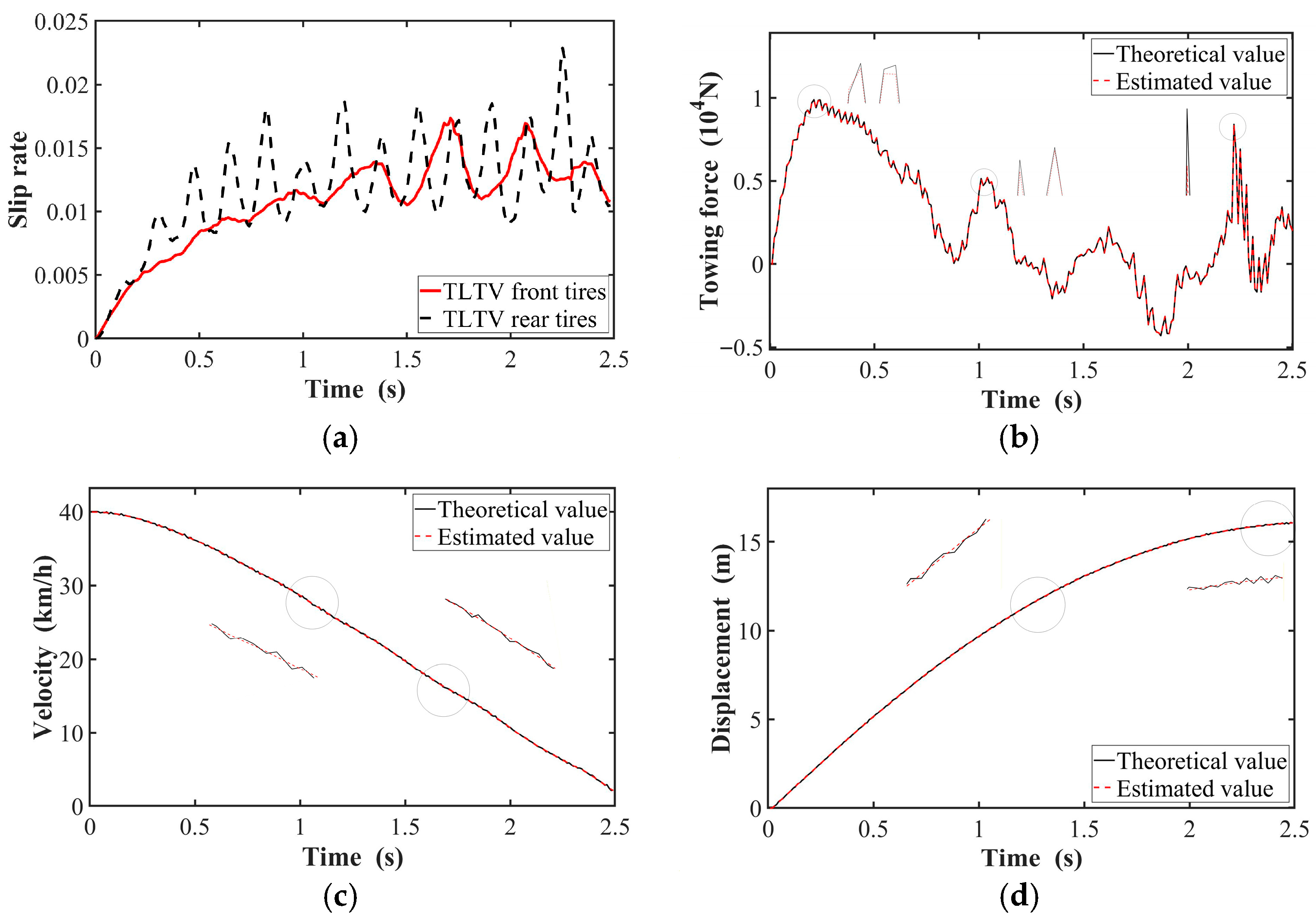
Figure 8a shows the slip rate control effectiveness of the TLTV front and rear wheels under the standard braking condition. It can be observed that as the aircraft’s braking force increases, the slip rate of the TLTV front and rear wheels also increases, stabilizing around 1 s and maintaining fluctuations. Random runway unevenness is the primary reason the slip rate cannot remain at a stable value. Furthermore, due to load transfer towards the front during braking, the fluctuation amplitude of the slip rate for the TLTV rear wheels is larger than that for the front wheels, indicating inferior control effectiveness for the rear wheels.
Figure 8b illustrates the variation trend of the towing force on the aircraft’s NLG under the standard braking condition. Observation reveals that the force estimation maintains high accuracy throughout the entire braking process. However, upon zooming in on the curve, certain errors persist, which are more pronounced at the extreme points of the force. At the extreme points of the traction force around 0.2 s, 1.1 s, and 2.2 s, the errors between the estimated traction force and the theoretical value are 1.6%, 1.2%, and 2.7%, respectively. Analyzing the trend of the traction force, it initially increases, then decreases with oscillations, and finally stabilizes. The peak traction force remains within the safe threshold and is relatively small in magnitude.
Figure 8c,d depict the changes in the speed and braking distance of the AEOTTS under the standard braking condition. The estimation errors for both speed and distance are minimal. Upon magnification, it is evident that the estimated values essentially coincide with the theoretical values.

4.2. Analysis of Towing Force on NLG

By introducing the method of average distribution of braking force between the TLTV front and rear wheels and the PI control (PI controller gain coefficient tuning through Ziegler Nichols method) of slip rate, a comparative analysis was conducted on the changes in the follow-up braking performance of the AEOTTS under different follow-up braking control methods.
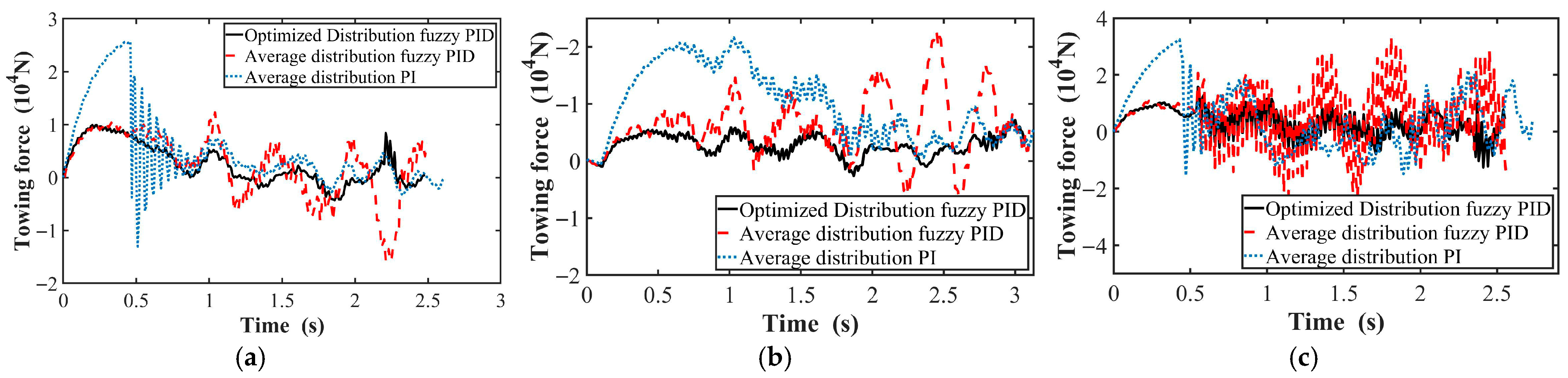
The variation trend of the towing force on the aircraft NLG is as follows: during the initial braking phase, the towing force on the NLG increases as the aircraft’s braking force rises. However, with the intervention of the TLTV follow-up braking control system, the force on the aircraft NLG gradually decreases, achieving a coordinated braking effect where the TLTV follows the aircraft’s motion. Figure 9 compares the force on the NLG of the AEOTTS under three follow-up braking control methods and three operating conditions. Observation reveals that all three methods can reduce the force on the NLG to some extent, but the fuzzy PID follow-up control strategy based on optimized braking force distribution delivers the best performance, resulting in the smallest force on the aircraft’s NLG during braking.
Under the standard braking condition with the optimized distribution fuzzy PID follow-up braking control strategy, the maximum and root mean square (RMS) values of the NLG force are 0.99 × 10⁴ N and 0.46 × 10⁴ N, respectively, as shown in Table 3. Compared to the other two follow-up control methods, the maximum and RMS values of the NLG force are reduced by 61.3% and 48.3%, respectively, indicating a significant optimization effect of the follow-up control.
Under the wet runway braking condition with the optimized distribution fuzzy PID follow-up control strategy, the variation trend of the landing gear force is the smoothest, fluctuating near a low value. The maximum and RMS values of the landing gear force are 0.71 × 10⁴ N and 0.34 × 10⁴ N, respectively. Compared to the other two follow-up control methods, the maximum and RMS values are reduced by 68.9% and 70.9%, respectively.
Under the Class C runway braking condition, due to the increased runway unevenness, the fluctuation amplitude of the traction force shows some increase compared to other braking conditions, even with the optimized distribution fuzzy PID follow-up control strategy, but it generally remains low. Compared to the other two follow-up control methods, the maximum NLG is reduced from 3.37 × 10⁴ N to 1.57 × 10⁴ N, a reduction of 53.4%, while the RMS value of the NLG force is reduced from 1.30 × 10⁴ N to 0.59 × 10⁴ N, a reduction of 54.6%.
Thus, it can be concluded that under various complex braking conditions, the fuzzy PID follow-up braking control strategy based on optimized braking force distribution demonstrates certain superiority over the other two follow-up control strategies in reducing the force on the aircraft’s NLG. This strategy effectively enhances the safety of taxiing traction braking operations.

4.3. Analysis of Braking Distance

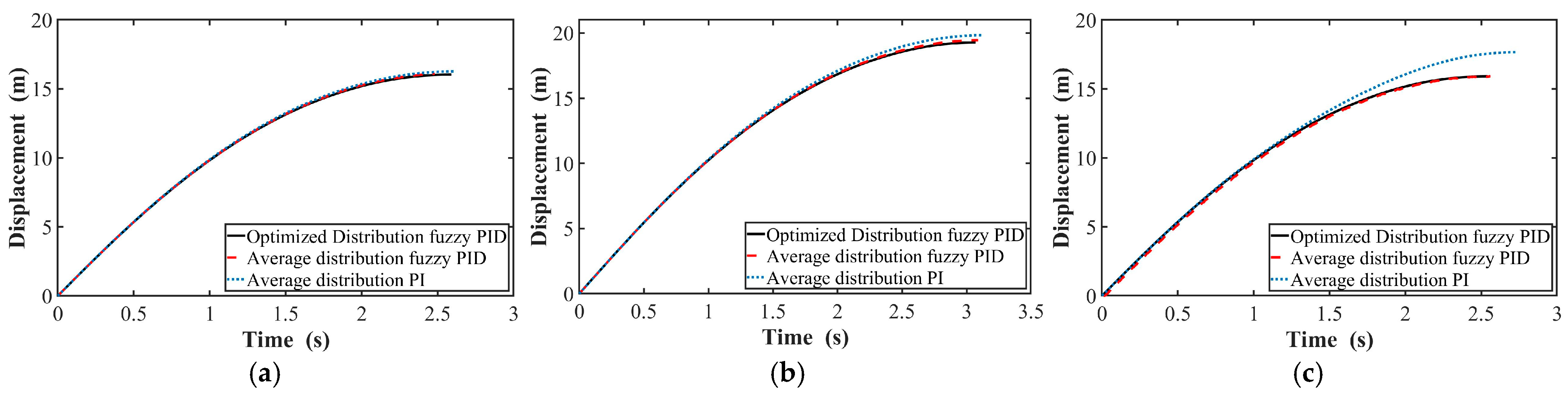
Figure 10 shows the braking distance comparison of the AEOTTS under three follow-up braking control methods across three operating conditions. It can be observed that under the fuzzy PID follow-up control strategy with optimized braking force distribution, the braking distance of the AEOTTS is reduced to some extent compared to the other two follow-up braking control methods, although the improvement is not very pronounced. The main reasons are twofold: first, the braking distance of the AEOTTS is significantly influenced by the aircraft’s braking force, with the tractor’s follow-up braking force having a relatively minor impact; second, the primary objective of the follow-up braking control strategy is to ensure the safety of the force on the aircraft’s NLG, thus the optimization of braking distance is limited.
Under the three operating conditions—standard braking, wet runway braking, and Class C runway braking—compared to the other two follow-up control methods, the braking distance of the AEOTTS under the optimized distribution fuzzy PID follow-up control strategy is reduced from 16.26 m, 19.83 m, and 17.66 m to 16.06 m, 19.27 m, and 15.91 m, respectively, as shown in Table 4. This corresponds to reductions of 1.2%, 2.8%, and 9.9% in braking distance.

5. Conclusions

(1)
Based on the refined symmetrical dynamic model of the AEOTTS, the follow-up estimator can effectively predict the state changes of the AEOTTS. The maximum error between the estimated and theoretical values of aircraft traction force is 2.7%. Under the follow-up braking control mode, the tire slip rate of the TLTV initially increases and then stabilizes with oscillations, with the front wheels demonstrating superior control performance.
(2)
Under three braking conditions considering road adhesion coefficient and runway unevenness, the braking performance of the AEOTTS was compared across three follow-up control modes: average distribution PI control, average distribution fuzzy PID control, and optimized distribution fuzzy PID control. The fuzzy PID follow-up control system based on optimized distribution significantly reduced the towing force on the aircraft’s NLG, with the peak towing force decreasing by up to 68.9% and the RMS value of the force by up to 70.9%. Additionally, the braking distance of the AEOTTS was reduced by up to 9.9%.
This paper focuses on the modeling of the follow-up braking control system for the AEOTTS and the simulation validation under complex working conditions. The research indicates that the follow-up braking control system can effectively enhance the braking safety of the AEOTTS under extreme conditions such as bumpiness and slippery surfaces. In the future, the symmetric model of the AEOTTS will be extended to three dimensions, and an adaptive estimation system will be introduced to further improve the accuracy of the follow-up control model and conduct experimental validation of its reliability.

Author Contributions

Conceptualization, K.Q.; methodology, K.Q.; software, K.Q.; validation, K.Q., G.L. and M.L.; formal analysis, K.Q.; investigation, K.Q.; resources, W.K.C.; data curation, W.K.C.; writing—original draft preparation, K.Q.; writing—review and editing, K.Q.; visualization, K.Q.; supervision, G.L.; project administration, K.Q.; funding acquisition, G.L. and W.K.C. All authors have read and agreed to the published version of the manuscript.

Funding

This research was funded by the Professor Wan Ki Chow research initiation project (No. XYKY2025002), Civil Aviation Safety Capacity Construction Foundation (No. GA2025009), and Sichuan Science and Technology Planning Project (No. 2024YFTX0064).

Data Availability Statement

The datasets generated and analyzed during the current study are not publicly available due to privacy and ethical restrictions. However, they may be available from the corresponding author upon reasonable request and with the permission of the involved institutions.

Acknowledgments

It was supported by the Wan Ki Chow research initiation project (No. XYKY2025002), Civil Aviation Safety Capacity Construction Foundation (No. GA2025009), and Sichuan Science and Technology Planning Project (No. 2024YFTX0064). The financial support is gratefully acknowledged.

Conflicts of Interest

The authors declare no conflicts of interest. The funders had no role in the design of the study; in the collection, analyses, or interpretation of data; in the writing of the manuscript; or in the decision to publish the results.

References

  1. Komite Nasional Keselamatan Transportasi. Aircraft Accident Investigation Report; Komite Nasional Keselamatan Transportasi: Jakarta, Indonesia, 2015. [Google Scholar]
  2. Fordham, D.; Stephens, M.; Chymiy, A. Deriving Benefits from Alternative Aircraft-Taxi Systems; National Academy of Sciences: Washington, DC, USA, 2016; pp. 1–26. [Google Scholar]
  3. Zhang, J.H.; Li, G.Y. Kinematic simulation of clamping/holding mechanism for no-rod airplane tractor based on Pro/Engineer. Hoisting Conveying Mach. 2008, 4, 46–49. [Google Scholar] [CrossRef]
  4. Song, H.Z.; Yu, H.B. Kinematics analysis of the clamping and lifting mechanism of new aircraft tractor. Hoisting Conveying Mach. 2019, 1, 119–123. [Google Scholar] [CrossRef]
  5. Wang, L.W.; Wu, Z.H.; Zhang, W. Kinematics Analysis for Clamping and Lifting Mechanism of Tow-bar-less Aircraft Tractor. Mach. Tool Hydraul. 2015, 43, 54–57. [Google Scholar] [CrossRef]
  6. Wang, Z.C. Structure Design and Analysis of Lifting Mechanism of Aircraft Tractor. J. Shandong Univ. Aeronaut. 2020, 36, 27–32. [Google Scholar] [CrossRef]
  7. Jin, J.Q.; Qi, J.Y.; Gao, X. Design of clamping and lifting mechanism for towbarless aircraft tractor. Hoisting Conveying Mach. 2019, 18, 53–58. [Google Scholar] [CrossRef]
  8. Gao, Q.Z.; Huang, A.; Shi, P.C. Anti-vibration optimization design for clamp-lifting device on aircraft tractors. J. Mech. Strength 2022, 44, 302–308. [Google Scholar] [CrossRef]
  9. Shi, H.T. Research on Braking Performance of the Towbarless Aircraft Tractor. Master’s Thesis, Harbin Engineering University, Harbin, China, 2011. [Google Scholar] [CrossRef]
  10. Wang, S.S. Research on Simulation of Braking Performance of Carrier Aircraft Tracting System. Master’s Thesis, Harbin Engineering University, Harbin, China, 2012. [Google Scholar] [CrossRef]
  11. Sun, Y.K.; Zhang, W.; Yang, X.W.; Liu, J.H.; Zhu, H.J.; Liu, Y.X.; Qin, J.H. Review on aircraft towing taxi technologies. J. Traffic Transp. Eng. 2023, 23, 23–43. [Google Scholar] [CrossRef]
  12. Wang, N.J.; Zhou, L.J.; Song, Q.; Zhang, D.F. Simulation research on braking safety properties of aircraft traction system. Key Eng. Mater. 2010, 419, 705–708. [Google Scholar] [CrossRef]
  13. Li, Y.; Jia, H.; Qi, J.; Sun, H.; Tian, X.; Liu, H.; Fan, X. An Acquisition method of agricultural equipment roll angle based on multi-source information fusion. Sensors 2020, 20, 2082. [Google Scholar] [CrossRef]
  14. Luo, Z.; Fu, Z.; Xu, Q. An adaptive multi-dimensional vehicle driving state observer based on modified Sage-Husa UKF algorithm. Sensors 2020, 20, 6889. [Google Scholar] [CrossRef] [PubMed]
  15. Zhou, C. Research on Vehicle State Estimation with Steer-by-Wire System Based on Nonlinear Estimation Method. Ph.D. Thesis, Southwest Jiaotong University, Chengdu, China, 2024. [Google Scholar]
  16. Wang, Z.; Qin, Y.; Gu, L.; Dong, M. Vehicle system state estimation based on adaptive unscented Kalman filtering combing with road classification. IEEE Access 2017, 5, 27786–27799. [Google Scholar] [CrossRef]
  17. Liu, T.; Yu, Z.; Xiong, L. Anti-lock braking system control design on an integrated-electro-hydraulic braking system. SAE Int. J. Veh. Dyn. Stab. NVH 2017, 1, 298–306. [Google Scholar] [CrossRef]
  18. Yu, D.; Wang, W.; Zhang, H.; Xu, D. Research on anti-lock braking control strategy of distributed-driven electric vehicle. IEEE Access 2020, 8, 162467–162478. [Google Scholar] [CrossRef]
  19. Jiang, Y.; Zheng, Y.; Guo, Y. Regenerative braking control strategy to improve braking energy recovery of pure electric bus. SAE Int. J. Veh. Dyn. Stab. NVH 2020, 4, 221–231. [Google Scholar] [CrossRef]
  20. Tang, Y.; Wang, Y.; Han, M.; Lian, Q. Adaptive fuzzy fractional-order sliding mode controller design for antilock braking systems. J. Dyn. Syst. Meas. Control 2016, 138, 041008–041016. [Google Scholar] [CrossRef]
  21. Mousavinejad, E.; Han, Q.-L.; Yang, F.; Zhu, Y.; Vlacic, L. Integrated control of ground vehicles dynamics via advanced terminal sliding mode control. Veh. Syst. Dyn. 2017, 55, 268–294. [Google Scholar] [CrossRef]
  22. Zhu, H.; Li, J.F. Analysis on braking stability of towbar-less towing vehicle under steering and braking. J. Mach. Des. 2020, 37, 72–76. [Google Scholar]
  23. Wang, L.W.; Wang, Q.; Zhang, W. Optimization design of towbarless aircraft tractor frame based on ansys workbench. Appl. Mech. Mater. 2013, 268, 921–925. [Google Scholar] [CrossRef]
  24. Zhu, H.J.; Qi, K.; Wang, L.W.; Zhang, W. Longitudinal dynamics modeling and braking performance of towbarless aircraft taxiing system on wet roads. Acta Aeronaut. Astronaut. Sin. 2024, 45, 129–144. [Google Scholar] [CrossRef]
  25. Abreu, R.; Botha, T.; Hamersma, H. Model-free intelligent control for antilock braking systems on rough roads. SAE Int. J. Veh. Dyn. Stab. NVH 2023, 7, 269–285. [Google Scholar] [CrossRef]
  26. Wang, H.P.; Zhang, Z.; Li, Q. Coherence of phase angle of harmonic superposition components in time domain simulation of road roughness for right and left wheel tracks. Trans. Beijing Inst. Technol. 2019, 39, 1034–1038. [Google Scholar] [CrossRef]
  27. GB/T 7031-2005; Mechanical Vibration-Road Surface Profiles-Reporting of Measured Data. General Administration of Quality Supervision, Inspection and Quarantine of the People’ s Republic of China. Standardization Administration of the People’s Republic of China, Standards Press of China: Beijing, China, 2005.
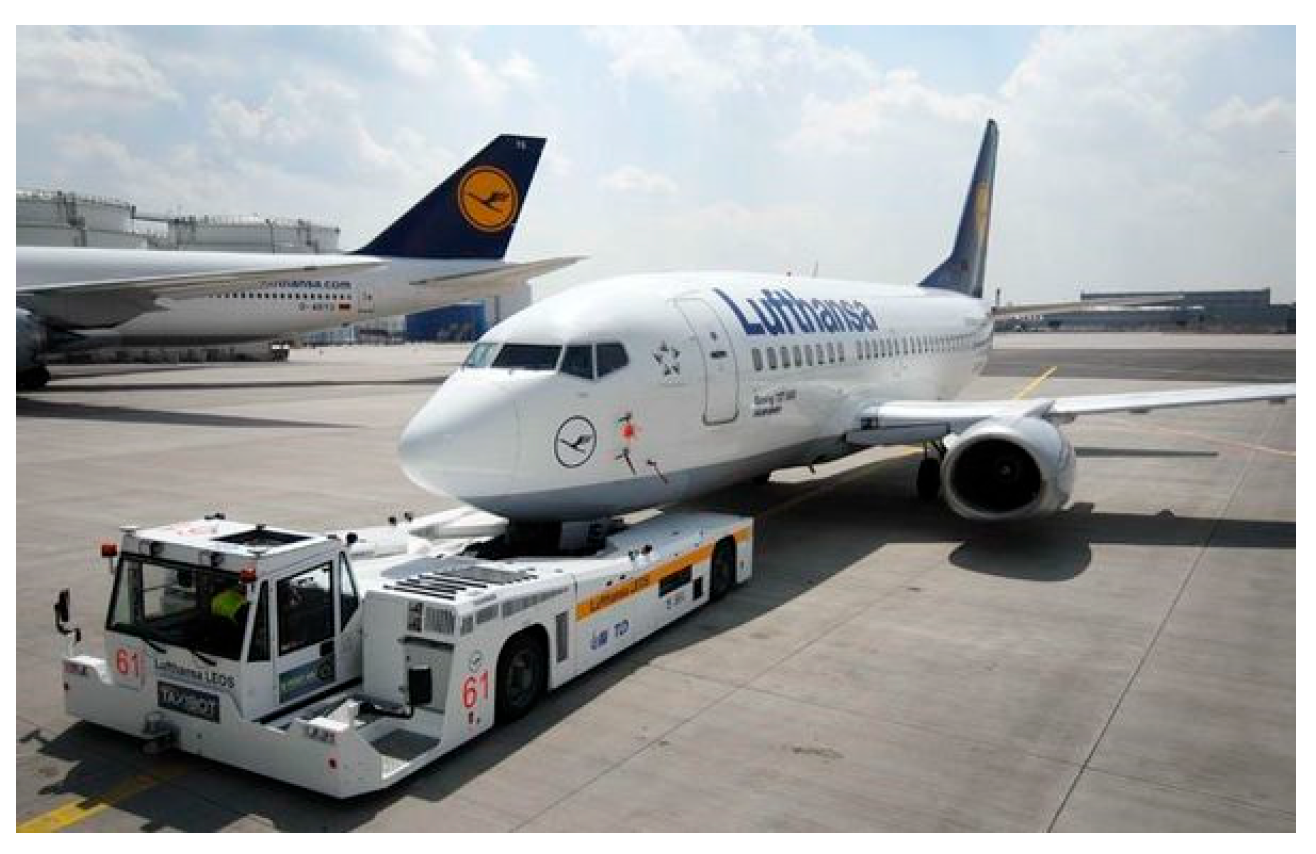
Figure 1. AEOTTS.
Figure 1. AEOTTS.
Symmetry 17 02131 g001
Figure 2. 11-DOF longitudinal-vertical coupling dynamic model of the AEOTTS.
Symmetry 17 02131 g002
Figure 3. PUHS contact diagram: (a) PUHS; (b) Schematic diagram of the PUHS.
Symmetry 17 02131 g003
Figure 4. Aircraft front wheel deformation diagram.
Symmetry 17 02131 g004
Figure 5. Lugre tire friction model schematic diagram.
Symmetry 17 02131 g005
Figure 6. Illustration of the AEOTTS follow-up braking control strategy.
Symmetry 17 02131 g006
Figure 7. The numerical model of the unevenness runway (a) Class A runway displacement unevenness at 40 km/h; (b) Class C runway displacement unevenness at 40 km/h.
Symmetry 17 02131 g007
Figure 8. Follow-up braking performance of standard operating condition: (a) TLTV slip rate; (b) Towing force on NLG; (c) Velocity; (d) Displacement.
Symmetry 17 02131 g008
Figure 9. Comparison of the NLG towing force of AEOTTS under different braking conditions and different follow-up braking control strategies: (a) Standard braking; (b) Wet runway braking; (c) Class C runway braking.
Symmetry 17 02131 g009
Figure 10. Comparison of braking distance of AEOTTS under different braking conditions and different follow-up braking control strategies: (a) Standard braking; (b) Wet runway braking; (c) Class C runway braking.
Symmetry 17 02131 g010
Table 1. The AEOTTS model parameters.
SymbolDescriptionValueSymbolDescriptionValue
m 1 TLTV mass1.3 × 104 kg h Height from ground to TLTV CG 0.5 m
J 1 The TLTV’s Pitch moment of inertia 5.4 × 10⁴ kg·m2 h 2 Height from ground to aircraft CG 10 m
m 2 Aircraft mass6.0 × 104 kg h 1 Height from ground to aircraft nose wheel center 0.1 m
J 2 The aircraft’s pitch moment of inertia 4.7 × 10⁶ kg·m2 k 2 r MLG stiffness coefficient1 × 106 N·m−1
m 3 NLG unsprung mass 400 kg c 2 r MLG damping coefficient40,000 N·s·m−1
m 4 MLG unsprung mass2000 kg l 1 Spacing between TLTV CG and the front axle 0.5 m
k 1 Stiffness coefficient TLTV of front wheel 4 × 10⁶ N·m−1 l 2 Spacing between TLTV CG and aircraft nose wheel 2 m
c 1 Damping coefficient of TLTV front wheel 1200 N·s·m−1 l 3 Spacing between aircraft nose wheel and TLTV rear axle 1.5 m
k 2 Dtiffness coefficient of TLTV rear wheel 5 × 10⁶ N·m−1 l r Spacing between TLTV CG and the rear axle 3.5 m
c 2 Damping coefficient of TLTV rear wheel 1200 N·s·m−1 l 4 Spacing between aircraft CG and the nose wheel15 m
k 3 Stiffness coefficient of aircraft nose wheel 2 × 10⁶ N·m−1 l 5 Spacing between aircraft CG and the main wheel 1 m
c 3 Damping coefficient of aircraft nose wheel 900 N·s·m−1 R 1 TLTV tire rolling radius0.39 m
k 4 Aircraft main wheel stiffness coefficient1 × 107 N·m−1 R 2 Aircraft main wheel rolling radius0.56 m
c 4 Aircraft main wheel damping coefficient4000 N·s·m−1 J 3 TLTV wheel moment of inertia 7.8 kg·m2
k 1 r NLG equivalent stiffness coefficient2 × 105 N·m−1 J 4 Aircraft main wheel moment of inertia 9.2 kg·m2
c 1 r NLG equivalent damping coefficient1 × 104 N·s·m−1
Table 2. Lugre model parameters of the TLTV tire.
Lugre Model ParametersValue
Bristle   Stiffness   coefficient   σ 0 138
Bristle   Damping   coefficient   σ 2 0.001
Coulomb   friction   coefficient   μ c 0.456
Static   friction   coefficient   μ s 1.4
Stribeck   velocity   v s 5
Table 3. Comparison of the NLG towing force under different braking conditions and different follow-up braking control strategies.
Braking
Condition
Maximum NLG Towing Force (104 N)NLG Towing Force RMS Value (104 N)
Average
Distribution
PI
Average
Distribution
Fuzzy PID
Optimized
Distribution
Fuzzy PID
Average
Distribution
PI
Average
Distribution
Fuzzy PID
Optimized
Distribution
Fuzzy PID
standard braking2.561.590.990.890.660.46
wet runway braking2.182.290.711.170.830.34
Class C runway braking3.253.371.571.301.240.59
Table 4. Comparison of the braking distance under different braking conditions and different follow-up braking control strategies.
Braking ConditionBraking Distance (9 m)
Average
Distribution
PI
Average
Distribution
Fuzzy PID
Optimized
Distribution
Fuzzy PID
standard braking16.2616.0916.03
wet runway braking19.8319.4119.27
Class C runway braking17.6615.9315.91
Disclaimer/Publisher’s Note: The statements, opinions and data contained in all publications are solely those of the individual author(s) and contributor(s) and not of MDPI and/or the editor(s). MDPI and/or the editor(s) disclaim responsibility for any injury to people or property resulting from any ideas, methods, instructions or products referred to in the content.