


You are currently viewing a new version of our website. To view the old version click .
Symmetry
  • Article
  • Open Access

1 December 2025

Effects of Sports Flooring on Peak Ground Reaction Forces During Bilateral Drop Landings

,
,
,
and
1
First Year College, Victoria University, Melbourne 8001, Australia
2
Sport, Performance and Nutrition Research Group, School of Allied Health, Human Services and Sport, La Trobe University, Melbourne 3086, Australia
3
Performance Science, Research and Innovation, The Movement Institute, Melbourne 3042, Australia
4
School of Energy, Geoscience, Infrastructure and Society, Heriot-Watt University, Edinburgh EH14 4AS, UK
Symmetry2025, 17(12), 2045;https://doi.org/10.3390/sym17122045 
(registering DOI)
This article belongs to the Special Issue Symmetry Application in Motor Control in Sports and Rehabilitation

Abstract

With continued advancement in flooring technology, modular sports flooring tiles have emerged as a potential alternative flooring solution for sports performance. However, there is limited empirical evidence regarding their effects on ground reaction forces in landing tasks (GRFs). Therefore, the aim of this study was to assess the effects of flooring surface on peak GRFs during bilateral drop landings. Eighteen physically active adults (10 males, 8 females) completed three bilateral drop landings from a 50 cm height across each of three flooring types: modular sport tiles, athletic track, and bare force plates, measuring contacts from both the left and right limb. GRFs were captured using two in-ground force platforms, normalised to body mass, and then analysed using a linear mixed-effects model with post-hoc comparisons where significant interactions were recorded. Peak anterior GRFs were significantly lower in the modular tiles compared with athletic sports track and bare metal surfaces (p < 0.001, η2p ≥ 0.430). Additionally, anterior (p = 0.048, η2p = 0.040), lateral (p < 0.001, η2p = 0.280), and vertical (p = 0.001, η2p = 0.100) GRFs were significantly greater in the right limb compared with the left limb within each flooring surface condition. Future research should investigate sport-specific movement patterns and long-term adaptations associated with training on modular surfaces to assess their potential role in enhancing performance and mitigating injuries.

1. Introduction

Playing surface is a critical factor that can influence athletic performance and injury risk across various sports. Contemporary sports surfaces are designed to incorporate natural, synthetic, or a combination of materials to enhance overall performance experience and mitigate injury risk during athletic movements []. Over recent decades, artificial turf has been increasingly adopted as an alternative to natural grass, particularly in field-based sports, due to its durability and consistent playing conditions []. However, despite its widespread implementation, there is limited evidence on the effectiveness of artificial surfaces in replicating natural surface characteristics regarding injury prevalence and severity [,].
Since the initial adoption of artificial playing surfaces in field sports competitions (e.g., soccer), other sports have subsequently adopted similar innovations. Indoor sports such as basketball utilise maple hardwood as the primary playing surface due to its stability for dribbling, reduced likelihood to expand and contract with changes in temperature, and shock absorption properties []. Biomechanical analyses have demonstrated that key performance metrics, including peak vertical ground reaction force, power output, and jump height, remain comparable across surface types during athletic tasks such as countermovement and depth jumps []. In contrast, one study that assessed consecutive ankle jumps (no active use of the knees) and standard countermovement jumps on varied thicknesses of athletic track reported a significant main effect of flooring surface, whereby the vertical instantaneous loading rate (N·s−1·Kg−1) during landing was reduced in three of four conditions (flooring thickness; SF1: 0.014 m; SF2: 0.007 m; SF3: 0.011 m; SF4: 0.018 m) compared with the reference condition (SF0) []). Contact time between jumps was also reported to be significantly longer from SF2 to SF1 []. It is evident that sports surfaces are a rapidly evolving and well-researched area for athletic performance; however, a deeper understanding of the biomechanical implications of sports surface engagement is crucial.
Modern sport surfaces continually evolve with the aim to improve the floorings’ force absorption ability, shoe–surface friction characteristics, vertical deformation, and energy transfer to an individual’s body [,]. For example, landing tasks are a primary movement in basketball (single- or double-legged landing) as a result of dribbling or attempting to score from open play. High surface friction, coupled with rapid decelerating movements, have been suggested to increase lower limb injury rate by two-fold []. One new and emerging technology is modular flooring tiles, which are an interlocking thermoplastic material joining system that links sport floor tiles together with the goal of reducing vertical and horizontal braking forces exerted on a tile by an athlete [], a key component of anterior cruciate ligament (ACL) ruptures, an injury that has a high incidence rate across high school, collegiate, and professional athletes (59%) []. Anecdotally, modular sports flooring tiles have been an increasingly utilised surface for sporting activities and can be used as an alternate playing surface. It is suggested that using modular flooring surfaces may result in lowered peak ground reaction forces (GRFs), and loading rates of modular tiles are aligned to reduce the risk of lower-body injuries []. Using this flooring technology may enable a gradual load exposure during injury rehabilitation, suggesting reduced ground contact landing forces compared with traditional surfaces []. However, the effect of modular flooring surfaces on peak ground reaction forces compared with traditional and commonly used flooring surfaces during landing tasks is unclear.
Therefore, the aim of this study was to quantify the effects of different flooring surfaces (modular sport tiles, athletic track, and bare force plates) on peak ground reaction forces during bilateral drop landings. It was hypothesised that the athletic track surface would exhibit lower peak vertical ground reaction forces compared with the modular sporting tile surface and bare (metal force plate) flooring.

2. Materials and Methods

2.1. Participants

Eighteen healthy male and female adults (mean ± SD; 10 males, 8 females; age: 24.6 ± 2.0 years, height: 1.74 ± 0.1 m, mass: 72.5 ± 7.5 kg) participated in the study. All participants were injury-free for at least six months at the time of testing and had previous experience in performing general athletic tasks (jumping and landing). Written informed consent was captured before participation in the study, which was approved by the La Trobe University Institutional Human Research Ethics Committee (#HEC21082).

2.2. Testing Procedure and Protocol

All testing was completed in a Sports Biomechanics Laboratory (La Trobe University, Melbourne, Australia). Participants were provided a demonstration of the experimental design and were afforded time to complete their individual warm-up.
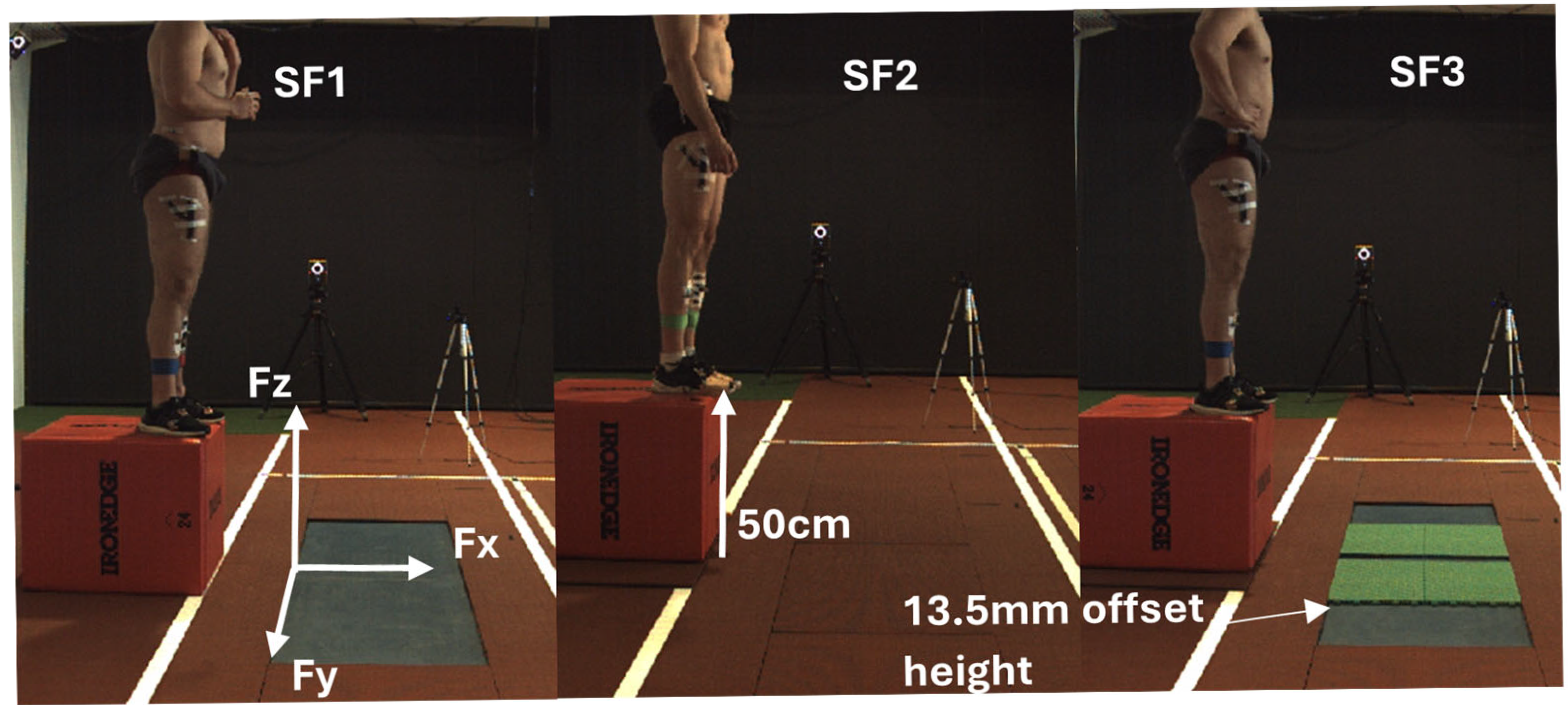
Participants were required to perform bilateral drop landings (DL) from a 50 cm height on three surfaces. The surfaces included two bare force plates as a reference condition (SF1), indoor Mondo athletic track (Sportflex Super X 720™ K39, Mondo, Alba, Italy; SF2) affixed to the two force plates, and two interlocked modular sports flooring tiles per plate (MSF Elite PRO, MSF Sports, Melbourne, Australia; SF3) mounted to the two force plates. All drop landings were performed on top of the force plates. The participants were required to perform three DLs for each flooring condition. Between each trial, participants were afforded 30 s of rest and 3 min of rest between conditions. Participants were instructed to stand still until prompted to “step out” with their right leg from the starting position, then instructed to land as if they were dropping down from a height. All DLs were performed with their hands on their hips, and participants were prompted to land naturally and hold the landing for two seconds. Drop landings were performed with each foot striking an individual force plate (mounted 13.5 mm below the laboratory floor), where GRFs were captured with two ground-embedded force platforms (BMS6001200; Advanced Mechanical Technology, Inc., Watertown, MA, USA; 1000 Hz). To achieve consistent drop heights, an offset height of 13.5 mm was applied to the SF2 and SF3 conditions as the athletic flooring track (custom-fitted according to the force plate dimensions) and modular flooring tiles (two interlocked per force plate) were positioned on top of the in-ground force plate, which fitted flush within the grooves of the custom force plate dimensions cutout and laboratory floor level (Figure 1). If complete foot contacts on individual landing surfaces were not achieved during the DL trial, the participants were required to repeat the landing until a total of three successful DLs across each surface condition were collected. Surface type (SF1, SF2, and SF3) was counterbalanced during data collection. Kinetic data were captured using Vicon Nexus software (Vicon Motion Systems Ltd., Oxford, UK, V 2.16.1). Between each surface condition, the force plates were zeroed. Raw force data were not filtered to avoid producing errors in peak GRFs similar to previous research []. Ground reaction forces, normalised to body mass (N·Kg−1), were analysed using the conventional coordinate system, where force in the anterior direction was defined as positive along the x-axis (Fx), lateral to the right as positive along the y-axis (Fy), and vertical force upward as positive along the z-axis (Fz).
Figure 1. A sagittal view of the participant’s starting position before initiating the drop landing, the representation of each flooring surface, and the conventional coordinate system of ground reaction forces planes (anterior [Fx], lateral [Fy], and vertical [Fz]). SF1 refers to the bare force plate reference condition; SF2 refers to the athletic track condition; and SF3 refers to the interlocked modular flooring tile condition.

2.3. Statistical Analysis

Statistical analyses were performed using jamovi (v2.6.26, jamovi project). Condition-specific individual means for the peak GRFs were calculated using three DL contacts from each condition. Data were screened for normality and sphericity prior to any analysis being conducted. Statistical comparisons were made for surface type (SF1, SF2, and SF3) and limb (Left and Right) using a linear mixed-effects model, with surface type and limbs as fixed effects and participant as a random intercept. Where significant main effects and interactions were present, post-hoc pairwise comparisons were undertaken using a Holm correction. The post-hoc pairwise comparisons were completed between flooring conditions within the same limb (e.g., for vertical GRF; Right limb SF1 vs. Right limb SF2 vs. Right limb SF3) and limb conditions within the same surface (e.g., for vertical GRF; Right limb SF1 vs. Left limb SF1). Effect sizes were reported as partial eta squared (η2p) for significant interactions and main effects and Cohen’s dz for post hoc analyses, which were defined as small (dz = 0.20–0.49), medium (dz = 0.50–0.79), and large (dz ≥ 0.80). All data were reported as means and standard deviations with an alpha level set at 0.05 for all statistical analyses.

3. Results

There were no significant interactions between flooring type and limb for any of the peak GRF variables (Table 1).
Table 1. Peak ground reaction forces across both the left and right lower limb, normalised to body mass, across various flooring types during drop landings from a 50 cm height.

3.1. Main Effect of Flooring Type

A significant main effect of flooring type was observed in only the peak anterior (p < 0.001, η2p = 0.221) GRF. Peak anterior GRF magnitude was smaller in the modular tile condition (mean ± SD; 5.5 ± 0.5 N∙Kg−1) compared with the Mondo (7.0 ± 0.6 N·Kg−1; p < 0.001, dz = 0.81) and bare metal force plate conditions (7.3 ± 1.1 N·Kg−1; p < 0.001, dz = 1.10). The posterior (p = 0.313, η2p = 0.024), lateral (p = 0.174, η2p = 0.036), and vertical (p = 0.588, η2p = 0.011) GRF directions were not significantly different between flooring types.

3.2. Main Effect of Limb

A significant main effect of limb type was observed in the anterior GRF (p = 0.048, η2p = 0.040). There was a smaller peak anterior GRF in the left limb (6.3 ± 0.7 N·Kg−1; p = 0.048, dz = 0.41) compared with the right limb across all surfaces (6.9 ± 0.7 N·Kg−1; Table 1). The posterior GRF was not significantly different between limbs (p = 0.066, η2p = 0.035). There were significant main effects for limb for lateral (p < 0.001, η2p = 0.280) and vertical (p = 0.001, η2p = 0.100) GRFs. There were smaller peak GRFs in the left limb (Lateral to the left: 2.7 ± 0.3 N·Kg−1, p < 0.001, dz = 1.25; Vertical: 24.2 ± 2.7 N·Kg−1, p < 0.001, dz = 0.67) compared with the right limb (Lateral to the right: 3.7 ± 0.5 N·Kg−1; Vertical: 29.0 ± 2.9 N·Kg−1) across all surfaces.

4. Discussion

This study explored the effect of flooring surface on ground reaction forces during bilateral drop landings. Peak anterior GRFs were significantly smaller in the modular tiles compared with the athletic track and bare metal force plate surfaces. Anterior, lateral, and vertical GRFs were all significantly greater in the right limb across all flooring surfaces. The hypothesis was not supported, as peak vertical ground reaction forces were similar across surface types. However, significant differences were observed in the anterior direction, where peak GRFs were smaller in the modular tile condition compared with the athletic sports track and bare metal force plate conditions. Collectively, the results suggest that the flooring surface can affect peak GRFs in the anterior-posterior direction but not in the downwards vertical and lateral directions, with the modular tile surface exhibiting reduced anterior forces during bilateral drop landing tasks.

4.1. Vertical GRF Landing Symmetry

Landing is a standard action performed in sports on various surfaces. Depending on the sport’s task requirements, individuals will complete a landing task preceded by a standing or running jump with one to two limbs, commonly reaching heights up to 65 cm in an athletic population []. The current study reported that there were no differences between flooring types in vertical GRFs across a drop height of 50 cm; however, significantly greater peak vertical GRFs were observed in the right limb compared with the left limb (Table 1). A similar pattern was also observed for the anterior and lateral GRFs, whereby the right limb was reported to have greater peak GRFs. The observed difference may be in relation to the instructions that the participants received, that being to “step out with your right limb” from the platform.
Task instruction or cuing is an important consideration when performing jumping-landing activities, as previous research has reported significant differences in vertical GRFs when receiving different verbal instructions during drop jumps []. Specifically, when participants received the instruction “jump as high as possible” (1A), there were lower vertical GRFs for the first peak and the Relative Strength Index was lower compared with the extended phrase instruction (2B; “jump as high as quickly as possible and during the landing attempt to dampen the impact at ground contact”) []. Conversely, vertical GRFs for the second peak and flight time were greater in instruction 1A compared with 2B []. It is evident that verbal instruction can cause alterations in landing kinetics and performance variables; therefore, it is possible that with the instruction to step with the right leg, participants may have contacted the right limb force plate earlier compared with the left limb, resulting in a reduced amount of time to create a symmetrical landing distribution in the lower extremities. From a biomechanical standpoint, it is possible that the centre of mass was shifted to the right of the midline from the stepping instruction, resulting in a greater proportion to absorb and decelerate the landing by the right limb initially. It is essential to note that the mean differences between flooring conditions that ranged from 0.7 N·Kg−1 in the left limb and 3.2 N·Kg−1 in the right limb are minor differences that may suggest the flooring surfaces included in this study have no significant effect on drop landing tasks for vertical ground reaction forces; rather, differences may be influenced by the instruction when performing the task.
Other jumping and landing tasks, such as countermovement jumps (CMJs), have demonstrated similar results across different surface types, where peak vertical GRFs were comparable across natural peat soil composition turf, natural loam composition turf, artificial turf, and a bare force plate []. On the contrary, during CMJs with varying flooring surface materials (natural grass, indoor rubber, artificial grass, and sand), jump height has been reported to be greater on natural grass and indoor rubber when compared with artificial grass and sand []. It might be suggested that different flooring surface materials may have different restitution properties, which could result in altered peak vertical GRFs during jumping-landing tasks. Previous research has shown that the differing densities of playing surfaces can have an altering effect on an individual’s muscular force-generating capacity []. Although the restitution profile of the flooring surfaces was not measured in the current study, the material and design of the surfaces may be an important consideration for the currently observed results.

4.2. Anterior, Posterior, and Lateral GRFs

Landing with effective movement strategies is crucial for reducing tissue stress and joint loading experience in the lower body. The peak anterior GRF was significantly lower for the modular tile flooring compared with both the bare force plate and athletic sports track in both limbs (Table 1). It is possible that these results are due to the foot landing strategies adopted by the participants. Previous research has demonstrated that a forefoot landing technique during landing tasks results in a significantly greater internal knee adductor moment compared with a rearfoot strategy []. The forefoot landing technique has also been shown to decrease flexion at the hip and knee and increase plantarflexion at the ankle compared with a rearfoot technique during drop landing tasks []. Alternatively, the landing strategy adopted by the participants may have caused a changed loading rate (force–time curve), resulting in an increased landing duration period and dispersed force. The participants may have performed a rearfoot landing technique during the modular tile flooring condition compared with the bare force plate and athletic track conditions, possibly resulting in a more posterior leaning centre of mass position or increased landing period and therefore reduced anterior GRF during the drop landing task. The foot landing technique was not controlled, nor was the loading rate calculated for this study, and therefore, this cannot be confirmed without further assessment.
The outcomes of the study can be related to the design of the flooring surface, which in turn can affect surface friction, energy storage, and energy loss []. As discussed, the coefficient of restitution of the included flooring surfaces was not assessed in this study; however, the surface design of each flooring is different and likely has varied static and dynamic friction coefficients. The friction force, or the sliding force between surfaces, has a strong dependency on the roughness of the surface and the contact pressure with which it is applied []. The design of the modular tile is a unique 300 × 300 mm square that has anchors on each edge for multiple tiles to interlock and a geometric square surface pattern, which in previous research has been shown to change static and dynamic coefficients of friction, suggested through the interlocking joints that disperse the friction forces [].
In multidirectional sports, common lower-limb injuries include anterior cruciate ligament (ACL) ruptures and lateral ankle sprains [,,], which may have an increased risk of manifestation if the shoe–surface friction is high []. Through the surface design and the possibility of a modified landing strategy, it is possible that the modular tile surface design and the landing strategy collectively contributed to reducing the anterior peak GRF in the modular tile condition. Given that biomechanical responses to landing tasks may vary across sex and age groups [], it is possible that the peak GRF responses may vary between biological sexes, which is important in the context of foot and ankle injuries, given that female athletes have an increased frequency and severity compared with their male counterparts [,].
An important implication of these findings is the potential use of modular flooring tiles as an alternative surface for athletic performance and rehabilitation, particularly following surface friction-related injuries such as ACL ruptures. The observed reduction in anterior GRFs on the modular tile surface might suggest a corresponding decrease in shear joint loading at the knee. This may help mitigate injury risk during landing tasks; however, this cannot be confirmed from the current study. Elevated knee abduction and internal rotation moments, both known to increase ACL strain via the posterior tibial slope, can be moderated through the use of more compliant surfaces []. From a practical standpoint, surface selection should be considered an important modifiable factor in both performance and return-to-play environments. Although the majority of GRFs were unaffected by flooring surface in the current study, the reduction in peak anterior GRF observed with modular tiles suggests their potential as an alternative surface during landing tasks where anterior-posterior loading is important.

4.3. Limitations and Future Directions

Although GRFs were the focus of this research, other biomechanical variables, such as joint kinematics and kinetics, were not measured. These parameters could explain the complex coordination that occurs between joint rotations to different sporting surfaces and may help identify compensatory strategies that influence injury risk []. The participants were not blinded to the surfaces on which they were landing during data collection. It is possible that the participants adjusted their landing technique across surfaces, attuning to visual stimuli within the surroundings and surfaces of the landing [].
The protocol involved a controlled drop landing task from a standardised height within a lab environment. While controlled tasks allow for reliable data collection, they do not account for the variability and complexity of sport-specific movements [,]. As such, there is merit in exploring future research on surface-specific responses during unanticipated or sport-relevant movement tasks, including cutting, jumping, and pivoting. Lastly, the surfaces utilised in this study were limited to commercially available flooring types with no characterisation beyond nominal labels. Including quantitative assessments of surface mechanical properties, such as energy restitution, coefficient of friction, or force attenuation profiles, would improve external validity and allow for standardised comparisons across future studies [,].

5. Conclusions

This study demonstrated that modular flooring tiles consistently resulted in lower anterior GRFs across both limbs at 50 cm heights compared with athletic sports track and bare metal force plate surfaces. These findings may suggest that the design characteristics of modular tiles may reduce anterior shear forces acting on lower body joints, offering potential benefits for injury risk mitigation. Future research should explore how flooring influences joint kinematics and kinetics strategies during more dynamic and sport-specific tasks.

Author Contributions

Conceptualisation, N.A.B., K.J.M., M.D. and A.H.R.; methodology, N.A.B., M.D. and K.J.M.; validation, N.A.B. and K.J.M.; visualisation, N.A.B., K.J.M., M.D., A.J.V. and A.H.R.; formal analysis, N.A.B.; investigation, N.A.B.; data curation, N.A.B.; writing—original draft preparation, N.A.B.; writing—review and editing, N.A.B., K.J.M., M.D., A.J.V. and A.H.R.; supervision, A.H.R., M.D. and K.J.M.; project administration, N.A.B. All authors have read and agreed to the published version of the manuscript.

Funding

This research was supported by the Australian Government Research Training Program (RTP), administered by La Trobe University.

Institutional Review Board Statement

The study was conducted according to the guidelines of the Declaration of Helsinki and approved by the Institutional Human Ethics Committee of La Trobe University (#HEC21082; date of approval: 13 April 2021).

Data Availability Statement

The original contributions presented in the study are included in the article, and further inquiries can be directed to the corresponding author.

Conflicts of Interest

The authors report no conflicts of interest.

References

  1. Stiles, V.; Dixon, S. Sports Surfaces, Biomechanics and Injury. In The Science and Engineering of Sport Surfaces; Dixon, S., Fleming, P., James, I., Carre, M., Eds.; Routledge: London, UK, 2015; pp. 70–97. [Google Scholar]
  2. Dragoo, J.L.; Braun, H.J. The effect of playing surface on injury rate: A review of the current literature. Sports Med. 2010, 40, 981–990. [Google Scholar] [CrossRef] [PubMed]
  3. Williams, S.; Hume, P.A.; Kara, S. A review of football injuries on third and fourth generation artificial turfs compared with natural turf. Sports Med. 2011, 41, 903–923. [Google Scholar] [CrossRef]
  4. Laver, L.; Kocaoglu, B.; Cole, B.; Arundale, A.J.; Bytomski, J.; Amendola, A. (Eds.) Basketball Sports Medicine and Science; Springer Nature: Cham, Switzerland, 2010. [Google Scholar]
  5. Hatfield, D.L.; Murphy, K.M.; Nicoll, J.X.; Sullivan, W.M.; Henderson, J. Effects of different athletic playing surfaces on jump height, force, and power. J. Strength Cond. Res. 2019, 33, 965–973. [Google Scholar] [CrossRef]
  6. Malisoux, L.; Gette, P.; Urhausen, A.; Bomfim, J.; Theisen, D. Influence of sports flooring and shoes on impact forces and performance during jump tasks. PLoS ONE 2017, 12, e0186297. [Google Scholar]
  7. Cismaru, I.; Filipașcu, M.; Fotin, A. Wooden flooring—Between present and future. Pro Ligno 2015, 11, 39–50. [Google Scholar]
  8. Turcas, O.M.; Fotin, A. The evolution and the characteristics of wooden flooring for gym and sport courts. Pro Ligno 2017, 13, 37–44. [Google Scholar]
  9. Thomson, A.; Whiteley, R.; Bleakley, C. Higher shoe-surface interaction is associated with doubling of lower extremity injury risk in football codes: A systematic review and meta-analysis. Br. J. Sports Med. 2015, 49, 1245–1252. [Google Scholar] [CrossRef] [PubMed]
  10. Krosshaug, T.; Nakamae, A.; Boden, B.P.; Engebretsen, L.; Smith, G.; Slauterbeck, J.R.; Hewett, T.E.; Bahr, R. Mechanisms of anterior cruciate ligament injury in basketball: Video analysis of 39 cases. Am. J. Sports Med. 2007, 35, 359–367. [Google Scholar] [CrossRef]
  11. Walker, A. Modelling and analysis of alternative “tile to tile” attachment mechanism designs, for a modular plastic tile sports surface using FEA. Procedia Eng. 2016, 147, 818–823. [Google Scholar] [CrossRef]
  12. Wang, H.; Zheng, W.; Ma, Y.; Tang, Y. Shock absorption properties of synthetic sports surfaces: A review. Polym. Adv. Technol. 2019, 30, 2954–2967. [Google Scholar] [CrossRef]
  13. Heebner, N.R.; Rafferty, D.M.; Wohleber, M.F.; Simonson, A.J.; Lovalekar, M.; Reinert, A.; Sell, T.C. Landing kinematics and kinetics at the knee during different landing tasks. J. Athl. Train. 2017, 52, 1101–1108. [Google Scholar] [CrossRef] [PubMed]
  14. Conceição, F.; Lewis, M.; Lopes, H.; Fonseca, E.M. An evaluation of the accuracy and precision of jump height measurements using different technologies and analytical methods. Appl. Sci. 2022, 12, 511. [Google Scholar] [CrossRef]
  15. La Greca, S.; Antonacci, G.; Marinelli, S.; Cifelli, P.; Di Giminiani, R. The acute effect of verbal instructions on performance and landing when dropping from different heights: The ground reaction force-time profile of drop vertical jumps in female volleyball athletes. Front. Sports Act. Living 2024, 6, 1474537. [Google Scholar] [CrossRef]
  16. Arianasab, H.; Mohammadipour, F.; Amiri-Khorasani, M. Comparison of knee joint kinematics during a countermovement jump among different sports surfaces in male soccer players. Sci. Med. Football 2017, 1, 74–79. [Google Scholar] [CrossRef]
  17. Sassi, A.; Stefanescu, A.; Bosio, A.; Riggio, M.; Rampinini, E. The cost of running on natural grass and artificial turf surfaces. J. Strength Cond. Res. 2011, 25, 606–611. [Google Scholar] [CrossRef]
  18. Cortes, N.; Morrison, S.; Van Lunen, B.L.; Onate, J.A. Landing technique affects knee loading and position during athletic tasks. J. Sci. Med. Sport 2012, 15, 175–181. [Google Scholar] [CrossRef] [PubMed]
  19. Cortes, N.; Onate, J.; Abrantes, J.; Gagen, L.; Dowling, E.; Van Lunen, B. Effects of gender and foot-landing techniques on lower extremity kinematics during drop-jump landings. J. Appl. Biomech. 2007, 23, 289–299. [Google Scholar] [CrossRef]
  20. Voyer, J.; Zehetner, J.; Klien, S.; Ausserer, F.; Velkavrh, I. Production and tribological characterization of tailored laser-induced surface 3D microtextures. Lubricants 2019, 7, 67. [Google Scholar] [CrossRef]
  21. Berardo, A.; Costagliola, G.; Ghio, S.; Boscardin, M.; Bosia, F.; Pugno, N.M. An experimental-numerical study of the adhesive static and dynamic friction of micro-patterned soft polymer surfaces. Mater. Des. 2019, 181, 107930. [Google Scholar] [CrossRef]
  22. Dowling, A.V.; Corazza, S.; Chaudhari, A.M.; Andriacchi, T.P. Shoe-surface friction influences movement strategies during a sidestep cutting task: Implications for anterior cruciate ligament injury risk. Am. J. Sports Med. 2010, 38, 478–485. [Google Scholar] [CrossRef] [PubMed]
  23. Nigg, B.M.; Stefanyshyn, D.J.; Rozitis, A.I.; Mündermann, A. Resultant knee joint moments for lateral movement tasks on sliding and non-sliding sport surfaces. J. Sports Sci. 2009, 27, 427–435. [Google Scholar] [CrossRef] [PubMed]
  24. Frias Bocanegra, J.M.; Fong, D.T. Playing surface traction influences movement strategies during a sidestep cutting task in futsal: Implications for ankle performance and sprain injury risk. Sports Biomech. 2022, 21, 380–390. [Google Scholar] [CrossRef]
  25. Dowling, A.V.; Andriacchi, T.P. The Role of Shoe-Surface Interaction and Noncontact ACL Injuries. In ACL Injuries in the Female Athlete: Causes, Impacts, and Conditioning Programs; Springer: Berlin/Heidelberg, Germany, 2018; pp. 97–118. [Google Scholar]
  26. Norcross, M.F.; Johnson, S.T.; Bovbjerg, V.E.; Koester, M.C.; Hoffman, M.A. Factors influencing high school coaches’ adoption of injury prevention programs. J. Sci. Med. Sport 2016, 16, 426–430. [Google Scholar] [CrossRef]
  27. Talia, A.J.; Busuttil, N.A.; Kendal, A.R.; Brown, R. Gender differences in foot and ankle sporting injuries: A systematic literature review. Foot 2024, 60, 102122. [Google Scholar] [CrossRef]
  28. Talia, A.J.; Busuttil, N.A.; Hotchen, A.; Kendal, A.R.; Brown, R. Sex Differences in Foot and Ankle Sports Injury Rates in Elite Athletes: A Systematic Review and Meta-analysis of 25,687,866 Athlete Exposures. Orthop. J. Sports Med. 2025, 13, 23259671251364261. [Google Scholar] [CrossRef]
  29. Navacchia, A.; Bates, N.A.; Schilaty, N.D.; Krych, A.J.; Hewett, T.E. Knee abduction and internal rotation moments increase ACL force during landing through the posterior slope of the tibia. J. Orthop. Res. 2019, 37, 1730–1742. [Google Scholar] [CrossRef]
  30. Wright, I.C.; Neptune, R.R.; van den Bogert, A.J.; Nigg, B.M. The influence of foot positioning on ankle sprains. J. Biomech. 2000, 33, 513–519. [Google Scholar] [CrossRef]
  31. Liebermann, D.G.; Goodman, D. Effects of visual guidance on the reduction of impacts during landings. Ergonomics 1991, 34, 1399–1406. [Google Scholar] [CrossRef]
  32. McNitt-Gray, J.L. Kinetics of the lower extremities during drop landings from three heights. J. Biomech. 1993, 26, 1037–1046. [Google Scholar] [CrossRef] [PubMed]
  33. Donelon, T.A.; Edwards, J.; Brown, M.; Jones, P.A.; O’Driscoll, J.; Dos’ Santos, T. Differences in biomechanical determinants of ACL injury risk in change of direction tasks between males and females: A systematic review and meta-analysis. Sports Med.-Open 2024, 10, 29. [Google Scholar] [CrossRef] [PubMed]
  34. Nigg, B.M.; Liu, W. The effect of muscle stiffness and damping on simulated impact force peaks during running. J. Biomech. 1999, 32, 849–856. [Google Scholar] [CrossRef] [PubMed]
  35. Dixon, S.J.; Collop, A.C.; Batt, M.E. Surface effects on ground reaction forces and lower extremity kinematics in running. Med. Sci. Sports Exerc. 2000, 32, 1919–1926. [Google Scholar] [CrossRef] [PubMed]
Disclaimer/Publisher’s Note: The statements, opinions and data contained in all publications are solely those of the individual author(s) and contributor(s) and not of MDPI and/or the editor(s). MDPI and/or the editor(s) disclaim responsibility for any injury to people or property resulting from any ideas, methods, instructions or products referred to in the content.

Article Metrics

Citations

Article Access Statistics

Article metric data becomes available approximately 24 hours after publication online.

