Article

Conservative Hypothesis Test of Multivariate Data from an Uncertain Population with Symmetry Analysis in Music Statistics


1
School of Mathematics, Physics and Information, Shaoxing University, Shaoxing 312000, China
2
Cai Yuanpei School of Art and Design, Shaoxing University, Shaoxing 312000, China
*
Author to whom correspondence should be addressed.
Symmetry 2025, 17(11), 1973; https://doi.org/10.3390/sym17111973
Submission received: 1 October 2025 / Revised: 10 November 2025 / Accepted: 12 November 2025 / Published: 15 November 2025

Abstract

Music data exhibits numerous distinct symmetric and asymmetric patterns—ranging from symmetric pitch sequences and rhythmic cycles to asymmetric phrase structures and dynamic shifts. These varied and often subjective patterns present notable challenges for data analysis, such as distinguishing meaningful structural features from noise and adapting analytical methods to accommodate both regularity and irregularity. To tackle this challenge, we present a novel uncertain hypothesis test, referred to as the conservative hypothesis test, which is designed to assess the validity of statistical hypotheses associated with the symmetric and asymmetric patterns exhibited by two multivariate normal uncertain populations. Specifically, we extend the uncertain hypothesis test for the mean difference between two single-characteristic normal uncertain populations to the multivariate case, filling a research gap in uncertainty theory. Building on this two-population multivariate hypothesis test, we propose the conservative hypothesis test—a feasible uncertain hypothesis testing method for multivariable scenarios, developed based on multiple comparison procedures. To demonstrate the practical utility of these methods, we apply them to music-related statistical data, assessing whether two groups of evaluators use consistent criteria to score music. In essence, the hypothesis tests proposed in this paper hold significant value for social sciences, particularly music statistics, where data inherently contains ambiguity and uncertainty.

1. Introduction

1.1. Background and Motivation

The subjective and unpredictable nature of many real-world problems often complicates their analysis, as traditional statistical methods struggle to address the inherent ambiguity and uncertainty in such data. This presents a significant challenge for accurately analyzing complex issues. More precisely, the subjective perspective inherent in real data may be represented by the degree of belief. This measure is strongly contingent on an individual’s accumulated knowledge and experience with respect to the event in question, and will undergo corresponding adjustments as their knowledge system or background information evolves.
Music classification—the process of categorizing musical works into distinct groups based on shared attributes—serves as a foundational role in modern music ecosystems. From streaming platform playlists to music education and cultural preservation, effective classification systems rely on identifying and quantifying core musical characteristics. Many studies have explored this direction; for example, educational platforms like universities use classification to teach music theory and help college students identify stylistic characteristics. Specifically, the students majoring in music should classify the music into different types based on their personal judgment. However, just like “there are a thousand Hamlets in a thousand readers’ eyes”, different people may have different judgments for the same piece of music even. In other words, to tell the feeling of music is sometimes fuzzy or uncertain.
Uncertainty theory, developed by Liu [1], offers a promising alternative to conventional techniques by providing a framework to model and interpret data under uncertainty more effectively. Liu [1] maintained that humans tend to estimate a far broader value range than the object truly embodies, instead of overweighting unlikely events mentioned by Kahneman and Tversky in [2]. Liu also emphasized that none of the existing systems presented thus far meets the criteria of a consistent mathematical system, and more thorough elaborations can be found in [1].
Presently, uncertainty theory, which serves as a mathematical discipline focused on uncertain phenomena and founded on four axioms, has emerged as a comprehensive and systematic discipline primarily comprising uncertain statistics, uncertain differential equations, uncertain finance, and other related areas.
As a suite of mathematical methods for data collection, analysis, and interpretation rooted in uncertainty theory, uncertain statistics has found numerous applications in various domains. In recent years, uncertain counterparts of numerous topics in mathematical statistics have been extensively developed. The uncertain statistics was started by Liu [3] in 2010 and later followed by many others, which has garnered substantial achievements from both theoretical research and practical application perspectives nowadays. Many uncertainty counterparts of probabilistic topics related to statistical models were developed recently. As a case in point, uncertain regression analysis—defined as a collection of statistical techniques that utilize uncertainty theory to investigate the relationship between explanatory variables and response variables—was introduced by Yao and Liu [4] in 2010. The key innovation lies in assuming the disturbance term is an uncertain variable rather than a random one. In addition, uncertain Bayesian statistics as a set of statistical tools from the viewpoint of Bayesian theory was introduced by Li and Lio in [5].
Our main motivation is as follows: with the development of uncertain statistics, one key issue comes into sight. Just like the story in probabilistic statistics, it is natural and necessary to check whether some data observed obey some law, i.e., the observations are sampled from some uncertainty distribution. In other words, the hypothesis test issue needs to be developed in the framework of uncertainty theory. Actually, the hypothesis test for one uncertainty population was proposed by Ye and Liu [6]. However, the hypothesis tests for two uncertainty populations are still open, which are confronted very often and naturally in real life.
Furthermore, the distributions of uncertain vectors and their operational laws are completely different from the corresponding cases in probability. As a consequence, the hypothesis tests for multivariate data are definitely a challenging topic to address.
To sum up, we will develop the hypothesis test for two uncertainty populations, as well as for the case of multivariate data in this paper.
On the other hand, it is very natural to consider the issue of whether the assessments of different judges or reviewers use consistent criteria in particular when confronting data with uncertainty and subjectivity involved in social science. This issue can be regarded as the uncertain counterpart of the analysis of variances in classical statistics. In other words, the second goal of this manuscript is to develop a test technique to measure whether two groups of agents use consistent criteria to assess the same objects. That is, we will implement the uncertain hypothesis test technique developed in this paper to solve common issues in social science.

1.2. Literature Review

This paper focuses on the application of uncertainty theory to the hypothesis test, especially for the case of multivariate uncertain data. Developed by Ye and Liu [6] in 2022, uncertain hypothesis testing serves as a statistical method to judge the correctness of a statistical hypothesis. It utilizes uncertainty theory and is based on observations of uncertain variables involved.
Music data analysis as one of the emergent interdisciplinary research fields generated by social science and data science, has attracted much attentions recently. Great progress has been made in the application of mathematical theory to other domains of cognitive modeling, including new techniques and demonstrating the enormous power of this novel approach. As a prominent illustration, pitch-set theory stands as one of the most influential mathematical tools for dissecting atonal music. By emphasizing the relational properties of pitch classes rather than tonal center or functional harmony, it provides a rigorous analytical lens for atonal works, with a comprehensive overview of its theoretical underpinnings and application paradigms presented in [7,8]. In the current era, driven by progress in media encoding standards, the increased processing performance of even portable small-scale devices, and the widespread availability of high-bandwidth Internet connectivity, many individuals no longer maintain physical music collections, opting instead to carry their digital libraries on smartphones. In other words, the advanced digitization process of music has made many theoretical results into reality. For example, in order to deal with the classification of musical triads, Perez et al. [9] proposed one technique based on artificial neural networks; to deal with the musical problems, Dawson et al. [10] developed some computer-aided technique relying on artificial neural networks. Moreover, Abarca [11] not only established several axioms underpinning the theory of rhythmic sets but also demonstrated their extensive practical applications.
However, when analyzing music from a mathematical perspective, most existing techniques or models are built on the outcomes of music analysis processes—whose primary goal is typically to extract the characteristic features of musical pieces. Consequently, the collected data or features often carry ambiguity and uncertainty, stemming from the subjective nature of music perception. This poses a significant challenge to the accurate analysis of music. In other words, it is necessary to develop feasible methods grounded in mathematical theory. The first study to analyze music using uncertainty theory, as far as we know, was proposed by Lu et al. [12]. To elaborate further, four definitive characteristic features were extracted to support the comparative analysis of four distinct music genres: Baroque, Classical, Romantic, and Impressionism. Correspondingly, two uncertain logistic regression models were proposed in [12], along with their applications in music classification. In this paper, we will reexamine the data in [12] (which can be reached via https://github.com/zoewang9527/music-characteristics.git (accessed on 21 October 2025)) and consider them from a completely different viewpoint.

1.3. Contribution

Our primary contribution is the introduction of a new testing technique—dubbed the “conservative uncertain hypothesis test”—derived from the uncertainty theory. This technique enhances the capacity to perform hypothesis tests on uncertain or imprecise observations, where traditional methods may be inadequate. Specifically, this paper addresses a core issue in statistics: hypothesis testing. We propose two novel methods previously unavailable in uncertainty theory: an uncertain hypothesis test for the difference between two population means, and an uncertain multiple comparison procedure for multivariate data from uncertain populations. These methods will play a critical role in hypothesis testing for multivariable scenarios.
Furthermore, a notable application of these models is to test whether two groups of evaluators adopt different criteria when scoring music—with the evaluation based on several characteristics. Given the subjective nature of musical genres and the often ambiguous boundaries between them, our approach is designed to furnish a more feasible framework, facilitating informed decision-making and judgment in real-world applications.

1.4. Organization of the Paper

This paper is structured as follows: Section 2 briefly reviews essential results from uncertainty theory—primarily including uncertain variables and corresponding uncertain distribution—that will be utilized in subsequent sections. Section 3 presents the hypothesis testing methods for the difference between two populations and for multivariate uncertain data. Section 4 illustrates the applications of these methods to music scoring test data. Finally, Section 5 concludes the paper with remarks and potential future research directions.

2. Preliminaries

This section is dedicated to a methodical review of necessary results in uncertainty theory.
Definition 1
(Liu [1]). Let L be a σ-field on a nonempty set Γ. A set function M : L [ 0 , 1 ] is called an uncertain measure if it satisfies the following three axioms:
  • Normality Axiom: M ( Γ ) = 1 for the universal set Γ.
  • Duality Axiom: M ( Λ ) + M ( Λ c ) = 1 for any event Λ L .
  • Subadditivity Axiom: For every countable sequence of events Λ 1 , Λ 2 , , we have
    M i = 1 Λ i i = 1 M { Λ i } .
To further improve and consolidate the framework of uncertainty theory, Liu [13] put forward the product axiom, which is stated below.
  • Product Axiom: Let ( Γ k , L k , M k ) be uncertainty spaces for k = 1 , 2 , . Then the product uncertain measure M satisfying
    M k = 1 Λ k = k = 1 M k { Λ k } ,
    where Λ k are arbitrary chosen events from L k for k = 1 , 2 , , respectively.
Then the triple ( Γ , L , M ) is called an uncertainty space, and every element of L will be called an event.
Definition 2
(Liu [1]). An uncertain variable is a function ξ from an uncertainty space ( Γ , L , M ) to the set of real numbers such that for any Borel set B, the set
{ ξ B } L .
Analogous to the corresponding concept in probability theory, the distribution of ξ is defined by
Φ ( x ) = M { ξ x } , x R .
An uncertain variable ξ will be called normal and be denoted by ξ N ( e , σ ) if
Φ ( x ) = 1 + exp π ( e x ) 3 σ 1 , x R .
Lemma 1
(Liu [1]). If ξ N ( e 1 , σ 1 ) and η N ( e 2 , σ 2 ) are independent, then,
ξ + η N ( e 1 + e 2 , σ 1 + σ 2 ) .
For a scalar number k > 0 and ξ N ( e , σ ) ,
k · ξ N ( k e , k σ ) .
For problems involving parameter estimation, the bias exhibited by an estimator of parameter represents a central concern. We further propose a definition of unbiasedness that delineates which estimators can be regarded as optimal.
Definition 3.
Let X 1 , X 2 , , X n be a sample from an uncertain population X, and θ ^ ( X 1 , X 2 , , X n ) be an estimator of some parameter θ. Then θ ^ ( X 1 , X 2 , , X n ) will be called unbiased if
E ( θ ^ ( X 1 , X 2 , , X n ) ) = θ .
Remark 1.
One fundamental distinction separating probability theory from uncertainty theory is rooted in the linearity of expectation: independency is necessary for uncertain variables, yet unnecessary for random variables.

3. Uncertain Hypothesis Test for Multivariate Uncertain Data

3.1. The Sample Distribution of the Difference Between Two Population Means

In this section, we introduce the uncertain hypothesis test for two independent samples. he population means of Population 1 and Population 2, respectively; we focus on the difference between these means, i.e., e 1 e 2 . To conduct statistical inference on e 1 e 2 , two samples are drawn: n 1 observations from Population 1 and n 2 observations from Population 2. For the sample distribution of the uncertain normal distribution N ( e , σ ) , the following theorems are presented—they play a critical role in the uncertain hypothesis test proposed in this work.
Theorem 1.
Let X 1 , X 2 , , X n be a sample from an uncertain normal population X N ( e , σ ) and X ¯ = i = 1 n X i n be the sample mean. Then
X ¯ N ( e , σ ) .
Proof. 
It is easy to obtain the result from Lemma 1 by induction on n:
i = 1 n X i N ( i = 1 n e i , i = 1 n σ i ) .
As a consequence, we have
X ¯ = 1 n i = 1 n X i N ( e , σ ) .
Theorem 2.
Let X 1 , X 2 , , X n 1 be a sample of size n 1 from X N ( e 1 , σ 1 ) and X ¯ the sample mean. Let Y 1 , Y 2 , , Y n 2 be a sample of size n 2 from Y N ( e 2 , σ 2 ) and Y ¯ be the corresponding mean. We also assume that X and Y are independent. Then,
X ¯ Y ¯ N ( e 1 e 2 , σ 1 + σ 2 ) .
Proof. 
It is easy to get that Y N ( e 2 , σ 2 ) . Then, by Theorem 1, we have
X Y N ( e 1 e 2 , σ 1 + σ 2 ) .

3.2. Interval Estimator Difference Between Two Population Means

Obviously, X ¯ Y ¯ can be regarded as one point estimator of the difference e 1 e 2 between two population means. Moreover, it is easy to get that the interval estimator of the difference e 1 e 2 between two population means is
X ¯ Y ¯ ± Φ 1 ( 1 α / 2 ) ( σ ^ 1 + σ ^ 2 ) ,
where 1 α is the confidence coefficient, σ ^ 1 and σ ^ 2 are the sample standard deviations, and
Φ 1 ( α ) = 3 π ln α 1 α .

3.3. Hypothesis Tests About e 1 e 2

For the difference between two population means, the corresponding uncertain hypothesis test is presented as follows:
H 0 : e 1 e 2 = 0 ,
H 1 : e 1 e 2 0 .
The hypothesis testing procedures are listed as follows:
  • Determine the null and alternative hypothesis
    H 0 : e 1 e 2 = 0 , H 1 : e 1 e 2 0 .
  • Set the level of significance α ( 0 , 1 ) for this specific testing.
  • Calculate the value of the test statistics
    Z = X ¯ Y ¯ σ ^ 1 + σ ^ 2 ,
    based on the samples: x 1 , x 2 , , x n 1 and y 1 , y 2 , , y n 2 .
  • From the statistical meaning of two-sided hypothesis test, the rejection rule is
    R = { z : | z | Φ 1 ( 1 α / 2 ) } .
  • Using z obtained in step 3 and the rejection rule specified in step 4, we determine whether to reject H 0 : if z R , we will reject H 0 and accept H 1 ; otherwise, we fail to reject H 0 .

3.4. Conservative Hypothesis Test

In classical statistics, multiple comparison procedures (see, e.g., [14]) are used to test whether the means of k ( k 3 ) populations are equal. This test is based on analysis of variance (ANOVA); rejecting the null hypothesis leads to the conclusion that the population means are not all equal—i.e., some differ statistically based on the hypothesis test. Herein, we introduce a novel testing technique for multivariate data from uncertain populations: the conservative hypothesis test. The rationale underpinning this method can be summarized as follows.
For two k-dimensional uncertain vectors
e 1 = { e 11 , e 12 , , e 1 k } , e 2 = { e 21 , e 22 , , e 2 k } ,
it is easy to see that
M ( e 1 e 2 ) = M ( i = k ( e 1 i e 2 i ) ) i = 1 k M ( e 1 i e 2 i ) .
For α ( 0 , 1 ) , it is obvious that
M ( e 1 e 2 ) α
if
M ( e 1 i e 2 i ) α / k
is assumed for i = 1 , , k .
Building on the above observations, we adopt the idea of multiple comparison procedures for the uncertain hypothesis test of multivariate uncertain data. Specifically, we perform the uncertain hypothesis test for each dimensional variable of k-dimensional uncertain vector. The original null hypothesis is rejected if any of the k differences between two multivariate uncertain populations is rejected at the significance level α / k . The method proposed herein is termed the conservative uncertain hypothesis test, as rejecting the hypothesis for any dimension of the k-dimension uncertain vector results in the complete rejection of the overall null hypothesis.
The whole paradigm is as follows:
  • Set the null and alternative hypotheses H 0 , H 1 as follows:
    H 0 : e 1 = e 2 , H 1 : e 1 e 2 .
    where e 1 = { e 11 , e 12 , , e 1 k } and e 2 = { e 21 , e 22 , , e 2 k } .
  • Implement the uncertain hypothesis test of two populations mentioned in Section 3.3 for
    H 0 : e 1 j = e 2 j , H 1 : e 1 j e 2 j , j = 1 , 2 , , k ,
    with the level of significance α / k .
  • Once one of k testings is rejected, the original null hypothesis
    H 0 : e 1 = e 2
    will be rejected. As a consequence, we will conclude that the means between two populations are different at the significance level α .
  • Otherwise, we will conclude that we accept H 0 .

4. Applications: Conservative Uncertain Hypothesis Test of Multivariate Uncertain Data

As previously mentioned, probabilistic hypothesis tests are inadequate for handling uncertain or imprecise data. In other words, it is necessary to develop uncertain versions of statistical testing methods. In this section, we implement the proposed uncertain hypothesis test to analyze music data. Concretely, we examine whether two evaluator groups employ consistent scoring criteria for music, using four core characteristics—harmonic complexity (HC), rhythmic complexity (RC), texture complexity (TC), and formal structure (FS). This examination is split into two parts: analysis of the same music type (Section 4.1) and analysis of different music types (Section 4.2). The data can be obtained via https://github.com/zoewang9527/music-characteristics.git (accessed on 21 October 2025).

4.1. Case 1: Evaluation of Criteria on Music Scores with Same Type

4.1.1. Data Set

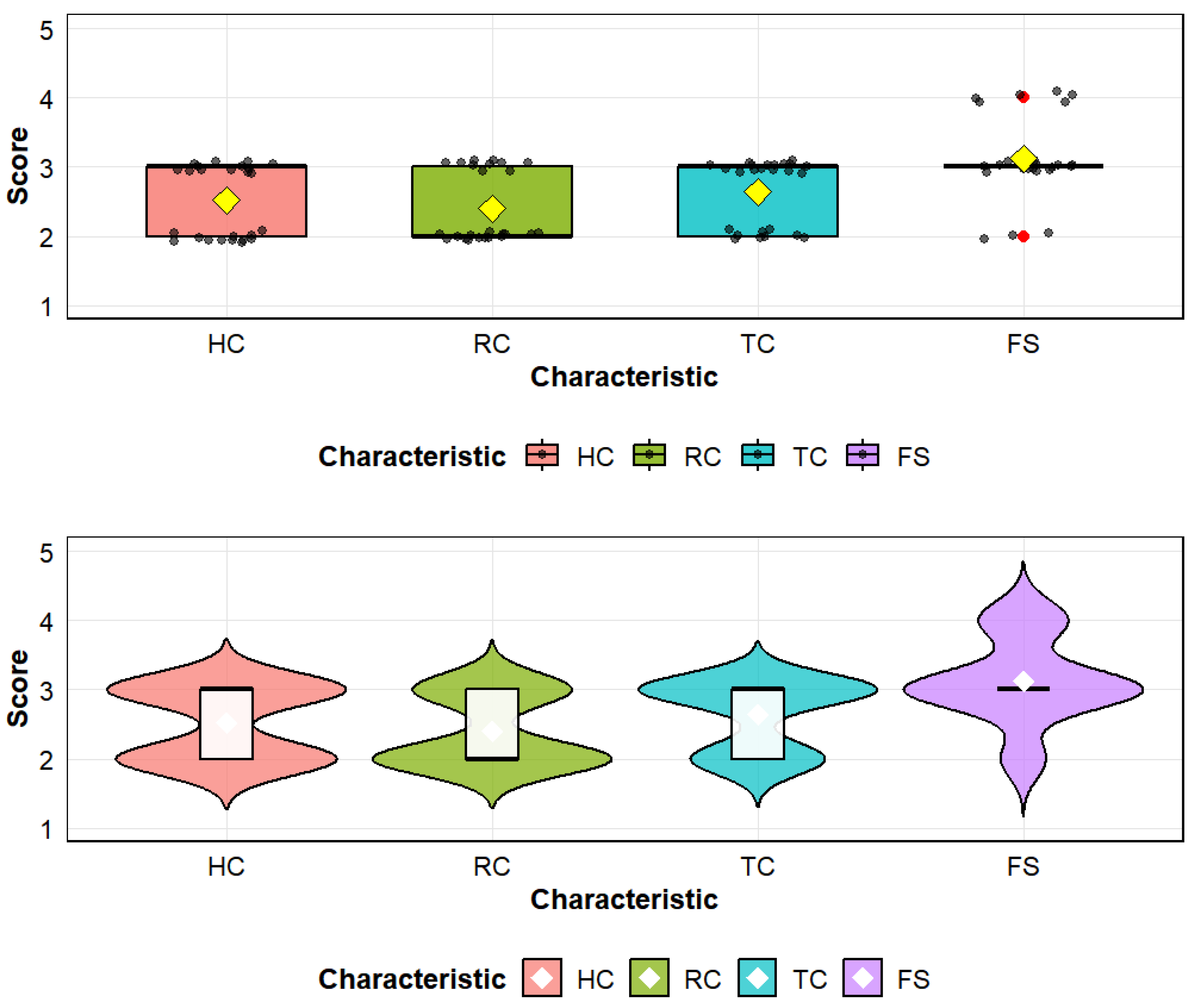
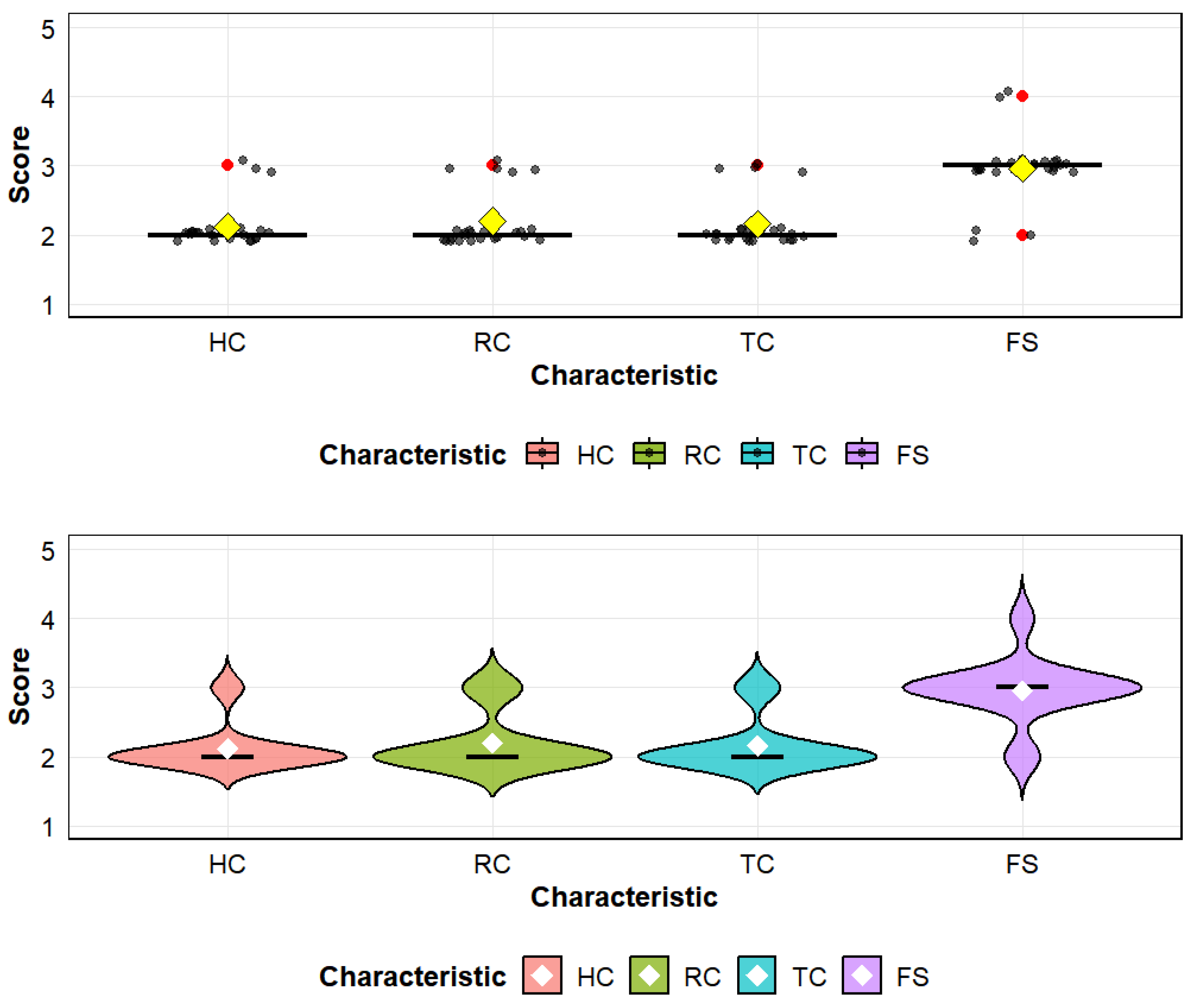
Data were collected from two cohorts of music students, each comprising 25 participants. Each student was instructed to score the four musical characteristics (HC, RC, TC, and FS) based on the music they heard, and further specify the music’s genre. The data for Group 1 and Group 2 can be accessed separately in the GitHub repository: https://github.com/zoewang9527/music-characteristics.git (accessed on 21 October 2025). To gain an intuitive grasp of the data distributions underlying our statistical tests, see Figure 1 and Figure 2, which provide graphical illustrations of Group 1 and Group 2, respectively.

4.1.2. Uncertain Hypothesis Test of Music Data with Conservative Hypothesis Test

In this section, we analyze the difference between the two population means using the aforementioned uncertain hypothesis test. Given the four characteristics of the same type of music, we implement the uncertain hypothesis test introduced in Section 3.3. Specifically, we conduct the test separately for each of the four characteristics. For the test of harmonic complexity, we have
e 1 = 2.52 , σ 1 = 0.51 , e 2 = 2.12 , σ 2 = 0.33 .
For the test of rhythmic complexity, we have
e 1 = 2.40 , σ 1 = 0.50 , e 2 = 2.20 , σ 2 = 0.41 .
For the test of texture complexity
e 1 = 2.64 , σ 1 = 0.49 , e 2 = 2.21 , σ 2 = 0.40 .
For the test of formal structure
e 1 = 3.12 , σ 1 = 0.60 , e 2 = 2.96 , σ 2 = 0.45 .
And we set α = 0.05 and then use the conservative hypothesis test developed in this paper. The detailed information can be checked in Table 1. In other words, we will conclude that the two groups have no difference on the score for the music of same type.

4.2. Case 2: Evaluation of Criteria on Music Scores with Different Types

4.2.1. Data Set

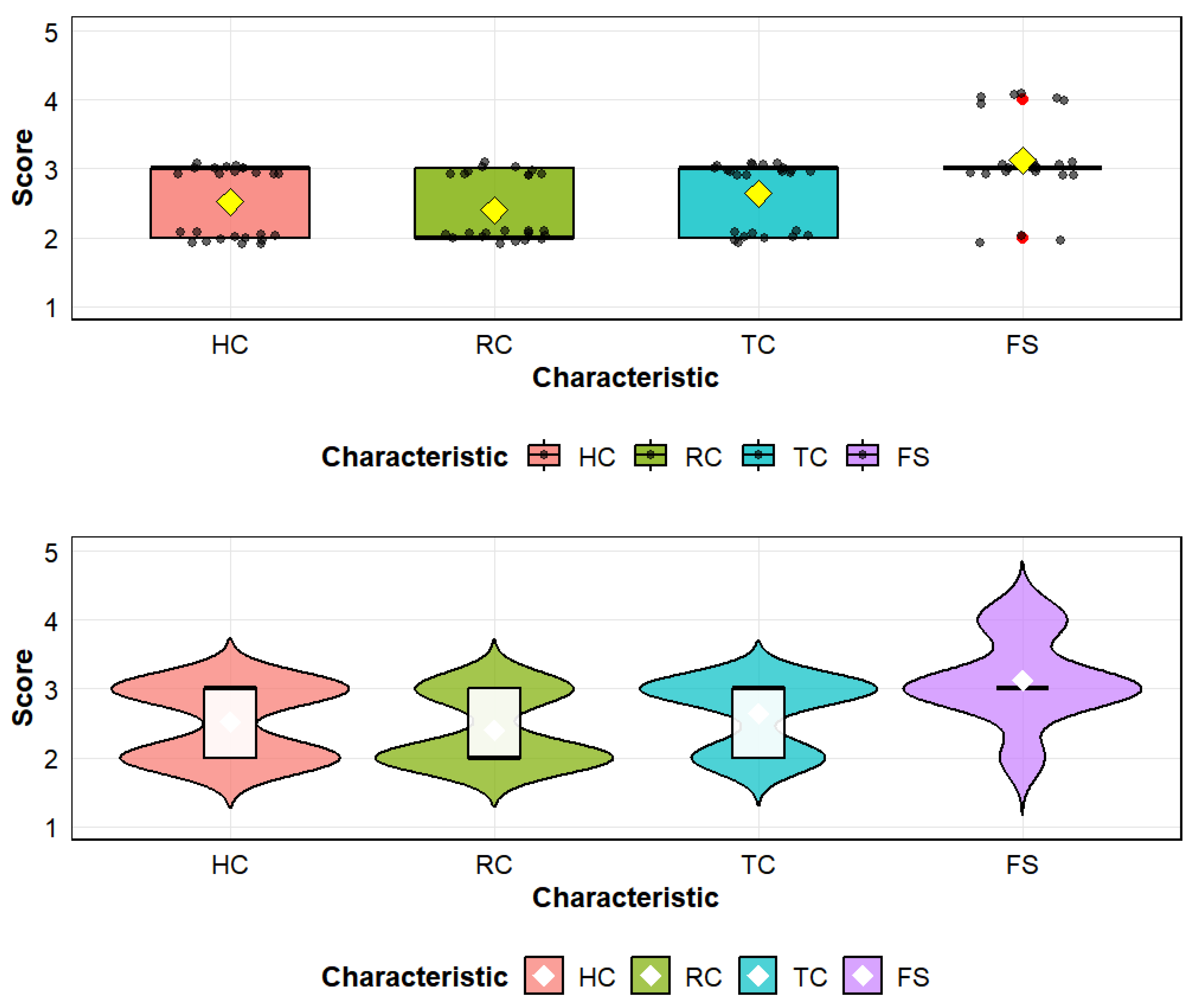
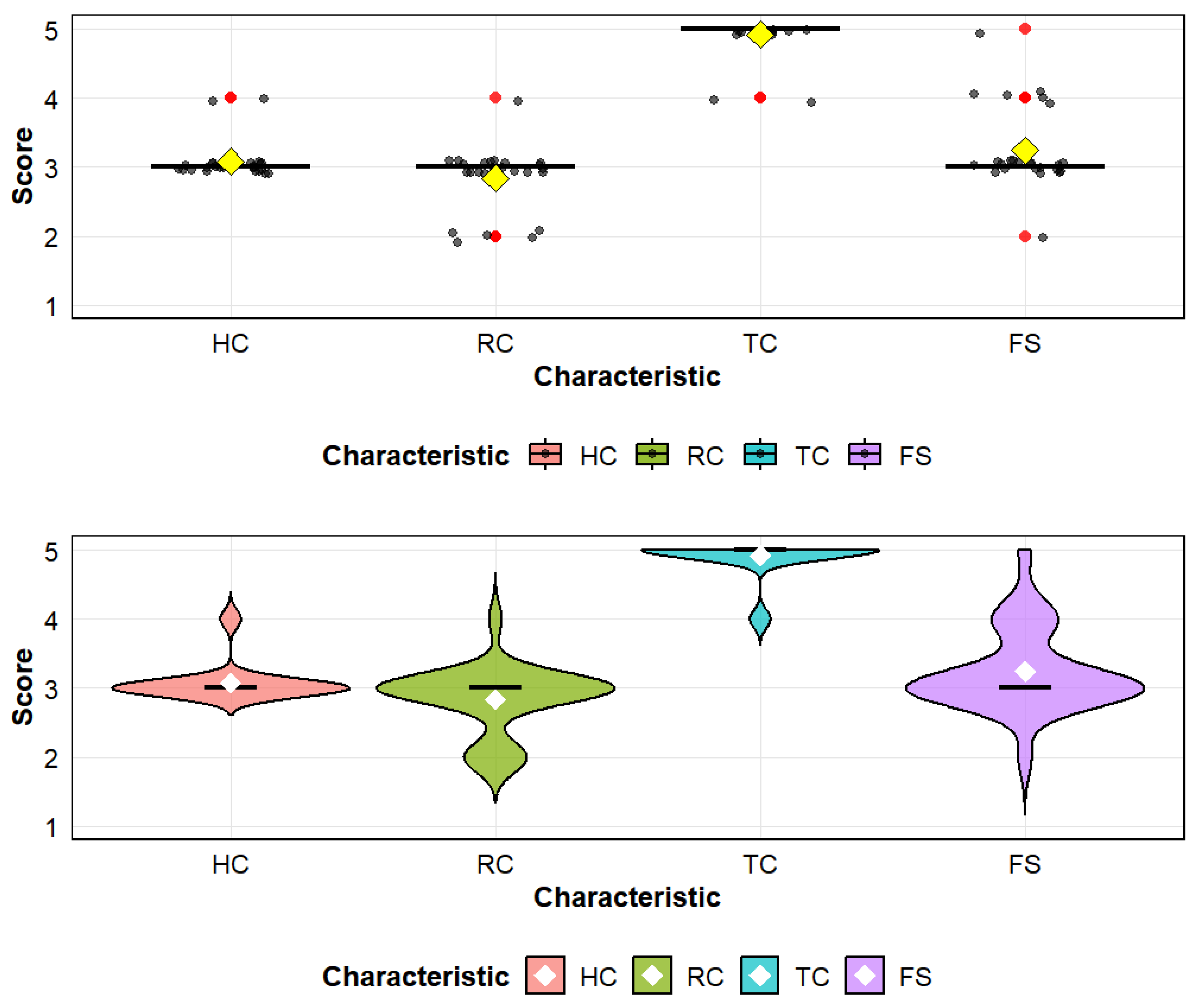
Data were gathered from two cohorts of music students (25 per group). Each student was instructed to rate the relevant musical characteristics and subsequently specify the music types. Group 3 and Group 4 data can be accessed separately at https://github.com/zoewang9527/music-characteristics.git (accessed on 21 October 2025). To gain an intuitive grasp of the data distributions supporting our statistical tests, see Figure 3 and Figure 4—graphical illustrations of Group 3 and Group 4, respectively.

4.2.2. Uncertain Hypothesis Test of Music Data with Conservative Hypothesis Test

With the same procedure as used in Section 4.1.2, we implement the hypothesis test for the corresponding data as follows:
For the test of harmonic complexity, we have
e 1 = 2.52 , σ 1 = 0.51 , e 2 = 3.08 , σ 2 = 0.28 .
For the test of rhythmic complexity, we have
e 1 = 2.40 , σ 1 = 0.50 , e 2 = 2.84 , σ 2 = 0.47 .
For the test of texture complexity
e 1 = 2.64 , σ 1 = 0.49 , e 2 = 4.92 , σ 2 = 0.28 .
For the test of formal structure
e 1 = 3.12 , σ 1 = 0.60 , e 2 = 3.20 , σ 2 = 0.50 .
And we set the significance level α = 0.05 and then use the multiple comparisons procedures test. The detailed information can be checked in Table 2. In other words, we conclude that the two groups employ different criteria when scoring music of different genres.

5. Conclusions

As a key issue in uncertain statistics, uncertain hypothesis testing is a technique designed to assess the validity of a hypothesis based on observed data that conforms to an uncertain distribution. This study introduces a novel uncertain hypothesis testing method: the conservative hypothesis test. By incorporating multiple comparison procedures, this method effectively addresses complex multivariate uncertain data. Its effectiveness is demonstrated through successful application to music statistical data. By integrating uncertain statistics with hypothesis testing, we present a novel analytical approach tailored to multivariate uncertain data characterized by ambiguity.
Future research could explore extending these models to other domains where uncertainty exerts a significant influence on data interpretation. By leveraging an interdisciplinary lens, this technique showcases the versatility of uncertainty theory, arming researchers with a feasible framework to unpack the subjective and unpredictable facets of music reception. In doing so, it expands the potential influence of our findings across diverse fields.

Author Contributions

Conceptualization, A.L.; data curation, W.Z.; methodology, A.L.; supervision, A.L. and W.Z.; writing—original draft, J.W. and S.Y. All authors have read and agreed to the published version of the manuscript.

Funding

This research received no external funding.

Data Availability Statement

All the data used in this work is available via https://github.com/zoewang9527/music-characteristics.git (accessed on 21 October 2025).

Acknowledgments

The authors especially thank the editors and anonymous referees for their kindly review and helpful comments. Any remaining errors are ours.

Conflicts of Interest

We declare that we have no relevant or material financial interests that relate to the research described in this paper. Neither the entire paper nor any part of its content has been published or accepted elsewhere. It is also not being submitted to any other journal.

References

  1. Liu, B. Uncertainty Theory; Springer: Berlin, Germany, 2007. [Google Scholar]
  2. KaiIneman, D.; Tversky, A. Prospect theory: An analysis of decision under risk. Econometrica 1979, 47, 363–391. [Google Scholar] [CrossRef]
  3. Liu, B. Uncertainty Theory: A Branch of Mathematics for Modeling Human Uncertainty; Springer: Berlin, Germany, 2010. [Google Scholar]
  4. Yao, K.; Liu, B. Uncertain regression analysis: An approach for imprecise observations. Soft Comput. 2018, 22, 5579–5582. [Google Scholar] [CrossRef]
  5. Li, A.; Lio, W. Bayesian inference in the framework of uncertainty theory. J. Ambient. Intell. Humaniz. Comput. 2024, 15, 2901–2908. [Google Scholar] [CrossRef]
  6. Ye, T.; Liu, B. Uncertain hypothesis test with application to uncertain regression analysis. Fuzzy Optim. Decis. Mak. 2022, 21, 157–174. [Google Scholar] [CrossRef]
  7. Ruditsa, R. Relative musical pitch in formal definition. Proc. Worldw. Music. Conf. 2021, 2, 3–17. [Google Scholar]
  8. Schuijer, M. Analyzing Atonal Music: Pitch-Class Set Theory and Its Contexts; University Rochester Press: Rochester, NY, USA, 2008. [Google Scholar]
  9. Perez, A. How do artificial neural networks classify musical triads? A case study in eluding bonini’s paradox. Cogn. Sci. 2023, 47, e13233. [Google Scholar] [CrossRef] [PubMed]
  10. Dawson, M.R. Artificial neural networks solve musical problems with fourier phase spaces. Sci. Rep. 2020, 10, 7151. [Google Scholar] [CrossRef] [PubMed]
  11. Abarca, J.A.L. Four axioms for a theory of rhythmic sets and their implications. Online J. Music. Sci. 2023, 8, 226–237. [Google Scholar] [CrossRef]
  12. Lu, J.; Zhou, L.; Zeng, W.; Li, A. Music statistics: Uncertain logistic regression models with applications in analyzing music. Fuzzy Optim. Decis. Mak. 2024, 23, 637–654. [Google Scholar] [CrossRef]
  13. Liu, B. Some research problems in uncertainty theory. J. Uncertain Syst. 2009, 3, 3–10. [Google Scholar]
  14. Anderson, D.R.; Williams, T.A.; Cochran, J.J. Statistics for Business & Economics; Cengage Learning: Boston, MA, USA, 2020. [Google Scholar]
Figure 1. The graphical representations of group 1.
Symmetry 17 01973 g001
Figure 2. The graphical representations of group 2.
Symmetry 17 01973 g002
Figure 3. The graphical representations of group 3.
Symmetry 17 01973 g003
Figure 4. The graphical representations of group 4.
Symmetry 17 01973 g004
Table 1. The statistics of the music data for four characteristics.
Variable e 1 σ 1 e 2 σ 2 Test StatisticRejection RegionConclusion
HC2.520.512.120.330.37 R 1 = { z : | z | 2.79 } Accept
RC2.400.502.200.410.22 R 2 = { z : | z | 2.79 } Accept
TC2.640.492.210.400.51 R 3 = { z : | z | 2.79 } Accept
FS3.120.602.960.450.15 R 4 = { z : | z | 2.79 } Accept
Table 2. The statistics of the music data for four characteristics.
Variable e 1 σ 1 e 2 σ 2 Test StatisticRejection RegionConclusion
HC2.520.513.080.280.64 R 1 = { z : | z | 2.79 } Accept
RC2.400.502.840.470.45 R 2 = { z : | z | 2.79 } Accept
TC2.640.494.920.282.96 R 3 = { z : | z | 2.79 } Reject
FS3.120.603.200.500.07 R 4 = { z : | z | 2.79 } Accept
Disclaimer/Publisher’s Note: The statements, opinions and data contained in all publications are solely those of the individual author(s) and contributor(s) and not of MDPI and/or the editor(s). MDPI and/or the editor(s) disclaim responsibility for any injury to people or property resulting from any ideas, methods, instructions or products referred to in the content.