Abstract
The field of geometric function theory has thoroughly investigated starlike functions concerning symmetric points. The main objective of this work is to derive certain geometric properties, such as the starlikeness of order , convexity of order , k-starlikeness, k-uniform convexity, lemniscate starlikeness and convexity, exponential starlikeness and convexity, and pre-starlikeness for the Galué type Struve function (GTSF). Furthermore, the conditions for GTSF belonging to the Hardy space are also derived. The results obtained in this work generalize several results available in the literature.
1. Introduction
Let us consider the disk of radius r to be represented as , and for simplicity, we denote as . Suppose the class of analytic functions f defined on , and normalized by the condition , can be denoted by . If a function is univalent in , and is a starlike domain with respect to the origin, then it is said to be starlike [1]. Analytically,
For ,
The class of the starlike function of order is denoted by . We simply denote as .
Also, if a function is univalent in , and is a convex domain, then the function f is said to be convex [1]. Analytically,
For , the function
We denote the class of convex functions of order by . For , the class of the convex function is simply denoted by .
Kanas and Wiśniowska in [2] introduced the class of k-uniformly convex functions, defined as the collection of functions such that the image of every circular arc contained in , with center , where , is convex and also provided the one variable characterization. Let and , then
According to [3], and .
In [4], Kanas and Wiśniowska had also defined a similar class , related to the starlike functions, known as the k-starlike function.
In the case when , we obtain the known class of starlike functions. For , the class coincides with the class , introduced by Rønning [5]. Geometrically, the class () can be described as () if the image of under the function , is contained in the conic domain , where and is bounded by the curve given by
Some of the widely known subclasses of starlike functions associated with domains that are symmetric with respect to the real axis are the class of lemniscate starlike functions , which was studied by Sokól and Stankiewicz in [6] and the class of starlike functions associated with exponential functions, which was introduced by Mendiratta et al. [7]. These classes are also characterized by the quantities and . A function is said to be lemniscate starlike (lemniscate convex) on if contained in the interior of the region bounded by the right half of the lemniscate of Bernoulli . The classes of lemniscate starlike functions and lemniscate convex functions are denoted by and , respectively. The classes and represent the starlike and convex functions associated with exponential functions, which are given by
where . It can easily be observed that the domains L and are symmetric with respect to the real axis [8]. Geometric function theory shares a close connection with symmetry. For example, both Möbius transformation theory and hyperbolic geometry employ symmetric principles. Furthermore, within function theory, there has been a comprehensive exploration of starlike functions in relation to symmetric points.
One of the special functions that has captured the interest of numerous researchers is the Struve function, along with its generalizations that arise in the field of mathematical physics and engineering. The generalized Struve function [9] is defined as a particular solution of the second-order inhomogeneous differential equation
such that
where . This function generalizes the Struve function of order p for and the modified Struve function of order p for . In [10], Nisar et al. introduced another generalization of the Struve function named the Galué type Struve function (GTSF), defined as
It can be easily seen that the Function (3) is a generalization of (2) and various other special functions frequently used in several branches of mathematics. For example:
- (i)
- If we put and , we obtainwhere is the generalized Struve function defined as (2).
- (ii)
- If we put , and , we obtainwhere is the Bessel function [11].
- (iii)
- If we put and , we obtainwhere is the Struve function of order p.
- (iv)
- If we put , and , we obtainwhere is the Wright function [12].
- (v)
- have a connection with the Fox–Wright function :
- (vi)
- Setting , and , we obtain generalized the Mittag-Leffler function [13]:
The GTSF in (3) does not belong to the class ; thus, we use the following normalization for our study:
It is noteworthy that research on special functions, such as the Struve functions, is a broad and ongoing field. Scholars subsequent to Struve have persisted in investigating diverse aspects, uses, and expansions of these functions. Further studies have broadened our knowledge and application of Struve functions in a variety of domains, such as engineering, physics, and mathematical analysis. The GTSF also plays a significant role in mathematical analysis, including applications in fractional calculus and integral transformations (see [10,14,15]).
Several researchers have investigated the geometric properties such as univalency, starlikeness, convexity, close to convexity, exponential starlikeness, exponential convexity, and the Hardy space of Struve functions and its generalizations, e.g., [9,16,17,18,19,20,21]. In [22], the strong starlikeness, strong convexity, and uniform convexity properties of GTSF were obtained. Motivated by these developments, we aim, here, to obtain the geometrical properties related to various kinds of starlikeness and convexity for normalized GTSF.
Outline
The rest of this paper is organized as follows. The Lemmas that are used to prove the main results are listed in Section 2. Section 3 contains the results related to the starlikeness and convexity of order and the geometrical properties on for . The k-starlikeness and k-uniform convexity properties are given in Section 4. In Section 5, the starlikeness and convexity associated with the exponential function and lemniscate of Bernoulli for are obtained. The conditions under which the function belongs to the class are provided in Section 6. In Section 7, the results associated with the Hardy space for are presented.
2. Useful Lemmas
This section contains some Lemmas that will be useful in proving the main results.
Lemma 1
([23]). For any real number , the digamma function satisfies the following inequality:
where γ is the Euler–Mascheroni constant.
Lemma 2
([24]). Let and for each , then f is univalent and starlike in .
Lemma 3
([25]). Let and for each , then f is convex in .
Lemma 4
([4]). Assume that with . If
then .
Lemma 5
([2]). Assume that with . If
then .
Lemma 6
([26]). If the function f, convex of order δ, is not of the following form:
for , then the following statements hold true:
- (i)
- If , then , such that .
- (ii)
- If , then .
- (iii)
- , such that .
Here, the notation is associated with the Hardy space described in Section 7.
3. Starlikeness and Convexity of GTSF
In this section, we establish various properties related to starlikeness and convexity for the normalized GTSF. Additionally, some corollaries and examples for particular cases of the GTSF are provided. Initially, we derive conditions for the starlikeness and convexity of order of .
Theorem 1.
Assume that such that . If the following holds true:
- (i)
- ;
- (ii)
then .
Proof.
To establish the required result, it suffices to show that
Now, by a calculation, we have
where
Next, consider the function as
Therefore,
where is given by
From Lemma 1, we obtain
This leads to
This implies that is decreasing on . Also, under the given hypothesis (i), and, thus, for . Consequently, is a decreasing sequence. Now, from (5), we have
Now,
where
Similarly, it can be shown that is a decreasing sequence. Therefore, using (10), we have
Combining (9) and (11), we have
From the condition (ii), the following holds:
Hence, the theorem is proved. □
Corollary 1.
Following are special cases from Theorem 1 when , and μ respectively and 1:
- (i)
- If , then the function is starlike in .
- (ii)
- If , then the function is starlike in .
Example 1.
Following examples can be construct from Theorem 1
- (i)
- is starlike in .
- (ii)
- is starlike in .
Now, in this following theorem, the conditions for the convexity of order are derived for GTSF.
Theorem 2.
Assume that such that . If the following holds true:
- (i)
- ;
- (ii)
then .
Proof.
Clearly, we are finished if we can show that
Now,
where
Now, consider the function as
Therefore,
where is given by
From Lemma 1, we obtain
This leads to
This implies that is decreasing on . Also, under the given hypothesis (i) and, thus, for . Consequently, is decreasing sequence. Now, from (13), we have
Now,
where
By similar arguments, we see that is a decreasing sequence. Therefore, using (18), we have
Finally, using the given hypothesis (ii), the desired result can be established. □
Corollary 2.
If , then the function is convex in .
Example 2.
Following examples can be construct from Theorem 2
- (i)
- is convex in .
- (ii)
- is convex in .
Next, we will obtain the starlikeness and convexity conditions over .
Theorem 3.
Assume that such that . If the following holds true:
- (i)
- ;
- (ii)
then is starlike in .
Proof.
A simple computation gives
where
Now, we define the function as
Therefore,
where
Again, applying Lemma 1, we obtain
Therefore,
Corollary 3.
Following are special cases from Theorem 3 when , and μ respectively 1 and :
- (i)
- If , then the function is starlike in .
- (ii)
- If , then the function is starlike in .
Example 3.
Following examples can be construct from Theorem 3
- (i)
- is starlike in .
- (ii)
- is starlike in .
Theorem 4.
Assume that such that . If the following holds true:
- (i)
- ;
- (ii)
then is convex in .
Proof.
A direct computation gives
where
Now, we define the function as
Differentiation gives
where
Using Lemma 1, we obtain
Thus, we have
We observe that the function is decreasing on and also by hypothesis (i), . So, for all . Now, with the aid of (28) and (29), the function is decreasing. Hence, the sequence is decreasing. Therefore, using (26), we obtain
In view of condition (ii), the proof of this theorem is completed. □
Corollary 4.
If , then the function is convex in .
Remark 1.
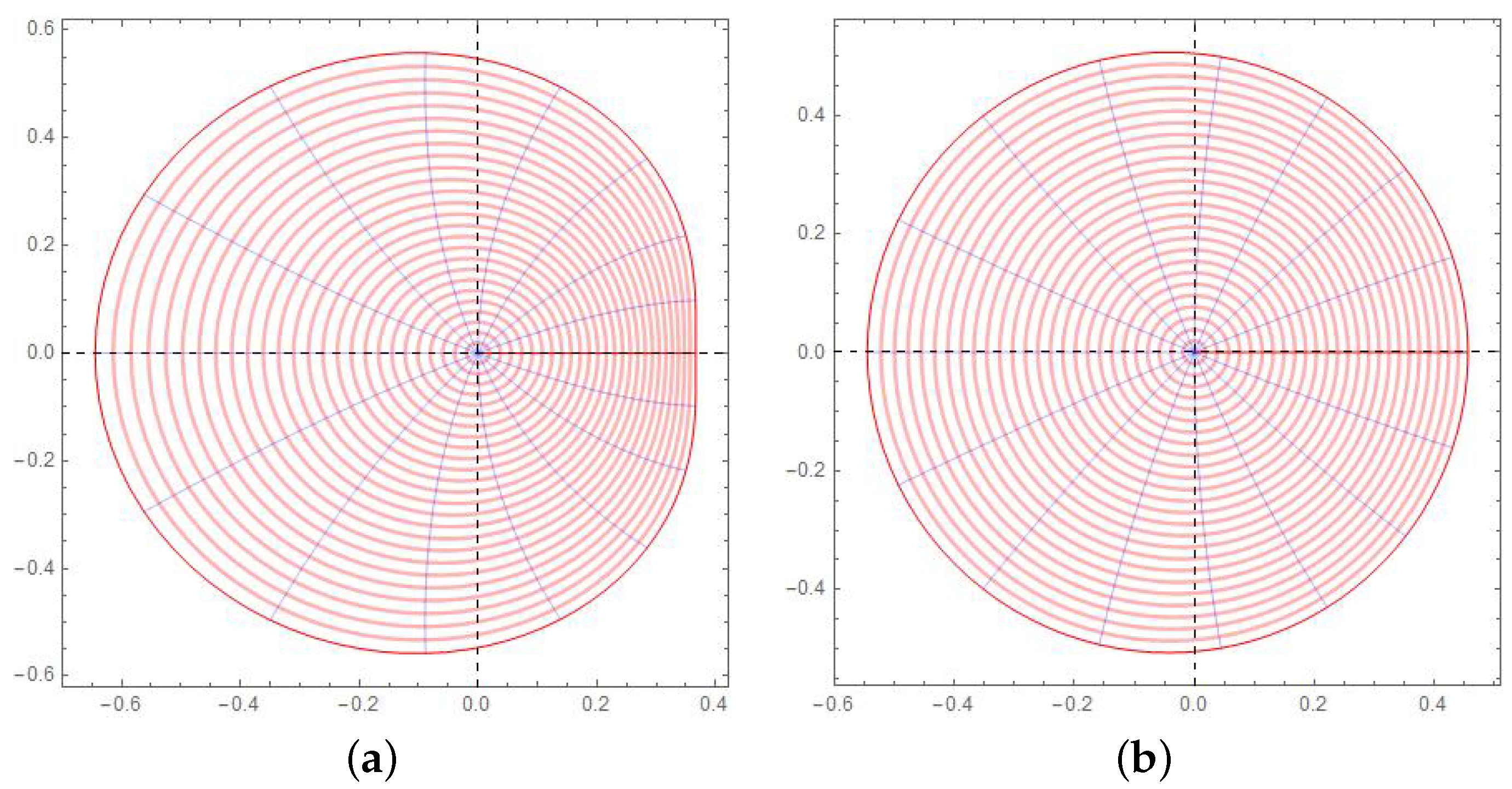
Figure 1.
Starlikeness and convexity of Struve function of order p. (a) Image of under for ; (b) image of under for .
Figure 2.
Starlikeness and convexity of Bessel function of order . (a) Image of under for ; (b) image of under for .
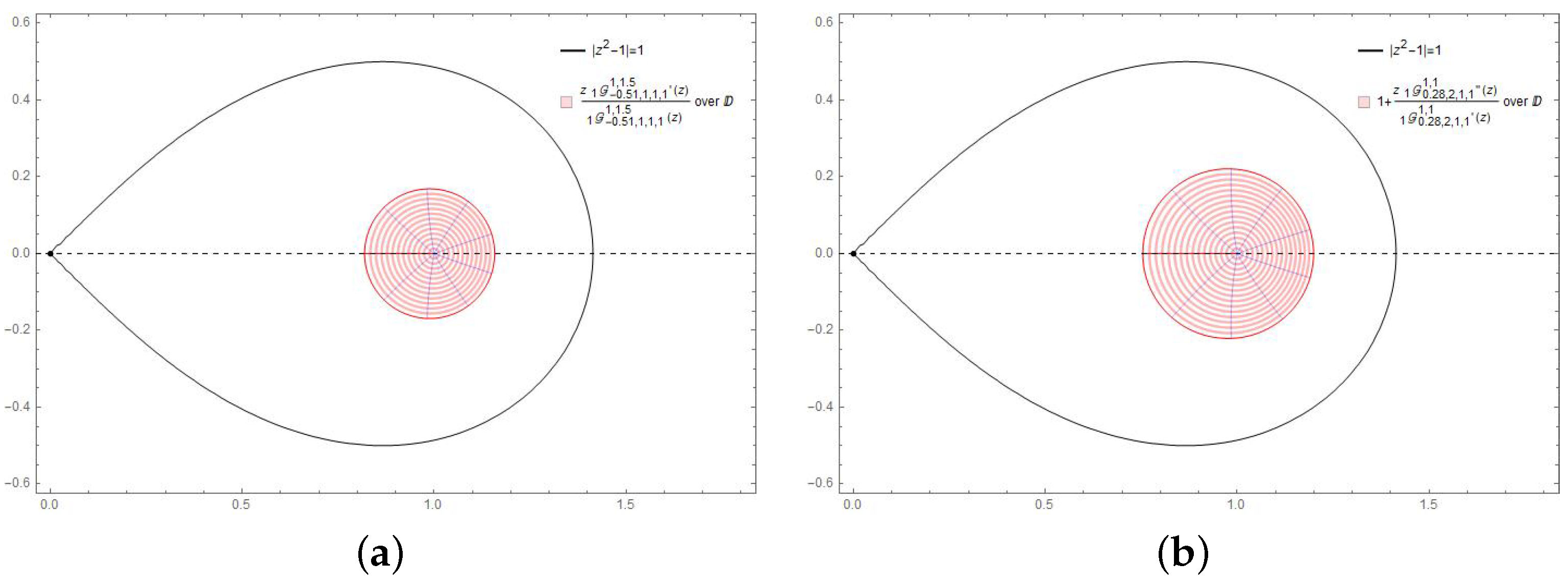
Figure 3.
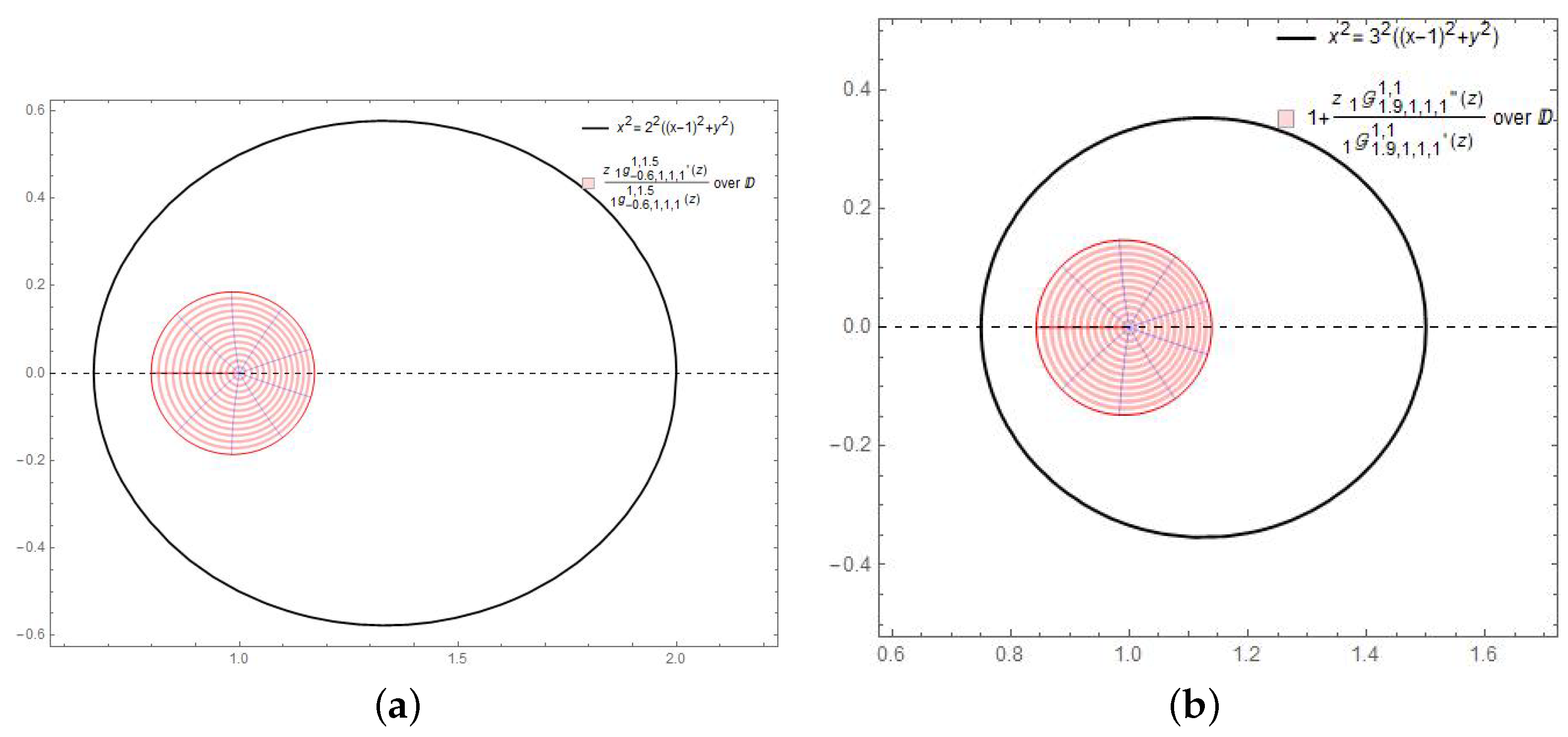
Starlikeness and Convexity in of . (a) Image of under for ; (b) image of under for .
- (i)
- (ii)
- (iii)
- Figure 3a,b visually represent the starlikeness and convexity properties within the domain of .
4. k-Starlikeness and k-Uniform Convexity of GTSF
In this section, the and are discussed.
Theorem 5.
Assume that such that . If the following holds true:
- (i)
- ;
- (ii)
then .
Proof.
According to Lemma 4, it is enough to show that, under the given hypothesis, the following inequality holds:
Let
Now, we define the function as
Therefore,
where
Applying Lemma 1, we obtain
Thus, we have
Hence, the function is decreasing on and also by hypothesis (i), . So, for all . Now, with the aid of (33) and (34), the function is decreasing. Consequently, the sequence is decreasing. Therefore,
From the given condition (ii), Inequality (31) is satisfied and, hence, the theorem is proved. □
Theorem 6.
Assume that such that . If the following holds true:
- (i)
- ;
- (ii)
then .
Proof.
In view of Lemma 5, we show that
Let
Now, we define the function as
Therefore,
where
By using Lemma 1, we have
where
Thus, we have
Hence, the function is decreasing on and also by hypothesis (i), . So, for all . Now, with the aid of (38) and (39), the function is decreasing. Consequently, the sequence is decreasing. Therefore,
From the given condition (ii), Inequality (36) is satisfied and, hence, the theorem is proved. □
5. Starlikeness and Convexity Associated with Exponential Function and Lemniscate of Bernoulli
Theorem 7.
Assume that such that . If the following holds true:
- (i)
- ;
- (ii)
then in .
Proof.
To prove the result, it is sufficient to show that
Theorem 8.
Assume that such that . If the following holds true:
- (i)
- (ii)
then in .
Theorem 9.
Assume that such that . If the following holds true:
- (i)
- ;
- (ii)
then in .
Proof.
To prove the result, it is enough to establish the following inequality:
From a simple computation, we have
where
Now, consider the function
Taking logarithmic differentiation,
where
By use of Lemma 1, we obtain
Since
and , we, therefore, eventually obtain that is a decreasing function on and, hence, the sequence is decreasing. Thus, from (44), the following holds:
Theorem 10.
Assume that such that . If the following holds true:
- (i)
- ;
- (ii)
then in .
Proof.
From (20), we have
Remark 3.
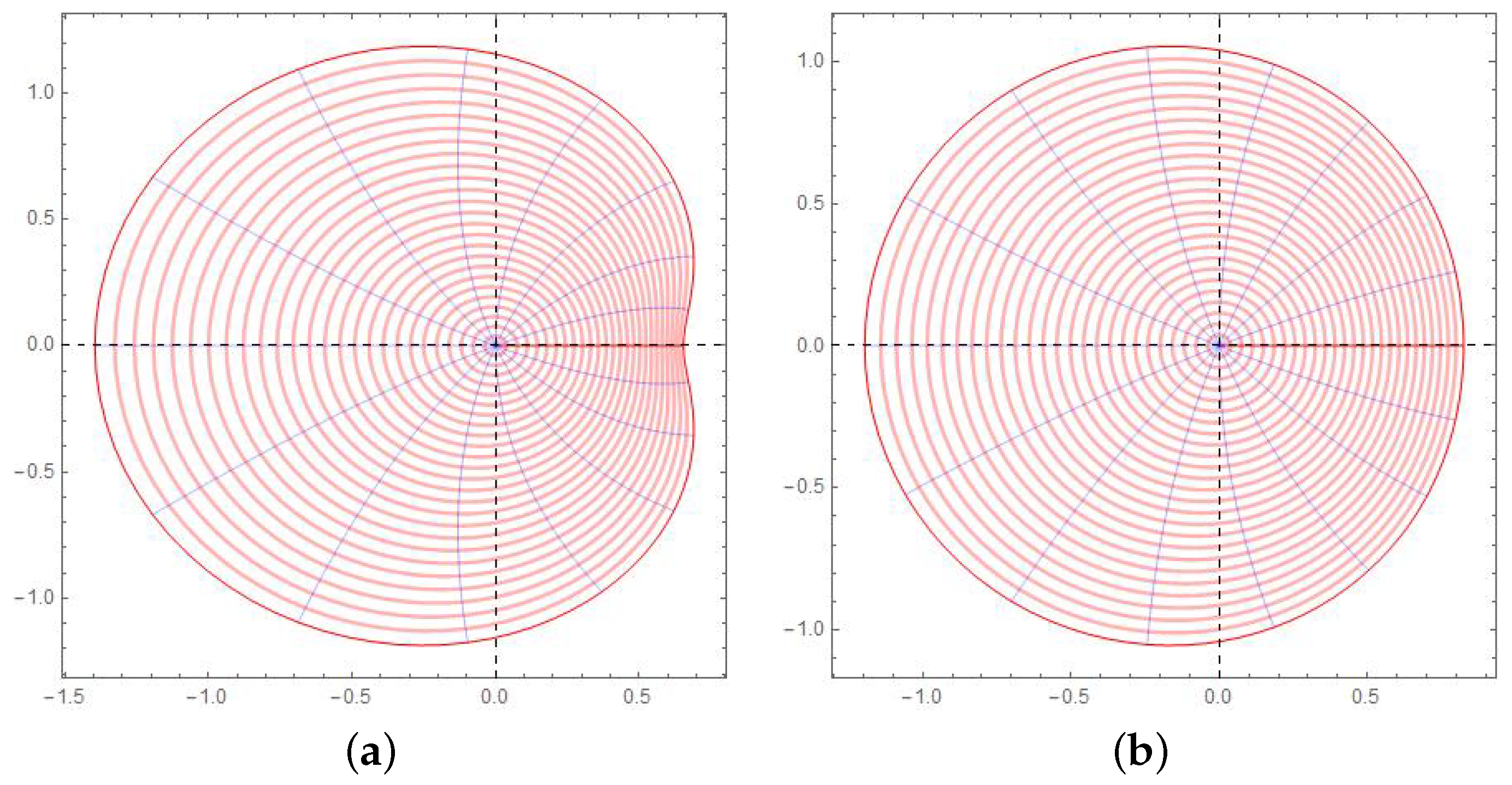
Figure 5.
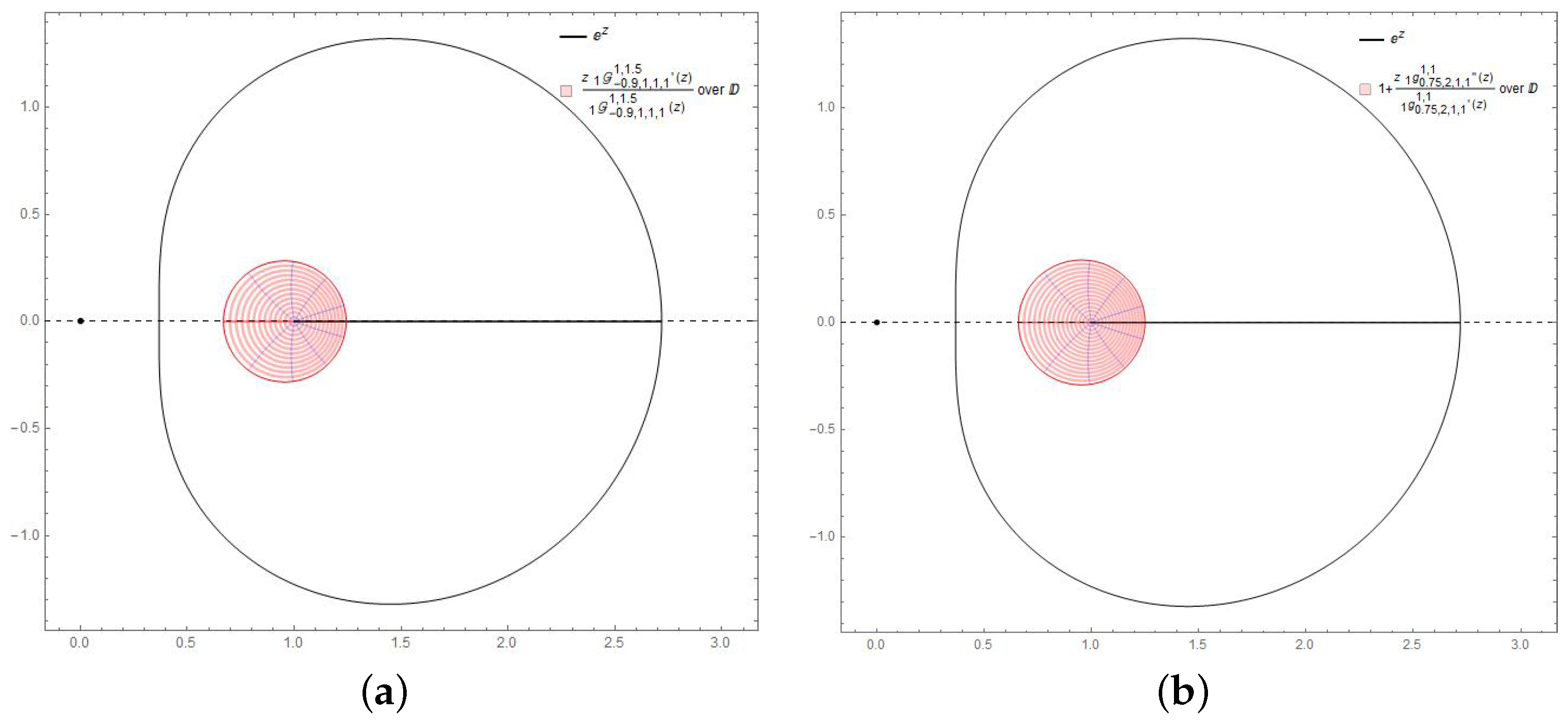
Starlikeness and convexity associated with exponential function of . (a) Image of under for . (b) Image of under for .
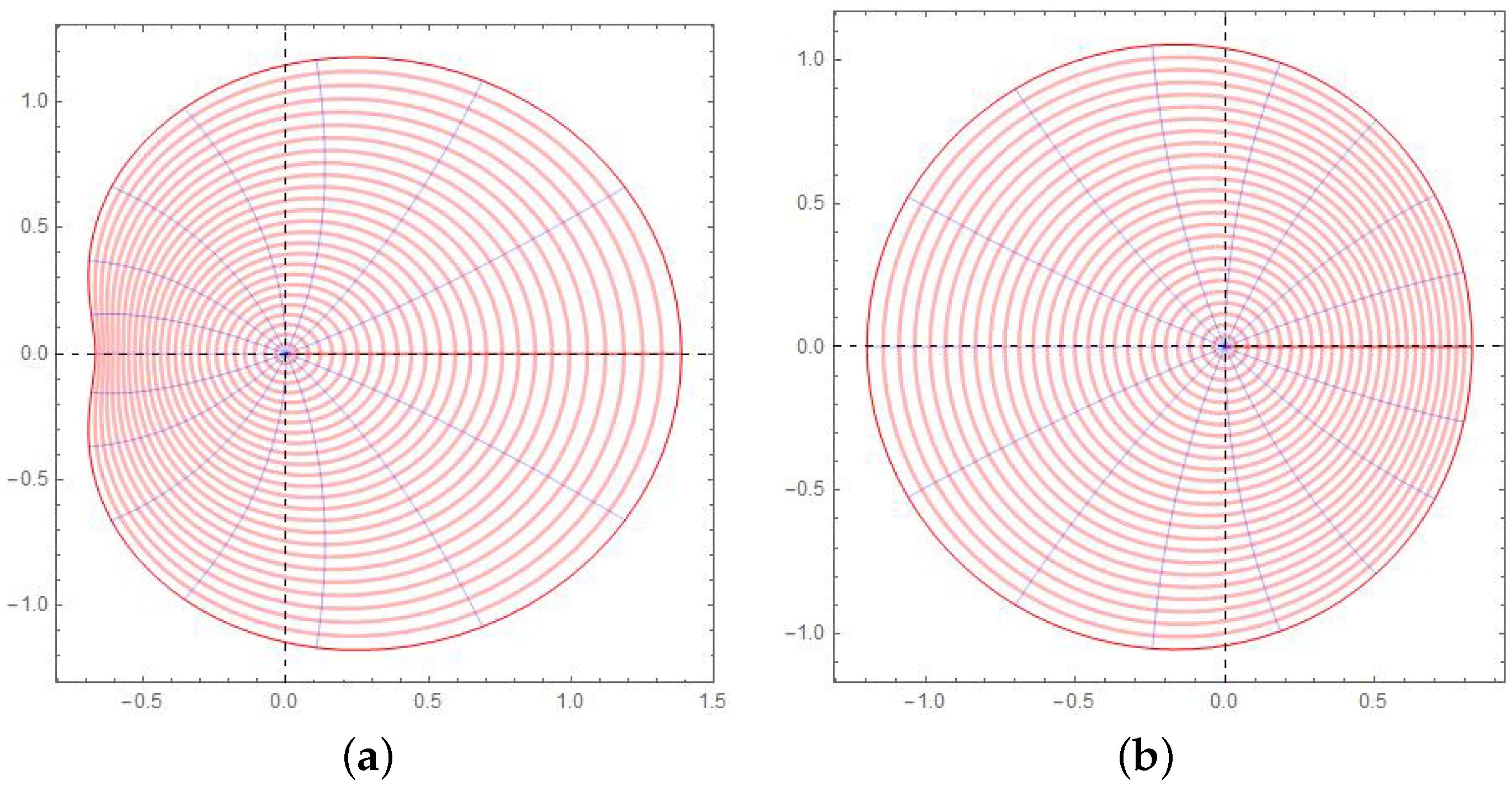
Figure 6.
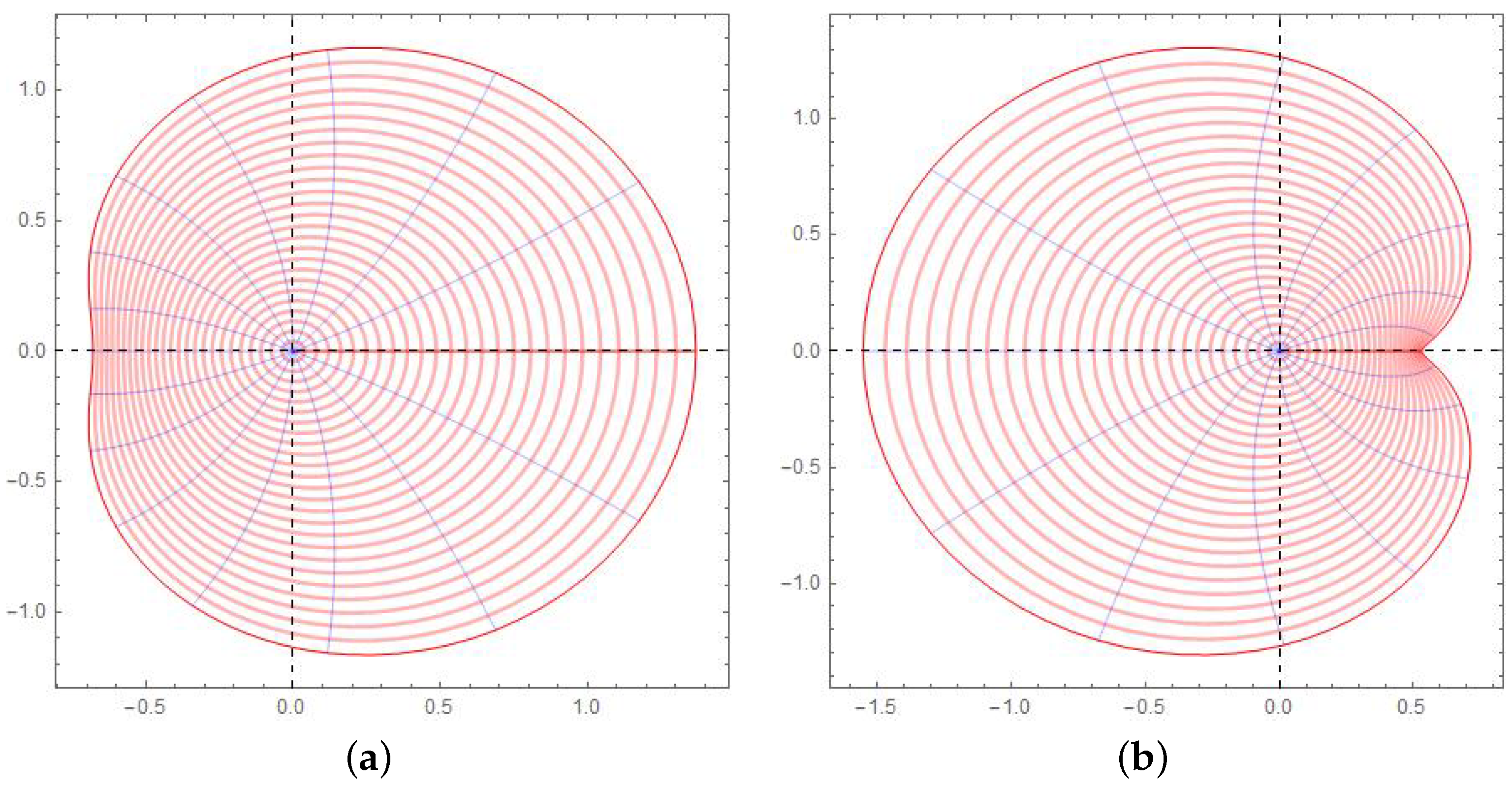
Lemniscate starlikeness and convexity of . (a) Image of under for . (b) Image of under for .
- (i)
- Figure 5a,b illustrate that satisfies the starlikeness and convexity properties associated with the exponential function when the values of the parameters are according to the obtained result.
- (ii)
- The lemniscate starlike and convexity properties are satisfied by when the values of the parameters adhere to the obtained results, as depicted in Figure 6a,b.
6. Pre-Starlikeness
Another important class of function known as pre-starlike functions, introduced by Ruscheweyh [27], is defined in the following manner:
where and denote the Hadamard product of these functions. The concept of pre-starlikeness is extended in [28] by generalizing the class to , which is given by
In the following theorem, we obtain conditions for GTSF belonging to the class .
Theorem 11.
Assume that such that and . If the following holds true:
- (i)
- ;
- (ii)
then .
Proof.
To prove the theorem, we show that by establishing the following inequality:
A calculation yields
where
Let
Differentiating logarithmically,
where
In view of Lemma 1, the inequality follows:
Differentiating , we obtain
Thus, is decreasing on . Also, by the hypothesis (i), . Hence, from (54) and (53), is a decreasing function on . Consequently, is a decreasing sequence. Therefore, from (52),
A simple computation leads to
where
By similar arguments, it can be shown that is a decreasing sequence. Now, using (56), we obtain
Remark 4.
In Figure 7, it can be observed that for suitable parameter values consistent with the obtained results, maps the unit disk onto a starlike domain. Consequently, satisfies the pre-starlikeness property.
Figure 7.
Pre-starlikeness of . (a) Image of under for . (b) Image of under for .
7. Hardy Space of GTSF
Let represent the space of all bounded functions in . We also assume that h is in the class of the analytic functions in domain and set
As per [29], the function h is considered to belong to the Hardy space, denoted as , if is bounded for all and
The study of the Hardy space of Mittag-Leffler functions is presented in [30]. In [31], the results related to the Hardy space for the Fox–Wright function are derived. Additionally, [17] establishes the conditions for generalized Struve functions belonging to the Hardy space. In the following, we demonstrate a direct consequence of convexity for GTSF connected to the Hardy space of analytic functions.
Theorem 12.
Under the conditions in Theorem 2, the following holds:
Also, .
Proof.
Applying Lemma 6, for any , there exists , such that
and if , then
Also, there exists , such that
Now, since for any with , it is implied that . Hence,
Also,
Hence, the proof is completed. □
8. Concluding Remarks and Observations
In this article, we established various geometric properties for the normalized Galué type Struve function (GTSF), including the starlikeness of order , convexity of order , k-starlikeness, k-uniform convexity, lemniscate starlikeness and convexity, exponential starlikeness and convexity, and pre-starlikeness. Moreover, Theorem 12 illustrates a direct implication of the convexity of GTSF connected to the Hardy space of analytic functions. Several outcomes derived herein generalize the findings available in prior literature. The findings of this study were supported by interesting examples and graphical representations.
Author Contributions
Conceptualization, S.S. and S.D.; methodology, S.S. and S.D.; software, S.S.; validation, S.S., S.D. and S.R.M.; formal analysis, S.S., S.D. and S.R.M.; investigation, S.S. and S.D.; resources, S.R.M.; writing—original draft preparation, S.S. and S.D.; writing—review and editing, S.S., S.D. and S.R.M.; visualization, S.D.; supervision, S.D. All authors have read and agreed to the published version of this manuscript.
Funding
This work was supported by the Deanship of Scientific Research, Vice Presidency for Graduate Studies and Scientific Research, King Faisal University, Saudi Arabia (Grant No. 5547).
Data Availability Statement
Data are contained within the article.
Acknowledgments
The authors wish to thank the reviewers for suggestions and comments that helped to improve the manuscript.
Conflicts of Interest
The authors declare no conflicts of interest.
References
- Duren, P.L. Univalent Functions. Grundlehren der Mathematischen Wissenschaften [Fundamental Principles of Mathematical Sciences]; Springer-Verlag: New York, NY, USA, 1983; Volume 259. [Google Scholar]
- Kanas, S.; Wisniowska, A. Conic regions and k-uniform convexity. J. Comput. Appl. Math. 1999, 105, 327–336. [Google Scholar] [CrossRef]
- Goodman, A.W. On uniformly convex functions. Proc. Ann. Pol. Math. 1991, 56, 87–92. [Google Scholar] [CrossRef]
- Kanas, S.; Wisniowska, A. Conic domains and starlike functions. Rev. Roum. Math. Pures Appl. 2000, 45, 647–658. [Google Scholar]
- Rønning, F. Uniformly convex functions and a corresponding class of starlike functions. Proc. Am. Math. Soc. 1993, 118, 189–196. [Google Scholar] [CrossRef]
- Sokół, J.; Stankiewicz, J. Radius of convexity of some subclasses of strongly starlike functions. Z. Nauk. Politech. Rzeszowskiej Mat. 1996, 19, 101–105. [Google Scholar]
- Mendiratta, R.; Nagpal, S.; Ravichandran, V. On a subclass of strongly starlike functions associated with exponential function. Bull. Malays. Math. Sci. Soc. 2015, 38, 365–386. [Google Scholar] [CrossRef]
- Gruszecki, L.; Lecko, A.; Murugusundaramoorthy, G.; Sivasubramanian, S. On a Class of Analytic Functions Related to Robertson’s Formula Involving Crescent Shaped Domain and Lemniscate of Bernoulli. Symmetry 2023, 15, 875. [Google Scholar] [CrossRef]
- Yagmur, N.; Orhan, H. Starlikeness and convexity of generalized Struve functions. In Proceedings of the Abstract and Applied Analysis; Hindawi: London, UK, 2013; Volume 2013. [Google Scholar]
- Nisar, K.S.; Baleanu, D.; Qurashi, M.M.A. Fractional calculus and application of generalized Struve function. SpringerPlus 2016, 5, 1–13. [Google Scholar] [CrossRef] [PubMed]
- Srivastava, H.; Manocha, H. Treatise on Generating Functions; John Wiley & Sons, Inc.: New York, NY, USA, 1984; Volume 500. [Google Scholar]
- Wright, E.M. On the coefficients of power series having exponential singularities. J. Lond. Math. Soc. 1933, 1, 71–79. [Google Scholar] [CrossRef]
- Wiman, A. Über den Fundamentalsatz in der Teorie der Funktionen Ea(x). Acta Math. 1905, 29, 191–201. [Google Scholar] [CrossRef]
- Kamarujjama, M.; Khan, O. Computation of new class of integrals involving generalized Galue type Struve function. J. Comput. Appl. Math. 2019, 351, 228–236. [Google Scholar] [CrossRef]
- Suthar, D.; Purohit, S.; Nisar, K. Integral transforms of the Galue type Struve function. TWMS J. Appl. Eng. Math. 2018, 8, 114–121. [Google Scholar]
- Orhan, H.; Yagmur, N. Geometric properties of generalized Struve functions. An. Ştiinţ. Univ. Al. I. Cuza Iaşi. Mat. (N.S.) 2017, 63, 229–244. [Google Scholar] [CrossRef]
- Yagmur, N.; Orhan, H. Hardy space of generalized Struve functions. Complex Var. Elliptic Equat. 2014, 59, 929–936. [Google Scholar] [CrossRef]
- Naz, A.; Nagpal, S.; Ravichandran, V. Exponential starlikeness and convexity of confluent hypergeometric, Lommel, and Struve functions. Mediterr. J. Math. 2020, 17, 204. [Google Scholar] [CrossRef]
- Nisar, K.; Purohit, S.; Mondal, S.R. Generalized fractional kinetic equations involving generalized Struve function of the first kind. J. King Saud-Univ.-Sci. 2016, 28, 167–171. [Google Scholar] [CrossRef]
- Ali, R.M.; Mondal, S.R.; Nisar, K.S. Monotonicity properties of the generalized Struve functions. J. Korean Math. Soc 2017, 54, 575–598. [Google Scholar] [CrossRef]
- Baricz, Á. Geometric properties of generalized Bessel functions. Publ. Math. Debrecen 2008, 73, 155–178. [Google Scholar] [CrossRef]
- Oyekan, E.A. Certain geometric properties of functions involving Galue type Struve function. Ann. Math. Comput. Sci. 2022, 8, 43–53. [Google Scholar]
- Mehrez, K.; Das, S. Logarithmically completely monotonic functions related to the q-gamma function and its applications. Anal. Math. Phys. 2022, 12, 65. [Google Scholar] [CrossRef]
- MacGregor, T.H. The radius of univalence of certain analytic functions. Proc. Am. Math. Soc. 1963, 14, 514–520. [Google Scholar] [CrossRef]
- MacGregor, T.H. A class of univalent functions. Proc. Am. Math. Soc. 1964, 15, 311–317. [Google Scholar] [CrossRef]
- Eenigenburg, P.J.; Keogh, F. The Hardy class of some univalent functions and their derivatives. Mich. Math. J. 1970, 17, 335–346. [Google Scholar] [CrossRef]
- Ruscheweyh, S. Convolutions in Geometric Function Theory; Séminaire de Mathématiques Supérieures [Seminar on Higher Mathematics]; Presses de l’Université de Montréal: Montreal, QC, Canada, 1982; Volume 83, p. 168. [Google Scholar]
- Sheil-Small, T.; Silverman, H.; Silvia, E. Convolution multipliers and starlike functions. J. Anal. Math. 1982, 41, 181–192. [Google Scholar] [CrossRef]
- Duren, P.L. Theory of Hp spaces. In Pure and Applied Mathematics; Academic Press: Cambridge, MA, USA, 1970; Volume 38. [Google Scholar]
- Prajapat, J.K.; Maharana, S.; Bansal, D. Radius of starlikeness and Hardy space of Mittag-Leffler functions. Filomat 2018, 32, 6475–6486. [Google Scholar] [CrossRef]
- Kumar, A.; Mondal, S.R.; Das, S. Certain Geometric Properties of the Fox–Wright Functions. Axioms 2022, 11, 629. [Google Scholar] [CrossRef]
Disclaimer/Publisher’s Note: The statements, opinions and data contained in all publications are solely those of the individual author(s) and contributor(s) and not of MDPI and/or the editor(s). MDPI and/or the editor(s) disclaim responsibility for any injury to people or property resulting from any ideas, methods, instructions or products referred to in the content. |
© 2024 by the authors. Licensee MDPI, Basel, Switzerland. This article is an open access article distributed under the terms and conditions of the Creative Commons Attribution (CC BY) license (https://creativecommons.org/licenses/by/4.0/).