


Abstract
In order to represent the data with non-monotonic failure rates and produce a better fit, a novel distribution is created in this study using the alpha power family of distributions. This distribution is called the alpha-power Kum-modified size-biased Lehmann type II or, in short, the AP-Kum-MSBL-II distribution. This distribution is established for modeling bounded data in the interval . The proposed distribution’s moment-generating function, mode, quantiles, moments, and stress–strength reliability function are obtained, among other attributes. To estimate the parameters of the proposed distribution, estimation methods such as the maximum likelihood method and Bayesian method are employed to estimate the unknown parameters for the AP-Kum-MSBL-II distribution. Moreover, the confidence intervals, credible intervals, and coverage probability are calculated for all parameters. The symmetric and asymmetric loss functions are used to find the Bayesian estimators using the Markov chain Monte Carlo (MCMC) method. Furthermore, the proposed distribution’s usefulness is demonstrated using three real data sets. One of them is a medical data set dealing with COVID-19 patients’ mortality rate, the second is a trade share data set, and the third is from the engineering area, as well as extensive simulated data, which were applied to assess the performance of the estimators of the proposed distribution.
1. Introduction
In distribution theory, there will always be attempts to generalize distributions. The objective of generalizing distributions is to produce stronger, more flexible models with a wide range of applications. This is achieved through a variety of methods, as evidenced by the great spectrum of work in the literature. The degree to which the chosen distribution fits the input data greatly influences both the analysis and the empirical results; see [1,2,3]. Bounded data with random variables for rates and proportions are widely used in many fields of knowledge, including economics and medicine. Given their asymmetry and/or kurtosis, some authors have recently concentrated on generating distributions defined on the bounded interval using any of the parent distribution modification strategies. Moreover, popular flexible distributions known as “skew-symmetric distributions” are useful for modeling non-normal characteristics such as skewness and kurtosis [3]. We refer to recent studies in [4,5,6,7,8] for a better understanding.
Additionally, this is frequently performed using generators [9,10], combining [11] two distributions, or increasing the baseline distribution by one parameter. These changes are intended to simplify the classical distributions so that they can be applied to the analysis of complicated data structures such as in [12,13,14,15,16,17]. Ref. [18] developed a novel probability distribution by applying the inverse Weibull to the alpha power family of distributions. Ref. [9] also introduced the idea of the T-X family of continuous distributions, which substitutes any continuous random variable’s probability density function (PDF) for the beta distribution’s PDF. A technique for creating continuous single-variable distributions was developed by [10].
The alpha power transformation (APT), a new technique for adding an extra parameter to a continuous distribution, was recently presented by [19]. The major objective of this family was to make use of the non-symmetric behaviour of the parent distribution. Let be the CDF of the continuous random variable X to define the alpha power transformation. The CDF of the APT family is expressed as
The corresponding PDF is
The alpha power transformation has been used by many researchers. Dey et al. [20], for example, applied the exponential and Rayleigh distributions to the alpha power family of distributions to study the new probability distributions. When modelling reliability, researchers such as Mahmood et al. [21] explored the traits and applications of the extended cosine generalized family of distributions. A novel flexible adaptation of the log-logistic distribution was also addressed by Muse et al. [22] to model the COVID-19 death rate. However, it is relevant because it might be preferable to the one-parameter exponential distribution when modeling data with a poor developing hazard rate function (HRF), such as the transmuted M-generated class of distributions that was proposed in [23], and the power M distribution that was investigated in [24].
A few examples of recent developments based on the T distribution include the new M-generated class of distributions elaborated in [25], the exponentiated power M distribution discussed in [26], the inverse power M distribution investigated in [27], and the truncated M-generated family of distributions stressed in [28]. Additionally, refs. [29,30] introduced the unit Teissier distribution and its applications, as well as the use of order statistics to identify extreme values in samples from continuous distributions. Additionally, refs. [18,31,32] employed the same transformation to obtain the alpha power Weibull distribution, alpha power inverse Weibull distribution, alpha power extended exponential distribution, etc.
One of the simplest and most useful lifetime models to be introduced to the scientific community [33] was the Lehmann type I (L-I) and type II (L-II) lifetime model. The Lehmann type I (L-I) model is most typically contested using the power function (PF) distribution. We used the Kumaraswamy modified size-biased Lehmann type II (Kum-MSBL-II) distribution from the study of [34] in this research. The Kumaraswamy modified size-biased Lehmann type II distribution is an enhanced version of the modified size-biased Lehmann type II (MSBL-II) distribution that was first described by [34].
The random variable X is said to be modified size-biased Lehmann type II (MSBL-II) if it possesses the following CDF:
where is a shape parameter.
The CDF and PDF of the Kum-MSBL-II distribution with three shape parameters take the form
and
where are three shape parameters that control the shape and tail behavior of the Kum-MSBL-II distribution.
As a result, significant additions to the body of literature already in existence have been created. Their expanding significance is evidenced by a sharp increase in research publications that suggest novel distributions in the unit interval. There is still insufficient agreement on which distribution is preferred despite the fact that many other distributions have been given and examined.
In this paper, we examine a new distribution called the alpha-power Kum-modified size-biased Lehmann type II (AP-Kum-MSBL-II) distribution, which we extend to the case of bounded random variables on the range. We also study the process of estimating the distribution’s parameters.
The remainder of the essay is structured as follows. The new bounded distribution, survival function, and hazard rate are introduced in Section 2, along with the AP-Kum-MSBL-II distribution. We derive some of its mathematical features in Section 3. The maximum likelihood estimation is shown in Section 4. Section 5 presents the Bayesian method. A simulation exercise is conducted in Section 6 to assess how well the model parameter estimates performed. Section 7 presents three examples that use actual data to show how the suggested approaches can be used. Finally, the conclusions are presented in Section 8.
2. Alpha-Power Kum-Modified Size-Biased Lehmann Type II (AP-Kum-MSBL-II) Distribution
The random variable X is said to have an AP-Kum-MSBL-II distribution if its PDF is of the form
where
and 0 otherwise. By setting in (6), it can be easily verified that
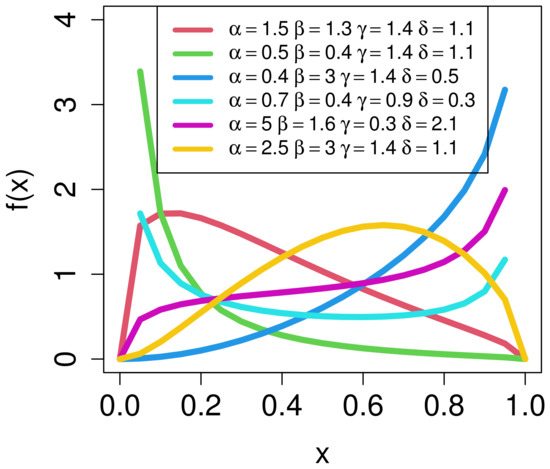
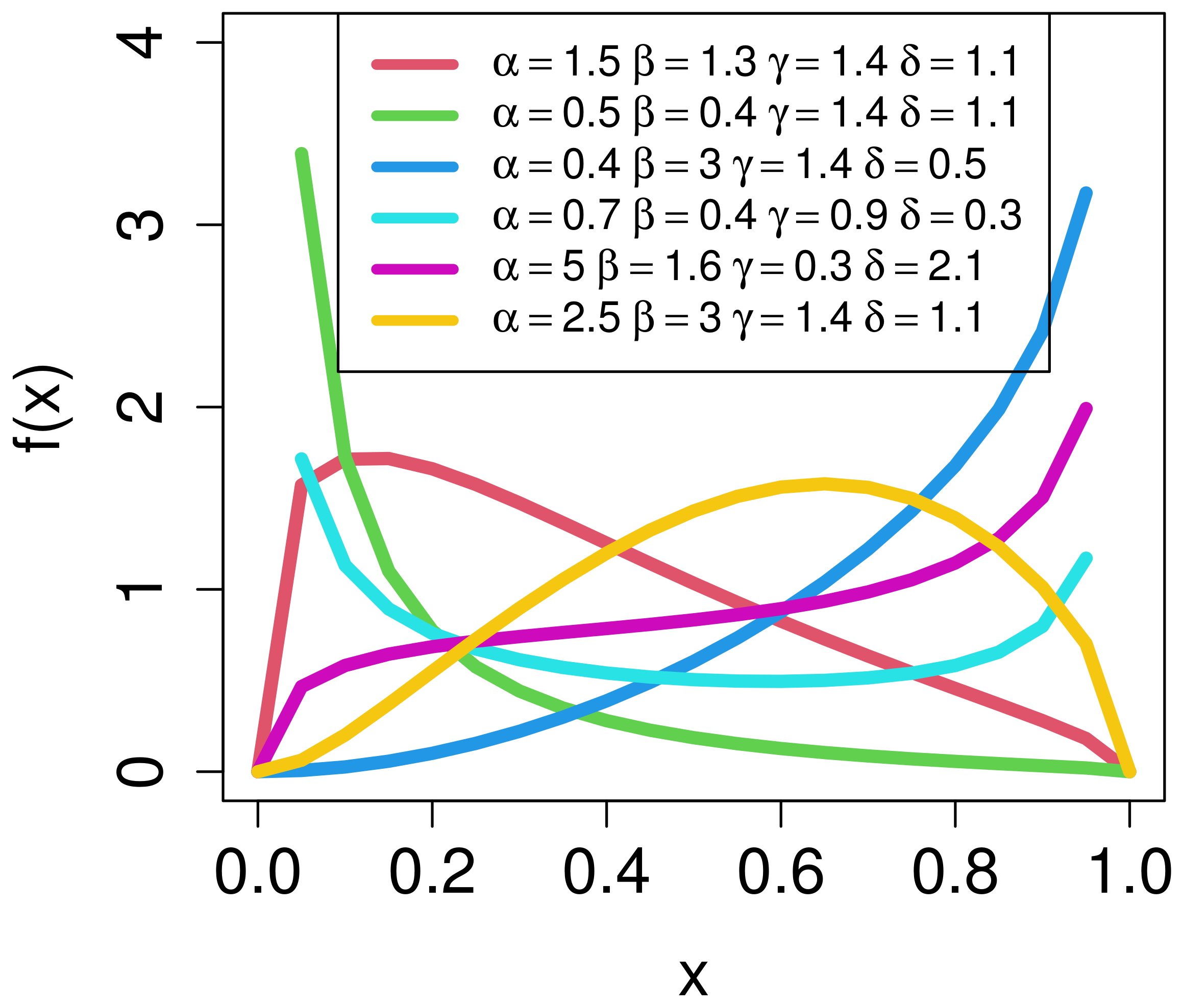
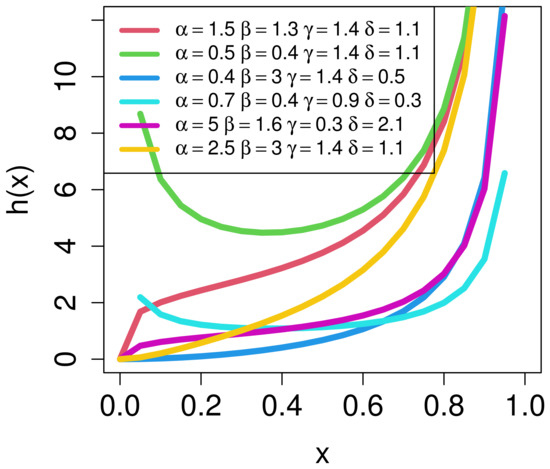
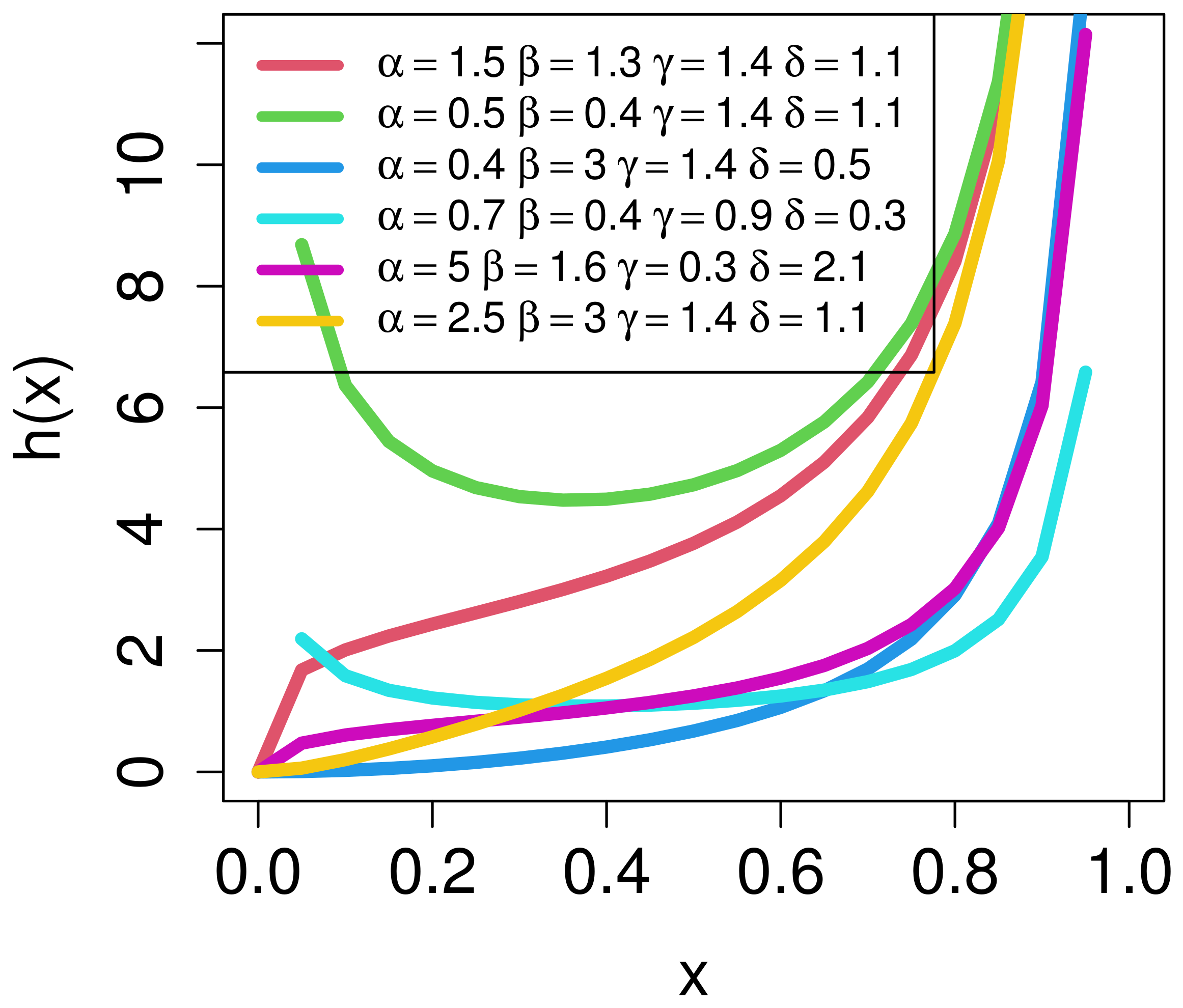
The PDF graphs in Figure 1 for various parameter combinations display a variety of shapes, including reversed J-shaped, U-shaped, left-skewed, and right-skewed. In addition, the UPBXD’s HF shapes Figure 2 include increasing, J-shaped, and bathtub-shaped.
Figure 1.
Probability distribution function of AP-Kum-MSBL-II distribution for different values of parameters.
Figure 2.
Hazard rate function of AP-Kum-MSBL-II distribution for different values of parameters.
The corresponding CDF of the AP-Kum-MSBL-II distribution is
The following, respectively, is how the survival function and hazard rate function are obtained:
3. Mathematical Properties
When calculating the mathematical properties, the linear combination provides a far more easy method of describing the CDF and PDF than the usual integral computation. The following binomial expansions are taken into consideration for this:
From Equations (6) and (7), the PDF and CDF are given as follows
where and .
3.1. Quantile Function
An inverse of the distribution function is what the quantile function is described as. Focus on the identity
where U follows the standard uniform distribution. The quantile of the AP-Kum-MSBL-II distribution is given by
You can calculate the median of the AP-Kum-MSBL-II distribution by setting that is,
3.2. rth Moments
Let X∼AP-Kum-MSBL-II. Then the expression for its rth moments is given as follows
where
Proof.
From the definition of the rth moments, we have
Using integration by parts, we obtain
Using the series representation and beta function in the above equation, we obtain (14). □
3.3. Moment-Generating Function (MGF)
Let X∼AP-Kum-MSBL-II. Then the MGF of the AP-Kum-MSBL-II distribution has the following form
where and is a beta function.
3.4. Mean and Variance
The mean and variance are given, respectively, by
3.5. Stress–Strength Reliability
Suppose and are two continuous and independent random variables, where ∼AP-Kum-MSBL-II and ∼AP-Kum-MSBL-II. Then the stress–strength reliability is defined as
Proof.
□
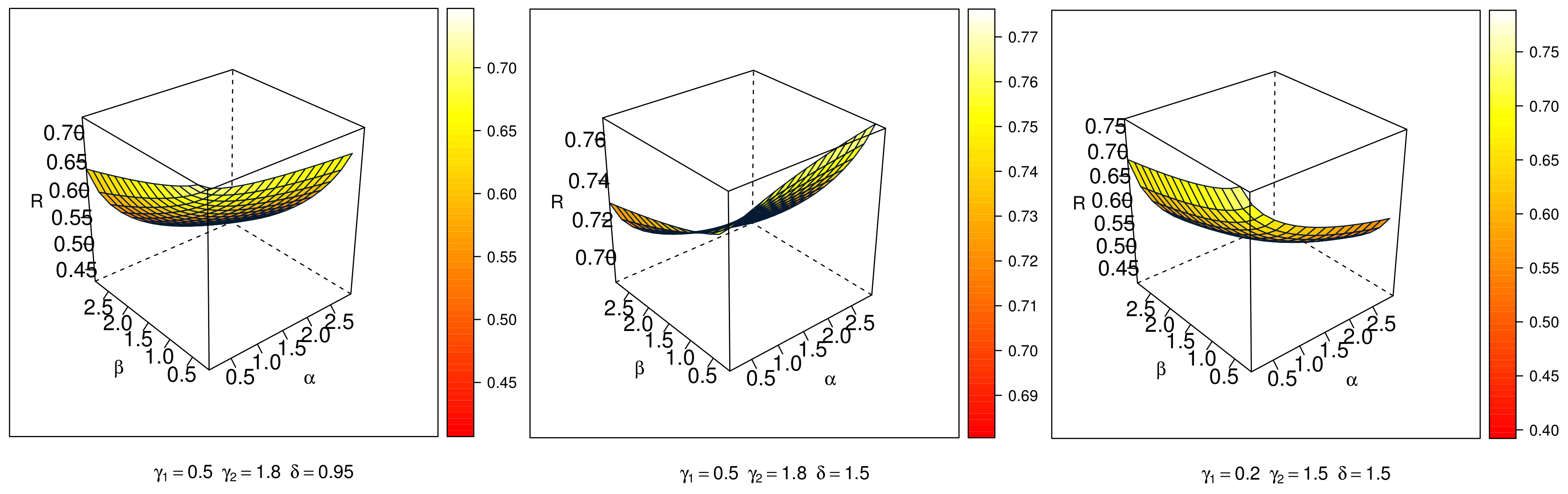
Figure 3.
Stress–strength reliability plots with different parameters.
4. Maximum Likelihood Estimation
Let be a random sample of size n from the PDF of the AP-Kum-MSBL-II model. Then the likelihood function is given by
where .
The log-likelihood function, , reduces to
Taking the derivative of (21) with respect to we have the following equations:
where and
By maximizing (21) or simultaneously resolving the aforementioned non-linear equations, one can derive the maximum likelihood estimates (MLEs) (alpha, beta, gamma, and delta) of X. However, these non-linear equations cannot analytically resolve the MLEs or determine the optimal value of .
5. Bayesian Estimators
In recent years, the Bayesian approach has developed into the most widely used technique in a variety of fields, including but not limited to various applications; for further details see [35,36,37,38]. Its ability to use prior information in the analysis makes it especially useful in reliability and quality studies, where one of the significant variables is reliability; see [39,40]. The Bayes estimates and related credible interval of the model parameters are covered in this section.
5.1. Prior Distribution and Loss Function
The Bayes estimators of the shape parameters , and are obtained under the assumption that they are independent random variables with prior distribution , and , respectively, with PDFs
where and the hyper-parameters and are assumed to be known. The non-normalized joint prior density of , , , and becomes, under the previous assumption,
In Bayesian analysis, the selection of symmetric and asymmetric loss functions is essential. The SEL function, , which is defined as follows, is the most frequently employed symmetric loss function in this study for estimating the considered unknown values.
where is a projection of . The posterior mean of provides the objective estimate under the condition of (27). However, it is simple to implement any additional loss function.
According to Calabria and Pulcini [41], the entropy loss function (ELF) is an acceptable asymmetric loss function. The form’s entropy loss function is thought of as
whose minimum occurs at . Then the Bayes estimator of under the entropy loss function is
5.2. Posterior Analysis
The joint posterior density function is given by
where is a normalizing constant.
Since it is obvious that sampling from this joint posterior distribution is difficult, this study used MCMC techniques, namely the Metropolis Hasting methodology. The computation of the conditional posterior was obtained as follows in order to execute this algorithm:
From (32)–(35), that no known distribution can be analytically reduced to conditional posterior distributions of parameters is obvious. As a result, the Metropolis Hasting algorithm employs normal proposal distributions.
6. Simulation
A Monte Carlo simulation was run using different sample sizes and different choices for the true values of the model parameters , as follows.
For Table 1, Case I: and and Case II: and to assess the performance of the MLE and Bayesian estimates of the AP-Kum-MSBL-II distribution. The steps that make up the simulation technique are as follows:
Table 1.
MLE and Bayesian estimations with different loss functions: Case I.
- Establish the sample size and the beginning parameter values.
- Create an n-sized random sample from the AP-Kum-MSBL-II distribution.
- For MLE, the Newton–Raphson iterative approach is used to solve non-linear equations using the “maxLik” package in the R program. For Bayesian estimation, MCMC is used to solve the complex integration using the “coda” package in the R program.
- Calculate the average estimates, along with their mean squared errors (MSE), relative biases (RB), length of asymptotic confidence intervals (LACI), and coverage probability (CP) with 95%.
- Perform the above two steps 5000 times.
The average RB estimates of (say ) are provided by
The average MSE estimates of are provided by
On the other hand, the length of confidence intervals (LCI) and coverage percentages (CP) of the interval estimations of were used to compare them:
Using Table 1 and Table 2, it was possible to make the following useful findings regarding the lowest RB, MSE, and LCL values as well as the greatest CP values:
Table 2.
MLE and Bayesian estimates with different loss functions: Case II.
- The provided estimates of , and offer good performance, which is the key general point.
- All estimates perform satisfactorily as n increases.
- Based on the gamma information, the Bayes estimates of , and behaved more predictably than the MLE estimate. Regarding the HPD credible intervals, the same statement might be made.
- When increases, the measures of , , and increase, and the measure of decreases.
- In some cases, when increases, the measures of all parameters decrease.
7. Applications
In this section, three real data sets are discussed to check the performance of the AP-Kum-MSBL-II distribution.
7.1. The COVID-19 Application
The COVID-19 data in question are from France and span 108 days from 1 March to 16 June 2021. These data have been discussed by [42], who use a transmuted generalization of the Lomax distribution.
The data are as follows:
“0.0023, 0.0023, 0.0023, 0.0046, 0.0065, 0.0067, 0.0069, 0.0069, 0.0091, 0.0093, 0.0093, 0.0093, 0.0111, 0.0115, 0.0116, 0.0116, 0.0119, 0.0133, 0.0136, 0.0138, 0.0138, 0.0159, 0.0161, 0.0162, 0.0162, 0.0162, 0.0163, 0.0180, 0.0187, 0.0202, 0.0207, 0.0208, 0.0225, 0.0230, 0.0230, 0.0239, 0.0245, 0.0251, 0.0255, 0.0255, 0.0271, 0.0275, 0.0295, 0.0297, 0.0300, 0.0302, 0.0312, 0.0314, 0.0326, 0.0346, 0.0349, 0.0350, 0.0355, 0.0379, 0.0384, 0.0394, 0.0394, 0.0412, 0.0419, 0.0425, 0.0461, 0.0464, 0.0468, 0.0471, 0.0495, 0.0501, 0.0521, 0.0571, 0.0588, 0.0597, 0.0628, 0.0679, 0.0685, 0.0715, 0.0766, 0.0780, 0.0942, 0.0960, 0.0988, 0.1223, 0.1343, 0.1781”
Jäntschi [29] discussed nine measures to select the best distribution model. In this paper, we discussed four important measures: Cramér von Mises, Anderson–Darling, Kolmogorov–Smirnov, and P-value for the AP-Kum-MSBL-II distribution. The different measures discussed include Akaike information, Bayesian information, consistent Akaike information, Hannan–Quinn information, Cramér von Mises, and Anderson–Darling, which are denoted M1, M2, M3, M4, M5, and M6, respectively.
For more information about criterion measures, see [43,44].
Table 3 demonstrates that the AP-Kum-MSBL-II distribution for COVID-19 data has the lowest values of M1, M2, M3, M4, M5, M6, and Kolmogorov–Smirnov distance (KSD), as well as the highest p-value for the Kolmogorov–Smirnov test (PVKS), among all fitted competitive models for the COVID-19 data. As a result, for the provided data sets, the AP-Kum-MSBL-II distribution offers a better fit. Table 4 discusses points and intervals estimated with MLE and Bayesian methods for the COVID-19 data. From the result in Table 4, we note that the Bayesian estimation is better than MLE to estimate the parameters of the AP-Kum-MSBL-II distribution for the COVID-19 data.
Table 3.
MLE for each model with different measures.
Table 4.
MLE and Bayesian estimates for COVID-19 data.
7.2. Determinants of Economic Development Application
The trade share data set, the second data set, considers the values of the trade share variable used in the renowned “Determinants of Economic Development Data” together with factors that may be associated with growth. The growth rates of up to 61 different countries are considered. The information is publicly accessible online according to [45].
The trade share data set consists of the following numbers:
“0.140501976, 0.156622976, 0.157703221, 0.160405084, 0.160815045, 0.22145839, 0.299405932, 0.31307286, 0.324612707, 0.324745566, 0.329479247, 0.330021679, 0.337879002, 0.339706242, 0.352317631, 0.358856708, 0.393250912, 0.41760394, 0.425837249, 0.43557933, 0.442142904, 0.444374621, 0.450546652, 0.4557693, 0.46834656, 0.473254889, 0.484600782, 0.488949597, 0.509590268, 0.517664552, 0.527773321, 0.534684658, 0.543337107, 0.544243515, 0.550812602, 0.552722335, 0.56064254, 0.56074965, 0.567130983, 0.575274825, 0.582814276, 0.603035331, 0.605031252, 0.613616884, 0.626079738, 0.639484167, 0.646913528, 0.651203632, 0.681555152, 0.699432909, 0.704819918, 0.729232311, 0.742971599, 0.745497823, 0.779847085, 0.798375845, 0.814710021, 0.822956383, 0.830238342, 0.834204197, 0.979355395”.
Table 5 demonstrates that the AP-Kum-MSBL-II distribution for the trade share data has the lowest values of M1, M2, M3, M4, M5, M6, and KSD, as well as the highest PVKS, among all fitted competitive models. Table 6 discusses the points and intervals found using MLE and Bayesian methods for the trade share data. From the result in Table 6, we note that the Bayesian estimation is better than MLE to estimate the parameters of the AP-Kum-MSBL-II distribution for the trade share data.
Table 5.
MLE for each model with different measures for trade share data.
Table 6.
MLE and Bayesian estimates for trade share data.
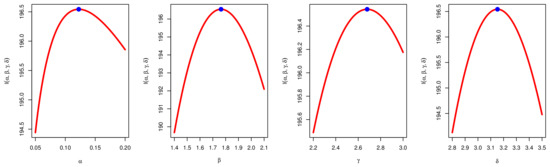
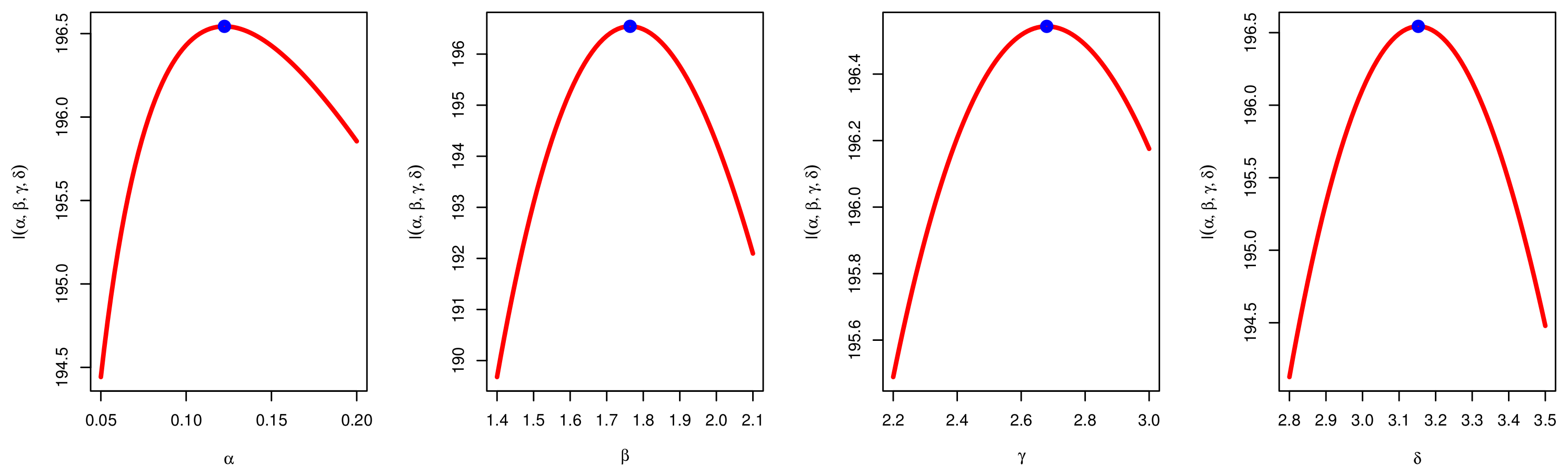
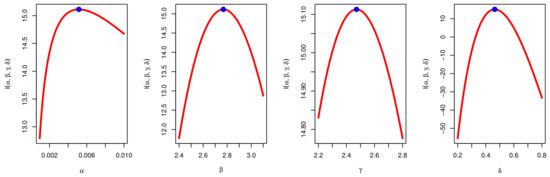
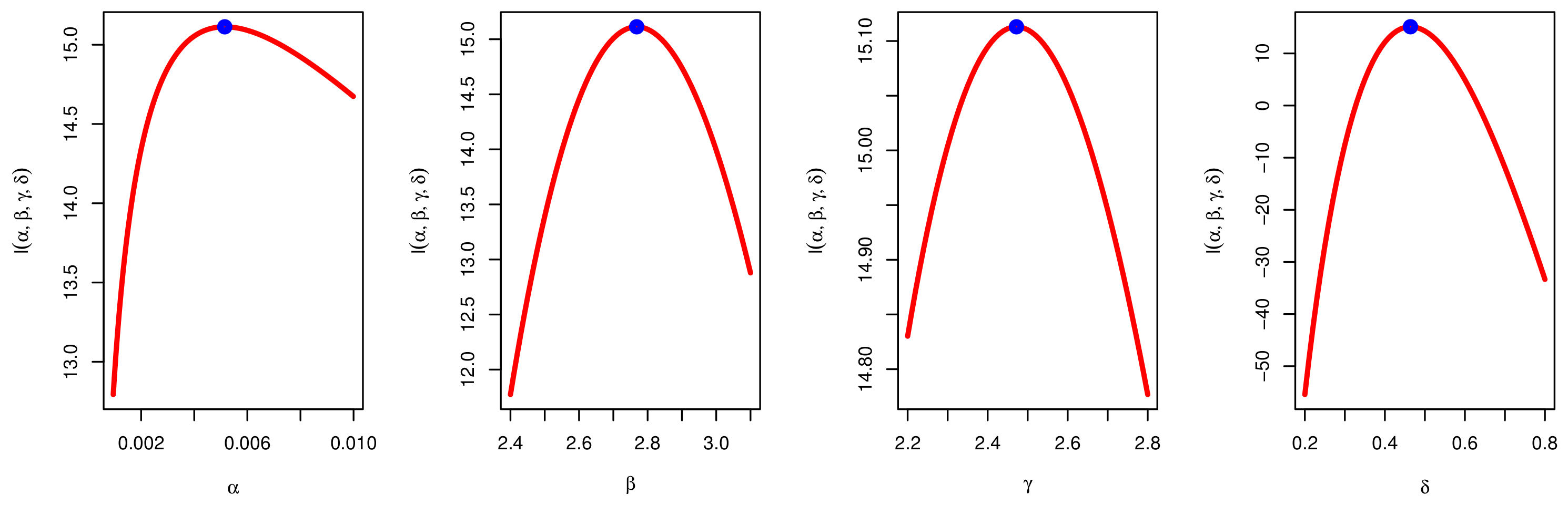
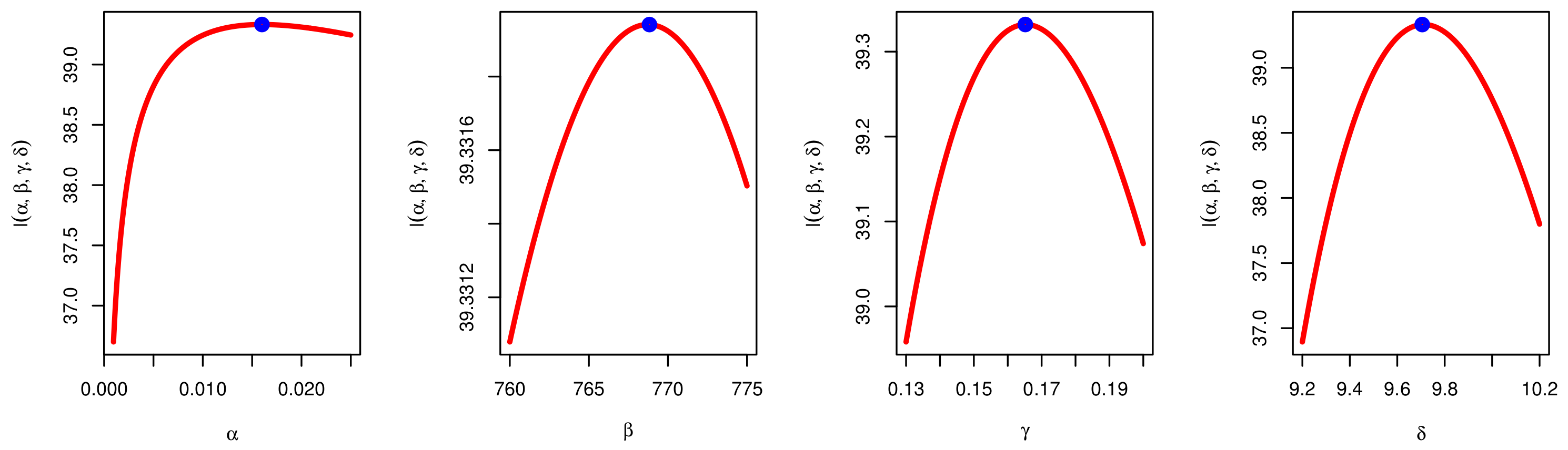
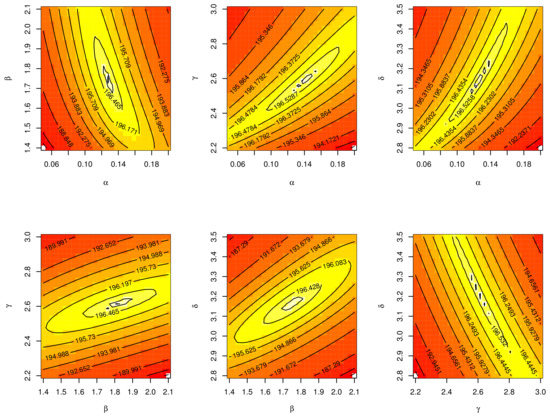
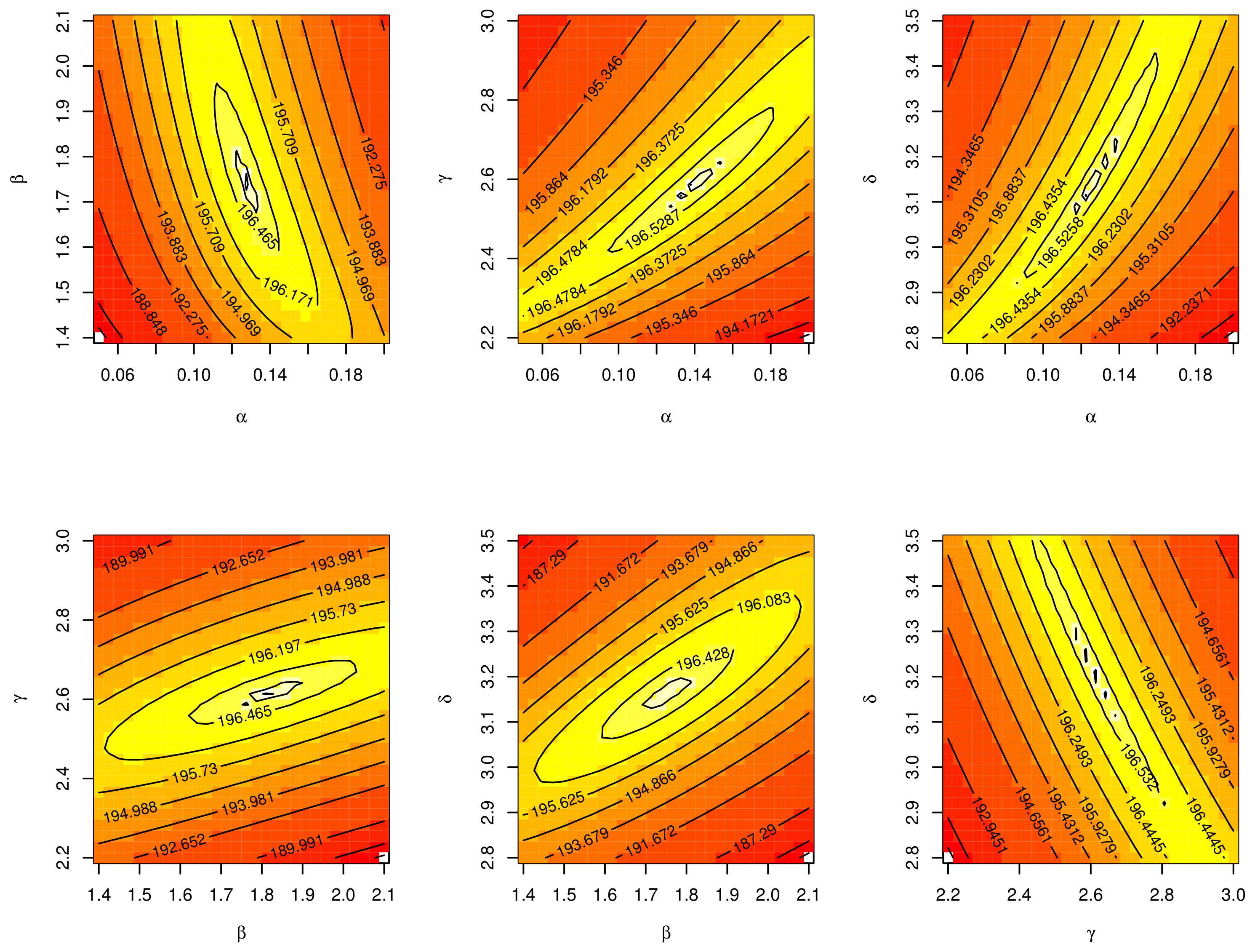
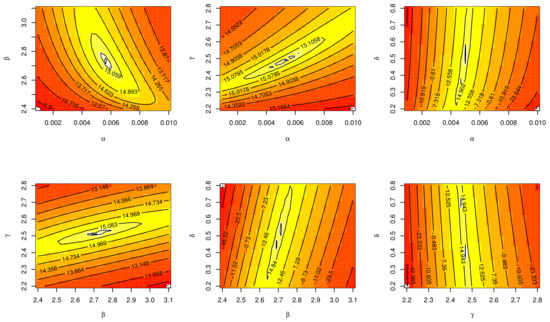
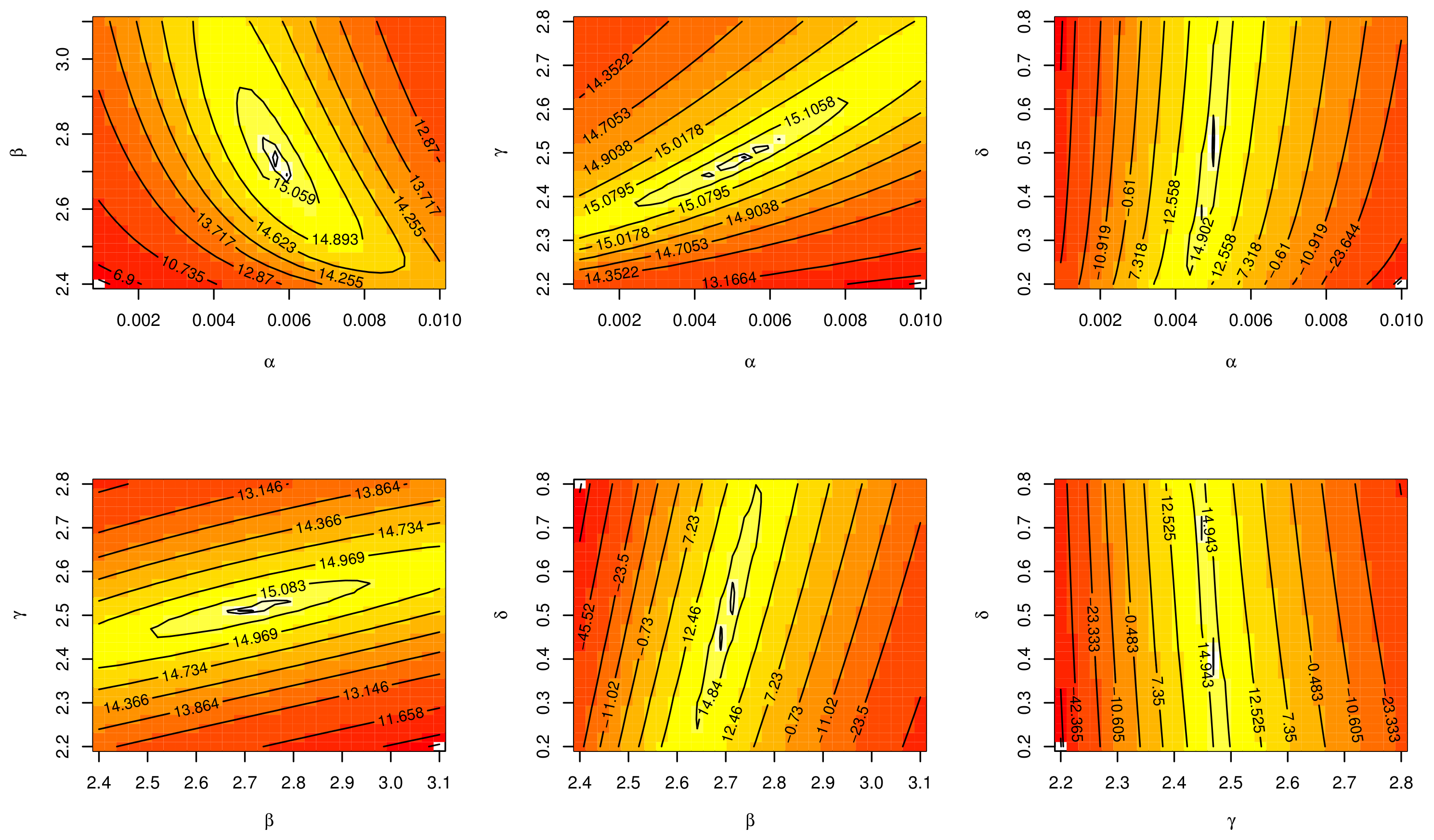
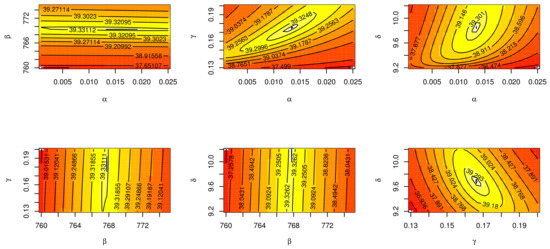
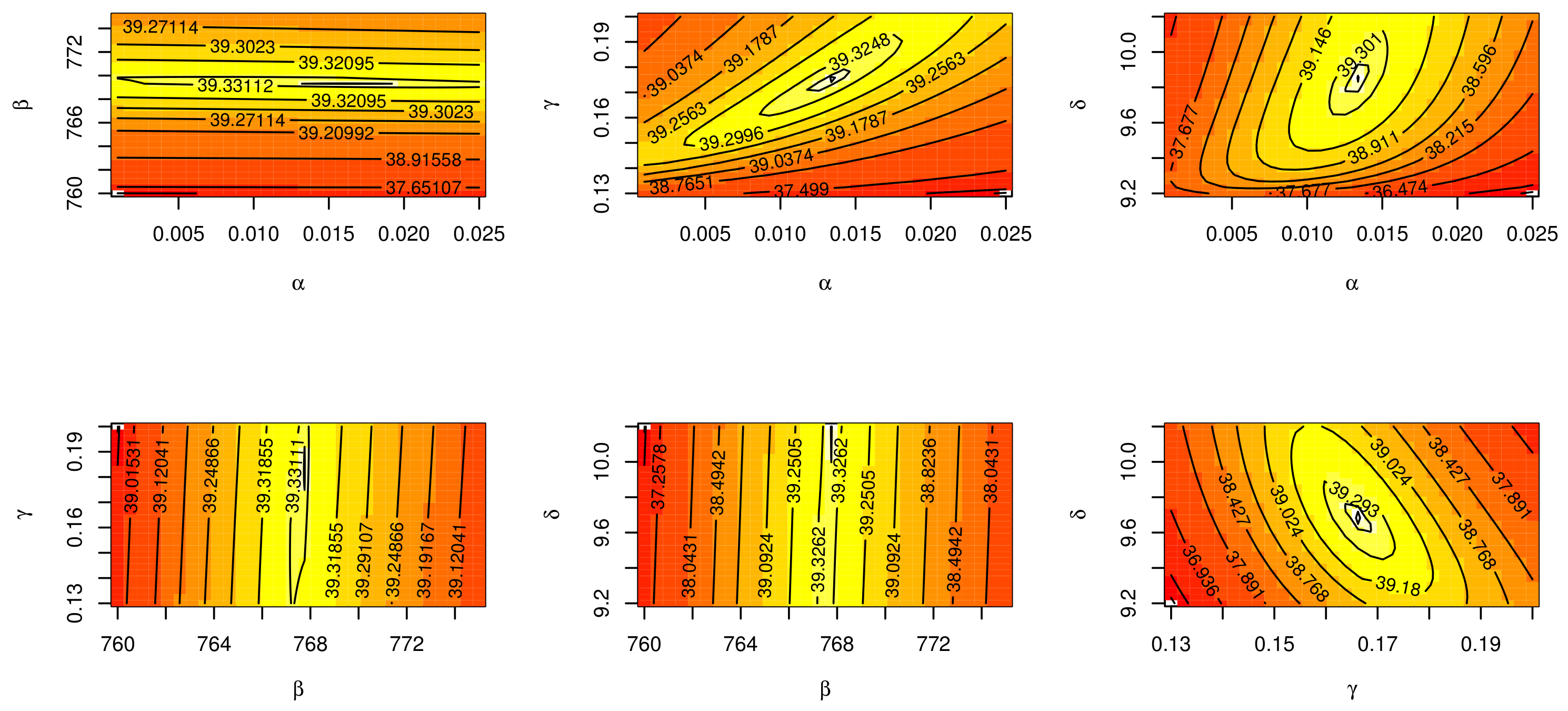
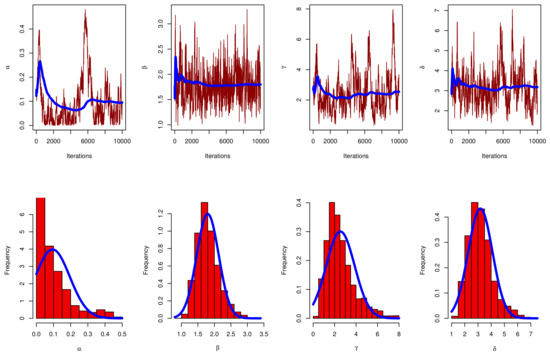
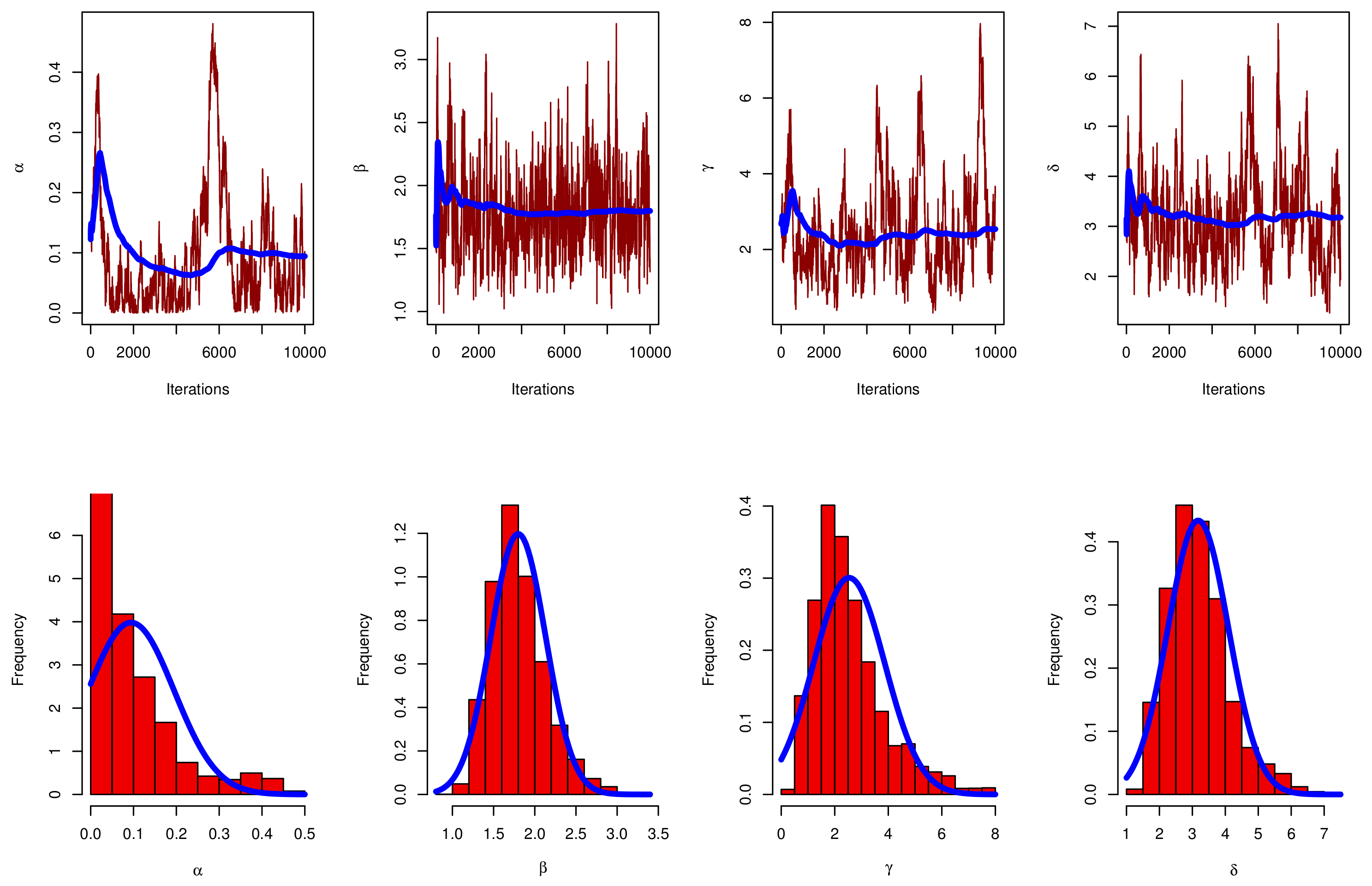
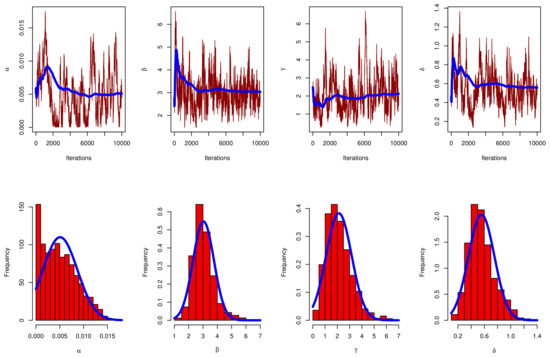
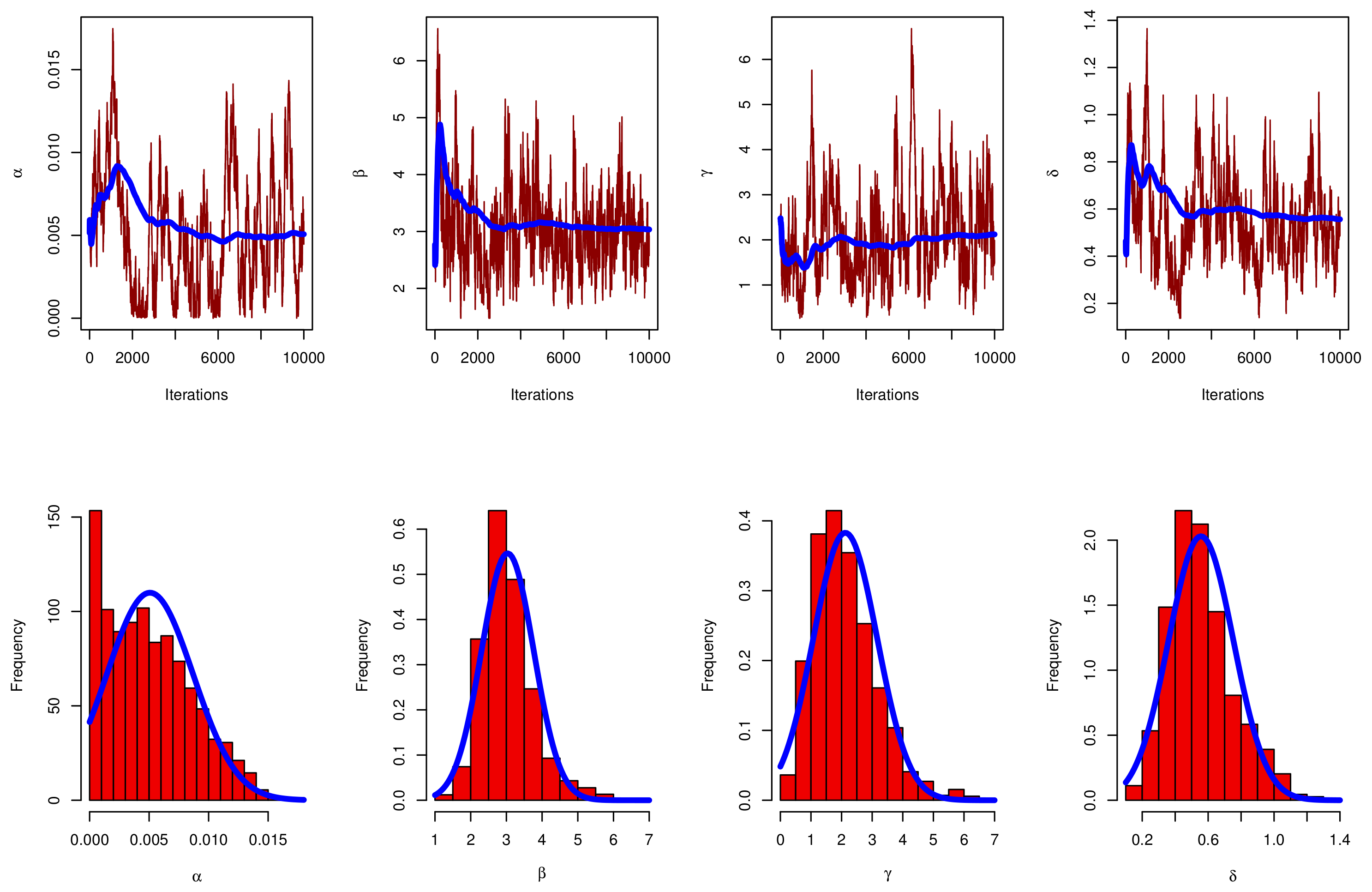
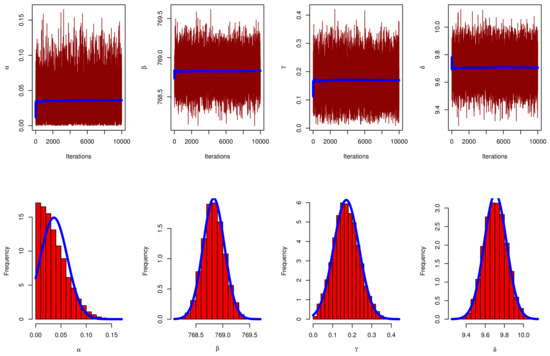
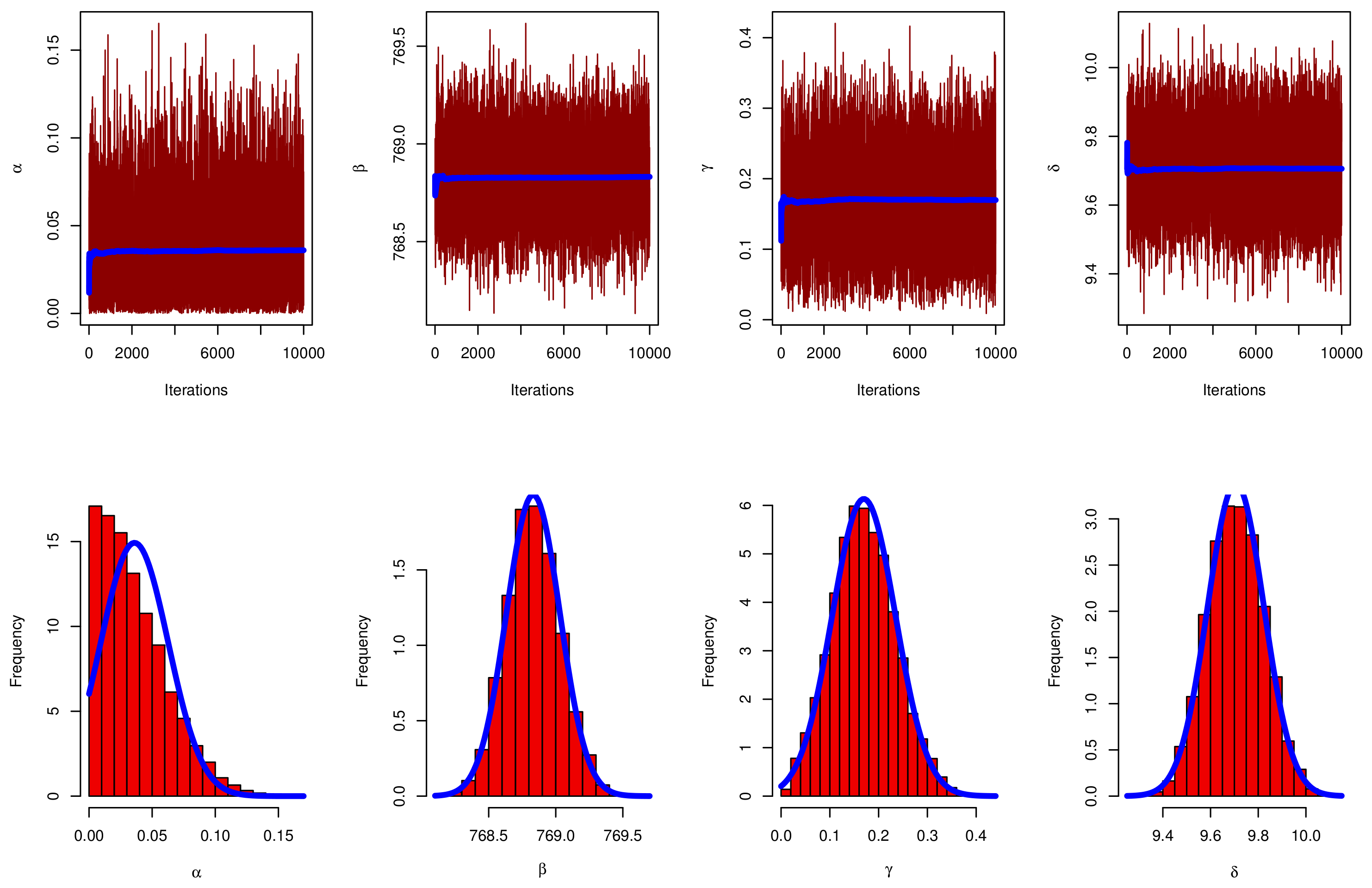
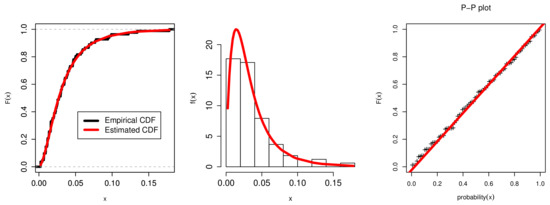
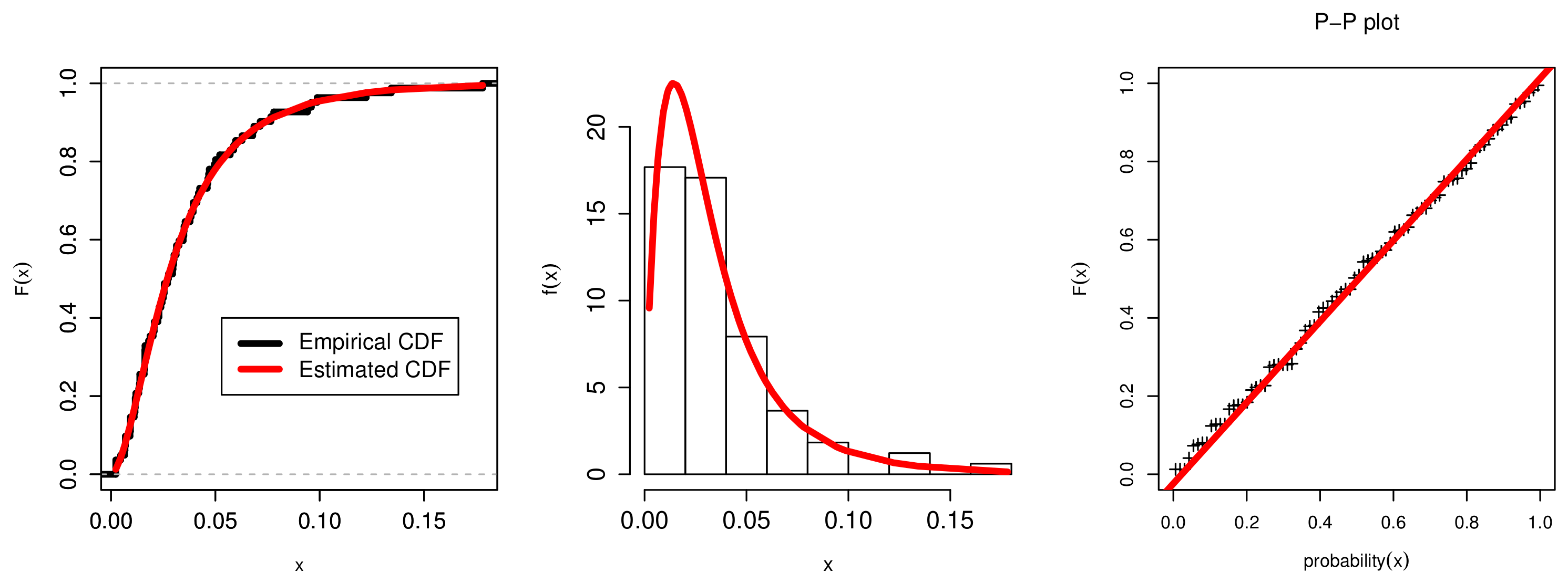
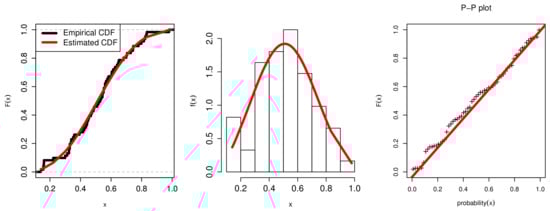
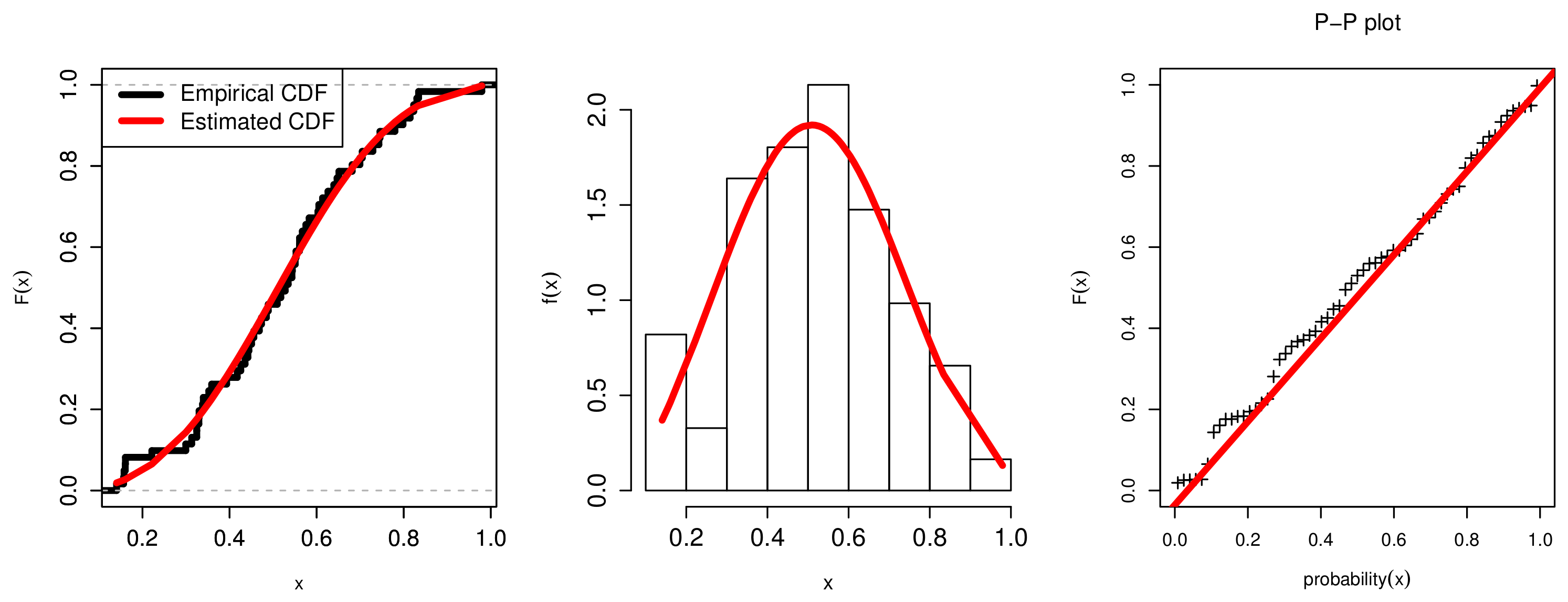
To obtain MLE, we should check that the estimates have maximum log-likelihood. Figure 4, Figure 5 and Figure 6 confirm that the estimates have maximum log-likelihood with blue points for each data set, respectively. Moreover, one of the main issues with MLEs is that it is frequently impossible to demonstrate their existence and uniqueness. To solve this issue, we suggest using the data sets shown in Figure 7, Figure 8 and Figure 9 to produce the contour plot of the log-likelihood function concerning the four parameters of the AP-Kum-MSBL-II distribution. In addition, the density and trace plots of , and were plotted and are shown in Figure 10, Figure 11 and Figure 12 using the results produced by both data sets. They provided evidence that the MCMC approach converged well. It is also evident that while the MCMC iterations of , and were symmetric and negatively skewed, was associated with positive symmetry. Figure 13, Figure 14 and Figure 15 show graphically the estimated CDF with the empirical CDF, the estimated PDF with a histogram of these data as a symmetry ship, and probability–probability (P-P) plots for the AP-Kum-MSBL-II distributions for both data sets. These figures confirm that the data sets fit the new proposed model.
Figure 4.
Profile likelihood of , and .
Figure 5.
Profile likelihood of , and for trade share data.
Figure 6.
Profile likelihood of , and for failure times data.
Figure 7.
Contour plot of , and .
Figure 8.
Contour plots of , and for trade share data.
Figure 9.
Contour plots of , and for failure times data.
Figure 10.
Symmetry and asymmetry MCMC plots of , and .
Figure 11.
MCMC plots of , and for trade share data.
Figure 12.
Symmetry and asymmetry MCMC plots of , and for failure times data.
Figure 13.
Fitting plots of , and .
Figure 14.
Fitting plots of , and for trade share data.
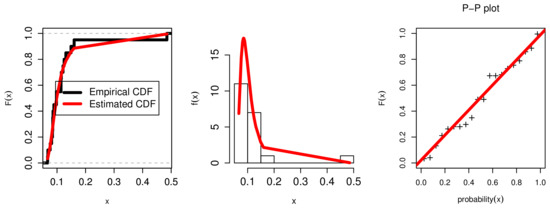
Figure 15.
Fitting plots of , and for failure times data.
7.3. The Failure Rates Application
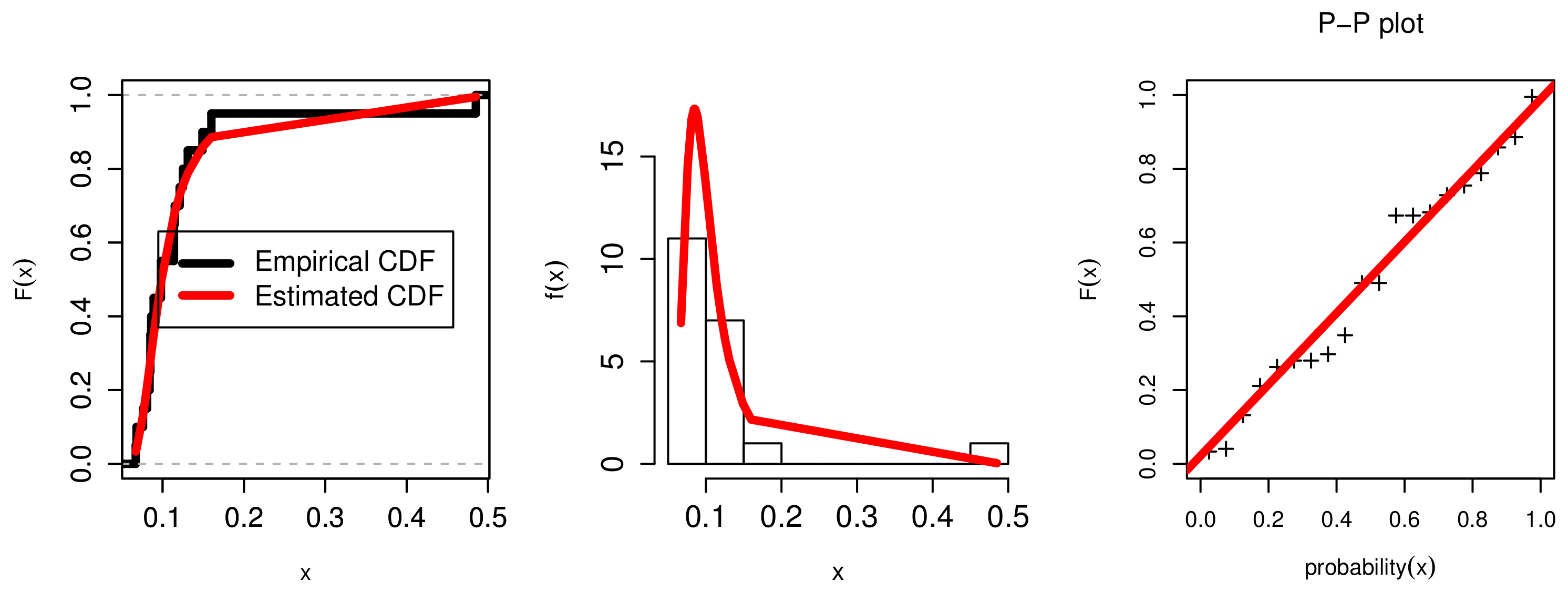
In this subsection, we present the analysis of the third real data set from an engineering area as an example of how the suggested estimators can be applied in a real-world setting. Murthy et al. [46] reported this information about the failure rates of 20 mechanical components stated as 0.067, 0.068, 0.076, 0.081, 0.084, 0.085, 0.085, 0.086, 0.089, 0.098, 0.098, 0.114, 0.114, 0.115, 0.121, 0.125, 0.131, 0.149, 0.160, 0.485.
Figure 15 shows graphically the estimated CDF with the empirical CDF, the estimated PDF with a histogram of these failure times data, and probability–probability (P-P) plots for the AP-Kum-MSBL-II distribution for the failure times data. These figures confirm that the failure times data fit the AP-Kum-MSBL-II distribution. Figure 6 and Figure 9 confirm that the estimates have maximum log-likelihood with blue points and unique values of estimates for the failure times data.
Table 7 demonstrates that the AP-Kum-MSBL-II distribution for the failure times data has the lowest values of M1, M2, M3, M4, M5, M6, and KSD, as well as the highest PVKS, among all fitted competitive models.
Table 7.
MLE for each model with different measures for failure times data.
We provide three real-world applications of COVID-19, trade share, and failure times data that show the AP-Kum-MSBL-II model is superior to all of its rivals in terms of fitting this kind of data set. All estimators obtained have the properties of the only unique estimator and have maximum points for MLE, while the Bayesian estimators had convergence properties.
8. Conclusions
As a novel expansion of the Kum-modified size-biased Lehmann type II distribution, the four-parameter AP-Kum-MSBL-II distribution has been developed. It is based on the alpha power family. The AP-Kum-MSBL-II model has more flexibility than the rival models due to the inclusion of an additional form parameter. We have covered a number of the proposed model’s statistical characteristics. The function for stress–strength reliability has also been derived. We provide three real-world applications that show the AP-Kum-MSBL-II model is better than all of its rivals in terms of fitting this kind of data set. Utilizing MLE, the AP-Kum-MSBL-II model’s parameters are estimated. Additionally, under the square error loss function, Bayesian estimation is used to estimate the parameters. The performance of the underlying model under various estimation methods is assessed using goodness-of-fit statistics. The three real data sets were applied to compare TIIPTLIE, K, Beta, UW, MOK, TLWL, KMK, and UG distributions.
Author Contributions
Conceptualization, R.S.G., A.M.M., N.A. and A.H.T.; methodology, R.S.G., A.M.M., A.H.T. and E.M.A.; software, E.M.A. and A.H.T.; validation, N.A., R.S.G., A.M.M. and A.H.T.; formal analysis, N.A., R.S.G. and E.M.A.; investigation, R.S.G., A.M.M. and A.H.T.; resources, R.S.G., N.A. and E.M.A.; data curation, R.S.G., A.M.M., N.A., E.M.A. and A.H.T.; writing—original draft preparation, R.S.G., A.M.M., A.H.T., E.M.A. and N.A.; writing—review and editing, E.M.A., R.S.G., A.M.M., N.A. and A.H.T.; funding acquisition N.A. All authors have read and agreed to the published version of the manuscript.
Funding
This research received no external funding.
Data Availability Statement
Data sets are available in this paper.
Acknowledgments
This research is supported by researcher support project number (RSPD2023R548), King Saud University, Riyadh, Saudi Arabia.
Conflicts of Interest
The authors declare no conflict of interest.
References
- Alsadat, N.; Hassan, A.S.; Elgarhy, M.; Chesneau, C.; Mohamed, R.E. An Efficient Stress–Strength Reliability Estimate of the Unit Gompertz Distribution Using Ranked Set Sampling. Symmetry 2023, 15, 1121. [Google Scholar] [CrossRef] [Scilit]
- Alghamdi, S.M.; Shrahili, M.; Hassan, A.S.; Gemeay, A.M.; Elbatal, I.; Elgarhy, M. Statistical Inference of the Half Logistic Modified Kies Exponential Model with Modeling to Engineering Data. Symmetry 2023, 15, 586. [Google Scholar] [CrossRef] [Scilit]
- Ghaderinezhad, F.; Ley, C.; Loperfido, N. Bayesian inference for skew-symmetric distributions. Symmetry 2020, 12, 491. [Google Scholar] [CrossRef] [Scilit]
- Ramadan Ahmed, T.; Tolba Ahlam, H.; El-Desouky Beih, S.A. Unit half-logistic geometric distribution and its application in insurance. Axioms 2022, 11, 676. [Google Scholar] [CrossRef] [Scilit]
- Dey, S.; Nassar, M.; Kumar, D. Alpha power transformed inverse Lindley distribution: A distribution with an upside-down bathtub-shaped hazard function. J. Comput. Appl. Math. 2019, 348, 130–145. [Google Scholar] [CrossRef] [Scilit]
- Mazucheli, J.; Menezes, A.F.B.; Ghitany, M.E. The unit-Weibull distribution and associated inference. J. Appl. Probab. Stat. 2018, 13, 1–22. [Google Scholar]
- Mazucheli, J.; Menezes, A.F.B.; Fernandes, L.B.; De Oliveira, R.P.; Ghitany, M.E. The unit-Weibull distribution as an alternative to the Kumaraswamy distribution for the modeling of quantiles conditional on covariates. J. Appl. Stat. 2020, 47, 954–974. [Google Scholar] [CrossRef] [Scilit]
- Mazucheli, J.; Menezes, A.F.B.; Chakraborty, S. On the one parameter unit-Lindley distribution and its associated regression model for proportion data. J. Appl. Stat. 2019, 46, 700–714. [Google Scholar] [CrossRef] [Scilit]
- Alzaatreh, A.; Lee, C.; Famoye, F. A new method for generating families of continuous distributions. Metron 2013, 71, 63–79. [Google Scholar] [CrossRef] [Scilit]
- Lee, C.; Famoye, F.; Alzaatreh, A.Y. Methods for generating families of univariate continuous distributions in the recent decades. Wiley Interdiscip. Rev. Comput. Stat. 2013, 5, 219–238. [Google Scholar] [CrossRef] [Scilit]
- Lemonte, A.J.; Cordeiro, G.M.; Ortega, E.M. On the additive Weibull distribution. Commun. Stat. Theory Methods 2014, 43, 2066–2080. [Google Scholar] [CrossRef] [Scilit]
- Sarhan, A.M.; Apaloo, J. Exponentiated modified Weibull extension distribution. Reliab. Eng. Syst. Saf. 2013, 112, 137–144. [Google Scholar] [CrossRef] [Scilit]
- Sarhan, A.M. A two-parameter discrete distribution with a bathtub hazard shape. Commun. Stat. Appl. Methods 2017, 24, 15–27. [Google Scholar] [CrossRef] [Scilit]
- Sarhan, A.M.; Hamilton, D.C.; Smith, B. Parameter estimation for a two-parameter bathtub-shaped lifetime distribution. Appl. Math. Model. 2012, 36, 5380–5392. [Google Scholar] [CrossRef] [Scilit]
- Tolba, A.H. Bayesian and Non-Bayesian Estimation Methods for Simulating the Parameter of the Akshaya Distribution. Comput. J. Math. Stat. Sci. 2022, 1, 13–25. [Google Scholar] [CrossRef] [Scilit]
- Tolba, A.H.; Almetwally, E.M. Bayesian and Non-Bayesian Inference for The Generalized Power Akshaya Distribution with Application in Medical. Comput. J. Math. Stat. Sci. 2023, 2, 31–51. [Google Scholar]
- Sarhan, A.M.; Smith, B.; Hamilton, D.C. Estimation of P (Y < X) for a two-parameter bathtub shaped failure rate distribution. Int. J. Stat. Probab. 2015, 4, 33–45. [Google Scholar]
- Ramadan, D.A.; Magdy, A.W. On the Alpha-Power Inverse Weibull Distribution. Int. J. Comput. Appl. 2018, 181, 6–12. [Google Scholar]
- Mahdavi, A.; Kundu, D. A new method for generating distributions with an application to an exponential distribution. Commun. Stat. Theory Methods 2017, 46, 6543–6557. [Google Scholar] [CrossRef] [Scilit]
- Dey, S.; Alzaatreh, A.; Zhang, C.; Kumar, D. A new extension of generalized exponential distribution with application to Ozone data. Ozone Sci. Eng. 2017, 39, 273–285. [Google Scholar] [CrossRef] [Scilit]
- Mahmood, Z.; Jawa, T.M.; Sayed-Ahmed, N.; Khalil, E.M.; Muse, A.H.; Tolba, A.H. An extended cosine generalized family of distributions for reliability modeling: Characteristics and applications with simulation study. Math. Probl. Eng. 2022, 2022, 3634698. [Google Scholar] [CrossRef] [Scilit]
- Muse, A.H.; Tolba, A.H.; Fayad, E.; Abu Ali, O.A.; Nagy, M.; Yusuf, M. Modelling the COVID-19 mortality rate with a new versatile modification of the log-logistic distribution. Comput. Intell. Neurosci. 2021, 2021, 8640794. [Google Scholar] [CrossRef] [Scilit] [PubMed]
- Al-Babtain, A.A.; Elbatal, I.; Chesneau, C.; Jamal, F. The transmuted Muth generated class of distributions with applications. Symmetry 2020, 12, 1677. [Google Scholar] [CrossRef] [Scilit]
- Jodra, P.; Gomez, H.W.; Jimenez-Gamero, M.D.; Alba-Fernandez, M.V. The power Muth distribution. Math. Model. Anal. 2017, 22, 186–201. [Google Scholar] [CrossRef] [Scilit]
- Alanzi, A.R.A.; Rafique, M.Q.; Tahir, M.H.; Jamal, F.; Hussain, M.A.; Sami, W. A novel Muth generalized family of distributions: Properties and applications to quality control. AIMS Math. 2023, 8, 6559–6580. [Google Scholar] [CrossRef] [Scilit]
- Irshad, M.R.; Maya, R.; Krishna, A. Exponentiated power Muth distribution and associated inference. J. Indian Soc. Probab. Stat. 2021, 22, 265–302. [Google Scholar] [CrossRef] [Scilit]
- Chesneau, C.; Agiwal, V. Statistical theory and practice of the inverse power Muth distribution. J. Comput. Math. Data Sci. 2021, 1, 100004. [Google Scholar] [CrossRef] [Scilit]
- Almarashi, A.M.; Jamal, F.; Chesneau, C.; Elgarhy, M. A new truncated muth generated family of distributions with applications. Complexity 2021, 2021, 1211526. [Google Scholar] [CrossRef] [Scilit]
- Jäntschi, L. Detecting extreme values with order statistics in samples from continuous distributions. Mathematics 2020, 8, 216. [Google Scholar] [CrossRef] [Scilit]
- Krishna, A.; Maya, R.; Chesneau, C.; Irshad, M.R. The Unit Teissier Distribution and Its Applications. Math. Comput. Appl. 2022, 27, 12. [Google Scholar] [CrossRef] [Scilit]
- Nassar, M.; Alzaatreh, A.; Mead, M.; Abo-Kasem, O. Alpha power Weibull distribution: Properties and applications. Commun. Stat. Theory Methods 2017, 46, 10236–10252. [Google Scholar] [CrossRef] [Scilit]
- Hassan, A.S.; Mohamed, R.E.; Elgarhy, M.; Fayomi, A. Alpha power transformed extended exponential distribution: Properties and applications. J. Nonlinear Sci. Appl. 2018, 12, 62–67. [Google Scholar] [CrossRef] [Scilit]
- Lehmann, E.L. The Power of Rank Tests. Ann. Math. Stat. 1953, 24, 23–43. [Google Scholar] [CrossRef] [Scilit]
- Balogun, O.S.; Iqbal, M.Z.; Arshad, M.Z.; Afify, A.Z.; Oguntunde, P.E. A new generalization of Lehmann type-II distribution: Theory, simulation, and applications to survival and failure rate data. Sci. Afr. 2021, 12, e00790. [Google Scholar] [CrossRef] [Scilit]
- Zhuang, L.; Xu, A.; Wang, X.-L. A prognostic driven predictive maintenance framework based on Bayesian deep learning. Reliab. Eng. Syst. Saf. 2023, 234, 109181. [Google Scholar] [CrossRef] [Scilit]
- Luo, C.; Shen, L.; Xu, A. Modelling and estimation of system reliability under dynamic operating environments and lifetime ordering constraints. Reliab. Eng. Syst. Saf. 2022, 218, 108136. [Google Scholar] [CrossRef] [Scilit]
- Xu, A.; Zhou, S.; Tang, Y. A unified model for system reliability evaluation under dynamic operating conditions. IEEE Trans. Reliab. 2019, 70, 65–72. [Google Scholar] [CrossRef] [Scilit]
- Bernardo, J.M.; Smith, A.F.M. Bayesian Theory; Wiley: New York, NY, USA, 1994; Volume 49. [Google Scholar]
- Al-Babtain, A.A.; Elbatal, I.; Almetwally, E.M. Bayesian and Non-Bayesian Reliability Estimation of Stress-Strength Model for Power-Modified Lindley Distribution. J. Comput. Intell. Neurosci. 2022, 2022, 1154705. [Google Scholar] [CrossRef] [Scilit]
- Yousef, M.M.; Almetwally, E.M. Bayesian Inference for the Parameters of Exponentiated Chen Distribution Based on Hybrid Censoring. Pak. J. Statist. 2022, 38, 145–164. [Google Scholar]
- Calabria, R.; Pulcini, G.S. An engineering approach to Bayes estimation for the Weibull distribution. Microelectron. Reliab. 1994, 34, 789–802. [Google Scholar] [CrossRef] [Scilit]
- Abu El Azm, W.S.; Almetwally, E.M.; Naji AL-Aziz, S.; El-Bagoury, A.A.A.H.; Alharbi, R.; Abo-Kasem, O.E. A new transmuted generalized Lomax distribution: Properties and applications to COVID-19 data. Comput. Intell. Neurosci. 2021, 2021, 5918511. [Google Scholar] [CrossRef] [Scilit] [PubMed]
- Anderson, D.R.; Burnham, K.P.; White, G.C. Comparison of Akaike information criterion and consistent Akaike information criterion for model selection and statistical inference from capture-recapture studies. J. Appl. Stat. 1998, 25, 263–282. [Google Scholar] [CrossRef] [Scilit]
- Bierens, H.J. Information Criteria and Model Selection; Penn State University: State College, PA, USA, 2004. [Google Scholar]
- Stock, J.H.; Watson, M.W. Introduction to Econometrics; Addison Wesley: Boston, MA, USA, 2003; Volume 104. [Google Scholar]
- Murthy, D.P.; Xie, M.; Jiang, R. Weibull Models; John Wiley & Sons: Hoboken, NJ, USA, 2004. [Google Scholar]


Disclaimer/Publisher’s Note: The statements, opinions and data contained in all publications are solely those of the individual author(s) and contributor(s) and not of MDPI and/or the editor(s). MDPI and/or the editor(s) disclaim responsibility for any injury to people or property resulting from any ideas, methods, instructions or products referred to in the content. |
© 2023 by the authors. Licensee MDPI, Basel, Switzerland. This article is an open access article distributed under the terms and conditions of the Creative Commons Attribution (CC BY) license (https://creativecommons.org/licenses/by/4.0/).