Abstract
We investigate Collins asymmetry in the hyperon produced semi-inclusive deep inelastic scattering (SIDIS) process based on the kinematical region of Electron-ion collider in China (EicC) and Electron–ion collider (EIC) within the transverse momentum dependence (TMD) factorization framework at next-to-leading-logarithmic order. The asymmetry is contributed by the convolution of the target proton transversity distribution function and the Collins function of the final-state hyperon. The TMD evolution effect of the corresponding parton distribution functions (PDFs) and fragmentation functions (FFs) is considered with the help of parametrization of the non-perturbative Sudakov form factors for the proton PDFs and fragmentation functions. We apply the parametrization of the collinear proton transversity distribution function and the model results of Collins function from the diquark spectator model as the inputs of the TMD evolution to numerically calculate Collins asymmetry in produced SIDIS process at the kinematical configurations of EIC and EicC. It can be shown that the asymmetry is significant and can be measured at EIC and EicC. The flavor dependence of transversity distribution functions could be further constrained by studying the hyperon produced SIDIS process in the future to improve our understanding of the spin structure within nucleons.
1. Introduction
The EMC experimental measurement in 1987 showed that the spin fraction carried by the internal quarks of a proton contributed only about 30% to the proton spin in the deep inelastic scattering (DIS) process through muons scattering the polarized protons. However, the quark model predicted the proton spin should be all contributed from its constituent quarks, which caused the so-called proton spin crisis [1,2]. Understanding the spin structure of nucleons has become one of the important goals of high-energy spin physics. Spin-dependent asymmetries in various processes in high energy physics, such as the semi-inclusive deep inelastic scattering (SIDIS) process, Drell–Yan process, and electron-positron annihilation process have been useful tools to extract the internal spin structure of nucleons.
Transversity, denoted by , is one of the fundamental quark distribution functions to describe the nucleon spin structure, which describes the asymmetric distribution of the transversely polarized quarks in a transversely polarized nucleon: . Different from the other two well-known unpolarized and helicity distribution functions, transversity is difficult to measure experimentally due to its chiral-odd property. In order to measure transversity, the chirality must be flipped twice [3], so one needs either two hadrons in the initial state (hadron-hadron collisions, Drell–Yan process), or one hadron in the initial state and one in the final state (semi-inclusive leptoproduction, SIDIS process), and at least one of these two hadrons must be transversely polarized. To ensure chiral conservation, it needs to be coupled to another chiral odd function in high-energy scattering processes. In Drell–Yan process, the transversity can be obtained by studying the double transverse spin asymmetry, with the other chiral-odd distribution being the anti-quark transversity. In the double hadron-produced SIDIS process considering the collinear factorization framework, the chiral odd fragmentation function of the double hadron can serve as the probe to extract quark transversity distribution function [4]. In addition, the next leading twist collinear fragmentation function in the SIDIS process can also be used as a probe to extract quark transversity distribution function [5,6].
Under the framework of TMD factorization [7,8,9,10] in SIDIS process, the chiral-odd Collins function is served as the probe to obtain transversity, with the corresponding observable being Collins asymmetry with the modulation of [11], where and are the azimuthal angles for the transverse momentum of the outgoing hadron and the transverse spin of the nucleon target, respectively. The Collins asymmetry has been measured by the HERMES Collaboration [12,13,14,15], COMPASS Collaboration [16], and JLab HALL A Collaboration [17,18] in SIDIS process. The experimental data measured from the SIDIS process can be applied to simultaneously extract the valence quark transversity distribution function and Collins function [19,20,21,22,23] together with the data from annihilation process. Although significant progress has been made, the information for the sea quark transversity distribution function is almost unknown due to the lack of experimental data. The phenomenological study in Kaon produced SIDIS process has been proven to be an opportunity to obtain information on the sea quark transversity through Collins asymmetry [24]. Using the spectator model, the authors of [6] estimated the twist-3 fragmentation function for the hyperon and predicted the asymmetry, the results showed that the asymmetry was quite sizable at the kinematical region of the planned electron–ion colliders (EICs), the proposed EIC in US and the EIC in China (EicC), and COMPASS. It provided a method to access the sea quark distribution function as well as the flavor dependence through the -produced SIDIS process. The unprecedented luminosity of the EICs will have a strong impact on the measurements for the SIDIS process. With the spin-1/2 hyperon produced in the final state of the SIDIS process, the sensitivity of the parton flavor in the proton will be much improved due to the constituent quarks, which can be an ideal probe to disentangle the different valence, sea quarks to study the flavor dependence of the TMD PDFs in the target proton. In addition, it will be possible to study the dependence of the hadronization process on polarization degrees of freedom via fragmentation into polarized hyperons. The upcoming spin measurements at the Spin Physics Detector (SPD) at the Nuclotron-based Ion Collider fAcility (NICA) with longitudinally and transversely polarized protons and deuterons will also have bright perspectives to make a unique contribution to extract the TMD PDFs and access the information of the flavor dependence in order to deepen our understanding of the spin structure of the nucleons [25].
The purpose of this work is to evaluate the Collins asymmetry in produced SIDIS process at EIC and EicC, in which the transversely polarized proton target will be available. Since high luminosity can be realized at the EICs, the sea quark constituent as well as the flavor dependence of the nucleon may be explored with unprecedented accuracy. The theoretical tool adopted in this study will be widely applied TMD factorization formalism [7,8,9,10], which has been proven valid in SIDIS [7,8,26,27,28,29], annihilation [8,30,31], Drell–Yan [8,32], and W/Z production in hadron collision process [8,9,33] at small transverse momentum region. In the TMD factorization framework, the differential cross section can be written as the convolution of the well-defined TMD PDFs and/or FFs and the hard scattering factors at a small transverse momentum region. The energy dependence of the TMD PDFs and FFs is encoded in the TMD evolution effects, which are included in the exponential form of the so-called Sudakov-like form factor [8,9,27,34]. The Sudakov-like form factor can be further separated into the perturbatively calculable part and the nonperturbative part, the latter can not be calculated through perturbative theory and may be obtained by parameterizing experimental data. We will estimate the numerical results for the Collins asymmetry in produced SIDIS process performing the TMD evolution effects of the corresponding TMD PDFs and FFs.
The rest of the paper is organized as follows. In Section 2, we provide a detailed review of the Collins asymmetry in the SIDIS process within the TMD factorization formalism. Particularly, we present the procedure for the TMD evolution of the unpolarized and polarized TMDs involved in our calculations. In Section 3, we perform the numerical estimate of the Collins asymmetry of produced SIDIS process at the kinematical region of EIC and EicC. We summarize the paper and discuss the results in Section 4.
2. Formalism of the Collins Asymmetry in SIDIS Process
In this section, we will set up the detail formalism for Collins asymmetry with modulation in hyperon produced SIDIS process with an unpolarized electron beam scattering off a transversely polarized proton target,
ℓ and represent the four-momenta of the incoming and outgoing electrons, respectively; P is the four-momentum of the target proton, the up-arrow in the superscript represents that the proton is transversely polarized, stands for the four-momentum of the final-state hadron, which is the hyperon in this work. The four-momentum of the exchanged virtual photon is and is the usual definition of the energy scale in the studied process. We denote the masses of the proton target and the final-state hadron by M and , respectively. We adopt the following Lorentz invariants to express differential cross section as well as the physical observables
where S is the center of mass energy square, x is the Bjorken variable, y denotes the lepton (quark) energy momentum transferring fraction, and z represents the longitudinal momentum fraction of the final fragmented hadron to the parent quark.
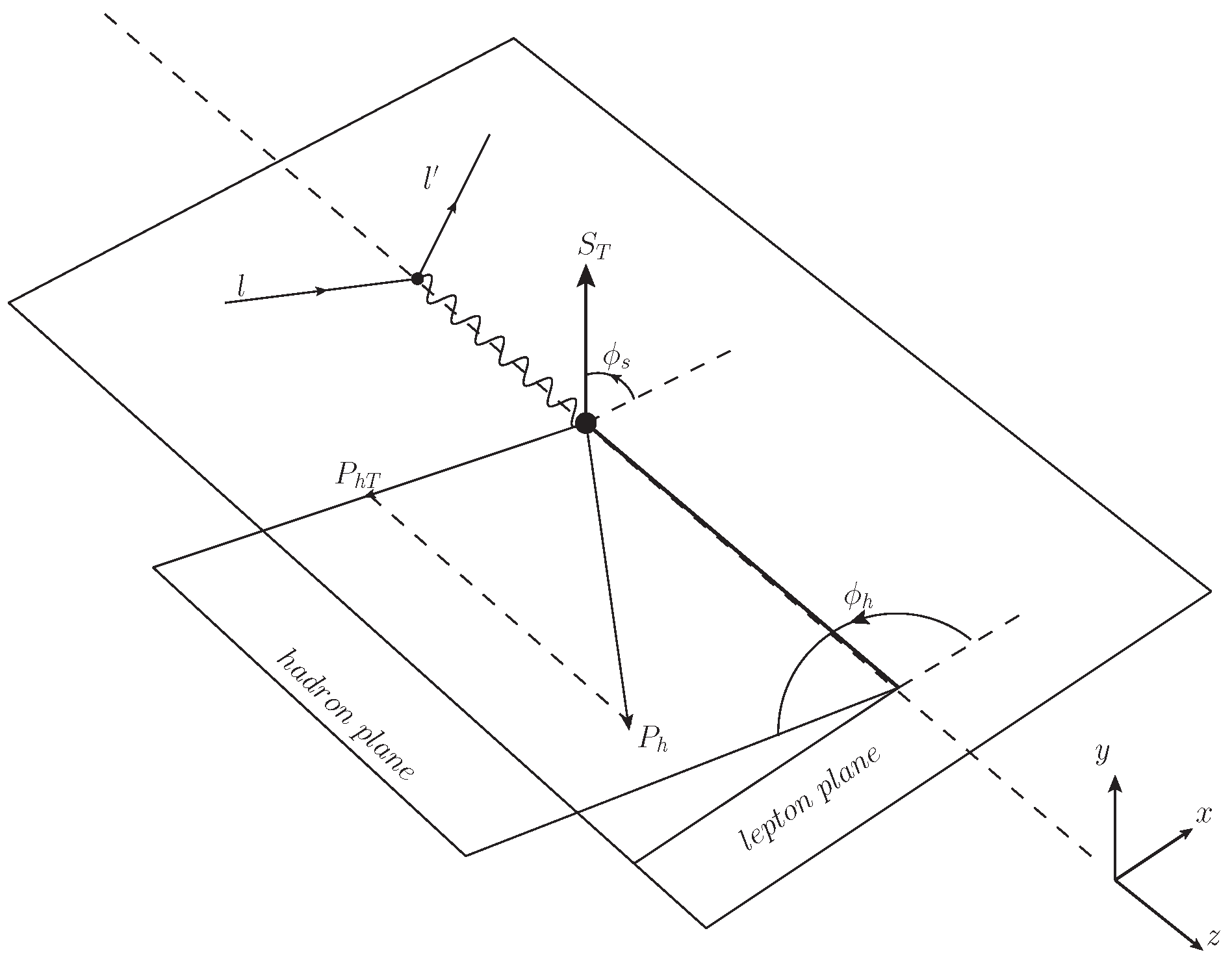
The reference frame in the studied SIDIS process is shown in Figure 1. According to Trento conventions [35], the z-axis is defined by the three-momentum direction of the exchanged virtual photon. The azimuthal angle of the outgoing hadron () is defined by
with and being the transverse components of ℓ and respect to z-axis. The tensor is
with . The azimuthal angle of the proton spin vector S is defined by replacing by S in Equation (3), and is the transverse component of S similar to the definition of .
Figure 1.
The reference frame in SIDIS process.
Assuming one photon exchange, the model-independent differential cross section can be written as a set of structure functions with the general form as [36]
where is the fine-structure constant. The three subscripts in the structure functions stand for the polarization of the lepton beam (X), the target proton (Y) and the virtual photon (Z) with U being unpolarized, T being transversely polarized. Thus, stands for the unpolarized structure function, is the transverse spin-dependent structure function contributed by the convolution of the transversity distribution function of the proton target and the Collins fragmentation function of the final state .
The transverse single-spin-dependent Collins asymmetry is defined as the ratio of the difference between the spin-dependent differential cross-sections and the unpolarized differential cross-section
where is the depolarizing factor. The structure functions in Equation (6) can be expressed as the convolution of the corresponding PDFs and FFs [36]
Here, is the unpolarized TMD distribution function and the is the transversity distribution function. Both the TMD distribution functions and depend on the Bjorken variable x and the transverse momentum of the quark within the target proton. is the unpolarized fragmentation function and is the Collins function. Both the and depend on the longitudinal momentum fraction z and the transverse momentum of the final-state quark. is the unit vector along . The notation represents the convolution among the transverse momenta
where is an arbitrary function of and . Substituting Equation (9) into Equation (7), the unpolarized structure function can be expanded as
where represents the transverse momentum of the final state hadrons with respect to the fragmentation quark, which has the relation with is the final-state quark transverse momentum respect to z axis. The -function Fourier Transformation was performed in the fourth line. The TMD distribution functions and TMD fragmentation functions in the b space can be obtained by performing a Fourier Transformation from momentum space to b space
hereafter, the term with a tilde denotes it is in the b space. Similarly, by substituting Equation (9) into Equation (8), we can obtain expansions for the spin-dependent structure function as
Similarly, the transversity distribution function and Collins function in b space can also be obtained from momentum space to b space by Fourier Transformation as
Therefore, the Collins asymmetry can be rewritten as
One should note that the energy dependence of the TMD structure functions was not encoded in the above formalism, which will be studied in detail in the following subsections.
2.1. TMD Evolution Effects
In this subsection, we will set up the basic formalism of the TMD evolution effects for TMD distribution functions and fragmentation functions, which is mainly to solve the energy dependence of the TMD distribution functions , and fragmentation functions , . Since the complicated convolution among the transverse momenta can be transformed into a simple product after performing the Fourier Transformation, it is convenient to solve the energy dependence in b space.
Specifically, there are two different energy dependencies and of the TMD distribution function and the fragmentation function in b space according to TMD factorization, where F and D are the general notation of the distribution functions and fragmentation functions, respectively. is the renormalization energy scale related to the corresponding collinear PDFs/FFs, and is the energy scale serving as a cutoff to regularize the light-cone singularity in the operator definition of the TMDs. and dependencies are encoded in different TMD evolution equations. The energy evolution for the dependence of the TMD distribution functions (fragmentation functions) is encoded in the Collins-Soper (CS) Equation [8,9,37]
while the dependence is given by the renormalization group equation
with being the running strong coupling at the energy scale , being the CS evolution kernel, and and being the anomalous dimensions. Hereafter, we will assume , TMD distribution function and the fragmentation function can be written as and for simplicity.
Solving these TMD evolution equations, one can obtain the solution of the energy dependence for TMD parton distribution functions and the fragmentation functions, of which the solution has the general form as
where and are the factors related to the hard scattering and depend on the factorization schemes, and S is the Sudakov-like form factor. Equations (21) and (22) show that the energy evolution of TMD distribution functions and TMD fragmentation functions from an initial energy to another energy Q is encoded in the Sudakov-like form factor S by the exponential form .
By performing the Reverse Fourier Transformation of the TMDs in b space, the TMDs in momentum space can be obtained, thus it is of great importance to study the b space behavior of the TMDs. In the small b region (), the b dependence of TMDs is perturbative and can be calculated by perturbative QCD. However, the dependence in large b region becomes nonperturbative, since the operators are separated by a large distance. It is convenient to include a nonperturbative Sudakov-like form factor to take into account the TMD evolution effect in the large b region, and the form factor which is usually given in a parametrization form and must be obtained by analyzing experimental data, given the present lack of non-perturbative calculations. To combine the perturbative information at a small b region with the nonperturbative part at a large b region, a matching procedure should be introduced with a parameter serving as the boundary between the two regions. A b-dependent function is defined to have the property in small b region and in large b region
which was introduced in the original CSS prescription [9]. The prescription also allows for a smooth transition from perturbative to nonperturbative regions and avoids the Landau pole singularity in . The typical value of is chosen around 1.5 GeV to guarantee that is always in the perturbative region. With the constraint of , we can calculate TMDs within a small b region.
In the small b region, the TMDs can be expressed as the convolutions of the perturbatively calculable hard coefficients and the corresponding collinear counterparts at fixed energy , which could be the collinear PDFs/FFs or the multiparton correlation functions [7,38]
where and and the Euler constant [7], the ⊗ stands for the convolution in the momentum fraction x,
where C coefficients in the formula have different values in different processes, and their specific values will be given in the subsequent calculation. In addition, the sum runs over all parton flavors. Now we can combine all the above information to get the expression for the TMD distribution function and the fragmentation function in b space as
The Sudakov-like form factor S can be separated into the perturbatively calculable part and the nonperturbative part
When calculating the Sudakov-like form factor of the perturbation part , which has a general form and can be expanded as the series of [29,39,40,41,42].
We take to and to [9,27,29,40,43,44],
For the nonperturbative Sudakov-like form factor , it cannot be obtained from perturbation calculation, and is usually extracted from the experimental data. Inspired by Refs. [43,45], a widely used parametrization of for TMD distribution functions or fragmentation functions was proposed [38,39,43,45,46,47]
where the initial energy is , and the factor in front of comes from the fact that only one hadron is involved for the parametrization of . The parameter in Equation (37) depends on the type of TMDs, which can be regarded as the width of the intrinsic transverse momentum for the relevant TMDs at the initial energy scale [27,44,48]. Assuming a Gaussian form for the dependence on the transverse momentum, one can obtain
where and represent the relevant averaged intrinsic transverse momenta squared for TMD distribution functions and TMD fragmentation functions at the initial scale , respectively. [39] has the same form in all forms of TMDs.
We assume that the Gaussian form of in Equation (37) satisfies the evolution of the TMD distribution functions and the fragmentation functions for producing the hyperon from one initial energy to another energy Q, so we can obtain the nonperturbative Sudakov form factor for the PDF and FF in the production of as
Combining all together, the scale-dependent TMD distribution functions and the fragmentation functions in b space as functions of , b, and Q can be rewritten as
2.2. The Solution of the Unpolarized Structure Function
In this part, we will solve the denominator of Collins asymmetry in detail, which is the unpolarized structure function in Equation (7). Since we have preliminarily expanded the unpolarized structure function in Equation (10), we will directly follow Equation (10) and start to solve further. We can divide Equation (10) into three parts to solve the problem: the weighted Bessel function part, distribution function part and the fragmentation function part . The weighted Bessel function can be obtained as
According to Equations (41) and (42), the unpolarized distribution function and unpolarized fragmentation function can be expanded as
where Sudakov-like form factor is expressed in Equations (31), (39) and (40). The hard scattering coefficient and can be set equal to 1. In addition, the C coefficient in Equations (44) and (45) can be expressed as [49]
where represents the strong coupling coefficient, and the expansion at next-to-leading order can be written as follows
In Equation (50) is running energy scale and , GeV. In addition, in Equations (48) and (49) the splitting functions and have the general form
where , , and the subscript symbol + denotes the following prescription
Combining the weighted Bessel function part, distribution function part and fragmentation function part we can get the denominator of Collins asymmetry as
where the nonperturbative Sudakov-like form factor is the combination of the unpolarized distribution function part and the unpolarized fragmentation function part
where and are obtained from Equation (38), so , .
2.3. The Solution of the Transverse Spin-Dependent Structure Function
In this part, we will further solve the numerator part of the Collins asymmetry on the basis of Equation (13), which is the transverse spin-dependent structure function . Using the general expression of the distribution function in Equation (41) and the fragmentation function in Equation (42), the proton transversity distribution function and the Collins function in b space can be written as
where the hard scattering coefficient and can be set equal to 1, represents the collinear transversity distribution function and relates to the first- moments of Collins function . The Sudakov-like form factor is expressed in Equations (31), (39) and (40). In addition, the C coefficient in Equations (56) and (57) can be expressed as [49]
in Equation (59) the can be expressed as
Combining all together, the numerator part of the Collins asymmetry can be rewritten as
where the nonperturbative Sudakov-like form factor is the combination of the transversity distribution function part and the Collins function part
where . In addition, the is taken from the parametrization in Ref. [22]
where GeV.
3. Numerical Estimate
In this section, we will present the numerical calculation results for Collins asymmetry in hyperon produced SIDIS process at the kinematical region of EIC and EicC.
The counterpart collinear distribution functions and fragmentation functions are the necessary inputs to obtain the numerical results of Collins asymmetry. For the proton collinear unpolarized distribution function , we apply the parametrization CT10 from [50]. For the collinear unpolarized fragmentation function of hyperon, we adopt the model results from the diquark spectator model [51]
The values of the free parameters in Equation (64) are taken from Ref. [51]. Since the model result is obtained at the initial energy of 0.23 GeV, to make it applicable to a more general energy range, we use the QCDNUM evolution package [52] to evolve the unpolarized fragmentation function from the initial energy of 0.23 GeV to another energy scale.
For the collinear transversity distribution function, we adopt the standard parameterization at the initial scale from Ref. [49] for the valence quark
where is the helicity distribution function, for which we adopt the DSSV parametrization from Ref. [53]. The free parameters are taken from Table I of Ref. [49]. However, there is no information on the sea quark transversity distribution function, the high-precision quantitative measurement of which is an important goal of the planned electron–ion colliders. We assume the transversity of the sea quark at the initial energy scale has the form of
where to ensure the positivity bound of transversity, we choose . To perform the DGLAP evolution of the transversity distribution function from the initial scale to a more general energy range, the evolution package QCDNUM [52] is applied and the evolution kernel is customed to include the transversity evolution effect.
For the collinear counterpart of Collins function , which is related to the first- momentum of the Collins function as
it can be obtained from the model calculation of the Collins function. The model calculation of the Collins function is performed in Ref. [54] using the diquark spectator model,
In addition, in Equations (37) and (38), the free parameter and universal parameter contain information about the evolution of TMDs and are the key parameters that determine the evolution of TMDs from one initial energy to another Q. Here we applied the data given in the Ref. [55] for . For the universal parameter in the nonperturbative Sudakov-like form factor, the specific value is given in Ref. [43].
The kinematical region that is available at EIC is chosen as follows [56]
As for the EicC, the following kinematical cuts are adopted
where is invariant mass of the virtual photon-nucleon system. Since TMD factorization is proved to be valid to describe the physical observables in the region , is chosen to guarantee the validity of TMD factorization. Combining Equations (6), (54) and (61) and the kinematical regions of EIC and EicC, we can calculate the single-spin dependent Collins asymmetry of hyperon produced SIDIS process within the EIC and EicC kinematical range.
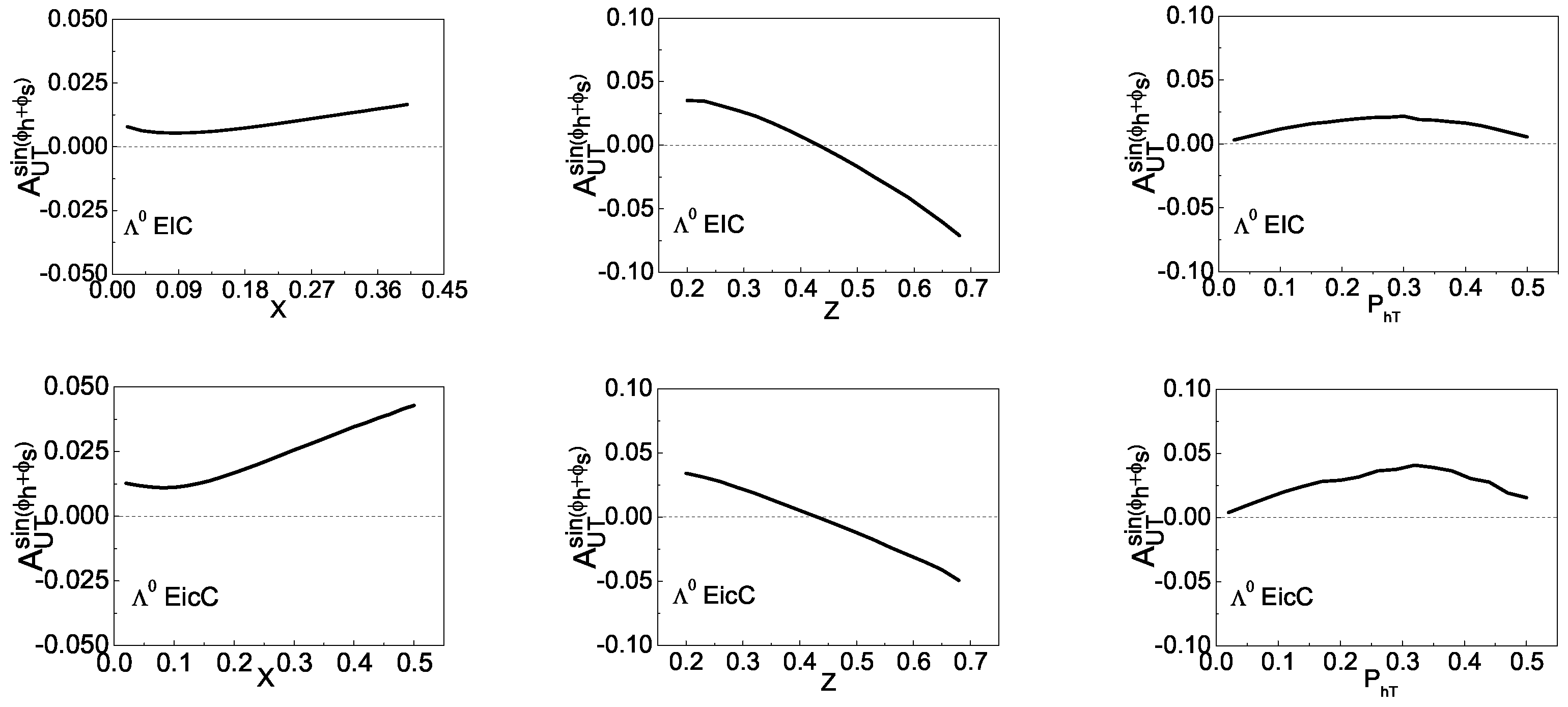
The results are shown in Figure 2, the upper and lower panels in the figure depict the numerical results of Collins asymmetry in the hyperon produced SIDIS process at the kinematical regions of EIC and EicC, respectively. The left panels, middle panels and right panels denote the Collins asymmetry as the functions of x, z, and , respectively. As can be seen from Figure 2, one can obtain that Collins asymmetry in the hyperon produced SIDIS process is sizable in all cases at both EIC and EicC kinematical regions, which provides an ideal tool to obtain the flavor dependence of transversity distribution function with the knowledge of Collins function for . The Collins asymmetries as the functions of x, z, and show similar tendencies as EicC and EIC. Both x and dependent Collins asymmetries in hyperon produced SIDIS process at the kinematics region of EIC and EicC are positive. The Collins asymmetry decreases with x at small x region and increases along x at large x region. For z dependent Collins asymmetry in hyperon produced SIDIS process at the EIC and EicC kinematical region, Collins asymmetry gradually decreases with z with a node around , since there is a node at the same point for the Collins function [54]. The Collins asymmetry as the function of increases with at small region and decreases along at large region, this is due to the fact that the Y term that we do not consider in the TMD factorization theorem dominates in the larger region. While, the magnitude of Collins asymmetry at the configuration of EicC is larger than that at EIC, which may be due to the fact that the constituent quarks of hyperon are and s quarks, and the configuration of EicC is more sensitive to the sea quark distributions. Therefore, the high energy, high luminosity electron–ion colliders in the future can provide a unique opportunity to extract the information of TMD distribution functions and fragmentation functions as well as their flavor dependence through produced SIDIS process.
Figure 2.
The Collins asymmetry in semi-inclusive hyperon production SIDIS process at the kinematics of EIC and EicC as functions of x (left panels), z (middle panels), and (right panels).
4. Conclusions
In this work, we applied the TMD factorization at next-to-leading-logarithmic order to study the single transverse-spin dependent Collins asymmetry with modulation in hyperon produced SIDIS process at the kinematical configurations of EIC and EicC. The asymmetry contributes to the convolution of the proton transversity distribution function and the Collins fragmentation function for the hyperon. By introducing the Sudakov-like form factor, we considered the TMD evolution effect of the distribution functions and fragmentation functions including the Sudakov-like form factor. For the nonperturbative Sudakov-like form factor associated with the TMDs, we adopted the traditional Gaussian form. For the collinear transversity distribution function of the target proton, we adopted the parametrization for which the TMD evolution effect is considered, as for the Collins function, we applied the results from the diquark spectator model. Our results show that Collins asymmetries in hyperon produced SIDIS process are sizeable at the kinematics configurations of both EicC and EIC, which can be measured experimentally. The measurement of the Collins asymmetry of semi-inclusive production at future electron–ion colliders can provide useful constraints on the sea quark transversity distribution function as well as the flavor dependence of the TMD transversity distribution function. We also note that the Collins function applied in our calculations comes from the diquark spectators model, there is still no parametric extraction of hyperon Collins function, which indicates the importance of future precise measurement data to extract the parameterization of the Collins function combining with annihilation data. We emphasize the importance of the measurement for transverse spin-dependent asymmetry in the produced SIDIS process in the future EICs and SPD in NICA, which will shed light on the flavor dependence of the TMD transversity as well as the parametrization of the TMD Collins function for hyperon in order to deepen our understanding of the spin structure of nucleons.
Author Contributions
Writing-original draft, S.Y.; Software, Q.X.; Conceptualization, Y.Z.; Supervision, X.W. All authors have read and agreed to the published version of the manuscript.
Funding
This work is partially supported by the NSFC (China) grants 11905187, 12205255. X.W. is supported by the China Postdoctoral Science Foundation under Grant No. 2018M640680.
Data Availability Statement
Not applicable.
Conflicts of Interest
The authors declare no conflict of interest.
Abbreviations
The following abbreviations are used in this manuscript:
| CS | Collins-Soper |
| CSS | Collins-Soper-Sterman |
| DGLAP | Dokshitzer-Gribov-Lipatov-Altarelli-Parisi |
| DIS | Deeply inelastic scattering |
| EIC | Electron–ion collider |
| EicC | Electron–ion collider in China |
| FF | Fragmentation functions |
| NICA | Nuclotron-based Ion Collider fAcility |
| Parton Distribution Function | |
| QCD | Quantum Chromodynamics |
| SIDIS | Semi-inclusive deep inelastic scattering |
| SPD | Spin Physics Detector |
| TMD | Transverse Momentum Dependent |
References
- Ashman; Badelek, J.; Baum, B.; Beaufays, G.; Bee, J.; Benchouk, C.P.; Bird, C.; Brown, I.G.; Caputo, S.C.; Cheung, M.C.; et al. A Measurement of the Spin Asymmetry and Determination of the Structure Function g(1) in Deep Inelastic Muon-Proton Scattering. Phys. Lett. B 1988, 206, 364. [Google Scholar] [CrossRef]
- Ashman, J.; Badelek, B.; Baum, G.; Beaufays, J.; Bee, C.P.; Benchouk, C.; Bird, I.G.; Brown, S.C.; Caputo, M.C.; Cheung, H.W.K.; et al. An Investigation of the Spin Structure of the Proton in Deep Inelastic Scattering of Polarized Muons on Polarized Protons. Nucl. Phys. B 1989, 328, 1. [Google Scholar] [CrossRef]
- Jaffe, R.L.; Ji, X. Chiral odd parton distributions and polarized Drell–Yan. Phys. Rev. Lett. 1991, 67, 552. [Google Scholar] [CrossRef] [PubMed]
- Bacchetta, A.; Courtoy, A.; Radici, M. First glances at the transversity parton distribution through dihadron fragmentation functions. Phys. Rev. Lett. 2011, 107, 012001. [Google Scholar] [CrossRef] [PubMed]
- Wang, X.; Lu, Z. Predicting the sinϕS transverse single-spin asymmetry of pion production at an electron–ion collider. Phys. Rev. D 2016, 93, 074009. [Google Scholar] [CrossRef]
- Yang, Y.; Wang, X.; Lu, Z. Predicting the sinϕS Single-Spin-Asymmetry of Λ Production off transversely polarized nucleon in SIDIS. Phys. Rev. D 2021, 103, 114011. [Google Scholar] [CrossRef]
- Collins, J.C.; Soper, D.E. Back-To-Back Jets in QCD. Nucl. Phys. B 1981, 193, 381, Erratum in Nucl. Phys. B 1983, 213, 543. [Google Scholar] [CrossRef]
- Collins, J. Foundations of Perturbative QCD; Cambridge University Press: Cambridge, UK, 2013; Volume 32, ISBN 978-1-107-64525-7. [Google Scholar]
- Collins, J.; Soper, D.E.; Sterman, G. Transverse Momentum Distribution in Drell–Yan Pair and W and Z Boson Production. Nucl. Phys. B 1985, 250, 199. [Google Scholar] [CrossRef]
- Ji, X.; Ma, J.-P.; Yuan, F. QCD factorization for spin-dependent cross sections in DIS and Drell–Yan processes at low transverse momentum. Phys. Lett. B 2004, 597, 299. [Google Scholar] [CrossRef]
- Collins, J. Fragmentation of transversely polarized quarks probed in transverse momentum distributions. Nucl. Phys. B 1993, 396, 161. [Google Scholar] [CrossRef]
- Airapetian, A.; Akopov, N.; Akopov, Z.; Amarian, M.; Andrus, A.; Aschenauer, E.C.; Augustyniak, W.; Avakian, R.; Avetissian, A.; Bacchetta, A.; et al. Single-spin asymmetries in semi-inclusive deep-inelastic scattering on a transversely polarized hydrogen target. Phys. Rev. Lett. 2005, 94, 012002. [Google Scholar] [CrossRef] [PubMed]
- Airapetian, A.; Akopov, N.; Akopov, Z.; Aschenauer, E.C.; Augustyniak, W.; Avetissian, A.; Avetisyan, E.; Bacchetta, A.; Ball, B.; Bianchi, N.; et al. Observation of the Naive-T-odd Sivers Effect in Deep-Inelastic Scattering. Phys. Rev. Lett. 2009, 103, 152002. [Google Scholar] [CrossRef] [PubMed]
- Airapetian, A.; Akopov, N.; Akopov, Z.; Aschenauer, E.; Augustyniak, W.; Avakian, R.; Avetissian, A.; Avetisyan, E.; Bacchetta, A.; Belostotski, S.; et al. Effects of transversity in deep-inelastic scattering by polarized protons. Phys. Lett. B 2010, 693, 11. [Google Scholar] [CrossRef]
- Airapetian, A.; Akopov, N.; Akopov, Z.; Aschenauer, E.C.; Augustyniak, W.; Avakian, R.; Avetissian, A.; Avetisyan, E.; Belostotski, S.; Blok, H.P.; et al. Azimuthal distributions of charged hadrons, pions, and kaons produced in deep-inelastic scattering off unpolarized protons and deuterons. Phys. Rev. D 2013, 87, 012010. [Google Scholar] [CrossRef]
- Adolph, C.; Alekseev, M.G.; Alexakhin, V.Y.; Alexandrov, Y.; Alexeev, G.D.; Amoroso, A.; Antonov, A.A.; Austregesilo, A.; Badełek, B.; Balestra, F.; et al. Experimental investigation of transverse spin asymmetries in muon-p SIDIS processes: Collins asymmetries. Phys. Lett. B 2012, 717, 376. [Google Scholar]
- Qian, X.; Allada, K.; Dutta, C.; Huang, J.; Katich, J.; Wang, Y.; Zhang, Y.; Aniol, K.; Ann, J.R.M.; Averett, T.; et al. Single Spin Asymmetries in Charged Pion Production from Semi-Inclusive Deep Inelastic Scattering on a Transversely Polarized 3He Target. Phys. Rev. Lett. 2011, 107, 072003. [Google Scholar] [CrossRef]
- Zhao, Y.X.; Wang, Y.; Allada, K.; Aniol, K.; Annand, J.R.M.; Averett, T.; Benmokhtar, F.; Bertozzi, W.; Bradshaw, P.C.; Bosted, P.; et al. Single spin asymmetries in charged kaon production from semi-inclusive deep inelastic scattering on a transversely polarized 3He target. Phys. Rev. C 2014, 90, 055201. [Google Scholar] [CrossRef]
- Anselmino, M.; Boglione, M.; D’Alesio, U.; Kotzinian, A.; Murgia, F.; Prokudin, A.; Türk, C. Transversity and Collins functions from SIDIS and e+ e- data. Phys. Rev. D 2007, 75, 054032. [Google Scholar] [CrossRef]
- Anselmino, M.; Boglione, M.; D’Alesio, U.; Kotzinian, A.; Murgia, F.; Prokudin, A.; Melis, S. Update on transversity and Collins functions from SIDIS and e+ e- data. Nucl. Phys. B Proc. Suppl. 2009, 191, 98. [Google Scholar] [CrossRef]
- Anselmino, M.; Boglione, M.; D’Alesio, U.; Melis, S.; Murgia, F.; Prokudin, A. Simultaneous extraction of transversity and Collins functions from new SIDIS and e+e- data. Phys. Rev. D 2013, 87, 094019. [Google Scholar] [CrossRef]
- Anselmino, M.; Boglione, M.; D’Alesio, U.; Hernandez, J.G.; Melis, S.; Murgia, F.; Prokudin, A. Collins functions for pions from SIDIS and new e+e− data: A first glance at their transverse momentum dependence. Phys. Rev. D 2015, 92, 114023. [Google Scholar] [CrossRef]
- Anselmino, M.; Boglione, M.; D’Alesio, U.; Hernandez, J.G.; Melis, S.; Murgia, F.; Prokudin, A. Extracting the Kaon Collins function from e+e− hadron pair production data. Phys. Rev. D 2016, 93, 034025. [Google Scholar] [CrossRef]
- Xue, S.-C.; Wang, X.; Li, D.-M.; Lu, Z. The Collins asymmetry in electroproduction of Kaon at the electron–ion colliders within TMD factorization. Eur. Phys. J. C 2020, 80, 685. [Google Scholar] [CrossRef]
- Abazov, V.M.; Abramov, V.; Afanasyev, L.G.; Akhunzyanov, R.R.; Akindinov, A.V.; Akopov, N.; Alekseev, I.G.; Aleshko, A.M.; Alexakhin, V.Y.; Alexeev, G.D.; et al. Conceptual design of the Spin Physics Detector. arXiv 2021, arXiv:2102.00442. [Google Scholar]
- Ji, X.; Ma, J.-P.; Yuan, F. QCD factorization for semi-inclusive deep-inelastic scattering at low transverse momentum. Phys. Rev. D 2005, 71, 034005. [Google Scholar] [CrossRef]
- Aybat, S.M.; Rogers, T.C. TMD Parton Distribution and Fragmentation Functions with QCD Evolution. Phys. Rev. D 2011, 83, 114042. [Google Scholar] [CrossRef]
- Collins, J.; Rogers, T. Equality of Two Definitions for Transverse Momentum Dependent Parton Distribution Functions. Phys. Rev. D 2013, 87, 034018. [Google Scholar] [CrossRef]
- Echevarría, M.G.; Idilbi, A.; Schäfer, A.; Scimemi, I. Model-Independent Evolution of Transverse Momentum Dependent Distribution Functions (TMDs) at NNLL. Eur. Phys. J. C 2013, 73, 2636. [Google Scholar] [CrossRef]
- Pitonyak, D.; Schlegel, M.; Metz, A. Polarized hadron pair production from electron-positron annihilation. Phys. Rev. D 2014, 89, 054032. [Google Scholar] [CrossRef]
- Boer, D. Angular dependences in inclusive two-hadron production at BELLE. Nucl. Phys. B 2009, 806, 23. [Google Scholar]
- Arnold, S.; Metz, A.; Schlegel, M. Dilepton production from polarized hadron hadron collisions. Phys. Rev. D 2009, 79, 034005. [Google Scholar] [CrossRef]
- Lambertsen, M.; Vogelsang, W. Drell–Yan lepton angular distributions in perturbative QCD. Phys. Rev. D 2016, 93, 114013. [Google Scholar] [CrossRef]
- Collins, J.; Hautmann, F. Infrared divergences and nonlightlike eikonal lines in Sudakov processes. Phys. Lett. B 2000, 472, 129. [Google Scholar] [CrossRef]
- Bacchetta, A.; D’Alesio, U.; Diehl, M.; Miller, C.A. Single-spin asymmetries: The Trento conventions. Phys. Rev. D 2004, 70, 117504. [Google Scholar] [CrossRef]
- Bacchetta, A.; Diehl, M.; Goeke, K.; Metz, A.; Mulders, P.J.; Schlegel, M. Semi-inclusive deep inelastic scattering at small transverse momentum. J. High Energy Phys. 2007, 02, 093. [Google Scholar] [CrossRef]
- Idilbi, A.; Ji, X.; Ma, J.-P.; Yuan, F. Collins-Soper equation for the energy evolution of transverse-momentum and spin dependent parton distributions. Phys. Rev. D 2004, 70, 074021. [Google Scholar] [CrossRef]
- Bacchetta, A.; Prokudin, A. Evolution of the helicity and transversity Transverse-Momentum-Dependent parton distributions. Nucl. Phys. B 2013, 875, 536. [Google Scholar] [CrossRef]
- Echevarria, M.G.; Idilbi, A.; Kang, Z.-B.; Vitev, I. QCD Evolution of the Sivers Asymmetry. Phys. Rev. D 2014, 89, 074013. [Google Scholar] [CrossRef]
- Kang, Z.-B.; Xiao, B.-W.; Yuan, F. QCD Resummation for Single Spin Asymmetries. Phys. Rev. Lett. 2011, 107, 152002. [Google Scholar] [CrossRef]
- Aybat, S.M.; Collins, J.C.; Qiu, J.W.; Rogers, T.C. The QCD Evolution of the Sivers Function. Phys. Rev. D 2012, 85, 034043. [Google Scholar] [CrossRef]
- Echevarria, M.G.; Idilbi, A.; Scimemi, I. Unified treatment of the QCD evolution of all (un-)polarized transverse momentum dependent functions: Collins function as a study case. Phys. Rev. D 2014, 90, 014003. [Google Scholar] [CrossRef]
- Landry, F.; Brock, R.; Nadolsky, P.M.; Yuan, C.P. Tevatron Run-1 Z boson data and Collins-Soper-Sterman resummation formalism. Phys. Rev. D 2003, 67, 073016. [Google Scholar] [CrossRef]
- Qiu, J.; Zhang, X. QCD prediction for heavy boson transverse momentum distributions. Phys. Rev. Lett. 2001, 86, 2724. [Google Scholar] [CrossRef] [PubMed]
- Konychev, A.V.; Nadolsky, P.M. Universality of the Collins-Soper-Sterman nonperturbative function in gauge boson production. Phys. Lett. B 2006, 633, 710. [Google Scholar] [CrossRef]
- Davies, C.; Webber, B.; Stirling, W. Drell–Yan Cross-Sections at Small Transverse Momentum. Nucl. Phys. B 1984, 1, I.95. [Google Scholar] [CrossRef]
- Ellis, R.K.; Ross, D.; Veseli, S. Vector boson production in hadronic collisions. Nucl. Phys. B 1997, 503, 309. [Google Scholar] [CrossRef]
- Anselmino, M.; Boglione, M.; Melis, S. A Strategy towards the extraction of the Sivers function with TMD evolution. Phys. Rev. D 2012, 86, 014028. [Google Scholar] [CrossRef]
- Kang, Z.-B.; Prokudin, A.; Sun, P.; Yuan, F. Extraction of Quark Transversity Distribution and Collins Fragmentation Functions with QCD Evolution. Phys. Rev. D 2016, 93, 014009. [Google Scholar] [CrossRef]
- Lai, H.-L.; Guzzi, M.; Huston, J.; Li, Z.; Nadolsky, P.M.; Pumplin, J.; Yuan, C.P. New parton distributions for collider physics. Phys. Rev. D 2010, 82, 074024. [Google Scholar] [CrossRef]
- Yang, Y.; Lu, Z.; Schmidt, I. Transverse polarization of the Λ hyperon from unpolarized quark fragmentation in the diquark model. Phys. Rev. D 2017, 96, 034010. [Google Scholar] [CrossRef]
- Botje, M. QCDNUM: Fast QCD Evolution and Convolution. Comput. Phys. Commun. 2011, 182, 490. [Google Scholar] [CrossRef]
- de Florian, D.; Sassot, R.; Stratmann, M.; Vogelsang, W. Extraction of Spin-Dependent Parton Densities and Their Uncertainties. Phys. Rev. D 2009, 80, 034030. [Google Scholar] [CrossRef]
- Wang, X.; Yang, Y.; Lu, Z. Double Collins effect in e+e−→ΛX process in a diquark spectator model. Phys.Rev. D 2018, 97, 114015. [Google Scholar] [CrossRef]
- Anselmino, M.; Boglione, M.; Hernandez, J.O.G.; Melis, S.; Prokudin, A. Unpolarised Transverse Momentum Dependent Distribution and Fragmentation Functions from SIDIS Multiplicities. J. High Energy Phys. 2014, 4, 5. [Google Scholar] [CrossRef]
- Accardi, A.; Albacete, J.L.; Anselmino, M.; Armesto, N.; Aschenauer, E.C.; Bacchetta, A.; Boer, D.; Brooks, W.K.; Burton, T.; Chang, N.-B.; et al. Electron–ion collider: The Next QCD Frontier. Eur. Phys. J. A 2016, 52, 268. [Google Scholar] [CrossRef]
Disclaimer/Publisher’s Note: The statements, opinions and data contained in all publications are solely those of the individual author(s) and contributor(s) and not of MDPI and/or the editor(s). MDPI and/or the editor(s) disclaim responsibility for any injury to people or property resulting from any ideas, methods, instructions or products referred to in the content. |
© 2023 by the authors. Licensee MDPI, Basel, Switzerland. This article is an open access article distributed under the terms and conditions of the Creative Commons Attribution (CC BY) license (https://creativecommons.org/licenses/by/4.0/).